
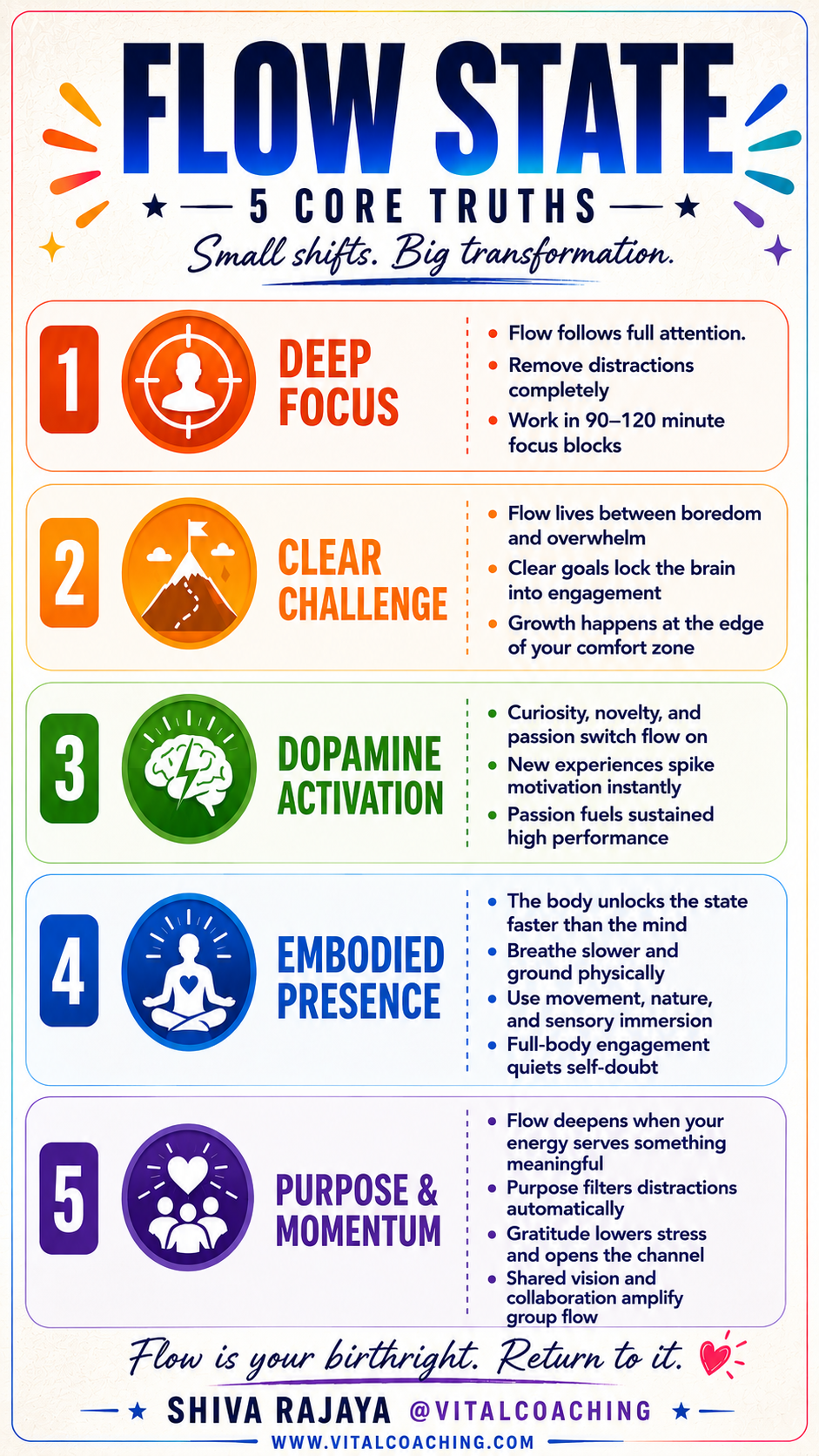
- Flow is the optimal state of human performance.
It’s when you feel your best and do your best work — at the same time. - Flow is not rare. It’s built into your biology.
Every human brain is hardwired for it. It’s a feature, not a gift. - Flow follows focus.
The state can only appear when your full attention is locked on the task at hand. - You can’t force flow. But you can trigger it.
There are specific conditions that reliably open the door to flow. - Flow has been studied for over 150 years.
It’s not a trend. The science goes back to Harvard in the late 1800s. - Mihaly Csikszentmihalyi named it flow for a reason.
The experience literally feels like being carried by a current — effortless and continuous. - Flow is universal.
It shows up in chess players, sheep herders, surgeons, and teenagers — across every culture on Earth. - In flow, your sense of self disappears.
The inner critic goes quiet and you stop second-guessing yourself. - Time distorts in flow.
Hours feel like minutes. Minutes feel like hours. The clock stops mattering. - Flow produces measurable neurochemicals.
Dopamine, norepinephrine, serotonin, anandamide, and endorphins all fire at once. - Your brain literally changes in flow.
The prefrontal cortex — the seat of self-doubt — partially shuts down. - This shutdown is called transient hypofrontality.
It’s why flow feels so free — the brakes of self-consciousness are released. - Your brainwaves slow down in flow.
You shift from fast beta waves into the alpha-theta borderline — the zone of creative insight. - Flow makes you up to 500% more productive.
McKinsey research showed executives in flow were five times more effective than normal. - Flow accelerates learning by up to 490%.
DARPA research found that people in flow learn new skills dramatically faster. - Flow boosts problem solving by 430%.
University of Sydney research confirmed that flow supercharges creative thinking. - Creativity extends for days after a flow state.
Harvard research showed heightened creativity lasting up to three days after flow. - Complete concentration is the master trigger.
Without it, there is no flow. Period. - 90 to 120 minutes of uninterrupted focus is the sweet spot.
This matches the brain’s natural awake-and-alert cycle. - Distractions are flow killers.
No multitasking. No notifications. No exceptions. - Clear goals tell your brain where to put its energy.
When you know exactly what you’re doing, focus locks in automatically. - The word “clear” matters more than the word “goals.”
Clarity removes mental wandering. That’s what opens the door to flow. - Immediate feedback keeps you inside the state.
When you know instantly how you’re doing, the mind stays present. - Autonomy is a flow trigger.
When you control your time and choices, your whole being engages. - Top performers protect their autonomy fiercely.
Many have turned down money and prestige to keep it. Flow is worth more. - The challenge-skills ratio is flow’s most important trigger.
The task must stretch you — but not break you. - Too easy means boredom. Too hard means anxiety.
Flow lives in the sweet spot right between the two. - Uncertainty pulls you into the present.
When you don’t know what comes next, your brain pays maximum attention. - Curiosity is an automatic attention machine.
When something makes you genuinely curious, focus happens without effort. - Passion is what happens when curiosities combine.
It’s the sustained flame that keeps you returning to hard problems with fresh eyes. - Passion fuels dopamine. Dopamine fuels flow.
It’s a direct neurochemical chain reaction. - Purpose aims your passion at something bigger than yourself.
That’s when serotonin and oxytocin join the cocktail — and flow deepens further. - Purpose filters the signal from the noise.
When you know why you’re doing something, everything irrelevant falls away. - Novelty spikes dopamine instantly.
Something new — even a small change in routine — can flip the switch toward flow. - Complexity tricks the conscious mind into letting go.
When the brain can’t hold it all at once, it hands control to the faster subconscious. - The subconscious processes faster and more efficiently than conscious thought.
Flow is what it feels like when the subconscious takes the wheel. - Awe is the entry point to complexity-driven flow.
Standing before something vast — a forest, an ocean, a mountain — drops you in. - Deep embodiment means using multiple senses at once.
Athletes access flow easily because sport forces full-body attention by design. - Creativity is pattern recognition plus risk taking.
Both generate dopamine. Both open the door to flow. - Gratitude is a neurobiological lever, not just a soft skill.
It activates dopamine and serotonin while lowering the cognitive load that blocks flow. - Gratitude calms the amygdala and reduces cortisol.
Fear and anxiety close the flow channel. Gratitude keeps it open. - A daily gratitude practice makes you more flow-prone over time.
Research confirms it. Morning gratitude before deep work is especially powerful. - Group flow is real — and it’s electric.
When a team enters flow together, collaboration amplifies individual performance. - Group flow requires shared goals, shared focus, and shared risk.
Everyone must be in the game equally — no passengers. - Blending egos is essential for group flow.
No one dominates. Collective humility creates the space where team genius emerges. - “Always say yes” is a group flow principle.
Ideas build on ideas. Momentum compounds. Saying no breaks the current. - Close listening is as important as speaking.
Presence — not performance — is what keeps group flow alive. - Flow is what makes life feel worth living.
Decades of research show that people with the most flow score highest on wellbeing. - Peak performance is not reserved for the exceptional.
It is a biological birthright available to every human being on the planet. - You were designed for this. Flow is not something you chase — it’s something you return to. Build the triggers, protect the conditions, and the state that unlocks your best self will find you. 🔥
