
What This Article Covers
- The fundamental split between macro boundaries and micro boundaries
- The three macro categories every couple falls into
- Why micro boundaries create more conflict than they solve
- The qualities that make any model actually work
- The 80/20 rule, and what happens when it breaks
- How to have this conversation early, and revisit it over time
Every Relationship Runs On Two Kinds Of Boundaries
Macro boundaries. Micro boundaries.
Understanding the difference between them might be the single most useful thing you do for your relationship.
Macro Boundaries Are The Big Lines
They’re the large categories that define what’s generally okay and what isn’t.
Decide these once, clearly, and most of the smaller conflicts stop needing a conversation at all.
The Three Macro Categories
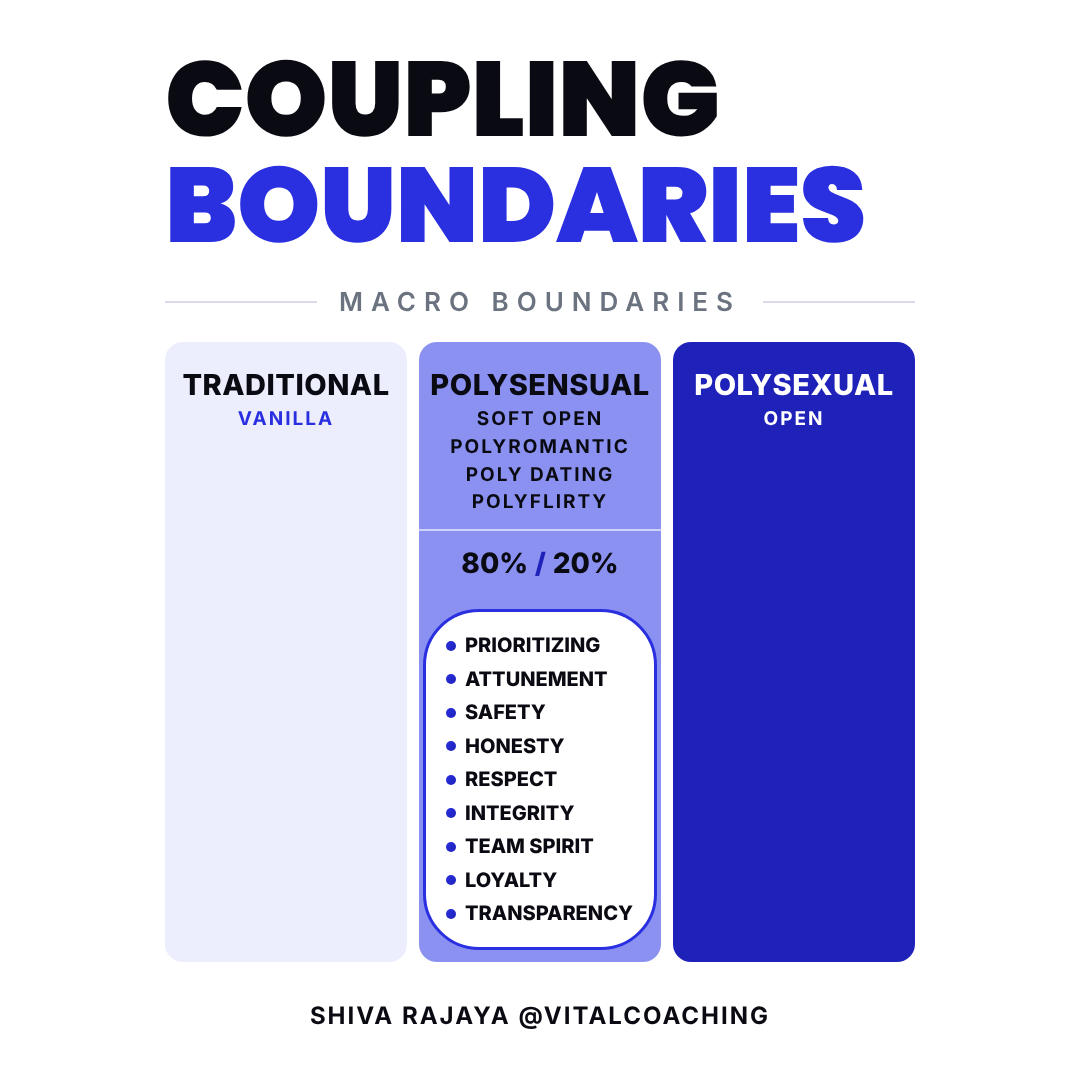
- Traditional (Vanilla) — no romantic or sensual connection outside the relationship, at all.
- Polysensual (Soft Open) — no sex with others, but some sensual or romantic energy is allowed.
- Polysexual (Open) — sexual connection with other people is genuinely on the table.
Traditional: The Vanilla Model
This is what most couples around the world practice, in many cultures and countries.
No sex outside the relationship. No sensuality outside it either. No close friendships with the opposite gender. No contact with exes.
Soft Open: The Middle Category
Here, sex stays exclusive to your partner. But some sensual or romantic energy with others is allowed.
A hug with a friend. A contact dance. A message to an ex, with nothing being built. None of it threatens the primary relationship.
What Soft Open Actually Includes
- Contact dance — physical closeness through dance, without it being sexual.
- A hug with a friend — affection that doesn’t build toward anything.
- Light contact with an ex — a message here and there, nothing active.
- Poly flirting — a flirty conversation that goes nowhere further.
The Line Soft Open Doesn’t Cross
No genital touch. No intercourse. No nakedness with someone else.
The moment any of that happens, you’ve moved into polysexual territory — a different category entirely.
Polysexual: The Fully Open Model
This is what most people mean when they say “open relationship.” Sex with other partners is genuinely part of the agreement, for both people.
Why Choosing A Macro Category Simplifies Everything
Pick one. Agree on it with your partner. That single decision removes an enormous amount of ongoing negotiation from your relationship.
Most Relationship Fights Trace Back To This
In a lot of relationships, a huge share of the fighting is jealousy and control: who you were with, who texted you, who that friend really is.
Most of that tension exists because the macro boundary was never actually agreed on.
Micro Boundaries Are Where It Gets Complicated
Once the big category is chosen, couples often try to negotiate dozens of smaller rules inside it.
This is where things get genuinely hard to navigate.
The Micro Distinctions Couples Try To Negotiate
- Public or private — does the setting change whether it’s okay?
- One-on-one or group — does being alone together change anything?
- Past connection or new one — is an old friend different from a new one?
- Ex or friend — does history make it safer, or more charged?
- Level of sensuality — a simple dance versus one with real erotic energy.
- Low energy or high energy — a quick hug versus a long, charged one.
- Frequency — occasional contact versus regular, ongoing contact.
Each of these feels important in the moment.
Each of these is also almost impossible to pin down with a clean rule.
Why Micro Boundaries Create So Much Processing
A connection “being okay” because it’s with an old friend, and “not okay” because it’s someone new, sounds logical.
But it’s actually a personal, intuitive read — not a rule anyone else can apply consistently. That’s why trying to negotiate every micro case eats enormous amounts of time and energy.
The Real Question To Ask When You’re Triggered
Not “did this feel uncomfortable?”
Did your partner cross the macro boundary you actually agreed on — yes or no?
Flirting Is Not Crossing The Macro Boundary
A flirty conversation at a social event isn’t sex. It isn’t even close.
If the macro boundary wasn’t crossed, the discomfort is information — not proof that something went wrong.
Rate The Trigger Before You React
Ask yourself: on a scale of 0 to 10, how intense is this?
A 1 or a 2 is usually not worth a confrontation. It’s worth noticing — not necessarily worth a fight.
The Cost Of Rigid Walls
Choosing a fully traditional, zero-tolerance model isn’t wrong. But it comes with a real risk.
The risk of asphyxiating your partner is high — especially if every ordinary conversation gets treated as a threat.
What Happens When You Lock Your Partner In A Box
- Interrogating every conversation they have.
- Questioning their integrity over nothing.
- Asking who texted, who called, what they wanted.
Over time, this can make a partner feel trapped rather than safe.
Choose A Lane, Then Commit To It
A rigid model can genuinely work — for a season, or for a lifetime. The point isn’t which model is “right.”
The point is choosing one on purpose, together, instead of discovering it fight by fight.
The Qualities That Make Any Model Actually Work
- Prioritizing — your partner comes first, in practice, not just in words.
- Attunement — you notice and respond to how they’re actually feeling.
- Safety — they can be honest with you without fear.
- Honesty — nothing hidden, nothing softened into a half-truth.
- Respect — their feelings matter, even when you disagree.
- Integrity — you do what you said you’d do.
- Team spirit — you’re still playing for the same side.
- Loyalty — your partner’s wellbeing comes before the thrill of something new.
- Transparency — they’re never left guessing.
Without these, no model works — traditional or open. With these, almost any model becomes workable.
The 80/20 Rule
Around 80% of your romantic potential goes to your primary partner. The remaining 20% can go to the outer circle.
That ratio is what keeps a soft-open or polysensual dynamic sustainable.
What It Looks Like In Practice
Dates, intimacy, and daily life with your partner make up the bulk of your week — several nights, consistently.
Once in a while, a casual conversation, a dance, or a social connection with someone else. That’s the 20%, not the other way around.
Signs The Balance Is Breaking
- You feel neglected, even though nothing “wrong” technically happened.
- Your partner’s attention is increasingly elsewhere.
- The outside connection is becoming regular, not occasional.
How To Raise It When Balance Is Off
You don’t need an accusation. You need a direct, honest check-in.
“I think we’re facing a challenge here — it feels like we’re going through a neglect phase right now. How are you experiencing this?”
Why 50/50 Changes Everything
When the split moves from 80/20 toward 50/50, something shifts — even without anyone crossing the sexual line.
A divided heart is felt, whether or not a boundary was technically broken.
Validation From Others Isn’t Automatically A Threat
A partner receiving warmth, attention, or admiration from the outside world isn’t inherently dangerous to a relationship.
Within the 80/20 range, it can actually be nourishing — like water for a flower, not a drain on the root.
Erotic Energy Without Crossing The Line
A dance that sparks a little erotic charge, with no genital touch and no sexual connection, can still sit comfortably inside soft open.
Energy rising isn’t the same as a boundary breaking.
Boundaries Aren’t Rigid Walls — There’s A Gray Area
The three macro categories are useful as general guides, not laser-precise lines.
There’s always a little room to breathe between them.
Poly Dating, Poly Romantic, And Poly Flirting Are Not The Same Thing
Even inside the soft-open category, couples can negotiate further: is dating others okay? Is a non-sexual romantic connection okay?
These are separate questions. Different couples will land in different places on each one.
Have This Conversation Early
Don’t wait for a trigger to force the conversation into existence.
Talk about sovereignty, friendships, and boundaries at the start of a relationship — before resentment has a reason to build.
Check In Monthly, Not Just When It Breaks
Agree on the macro boundary, then sustain it for a stretch — a month is a useful marker.
At the end of it, do a real check-in: is this still working for both of us?
Signs It’s Time To Renegotiate
- The 80/20 balance is no longer being respected.
- One specific outside connection is getting too much weight.
- Team spirit or transparency has quietly gone missing.
- You no longer feel chosen, or prioritized.
When Dissonance Doesn’t Resolve, It Might Be Time For A Freeup
Sometimes a recurring check-in reveals something deeper than a boundary issue.
If the agreement keeps breaking down no matter how it’s renegotiated, that’s worth naming honestly — it may be pointing toward a bigger transition.
Jealousy Doesn’t Mean Something’s Wrong
Feeling a flash of jealousy is human. It happens even in strong, secure relationships.
Jealousy is a signal to check in with yourself — not proof that your partner did something wrong.
Reassurance Goes Both Ways
If you’re the one who feels triggered, reassurance from your partner matters: “You have nothing to worry about. I choose you.”
And if you’re the one with more outside connection, claiming your partner openly — in public, in words, in attention — is part of what makes the dynamic sustainable for them.
Ask Yourself These Questions
- Which model am I actually practicing right now?
- Am I satisfied — too open, or not open enough?
- What situations keep creating tension with my partner?
- Which micro boundaries am I actually in conflict over?
- Would choosing a clearer macro boundary resolve some of that tension?
If you want support working through this with your partner, this is exactly where coaching helps. Reach out for coaching →
Keep Reading
- Micro Boundary Distinctions? Stick To Macro Boundaries Instead!
- Social Media Sovereignty: The Boundaries Every Couple Needs To Set Before It Becomes A Fight
- Social Media Boundaries: The One Macro Rule, The Right Questions To Ask, And The Impact Your Social Media Choices Have On Your Relationship
- What Is Coupling Polarity? Masculine, Feminine, Light, And Dark Energy — 4 Possible Coupling Configurations
MORE
Check all Coupling Design articles →
Download Your Fight Mastery App

