
What This Article Covers
- Why not every trigger needs a reaction
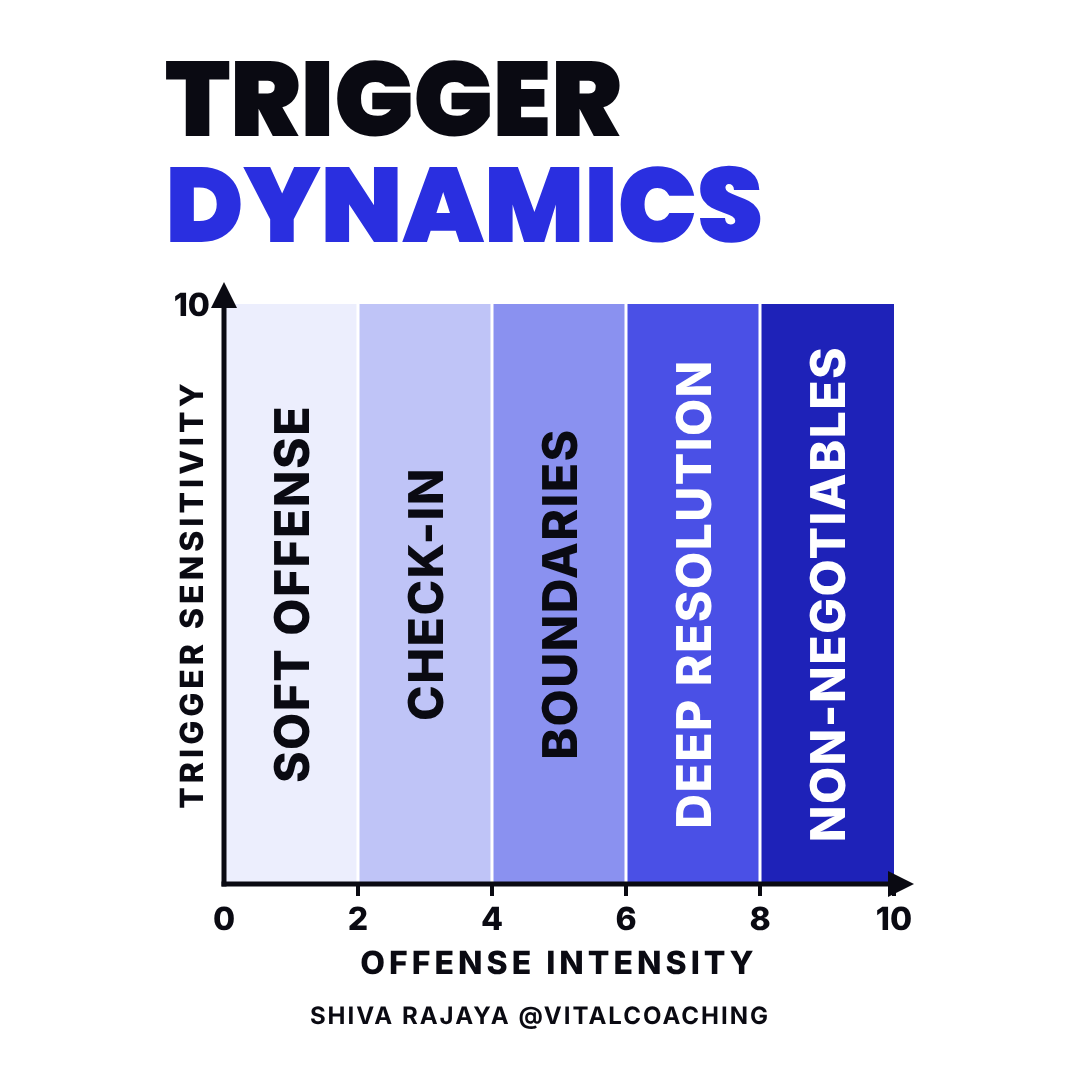
- The five levels of offense intensity, and what each one actually calls for
- Why a repeated small offense isn’t small anymore
- How to tell when something has moved into non-negotiable territory
Not Every Trigger Needs A Response
A trigger firing doesn’t automatically mean something needs to be said.
The level of the offense decides the level of the response. Nothing more, nothing less.
Level One: Soft Offense (0–2)
Most of the time, this level doesn’t require any intervention at all.
- Low offense, even with high sensitivity — still usually navigable without bringing it up.
- Share from vulnerability, not demand — if you do mention it, it’s from an open place, not a request for behavior change.
- No processing mode needed — this isn’t a conversation that needs a resolution.
Here’s the catch: a soft offense doesn’t always stay soft.
Repeated enough times, it stops being a one-time thing and starts accumulating weight.
Level Two: Check-In (2–4)
This is where curiosity enters.
“Hey, I noticed this happened. How did you experience it?”
The goal is understanding, not confrontation. A real conversation about what happened, from both sides.
Level Three: Boundaries (4–6)
At this level, something needs to be named more directly.
- Existing boundaries get reinforced — not newly invented, just stated with more solidity.
- The conversation gets firmer — still a conversation, but with less room for ambiguity.
Level Four: Deep Resolution (6–8)
Something is clearly wrong here. This isn’t a quick check-in anymore.
This level often calls for restructuring the agreements in the relationship itself — not just addressing the moment, but looking at what made the moment possible.
Level Five: Non-Negotiables (8–10)
This is the territory of real harm.
- Verbal or physical abuse, repeated
- Betrayal, lying, broken trust at a foundational level
- Constant harassment
- A living environment that’s become toxic
At this level, there’s no conversation that fixes it in place. This is where the relationship itself is in question.
Why Repetition Changes Everything
A 2 or a 3 on its own might genuinely be nothing.
The same offense, repeated without change, doesn’t stay a 2 or a 3. It compounds — and the accumulated weight can carry it all the way into non-negotiable territory, even if no single instance ever crossed that line alone.
Match The Response To The Level, Not To The Charge
The charge you feel in the moment isn’t always proportional to the actual offense.
Before reacting, locate the level. That’s what decides whether this needs silence, curiosity, a boundary, a deep conversation, or a hard line.
If you’re trying to work out where something you’re holding actually falls, this is exactly where coaching helps. Reach out for coaching →
Keep Reading
- Is Your Trigger Justified Or Not? Ask Yourself These Questions
- Trigger To Resolution Pathway: 11 Questions To Ask Yourself Before You Say A Word
- The Real Price Of Staying Triggered
- 🔺 Reactive. Aware. Safe. Free. The Four Stages Of Trigger Mastery
MORE
Check all Fights Triggers articles →
Download Your Fight Mastery App

