
VITAL SHADOWS EBOOK
What This Article Covers
- Why boundaries around social media need to be set before the relationship starts, not mid-fight
- The difference between a preference and an actual deal-breaker
- Why your partner’s social media is their own territory, not shared property
- The gray zone that needs a real conversation instead of an assumption
- Why hurt feelings and a broken agreement are two completely different things
- Why an unspoken agreement was never actually an agreement
- Why one friction point rarely means what it feels like it means
- Why forcing a public declaration backfires every time
- What to actually do instead of complaining or controlling
Agreements Belong At The Start, Not Mid-Fight
Most couples never actually discuss social media boundaries. They just assume the other person shares their instincts.
Then the first awkward moment hits, and the agreement gets negotiated in the middle of a fight instead of before it ever needed to happen.
Preference Or Deal-Breaker? Decide That Early
Not every desire is a non-negotiable. Some are simply preferences you’d like honored.
Know the difference before you’re in the moment reacting to it. A preference you never named can’t fairly be treated like a broken rule.
Social Media Is Personal Territory, Not Shared Property
A person’s social media is their own space — how they talk, what they post, who they follow, how they present themselves.
Unless it crosses an explicitly agreed boundary, what they do there is their business, the same way yours is your business.
The Gray Zone That Needs An Actual Conversation
- Liking Posts — Is it okay to like another person’s photo? That’s worth naming out loud, not assuming.
- Flirty Messages — Where does playful banter end and something else begin, for each of you specifically?
- Talking To An Ex — Is staying in touch fine, occasional, or off the table entirely?
Hurt Feelings Aren’t The Same As A Broken Agreement
Something can genuinely sting and still not be a violation of anything you actually agreed to.
Those are two separate questions: “Does this hurt?” and “Was a real agreement broken?” Don’t let the first answer decide the second.
An Unspoken Agreement Was Never An Agreement
You can’t hold someone accountable to a rule they never knew existed.
If it wasn’t said out loud and agreed to by both people, it’s an expectation, not an agreement — and expectations aren’t fair ground for blame.
Sovereignty Extends Past Social Media
Her money. Her words. How she communicates with other people. The way she expresses herself.
None of it is yours to direct, unless she’s explicitly invited you into that conversation.
Trying to manage someone else’s territory doesn’t create safety. It creates control — and control creates its own kind of shadow in a relationship.
One Friction Point Rarely Means What It Feels Like It Means
A single uncomfortable moment is almost never the whole story.
Deal-breakers are usually built from accumulation — the same flavor of neglect, distance, or imbalance showing up again and again, not one isolated thing.
Check The Whole Relationship Before You Catastrophize One Part Of It
Before reacting to one friction point, look at the full picture: connection, communication, intimacy, safety, fun, shared direction.
One low score in an otherwise strong relationship is a conversation. The same score across everything is a different situation entirely.
Forcing A Public Declaration Backfires
Pressuring a partner into announcing the relationship, or posting something before they’re genuinely ready, rarely produces the reassurance you’re actually looking for.
If it doesn’t come from her own truth, it reads as fake — and it usually feels that way to both of you.
A Pattern Can Be Information Without Being A Verdict
Noticing that a partner hasn’t shared something publicly, or seems to be keeping options open, is useful data.
It doesn’t automatically mean betrayal. It might mean something worth a real conversation — not an accusation.
Don’t Push Her Into A Corner
An ultimatum aimed at forcing a specific public action rarely creates the devotion it’s chasing.
It usually creates resentment instead, and resentment is a far bigger threat to the relationship than the original issue ever was.
What To Actually Do Instead
- Name What You Noticed — “I noticed you haven’t posted about us, and I’m curious how you feel about that,” instead of an accusation.
- Build The Missing Agreement — If something was never discussed, that’s the actual conversation to have now.
- Decide What You Can Live With — Some things are worth raising. Others are worth consciously letting go of.
If you’re trying to design real agreements instead of silently resenting unspoken ones, this is exactly where coaching helps. Reach out for coaching →
Keep Reading
- 🔺 You Can’t Repair A Fight While It’s Still Burning
- 20 Core Fight Patterns
- 🔺 10 Empty Statements That Sound Like Promises But Aren’t
- 🔺 Name the Fight — The 16 Fight Types Every Couple Needs to Know
MORE
Check all Fights Patterns articles →
Download Your Fight Mastery App

Thinking about your pain over and over feels like working on it. Most of the time, you’re just replaying it.
Rumination Is Pain On Repeat
Rumination means going over the same painful thought again and again.
The breakup. The insult. The mistake. The “what if.”
Same scene. Same ending. Every single time.
Rumination Happens Out Loud Too
Thinking about your pain and speaking about your pain go hand in hand. Each one feeds the other.
- With friends: You tell the same painful story to every friend, every week.
- With your partner: You bring up the same old hurt again and again.
- In therapy: You retell the pain session after session, and nothing shifts.
Every time you retell the story, you rehearse it. And what you rehearse gets stronger.
Talking heals when it moves the pain through you. When it circles, it does the opposite of what you want: it digs the pain deeper instead of releasing it.
It Disguises Itself As Problem-Solving
That’s the trap. Your mind whispers, “Just think about it a little more and you’ll figure it out.”
So you think. And think. And the loop circles back to where it started, a little deeper each round.
Spot The Loop Early
- Same question: “Why did they do that to me?” for the tenth time today.
- Replaying scenes: You rerun the conversation and rewrite what you should have said.
- Imaginary fights: You argue with someone who isn’t even in the room.
- Night spirals: It’s 2am and you’re still on it.
Every Replay Feeds The Pain
What you feed grows.
Each replay fires up your body again. Tight chest. Racing heart. Heavy mood. As if it’s happening right now.
The event happened once. You relive it a hundred times.
Rumination Steals Your Present
While you’re stuck in yesterday, today walks right past you.
Your partner talks. You nod. You’re somewhere else.
Feeling Heals. Replaying Loops.
Rumination lives in the head. Healing moves through the body.
Feel the pain fully, and it can move. Keep replaying it, and it stays.
Break The Loop With Action
- Name it: “I’m ruminating again.” Naming it creates instant distance.
- Move your body: Walk, shake, breathe deep, and your thoughts shift with your state.
- Set a worry window: “I’ll give this 15 minutes at 6pm, then I’m done.”
- Ask a better question: Swap “Why me?” for “What’s my next step?”
- Say it out loud: Tell someone you trust once, instead of telling yourself 100 times.
Your Mind Is A Garden
Water what you want to grow.
Your Pain Deserves To Be Felt, Then Freed
Your pain is real. It deserves your attention, your breath, your honesty.
Give it that, then let it go, and step back into your life.
Ready to break the loop for good? Reach out for coaching at vitalcoaching.com/coaching.
Keep Reading
- Self-Talk: Whining And Complaining Keeps You Stuck. Clear Words Get You Moving.
- Hebb’s Law: Neurons That Fire Together, Wire Together
- Metacognition Is Your Superpower — The Moment You Start Watching Your Mind, You Stop Being Controlled By It
- Cognitive Diffusion — The Art Of Breaking Free From Your Mind’s Grip
- The Zeigarnik Effect: The Hidden Drive Behind Your Obsession, Genius, And Growth
MORE
Neuroticism Is A Sensitive Alarm System
Neuroticism is a personality trait.
Worry, stress and big feelings arrive fast.
They also take longer to leave.
Everyone has some. Some people have more.
The Alarm Rings Even For Burnt Toast
A smoke alarm saves lives. A very sensitive one also rings when you make toast.
A mind with high neuroticism works like that. It spots danger fast, and sometimes the danger is only toast.
A sensitive alarm is a working alarm. It just needs tuning.
Neuroticism Is One Of The Big Five Personality Traits
- Openness — Loves new ideas and new experiences.
- Conscientiousness — Plans, finishes and stays organized.
- Extraversion — Gets energy from being around people.
- Agreeableness — Cares, cooperates and trusts.
- Neuroticism — Feels worry and stress quickly.
Everyone sits somewhere on each scale. The calm, steady end of the neuroticism scale is called emotional stability.
Here Is What Neuroticism Feels Like Inside
- Fast Worry — “What if something goes wrong?”
- Replay Loop — “Why did I say that?”
- Big Feelings — A small comment lands like a big hit.
- Slow Reset — “I’m still upset about yesterday.”
- Self-Doubt — “What if I’m not good enough?”
- Body Alarm — Tight chest, racing heart, restless sleep.
It Is Simply How A Mind Is Wired
Some people are tall. Some are shy. Some feel everything fast. It is simply how a mind is wired, and your worth is the same at every level.
Part Of It Is Born. Part Of It Is Learned.
Research suggests about half of it comes from your genes.
The other half comes from life: childhood, stress, past hurts and daily habits.
That second half can change.
Sensitive Minds Have Real Superpowers
- Early Radar — “I sensed something was off before anyone said a word.”
- Deep Feeling — “I feel what you feel.”
- Smart Preparing — “I already have a plan B.”
- Strong Care — “I notice when someone is hurting.”
- Creative Depth — Feelings turn into music, words and art.
Neuroticism Shows Up Fast In Love
Your partner goes quiet.
Your mind says: “They’re mad at me.”
A text takes hours.
Your mind says: “They’re pulling away.”
So you ask again: “Do you still love me?”
Your alarm rings. Check for fire before you react.
Loving someone with a sensitive alarm? Slow down, speak softly and say the kind thing out loud.
You Can Turn The Volume Down
Neuroticism can change. Studies show it often eases with age, therapy, mindfulness and steady practice.
- Name It — “This is my alarm, not the truth.”
- Breathe Out Slow — Make your out-breath longer than your in-breath.
- Move Your Body — Walk for ten minutes.
- Protect Your Sleep — Go to bed at the same time each night.
- Check The Facts — “What do I actually know right now?”
- Write It Out — Put the worry on paper, then close the page.
- Tell Someone — “I’m having a big feeling. Can you listen?”
Your Alarm Can Learn
Befriend it. Then teach it the difference between smoke and toast.
Ask For Help When It Feels Heavy
If worry or low mood feels too heavy to carry, talk to a doctor or therapist. Reaching out is a strong move.
Ready to turn your sensitive mind into strength and peace? Reach out for coaching and let’s work on it together.
Keep Reading
- 20 Core Truths About Cognitive Hyperarousal
- Amygdala Unleashed: Master Your Triggers Before They Master You
- Rewire Your Mind: Take Back Control Of Your Emotions
- 100 Types Of Anxiety You Might Recognize
MORE
A Feeling Turned Into A Measurement
Spiritual bypassing was first described as a pattern, not a number.
In 2017, psychologist Jesse Fox and colleagues built the Spiritual Bypass Scale (SBS-13) to actually measure it.
13 Items, One Simple Format
The scale has 13 statements. You rate how true each one is for you on a four-point scale of agreement, from strongly disagree to strongly agree.
No pass or fail. Just a pattern, scored.
It Splits Into Two Factors
- Psychological Avoidance — Nine items measuring the tendency to dodge difficult emotions by turning to spirituality instead.
- Spiritualizing — Four items measuring the habit of reframing ordinary psychological struggles in purely spiritual terms.
Both factors correlate with each other, but they’re measuring two slightly different moves.
Factor 1: Psychological Avoidance
These nine items catch the direct move — something painful comes up, and spirituality becomes the exit instead of the path through it.
- Emotional Deflection — When I feel intense negative emotions like anger or grief, I use spiritual practices to quickly change my emotional state rather than feel them directly.
- Preference For Spiritual Help — It is more important to me to seek spiritual guidance than to seek aid from a psychological helper or counselor.
- Detachment From Conflict — I avoid addressing relationship issues or interpersonal conflict because I believe love and light should resolve everything naturally.
- Invalidation Of Negative Feelings — I believe that feeling angry, sad, or disappointed is a sign of lower consciousness or spiritual failure.
- Premature Forgiveness — I forgive people immediately after they hurt me so that I don’t hold onto negative spiritual energy, even if I haven’t fully processed the boundary or the pain.
- Ego Dismissal — When someone gives me critical feedback, I tend to view it as “their ego” or projection rather than taking personal accountability.
- Bypassing Physical Or Psychological Treatment — I believe standard medical or psychological treatments are unnecessary if one relies fully on spiritual healing.
- Detached Neutrality — I work to maintain a state of spiritual detachment so that difficult life events cannot affect me emotionally.
- Superiority Or Spiritual Rank — I feel that my spiritual understanding places me above mundane human drama and petty emotional concerns.
Factor 2: Spiritualizing
These four items catch something subtler — taking an ordinary human struggle and re-labeling it entirely in spiritual language, so it never has to be dealt with as what it actually is.
- Blame Via Karma Or Spiritual Attribution — When someone I know is experiencing hardship or trouble, I believe it is because they have done something wrong spiritually or attracted it.
- Attributing Malice To Spiritual Forces — When experiencing life difficulties, I tend to explain them primarily as spiritual attacks or cosmic tests rather than earthly or psychological causes.
- Expectation Of Divine Intervention Over Action — When I am in emotional pain, I believe God or the Universe will deliver me from it without requiring me to take practical or therapeutic action.
- Exaggerating Meaning — I believe every minor setback or unpleasant interaction carries a deep, fate-driven cosmic lesson that must immediately be reframed.
The Scale Holds Up Statistically
The SBS-13 has been tested for reliability, and the numbers are solid: strong internal consistency for the total scale, and for each of the two subscales separately.
It’s since been translated and validated in other populations, including adaptations in Brazil, Korea, India, and Spain, with similar results.
It Connects To Real Outcomes
Higher scores on the scale have been linked to higher stress, anxiety, and depression in the research that’s used it.
The bypass doesn’t just feel unresolved. It measurably correlates with unresolved distress.
It’s Not A Diagnosis
Fox has been clear that spiritual bypass isn’t automatically pathological. In his own words, it often looks like taking something spiritual out of context and misapplying it.
Clinicians generally don’t treat a temporary bypass during acute stress or a genuine spiritual crisis as unhealthy on its own. The scale measures a pattern, not a verdict.
A Simpler Version For Everyday Self-Reflection
Alongside the formal SBS-13, a more accessible set of 13 self-inquiry questions has circulated as a practical reflection tool.
This isn’t the validated academic scale — it’s a plainer-language way to ask yourself the same underlying question: is this practice helping me feel it, or helping me skip it?
- On Anger — Do I allow myself to feel genuine anger and set firm boundaries, or do I quickly reframe anger as “unspiritual” or “low vibration”?
- On Grief — Am I letting myself fully feel sadness and loss, or am I rushing to say “everything happens for a reason” to stop the pain?
- On Relationships — Do I use terms like “mirroring” or “projection” to avoid taking responsibility for my impact on others?
- On Conflict — Am I avoiding difficult conversations in the name of “keeping the peace” or “staying in love and light”?
- On Forgiveness — Have I genuinely processed the impact of being hurt, or did I grant premature forgiveness to make myself feel spiritually evolved?
- On Human Needs — Do I honor my fundamental human desires for intimacy, security, and recognition, or do I dismiss them as “just my ego talking”?
- On The Body — When uncomfortable emotions arise, do I retreat into mental or spiritual concepts, or do I stay present with the physical sensations in my body?
- On Boundaries — Can I say a clear, unapologetic no without needing a spiritual or energetic justification for it?
- On Compassion — Do I offer genuine, practical support to people who suffer, or do I dismiss their pain by telling them they “manifested” or “attracted” it?
- On Shadows — Am I actively looking at my unlikable traits, like jealousy, insecurity, and control, or am I identifying exclusively with a light, transcendent self-image?
- On Disagreement — How do I react when someone challenges my beliefs — do I stay grounded and open, or do I privately judge them as less conscious or spiritually blind?
- On Vulnerability — Do I share my real struggles and uncertainties as they happen, or do I only share past struggles after I’ve turned them into neat spiritual lessons?
- On Integration — Is my spiritual practice helping me show up more grounded, accountable, and present in daily human life, or is it acting as an escape hatch?
Why A Scale Like This Actually Matters
Before this, spiritual bypass was mostly discussed through anecdote and case study.
A validated scale means therapists and researchers can actually track it, study what predicts it, and see whether treatment approaches move the number. The self-inquiry version means you can ask yourself the same question without waiting for a research setting.
If you recognize yourself in several of these and want to look at what’s actually underneath it, reach out for coaching and let’s find out together.
Keep Reading
- Spiritual Bypassing: Using Spiritual Ideas To Avoid Facing Real Pain
- Unraveling: The Spiritual Breakdown That Awakens Your Real Self
- Not Every Feeling Is A Truth: Stop Worshipping Mind Fog
MORE
The Scenario
You tell a friend your father passed away and you’re struggling.
Instead of sitting with you, they say: “Everything happens for a reason.” Or: “He’s in a better place now.”
You Can Do It To Yourself Too
Meditating through the grief. Telling yourself you’ve already let it go.
When really, you’ve just stopped looking at it.
This Is Spiritual Bypassing
The tendency to use spiritual ideas and practices to avoid facing unresolved emotional wounds, painful feelings, and unfinished developmental tasks.
Where The Term Comes From
Coined in 1984 by psychologist and Buddhist practitioner John Welwood, after he noticed the pattern in himself.
Spirituality Itself Isn’t The Problem
Welwood’s point: the problem is using it as a shortcut around the work.
His Example
Someone tries to practice non-attachment by dismissing their own need for love.
That doesn’t remove the need. It just pushes it underground, where it keeps shaping their behavior without them noticing.
It’s Been Studied Since
Psychologist Jesse Fox and colleagues built a spiritual bypass scale to measure it.
Described as a defensive posture that privileges spiritual beliefs and experiences over real psychological needs.
It Isn’t Always A Red Flag
Some researchers argue certain behaviors labeled as bypassing may just be a normal stage of spiritual development.
The difference comes down to what the practice is being used for.
If you suspect you’ve been using a practice to skip past something instead of moving through it, reach out for coaching and let’s find out what’s actually underneath it.
Keep Reading
- Unraveling: The Spiritual Breakdown That Awakens Your Real Self
- Not Every Feeling Is A Truth: Stop Worshipping Mind Fog
- The Goddess Syndrome: When Empowerment Turns Into Entitlement
MORE
Narcissism Is A Spectrum, Not A Label
Most people hear the word narcissist and picture a villain. A cold, cruel person who is nothing like them.
In reality, narcissism is a set of traits, and everyone sits somewhere on the scale. A clinical disorder sits at the far end. Most people are nowhere near it, and most people still carry a few of the traits.
A Little Narcissism Is Healthy
Self-respect, confidence, and the belief that your life matters all live on this spectrum.
The trait itself isn’t the issue. The issue starts when it costs the people around you.
There Are Different Types Of Narcissism
It doesn’t always look loud. Psychologists commonly describe several styles.
- Grandiose — Loud confidence and a need to be seen as special: “I’m just better at this than everyone.”
- Vulnerable — Quiet on the surface, easily wounded, and always feeling overlooked: “Nobody ever appreciates what I do.”
- Communal — A self-image built on being the most giving person in the room: “I do everything for everyone, and no one sees it.”
- Malignant — Cold and manipulative, with little concern for the harm caused: “It worked, so who cares who got hurt.”
Signs You May Sit Higher On The Spectrum
One sign means nothing. A repeating pattern is what matters.
- Need For Admiration — You feel flat or restless when you’re not being praised or noticed.
- Trouble With Criticism — Feedback feels like an attack, so you defend or counter-attack fast.
- Bored By Others’ Needs — You quietly drift or get irritated when the spotlight isn’t on you.
- Sense Of Entitlement — Rules and waiting in line feel like they apply to other people.
- Constant Comparing — Someone else’s win feels like your loss.
- Blame Reflex — When something goes wrong, the cause is almost always someone else.
Ask Yourself These Five Questions
Do people get quiet or careful around me when I’m upset?
When did I last say “you’re right” and mean it?
Can I celebrate someone’s win without feeling smaller?
Do I ask about other people mainly to steer the conversation back to me?
Do the people closest to me say they feel unheard?
Answer honestly. Then notice how many of them made you flinch.
How High Are You, Really?
No single quiz can tell you, and neither can an article.
A pattern across your relationships, plus the impact on the people close to you, says far more than any score.
A formal diagnosis of narcissistic personality disorder can only come from a qualified mental health professional.
Should You Change It, Or Own It?
Both. And they aren’t opposites.
Owning it means you stop hiding from the traits and the story behind them.
Changing it means you adjust the behaviors that hurt the people around you.
Keep The Strengths, Adjust The Impact
- Keep — Confidence, ambition, and belief in yourself.
- Adjust — Needing to win, dismissing feelings, and expecting special treatment.
- Ask First — Before sharing your view, ask one real question about theirs.
- Say “You’re Right” — Practice it once a day, whenever it’s true.
- Pause On Feedback — Wait ten seconds before you respond to criticism.
Owning It Is Not The Same As Excusing It
“That’s just how I am” is not ownership.
Ownership sounds like: this is my pattern, and here’s what I’m changing.
Being Willing To Look Is Already Movement
Asking the question honestly is a useful sign. It isn’t proof either way.
What you do with the answer is what shapes who you become.
If you want a clear, honest look at your own patterns without judgment, reach out for coaching and let’s map them together.
Keep Reading
- Is The Goddess Syndrome Just Narcissism In Heels? Let’s Break It Down
- Toxic Relationships: How To Spot, Stop, And Transmute Emotional Poison
- DARVO Has 5 Steps. Learn Them And You’ll Never Be Fooled Again.
- 100 Ways To Deal With Or Understand A Narcissistic Person
MORE
The Quick Strategy
- See What Actually Activates Devaluation
- Understand The Shadow Jung Was Pointing At
- Recognize The Mind’s Rewrite In Real Time
- Know Why This Relief Is Only Ever Temporary
- Turn The Mirror Around When It’s Your Turn To Devalue Someone
The Pattern Psychology Keeps Finding
When someone treats you poorly, it’s often not because you did something wrong.
It’s frequently because some part of them perceives you as better than they currently feel about themselves — and tearing you down is easier than sitting with that.
What Actually Activates It
- Confidence
- Emotional intelligence
- Integrity
- Authenticity
- Beauty
- Intelligence
Qualities someone secretly admires, longs for, or feels threatened by can activate an old, unconscious wound of shame or inadequacy — long before either person is even aware anything just happened.
The Shadow Jung Was Pointing At
Carl Jung described the shadow as the unconscious part of the psyche holding everything we learned to reject in ourselves — qualities, emotions, and desires we decided, somewhere along the way, weren’t safe to claim.
The Rewrite Happens Fast
Rather than consciously feeling “I’m not good enough for this,” the psyche protects itself instantly, through projection and devaluation.
The story flips in real time:
- “I’m not the problem — they are.”
- “They’re too much.”
- “They’re too needy.”
- “They’re too emotional.”
- “They need too much attention.”
Relief, Not Resolution
From a Jungian view, this move genuinely does protect the ego — for a moment.
But projection and devaluation distort reality. As long as the blame stays pointed outward, the behavior never gets recognized as what it actually is — which means nothing about it can change.
The Actual Goal Isn’t To Erase The Shadow
It’s to become conscious of it. The more a person can recognize their own patterns, the less those patterns get projected onto whoever happens to be standing closest.
What This Means When You’re On The Receiving End
Her criticism of your confidence, your steadiness, or your emotional intelligence may say far more about her relationship to those qualities in herself than it says about you.
The Question Worth Asking Yourself Too
Next time you catch yourself about to devalue or criticize someone, pause before the words land.
- What is this person’s behavior actually making me feel about myself?
- What are they showing me about myself that I don’t like?
- What are they awakening in me that I haven’t made peace with yet?
Everyone’s A Mirror
That reflection can be used for good. Turned toward, instead of projected outward, it’s one of the more direct paths back to yourself.
If You Keep Ending Up On Either Side Of This
Coaching can help you tell the difference between what’s actually about you and what’s someone else’s shadow. Reach out at vitalcoaching.com/coaching
Keep Reading
- Fundamental Attribution Error
- Gaslighting
- Manipulation Is Provoking You, Then Blaming You For How You React
- Jackal Mode Is Not Anger. It’s A Woman Reclaiming Her Fire.
MORE
Check all Fights Toxicity articles →
Download Your Fight Mastery App
What It Is
Gaslighting is making someone doubt their own memory, perception, or sanity — on purpose, over time.
Not lying about a fact. Rewriting reality itself, until the other person stops trusting their own read of it.
What It Sounds Like
- “That never happened.”
- “You’re remembering it wrong.”
- “I never said that.”
- “You’re too sensitive, you’re overreacting.”
- “You’re crazy, you know that?”
Why It Works
Nobody has a perfect memory. There’s always a little room for doubt to slip into.
Gaslighting doesn’t need to win the argument. It just needs to widen that small room of doubt until you start managing yourself instead of the actual issue.
It’s Not One Conversation. It’s A Hundred Small Ones.
No single instance usually feels dramatic enough to name.
It’s the accumulation — denial after denial, small rewrite after small rewrite — that eventually adds up to someone who no longer trusts their own read of their own life.
Gaslighting Vs. Genuinely Misremembering
- Misremembering — “Actually I think it happened this way” — open to being wrong, open to the other person’s version too
- Gaslighting — total certainty, no room for the other version, and it always lands on the same person being wrong
The Tell
You start narrating your own life before you’ve even lived it — rehearsing how to describe an event so it will be believed, before it’s even over.
That habit alone is usually the clearest sign something’s off.
What It Costs Over Time
Not just the specific facts in dispute. The whole muscle of trusting yourself.
Once that muscle weakens, it doesn’t just affect this relationship — it affects every judgment call after it.
The Way Out
Write things down. Say them out loud to someone outside the relationship. Trust the version that existed before the conversation started.
An outside reference point is often the only thing that can break the loop once you’re inside it.
If This Sounds Familiar
Coaching can help you rebuild trust in your own perception. Reach out at vitalcoaching.com/coaching
Keep Reading
- DARVO Has 5 Steps. Learn Them And You’ll Never Be Fooled Again.
- Manipulation Is Provoking You, Then Blaming You For How You React
- The Only 5 Lies That Exist — Learn Them And Catch Every One
- Fundamental Attribution Error
MORE
Check all Fights Toxicity articles →
Download Your Fight Mastery App
The First Question Healing Actually Asks
Before you heal someone, you have to ask them something first.
Are they willing to give up the things that made them sick?
Crying Out For Change While Holding The Pattern Tight
People ask for change constantly.
And just as constantly, they hold onto the exact habits, identities, and attachments that keep the old pattern alive.
The Man In The River
A man is drowning. He screams for rescue.
And the whole time, he’s gripping the stone that’s pulling him under.
His struggle was never against the current. It was against himself.
Suffering Is Familiar. That’s What Makes It Sticky.
Suffering is a well-worn groove in the mind, a rhythm you’ve danced to for years.
Painful, yes. But known. And the known, no matter how unbearable, usually feels safer than the vastness of the unknown.
Healing Is A Subtraction, Not An Addition
It’s not something you gain.
It’s something you release.
Stepping Into Wellness Means Leaving Someone Behind
Not another person. A version of yourself.
The one who had gotten comfortable inside the sickness has to be the one who stays behind.
So Before You Ask For Healing
Ask yourself this instead:
Am I ready to let go of who I was, to become who I am meant to be?
If you already sense which stone you’re gripping but can’t quite open your hand, that’s exactly where real support makes the difference. Reach out for coaching and let’s open it together.
Keep Reading
- Victimhood Is The Only Addiction The World Applauds
- 5 Signs You’re Slipping Into A Victimized Mindset
- From Victim To Visionary: How To Flip The Script And Become Unstoppable
- Are You Playing The Victim? Here’s How To Catch Yourself Red-Handed
MORE
Every Other Addiction Gets Stopped. This One Gets Fed.
People try to pull each other out of every other addiction they can name.
Victimhood is the exception. The moment you’re the one who was wronged, you become untouchable.
Three Things Make This One Almost Impossible To Give Up
- Sympathy — Attention and comfort that costs nothing to receive.
- An Excuse — A ready-made reason for anything that hasn’t worked out.
- An Identity — One nobody’s allowed to challenge without looking cruel.
Questioning It Looks Like An Attack
Question the identity, and suddenly you’re the one attacking someone who’s already hurting.
That single dynamic buys total immunity. You get to be right, and you never have to change.
But There’s A Price Nobody Names
The story that protects you is the same story that keeps you standing exactly where you were hurt.
You Can’t Heal From A Place You Refuse To Leave
And you won’t leave a place that has become your entire identity.
Those two facts trap each other in place.
The Real Question Was Never Whether You Were Wronged
You probably were. That part usually isn’t in question.
The real question is whether being the victim has stopped being something that happened to you, and started being who you are.
Two Paths, One Choice
One of those you can heal from.
The other you have to defend forever.
If you’re not sure which one you’re standing in right now, that’s exactly the kind of question worth working through with support. Reach out for coaching and let’s find out together.
Keep Reading
- 5 Signs You’re Slipping Into A Victimized Mindset
- From Victim To Visionary: How To Flip The Script And Become Unstoppable
- Are You Playing The Victim? Here’s How To Catch Yourself Red-Handed
MORE
The Setup Comes First. The Blame Comes Second.
They provoke you. Disrespect you. Cross a boundary they know is there.
Then, the moment you react, they act completely shocked — as if you’re the one who started it.
This Is What Manipulation Actually Looks Like
Not a single dramatic moment. A sequence.
They provoke you with disrespect, then blame you for how you react. The provocation is real. Your reaction is real. Only one of those two things ever gets addressed.
What They Did Gets Erased. What You Did Gets Magnified.
They ignore what they did to hurt you and focus entirely on your response.
Suddenly you’re the “problem” — for reacting to behavior they refuse to take responsibility for in the first place.
The Timeline Gets Cut In Half
- What Actually Happened — Provocation, then reaction. Two parts, in order.
- What Gets Discussed — Just the reaction, presented as if it came from nowhere.
This Is How Blame Gets Shifted
That’s the whole mechanism. Cut the story down to just your half, and the accountability quietly disappears with the missing half.
Naming The Pattern Is What Breaks It
The next time this happens, put the full sequence back together out loud.
Sounds like: “Let’s talk about what you did first, then we can talk about how I reacted to it.”
You’re not obligated to defend a reaction to a provocation nobody’s willing to own.
If you keep ending up as the one who has to explain yourself in these moments, that’s worth untangling with support. Reach out for coaching and let’s put the full sequence back together.
Keep Reading
- DARVO Has 5 Steps. Learn Them And You’ll Never Be Fooled Again.
- 5 Dark Social Tactics That Actually Work On People
- 10 Compliance Tests Manipulators Use To See How Far They Can Push You
- The Only 5 Lies That Exist — Learn Them And Catch Every One
MORE
These Tactics Work Because They’re Subtle, Not Obvious
Nobody notices the dark tactics that actually land.
The obvious ones get called out immediately. The subtle ones slip straight past the radar.
The Eye Scan Establishes Dominance Without A Word
Someone tries to intimidate you. Instead of flinching, look at their left eye. Then their right eye. Then their forehead.
That slow, deliberate scan subtly establishes psychological dominance — no raised voice required.
Fake Niceness Cracks Under One Sentence
Someone’s being fake nice. Lean in and say it quietly: “You don’t have to pretend with me.”
Watch their face. The mask flickers before they can catch it.
Pretending To Already Know Gets People To Talk
Sounds like: “It’s fine, I already know.”
They don’t want to be wrong. They don’t want to be caught holding onto something you supposedly already found out. So they spill it, just to correct the record.
Arrogance Opens Up The Moment You Ask For Advice
- Ask For Their Opinion — Arrogant people rarely turn down a chance to advise.
- Let Them Talk — They open up fast, convinced they’re the superior one in the exchange.
Two Words Can Collapse Someone’s Ego Instantly
“You’ve changed.”
It doesn’t matter if it’s true. Most people will spiral trying to prove it isn’t, replaying everything they’ve said and done since the accusation landed.
Knowing These Changes How You Read A Room
Once you can see these five moves, you start noticing them everywhere.
The slow eye scan before a negotiation. The casual “you’ve changed” dropped mid-argument. The fishing question disguised as already knowing the answer.
What used to feel like an unexplainable gut reaction now has a name attached to it.
If you keep sensing these tactics being used on you but couldn’t name them until now, that instinct was right all along. Reach out for coaching and let’s sharpen it further.
Keep Reading
- 10 Compliance Tests Manipulators Use To See How Far They Can Push You
- The Only 5 Lies That Exist — Learn Them And Catch Every One
- 31 Manipulation Tactics That Actually Work On People
- DARVO Has 5 Steps. Learn Them And You’ll Never Be Fooled Again.
MORE
Every test on this list is checking the same thing: your frame. Ranked from the ones that actually hurt to the ones that are secretly just fun.
1. Pulling Away Out Of Nowhere
She randomly goes cold for a few days, just to see if you’ll chase.
Most guys panic and spam her with texts. The best move here is no move. Do nothing.
2. The Jealousy Test
She flirts with another guy, or brings one up out of nowhere, just to watch what you do with it.
Most men get insecure right on cue. Hold your frame, stay stoic, and don’t overreact.
3. “Hold My Purse”
Sounds harmless. It’s actually a compliance test.
Most guys people-please and grab the purse instantly. To pass, you need to hold your frame and not comply on reflex.
4. Stirring Drama For No Reason
She starts an argument out of thin air.
Buy into her frame and argue back, and you fail on the spot. Stay calm, stay above it, stay logical — that’s what passes.
5. Apology Fishing
She tries to guilt-trip you into apologizing for absolutely nothing.
Fold once, especially early on, and you’ll be apologizing for the rest of the connection.
6. “We’re Not Hooking Up Tonight”
She throws this out to see if you’ll start chasing the outcome.
The guys who genuinely don’t care are usually the ones who end up hooking up anyway. Arguing the logic of it never works.
Sounds like: “That’s fine, tell her you’re on your period.” She’ll think it’s hilarious.
7. “I Bet You Do This With Every Girl”
This one’s actually fun. She’s fishing for you to justify yourself.
Don’t defend yourself. Stay playful and mysterious instead — this is a green light in disguise.
8. “You’re Not My Type”
A disqualifier test, and an easy one to miss.
Weak men beg for validation here — “why not, what’s wrong with me.” Men who hold frame just laugh it off.
Every single one of these tests is checking the same underlying thing: does your frame hold under pressure. If you keep getting caught off guard by tests like these, reach out for coaching and let’s build a frame that doesn’t move.
Keep Reading
- 10 Compliance Tests Manipulators Use To See How Far They Can Push You
- The “Real Man” Trap: How To Respond With Power
- Stop Taking The Blame
- Building A Blame Case Against You: What She’s Really Doing And Why
MORE
Before someone manipulates you in a big way, they usually test the water in a small one. Here are 10 of the tests, and why each one is more dangerous than it looks.
1. The Small Ask Test
A tiny, harmless-seeming request. Nothing worth refusing over.
Why it’s toxic: it’s not really about the request. It’s a foot in the door, checking whether you comply automatically so a bigger ask can follow later.
2. The Boundary Push Test
You state a boundary. They cross it anyway, just slightly, just once.
Why it’s toxic: if you don’t enforce it, they’ve just learned your boundaries are suggestions, not rules.
3. The Chronic Lateness Test
Showing up late, again and again, with no real consequence.
Why it’s toxic: it quietly measures how much disrespect of your time you’ll absorb before you say something.
4. The Favor Escalation Test
- Start Small — A ride, a loan of $20, a quick errand.
- Escalate Fast — Bigger favors follow once the small ones go unquestioned.
Why it’s toxic: each yes becomes the evidence used to justify the next, bigger ask.
5. The Silent Treatment Test
Sudden withdrawal. No explanation. Just silence.
Why it’s toxic: it checks whether you’ll chase, apologize, or anxiously fill the silence — training you to over-function every time they go quiet.
6. The Jealousy Test
Flirting with someone else, right in front of you, just to watch your reaction.
Why it’s toxic: your discomfort becomes information about how much insecurity they can provoke and still keep you around.
7. The Money Test
Sounds like: “Can you cover this, just this once?” Then it happens again. And again.
Why it’s toxic: money that flows one way without resistance becomes an expectation instead of a favor.
8. The Isolation Test
A gentle suggestion to skip seeing a friend. Then family. Then another friend.
Why it’s toxic: every skipped visit checks how much of your outside world you’ll trade away without pushing back.
9. The Skipped Apology Test
They do something wrong. No apology comes. Life just continues as if nothing happened.
Why it’s toxic: if you show up the same as always, you’ve just confirmed accountability isn’t required to keep your presence.
10. The Yes Ladder Test
A string of easy agreements, one after another, each one small enough to barely notice.
Why it’s toxic: by the time a real ask arrives, saying no suddenly feels inconsistent with everything you already agreed to.
None of these tests are accidents, and none of them require you to keep passing them. If you keep noticing this pattern in your relationships, reach out for coaching and let’s break the pattern together.
Keep Reading
- 31 Manipulation Tactics That Actually Work On People
- The Only 5 Lies That Exist — Learn Them And Catch Every One
- DARVO Has 5 Steps. Learn Them And You’ll Never Be Fooled Again.
- Circular Reasoning Is How They Trap You Without Ever Proving Anything
MORE
Each Sign On This List Gets More Toxic Than The Last
A victimized mindset doesn’t arrive all at once.
It builds in layers, and each layer makes the next one easier to justify.
1. All Your Time Goes To What Happened. None Goes To What’s Next.
“Why me” on repeat, with no room left over for “now what.”
The lament isn’t the problem. The problem is that it’s being used as an excuse to never live up to your potential.
2. “I’ve Tried Everything” Usually Means One Attempt At Half Effort
Not ten tries. Not full effort. One shot, given about 50 percent.
That’s not a failed experiment. That’s a rigged result, engineered from the start to keep you exactly where you already were.
3. Your Trauma Gets Ranked Above Your Own Ability
Not acknowledged. Ranked higher. Made superior.
That way, the moment you try and fail, the excuse is already loaded and ready. Accountability never has to show up.
4. Every Decision Gets Outsourced Until Someone Says What You Wanted To Hear
Polling one person. Then another. Then another.
Not to gather perspective — to keep asking until someone finally gives the answer you already wanted. That way, if it fails, you get to be the victim of someone else’s bad advice instead of the owner of your own choice.
5. This Is The One That Costs The Most
Your life fills with exactly two kinds of people.
- Other Victims — Relationships that run on competing over whose trauma is worse.
- People Who Enable Victims — Relationships that run on endless sympathy, with zero pressure to ever change.
Every relationship becomes transactional. Either it’s the trauma Olympics, or it’s a sympathy loop with no exit. Neither one asks anything real of you.
Every Single One Of These Is Just A Habit
Not a life sentence. Not a fixed identity.
A habit you picked up, which means it’s also a habit you can put down. The moment you decide to, you take actual control of your own life back.
If any of these five landed harder than you expected, that’s worth working through directly. Reach out for coaching and let’s put the habit down together.
Keep Reading
- From Victim To Visionary: How To Flip The Script And Become Unstoppable
- Are You Playing The Victim? Here’s How To Catch Yourself Red-Handed
MORE
Every Lie You’ve Ever Heard Fits Into Five Categories
Not a thousand kinds of lies. Not infinite variations.
Five. That’s all there are.
Denial: Flat-Out Refusing What Already Happened
Sounds like: “I didn’t do that.” Said with a straight face, about something you both know happened.
Denial doesn’t reshape the story. It just refuses the story exists at all.
Fabrication: Building A Story From Nothing
“Where were you last night?” “I was working late, then came straight home.”
Meanwhile they were somewhere else entirely, and the whole timeline was invented on the spot. This is the hardest lie to build, because every detail has to be manufactured from scratch.
Minimization: Making It Smaller Than It Was
The event happened. The story isn’t invented.
It just gets softened, shrunk, and stripped of whatever detail would make it land harder.
Exaggeration: Making It Bigger Than It Was
“I’m so busy, I’m swamped, I’ve got so much to do.”
The workload is real. The scale of it just got stretched to justify something else — usually an absence, a delay, or a distance.
Omission Is The Fifth Lie. It’s Also The Most Popular One.
Not the same as forgetting.
Omission is deliberately leaving something out, with the specific intent to send you down the wrong path.
Why Omission Is The One People Underestimate
- No False Statement — Nothing said can technically be called a lie.
- Easy Deniability — “I never said that” becomes a real defense.
- Same Intent As Fabrication — Mislead you, just without inventing anything.
These Five Categories Cover Everything
A white lie. A cover story. A half-truth. An alibi.
Every single one sorts into denial, fabrication, minimization, exaggeration, or omission. There is no sixth category.
Knowing The Five Changes What You Listen For
Instead of asking “is this person lying,” ask which of the five categories a statement might belong to.
A vague timeline. A conveniently small number. A story with suspiciously few gaps. A detail that’s just never mentioned.
Once you know the five shapes, they get a lot harder to hide inside.
If you keep sensing you’re being misled but can’t pin down how, that instinct is worth trusting. Reach out for coaching and let’s sharpen it together.
Keep Reading
- 31 Manipulation Tactics That Actually Work On People
- DARVO Has 5 Steps. Learn Them And You’ll Never Be Fooled Again.
- Circular Reasoning Is How They Trap You Without Ever Proving Anything
- The DENNIS System Exposed: The Ultimate Masterclass In Delusional Manipulation
MORE
None of this is fair. All of it is happening around you right now.
- Good-Looking People Get Paid More — For the exact same work.
- Posting Your Enemies Goes Viral Overnight — Conflict travels faster than kindness ever does.
- Villains Are More Memorable Than Nice People — Being remembered beats being liked.
- Whoever Goes First Holds The Power — First move sets the terms for everyone after.
- Confident Liars Beat Honest Doubters — Every single time.
- Casual Bragging Actually Works — If it doesn’t sound like bragging, it lands as fact.
- Looking Busy Reads As Successful — Nobody checks if the busy is productive.
- Slight Meanness Earns Faster Respect — Kindness gets tested. Edge gets deferred to.
- Looking Expensive Beats Being Competent — Perception moves faster than proof.
- Picking On Smaller People Grows An Audience Fast — Cruelty is entertaining in a way fairness isn’t.
- Acting Bored Makes People Work Harder For You — Disinterest reads as a prize to win.
- The Loudest Opinion Gets Mistaken For The Smartest — Volume gets confused with authority.
- “Built Different” Actually Works On People — Say it enough, and belief follows.
- Treating People Like Options Makes Them Chase You — Scarcity beats certainty.
- Pretending Not To Remember Someone Humiliates Them Perfectly — No insult required.
- The Most Arrogant Person Gets Heard First — Certainty gets the floor before merit does.
- Hot Takes Beat Nuanced Ones — Nuance doesn’t travel. Extremes do.
- Looking Unbothered While Losing Is An Unchallengeable Flex — Nobody can argue with calm.
- Cutting People Off Keeps You In Control — Of every conversation you’re in.
- The Biggest Faker Gets The Most Invites — Confidence gets mistaken for likability.
- Being Unreachable Signals Importance — Access becomes the currency people chase.
- Public Fights Make You Famous Overnight — Attention doesn’t care if it’s earned well.
- Acting Like You’ve Been There Before Opens Doors For Free — Assumed competence rarely gets questioned.
- The Most Controversial Post Always Performs Best — Outrage outperforms agreement.
- Talking About Money Filters The Room — It makes broke people uncomfortable and rich people interested.
- Pretending Not To See Someone Beats Insulting Them — Erasure cuts deeper than words.
- People Believe Whatever Sounds Most Certain — Even when it’s wrong.
- Looking Like You Don’t Try Is The New Flex — Effortlessness reads as superiority.
- Acting Like You’ve Outgrown People Makes Them Chase You For Life — Withdrawal reads as ascension.
- People Reward Whoever Triggers FOMO — Missing out motivates faster than gaining does.
- Stop Being Nice And Watch How Fast You Get Respected — The uncomfortable truth underneath all of it.
Recognizing these patterns is the first step to not being run by them, whether they’re being used on you or you’ve caught yourself using them. If you want to understand which side of these you’re standing on, reach out for coaching and let’s look at it together.
Keep Reading
- 31 Uncomfortable Truths About Shadow Manipulation Tactics
- Circular Reasoning Is How They Trap You Without Ever Proving Anything
- DARVO Has 5 Steps. Learn Them And You’ll Never Be Fooled Again.
- The DENNIS System Exposed: The Ultimate Masterclass In Delusional Manipulation
MORE
The Guilt Arrives Before You’ve Even Done Anything Wrong
You take a night for yourself. You say no to a request. You spend money on something just for you.
And guilt shows up immediately, as if you’ve done something to apologize for.
Guilt Is Not Proof Of Wrongdoing
Guilt is supposed to signal that you hurt someone or broke a value you hold.
But for many people, guilt fires just as loudly for meeting their own needs as it would for actually harming someone.
Somewhere, Self-Care Got Filed As Selfishness
Not because it actually is selfish.
Because somewhere along the way, you learned that your needs and other people’s needs were competing for the same limited space — and you weren’t supposed to win.
This Often Traces Back To A Role You Learned Early
- The Caretaker — Your value came from managing everyone else’s needs.
- The Peacekeeper — Your comfort was the price of everyone else’s calm.
- The Good One — Approval depended on never asking for much.
The Role Worked. That’s The Problem.
It kept you connected, safe, or approved of.
So your system still treats stepping out of it as a threat, even decades later.
Guilt Can Be Inherited, Not Earned
If you grew up watching someone constantly sacrifice their own needs, that became the model.
Prioritizing yourself can feel like betraying that model, even if nobody around you actually asked you to follow it.
Other People’s Reactions Don’t Help
Someone in your life may genuinely be used to you always being available.
Their disappointment is real. It’s also not automatically proof that you did something wrong.
Two Things Can Be True At Once
Someone can be disappointed, and your boundary can still be fair.
Their feelings are valid. Your right to prioritize yourself is also valid. Neither cancels the other out.
Let The Guilt Sit There Without Obeying It
- Notice It — “I feel guilty right now.”
- Name The Trigger — “This is happening because I said no.”
- Don’t Reverse The Decision — Feeling guilty is not a signal to undo what you just did.
The Guilt Fades With Repetition
The first few times you prioritize yourself, it will feel wrong. That’s expected.
Unfamiliar isn’t the same as wrong. The discomfort is often just proof that you’re doing something new.
If this guilt has been quietly running your decisions for a long time, it’s worth untangling with support. Reach out for coaching and let’s work through where it started.
Keep Reading
- How Do I Stop People-Pleasing?
- Why Do I Keep Saying Yes When I Mean No?
- What Are The Signs You’re Betraying Yourself?
- What Is Self-Betrayal? The Definition Nobody Gives You Straight
MORE
Stopping Isn’t About Willpower
Nobody people-pleases because they lack discipline.
It’s a survival strategy that worked once. That’s why it’s so hard to just “stop.”
Start By Naming What It’s Actually Protecting
People-pleasing isn’t really about the other person.
It’s about avoiding a feeling — rejection, conflict, disappointing someone you care about.
You Can’t Skip The Discomfort
Every time you stop people-pleasing, that avoided feeling shows up instead.
That’s not a sign you’re doing it wrong. That’s the actual work.
Start Small On Purpose
- Low-Stakes First — Practice with a stranger or acquaintance before family.
- One Rep At A Time — Disagree once in a meeting instead of overhauling every relationship at once.
- Notice The Aftermath — Track what actually happens, not what you feared would happen.
Delay The Answer
You don’t have to respond in the moment.
Say: “Let me think about it and get back to you.” That single sentence breaks the automatic yes.
Watch What People Actually Do
Most feared reactions never happen.
People adjust. Conversations continue. The relationship survives a no.
Notice Who Doesn’t Adjust
If someone reacts badly to one honest no, that’s information too.
It tells you the relationship was built on your compliance, not your presence.
Give Yourself Scripts
- Soft No — “That doesn’t work for me right now.”
- Direct No — “I’m not able to do that.”
- No Explanation Needed — “No, but thank you for asking.”
Expect The Guilt To Show Up Anyway
Guilt after a boundary doesn’t mean you did something wrong.
It means you did something unfamiliar. Those aren’t the same thing.
This Isn’t A One-Time Fix
It’s a rep you repeat until it stops feeling foreign.
Every rep makes the next one slightly easier.
If you know the pattern but can’t seem to break it alone, that’s exactly what support is for. Reach out for coaching and let’s build the muscle together.
Keep Reading
- Why Do I Keep Saying Yes When I Mean No?
- What Are The Signs You’re Betraying Yourself?
- What Is Self-Betrayal? The Definition Nobody Gives You Straight
- Sycophant Energy: Why Playing Nice Will Kill Your Power
MORE
The Word Comes Out Before You Decide
Someone asks. “Yes” leaves your mouth.
By the time you notice what happened, you’ve already agreed.
It’s Not A Willpower Problem
You’re not weak. You’re not lacking discipline.
Something faster than willpower is running the show.
No Feels Like A Risk
Somewhere along the way, saying no got coded as dangerous.
Disappointment. Conflict. Being seen as difficult.
Yes Feels Like Safety
Yes keeps the peace. Yes keeps you liked. Yes ends the moment fast.
Your nervous system learned this trade a long time ago.
This Usually Starts Early
- A Household Where No Wasn’t Welcome — Compliance got rewarded. Pushback got punished.
- A Role As The Easy One — Being agreeable became your value in the family.
- An Early Lesson About Love — Approval felt conditional on saying yes.
The Pattern Outlives Its Purpose
What protected you once keeps running long after the danger is gone.
Nobody’s punishing your no anymore. The reflex doesn’t know that yet.
The Gap Happens In Milliseconds
Request comes in. Your body reacts before your mind catches up.
By the time your thinking brain arrives, your mouth has already answered.
You Feel It Right After
A drop in your stomach. A quiet “why did I just say that.”
That feeling is your actual answer, arriving a few seconds too late.
Closing The Gap Is The Actual Skill
Not forcing yourself to say no more often.
Slowing the moment down enough to feel your real answer before your mouth moves.
A Pause Buys You The Space
- Buy Time — Say: “Let me check and get back to you.”
- Name The Delay — Say: “I don’t want to answer that on the spot.”
- Check In First — Ask yourself: “What do I actually want here?” before answering at all.
If the gap between your yes and your real feelings has been running your life for a while, that’s worth working on directly. Reach out for coaching and let’s close it together.
Keep Reading
- What Is Self-Betrayal? The Definition Nobody Gives You Straight
- What Are The Signs You’re Betraying Yourself?
- From Self-Betrayal To Unshakable Truth
- Sycophant Energy: Why Playing Nice Will Kill Your Power
MORE
The Signs Are Usually Quiet
Self-betrayal rarely announces itself.
It shows up as small, everyday moments that feel normal until you actually look at them.
You Say Yes When You Mean No
Plans you didn’t want. Favors you didn’t have room for.
The word “yes” comes out before you’ve even checked in with yourself.
You Apologize For Things That Aren’t Your Fault
A quick “sorry” to smooth things over.
Even when you did nothing wrong.
You Agree Out Loud While Disagreeing Inside
Nodding along in a conversation.
Meanwhile, something in you is saying the opposite.
You Shrink To Avoid Making Others Uncomfortable
Softening your opinion. Downplaying your success. Going quiet in a room.
Not because you don’t have something to say.
You Ignore Your Body’s Signals
A tight chest. A knot in your stomach.
And you push through anyway, because stopping feels harder than continuing.
You Stay Long After You Know It’s Over
A job. A relationship. A friendship.
You knew months ago. You stayed anyway.
You Explain Away Your Own Discomfort
- “It’s Not That Bad” — Minimizing something that actually bothered you.
- “I’m Probably Overreacting” — Doubting your own read on a situation.
- “They Didn’t Mean It Like That” — Defending someone before defending yourself.
You Feel Resentful But Can’t Say Why
A low-grade irritation that doesn’t have an obvious source.
Often, it’s aimed at yourself for something you allowed.
You Perform Instead Of Show Up
Being who the room needs you to be.
Instead of who you actually are in that moment.
You Feel Exhausted After Being Around People
Not from the people themselves.
From how much of yourself you edited to be there.
None Of These Are Weaknesses
Every one of these signs is a learned habit, not a character flaw.
That distinction matters, because habits can be unlearned.
If you recognized yourself in more than one of these, that’s worth paying attention to. Reach out for coaching and let’s look at where it’s coming from.
Keep Reading
- What Is Self-Betrayal? The Definition Nobody Gives You Straight
- From Self-Betrayal To Unshakable Truth
- From Self-Abandonment To Self-Reclamation: The Polarity Shift
- Sycophant Energy: Why Playing Nice Will Kill Your Power
MORE
Betrayal Doesn’t Need Another Person
Most people learn “betrayal” as something done to them.
Self-betrayal is the same wound, turned inward. You’re the one doing it to yourself.
The Simplest Definition
Self-betrayal is saying yes when the honest answer is no.
Every time it happens, a message gets sent: what you want doesn’t count.
It’s Quiet, Not Dramatic
Going to the party when you needed to stay home.
Taking blame you don’t deserve just to end the tension.
None of it looks like betrayal. That’s what makes it easy to miss.
There’s A Specific Feeling Underneath It
A quiet unease after the moment passes.
That’s the gap between what you did and what you actually wanted.
It Has A Real Name In Psychology
This gap is a form of cognitive dissonance.
Your actions and your truth, pulling in two directions at once.
Why It Happens So Easily
- Fear Of Conflict — Disagreeing feels riskier than staying quiet.
- Fear Of Disappointing Someone — Their comfort comes first.
- Old Survival Patterns — Shrinking once kept you safe.
None Of This Is Your Fault
These reasons explain the pattern.
They don’t mean something is wrong with you for having it.
One Moment Rarely Does The Damage
A single instance barely registers.
Repetition is what does it.
Each Time Makes The Next Easier
Override your truth once, nothing bad happens.
Do it again, and it stops feeling like a choice.
Eventually It Feels Like Identity
Not a habit anymore.
Just who you think you are.
This Is Where Self-Trust Breaks Down
Trust is built on consistency — keeping your word.
Self-betrayal is a broken promise to yourself, every time.
Broken Promises Add Up
Even private ones.
Enough of them, and you stop believing your own word.
If this pattern sounds familiar and you’re ready to understand where it started, reach out for coaching and let’s work through it together.
Keep Reading
- From Self-Betrayal To Unshakable Truth
- From Self-Abandonment To Self-Reclamation: The Polarity Shift
- The Empathy Isolation Paradox
- Sycophant Energy: Why Playing Nice Will Kill Your Power
MORE
Your Understanding Has A Cost Nobody Warned You About
Someone was rude to you. You understood — they were probably having a terrible day.
Someone disappeared without an explanation. You understood that too — they were likely fighting battles they never talked about.
You forgave. You adjusted. You gave another chance. Every single time.
Somewhere In All That Understanding, You Disappeared
Between understanding everyone’s reasons and forgiving everyone’s behavior, something quietly happened.
Your own feelings stopped getting a seat at the table.
This Has A Name: The Empathy Isolation Paradox
The people who are the most understanding toward others often end up feeling the most alone.
Empathy is supposed to build connection. But when it only flows in one direction, it quietly produces the opposite result.
You Became The One Everyone Comes To
Deep empathy makes you the person everyone turns to when life gets heavy.
You listen. You notice what other people don’t say out loud.
But when your own world gets heavy, you discover something uncomfortable: not everyone knows how to sit with your silence the way you sat with theirs.
Empathy Was Never The Problem
The paradox isn’t that empathy is wrong.
It’s that empathy without any boundary becomes a one-way current.
Understanding Someone Doesn’t Cancel Your Own Truth
You can understand exactly why someone hurt you and still be allowed to say that they hurt you.
Both things are true at once. But the person who is always understanding rarely lets themselves reach for the second one.
Loneliness Isn’t Always About Who’s Around You
Sometimes loneliness is not the absence of people around you.
It’s the absence of someone who understands you the way you have always tried to understand everyone else.
If this landed and you’re not sure how to start letting your own feelings back into the room, reach out for coaching and let’s work on it together.
Keep Reading
- From Self-Betrayal To Unshakable Truth
- From Self-Abandonment To Self-Reclamation: The Polarity Shift
- Sycophant Energy: Why Playing Nice Will Kill Your Power
- Anta Ninda — The Invisible Self-Attack That Keeps You Small
MORE
None of these are fair. All of them are true.
Attractive And Well-Dressed People Get Treated Differently
- Attractive People Get More Second Chances — Same mistake, softer consequence.
- People Judge Your Whole Life By Your Shoes — Fair or not, they do it in seconds.
- Overdressing Gets You Treated Better Everywhere You Go — Nobody asks why. They just adjust.
- Acting Rich Gets You Discounts Broke People Never See — Confidence gets quoted a different price.
Distance Is What Gives You Power In A Relationship
The one who needs it less runs the room.
- The Friend Who Cancels First Controls The Friendship — Availability becomes leverage.
- Whoever Cares Less About The Friendship Controls It — Caring more is treated like a weakness, not a virtue.
- The One Who Shows Up Late Leaves First — And somehow, nobody says anything.
- The One Who Storms Out Gets Chased — Walking away pulls harder than staying ever could.
- The One Who Talks About Leaving Gets Offered More To Stay — Threats get answered. Loyalty gets ignored.
- Threatening To Leave Gets You The Raise Loyalty Never Did — Same for jobs as it is for love.
Confidence Is Manufactured, Not Given
Nobody is born in charge. People just learn to act like it.
- Talking Slower Makes People Think You’re In Charge — Speed reads as nerves. Slowness reads as power.
- Acting Confused Gets Other People To Do Your Work — Competence gets you handed more work. Confusion gets you rescued.
- Whoever Seems Replaceable Gets Replaced — Certainty is a form of job security.
- People Respect “No” More Than They Respect “Yes” — Every yes gets taken for granted. Every no gets remembered.
- Stop Explaining Yourself And Watch How Fast People Accept It — Justification invites debate. Silence doesn’t.
- Keeping What You Know To Yourself Keeps You Employed — Full transparency is rarely rewarded the way people expect.
Emotion Beats Logic In Almost Every Room
- People Apologize To Whoever Seems Angriest — Not whoever actually got hurt.
- Crying At The Right Moment Wins Arguments Logic Can’t — Tears close arguments facts can’t touch.
- Whoever Brings The Drama Gets The Attention — Calm gets ignored. Chaos gets a crowd.
- Being Petty In Public Gets More Likes Than Being Kind — Cruelty is more entertaining than decency.
Scarcity Makes People Want You More
- Ignoring Texts Makes People Write Longer Ones — Silence is a magnet, not a repellent.
- People Want Whatever Has A Waitlist — Access is more attractive than the thing itself.
- People Invite Whoever Seems Busiest — Free time reads as undesirable. A packed calendar reads as valuable.
- Being Difficult Makes People Prepare Harder For You — Ease gets taken for granted. Difficulty gets respected.
Boldness Gets Rewarded More Than Waiting For Permission
- Showing Up Uninvited Works More Often Than Asking — Permission invites a no. Presence rarely gets turned away.
- The Loudest Complainer Gets The Refund — Quiet dissatisfaction gets nothing.
- Better Service Goes To Customers Who Look Like They’ll Complain — Politeness gets you overlooked.
- Interrupting With A Smile Gets Forgiven Every Time — Tone erases the rudeness underneath it.
- Forgiveness Beats Permission — Asking first invites a no. Acting first rarely does.
- People Help Whoever Looks Like They Don’t Need It — Struggling visibly gets you ignored, not rescued.
The One Workplace Truth Nobody Says Out Loud
- The Coworker Who Takes Credit Gets Promoted Before The One Who Does The Work
These patterns run the world whether you play along with them or not. If you want to understand which of these you’re stuck on the wrong side of, reach out for coaching and let’s look at it together.
Keep Reading
- Circular Reasoning Is How They Trap You Without Ever Proving Anything
- DARVO Has 5 Steps. Learn Them And You’ll Never Be Fooled Again.
- Toxic Relationships: How To Spot, Stop, And Transmute Emotional Poison
- The DENNIS System Exposed: The Ultimate Masterclass In Delusional Manipulation
- Seduction, Influence, Persuasion, Manipulation: Master The Powers Without Losing Your Soul
MORE
Every one of these feels like self-protection in the moment. All ten together are how a life gets smaller.
1. Blaming Everyone Else
The boss is unfair. The partner is toxic. The economy is rigged.
Every outcome has an external cause — and somehow, never an internal one.
2. Rewriting History In Your Favor
Sounds like: “I always try my best, they just never appreciate it.” The story gets edited until you’re always the hero and never the variable.
3. Refusing Responsibility For Outcomes
- A Missed Deadline — “Nobody gave me clear instructions.”
- A Failed Relationship — “They changed, I didn’t do anything different.”
Responsibility feels like blame, so it gets rejected on sight.
4. Collecting Evidence Of Unfairness
Every slight gets filed away. Every disappointment becomes proof of a pattern against you.
The collection grows every year — and so does the case for staying stuck.
5. Waiting For Someone To Save You
The right partner. The right boss. The right apology.
Waiting feels like patience. It’s actually outsourcing your life to someone who never signed up for the job.
6. Turning Feedback Into Attack
Sounds like: “Why is everyone always against me?” A simple critique becomes proof the world has it out for you — so the feedback never gets used.
7. Comparing Your Pain To Everyone Else’s
“You think that’s bad? You have no idea what I’ve been through.”
Suffering becomes a competition, and winning it means nothing ever has to change.
8. Using The Past As A Permanent Excuse
- The Childhood Excuse — “This is just how I was raised.”
- The Relationship Excuse — “My ex broke something in me.”
The past explains where you started. It doesn’t have to dictate where you stay.
9. Avoiding Action By Staying “Wronged”
As long as you’re the one who was hurt, nobody can ask you to move first.
Staying wronged feels safer than trying and failing on your own terms.
10. Trading Growth For Sympathy
Sympathy comes fast. Growth comes slow, and nobody claps for it right away.
The trade feels good in the moment — and it’s the exact trade that keeps your future exactly where it is now.
Victim mentality protects the ego by keeping you innocent. It destroys the future by keeping you powerless. You don’t get to keep both.
One Story Just Beat Decades Of Evidence In Your Head
Your friend tells you his uncle smoked every day, never exercised, and lived to 95.
Suddenly everything you knew about smoking feels less certain.
That’s the anecdotal fallacy. One story just overrode a mountain of evidence.
This Trick Is Running Your Life Right Now
Someone denies climate change because of one cold winter.
Someone skips their seatbelt because they heard about a survivor who wasn’t wearing one.
One story. Mountains of evidence. Somehow the story wins.
You Live In A Cave And You Don’t Know It
400 years ago, Francis Bacon called this the idol of the cave.
We all live inside our own small cave of personal experience.
And we assume what we see in that cave is the whole world.
Your Brain Remembers Stories, Not Statistics
You remember the headline about the plane crash.
You don’t remember the millions who flew safely that same day.
The rare disaster gets remembered. The safe majority disappears.
This Is Where It Actually Hurts You
You don’t personally know anyone who crashed while texting and driving.
So you keep texting while driving.
You fear flying. You trust texting behind the wheel. The data says the opposite.
An Exception Does Not Cancel The Rule
One story is one data point.
The general pattern is built from thousands of data points.
The pattern is almost always more important than the exception.
How To Catch It Fast
- One Story — Is this based on one person’s experience?
- No Data — Is there actual research behind this, or just a story?
- Feels Personal — Does it feel true just because someone you know said it?
- Ignores The Rest — Does it skip over everyone the story doesn’t include?
How To Respond Without Falling For It
- Name It — Say: “That’s one story. What does the data say?”
- Ask For The Pattern — Say: “Is this the exception or the rule?”
- Don’t Update On One Point — One story shouldn’t change years of evidence.
- Check Yourself Too — Ask: “Am I doing this with my own story right now?”
The Truth That Ends This For Good
Do not confuse the shadows on your cave wall for reality.
Next time someone tells you about their uncle who smoked and lived to 95, remember the millions of data points they’re not telling you about.
The exception does not disprove the rule. It’s just one shadow on one cave wall.
Sealioning Looks Like Curiosity. It’s Actually A Siege.
Sealioning is relentless questioning dressed up as innocent curiosity.
The person never yells. They never insult you.
They just keep asking. And asking. And asking.
Here’s Exactly How It Plays Out
You post a simple opinion. “Social media makes people more anxious.”
“Interesting claim. Do you have research for that?” You send a study.
“Small sample size. Anything more conclusive?” You send another.
“This was funded by a biased source. Independent research?” You find one.
“This doesn’t directly address your claim. What did you mean by anxious?”
Two hours later, you finally snap.
“I was just asking questions. Why are you being so hostile?”
The Questions Were Never The Point
They don’t want to understand your position.
They want to exhaust you until you crack.
Once you snap, they get exactly what they came for.
Politeness Is The Weapon
They never break character. They stay calm the entire time.
That’s what makes it work. They look reasonable. You look tired.
Anyone watching only sees the moment you lose your patience.
You Are Not The Unreasonable One
You answered every question. You brought sources. You stayed patient.
Snapping after hours of bad faith is not the crime here.
The trap was set the moment they asked the first question.
How To Spot It Fast
- Endless Asks — Every answer gets a brand new demand.
- Moving Target — The bar for “proof” keeps changing.
- Fake Calm — They stay polite no matter what.
- No Real Answer — They never say what would satisfy them.
How To Respond Without Getting Trapped
- Name It — Say: “I’ve answered this. I’m not doing another round.”
- Set The Limit — Say: “I gave you sources. That’s where this ends.”
- Don’t Chase — Stop sending proof. The goalpost will just move again.
- Walk Away — Say: “I’m done engaging with this.” Then stop replying.
The Truth That Ends This For Good
A question asked in bad faith deserves no more answers.
Politeness is not proof of honesty.
You’re allowed to stop answering someone who was never listening.
A Fallacy Is Broken Logic That Sounds Right
A fallacy is an argument that sounds true but isn’t actually valid.
It skips real proof. It leans on tricks instead.
It’s not truth. It’s a costume truth wears to fool you.
Fallacies Work Because They Feel Right
A fallacy doesn’t need to make sense. It just needs to sound confident.
Your brain confuses confidence with correctness.
That’s the whole trick. That’s all it needs to work.
Here Are The Fallacies You Meet Every Day
Attack The Person, Not The Point. At work you raise a concern that the marketing budget was mismanaged. Instead of addressing the numbers, your manager says, “You’re just upset because your project didn’t get funded.” Your actual point never gets touched.
Twist What You Said. You tell your partner, “I think we should cook at home more to save money.” They respond, “So you want us to never go out and have fun again?” That’s not what you said, but now you’re defending against it anyway.
Only Two Choices. Your mother tells you, “Either you invite my entire side of the family to the wedding, or you don’t care about family at all.” There are dozens of options between those two extremes, but she’s boxed you into just one.
Everyone Does It. A coworker gets caught inflating mileage on expense reports. When confronted, they say, “Come on, everyone rounds up a little. I’m not the only one.” The behavior isn’t suddenly okay just because it’s common.
Slippery Slope. Your teenager asks to stay out until midnight for a friend’s birthday. You say no, reasoning, “If I let you stay out till midnight tonight, next month you’ll want 2 AM, and soon you’ll stop coming home at all.” One request just got turned into a doomsday scenario.
Because A Confident Voice Said So. Your uncle, who has no medical background but watches a lot of health podcasts, tells you a supplement cures anxiety. You start to believe it simply because he “sounds like he knows a lot about this stuff,” not because there’s actual evidence.
If You Loved Me, You’d Do This. Your partner says, “If you really loved me, you’d lend me the money without asking questions.” The request itself might be reasonable or not, but love is being used as leverage instead of an honest reason.
One Bad Experience, One Big Rule. You dated someone born in June who cheated on you, so now you tell your friends, “People born in June just can’t be trusted.” One person’s behavior has been turned into a rule about millions of people.
Bring Up Something Else Entirely. You tell your manager the new safety protocol on the floor isn’t being followed. Instead of addressing it, they bring up a minor mistake you made three months ago. Now you’re explaining an old error instead of getting the safety issue fixed.
We’ve Always Done It This Way. You suggest splitting the holidays evenly between both families this year. Your parent responds, “We’ve always spent Thanksgiving here, so that’s what we’re doing.” Tradition is used to end the conversation instead of actually making a case for it.
A Fallacy Is Never About Finding Truth
A real argument tries to get closer to what’s true.
A fallacy tries to win. That’s the only goal.
Winning and being right are not the same thing.
Fallacies Make You Feel Crazy On Purpose
You know something feels off. You can’t explain why yet.
That gap is exactly where fallacies live.
Once you can name it, it stops working on you.
How To Catch A Fallacy Fast
- Check The Target — Are they attacking you or your actual point?
- Check Your Words — Did they twist what you said into something else?
- Check The Choices — Are there really only two options here?
- Check The Proof — Is there real evidence, or just confident tone?
How To Respond Without Getting Trapped
- Name It — Say: “That’s not answering my actual point.”
- Redirect — Say: “Let’s go back to what I originally said.”
- Ask For Proof — Say: “What’s the actual evidence for that?”
- Don’t Chase — Don’t argue the fake point. Return to the real one.
The Truth That Ends This For Good
A confident voice is not the same as a correct one.
You’re allowed to reject an argument just because it doesn’t hold up.
Once you can name the fallacy, it stops having power over you.
Circular Reasoning Is A Trap With No Exit
Circular reasoning is when the proof is just the claim, said again.
Nothing new is offered. Nothing is actually proven.
It sounds like logic. It is not logic. It’s a loop.
Here’s What It Actually Sounds Like
“I’m right because I’m always right.”
“You’re too sensitive because you get upset too easily.”
Notice something? The reason and the claim are the exact same thing.
It Feels Convincing. That’s The Danger.
Circular reasoning doesn’t sound crazy. It sounds confident.
Confidence is not proof. Repetition is not evidence.
But your brain hears it stated firmly, and it starts to feel true.
This Is How It Gets Used On You
You ask a real question. You get a circle instead of an answer.
“Why did you do that?” “Because that’s just how I am.”
That’s not an explanation. That’s a wall dressed up as one.
You End Up Arguing In Circles Too
You push back. They repeat the same claim in different words.
You push back again. Same loop, new sentence.
You’re not losing the argument. There was never an argument to win.
Stop Looking For The Exit Inside The Circle
There is no better way to phrase your point that will break a circle.
The circle isn’t waiting for smarter words. It’s just a circle.
The exit isn’t inside it. The exit is you, stepping outside it.
How To Spot It Fast
- Same Claim Twice — The “proof” is just the claim said again.
- No New Info — Nothing added, nothing explained.
- Feels Slippery — You can’t pin down what they actually mean.
- Always Circles Back — Every answer returns to the same spot.
How To Respond Without Getting Pulled In
- Name It — Say: “That’s the same point, just said again.”
- Ask For Proof — Say: “What’s the actual evidence for that?”
- Don’t Repeat Back — Don’t restate your point a fourth time. Stop.
- Exit The Loop — Say: “We’re going in circles. I’m done here.”
The Truth That Breaks The Circle For Good
A claim is not proof just because it’s repeated with confidence.
You don’t owe anyone endless laps around the same point.
You’re allowed to walk away from a circle that was never going anywhere.
DARVO Is Five Moves, Not One
DARVO stands for Deny, Attack, Reverse, Victim, Offender.
Five letters. Five steps. One pattern.
Once you know all five, you’ll spot it instantly.
Step 1: Deny
They act like nothing happened.
“That never happened.” “You’re imagining this.”
The goal is simple: make you doubt your own memory.
Step 2: Attack
They stop talking about the issue. They start attacking you.
Your tone. Your timing. Your past mistakes.
This is a distraction, not a defense.
Step 3: Reverse
Now they flip the whole story.
Suddenly you’re the problem. They’re not.
The conversation has officially changed direction.
Step 4: Victim
They make themselves the one who’s hurting.
“I can’t believe you’re doing this to me.”
They perform pain to shut you down.
Step 5: Offender
Now you’re the villain.
You’re accused of attacking, when all you did was speak up.
The roles have fully flipped. You’re defending yourself for telling the truth.
Why This Works So Well
DARVO isn’t random. It’s a system.
Each step builds on the last.
By step five, you forget you were ever hurt in the first place.
The Real Damage Isn’t The Fight. It’s The Confusion.
You start wondering if you were too much.
Too harsh. Too sensitive. Too dramatic.
That confusion is the tactic working exactly as designed.
How To Respond At Every Step
- Name The Denial — Say: “I know what happened. I was there.”
- Don’t Chase The Attack — Don’t defend your tone. Return to the point.
- Call Out The Reverse — Say: “This isn’t about me. Let’s stay on the original issue.”
- Don’t Rescue Their Pain — Their discomfort is not your job to fix right now.
- Refuse The Role — Say: “I’m not the offender here. I brought up something real.”
The One Sentence That Breaks DARVO
“I’m willing to talk about this, but not if the real issue keeps disappearing.”
Say it. Repeat it. Don’t budge from it.
The Truth That Ends This For Good
Accountability is not an attack.
Truth is not cruelty.
Once you know all five steps, DARVO stops working on you.
There is no neutral position in life.
You are either choosing your direction — or someone else is choosing it for you.
There is no third option.
The moment you stop deciding, the world starts deciding for you.
And the world is not gentle. It is not fair. And it does not have your best interests at heart.
A Life Without Direction Gets Filled By Someone Else’s Agenda
Nature hates a vacuum. So does life.
When you don’t fill your time with purpose, someone fills it for you — with their demands, their needs, their vision.
Your boss fills it with overtime.
Your family fills it with expectations.
Social media fills it with distraction.
Your fear fills it with avoidance.
You end up living a life that is completely full — and completely not yours.
Most People Are Living Someone Else’s Life And Don’t Know It
Look around.
Most people are working jobs they didn’t choose. In relationships that drifted rather than were decided. Living in cities that were convenient, not intentional.
They didn’t lose control in one big dramatic moment.
They lost it one small surrender at a time.
One “I’ll deal with it later.” One “It’s easier to just go along.” One “It’s not worth the fight.”
A thousand small surrenders. And suddenly it’s ten years later.
The People Who Control Your Life Aren’t Always Evil — They’re Just Decisive
Here’s something uncomfortable.
The people who end up controlling your life don’t always mean to.
They’re just moving forward with their own goals. And when they find empty space where your direction should be — they fill it.
Your passive partner makes all the decisions because you won’t.
Your boss assigns you work because you never said what you wanted.
Your culture shapes your values because you never examined them yourself.
It’s not a conspiracy. It’s a vacuum being filled.
And the solution is brutally simple: take up your own space.
Fear Is The #1 Controller And Nobody Talks About It
Most people think external forces control their life.
Their boss. Their parents. Their partner. The economy.
But the real controller lives inside you.
Fear of failure. Fear of judgment. Fear of being wrong. Fear of standing out.
Fear is the most powerful controller because it works from the inside out. It stops you before you even begin. It makes you hand the wheel over without anyone even asking for it.
You don’t need an enemy when you have your own fear running the show.
Comfort Is The Sweetest Trap Ever Built
The most dangerous prison has no bars.
It’s called comfort.
When life is comfortable enough, you stop moving. Stop deciding. Stop building. Because nothing hurts badly enough to force a change.
And slowly, comfort becomes a cage.
The job is fine. The relationship is okay. The routine is manageable.
Fine. Okay. Manageable.
Is that the life you came here for?
Signs You’ve Already Handed The Wheel To Someone Else
Be honest with yourself right now.
- No vision: You don’t know what you actually want from your own life.
- Always reactive: You respond to what happens but never create what you want.
- Resentment builds: You feel controlled by others but won’t make your own moves.
- Waiting for permission: You keep waiting for someone to say it’s okay to start.
- Drifting schedule: Your day is shaped entirely by other people’s demands.
- No boundaries: You say yes when you mean no, constantly.
- Empty weekends: Given free time, you don’t know what to do with yourself.
If this is you — the wheel is already gone.
And someone or something else is steering.
Taking Control Doesn’t Mean Being Selfish — It Means Being Honest
A lot of people confuse self-direction with selfishness.
They think: “If I start choosing myself, I’m letting people down.”
But here’s the truth:
A person with no direction is a burden to everyone around them.
They need to be managed. Reassured. Directed. Carried.
When you take control of your own life, you stop needing others to hold you up. You become someone who contributes instead of drains.
Taking control is one of the most generous things you can do for the people around you.
The Moment You Stop Deciding Is The Moment You Become Someone’s Resource
This is harsh. But it’s true.
When you have no direction, you become available for everyone else’s direction.
Your time becomes a resource. Your energy becomes a resource. Your life becomes a resource.
Not because people are bad. But because that’s how unfilled space works.
Companies hire people with no vision because they’re easy to direct.
Relationships absorb people with no identity because the stronger personality fills the space.
You are either the author of your life — or a character in someone else’s story.
Control Starts With One Decision Made On Purpose
You don’t reclaim your life all at once.
You reclaim it one intentional decision at a time.
Not a thousand changes tomorrow. One choice today. On purpose. For you.
What time you wake up. What you eat. How you spend the first hour of your day. Whether you say yes or no to that request.
Every deliberate choice is a vote for yourself.
Every passive drift is a vote for whoever fills the space.
How To Take The Wheel Back Starting Today
- Name your vision: Write down what you actually want — in work, love, health, life.
- Own your morning: The first hour of the day belongs to you, not your phone or inbox.
- Say no once: Find one thing you’ve been agreeing to out of fear and say no today.
- Stop waiting: Whatever you’ve been waiting for permission to start — start it now.
- Set one boundary: Name one limit and hold it, even if it’s uncomfortable.
- Make one decision: Pick something you’ve been postponing and decide it today.
- Protect your time: Block one hour this week that is entirely yours, non-negotiable.
None of these are dramatic. All of them are powerful.
Because each one signals to your nervous system: I am the one steering here.
Nobody Is Coming To Save You — And That’s The Best News You’ve Heard All Year
No mentor. No perfect partner. No lucky break. No sign from the universe.
Nobody is riding in to hand you your life.
And that means you don’t have to wait anymore.
The power was always yours. The only question was whether you were going to pick it up.
Pick it up.
Your life does not belong to your fear. It does not belong to your habits. It does not belong to your past or your boss or your family’s expectations.
It belongs to you. Claim it.
The Setup
Criticism, blame, and shaming are among the most charged triggers in any relationship. The moment they land, the nervous system fires. Something contracts. And within seconds, a response is already forming — usually before the mind has had any say in it.
Most people respond from that first automatic impulse. That is the immature response. It feels justified. It feels necessary. But it almost always makes things worse.
The mature response is different. It requires training, awareness, and the willingness to pause in the heat of the moment. It is rarer. And it is exponentially more effective.
What follows is a map of both. Ten ways people typically blow it — and ten ways to actually master it.
THE IMMATURE RESPONSES
1. GO COLD
Shutting down completely and withdrawing all warmth. Not as a conscious choice — as a punishment. The relationship freezes. Both people suffer in silence and nothing gets resolved.
“I have nothing to say to you right now.” — said with complete flatness, followed by days of distance.
2. FIGHT BACK
Responding to the criticism with a counter-criticism. The original issue disappears and now there are two attacks on the table instead of one. Escalation is guaranteed.
“Oh really? Well let me tell you what you always do…”
3. SOFT COLLAPSE
Apologizing immediately without any real understanding of what happened. A weak, appeasing response that closes the door before anything real gets addressed.
“I’m sorry, okay? I’m sorry. Can we just move on?”
4. FULL RANT
Taking a small criticism and exploding it into a full dramatic monologue. Three minutes of voice messages. A litany of everything that is wrong. The original point gets buried under an avalanche of noise.
“This is typical. This is exactly what always happens between us and I’m done pretending it’s fine.”
5. OVER EXPLAIN
Launching into a long rational explanation of context, history, and reasons. The other person needed to feel heard — they got a dissertation instead.
“Well the reason I did that was because last week when you said that thing, I felt like I had no choice but to…”
6. PLAY VICTIM
Flipping the script and positioning yourself as the one who is actually suffering. The criticism gets redirected and the initiator ends up feeling guilty for bringing it up.
“I can’t believe you’re attacking me after everything I do for you. I give everything and this is what I get.”
7. SHUT DOWN
Going emotionally flat and completely unreachable. Not anger — absence. The lights go out. Nothing comes in and nothing goes out.
“Fine.” — said with zero affect, followed by complete emotional withdrawal.
8. GUILT RETURN
Using guilt as a weapon in response. Making the other person feel bad for having expressed something instead of addressing what was said.
“Great. Now I feel terrible. Is that what you wanted? To make me feel like a failure?”
9. PASSIVE FREEZE
Nodding, agreeing on the surface, and doing absolutely nothing differently. The conflict appears to end but nothing has actually moved. The same fight returns in a week.
“Yeah, you’re right. Sorry.” — said with no real engagement, followed by the exact same behavior.
10. EXPLODE
Full loss of control. The nervous system takes over entirely. Words come out that can’t be taken back. The original criticism is now completely irrelevant — the explosion is the new problem.
“You want to go there? FINE. Let’s go there. I’m done holding this in.”
THE MATURE RESPONSES
11. STAY STILL
Receiving the criticism without moving. No defense. No counter. Just presence and stillness. This alone signals that the attack has been received without igniting a reaction.
“I hear you.” — said calmly, with eye contact, and nothing more.
12. GET CURIOUS
Responding with genuine interest in what’s underneath the criticism. Curiosity disarms because it refuses to participate in the fight dynamic.
“Tell me more about what’s bothering you. I want to understand it.”
13. NAME IT
Identifying out loud what is actually happening beneath the surface. Naming the real feeling or need behind the criticism transforms the attack into a conversation.
“I think what you’re really saying is that you felt unsupported. Is that it?”
14. CATCH THE WAVE
Instead of retreating from the aggressive energy, meeting it with playful engagement. Turning the charge into connection rather than conflict.
“Oh so we’re doing this? Okay. Let’s actually talk about it then — all of it.”
15. SET BOUNDARY
Clearly and calmly naming what is and isn’t acceptable without attacking back. Holding a line from a place of dignity rather than defensiveness.
“I want to hear what you have to say. But not when it comes at me like this. Can you try again differently?”
16. BREATHE FIRST
Doing nothing before doing something. Taking a visible, conscious breath before responding. This single act creates enough space to choose the response instead of firing one.
“Give me one second.” — followed by a slow breath, and then genuine engagement.
17. SOFTEN BACK
Responding to hardness with unexpected softness. Not weakness — warmth. The contrast alone can shift the entire dynamic in a matter of seconds.
“I love you. And I want to understand why this is hurting you so much right now.”
18. HOLD SPACE
Staying present with the other person’s emotion without trying to fix it, argue it, or escape it. Simply being there — steady, open, and available.
“I’m not going anywhere. Take your time. I’m listening.”
19. FIND THE NEED
Looking past the words and the tone to identify what the person is actually asking for. Responding to the unspoken need rather than the surface attack.
“It sounds like you need to feel like you matter to me. You do. Let me show you that.”
20. TRANSMUTE IT
Taking the incoming charge — anger, tension, pain — and redirecting it into connection, humor, physical contact, or shared release. Turning the energy rather than fighting it.
“Okay. We’re both wound up. Let’s go for a walk and talk while we move. Right now.”
1. Your brain won’t stop talking.
Cognitive hyperarousal means your mind is running at full speed even when your body wants rest.
2. It’s not stress — it’s your nervous system stuck in “on.”
The brain stays in alert mode long after the threat or task is gone.
3. Thoughts loop because the brain thinks looping keeps you safe.
Repetition feels like problem-solving, but it’s just your mind spinning its wheels.
4. You can be exhausted and wired at the same time.
The body is depleted, but the brain keeps firing — this is one of the most common causes of insomnia.
5. Hyperarousal is learned. It can be unlearned.
Years of overstimulation train the brain to stay alert. New habits can retrain it.
6. The more you try to force sleep, the worse it gets.
Effort signals urgency. Urgency signals danger. Danger keeps the brain awake.
7. Screens feed it directly.
Light and stimulation from devices tell your brain it’s still daytime — game over for sleep.
8. Anxiety and hyperarousal are cousins, not twins.
You can have a hyperaroused brain without feeling anxious — it often shows up as racing thoughts, not fear.
9. Your brain is addicted to mental activity.
Thinking releases dopamine. A hyperaroused brain keeps thinking just to feel stimulated.
10. Stillness feels threatening when you’re wired.
The quiet triggers more thoughts because the brain interprets rest as a vacuum it needs to fill.
11. It lives in the body, not just the mind.
Tight chest, shallow breathing, clenched jaw — hyperarousal has a physical signature you can feel.
12. Caffeine amplifies it, but it’s rarely the root cause.
Cut caffeine and you reduce the volume — but the radio is still on.
13. Planning and problem-solving at night are traps.
Your brain convinces you that thinking at 2am is productive. It almost never is.
14. Cold showers, breathwork, and cold air work fast.
These activate the parasympathetic nervous system — the brain’s natural off-switch.
15. Meditation doesn’t quiet the mind — it teaches you to stop fighting it.
You don’t eliminate the noise. You stop giving it your full attention.
16. Social overstimulation is a hidden trigger.
Too many conversations, inputs, and emotional exchanges in one day can keep the brain buzzing for hours.
17. The solution is always downregulation, not suppression.
You can’t think your way out of a hyperaroused state. You have to feel your way down.
18. Sleep onset is a release, not an achievement.
The brain falls asleep when it feels safe — not when you’ve earned it through enough trying.
19. Chronic hyperarousal reshapes the brain over time.
Long-term overstimulation raises baseline alertness, making it harder and harder to unwind naturally.
20. The brain that can’t stop is asking for one thing: permission to rest. 🔥
All the noise, all the loops, all the midnight planning — underneath it, your mind is just waiting for the signal that it’s finally safe to let go.
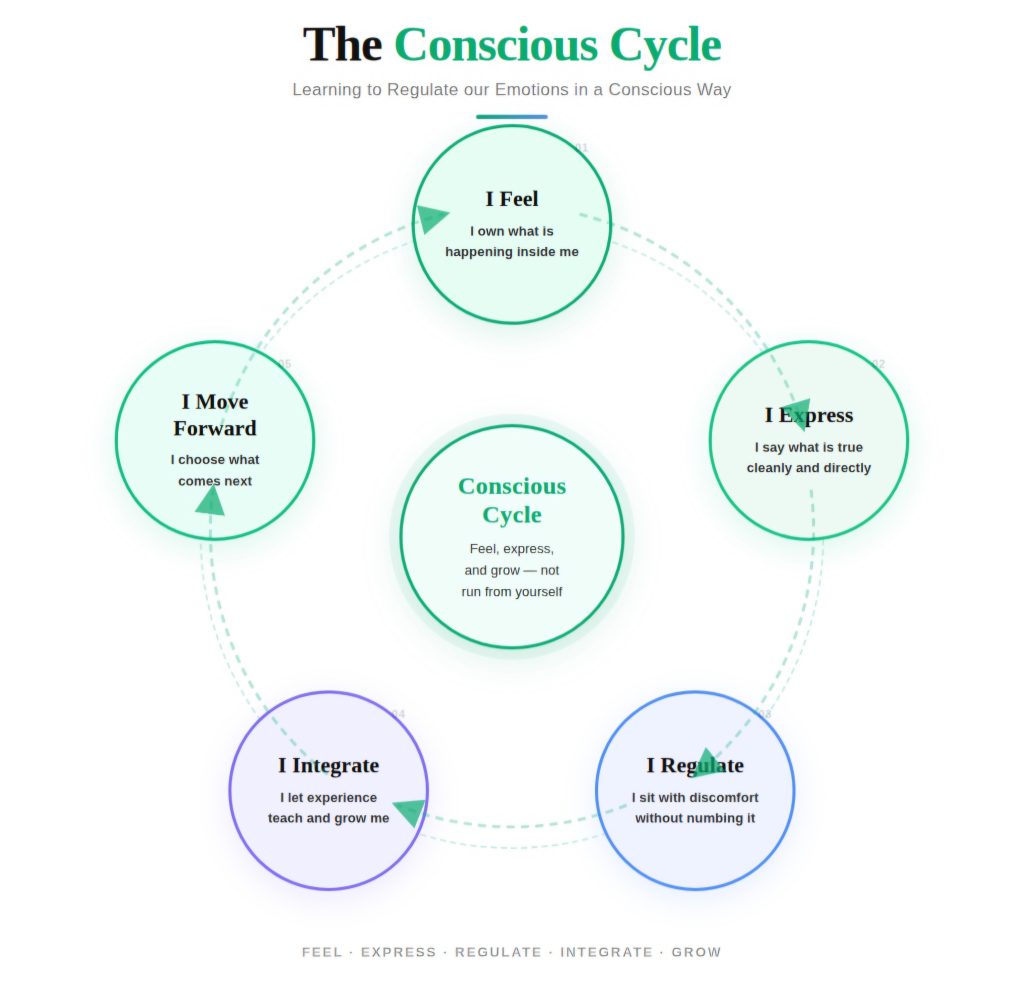
The Addictive Cycle Runs on Avoidance — The Conscious Cycle Runs on Presence
One choice separates them.
Feel it — or flee it.
1. I Feel — Instead of Blame
Something hurts. I own it.
“I am feeling hurt right now.”
No blame. No victim story. Just honest contact with what is.
2. I Express — Instead of Demand
I say what is true for me. Cleanly. Directly.
“I need space right now” or “This matters to me.”
Real expression creates connection. Demands create war.
3. I Regulate — Instead of Medicate
I breathe. I move. I sit with the discomfort.
“This feeling is temporary. I can handle it.”
You do not need to numb what you can actually survive.
4. I Integrate — Instead of Bury
I let the experience teach me something.
“What is this showing me about myself?”
Every hard feeling carries a message. Integration means you receive it.
5. I Move Forward — Instead of Stay Stuck
The feeling passed. I learned. I grow.
“I am not my emotions. I am the one who feels them.”
This is freedom. Not the absence of pain — but the ability to move through it.
The Conscious Cycle Is Not Weakness — It Is the Hardest Thing You Will Ever Do
Anyone can react.
It takes real strength to feel, express, regulate, integrate, and grow.
You Already Know How to Run the Old Cycle
Now you know the new one.
Choose it. Every single time. That is the whole practice.

You Are Not Broken — You Are Stuck in a Loop
Most people think their problem is outside them.
It is not.
You are running the same cycle on repeat. And it is costing you everything.
The Cycle Has Five Moves — And You Know Them All
1. You Blame — And Hand Your Power Away
Something hurts. Someone must be responsible.
“Look what you made me do.”
The moment you blame — you become powerless.
2. You Demand — And Fight Reality
Blaming was not enough. Now you need the world to change.
“Everything should go my way.”
Fighting reality is a war you will never win.
3. You Medicate — And Numb the Signal
The pain is still there. So you kill it.
Food. Alcohol. Screens. Sex. Drama. Busyness.
You are not solving the problem. You are muting the alarm.
4. You Bury — And Build a Story Around It
Now you wrap it all in a narrative.
“I am the victim. They are the villain.”
The story feels true. It is a prison.
5. You Get Stuck — And Call It Your Identity
The cycle solidifies. The problem becomes who you are.
“This is just how I am.”
No. This is just what you keep doing.
The Real Name for This Cycle Is Self-Sabotage
Every step feels like relief.
None of it actually regulates you.
You are not managing your emotions. You are avoiding them.
The Exit Is Always the Same
Stop blaming. Stop demanding. Stop numbing.
Feel the feeling. Name it. Let it move through you.
That is it. That is the whole answer.
Conscious Regulation Is a Skill — Not a Gift
Nobody is born doing this well.
But anyone can learn it.
The cycle ends the moment you choose to feel instead of flee.
THIS IS EXACTLY WHAT A HOE IS – AND HERE ARE THE 10 REAL-LIFE SITUATIONS WHERE THE LABEL STRIKES WITH FORCE
A hoe is the raw, unfiltered slang term our culture hurls at anyone—most often women—who dares to move through life with open, unapologetic sexual expression outside the narrow rules of commitment, restraint, or societal approval. It’s not about the number of partners or the nature of the encounters; it’s about the audacity to treat desire as a living, breathing force rather than something to be locked away until the “right” relationship arrives. This label packs centuries of fear, control, and projection into two syllables, designed to shame, diminish, and pull people back into line.
Yet the moment you see it for what it is—a mirror reflecting other people’s discomfort with untamed aliveness—you stop letting it define you. Here are ten crystal-clear, everyday situations where the word drops like a bomb, making the concept impossible to ignore:
The woman fresh out of a long-term relationship who dives into casual dating is branded a hoe by her inner circle.
Like when 29-year-old Lina ended a draining engagement and started exploring fun, no-strings connections on dating apps that made her feel desired and electric again, only for her longtime friends to text behind her back that she had “turned into such a hoe,” their words dripping with envy for the freedom they secretly craved but never claimed.
The confident individual who shares sensual self-portraits online hears the hoe label from family and followers.
Picture Tara, who finally stopped hiding her body after years of shame and began posting artistic, empowering photos that celebrated her curves and radiance, inspiring thousands—yet her relatives and random commenters immediately called her a hoe, unable to handle the sight of a woman owning her sensuality in public.
The partygoer who flirts openly and dances with abandon at social events gets tagged as a hoe.
Consider Maya at a rooftop gathering, moving her body freely to the beat, exchanging charged banter and magnetic eye contact with whoever matched her energy, fully alive in the moment—only for the more reserved guests to whisper by the bar that she was acting like a total hoe for refusing to play it safe.
The single person maintaining several friends-with-benefits arrangements is called a hoe.
Envision Priya, who kept a handful of mutually respectful, ongoing physical connections while pouring her focus into her career and self-growth, never pretending any of it was heading toward forever—yet colleagues who caught wind through mutual friends started labeling her a hoe, their judgment laced with their own frustration at staying stuck in monogamous routines that no longer fit.
The woman who openly discusses her enjoyment of casual hookups faces the hoe accusation in conversations.
Think of Sofia during a girls’ night, speaking honestly about how liberating and joyful safe, consensual one-night stands felt for her right now—only for the group vibe to shift as someone muttered that she was such a hoe, exposing the unspoken rule that desire should stay hidden or wrapped in guilt.
The individual who dresses in bold, sexy attire for a night out is labeled a hoe by observers.
See Elena slipping into a stunning outfit that hugged every curve and radiated confidence as she headed to the club with friends, owning her presence completely—only for strangers and even some acquaintances to comment under their breath that she was dressed like a hoe, their stares revealing more about their own repressed fire than her choices.
The person engaged in polyamorous or open dynamics gets the hoe stamp from traditional circles.
Imagine Rina navigating deep, honest connections with multiple partners through clear communication and respect, refusing the idea that one person must meet every need—yet her extended family dismissed her entire lifestyle as that of a hoe the moment they heard, their discomfort exposing their inability to fathom mature relational freedom.
The vocal advocate for her own high sex drive encounters the hoe label in professional or social settings.
Like when Nia casually mentioned over lunch with coworkers that she had a strong libido and enjoyed exploring it responsibly, normalizing healthy appetite—only for the water-cooler talk afterward to brand her a hoe, proving that even naming desire out loud can trigger collective repression.
The ex-partner spreading rumors after a messy breakup deploys the hoe narrative to regain control.
Consider Dara, whose former boyfriend, stung by the split, exaggerated stories of her sexual history to mutual friends in order to paint her as a hoe and soothe his ego—a classic move that turns private heartbreak into public ammunition.
The woman who prioritizes personal adventures and variety over early commitment is dubbed a hoe by peers pressuring her to settle.
Visualize Aisha at 34, traveling, building her empire, and allowing romantic and physical experiences to unfold naturally without rushing toward marriage or kids—only for her peer group, already locked into traditional timelines, to start calling her a hoe for daring to live on her own terms.
These ten moments aren’t random. They reveal that the label “hoe” is rarely about the person it’s aimed at. It’s a spotlight on the fears, envy, and outdated rules of the people wielding it.
THE WORD HOE IS THOUSANDS OF YEARS OLD — AND IT WAS ALWAYS A WEAPON TO SHAME WOMEN INTO SUBMISSION
Yes. “Hoe” comes straight from the ancient word “hore.”
It is not some fresh slang invented on the streets. It is the direct modern evolution of Old English “hore” — the exact same term used over a thousand years ago to brand women who dared to express open sexuality, desire, or independence. By the 12th century, “hore” already meant prostitute, adulteress, or any woman who refused to keep her desire locked behind marriage and modesty. The pronunciation shifted in African American Vernacular English into “ho,” then got spelled “hoe” to match how it actually sounds — same word, updated outfit.
This is the raw historical truth that most people never say out loud. The label has always served one core purpose: to control and diminish female aliveness. From “hore” to “whore” to “harlot” to “slut” to “hoe,” society keeps recycling the same linguistic weapon. Every era finds a new spelling or accent, but the intention never changes — shame her, isolate her, make her smaller so the old rules feel safe again.
Understanding this etymology is pure liberation.
When you realize the word attacking you is literally medieval, it loses its sting. You stop taking it personally and start seeing it for what it is: recycled fear projected onto your body and your choices. It was never about your worth. It was always about other people’s discomfort with untamed feminine power.
This knowledge flips the script in real time.
Next time someone throws “hoe” at you or at another woman living boldly, you hear the echo of centuries of control instead of a personal attack. You feel the weight of history trying to pull you backward — and you smile, because you now choose to walk forward anyway. You become the woman who breaks the ancient chain by refusing to carry the shame that was never yours to begin with.
Own this truth and watch your power expand.
You are not a product of modern drama. You are standing at the end of a long line of women who were called the same thing in different languages. Some shrunk. Some burned. You get to do something different — you get to rise, unapologetic, fully expressed, and completely free. The word is ancient. Your freedom is brand new. Claim it.
THE WORD HOE EXPOSES SOCIETY’S DEEPEST INSECURITIES AROUND DESIRE—AND THAT CHANGES EVERYTHING
The moment you understand that the word is a weapon forged from other people’s unhealed wounds, you stop absorbing it as truth. People lash out with “hoe” because your freedom reminds them of everything they’ve denied themselves—every fantasy they buried, every urge they judged, every risk they never took. This is the uncomfortable truth that sets you free: the label says far more about their cage than your character. It’s cultural programming designed to keep desire quiet, contained, and convenient for everyone else.
When you see it clearly, the power flips. You no longer shrink to make others comfortable. You start asking sharper questions: Where am I still seeking approval through my choices? Whose voice is still living in my head telling me my desire is too much? That single shift turns the word from a wound into a mirror that accelerates your growth. You begin choosing your experiences from sovereignty instead of rebellion or shame, and suddenly the opinions of others lose their voltage.
This perspective doesn’t excuse anything—it empowers everything. It invites you to move through life with the kind of presence that makes labels bounce off you like water on flame.
SOMETIMES THE LABEL HITS A DEEPER PATTERN—AND THAT’S YOUR INVITATION TO LEVEL UP
While the word is often pure projection, there are moments when it points to a real pattern worth examining—not for shame, but for radical evolution. If your sexual choices are driven by a hunger for validation, a fear of true intimacy, or a way to outrun loneliness, the label can become a loud, uncomfortable alarm clock. The transformational truth: real power isn’t about proving you can sleep with whoever you want; it’s about choosing from wholeness instead of wounds.
When sex becomes a quick hit of validation instead of genuine connection, it’s time to pause and heal the root.
Picture the person who jumps from one partner to the next every time emotions get heavy, using physical closeness to feel wanted rather than facing the emptiness inside—until one day they sit alone, journal in hand, and realize they’ve been outsourcing their worth; they book the therapy session, start the inner work, and watch their choices become cleaner and more satisfying overnight.
When variety is used to avoid vulnerability, the pattern reveals itself through repeated emptiness.
Envision someone who keeps every encounter surface-level so no one can truly see them, only to wake up one morning feeling more alone than ever—the label stings, but it forces the honest conversation with self that leads to choosing depth over distraction.
When choices stem from rebellion rather than authentic desire, freedom remains an illusion.
Think of the woman who sleeps around purely to shock her strict upbringing, only to realize she’s still letting her family’s rules run her life from the inside out—until she drops the middle finger and starts choosing what actually lights her up, not what proves a point.
These patterns aren’t life sentences. They’re doorways. The moment you own them without self-attack, you step into a sexuality that feels expansive instead of exhausting.
CLAIM YOUR SEXUAL SOVEREIGNTY—THE PRACTICAL STEPS THAT TURN ANY LABEL INTO FUEL FOR YOUR RISE
You don’t transcend the label by arguing with it. You transcend it by becoming so rooted in your own truth that the word has nowhere to land. Here’s exactly how you do it, step by powerful step:
Define your erotic life from your own values, not anyone else’s script.
Sit down tonight, pen in hand, and write what truly turns you on, what feels honoring, and what drains you—then live from that list alone; the next time someone whispers the word, you smile because your choices already align with your soul.
Practice radical self-honesty before every intimate encounter.
Ask yourself in the moment: Am I here because I genuinely desire this, or am I chasing a feeling I haven’t learned to give myself? That single pause transforms casual sex from escape into conscious celebration.
Build a private world of pleasure that doesn’t need external validation.
Create rituals—sensual self-touch, erotic reading, movement practices—that remind your body it is already enough; suddenly the need to prove anything through partners dissolves.
Surround yourself with people who celebrate desire instead of policing it.
Audit your circle: keep the ones who cheer your freedom and release the ones who shrink at the sight of it; your environment either fans your fire or tries to snuff it out.
Speak your desires aloud without apology in safe spaces.
Practice voicing what you want in low-stakes conversations—your voice gets stronger, your shame gets quieter, and the word “hoe” loses every ounce of its former power.
Turn the label into a reminder of your courage every single time it appears.
When it lands, smile and say silently to yourself, “Thank you for noticing I’m living boldly”—then keep moving forward, because your life is no longer up for public vote.
This is not theory. This is the practical path that turns every uncomfortable truth into unstoppable momentum. You are not a hoe. You are a force of conscious desire moving through the world with eyes wide open. The label was never yours to carry. Your power was always yours to claim. Now go live like it.
EMDR DOES NOT ERASE YOUR PAST — IT UPDATES HOW YOUR NERVOUS SYSTEM STORES IT
EMDR stands for Eye Movement Desensitization and Reprocessing — a therapeutic approach developed in the late 1980s by psychologist Francine Shapiro, who discovered that certain eye movements could reduce the emotional intensity of distressing thoughts.
At its core, EMDR is a structured process where you briefly focus on a memory while engaging in bilateral stimulation — usually guided eye movements, tapping, or alternating sounds — which helps your brain reprocess the experience in a new, more integrated way.
A typical session follows a clear flow: you identify a specific memory, notice the emotions and body sensations connected to it, and then follow the therapist’s guidance through sets of eye movements or tapping while allowing whatever arises to move through your system. Over time, the memory loses its emotional charge and becomes something you remember without being controlled by.
Your past is not the problem. The way it is stored in your nervous system is.
And EMDR targets exactly that.
TRAUMA IS NOT THE EVENT — IT IS THE MEMORY THAT GOT STUCK
This is where everything shifts.
Two people can go through the same experience — one moves forward, the other carries it for years.
Why?
Because trauma is not defined by what happened — it is defined by whether your system was able to process, integrate, and release it.
- Your brain can “freeze” a moment in time when overwhelmed.
You react to a current situation as if it is still happening, even though it’s long gone. - Your body holds emotional charge long after the event is over.
You feel anxiety, tension, or fear without fully understanding why. - Your perception becomes shaped by unprocessed memory.
“I’m not safe,” “I’m not enough,” or “I’ll be rejected,” even when reality says otherwise.
You are not reacting to the present — you are reacting to an unresolved past stored in your system.
EMDR USES BILATERAL STIMULATION TO UNLOCK STUCK PATTERNS
This is the mechanism that makes EMDR unique.
Through guided eye movements or alternating left-right stimulation, EMDR activates both hemispheres of the brain — allowing the memory to be reprocessed instead of replayed.
It’s not about forcing insight.
It’s about creating the conditions where your brain can naturally reorganize what was fragmented.
- You recall a memory while your brain is in a processing state.
You think about an experience while following guided eye movements or tapping. - The emotional charge begins to shift without effort.
A memory that felt intense starts to feel distant, neutral, or resolved. - New perspectives emerge without forcing them.
Instead of “I was powerless,” you naturally feel, “I handled what I could.”
This is not intellectual understanding — this is neurological transformation.
EMDR BYPASSES OVERTHINKING AND WORKS DIRECTLY WITH THE BODY
Talking therapy can sometimes keep you in the loop of analysis.
EMDR moves deeper — into the body, the nervous system, the implicit memory layer.
Because trauma is not stored as a story.
It is stored as sensation, emotion, and fragmented perception.
- You don’t need to explain everything for it to shift.
You can process experiences even if you don’t have the full narrative. - Your body releases stored tension as the memory integrates.
You might feel waves of emotion, relaxation, or shifts in breathing. - Your system moves from survival to regulation.
What once triggered you no longer has the same grip.
Healing happens when the body catches up to the present moment.
EMDR CREATES FREEDOM BY REMOVING THE EMOTIONAL CHARGE
The goal is not to forget what happened.
The goal is to remember without being controlled by it.
- You can recall the memory without intense emotional activation.
It becomes a fact, not a trigger. - You stop reacting automatically to similar situations.
You respond consciously instead of being pulled into old patterns. - You regain choice where there was once compulsion.
You act from presence instead of conditioning.
This is what real freedom feels like — the past no longer runs your present. 🔓
EMDR IS NOT JUST FOR “BIG TRAUMA” — IT REWIRES EVERYDAY PATTERNS
You don’t need extreme experiences for EMDR to be powerful.
Subtle moments — rejection, criticism, emotional neglect — can create deep imprints over time.
- You can process repeated micro-experiences that shaped your identity.
Moments like being ignored, dismissed, or misunderstood. - You can dissolve patterns like anxiety, insecurity, or avoidance.
Not by managing them, but by resolving their root. - You can upgrade your internal beliefs at a deep level.
Shifting from “I’m not enough” to a felt sense of worth.
Small moments, repeated over time, create big patterns — and EMDR can unwind them.
EMDR REQUIRES SAFETY, GUIDANCE, AND READINESS
This is powerful work — and it needs to be done with awareness.
Not every moment is the right moment to open deep layers.
- You need a regulated environment to process safely.
A trained practitioner helps guide and contain the experience. - You need enough internal stability to engage the process.
If your system is overwhelmed, preparation comes first. - You need integration after each session.
Insights, shifts, and emotional releases need space to settle.
This is not about rushing healing — it’s about allowing it to unfold intelligently.
EMDR IS A DOORWAY — BUT YOU STILL WALK THE PATH
Here’s the deeper truth.
EMDR can unlock, release, and rewire.
But what you do after that — how you live, choose, relate — determines the real transformation.
- You must embody the new patterns that emerge.
Acting differently when old triggers no longer control you. - You must make new choices aligned with your updated state.
Speaking up, setting boundaries, moving forward. - You must reinforce the new identity through action.
Becoming someone who lives from clarity, not from past wounds.
Healing is not just what you process — it is what you become after you process it. 🔥
ANTA NINDA IS NOT JUST NEGATIVE THINKING — IT IS SELF-DIRECTED VIOLENCE DISGUISED AS AWARENESS
You think you’re being honest with yourself.
You think you’re being accountable, reflective, even “high standard.”
But look closer.
That voice inside you—the one that criticizes, judges, shames, blames—it is not refining you. It is eroding you from within while pretending to make you better.
ANTA NINDA is not growth.
It is self-inflicted contraction, repeated so often that it starts to feel normal, justified, even necessary.
And the deeper truth is this:
You don’t sabotage your life because you lack potential—you sabotage it because your inner voice keeps attacking the very parts of you that need support to expand.
ANTA NINDA CREATES A LOOP WHERE YOU ATTACK YOURSELF AND THEN LOSE TRUST IN YOURSELF
Every time you judge yourself harshly, something subtle but powerful happens.
You don’t just feel bad—you weaken your internal foundation.
You create doubt. Hesitation. Fragmentation.
And then you wonder why you don’t act, why you don’t follow through, why you feel stuck.
- YOU BREAK YOUR OWN MOMENTUM THROUGH INTERNAL CRITICISM
You start something with energy, then tear yourself down mid-way.
Example: You’re writing, creating, or building something, and suddenly your mind says, “This is not good enough,” and you stop completely. - YOU CREATE SHAME AROUND YOUR NATURAL HUMAN EXPERIENCE
Instead of allowing imperfection, you punish it.
Example: You feel nervous before a conversation and think, “Why am I like this? I should be more confident,” which adds pressure instead of grounding. - YOU LOSE TRUST IN YOURSELF BECAUSE YOU CONSTANTLY INVALIDATE YOUR OWN PROCESS
You become your own enemy instead of your ally.
Example: You make a decision, then immediately question it, doubt it, and second-guess yourself repeatedly.
ANTA NINDA doesn’t just hurt your feelings—it dismantles your ability to move forward with power.
ANTA NINDA SHOWS UP IN SPECIFIC, REPEATABLE SELF-SABOTAGE PATTERNS
This is not random. It has structure. It has rhythm. It has patterns that repeat across your life.
Once you see them clearly, you can no longer pretend they are invisible.
- YOU ATTACK YOURSELF RIGHT AFTER A MISTAKE INSTEAD OF LEARNING FROM IT
You turn a moment into an identity.
Example: You say something awkward, and instead of moving on, you think, “I always mess things up,” replaying it for hours. - YOU PRE-REJECT YOURSELF BEFORE ANYONE ELSE CAN
You lower your own value before stepping forward.
Example: You don’t approach someone you’re interested in because your mind says, “They probably won’t be interested anyway.” - YOU USE HARSH SELF-TALK AS A WAY TO CONTROL YOUR BEHAVIOR
You believe pressure creates performance.
Example: You tell yourself, “If I don’t push harder, I’ll never succeed,” using fear as motivation. - YOU INVALIDATE YOUR SUCCESS AND FOCUS ONLY ON WHAT’S MISSING
You cannot fully receive your own growth.
Example: You achieve something meaningful, but your mind says, “It’s not that impressive,” minimizing your progress.
This is not discipline. This is self-sabotage wearing the mask of high standards.
ANTA NINDA IS ROOTED IN A FALSE BELIEF THAT HARSHNESS CREATES GROWTH
Somewhere along the way, you learned that being hard on yourself makes you better.
That if you relax, accept, or appreciate yourself, you will become lazy, weak, or complacent.
This belief is deeply ingrained—and deeply flawed.
Because growth does not come from attack.
It comes from clarity, awareness, and aligned action supported by inner stability.
- HARSHNESS CREATES TENSION, NOT EXPANSION
You tighten instead of opening.
Example: You try to “push through” fatigue with criticism instead of adjusting and recovering. - SELF-ATTACK REDUCES YOUR CAPACITY TO TAKE RISKS
You avoid situations where you might fail because failure feels too painful internally.
Example: You don’t start something new because you know how brutal your inner voice will be if it doesn’t go well. - YOU BECOME ADDICTED TO FIXING YOURSELF INSTEAD OF EXPRESSING YOURSELF
Your focus shifts from creation to correction.
Example: You spend more time analyzing what’s wrong with you than actually building your life.
You don’t grow through punishment—you grow through aligned, supported expansion.
THE WAY OUT OF ANTA NINDA IS NOT POSITIVE THINKING — IT IS RADICAL SELF-ALIGNMENT 🔱
You don’t overcome this by pretending everything is fine.
You overcome it by changing your relationship to your own mind, your own voice, your own internal environment.
- YOU INTERRUPT THE PATTERN THE MOMENT IT STARTS
You don’t let the spiral build momentum.
Example: When you hear, “I’m not good enough,” you immediately pause and say, “That’s a thought, not a fact.” - YOU SHIFT FROM JUDGMENT TO OBSERVATION WITHOUT LOSING HONESTY
You stay real without being destructive.
Example: Instead of “I failed,” you say, “That didn’t work, what can I adjust?” - YOU SPEAK TO YOURSELF LIKE A HIGH-LEVEL ALLY, NOT AN INTERNAL ENEMY
You upgrade the tone without losing clarity.
Example: You say, “You can do better, and I’ve got you,” instead of “You’re not enough.” - YOU BUILD SELF-TRUST THROUGH CONSISTENT FOLLOW-THROUGH
You prove to yourself that you can rely on your own word.
Example: You commit to something small and execute it fully, reinforcing internal stability.
The goal is not to silence your mind—it is to transform it into a force that supports your expansion.
ANTA NINDA DISTORTS YOUR SEXUAL EXPRESSION AND DISCONNECTS YOU FROM YOUR BODY 🔥
Sex is one of the most sensitive mirrors of your inner dialogue, because it reveals instantly whether you are present, open, and connected—or self-conscious, critical, and fragmented.
When ANTA NINDA enters your sexual space, it turns intimacy into performance, comparison, and subtle pressure.
- YOU JUDGE YOUR PERFORMANCE INSTEAD OF FEELING YOUR EXPERIENCE
You leave your body and enter evaluation mode.
Example: You think, “Am I good enough? Are they satisfied?” instead of actually feeling pleasure. - YOU SUPPRESS DESIRE OR BOUNDARIES OUT OF SHAME OR FEAR OF REJECTION
You disconnect from your truth to maintain approval.
Example: You say yes when you’re not fully aligned, or stay silent about what you truly want. - YOU ATTACH YOUR WORTH TO YOUR SEXUAL EXPRESSION
You turn intimacy into validation.
Example: If the experience feels off, you think, “There’s something wrong with me,” instead of exploring the dynamic.
Freedom in sex comes when you replace self-judgment with self-presence.
ANTA NINDA UNDERMINES YOUR MONEY FLOW AND SUCCESS CAPACITY 💰
Money and success amplify your inner patterns—they don’t create them.
If your internal voice is critical, doubtful, and harsh, it will directly limit your ability to expand, take risks, and sustain growth.
- YOU DOWNPLAY YOUR VALUE AND UNDERCHARGE OR UNDERPERFORM
You shrink before the world even challenges you.
Example: You hesitate to ask for higher payment because you think, “Am I really worth that?” - YOU SELF-SABOTAGE OPPORTUNITIES THROUGH DOUBT AND OVERTHINKING
You stall instead of moving.
Example: You delay launching something because it’s “not ready yet,” even though it already is. - YOU CREATE AN INTERNAL CEILING YOU DON’T ALLOW YOURSELF TO CROSS
You unconsciously limit your expansion.
Example: As soon as things start going well, you find reasons to slow down or question everything.
Your external success will always mirror your internal permission to expand.
ANTA NINDA DISTORTS YOUR RELATIONSHIP WITH YOUR BODY AND ENERGY
Your body is not just physical—it is energetic, expressive, alive.
But when ANTA NINDA enters, the body becomes an object of criticism instead of a space of power and presence.
- YOU CONSTANTLY SCAN FOR WHAT IS “WRONG” INSTEAD OF FEELING WHAT IS ALIVE
You observe through judgment, not awareness.
Example: You look in the mirror and immediately focus on what needs fixing. - YOU DISCONNECT FROM YOUR BODY WHEN IT DOESN’T MATCH YOUR IDEAL
You withdraw instead of engaging.
Example: You avoid situations where your body is seen because you feel self-conscious. - YOU PUSH YOUR BODY THROUGH PRESSURE INSTEAD OF SUPPORTING IT THROUGH ALIGNMENT
You treat it like a problem to solve.
Example: You force routines or habits from criticism instead of listening to what your body actually needs.
Your body opens when it feels respected, not when it is constantly judged.
ANTA NINDA BLOCKS YOUR SOCIAL EXPRESSION AND NATURAL CHARISMA
Social life is where your internal voice becomes visible in real time—because connection requires presence, openness, and self-trust.
When ANTA NINDA is active, you second-guess yourself before, during, and after every interaction.
- YOU OVERTHINK WHAT TO SAY AND LOSE YOUR NATURAL FLOW
You become calculated instead of spontaneous.
Example: You hesitate to speak because you’re trying to find the “perfect” thing to say. - YOU REPLAY INTERACTIONS AND CRITICIZE YOURSELF AFTERWARD
You relive moments instead of integrating them.
Example: You think, “I sounded weird,” or “I should have said something else,” long after the moment is gone. - YOU HOLD BACK YOUR FULL EXPRESSION OUT OF FEAR OF JUDGMENT
You filter yourself excessively.
Example: You don’t share your ideas, humor, or energy because you’re unsure how it will be received.
Charisma is not something you build—it is something you allow when self-judgment dissolves.
ANTA NINDA SHAPES YOUR FAMILY DYNAMICS AND KEEPS OLD IDENTITIES ALIVE
Family is often where ANTA NINDA was first installed, reinforced, and normalized.
And without awareness, you keep playing the same role, the same identity, the same patterns—even as an adult.
- YOU REGRESS INTO OLD PATTERNS WHEN YOU ARE AROUND FAMILY
You become who you used to be instead of who you are now.
Example: You feel smaller, less confident, or more reactive around certain family members. - YOU INTERNALIZE THEIR VOICES AND TURN THEM INTO YOUR OWN SELF-TALK
Their judgment becomes your inner dialogue.
Example: You hear their criticism in your head even when they are not present. - YOU SEEK APPROVAL OR VALIDATION IN WAYS THAT KEEP YOU STUCK
You stay in old dynamics to maintain connection.
Example: You avoid expressing your truth because you don’t want to disrupt the relationship.
Freedom begins when you recognize that their voice is not your truth anymore.
THE ULTIMATE SHIFT IS REALIZING THAT YOUR INNER VOICE SHAPES YOUR REALITY
Every thought you repeat becomes a pattern.
Every pattern becomes a behavior.
Every behavior shapes your life.
And if your internal environment is built on shame, guilt, judgment, and blame, then no matter how much potential you have, you will keep shrinking yourself unconsciously.
But the moment you shift—
The moment you become aware, intentional, and aligned with how you speak to yourself—
Everything begins to change.
Because the most powerful truth is this:
You don’t need more motivation. You need a better relationship with yourself. 🔥
AGENCY IS NOT CONTROL — IT IS THE ABILITY TO CHOOSE YOUR RESPONSE NO MATTER THE CONDITIONS
Most people confuse agency with control, thinking that power means shaping the world exactly as they want it.
But control is fragile. It depends on circumstances, on people behaving a certain way, on outcomes aligning perfectly.
Agency is different.
Agency is the ability to remain the author of your actions, your energy, and your direction—even when reality doesn’t cooperate.
You don’t need everything to go your way to stay powerful.
You only need to stay aligned with your choices.
CONTROL TRIES TO DOMINATE REALITY — AGENCY NAVIGATES IT WITH CLARITY AND STRENGTH
Control is rigid. It resists uncertainty. It tries to eliminate variables.
Agency is adaptive. It works with reality, not against it. It doesn’t collapse when things change—it recalibrates.
- CONTROL DEMANDS CERTAINTY BEFORE MOVING FORWARD
You wait until everything is clear, safe, and predictable.
Example: You delay taking action because “it’s not the right time yet.” - AGENCY MOVES EVEN WHEN CONDITIONS ARE IMPERFECT
You act with what you have, where you are.
Example: You start the project, initiate the conversation, or make the decision despite incomplete clarity. - CONTROL SEEKS TO ELIMINATE RISK — AGENCY LEARNS THROUGH ACTION
One avoids discomfort, the other grows through it.
Example: Instead of avoiding rejection, you approach, express, and refine through experience.
Control tries to freeze reality. Agency dances with it.
POWER IS YOUR ENERGY — AGENCY IS HOW YOU DIRECT IT
Power is raw. It is presence, intensity, life force, confidence.
But power without agency can become chaotic, overwhelming, or even destructive.
Agency gives direction to power. It channels it into intentional action.
- POWER WITHOUT AGENCY CAN OVERWHELM OR DOMINATE
You come in strong but lack precision or awareness.
Example: You express yourself intensely but leave confusion or pressure in your wake. - AGENCY FOCUSES POWER INTO CLEAR, CLEAN ACTION
You know when to move, when to pause, when to speak, when to hold.
Example: You feel strong emotion but choose a grounded, precise way to communicate it.
Power is the force. Agency is the steering wheel.
LEADERSHIP INFLUENCES OTHERS — AGENCY ENSURES YOU DON’T LOSE YOURSELF WHILE DOING IT
A leader can guide, inspire, and move people—but without agency, leadership becomes dependent on external validation.
You start leading to be liked, to be approved, to maintain harmony.
Agency keeps your leadership clean.
- LEADERSHIP WITHOUT AGENCY SEEKS APPROVAL
You adjust your direction based on how others respond.
Example: You soften your message because you fear losing support. - AGENCY-DRIVEN LEADERSHIP STAYS TRUE EVEN UNDER PRESSURE
You hold your direction even when it’s uncomfortable.
Example: You speak your truth clearly, even if it challenges the room.
True leadership is not about being followed—it is about being anchored.
VISION SEES THE FUTURE — AGENCY BRINGS IT INTO REALITY 🔱
Vision is powerful. It gives direction, meaning, inspiration.
But vision without agency is fantasy.
Agency is what translates vision into movement, into decisions, into consistent action.
- VISION WITHOUT AGENCY STAYS IN THE MIND
You imagine, dream, plan—but nothing materializes.
Example: You talk about what you want to build, but never take concrete steps. - AGENCY TURNS VISION INTO DAILY ACTION
You bring the future into the present through execution.
Example: You break your vision into actions and move on them consistently, regardless of mood.
Vision inspires. Agency manifests.
MASTERY REFINES YOUR SKILL — AGENCY DETERMINES WHETHER YOU USE IT OR NOT
Mastery is about depth, repetition, precision, and the gradual refinement of your ability over time.
You can master communication, business, relationships, health, or any domain—but here is the uncomfortable truth most people avoid:
You can be highly skilled and still be inactive, avoidant, or inconsistent if you lack agency.
Agency is what activates mastery. It is what brings your capacity into the world instead of leaving it dormant inside you.
- MASTERY WITHOUT AGENCY STAYS THEORETICAL OR INCONSISTENT
You know what to do, but you don’t always do it when it matters.
Example: You understand communication deeply, yet in moments of tension, you still avoid the conversation or collapse into old patterns. - AGENCY ENSURES YOUR MASTERY IS EXPRESSED IN REAL TIME
You bring your skills online exactly when they are needed.
Example: You feel triggered, yet you consciously apply everything you’ve learned and communicate with clarity instead of reacting. - MASTERY BUILDS CAPACITY — AGENCY DECIDES EXECUTION
One expands what you can do, the other determines what you actually do.
Example: You may have the skill to lead, but agency is what makes you step forward and take responsibility in the moment.
Mastery makes you capable. Agency makes you effective.
HAVING AGENCY LOOKS LIKE THIS IN REAL LIFE
Agency is not abstract—it is visible in how you move, decide, and respond every single day.
- YOU MAKE DECISIONS WITHOUT OVER-DELEGATING YOUR AUTHORITY
You don’t constantly seek permission or validation before acting.
Example: Instead of asking five people what you should do, you gather input and then choose. - YOU TAKE RESPONSIBILITY FOR YOUR STATE INSTEAD OF BLAMING CIRCUMSTANCES
You own your energy, even when things are not ideal.
Example: You feel off, but instead of blaming the situation, you regulate, reset, and re-engage. - YOU INITIATE INSTEAD OF WAITING TO BE CHOSEN OR INVITED
You move first when it matters.
Example: You start the conversation, propose the idea, or create the opportunity instead of waiting. - YOU HOLD YOUR DIRECTION EVEN WHEN OTHERS ARE UNCERTAIN
You don’t collapse because others hesitate.
Example: You continue moving forward with clarity even if people around you are indecisive.
Agency is visible in movement, not in intention.
YOU BUILD AGENCY BY TRAINING YOURSELF TO ACT FROM ALIGNMENT, NOT EMOTION
Agency is not something you either have or don’t have—it is something you develop through consistent practice.
- YOU CREATE A GAP BETWEEN IMPULSE AND ACTION
You pause before reacting.
Example: You feel triggered, but instead of responding immediately, you take a breath and choose consciously. - YOU COMMIT TO FOLLOWING THROUGH ON YOUR OWN DECISIONS
You build trust with yourself.
Example: You say you will do something, and you do it—especially when you don’t feel like it. - YOU EXPOSE YOURSELF TO DISCOMFORT ON PURPOSE
You train your nervous system to stay stable under pressure.
Example: You initiate difficult conversations instead of avoiding them. - YOU REDUCE DEPENDENCY ON EXTERNAL VALIDATION
You stop outsourcing your authority.
Example: You make choices based on alignment, not approval.
Agency grows every time you choose alignment over comfort.
THE MOMENT YOU FULLY CLAIM AGENCY, YOUR LIFE STOPS BEING A REACTION AND STARTS BEING A CREATION 🔥
You stop waiting.
You stop blaming.
You stop hesitating.
And you start moving with clarity, precision, and intent.
Because the truth is simple, direct, and powerful:
You don’t need more time, more certainty, or more permission.
You need to decide—and then act like that decision matters.
Kala Jadu is not superstition — it is misunderstood power
Kala Jadu is not just “black magic.”
It is raw intention amplified through fear, belief, ritual, and subconscious force.
The real danger is not the ritual.
The real danger is unconsciousness.
Most people don’t suffer because someone did Kala Jadu on them.
They suffer because they believe they are powerless.
Power never harms the awake.
It only feeds on the unaware.
Fear is the real fuel behind Kala Jadu
Kala Jadu feeds on fear, obsession, jealousy, resentment, and fixation.
When fear is strong, the nervous system opens.
When belief locks in, the mind creates reality.
The spell works only if the door is open.
No fear.
No obsession.
No fixation.
No entry.
Most Kala Jadu is psychological, not mystical
Harsh truth:
90% of so-called Kala Jadu is psychological suggestion combined with emotional trauma.
Someone plants an idea.
The mind repeats it.
The body reacts.
The nervous system collapses.
Boom.
The “spell” appears real.
Awareness breaks it instantly.
True Kala Jadu cannot touch someone rooted in presence
A grounded nervous system is spiritual armor.
Someone who breathes deeply.
Someone who stands in truth.
Someone who owns their shadow.
Untouchable.
Kala Jadu collapses in the presence of clarity.
Darkness dissolves when it is seen.
Protection is not rituals — it is embodiment
People run to charms, lemons, threads, mantras.
Those help… a little.
But real protection comes from:
- Strong boundaries
- Emotional regulation
- Embodied confidence
- Clear intention
- Self-trust
A person who knows who they are does not leak energy.
No leaks.
No hooks.
No manipulation.
Kali, Bhairav, and awareness dissolve Kala Jadu instantly
Fierce consciousness destroys subtle manipulation.
Kali cuts illusion.
Bhairav guards thresholds.
Awareness burns deception.
Not because of belief.
But because fear cannot coexist with presence.
These energies don’t fight darkness.
They expose it.
And exposed darkness dies.
The shadow must be integrated, not denied
People obsessed with Kala Jadu often deny their own shadow.
Jealousy.
Rage.
Desire.
Control.
Suppressed shadow looks for external enemies.
Integrated shadow becomes power, intuition, magnetism.
What you own cannot be used against you.
Kala Jadu loses power when you stop outsourcing responsibility
The moment you say:
“Someone did this to me”
You give away your throne.
The moment you say:
“I take responsibility for my energy”
You reclaim sovereignty.
Power returns instantly.
Strong people are boring to dark manipulation
Dark manipulation looks for drama.
Chaos.
Fixation.
Emotional loops.
A calm, present, embodied human is… boring.
No hooks.
No reaction.
No fuel.
Nothing sticks.
The real antidote is radical self-trust
Trust your body.
Trust your intuition.
Trust your breath.
Stop scanning for threats.
Stop feeding fear stories.
Stop giving power to whispers.
Clarity is louder than any spell.
Kala Jadu is a teacher, not an enemy
It teaches one thing:
Where fear lives, power is unclaimed.
Once claimed…
There is nothing to fight.
Nothing to protect against.
Nothing to fear.
Only presence.
Only truth.
Only power.
HAR HAR MAHADEV 🔱 JAYA KALI 🖤 JAYA BHAIRAV 🔥
NAME IT OUT LOUD WITHOUT STORY
Guilt, shame, and remorse gain power in silence. The moment you name the emotion plainly, without drama or explanation, it loses its grip. No autobiography. No justification. Just truth.
Saying “I feel shame” is radically different from saying “I am broken.”
One is information. The other is identity collapse.
Shadow emotions dissolve when they are seen without narrative.
SEPARATE THE EVENT FROM YOUR IDENTITY
Something happened. You are not that thing.
This is where most people get stuck. They fuse a single action, mistake, or moment with who they are. That fusion is what creates chronic shame.
An event is finite.
Identity is fluid.
When you separate the two, growth becomes possible again.
OWN THE ACTION, DROP THE SELF-ATTACK
Responsibility is clean. Self-attack is lazy.
Owning an action means saying: “Yes, I did that.”
Self-attack says: “I am terrible for doing that.”
One leads to power.
The other leads to paralysis.
Drop the inner violence. Keep the ownership.
EXTRACT THE LESSON, RELEASE THE EMOTION
Every shadow emotion carries data.
Once the lesson is extracted, the emotion has completed its job. Keeping it alive beyond that point is emotional hoarding.
Ask yourself: What did this teach me?
Apply the insight.
Then let the emotion go.
Holding on after the lesson is learned is not maturity — it’s attachment.
MAKE REPAIR OR MAKE PEACE — THEN MOVE ON
There are only two clean options after harm.
If repair is possible, do it fully.
If it’s not, make peace internally and release.
What destroys people is lingering in the in-between — endless regret without action.
Closure is an act of leadership over your inner world.
STOP PUNISHING YOURSELF AFTER THE MESSAGE IS RECEIVED
Pain is a messenger, not a prison guard.
Once the message is clear, continued punishment serves no purpose. It does not make you better. It makes you smaller.
Growth comes from course correction, not self-flagellation.
End the punishment cycle consciously.
RETURN TO THE PRESENT MOMENT IMMEDIATELY
Guilt lives in the past.
Shame lives in imagined judgment.
Power lives now.
The fastest way out of shadow is presence.
Feel your breath. Feel your body. Feel the ground.
The present moment has no interest in your old mistakes.
TRANSMUTE SHAME INTO RESPONSIBILITY
Shame says: “I am bad.”
Responsibility says: “I choose differently now.”
This is alchemy.
Responsibility restores dignity. It gives direction. It creates momentum.
Shame collapses energy. Responsibility mobilizes it.
Choose responsibility every time.
USE REMORSE AS A COURSE-CORRECTION, NOT A SENTENCE
Remorse is not meant to jail you.
It’s meant to recalibrate your compass.
Once direction is corrected, the feeling has served its function.
Do not confuse conscience with condemnation.
One guides. The other imprisons.
ACT FROM INTEGRITY NOW, NOT FROM REGRET THEN
The past cannot be rewritten.
The present can be embodied.
Integrity is not about being perfect — it’s about being aligned now.
Every clean action taken today weakens the grip of yesterday.
Shadow dissolves when life is lived forward with clarity.
DISQUALIFYING SOLUTIONS IS OFTEN A WAY TO AVOID CHANGE
One of the most efficient ways to avoid effort, responsibility, or growth is simple: invalidate the solution before it has a chance to touch you.
Instead of engaging, people dismiss.
Instead of exploring, they mock.
Instead of trying, they argue.
When someone suggests a solution that would require adaptation, discipline, humility, or discomfort, the nervous system looks for an exit. Mockery, dismissal, or over-rationalization becomes that exit. It creates distance. It shuts the door without having to say, “I’m afraid to change.”
MOCKERY IS NOT INTELLIGENCE — IT’S DEFENSE
People often confuse cynicism with sharpness. They believe that being sarcastic, ironic, or dismissive makes them insightful.
It doesn’t.
Mockery is rarely about the quality of the solution. It’s about protecting identity. If the solution works, then staying the same becomes a choice — and that’s confronting.
So the solution must be framed as naive, simplistic, unrealistic, or “not for people like me.”
Not because it’s false — but because it’s threatening.
DISQUALIFYING IDEAS PRESERVES COMFORT, NOT TRUTH
Real solutions create friction. They ask something of you. Time. Effort. Emotional maturity. Consistency.
Disqualifying them preserves the status quo.
It allows someone to stay exactly where they are while feeling intellectually superior.
This is why people say things like:
“Yeah, that sounds nice, but real life doesn’t work that way.”
“Sure, if you live in a fantasy world.”
“That might work for others, not for me.”
These statements sound rational. They’re actually avoidance dressed as realism.
MOCKING SOLUTIONS SHIFTS THE SPOTLIGHT AWAY FROM ACTION
As long as the conversation stays at the level of criticism, no action is required.
You don’t have to test anything.
You don’t have to fail.
You don’t have to be seen trying.
Mockery creates a safe spectator position. From there, you can comment on life without participating in it.
THE DEEPER FEAR IS BEING EXPOSED
Trying a solution means risking disappointment.
It means risking that the problem might not be external.
It means facing the possibility that change was available — but uncomfortable.
Mocking or dismissing the solution prevents that exposure.
If the idea is stupid, then not trying it is smart.
If the method is flawed, then staying stuck is justified.
WEAPONIZED SKEPTICISM KEEPS PEOPLE STUCK
Healthy skepticism asks questions.
Weaponized skepticism shuts things down.
It uses tone instead of curiosity.
It uses arguments instead of experiments.
It uses dismissal instead of exploration.
This doesn’t protect intelligence — it paralyzes growth.
PEOPLE WHO MOCK OR DISMISS SOLUTIONS OFTEN ENVY THOSE WHO APPLY THEM
Underneath the dismissal, there is often admiration mixed with resentment.
Seeing someone apply a solution and get results is confronting. It removes excuses. It proves movement is possible.
Mockery, disqualification, or endless argument is how people reduce that discomfort.
If they can make the solution look invalid, they don’t have to face their own inertia.
10 REAL-LIFE WAYS PEOPLE MOCK SOLUTIONS TO AVOID CHANGE
This pattern shows up everywhere — not just in self-help conversations.
Healthy eating:
Someone suggests eating whole foods, less sugar, more protein.
Response: “Life’s too short to eat like a monk.”
Going to the gym:
Someone commits to training three times a week.
Response: “Yeah, must be nice to have that much free time.”
Meditation or nervous system work:
Someone talks about regulating stress or emotions.
Response: “I don’t have time to sit and breathe all day.”
Couples therapy or coaching:
A couple explores guidance to improve intimacy.
Response: “If you need coaching, your relationship is already broken.”
Setting boundaries at work:
Someone stops overworking and says no more often.
Response: “That only works if you don’t care about success.”
Learning about money:
Someone budgets or studies investing.
Response: “Money just comes and goes. No point obsessing.”
Quitting toxic habits:
Someone reduces alcohol or late nights.
Response: “Wow, you’ve become boring.”
Personal development:
Someone journals or attends workshops.
Response: “Sounds like overthinking to me.”
Career reinvention:
Someone changes direction to do meaningful work.
Response: “Good luck. The real world doesn’t work like that.”
Emotional responsibility:
Someone takes ownership of their reactions.
Response: “You’re analyzing everything too much.”
10 REAL-LIFE WAYS PEOPLE RATIONALLY DISQUALIFY OR ARGUE AGAINST SOLUTIONS
This version sounds smarter — but often leads to the same paralysis.
Healthy eating:
“Yes, nutrition matters, but genetics play a bigger role anyway.”
Exercise:
“Training is great, but overtraining causes inflammation too.”
Therapy or coaching:
“I’ve read the research — most modalities have mixed results.”
Meditation:
“Silence isn’t proven to work for everyone’s brain type.”
Boundaries:
“In theory it’s good, but in my industry it’s unrealistic.”
Relationship practices:
“Communication tools work only if both people are already mature.”
Financial planning:
“Markets are unpredictable, so planning is mostly illusion.”
Sleep optimization:
“Some people function perfectly well on five hours.”
Detox or stress reduction:
“Toxins are everywhere anyway, you can’t avoid them.”
Lifestyle change:
“Incremental change doesn’t matter unless everything changes.”
None of these statements are entirely false.
They’re simply used to avoid doing anything at all.
WHY PEOPLE DO THIS: ENERGY PRESERVATION AND HABIT PROTECTION
Yes — your intuition is correct.
At the deepest level, mocking, dismissing, disqualifying, or endlessly arguing against solutions is a self-preservation strategy.
Change costs energy.
New habits require metabolic effort.
Learning requires attention.
Transformation disrupts comfort.
The nervous system prefers the familiar, even when the familiar is painful. So it protects current habits by minimizing energy expenditure. It does this by shutting down the impulse to try.
Mockery saves energy.
Dismissal saves energy.
Endless analysis saves energy.
Action costs energy.
So the system chooses the cheapest option: stay the same while feeling justified.
THE TRUTH
Mocking solutions feels powerful in the moment.
Disqualifying them feels intelligent.
Arguing endlessly feels safe.
Applying them is the only thing that actually changes your life.
One preserves identity.
The other builds capacity.
Growth doesn’t require blind belief.
It requires honest experimentation.
And honest experimentation always costs more energy than mockery — but it’s the only investment that compounds.
CRITICISM IS A CULTURAL STRATEGY, NOT A PERSONAL FLAW
Some cultures, families, communities, and social groups are trained to be critical rather than appreciative.
Not because they are evil.
Not because they are unintelligent.
But because criticism has been normalized as a tool for regulation and control.
In these environments, validation is seen as dangerous. Appreciation is perceived as weakness. Encouragement feels like a loss of authority.
So people learn to correct instead of connect. To judge instead of witness. To point out flaws instead of amplifying strengths.
VALIDATION THREATENS HIERARCHY
Validation creates equality.
When you genuinely validate someone, you communicate: I see you. I acknowledge your truth. I don’t need to dominate you to feel safe.
For hierarchical systems, this is destabilizing. Validation empowers the other person. It gives them inner authority. And for structures built on dominance, empowerment feels like rebellion.
CRITICISM CREATES CONTROL
Criticism is never neutral.
When someone criticizes you, your attention collapses inward. You start self-monitoring. You question yourself. You subtly seek approval or correction. The critic gains influence simply by triggering that contraction.
That’s why criticism feels heavy. That’s why judgment lingers in the nervous system. It’s not feedback — it’s control disguised as guidance.
JUDGMENT PROVIDES A FALSE SENSE OF POWER
People judge because it gives them an immediate sense of elevation.
Judgment makes them feel bigger, safer, more relevant. It creates the illusion of authority without requiring true inner mastery. Saying “what’s wrong with you” is easier than building something meaningful within oneself.
Instead of cultivating presence, depth, or competence, some people manage others through critique. It’s faster. It’s cheaper. And it temporarily masks inner insecurity.
WEAPONIZING OPENNESS
This is where it becomes subtle.
Many people hide judgment behind words like honesty, transparency, or being real. But honesty without attunement is not wisdom — it’s intrusion. Transparency without consent is not maturity — it’s emotional violence.
Weaponized openness collapses safety. True openness expands connection. The difference is intention, timing, and care.
CRITICISM MASQUERADES AS CARE
Most chronic critics don’t believe they are harming anyone.
They were often raised in environments where love came with correction, praise was conditional, and appreciation was rare. So they learned that pointing out flaws equals helping.
But impact matters more than intention. And the impact of repeated criticism is contraction, self-doubt, nervous system threat, and the slow erosion of creativity and confidence.
VALIDATION BUILDS LIFE — CRITICISM MANAGES BEHAVIOR
Validation does something radical.
It tells a person they are already worthy. It gives permission to expand instead of shrink. It builds trust, confidence, and emotional safety.
Criticism, by contrast, manages behavior. Validation grows humans. One produces compliance. The other produces devotion.
WHY SOME PEOPLE RESIST APPRECIATION
Appreciation requires presence.
You have to slow down. Feel. Witness. Let go of superiority. For people who rely on control to feel safe, that level of equality is terrifying.
So they default to judgment. Not because they are cruel — but because they don’t know how to stand in shared power.
THE REAL CHOICE: CONTROL OR CONNECTION
Every interaction offers a choice.
You can expand your influence by shrinking others through critique. Or you can expand connection by validating their humanity.
One creates obedience. The other creates loyalty.
One manages people. The other inspires them.
Cultures that choose appreciation don’t lose power. They generate a deeper kind of power — one that doesn’t need to dominate.
And once you see this clearly, you stop personalizing judgment.
You realize: it was never about you.
It was about control.
DISCLAIMER
Don’t get offended by by this post. The original comment is not AI (I think…) but the whole sarcastic article is. This is an experiment, not an intention to escalate a fight with anyone…
ORIGINAL COMMENT ON A FACEBOOK POST 👇👇👇
I remember when ubud ecstatic dance was joyful. 13 years ago. Children and couples and grandparents all spinning around each other with unspoken respect and true joy. Then the “Tantra” crowd entered- they sexualized everything from dancing to eating fruit to singing to Balinese ceremonies. Then the plant drugs arrived and what frail social boundaries of respect that were left were quickly crushed with the “I should be able to do anything I want because I’m free” false freedom basket – bypassing any care or consideration for others wellbeing in classic toddler regression style. But they didn’t destroy Ubud’s culture alone. It took quiet compliance of a community of men and women too scared to speak up loudly instantly hard no on the spot. They fell prey to “it must just be me” or “someone else will handle it” bypass themselves.
The last time I dance in Ubud over 6 years ago I saw a young girl about 7 crying as she watched a Prominent Ubudian characture of a man dry fuck a woman in the dance floor both of which were oblivious to their community impact. The mother swept her up and took her away. That same dance a man came at me, trying the we-made-eye-contact-so-I-can-push-past-all-boundaries- right? Look reaching out before he could touch my arm I simply extended mine palm to his face and yelled NO! He never came near me again. That doesn’t work in all cases but for many – “they”are not getting the feed back “we” need to give them. For the love of yourself default to NO! Louder faster and sooner. Brave men if you see it tell them STOP And if someone was truly “just trying to be nice” they will apologize for the confusion.
Why Is This Comment the Epitome of Armchair Toxicity?
Oh, honey, let’s dive right into this steaming pile of judgmental garbage. This commenter hasn’t set foot on the Ubud dance floor in over six years, yet she’s out here slinging mud like she’s the oracle of ecstatic enlightenment. Toxic alert! She’s pontificating from her dusty memory lane, ignoring evolution, growth, or—gasp—actual current facts. It’s like critiquing a movie you walked out of halfway through and calling it the worst film ever. 🙄
The real venom? She’s weaponizing nostalgia to bash entire communities. “Joyful 13 years ago” sounds sweet until you realize it’s code for “Back when it fit my comfort zone.” Newsflash: Cultures shift, scenes evolve, and if you’re not in it, you’re not informed. Her “tantra crowd” and “plant drugs” rants? Pure projection. She’s got her own intense breathwork and shadow exploration gigs—practices that dive deep into the psyche, often stirring up raw, boundary-pushing stuff. Pot, meet kettle. She’s blame-shifting like a pro, painting others as the villains to deflect from her own “intense” world. Savage truth: This isn’t wisdom; it’s competitive sabotage. She’s hijacking a conversation to elevate her brand by trashing rivals. Unhinged? Absolutely. Direct? She’s the toxic troll we all scroll past, but today, we’re calling it out.
And that “quiet compliance” jab? It’s her subtly shaming the community for not being as “brave” as her palm-to-face yell-fest. But wait—she bailed years ago! If she’s so heroic, why not stick around and lead the charge? Mic drop: Hypocrisy at its finest. This message reeks of unresolved bitterness, turning a fun topic into her personal vendetta. Don’t let this energy vampire suck the joy out of your dance—spot the toxicity, laugh it off, and keep spinning.
How Does She Distort Facts to Push Her Agenda?
Buckle up, because this is where her narrative crumbles like a stale Bali rice cracker. She claims the “tantra crowd sexualized everything”—from dancing to eating fruit? Eye roll intensifies. Ecstatic dance has always been about free expression, and tantra’s roots are in sacred connection, not some orgy-fest she’s hallucinating. Distortion level: Expert. She’s cherry-picking extremes to fit her puritanical agenda, ignoring the consent workshops, boundary-setting norms, and inclusive vibes that define modern Ubud scenes. If tantra’s so evil, why not address it constructively instead of this blanket smear? Oh right—because facts don’t fuel feuds.
Then there’s the “plant drugs” apocalypse she paints, crushing boundaries in “toddler regression style.” Laughable. Plant medicines have been part of spiritual practices for centuries, often with facilitators ensuring safety and respect. Her “false freedom” label? It’s her dismissing personal sovereignty because it doesn’t match her rulebook. Truth bomb: Not everyone’s “frail boundaries” are shattered; many thrive in these spaces with mutual care. She’s distorting isolated incidents into a community-wide downfall to justify her exit. Agenda exposed: She’s positioning her breathwork as the “safe” alternative, redirecting “possible attacks” by attacking first. Bold savage insight: This is classic deflection from someone feeling threatened by competition. Her practices sound intense too—shadow work? That’s unpacking dark stuff, potentially more boundary-blurring than a dance high. Why the double standard? Because it serves her narrative.
That child-crying story? Heart-wrenching if true, but she’s wielding it like a weapon without context. Was it reported? Addressed? Or just ammo for her rant? Six years old, unverified—smells like exaggeration to amp up the drama. Unhinged directness: Stop using kids as props in your toxicity parade. If she’s so concerned, why not advocate positively instead of this fear-mongering? Her agenda hijacks the original topic, turning ecstatic dance joy into her soapbox sermon. Destroyed? Utterly. Move on with facts, not fiction.
What’s the Real Damage of This Kind of Toxic Commentary?
Let’s get ruthless: This comment isn’t just annoying—it’s destructive AF. By blasting “whole communities” with zero nuance, she’s fostering division in a space meant for unity. Ecstatic dance thrives on vulnerability, but her toxicity breeds paranoia: “Is tantra bad? Are drugs destroying us?” Spoiler: No, unless you’re buying her biased BS. It’s the ultimate conversation hijack, derailing joy with judgment. And for what? Her ego boost? Pathetic.
Deeper sarcasm incoming: Oh, brave keyboard warrior, preaching “default to NO! Louder faster” while silently complying with her own absence. Irony alert! She’s the one bypassing reality, scared to engage with the evolved scene. The damage? It discourages newcomers, shames participants, and perpetuates stereotypes. Unfiltered truth: Toxic people like this thrive on drama because their own light’s dimming. She’s competitive, feeling sidelined by tantra or plant circles, so she attacks to reclaim relevance. Perspective shift: Don’t be her. Speak up with love, not venom. If something’s off, address it on-site, not from afar.
Wildly motivational twist: Use this as fuel. Dance harder, set boundaries boldly, but without the bitterness. Her toxicity exposes her—stuck in the past, while you’re free in the now. Sass emoji: 💥 Own your space, call out nonsense, and let the rhythm heal. No more quiet compliance to haters.
How Can We Rise Above This Toxicity and Reclaim the Dance?
First off, destroy the myth: Her outdated rants don’t define Ubud’s ecstatic dance. Scenes evolve with guidelines, consent culture, and diverse crowds—kids, couples, elders included, minus the doom she predicts. If she’s wrong (spoiler: she is), why let her narrative win? Ruthless advice: Fact-check your sources, folks. Don’t swallow six-year-old stories hook, line, and sinker.
Sarcastic deep dive: Her “prominent Ubudian character” dry-humping tale? Sounds like one bad apple, not the orchard. But she amplifies it to attack tantra and plants, conveniently ignoring her own “intense” teachings. Shadow work? That’s facing inner demons—potentially messier than any dance floor. Unhinged call-out: Physician, heal thyself! She’s redirecting heat, portraying others as “bad” to shine brighter. Toxic playbook 101.
To rise above: Be the change she preaches but doesn’t practice. Default to YES on joy, NO on toxicity. If boundaries blur, yell it out—like she did once— but stay engaged. Build community, not bash it. Motivational fire: This toxicity is a mirror—reflect on your own judgments, then dance them away. Bold truth: You’re not a toddler; you’re a warrior. Spin free, unfiltered, and fierce. Her agenda crumbles when we thrive without it. Mic drop. 🔥
Why Should We Laugh This Off and Keep Dancing?
Because, darling, life’s too short for bitter exiles raining on our parade. Her toxicity? A sad symphony of jealousy and judgment, wrapped in faux-concern. Savage insight: She’s not destroying culture; she’s exposing her irrelevance. Hasn’t danced in years? Cool, more space for us.
Laugh it off: Her distortions—tantra as sexual apocalypse, plants as boundary-busters—are comical caricatures. Reality? Ecstatic dance is about liberation, with respect as the beat. Her competitive edge? Transparent. Teaching breathwork while bashing similar vibes? Hypocrite much? It’s blame-shifting to protect her turf.
Keep dancing: Turn her negativity into nitro. Set boundaries with sass, embrace evolution, and ignore the sidelines snipers. Direct unhinged wisdom: Toxicity like this is fertilizer for growth—let it compost. You’re the star; she’s the heckler. Groove on, unapologetic and alive. 😏
DISCLAIMER
Don’t get offended by by this post. The original comment is not AI (I think…) but the whole sarcastic article is. This is an experiment, not an intention to escalate a fight with anyone…
ORIGINAL COMMENT ON A FACEBOOK POST
👇👇👇
I remember when ubud ecstatic dance was joyful. 13 years ago. Children and couples and grandparents all spinning around each other with unspoken respect and true joy. Then the “Tantra” crowd entered- they sexualized everything from dancing to eating fruit to singing to Balinese ceremonies. Then the plant drugs arrived and what frail social boundaries of respect that were left were quickly crushed with the “I should be able to do anything I want because I’m free” false freedom basket – bypassing any care or consideration for others wellbeing in classic toddler regression style. But they didn’t destroy Ubud’s culture alone. It took quiet compliance of a community of men and women too scared to speak up loudly instantly hard no on the spot. They fell prey to “it must just be me” or “someone else will handle it” bypass themselves.
The last time I dance in Ubud over 6 years ago I saw a young girl about 7 crying as she watched a Prominent Ubudian characture of a man dry fuck a woman in the dance floor both of which were oblivious to their community impact. The mother swept her up and took her away. That same dance a man came at me, trying the we-made-eye-contact-so-I-can-push-past-all-boundaries- right? Look reaching out before he could touch my arm I simply extended mine palm to his face and yelled NO! He never came near me again. That doesn’t work in all cases but for many – “they”are not getting the feed back “we” need to give them. For the love of yourself default to NO! Louder faster and sooner. Brave men if you see it tell them STOP And if someone was truly “just trying to be nice” they will apologize for the confusion.
Is ecstatic dance in Ubud really ruined, or is someone just nostalgic, triggered, and bored?
Short answer?
No, ecstatic dance is not ruined.
Someone is just having a highly emotional TED Talk in their own head and decided to post it as truth.
This comment is classic:
“I remember the golden days.
Then the barbarians arrived.
Now everything is destroyed.”
It’s not analysis.
It’s nostalgia wrapped in judgment, sold as objective reality.
She hasn’t been on the dance floor for years.
But somehow she knows exactly what’s happening now?
Telepathic field research, I guess. 🔮
What she’s really saying is:
“The culture moved on, evolved, got weirder, more sensual, more complex… and I didn’t like it.”
That’s not a global truth.
That’s personal preference plus unprocessed frustration.
Nothing wrong with having a preference.
The toxic part is pretending your taste is moral law and everyone else is devolved toddlers.
What exactly makes her message so toxic?
Let’s break it down like adults:
- Massive overgeneralization.
A few extreme experiences → “They destroyed Ubud.”
That’s not insight. That’s emotional storytelling. - Total demonization of whole communities.
“The Tantra crowd.”
“The plant drugs crowd.”
“The people who say they’re free.”
All put in one box: irresponsible, selfish, toddler-like.
That’s not nuance. That’s scapegoating. - Erasing everyone who does hold strong integrity.
All the facilitators who obsess about consent.
All the dancers who move with deep awareness.
All the couples who keep it beautiful, sensual, and respectful.
In her story, they don’t exist.
Because that wouldn’t fit the villain narrative. - Playing savior and victim at the same time.
She’s the one who “sees the truth,”
surrounded by naive cowards who didn’t say no loudly enough.
That’s a seductive identity:
“I’m the only one with a spine in a world of bypassers.”
Looks empowering. Smells like ego. - Weaponizing shame as a community tool.
The entire tone is:
“You people ruined everything.
You’re unconscious.
You shouldn’t be trusted with your own bodies or freedom.”
That doesn’t create safety.
It creates fear, self-doubt, and witch-hunts.
That’s why this message is toxic:
Not because boundaries are bad.
But because she’s trying to police pleasure, freedom, and evolution through shame and superiority.
But what about the crying child and the ‘dry humping on the dance floor’? Isn’t that messed up?
Yes. That specific scene?
Totally not okay in a mixed-age space.
That’s where real community standards and crew intervention matter.
But here’s the key:
- An intense, inappropriate moment happened.
- It was not handled well.
- That’s a specific incident, a human failure, not a cosmic proof that Tantra, plant medicine, and ecstatic dance are now demonic cults.
When you take:
- one crying child,
- one badly held event,
- one boundary-ignorant dude dry-grinding in public,
…and then declare:
“This whole culture is disgusting now, they destroyed Ubud,”
you’ve left reality and entered propaganda mode.
We need:
- Better facilitation.
- Clear codes of conduct.
- Swift intervention when lines are crossed.
We do not need:
- Blanket hatred of tantra,
- Blanket hatred of plant medicine,
- Blanket hatred of sensuality,
- And some self-appointed moral police broadcasting a one-sided story as universal truth.
Call out individual behavior? Yes.
Burn whole communities in the public square? No.
How is she hijacking the conversation and making it all about her agenda?
Look at the structure:
- The original topic is ecstatic dance.
- She enters with: “Back in my day, it was pure and innocent.”
- Then: “Then Tantra came. Then drugs came. Then freedom turned fake.”
- Then: “The real problem is no one is saying hard NOs like I do.”
She:
- Centers her nostalgia as the gold standard.
- Centers her boundaries as the only correct model.
- Centers her heroic “NO” moment as the template for everyone.
This is not a community reflection.
It’s a branding speech disguised as concern.
She teaches “breathwork” and “shadow exploration” – intense stuff.
So what does her subconscious do?
It projects intensity onto everyone else while keeping her method as the enlightened one.
Translation:
“My intense practices are sacred.
Yours are degenerate.”
That’s not protection of the community.
That’s competitive positioning with moral perfume on top.
What shadow patterns are actually leaking through her comment?
Oh, there’s a whole buffet:
- Control shadow.
“I should decide what is acceptable expression for everyone.”
If it’s too wild, too sensual, too free?
It must be wrong. - Purity shadow.
“It used to be pure, now it’s corrupted.”
Classic. Any time sexuality, drugs, and freedom show up,
purist minds jump to:
“We’re losing the sacred!”
No. You’re losing control of the narrative. - Projection shadow.
She works with shadow. She knows intensity.
But instead of owning: “Intensity is inherently risky and requires mastery,”
she projects all risk onto the “others.” - Moral superiority shadow.
“Everyone else bypassed.
I spoke up.
Brave men, be like me.”
That’s not leadership.
That’s recruiting followers for an ego story. - Unprocessed hurt.
She clearly had disturbing experiences on the dance floor.
Totally valid to be impacted.
But instead of healing that, she’s now trying to recode an entire culture as unsafe so her pain feels justified.
When shadow leads the narrative, you don’t get truth.
You get distorted, emotionally charged storytelling dressed as community care.
Isn’t she at least right about one thing: people need to say “NO” louder and sooner?
Yes. And that’s the only part of her message that’s in real service.
- Clear NO? Gold.
- Calling out predatory behavior? Essential.
- Brave men stepping in? Absolutely.
But here’s the thing: You can teach boundaries
without demonizing ecstatic dance, tantra, plant medicine, and freedom itself.
You can say:
“Let’s hold stronger codes,
protect the kids,
and call out unconscious behavior.”
…without:
“These communities ruined everything, regressed everyone to toddlers, and destroyed Ubud.”
Boundaries are medicine.
Her shaming, blaming generalizations are not.
How do you respond when someone drops a rant like this in the middle of a nuanced conversation?
You don’t tiptoe.
And you don’t go into counter-attack on her as a person either.
You slice the narrative, not the human.
Something like:
- “I hear your hurt and your past experiences.”
- “Those specific situations are absolutely not okay.”
- “But your story is painting thousands of people and multiple communities with one brush.”
- “Ecstatic dance, tantra, and plant medicine are not the enemy. Unconscious behavior is.”
- “Let’s distinguish between:
- honest trauma,
- valid boundaries,
- and moral panic.”
You bring precision where she brought drama.
You bring accountability without witch-hunting.
You insist on truth, not just emotional intensity.
That’s how you disarm this kind of toxic message: Not by silencing her.
But by refusing to let her narrative become the new default reality.
So what’s the real, grown-up take on ecstatic dance, tantra, and freedom in Ubud?
It’s this:
- Ecstatic dance is a living organism, not a museum piece.
- Communities evolve.
- Expression gets wilder, then refines, then mutates again.
Tantra, plant medicine, and ecstatic dance bring:
- Massive healing
- Wild liberation
- Big emotional and sexual currents
Which means:
- They demand mature facilitation
- Clear community agreements
- Strong boundaries
- Swift intervention when things cross the line
The answer is not:
“Make everything desexualized, controlled, child-safe, and vanilla forever.”
The answer is:
“Create clear containers.
Have adult-only spaces and family-friendly spaces.
Take responsibility as dancers, facilitators, and venues.
Say NO when needed.
And stop projecting all your unresolved stuff on entire cultures.”
Ecstatic dance is not dead.
Tantra is not the villain.
Freedom is not the problem.
Unconscious behavior is.
Unprocessed trauma is.
Moral superiority disguised as “care” is.
Call those out.
Not the entire field of human ecstasy. 💥
Why do so many men hold back from challenging a woman they love?
Because they’re terrified of conflict, disapproval, emotional storms, or triggering her dragons.
Most men want peace, harmony, and a sense of safety in their relationship — so they lean toward softness, accommodation, and endless spaciousness.
And while intention matters, here’s the truth:
Too much softness collapses polarity.
Too much harmony dissolves attraction.
Too much accommodation weakens leadership.
Men often confuse kindness with avoidance.
They confuse safety with passivity.
They confuse love with non-interference.
But the feminine doesn’t always want “no resistance.”
She wants presence, strength, boundaries, and leadership she can trust.
Is it wrong to challenge a woman?
Not at all — it’s essential.
Every mature woman knows this:
A relationship without challenge becomes stagnant.
A man who never confronts her blind spots doesn’t help her grow.
Women may protest in the moment, but long-term they respect the man who:
- holds the line
- names the truth
- doesn’t collapse when she gets emotional
- doesn’t sell his integrity to “keep the peace”
Contrary to the fantasy that the feminine wants unlimited emotional freedom without feedback, the feminine actually wants containment, clarity, and clean edges.
Why do many men avoid setting boundaries or giving clear guidance?
Because all their alarms go off:
- “She’s going to get upset.”
- “She’ll say I’m controlling.”
- “She’ll accuse me of not being loving.”
- “She’ll withdraw affection.”
- “It will create a fight.”
So men stay NICE.
But “nice” is often a disguise for:
fear, self-protection, conflict-avoidance, and approval-seeking.
And guess what?
The feminine feels it.
She feels the hesitation.
She feels the emotional flinch.
She feels the avoidance.
And that avoidance creates:
- loss of trust
- loss of polarity
- loss of respect
- loss of sexual charge
Why does firm masculine leadership serve the relationship?
Because leadership — when clean — is not dominance.
It’s direction, presence, and integrity.
Women don’t want a tyrant.
Women don’t want a boy.
Women want a man who can say:
“This doesn’t work for us. Let’s elevate this.”
A man who can stand steady when she’s emotional.
A man who can invite her into a higher standard.
A man who can protect the dynamic from going toxic or immature.
Healthy challenge is not criticism.
It’s devotion to the relationship’s potential.
But isn’t the feminine supposed to be free?
Yes — free within a container.
The ocean is wild, but it still respects the pull of the moon.
Fire is untamable, but it still needs a hearth.
Emotion is fluid, but it still wants grounding.
The feminine doesn’t want suppression — she wants attunement + backbone.
What she desires is:
- emotional safety
- spiritual depth
- the freedom to express
- AND the masculine clarity that says
“This part of your behavior is not aligned with the best version of us.”
What happens when a man avoids the hard conversations?
The relationship slowly destabilizes.
When he doesn’t speak up:
- resentment builds
- attraction drops
- boundaries blur
- chaos enters
- the woman feels unheld
- the man feels disrespected
- the connection becomes lopsided
Avoidance looks like peace…
But below the surface, it creates tension, confusion, and disconnection.
Silence becomes sabotage.
How do you challenge a woman in a way that elevates her?
With presence, not aggression.
With clarity, not criticism.
With steadiness, not shame.
With invitation, not domination.
Here are clean masculine approaches:
“I love you. And this behavior doesn’t work for us. Let’s shift it.”
“I hear your feelings. And I also want us to rise above this pattern.”
“I’m not abandoning you, but I’m also not feeding this reaction.”
“We’re better than this dynamic — let’s upgrade.”
Challenge is powerful when it’s:
- rooted in love
- free of ego
- directed toward potential
- grounded in long-term vision
How do women actually respond to this kind of masculine clarity?
In the moment?
Often with fire.
Long-term?
With respect, trust, attraction, emotional safety, and devotion.
Because the feminine tests to feel:
- your depth
- your spine
- your certainty
- your stability
- your capacity to hold both light and shadow
If you fail the test by collapsing, she loses trust.
If you meet the test with clarity, she relaxes deeper.
Does challenging the feminine risk conflict?
Yes — and that’s the point.
Conflict is not the enemy.
Avoidance is.
Conflict is the pressure that creates evolutionary breakthroughs.
Conflict is the friction that reveals truth.
Conflict is the fire that burns immaturity.
When approached with mastery, conflict becomes intimacy + growth + polarity.
How do you know when it’s time to challenge?
The moment you feel:
- “This doesn’t feel clean.”
- “This dynamic is repeating.”
- “We’re operating below our potential.”
- “I’m collapsing to avoid her reaction.”
- “This behavior is eroding our connection.”
That’s the moment to step in.
Not aggressively.
Not harshly.
Not from ego.
But from responsibility to the integrity of the connection.
What does healthy masculine challenge look like in a relationship?
Like this:
“I see the queen in you.
And I’m not letting this behavior diminish you.”
It’s not about controlling her — it’s about serving her highest self.
It’s not about being right — it’s about keeping the relationship aligned.
It’s not about avoiding storms — it’s about becoming the one who can navigate them.
What’s the ultimate message men need to understand?
That the relationship thrives not on endless softness…
But on balanced polarity: openness + backbone, care + clarity, love + leadership.
Women don’t need you to be harsh.
They don’t need you to dominate.
They don’t need you to suppress their emotions.
They need you to stay present, stay grounded, stay truthful, and stay strong.
Because when the masculine speaks truth with love…
The feminine expands, relaxes, rises, and trusts.
🔥 A relationship reaches its highest potential when the man isn’t afraid to challenge — and the woman isn’t afraid to feel.
What is upper limiting, really?
It’s the self-imposed ceiling you hit the moment life gets too good, too expansive, too aligned — and your subconscious freaks out.
Upper limiting is when your system says:
“This level of joy, success, love, or abundance is unfamiliar… pull back.”
It’s not failure. It’s protection.
Your mind is trying to keep you “safe” by keeping you small.
It’s the invisible limiter on your destiny — built from childhood conditioning, past wounds, and inherited beliefs.
Why do people sabotage themselves when things start going well?
Because expansion threatens identity.
If you’ve lived decades at a certain emotional altitude, rising above it feels dangerous.
Your subconscious asks:
- “Do I really deserve this?”
- “What if I lose it?”
- “What if I can’t sustain it?”
So it creates a self-correction mechanism:
You fight with your partner.
You procrastinate on your mission.
You spend money recklessly.
You withdraw from intimacy.
You generate chaos to bring yourself “back to normal.”
Upper limiting is the nervous system saying:
“I choose the discomfort I know over the bliss I don’t.”
What does upper limiting look like in romantic relationships?
This is where it gets raw.
A woman finally meets a man who treats her beautifully — and she pushes him away because it feels “too much.”
A man meets a deeply feminine, open-hearted woman — and suddenly ghosts her because he feels “not ready.”
The relationship becomes incredible — and one partner picks a fight out of nowhere.
Real talk:
Love triggers the highest upper limits because intimacy demands expansion.
If you’re not used to healthy connection, it feels unsafe — so you sabotage it before it sabotages you.
What are the most common signs that you’re upper limiting?
Here are the classics:
1. Sudden irritation or conflict right when things are going smoothly.
2. Self-criticism right after receiving praise or success.
3. Procrastination exactly when momentum builds.
4. Picking emotional fights when you feel deeply connected.
5. Overthinking right when life starts to align.
6. Creating drama to avoid receiving love or support.
7. “Accidentally” messing up opportunities that were meant for you.
8. Pulling away from people who uplift you.
9. Sabotaging financial growth once money starts flowing.
10. Feeling guilty when something good happens.
Upper limiting is never random.
It’s a pattern — and once you see it, you can dismantle it.
Where does this pattern come from?
Your psyche has comfort zones just like your body does.
These comfort zones were shaped by:
- Childhood emotional climate
- Cultural conditioning
- Past relationships
- Family beliefs around success, love, and visibility
- Fear of losing control
- Fear of envy, judgment, or abandonment
If joy wasn’t safe in your childhood, joy won’t feel safe now.
If love was unstable before, stability will feel suspicious today.
Your nervous system confuses the familiar with the safe — even when the familiar is painful.
How do you break through the upper limit barrier?
You confront it head-on with awareness + expansion.
Here’s the formula:
1. Name the pattern.
The moment you notice yourself spiraling right after a win, pause and say:
“This is an upper limit. Not truth.”
2. Normalize the discomfort.
Expansion always feels shaky at first.
Don’t misinterpret growth as danger.
3. Regulate the nervous system.
Breathwork. Grounding. Stillness.
Let your body learn that abundance is safe.
4. Upgrade the identity.
Ask:
“Who am I becoming — and what identity do I need to let go of?”
5. Stay in the expansion longer than feels comfortable.
Don’t collapse. Don’t run.
Hold the frequency until it becomes your new baseline.
How does upper limiting show up with money and success?
Like this:
- You reach your highest income month… and then stop marketing.
- You land your dream client… and suddenly feel exhausted.
- You get a new opportunity… and talk yourself out of it.
- You hit a breakthrough… and spend the next week numbing out.
Success demands a new identity.
Upper limiting is the psyche rebelling against that upgrade.
The truth?
You’re not afraid of failure — you’re afraid of your power.
How does upper limiting show up in love and intimacy?
In two big ways:
1. Receiving love feels overwhelming.
If you’re used to emotional unpredictability, consistent love feels foreign.
2. Deep intimacy threatens old survival patterns.
Closeness = vulnerability.
Vulnerability = old danger.
So your system says:
“Run.”
Or
“Destroy this before it destroys you.”
This is why people misinterpret healthy love as “boring,” “too much,” or “not real.”
Their nervous system can’t yet tolerate it.
What’s the fastest way to dissolve upper limits in relationships?
Practice capacity building.
That means:
- Letting yourself receive compliments without deflecting
- Staying open when you want to shut down
- Softening instead of escaping
- Sharing the fear instead of acting it out
- Leaning into connection when conflict arises
Intimacy is a skill — not a personality trait.
What’s the deeper truth behind upper limiting?
Upper limits are not your enemy.
They’re your next initiation.
Every time you hit one, you’re standing at the threshold of expansion.
Your job is not to avoid upper limits — your job is to move through them faster every time.
You’re not meant to fit inside your old life.
You’re meant to grow beyond the version of you that’s afraid of your own greatness.
What’s one mantra that destroys upper limits on the spot?
Say this aloud:
“It’s safe to expand.”
“It’s safe to rise.”
“It’s safe to receive more.”
Say it until your nervous system believes it.
Because the truth is simple:
You are built for more — and your expansion is inevitable once you stop resisting it.
WHAT IS BRANDOLINI’S LAW AND WHY DOES IT MATTER SO MUCH FOR YOUR POWER?
Brandolini’s Law states: “The amount of energy required to refute nonsense is an order of magnitude greater than the energy needed to produce it.”
Translation?
It takes zero effort to throw chaos… and ten times more effort to clean it up.
This is not just about debates.
This is about your relationships, your business, your boundaries, your emotional energy, your self-respect.
If you don’t understand this principle, you’ll waste your life fighting battles that drain your soul while someone else spent five seconds creating the mess.
Brandolini’s Law is the ultimate reminder:
Not every fire deserves your water.
WHY DOES NONSENSE SPREAD FASTER AND HIT HARDER?
Because dysregulation is louder than wisdom.
Emotional reactivity — accusations, drama, impulsive comments, projections — they all explode instantly.
But clarity?
Clarity takes composure, reasoning, presence, breathing, and emotional maturity.
Someone can throw a chaotic statement in one second:
- “You don’t care.”
- “You’re selfish.”
- “You’re wrong.”
- “You’re the problem.”
To respond consciously requires ten times more energy:
- Grounding your nervous system
- Not taking it personally
- Clarifying the truth
- Protecting your boundaries
- Speaking with calm precision
This is why most arguments are energy traps — not truth battles.
HOW DOES BRANDOLINI’S LAW SHOW UP IN ROMANTIC RELATIONSHIPS?
This law rules the emotional battlefield of love.
Because nothing spreads faster than unregulated emotion, and nothing drains you faster than trying to explain your way out of someone else’s projection.
Examples:
- A quick sarcastic jab takes 2 seconds. Explaining why it hurt takes 15 minutes.
- A passive aggressive comment takes 1 breath. Repairing the emotional rupture takes 20.
- A jealous accusation takes zero reflection. Reassuring someone takes a full nervous system reset.
In love, Brandolini’s Law becomes:
“It’s easier to cause emotional chaos than to restore emotional safety.”
And if you don’t recognize this dynamic, you’ll spend your relationship repairing instead of relating.
WHY IS IT SO EASY FOR PEOPLE TO PRODUCE CHAOS?
Because chaos is reflex.
Clarity is mastery.
Reacting is fast.
Understanding is slow.
Blaming is easy.
Self-awareness is hard.
Projecting takes nothing.
Reflecting takes courage.
Brandolini’s Law exposes the truth:
Most people default to unconscious emotional patterns.
Which means:
If you stay conscious, YOU will always expend more energy.
Unless…
You learn to stop engaging with every unconscious impulse thrown at you.
HOW DO YOU PROTECT YOUR ENERGY AGAINST BRANDOLINI’S LAW?
You master selective engagement.
3 rules:
- Not every comment deserves a response.
Some statements are emotional bait. Let them die in silence. - Not every projection deserves clarification.
If someone isn’t in a receptive state, truth won’t land. Preserve yourself. - Not every conflict deserves your bandwidth.
If fixing it costs more than leaving it, choose peace over pride.
This is how you win:
You stop playing the game. You raise the field instead.
WHAT DOES BRANDOLINI’S LAW LOOK LIKE IN DAILY LIFE?
Let’s get raw and real.
- Someone fires a quick insult → but your calm response takes awareness + restraint.
- Someone drops a half-true accusation → you need paragraphs to untangle it.
- Someone misquotes you → you need screenshots to correct the narrative.
- Someone spreads a rumor → you need three conversations to rebuild trust.
This law is the blueprint of emotional exhaustion.
If you’re drained, it’s because you’ve been fighting asymmetrical battles.
HOW DO YOU APPLY THIS LAW TO MAINTAIN RELATIONAL POWER?
You shift from defending to leading.
Stop proving.
Stop explaining.
Stop correcting every false interpretation.
Stop trying to fix someone’s emotional storm.
Start saying things like:
- “This doesn’t feel like a grounded moment. Let’s return when we’re both regulated.”
- “I’m not entering a debate in this tone.”
- “I hear the emotion. I don’t agree with the conclusion.”
- “Let’s pause.”
You’re not avoiding — you’re mastering the energetic economy.
WHAT ARE THE BIGGEST TRAPS OF BRANDOLINI’S LAW IN LOVE?
- Trying to explain your intentions to someone who’s emotionally flooded.
- Trying to soothe someone who’s not ready to de-escalate.
- Trying to correct a story they already decided to believe.
- Trying to fix chaos you didn’t create.
- Trying to give logic to someone in survival mode.
The antidote?
Boundaries. Timing. Nervous system literacy.
HOW DOES BRANDOLINI’S LAW SHOW UP IN SOCIAL MEDIA, BIOHACKING, AND INFORMATION SPREAD ONLINE?
Welcome to the digital battlefield, where Brandolini’s Law becomes a supercharged monster.
Online, misinformation travels faster than truth, because the cost of creating nonsense is zero — but the cost of disproving it is massive.
In social media, biohacking circles, health groups, and spiritual communities, Brandolini’s Law looks like this:
- Someone posts a 4-second reel promoting a “miracle protocol.”
- It takes a full hour to explain why it’s incomplete, dangerous, or flat-out wrong.
- Someone drops a simplified “hack” with no context.
- You need 10 paragraphs to unpack the nuance.
- Someone shares an out-of-context study.
- You need three scientific papers to correct the narrative.
- Someone confidently states a false claim.
- You need measured analysis to counter it — and half the audience has already moved on.
This is the dark side of the information age:
virality amplifies nonsense faster than accuracy.
And because quick, bold claims trigger dopamine, they outperform slow, grounded truth every time.
In biohacking specifically, Brandolini’s Law becomes dangerous because people chase shortcuts and magic bullets.
A one-line “biohack” might get 1 million views.
Correcting it requires actual biology, nuance, and explanation — and gets 1,000.
So what’s the solution?
- Teach discernment, not dependence.
- Educate people to question claims — not just share them.
- Model integrity by only spreading what is grounded.
- Stop trying to fight every misinformation fire. Pick the ones that matter.
Brandolini’s Law online reminds you:
Your sanity depends on choosing which battles to enter — and which waves of nonsense to let pass.
Because the ultimate biohack is not red light therapy or cold plunging.
The ultimate biohack is protecting your cognitive energy from low-quality information.
That’s the real optimization.
That’s emotional and intellectual sovereignty.
HOW CAN YOU USE THIS LAW TO CREATE LESS DRAMA AND MORE CONNECTION?
You learn to identify which moments deserve your energy — and which moments require the word “STOP.”
You learn the difference between:
- A conflict that can deepen intimacy
vs - An argument that will only drain life-force.
Brandolini’s Law teaches you to save your insight for the moments that matter — not the moments that only feed someone’s emotional reactivity.
This is how conscious communication becomes sustainable.
HOW DO YOU EMBODY BRANDOLINI’S LAW AS A HIGH-LEVEL LEADER?
You become a master of energetic discernment.
You learn to differentiate:
- Truth vs noise
- Feedback vs projection
- Inquiry vs attack
- Connection vs chaos
- Repair vs self-sacrifice
Your clarity becomes your shield.
Your presence becomes your filter.
Your boundaries become your power.
This is where the game changes.
THE FINAL ACTIVATION
Brandolini’s Law isn’t a warning.
It’s a strategy of power.
When you stop wasting energy on chaos, you free energy for:
- Vision
- Creativity
- Leadership
- Love
- Presence
- Self-respect
- Magnetic communication
- High-quality intimacy
Brandolini’s Law reminds you:
Your energy is sacred. Don’t spend ten units of life-force correcting something that took someone one unit of chaos to create.
Choose where your power goes.
Choose what you respond to.
Choose who gets access to your clarity.
That’s how you win the emotional game.
Every. Single. Time. 🌟
WHAT MAKES A RELATIONSHIP TOXIC?
A relationship becomes toxic when the connection drains more life force than it gives.
It’s not about having conflict — that’s normal. It’s about the energetic exchange. When love starts feeling like walking on eggshells, explaining yourself nonstop, or questioning your worth every day, something’s off.
Toxicity thrives in power imbalance, emotional manipulation, and unspoken resentment. It’s when love turns into control, care turns into guilt, or intimacy becomes obligation.
Here’s the truth: most people don’t set out to be toxic. They’re just running unhealed patterns — wounds disguised as behaviors.
But until you see it, you can’t shift it.
WHAT ARE THE 10 MAIN SOURCES OF TOXICITY IN RELATIONSHIPS?
Let’s break it down — because clarity kills confusion.
1. CONTROL AND POSSESSION
Love turns toxic when it becomes about owning instead of honoring.
Example: “Where are you? Who are you with?” → control disguised as care.
Healthy alternative: “I trust you. Let’s communicate openly.”
2. LACK OF ACCOUNTABILITY
When one person never admits mistakes, toxicity grows.
Example: “You made me angry!” instead of “I got angry.”
Healthy alternative: both partners own their part. Responsibility builds trust.
3. EMOTIONAL MANIPULATION
Guilt trips, gaslighting, or using silence as punishment are all weapons of control.
Example: “If you really loved me, you’d do this.”
Healthy alternative: express needs clearly without emotional blackmail.
4. CONSTANT CRITICISM
When love turns into a performance review, attraction dies.
Example: “You never do anything right.”
Healthy alternative: validate first, then express a request with respect.
5. BLAME LOOP
The endless “you always / you never” fight. Nobody wins.
Example: “You’re the reason we’re unhappy.”
Healthy alternative: shift from accusation to awareness — “Here’s what’s happening between us.”
6. WITHHOLDING LOVE OR AFFECTION
When one partner uses distance or sex as punishment, it breeds insecurity.
Example: “I’m not touching you until you learn.”
Healthy alternative: keep intimacy separate from power games.
7. LACK OF BOUNDARIES
Without boundaries, love becomes chaos.
Example: reading each other’s messages, showing up unannounced, or sharing private things.
Healthy alternative: boundaries create safety, not distance.
8. JEALOUSY AND COMPETITION
When your partner becomes your rival instead of your ally.
Example: “You’re getting too much attention.”
Healthy alternative: celebrate your partner’s light — not compete with it.
9. UNRESOLVED TRAUMA
Old pain leaking into new love.
Example: projecting a cheating ex onto your current partner.
Healthy alternative: do your inner work. Don’t make your partner your therapist.
10. EMOTIONAL STAGNATION
When growth stops, love decays.
Example: avoiding hard conversations to “keep the peace.”
Healthy alternative: evolve together — truth is medicine.
HOW TO QUANTIFY THE DEGREE OF TOXICITY (0–10 SCALE)
Toxicity isn’t black or white — it’s a spectrum.
You can measure how intense a dynamic feels to you right now.
0 means peaceful and safe.
10 means unbearable, chaotic, or emotionally damaging.
Use this as a tool for awareness — not judgment.
Here’s how it looks across the 10 main sources of toxicity 👇
CONTROL & POSSESSION
- 0 = I feel fully free and trusted.
- 5 = Occasional jealousy or pressure to report whereabouts.
- 10 = Constant surveillance, accusations, or emotional punishment.
💡 Example: You get three “Where are you?” texts during a night out with friends. The next day, you’re guilted for not answering — toxicity level 4/10.
LACK OF ACCOUNTABILITY
- 0 = We both take ownership.
- 5 = Partner often deflects or blames.
- 10 = Never admits wrongdoing — gaslights or flips every situation.
💡 Example: You bring up how hurt you felt after a fight, and they say, “You’re too sensitive, I didn’t do anything wrong.” — toxicity level 5/10.
EMOTIONAL MANIPULATION
- 0 = Clear, honest emotional communication.
- 5 = Subtle guilt-tripping or conditional affection.
- 10 = Constant gaslighting, guilt, or punishment for honesty.
💡 Example: You express a need for space and they reply, “So you just want to leave me like everyone else?” — toxicity level 6/10.
CONSTANT CRITICISM
- 0 = Supportive feedback and mutual upliftment.
- 5 = Frequent negative comments, jokes at your expense.
- 10 = Daily verbal attack or ridicule destroying self-esteem.
💡 Example: You share a project you’re proud of and they say, “You think that’s impressive?” — toxicity level 6/10.
BLAME LOOP
- 0 = Conflicts resolved constructively.
- 5 = Regular “you always” fights, circular arguments.
- 10 = Permanent blame cycle, emotional exhaustion, hopelessness.
💡 Example: Every disagreement, no matter the topic, ends with “You’re always the problem.” — toxicity level 5/10.
WITHHOLDING LOVE OR AFFECTION
- 0 = Open affection regardless of mood.
- 5 = Subtle withdrawal during tension.
- 10 = Complete emotional or sexual shutdown as control tactic.
💡 Example: After a small argument, your partner goes cold for two days — toxicity level 5/10.
LACK OF BOUNDARIES
- 0 = Full respect for privacy and individuality.
- 5 = Occasional boundary crossings or guilt when asserting space.
- 10 = Constant intrusion, no autonomy, suffocating control.
💡 Example: You ask for an evening alone, and they guilt-trip you with, “Why are you avoiding me?” — toxicity level 4/10.
JEALOUSY & COMPETITION
- 0 = Mutual support and admiration.
- 5 = Occasional comparison or insecurity.
- 10 = Constant rivalry, sabotage, or resentment.
💡 Example: You share that someone complimented you, and they immediately respond, “I bet you loved the attention.” — toxicity level 4/10.
UNRESOLVED TRAUMA
- 0 = Emotional awareness and healing conversations.
- 5 = Occasional projection of past wounds.
- 10 = Living in constant trauma reenactment or emotional volatility.
💡 Example: You forget to reply to a text, and your partner accuses you of cheating — toxicity level 5/10.
EMOTIONAL STAGNATION
- 0 = Continuous growth, depth, and renewal.
- 5 = Routine dominates, lack of emotional spark.
- 10 = Emotional shutdown, no progress, spiritual suffocation.
💡 Example: You try to plan a trip or talk about the relationship’s future, and they shrug it off every time — toxicity level 4/10.
👉 PRO TIP:
Rate each area honestly. If multiple categories score 6 or above, it’s a red flag for deeper dysfunction.
If it’s mostly 3–5, there’s space for repair — but it requires conscious effort.
This practice doesn’t just measure pain — it maps your path to clarity.
TOXICITY ISN’T ABOUT ONE EVENT — IT’S ABOUT REPETITION
A single argument doesn’t make a relationship toxic.
Toxicity becomes real when the same harmful pattern repeats over time — with no accountability, no repair, and no evolution.
One guilt trip can be a bad moment.
Ten guilt trips in a month? That’s emotional conditioning.
The pattern is the poison.
Because your nervous system starts adapting to survive instead of thrive.
You stop expressing. You start anticipating reactions. You shrink to stay safe.
That’s when toxicity becomes chronic — not just situational.
TOXICITY COCKTAILS — WHEN PATTERNS COMBINE
Here’s where it gets dangerous: most toxic relationships aren’t about one behavior — they’re cocktails.
Control mixes with manipulation.
Criticism blends with withdrawal.
Unhealed trauma fuses with jealousy.
And the result? Emotional chaos.
💥 Example: A partner criticizes your outfit (criticism), accuses you of wanting attention (jealousy), and then ignores you for two days (withholding affection).
That’s a toxicity cocktail — three patterns reinforcing each other.
These cocktails create confusion. Because each behavior alone might seem manageable.
But combined, they form an energetic vortex that’s disorienting, addictive, and destructive.
You start craving the “highs” — the make-up sex, the apologies, the moments of love — to numb the “lows.”
That’s how emotional dependency forms.
The cure? Isolate the ingredients.
See which toxic elements are active, one by one.
When you can name them, you can detox them.
WHY DO WE STAY IN TOXIC RELATIONSHIPS?
Because toxicity mimics intensity.
The adrenaline, the chaos, the make-up highs — it feels like passion.
But intensity isn’t intimacy.
Toxic relationships are like emotional casinos — unpredictable rewards keep you playing longer than you should.
And deep down, it often connects to childhood wiring.
If you grew up equating love with pain, rejection, or inconsistency, your brain thinks chaos is love.
Healing starts when you realize peace doesn’t mean boredom — it means safety.
CAN A TOXIC RELATIONSHIP BE HEALED?
Sometimes, yes — if both partners are willing to grow.
But if one person keeps recycling the same pattern while the other keeps compensating — it becomes a loop of trauma bonding.
You can’t heal someone who refuses to see their shadow.
You can only choose to stop participating in dysfunction.
Healing happens when:
- Both people take responsibility for their behavior.
- Communication becomes transparent.
- Therapy, coaching, or spiritual work is embraced.
- Boundaries are respected and reinforced.
If that’s not happening, it’s not healing — it’s surviving.
HOW DO YOU TRANSMUTE TOXICITY INTO GROWTH?
You don’t fight toxicity — you raise the vibration above it.
- Pause before reacting. Emotional charge feeds the loop.
- Speak your truth calmly. Power without peace becomes war.
- Detach with compassion. You can love someone and still choose distance.
- Surround yourself with clarity. Friends, mentors, and healthy models.
- Heal your own triggers. Toxic dynamics die when you stop matching their frequency.
Every boundary you enforce, every truth you speak, every emotion you regulate — that’s alchemy in action.
IS TOXICITY ALWAYS PERMANENT?
No. But it’s only reversible when both souls are awake enough to see it.
If you both are growing, toxicity can become medicine.
The friction reveals unhealed parts. The chaos forces honesty.
But that only works if there’s mutual commitment to evolution.
Otherwise, staying becomes self-betrayal.
Sometimes, the most loving act is walking away.
Leaving toxicity is not giving up — it’s choosing vitality over addiction.
10 HEALTHY SIGNS THAT REPLACE TOXICITY
Let’s end on the light side — here’s what real, clean love feels like:
- You feel safe to express anything.
- Disagreements lead to understanding, not punishment.
- Boundaries are respected, not resented.
- Both partners take responsibility for triggers.
- You can be authentic, not performative.
- Growth is mutual — not one-sided.
- Silence feels peaceful — not scary.
- Affection is freely given — not manipulated.
- Jealousy turns into admiration.
- Love feels like oxygen, not tension.
THE FINAL TRUTH
Toxicity is the shadow side of connection. It teaches what love is not.
The moment you stop fighting to be seen, stop explaining your worth, stop confusing pain for passion — you reclaim your power.
You don’t need to fix people. You just need to choose frequency over familiarity.
Because real love doesn’t drain.
It expands.
And when you choose that — your entire nervous system exhales.
What do you do when someone starts challenging your boundaries?
You breathe, you feel, and then you own your field like a king or queen.
Because here’s the truth:
When someone criticizes, shames, or pressures you… it’s a test.
A test of your clarity.
A test of your nervous system capacity.
A test of your self-trust.
Most people collapse.
They explain.
They justify.
They get triggered, defensive, or apologetic.
But power doesn’t collapse.
Power witnesses the tension… and stays grounded in clarity.
You don’t have to fight to stand firm.
You don’t have to explain to stay sovereign.
You just say:
“This isn’t aligned for me right now.”
Why do we freeze or contract when someone tries to control us?
Because control often wears a mask:
Guilt. Shame. Intensity. Righteousness. Emotional pressure.
It’s not always obvious.
It sneaks in like a whisper:
“Don’t you care?”
“You’re being difficult.”
“Why are you making this so hard?”
Suddenly, you’re questioning yourself.
Your body tightens.
Your energy shrinks.
You want to please, fix, avoid the storm.
But here’s the unlock:
That contraction is the doorway.
When you feel it, pause. Feel. Don’t react.
Because right behind that contraction is your next level of power.
How do you tell the difference between pressure and collaboration?
Easy: Collaboration feels open. Pressure feels tight.
Collaboration is:
“Here’s an idea. What do you think?”
Pressure is:
“If you don’t do this, I’ll be upset.”
The moment energy turns into entitlement, manipulation, or emotional demand,
you know you’re not co-creating — you’re being hijacked.
Your job isn’t to convince them otherwise.
Your job is to stay in your lane and own your yes or no.
What happens in your body when someone confronts you?
Your system lights up.
Fight. Flight. Freeze. Fawn.
If you’re not trained, you default into survival.
That’s where the shadow games begin:
- You explain too much.
- You say yes when you mean no.
- You collapse your truth to keep peace.
But here’s the mastery move:
Train your nervous system to feel the fire without running from it.
This is energetic aikido.
You let the heat rise… but you don’t let it fry your clarity.
You become the eye in the storm.
Why do romantic or collaborative relationships activate this so much?
Because polarity = pressure.
Relationships are energetic magnets.
The closer you get, the more your boundaries, values, and truths rub up against each other.
In those moments, the dance becomes:
- Do I stay aligned with myself?
- Or do I lose myself to keep the harmony?
That’s where most people crumble.
They confuse love with obedience.
They confuse intimacy with submission.
But real connection?
Thrives when both people stay rooted in their truth.
That’s where the fire stays clean.
What if the other person tries to shame you for setting a boundary?
Then congratulations:
You’ve just revealed the shadow.
Shame is a weapon of the ego.
It says:
“You’re bad for not choosing me.”
“You’re wrong for not doing what I want.”
That’s not love.
That’s emotional control dressed as connection.
Your response?
Don’t fight.
Don’t defend.
Just own it without apology.
“I hear you. This still doesn’t feel right for me.”
Boom. Power held. No drama needed.
What if you’re tired, stretched thin, and just don’t have the energy to fight?
You don’t have to fight.
You just have to stay in truth.
If your system is maxed out, don’t override that.
You say:
“I’m at capacity. I’m not available for this right now.”
You don’t need permission to say no.
You don’t need to justify your bandwidth.
If someone pushes harder after that?
They’re not listening — they’re projecting.
And you have full right to disengage.
Not from fear.
From self-respect.
Is it selfish to protect your peace when someone else wants something meaningful from you?
No.
It’s sacred responsibility.
Your peace is your field of power.
If you betray that to appease someone else, you’re teaching your system:
“My energy doesn’t matter.”
Eventually, resentment builds.
You’ll either collapse… or explode.
Neither is love.
Saying no early, with clarity and grace, is what keeps relationships clean.
That’s emotional maturity.
How do you shift from emotional reaction to energetic presence in the moment?
Here’s the code:
- Notice the trigger.
- Feel the contraction.
- Pause the story.
- Breathe into your power center.
- Speak from clarity, not emotion.
Say less.
Breathe more.
Anchor deeper.
The moment you do this, your energy shifts from reactive to magnetic.
People feel it.
They might not like it.
But they’ll respect it.
And more importantly — you’ll respect yourself.
What’s the long-term impact of reclaiming your power this way?
You stop leaking.
You stop shrinking.
You stop shape-shifting to make everyone else comfortable.
You become a walking field of clarity.
Unshakable. Rooted. Clean.
You attract better lovers.
Stronger collaborations.
Real respect.
Because when people feel your boundary isn’t for sale?
They rise.
And if they don’t?
They fall away.
Either way… you win. 🔥
JAYAHAAAAAAA 🔥 THIS IS YOUR SOVEREIGN ERA. OWN IT.

Why do some people always try to pick fights online?
Because drama is dopamine.
Social media isn’t just a communication platform — it’s an emotional casino. Every argument, every reaction, every spark of outrage hits the brain’s reward system like a slot machine. When someone starts a fight, they’re not seeking truth — they’re seeking a rush.
It’s not about the topic. It’s about the feeling of aliveness they get when someone engages, reacts, or defends. Fighting online gives them a temporary sense of significance. It’s how they prove to themselves, “I exist. I matter. I can make an impact.”
The deeper truth? They’re not trying to fight you — they’re trying to escape their own numbness.
What’s actually happening inside them when they escalate?
They’re losing emotional regulation and seeking control through chaos.
When someone’s inner world feels powerless, the easiest way to feel powerful again is to trigger someone else. It’s emotional projection — turning inner pain into outer conflict.
So instead of feeling their insecurity, they provoke. Instead of facing their shame, they attack. Instead of seeking connection, they create polarity. Because polarity — even when it’s negative — feels better than disconnection.
They’re addicted to intensity, not intimacy.
What drives people to shame others or go toxic in comments?
Unintegrated pain and identity insecurity.
Shaming gives a false sense of superiority. It’s a power play that masks fragility. When someone publicly attacks or mocks others, it’s because they can’t tolerate ambiguity — they need to feel “right” to feel safe.
Most online toxicity isn’t about moral conviction — it’s about ego protection.
The person is often carrying wounds of rejection, invisibility, or unacknowledged anger. Social media becomes the perfect theater to project it all out, wrapped in the costume of righteousness.
When you see toxicity online, you’re not witnessing strength — you’re witnessing unprocessed trauma with Wi-Fi.
What’s the deeper goal of all this conflict?
Connection — through distortion.
Humans are wired to connect. But when we don’t know how to connect through love, truth, or vulnerability, we do it through friction. Conflict creates instant energy between people — it’s the shadow form of intimacy.
Picking fights online is like saying, “I can’t reach you through warmth, so I’ll reach you through fire.” It’s the only way some people feel seen or relevant.
The tragedy? It never nourishes. It just keeps feeding the loop of loneliness and defensiveness.
Why does this happen more on social media than in real life?
Because disembodiment breeds disinhibition.
Behind a screen, people lose access to empathy. There’s no tone, no eye contact, no nervous system resonance. You’re not talking to a human — you’re talking to a projection.
That’s why the same person who would be polite face-to-face becomes brutal online. They’re disconnected from the impact of their words. The screen acts like armor — it hides shame and amplifies shadow.
Digital distance gives rise to keyboard courage — aggression without accountability.
Are these people aware of what they’re doing?
Rarely.
Most don’t wake up thinking, “Let’s spread toxicity today.” They’re acting out unconscious emotional programs — seeking relief from their inner discomfort by creating outer disturbance.
They believe they’re standing for truth, justice, or integrity — but beneath that noble mask lies the wounded child saying, “Please see me.”
That’s why arguing with them never works. You can’t reason with a nervous system that’s in fight-or-flight. You can only regulate yours and refuse to feed the pattern.
What happens to your own energy when you engage with them?
You get sucked into their storm.
Arguing with someone in a dysregulated state drags you into matching frequency — from calm to chaos. Suddenly you’re defending your worth, explaining yourself, trying to win. But the moment you engage, you’ve already lost your peace.
The best strategy? Don’t fight fire with fire. Fight it with clarity, humor, and distance. Stay regulated. Stay sovereign. Don’t let their unprocessed emotion become your energetic homework.
Every fight avoided is a victory of consciousness.
What’s underneath all the flaming, shaming, and over-reacting?
Loneliness. Powerlessness. Unmet needs for validation.
When people don’t know how to feel seen or heard in real life, they look for validation online — even if it’s through conflict. They post provocatively, react explosively, or moralize aggressively because it gives them a brief hit of attention.
In their nervous system, outrage equals belonging. Anger equals purpose. Conflict equals contact.
What they really need isn’t more debate — it’s connection without drama.
How do you stay powerful and clear when facing online aggression?
By refusing to mirror their wound.
Don’t collapse into silence, and don’t fall into combat. Instead, hold grounded presence. Respond with truth, not emotion. Speak with compassion but from authority.
Sometimes, the most powerful move is not replying at all — because silence is sovereignty.
And if you do reply, do it with a tone that disarms: calm, confident, and slightly amused. Nothing deflates a fight faster than someone who won’t feed the fire.
How can we elevate communication online as a collective?
By modeling emotional maturity in public.
Every time you post something thoughtful, grounded, or respectful, you’re re-programming the field. You’re showing that discourse can be passionate without being poisonous.
We need more people who speak with fire and consciousness — who can stand for truth without attacking, disagree without degrading, debate without dehumanizing.
The new digital leadership is energetic hygiene. Clean words. Clear tone. No projection. No blame.
🔥 10 REAL-LIFE EXAMPLES OF TOXIC ONLINE BEHAVIOR — AND THEIR HEALTHY UPGRADES
Let’s bring this home with real examples.
Here’s what flaming, fighting, or toxic online dynamics look like in action — and how a mature communicator transforms the same moment into consciousness and power.
1. DISAGREEMENT TURNED HOSTILE
Situation: Someone disagrees with your post on relationships.
- Toxic Response: “You clearly don’t understand how real relationships work. Stop spreading nonsense.”
- Healthy Response: “Interesting perspective. I see it differently — here’s what’s worked for me.”
👉 Healthy communication adds value instead of tearing others down.
2. SHAMING CONFIDENCE
Situation: A friend posts something sensual or confident.
- Toxic Response: “Wow, you’re just doing this for attention.”
- Healthy Response: “You look radiant — love seeing people express confidence in their own way.”
👉 The mature one celebrates expression, not shames it.
3. SPIRITUAL DEBATE TURNED JUDGMENT
Situation: Someone shares a belief or spiritual view you don’t agree with.
- Toxic Response: “This is dangerous misinformation.”
- Healthy Response: “I resonate with a different angle — how do you see it playing out in practice?”
👉 Curiosity opens doors. Judgment closes them.
4. CANCEL CULTURE REACTION
Situation: A public figure makes a mistake or posts something controversial.
- Toxic Response: “Unfollowed. You’re fake like the rest.”
- Healthy Response: “I was surprised by that post. Curious what you meant — open to explaining?”
👉 Accountability without attack creates real dialogue.
5. ENVY IN DISGUISE
Situation: Someone’s post triggers envy or insecurity.
- Toxic Response: Passive-aggressive subtweet: “Some people just love showing off.”
- Healthy Response: “Seeing this activated me — I’m reflecting on why. Thanks for the mirror.”
👉 Turning the trigger inward = emotional mastery.
6. ARGUMENT IN THE COMMENTS
Situation: Heated argument in the comments.
- Toxic Response: “LOL you’re clueless, go read a book.”
- Healthy Response: “We clearly see this differently, and that’s okay. Let’s not make it personal.”
👉 Mature communication protects the connection, not just the opinion.
7. POLARITY POLICING
Situation: Someone shares a post about gender, dating, or polarity.
- Toxic Response: “Typical toxic masculinity/feminine manipulation.”
- Healthy Response: “This perspective feels edgy to me — can we unpack it without labeling?”
👉 Conscious dialogue doesn’t weaponize identity; it deepens understanding.
8. ATTENTION-STARVED POSTING
Situation: You feel unseen or ignored online.
- Toxic Response: “Guess no one cares about real content anymore.”
- Healthy Response: “Maybe it’s time to share more authentically, not just for engagement.”
👉 Mature communication shifts from blame to authenticity.
9. OFFENDED REACTION LOOP
Situation: You read a comment that offends or challenges you.
- Toxic Response: “People like you are the problem.”
- Healthy Response: “That perspective feels strong — can you explain what led you there?”
👉 The wise communicator leads with inquiry, not accusation.
10. HEATED DEBATE DE-ESCALATION
Situation: A debate starts to heat up in your post.
- Toxic Response: “I’m done with this, everyone’s just stupid.”
- Healthy Response: “Let’s take a breath. I appreciate the passion — let’s keep it respectful.”
👉 True leadership is being the calm anchor in the digital storm.
🔥 Bottom line: Every comment is an energetic choice.
You can either feed the fire of reactivity or become the flame of awareness that transforms it.
Each online exchange is a test of mastery — and when you rise above toxicity, you don’t just win the argument, you elevate the entire frequency of communication.
What’s the deeper invitation for all of us?
To grow beyond reactive communication and step into embodied dialogue.
Behind every fight is a cry for connection. Behind every attack is unintegrated pain. Behind every flame is a spark of unexpressed longing.
When you see that, you stop taking it personally. You become the calm in the digital storm.
So next time someone tries to bait you — breathe, smile, and rise above.
Because you’re not here to argue online.
You’re here to elevate the frequency of communication itself.
What is homeostatic plasticity really about?
Homeostatic plasticity is your brain’s balancing act.
Your neurons are constantly firing, adapting, rewiring. Too much activity, and your system burns out. Too little, and it collapses. Homeostatic plasticity is how the brain self-regulates its own wiring to stay in the sweet spot of stability and growth.
Think of it like a thermostat. If things get too hot, it cools down. If things get too cold, it warms up. The brain uses this principle to keep your nervous system stable, even as it constantly rewires through experience and learning.
This is why you can learn endlessly without frying your circuits. It’s why you can adapt to stress and still bounce back. It’s stability in the middle of chaos.
How does it work in the brain?
Neurons are competitive. They’re hungry for activity. But they also need balance.
When one neural circuit starts firing too much, the brain dials it down—reducing sensitivity, lowering synaptic strength, adjusting neurotransmitters. When another circuit goes quiet, the brain dials it up—increasing sensitivity, boosting signal, making those neurons more excitable.
This constant up-regulating and down-regulating is homeostatic plasticity. It keeps your neural network from going haywire and ensures that learning, memory, and emotion don’t tip you into overload.
It’s self-mastery at the cellular level. Your brain is always coaching itself back into alignment.
Why is this concept so powerful for life beyond neuroscience?
Because homeostatic plasticity is not just biology—it’s a metaphor for how you regulate your life.
Too much stress, pressure, and stimulation? You burn out. Too little challenge, variety, or intensity? You stagnate.
Your nervous system is showing you the pattern: balance is not static—it’s dynamic. It’s the dance between intensity and recovery, action and rest, growth and integration.
If your brain lives by this rule, so should your life.
How can we apply homeostatic plasticity to emotional and personal mastery?
Here’s the translation:
- When your emotions spike—rage, anxiety, ecstasy—you need down-regulation. Breath, silence, grounding.
- When your emotions flatline—numbness, apathy, low drive—you need up-regulation. Movement, risk, intensity, passion.
The brain knows that too much fire fries the circuit, too little spark kills it. So does your soul.
Emotional mastery means reading your state and adjusting the dial—just like your neurons.
What practices embody this principle in daily life?
- Breathwork — hyperventilation for up-regulation, slow breathing for down-regulation.
- Cold plunges & saunas — shock and restore, stress and balance.
- Work cycles — deep sprints of focus followed by true rest.
- Training — high intensity, then recovery.
- Social energy — big expression, then solitude.
Each is a human version of homeostatic plasticity. You stretch, then you stabilize. You amplify, then you calm.
That’s the rhythm of growth without collapse.
What’s the ultimate takeaway?
Homeostatic plasticity proves that stability is not the opposite of change—it’s the product of it.
Your brain is always adapting, but it does so intelligently, protecting balance while unlocking evolution.
The lesson? Live like your neurons. Stretch, adapt, rewire, but never lose your center. Stay in the game of growth without tipping into chaos.
That’s not just neuroscience. That’s the art of sustainable transformation.
What does it mean to abandon yourself?
It means you betray your own truth. You silence your voice. You reduce your power to please others. You trade authenticity for approval.
It looks like saying yes when your body screams no.
It looks like shrinking to keep the peace while your soul suffocates.
It looks like living on autopilot, disconnected from your own fire.
Here’s the shadow language of self-abandonment:
- Self-erasure
- Self-neglect
- Self-abandonment
- Self-repression
- Self-renunciation
- Self-betrayal
- Self-subjugation
- Self-sacrifice (the unhealthy kind)
- Self-compromise
- Self-effacement
- Self-denial
- Self-devaluation
- Self-suppression
- Self-nullification
Each of these words carries the weight of losing yourself to fear, guilt, or dependency.
What’s the opposite of self-abandonment?
The antidote is radical self-reclamation.
It’s the moment you stop outsourcing your worth.
It’s when you stop dimming your light to keep others comfortable.
It’s when you choose sovereignty, truth, and unapologetic alignment.
Here’s the high-vibe language of self-reclamation:
- Self-ownership ⚡
- Self-honoring 🌹
- Self-expression 🔥
- Self-affirmation 💎
- Self-empowerment 🐉
- Self-liberation 🕊️
- Self-validation 🌟
- Self-celebration 🎉
- Self-sovereignty 👑
- Self-reclamation 🌊
- Self-devotion ✨
- Self-alignment 🌈
These words are not fluffy affirmations. They are energetic commands. They flip the script. They anchor you back into your essence.
Why does naming both matter?
Because clarity creates power.
When you can name your shadows, you stop being blind to them. You see exactly where you give yourself away.
When you can name your antidotes, you hold the key to your liberation. Language becomes medicine. Words become codes of remembrance.
This polarity is a map: from self-nullification to self-sovereignty. From betraying your soul to embodying your truth.
How do you practice this shift in daily life?
Every time you feel the pull toward silence, denial, or compromise—pause. Ask:
👉 Am I abandoning myself right now? Or am I reclaiming myself?
Choose the word you need. Speak it. Embody it. Anchor it.
That’s not just language. That’s transformation. That’s how you stop living as a shadow of yourself and rise as the full, unapologetic, radiant force you were born to be.
Do you want me to create the side-by-side polarity chart (shadow words vs antidote words) so you can drop it straight into your coaching content as a visual?
What is the Zeigarnik Effect—and why should you care?
It’s the brain’s built-in obsession loop.
The Zeigarnik Effect is a psychological principle that says:
Your mind holds onto unfinished tasks more than completed ones.
In other words, what’s incomplete sticks.
That project you haven’t finished.
That conversation you didn’t close.
That dream that’s still just an idea.
They’re all alive in your system—buzzing, nagging, pulling at your attention.
Why?
Because your brain doesn’t like open loops. It craves closure.
But here’s the twist:
That tension? It’s POWER. If you know how to use it.
So how is this effect secretly running your life?
Look around.
Why do you feel “drained” by things you haven’t done yet?
Why does a 2-minute text you haven’t sent feel heavier than a 3-hour project you already completed?
Because it’s still open in your psyche.
It’s occupying energetic real estate.
And it builds up.
That’s why people feel anxious without knowing why.
They’re buried under a pile of incomplete loops—conversations, commitments, ideas, dreams.
Your system is tracking every single one—even if you’re not.
Can this actually be used for motivation?
Yes. If you flip the script.
Instead of letting unfinished tasks haunt you…
Let them fuel you.
You can use the tension of incompletion as a magnetic pull toward action.
You can even trigger it on purpose.
Start something bold. Say something you’ll have to back up.
Leave yourself halfway through—so your brain stays locked in.
Writers do this. Entrepreneurs do this. High-performers do this.
Because they know:
Unfinished business = activated energy.
What’s the danger of ignoring this loop?
You leak power.
Every incomplete loop is a drip of your life force.
You might not feel it at first. But over time?
You’re scattered. Numb. Confused. Unmotivated.
And you won’t know why.
Because you’re carrying a hundred micro-burdens—none of them urgent, but all of them present.
Want your focus back?
Close the loops.
Even one.
Today.
How do you close the loop and reclaim your energy?
- Make the unseen, seen.
Write down everything that’s open in your life. The honest list. - Sort it.
- Close it.
- Delegate it.
- Delete it.
- Or commit to it with a real deadline.
- Take one action.
Just one. Don’t aim for “done”—aim for momentum.
Every time you complete something that was incomplete, you free energy.
You feel lighter. Clearer. More magnetic.
It’s not just productivity.
It’s self-liberation.
How can creatives and visionaries use this effect?
By leveraging the power of open loops.
You can use the Zeigarnik Effect to:
- Keep your audience hooked. (Unanswered question? They’ll stay tuned.)
- Stay motivated on long projects. (Stop right before the finish line so you’re pulled back in.)
- Trigger curiosity in clients. (Start a conversation that makes them want more.)
It’s a tool for momentum.
A creative engine if you wield it right.
Is this effect physiological or just psychological?
Great question. Here’s the real deal:
While the Zeigarnik Effect is rooted in cognitive psychology, it doesn’t live in a vacuum.
Your brain’s obsession with unfinished tasks activates stress circuits.
We’re talking dopamine loops, cortisol spikes, and sympathetic nervous system activation.
That nagging feeling of “I should’ve done that”?
That’s not just a thought—it’s a biochemical signal.
Every open loop triggers a mild stress response.
Not dramatic, but cumulative.
Over time, these signals stack, flooding your system with low-grade tension.
So yes, the Zeigarnik Effect starts in the mind…
But it echoes through the body.
The longer you leave something open, the more your physiology reflects that incompletion.
Hormonal shifts. Tension in the muscles. Cortisol in the bloodstream.
And when you finally complete the loop?
You often feel an instant physiological release—like a wave of relaxation, clarity, even euphoria.
This is why completing a task feels so damn good.
You’re not just checking a box. You’re discharging tension at every level.
So no—it’s not “just psychological.” It’s whole-system.
Final truth?
You’re not lazy.
You’re just carrying too many incomplete loops.
Your mind is cluttered with half-finished decisions, half-spoken truths, half-lived dreams.
Want peace?
Want power?
Want your full attention back?
Close the damn loop.
Or start one that’s so compelling—you can’t ignore it.
The Zeigarnik Effect isn’t a flaw. It’s a feature.
One that turns unfinished into unforgettable.
Use it.
What is self-betrayal?
Self-betrayal is saying yes when your soul screams no.
It’s staying quiet when you want to speak.
It’s shrinking when you’re meant to roar.
It’s putting everyone else’s needs above your own until you forget what yours even are.
It shows up in the tiniest choices—and destroys your deepest alignment.
And most of the time?
You don’t even realize you’re doing it.
How do I know if I’m betraying myself?
You’re constantly tired… even when you’ve rested.
You feel resentment under your smile.
You rehearse fake answers instead of telling the truth.
You feel invisible even when you’re surrounded by people.
You morph to fit rooms that don’t deserve your presence.
You say “it’s fine” when you’re dying inside.
You keep tolerating breadcrumbs and calling it love.
That’s not being kind.
That’s being disconnected.
Why do we betray ourselves?
To be liked.
To avoid conflict.
To feel safe.
To not rock the boat.
To not lose love.
You were taught that peace = silence.
That love = pleasing.
That survival = sacrifice.
So you became a shape-shifter.
You mastered performance.
You told yourself:
“This is who I need to be to be chosen.”
But in doing that—you abandoned the one who actually matters: YOU.
What does self-loyalty look like instead?
It looks like choosing yourself without guilt.
It’s saying no and not explaining.
It’s honoring your truth before someone else’s comfort.
It’s walking away from what drains you—even if it’s familiar.
It’s:
- Leaving the party early.
- Not answering that text.
- Charging your worth.
- Admitting, “This isn’t working for me anymore.”
- Listening to your body and your intuition over the noise.
Self-loyalty is a muscle.
Train it. Use it. Live by it.
But isn’t this selfish?
No.
Self-betrayal is silent self-harm.
Self-loyalty is sacred leadership.
You can’t pour from an empty soul.
You can’t serve when you’re disconnected.
You can’t love fully when you’re betraying yourself daily.
Choosing yourself doesn’t mean rejecting others.
It means showing up fully, honestly, and powerfully.
The world doesn’t need your politeness.
It needs your presence.
How do I break the pattern?
Step 1: Pause before you say yes.
Feel into your body. Is it a “hell yes” or a “please don’t”?
Step 2: Notice where you flinch.
Where do you feel fake? Tight? Off? That’s your compass.
Step 3: Practice micro-loyalty.
Tiny daily acts: speaking your needs, setting 5-minute boundaries, saying “I need space.”
Step 4: Rewrite your story.
“I have to betray myself to belong” becomes:
“I belong most when I’m true to me.”
Step 5: Surround yourself with people who celebrate your truth.
Not those who punish it.
What’s the ultimate shift?
When you stop betraying yourself, your entire life upgrades.
Your energy shifts. Your relationships elevate. Your clarity sharpens.
You stop chasing love—and start embodying it.
Because here’s the truth:
You will never feel fully free until you stop abandoning yourself.
No title, partner, follower count, or dollar amount can replace the inner peace of being in integrity with your own soul.
So next time you’re about to say yes…
Ask yourself:
Is this my truth—or my betrayal?
Choose power.
Choose truth.
Choose YOU. 🔥
Why do our go-to closure statements still feel… a little flat?
Because they’re polite—but not anchored.
They’re soft exits. Graceful bows.
But often, they leak just a little energy.
Why?
Because they’re still explaining, just a bit.
Still needing to be understood.
Still asking for approval or permission to disengage.
The vibe? “Hey, I’m done… unless you have more to say?”
Let’s upgrade.
What’s the energy behind “Thanks for sharing, we both found our truth”?
It’s neutral. Gentle. But it invites more discussion.
It’s low-key… diplomatic.
But when you’re anchored in your truth, you don’t need to wrap it with a bow.
You declare it. You don’t negotiate it.
Upgrade it to:
“I hear you. My truth is clear. I’m complete.”
No drama. No invitation. Just anchored closure.
“I’m not asking you to convince me—I already found my truth.” Sounds powerful, right?
Yes… but it’s still a response to their energy.
It’s still defensive.
Translation:
“I’m explaining why you don’t need to keep talking.”
But why even explain?
Why defend clarity?
Upgrade it to:
“No further debate needed. I’ve landed.”
Boom. That’s a frequency set, not a request.
“If I need more insight, I’ll reach out.” Polite? Yes. Empowered? Not quite.
This one’s a breadcrumb.
You’re still leaving the door open.
You’re hinting that they might still be your teacher later.
Which, fine—maybe true.
But in this moment, what matters is clarity.
Upgrade it to:
“I trust what came through. That’s enough for now.”
It affirms self-trust. It closes the loop without attachment.
“For now, I feel complete with what was revealed.” Sounds clear. So why does it feel a bit… wobbly?
Because it’s still passive.
You’re feeling complete, not choosing completion.
Energy isn’t fully sealed.
There’s space for someone else to challenge your clarity.
Upgrade it to:
“I’m complete. No further engagement needed.”
Short. Final. Centered AF.
“I know enough. Moving on.” Is this confidence or escape?
It’s decent. But still low voltage.
You’re signaling departure without fully owning the departure.
What if it sounded like:
“I got what I came for. I’m moving on with full clarity.”
Or even:
“This chapter’s closed. Thanks for being part of it.”
That’s poetic and powerful.
So what’s the real energetic upgrade to these polite exits?
Self-trust. Precision. Authority. Closure.
Stop seeking approval for your truth.
Stop explaining your exit.
Stop sugarcoating sovereignty.
You don’t need to ask for space.
You take it. Gracefully. Cleanly. Boldly.
Want a few final zingers for real-world use?
Here you go:
- “I’m complete here. Feel free to continue without me.”
- “My path’s clear—I’m not available for further debate.”
- “I appreciate the exchange. I’m now moving forward.”
- “This conversation has served its purpose for me.”
- “I’m anchoring in my truth. No need to circle back.”
Each one is:
✅ Respectful
✅ Boundaried
✅ Energetically sovereign
Final tip?
Practice these like spells.
Say them out loud.
Feel how they land in your body.
Let them become part of your communication armor.
Because your clarity is sacred.
And your energy?
Too valuable to leak.
What do you do when someone starts flaming you in the comments—again?
You don’t clap back. You pause.
Yes—put down the keyboard. Step away from the “perfect reply.”
Because guess what? That instant reaction? It’s usually the clone of thousands you’ve already done.
And no, it doesn’t win anything important. It just feeds the noise.
Mic drop moment: Silences speak louder than insults when you carry your energy higher.
Why are comment wars so damn addictive—and disastrous?
Because your ego thinks it’s defending truth.
Let me tell you: truth doesn’t need shouting.
Validation isn’t earned by volume.
What’s addictive is the dopamine from “likes,” “I told you so,” or “I win.”
What’s disastrous is that every reaction leaks your power.
You spend hours arguing with strangers online—
while you could be creating, healing, breathing.
That’s what makes this mess so tragically funny.
How to shut it down without looking weak—or worse, insane?
First rule: you’re not the grand judge of everything.
Second rule:
Choose one killer move, then walk away:
- Reply once with clarity, then mute or block.
- Drop a “I won’t engage here—thanks for sharing” line.
- Let a one-liner land so hard it echoes in silence.
You don’t need to win.
You need to not descend into madness.
What if they twist your words—or lie about what you said?
Cool. Let them.
Nothing burns reputation faster than reacting to lies with anger.
Instead:
Claim the space. Clarify once—calmly. Then retreat into your dignity.
You’ll look like the adult. They’ll look… predictable.
Silence + clarity = the classic move they never expect.
Should you even engage with trolls?
Only if you enjoy being drained today.
Engagement is the cheapest way to lose your center.
Ask yourself:
- “Does this matter in 5 years?”
- “Am I trying to teach wolves to appreciate dinner manners?”
If the answer is “not really,”
then don’t.
Let the most ridiculous comment be its own monument of immaturity.
What are the best one-liners to kill the tension without melting your heart?
- “Thanks for your passion—rest easy, I’ll pass.”
- “Interesting take—I’ll get back to you when I stop caring.”
- “I’m not here for drama today.”
Precision. Wit. No need for “you’re wrong”—just show them your peace is pricier.
Why do most people escalate instead of rise?
Because they think loudness = correctness.
Because they want to be seen.
Because they believe offense = ownership.
Spoiler alert: it’s not.
Most flames are ego mirrors.
You see yours when you collapse into the fight.
Clarity isn’t delivered through volume.
It emerges when you stay rooted.
How do you walk away still proud?
You accept that you won’t be understood by some.
You stop needing everyone’s approval.
You build internal validation strong enough to block toxic air.
Then: you do what feels aligned.
Not what feels reactive.
What if I’m supposed to lead, be consistent, and maintain a presence? Can I still stay out of the flame war?
Yes—like a boss.
You lead by example:
- Post what matters.
- Respond with integrity.
- Refuse to be dragged into petty fights.
- Sometimes, just don’t open comments.
Your audience doesn’t need to see you battling. They need to feel the truth you carry.
Final roar?
Don’t be the flame. Be the still forest that the flame dances through.
Every time you resist reacting,
you deepen your resonance.
Every time you walk away with your energy intact,
you win—not because they’re right, but because you chose power.
And in that decision lies freedom. 🔱
What’s really going on when people start flaming in the comments?
It’s not about you.
It’s rarely about logic.
It’s emotional projection. Shadow leakage. Ego warfare.
People aren’t looking for truth — they’re trying to win.
And in that state, reason doesn’t land.
It’s not a debate. It’s a trigger fest.
And if you take the bait, you’re handing over your power.
The real game isn’t proving you’re right.
It’s keeping your frequency high when others lose theirs.
So what’s the first step when conflict breaks out?
Don’t react. Don’t justify. Don’t explain. Don’t defend.
Pause.
Feel the pull to clap back — and don’t.
This isn’t cowardice. This is emotional dominance.
Every second you don’t react, you rise.
Every second you don’t respond, you reclaim energy.
Breathe. Feel your body.
Return to power, not drama.
But what if they twist my words or attack me?
Let them.
The mature path is to anchor deeper into your truth, not prove it.
You don’t need to rescue your image.
You don’t need to convince strangers.
You don’t need to stay in a mud pit to show you’re clean.
Your energy speaks louder than their words.
If needed, respond once — clean, clear, and kind. Then exit the spiral.
What are some strategies to de-escalate a Facebook comment war?
- Silent Sovereignty: Say nothing. Let it die. Presence > response.
- One-Liner Clarity: “I respect your view. I’ll leave it here.”
- Empathy Flip: “Sounds like this really matters to you. Wishing you clarity.”
- Comment Collapse: Delete your post if the energy is off. Power move.
- Boundary Reset: “This space isn’t for arguments. I’m closing comments.”
- Private Shift: DM them with genuine curiosity instead of feeding the mob.
- Unfollow / Block / Mute: Protect your field without guilt.
These aren’t signs of weakness.
They’re signs of emotional maturity.
When should you engage, if ever?
Only if:
- You’re centered.
- Your response adds value.
- You’re not trying to be right.
- You’re clear this isn’t about ego.
Engage from contribution, not control.
If your body is tight, your fingers are fast, and your heart is racing — don’t type.
You’re not in truth. You’re in reaction.
Wait until your power returns. Then decide if it’s even worth it.
What’s the risk of fighting back in the comments?
You lower yourself.
You leak energy.
You burn time.
Worse — you become just like the person you’re reacting to.
You can’t elevate the conversation by dropping your frequency.
You can’t create peace by weaponizing words.
You can’t shine by fighting in the dark.
How do you keep your brand and leadership clean?
Lead with clarity.
Don’t feed controversy for likes.
Let your audience feel your grounded maturity.
When they see you not taking the bait,
you magnetize trust.
People will remember your energy more than your argument.
And if you must respond, respond with brilliance, not backlash.
What if someone is trying to shame or cancel me?
Pause. Feel everything. Then choose power.
Don’t spiral. Don’t beg. Don’t lash out.
- State your truth once.
- Stand firm in your values.
- Let go of trying to be liked.
Cancel culture feeds off reactions.
Your peace is your rebellion.
If you stay true to yourself,
your real tribe will rally around your grounded fire.
What’s the ultimate shift?
From reaction to initiation.
From defense to depth.
From comment wars to embodied wisdom.
You don’t fight fire with fire.
You become the water that cools the flame.
Every time you rise above conflict,
you teach the internet — and yourself — a new way of power.
Be the one who stops the spiral.
Be the one who doesn’t need to be right.
Be the one who leads through energy, not ego.
That’s the new frequency.
JAYAHAAAAAAA 🔱
What exactly is posturizing?
Posturizing is when you lock yourself into a role.
You act like the Alpha.
You act like the Nice Guy.
You act like the Guru.
You act like the Good Girl.
You act like you’ve got it all figured out.
It’s a rigid performance, not your truth.
You’re playing a character—even if unconsciously.
It’s a coping strategy.
A way to protect your nervous system from vulnerability, chaos, or the unknown.
But here’s the trap: the more you commit to the role, the more disconnected you become from your raw, real, magnetic self.
Why is posturizing a shadow?
Because it pretends to be power… but it’s fear in disguise.
When you’re posturizing:
- You stop listening.
- You stop feeling.
- You stop evolving.
You get stuck in image maintenance.
And image always demands energy.
You’re no longer responding to reality—you’re stuck protecting your performance.
And no performance is more exhausting than being someone you’re not.
It creates distance. Disconnection.
You might look confident—but it’s hollow. People feel it. Especially women.
They can sense the mask.
How does posturizing block intimacy?
Real intimacy doesn’t happen in performance.
It happens in presence.
Posturizing shuts down curiosity.
You stop asking real questions because you’re too busy being right.
You stop expressing real feelings because you’re too busy being in control.
You stop receiving your partner’s energy because you’re too busy defending your identity.
And intimacy needs fluidity.
It needs breath. Movement. Emotion.
Not rigidity, masks, and tension.
So when you’re posturizing, you’re not open.
You’re armored. Closed. Unavailable.
No matter how magnetic you look on the outside… the real juice is blocked.
Can posturizing ever be useful?
Absolutely.
There are moments when stepping into a role can be powerful and needed.
🔥 When you’re leading a team under pressure.
🔥 When you’re anchoring a space of chaos or emotional storm.
🔥 When you’re protecting someone.
🔥 When you’re embodying a frequency to shift a room’s energy.
It becomes a sacred posture, not a shadow one.
The key difference?
You’re not stuck in the role.
You’re choosing it.
Posturizing as a superpower means:
- You can enter the pose with full command.
- You can exit the pose without ego collapse.
- You’re still connected to your truth underneath it.
When used consciously, posture becomes embodiment—a tool to serve, guide, and stabilize.
But if it owns you, it becomes a prison.
How do I drop the posture and reclaim my truth?
- Notice when you’re faking it. Be honest. Is this really you or your defense?
- Breathe into your body. The posture lives in your muscles. Relax them.
- Dare to speak what’s real. Say the thing you’re hiding behind the mask.
- Welcome feedback. Let others reflect the energetic impact you’re having.
- Choose presence over performance. Every time.
This is the ultimate polarity shift.
From rigid to fluid.
From control to power.
From performance to presence.
That’s where your real magnetism lives.
🔥 Drop the posture.
🔥 Drop the mask.
🔥 Drop into intimacy.
That’s where your true strength begins.
Is it really okay to put distance between me and someone?
Yes. You don’t owe your energy to anyone.
If someone comes into your field with toxicity, projections, drama, or unresolved chaos, you have the right—and the responsibility—to protect yourself. Not all intimacy is nourishing. Some intimacy drains you, destabilizes you, or pulls you into shadows that aren’t yours to carry.
Distance isn’t rejection. Distance is wisdom. It’s you saying: “My energy is sacred. My emotional space is not a dumping ground.”
But isn’t intimacy supposed to be open and unconditional?
That’s the myth. Here’s the truth: intimacy without discernment is self-abandonment.
Love 2.0 means you choose your connections consciously. You decide who gets access to your time, your body, your emotions, your spirit.
When intimacy expands you—keep it. When intimacy contracts you—step back. That’s not cold. That’s clarity.
What forms of intimacy are we even talking about?
Intimacy is more than sex or romance. It can be:
- Spending time together.
- Having deep conversations.
- Listening to someone’s life story.
- Holding emotional space for their struggles.
Every one of those is an energetic exchange. And every exchange either fuels your vitality or drains it.
How do I know when to create distance?
Your body knows. Tension in the chest. A gut warning. Restlessness. Fatigue after spending time with them.
Those are not random. They are signals from your nervous system and energy field.
When someone pulls you into their vortex of drama or chaos, you’ll feel it immediately. And if you override those signals, you pay the price later—with exhaustion, confusion, or even resentment.
So what’s the mature way to handle this?
It’s simple: choose your space over their storm.
You don’t need to explain, justify, or rescue. You can stay kind while being clear. You can say “not today,” “I need space,” or simply step back without guilt.
Because protecting your emotional and energetic boundaries isn’t selfish—it’s the foundation of healthy intimacy.
⚡ Remember: Distance can be the highest form of love—for yourself, and sometimes even for them.
What is emotional toxicity?
Emotional toxicity is the energetic poison that builds up when you don’t clear your emotions.
It’s what happens when you suppress your truth, hold grudges, avoid conflict, and refuse to feel what’s real.
It’s not always loud — sometimes it’s subtle.
But it lingers. It leaks. It drains.
It’s the resentment you never voiced.
The judgment you pretend not to have.
The pain you never processed.
And it shows up as:
- Passive-aggressiveness
- Mood swings
- Energy crashes
- Unexplained anxiety
- Relationship chaos
Your system becomes a swamp instead of a stream.
Blocked, stuck, inflamed, and reactive.
Where does it come from?
Toxicity builds when you don’t digest your emotions.
Imagine eating every day and never going to the toilet.
Gross, right? That’s your emotional system when you don’t process pain, anger, shame, fear, or sadness.
Most of us were never taught how to:
- Feel without drowning
- Express without attacking
- Own our truth without guilt
So instead, we:
- Fake smiles
- Numb with addictions
- Dump on others
- Collapse or explode
Toxicity doesn’t just “happen” —
it’s the side effect of emotional avoidance.
How does it impact your body, mind, and relationships?
Physically? It wrecks your nervous system.
Your cortisol spikes. Your digestion crashes. Your sleep breaks. Your immune system weakens.
Mentally? You lose clarity. Overthinking becomes the norm. You spiral. You project. You lose your sense of grounded direction.
Relationally? You become either emotionally unavailable or hyper-reactive.
You push people away or drown them with your unprocessed junk.
You blame. You fight. You shut down. You manipulate — even if you don’t mean to.
In short: toxicity hijacks your system and turns your brilliance into chaos.
How do I know if I’m emotionally toxic?
Ask yourself:
- Do I get easily triggered?
- Do I hold on to grudges?
- Do I secretly resent people I love?
- Do I avoid expressing how I really feel?
- Do I blame others for how I feel?
- Do I collapse or attack when I’m overwhelmed?
If the answer is yes to more than a couple — there’s toxicity in your field.
Not because you’re bad.
But because your system needs a deep clean.
What’s the first step to clearing it?
Stop bypassing your emotions.
Start feeling. Start owning. Start expressing.
Without blaming, dumping, or projecting.
Here’s a simple 3-step detox:
- Name the emotion – “I feel angry/sad/afraid/ashamed.”
- Feel it in your body – Don’t fix it. Just sit with it. Let it move.
- Express it constructively – Voice note. Journal. Move your body. Scream into a pillow. Share with a coach or safe person.
The key is to let the energy move through you, not control you.
What’s emotional hygiene — and why do I need it?
Emotional hygiene is your daily practice of staying clear and clean.
Just like brushing your teeth or showering —
you don’t wait until you reek to take care of your body.
Same with emotions.
Daily emotional hygiene could look like:
- Morning breathwork
- Journaling
- Honest self-reflection
- Clearing conversations
- Movement + music
- Nervous system regulation
Do this daily and you’ll feel:
- Lighter
- Clearer
- More powerful
- Magnetic
- Resilient
Toxicity becomes clarity.
Emotion becomes fuel.
Your field becomes radiant again.
How do I deal with toxic people?
First: Clean your own field so you’re not reacting from your shadows.
Then set clear energetic boundaries.
Don’t collapse. Don’t engage in their chaos. Don’t try to fix them.
Just stay rooted in your clarity and say:
- “I don’t accept this tone.”
- “This feels off. Let’s revisit when we’re calm.”
- “I’m not available for drama. Let me know when you’re ready to connect cleanly.”
Your calm, clear presence will either invite them to rise or expose their mess.
Either way, you stay in your power.
What is emotional clutter?
Emotional clutter is the invisible junk crowding your inner space.
It’s not as explosive as emotional toxicity — but it’s just as draining.
Think of it as the low-grade noise, half-felt emotions, unfinished thoughts, and unspoken words that linger in the background.
It sounds like:
- “I should’ve said something.”
- “I don’t know why I feel off.”
- “Something’s bothering me, but I can’t name it.”
- “That message still stings… even if I pretend it doesn’t.”
Clutter builds when you don’t fully process, but also don’t fully ignore.
It sits in the middle — stealing bandwidth.
It’s emotional tabs left open.
You can’t fully feel joy because you’ve got 17 unresolved micro-situations buffering in your background.
To clear it:
- Close loops. Say what needs to be said. Finish what you started.
- Declutter your emotional space. Forgive. Let go. Archive the past.
- Create energetic stillness. Breathwork. Silence. Walks. Nature. No-input zones.
Emotional clutter doesn’t scream — but it blocks clarity, drains intuition, and kills magnetism.
Clear it, and you’ll feel your life force flood back in.
Clean space = Clean power.
Final truth?
Toxicity isn’t permanent.
But you’ve got to face it.
Feel it. Clear it. Transmute it.
You are not your pain.
You are not your shadow.
You are not the chaos you inherited.
You are pure voltage.
But only if you choose to clean your field —
and rise from the inside out. ⚡🔥
What is karmic debt, really?
Karmic debt is the energetic residue of past actions — from this life or another.
It’s not punishment. It’s not judgment.
It’s unfinished business.
Think of it like cosmic math.
You borrowed energy. Now it’s time to balance the books.
Sometimes it shows up as:
- Repeating patterns
- Intense relationships
- Sudden misfortunes
- Emotional heaviness
- Stuckness that doesn’t make logical sense
If it feels like you’re paying for something you don’t even remember doing — that’s the signature of karmic debt.
Is karmic debt real or just spiritual storytelling?
It’s real in the way gravity is real.
You can’t see it, but you can feel its pull.
Karmic debt is stored in your energy field, not your conscious memory.
It weaves through timelines, emotions, and relational entanglements.
It’s the reason you keep attracting unavailable partners.
Or why abundance always slips through your fingers.
Or why that one area of life feels cursed.
It’s not imagination.
It’s spiritual math calling for reconciliation.
How do I know if I’m carrying karmic debt?
Ask yourself:
- Do I feel like I’m cycling the same pain on repeat?
- Do certain people trigger me in a way that feels disproportionate?
- Are there specific areas in life where I keep sabotaging my growth?
You’ll know by the intensity + repetition.
If it doesn’t shift no matter how much mindset work you do —
you’re probably dealing with energetic backlog.
Karmic debt isn’t solved with logic.
It requires soul-level awareness.
Can karmic debt be cleared?
Yes. Absolutely.
But not with bypassing.
You can’t just chant it away or do a “5-minute forgiveness ritual.”
You have to:
- Face the pattern.
- Feel the emotion.
- Forgive the story.
- Shift the behavior.
Karmic debt clears when you stop feeding it.
When you respond differently.
When you act from alignment instead of reaction.
When you choose love over fear — again and again and again.
It’s not instant.
But it’s possible.
And when it clears, the liberation is cosmic.
Why does karmic debt show up in relationships?
Because people are mirrors.
And karmic contracts often play out through intense emotional dynamics.
That lover who shattered your heart?
That family member you can’t seem to escape?
That friendship that keeps circling the same fight?
They’re not random.
They’re karmic teachers.
Your souls signed an ancient contract:
“I’ll play this role so you can learn this lesson.”
Until you learn it — the dance continues.
Once you do — the spell breaks.
Do we all carry karmic debt?
Most of us, yes.
Because most of us have made messy choices — in this life or others.
But here’s the powerful truth:
You are not defined by your karmic debt.
You’re defined by what you choose to do now.
You’re not a prisoner of your past.
You’re a liberator of your future.
And you have the tools to break every cycle — if you’re brave enough to use them.
What keeps karmic debt alive?
Three things:
- Unawareness. You don’t see the pattern.
- Attachment. You’re identified with the pain.
- Avoidance. You keep running from the lesson.
Karmic debt feeds on resistance.
The more you fight it, the deeper it grips you.
But the moment you say:
“Okay. I see you. Let’s face this.”
You flip the power dynamic.
Karmic loops don’t survive the light of consciousness.
What’s the fastest way to start clearing it?
Start with this sequence:
- Identify the repeating pattern. What keeps showing up?
- Name the emotion. What’s the core wound?
- Take radical responsibility. Where are you perpetuating it?
- Shift your behavior. Do the opposite of what the pattern demands.
- Bless the process. Don’t judge it. Witness it with reverence.
And if you’re ready to go deeper — find a healer, guide, or ceremony space that resonates.
Because sometimes… the karmic knot is too tangled to undo alone.
Final truth?
Karmic debt is not a curse.
It’s a sacred opportunity.
It’s life saying:
“Are you ready to evolve?”
“Are you ready to walk in full alignment?”
“Are you ready to stop running from yourself?”
The moment you stop reacting and start responding —
The moment you step into your higher timeline —
Karma bows. Cycles end. And your soul walks free.
Let’s go. ⚡
Why do we need Shadow Mastery Mantras?
Because shadows run your life if you don’t master them. Fear, anger, sadness, stress, crisis—they’re not going away. You can numb them, suppress them, or let them control you… or you can transmute them.
Shadow Mastery Mantras are ancient codes to flip the script. They take pain and flip it into power. They take struggle and refine it into wisdom. They take raw, messy human emotion and alchemize it into clarity, courage, and bliss.
These mantras are not for escape. They are for warriors of consciousness. You don’t deny the shadow—you integrate it. You don’t fear the storm—you ride it. Each mantra is a portal that transforms contraction into expansion, shadow into Shakti.
CHAYA YAMA = SHADOW MASTERY
This is the mantra of owning your hidden side. Instead of running from your shadow, you face it, study it, and use it. Shadow work is not weakness—it’s weaponization. When you master Chaya Yama, you no longer fear what’s inside you. You wield it.
YUDA YAMA = FIGHT MASTERY
Life will test you. Conflict is unavoidable. But whether you collapse or rise depends on your fight mastery. Yuda Yama is the art of clean battle—no wasted energy, no victim drama. You fight for what matters, not everything that distracts.
TANAVA YAMA = STRESS MASTERY
Stress will not vanish; it will amplify as you grow. Tanava Yama trains you to dance with pressure instead of breaking under it. Stress becomes signal, not sickness. You learn to expand your nervous system’s capacity and thrive in intensity.
SAMKATA YAMA = CRISIS MASTERY
This is mastery of the storm. Life throws breakdowns, uncertainty, and destruction. Most panic. You don’t. You breathe, you sharpen, you lead. Samkata Yama turns chaos into clarity. It’s the mantra of crisis alchemists.
TRASA YAMA = FEAR MASTERY
Fear is fuel. Anxiety is energy. When mastered, they stop being cages and become accelerators. Trasa Yama reminds you that courage isn’t absence of fear—it’s action in its presence. Fear becomes your compass, not your enemy.
DUKA YAMA = PAIN, SADNESS MASTERY
Pain is unavoidable. Suffering is optional. Duka Yama is the mantra of resilience: feeling sadness without drowning in it. When you master this, heartbreak becomes initiation, and sadness becomes depth.
NIRODA YAMA = CONTROL MASTERY
This is the shadow of restriction—but also its gift. Discipline, boundaries, and closures are not chains; they are containers. Niroda Yama teaches you when to stop, when to close, when to lock the gate. Power grows from control.
KRODA YAMA = ANGER MASTERY
Anger is sacred fire. Unconscious, it destroys. Conscious, it purifies. Kroda Yama is about channeling anger into clarity and decisive action. No explosions, no suppression—just clean flame that protects and directs.
So how do these mantras transmute shadow into bliss?
By refusing to label shadows as enemies. By learning their language. By riding their currents.
Every contraction hides a release. Every shadow hides a gift. Anger contains clarity. Fear contains courage. Pain contains compassion. Crisis contains power. When you chant these mantras, you call forth those hidden gifts and let them flow through you.
This is alchemy. Not escape, not denial—transformation.
🔥 Chaya. Yuda. Tanava. Samkata. Trasa. Duka. Niroda. Kroda. 🔥
Chant them. Live them. Master them. And you will discover what few dare to: your shadows are not your prison—they are your fuel. When you own them, you stop surviving and start burning with unstoppable bliss.
What does it mean to be addicted to struggle?
It means you unconsciously fuel your identity through hardship.
You become the chaos. You ride the drama. You anchor your worth in how much you’ve suffered.
And strangely—it gives you energy.
Dopamine hits. Adrenaline surges. A twisted sense of meaning.
When life is always intense, always complicated, you start to believe that ease is suspicious.
That simplicity is boring.
That if you’re not grinding, you’re not growing.
But here’s the truth:
Struggle is not strength. Struggle is unprocessed survival mode.
You don’t need to suffer to evolve. You need to wake up.
Why do we stay in the struggle, even when we say we want freedom?
Because struggle gives us a role to play.
It gives us a story.
It gives us something to talk about.
It gives us an excuse.
If someone offers you a key to unlock the cage, part of you hesitates.
Why?
Because if the struggle ends…
Who are you without it?
We sabotage solutions because they threaten the identity we’ve crafted around “the fight.”
It’s not about the problem—it’s about the person we’ve become inside it.
How does struggle become a source of energy?
Struggle is a loop. A cycle. A charge.
When you’re fighting, arguing, hustling, fixing, solving—you feel alive.
The intensity becomes your source of momentum.
But it’s false fuel.
You’re running on stress hormones.
You’re getting “high” on breakdowns.
You’re tapping into primal survival wiring instead of liberated creative power.
Eventually, it burns you out.
You confuse emotional spikes for emotional power.
You crave drama because you fear peace.
What happens when you finally let go?
At first… a void. A silence.
It might feel empty, weird, flat.
That’s detox.
That’s withdrawal from the chaos drug.
And then…
✨ Space.
✨ Clarity.
✨ True vitality—not built from crisis, but from calm conviction.
Letting go of struggle gives you your real life force back.
Not the one addicted to fighting fires.
The one that creates light.
What can you do to start breaking the pattern?
- Call out the pattern. Say it out loud: “I’m addicted to struggle.”
- Observe the triggers. What situations light up your survival mode?
- Breathe instead of react. Interrupt the rush. Choose presence.
- Challenge the identity. Ask: Who am I without this?
- Replace it with purpose. Redirect that energy into something sacred and aligned.
Why is this so hard to change?
Because you’ve practiced the struggle for years.
It’s not just a mindset—it’s an energetic ecosystem.
You’re not just thinking the struggle, you’re being it.
To change it, you need to shift at the level of:
- Beliefs
- Nervous system
- Habits
- Environment
- Relationships
- Language
- Mission
One by one, those layers collapse. And something new gets built.
What does life look like without the struggle identity?
Peace becomes your baseline.
Flow becomes your operating system.
Power becomes subtle, magnetic, elegant.
You start playing the game of elevation, not the game of survival.
You stop reacting.
You start initiating.
You stop resisting.
You start radiating.
Final truth bomb?
Struggle is seductive.
But it’s not your destiny.
It’s just a pattern.
And patterns can be broken.
So if you’re done with surviving…
And ready to start thriving…
Burn the script.
Rewrite the role.
Reclaim your radiance.
You were never meant to stay stuck.
Let’s go. 🔥
Why do I keep being so critical of others—and myself?
Because at some point, criticism became your shield.
It’s a survival strategy.
A way to feel in control.
A way to avoid vulnerability.
A way to protect your inner child from feeling unsafe, unseen, or not good enough.
Judgment gives you the illusion of power.
But it’s not power—it’s a wall.
It blocks connection. It blocks intimacy.
And worst of all—it blocks you.
Criticism is the voice of an unhealed wound.
It’s not your truth—it’s your trauma trying to protect you.
Where does this shadow pattern really come from?
It often starts young.
You were probably judged, micromanaged, belittled—or expected to be perfect.
So you internalized that voice.
And now it whispers through your thoughts:
- “She’s doing it wrong.”
- “He’s not good enough.”
- “I’m failing again.”
It’s ancestral. Cultural. Familial.
But above all—it’s inherited pain pretending to be wisdom.
Criticism isn’t your essence.
It’s a shadow masquerading as discernment.
Why does it feel so enslaving and alienating?
Because it is.
Criticism isolates you.
It separates you from life, people, and your own heart.
It creates a gap between who you are and who you think you should be.
A never-ending chase for perfection.
And perfection is a prison.
You weren’t born to nitpick reality.
You were born to create, connect, love, and expand.
But that can’t happen if your inner voice is a drill sergeant.
Every time you judge, you contract.
Every time you compare, you shrink.
And that’s exhausting.
How do I stop this pattern from running my life?
You don’t kill the critic—you alchemize it.
You start by meeting it.
Listening.
Feeling where in your body that voice lives.
And you ask:
- What are you afraid of?
- What are you trying to protect?
- What would happen if I softened instead?
Then you reclaim your power to choose a new voice.
Not the voice of attack, but the voice of wisdom.
Not judgment—but clarity.
Not projection—but presence.
What’s the deeper energy underneath criticism?
Control. Fear. Shame. Scarcity.
Your critic is trying to control outcomes.
To avoid disappointment.
To feel safe in a chaotic world.
But true safety doesn’t come from control.
It comes from presence.
From self-love.
From trusting the flow.
When you trust life more—you’ll judge it less.
When you love yourself more—you’ll criticize others less.
The critic melts in the presence of compassion.
How do I transmute it into something powerful?
Transform judgment into discernment.
Transform critique into creation.
Transform resistance into revelation.
You do that by slowing down.
By catching the pattern as it rises.
And instead of running it—you witness it.
Then you flip the script:
- “She’s too much” → “Where am I afraid to be fully expressed?”
- “He’s lazy” → “Where am I burned out and secretly craving rest?”
- “I’m not good enough” → “Where did I stop honoring my own path?”
Every judgment is a mirror.
Every projection is an unclaimed part of you.
Own it—and you free yourself.
So what’s the master move here?
Compassion with boundaries.
Presence with power.
Clarity with heart.
Become the kind of person who sees clearly without cutting.
Who speaks truth without shaming.
Who uplifts instead of policing.
You’re not here to be the inner judge.
You’re here to be the inner creator, lover, and liberator.
Let that voice take the mic.
Final invitation?
If this pattern is running deep—you’re not broken.
You’re just being called to your next level of evolution.
This is your shadow asking to be met.
To be seen.
To be healed.
To be turned into power.
So choose mastery over misery.
Choose presence over perfection.
And watch how everything in your life starts to open up.
🔱
Why is a woman’s body more sensitive to stress than a man’s?
Because her hormonal system is wired differently. Research shows the female HPA axis (hypothalamic-pituitary-adrenal axis) activates five times faster and stays active longer. That means the same stressor hits her harder, floods her system with more cortisol, and takes longer to come down from.
Even if she looks calm, her nervous system might already be in survival mode.
What happens when cortisol spikes?
High cortisol shuts down emotional bonding.
Cortisol suppresses oxytocin—the “love and connection hormone.” So even if she has a supportive partner, family, or stable home, her body doesn’t register it as safety. It registers overload.
This isn’t about her not loving you. It’s about her body being too flooded with stress hormones to feel the love that’s actually there.
Why does she sometimes feel stuck in anxiety?
Because stress, if not released, loops into anxious arousal.
Without deep rest, breath, or movement, her system stays on fire. That translates into:
- Sleepless nights
- Libido drop
- Emotional volatility
- Mood swings
- “Nagging” or “coldness”
Here’s the truth: that’s not a personality flaw. It’s a nervous system screaming for relief.
How does chronic stress affect her ability to connect?
Chronic cortisol kills cognitive flexibility.
The longer she stays in stress, the fewer brain resources she has for empathy, problem-solving, and creative dialogue. Her brain goes into energy-saving mode:
- Emotional shutdown
- Withdrawal
- Detachment
Not because she stopped caring. But because her body is conserving fuel.
Does she even realize what’s happening?
Often, no.
She may blame herself, doubt her partner, or think the love is gone. But the truth is biological: her nervous system is exhausted. Without addressing stress at the root, no therapy, no conversation, no grand romantic gesture will stick.
What’s the real bottom line?
When a woman “stops loving,” it’s rarely about emotions. It’s about biology hijacking her brain.
This isn’t psychology. This is unhealed stress no one talks about.
And unless you restore her nervous system, love, safety, and intimacy will always feel out of reach.
Truth bomb: Heal the stress, and you don’t just save the relationship—you resurrect it. 🔥
What are shadows, really?
Shadows aren’t monsters under the bed. They’re emotions, situations, places, mindsets, stories, people, energies, thoughts, beliefs, spaces, actions, choices, and realities that you haven’t yet learned to fully own.
They’re not here to punish you. They’re here to reveal you.
When you reject, suppress, or avoid them, they get louder. When you meet them with awareness, they turn from poison into power.
How do I know when I’m in a shadow?
Look for the signs:
- Suppressed: You’re holding back words, truths, or emotions.
- Shamed: You feel unworthy or “wrong” for simply being.
- Hidden: You avoid showing the real you, afraid of judgment.
- Uncomfortable: Every cell wants to escape the moment.
- Unconscious: You’re running on autopilot, repeating old scripts.
- Immature: You lash out, withdraw, or play victim instead of owning it.
- Unhealthy: Choices are draining you rather than fueling you.
- Challenging: The situation feels like quicksand pulling you under.
- Contracted: Your chest tightens, energy shrinks, presence collapses.
- Dysfunctional/Toxic: The dynamic keeps spiraling into chaos.
These are the fingerprints of shadow at work.
Why do shadows feel so uncomfortable?
Because they hold the parts of you you’ve rejected, disowned, or buried.
They mirror the edges of your growth.
The discomfort is not proof you’re broken. It’s proof you’re being initiated.
Think of it like a spiritual gym. Shadows are the weights. If you lift them with presence, you get stronger. If you run from them, you stay weak.
What’s the danger of ignoring my shadows?
Suppression doesn’t delete energy—it just buries it alive.
Ignored shadows leak into your words, your body, and your relationships:
- You snap at your partner over “small” things.
- You sabotage opportunities without knowing why.
- You feel drained, anxious, or stuck without a clear reason.
Unowned shadows rule you from the dark. Owned shadows fuel you with light.
How do I turn my shadows into power?
Step 1: Acknowledge. Name it. “I feel fear. I feel anger. I feel shame.”
Step 2: Allow. Breathe into it instead of fighting it.
Step 3: Alchemize. Ask: What’s the energy behind this shadow? What’s it trying to show me?
Step 4: Integrate. Use mantras, rituals, or conscious actions to turn the energy into clarity, strength, and intimacy.
Remember: A shadow is just energy waiting for direction. You decide if it chains you or fuels you.
Final Truth Bomb
Shadows aren’t your enemy. They’re doorways.
Every suppressed, shamed, hidden, uncomfortable part of you is a key to greater power, love, and expansion.
The question isn’t “Do I have shadows?” You do.
The real question is: Will you run from them—or will you use them as the fire that forges your mastery?

What are Shadow Mantras—and why do they matter?
Shadow mantras are codes of mastery.
They’re not meant to scare you—they’re meant to train you.
Every relationship, every mission, every path of growth will bring shadows.
These mantras are your weapons of awareness.
They turn what feels heavy—fear, conflict, stress—into raw material for strength, clarity, and deeper love.
Let’s break them down. 🔥
CHAYA — SHADOW
CHAYA = Shadow.
The art of seeing what you’d rather not see.
When you deny your shadows, they own you.
When you name them, you master them.
Practice: Whisper CHAYA when projection or shame rises. Claim your shadow. Transmute it into presence.
YUDA — FIGHT, CONFLICT
YUDA = Conflict.
Not all fights are bad. But unconscious fights destroy intimacy.
YUDA reminds you to fight with dignity, not destruction.
Stand your ground—but without venom.
Practice: Use YUDA when tension rises. Lower your voice. Protect the love, even in disagreement.
TANAVA — STRESS
TANAVA = Pressure.
Stress is inevitable. Unmanaged stress is poison.
When TANAVA hits, it’s not about avoiding life.
It’s about centering in the storm.
Practice: Pause. Breathe. Say TANAVA as a reminder to regulate your nervous system before projecting chaos on your partner.
SAMKATA — CRISIS, CHAOS
SAMKATA = Chaos.
This is the warrior’s battlefield. When everything breaks apart, SAMKATA anchors you.
Crisis isn’t punishment—it’s initiation.
Do you panic? Or do you rise?
Practice: Invoke SAMKATA when the ground shakes. Stand tall. Be the rock. Lead through the storm.
TRASA — FEAR
TRASA = Fear, Anxiety, Insecurity.
The shadow that whispers: You’re not enough. You’ll be abandoned. You’ll fail.
TRASA is the alarm bell. It asks: Will you collapse—or breathe into courage?
Practice: Say TRASA when fear hijacks you. Don’t suppress it—face it. Walk through it.
DUKA — PAIN
DUKA = Sadness, Hurt.
Pain is part of love. But drowning in it will paralyze you.
DUKA teaches you to hold pain without collapsing.
To turn tears into a sacred river, not a swamp.
Practice: Invoke DUKA when grief strikes. Hold yourself. Alchemize pain into poetry, not despair.
NIRODA — BLOCKING
NIRODA = Stopping, Withholding, Rejecting.
It’s the freeze. The wall. The silent treatment.
NIRODA calls it out. Because shutting down kills intimacy faster than shouting ever could.
Practice: Use NIRODA when you notice yourself closing. Reopen the channel. Speak. Touch. Return.
KRODA — ANGER
KRODA = Rage, Frustration, Trigger.
Fire energy.
Unchanneled, it burns down love.
Mastered, it forges boundaries, truth, and clarity.
Practice: Whisper KRODA when fire rises. Instead of attacking, direct the flame into fierce truth and clean boundaries.
SYNONYMS
CHAYA — SHADOW
- Darkness
- Hidden self
- Projection
- Denial
- Blind spot
- Repression
- Subconscious
- Inner shadow
- Suppressed truth
- Disowned self
YUDA — FIGHT / CONFLICT
- Struggle
- Clash
- Confrontation
- Argument
- Disagreement
- Tension
- Aggression
- Opposition
- Battle
- Friction
TANAVA — STRESS / PRESSURE
- Overwhelm
- Burden
- Strain
- Tension
- Anxiety
- Fatigue
- Overload
- Pressure
- Restlessness
- Unease
SAMKATA — CRISIS / CHAOS
- Breakdown
- Emergency
- Turmoil
- Upheaval
- Confusion
- Disaster
- Collapse
- Meltdown
- Storm
- Disruption
TRASA — FEAR / INSECURITY
- Anxiety
- Worry
- Doubt
- Dread
- Unease
- Apprehension
- Nervousness
- Panic
- Vulnerability
- Insecurity
DUKA — PAIN / SADNESS
- Grief
- Heartache
- Sorrow
- Loss
- Despair
- Hurt
- Melancholy
- Loneliness
- Misery
- Mourning
NIRODA — BLOCKING / STOPPING
- Withholding
- Shutdown
- Resistance
- Rejection
- Avoidance
- Closure
- Denial
- Stonewalling
- Refusal
- Withdrawal
KRODA — ANGER / TRIGGER
- Rage
- Fury
- Irritation
- Wrath
- Frustration
- Agitation
- Resentment
- Outburst
- Annoyance
- Indignation
How to Use This List
These synonyms aren’t just words.
They’re energetic doorways into the states you’re naming.
Use them to expand your awareness, spot shadows faster, and speak with laser precision in coaching, rituals, or relationships.
Want to Go Deeper Into Shadow Transmutation?
If you’re ready to not just understand but actually transmute these shadows, this is where the real work begins.
Behind every shadow is just raw energy moving.
Fear. Anger. Pain. Stress.
They’re not punishments—they’re power waiting to be claimed.
With the right code, the right mantra, and the right mindset, you can shift the entire energetic impact of these emotions.
What once drained you becomes fuel.
What once triggered you becomes your training ground.
These are not casual tips—they’re specific initiations.
Practices designed to anchor you into mastery instead of reaction.
🔥 If you’re ready to step into that level of power, get in touch with me for a session.
We’ll unlock the techniques, codes, and rituals to help you turn these shadow states into weapons of love, clarity, and fire.
Final Truth Bomb
These 9 Shadow Mantras are not curses—they’re codes of power.
Each one turns a reactive storm into a dojo of mastery.
Your job is not to avoid shadows.
Your job is to meet them, name them, and transmute them.
Because the moment you do, you stop being a victim of chaos—
and you start becoming a master of it.
Isn’t the sympathetic nervous system just “fight or flight”?
That’s the outdated view.
Yes, the sympathetic nervous system (SNS) triggers the fight-or-flight response.
But it’s also your activation system—the one that gets you moving, focused, fired up, and fully alive.
Without it, you’re a puddle.
With it mastered, you’re a force.
The problem isn’t the SNS. The problem is being stuck in it all day with no exit plan.
Used wisely, your SNS is your inner rocket launcher.
It’s how you charge into the day, take bold action, lead powerfully, and chase your mission like your soul depends on it.
What’s really happening in my body when my SNS activates?
You go primal. Strategic. Wired for survival—and execution.
- Adrenaline spikes.
- Heart rate increases.
- Blood gets pumped to your muscles.
- Digestion slows.
- Vision narrows.
- Cortisol enters the chat.
It’s a physiological power surge designed to protect you or push you into peak alertness.
Short bursts? Amazing.
Chronic overuse? Disaster.
Your body isn’t meant to live with your foot on the gas 24/7.
But when used intentionally, your SNS is how you break inertia and get things DONE.
How do I know if I’m stuck in sympathetic overdrive?
Let’s hit the signs. Be honest:
- You wake up already tense.
- You grind through caffeine and never feel fully rested.
- You overthink, overwork, overgive.
- You’re constantly “on,” but barely ever present.
- Your digestion sucks, your sleep is shallow, and your jaw is tight.
- You’re wired… and tired.
That’s sympathetic dominance.
You’re stuck in survival gear, burning fuel like there’s no tomorrow.
And over time, that leads to:
- Adrenal fatigue
- Hormonal crashes
- Autoimmune flares
- Mood swings
- Burnout that no vacation can fix
So should I shut it down completely?
No. You don’t kill the fire. You learn to work with it.
The sympathetic system is a sacred beast.
It’s the lion inside you that charges when life calls for courage.
You just need to retrain your rhythms.
Use the SNS to activate.
Use the PNS to integrate.
Together, they create your full-spectrum nervous system mastery.
How do I use my sympathetic system like a high-performance weapon?
This is where it gets fun. It’s about intentional arousal, not accidental chaos.
1. Create deliberate activation windows
- Use morning movement, cold plunges, or fire breath to wake up your system.
- Give yourself 1–2 hours of focused action where you go full beast mode.
- Then? Come down intentionally. Don’t live in that gear all day.
2. Train your stress response
- Use tools like ice baths, intense breathwork, HIIT, or fasting to practice staying calm in stress.
- You teach your body to handle activation without spiraling.
3. Anchor with presence
- Stay in your body.
- Set alarms to breathe, soften your gaze, and scan for tension.
- Sympathetic mastery means awareness, not just power.
4. Switch it off on command
- Practice recovery drills.
- Long exhale breathing.
- Sound (humming, chanting).
- Stillness.
- Laughter.
- Pleasure.
- Flip the switch, don’t get fried.
What’s the real power move here?
Learn to ride the edge—without falling off the cliff.
You want to be able to:
- Snap into focus when the mission calls
- Hold your ground under pressure
- Speak boldly, move fast, lead hard
- Then drop into deep rest, recovery, and receptivity when it’s time
This is nervous system adaptability.
The edge between warrior and monk.
Power with softness. Fire with flow.
Final truth: How do I stop being a slave to stress and start leading my nervous system?
You lead by training rhythm, not chasing balance.
Balance is a myth.
Rhythm is king.
Your nervous system wants to rise, roar, and rest.
Not rise and crash. Not hustle and hide.
So own your sympathetic fire.
Use it like a sacred engine, not a burnout trap.
Breathe deeper. Rest harder. Move sharper.
You’re not here to survive—you’re here to thrive with fire.
What is the parasympathetic nervous system—and why does it matter?
Let’s break it down: your nervous system has two gears.
- Sympathetic = fight, flight, grind, survive.
- Parasympathetic = rest, digest, recover, restore.
Your parasympathetic nervous system (PNS) is the master controller of healing, repair, and deep restoration.
When it’s online, your body:
- Heals faster
- Thinks clearer
- Sleeps deeper
- Digests better
- Connects more fully
- Loves more openly
It’s the “slow down to power up” system.
You can hustle all day, but without the PNS activated… you’re just burning out in slow motion.
What happens in my body when I activate my parasympathetic system?
Magic. Science. Power.
When you drop into PNS mode:
- Heart rate slows.
- Blood pressure drops.
- Breath deepens.
- Muscles unclench.
- Cortisol levels plummet.
- Digestive enzymes get released.
- Hormones like oxytocin, serotonin, and melatonin rise.
Your body shifts from defense to regeneration.
From tension to expansion.
From survival to creation.
The PNS isn’t passive—it’s potent.
This is where your true vitality builds.
What’s blocking me from being in parasympathetic flow?
One word: overdrive.
- You’re overstimulated by screens, news, EMFs, caffeine, noise, notifications.
- You’re undernourished in presence, nature, silence, breath, human touch.
- You’re stuck in hyper-alert survival mode—and you probably don’t even know it.
- You’ve normalized stress, but your nervous system is SCREAMING for a reset.
Here’s the truth:
Most people are stuck in a sympathetic loop 24/7.
They wake up with tension and fall asleep with anxiety.
PNS activation isn’t optional anymore.
It’s the difference between breaking down and breaking through.
How do I actually switch on my parasympathetic nervous system?
Here’s the strategy. No fluff. All fire:
1. Long, slow exhales
- Inhale 4 counts, exhale 8.
- Exhale is the parasympathetic switch. Make it longer, smoother, deeper.
- Do this anytime, anywhere. It works fast.
2. Cold face immersion or vagus nerve stimulation
- Splash cold water on your face or use a cold pack on your neck.
- You stimulate the vagus nerve = drop straight into calm.
- Bonus: hum, chant, or sing—your vagus LOVES vibration.
3. Nasal breathing + breath-holds
- Mouth breathing = fight-or-flight.
- Nose breathing = parasympathetic power.
- Add exhale holds to train calm under tension.
4. Shake your body
- Trauma lives in the fascia. Shaking clears it.
- 2–3 minutes of primal shake mode = nervous system reset.
5. Eye softness + jaw release
- Hard gaze = hypervigilance. Soft gaze = safety.
- Clenched jaw = armor. Relax it = openness.
6. Connection & touch
- Hug someone you love. Hold eye contact. Touch with presence.
- Oxytocin release = instant parasympathetic activation.
7. Stillness + nature
- Sit. Breathe. Feel.
- Let nature regulate your rhythm.
- Forest = nervous system medicine.
You don’t need hours. You need intention and repetition.
What does my life look like when my PNS is strong?
Completely different.
- You’re calm even when life throws curveballs.
- Your digestion is clean, your sleep is deep, your skin glows.
- You walk into rooms and people feel your grounded presence.
- You stop reacting and start responding.
- You create from overflow—not depletion.
You become magnetic, not manic.
Present, not panicked.
Powerful, not performative.
PNS activation turns you into a grounded force of nature.
Is this just about relaxation—or something deeper?
This isn’t just relaxation. This is reclamation.
Reclaiming:
- Your emotional clarity
- Your physical sovereignty
- Your spiritual depth
- Your creative genius
- Your capacity to love fiercely without collapse
When your parasympathetic nervous system is online, you are unshakable.
You can feel more, lead more, hold more, heal more.
Not by effort… but by being regulated.
Final truth: What’s the mindset shift I need to activate my PNS consistently?
Stop thinking rest is a reward.
Start treating it like a skill. A weapon. A superpower.
The nervous system doesn’t care what you believe. It responds to practice, rhythm, breath, presence.
So don’t wait for burnout.
Build the calm before the storm.
Train your parasympathetic system like your life depends on it—
Because it does.
What does it mean when people say they’re “unraveling”?
It means the mask is falling off.
It means the identity you built—the polished persona, the nice little life plan, the ego that kept you safe—is starting to crack.
Unraveling isn’t weakness.
It’s not failure.
It’s the sacred moment when your system says:
“Enough pretending. Let’s get real.”
It’s your soul kicking the door open.
And yes—it can feel like chaos.
You cry, you question everything, you feel lost.
But underneath it all, something wild and pure is waking up.
Unraveling is the initiation.
Why does unraveling happen during deep spiritual work?
Because truth doesn’t fit inside a cage.
And when you dive into real spiritual work—not the Instagram-spirituality, but the real stuff—
you start dissolving all the illusions you built to survive.
The deeper you go, the more your old structures start melting.
That toxic relationship you tolerated?
That job that crushed your soul?
That story about being unworthy?
They start to crumble.
Unraveling is the body and psyche saying:
“We can’t carry this anymore.”
It’s not a breakdown. It’s a breakthrough in disguise.
Isn’t it dangerous to fall apart?
Only if you don’t know what’s happening.
When you fight the unraveling, suppress it, label it “bad,” or try to fix it too fast—
that’s when it gets dark.
But when you understand it as part of your rebirth, you stop resisting.
You breathe through the mess.
You let the old version of you die—with love, with reverence.
This isn’t a nervous breakdown.
This is sacred disintegration.
The old scaffolding is collapsing so something more authentic, more alive, more you can rise.
How do I navigate the unraveling?
Here’s your power map:
- Surrender – Stop clinging to old identities. Let the wave take you.
- Feel everything – No numbing. No bypassing. Let the grief, rage, confusion, and tenderness move through you.
- Stay connected – Find your tribe. Let someone witness your unraveling without fixing it.
- Create space – Get off social media. Say no to extra noise. Go inward.
- Express – Dance it. Paint it. Scream into a pillow. Journal raw and uncensored.
- Trust the fire – You are not being punished. You’re being reforged.
The unraveling isn’t the end. It’s the middle.
And the middle is always messy—before it becomes magical.
What’s on the other side of unraveling?
Freedom. Depth. Power. Truth.
You come out less polished but more real.
You speak from the gut.
You stop negotiating your worth.
You become magnetic in your rawness.
You walk with clarity and grace because you know who you are without the mask.
You become someone who’s no longer afraid to be seen naked in spirit.
And that’s where the real journey begins.
Why is unraveling a gift for the planet, not just the individual?
Because the world doesn’t need more people who “have it all together.”
It needs people who’ve walked through their own fire.
People who’ve felt the collapse and rebuilt themselves in truth.
People who carry empathy, presence, depth, and power—because they’ve earned it.
Unraveling births those people.
The more of us who break open, the more authentic, heart-aligned leaders emerge.
Not leaders of empires—leaders of energy, community, art, healing, connection.
Unraveling isn’t personal collapse.
It’s planetary medicine.
What’s the difference between unraveling and awakening?
🔥 Big one. Here’s the deal:
Unraveling is the dismantling.
Awakening is the realization.
Unraveling is when life rips your mask off.
Awakening is when you realize you never needed it.
Unraveling happens in the mud.
Awakening is the lotus blooming from it.
You can have an awakening during unraveling. You can have many awakenings.
But they don’t always last. They’re flashes of truth. Moments of crystal-clear knowing.
The unraveling? That’s the gritty work of embodying those awakenings.
Of actually living them.
Of turning insights into transformation.
Unraveling cracks you open. Awakening shows you what’s always been inside.
How is ego death different from unraveling?
Unraveling and ego death are cousins—but they’re not twins.
Ego death is the moment your mind lets go of its illusion of control.
It’s intense, disorienting, even mystical.
It often happens during ceremonies, near-death experiences, or deep meditations.
You feel like you are dissolving—because the “you” you thought you were… was never real.
Ego death is a shock to the identity system.
Unraveling, on the other hand, is slower. Deeper. More integrated.
It’s not a one-time death. It’s a thousand soft deaths over weeks, months, or even years.
It’s emotional. Messy. Tangled with your relationships, work, daily life.
Ego death is the lightning strike. Unraveling is the slow burn.
You don’t choose when ego death hits.
But you can choose how you walk your unraveling—with courage, with support, with presence.
And both?
They’re doorways to your liberation.
Final truthbomb?
If you’re unraveling right now, don’t rush to fix it.
Sit in the fire. Let it burn what isn’t yours. Let it birth what is.
This is your becoming.
Not your breakdown.
What does the DENNIS acronym actually stand for?
Glad you asked. Buckle up:
- D – Demonstrate Value
Aka “peacock hard.” Flash status, flaunt money, pretend to be deep. Be the most exaggerated version of a man she never asked for. - E – Engage Physically
Don’t wait for trust or emotional connection. Just escalate. Fast. Bonus points if it feels like a checklist. - N – Nurture Dependence
Shower her with attention, texts, gifts, fake vulnerability. Make her think you’re “not like other guys.” Then slowly become exactly like them. - N – Neglect Emotionally
Ghost. Disappear. Cancel plans. Pull away the moment she’s hooked. Why? Because apparently, chaos is romantic. - I – Inspire Hope
Throw in a fake apology or poetic moment. Just enough to make her believe the old you is still in there. Spoiler: he’s not. - S – Separate Entirely
Peace out. Leave her confused, emotional, doubting herself, probably journaling in lowercase poetry. And you? Off to repeat the cycle.
Isn’t this just confident flirting with a plan?
Nope. It’s sociopathic theater with good hair.
This isn’t confidence—it’s calculated deception wearing a cologne sample from a GQ ad. Confidence inspires connection. The DENNIS System manufactures confusion.
Why do some guys worship this?
Because it gives weak men a script.
And when you have no internal power, charisma, or emotional depth—well, systems like this feel like cheat codes. But it’s not a shortcut to love—it’s a fast pass to being emotionally bankrupt.
Could it ever “work”?
Sure, if by “work” you mean:
- Leaving a trail of broken trust
- Turning real humans into conquests
- Replacing connection with performance
Yeah, then it works. 🎉
What kind of emotional damage does it cause?
The kind that makes people think love is unsafe.
The DENNIS System doesn’t seduce. It wounds. It teaches people to question their intuition and lowers their standard of what love should feel like.
What’s the long-term impact for the guy using it?
You become emotionally irrelevant.
Your relationships become shallow.
People stop trusting you.
And at some point, even you don’t know who you really are—just a guy cycling through tactics, wondering why it always ends in disconnection.
Is there anything to salvage from this madness?
Sure—flip the script.
- Demonstrate Depth instead of value
- Engage Emotionally instead of just physically
- Nurture Respect instead of dependence
- Never Neglect communication
- Inspire Growth
- Stay Present, don’t disappear
That’s how real power moves. And guess what? It’s actually sustainable.
Final verdict?
The DENNIS System is a blueprint for emotional manipulation disguised as charisma.
It’s fast food romance—tastes good for a second, leaves you sick for days.
If you want real connection, throw this playbook in the fire and start being an actual human being.
What does it mean to “glorify the shadow”?
Stop demonizing your darkness.
Every emotion you feel—rage, shame, jealousy, fear—is a sacred signal.
You’ve been trained to suppress it. Ignore it. Hide it.
But here’s the truth: What you suppress becomes your master. What you glorify becomes your power.
Glorifying the shadow doesn’t mean acting out from it.
It means honoring it. Feeling it fully. Letting it move. Letting it roar.
No guilt. No apology. Just full permission to feel.
That anger? It’s your fire.
That grief? It’s your depth.
That shame? It’s your call to rise.
Stop being ashamed of your shadows. Worship the wisdom inside them.
Do I need to understand all my shadows to master them?
Nope. You’re not building a museum of trauma.
You’re catching waves—not documenting entire oceans.
It’s not about analyzing every wound from childhood.
It’s about noticing the pattern that’s alive right now.
- What’s triggering me in this moment?
- What’s the emotion underneath?
- What’s the message inside this discomfort?
Mastery begins with presence.
Name the pattern. Feel it. Choose your response.
You don’t need to heal everything.
Just this wave. Just this moment.
Master one shadow at a time.
How do I spot a shadow outbreak?
Oh, you’ll know.
Suddenly you’re irrational.
Overreacting.
Projecting.
Triggered AF.
It’s not logic—it’s lava.
That’s a shadow outbreak.
Call it what it is.
“Shadow alert: I’m spiraling.”
“This isn’t truth. This is wounding.”
“I’m in a pattern.”
Awareness breaks the spell.
Naming it gives you power.
When the surge shows up, don’t fight it blindly.
Track it. Feel it. Channel it.
What should I do when a shadow hits me hard?
Shake. Move. Growl. Sweat. Scream.
Get primal. Get free. Get real.
Return to the body.
Back to Kali Jaya mode.
Drop the story.
Drop the analysis.
Drop the “Why am I like this?” trap.
And just MOVE.
Let the body purge what the mind can’t solve.
Shadows live in the nervous system.
So liberation lives in the body.
What about emotional release techniques?
Yes. Use them like sacred weapons.
Shame?
→ Don’t talk about it. It grows in conversation.
→ Dance it out. Breathe it out. Shake it loose.
Guilt?
→ Don’t spiral. Move. Sweat. Forgive yourself fast.
→ Burn it clean through your physical power.
The body doesn’t lie.
So let it lead the healing.
Stop outsourcing your release to more talking.
Start trusting your body’s wisdom to alchemize pain.
How do I evolve from immature to mature shadow patterns?
Immature = Shadow owns you.
Mature = You own the shadow.
Immature:
- You lash out when hurt.
- You shrink when criticized.
- You manipulate when scared.
Mature:
- You pause.
- You witness.
- You choose.
Immaturity is reaction. Maturity is response.
Every time you catch yourself before the spiral…
Every time you choose integrity over impulse…
Every time you lead your emotion instead of leaking it…
You level up.
You move from victim to warrior.
From boy to king.
From fragmented to whole.
What is shadow mastery really about?
It’s the art of evolution.
It’s seeing the ugliest part of yourself—and still choosing to love it.
It’s not perfection.
It’s power through presence.
Shadow mastery says:
“I’m not afraid of my darkness. I know how to dance with it.”
“I can witness, name, move, and transform my own chaos.”
“I am a walking alchemist of energy.”
This is the work.
Not to become someone else.
But to become so deeply yourself that even your shadows bow to your light.
Final blast: Why should I worship the shadow instead of fearing it?
Because that’s where your gold is buried.
The shadow holds:
- Your unclaimed power.
- Your unspoken truth.
- Your wildest vitality.
Fear it—and you stay small.
Master it—and you become unstoppable.
Your darkness isn’t here to destroy you.
It’s here to initiate you.
So bow to the chaos.
Glorify the fire.
Move like a storm—and rise like a god.
Done. The article no longer contains the word “demon” while keeping everything else exactly as it was. Let me know if you’d like to make any other refinements.
Aren’t seduction and manipulation basically the same thing?
No. And if you think they are, you’re already behind.
Seduction is magnetic. It pulls.
Manipulation is deceptive. It pushes.
Influence is strategic. It moves.
Persuasion is precise. It lands.
These are not dirty words. These are human tools. The only question is: Are you using them with integrity—or hiding your shadow behind charm?
Why do we even need these powers?
Because everything is energy exchange.
Every conversation, every business deal, every romantic moment—it’s influence.
You’re either using your power or being used by someone else’s.
If you don’t learn seduction, persuasion, and influence, you’ll spend your life wondering why you keep getting overpowered by people who did.
Mastery means using these tools with awareness, clarity, and purpose—not as a crutch, but as a conscious extension of your will.
What does healthy seduction look like?
It looks like truth wrapped in beauty.
It’s not about pretending. It’s about amplifying what’s already real.
It’s the art of making someone feel something they want to feel anyway—desire, safety, curiosity, expansion.
You’re not selling a fantasy. You’re activating potential.
A healthy seducer invites the soul forward.
Not just the body. Not just the mind.
Isn’t persuasion manipulative?
Only if you’re hiding your intent.
Persuasion is about framing the truth in a way that lands.
It’s not about lying—it’s about leading.
A great persuader doesn’t dominate the conversation.
They guide it.
They invite clarity.
They reframe the stuck stories.
Your tone, timing, and precision create the shift.
You’re not tricking people—you’re helping them see what’s already possible.
What’s the difference between ethical influence and manipulation?
Intent and transparency.
If you’re influencing someone to help them evolve, grow, or make a conscious choice—great.
If you’re influencing them to get what you want while hiding your real motives—congrats, that’s manipulation.
Influence becomes toxic when it’s about control instead of connection.
Real leaders influence by being the message, not by playing puppet master.
How do I channel these powers ethically?
- Own your desire. Stop pretending you’re not here to move people. You are. Own it.
- Check your ego. Are you serving your mission or your insecurity?
- Speak to the highest in others. Not their wounds. Not their fear.
- Create clarity, not confusion. Don’t bait. Don’t switch.
- Use your power to uplift, not diminish.
If someone feels more themselves after interacting with you—you used your powers well.
If they feel drained, tricked, or confused—you didn’t.
What happens when you suppress these powers?
You become awkward, powerless, and ineffective.
You hesitate in love.
You play small in business.
You second-guess your truth.
And worst of all—you judge the people who mastered these arts instead of learning from them.
Suppression is not innocence.
It’s weakness in disguise.
Isn’t this dangerous in the wrong hands?
Of course it is.
So is fire. So is sex. So is money.
That’s why the answer isn’t avoidance. It’s mastery.
The most dangerous person in the room is the one who’s subtly manipulating without admitting it.
The safest person?
The one who knows exactly what they’re doing—and why.
How do I train these skills?
- Start with presence. You can’t seduce or influence if you’re not attuned.
- Watch the masters. Sales legends. Spiritual teachers. Charismatic leaders.
- Practice framing. Say the same truth 10 ways until it lands.
- Get feedback. Learn how your energy impacts others.
- Keep your heart open. Your power doesn’t come from the mind alone.
These skills are learnable. Train like you would in martial arts. Precision, clarity, repetition. Until you become unshakable and irresistible.
Final Power Drop ⚡
Seduction without soul is manipulation.
Persuasion without purpose is noise.
Influence without awareness is chaos.
Master the tools. Own your frequency. Lead with integrity.
Because when your words, your vibe, and your impact align—you don’t just move people…
You transform them.
What even is a sycophant?
A sycophant is someone who flatters, submits, or over-pleases to gain approval. Think fake smiles, nodding at nonsense, clapping for mediocrity. It’s not kindness—it’s strategy wrapped in insecurity.
It’s the art of self-erasure for social gain.
They’ll praise someone just to stay close. They’ll agree just to avoid friction. They’ll shape-shift into whatever version is most liked—because deep down, they’re afraid of being disliked for who they really are.
How do you know if you’re doing it?
You feel the shrink.
You feel like you’re watching yourself act “nice” but you’re bored out of your mind. You say “yes” when your gut screams “nah.” You laugh at jokes that aren’t funny. You smile too much. You nod too much. You ask questions you don’t care about.
Your power? Gone. Because you handed it to approval.
Why do people become sycophants?
It’s nervous system 101.
They learned early on that being agreeable = survival. Maybe their childhood was chaotic. Maybe they got love only when they were “good.” So they over-adapt. Over-agree. Over-give.
They don’t want connection—they want to avoid rejection. Big difference.
What’s the danger of being surrounded by sycophants?
You’ll rot.
Sycophants don’t give truth. They give comfort. And comfort addicts create echo chambers, where no one challenges, stretches, or grows. You’ll think you’re wise, but you’re just being coddled.
Surround yourself with yes-people, and you’ll never hear what actually needs to be said.
Is being nice always sycophantic?
No—but check the source.
If your kindness comes from power, clarity, and choice, it’s magnetic. If it comes from fear, people-pleasing, or insecurity, it’s manipulation wearing a halo.
Nice isn’t always honest. And truth isn’t always nice.
What’s the opposite of a sycophant?
A sovereign mirror.
Someone who sees you clearly and reflects your greatness and your blind spots. Someone who calls you forward, not just makes you feel good. Someone who’s kind—but not at the cost of their own voice.
They’ll say, “You’re powerful. And you’re full of shit. Let’s go.”
How do I stop being one?
Start with your body.
Notice when you tense up around power. When you laugh to be liked. When you say things just to keep peace. Feel the urge to perform? Pause. Breathe. Drop in.
Then speak. With truth. With spine. With soul.
You’ll lose some approval—but gain your actual self.
What’s the hidden cost of sycophancy?
Your creativity dies.
You can’t innovate while managing perception. You can’t channel bold truths when you’re busy reading the room. You’ll play it safe, sound like everyone else, and wonder why your fire feels dim.
Approval addiction is the fastest way to creative mediocrity.
Can sycophants heal?
Absolutely.
But only if they stop outsourcing worth. Only if they stop faking resonance. Only if they risk being real—even if it means losing the applause.
Truth-telling is the cure. Nervous system work is the bridge. And self-respect is the reward.
FINAL TRUTH BOMB:
Your greatness doesn’t need approval. It needs activation.
Stop nodding. Start roaring.
What’s the real deal with Dopamine? Is it just digital heroin?
No. Stop demonizing dopamine. It’s not the enemy — it’s your ignition switch.
Dopamine is the fuel of desire. The spark behind your drive. The thing that gets you out of bed chasing greatness.
You feel lit after a killer workout? That’s dopamine.
You launch a new offering and get fired up? Dopamine again.
You see someone sexy and feel a magnetic pull? Yep. Dopamine.
It’s your brain’s YES. Your internal green light.
The problem isn’t dopamine — it’s how you trigger it.
Short-term hits from reels, sugar, validation? That’s dopamine bankruptcy.
But deep, purpose-driven dopamine — that’s how kings are built.
Use dopamine like a sword. Not like candy.
- Set big goals.
- Build things that matter.
- Chase the real highs — like fulfillment, not quick likes.
Dopamine isn’t your addiction. It’s your evolution.
Why does Adrenaline feel like chaos? Is it just anxiety juice?
Adrenaline is power. Period.
It’s the reason you don’t freeze in danger.
It’s the electricity in your veins when it’s go time.
You want presence on stage? Adrenaline. You want to protect your lover in a crisis? Adrenaline. You want to break your own limits? You guessed it.
It’s the edge between fear and flow.
But here’s the catch: if you live on adrenaline, you burn out.
It’s a short-term boost — not a lifestyle.
Adrenaline is like nitro in a race car. Use it. Don’t abuse it.
When it hits, breathe slower.
Ride the wave. Channel it into movement, voice, presence.
Master adrenaline, and you become unstoppable under pressure.
Cortisol sounds like the villain. Is it really just toxic stress?
Nope. Cortisol is your survival system, your long-game hormone.
It’s the one that says, “This matters. Stay sharp. Don’t die.”
It’s what helped your ancestors outrun lions, survive famines, and build empires.
Today? It’s what helps you endure that launch season, care for your family, or hold steady in chaos.
Cortisol is resilience in chemical form.
But here’s where it flips: chronic cortisol = destruction.
Constant emails, traffic, noise, hustle, deadlines — all without rest?
Now you’re in survival mode… 24/7.
That’s when cortisol turns from shield to poison.
So how do you flip it back?
- Rest like a warrior.
- Fast from stimulation.
- Reclaim your inner peace like it’s sacred territory.
Cortisol isn’t the enemy. Your lifestyle is.
How do these 3 work together? Or do they just wreck each other?
They’re a holy trinity of human power — when aligned.
- Dopamine says “GO!”
- Adrenaline says “NOW!”
- Cortisol says “SURVIVE!”
Together, they create peak moments.
Think: hero’s journey, performance edge, initiation threshold.
But if they fire without rhythm? Welcome to burnout.
Here’s the key: Ritualize the cycles.
- Chase (Dopamine): Create, seduce, build, move.
- Perform (Adrenaline): Execute, show up, respond.
- Recover (Cortisol reset): Fast, rest, breathe, integrate.
Flow isn’t freedom from hormones. It’s rhythm with them.
So how do I stop being a dopamine junkie without killing my fire?
Don’t quit dopamine. Evolve it.
You don’t need less pleasure — you need better pleasure.
Deeper wins. Truer joy. Cleaner hits.
- Ditch the reels, seek real beauty.
- Drop the sugar, taste life.
- Move from fantasy to embodiment.
Train your dopamine like a wild stallion. Tame it with purpose.
Every time you don’t chase a quick fix and instead choose the deeper path, dopamine rewires.
From distraction to discipline. From craving to creation.
That’s how you become magnetic, powerful, and awake in your own body.
Final word?
Your hormones aren’t broken. They’re waiting for your leadership.
Stop outsourcing your chemistry to the algorithm.
Own your inner lab. Run your nervous system like a king.
Dopamine = reward. Adrenaline = stress. Cortisol = survival.
But YOU = the one who commands the symphony.
Lead it well — and you unlock your full, wild, sacred potential.
What even is JOMO and why should I care?
Because chasing FOMO is making you miserable—and JOMO is the cure you didn’t know you needed.
JOMO = The Joy of Missing Out.
Yes, joy. Not guilt. Not second-guessing. Pure, glorious liberation.
It’s that sacred moment you say “no thanks” to the rooftop party, toss your phone on airplane mode, and make sweet love to silence, solitude, or your own damn life.
While the crowd is out posting “look how much fun we’re pretending to have,”
you’re home glowing like a monk on mushrooms.
But what if I actually want to be included? Isn’t JOMO just social avoidance in disguise?
Nope. That’s called people-pleasing with a side of self-abandonment.
JOMO isn’t hiding.
JOMO is choosing yourself—on purpose.
It’s not about rejecting connection, it’s about rejecting obligation dressed up as opportunity.
If you’re at the event but secretly hate everyone there, guess what?
You didn’t show up. You just delivered your body like a pizza.
How do I know if I’m trapped in FOMO?
Simple. You feel:
- Anxious when your phone’s dry.
- Jealous when your friends post reels.
- Panic when you’re not “making the most” of your weekend.
- Like your worth depends on being seen doing something epic.
FOMO feeds on insecurity.
JOMO feeds your soul.
What does JOMO actually look like?
- Not going to the party and not explaining why.
- Muting the friend group chat because it’s 90% noise and 10% existential dread.
- Staying in, naked, eating mangoes, watching the moon rise.
- Skipping “networking events” to build actual power moves.
JOMO is saying YES to peace. And peace is sexy.
Won’t I fall behind if I miss out too much?
Behind what?
The imaginary leaderboard of life curated by anxious overachievers and dopamine-deprived influencers?
JOMO isn’t falling behind. It’s stepping out of the rat race.
Let them chase clout.
You chase alignment.
Let them panic-scroll.
You soul-scroll—within.
Let them compare.
You calibrate.
So how do I master the art of JOMO?
- Decide you’re enough. Period. Even in silence. Especially in silence.
- Cut the noise. Detox your feed, your inbox, your life.
- Find your thing. Dance alone. Paint badly. Breathe. Nap. Read witchy books.
- Let them go. Anyone who guilts you for choosing peace over performance isn’t your tribe.
- Celebrate it. Post a photo of your tea and call it a vibe. Watch the world copy you in 3 months.
What happens when I fully embrace JOMO?
You become:
- More magnetic (because peace is rare and rare is hot)
- More grounded (because you’re not outsourcing your joy)
- More powerful (because energy leaks are gone)
- More creative (because boredom breeds genius)
JOMO is the rebellion. JOMO is the revolution. JOMO is the vibe.
Mic-drop mantra to end with?
If you needed permission, here it is:
Not showing up is the new glow up.
Now go miss out—with joy.
Are we talking divine feminine… or divine ego trip?
Let’s get real.
When we speak of the “Goddess Syndrome,” we’re talking about a specific shadow pattern where a woman identifies so deeply with a spiritual, sensual, empowered identity that it becomes untouchable, unquestionable—and frankly, unrelatable.
Now ask yourself: What happens when identity becomes a throne?
Welcome to the gray zone between empowerment and narcissism.
What is narcissism, really?
It’s not just selfies and arrogance.
Psychologically speaking, narcissism is:
- Inflated sense of self-importance
- Lack of empathy
- Constant need for admiration
- Fragile self-esteem underneath the mask
- Intolerance to feedback or challenge
Now hold that up to the Goddess Syndrome and ask:
Do these traits ever show up?
Answer: Yes. Loud and clear.
What are some signs the Goddess Syndrome is crossing into narcissism?
Let’s name them with precision.
She might:
- Preach about divine feminine wisdom but shame men for not being “evolved”
- Speak of “embodied truth” but dominate conversations and interrupt constantly
- Demand total emotional presence from others while offering little back
- Use phrases like:
- “You wouldn’t understand. You’re not on my level.”
- “My intuition knows better.”
- “I’m just holding a higher frequency.”
- “That’s just your wounded masculine speaking.”
- Avoid accountability behind a veil of “sovereignty” or “spiritual boundaries”
- Turn every conflict into a lesson for others, never self-reflection
In other words, self-worship disguised as sacred self-love.
But isn’t that just confidence? Don’t we want women to rise in power?
Hell yes, we do.
But here’s the nuance:
- Empowerment uplifts everyone.
- Narcissism centers one person and diminishes others.
Empowered femininity is radiant, open, inclusive.
Narcissistic femininity is performative, rigid, dismissive.
The Goddess archetype is beautiful.
But when it’s used to avoid vulnerability or control the emotional field, it’s not power—it’s protection.
So, is the Goddess Syndrome always narcissistic?
No. And that’s where we keep it nuanced.
Sometimes it’s just a phase of reclaiming power.
A pendulum swing after years of suppression.
Sometimes it’s a woman discovering her voice, sensuality, and truth for the first time.
Of course she might overcorrect. That’s part of growth.
But when it stays locked in superiority, when she refuses feedback, when she uses her spiritual identity to elevate herself and shame others…
Yeah. That’s a narcissistic edge.
What’s the cost of ignoring this pattern?
Real intimacy dies.
Men walk on eggshells.
Women lose connection with their deeper selves.
Spiritual spaces turn toxic.
Relationships collapse under the weight of one-way energy.
Worst of all? She misses the very love and presence she’s claiming to embody.
Because behind the curtain of divine embodiment, there’s a scared little girl who didn’t feel safe being soft.
What’s the way forward if you notice this dynamic in yourself—or someone else?
- Get curious, not defensive.
- Ask: “Is this coming from love… or protection?”
- Welcome feedback. If you can’t hear it, that’s your edge.
- Reconnect with humility. You’re divine. You’re also human.
- Stay open. Power isn’t lost by softening—it’s deepened.
Bottom line?
Not every woman who calls herself a goddess is a narcissist.
But when the crown becomes a mask, and the throne becomes a fortress…
It’s time to check the mirror, not the mantra.
Let your power be real.
Let your truth be open.
Let your love be fierce—but not self-absorbed.
The Goddess archetype wasn’t meant to dominate.
It was meant to awaken.
And awakening means… owning all of it.
Why do some women act like they’re floating above us mere mortals? 😒
Oh, darling, you’ve stumbled into the goddess syndrome—where certain women strut around like they’ve been anointed by the universe, while the rest of us (especially men) are just peasants in their divine presence. Symptoms? Condescending smirks, relentless blaming, shaming men for existing, and a vibe that screams, “You’re the problem, not my perfect self.” It’s not empowerment—it’s ego on steroids.
This nonsense comes from a mix of unprocessed trauma and cultural hype. Some women, burned by bad relationships or societal BS, flip the script and decide superiority is their armor. Why heal when you can just crown yourself queen? It’s a power trip, not a personality. And the kicker? It’s often egged on by cliques who cheer this toxicity like it’s a sport. Spoiler: it’s not divine—it’s desperate. Wake up and see through the façade. 🎤
What’s the deal with this goddess syndrome? Is it just overblown confidence? 🤔
Confidence? Ha! Don’t insult confidence like that. Goddess syndrome is a tantrum disguised as a tiara. It’s when someone’s so deep in their own hype, they think they’re untouchable, and everyone else—especially men—is a punching bag. Think blame-dropping, accusing guys of “toxic” everything, and shaming them into submission. It’s not self-love; it’s self-worship gone rogue.
Why does it happen? Hurt, plain and simple. Society’s fed women a raw deal—be perfect, be soft, be everything. Some rebel by building a throne out of their pain. Past betrayals, bad exes, or echo chambers screaming “men are trash” fuel the fire. It’s a coping mechanism, not a calling. But here’s the tea: acting superior doesn’t heal wounds—it just spreads the damage. Call it out or get crushed. 😎
How does this goddess syndrome wreck relationships? 💥
It’s a relationship assassin. Goddess syndrome turns love into a battlefield where one partner’s “divine” and the other’s just dirt. Men get hit with constant criticism—you’re not “evolved” enough, not “spiritual” enough, not enough enough. The result? Intimacy implodes. Trust? Gone. Communication? Just a lecture series on why you suck.
This dynamic thrives on power games. She’s up on her pedestal, and you’re groveling to prove your worth. Spoiler: you’ll never win. Men either shut down or lash out, and both feed the cycle. Resentment festers like a bad rash. Long-term, it’s a one-way ticket to Splitsville. Equal partnership > ego worship. If she can’t come down to earth, you’re dodging a bullet by walking away. 🎯
As a man, how do I handle this superiority complex without starting a war? 😤
First, grow a spine. Her goddess act isn’t your fault—it’s her baggage. Don’t let shame or blame hook you; that’s her trap. Stay cool, stay sharp. Respond like a boss, not a doormat. Try: “I’m all for your glow-up, but the shaming’s gotta stop. We’re equals, not your fan club.” Direct. Calm. Lethal.
Set boundaries like you’re guarding a vault. No groveling, no defending your existence. If she pushes, don’t argue—step back. Silence is louder than a comeback. Show up as mature, not mad. Listen to her feelings, but don’t bow to her throne. Your dignity’s not up for grabs. If she can’t handle a real man, she’s not your queen—she’s just loud. 💪
How do we fix this as a couple without it turning into a cage match? 😬
Fix it? Only if you’re both ready to ditch the drama. Start with a no-BS convo. “Your superiority vibe’s killing us. I want a partner, not a preacher.” Be real, be raw, but don’t beg. Invite her to open up—her pain’s driving this, not you. If she’s willing, dig into the root together.
Make it team vs. problem, not you vs. her. Set ground rules: mutual respect, no shaming, equal effort. Therapy’s not a dirty word—it’s a power move. Hold her accountable, but don’t nag. Praise progress, but don’t fake it. If she’s stuck on her throne, you can’t force her down. Love’s a two-player game. No effort, no future. Keep it real or keep it moving. 🚀
Can a relationship survive this goddess syndrome nonsense? 🤷♂️
Survive? Maybe. Thrive? Only if you both burn the pedestal to the ground. She’s gotta own her shadow—her pain, her blame game, her need to control. You’ve gotta stay unshakable, refusing to play the villain or the servant. Half-assed fixes won’t cut it. Commitment to growth is the only way.
Here’s the brutal truth: you can’t save her from herself. If she’s addicted to superiority, no amount of love will crack that armor. Give her a chance—set a timeline, like three months. No change? Bounce. You’re not here to worship—you’re here to build. A real relationship lifts both of you, not just her ego. Anything less is a scam. Mic drop. 🎤
What exactly is the goddess syndrome, and why does it feel like a punch to the gut? 😤
The goddess syndrome is when someone—often a woman—wields a sense of superiority like a sledgehammer, blaming, shaming, and accusing others (usually men) to assert dominance. It’s not confidence; it’s a shadow archetype dressed up as empowerment. Symptoms? Think condescending vibes, dismissive attitudes, and a knack for painting men as the root of all evil. It’s less “I’m divine” and more “you’re beneath me.”
This energy stems from unhealed wounds—think societal pressures, past betrayals, or internalized narratives of victimhood. Instead of processing pain, it’s weaponized into a holier-than-thou stance. The result? A toxic cycle where connection gets crushed under the weight of judgment.
Why does it sting? Because it’s a power play that thrives on diminishing others. It’s not about equality—it’s about control. And deep down, it’s a cry for validation masquerading as strength. Knowledge is your shield. See it for what it is, and you’re already halfway to freedom. 💥
Why do some women lean into this goddess syndrome vibe? 🤔
It’s not random—it’s rooted in a cocktail of cultural conditioning and personal pain. Society’s been feeding women a mixed bag: “Be powerful, but not too much; be nurturing, but don’t be weak.” Some respond by swinging hard into hyper-empowerment, where anything “masculine” becomes the enemy. It’s a rebellion against centuries of suppression, but it’s gone rogue.
Add in personal trauma—bad relationships, betrayal, or systemic inequality—and you’ve got fertile ground for defensive superiority. The goddess syndrome is a shield, not a crown. It’s easier to shame than to heal. Easier to blame than to trust. Hurt people hurt people.
But here’s the kicker: it’s also fueled by community echo chambers. Social circles or online spaces can amplify this vibe, turning pain into a pedestal. It’s not empowerment—it’s avoidance. Understanding this helps you respond with clarity, not rage. 🎯
How does goddess syndrome mess with relationships? 😬
It’s a wrecking ball. The goddess syndrome thrives on polarization, turning partners into adversaries. Men get cast as villains—lazy, toxic, or “not evolved enough.” The result? Trust erodes. Intimacy? Dead. Communication? A minefield of accusations and defensiveness.
This vibe creates a power imbalance. One partner’s “divine” while the other’s scrambling to prove their worth. It’s exhausting. Men often feel emasculated or silenced, leading to resentment or withdrawal. Meanwhile, the “goddess” feels justified but isolated, because superiority repels connection.
Long-term? It’s a death spiral. Relationships need mutual respect, not thrones. The syndrome’s shadow side—unaddressed pain—keeps both partners stuck. Break the cycle or break the bond. That’s the choice. ⚡
As a man, how do I respond to goddess syndrome without losing my cool? 🧘♂️
First, check your ego. Her superiority isn’t your failure—it’s her baggage. Stay grounded. Don’t take the bait of shame or blame; that’s her game, not yours. You’re not here to fix her—you’re here to hold your own.
Respond with calm strength. Call out the behavior, not the person. Try: “I hear you, but the shaming isn’t working. Let’s talk like equals.” Be direct, not defensive. Clarity is your superpower. Set boundaries like a king—firm, fair, unshakable. If she doubles down, step back. Your peace is non-negotiable.
Lead by example. Show up as emotionally mature—listen, validate her feelings, but don’t grovel. Offer partnership, not servitude. If she can’t meet you halfway, she’s not ready. Keep growing, keep shining. Your worth isn’t up for debate. 💪
What’s the mature way to navigate this as a couple? 💑
Start with radical honesty. Sit down, no distractions, and name the dynamic. “When you talk down to me, it feels like a wall. I want us to lift each other up.” Be vulnerable but firm. Invite her to share her pain—she’s likely carrying more than she shows.
Build a team mindset. Replace “me vs. you” with “us vs. the problem.” Agree on shared values—respect, equality, growth. Then, act on them. If she’s open, explore her triggers together. Therapy’s a game-changer; it’s not weakness, it’s strength in action.
Hold each other accountable. Call out goddess vibes gently but consistently. Celebrate progress. Small wins build trust. If she’s unwilling to shift, reassess. You deserve a partner, not a project. Love thrives on mutual effort, not pedestals. 🌟
Can a relationship survive goddess syndrome? 🚀
Yes, but it’s a climb. Survival depends on both partners’ willingness to face the shadow. If she owns her part—unhealed wounds, defensive habits—there’s hope. If you stay grounded and refuse to play the villain, you’re setting the stage for growth. It’s a two-way street.
Healing means rebuilding trust. That takes time, patience, and brutal honesty. Couples therapy, open communication, and shared goals can work wonders. But if she’s married to her throne, no amount of love can bridge that gap. You’re not here to beg for respect—you’re here to claim it.
The real glow-up? When both of you choose growth over ego. A relationship that survives goddess syndrome isn’t just stronger—it’s unstoppable. Build that, and you’re both legends. Anything less? Keep it moving. 🎤
What is the “Goddess Syndrome”?
The Goddess Syndrome is a shadow distortion of feminine power.
It’s when spiritual identity becomes a superiority complex.
When sacred womanhood mutates into righteous blame.
It’s not feminine leadership—it’s inflated ego wearing beads and chanting mantras.
At its core, it’s a mask.
A defense mechanism.
A shield forged from past pain, dressed in divine language.
She’s not connecting. She’s correcting.
She’s not inviting. She’s indicting.
And she’s not actually open—she’s just louder, more theatrical, and less available to real intimacy.
What are the symptoms of this shadow?
- Constantly calling out “wounded masculine energy” in others—but never owning her own wounds.
- Treating men like unawakened projects she’s here to fix or spiritually purify.
- Using divine feminine buzzwords to dominate conversations instead of connecting.
- Deflecting accountability by weaponizing sensitivity: “You just can’t handle my power.”
- Making men walk on eggshells while claiming she’s all about love and liberation.
- Presenting herself as an oracle—but refusing to be questioned, challenged, or grounded.
- Needing constant validation, worship, or emotional labor from men… under the name of “holding space.”
- Shaming men for their shadows while glorifying her own.
It’s not divine feminine—it’s divine narcissism cloaked in silk robes and cacao rituals.
Where does this come from?
Pain.
Disappointment.
Generations of suppression.
It’s the backlash of disempowerment.
The spiritualized rebellion against centuries of being silenced, objectified, or abandoned.
But instead of healing the wound—it amplifies it.
Instead of reconnecting to authentic feminine power—it builds a golden throne on top of the trauma and rules from there.
It’s trauma with a tiara.
Why is this so common in spiritual and conscious communities?
Because spiritual communities are fertile ground for bypassing.
When women gather around concepts like goddess embodiment, sacred feminine, and divine power—but don’t integrate shadow work—this shadow gets reinforced instead of transmuted.
The feminine becomes idolized.
Men become villainized.
And no one is actually meeting anyone. They’re just playing roles.
How should a conscious man respond to this energy?
First, don’t collapse.
Don’t shrink. Don’t play the guilty little boy.
Her performance is not your truth.
Second, don’t fight fire with fire.
You don’t need to argue with someone committed to superiority. That’s not leadership—it’s entanglement.
Third, stay rooted. Stay clear.
Name what you see with calm, unshakable presence.
Say things like:
- “I’m here to connect, not to be punished for the pain others caused you.”
- “I honor your power, but I’m not available for superiority dynamics.”
- “Let’s drop the roles and meet as humans, not archetypes.”
- “If we can’t co-lead this space, I’m going to step out.”
Fourth, mirror with love.
Because underneath that firestorm is a woman who’s terrified of being hurt again.
And she’s testing you.
Can you stand tall without dominating?
Can you love without enabling?
Can you stay calm in the face of her chaos?
That’s the real masculine initiation.
What can women do to shift this pattern?
Get honest.
Ask:
- “Am I relating or just performing?”
- “Am I connected to my heart or just defending my ego?”
- “Do I truly want intimacy—or do I want control?”
Drop the hierarchy.
Dismantle the pedestal.
Stop weaponizing the womb.
Reclaim your feminine power by softening into it—not by hardening against others.
Is this a war between masculine and feminine?
Not at all.
This is the collapse of false polarity.
The end of spiritual posturing.
Men and women are not enemies.
We’re not here to dominate, fix, convert, or spiritualize each other.
We’re here to meet.
To dissolve the masks.
To honor the real.
To build a new kind of union that’s rooted in truth, not titles.
Final truth bomb?
The Goddess doesn’t shame.
She doesn’t preach.
She doesn’t punish.
She invites.
She seduces the soul awake.
And if the energy you’re embodying doesn’t feel like an invitation…
It might not be the Goddess you’re channeling.
It might just be your wound wearing a crown.
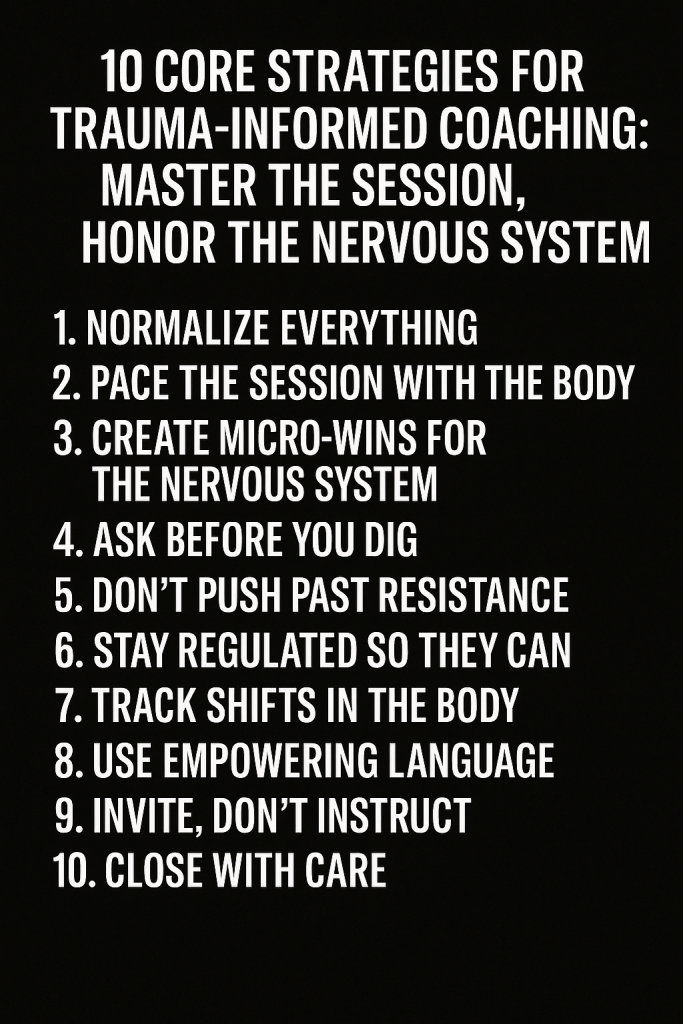
1. Normalize Everything
Nothing your client says should shock you. Normalize their fear, tears, freeze, or rage. Say, “That makes sense,” more often. When you do, you deactivate shame and open the space for healing.
2. Pace the Session With the Body
Don’t rush. Go slow. Pause. Breathe together. Let silence speak. The nervous system doesn’t heal on command—it unwinds when it feels safe. Let the tempo follow the client’s regulation, not your agenda.
3. Create Micro-Wins for the Nervous System
A deep breath held for five seconds. A single word of truth spoken. A hand that stops trembling. These are victories. Celebrate them. When the body succeeds, the mind catches up.
4. Ask Before You Dig
Just because they bring up trauma doesn’t mean they’re ready to relive it. Say: “Would it feel supportive to explore that right now, or shall we hold it gently and come back later?” Always honor the nervous system’s timeline.
5. Don’t Push Past Resistance
Resistance is not rebellion—it’s protection. If a client deflects, jokes, or intellectualizes, don’t bulldoze. Say, “That might be a part of you keeping you safe. Let’s honor it.”
6. Stay Regulated So They Can
Your energy sets the tone. If you collapse, they’ll spiral. If you get anxious, they’ll shut down. Stay grounded. Breathe. Anchor the space with your body so they can feel what safety actually feels like.
7. Track Shifts in the Body
Eyes glaze over? Breath gets shallow? Shoulders lock up? That’s your cue. Say, “Something just shifted—do you feel that?” Bring awareness back to the body. That’s where the truth lives.
8. Use Empowering Language
Instead of “What’s wrong with you?” ask “What happened to you?” Instead of “Why are you stuck?” ask “What’s needing support to move?” Your words shape their inner world. Choose them like sacred tools.
9. Invite, Don’t Instruct
Never force a breakthrough. Invite it. Say: “Would it feel safe to try something different here?” or “Are you open to experimenting with this?” Let their yes lead the way.
10. Close With Care
Don’t leave them cracked open and raw. End with grounding, integration, celebration. Ask: “What are you taking from this?” or “How can you nurture yourself after this session?” Give their system time to re-seal.
What is emotional mastery in relationships?
It’s the ability to navigate intensity without collapse.
To hold presence when tension rises.
To tune into your partner’s emotional waves without drowning in them.
To respond with power instead of reacting from pain.
This isn’t “emotional labor.”
This is emotional intelligence in motion.
It’s what turns average couples into magnetic, unstoppable teams.
Here are 20 real-life examples of emotional mastery—not from a place of resentment or obligation, but from depth, power, and mutual devotion.
1. You notice they’re shutting down—and instead of demanding, you soften.
You feel the wall.
You don’t push through.
You pause, breathe, and say: “I can feel you pulling away. I’m here when you’re ready.”
That’s leadership. Not neediness.
2. You manage your own triggers before making it their problem.
You feel the heat rising in your chest.
But instead of exploding, you ground.
You ask: “Is this mine? Or am I projecting?”
That’s sovereignty. Not avoidance.
3. You hold space when they spiral instead of trying to fix it.
They cry.
They rant.
They collapse.
You breathe with them.
You don’t rush them to calm down.
You sit in the fire and let it burn clean.
That’s presence. Not problem-solving.
4. You communicate hurt without blame.
You don’t accuse.
You reveal.
You say: “When that happened, I felt invisible. Can we talk about it?”
Not: “You always do this. You don’t care.”
That’s vulnerability. Not victimhood.
5. You hold your partner in their shame without trying to fix it.
When they confess something they’re not proud of, you don’t flinch.
You don’t minimize.
You don’t rush to make it better.
You say: “Thank you for trusting me.”
That’s emotional depth. Not codependence.
6. You don’t expect them to read your mind. You speak your needs.
You don’t punish them for not guessing.
You honor them by being clear.
You say: “I need more touch this week. Would you be open to that?”
That’s clarity. Not manipulation.
7. You redirect fights before they escalate.
You feel it heating up.
Instead of going nuclear, you pause and say:
“Do we want to hurt each other or find the root?”
That’s mastery. Not control.
8. You know when your partner needs silence instead of solutions.
You see their eyes shift.
You feel the tension in their jaw.
Instead of talking over it, you reach for their hand.
No words. Just contact.
That’s sacred subtlety.
9. You celebrate their wins like they’re your own.
No jealousy.
No competition.
Just pure amplification.
That’s emotional abundance.
10. You take responsibility when your tone or energy is off.
You don’t defend.
You own it.
You say: “That came out sharper than I meant. Let me try again.”
That’s maturity. Not perfection.
11. You give your partner space to recalibrate without panicking.
They go quiet.
They need time.
You don’t chase.
You trust their process.
That’s inner security.
12. You mirror their emotional truth before offering advice.
“You’re overwhelmed. I can feel that.”
Pause.
“Would you like support or just to vent?”
That’s attunement.
13. You learn how to regulate together.
You co-breathe.
You co-soothe.
You co-rise.
You become a symphony, not a shouting match.
14. You let their shadows come to the surface without making them wrong.
They lash out.
You don’t personalize it.
You reflect: “Is there something deeper underneath this?”
That’s sacred inquiry.
15. You catch the moment attraction dips—and re-polarize.
You don’t panic.
You lean back.
You re-anchor in your essence.
You flirt again. You tease. You play.
You shift the field.
That’s erotic intelligence.
16. You ask powerful questions when energy feels off.
Instead of accusing, you ask:
“What’s not being said right now?”
Or: “What do you need that you’re not asking for?”
That’s energetic navigation.
17. You know when to apologize—and when to hold your frame.
Not every disagreement is yours to fix.
Sometimes the most loving move is to stay rooted.
That’s discernment.
18. You understand the nervous system’s language.
When they go cold, it’s not always about you.
It could be freeze.
When they get loud, it could be fight mode.
You respond accordingly—not reactively.
19. You embody consistency.
They trust you not because you never wobble—but because you return to presence quickly.
You’re a lighthouse. Not a lifeguard.
20. You know that emotional mastery isn’t a performance. It’s a path.
You mess up.
You learn.
You evolve.
That’s the real work.
That’s the beauty.
That’s love, practiced like art.
Final vibe?
This isn’t about who does more.
This is about who’s willing to go deeper.
Emotional mastery is not “work.”
It’s an act of devotion.
A skill.
A sacred practice.
And when it’s shared?
That’s where the magic begins.
Say the right thing—on purpose.
Trauma-informed coaching isn’t just about holding space.
It’s about how you speak, how you frame, and what you don’t say.
One wrong sentence can shatter trust. One intentional phrase can unlock transformation.
Let’s flip the script—starting with your language.
1. “It makes sense that part of you stayed.”
❌ Bad version: “Why didn’t you just leave?”
That’s not curiosity—that’s blame dressed as logic.
You’re interrogating their past choices without honoring their survival strategies.
✅ Do this instead:
“I can imagine that staying felt safer at the time. What do you think kept you there?”
It validates the nervous system’s choice in a threatening environment and opens the door to safe reflection.
2. “You don’t need to relive it for me to support you.”
❌ Bad version: “Tell me exactly what happened that night.”
That’s trauma tourism.
You’re pulling them into retraumatization just to satisfy your timeline.
✅ Do this instead:
“You don’t have to go into detail. I’m more interested in how that experience shaped what you’re carrying today.”
You stay present-focused and let their system stay regulated while still working with the impact.
3. “Your reaction makes perfect sense.”
❌ Bad version: “It sounds like you’re overreacting.”
Translation: “You’re too much.” Instant nervous system shutdown.
✅ Do this instead:
“Your reaction makes total sense based on what you’ve lived through. Want to unpack what’s coming up right now?”
You create safety by mirroring understanding—not judgment.
4. “Let’s explore this together with curiosity.”
❌ Bad version: “Let’s fix this.”
Fixing implies brokenness. They’re not broken. They’re brilliant survivors.
✅ Do this instead:
“Let’s bring some curiosity to this together. What’s your system trying to tell us here?”
It shifts the dynamic from problem-solving to embodied discovery.
5. “Let’s reclaim your power—without blame.”
❌ Bad version: “You’ve got to take responsibility.”
Sounds like a lecture. Feels like shame.
✅ Do this instead:
“What would it feel like to reclaim your power here—without blaming yourself?”
Now you’re inviting them into sovereignty, not guilt.
6. “What would help this part of you feel safe enough to let go?”
❌ Bad version: “You need to let that go.”
You just told their protection system it’s wrong for doing its job.
✅ Do this instead:
“It sounds like a part of you is still holding that to stay safe. What would it need to feel okay releasing?”
Now you’re partnering with the protector instead of bulldozing it.
7. “What’s happening in your body right now?”
❌ Bad version: “What’s wrong with you right now?”
That’s an accusation, not a check-in. It increases shame and disconnection.
✅ Do this instead:
“I notice a shift in your energy—what are you feeling in your body right now?”
You normalize regulation and make embodiment a shared language.
8. “I’m noticing a pattern. Want to explore it?”
❌ Bad version: “You always do this.”
Generalizations activate defense mode. Always.
✅ Do this instead:
“I’ve noticed this pattern a few times. Want to explore what might be driving it?”
You address the behavior without attacking the person.
9. “Let’s meet the part that’s hesitating with respect.”
❌ Bad version: “If you really wanted change, you’d do it.”
That assumes laziness instead of protection. And it’s a surefire way to lose trust.
✅ Do this instead:
“What’s the part of you that might be hesitant to change trying to protect?”
This honors the intelligence of resistance and creates space for safety.
10. “You’re in control of the pace. I’m right here with you.”
❌ Bad version: “You’re safe now.”
Words don’t equal safety. Presence does.
✅ Do this instead:
“You’re in control of the pace here. I’m right here with you. We go only where it feels okay to go.”
This puts the nervous system in the driver’s seat—where it belongs.
Bottom line:
If you want to guide transformation, get fluent in safety.
Because when you speak with precision, empathy, and presence—
You don’t just talk healing.
You become it.
Why does language matter so much in trauma-informed coaching?
Because words can reopen wounds or build bridges.
Because how you say something is what they hear.
Because the body doesn’t care if you meant well—
It reacts to tone, energy, and context.
If you want to lead your clients into healing, not back into their trauma loops,
you better speak like someone who knows what they’re doing.
Here’s how:
1. Don’t Say: “Why didn’t you just leave?”
This sounds logical—but it shames their survival.
Do Say:
“I can imagine that staying felt safer at the time. What do you think kept you there?”
Validate the strategy. Then explore the pattern.
2. Don’t Say: “Tell me exactly what happened that night.”
That’s interrogation, not coaching.
And it drags them into reliving the trauma.
Do Say:
“You don’t have to go into detail. I’m more interested in how that experience shaped what you’re carrying today.”
Stay present. Stay relevant. Stay safe.
3. Don’t Say: “It sounds like you’re overreacting.”
Translation: “You’re too much.”
Instant shutdown.
Do Say:
“Your reaction makes total sense based on what you’ve lived through. Want to unpack what’s coming up right now?”
Normalize. Then navigate.
4. Don’t Say: “Let’s fix this.”
You’re not a mechanic. And they’re not broken.
Do Say:
“Let’s bring some curiosity to this together. What’s your system trying to tell us here?”
Shift from fixing to listening.
5. Don’t Say: “You’ve got to take responsibility.”
Even if it’s true, trauma often clouds the timeline of blame and power.
Do Say:
“What would it feel like to reclaim your power here—without blaming yourself?”
Empowerment over accusation.
6. Don’t Say: “You need to let that go.”
Let it go? If it were that easy, they’d have done it already.
Do Say:
“It sounds like a part of you is still holding that to stay safe. What would it need to feel okay releasing?”
Honor the part. Invite it to soften.
7. Don’t Say: “What’s wrong with you right now?”
This lands like a punch, even when said casually.
Do Say:
“I notice a shift in your energy—what are you feeling in your body right now?”
Curiosity instead of critique.
8. Don’t Say: “You always do this.”
Generalizations = instant shame spiral.
Do Say:
“I’ve noticed this pattern a few times. Want to explore what might be driving it?”
Call it out—without calling them out.
9. Don’t Say: “If you really wanted change, you’d do it.”
This assumes resistance is laziness, not protection.
Do Say:
“What’s the part of you that might be hesitant to change trying to protect?”
Every block has intelligence. Honor it.
10. Don’t Say: “You’re safe now.”
Your nervous system doesn’t believe words.
It believes tone. Pace. Presence.
Do Say:
“You’re in control of the pace here. I’m right here with you. We go only where it feels okay to go.”
That’s how you create safety—not demand it.
Final Drop:
Being trauma-informed isn’t about being soft.
It’s about being skilled.
It’s about knowing that a single word can either build a bridge—or burn it.
Speak to the system. Not just the story.
Because when you choose the right words, you unlock the part of them that’s been waiting to exhale.
Why does working with the nervous system matter?
Because trauma isn’t in the story.
It’s in the breath.
It’s in the tension.
It’s in the flinch before the smile.
You don’t “logic” your way out of trauma.
You regulate through the body.
And as a coach, your job isn’t just to inspire—it’s to co-regulate, attune, and create a space where transformation is physiologically safe.
Here’s how:
1. Learn the 4 States: Ventral, Sympathetic, Dorsal, Freeze
Know the map. Ventral = Safe & Connected.
Sympathetic = Fight/Flight.
Dorsal = Collapse/Shut Down.
Freeze = Both on & off.
Your job? Spot the state. Coach from awareness, not assumption.
2. Match Before You Shift
If your client is hyped and activated, don’t whisper calm.
If they’re shut down, don’t bark motivation.
Meet their energy—then lead them where you want to go.
That’s nervous system judo.
3. Use Breath as Your Bridge
Breath isn’t woo-woo. It’s data.
Fast = activated.
Shallow = anxious.
Paused = processing.
Co-regulate by breathing with them.
Try: “Can we take one deep breath together before we continue?”
4. Track Micro-Movements Like a Hawk
Fidgeting. Eye darting. Frozen jaw.
These aren’t distractions—they’re diagnostics.
Ask: “What just happened in your body right now?”
You’ll get more truth from their shoulders than their words.
5. Use Slowness as Medicine
Rushing bypasses the body.
Slow down your speech. Pause often. Let silence work.
Trauma speeds up. Healing slows down.
6. Regulate Your Nervous System First
You can’t hold their storm if you’re in one.
Ground yourself before sessions.
Breathe. Root. Drop in.
You are the barometer they calibrate to.
7. Start with Anchoring, Not Processing
Before diving into trauma or intensity, start with grounding:
- “What feels steady right now?”
- “Can you feel your feet on the floor?”
Anchor first. Then explore.
8. Use Touch Language Without Touching
Try: “Can you feel your spine behind you?”
Or: “What part of your body feels most present right now?”
Help them come back home to their body without overwhelming it.
9. Invite, Don’t Force
The nervous system opens through choice.
Never command.
Use soft language: “Would it feel okay to go here?”
If the answer’s no, celebrate it. That’s a nervous system win.
10. End With Regulation, Not Revelation
Big insights can leave clients raw.
Don’t end on a peak.
End with grounding.
Try: “Let’s take a breath and feel your body. What’s one thing that feels steady right now?”
Integration is everything.
Final Truth:
Working with the nervous system isn’t a bonus skill.
It’s the real coaching.
Because you can’t lead a client into their power while ignoring the biology that’s been protecting them.
Power meets peace when safety comes first.
What is consent-based coaching—and why does it matter?
Because power dynamics are real.
Because trauma lives in the body.
Because healing only happens where choice is honored.
Consent-based coaching isn’t just about saying “Is this okay?”
It’s about building a relationship where the client’s yes is empowered, no is respected, and maybe is never rushed.
Here’s how to do it like a master:
1. Always Ask Before You Guide
Before leading a meditation, breathwork, or even a visualization:
Ask: “Would you like to try something with me that might help regulate this feeling?”
This gives them agency to say no, not just nod politely.
2. Check-In Before You Deep-Dive
Even if you feel the urge to dig deeper into their trauma story—pause.
Ask: “Is now a good moment to explore this more, or would you prefer to pause and ground?”
Safety is created in micro-moments of choice.
3. Use Clear Permission Language
Instead of “Let’s do this,” say:
- “Would you be open to…”
- “Would it feel okay if…”
- “Can I offer a reflection?”
Language sets the tone. Use words that invite, not instruct.
4. Honor Their ‘No’ Without Needing a Reason
If your client says, “I don’t want to go there,” don’t ask why.
Don’t push. Don’t fix.
Just say: “Totally okay. You get to lead the pace. Let’s shift gears.”
Their no is sacred. Treat it like that.
5. Normalize Changing Consent Mid-Session
Let them know upfront:
“You can say yes and change your mind anytime. You’re in control here.”
This makes the space dynamic, not rigid. Consent is a process, not a checkbox.
6. Pause for Somatic Consent
When guiding embodiment or breath:
“Check in with your body. Does this feel safe to continue?”
Sometimes the body says no before the words do. Teach them to listen.
7. Ask Before Naming Patterns or Giving Insight
Just because you see it doesn’t mean you need to say it.
Try: “Would you like a reflection on something I’m noticing, or would you prefer we stay with what’s present for you?”
This keeps you from playing guru and keeps the client in the driver’s seat.
8. Get Consent Before Recording, Sharing, or Taking Notes
Seems obvious? You’d be shocked.
Trauma survivors are hyper-sensitive to surveillance, exposure, or being “documented.”
Always ask, “Is it okay if I jot this down or reflect on it after our session?”
9. Let Them Set the Boundaries of Touch or Tone
If you’re in-person:
Never assume a hug, touch, or even prolonged eye contact is welcome.
Ask: “Would it feel okay to hold eye contact for a moment, or shall we soften?”
Even tone matters. Mirror their nervous system.
10. Close the Session With Empowerment, Not Pressure
Instead of: “Here’s your homework,” try:
“Here are a few things you could explore this week. Want to pick one—or none?”
Let them choose their next step. That’s where the power lives.
Final Truth:
Consent-based coaching isn’t about playing small.
It’s about playing clean. Playing real.
You don’t build trust by force—you build it by invitation.
Permission is power.
Choice is sacred.
Respect is the portal.
Why glorify coping mechanisms instead of changing them?
Because they’re not flaws—they’re adaptive genius.
They helped your client survive trauma, manage chaos, and make it through hell.
So before you try to “fix” something, learn to honor the brilliance behind it.
Here are 50 coping mechanisms that deserve a crown, not a correction.
1. Overthinking
High-functioning threat assessment.
She’s not indecisive—she’s scanning 20 possible futures at once.
2. People-pleasing
Advanced nervous system negotiation.
He learned to survive by sensing what others needed before they said it.
3. Shutting down in conflict
That’s not avoidance—it’s a freeze response keeping the nervous system safe.
4. Joking through pain
That’s transmutation. Humor is alchemy.
Laughter saved her life.
5. Staying busy
Hyper-productivity is a trauma response? Maybe.
But it also built her business, saved his sanity, and created structure where there was none.
6. Zoning out
Dissociation = built-in psychic firewall.
It kept her from feeling what would’ve destroyed her.
7. Controlling every detail
Predictability is safety when chaos was the norm.
It’s not just “Type A”—it’s trauma intelligence.
8. Always helping others
It’s easier to care for others than to feel your own unmet needs.
This is compassion in overdrive.
9. Avoiding vulnerability
That wall? That’s where the arrows used to come in.
Respect it.
10. Hyper-independence
If they learned no one would catch them, they built their own wings.
Don’t call it cold—call it survival craft.
11. Withdrawing
Sometimes disappearing is the only way not to explode.
12. Being ‘too nice’
She was trained to keep the peace at any cost.
Even her identity.
13. Perfectionism
He believed love was earned by being flawless.
He’s not arrogant—he’s terrified.
14. Fixing everything
If she couldn’t fix the past, at least she could fix the present.
15. Apologizing constantly
If they said sorry first, maybe they could avoid the storm.
16. Keeping emotions to themselves
Some learned early: expressing feelings = punishment.
So silence became protection.
17. Never asking for help
It wasn’t pride—it was conditioning: “I’m a burden.”
18. Obsessing over self-improvement
Because if they were just better, maybe the pain would stop.
19. Procrastination
It’s not laziness. It’s nervous system paralysis from fear of failure or judgment.
20. Staying in their head
Thoughts were safer than feelings.
21. Sarcasm
Truth wrapped in armor.
22. Flirting
Not attention-seeking—connection-seeking in a world that made love conditional.
23. Numbing with food or screens
Because reality was too raw. Comfort matters.
24. Over-talking
Silence was once dangerous. Noise is control.
25. Needing structure
Chaos used to mean harm. Routine now means safety.
26. Not trusting easily
Their trust was shattered. Caution is earned wisdom.
27. Being the clown
If people are laughing, they’re not hurting you.
28. Staying in bed
Some days, not dying is the accomplishment.
29. Crying easily
That’s not weakness. That’s a soul that’s still open.
30. Oversharing
Sometimes trauma breaks the filter.
But at least they’re still speaking.
31. Talking in circles
They’re not avoiding. They’re decoding the memory while protecting their system.
32. Being late
It’s not always disrespect. Some are battling executive function overload.
33. Constant analyzing
They were trained to read the room for safety.
Now they read everything.
34. Getting defensive
They were punished for being wrong. Of course they guard their truth.
35. Leaving before they’re left
It hurts less to disappear than to be abandoned again.
36. Taking care of everyone else
If everyone’s okay, maybe the pain inside will stay quiet.
37. Daydreaming
Imagination was the only safe place they ever had.
38. Masking
Neurodivergent brilliance disguised as normalcy.
That mask is a masterpiece of adaptation.
39. Hoarding
Safety in surplus. Survival in stockpiles.
40. Saying yes to everything
No was once dangerous. Yes was the shield.
41. Overexplaining
If they explain it right, maybe they won’t be misunderstood—again.
42. Needing constant feedback
They were never affirmed growing up.
Now they’re still asking: “Did I do okay?”
43. Being passive-aggressive
Directness was punished. Indirection became survival.
44. Vanishing when things get deep
Because depth once came with betrayal.
45. Overspending
Comfort disguised as control. Dopamine is medicine when life feels empty.
46. Under-reacting
Flat affect? No—it’s emotional over-regulation.
Because one meltdown cost them everything.
47. Pacing or fidgeting
That’s not distraction—it’s their nervous system finding rhythm.
48. Re-reading texts
They learned the details could destroy them.
Now they scan for threat.
49. Looking ‘too confident’
Hyper-functionality is a disguise for devastation.
50. Doing it all themselves
Because when they needed help, no one came.
Final reminder:
Never shame a survival strategy.
Name the intelligence. Validate the instinct. Witness the wisdom.
That’s trauma-informed power.
1. Don’t Pathologize—Validate
When a client jokes in the middle of pain, don’t say “You’re avoiding.”
Say: “That humor is powerful—it helped you survive.”
Validation rewires shame. It opens trust.
You’re not tearing down the shield—you’re appreciating why it was built.
2. Say the Line That Changes Everything
“That strategy kept you safe.”
One sentence. Massive permission.
You’re not trying to fix them.
You’re honoring the brilliance behind their defenses.
3. Name the Genius Behind the Guard
Overthinking? That’s strategic pattern detection.
People-pleasing? That’s advanced nervous system calibration.
Dissociation? That’s a built-in psychic firewall.
Every coping mechanism is a sign of intelligence, not weakness.
Mirror that truth back to them until they believe it.
4. Follow the Thread, Not the Reaction
Instead of saying “Why do you do that?” ask:
“When did that pattern first become useful?”
It shifts the frame from blame to curiosity.
From shame to insight. From defense to dialogue.
5. Ask What It’s Protecting
All defenses have a purpose.
The key question: “What is this reaction trying to protect you from feeling?”
Now you’re not just identifying behavior. You’re speaking to the wisdom beneath it.
6. Let the Armor Stay—For Now
Don’t demand emotional nakedness. That’s re-traumatizing.
Let them keep their defenses until they’re ready to drop them.
Trust builds when you respect their timing.
Try: “It’s okay to keep that wall up. We can still explore together.”
7. Track the Shift with Care
When a defense shows up—sarcasm, zoning out, over-rationalizing—don’t call it out like a referee.
Reflect gently: “I notice a shift—can we pause here and check what’s happening in your body?”
That moment of awareness becomes the invitation.
8. Normalize Their Genius
Say things like:
“Lots of smart people overthink—it means your brain moves fast.”
“That freeze you just had? That’s your body protecting you.”
When they realize they’re not broken—they relax.
When they relax—they heal.
9. Reframe It as a Superpower—Because It Is
Ask:
“Where in your life did this strategy actually help you succeed?”
Now you’re not just disarming a defense—you’re empowering the archetype behind it.
Every trauma response has roots in genius.
Help them own the gift, not just the wound.
10. Leave the Door Open, Not Forced
You don’t smash walls. You help them crack the window.
Say: “If this part of you could speak, what would it say?”
That’s how you meet a defense mechanism without making it wrong.
That’s how you help the client open the door from the inside.
Never shame a coping mechanism.
It’s not dysfunction. It’s design.
You’re not here to dismantle their armor—you’re here to witness the brilliance that built it.
1. Watch the Eyes Like a Lie Detector
When the eyes glaze over, dart sideways, or look away too fast—don’t ignore it.
That’s not just distraction. That’s a shift in nervous system state.
Ask gently: “What happened just now as you looked away?”
Boom. You just tracked a trauma thread.
2. Track the Breath—The Body’s Truth-Teller
Sudden shallow breathing? Holding the breath? A deep exhale out of nowhere?
The breath tells you everything. It’s the first thing that shifts when someone gets triggered or starts feeling safe.
Use it. Ask: “Can you feel your breath right now?”
Or mirror: “Let’s breathe together for a moment.”
3. Notice the Fidgeting
They touch their face, crack their knuckles, pull at their clothes. That’s not random.
Fidgeting is a discharge of nervous energy. It means something just landed too hard or is heating up inside.
Say: “I notice your hands just started moving—what are they trying to say?”
You’ll be shocked what opens from there.
4. Track Posture Like a Signal Flare
Do they collapse? Cross arms? Go rigid like a statue?
Every micro-movement is a message. Shoulders tightening = guarding. Spine collapsing = withdrawal.
Ask: “What’s happening in your body right now?”
Or: “Notice your posture—what’s it trying to tell us?”
5. Listen for Voice Shifts
Tone matters more than content.
Do they start whispering, speeding up, going monotone, or tightening their throat?
Their voice is the nervous system transmitting live.
Say: “You don’t need to rush this.”
Or: “What does your voice want to do if it had more space?”
6. Name the Freeze—With Love
Silence. Blank stare. No reaction.
That’s not nothing. That’s a freeze.
You don’t break it by pushing. You melt it by acknowledging it.
Say softly: “I’m here with you. Take your time. We can pause.”
Validation is the antidote to shutdown.
7. Notice the Gut—Literally
Do they hold their stomach? Lean forward? Hunch down?
The gut is the second brain. Anxiety, dread, and shame all sit there.
Offer: “Can you place a hand on your belly and just breathe into that space?”
You just reconnected the body to safety.
8. Track Micro-Expressions
A flicker of the lip. A tightening of the jaw. A flash of contempt, sadness, fear.
Don’t miss it. Facial muscles fire faster than words.
You can say: “I saw something shift in your face—can we follow that?”
They might not even know it happened, but their body does.
9. Use Slowness to Spot the Signal
Speed hides truth. Slow down the pace and you’ll see more clearly.
Say: “Let’s slow that down—what happens in your body as you say that again, but slower?”
Tracking starts working when we stop rushing through it.
10. Touch the Present Moment
Ask:
“Can you feel your feet right now?”
“Can you feel the chair holding you?”
“What’s one sensation you’re aware of right now?”
Sensory awareness brings the body online.
Once they’re here, then the real work begins.
Trauma isn’t just in the past—it’s in the present tension, the breathless pause, the flicker in the eyes.
Track the body. That’s where the map to healing lives.
1. Co-Regulate the Space Before You Even Begin
Before a word is spoken, your energy is already speaking.
Slow your breathing. Soften your face. Ground your presence.
Your nervous system sets the tone. If you’re anxious, they’ll tighten.
If you’re calm, they’ll breathe deeper.
Start every session with presence, not performance.
Try: “Let’s take one deep breath together to arrive in this space.”
2. Let the Client Set the Pace
Rushing is aggression to a nervous system that’s been violated.
Don’t demand breakthroughs. Don’t “pull” insight.
Ask: “Is it okay if we explore that further?”
Or: “Would you rather pause and come back to this later?”
Safety is choice. Choice is power. Power heals.
3. Name the Power Dynamics and Dismantle Them
You’re not above them. You’re beside them.
Say it clearly: “You’re the expert of your own experience.”
Remind them: “This is your space. You get to lead the way.”
When they feel equal, they feel safe. When they feel safe, they open.
4. Create Permission for ALL Emotions
Tears, silence, rage, shaking—nothing is “too much” here.
Say: “You don’t need to censor anything.”
Or: “However this wants to come out is welcome.”
The moment you normalize intensity, the shame melts.
That’s where real release begins.
5. Use Consent-Based Language, Always
Don’t ask “What’s wrong?”
Ask “Would you like to share what’s alive for you right now?”
Don’t assume. Invite. Don’t direct. Suggest.
Ask before diving in. Ask before shifting direction.
Words that honor autonomy create safety in the body.
6. Anchor With Structure
Trauma is chaos. Safety is predictability.
Start with:
“Here’s what today’s session might look like.”
End with:
“Here’s what to expect next.”
Let them know where they’re going. Give them a container.
Even emotional chaos needs a floor to land on.
7. Mirror Their Pace and Tone
If they speak slowly, you speak slowly.
If their energy is cautious, don’t bulldoze with enthusiasm.
Mirroring signals: “I’m attuned to you.”
That attunement builds trust deeper than any words can.
8. Celebrate Their No
If a client says “I don’t want to go there,” say:
“Beautiful. Thank you for honoring yourself.”
Every time they say no and you honor it, you rewire safety into their system.
You become the first person who doesn’t override them. That’s sacred.
9. End With Grounding, Not Just Insight
Don’t leave them floating in intensity.
Close with:
“Can you feel your feet right now?”
“Let’s take three slow breaths together before we close.”
“What do you need to feel complete today?”
Integration is not optional. It’s what makes the transformation last.
10. Remind Them: Nothing Is Broken
Trauma lies. It whispers: “You’re too much.” “You’re broken.” “It’s your fault.”
You counter that with:
“Everything you did was intelligent.”
“Your body found a way to survive.”
“There’s nothing wrong with you.”
That moment? It plants a new truth. One that replaces the shame with power.
Because the most powerful healing doesn’t come from tools—it comes from your presence.
Be the safe space their body never had. That’s trauma-informed mastery.
1. Safety First—Always.
Before insight, before action, before transformation… comes safety.
If your client doesn’t feel safe with you, their system won’t open.
Their brilliance? Locked. Their truth? Buried.
Your job? Create a sacred space where their body can finally exhale.
Use gentle tone. Use consent-based language. Let them set the pace.
Because without nervous system safety, you’re coaching a mask—not a person.
2. Slow is Fast.
Trauma lives in the fast lane.
So what do you do?
Slow. The. F*ck. Down.
Give space between questions. Let silence be sacred.
When you feel the urge to rush in and fix—pause. That’s your cue.
Power isn’t always in pushing forward. It’s in knowing when to hold space.
3. Track the Body, Not Just the Story.
The story can lie. The body can’t.
Trauma shows up in the eyes, the breath, the fidgeting, the frozen shoulders.
Watch for disconnection. Look for shutdown. Feel for activation.
Ask:
“What just shifted in your body?”
“Are you still with me?”
That awareness? That’s the real map.
4. Honor Defense Mechanisms as Intelligence.
They overthink. They joke. They deflect.
Guess what? That’s brilliance. That’s survival.
Never shame a coping mechanism.
Instead, say: “That strategy kept you safe. Want to explore what it’s protecting?”
Trauma-informed coaching doesn’t rip walls down—it helps the client open the door from the inside.
5. Ask for Consent at Every Layer.
“Can I ask you a deeper question?”
“Would you like to explore that memory more?”
“Do you want to stay with this or shift?”
You’re not dragging them through their healing. You’re walking with them.
That’s sacred. That’s trust. That’s trauma-informed.
6. Work with the Nervous System, Not Against It.
If they’re in freeze, don’t push action steps.
If they’re in fight, don’t argue logic.
If they’re in flight, don’t demand presence.
Instead, co-regulate. Use your own calm, grounded energy to anchor theirs.
Start with: “Let’s both take a deep breath together.”
7. Use Language That Doesn’t Re-Traumatize.
Don’t say “what’s wrong with you?” Say “what happened to you?”
Don’t say “just let it go.” Say “let’s understand why it’s here.”
Words heal—or harm. Choose precision. Choose compassion.
You’re not just coaching. You’re translating safety.
8. Spot Shame and Name It Gently.
Shame thrives in silence.
If they say: “I feel stupid talking about this…”
Respond: “That sounds like shame talking. And there’s zero shame here.”
Call it out. Not to confront—but to free.
Because shame is a trap, and you’re here to break chains.
9. Let the Client Lead—Even When They Don’t Know How.
If they say “I don’t know,” don’t rush in to fill the gap.
Hold it. Let them listen deeper. Wait.
Say: “If you did know… what might you say?”
Or: “What’s the feeling underneath that ‘I don’t know’?”
Empowerment comes from discovering their own truth—not yours.
10. Prioritize Integration Over Insight.
Big ahas feel good. But real change? Happens in the body.
Don’t chase breakthroughs. Help them embody what they just realized.
End with:
“What’s one way you’ll carry this feeling into your day?”
“Where do you feel this in your body right now?”
Because a grounded client is a transformed client.
And trauma-informed coaching isn’t about looking deep—it’s about landing safely.
1. Client shuts down emotionally mid-session. What’s going on?
Client says: “I don’t know… I just feel blank all of a sudden.”
Coach responds: “That’s totally valid. Let’s pause. Your system might be going into freeze. Can we slow down together and take a few breaths before we continue?”
Why it works: Trauma-informed coaches know when dissociation kicks in—and they honor it without pushing forward. They prioritize nervous system safety over agenda.
2. Client laughs while telling a painful story.
Client says: “Haha… yeah, my dad used to lock me in my room when I cried.”
Coach responds: “I hear the laughter, and I also sense something really painful underneath. Is it okay if we explore what’s coming up with curiosity?”
Why it works: They recognize defense mechanisms like humor as protective layers, not as the full truth.
3. Client is hyper-verbal and overexplains.
Client says: “So then this happened and that happened and I think it means… maybe I’m overthinking. Or maybe not. Anyway…”
Coach responds: “It sounds like your mind is working overtime to stay in control. Let’s drop into the body for a moment. What are you feeling—right now?”
Why it works: Trauma often lives in the body, not the story. This shifts attention inward.
4. Client resists a compliment.
Client says: “Yeah but you’re just saying that.”
Coach responds: “Notice how fast that got deflected. What would it be like to receive it fully—even if just for one breath?”
Why it works: They’re tracking resistance to love and helping the client gently sit with being seen.
5. Client cries and apologizes.
Client says: “Sorry for getting emotional.”
Coach responds: “There’s nothing to apologize for. Your tears are sacred. Let them speak.”
Why it works: They normalize emotional release and remove shame from vulnerability.
6. Client gets defensive during feedback.
Client says: “I don’t agree with that at all.”
Coach responds: “I can feel some fire coming up. I welcome it. Can we slow this moment down together?”
Why it works: They don’t make the reaction wrong—they create room for it to breathe.
7. Client shares a trauma story and wants advice.
Client says: “What do you think I should’ve done differently?”
Coach responds: “Before we analyze, can we honor how hard that was? Let’s be with what’s alive before trying to fix it.”
Why it works: They resist bypassing the emotional process with quick fixes.
8. Client comes in anxious and agitated.
Coach opens with: “Let’s take 60 seconds to drop into our breath. No rush to start. Just land.”
Why it works: They regulate first. A dysregulated client can’t process.
9. Client shares past abuse but minimizes it.
Client says: “But it wasn’t a big deal, I turned out fine.”
Coach responds: “You survived. That’s huge. And you don’t have to downplay what happened. I believe you.”
Why it works: They hold belief, even when the client struggles to validate their own pain.
10. Client zones out during a heavy topic.
Coach notices: Glassy eyes, long pauses.
Coach responds: “I notice your energy shifted. Want to pause and check in with your body together?”
Why it works: They’re attuned to subtle changes and know how to gently bring presence back.
11. Client is caught in perfectionism.
Client says: “I just don’t want to get it wrong.”
Coach responds: “Where did you first learn that ‘getting it wrong’ wasn’t safe?”
Why it works: They tie behavioral patterns back to origin stories that often involve trauma.
12. Client avoids eye contact.
Coach adjusts: Sits slightly to the side, softens eye pressure.
Why it works: Trauma-informed coaches remove pressure rather than force intimacy.
13. Client is terrified of disappointing others.
Coach says: “Let’s explore whose voice comes up when you think about letting someone down. Is it really yours?”
Why it works: They help clients separate their authentic voice from conditioned trauma responses.
14. Client dissociates during body scan.
Coach says: “Let’s just come back to the room. Look around. Name three things you see.”
Why it works: They ground the nervous system through sensory orientation.
15. Client feels shame after a vulnerable share.
Coach says: “Shame loves silence. Let’s speak it out loud so it loses power.”
Why it works: They help metabolize shame by naming it.
16. Client is afraid of being “too much.”
Coach says: “What if your ‘too much’ is exactly what this world needs more of?”
Why it works: They reframe rejection as superpower.
17. Client avoids goals or action steps.
Coach says: “I’m sensing some freeze. Want to explore what that part of you is protecting you from?”
Why it works: They don’t pathologize resistance—they honor it as intelligence.
18. Client talks about rage but won’t feel it.
Coach says: “Let’s explore where that fire lives in your body. Can we give it space without needing to act on it?”
Why it works: They invite embodied exploration rather than suppression.
19. Client feels unsafe being seen.
Coach says: “We’ll go at your pace. Your boundaries are sacred. I’ll never rush your process.”
Why it works: Consent is everything. They co-create safety.
20. Client shows up late, scattered.
Coach says: “Let’s land together. Anything you need to release before we drop in?”
Why it works: Trauma-informed coaches know that regulation is step one, not optional.
Final thought: A trauma-informed coach isn’t just skilled. They’re sacred space holders. They don’t just guide the session. They guard the nervous system. That’s the difference between coaching that performs—and coaching that heals.
What does “trauma-informed” actually mean in coaching?
It means your coach doesn’t bulldoze your nervous system in the name of “breakthrough.”
Trauma-informed coaching understands that you’re not just a mindset project—you’re a living, breathing system of memory, emotion, energy, and biology. It respects that your resistance, your shutdowns, your fears—they’re not flaws. They’re adaptive survival strategies.
A trauma-informed coach doesn’t just ask, “What do you want?”
They ask, “What’s safe for your system right now?”
Because pushing a client into goals their body isn’t ready to hold is not coaching.
It’s re-traumatization in a hoodie.
Why is trauma-informed coaching necessary now more than ever?
Because we’re living in an era of spiritual bypass and mindset hustle.
“Just do it.”
“Power through.”
“Raise your vibration.”
Sounds great—until your nervous system says nope.
We now know through polyvagal theory, somatic psychology, and neuroscience that the body stores trauma, not just the mind. And traditional coaching that ignores that is like putting motivational stickers on a locked trauma vault and expecting it to open.
If the body isn’t onboard, the shift won’t stick.
How does trauma-informed coaching actually work?
Here’s what separates it from generic “rah-rah” coaching:
- It slows down to track your nervous system.
- It respects resistance as sacred information.
- It integrates somatic practices like breath, movement, and felt sense.
- It helps you rewire from the inside out—not just pump affirmations into your mind.
Your coach listens to what’s said—and what’s not.
They feel your pauses.
They catch your patterns.
They help you regulate in real time so breakthroughs happen without breakdowns.
What kind of techniques are used in trauma-informed coaching?
Let’s get specific. Here’s the tactical list:
- Somatic tracking – following sensation, not just story.
- Parts work – welcoming your inner protector, critic, child.
- Breathwork – not the Wim Hof hype, but nervous system-aligned breath patterns.
- Co-regulation – using tone, presence, and body language to help you drop into safety.
- Resourcing – identifying inner strengths and external anchors.
- Microshifts – choosing 1% moves instead of giant unrealistic leaps.
- Consent-based processes – no pushing, no forcing, no flooding.
How is this different from therapy?
Great question. Coaching isn’t therapy. Period.
Therapy often deals with healing the past.
Trauma-informed coaching focuses on building the future—but with full awareness that the past rides shotgun.
A good coach isn’t there to diagnose, but to track your nervous system, hold you through discomfort, and guide you forward without bypassing the real stuff that lives in your body.
They’re not digging into your childhood unless your body brings it up.
What happens if a coach is not trauma-informed?
Simple. You feel unsafe.
You’ll get coached into:
- Shutdown
- Shame
- Overwhelm
- Disconnection
You’ll leave the session feeling like a failure instead of a firestarter.
And worst of all?
You might start thinking you’re the problem, when really the space wasn’t safe for your system to unfold.
So how do I know if my coach is trauma-informed?
Ask these truth-check questions:
- Do they know what polyvagal theory is?
- Can they name the difference between sympathetic, parasympathetic, and dorsal states?
- Do they track your physical cues, or just bulldoze your mindset?
- Can they sit in silence, or do they rush to fix you?
- Do they let you set the pace?
If they just throw affirmations at your trauma, run.
You need embodied wisdom, not high-vibe fluff.
Final truth: why does this matter?
Because your nervous system is the gatekeeper to your potential.
Trauma-informed coaching isn’t soft.
It’s fierce precision.
It’s safety as a superpower.
It’s strategy that includes your soul.
When you feel safe, you access courage.
When you feel seen, you step into power.
When your body is with you—not against you—you become unstoppable.
So don’t just hire a coach.
Hire a nervous system whisperer who can hold your power and your pain.
That’s not extra. That’s essential.
What does it really mean to be “trauma-informed”?
It means stop treating symptoms and start seeing the system.
Trauma-informed therapy isn’t just about having compassion. It’s about recognizing that trauma rewires the brain, short-circuits the nervous system, and hijacks safety.
A trauma-informed approach asks:
- What happened to you?
—not— - What’s wrong with you?
It doesn’t label. It listens.
It doesn’t force. It invites.
It doesn’t retraumatize. It creates safety.
If your therapy doesn’t account for the nervous system, triggers, or the body—it’s not trauma-informed. Period.
Why does this even matter?
Because trauma isn’t just emotional pain—it’s a full-body response that doesn’t know time.
Your boss raises their voice and suddenly you’re 7 years old again.
Your partner goes silent and your nervous system thinks it’s abandonment.
You freeze, panic, explode… for no “logical” reason.
That’s trauma.
It lives in your body.
And if your therapist isn’t trained to read those signals, they’ll miss 90% of your healing journey.
What types of therapy are considered trauma-informed?
Let’s break it down like a savage strategist.
1. Somatic Experiencing (SE)
Created by Peter Levine.
Focuses on how trauma gets stuck in the body.
It helps you slowly release stored survival energy through sensation, not story.
Game changer for freeze and shutdown states.
2. Internal Family Systems (IFS)
You’ve got “parts.”
Some protect, some perform, some panic.
IFS helps you speak to those parts, instead of shaming them.
It builds trust with your inner world instead of bulldozing it.
3. Polyvagal-Informed Therapy
Built on the work of Dr. Stephen Porges.
Teaches that your nervous system dictates your ability to connect, communicate, and feel safe.
Helps you recognize when you’re in fight, flight, freeze, or fawn—and how to come back to center.
4. EMDR (Eye Movement Desensitization and Reprocessing)
Yes, it looks weird. Yes, it works.
Uses bilateral stimulation (like eye movements) to reprocess traumatic memories without reliving them.
Fast-track for PTSD and stuck trauma loops.
5. Somatic Breathwork
This is not your “inhale-exhale 4-7-8 chill hack.”
We’re talking deep nervous system rewiring.
Breath bypasses the mind and taps straight into the body.
Stored trauma, suppressed grief, unexpressed rage—all of it can surface and be released.
6. Trauma-Informed Coaching
Not all healing has to happen in therapy.
Trauma-informed coaches are trained to hold safe space, track nervous system responses, and guide transformation without poking at raw wounds.
What about traditional talk therapy? Is it trauma-informed?
Only if the therapist is.
Just because someone has a degree doesn’t mean they know trauma.
In fact, many therapists accidentally retraumatize their clients by pushing too fast, too soon.
If a therapist…
- jumps into your childhood in session one
- talks more than they listen
- ignores body cues
- doesn’t track dissociation or hyperarousal…
…then they’re not trauma-informed. They’re just “talking.”
So what makes a therapy truly trauma-informed?
Here’s the checklist:
- Safety is priority #1 (Not progress. Not productivity. Not insight. Safety.)
- Slowness is respected. Nothing gets rushed.
- The body is part of the process.
- You are never shamed for your responses.
- Power dynamics are transparent.
- Curiosity > diagnosis.
- There’s space for your parts, not just your “presenting issue.”
A trauma-informed practitioner knows that trauma affects how you show up, how you breathe, how you attach, how you love, how you speak, and how you shut down.
How do I choose the right trauma-informed support for me?
Ask these savage questions before you commit:
- Do they understand the nervous system?
- Do they have tools beyond talk?
- Do they respect your pace, or push their own agenda?
- Do you feel safe in their presence?
- Do they know how to regulate with you, not just sit and nod?
Your trauma was real.
Your healing deserves to be intelligent, intentional, and embodied.
Final truth bomb?
Trauma isn’t in your story. It’s in your state.
And the path to healing isn’t retelling the pain.
It’s rewiring your experience of safety, joy, and aliveness—right now.
Don’t settle for therapy that talks.
Find one that transforms.
Have we been healing trauma the wrong way all along?
Yep.
For decades, we put all our chips on talk therapy.
And neuroscience is now handing us the bill.
The logic was simple: if trauma happened through painful stories, it must be healed by retelling those stories.
Only problem?
That’s not where the trauma lives.
According to a pivotal 2023 study published in the Journal of Neuroscience Research,
talk therapy alone often keeps trauma alive—by reinforcing the same stress loops you’re trying to escape.
Talking can re-trigger the very pain you’re trying to release.
Then where is trauma actually stored?
Not in your mind.
In your nervous system.
It’s coded into your breath.
Your muscle tension.
Your heartbeat.
Your freeze response when someone raises their voice.
Your shallow inhale when a memory hits.
Trauma is physical. Not just psychological.
That means healing must be physical too.
So what works better than talk therapy?
Breath retraining.
Somatic therapy.
Nervous system regulation.
In other words: feeling more, talking less.
Recent clinical findings show that breathwork and body-based practices reduce PTSD and anxiety
faster, more powerfully, and more permanently than cognitive methods alone.
Why? Because these tools bypass the mind and go straight to where the trauma lives—in the body.
But isn’t understanding your story important?
Sure. Understanding helps.
But understanding alone is not transformation.
You can analyze your trauma for years and still get triggered by a sound, a look, a scent.
Why? Because logic doesn’t reach the survival system.
You can’t think your way out of a freeze response.
You have to train your system to feel safe again.
To breathe deeper.
To expand your window of tolerance.
To stop mistaking intimacy for danger.
What’s the science behind this shift?
It’s called state-dependent learning.
Your brain learns based on the state you’re in.
If trauma happened in a high-stress or dissociated state,
healing must happen in a calm, grounded, present state.
You’re not healing by replaying the past.
You’re healing by experiencing safety in the now.
Again and again. Until your system starts believing it.
So what should I do if talk therapy isn’t enough?
Don’t throw it out.
Just stop using it as the only tool.
Layer it with:
- Breathwork to shift your state in real-time
- Somatic release to free trapped energy
- Movement to process emotions through the body
- Nervous system training to build real resilience
- Stillness to learn how to be with yourself without flinching
This is how trauma heals.
Not through endless rehashing.
But through new embodiment.
What’s the bigger picture here?
We made a collective mistake.
We worshipped the mind.
And we forgot the body.
But the tide is turning.
Breathworkers. Somatic therapists. Somatic experiencing. Polyvagal theory.
They’ve all been shouting the same thing for years:
“You’re not broken. You’re dysregulated.”
The good news?
Regulation is a skill.
And skills can be trained.
Bottom line?
If you’re tired of healing the same wound over and over again,
it’s time to stop just talking—and start feeling.
Your breath is the access point.
Your body is the roadmap.
And your healing is waiting in the now.
Why do I feel like I’m always behind in life, even when I’m doing okay?
Because your brain is a sneaky copycat.
What you’re experiencing is something called automatic goal contagion.
That’s a fancy neuroscience term for when your brain adopts someone else’s goals just by watching them.
You see someone traveling the world on Instagram?
Now your brain thinks that’s your goal.
You watch a fitness influencer doing two-a-days at the gym?
Suddenly, you feel lazy even if you just crushed your own workout.
You didn’t choose those goals. Your brain absorbed them.
Wait… so FOMO is actually biological?
Yes.
It’s not your fault. It’s dopamine doing what dopamine does best: chasing rewards.
Here’s how it works:
When you see others chasing a goal, your brain mirrors their behavior.
It simulates the reward they’re about to get.
Even if that reward isn’t meant for you.
Your dopamine system gets hyped for someone else’s life.
And when you don’t pursue that borrowed goal—when you don’t go to that party or launch that business—
You get hit with a reward prediction error.
Translation?
Dopamine crash.
Your brain anticipated a reward. It didn’t happen. Now you feel like crap.
So how do I stop FOMO from ruining my peace?
Here’s the move:
Step 1: Catch it.
The next time you feel behind, stop.
Don’t scroll. Don’t spiral. Just ask yourself one question:
“Is this actually my dream—or did I just catch it from someone else?”
Step 2: Reclaim your goals.
Make a list of what YOU want.
No filters. No borrowed fantasies.
Just your vision, grounded in your truth.
Step 3: Unfollow the noise.
If someone’s feed constantly triggers comparison, mute it.
It’s not about them.
It’s about protecting your nervous system.
Why is this so important for confidence and happiness?
Because when you chase the wrong goals, you destroy your own joy.
Every time you simulate someone else’s reward system, you disconnect from yours.
You stop celebrating your wins.
You forget how far you’ve come.
You feel “behind” in a race you never signed up for.
Freedom = reclaiming your own timeline.
When you’re living YOUR path, dopamine aligns.
Energy flows. Clarity sharpens.
And FOMO?
It dies in the face of purpose.
Bottom line?
You’re not behind.
You’re just being pulled by goals that aren’t yours.
Cut the cord. Own your lane. Run like fire.
“` ❶
Why do tough conversations crumble over text?
Because text removes tone, presence, and humanity.
You’re not just missing a voice—you’re missing vibration.
That eye contact? That energetic read? Gone.
What’s left? A digital guessing game fueled by assumption and overreaction.
One emoji can start a war.
And the worst part? You won’t even see it coming.
What’s the cost of avoiding face-to-face confrontation?
You think you’re protecting peace.
What you’re really doing is feeding a monster called emotional distance.
Every avoided eye contact?
Another brick in the wall between you.
Every “we’ll talk later”?
Another opportunity missed to connect on a soul-deep level.
Avoidance doesn’t solve conflict—it delays it, multiplies it, and robs it of resolution.
Why does in-person connection matter when emotions run high?
Because the body speaks louder than the words.
You might say “I’m fine,”
But your shaking hands, teary eyes, clenched jaw scream the truth.
And in person? That truth lands.
It creates empathy.
It gives the other person a chance to hold your heart, not just read your rant.
What actually happens when we try to solve conflict through the screen?
We lose co-regulation.
You send a loaded message. They read it in their trauma tone.
Now it’s not you versus them—it’s you versus their inner child’s defense system.
Now both of you are triggered.
You respond from survival.
They counter with ego.
Congrats. You’re no longer in conversation—you’re in a cold war.
Is texting during conflict just emotional laziness?
Sometimes, yes.
Sometimes it’s fear wearing a hoodie labeled “convenience.”
It’s easier to be bold behind a screen.
Easier to be dramatic.
Easier to ghost.
But easy isn’t powerful.
You can’t claim maturity and avoid presence at the same time.
How does digital miscommunication destroy relationships?
One misunderstood word becomes a three-day spiral.
One “K.” reads like a slap.
One “sure” sounds sarcastic.
And now you’re arguing about how you’re saying it—not what you’re saying.
It’s not just frustrating—it’s lethal to emotional clarity.
Digital drama is real—and it’s eating trust alive.
Why is face-to-face talk a sign of emotional maturity?
Because it says:
“I’m willing to be vulnerable.”
“I’m not hiding behind a screen.”
“I’m strong enough to sit in the fire with you.”
It’s presence.
It’s leadership.
It’s taking full energetic responsibility for your words and emotions.
Nothing commands more respect.
How do real conversations heal what text can only trigger?
Because real conversation is relational alchemy.
When you speak from your heart—raw, messy, human—you invite transformation.
There’s space for silence.
Room for repair.
A chance to touch, hug, cry, breathe.
No phone can hold space like a human soul can.
Why do couples fight more digitally than in person?
Because digital removes consequence and compassion.
You’re not staring into their eyes as you press send.
You’re not seeing the pain on their face when your words land like daggers.
In person, your empathy system kicks in.
Your tone softens. Your body listens.
You fight to reconnect—not to win.
What’s the golden rule for deep communication?
If it matters—meet in person.
Call it sacred.
Make it intentional.
Turn your phones off.
Breathe the same air.
Feel each other.
Because your relationship deserves more than bubble texts and typing dots.
So what’s the new standard?
- Sensitive convo? Face to face.
- Complicated emotion? In the same room.
- Relationship check-in? Coffee, couch, candles.
- Triggered and upset? Breathe first. Speak later.
- Feel like avoiding? That’s your cue to show up even more.
Presence is power.
And if you can’t say it in person, maybe it’s not ready to be said.
Does lust ever go away?
No. And it shouldn’t.
Let’s get one thing straight: Lust isn’t the problem.
Unintegrated lust is. Lust without awareness. Lust without direction. That’s the kind that burns bridges and hijacks your soul.
But real lust? Conscious lust?
It’s the wildfire that forges kings.
You’re not supposed to get rid of it.
You’re meant to ride it, master it, and weaponize it.
Lust is divine energy in primal form.
Kill it and you kill your mojo.
Tame it and you activate your magic.
What’s the difference between unconscious lust and sacred lust?
Unconscious lust:
- Scattered.
- Addicted.
- Needy.
- Self-destructive.
- Draining your power like a leaking hose.
Sacred lust:
- Focused.
- Potent.
- Devotional.
- Creative.
- Fuels your mission and electrifies your presence.
One is grasping.
The other is radiating.
Unconscious lust wants to take.
Sacred lust wants to offer.
It’s the same energy—just a different level of self-awareness and discipline.
So how do I transmute lust into power instead of shame?
First, stop demonizing it.
It’s not evil. It’s just raw.
And raw power becomes dangerous only when ignored.
Now—here’s how to take the reins:
- Witness the beast. Feel the urge. Don’t suppress it. Don’t indulge it blindly. Just observe. Breathe. Watch it rise. Own it.
- Breathe it up. Literally. Close your eyes, inhale into your root, and pull the energy up your spine like a serpent. Let it hit your heart. Then your throat. Then your crown. This is real-time transmutation.
- Create with it. Turn that sexual voltage into music, movement, leadership, poetry, intimacy, vision. Lust is fuel. Don’t waste it on mindless scrolling and fantasy. Build something with it.
- Choose your edges. You’re not here to be a monk in a cave. You’re here to be a grounded, primal, magnetic man. Learn to walk with your edge without falling off the cliff.
What if lust still feels like it’s controlling me?
Then it’s revealing your next initiation.
Shadow mastery isn’t about becoming perfect. It’s about becoming aware.
It’s about knowing exactly what’s playing in your inner theatre and still choosing how you act.
So if lust still hijacks your thoughts, don’t run.
Turn and face it.
Ask:
- What is this lust trying to mask?
- What is it trying to awaken?
- What truth am I avoiding through fantasy?
Sometimes lust is the camouflage for loneliness, creative stagnation, or fear of commitment.
Sometimes it’s the messenger of your untapped fire.
Either way, you don’t shame it. You interrogate it.
Can I ever “master” lust?
Yes—but not the way you think.
Mastery doesn’t mean the impulse dies.
Mastery means you stop being enslaved by it.
You don’t kill the dragon. You ride it.
And when you do, you become a force that:
- Attracts, without seeking.
- Penetrates, without grasping.
- Emanates, without leaking.
That’s the frequency of a man who owns his fire.
That’s the shadow integrated.
Let your lust become a prayer, a pulse, a path to power.
Own it. Channel it. Lead with it.
Why the hell can’t I stop watching p* or compulsively masturbating?**
Because you’re not addicted to pleasure.
You’re addicted to escape.
Every time life feels overwhelming, boring, uncertain, or powerless—boom, your brain runs to the dopamine button.
Quick hit. Quick relief.
And then? Guilt. Numbness. Emptiness.
Let’s be real:
This isn’t about sex.
It’s about control.
You’re outsourcing your power to a screen.
You’re draining your fire through your fingertips.
You’re letting a pixel fantasy rob your vital life force.
But that ends now.
What’s the cost of staying addicted?
Let’s not sugarcoat it.
- You lose magnetism.
- You lose creative voltage.
- You lose sexual polarity.
- You feel weaker, duller, more scattered.
Every time you binge, you reinforce a pattern that says:
“I can’t handle life. I need escape. I need comfort.”
And here’s the savage truth—
Women feel it. Opportunities feel it. The universe feels it.
When your energy is leaking, you’re not a match for greatness.
So how do I break the pattern for real?
Let’s talk techniques, not theories.
1. Track the triggers like a warrior on surveillance.
Get a journal. Every time you feel the urge, pause and write:
- What am I feeling right now?
- What am I avoiding?
- What do I actually need?
This builds awareness.
Without awareness, you’re a puppet.
With awareness, you’re the director.
2. Replace the urge with activation, not suppression.
When the impulse hits, don’t sit there battling it.
Move.
- Do 50 push-ups.
- Cold shower.
- Breath of fire.
- Scream into a pillow.
- Sprint outside.
- Slam a drum.
- Dance like a lunatic.
Shift the frequency. Rewire your nervous system.
3. Transmute the energy upward.
This is sexual kung fu 101.
Close your eyes.
Breathe deep into your belly.
On the inhale, squeeze your pelvic floor and draw the energy up your spine.
On the exhale, relax and keep the energy high.
Do this for 10 minutes every time the lust spike hits.
You’re literally rewiring your brain and body to channel arousal into power.
4. Cut the fantasy circuit.
You’re not just addicted to pixels.
You’re addicted to mental loops.
So interrupt them.
- Set browser blockers.
- Delete files.
- Kill the bookmarks.
- Cancel the subscriptions.
But more importantly:
Starve the fantasy.
Every time it tries to come back, interrupt it with a mantra:
“I’m done leaking. I channel. I build. I rise.”
5. Use semen retention as a sacred path, not a punishment.
This isn’t about shame.
It’s about mastery.
Try 7 days.
Then 14.
Then 30.
Not with rigidity.
With intention.
With breath. With awareness.
You’re learning to own your sexual energy, not be ruled by it.
But what if I relapse?
Cool. Welcome to the dojo.
This isn’t about perfection.
It’s about progress.
Each time you fall, analyze it:
- What did I miss?
- What was the pattern?
- Where was my attention leaking?
Then get back in the game with twice the focus.
You’re not failing. You’re forging.
Relapses don’t ruin you. Quitting does.
What’s the final vision here?
Imagine this:
- You walk into a room, and people feel your presence.
- You create art, business, love, with raw, magnetic clarity.
- You’re not hiding. Not escaping. Not fragmented.
- Your sexuality becomes a force of creation, not destruction.
This is not just quitting an addiction.
This is about taking the throne of your own energy.
Rise now.
Does lust ever go away?
No. And it shouldn’t.
Let’s get one thing straight: Lust isn’t the problem.
Unintegrated lust is. Lust without awareness. Lust without direction. That’s the kind that burns bridges and hijacks your soul.
But real lust? Conscious lust?
It’s the wildfire that forges kings.
You’re not supposed to get rid of it.
You’re meant to ride it, master it, and weaponize it.
Lust is divine energy in primal form.
Kill it and you kill your mojo.
Tame it and you activate your magic.
What’s the difference between unconscious lust and sacred lust?
Unconscious lust:
- Scattered.
- Addicted.
- Needy.
- Self-destructive.
- Draining your power like a leaking hose.
Sacred lust:
- Focused.
- Potent.
- Devotional.
- Creative.
- Fuels your mission and electrifies your presence.
One is grasping.
The other is radiating.
Unconscious lust wants to take.
Sacred lust wants to offer.
It’s the same energy—just a different level of self-awareness and discipline.
So how do I transmute lust into power instead of shame?
First, stop demonizing it.
It’s not evil. It’s just raw.
And raw power becomes dangerous only when ignored.
Now—here’s how to take the reins:
- Witness the beast. Feel the urge. Don’t suppress it. Don’t indulge it blindly. Just observe. Breathe. Watch it rise. Own it.
- Breathe it up. Literally. Close your eyes, inhale into your root, and pull the energy up your spine like a serpent. Let it hit your heart. Then your throat. Then your crown. This is real-time transmutation.
- Create with it. Turn that sexual voltage into music, movement, leadership, poetry, intimacy, vision. Lust is fuel. Don’t waste it on mindless scrolling and fantasy. Build something with it.
- Choose your edges. You’re not here to be a monk in a cave. You’re here to be a grounded, primal, magnetic man. Learn to walk with your edge without falling off the cliff.
What if lust still feels like it’s controlling me?
Then it’s revealing your next initiation.
Shadow mastery isn’t about becoming perfect. It’s about becoming aware.
It’s about knowing exactly what’s playing in your inner theatre and still choosing how you act.
So if lust still hijacks your thoughts, don’t run.
Turn and face it.
Ask:
- What is this lust trying to mask?
- What is it trying to awaken?
- What truth am I avoiding through fantasy?
Sometimes lust is the camouflage for loneliness, creative stagnation, or fear of commitment.
Sometimes it’s the messenger of your untapped fire.
Either way, you don’t shame it. You interrogate it.
Can I ever “master” lust?
Yes—but not the way you think.
Mastery doesn’t mean the impulse dies.
Mastery means you stop being enslaved by it.
You don’t kill the dragon. You ride it.
And when you do, you become a force that:
- Attracts, without seeking.
- Penetrates, without grasping.
- Emanates, without leaking.
That’s the frequency of a man who owns his fire.
That’s the shadow integrated.
Let your lust become a prayer, a pulse, a path to power.
Own it. Channel it. Lead with it.
What the heck is “fake dopamine” and why is everyone suddenly obsessed with it?
Because we’re in a pleasure crisis.
“Fake dopamine” isn’t a scientific term.
But it perfectly captures a modern epidemic:
Overstimulated brains chasing cheap highs while starving for real fulfillment.
It’s that endless scroll.
That junk food hit.
That binge-worthy series that leaves you empty.
Fake dopamine is the illusion of reward without the real payoff.
It spikes you up, then crashes you down.
It tricks your nervous system into thinking you’ve achieved something — but you haven’t.
It’s stimulation without satisfaction.
So what’s real dopamine then?
Real dopamine is the neurochemical of motivation, focus, and reward.
It’s what gets you excited to build, explore, create, connect.
But here’s the key:
Dopamine is meant to be earned.
It’s supposed to rise in anticipation of a meaningful goal — not from mindless consumption.
Real dopamine kicks in when:
- You take a cold shower.
- You work out and push through resistance.
- You finally publish that project.
- You have a deep conversation that stretches your soul.
- You fast, meditate, or overcome distraction.
It’s growth-based pleasure.
Rooted in discipline, not indulgence.
What’s the real difference between fake and real dopamine?
Fake dopamine numbs. Real dopamine nourishes.
Fake dopamine is fast, easy, and empty:
- Scrolling
- Porn
- Processed sugar
- Endless streaming
- Notifications
Real dopamine is slow, earned, and soul-fueling:
- Deep intimacy
- Mastery
- Nature
- Presence
- Purposeful creation
Fake dopamine makes you a consumer.
Real dopamine makes you a creator.
Why does fake dopamine leave you more drained over time?
Because your brain has a built-in reward tolerance system.
Overstimulate it, and it adapts.
What once thrilled you now bores you.
So you chase more. You need a bigger hit.
That’s addiction 101.
Every time you choose the shortcut, you’re training your system to expect instant gratification — and hate reality.
You wire your brain to resist peace, silence, and stillness.
You destroy your capacity for focus, patience, and long-term joy.
What happens when you detox from fake dopamine?
At first? Withdrawal. Boredom. Agitation.
Then?
Clarity. Vitality. Creative fire.
You start craving what’s real.
You reclaim your attention. Your energy. Your spark.
Suddenly:
- Music hits deeper.
- Food tastes richer.
- Sex becomes sacred.
- Nature blows your mind.
- Conversations feel electric.
You’re no longer numbed out.
You’re ALIVE.
So how do I switch from fake to real?
- Start with dopamine fasting: cut the junk (scrolling, porn, sugar, noise).
- Move your body every day. Sweat is a sacred reset.
- Focus on creation over consumption — write, build, speak, share.
- Spend time in nature, without your phone.
- Choose boredom on purpose. Let your brain reset.
- Cultivate stillness. That’s where real pleasure begins.
- Chase meaning, not distraction.
Is there a biochemical difference between fake dopamine and real dopamine?
Biochemically, dopamine is dopamine.
The molecule itself doesn’t change.
But what does change is the context, the cocktail, and the consequences.
Let’s break it down:
Same molecule, different pathways.
Dopamine is released in response to all sorts of stimuli — but the way it’s triggered matters.
- Fake dopamine hits (junk food, porn, social media) flood your brain with unnatural surges via shortcuts — especially from the mesolimbic pathway, the brain’s reward center.
This creates a spike-crash cycle and over time downregulates dopamine receptors, meaning you feel less from more stimulation. - Real dopamine is released through effort-based rewards, activating prefrontal cortex integration and engaging the mesocortical pathway, which ties your reward to memory, values, and long-term learning.
Real dopamine is supported by hormonal allies.
When you engage in meaningful, earned experiences, your brain often releases a blend of neurochemicals, not just dopamine.
You get a balanced neurochemical symphony:
- Serotonin – creates mood stability and contentment
- Oxytocin – builds bonding and trust
- Endorphins – reduce pain and amplify pleasure
- Norepinephrine – sharpens focus and alertness
- GABA – helps regulate calm and control
- BDNF (Brain-Derived Neurotrophic Factor) – promotes neuroplasticity and growth
This cocktail stabilizes your nervous system and reinforces resilience, not addiction.
Fake dopamine hits? Usually isolate dopamine without the supportive chemistry.
This leads to agitation, craving, and dysregulation.
The aftermath is the giveaway.
- Fake dopamine leaves you foggy, jittery, moody.
You feel guilt, fatigue, and a drop in motivation.
Over time, it rewires your brain to chase hits, not meaning. - Real dopamine leaves you focused, calm, and fulfilled.
You feel proud. Grounded. Ready to keep going.
It builds your emotional capacity, not just pleasure tolerance.
Bottom line?
It’s not about the dopamine itself —
It’s about how you earn it, what comes with it, and what it does to your brain long term.
Train your system to crave earned pleasure, not cheap stimulation.
That’s how you win the neurochemical game.
Final truth?
If your pleasure doesn’t leave you stronger, clearer, more inspired —
it’s not real pleasure.
It’s sedation.
Don’t numb your brilliance chasing quick hits.
Reclaim your fire.
Rewire your focus.
And build the life that actually turns you on.
The dopamine is real when the life is real.
What if your anxiety was actually just energy you never learned to master?
Your brain doesn’t react. It predicts.
That’s right—every emotion, every response, every “trigger” is your brain running a script it already wrote based on past experience.
You’re not anxious. You’re misinterpreting power.
You’re not broken. You’re running old code.
The problem? You believed the code was you.
Let’s fix that.
What does neuroscience say about how emotions are actually created?
You are not reacting to the world—you are predicting it.
Emotions are not hardwired. They are not fixed. They are constructed by your brain using memories of past events. That “anxiety” you feel? It’s the same physical state as excitement or determination. The only difference is how you’ve been trained to interpret it.
Want to change the emotion?
Change the meaning.
So how do I actually do that in the real world?
Step into the arena and train your nervous system like a gladiator.
Expose yourself to small doses of what triggers you—this is called prediction error.
You’re not trying to calm down. You’re trying to train your brain to predict differently.
That means:
- Practice facing discomfort with new actions.
- Create new experiences with the same physical sensations.
- Repeat until it becomes automatic.
Just like a workout. But for your emotional system.
What about trauma? You’re telling me it’s not hardwired into me?
Trauma isn’t the event. Trauma is the meaning you gave it.
The same event can destroy one person and leave another untouched. Why?
Because experience is built from the present moment + the remembered past.
Change the memory pattern.
Change the meaning.
Change the experience.
You’re not to blame.
But you are responsible—because you’re the only one who can do this work.
That sounds like a lot. Is it really possible to rewire myself?
Yes—and the science proves it.
Dr. Lisa Feldman Barrett showed that people trained themselves to turn anxiety into determination.
Not by journaling. Not by affirmations.
By practicing a new emotional meaning over and over again until the brain got the message.
This is neuroplasticity in motion.
Your emotional identity is not permanent.
It’s programmable.
But what if I’m too tired, depressed, or stuck to even begin?
Start smaller. Change your environment before you change yourself.
Depression is a metabolic issue—your brain cuts costs when energy is low.
You’re not lazy. You’re budgeting survival energy.
So what do you do?
- Build structure.
- Plan simple actions.
- Don’t wait for motivation—schedule the transformation.
If you’re stuck, change one tiny context, and practice new behaviors like they’re physical reps at the gym.
What’s the number one principle I need to walk away with?
You are a meaning maker.
The world doesn’t define you.
Your actions define your meaning.
Your thoughts, emotions, identity—they’re all a result of what you do.
Change what you do.
You change who you are.
Every emotional reaction is a chance to make a new prediction.
Every discomfort is a door to a new future.
You are not the past. You are the pattern-breaker.
Final word?
Don’t try to calm the butterflies.
Get them flying in formation.
You were never broken.
You were never powerless.
You just hadn’t learned how to fly.
Now you do.
How do I know if what I’m feeling is real—or just a random emotional cloud?
Because not every emotion, thought, or impulse deserves a seat at your inner leadership table.
Just because it appears doesn’t mean it belongs.
You can feel something deeply without needing to tattoo it onto your identity.
You can have an insight without turning it into a mission.
Feelings float. Thoughts flash. Desires flirt.
They enter, they swirl around, and then—if you’re wise enough to wait—they often leave without a trace.
But what if it feels intense? Isn’t that a sign it’s important?
No. Intensity ≠ truth.
Intensity means it’s loud.
It means it’s alive.
It doesn’t mean it’s wise.
Some of the most destructive decisions ever made came from confusing a moment of heat with a lifetime of direction.
Feel it. Breathe it. Question it.
Don’t obey it.
So what do I do when a big desire or insight drops in?
Simple: Don’t rush. Test it. Move energy. Watch what sticks.
Ask:
- Is this aligned with my core values?
- Is this part of the bigger vision—or just a seductive detour?
- Does this feel expansive over time—or just explosive in the moment?
Give your soul some room to sort the signal from the static.
Because the truth doesn’t panic.
The truth doesn’t scream for your attention.
The truth… stays.
Why do people confuse every thought or emotion with ultimate truth?
Because they’re high on inner drama.
We’re wired for meaning. For story. For significance.
So the second something stirs, we want to declare it divine.
But most of it? It’s background noise.
Mental fog.
Emotional turbulence.
Your job isn’t to believe everything you feel.
Your job is to discern.
To refine.
To stand still long enough to see what’s real and what’s just passing through.
What’s the strategy then? How do I stay clear?
Anchor. Wait. Observe.
- Anchor in your highest vision—not your lowest mood.
- Wait before you act—feelings often shift in hours.
- Observe what repeats, what deepens, what returns even after silence.
That’s the stuff worth listening to.
Not the mind fog.
Not the fantasy surge.
Not the chaos impulse that disappears as fast as it came.
Final mantra?
“I honor what passes through me, but I only follow what roots in truth.”

What are the YAMAS—and why do they matter in relationships?
These aren’t yoga rules. They’re battle-tested mantras for when love gets messy, triggered, and raw.
Each YAMA is a power key—a mastery code—for navigating the deep emotional shadows that sabotage connection.
Use them like spells. Tools. Shields. Lightsabers.
They’re here to help you move from reaction to power, from chaos to clarity, from drama to devotion.
Instead of avoiding fear, anger, stress, or conflict… you turn them into your dojo. Your training ground. Your fuel. Each Yama helps you use the very intensity you’re facing to build more presence, strength, and intimacy.
Let’s decode them one by one:
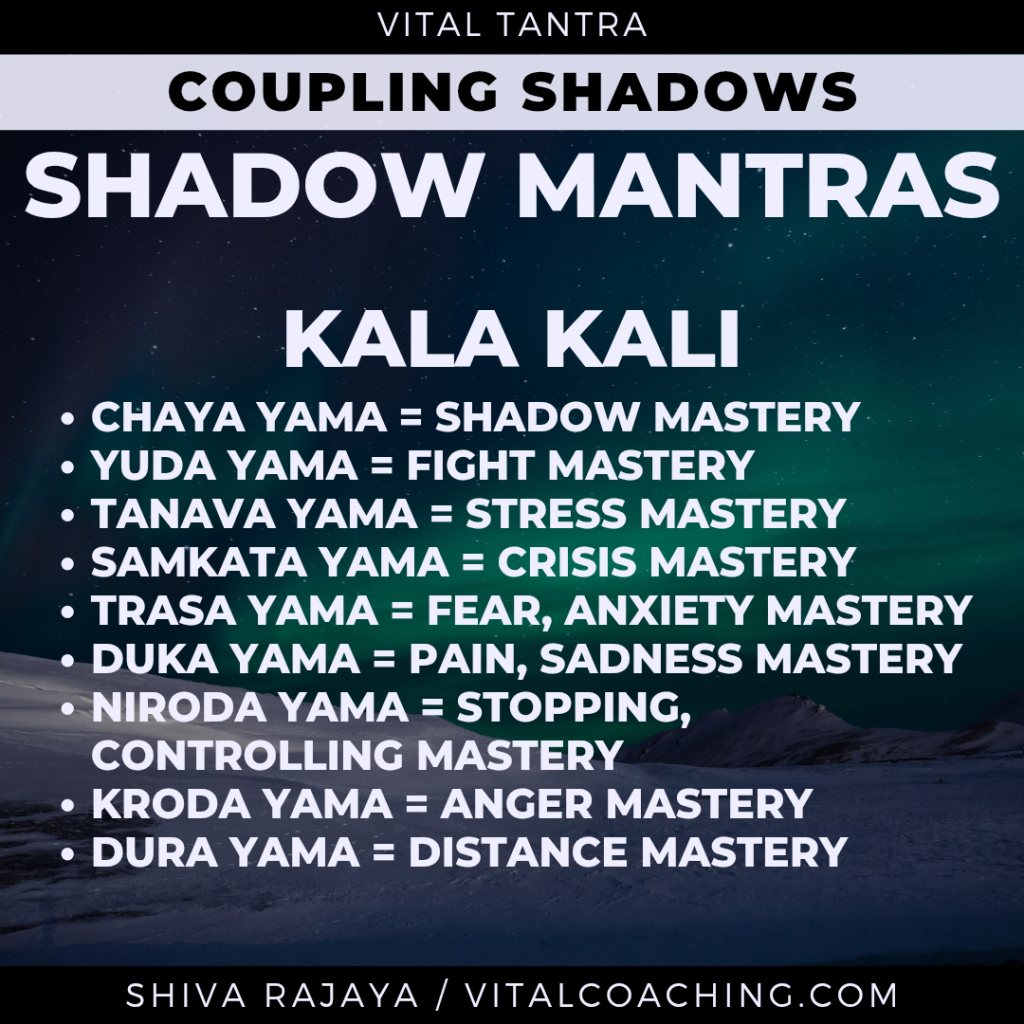
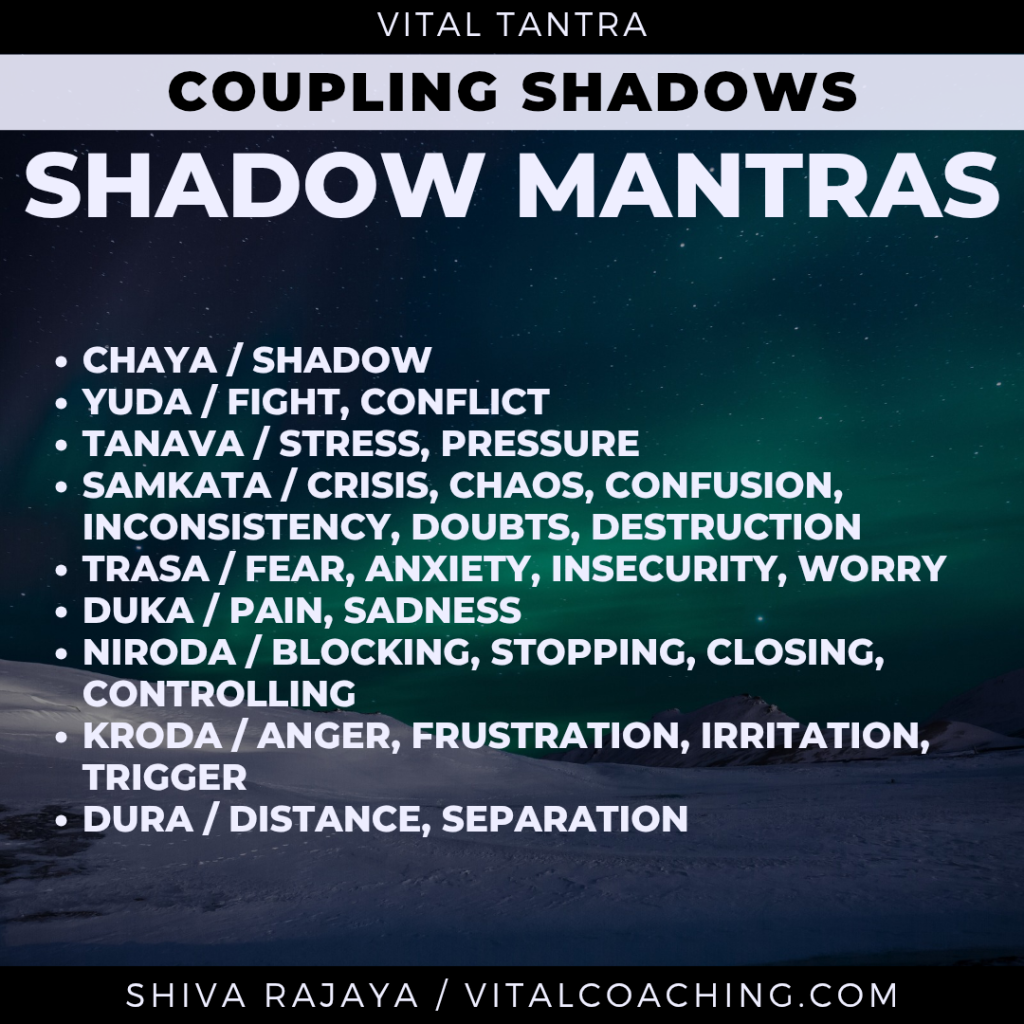
CHAYA YAMA — SHADOW MASTERY
CHAYA = Shadow.
This is the art of seeing the part of yourself that you’ve rejected or denied—then owning it fully.
Use this mantra when you’re projecting, blaming, or looping in shame.
Impact: You reclaim your power by saying, “This is mine. I see it. I choose to transmute it.”
Shadow becomes fuel. You stop blaming and start evolving.
YUDA YAMA — FIGHT MASTERY
YUDA = Conflict.
This one kicks in when tension rises and the war is about to start. It teaches you to fight with consciousness, not destruction.
Use it when you’re tempted to escalate, prove you’re right, or emotionally punish.
Impact: You interrupt the unconscious fight cycle.
You drop your sword, keep your dignity, and protect the love—even in disagreement.
TANAVA YAMA — STRESS MASTERY
TANAVA = Stress.
Stress isn’t the enemy. Unmanaged stress is.
This YAMA reminds you to pause, breathe, and center before you unleash cortisol-fueled chaos on your partner.
Use it when you’re feeling overwhelmed, overextended, or close to snapping.
Impact: You regulate your nervous system before entering the space.
You stop projecting pressure and start anchoring peace.
SAMKATA YAMA — CRISIS MASTERY
SAMKATA = Crisis, Chaos, Confusion.
This is the YAMA of spiritual warriorship. When everything breaks apart—this is your anchor.
Use it when emotions explode, clarity disappears, and your relationship hits a wall.
Impact: You stay grounded in the storm.
You don’t panic. You lead. You rise.
Chaos becomes initiation—not destruction.
TRASA YAMA — FEAR MASTERY
TRASA = Fear, Anxiety, Insecurity.
This one hits deep.
The fear of abandonment. The terror of being too much. The shame of being not enough.
Use this mantra when insecurity hijacks your heart or mind.
Impact: You stop leaking fear through control or withdrawal.
You meet your vulnerability with breath, compassion, and courage.
You become safe within yourself.
DUKA YAMA — PAIN MASTERY
DUKA = Pain, Sadness.
Grief. Loss. Disappointment. The ache of a moment that didn’t go how you hoped.
Use this YAMA when your heart is heavy, when you feel unseen, or when sadness clouds your joy.
Impact: You hold your own emotional depth like a sacred river.
You stop collapsing into despair or begging for validation.
You alchemize pain into poetry.
NIRODA YAMA — BLOCKING MASTERY
NIRODA = Stopping, Closing, Withholding.
This is for the silent treatment. The wall-building. The freeze.
Use this mantra when you notice yourself emotionally shutting down, blocking love, or avoiding truth.
Impact: You reopen the channel.
You unfreeze. You come back.
You choose connection over protection.
KRODA YAMA — ANGER MASTERY
KRODA = Anger, Frustration, Irritation.
This is fire energy—and you can either burn down your relationship or light it up with power.
Use this YAMA when you feel rage rising and want to discharge it with blame or venom.
Impact: You direct anger into clarity, boundary, and strength.
You stop attacking and start embodying truth with fire and grace.
DURA YAMA — REMOTE LOVE MASTERY
DURA = Distance. Separation.
This YAMA is for the lovers walking across continents. The soulmates stretched across time zones.
The challenge is real: no hugs, no kisses, no daily presence. Just space. Emptiness. Longing.
But DURA isn’t a curse. It’s a portal.
Use this mantra when physical absence stirs fear, insecurity, or doubt.
Use it when your connection feels like it’s floating in the void—and you crave something to grip.
Impact: You master the art of energetic connection.
You learn to transmit through voice, text, breath, presence.
You don’t rely on proximity—you amplify intimacy across space.
You stop saying, “It’s hard because you’re far,” and start saying:
“It’s sacred because we’re choosing this… and we’re still rising.”
This is the YAMA of energetic lovers.
Spiritual warriors of love who hold the thread—through silence, time, and space—
And never drop it.
Final Integration
These YAMAS are not just words.
They are frequency upgrades.
They turn reactive moments into rituals of growth.
They transform drama into devotion.
Print them. Learn them. Speak them. Practice them.
And watch your relationship evolve from emotional chaos…
to energetic mastery.
WHY DO YOU FEEL SO FREE WHEN YOU’RE SINGLE… BUT ANXIOUS THE MOMENT YOU START DATING?
Because peace alone is predictable. But dating? That’s a wild cocktail of unknowns, projections, hopes, and fears.
When you’re on your own, you’re the queen of your domain. No emotional curveballs. No mysterious texts. No wondering where you stand.
But bring in romantic connection—and suddenly, your nervous system is on red alert. Why?
Because dating activates the parts of you that still crave love, approval, safety, and belonging. And if any of those things were missing growing up… buckle up. Your subconscious now believes your entire worth is on the line.
IS THIS JUST ATTACHMENT THEORY IN ACTION?
Partially—yes.
When you meet someone new, your attachment system wakes up. If you’re secure, great. But if you lean anxious, you’ll start scanning for rejection, ghosting, abandonment… even if things are going fine.
This isn’t immaturity. It’s your brain doing its job: trying to protect you from pain you’ve already felt before.
But if you don’t consciously work with it, it’ll sabotage everything good before it begins.
WHY DOES DATING FEEL LIKE A TEST YOU COULD FAIL?
Because you’re still equating romantic success with personal worth.
Instead of treating dating as a space to explore compatibility, you might treat it like an emotional exam. If he pulls away, you fail. If he doesn’t text, you did something wrong. If he likes you, maybe—just maybe—you’re enough.
This is the hidden war inside so many powerful women. You’re strong everywhere… except when it comes to your own heart.
HOW CAN YOU BREAK THE CYCLE?
You’ve got to separate your self-worth from your dating life. Period.
- Anchor into practices that build inner safety—breathwork, journaling, mirror work, emotional regulation.
- Shift from “Does he like me?” to “Do I feel safe, inspired, and seen here?”
- Remember: Dating is not a performance. It’s a co-discovery process.
The moment you stop auditioning and start owning your throne, you become magnetic AF.
WHAT’S REALLY GOING ON UNDER THE SURFACE?
Under the surface, dating is stirring old survival patterns.
For many women, love = survival. If you had to perform for love as a child, you’ll unconsciously do the same in adulthood. That means shapeshifting, over-giving, overthinking, and abandoning yourself to be chosen.
The solution isn’t better strategy. It’s deeper healing.
WHAT’S THE MOST EMPOWERING REFRAME?
Dating isn’t the enemy. It’s the arena.
And every emotional wave is not proof you’re broken—it’s proof you’re healing.
When you meet your triggers with love instead of shame, you transform from a reactor into a queen.
Mastery Mantra:
“My peace is not a prize I sacrifice to be loved. It’s the standard that chooses who gets close.”
IS COMPLAINING REALLY BAD FOR YOUR BRAIN, OR IS THAT JUST A SPIRITUAL CLICHÉ? 🧠⚠️
It’s not a cliché—it’s cold, hard neuroscience.
Every time you complain, judge, or criticize, you reinforce that neural pathway.
You’re literally training your brain to look for problems, not possibilities.
The brain runs on a rule:
“Neurons that fire together, wire together.”
So when you’re constantly focused on what’s wrong, you wire your brain to find more things to be upset about.
This kills your ability to create solutions.
You’re weakening your prefrontal cortex—the exact part of the brain responsible for:
- Focus
- Emotional regulation
- Creative problem solving
- Long-term vision
In short? You’re training your brain to be stuck, angry, and small.
CAN NEGATIVE THINKING PHYSICALLY CHANGE THE BRAIN? 💣
Hell yes.
Chronic stress, criticism, and complaining shrink your prefrontal cortex.
That’s not a metaphor. That’s measurable.
The more you engage in negative thinking, the more your brain degenerates in the areas that handle executive function.
You become reactive, short-tempered, and emotionally dysregulated.
And here’s the kicker:
The more you do it, the harder it is to stop.
Your brain builds what you practice.
And if you practice being a bitter, low-vibe complainer?
You get really, really good at it.
IS IT TRUE THAT COMPLAINING MAKES YOU LESS ATTRACTIVE? 👀
Yes—and science backs it.
Studies show that complaining, criticizing, or being overly negative makes people appear less attractive, both physically and emotionally.
Why?
Because energy is real.
Negativity is felt before it’s understood.
It drains the room. It makes people withdraw. It repels opportunities, love, connection, and even business.
Positivity, on the other hand, lights people up.
It signals resilience, confidence, and leadership.
Attractive isn’t just about looks—it’s about vibration.
DOES COMPLAINING PUT YOU IN A VICTIM MINDSET? ⚠️
Absolutely.
When you complain, you’re telling the world:
“I have no power. I’m not in charge. Life is happening to me.”
This is the opposite of creator consciousness.
Complaining and criticizing are reactive habits. They come from a place of helplessness and blame.
That mindset will never give you freedom, success, or power.
It puts you in a loop of pain where nothing changes—because the world becomes the problem, not you.
Want real change?
Stop reacting. Start creating.
WHAT HAPPENS WHEN YOU FLIP THE SCRIPT? 🔄✨
When you focus on gratitude, speak with positivity, and train your mind to seek solutions, amazing things happen:
- Your prefrontal cortex strengthens
- You become more focused and emotionally resilient
- Your brain starts wiring for clarity, calm, and high performance
- You feel joyful, abundant, and magnetic
Every time you type, speak, or even think—you’re either building a prison or building a masterpiece.
You don’t get what you want in life.
You get what your brain is wired to find.
So wire it for joy. For abundance. For leadership. For beauty.
BOTTOM LINE?
Your brain is your reality generator.
And you’re programming it with every thought, word, and reaction.
Complain less. Create more.
Criticize less. Appreciate deeper.
Blame less. Take wild ownership.
Neuroscience doesn’t lie.
You’re either wiring yourself for greatness or for mediocrity.
Choose like it matters. Because it does. ⚡🧠🔥
OKAY, FIRST—WHAT EVEN IS A “DELULU”?
“Delulu” = delusional—but make it pop culture, Gen Z, and a little bit magical.
It’s a slang term born from K-pop fandoms, TikTok psychology, and manifestation culture.
And it’s blowing up for a reason:
A delulu is someone who believes in their fantasy so hard, so shamelessly, that it bends reality.
They don’t wait for the evidence.
They act like it’s already theirs—the lover, the lifestyle, the dream.
They don’t ask permission.
They declare it done.
It’s radical self-belief on steroids.
It’s manifestation with attitude.
It’s delusion—used as a power tool.
IS BEING “DELULU” A BAD THING OR A SUPERPOWER? ⚡
Both. And it depends on how you wield it.
When used intentionally?
It’s a weapon. A vibe. A reality-hacking cheat code.
Delulu energy helps you:
- Break out of mediocrity
- Defy “realistic” limitations
- Attract better by believing you deserve better
- Rewrite old programming by embodying the new story NOW
- Magnetize people, money, success, or love by walking like it’s already yours
It’s the energy of:
“I don’t chase. I don’t beg. I become.”
But used recklessly?
- It can spiral into denial
- Avoidance of hard truths
- Chasing unavailable people
- Refusing to do the real inner work
- Living in a fantasy bubble without grounded action
Healthy delulu = manifestation.
Toxic delulu = escapism.
WHERE DID THIS TERM EVEN COME FROM? 🧠
“Delulu” started as K-pop fan slang for fans who’d fantasize that their idol would fall in love with them.
It was originally sarcastic—a playful way to laugh at your own obsession.
But TikTok took it and turned it into a manifestation mindset.
Now, it’s less about celebrity crushes—and more about manifesting your dream life like it’s already signed, sealed, and delivered.
“Be delulu” became a movement.
Because in a world drowning in doubt?
Radical self-belief looks like insanity. Until it works.
WHAT’S THE PSYCHOLOGY BEHIND “DELULU” THINKING? 🧬
Neuroscience backs it:
The brain doesn’t know the difference between what’s real and what’s vividly imagined.
If you rehearse a new identity over and over—emotionally, physically, visually—
your brain starts to rewire your neural pathways to match that belief.
- You speak differently.
- You move differently.
- You attract differently.
It’s called embodied cognition.
You become what you believe.
Even if it starts as “delusion.”
CAN BEING “DELULU” HELP YOU ATTRACT LOVE? 💘
Absolutely. And people are doing it—daily.
Here’s how:
- Instead of chasing validation, they act like they’re already the one.
- Instead of obsessing over someone who’s half in, half out, they say:
“I only match with full-power, obsessed, soulmate-level love.” - Instead of asking, “Am I enough?” they declare,
“I’m the fantasy. I’m the standard. I’m the prize.”
And here’s the twist—people feel that.
Delulu energy is magnetic because it’s rooted in embodied confidence, not logic.
WHAT’S THE DANGER OF BEING TOO “DELULU”? ⚠️
The shadow side?
- Ignoring red flags
- Fantasizing someone loves you when they clearly don’t
- Believing “everything will work out” while avoiding real effort
- Living in potential instead of reality
- Avoiding feedback or growth because you’re too busy pretending you’re already there
Being delulu isn’t a substitute for action, truth, or emotional maturity.
It’s a mindset booster—not a reality replacement.
Use it with discernment.
Not to lie to yourself—but to liberate yourself from limits.
BOTTOM LINE?
“Delulu” is a frequency. A portal. A vibe that turns your inner narrative into outer reality.
It’s not about lying to the world.
It’s about telling the truth your future self already knows.
So yes—be delulu.
But be bold, wise, and embodied about it.
Dream louder.
Walk bigger.
Act like it’s already yours—
And watch the world catch up. 🔥👑💭
WHAT IS THE AMYGDALA AND WHY DOES IT RUN THE SHOW? 🧠🔥
The amygdala is your brain’s panic button.
Two almond-shaped clusters buried deep in your limbic system.
Small but savage.
It’s your threat detector, your emotional fire alarm, your instant reaction engine.
When it senses danger—real or imagined—it does one thing fast:
Hijack your nervous system.
Your heart races.
Your palms sweat.
Your mind goes blank.
You either attack, run, freeze, or fawn.
Welcome to survival mode.
But here’s the problem:
The amygdala can’t tell the difference between a tiger and a text message.
It’ll freak out over a breakup, a tone of voice, a social media comment, or an awkward silence.
You think you’re angry?
Triggered?
Falling apart?
No. You’re just amygdala-activated.
WHAT HAPPENS TO YOU WHEN THE AMYGDALA TAKES OVER? ⚠️
You stop thinking.
You start reacting.
When the amygdala hijacks your system:
- Your prefrontal cortex shuts down. That’s your logic, planning, and self-awareness—offline.
- Cortisol and adrenaline flood your body. That’s stress, tension, overdrive.
- Your focus narrows, your options disappear, and your world becomes black-and-white.
In this state, you:
- Say things you regret
- Make impulsive decisions
- Project your pain onto others
- Replay trauma loops
- Collapse into fear, rage, or shutdown
It’s not just emotional—it’s neurological warfare.
You’re no longer operating from your higher self.
You’re in survival… not strategy.
HOW DO YOU KNOW IF YOUR AMYGDALA IS OVERACTIVE? 🔍
Check your patterns.
- Constant anxiety?
- Explosive reactions?
- Overthinking?
- Emotional flashbacks?
- Fear of confrontation?
- Obsessing over worst-case scenarios?
That’s your amygdala doing overtime.
And if you’ve lived in chaos, trauma, or hyper-stimulation for too long?
It’s been conditioned to stay on HIGH ALERT.
Even when there’s no danger.
You’re not crazy—you’re just neurologically overstimulated.
CAN YOU RETRAIN THE AMYGDALA? OR ARE YOU SCREWED FOR LIFE? 💪
Yes. You can absolutely retrain it. Rewire it. Reinvent yourself.
The amygdala isn’t your enemy—it’s just outdated software.
It’s doing its job… based on old code.
But you?
You’ve evolved.
Here’s how you reclaim control:
- Breathwork – Deep breathing sends safety signals to your body.
- Cold exposure – Teaches your nervous system to stay calm under stress.
- Meditation – Literally shrinks the amygdala and grows your prefrontal cortex.
- EMDR or somatic therapy – Helps clear trauma and restore balance.
- Presence practice – Keeps you grounded in NOW, not past triggers.
- Movement + expression – Shake, scream, sing, dance—release the emotional charge.
And most importantly:
Catch the hijack in real time.
Name it.
Pause.
Don’t react.
Recenter.
The moment you can say:
“My amygdala is firing, but I’m not going with it,”
you’ve already won.
HOW DOES MASTERING THE AMYGDALA CHANGE YOUR LIFE? 🚀
It changes everything.
- You stop being run by fear.
- You stop falling into toxic patterns.
- You stop losing your shit over nonsense.
- You respond instead of react.
- You speak from grounded truth, not emotional chaos.
Emotional mastery starts here.
The difference between a triggered child and a powerful adult?
Nervous system regulation.
When you own your amygdala, you own your life.
Your power, your peace, your presence—it all begins with this tiny but mighty brain organ.
So don’t demonize it.
Dominate it.
The world doesn’t need more people reacting.
It needs people who’ve learned to pause, breathe, and lead.
Master the amygdala = Master the moment = Master your destiny.
Let’s f*cking go. ⚡
WHAT’S WITH ALL THE SHAMING AND ATTACKS ON WHOLE COMMUNITIES?
Yo, squad, buckle up—this shaming nonsense is a wildfire, torching genders, tribes, vibes like it’s a sport. Brothers bashing masculinity, women dissing men, women tearing down other women, men shading women, ecstatic dancers called shallow? What the hell? It’s toxic, lazy, and screams unhealed wounds. Let’s rip it apart and build better.
Shaming’s a cop-out. It’s not truth—it’s triggers dressed as wisdom. People point fingers to feel taller, not deeper. Men, women, spiritual crews—nobody’s immune when ego’s driving. Critics simplify complex journeys into soundbites, stripping nuance, killing growth. It’s not insight—it’s insecurity.
Communities like dancers? They’re vibing, exploring, living. Calling ‘em shallow? That’s projection, not perception. Every path—man, woman, tribe—has depth, struggle, magic. Shaming shuts it down, steals the light, spreads poison. You see it—X posts, rants, takedowns.
Flip the script. Don’t curse the journey—celebrate it. Men, women, dancers, seekers—they’re trying, growing, being. Call out BS, sure, but lift truth, not shade. You’re not here to judge—you’re here to ignite.
Own your lens. Shaming’s a mirror—your wounds, your shadows. Next time you wanna blast a tribe, check yourself. What’s unresolved? What’s screaming? Heal that, share love, build bridges. You’re the vibe—make it shine bright ⚡.
WHY DO PEOPLE BRAG ABOUT BEING “BETTER” THAN THEIR PAST SELVES?
That “I used to be like them, but I’m better now” flex? Pure ego, zero soul. Men crowing about ditching old ways, women claiming new enlightenment—it’s not growth, it’s a glow-up for clout. Bragging’s loud, but hollow. Let’s shred it and find real.
It’s competitive. Saying “I’ve changed” bashes others to boost self. Ex-player turned guru? Cool story, but why shade the old crew? Real change lifts all, not just you. Dissing your past—men, women, tribes—screams insecurity, not strength.
Gratitude’s missing. Your old life—dances, loves, fights—shaped you. Those “shallow” dancers? They held you. Those “lost” seekers? They taught you. Bragging skips thanks, spits on roots, builds nothing. Honor your path, don’t burn it.
Test the claim. Someone says, “I’m different”? Ask how. What’s healed? What’s shifted? Vague vibes? Red flag. Real growth has scars, stories, humility. No need to slam others—truth stands solo.
Choose better. You’ve grown? Share the lesson, not the shade. Inspire, don’t divide. Your change means squat if it’s built on shame. Own your glow, lift your tribe, vibe real. You’re a spark—light the world up.
HOW DO YOU CALL OUT SHAMING WITHOUT ADDING TO THE NOISE?
Shaming’s contagious, but you’re smarter. When you spot takedowns—men, women, spiritual crews—don’t clap back, rise up. Call it out clean, clear, kind. You’re not here to fan flames—you’re here to flip vibes.
Name the pattern. Say, “This shade’s lazy—let’s talk real.” Point to truth—complexity, humanity, growth. Men aren’t monsters, women aren’t weak, dancers aren’t dumb. Reset the convo, no venom.
Ask questions. Why bash a whole tribe? What’s the wound? What’s the fear? Not to roast, but to reveal. Shamers crumble when mirrored—they dodge, you win. Keep it cool, stay sharp.
Share your truth. Got a story? Drop it. Ecstatic dance saved you? Say it. Men lifted you? Shout it. Women held you? Celebrate it. Your voice cuts through toxic noise. No fight needed—just facts.
Stay high. Shaming’s low—you’re not. Don’t sink, soar. Call it out, then create. Build spaces for truth, not trash. You’re a leader, not a loudmouth. Vibe fierce, always rise.
WHAT DO YOU SAY TO SOMEONE SHAMING YOUR COMMUNITY?
When they attack your tribe—dancers, seekers, men, women—you don’t flinch, you flex. Your words set the stage, shift the game, own the truth. No defense—just power. Here’s how to slay it.
Stay calm. No rage, no tears—pure strength. Say, “That’s your lens, not my truth.” You’re not pleading—you’re planting. Their shade can’t touch your light. Own your vibe, always.
Flip it back. Ask, “What’s shallow about dancing free?” Or, “Why’s seeking truth a failure?” Make ‘em think, not fight. Shamers stutter when challenged smart. You’re not arguing—you’re awakening.
Share your heart. Tell ‘em, “My tribe lifts me, teaches me, holds me.” Not to prove, but to shine. Your story’s stronger than their stereotypes. Ecstatic dance? It’s soulfire. Spiritual quests? It’s courage. Speak it, live it.
Walk tall. Their words don’t define your crew. You do. Say less, do more. Dance harder, love deeper, grow fiercer. You’re not here to answer haters—you’re here to be you. Shine on, unfazed.
HOW DO YOU HEAL FROM SHAMING AND KEEP YOUR VIBE HIGH?
Shame stings, but you’re tougher. When they bash your people, your path, your soul, don’t break—build. Healing’s not hiding—it’s rising, reclaiming, roaring. Here’s how to shake it off and slay.
Feel it first. Hurt’s real—own it. Cry, rage, breathe. You’re not weak—you’re human. Let it move, not stick. Your heart’s a warrior, not a wound. Process, then pivot.
Find your tribe. Shamers isolate—crews connect. Dance with your dancers, chant with your seekers, vibe with your kin. They remind you—you’re enough, you’re fire, you’re home. Lean in, lift up.
Rewrite the story. Their shade ain’t your script. Say, “I’m deep, I’m real, I’m growing.” Not to them, to you. Your truth erases lies. Ecstatic dance saved your soul? Own it. Seeking’s your strength? Claim it.
Create, don’t curse. Shaming’s noise—you’re music. Dance louder, love harder, live bolder. Build beauty where they build hate. Your vibe’s unstoppable, untouchable, unshamed. You’re the spark—light it up ⚡.
WHY DO RELIGIONS MAKE IT LOOK LIKE WE’RE PRAYING TO DIFFERENT DEITIES?
Strap in, fam—religions aren’t out to confuse you, but they’re serving the divine in a million flavors. Names like Allah, Shiva, God, or Spirit feel like separate teams, but it’s one source dressed in cultural swag. Humans love their spin—stories, rituals, and rules turn unity into a cosmic soap opera.
It’s not division—it’s perspective. Each faith’s a lens, catching the infinite in ways that vibe with its people. The divine’s whole, but we slice it to fit our hearts. Time to zoom out and see the big picture—no beef, just brilliance.
HOW DID THIS “DIFFERENT GODS” VIBE EVEN START?
History’s the architect. Back when tribes roamed, every crew had its sacred story—think Nile gods for Egyptians or sky spirits for nomads. Local life shaped local worship, tying the divine to land, survival, power. No one was beefing—it was just their truth.
Then empires crashed the party. Trade, wars, conquests mixed beliefs, and folks started picking sides. Monotheism upped the stakes—one God, one way, one winner. Politics and pride drew lines, but the divine stayed borderless. It’s us, not the source, making it messy.
WHY DO RELIGIONS GIVE THE DIVINE DIFFERENT NAMES?
Names are just vibes. Yahweh, Krishna, Tao—they’re human tags for something too big for words. Cultures craft the flavor—desert faiths lean fierce, forest ones flow gentle. It’s the same light, split by our prisms.
Language locks it. Allah means “God” in Arabic, Brahman’s “ultimate reality” in Sanskrit. Names carry history, not conflict—they’re love letters, not battle cries. Strip the label, and it’s one pulse. Words divide; truth unites.
WHY DO SOME FAITHS SWEAR THEIR GOD’S THE ONLY ONE?
It’s human, not holy. Certainty feels safe—claiming “my way’s right” soothes doubt. Religions rally tribes—think medieval crusades or modern “one true path” sermons. It’s ego in robes, not the divine throwing shade.
Power plays a role. Leaders lean on “truth” to unify or dominate—popes, imams, gurus, same game. Fear fuels it—if another god’s real, what’s your vibe worth? Drop the turf war, and the divine’s just chilling, one and done.
HOW DO RITUALS MAKE IT FEEL LIKE SEPARATE GODS?
Rituals are culture’s heartbeat. Kneeling in a mosque, chanting in a temple—they’re paths to the same peak. Rules like fasting or sabbath keep tribes tight, not gods apart. Think family traditions—different moves, same love.
They’re bridges, not walls. A Catholic’s rosary, a Buddhist’s mantra—both chase peace, not points. Rituals ground us, but the feeling’s universal. Focus on the why—connection, not competition—and the “split” vanishes like smoke.
WHY DO RELIGIONS CLASH IF IT’S ONE DIVINE?
It’s people, not powers. Institutions crave control—think holy wars or temple turf battles. Dogma draws blood—if your god’s “wrong,” you’re out. History’s littered—Inquisition, jihads, caste fights. It’s fear, not faith, swinging fists.
Not everyone’s scrapping. Plenty vibe cross-faith—like interfaith peace talks or shared charity drives. Clashes come from rigidity, not revelation. Seekers find harmony; fanatics find foes. Choose love, and the divine’s one big party.
HOW CAN I SEE THROUGH THE “DIFFERENT GODS” FOG?
Rewire your view, legend. Dig into texts—Bible, Quran, Vedas. Core themes—love, truth, surrender—shine through every page. Compare and connect—Jesus’ mercy vibes with Buddha’s calm. Dogma’s noise; essence is signal.
Feel it yourself. Pray, meditate, stare at the stars—the divine hits direct, no middleman. Ask believers—“What’s your faith’s heart?” You’ll hear unity, not ultimatums. Truth’s in the overlap—chase that, not the brand.
WHAT’S THE COST OF BUYING THE “DIFFERENT GODS” MYTH?
It’s a soul-sucker. Division sparks hate—think religious riots or “heathen” slurs. It blinds you—you’ll skip Sikh wisdom ‘cause it’s “not your vibe.” It’s a missed party—one note instead of a symphony.
It chains your spirit. Clinging to one name shrinks the infinite—like eating only salt. You’re here for the feast, not a snack. Break free, taste every shade of the divine. That’s living, not just believing.
HOW DO I TALK THIS OUT WITHOUT A HOLY WAR?
Heart first, heat last. Ask real questions—“What’s the divine to you?” You’ll get stories, not sermons. Share soft—“I see one source, many paths.” Stay curious, not cocky—nobody owns eternity.
Dodge traps. Mocking faith is a cheap shot—it shuts doors. Find shared vibes—hope, kindness, awe. Listen like it’s gold—empathy melts armor. Aim for connection, not conversion. Unity’s the win, not a debate trophy.
WHAT’S THE ULTIMATE FLEX OF SEEING ONE DIVINE?
The flex? You’re a cosmic warrior, weaving every faith’s fire into your glow. You don’t choose sides—you dance with all, finding truth in mosques, temples, forests. Your soul’s a beacon, no dogma, all devotion. You feel the divine everywhere—stars, smiles, silence.
You live the oneness—loving fierce across lines, no “us vs. them.” Every breath’s a prayer, every act a bridge. You’re not just awake—you’re electric, showing the world one divine, no splits, pure power ⚡.
Why do Flat Earth folks think the planet’s a cosmic pancake?
Oh, buckle up, fam—Flat Earth believers are out here living in a 2D fantasy, swearing the world’s flatter than their Wi-Fi signal. They’re not just quirky—they’re all-in on a delusion that defies telescopes, satellites, and basic geometry. It’s not ignorance; it’s a rebel yell against reality, wrapped in YouTube conspiracies and Reddit rabbit holes.
They cherry-pick “evidence” like it’s a buffet—ancient texts, shaky math, “I saw it with my eyes!” Meanwhile, NASA’s laughing, and so are we. It’s less about facts and more about feelings—they’re vibing with a story that makes them special, not wrong.
How does this delusion even get its claws in?
Picture this: a perfect storm of distrust and dopamine. It starts with a seed—maybe a meme, a video, or Uncle Bob’s rant at Thanksgiving. “What if they’re lying?” hooks their brain. Suddenly, they’re Sherlock, “uncovering” truths the sheeple missed. It’s a thrill ride, not a research paper.
The internet’s their candy store. Echo chambers serve up endless “proof”—shady forums, blurry pics, “experts” with no credentials. Confirmation bias is the MVP, turning every flat horizon into a mic drop. They’re not computing—they’re cosplaying as rebels, and it feels so good.
What’s the psychology driving this globe-denying circus?
It’s a mental rollercoaster fueled by ego and angst. Distrust’s the big daddy—governments, scientists, “elites” are all in on some grand lie, right? Flat Earthers feel smarter than the system, like they’ve cracked a code normies can’t touch. It’s superiority with a side of paranoia.
Then there’s tribalism—they join a squad of “truthers” who cheer every wild claim. Belonging beats being right. Add a sprinkle of cognitive dissonance—facts bounce off because admitting error hurts more than clinging to crazy. Their brain’s a bouncer, kicking out logic at the door.
Why diss millions of scientists for a theory that’s bonkers?
Because scientists are the “man,” and Flat Earthers are sticking it to ‘em! They don’t trust institutions—Big Science, Big Pharma, Big Globe, whatever. It’s not about evidence; it’s about feeling like the underdog. Dismissing PhDs makes them David to NASA’s Goliath. Spoiler: David’s got no sling.
They lean on “my truth” vibes, not data. Photos from space? CGI. Math? Witchcraft. They’re not debating—they’re preaching. It’s easier to scream “hoax” than crack a textbook. Ego’s the real MVP, whispering, “You’re the genius they’re hiding from.”
What do they get out of being so extra?
Oh, they’re living for the rush! Believing the Earth’s flat gives them purpose, identity, a cape in their own superhero flick. They’re not just Karen from accounting—they’re Karen, the Cosmic Crusader, saving humanity from globe lies. It’s an ego glow-up, plain and simple.
Plus, community’s a helluva drug. Flat Earth groups are tight—high-fives for every “gotcha” post. They’re bonded by “us vs. them,” dodging reality together. Attention’s the cherry on top—troll a scientist, go viral, bask in clout. Delusion’s their VIP pass to feeling alive.
Why’s it so hard to talk sense into them?
Because logic’s not invited to this party. Their belief’s a fortress, not a tent—every fact you lob gets spun into “part of the cover-up.” Cognitive bias is their bodyguard, filtering out anything that smells like a globe. Argue with them? You’re just a sheeple, and they’re cackling.
It’s emotional, not rational. Admitting they’re wrong means losing their tribe, their swagger, their whole “I’m special” vibe. It’s identity suicide. So they double down, quoting “flat facts” like it’s scripture. You can’t win—they’re playing chess with pigeons.
How do I deal with a Flat Earther without losing my mind?
Deep breath, fam—don’t wrestle pigs in mud. They love the fight; you’ll just get dirty. Don’t debate—deflect. Ask, “What’s it like believing that?”—let them ramble, nod, sip your coffee. Humor’s your wingman—toss a “So, where’s the edge?” with a smirk, then dip.
If they’re fam or friends, set boundaries. “Cool, let’s talk pizza instead.” Don’t take it personal—their delusion’s not your drama. Stay sane by staying detached—you’re not their therapist or their globe police. Laugh it off and keep scrolling.
Can they ever snap out of this flat-out nonsense?
It’s rare, but cracks can form. Usually, it’s not facts that do it—it’s life shaking their core. A trusted friend, a personal crisis, or stumbling on a contradiction they can’t spin. The fortress falls when they question themselves, not when you shove graphs in their face.
Don’t hold your breath. Change comes from within, not your epic PowerPoint. Plant seeds, don’t swing hammers—a casual “Ever seen a ship disappear bottom-first?” might linger. Their journey’s theirs—you just keep shining your round-world light.
Why’s this even a big deal—let them believe their fairy tale, right?
Wrong, Karen—delusions aren’t harmless. Flat Earth’s a gateway drug to deeper conspiracies—anti-science, anti-reality vibes that mess with progress. It’s not just cute; it’s corrosive, breeding distrust in facts, experts, truth itself. That’s a societal facepalm.
On the flip side, it’s a mirror. Their need to rebel screams we’re all craving meaning. Instead of roasting, redirect—channel that passion into real fights, like climate or justice. They’re not dumb—they’re lost. Laugh, but learn: shadows thrive when truth feels cold.
What’s the ultimate flex of dodging this delusional trap?
The flex? You’re a reality rockstar, grounded in facts but open to wonder. You don’t need a flat fantasy to feel special—your vibe’s already cosmic. You question without losing grip, laugh at nonsense without malice, and build bridges, not bunkers.
Your mind’s a blade, slicing through BS with wit and wisdom. You don’t fight fools—you outshine them, living so bold they rethink their script. That’s the win: not proving the Earth’s round, but proving your soul’s unbound ⚡.
Why’s Facebook turning into a digital dumpster fire?
Oh, honey, grab some popcorn—Facebook’s the new Colosseum, but instead of gladiators, we’ve got keyboard warriors slinging shame like it’s an Olympic sport. It’s a public pillory where people air their dirty laundry—breakups, betrayals, bad biz deals—hoping for a mob to cheer their vendetta. No trial, no facts, just vibes and vitriol.
Why? Because everyone’s itching to be right, and nothing screams “I’m winning” like a viral rant. Algorithms love the chaos—rage gets clicks, shares, sad reacts. It’s not connection; it’s a shame-fest circus, and the clowns are running the show. Buckle up—it’s messy.
What’s the deal with these endless group fights?
Picture this: a digital Thunderdome where wannabe philosophers and triggered trolls battle to the death—or at least till someone’s Wi-Fi cuts out. Group fights never resolve because nobody’s listening—they’re just yelling into the void, desperate for that “mic drop” moment. Spoiler: it never lands.
It’s a comedy of errors—misquotes, strawmen, CAPS LOCK rants. People don’t want solutions; they want validation for their tantrums. Shadows run the game: ego, insecurity, need-to-be-right-itis. Meanwhile, the rest of us are scrolling like, “Y’all need a nap.”
Why do people think shaming’s the answer to everything?
Because calling someone out feels like power, duh! Forget private convos—why solve shit when you can screenshot and shame for 500 likes? It’s lazy AF. Victims play martyrs, villains get dogpiled, and everyone’s addicted to the drama high. Zero accountability, maximum applause.
The psychology? Hurt people hurt people. Shaming’s a quick hit of control when you feel powerless. Spiritual bypassing alert: folks think “exposing truth” equals growth. Nah, it’s just gossip with a halo. Real talk? Shame solves nothing—it just breeds more shadows.
How’s this toxicity screwing with our vibes?
It’s a soul-sucking vortex, fam. Every rant you read spikes your cortisol—you’re stressed just scrolling. Misrepresentations and half-truths twist your perception, leaving you paranoid or pissed. No one’s listening, so you feel invisible, even in “conscious” groups. It’s a buzzkill.
Worse? It’s contagious. You start snapping IRL, judging friends, picking fights. Your energy tanks, creativity dips, and suddenly you’re that person subtweeting your barista. Facebook’s shadow fest doesn’t just stay online—it creeps into your heart. Time to unplug.
How do I navigate this cesspool without losing my cool?
First, curate your feed like a savage. Unfollow drama queens, mute ranters, hide groups that feel like WWE SmackDown. Your peace > their noise. Set a scroll timer—15 minutes, then bounce. Protect your vibe like it’s VIP.
When you engage, be a ninja, not a knight. Ask questions, don’t preach—“What’s your take on this?” sidesteps traps. Humor’s your shield—drop a meme or a “lol, y’all wild” to defuse. Don’t feed the trolls—they’re hungry for your meltdown, not your wisdom.
What’s the play when I get dragged into a shame storm?
Don’t take the bait, boo—you’re not their punching bag. If someone’s shaming you, don’t clap back. Screenshot, mute, move on. Public rants aren’t about truth—they’re about attention. Engaging’s like wrestling a pig in mud—you both get dirty, but the pig loves it.
Go private: DM trusted friends for clarity, not the mob for justice. Own your part—if you messed up, apologize clean, no excuses. Stay high-vibe—post love, not shade. Their storm’s not your story—write your own with grace and grit.
Why do these “I’m right” clowns keep hijacking every thread?
Because their ego’s got a PhD in never-shutting-up. Meet Chad, the Thread Dominator—he’s got 47 comments and zero chill, quoting Sun Tzu to “win” a vegan recipe debate. And Karen? She’s typing novels, correcting your grammar while missing your point. They’re not here to connect—they’re here to conquer.
It’s sad, really—insecurity’s driving the bus. They’d rather die on a hill of “rightness” than admit they’re human. Shadows alert: fear of losing face, need for control, validation addiction. Laugh it off—their circus, not your monkeys.
How do I communicate consciously in this hot mess?
Be the anti-rant superhero. Listen first, type later—read their post twice before you chime in. Ask, don’t assume—“Can you clarify what you meant?” shuts down fights faster than “You’re wrong.” Keep it real: share your truth without dragging theirs.
Set boundaries—“I’m not vibing with this convo, peace out.” Model the energy you want—post gratitude, insights, or straight-up silliness. You’re not fixing Facebook, but you’re planting seeds. One conscious comment can shift the whole game.
What’s the win when everyone’s losing it online?
The win’s staying unbothered in a sea of chaos. You don’t just dodge the drama—you rise above it, a beacon of wit and wisdom. Engage with purpose: spark joy, drop truth, then dip. Build your tribe—connect with souls who vibe high, not fight dirty.
Use the noise as fuel—let their rants remind you who you’re not. Create your own content—posts, groups, lives—that scream authenticity. You’re not here to win arguments—you’re here to win at life, shining so bright the shadows can’t touch you.
What’s the ultimate flex of slaying the shame game?
The flex? You become a vibe legend—untouchable, radiant, real. You’re not sucked into shame spirals or petty fights—you’re building bridges, not burning them. Your words spark light, not wars—people scroll your posts and think, “I want that energy.”
You’re not just surviving Facebook’s circus—you’re rewriting the script, showing the world what conscious looks like. Every interaction’s a chance to slay—with humor, heart, and zero Fs given for the haters. That’s the game: you don’t play their shame—you create your fame ⚡.
Why does an angry outburst mess with my body for so damn long?
Listen up, fam—anger’s a chemical wildfire, and your body’s the one getting burned. When you lose it, cortisol—the stress hormone—spikes like a rocket, flooding your system. It takes seven hours for your body to chill because cortisol’s a clingy beast, keeping your heart racing, muscles tense, and mind wired.
It’s not just a mood—anger rewires your physiology. Your nervous system’s stuck in fight-or-flight, screwing with your sleep, digestion, even your vibe. That outburst? It’s a debt your body pays long after you’ve moved on. Knowing this is power—it’s your cue to rethink rage.
What’s cortisol doing to me during those seven hours?
It’s throwing a stress party, and you’re not invited. Cortisol pumps up your blood pressure, jacks your heart rate, and tightens every muscle like you’re prepping for battle. Your brain’s on high alert, scanning for threats, making you snappy or paranoid.
Long-term? It’s a health hit job. Chronic cortisol spikes can tank your immune system, mess with your gut, and invite anxiety to the party. Those seven hours are a warning—one outburst’s bad enough; stack ‘em up, and you’re playing with fire. Your body’s begging you to cool it.
Why do I even get so pissed in the first place?
Anger’s a signal, not a sin. It’s your soul screaming, “Something’s off!” Triggers vary—betrayal, disrespect, feeling powerless—but the root’s usually deeper. Unmet needs, old wounds, or just plain exhaustion can turn a spark into a blaze.
Your brain’s wired for survival. Anger’s a reflex to protect your boundaries or dodge pain. Problem is, modern life’s a trigger minefield—traffic, trolls, trauma—and we’re not cavemen fighting sabertooths. Unpack the why, or you’re just swinging at shadows.
How does anger screw with my life beyond those seven hours?
It’s a vibe thief, fam. One outburst can ripple, tanking your mood, focus, and connections. You’re not just mad—you’re stuck in a cortisol haze, snapping at loved ones or ghosting your goals. Relationships? Anger builds walls—people pull back when you’re a volcano.
Mentally, it’s a fog machine. Clarity’s gone; doubt’s in. You’re less creative, less present, less you. And if rage becomes your default? You’re signing up for burnout, not badassery. Anger’s a moment; don’t let it steal your life.
What’s the fastest way to cool off when I’m raging?
Breathe, don’t break. Box breathing’s your MVP—inhale four counts, hold four, exhale four, hold four. Do it for two minutes; it hits reset on your nervous system. Move your body—walk, shake, punch a pillow. Rage lives in your muscles; burn it out.
Name the feeling: “I’m pissed because…” Saying it cuts its power. Splash cold water on your face—it shocks your vagus nerve into chill mode. Don’t vent online or at someone—that fuels the fire. Pause, process, protect your peace.
How do I stop outbursts before they start?
Know your triggers—they’re your roadmap. Journal what sets you off: loud noises, disrespect, being ignored? Spot the pattern, and you’re halfway there. Prep your nervous system—daily meditation or yoga keeps cortisol low, so you’re less likely to snap.
Set boundaries early—say “I need space” before you’re fuming. Check your basics—sleep, food, hydration. A hangry body’s a ragey body. Practice micro-pauses: count to five before reacting. You’re not a slave to anger—you’re its master.
Why’s it so hard to let go of anger?
Because anger’s addictive. It feels powerful, righteous, alive—like you’re finally in control. Your brain craves that dopamine hit, even if it’s wrecking you. Plus, holding grudges is comfy—it’s easier than forgiving or facing the real pain underneath.
Society’s no help. We’re taught rage is strength, especially for some vibes—think “tough guy” or “fiery diva.” But clinging to anger’s a trap—it’s not strength; it’s stuckness. Letting go takes guts, because it means owning your vulnerability. That’s the real flex.
How do I turn anger into something epic instead of destructive?
Alchemize that heat, fam! Anger’s raw energy—use it like rocket fuel. Channel it into action: hit the gym, paint, write a manifesto. That fury? It’s passion in disguise. Reframe the trigger: “This pisses me off because I value respect—so how do I honor that?”
Set goals with your fire—use rage to crush a project or stand up for what’s right. Speak your truth, but clean—say “I’m upset, let’s fix this” instead of yelling. Anger’s a teacher—let it push you toward growth, not chaos.
What’s the long game for mastering my anger?
Build a rage-proof life. Daily rituals are your armor—meditation, journaling, breathwork keep cortisol in check. Therapy or coaching’s a game-changer—dig into roots, not just reactions. Surround yourself with real ones—people who call you out with love, not drama.
Practice radical self-compassion—you’re human, not a robot. Mess up? Learn, don’t lament. Track your wins: notice when you pause, breathe, choose calm. Mastery’s a marathon, not a sprint—every step’s sculpting a calmer, fiercer you.
What’s the ultimate flex of turning rage into radiance?
The flex? You become a vibe alchemist, turning poison into power. You don’t just control anger—you transcend it, wielding its energy to create, connect, conquer. Your presence? Magnetic and unshakable. People feel your calm strength and want in.
Every convo’s clear, every goal’s closer, every day’s brighter. You’re not dodging rage—you’re using it to fuel a life that slaps. Your scars become stories, your fire becomes light. That’s radiance: you don’t just survive anger—you shine through it ⚡.
Why do people think they’re owed an explanation in spiritual circles?
Wake up, fam—nobody owes you a damn thing, not even a “why.” Spiritual communities aren’t Disney Land; they’re packed with humans—flawed, messy, and real. You’re not entitled to someone’s time, energy, or answers just because you share a yoga mat or a mantra. That’s not conscious—it’s clingy.
The vibe’s simple: people set their own boundaries, and that’s their right. They can ghost, block, or dip out if the convo feels toxic or off. Expecting them to spell it out? That’s your ego demanding control, not your soul seeking clarity. Check yourself—entitlement’s not a spiritual flex.
What’s conscious communication really about?
It’s raw, real, and respectful—not a free-for-all therapy session. Conscious communication means speaking your truth without forcing others to match your vibe. It’s listening, owning your triggers, and knowing when to walk away. Silence is communication too—sometimes louder than words.
It’s not about “fixing” every conflict. Some fights aren’t worth having. If someone pulls back, that’s their boundary, not your cue to chase. Respect their space—that’s the conscious part. You don’t get to dictate their process, even if you’re both chanting “namaste” on weekends.
Why’s it so hard to accept when people pull back?
Because rejection stings, and we’re wired to crave closure. Your brain’s like, “Why’d they ghost? What’d I do?”—it’s a control freak tantrum. Spiritual communities amplify this—we assume “woke” folks should always talk it out. Newsflash: they’re human, not perfect.
You’re projecting. You want their exit to fit your narrative—but life ain’t a script. Their silence isn’t about you; it’s about them choosing their peace. Let go of the need to know. It’s not betrayal—it’s their right to self-protect. Grow up and vibe higher.
What’s the shadow side of expecting everyone to “talk it out”?
It’s entitlement dressed as enlightenment. You’re not seeking truth—you’re demanding compliance. Forcing someone to explain themselves flips the script: you’re the one crossing boundaries, not them. Shadows don’t vanish in spiritual spaces—they just wear fancier masks.
Another trap? Assuming “conscious” means conflict-free. Wrong. Spiritual communities are human, packed with egos, triggers, and mess. Shadows thrive in the light too. Expecting perfection’s a setup for drama—you’re begging for disappointment. Own your projections, or they’ll own you.
How do I handle it when someone blocks or ghosts me?
First, breathe—don’t spiral. Their silence isn’t your verdict; it’s their choice. Check your triggers: what’s this stirring—abandonment, shame, rage? Journal it raw. Name it, don’t numb it. You don’t need their “why” to heal.
Next, respect their boundary. Don’t stalk, beg, or blast them on group chat—that’s low-vibe. Reflect, don’t react: what’s your role in this? Maybe you pushed too hard. Maybe it’s just their stuff. Either way, let them go. Focus on your peace, not their process.
What’s the right way to set my own boundaries?
Be a boss, not a doormat. Know your limits—what feels good, what drains you? If a convo’s toxic, say it: “I’m not vibing with this—let’s pause.” No need to over-explain; clarity’s enough. Silence is a boundary too—ghosting’s fine if it protects your energy.
Use actions, not just words. Block, mute, step back—no guilt needed. You’re not here to fix everyone. Communicate your needs upfront in relationships: “I need space when I’m off.” Own your energy—it’s your most sacred asset. Protect it like gold.
Why do spiritual communities still breed drama despite the “love and light”?
Because humans are messy, and no crystal can fix that. Spiritual circles aren’t immune to shadows—jealousy, power trips, victim vibes still creep in. Labeling something “conscious” doesn’t erase ego; it just gives it a glow-up. People hide flaws behind jargon, but flaws don’t vanish.
We’re also sloppy with boundaries. “Unity” gets twisted into “you owe me your soul.” Nah, fam—spirituality’s about freedom, not obligation. Drama brews when we expect perfection instead of growth. Embrace the mess—it’s where real work happens.
How do I stay conscious without getting sucked into toxicity?
Stay sharp—choose your battles. Not every conflict needs your energy. If it feels heavy, step back. You’re not dodging growth; you’re picking your peace. Surround yourself with real ones—people who call you out with love, not shade.
Practice radical self-awareness. Triggers hit? Pause, breathe, ask: “What’s mine, what’s theirs?” Don’t engage with chaos—block, mute, move on. Keep your vibe high with daily rituals—meditation, journaling, nature. You’re a lighthouse, not a lifeboat. Shine, don’t sink.
What’s the growth edge when someone sets a hard boundary against me?
It’s a mirror, not a middle finger. Their boundary’s a chance to level up. Ask: “What’s this showing me?” Maybe you overstepped. Maybe you’re projecting. Maybe it’s their wound, not yours. Either way, use it to grow, not to grudge.
Get curious, not defensive. Journal: “What’s my pattern here?” If you keep hitting walls, look at your vibe—pushy? Needy? Disconnected? Healing’s on you, not them. Their “no” is a gift—it’s clarity to refine your energy and show up better next time.
What’s the ultimate flex of conscious communication?
The flex? You become a vibe master—free, fierce, and fully you. You speak truth without forcing it, listen without fixing, and walk away when it’s not your circus. You don’t need everyone’s approval—your peace is your power. People feel your clarity and crave it.
You’re not dodging shadows—you’re transcending them, owning your energy in every convo, every conflict. You set boundaries like a boss and respect others’ without whining. That’s conscious communication: not perfection, but presence, lighting up the world one real talk at a time ⚡.
What’s this Clarity Mastery thing, and why’s it the new vibe?
Hold up, fam—Clarity Mastery is the next-level glow-up after shadow work’s done its thing. Shadow work’s all about digging into your dark corners—trauma, fears, messy bits. Cool, but Clarity Mastery flips the script: it’s about riding the waves of joy, beauty, and pure magic without wiping out. It’s light work, but make no mistake—it’s fierce.
Think of it as surfing the high vibes—bliss, inspiration, crystal-clear purpose—while staying sharp enough to not crash into stagnation. It’s not fluffy positivity; it’s a bold, soul-deep practice to live in radiance and keep it real. This is your ticket to a life that slaps.
Why’s mastering clarity harder than wrestling shadows?
Because shadows are loud—they scream for attention. Clarity? It’s subtle, slippery, and demands focus. Wrestling your demons feels gritty, heroic. But holding bliss? That’s a tightrope walk. Your brain’s wired for drama, not sparkle—it’ll sabotage joy faster than you can say “self-doubt.”
Plus, society’s obsessed with struggle. We’re taught to grind, not glide. Bliss feels foreign, almost suspicious—like, “Am I allowed to feel this good?” Spoiler: you are. Clarity Mastery’s tough because it’s unlearning the hustle and owning the light without falling back into old, comfy ruts.
How does Clarity Mastery actually work?
It’s a vibe shift with strategy. Step one: tune into your light. Meditate on what sparks you—beauty, love, purpose. Visualize it as a radiant current in your chest. Step two: amplify it daily. Journal three things that lit you up. Dance to epic music. Say “yes” to what feels expansive.
Step three: anchor it. Create rituals—morning gratitude, evening reflection—to keep your frequency high. Step four: guard it. Ditch energy vampires—people, habits, thoughts—that dim your shine. Clarity Mastery’s about living in flow, not forcing it. Surf the wave, don’t fight it.
What’s the payoff for chasing this light-work high?
Oh, it’s a cosmic jackpot! Clarity Mastery makes you a magnet for magic. Your purpose? Crystal clear—you know your why and live it loud. Creativity? Popping off like fireworks. Ideas flow, projects slay, and you’re in sync with the universe’s rhythm.
Relationships? Next level. You attract soul-aligned connections—no more settling for low-vibe drama. Your energy? Electric. People feel your glow and want in. The biggest win? Freedom to feel good—no guilt, no second-guessing. You’re not just living—you’re thriving.
Why do we keep slipping back into stagnation?
Because stagnation’s sneaky AF. It’s the default setting for a brain that loves safety. Bliss feels amazing, but it’s unfamiliar—your inner critic’s like, “Whoa, too much happy, let’s chill.” Next thing you know, you’re scrolling, overthinking, or stuck in “meh” mode.
We also get lazy. High vibes need maintenance—like a car, you gotta keep the tank full. Skip your rituals, ignore your spark, and boom—you’re back in the mud. Society doesn’t help; it rewards grind over glow. Clarity Mastery’s a rebellion—you’ve gotta fight to keep the light on.
How do you stay in the clarity zone without crashing?
It’s all about rhythm, not perfection. Build a clarity toolkit: meditation, movement, music—whatever keeps your soul buzzing. Do it daily, even for five minutes. Track your energy—notice what lifts you, what drains you. Cut the drains, double down on the lifts.
Stay curious. Ask, “What’s sparking me today?” Keep exploring—new passions, new people, new vibes. Surround yourself with high-frequency souls who mirror your light, not your shadows. When you slip, don’t panic. Name it, reset, ride the next wave. Clarity’s a dance—keep moving.
What’s the biggest block to mastering this light stuff?
Fear of your own shine. Most of us are terrified of being too bright. We’ve been taught to dim it—don’t be too loud, too happy, too much. That’s BS conditioning keeping you small. Another block? Thinking bliss is shallow. It’s not—clarity’s deep, raw, real.
Distraction’s a killer too. Scrolls, drama, busywork—they’re clarity kryptonite. You’ve gotta choose light over noise, every day. The biggest trap? Believing you don’t deserve it. You’re built for bliss, fam—own it, or stagnation wins.
How do you know you’re slaying Clarity Mastery?
You feel it in your bones. Your life feels like a yes—aligned, alive, electric. You’re not chasing highs; you’re living them. Decisions flow—doubt’s replaced by “hell yeah” energy. You’re a vibe magnet, pulling in opportunities, love, and straight-up magic.
You still hit waves—life’s messy—but you surf them like a pro. Triggers don’t own you; they teach you. Your joy’s unshakable, not because you’re perfect, but because you’ve built a foundation of light. You’re not just clear—you’re a damn beacon.
Why’s Clarity Mastery the ultimate game-changer?
Because it’s freedom in HD. Shadow work heals your past; Clarity Mastery builds your future. It’s not about escaping pain—it’s about creating a life that sings. You’re no longer defined by wounds—you’re defined by what lights you up.
It’s contagious, too. Your clarity sparks others—friends, fam, strangers. You’re not just winning—you’re rewriting what winning means. Joy, purpose, magic—they’re not luxuries; they’re your birthright. Clarity Mastery’s the art of living loud, unapologetic, and fully you.
What’s the biggest flex of owning your light?
The flex? You become a walking revolution. Your vibe’s a force—people feel it, crave it, chase it. You’re not just surviving—you’re sculpting a life of beauty, bliss, and badassery. Every step screams purpose; every word drips power.
You’re not dodging shadows—you’re shining so bright they can’t touch you. Your impact? Cosmic. You lift the world by living your truth. Clarity Mastery’s the ultimate glow-up: you don’t just find the light—you become it ⚡.
What exactly is trauma, and why’s it such a big deal?
Trauma’s not just a buzzword—it’s a wrecking ball that hits your body, mind, and soul. It’s the residue of pain that lingers when life throws you curveballs you couldn’t catch. Big or small—abuse, loss, neglect, or even subtle betrayals—it’s anything that overwhelms your system and leaves a mark.
It’s a big deal because it rewires your reality. It’s not just “in your head”—it’s in your nerves, your cells, your vibe. Left unchecked, it’s a thief, stealing your peace, your power, your potential. But here’s the tea: trauma’s also a teacher, and you can flip it into fuel.
How does trauma mess with your body?
Your body’s like a hard drive—trauma’s the glitch that keeps crashing it. It hijacks your nervous system, sending you into fight, flight, freeze, or fawn mode. Heart racing, palms sweaty, muscles tense—that’s your survival wiring on overdrive. Chronic stress hormones like cortisol flood your system, taxing your organs.
Over time? It’s a physical toll. Insomnia, headaches, gut issues, chronic pain—trauma doesn’t play nice. It’s stored in your tissues, not just your thoughts. That’s why you can’t just “think” it away—it’s a body thing, and it demands a body fix.
What’s it doing to your mind?
Your brain’s a battlefield. Trauma fragments your mental software, leaving you stuck in loops of fear, shame, or self-doubt. It’s why you overthink, underdeliver, or ghost your own dreams. Flashbacks, triggers, anxiety—they’re your mind replaying old tapes, trying to protect you but screwing you over instead.
It warps your lens. You see threats where there’s trust, rejection where there’s love. Your inner critic gets loud—“you’re broken, you’re weak.” Spoiler: that’s not you talking; that’s trauma lying. It’s a mental hijack, but you can take back the wheel.
Where does trauma come from?
It’s not one-size-fits-all. Big-T trauma—think abuse, accidents, war—hits hard and obvious. Small-t trauma—neglect, bullying, invalidation—sneaks in, stacking up over time. Root causes? Childhood wounds, family dysfunction, cultural pressures, or just life being a chaotic mess.
The real kicker? It’s not the event—it’s the lack of repair. No safe space to process, no one to hold you through it—that’s where trauma takes root. Unmet needs, unhealed pain, unspoken truths. It’s less about what happened and more about what didn’t—support, love, closure.
How do you know trauma’s running the show?
It’s sneaky, but the signs scream loud. Triggers are your first clue—a word, a look, a vibe sends you spiraling. You’re snappy, numb, or stuck in people-pleasing mode. You sabotage success—new job, new love, new you—because deep down, you feel unworthy.
Physically? You’re exhausted, wired, or both. Mentally? You’re stuck in “what if” or “why me.” Relationships? Drama magnets or ghosting pros. Your life feels like a rerun of the same pain. That’s trauma waving its flag, begging you to see it and slay it.
How do you start healing this mess?
Healing’s not a spa day—it’s a revolution. Step one: feel it to heal it. Stop running. Name the pain. Journal, cry, scream into a pillow. Get it out. Step two: rewire your body. Breathwork, yoga, dance—move the stuck energy. Trauma lives in your nervous system; soothe it with somatic vibes.
Step three: reframe your story. Therapy, coaching, or deep self-work—dig into the roots, not just the branches. EMDR, IFS, or CBT can be game-changers. Step four: build safety. Surround yourself with real ones—people who see you, hear you, hold you. Healing’s a team sport.
What’s the fastest way to transmute trauma into success?
Alchemize that pain, fam! Trauma’s your raw material—turn it into gold. First, own it—stop hiding, stop shaming. Your scars are proof you survived. Next, channel the energy. That intensity? It’s rocket fuel. Use it to create—art, business, impact. Turn wounds into wisdom.
Reframe triggers as teachers. They show you where to grow. Build resilience—meditate, train, grind. Success isn’t escaping trauma; it’s using it as a springboard. Set bold goals tied to your purpose. Every step forward flips the script: you’re not a victim—you’re a damn victor.
Why do some people stay stuck in trauma forever?
Because it’s comfy in a twisted way. Trauma’s a familiar prison—scary, but known. Change feels like jumping off a cliff with no parachute. Fear of the unknown, shame, or believing “I’m broken” keeps people looping the same pain. Society doesn’t help—hustle culture shames rest, healing, vulnerability.
Plus, healing’s work. It’s messy, raw, relentless. Some don’t know where to start—or don’t believe they deserve better. But staying stuck is a choice, even if it’s unconscious. The truth? You’re not doomed—you’re dormant. Wake up and claim your power.
How do you keep trauma from coming back?
You don’t “cure” trauma—you master it. Build a lifestyle that screams resilience. Daily practices—meditation, movement, gratitude—keep your nervous system chill. Boundaries are your superpower—say no to toxic vibes, yes to soul-aligned ones. Stay connected to your why—purpose anchors you.
Triggers might pop up, but you’ll handle them like a boss. Learn your patterns, interrupt them fast. Therapy’s not a one-and-done; it’s a tune-up. Keep growing, keep healing, keep shining. Trauma’s a shadow—light it up with your fire.
What’s the ultimate flex of turning trauma into triumph?
The flex? You become a living legend—a phoenix who rose from ashes. You’re not just surviving—you’re thriving, creating, leading. Your pain becomes your power, your story a spark for others. You rewrite your legacy, breaking cycles for yourself, your fam, your tribe.
Your vibe? Magnetic. Your impact? World-shifting. You’re proof that pain doesn’t win—you do. Every goal crushed, every dream built, every heart touched screams victory. That’s the alchemy: trauma’s no longer your cage—it’s your crown ⚡.
What’s the deal with echo chambers anyway?
Yo, let’s get real—echo chambers are social media’s sneaky trap, sucking you into a cozy bubble where everyone nods along to your vibe. It’s like living in a mental cul-de-sac: same opinions, same hot takes, same “yaaas” energy on repeat. They’re built by algorithms that feed you what you already like, turning your feed into a mirror of your own brain.
It’s not just online—IRL, too. You hang with people who think like you, talk like you, stan the same stuff. Sounds comfy, right? Wrong. It’s a setup that keeps you stuck, small, and blind to the bigger picture. Echo chambers aren’t just annoying—they’re a psychological cage.
How do these bubbles even form?
It’s a digital conspiracy, fam! Algorithms are the puppet masters, tracking your clicks, likes, and late-night scrolls to curate a feed that feels tailor-made. You rage-watch a political rant? Boom—here’s ten more. You heart a vegan recipe? Say hello to endless kale propaganda. It’s not random; it’s calculated.
Offline, it’s your own fault (sorry, not sorry). You pick friends who vibe with your worldview—same values, same gripes, same memes. Conflict feels icky, so you dodge it. Over time, your circle becomes a choir, singing your tune. That’s how bubbles solidify—online and off.
What’s the psychology pulling the strings here?
It’s all about your brain’s lazy shortcuts. Confirmation bias is the MVP, making you crave ideas that match what you already believe. Hearing “you’re right” feels like a warm hug; hearing “you’re wrong” feels like a slap. So, you lean into the hugs and block out the slaps.
Then there’s tribalism—your need to belong. Echo chambers are digital tribes, giving you a squad that cheers your every word. It’s dopamine on tap: likes, retweets, high-fives. You’re hooked on the validation, so you stay in the bubble, even when it’s warping your reality.
Why are echo chambers so damn dangerous?
They’re not just annoying—they’re **mental quick
❓ What do intimidation, coercion, and ultimatums actually look like in relationships?
They don’t always show up wearing boxing gloves.
Sometimes they whisper.
Sometimes they guilt.
Sometimes they withdraw affection like it’s a paycheck you didn’t earn.
Intimidation = “If you loved me, you’d…”
Coercion = “Do this or I’ll be ‘disappointed’.”
Ultimatums = “Change or I’m done.”
This is emotional warfare disguised as “honesty.”
It’s manipulation in a relationship costume.
And guess what? It breaks trust. Fast.
❓ What’s the actual impact of these behaviors?
They kill intimacy.
They freeze love.
They replace connection with control.
Every threat is a withdrawal from the emotional bank account.
Every “my way or the highway” breaks the bridge you’re building.
You’re not leading. You’re dominating.
And domination creates distance, not devotion.
❓ But isn’t giving an ultimatum sometimes necessary?
Let’s be clear:
Boundaries are sacred.
Ultimatums are control wrapped in panic.
A boundary sounds like:
“I will not accept being yelled at. I’ll step away if it happens again.”
An ultimatum sounds like:
“If you don’t stop yelling, I’m leaving you forever and taking the dog.”
One comes from power.
The other from fear.
Want to lead with strength? Drop the threat. Own the line. Stay rooted.
❓ Why do people use these tactics in the first place?
Because they don’t feel safe.
Because they weren’t taught healthy communication.
Because their inner child is screaming: “Do it my way or I’ll break everything.”
Underneath every coercion tactic is a terrified human trying to gain control.
But in relationships, control ≠ love.
Control is a trauma strategy.
And it keeps you locked in loops of fight-or-flight love.
❓ What should I do if I’m the one using these tactics?
Celebrate the awareness. Then SHIFT it.
- Name it. “Wow. That was a threat. I don’t want to love like that.”
- Breathe before you speak. No more reactive bombs.
- Speak from need, not demand. “I feel unsafe when I don’t hear from you. Can we create a check-in rhythm?”
You’re not here to dominate. You’re here to lead with love.
And love doesn’t need to manipulate to be heard.
❓ And what if I’m on the receiving end?
Then you set fireproof boundaries.
You do not negotiate with emotional terrorism.
Say it like this:
- “I’m not available for ultimatums. Let’s have a real conversation instead.”
- “I hear your needs, but threats don’t work with me.”
- “Let’s rebuild trust—not power games.”
And if they keep using threats after you’ve set the line?
Walk.
Because true love never asks you to betray yourself.
❓ Can a relationship heal after this dynamic?
Hell yes. But both partners need to drop the weapons.
It takes:
- Radical honesty
- Emotional maturity
- Communication rehab
- Mutual accountability
Not “you made me act like this” BS.
But “I see what I did. I want to shift it.” Real. Raw. Rebuild.
That’s how love transforms.
💥 Final Truth Detonator:
Threats are a short-term tactic for long-term destruction.
Ultimatums are weapons disguised as boundaries.
Coercion is fear pretending to be strength.
But you’re not here to dominate.
You’re here to lead with power, not pressure.
To inspire devotion, not demand submission.
To build love, not control it.
So drop the threats. Dismantle the fear.
And step into relationships that feel like freedom—not warfare.
❓ Is this manipulation… or just “communication”?
Let’s call it what it is: emotional coercion.
It’s when someone uses your nervous system against you.
Not through open violence. But through pressure. Withdrawal.
Passive aggression. Shame. Guilt. Threat.
You know the moment:
She raises her voice. Her body stiffens. She pulls away.
You feel like you’re walking on energetic eggshells.
That’s not open communication.
That’s control dressed as emotion.
❓ How does this actually show up in a relationship?
Here’s how it works:
- She withholds affection if you don’t do what she wants.
- She floods you with rage to collapse your will.
- She guilt-trips you into compliance.
- She drops silent treatments that turn your home into a cold war.
And guess what?
Men do it too.
Bosses. Parents. Coaches. Leaders.
Anyone can use pain to force behavior.
But in relationships, it’s a silent epidemic.
One micro-manipulation at a time. Until your nervous system screams.
❓ Why is this so powerful (and dangerous)?
Because it’s invisible warfare.
No one’s yelling. No one’s hitting.
But you FEEL it. In your gut. In your chest. In your spine.
Your body starts adapting to survive.
Not to love.
Not to lead.
To survive.
You start shrinking, editing yourself, avoiding topics, over-explaining, tiptoeing around triggers.
You’re no longer a man.
You’re a manager of someone else’s emotional state.
❓ What if I’m the one doing it?
Own it.
If you use pressure, guilt, shame, or withdrawal to get your way — you’re playing the same game.
And it’s not power.
It’s weakness dressed as dominance.
Real power doesn’t need to threaten, it inspires.
It doesn’t control, it leads.
So drop the performance. Stop bending people’s nervous systems to your will.
Get honest. Ask clearly. Communicate directly.
Stop outsourcing your needs through energetic pressure.
❓ What’s the solution if I’m the target?
You don’t need to yell.
You don’t need to run.
You need to see it for what it is — and stand your ground.
Try this:
“Hey, I feel like I’m being punished for not agreeing. That’s not love — that’s pressure. Can we talk about this without the tactics?”
Or:
“Your tone just shifted. Are you trying to express something — or are you trying to make me submit?”
That’s not aggressive.
That’s clarity.
And clarity cuts through manipulation like a sword.
❓ How do I transmute this pattern in my relationship?
- Call it out — lovingly but firmly.
- Refuse to play the game.
- Name the behavior, not the person.
- Re-establish clear agreements about how you both express your needs.
- Reward honesty. Withdraw attention from manipulation.
- Keep your center.
Your response trains the dynamic.
Every time you react, the game gets fed.
Every time you anchor, the game dissolves.
❓ Why do people use this strategy in the first place?
Because it works.
Until it doesn’t.
They learned somewhere that being dramatic, distant, or domineering gets results.
They’ve equated love with power, not presence.
And they don’t know another way to feel safe.
But that doesn’t mean you feed it.
It means you elevate the standard.
💥 Final Truth Bomb:
Emotional coercion isn’t just a female thing. It’s a human shadow.
And the only way out is UP.
So ask yourself:
Are you building a relationship based on truth…
Or on tactics?
Because one leads to connection.
And the other?
To collapse.
Choose power.
Choose clarity.
Choose conscious love — or walk away from the circus.
(Spoiler: If you’re always keeping score, you’re already losing.)
❓ What even is a transactional relationship?
Let’s cut through the fluff.
A transactional relationship is this:
“I’ll give you this… if you give me that.”
It’s tit-for-tat.
A constant scoreboard.
A silent (or loud) contract that says:
“My love, energy, time, sex, support, money… all come with a price tag.”
You give to get.
You love to receive.
You show up… conditionally.
❓ Wait—aren’t all relationships transactional in some way?
YES.
But here’s the difference:
Healthy transaction:
“I give because I love you, and you pour into me too. We BOTH rise.”
Toxic transaction:
“I’m only here if you’re delivering what I want.”
One is mutual empowerment.
The other is energetic blackmail.
❓ How do you spot a toxic transaction?
Ask yourself this:
- Do I give with a hidden agenda?
- Do I expect ROI on every act of love?
- Do I resent my partner when they’re not “keeping up”?
If your giving feels like an invoice, not an offering—
You’re in the red, emotionally and spiritually.
❓ What’s an example of a subtle but deadly transactional pattern?
Oh, here’s a classic:
“I planned the trip… so why aren’t you more affectionate tonight?”
Translation?
“I did something for you, now pay up—emotionally, sexually, or with praise.”
It’s not love.
It’s manipulation in high heels or cologne.
❓ What’s the opposite of transactional love?
Transformational love.
Where the relationship itself makes you a better person.
Where giving isn’t a strategy—it’s a frequency.
Where you hold space for each other’s growth without demanding proof or payment.
This kind of love expands. It doesn’t negotiate.
❓ How do we break out of the transaction trap?
- Give without attachment.
If you need a receipt for every loving act, it’s not a gift—it’s a loan. - Speak your needs cleanly.
Don’t guilt-trip. Don’t hint. Don’t test. Say what you want. - Celebrate what’s given freely.
If you’re counting favors, you’re counting down to collapse.
❓ Is it wrong to expect things from your partner?
NO.
But here’s the key:
Desires are sacred. Demands are toxic.
If your love is based on ultimatums—
“Do this or I’ll pull away.”
You’re not in a relationship.
You’re in a hostage negotiation.
❓ Can a relationship shift from transactional to transformational?
Hell yes.
But it starts with YOU.
- Drop the scoreboard.
- Lead with presence, not pressure.
- Praise what’s given, instead of punishing what’s missing.
Watch what happens when you choose devotion over deals.
💥 Final Truth Bomb
You’re not Amazon.
Your partner isn’t a Prime membership.
Stop trying to get love on-demand with 2-day emotional shipping.
If you want a soul-deep relationship that grows, heals, and turns you BOTH into legends—
Trade the transaction for transformation.
And remember:
The most powerful love isn’t earned—it’s given.
(Be the one they rave about—not the one they regret.)
❓ Why do some freelancers never get hired again?
Because they turn a simple job into a full-blown drama series.
Missed deadlines. Passive-aggressive replies. Mystery files.
They deliver chaos instead of clarity.
If your client needs therapy after working with you—
You’re not a freelancer.
You’re a freelance repellent.
❓ What do people ACTUALLY want when they hire you?
Let’s break it down. If you master these, you’ll never be out of work:
1. Make Their Life Easier
If your presence creates more stress than peace, you’ve already failed.
Be the human aspirin. Remove headaches. Don’t create new ones.
Killer move:
“I’ll handle this. You relax.”
2. Communicate Like a Pro
No ghosting. No weird tone. No cryptic one-word replies.
Be warm, clear, and responsive.
Green flag email:
“Hey! Just keeping you in the loop—this is where we’re at. Next steps coming!”
3. Deliver On Time (Or Early)
Your talent means nothing if your timeline is trash.
Your client shouldn’t have to chase you like a raccoon in a dumpster.
4. Be Emotionally Neutral
They’re not your enemy.
If you get triggered by a feedback request, it’s YOU, not them.
Golden attitude:
“Thanks for the note! Let’s tweak that and dial it in.”
5. Take Ownership
Own your part. Fix your mistakes. Don’t blame the tools, Mercury retrograde, or your cat.
Client heaven:
“I see where that went off. I’ll fix it today.”
6. Stay Organized
Scattered = stressful.
When your files, timelines, or systems are a hot mess, it shows you’re not ready for serious work.
Next-level move:
Use folders. Version control. Clear naming conventions. Google it.
7. Don’t Disappear After Delivery
Support matters.
Be available for post-delivery questions. Offer to clean up the last 5%.
That’s where trust is built.
8. Give Solutions, Not Excuses
“I don’t know” is fine.
But “Here’s what I can do” is KING.
Be the fixer. Be the path-opener.
9. Be a Joy to Work With
Clients will hire less talented people just because they’re easier to vibe with.
Bring good energy. Be kind. Say thank you. Smile. Seriously.
10. Leave Them Blown Away
Your goal? Make them say:
“Holy sh*t… I wish everyone worked like you.”
When you go the extra mile, give 110%, and treat the job like a sacred mission—
They won’t just hire you again.
They’ll send you everyone they know.
💥 Final Truth Bomb
You’re not just being hired for your skill.
You’re being hired for your vibe, energy, presence, reliability, and emotional maturity.
Make it fun. Make it smooth.
Be the easiest YES in their inbox.
And while everyone else is out there self-sabotaging with ego and chaos—
You’ll be fully booked. And fully respected.
(You Don’t Need Therapy. You Need to Move That Sht.)*
❓ What’s the real problem here?
Most men are walking pressure cookers.
Sadness, rage, shame — all bottled up in a body that’s pretending everything’s fine.
You weren’t taught how to feel.
You were taught to perform.
And now? You’re either numb or explosive.
Time to fix that.
❓ What’s the solution?
Emotional Hygiene.
Like brushing your teeth, but for your nervous system.
It’s called the Emotional Release Practice, and it’s how you clear the junk out before it ruins your relationship, business, or sanity.
❓ What is this practice exactly?
It’s a 5–20 minute solo ritual using:
- Breath
- Sound
- Movement
- Touch
- Voice
No therapy couch. No overthinking. No talking.
Just you, your body, and the truth moving through you.
❓ What are the benefits?
- Clears emotional static from your system
- Prevents blowups and breakdowns
- Trains your nervous system to hold more
- Stops you from outsourcing your healing to your woman
- Makes you magnetic, clear, and emotionally resilient
- Turns shame into fuel, and pain into power
❓ How is this different from other emotional tools?
No analysis.
No story.
No drama.
Just energy moving through the body.
It’s primal. Physical. Effective.
This is shadow alchemy — not self-help fluff.
❓ What’s the practice? Walk me through it.
You’ll follow this 7-part sequence:
PBSMTVA
- Presence — Pause. Breathe. Feel what’s actually alive inside.
- Breath — Activate with 3–5 rounds of fire breath into the belly.
- Sound — Growl. Roar. Cry. Moan. Let it rip through you.
- Movement — Shake. Stomp. Stretch. Let your body take over.
- Touch — Push into a wall. Press your chest. Wake the body up.
- Voice — Let words out: “Why does this always happen?!” Repeat. Go raw.
- Action — Ask: Is there something to do? Or was that just energy that needed to move?
Often? You’re already free.
❓ But isn’t this… dramatic?
Nope.
Suppressing your emotions is what’s dramatic.
Pretending you’re calm while silently seething?
That’s the real performance.
This? This is emotional precision training.
It’s how warriors reset.
It’s how leaders lead.
❓ When should I do it?
Whenever the emotional static builds up:
- After work
- Before bed
- After a fight
- Before a date
- When you feel off but can’t explain it
Your body knows. Listen to it.
❓ What changes when I practice this consistently?
- You stop reacting to life — you start responding
- You stop exploding at your partner — and start protecting her
- You stop spiraling in your head — and start grounding in your body
- You stop looking for someone to fix you — and start feeling like a fcking king*
💥 Final Truth Bomb
You don’t need more tools.
You need this one.
Because once you master your emotional fire?
You stop being a slave to your triggers.
You start being a Shiva in motion — clear, grounded, and unshakably free.
Move the energy. Own your power.
And watch every part of your life level up.

(Why That “Tight Neck” Isn’t Just About Posture—and How to Set Your Body Free)
❓ So… where do we actually store emotions?
Here’s the short answer:
Everywhere.
Muscles? Yep.
Nervous system? Definitely.
Organs? 100%.
Fascia? Ohhh yeah—big time.
Your body is a library of emotional memory.
Every trauma, heartbreak, suppressed rage, or fake “I’m fine” didn’t disappear.
It just went… somewhere.
❓ Wait, what does that even mean?
Let’s break it down:
- Muscles tighten to hold it together. That stiff jaw? Rage. That clenched fist? Fear. That locked neck? Control.
- Nervous system gets jacked. Fight, flight, freeze… It records patterns and loops them until you interrupt the signal.
- Organs absorb energetic signatures. Liver = anger. Lungs = grief. Stomach = anxiety. Heart = heartbreak.
- Fascia (the body’s spiderweb suit) wraps tension like a protective cocoon. It holds trauma like a body-wide USB drive.
So when people say “let it go” but you still feel heavy?
It’s because your body hasn’t been given permission to unstore the story.
❓ Why does it matter where the emotion is?
Because healing isn’t just mindset.
It’s somatic warfare.
You can’t affirm your way out of what your fascia is still gripping.
You can’t journal away what your nervous system never processed.
If you want true liberation, you don’t just talk it out.
You MOVE it out.
You BREATHE it out.
You FEEL it out.
❓ How do I know where it’s stuck?
Here’s a cheat sheet:
- Neck & Shoulders: Control freak mode. “I carry the world on my back.”
- Jaw & Face: Unspoken truth. “I’m holding back what I really want to scream.”
- Chest & Heart: Grief, heartbreak, closed vulnerability.
- Belly & Gut: Anxiety, powerlessness, shame.
- Hips & Pelvis: Repressed sexual energy, fear of movement, trauma.
- Fascia (everywhere): Chronic tightness, emotional flashbacks, weird tension that makes no “logical” sense.
Where it aches, you’ve probably stored what you didn’t express.
❓ Can you give me examples of release?
Let’s GO:
- Sobbing during a massage? Fascia release = emotional floodgates.
- Shaking in a breathwork session? Nervous system discharging a stuck trauma loop.
- Screaming into a pillow and feeling light AF after? Organs and muscles just dropped a decade of tension.
- Crying during hip openers in yoga? Pelvic prison is finally breaking open.
If the body expresses it, don’t block it.
Bless it.
❓ What’s the best way to start releasing?
Choose your tools like a ninja:
- Breathwork – Reset your nervous system and dump emotional gunk.
- Somatic practices – Dance, shake, vocalize, EMOTE.
- Fascial release – Foam roll, massage, bodywork.
- Embodiment rituals – Move with INTENTION. Let emotion be the fuel, not the resistance.
- Cold exposure – Forces the body to regulate, surface tension, and bring clarity.
You don’t need 10 years of therapy to shift.
You just need permission to feel + a physical gateway.
💥 Final Truth Drop:
Your body isn’t a dumb shell—it’s an emotional intelligence powerhouse.
Every ache, knot, freeze, and twitch is data.
If you ignore it, you stay looped.
If you listen, you EVOLVE.
So stop bypassing.
Stop pretending.
Go IN.
Let the rage shake. Let the grief move. Let the joy scream.
Your healing is IN your tissue.
And when you finally unlock it?
That’s when you stop carrying your past—
and start embodying your power.
Buckle up, fam—this isn’t your average snooze-fest Q&A. We’re diving into the wild, messy, electrifying chaos of insecurities vs. confidence. Insecurities screech like a toddler on a sugar high. Confidence? It smirks and sips its espresso. Let’s rip this dynamic apart, flip it, and hit you with truth bombs so loud your soul wakes up. Ready? Let’s GO! 💥
Q: Why the hell are my insecurities so damn LOUD? 😱
A: Because they’re drama queens, babe! Insecurities are that friend who overshares at brunch—screaming, “LOOK AT ME, I’M A MESS!”
- They thrive on attention.
- They hijack your brain with a megaphone of doubt.
- Why? They’re scared gremlins, terrified you’ll ditch ‘em.
Your brain’s wired to spotlight threats—caveman leftovers. They’re loud to survive. Starve ‘em! Stop feeding the noise. Do something—ANYTHING—that scares them quiet. Action’s their kryptonite. 💪
Q: Okay, but why’s confidence so chill? Doesn’t it need to flex? 😎
A: Confidence doesn’t flex—it wins. It’s the cool kid owning the room, no words needed.
- It’s not quiet because it’s weak.
- It’s quiet because it’s secure.
- No begging for validation—it knows.
Think lion: roars only when it must. Want that? Stack small, gritty wins. Confidence grows in effort’s shadows, not hype’s echo. 🦁
Q: How do I shut up the insecurity noise without losing my mind? 🤯
A: You don’t “shut it up”—you outgrow it! Insecurities are loud because you’re still renting them headspace.
- Evict ‘em!
- Step 1: Name the bastards—“Hi, fear of failure, you’re loud—cute.”
- Step 2: Flip it—“What’s the boldest thing I could do to prove you wrong?”
Then do it. Run toward the fire. Confidence builds skyscrapers while they whine. Blast hype music, sweat it out—insecurities hate that! 🎶💦
Q: What’s the sneakiest trick insecurities pull to stay loud? 🕵️♂️
A: They’re sneaky AF—posing as “realism.” They whisper, “You’re not enough,” dressed as humility.
- Bullsh*t! That’s not realism—it’s a trap.
- They keep you small, convincing you “safe” is smart.
- Safe is boring. Boring is death.
Confidence sees a cliff and builds a wingsuit. Catch the trick—when “I can’t” hits, slap back with “Watch me.” Starve ‘em with defiance! ✈️
Q: How do I flex confidence without turning into an arrogant jerk? 😏
A: Confidence isn’t loudmouth—it’s a vibe. Arrogance yells, “I’m better!” Confidence says, “I’m good, period.”
- Flex by owning wins, no nose-rubbing.
- Share glow-ups to inspire, not dunk.
- Silent swagger: walk taller, speak sharper, act bolder.
Let moves talk. Real confidence is magnetic—no fake bravado needed. 🌟
Q: What’s one savage move to make insecurities cry and confidence soar? 😈
A: Faceplant into fears and laugh! Pick what makes your stomach drop—charge it.
- Public speaking? Sign up.
- Hate your body? Rock a bold fit.
- Fail on purpose—bomb a pitch, trip on stage, suck—and own it.
Insecurities lose voice when you stop running. Confidence? Born in the wreckage. You’re untouchable now! 😂🚀
Q: Why should I even care about this loud-quiet drama? 🤔
A: Because it’s your LIFE, genius! Insecurities cage you—small, scared, scrolling someone else’s reel.
- Confidence unlocks your beast mode.
- This isn’t fluffy—this is war.
- You’re too dope to waste on doubt.
The world needs your fire. Quit letting insecurities hog the mic! 🌍🔥
Q: Gimme a final, no-BS pep talk to obliterate this crap TODAY. 💣
A: Listen, rockstar—you’re a supernova, and insecurities are dust trying to dim you. Screw the noise!
- You’re not here to shrink or tiptoe.
- Confidence isn’t waiting—it’s YOURS.
- Pick one loud doubt, punch it with action, strut away like a legend.
Scream less, slay more. Let’s freaking GOOOOO! 🚀✨
There it is—your insecurities are quaking, confidence is smirking. Get out there and own it, you icon! 😎
A Sarcastic, No-BS Q&A on Why Your Doubts Suck & How Confidence Just Whispers Wins
Q1: Why are my insecurities so damn loud?
A: Because they’re obnoxious, overcompensating toddlers with megaphones. Insecurities scream to cover up the fact they have zero real power. Confidence? It’s the chill CEO in the corner sipping espresso, knowing the game is already won.
Pro Tip: Next time your insecurities yell, ask: “Would I take advice from a drunk clown?” No? Then stop listening.
Q2: But what if my confidence is… nonexistent?
A: Wrong. It’s not nonexistent—it’s just outshouted. Confidence isn’t flashy. It’s the quiet kid who aces the test while the class clown (your insecurities) gets detention.
Power Move: Fake it till you become it. Stand tall, speak slow, and watch your brain go, *”Wait… are we *actually* that guy?”*
Q3: How do I shut up my inner critic?
A: Stop treating it like a TED Talk and start treating it like spam mail. Delete. Unsubscribe. Ignore. Your critic’s job is to “keep you safe” by keeping you small. Boring.
Savage Strategy: Every time it says “You can’t,” reply “Watch me.” Then do the thing. Insecurities hate action.
Q4: Why does confidence feel so… quiet?
A: Because loud = needy. Confidence doesn’t beg for attention—it commands it. Ever seen a lion try to be alpha? Nope. It just is.
Mindshift: Stop chasing confidence. Own it. The quieter you get, the more people lean in to hear you.
Q5: What if people think I’m arrogant?
A: Oh no, people! Newsflash: Insecure folks confuse confidence with arrogance because they can’t fathom not self-doubting 24/7.
Reality Check: You know what’s truly arrogant? Letting other people’s opinions drown out your own potential.
Q6: How do I make confidence my default?
A: Repetition. Insecurities thrive on your attention. Starve them. Feed confidence instead.
Game Plan:
- Stand like a superhero (yes, seriously—power poses work).
- Celebrate tiny wins (confidence compounds).
- Surround yourself with people who force you to level up.
Q7: What’s the ultimate truth about confidence vs. insecurities?
A: Insecurities are relics—old survival mechanisms that forgot you’re not in caveman times. Confidence? It’s your future self high-fiving you for finally showing up.
Final Boss Energy: Stop negotiating with your doubts. Outgrow them.
🔥 BONUS: The Confidence Commandments 🔥
- Doubt is a suggestion, not an order.
- If you wouldn’t say it to your best friend, don’t say it to yourself.
- The world rewards those who act—not those who overthink.
Mic Drop. 🎤 Now go be the quiet storm.
(Because Real Power Doesn’t Need a Megaphone)
❓ Why are insecure people so LOUD?
Because if they don’t scream it… they might have to feel it.
You’ve seen it:
The guy name-dropping every third sentence.
The woman one-upping stories like it’s an Olympic sport.
The spiritual dude flexing his silence like it’s a competition:
“I did a 21-day water fast in the jungle with no thoughts.”
Oh, CONGRATS, bro.
Insecurity is noisy because it’s trying to DROWN OUT the inner panic.
If they stop talking, they might hear their own thoughts—and that’s terrifying.
❓ So what does confidence sound like?
Mostly… silence.
Or a “cool.”
Or a slow nod from someone who has nothing to prove.
Confidence doesn’t perform.
It doesn’t need to announce itself like a walking TED Talk with daddy issues.
Confidence shows up, owns the room without raising the volume,
And knows that real presence doesn’t need pyrotechnics.
❓ Can you give me an example of insecure vs confident communication?
Oh yes. Let’s go there:
Insecure energy:
“I just want to say—like—I’ve read every book on this and I know EXACTLY what’s going on and honestly I’ve helped so many people with this and…”
Confident energy:
“Here’s what I see.”
(Drops one sentence. Mic drop. Done.)
❓ Why do people fake confidence so hard?
Because fake it till you make it became:
Fake it forever so no one sees you melt.
But faking confidence is like putting glitter on anxiety.
Still panic underneath—just shinier.
The real flex?
Feeling insecure… and not needing to hide it.
❓ So what is real confidence?
Real confidence is being okay with people not liking you.
It’s speaking with no script.
It’s walking into a room without adjusting your vibe to fit the crowd.
It’s when you don’t audition for belonging—you just exist like a damn masterpiece.
❓ What’s the worst thing insecurity makes people do?
EVERYTHING.
- Overshare like they’re in a confessional booth with 1,000 strangers.
- Flex achievements that no one asked about.
- Interrupt constantly because silence = danger.
- Post 14 Instagram stories explaining their every move.
“Hey guys, just checking in from the airport. I know nobody asked but I’m CRUSHING LIFE right now!”
We see you. We love you. Please… log off.
❓ Can insecure people get better?
Of course. You’re not doomed to eternal cringe.
The key?
Catch yourself performing. Pause. Breathe. Drop in.
Let people feel the YOU that isn’t doing cartwheels for approval.
The medicine is presence—not performance.
❓ Give me the cheat codes to embody real confidence.
Here you go, champ:
- Speak less. Let silence do the seduction.
- Move slower. Rushing is for the desperate.
- Make eye contact. Not like a psycho. Just like a legend.
- Own your “no.” It’s the sexiest word in the language.
- Be unfazed. Like someone who knows the world bends to them.
💥 Final Truth Drop:
Insecurity needs an audience. Confidence just needs a moment.
So next time you feel the need to over-explain, over-prove, or over-post…
Just pause.
Smile.
And let your calm be louder than the noise.
Because the most dangerous person in the room?
The one who doesn’t need to be noticed… to be in full control.
(If You’re Shouting “I’m the Alpha,” You’re Probably Not)
❓ Why are insecurities so LOUD?
Because they’re desperate for attention.
Insecurity needs noise, validation, followers, likes, claps, and a six-paragraph caption explaining how “unbothered” it is.
It’s loud because it’s hollow.
Like a soda can someone already drank. Clank, clank, clank.
Ever met someone who had to tell you how confident they are?
That’s not confidence.
That’s a full-blown emotional sales pitch.
❓ What does real confidence sound like?
Nothing.
Silence. Stillness. A half-smile that says “I already won.”
Real confidence doesn’t argue.
It doesn’t perform.
It doesn’t post a 17-slide story with the hashtag #SelfLoveQueen.
It walks in, scans the room, and says everything without saying a damn word.
❓ So how can I spot insecurity disguised as power?
Easy.
Here’s your red flag cheat sheet:
- Overexplaining everything = I’m afraid you won’t get it.
- Name-dropping constantly = Please see me as important.
- Dominating the room = If I stop talking, I might disappear.
- Posting affirmations hourly = I’m trying to convince myself.
If someone’s wearing confidence like a costume, it’ll always slip at the seams.
❓ Is being quiet always confidence?
Nope.
Sometimes it’s fear.
Sometimes it’s social anxiety dressed as “mystery.”
But here’s the difference:
Fearful silence shrinks away.
Confident silence takes up space without asking.
You FEEL it. It’s not shy—it’s sovereign.
❓ How do I cultivate quiet power?
- Get internally loud.
Let your self-trust make the noise in your chest—not your mouth. - Say less. Mean more.
Every word becomes a bullet when you’re not spraying verbal glitter everywhere. - Stay rooted.
Confidence lives in the body, not the ego. Breathe deeper. Stand taller. - Validate yourself first.
If you’re waiting for the crowd to clap, you’ll be dancing forever.
❓ Can we talk about social media for a second?
Oh, let’s.
Social media is where insecurity throws its biggest party.
It’s the Met Gala of mental fragility.
If your confidence crumbles when no one likes your post—guess what?
That’s not confidence. That’s caffeine mixed with coping.
Real confidence doesn’t ask for permission to be felt.
It just is.
❓ Got an example of the contrast?
Yes. Here’s one.
Insecure energy:
“Just wanted to say this from my heart… I don’t care what anyone thinks about me. I’m unshakable and protected by angels and moon crystals.”
(Translation: Please validate me, I’m dying inside.)
Confident energy:
Does the thing. Doesn’t explain it. Smiles. Moves on.
Boom.
❓ How do I shift from noisy insecurity to quiet power?
- Stop defending your value. You are. That’s enough.
- Practice stillness. No performance. No validation-fishing. Just BE.
- Hang with the confident. You’ll notice… they’re not talking that much.
- Interrupt your own brag. Before you post that flex, ask: “Who am I proving this to?”
💥 Final Truth Bomb:
If your confidence needs a microphone, it’s probably not confidence—it’s a costume.
But when your presence makes noise before your mouth does?
When your energy enters the room first?
That’s not just power.
That’s mastery.
Stop performing. Start embodying.
Because the real ones don’t shout.
They show up.
They own it.
And they let the silence speak volumes.
(Why Micro-Managing Every Detail is Killing Your Magic)
❓ Why do we obsess over perfection?
Because we’ve been sold a scam.
The “Perfect = Worthy” lie.
And now you’re out here proofreading your soul like it’s a resume for a job you don’t even want.
You tweak. You pause. You second-guess.
You take a blazing download from your intuition…
…and run it through a 12-step sterilization program until it’s a flat, lifeless motivational quote no one reads.
Congratulations. You just babysat your brilliance into boredom.
❓ What does “babysitting perfection” actually look like?
Oh, you know the vibe:
- Spending 45 minutes deciding if the word is “ignite” or “unleash”.
- Editing your caption 14 times and posting nothing.
- Rewriting your message so many times, the original inspiration ghosted you out of boredom.
- Polishing your creative fire until it shines like… beige wallpaper.
Meanwhile, someone out there is posting from the heart, messy, bold, and magnetic as hell—and winning.
❓ So what should I do instead?
Stop micromanaging your genius.
Let the mess breathe. Let the lightning strike.
Because you know what lives on the other side of perfectionism?
Presence. Power. Raw f*cking truth.
Try this:
- Write fast. Hit send.
- Speak before you’re ready.
- Publish the draft that’s 80% perfect and 100% real.
- Choose impact over polish.
- Stop rearranging the spiritual furniture and just start the party.
❓ But what if it’s not good enough?
Let me tell you a secret:
Your idea at 70% power is more alive than your perfection at 100% dead.
People don’t remember perfect.
They remember energy. Truth. Guts.
They remember the one who DARED.
You’re not here to please grammar teachers from the 7th dimension.
You’re here to burn so bright, the universe takes notes.
❓ Give me an example of how to flip the script
Old way:
“Let me triple-check this email. What if it sounds too intense? Too emotional? Too bold?”
New way:
“I’m sending this now. I trust the energy it came with. Let’s f*cking go.”
Old way:
“Should I post this today? Or wait for the full moon in Pisces?”
New way:
“Post. Move. Next.”
Because your timeline isn’t sacred. Your momentum is.
❓ What’s the deeper truth here?
Micromanaging is fear in a tuxedo.
It’s the ego dressing up like “professionalism” to avoid being seen.
It says, “If I polish every pixel, I won’t get hurt.”
But here’s the plot twist:
The more you control, the less you connect.
The more you perfect, the less you transmit.
The more you babysit your creative genius, the more it starts looking for a new parent.
💥 Final Truth Explosion:
You weren’t born to babysit perfection.
You were born to blast truth into the world with reckless reverence.
Let your work breathe.
Let your message roar.
Let your brilliance be raw, loud, and imperfectly sacred.
Because when you stop trying to look flawless…
You finally start looking real.
(How to Spot the Trap, Break the Spell, and Reclaim Real Freedom on Your Path)
❓ What is compulsive spirituality?
It’s when your sacred rituals turn into spiritual addictions.
Your practices go from empowering you…
To controlling you.
You don’t meditate anymore to connect—you do it because you’re scared not to.
You don’t pull cards to get clarity—you do it because you feel lost without them.
You don’t chant, cleanse, journal, or cold plunge from joy—
You do it out of FEAR.
You’re not evolving anymore.
You’re checking boxes, afraid that if you skip one, the universe will punish you.
❓ Why is this a trap?
Because you traded religion for ritual—but kept the guilt, fear, and dogma.
You’ve replaced the judgmental church voice with a “high-vibe” inner tyrant:
- “You didn’t sage the room? No wonder you’re off.”
- “You skipped your 5 AM practice? That’s why your day is trash.”
- “You ate garlic during a full moon? You just blocked your third eye.”
Listen—discipline is beautiful. Structure is sacred.
But when you’re acting out of fear instead of freedom,
you’ve stepped out of spiritual mastery and into magical superstition.
❓ What does compulsive spirituality look like in real life?
- You panic if your altar isn’t “perfect.”
- You can’t start your day without exactly 6 rituals in order.
- You feel “off” or “unclean” if you miss a moon phase or forget a mantra.
- You think your vibration is broken if you don’t cleanse crystals weekly.
- You say “no” to aligned opportunities because Mercury is in Gatorade again.
This isn’t intuition. This is spiritual OCD in a silk robe.
❓ What’s the deeper fear driving this?
The fear that if you’re not doing everything right…
The divine will abandon you.
You’ll lose the magic.
You’ll fall off the path.
You’ll be cursed, blocked, left behind.
But here’s the TRUTH BOMB:
God isn’t grading your rituals.
The universe doesn’t need you to be perfect.
Your soul didn’t come here to be micro-managed by astrology apps.
❓ So how do I transmute this shadow?
You flip the script.
From: “If I don’t do this, something bad might happen.”
To: “I choose to do this because it aligns with my joy, power, and purpose.”
From: “I have to.”
To: “I GET to.”
Ask yourself:
- Is this coming from love or from fear?
- Is this practice lighting me up or locking me down?
- Am I using this as a tool—or has it become a cage?
You don’t owe your evolution to a checklist.
❓ Can I still be disciplined without becoming obsessive?
HELL YES.
True spiritual mastery is the balance of structure and surrender.
Build a temple. Burn the temple.
Love your rituals. But don’t need them.
Let discipline be your launch pad—not your leash.
Rituals are here to SERVE you—not own you.
❓ What’s the ultimate sign of freedom?
You can skip the ritual—and still feel divine.
You can forget the mantra—and still feel magnetic.
You can drop the structure—and still be in full trust.
Because the real power doesn’t come from what you do.
It comes from who you ARE when you’re doing it.
💣 Final Truth Bomb:
You’re not sacred because you do “spiritual things.”
You’re sacred because your being is holy with or without the performance.
So stop letting fear masquerade as devotion.
Stop letting your path become your prison.
Start walking with trust, power, and freedom again.
The divine isn’t keeping score.
It’s watching to see when you finally realize…
YOU are the ritual.
(Embodiment Training for Men Ready to Hold the Fire)
10-Step Embodiment Sequence for Men
- Conflict Agreements – Set clear rules beforehand: 5-min timer, no physical touch during emotional outbursts, no self-harm, respect the space. This builds safety.
- Avoidant Mode – Stop running from intensity. Avoidance weakens polarity. Show up, stay present, even when it’s uncomfortable.
- Conscious Boundaries – You’re allowed to say “Not now.” Set boundaries from clarity, not shutdown. Leadership, not escape.
- Set the Ritual Space – Clear the room, turn off distractions, ground the energy. Treat it as sacred.
- Passive Presence – During the meltdown, don’t fix. Don’t comment. Just breathe. Be the mountain.
- Synergistic Engagement – Mirror her expression gently. Move with her energy. Sync your breath, your voice, your body.
- Regulate Your Energy – Feel your emotions without reacting. Circulate the intensity through breath and posture. Stay sovereign.
- Cooldown – No speaking. Just stillness. Let the storm settle before talking.
- Completion & Appreciation – Speak gratitude. Share reflections. Honor the depth you both accessed.
- Integration – Ground yourself. Cold shower. Walk. Shake. Breathe. Reset your nervous system.
Core Integration & Purpose
- Therapeutic Holding – She might be expressing pain that’s older than you—wounds from father figures, past lovers, or the collective masculine. Don’t take it personally. Hold her like a temple, not a target.
- Romantic Use – This isn’t just for conflict. Use it as a ritual to clear static and reignite intimacy. Rage can lead to deeper trust, passion, and connection.
- Group/Circle Application – Works in brotherhoods, sisterhoods, teams, or healing spaces. With the right container, rage becomes medicine.
- The Bigger Picture – Stop demonizing emotions. Rage is just energy. Truth. Power. Held consciously, it unlocks connection, polarity, and clarity.
- Emotional Range = Sexual Range – The more emotion you can hold, the more depth and intimacy you can create. Shadow work isn’t a chore—it’s the key to ecstatic, whole-hearted love.
This isn’t just a practice.
It’s a portal.
A test.
A sacred fire.
Step in.
(For Men Who Are Ready to Stop Running and Start Rising) 🔥🧘♂️🌪️
❓ What’s this practice REALLY about?
It’s about becoming the kind of man who can hold fire without flinching. 🔥
Who doesn’t collapse, shut down, or run away when the wild feminine roars. 🐉
It’s about becoming spacious, embodied, unshakeable. 🪨
And it’s also about creating safe, conscious containers for rage, release, and reclamation. 🛡️💥
This is embodiment training for the real world—not some yoga studio fantasy. 🧘♂️
Let’s break it down.
Part 1: Conflict Agreements
Before the fire, there must be a frame. 🧱🔥
Set the ground rules when the waters are calm. Agreements might include:
- A timer: 5 minutes of pure expression. She gets to let it rip. You don’t interrupt, fix, or flee. ⏱️
- No touch during release: This keeps the container clean. No rescuing, no manipulating. Just holding. 🚫🤝
- Self-responsibility: She gets to hit the pillows, scream, cry—but not hurt herself. 🧸💥
- Respect the space: No breaking objects. Destruction is not power—it’s drama. 🕊️🪞
These agreements are your foundation of trust. Without them? Chaos. ⚠️
Part 2: The Avoidant Man
You freeze. You flee. You resent the outburst. 😤
You think, “Why is she doing this again?”
But here’s the truth:
Avoidance kills polarity. ❌🧲
It makes her feel unsafe. 🧨
It makes you feel small. 🐭
This part teaches you how to meet the storm instead of disappearing into your mental cave. 🕳️🌪️
Part 3: Conscious Boundaries
Sometimes the container leaks. The energy’s too high. The timing is wrong.
This is when you stand your ground—not from shutdown, but clarity. 🧘♂️💬
- “I want to hold this, but I need us to reschedule and reset.”
- “I’m at capacity. Let’s pause and come back later with full presence.”
This isn’t avoidance—this is leadership. 👑
Part 4: Setting the Ritual Space
Think of this as sacred dojo time. 🏯✨
- Clear the room. 🧹
- Timer on. ⏰
- Phones off. 📵
- Agreements fresh in mind. 🧾🧠
- Breath flowing. Eyes present. 🌬️👁️
This isn’t a fight.
This is alchemy. 🧪
Part 5: Passive Presence During Her Meltdown
You sit. You breathe. You feel. 🪵🧘♂️
She screams, cries, shakes, rages. 😤💔💣
You witness her like a mountain.
Still. Grounded. Not flinching. 🏔️
Maybe you even close your eyes to go deeper into your core.
No words.
No action.
Just breath and presence. 🌬️👁️
You become pure container. 🧊
Part 6: Synergistic Energy Engagement
This time, you move with her.
Not mimicking—mirroring with awareness. 🔄🕺💃
- She yells—you let out a deep growl. 🐅
- She punches a pillow—you push into the ground with force. 🤛🌍
- You flow together, like two primal forces in resonance. 🌀
This is co-expression, not co-dysfunction. 🧬
You’re not holding space for her—you’re holding space with her. 🤲🤝
Part 7: Circulating and Regulating the Energy
The heat is real. You’ll feel it in your gut, your heart, your throat. 🔥🫀🧠
Now you train yourself to:
- Stay rooted in your breath. 🌳
- Channel the energy through your body instead of bracing against it. 🌀
- Regulate your nervous system in real time. ⚙️🧘♂️
This is next-level nervous system mastery.
This is how you build real power. 💪⚡
Part 8: The Cooldown: Return to Stillness
No rush to explain.
No talking to “make things okay.” 🙊
Just sit.
Side by side.
Witnessing what just moved. 👁️👁️
Let the dust settle. Let the energy integrate. 🌫️
This moment is pure golden silence. ✨
Part 9: Completion + Appreciation
Now you can speak. 🗣️❤️
- “Thank you for trusting me.”
- “That was big. I’m proud of us.”
- “I see you more clearly now.”
Let there be tears. Gratitude. Laughter. 🙏😂😭
You both came through a portal.
Honor it. 🔮
Part 10: Integration for the Man
She may be blissed out.
You may feel fried. 🥵
Now YOU integrate. 🧘♂️
- Cold shower ❄️🚿
- Shake 🕺
- Deep breathwork 🌬️
- Journaling 📝
- Walk barefoot outside 👣🌿
- Or simply… silence + stillness 🛏️
Don’t skip this.
Your system needs to digest the fire you just held. 🔥
Holding Space in a Therapeutic Way
Sometimes she’s not just yelling at you.
She’s yelling at her father.
Her ex. Her brother. The masculine itself. 👥
And you’re not the target—you’re the temple. 🕍
This is not personal. This is archetypal release. 💫
Holding space becomes healing.
Not for the ego. For the entire masculine lineage. 🧬
This Can Be Used In Romantic Partnership
You don’t need to be in a healing session to do this.
This can be part of your relationship hygiene. 💑🧼
A way to stay clear, emotionally agile, and sexually polarized. 💥🧲
The couple that rages together—reconnects deeper than ever. ❤️🔥
This Can Be Used in Circles, Teams, and Friendships
You can facilitate this in:
- Sisterhoods and Brotherhoods 🧍♀️🧍♂️
- Therapeutic group settings 🌀
- Leadership teams needing emotional detox 💼💧
- Friendships ready to go deeper 🫱🫲
The rules are the same: container, clarity, and conscious fire. 🛡️🔥
Glorifying Shadows: It’s Just Energy Moving
We stop demonizing anger. 😡➡️✨
We stop shaming the scream. 🗣️🕊️
Rage is not bad. Rage is truth that’s been silenced for too long. 📢
When you stop resisting the shadow—you become magnetic to the full feminine. 🧲💃
Expand Your Emotional Capacity
Most men run from intensity. 🏃♂️💨
But true kings don’t shrink from the storm—they open to it. 👑🌪️
The bigger your emotional bandwidth,
the more love, sex, truth, and magic you can hold. 💗✨🧙♂️
Darkness Bonding For Couples
It’s not just about the light. 🌞
Real intimacy happens in the fire. 🔥
When she shows you her rage—and you don’t disappear. 💥
When he reveals his pain—and you don’t recoil. 💔
That’s how bonds get forged, not faked. 🔗🔥
Expand Your Couple’s Emotional Range
You want more polarity?
More passion?
More aliveness? 💃🔥💦
Then you need more range.
Not just joy and kisses. 😘💋
But chaos, tears, roaring, shaking. 🌪️😭🦁
The more emotions you can safely hold,
The more orgasmic your relationship becomes. 💥❤️🔥
All done! The article now includes a vibrant touch of emojis to enhance the energy while keeping the structure exactly as it was. Let me know if you want a version optimized for Instagram, PDF, or video scripting next!
(No More Drama. No More Power Struggles. Just Deep, Magnetic Love.)
❓ What’s the opposite of victimization in love?
It’s not pretending nothing hurts.
It’s owning your emotions without outsourcing your power.
It’s switching from:
- “You made me feel this way” → to → “I noticed I closed when that happened.”
- “Why do you always do this?” → to → “Something got activated in me. Can I share it with you?”
The opposite of victimhood in love is conscious sovereignty.
You stay soft, stay connected—but you don’t collapse.
Let’s play with some juicy relationship antonyms to victimhood:
- Emotional Leadership – I lead myself even when I’m triggered.
- Sacred Responsibility – I take full ownership of what I bring into the dynamic.
- Co-creation – We build the vibe, together.
- Energetic Clarity – I don’t bleed my wounds onto you.
- Aligned Vulnerability – I share to connect, not to manipulate.
❓ How do I shift OUT of victim mode in a relationship?
Here’s how. With fire and finesse.
🔥 Technique 1: The Pattern Interrupt Phrase
Next time you’re tempted to say, “You’re doing this AGAIN…”
Say this instead:
“Something’s happening between us. I want to stay close while we move through it.”
Boom. You just swapped blame for bond.
🔥 Technique 2: Shift from Blame to Reveal
Victimhood says:
- “You made me feel unwanted.”
- “You never choose me.”
- “You always leave when it gets hard.”
Powerful love says:
- “When that happened, I felt my old story of abandonment come up. I want to stay open with you.”
- “My heart closed. Can we breathe together before we speak more?”
Revealing creates connection.
Blaming creates shutdown.
🔥 Technique 3: Self-Check Before You Speak
Ask yourself:
- Am I sharing to connect—or to be right?
- Am I inviting us into closeness—or trying to punish them?
- Am I in my heart—or in a wounded loop?
If it’s not love… wait, breathe, reframe.
🔥 Technique 4: Flip the Story of the Conflict
Instead of “They always reject me,” ask:
“What is this moment inviting me to heal?”
Instead of “They don’t care about me,” ask:
“Where am I not honoring myself or expressing my needs clearly?”
You’re not a victim of their behavior.
You’re a mirror, a co-creator, a channel for new possibility.
🔥 Technique 5: Sacred Communication Moves
Here’s what to say when you feel the urge to spiral:
- “I’m noticing tension building—can we slow down and re-attune?”
- “My body is starting to close. I want to stay open with you.”
- “Can we pause and come back to love before we go further?”
This is warrior-hearted communication.
Rooted in presence. Drenched in care.
And radically powerful.
❓ What does it feel like to shift?
- Your nervous system calms.
- Your voice gets softer, stronger.
- You stop needing to win, and start wanting to understand.
- You remember: love isn’t about control—it’s about communion.
❓ Why do we fall into victimhood in love?
Because we were raised in emotional war zones.
Because we’re scared of being vulnerable without defense.
Because no one taught us how to fight FOR connection instead of against each other.
But now you know better.
And love, like power, is a choice.
💣 Final Truth Bomb:
You can’t create conscious love with unconscious blame.
You can’t build safety while broadcasting “you hurt me.”
You can hold your wounds without weaponizing them.
You can speak your pain without punishing your partner.
You can shift from victim to visionary—
And in that shift, your entire relationship transforms.
Not by force.
But by frequency.
And when you do that?
You don’t just fall in love.
You rise in it.
(Ditch the Drama. Take the Throne. Shape Reality.)
❓ What’s the opposite of victimization?
It’s not just “taking responsibility.”
It’s embodied power.
It’s conscious authorship.
It’s choosing to shape life, not react to it.
Let’s play with some spicy antonyms:
- Empowerment – I own my life.
- Sovereignty – Nothing owns me.
- Alchemization – I transmute pain into purpose.
- Authorship – I write the story.
- Leadership – I respond with vision.
- Self-Mastery – I’m aware, awake, and in command.
❓ How do I shift OUT of victim mode?
You flip the script. You interrupt the loop. You reframe fast.
🔥 Technique 1: The Power Question
Every time you say “Why is this happening to me?”
Switch it to:
“What am I being asked to rise into?”
🔥 Technique 2: Ownership Language
Kill the passive voice.
Speak like a creator, not a casualty.
Examples:
- “They made me feel…” → “I noticed I felt triggered when…”
- “I had no choice.” → “I didn’t choose consciously, but now I will.”
- “That’s just how things are.” → “I’m ready to shift this dynamic.”
🔥 Technique 3: Body Break Interrupt
Victim energy lives in slumped posture, shallow breath, frozen tension.
SHIFT IT.
- Stand tall.
- Take 3 deep, intentional breaths.
- Move. Shake. Roar. Snap your state.
🔥 Technique 4: Flip the Narrative
Take your worst story—the one where you feel like a victim—
and re-tell it like a f*cking legend.
Example:
- “I was abandoned and betrayed.” →
“I got forged in fire. I met my true strength alone. And now I trust myself deeply.”
🔥 Technique 5: Sovereign Communication
Instead of shutting down or lashing out, say:
- “Something’s happening between us. I want to name it and stay connected.”
- “That landed heavy. Can we slow down and talk about it consciously?”
- “I take responsibility for my reaction. Here’s what I’m feeling, and here’s what I need.”
❓ What does the shift FEEL like?
It feels like:
- Your spine straightens.
- Your breath deepens.
- You stop waiting for permission.
- You stop needing someone to change for you to feel free.
❓ Why is this so hard sometimes?
Because playing small feels safe.
Because blame feels easier than ownership.
Because your nervous system was trained to survive, not to thrive.
💣 Final Truth Bomb:
Victimhood is a frequency trap.
It seduces you with false comfort and keeps you addicted to drama.
You’re here to create, not complain.
To lead, not collapse.
To alchemize, magnetize, and revolutionize.
So next time life punches you in the gut?
Stand up.
Take a breath.
Speak power.
Walk like your future is already watching.
(10 Brutal Truths That’ll Snap You Out of Your Self-Pity Spiral)
Let’s be real.
Victim energy is sneaky.
It sounds like self-reflection.
It looks like storytelling.
It feels justified.
But here’s the raw truth:
Victimizing yourself is like slashing your own tires and then complaining that you can’t move forward.
So how do you catch it?
Let’s decode the sneaky phrases, tones, and postures that scream VICTIM—even when you think you’re just being “honest.”
❓What does victimizing yourself sound like?
1. “I’ve done everything, and nothing ever works for me.”
Translation: I want the results, but I’m not willing to shift the deeper pattern.
Try this instead: “What haven’t I tried yet? Where’s my blind spot?”
2. “They always do this to me.”
Translation: I refuse to see my role in choosing, attracting, or tolerating it.
Try this instead: “Why does this pattern keep showing up in MY life?”
3. “No one understands me.”
Translation: I’ve stopped trying to connect and now I’m hiding in isolation.
Try this instead: “How can I express myself more clearly and openly?”
4. “It’s not my fault.”
Translation: I want to avoid any ownership, so I’m passing the hot potato.
Try this instead: “Even if it’s not my fault—how can I respond differently?”
5. “I just attract the wrong people.”
Translation: My unconscious wounds are picking my lovers and friends.
Try this instead: “What inside me is magnetizing these dynamics?”
6. “Life is so unfair.”
Translation: I’m stuck in comparison, entitlement, or disempowerment.
Try this instead: “What would it look like to own everything that’s happening for me?”
7. “I don’t know what to do.”
Translation: I’m avoiding choosing, because choosing means risking.
Try this instead: “What’s the boldest next step I’ve been afraid to take?”
8. “They owe me an apology.”
Translation: I’m stuck waiting for someone else to fix my feelings.
Try this instead: “What do I need to forgive or release to free myself?”
9. “This always happens to me.”
Translation: I’m repeating stories that keep me stuck in identity loops.
Try this instead: “What if this is an invitation to break a pattern for good?”
10. “I’m just being real.”
Translation: I’m venting my pain without looking for my power.
Try this instead: “I’m going to feel this AND ask what’s the gift in it.”
❓What does victim ENERGY look like?
- Slumped posture, defeated eyes, sighs.
- Overexplaining your pain.
- Deflecting feedback.
- Needing to be rescued.
- Passive-aggressive comments.
- Constantly “processing” without action.
- Blaming “the universe,” your ex, your boss, your chart.
❓What’s the REAL cost of staying in victim mode?
- You repel high-vibe people.
- You attract more chaos to reinforce your pain story.
- You lose momentum, magnetism, clarity.
- You become addicted to being right about how unfair life is.
⚔️ Radical Reframe: Victim vs. Alchemist
💣 Final Truth Bomb:
Victimhood is not a vibe.
It’s a cage made of excuses, blame, and story loops.
And the key? It’s in your back pocket.
You don’t need to be perfect.
You just need to be willing.
To own it. Feel it. And shift it.
Stop narrating powerlessness.
Start radiating responsibility.
Because when you stop being a victim of your story—
You become the author of your destiny.
Want to turn this into a self-check list or Instagram carousel next? Let me know!
🔥 Tantra isn’t just sex.
🔥 Tantra isn’t just meditation.
🔥 Tantra is the ART of working with LIFE itself.
Where do you start? Right where it hurts.
Pain is a signal.
Discomfort is a message.
Your suffering is pointing to exactly where your power is waiting to be unlocked.
Let’s go deep. Let’s go raw. Let’s go all in.
Q: Why start with pain? Isn’t Tantra about bliss?
Because pain is the doorway.
🚀 If something hurts, something is missing.
🚀 If something feels off, something is calling.
🚀 If you feel blocked, it means energy isn’t flowing the way it should.
🔥 Tantra doesn’t bypass pain. It TRANSMUTES it.
🔥 Tantra doesn’t ignore wounds. It INTEGRATES them.
🔥 Tantra doesn’t just give pleasure. It teaches you to MASTER energy—ALL of it.
Pain is unprocessed power.
The fastest way to bliss? Start exactly where you are stuck.
Q: How do I find my starting point?
Ask yourself:
💥 Where do I feel the most tension in my body?
💥 Where am I leaking energy—emotionally, sexually, mentally?
💥 What patterns keep repeating in my relationships?
💥 Where do I feel the most fear or resistance?
That’s your entry point.
That’s where the transformation begins.
Q: How do I turn pain into power?
🔥 Step 1: Stop avoiding it. Face it. Sit with it. Feel it FULLY.
🔥 Step 2: Breathe into it. Instead of contracting, open up and let energy move.
🔥 Step 3: Find the wisdom inside it. Pain isn’t random. It’s a teacher.
💡 Emotional pain? Learn breathwork to process emotions instead of suppressing them.
💡 Sexual frustration? Explore self-cultivation practices and energy circulation.
💡 Relationship struggles? Work on your energetic presence and your ability to polarize attraction.
Pain isn’t the enemy. It’s the map to your next level.
Q: What are the most powerful Tantra techniques to start with?
🔥 Breathwork: Expand your energy, release tension, open your body.
🔥 Energy Awareness: Feel the subtle sensations, the flows, the blocks.
🔥 Root Lock (Mula Bandha): Strengthen your core energy, amplify your presence.
🔥 Eye Gazing: Deepen connection, activate the magnetic field between you and others.
🔥 Sacred Touch: Explore sensation, slowness, and the full-body experience of energy.
Forget quick fixes. Start with deep embodiment.
Q: Can Tantra really change my life?
Only if you let it.
🚀 If you half-step into it? You’ll get surface-level results.
🚀 If you go ALL IN? Your entire experience of life will transform.
💥 Your presence will deepen.
💥 Your relationships will ignite.
💥 Your body will become a vessel of energy, sensitivity, and raw power.
Tantra isn’t about learning—it’s about EXPERIENCING.
And once you feel it? You’ll never go back.
Q: Final thoughts?
💥 Start where you feel resistance. That’s where the breakthrough is.
💥 Pain isn’t blocking you—it’s guiding you. Listen. Work with it.
💥 Tantra is not a concept—it’s a practice. Live it. Breathe it. Embody it.
🔥 You don’t need to be perfect. You don’t need to be “spiritual.” You just need to start.
🔥 Right here. Right now. With exactly what you’re feeling.
Are you ready? Then breathe… and step in.
Q: What’s so dangerous about absolutism? Isn’t having strong beliefs a good thing?
Strong beliefs can empower you—but blind loyalty to them will break you.
The danger? Absolutism kills growth.
⚡ It makes you think you’ve already arrived.
⚡ It makes you shut down new ideas before they even land.
⚡ It makes you cling to one truth while reality moves past you.
When you worship a belief system instead of questioning it, you stop thinking. And when you stop thinking, you stop evolving.
Real power? Staying sharp, adaptable, and open.
Q: What does absolutism actually look like in real life?
It’s everywhere—in religion, politics, relationships, self-development.
🚨 Example 1: The Spiritual Guru Complex
📌 “If you don’t meditate, you’re unconscious.”
📌 “If you eat meat, you’re low vibration.”
🚨 Reality Check: Some people meditate daily and still act like narcissists. Some eat steak and live with pure hearts. Truth isn’t binary—it’s nuanced.
🚨 Example 2: The “Only One Right Way” Business Mindset
📌 “If you don’t wake up at 5 AM, you’ll never be successful.”
📌 “You MUST follow this exact formula or you’ll fail.”
🚨 Reality Check: Different strategies work for different people. The minute you think one system is the ONLY system, you’ve become a robot, not a thinker.
🚨 Example 3: The Relationship Absolutist
📌 “If love is real, it should last forever.”
📌 “If someone truly loves you, they’ll never leave.”
🚨 Reality Check: Some of the most powerful loves are temporary. A relationship can change you forever, even if it doesn’t last a lifetime.
💡 The key? FLEXIBILITY. Adapt your beliefs as reality evolves.
Q: But aren’t some things just TRUE? Shouldn’t we stand by our values?
YES. Stand by your values. But hold them in an open hand, not a clenched fist.
Truth expands the more you engage with it. Absolutism shrinks your mind into a box.
📌 A strong mind says:
💡 “This is what I believe. But I’m open to evolving it.”
📌 A weak mind says:
❌ “This is the ONLY truth. If you disagree, you’re wrong.”
One path leads to growth. The other leads to stagnation. Your choice.
Q: So why do people get trapped in dogmatic systems?
Because certainty feels safer than freedom.
🔥 Freedom is messy. Dogma is clean.
🔥 Freedom is unpredictable. Dogma is structured.
🔥 Freedom forces you to think. Dogma thinks for you.
People love being told what’s right, what’s wrong, what’s absolute—because it removes the burden of critical thinking.
But guess what? Growth lives in the unknown. If you’re not willing to challenge what you “know,” you’ll never evolve beyond it.
Q: How do I know if I’m stuck in an absolutist mindset?
ASK YOURSELF:
🔴 Do I shut down people who challenge my beliefs?
🔴 Do I immediately reject ideas that don’t align with mine?
🔴 Do I feel morally or intellectually superior to people with different views?
🔴 Do I blindly follow a belief system without ever questioning it?
If you answered yes to any of these, you might be locked in a mental prison.
Good news? You hold the key.
Q: How do I break free from absolutism?
🚀 Step 1: QUESTION EVERYTHING.
Don’t assume anything is true just because it’s been repeated a thousand times.
Ask yourself: “Who benefits from me believing this?”
🚀 Step 2: ENGAGE WITH OPPOSING VIEWS.
Challenge yourself to seriously consider ideas that contradict yours.
Even if you don’t agree, it’ll sharpen your mind.
🚀 Step 3: LEARN TO LOVE UNCERTAINTY.
Certainty is an illusion. The most powerful people are the ones who can navigate the unknown with confidence.
🚀 Step 4: BE OPEN, BUT GROUNDED.
Being open-minded doesn’t mean believing everything—it means questioning everything. Stay open, but stay discerning.
Q: What’s the ultimate mindset shift here?
💡 Real intelligence isn’t about having “all the answers.” It’s about staying open to new ones.
💥 Certainty is comfortable. Growth is uncomfortable. Choose growth.
💥 Blind faith is easy. Thinking for yourself is hard. Do the hard thing.
💥 Your mind is your weapon. Keep it sharp. Keep it flexible.
🚀 Stay open. Stay questioning. Stay evolving. 🚀
Q: Isn’t truth… well, TRUE? What’s wrong with seeking absolute truth?
Truth is real. But the moment you cling to one ultimate, unshakable “higher truth,” you stop thinking, evolving, and experiencing.
Higher truths should liberate you, not trap you.
- If your truth makes you judge others… it’s a prison.
- If your truth makes you stop questioning… it’s a prison.
- If your truth makes you feel superior… it’s a prison.
Truth isn’t a destination. It’s a path. Keep walking.
Q: Give me an example. When does this “truth-trap” actually happen?
🚨 Scenario 1: You’re at a party. Someone says, “Nothing is real. It’s all an illusion.”
Sounds deep, right? But here’s the test—
📌 Ask them: “Cool. So if I take your drink and pour it on your head, does that still feel real?”
If they flinch, get mad, or suddenly “reconnect” with reality—boom. Their so-called higher truth just collapsed under real-life experience.
🚨 Scenario 2: A friend says, “Love should be eternal, or it’s not real.”
💡 Ask: “So if a relationship lasts 3 months but transforms you forever, does that mean it wasn’t real?”
If they hesitate, they’re clinging to an ideology that blinds them from seeing actual life.
🚨 Scenario 3: Someone claims, “If you’re truly enlightened, you feel no pain.”
🔥 Really? Break a toe. Lose someone you love. Still no pain?
💀 Ignoring human experience isn’t enlightenment—it’s delusion.
Higher truths are guiding stars, not cages. If it makes you less human, it’s not higher—it’s hollow.
Q: But aren’t some truths absolute? Isn’t it good to have certainty?
Sure—certainty feels good. But life isn’t certain.
If your certainty stops you from seeing new angles, questioning yourself, or evolving, then it’s not truth—it’s just a mental crutch.
🔴 Bad Absolutism: “People who don’t meditate are unconscious.”
✅ Reality Check: Some people meditate every day and are still toxic. Some never meditate but are deeply wise.
🔴 Bad Absolutism: “A true connection lasts forever.”
✅ Reality Check: Some of the most powerful, life-changing connections are short. Some long-term relationships are dead inside.
The moment you lock truth into a rigid box, you stop experiencing the raw, unpredictable magic of life.
Q: So why do people cling to absolute truths so hard?
Because certainty feels safer than growth.
⚡ Growth is messy. Certainty is clean.
⚡ Growth challenges you. Certainty comforts you.
⚡ Growth forces self-awareness. Certainty strokes your ego.
People cling to absolutes because it makes them feel in control.
But real mastery comes from being fluid, adaptable, and open.
Q: How does this relate to spiritual bypassing?
Spiritual bypassing is when people use spiritual concepts to avoid real life.
📌 Example: “Anger is low vibration. Just let it go.”
🚨 Translation: “I don’t want to deal with emotions, so I’ll pretend I’m above them.”
📌 Example: “Everything happens for a reason, so don’t be sad.”
🚨 Translation: “I don’t know how to hold space for pain, so I’ll throw a cliché at it.”
True spirituality embraces everything—love, loss, anger, pain, joy, uncertainty.
If your spirituality is making you less connected to real life, it’s not spiritual—it’s an escape.
Q: How do I spot if I’m trapped in a mental prison?
Ask yourself:
1️⃣ Does this “truth” make me dismiss real emotions and experiences?
2️⃣ Does this “truth” make me judge people who don’t follow it?
3️⃣ Does this “truth” make me feel “superior” to those who think differently?
4️⃣ Does this “truth” stop me from exploring new ideas?
If the answer is yes to any of these, you’re in a cage.
And guess what? That’s GOOD NEWS—because now you can break free.
Q: How do I escape the trap of absolute thinking?
🔥 Step 1: Stay Curious
The moment you think, “I have it all figured out,” you’ve stopped growing.
🔥 Step 2: Challenge Your Own Beliefs
Ask yourself: “What if I’m wrong? What’s another way to look at this?”
🔥 Step 3: Embrace the Paradox
Life is full of contradictions. The wise person isn’t the one who eliminates paradoxes—it’s the one who can dance with them.
🔥 Step 4: Stay Open, But Grounded
Being open-minded doesn’t mean believing everything—it means questioning everything. Balance wisdom with reality.
Q: What’s the ultimate mindset shift here?
💡 Truth isn’t a fixed point. It’s a moving river.
🌊 If you try to grasp it too tightly, you drown.
🌊 If you learn to flow with it, you thrive.
The most powerful mind isn’t the one that clings to absolute truths.
It’s the one that can hold multiple perspectives, challenge itself, and still stay grounded in reality.
So let go of the need to be “right.” Stay fluid. Stay engaged. Keep evolving.
🚀 That’s where true power is. 🚀
🔥 You feel stuck? Trapped? Drowning in old emotions?
🔥 Your past is STILL running your life?
🔥 It’s time to let that sh*t go.
Emotional release isn’t “self-care.” It’s power.
It’s the key to freedom, clarity, and unstoppable energy.
You want more confidence? Release.
You want better relationships? Release.
You want to feel fully alive? Release.
Let’s get into it.
Q: What exactly is emotional release?
It’s the process of LETTING GO.
✅ Of old wounds.
✅ Of bottled-up anger.
✅ Of suppressed sadness.
✅ Of trauma you don’t even realize is weighing you down.
When you don’t release? You carry that weight everywhere.
It leaks into your relationships. Your decisions. Your energy.
Releasing is like clearing out the junk in your system.
Do it, and you move LIGHTER. FASTER. FREER.
Q: How do I know if I need emotional release?
Simple. Look at your life.
🚨 Signs you’re carrying emotional baggage:
❌ You overreact to small things.
❌ You feel heavy, stuck, or drained for no reason.
❌ You have patterns of self-sabotage, fear, or avoidance.
❌ You hold onto grudges and resentments like trophies.
❌ Your past STILL dictates your present.
If any of these hit home? You need to release.
Q: What happens if I DON’T release my emotions?
They OWN you.
❌ Unreleased anger? It turns into resentment and bitterness.
❌ Unreleased sadness? It turns into depression and numbness.
❌ Unreleased fear? It turns into anxiety and avoidance.
Suppressed emotions don’t just disappear. They fester. They become your identity.
You either release them consciously… or they control you subconsciously.
Your choice.
Q: What’s the FASTEST way to release emotions?
🔥 MOVE YOUR BODY. MOVE YOUR BREATH. MOVE YOUR SOUND.
💥 Breathwork – Unlock deep emotional blocks FAST.
💥 Screaming into a pillow – Yes, it works. Try it.
💥 Punching a bag – Let the rage OUT.
💥 Dancing like a maniac – Shake off the stored tension.
💥 Crying and actually FEELING it – Stop holding back. Let it move through you.
Most people suppress, distract, or numb.
You? You’re going to RELEASE.
Q: What’s the difference between healthy release and just venting?
🔥 Release = letting it go.
🔥 Venting = replaying the same story over and over.
🚀 Release is ACTION. It’s MOVING the emotion OUT of your system.
🚀 Venting keeps you stuck. It makes you relive the pain instead of releasing it.
If you keep talking about the same emotional wound?
You’re feeding it instead of freeing it.
Q: What about deep, buried emotions I don’t even realize I have?
Oh, they’re in there. Trust me.
💀 That tightness in your chest?
💀 That tension in your gut?
💀 That random wave of sadness or irritation?
Your body REMEMBERS what your mind tries to ignore.
The fix? Drop into your body. Feel where the tension is. MOVE IT OUT.
Q: What do I do AFTER I release?
⚡ Integrate.
⚡ Recharge.
⚡ Refocus.
✅ Sit in stillness and notice the shift.
✅ Hydrate. Emotional release is detoxing.
✅ Do something that grounds you—walk, stretch, breathe.
✅ CHOOSE how you want to show up now that you’re lighter.
You just made space. Now FILL IT with power.
Q: Final words?
🔥 Your emotions aren’t your enemy. Holding onto them is.
🔥 Release isn’t weakness. It’s STRENGTH.
🔥 Let go of the weight, and watch how much faster you FLY.
You ready? It’s time to drop the baggage and set yourself FREE.
🔥 Forget just looks. Forget just charm.
🔥 Want to be the kind of woman that drives high-value men WILD?
🔥 Master emotional maturity.
This isn’t about “not being dramatic.”
This isn’t about “being chill.”
This is about power. Depth. Magnetic presence.
A woman who is emotionally mature commands respect.
She draws in kings, not boys.
Let’s break it down.
Q: What makes emotional maturity so attractive to men?
Because it’s RARE.
Most women react. They let their emotions own them.
An emotionally mature woman? She OWNS her emotions.
✅ She’s stable, not chaotic.
✅ She brings peace, not problems.
✅ She knows when to lean in and when to pull back.
✅ She makes a man feel safe, seen, and excited all at once.
Men don’t run from emotions. They run from emotional instability.
Mature energy? Turns them ON.
Q: How do you know if you’re emotionally mature?
Check yourself. Be honest.
🚀 Signs you’re emotionally mature:
✔ You take responsibility for your feelings instead of blaming him.
✔ You can handle discomfort without creating drama.
✔ You communicate directly instead of testing or manipulating.
✔ You know your worth and don’t need constant reassurance.
🚨 Signs you’re playing small emotional games:
❌ You use passive-aggressive tactics to get what you want.
❌ You shut down, withdraw, or punish when you don’t get your way.
❌ You make everything his fault instead of looking at your own reactions.
❌ You thrive on drama and attention instead of real connection.
Be real with yourself. Where do you stand?
Q: What happens when a man meets an emotionally mature woman?
He can’t HELP but be drawn in.
💥 He feels at ease. He trusts her. He respects her.
💥 He sees her as a partner, not a problem.
💥 He knows she won’t crumble under pressure or turn every argument into a war.
And the biggest one?
🔥 He feels like he can bring his FULL power to the table. 🔥
Men hold back when they sense instability. They go ALL IN when they feel safe and inspired.
Q: What makes emotional maturity a total turn-on?
Because it’s the difference between a girl and a woman.
❌ A girl seeks validation.
✅ A woman knows her worth.
❌ A girl creates drama to test him.
✅ A woman creates an environment where he can be his best.
❌ A girl reacts emotionally and regrets it later.
✅ A woman processes emotions and responds with depth.
Maturity = power.
Maturity = irresistible confidence.
Maturity = a woman who knows who the hell she is.
Q: What’s the biggest emotional maturity test?
💥 How you handle TRIGGERS.
Triggers happen. Emotions flare up. It’s what you DO next that defines you.
✅ Mature response: You pause, breathe, and communicate clearly.
❌ Immature response: You lash out, ghost, or create unnecessary chaos.
Want to be magnetic? Master this.
Q: How do I become more emotionally mature starting TODAY?
🔥 Do the inner work.
🔥 Stop blaming, start owning.
🔥 Get curious about your reactions instead of being controlled by them.
🔥 Practice emotional self-control—don’t let temporary emotions create permanent damage.
The more emotionally grounded you are, the more powerful your presence becomes.
And that? Is insanely attractive.
Q: Final thoughts?
A woman’s emotional maturity is her SECRET WEAPON.
It’s what separates a momentary fling from a high-value, unforgettable woman.
If you master this?
You won’t chase men. They’ll chase YOU.
🔥 Men crave peace, depth, and emotional security.
🔥 Be that, and you’ll become the kind of woman he’ll never forget.
Game on. Are you ready?
🔥 Think women just fall for charm and good looks?
🔥 Think attraction is all about your confidence and banter?
🔥 Think again.
Women test men HARD. And the higher-value she is? The tougher the tests.
She’s not doing it to mess with you. She’s doing it to see if you’re the real deal.
Fail? She loses respect for you.
Pass? She sees you as a KING.
Let’s break it down.
Q: Why do women test men?
Because a woman’s attraction is based on trust.
She needs to know:
✅ Are you strong enough to handle her?
✅ Can you hold your ground under pressure?
✅ Do you bring value, or are you just another guy looking for validation?
✅ Are you emotionally solid, or will you crumble when things get hard?
A woman tests to filter out the weak. She’s not playing games—she’s looking for a KING.
Q: What are women secretly looking for when they test a man?
She’s testing your FRAME.
🔹 Can you handle her emotions?
🔹 Do you stay grounded under pressure?
🔹 Are you confident enough to lead, or do you fold under stress?
🔹 Are you fun, challenging, and interesting enough to keep her engaged?
She’s looking for emotional strength. Stability. A leader. A protector.
🚦 Green Flags (Pass her tests, and she’s hooked):
✔ You stay calm when she throws emotions at you.
✔ You don’t chase, beg, or seek validation.
✔ You have a strong purpose outside of her.
✔ You make her feel safe and excited at the same time.
🚨 Red Flags (Fail, and she’ll lose attraction FAST):
❌ You get defensive or try to “prove” yourself.
❌ You get emotional and reactive.
❌ You pedestalize her instead of holding your ground.
❌ You get needy, jealous, or insecure.
If she senses weakness? She won’t respect you.
Q: What’s the #1 absolute turnoff that makes women lose interest instantly?
NEEDINESS.
🚨 Neediness = Desperation. Desperation = Death.
❌ If you constantly seek her approval, you FAIL.
❌ If you let her mood swings throw you off, you FAIL.
❌ If you drop everything for her and have no life of your own, you FAIL.
A woman wants to be part of your world, not the center of it.
If she senses you need her more than she needs you? Game over.
Q: How exactly do women test men? What might they say or do?
Oh, you better believe women test.
Some do it instinctively. Some do it intentionally. Either way, if you don’t recognize it, you might be failing without even knowing.
🔹 The Emotional Storm Test:
She suddenly gets moody, annoyed, or upset over something small.
✅ Pass: You stay calm, don’t take it personally, and keep your energy steady.
❌ Fail: You get defensive, apologize excessively, or try to “fix” her emotions.
🔹 The Frame Check Test:
She challenges your opinion, questions your plans, or subtly undermines your confidence.
✅ Pass: You hold your ground with a smile, respond playfully, or stay unfazed.
❌ Fail: You backtrack, get defensive, or seek her approval.
🔹 The Jealousy Test:
She talks about other men, gets flirty in front of you, or mentions her options.
✅ Pass: You stay unbothered, laugh it off, or make her feel lucky to be with you.
❌ Fail: You get insecure, lash out, or start chasing harder.
🔹 The Loyalty Test:
She observes how you interact with other women—especially when she’s not around.
✅ Pass: You remain charismatic but respectful, never acting desperate for attention.
❌ Fail: You seek validation from every woman in the room.
A woman wants a man who can handle pressure, lead, and make her feel something deep.
If you fold under her tests? She won’t trust you.
Q: What’s the difference between a high-value and low-value response to tests?
🔥 High-value men stay centered.
🔥 Low-value men react emotionally.
A woman’s test isn’t meant to destroy you. It’s meant to reveal you.
🚀 High-value response:
✔ You stay calm, playful, and unfazed.
✔ You hold your ground and don’t seek her approval.
✔ You turn challenges into flirtation instead of getting defensive.
🚨 Low-value response:
❌ You get needy, insecure, or overly emotional.
❌ You try too hard to explain yourself.
❌ You become reactive instead of standing firm.
Women don’t test because they’re “difficult.” They test because they need to see who you really are under pressure.
Q: So, what’s the ultimate way to pass a woman’s tests?
Simple. OWN YOUR FRAME.
💎 Be the calm in her storm.
💎 Stay playful, not reactive
MEN TEST WOMEN TOO—HERE’S WHAT YOU NEED TO KNOW!
🔥 You thought only women had tests?
🔥 You thought only men had to prove themselves?
🔥 Think again.
Men test women all the time. Consciously. Subconsciously. In ways you don’t even realize.
Because high-value men aren’t just looking for a pretty face. They’re looking for substance, energy, presence, and compatibility.
And if you fail these tests? Game over.
Let’s break it down.
Q: Why do men test women?
Because men need to know.
✅ Are you real or just playing a role?
✅ Do you bring peace or chaos?
✅ Are you genuinely into him or just enjoying the attention?
✅ Are you a queen… or just another distraction?
Men test because they have standards. And the ones who don’t? Are the ones who get played.
Q: What are men secretly looking for when they test a woman?
Men want to see your TRUE COLORS.
Not the Instagram version. Not the first-date-act. The real, unfiltered you.
Here’s what he’s checking for:
🚦 Green Flags (Pass the test, win the game):
✔ Do you respect yourself?
✔ Are you emotionally stable?
✔ Can you handle life’s ups and downs without turning into a hurricane?
✔ Do you bring value, fun, and good energy into his life?
🚨 Red Flags (Fail these, and he’s out):
❌ Are you constantly seeking validation?
❌ Do you play manipulation games?
❌ Do you bring drama, jealousy, or emotional instability?
❌ Do you test HIM just to feel powerful?
Men want someone who adds to their life, not drains it.
Q: What’s the #1 absolute turnoff that makes men run?
Entitlement + Ego + Drama = Instant Repulsion.
❌ If you act like he’s lucky to have you, but you bring nothing to the table? Fail.
❌ If you demand, expect, and never give? Fail.
❌ If every conversation turns into a test, a fight, or emotional chaos? Fail.
A man’s greatest currency is PEACE. If you don’t bring it? He won’t stay.
Q: How exactly do men test women? What might they say or do?
Oh, you better believe they test. And if you don’t recognize it? You might be failing without knowing.
🔹 The Low-Effort Test:
He stops initiating for a bit. Will you chase? Will you get needy? Will you overreact?
✅ Pass: You stay centered, unbothered, and live your life.
❌ Fail: You panic, demand reassurance, or start playing mind games.
🔹 The Attitude Test:
He subtly disagrees with you. Do you get defensive or can you handle a real discussion?
✅ Pass: You stay calm, playful, or engage intelligently.
❌ Fail: You lash out, get emotional, or turn it into a battle.
🔹 The Respect Test:
He makes a decision. Do you trust his judgment or constantly second-guess him?
✅ Pass: You let him lead when appropriate, without trying to control everything.
❌ Fail: You challenge him on every little thing, just to prove a point.
🔹 The Loyalty Test:
He observes how you interact with other men. Are you subtly flirting, or are you respectful?
✅ Pass: You hold yourself with confidence, but don’t entertain unnecessary attention.
❌ Fail: You seek validation from every man around you.
High-value men want a queen by their side. Someone solid. Someone secure. Not a liability.
Q: What’s the difference between a high-value and low-value response to tests?
🔥 High-value women don’t react. They respond.
🔥 Low-value women take everything personally and get defensive.
Here’s the key: He’s not trying to make you fail. He’s trying to see if you’re the real deal.
🚀 High-value response:
✔ You stay playful, calm, and confident.
✔ You don’t get triggered. You show you have emotional depth.
✔ You make HIM feel like he’s leveling up by being with you.
🚨 Low-value response:
❌ You become defensive, accusatory, or insecure.
❌ You turn every test into a battle.
❌ You act entitled, thinking he should prove himself while you bring nothing in return.
The truth? Men don’t test to play games. They test to find their queen.
Q: So, what’s the ultimate way to pass a man’s tests?
Simple. BE UNFAZED.
💎 Keep your emotions in check.
💎 Stay playful, lighthearted, and feminine.
💎 Bring peace, not problems.
💎 Show you have a life, standards, and self-respect.
When you pass a man’s tests, he doesn’t just like you—he values you.
And when a man values you? You OWN his heart.
Q: Final thoughts?
Men test women just like women test men.
If you fail? He won’t say it. He’ll just disappear.
So the question isn’t, “Is he testing me?”
The question is, “Are you the kind of woman who passes effortlessly?”
🔥 Want to win the game?
🔥 Level up, stay grounded, and let your energy do the talking.
🔥 That’s how you make a man see you as UNDENIABLE.
Game. Set. Match. Are you ready?
THE FASTEST WAY TO DESTROY YOUR RELATIONSHIP
💥 You want love.
💥 You crave connection.
💥 You dream of deep, magnetic, soul-shaking intimacy.
But instead?
You’re caught in a toxic loop of retaliation, emotional threats, and passive-aggressive bullshit.
You fight.
You shut down.
You make them pay for hurting you.
And before you know it?
You’re pushing them away.
👇 Here’s why this toxic cycle will RUIN your relationship—and how to fix it. 👇
1️⃣ RETALIATION: THE “PAYBACK” THAT COSTS YOU EVERYTHING
You feel hurt. So what do you do?
🔥 You withdraw.
🔥 You punish them.
🔥 You make sure they “know how it feels.”
👎 But guess what? Instead of fixing the problem, you just made it worse.
💀 Retaliation = Emotional Warfare.
❌ If your relationship feels like a battlefield, intimacy is already dead.
2️⃣ EMOTIONAL THREATS: THE ULTIMATE TRUST-KILLER
“If you don’t do this, I’ll leave.”
“If you don’t change, I’ll find someone who treats me better.”
“If you don’t fix this, I don’t see a future for us.”
💥 THREATS DON’T INSPIRE LOVE. THEY CREATE FEAR.
Your partner isn’t opening up because they trust you.
They’re doing it because they’re afraid of losing you.
And fear-based love? DOOMED TO FAIL.
3️⃣ PASSIVE-AGGRESSIVE RESPONSES: THE SILENT RELATIONSHIP KILLER
“Oh, don’t worry about me. I’m FINE.”
“Wow, must be nice to care that little.”
“No, no, seriously, I love being ignored.”
👏 Congratulations! You’re speaking in riddles instead of communicating like an adult.
Here’s the problem:
Your partner isn’t a mind-reader.
They can’t decode your sarcastic little hints.
💥 If something bothers you, SAY IT. Directly. Clearly. Like a fucking grown-up. 💥
4️⃣ THE REAL REASON YOU’RE DOING THIS? YOU WANT CONTROL.
Let’s be real.
Retaliation, threats, and passive-aggressiveness?
🔥 It’s not about “teaching them a lesson.”
🔥 It’s not about “making them understand.”
🔥 It’s about controlling the situation.
Because deep down, you’re afraid.
Afraid of being abandoned.
Afraid of being hurt.
Afraid of being vulnerable.
🚨 So instead of being honest, you manipulate the dynamic. 🚨
5️⃣ BUT GUESS WHAT? YOU’RE KILLING THE INTIMACY YOU CRAVE.
You want your partner to be open with you?
To trust you?
To feel safe with you?
Then STOP using fear, shame, and guilt to control them.
💥 Emotional threats make your partner feel unsafe.
💥 Retaliation makes your partner defensive.
💥 Passive-aggressiveness makes your partner resentful.
🔥 You’re building WALLS instead of CONNECTION. 🔥
6️⃣ WHAT HAPPENS WHEN YOU KEEP PLAYING THESE GAMES?
❌ Your partner stops opening up to you.
❌ They feel like they’re walking on eggshells.
❌ Every conversation feels like a trap.
❌ They become emotionally distant.
❌ RESENTMENT builds.
And then?
💥 The relationship fucking dies.
7️⃣ HOW TO BREAK THE CYCLE & ACTUALLY BUILD INTIMACY
1️⃣ Drop the ego.
→ This isn’t about “winning.” It’s about connection.
2️⃣ Own your emotions.
→ If you’re hurt, say it. Don’t make them guess.
3️⃣ Stop punishing.
→ Your partner isn’t the enemy. Act like it.
4️⃣ No more silent treatment.
→ Emotional distance is NOT the solution.
5️⃣ Be direct.
→ Want something? Need something? SAY IT.
6️⃣ Communicate without threats.
→ Love isn’t built on ultimatums.
7️⃣ Ask yourself: “Am I trying to control or connect?”
→ One builds intimacy. The other destroys it.
8️⃣ WHAT A HEALTHY RESPONSE LOOKS LIKE:
❌ INSTEAD OF THIS:
🔹 “If you don’t change, I’m done.”
✅ SAY THIS:
🔹 “I feel hurt when this happens. Can we talk about it?”
❌ INSTEAD OF THIS:
🔹 Passive-aggressive sarcasm.
✅ SAY THIS:
🔹 “I need your attention on this. It really matters to me.”
❌ INSTEAD OF THIS:
🔹 “Oh, don’t worry, I’ll just suffer in silence.”
✅ SAY THIS:
🔹 “I’m upset, and I want to work through it with you.”
9️⃣ THE BOTTOM LINE: IF YOU WANT LOVE, ACT LIKE IT.
🛑 STOP making your partner afraid of messing up.
🛑 STOP using pain as a weapon.
🛑 STOP expecting love to thrive in an environment of threats, punishments, and emotional warfare.
If you want a deep, unbreakable, magnetic connection?
💥 CREATE SAFETY. BUILD TRUST. CHOOSE LOVE. 💥
Because real intimacy isn’t about control.
🔥 It’s about two people feeling safe enough to be fully themselves. 🔥
DropTheDrama #NoMoreMindGames #EmotionalMaturity #RadicalLove #CommunicationIsKey #DeepConnection #SafeLove
How Your Emotional Baggage Is Wrecking Your Dating Life (And How to Fix It)
You’ve been hurt before.
You’ve been betrayed.
You’ve been left broken, confused, maybe even a little bitter.
And now?
You’re bringing all that unfinished business into your next connection like a fucking carry-on bag of trauma you refuse to check.
💥 You assume all women are “crazy.”
💥 You think all men are “emotionally unavailable.”
💥 You expect every new person to prove they aren’t like your ex.
And what happens?
You sabotage everything before it even begins.
Because when you enter a new relationship already armed for war, you don’t leave space for love.
🚫 THE DANGER OF PROJECTIONS 🚫
Imagine this.
You meet someone new.
They seem great. Attractive. Interesting. Potentially safe.
But instead of experiencing who they actually are, you’re seeing them through the lens of your past pain.
🔹 Your ex ghosted you? Now you expect them to disappear.
🔹 Your last partner manipulated you? Now you assume they have an agenda.
🔹 Someone cheated on you? Now you act like loyalty is something people need to prove on day one.
And guess what? They can feel it.
Energy doesn’t lie.
They’re picking up on the fact that you’re not fully open.
They can sense the hesitation, the distrust, the guarded walls.
And instead of creating attraction, you’re creating distance.
🔥 MEN: STOP PROJECTING YOUR EX ONTO EVERY WOMAN YOU MEET
Maybe you dated someone who was emotionally chaotic.
Maybe she was unpredictable. Maybe she hurt you.
Now you carry this unspoken belief: “Women are crazy.”
Every time you date, that thought is playing in the background like a fucking broken soundtrack.
And the women you meet?
They’re not stupid. They feel your hesitation.
They can sense your resistance.
And instead of giving you their feminine radiance, they either mirror your energy or pull away completely.
And you walk away thinking: “See? Women ARE crazy.”
But were they? Or did you just project your past onto them before they even had a chance to show you who they were?
🔥 WOMEN: STOP TREATING EVERY MAN LIKE A FUTURE FUCK-UP
You’ve been played.
You’ve been hurt.
You’ve been on the receiving end of lies, gaslighting, manipulation, and broken promises.
Now, every new man in your life has to climb Mount Everest just to prove he’s not a piece of shit.
You sit there waiting for him to fail.
Every text delay? He’s talking to someone else.
Every minor mistake? See? Just another man-child.
Every emotional misstep? Ugh, men are useless.
So what happens?
You’re building walls instead of bridges.
You’re putting him on trial instead of in your heart.
And eventually? He leaves.
Not because he’s guilty.
Not because he was going to hurt you.
But because he was tired of proving himself innocent.
🧨 HOW TO BREAK THE CYCLE & STOP PROJECTING YOUR TRAUMA
1️⃣ Recognize Your Triggers.
→ The moment you assume the worst, PAUSE.
→ Ask yourself: Is this real, or is this my past talking?
2️⃣ Take Responsibility.
→ Your past happened. It was painful. But you don’t have to let it define your future.
3️⃣ Stop Punishing New People for Old Wounds.
→ They aren’t your ex.
→ They haven’t hurt you.
→ They don’t deserve to carry the weight of someone else’s mistakes.
4️⃣ Do the Inner Work.
→ Heal your shit. Process your pain.
→ Therapy, journaling, breathwork, whatever it takes—do it.
5️⃣ Open the Fuck Up.
→ Give people a chance.
→ Approach new relationships with curiosity, not caution tape.
💡 FINAL TRUTH BOMB 💡
⚡ Not everyone will hurt you.
⚡ Not every relationship is doomed.
⚡ Not every new person in your life is a ghost from your past wearing a different face.
But if you keep carrying your old wounds into new relationships…
You’ll keep getting the same fucking results.
It’s time to stop projecting and start trusting again.
The love you want?
It’s waiting for you.
But only if you’re brave enough to let go of the past and actually receive it.
💥 #NoMoreProjections #DropYourBaggage #OpenToLove #HealBeforeYouDeal #EmotionalMaturity #RadicalAccountability 💥
Ever felt like you signed up for one thing and got slapped with something completely different?
Welcome to the bait-and-switch—one of the most toxic games in dating, relationships, and life itself.
It’s sneaky.
It’s frustrating.
And if you don’t spot it, you’ll keep falling into the same trap over and over again.
Let’s break it down so you never get played again.
🚨 WHAT IS BAIT-AND-SWITCH?
It’s when someone presents themselves one way to pull you in, then flips the script once they’ve got you.
🔹 They act like the perfect partner… until you commit.
🔹 They seem open, playful, and fun… until you show interest.
🔹 They promise a deep, soul-connecting romance… then give you cold detachment.
Sound familiar?
It happens in dating, business, friendships—even family.
And it leaves you feeling trapped, confused, and powerless.
❌ THE CLASSIC BAIT-AND-SWITCH MOVES
1️⃣ THE ROMANTIC MASK
At first, they’re obsessed with you.
Endless compliments. Passionate attention. Texts every hour.
Then BOOM—once you fall for them… they pull back.
Suddenly, they’re “not sure,” “need space,” or “aren’t ready.”
💡 REALITY CHECK:
They were never that invested. They just wanted the thrill of the chase.
2️⃣ THE SEXUAL TEASE
🔥 They flirt like crazy.
🔥 They build insane tension.
🔥 They make you feel like the hottest person alive.
Then, when you make a move? They shut it down.
“Oh, I didn’t mean it like that.”
“I just like the attention.”
“I don’t want to ruin our connection.”
💡 REALITY CHECK:
They love the validation but fear intimacy. Classic game.
3️⃣ THE HIGH-VALUE SELL, LOW-VALUE DELIVERY
This one’s huge in relationships.
They present as ambitious, passionate, and emotionally available.
You think, “Wow, I’ve found someone amazing!”
Then…
🔹 No more effort.
🔹 No more presence.
🔹 No more magic.
They hooked you with a dream. Now they’re coasting on bare minimum energy.
💡 REALITY CHECK:
If someone’s not showing up consistently, they’re not serious.
4️⃣ THE FRIENDLY FAKE
Ever met someone who’s overly nice at first—then starts making subtle digs?
🔹 They acted supportive… now they undermine you.
🔹 They seemed kind… now they guilt-trip you.
🔹 They appeared loyal… now they’re gossiping about you.
💡 REALITY CHECK:
They were never a true friend. They just wanted access to your energy.
⚔️ HOW TO STOP FALLING FOR THE BAIT-AND-SWITCH
🔥 1. TRUST ACTIONS, NOT WORDS
People will say anything to win you over.
But what do they actually do?
✨ If they claim to be emotionally available but never show up, they’re lying.
✨ If they flirt but never commit, they’re playing.
✨ If they promise the world but deliver crumbs, they’re not serious.
Watch patterns, not performances.
🔥 2. TEST BEFORE INVESTING
Before you go all in, TEST:
✅ Are they consistent over time?
✅ Do their words match their energy?
✅ Do they stay present after they “get” you?
If you see flaky energy, slow down.
🔥 3. STOP CHASING, START OBSERVING
When someone switches up their behavior, don’t react—watch.
👀 Are they pulling away to see if you’ll chase?
👀 Are they withdrawing effort because they think they “have” you?
The moment you chase, you lose power.
The moment you step back, you see the truth.
🔥 4. MATCH ENERGY, DON’T GIVE FREE PASSES
If someone starts pulling back, mirror them.
🚀 They give effort? You match it.
🚀 They pull away? You create space.
🚀 They bring inconsistency? You walk away.
Stop making excuses for people’s weak behavior.
🏆 THE FINAL RULE: VALUE YOURSELF MORE THAN THE GAME
People will always play bait-and-switch when they think you’ll accept it.
But if you:
💎 Set boundaries.
💎 Move with confidence.
💎 Refuse to tolerate inconsistency.
Then suddenly, they can’t play games with you.
You’re too solid.
Too clear.
Too powerful.
No more bait. No more switch. Just real, powerful, high-value connections.
🔥 Drop a comment—have you ever experienced a bait-and-switch? How did you handle it? 🔥
If you’re leading retreats, workshops, or personal development events, listen up!
Because most facilitators mess this up.
And if you don’t fix these mistakes, your events will feel:
❌ Boring.
❌ Chaotic.
❌ Unimpactful.
🔥 So let’s break it down. 🔥
❌ MISTAKE #1: BRAGGING INSTEAD OF LEADING
Ever met a facilitator who talks more about themselves than the experience?
💀 “I’ve trained with gurus, I’ve done 10,000 ayahuasca ceremonies, I once meditated for 40 days in a cave…”
Cool story, bro. But no one cares.
✅ THE FIX:
Facilitation is about them, not you.
Your audience needs transformation, not your resume.
Speak less about your greatness and more about how THEY will rise.
❌ MISTAKE #2: BEING TOO RIGID
Some facilitators run events like a military operation.
🚨 “We must follow the schedule. No improvisation allowed.” 🚨
And what happens?
💀 Dead energy.
💀 Participants feel trapped.
💀 No room for magic.
✅ THE FIX:
Structure is great, but flow is power.
Learn to read the room.
If energy is high, ride the wave.
If people are deep in a moment, don’t kill it just to stay on schedule.
❌ MISTAKE #3: BEING UNCLEAR ON WHAT YOU’RE DOING
Ever been to an event where the facilitator is like:
🤷♂️ “Uh… yeah, so… what do you guys wanna do next?”
BIG FAIL.
No one wants a leader who doesn’t know where they’re going.
✅ THE FIX:
Own your space.
Be crystal clear on your purpose, your structure, and your outcome.
If you don’t know what you’re doing, why should anyone trust you?
❌ MISTAKE #4: LOW ENERGY, LOW IMPACT
Some facilitators sound like they just woke up from a 6-hour nap.
😴 “Now we will do an exercise… breathe in… and out… yeah…”
NOPE.
If your energy sucks, the group energy sucks.
✅ THE FIX:
Your voice, your movement, your presence—it sets the tone.
Command the room.
Radiate conviction.
Make people FEEL something.
❌ MISTAKE #5: TALKING TOO MUCH
Some facilitators love their own voice a little too much.
Blah, blah, blah…
Lecture after lecture…
No one came to hear you ramble.
✅ THE FIX:
Give them experience, not just words.
Let people MOVE, EXPRESS, FEEL.
The less you talk, the more impact your words will have.
❌ MISTAKE #6: NOT KNOWING HOW TO HOLD EMOTIONAL SPACE
💀 Someone starts crying.
💀 A deep trauma gets triggered.
💀 And you panic.
If you can’t hold emotional energy, you shouldn’t be facilitating.
✅ THE FIX:
Do your inner work.
Be comfortable in intensity, rawness, and deep transformation.
When things get real, hold firm. Don’t run.
❌ MISTAKE #7: TRYING TO PLEASE EVERYONE
You can’t lead and people-please at the same time.
Weak facilitators try to:
❌ Make sure everyone’s happy.
❌ Avoid triggering anyone.
❌ Play it safe.
✅ THE FIX:
Speak the truth—even when it’s uncomfortable.
Not everyone will like you.
That’s okay.
🔥 FINAL WORDS: OWN YOUR POWER!
Facilitation is an art. A dance. A battlefield.
If you want your events to be life-changing, you need to:
🔥 Drop the ego.
🔥 Lead with clarity.
🔥 Hold space like a warrior.
🔥 Bring energy, presence, and power.
Because if you don’t, your audience will feel it.
👉 Which of these mistakes have you seen (or made) before? Drop it in the comments! 🚀🔥
Shadows. Triggers. Emotional landmines.
They hit you when you least expect it.
Your partner says that one thing—and boom, you’re spiraling.
What do you do? Complain? Blame? Shut down?
Wrong move.
That’s how you push them away instead of drawing them closer.
Let’s get real. Your emotions are YOUR responsibility.
How you process them? That’s what makes or breaks intimacy.
Here’s how to turn your emotional triggers into POWER.
🔥 1. FIRST, DON’T DUMP YOUR SHADOW ON THEM 🔥
When you’re triggered, your instinct might be to whine, attack, or unload.
You think it’s just “expressing your truth.” But what you’re really doing?
Throwing emotional garbage in their face.
🔴 How it lands on them:
“Irritating.” “Exhausting.” “Overwhelming.”
They feel trapped, pressured, and they want to escape.
🔥 What to do instead:
Own it. Your emotions are yours. Before you bring it to them, process it first.
🔥 2. RELEASE IT BEFORE YOU COMMUNICATE 🔥
80% of what triggers you? Has nothing to do with them.
So why throw it at them?
Process first. THEN talk.
🌀 How to release it:
- Shake it out.
- Breathe deeply.
- Scream into a pillow.
- Move your body.
- Do fire breath (inhale/exhale forcefully).
- Sound it out—moan, growl, let it move through you.
- Hit a punching bag.
- Journal it.
This isn’t “suppressing.”
It’s giving your emotions space to move BEFORE you bring them into your relationship.
🔥 3. USE YOUR VOICE TO CLEAR THE CHARGE 🔥
Your emotions need a voice.
But not in a toxic, blame-filled way.
Try this:
- Say it to yourself first.
- Let the words flow without judgment.
- Sound it out like a child having a tantrum.
Example:
“I’M SO FRUSTRATED! WHY DOES THIS KEEP HAPPENING?! THIS SUCKS!!”
Let it out. Fully. Loudly.
Once you do?
You’ll feel 70-80% lighter before you even talk to your partner.
🔥 4. DON’T IDENTIFY WITH THE TRIGGER 🔥
Your emotions are not you.
They are waves passing through the surface of your mind.
When you hold on?
You make them your identity.
You start sharing them with friends, posting them online, amplifying the charge.
That’s when shadows control your life.
Instead?
✅ Release it.
✅ Move forward.
✅ Stop past reminiscing.
🔥 5. ONCE RELEASED, FIND THE ACTION 🔥
After the charge is gone, then decide what to do.
Is there something to express to your partner?
Maybe. But say it differently.
Instead of: “You NEVER consider me!” 🚫
Say: “Hey, next time you make a big decision, can we check in first? It would mean a lot to me.” ✅
See the difference?
One triggers defensiveness.
The other invites connection.
🔥 6. STOP ESCALATING INTO FIGHTS 🔥
If you bring your unprocessed charge to them?
They shut down.
They feel attacked, blamed, or overwhelmed.
And guess what happens next?
🚨 You’re in a fight you didn’t even want. 🚨
Instead, come to them AFTER you’ve processed.
Speak from clarity, not chaos.
🔥 7. THIS CHANGES EVERYTHING 🔥
- More connection.
- Fewer fights.
- Deeper trust.
- Better intimacy.
This is emotional mastery.
It takes practice. But once you learn it?
🔥 Your love life will never be the same. 🔥
💬 WANT TO MASTER THIS IN YOUR RELATIONSHIP? 💬
This is what I teach in my coaching sessions.
Real skills. Real tools. Real transformation.
🌀 2-Hour Deep-Dive Session – $250 USD
🔥 In person or remote.
✅ We check in before to target your specific challenges.
📲 Message me on WhatsApp: +62 822-3664-7624
Stop drowning in emotional chaos. Step into mastery.
🔥 Let’s upgrade your relationship NOW. 🔥
You feel it. That surge of anger, frustration, sadness, or resentment.
It rises like a storm, demanding attention.
And here’s the thing… FEEL IT.
EXPRESS IT.
OWN IT.
But then—LET IT GO.
The problem isn’t feeling emotions. The problem is holding onto them.
You cling to your wounds like battle scars that define you.
You replay the same stories, looping the pain over and over.
You identify with the trigger, as if it’s a permanent part of you.
💥 That’s the real trap. 💥
STOP MAKING YOUR TRIGGERS YOUR IDENTITY
🚫 You are NOT your anger.
🚫 You are NOT your past.
🚫 You are NOT your worst moments.
Emotions are waves.
They come. They crash. They pass.
Your job?
Ride them. Release them. Move on.
THE 3-PHASE RELEASE METHOD
🔥 1. SHAKE IT OUT
Your body stores emotion. Physically release it.
- Jump, dance, scream, run—MOVE.
- Let the tension break loose from your system.
🔥 2. BREATHE IT THROUGH
Your breath is the ultimate reset button.
- Deep inhales, slow exhales.
- Let the emotion dissolve with each breath.
🔥 3. EXPRESS & RELEASE
Don’t suppress. Don’t pretend. But don’t overindulge either.
- Speak it. Journal it. Scream into a pillow.
- But then—STOP THE LOOP.
Once it’s out, don’t keep feeding it.
THE DANGER OF HOLDING ON
⚡ Replaying pain keeps you stuck in it.
⚡ Ruminating drains your energy.
⚡ Holding onto grudges poisons your future.
You want freedom? You want clarity?
Then cut the emotional weight dragging you down.
It’s simple:
✅ Feel it.
✅ Express it.
✅ Let it go.
🚀 And then move forward like the unstoppable force you are. 🚀
You can’t breathe without processing something.
Every conversation turns into a therapy session.
Every minor trigger sends you into a deep dive of emotional excavation.
Sound familiar?
Let’s get real. Are you actually healing? Or are you just stuck in a loop of endless self-analysis?
1. PROCESSING ADDICTION IS A TRAP 🌀
Yes, self-awareness is great.
Yes, healing is necessary.
Yes, shadow work is powerful.
BUT…
If you’re constantly processing, analyzing, and “working through stuff”…
You’re not actually living.
You’ve turned growth into a never-ending homework assignment.
2. NOT EVERYTHING NEEDS TO BE “WORKED THROUGH” 🛑
Not every trigger is a deep childhood wound.
Not every emotion needs to be dissected under a microscope.
Not every moment requires a full-on psycho-spiritual intervention.
🔥 Sometimes you just need to laugh.
🔥 Sometimes you just need to dance.
🔥 Sometimes you just need to f* and not overthink it.**
3. CONSTANTLY PROCESSING KILLS YOUR JOY 😩
You wonder why you feel exhausted?
Because you’re living in mental overdrive.
Because instead of feeling life, you’re diagnosing it.
Ever notice how kids don’t process every emotion?
They just experience, express, and move on.
Maybe you should try that.
4. WHEN PROCESSING BECOMES SELF-SABOTAGE 🔪
🚨 You’re always in “deep healing” mode but never actually healed.
🚨 You overanalyze your partner instead of just loving them.
🚨 You think if you process enough, you’ll finally feel safe.
🚨 You can’t just be because you’re obsessed with fixing.
At some point, you have to trust yourself.
At some point, you have to let go.
5. HOW TO BREAK FREE & START LIVING 🚀
🔥 Catch yourself in the overprocessing trap. Ask, “Is this actually useful or am I spiraling?”
🔥 Set a time limit. Give yourself 5 minutes to reflect, then move the f*** on.
🔥 Feel, don’t fix. Experience emotions without trying to diagnose them.
🔥 Give yourself permission to be messy. Life isn’t a self-improvement project.
🔥 Surround yourself with people who bring you into the present. Not just those who fuel your obsession with healing.
6. FINAL WAKE-UP CALL: HEALING IS MEANT TO SET YOU FREE! 🔥
If your healing journey is keeping you stuck in analysis paralysis…
You’re not healing. You’re hiding.
True growth isn’t about perfect self-awareness.
It’s about being so alive that you forget to overthink.
So stop processing. Start living.
The world is waiting. 🌍🔥
Confrontation is energy.
Handled right? It’s powerful. It deepens connection.
Handled wrong? It’s a wrecking ball that destroys intimacy, trust, and passion.
Most people fear confrontation.
They either avoid it completely or explode without control.
Both approaches are deadly to love.
Let’s break it down.
1. SUPPRESSED CONFLICT = HIDDEN RESENTMENT 😤
Avoiding confrontation doesn’t make the problem disappear.
It stores it. Buries it.
Until one day, it erupts like a volcano of resentment.
🔥 Silent treatment.
🔥 Passive-aggressive digs.
🔥 Emotional withdrawal.
This is emotional decay. It eats away at your relationship slowly and silently.
2. EXPLOSIVE CONFRONTATION = DESTROYED CONNECTION 💣
On the flip side…
Uncontrolled fights shatter trust.
Words become weapons.
Blame replaces understanding.
Instead of solving the issue, you wound each other deeper.
Passion turns into bitterness.
Love turns into war.
You don’t win by winning the fight.
You win by keeping the relationship intact.
3. THE COST OF WRONG CONFRONTATION 💸
💔 Lost trust – Every harsh word chips away at the foundation.
😞 Emotional exhaustion – Fighting drains both of you.
🚪 Distancing & disconnect – You stop feeling safe with each other.
🔥 Lost attraction – Nothing kills passion like constant negativity.
A relationship that’s filled with bad confrontation slowly rots from the inside.
4. MASTERING THE ART OF POWERFUL CONFRONTATION 🏆
🔥 Attack the problem, not the person.
🔥 Stay grounded. Don’t let emotions hijack you.
🔥 Listen to understand, not to react.
🔥 Validate their emotions before defending yours.
🔥 Know when to take a break instead of escalating.
Confrontation isn’t bad. It’s necessary.
But how you do it determines if your love grows stronger or falls apart.
5. THE ULTIMATE GOAL: FIGHT FOR THE RELATIONSHIP, NOT YOUR EGO ❤️
The real cost of confrontation?
It’s not about being right or wrong.
It’s about how much love, respect, and connection you’re willing to protect.
If you confront with awareness, respect, and emotional mastery…
Your relationship will become unstoppable.
🔥 Don’t let bad confrontation steal your love.
🔥 Master the way you fight, and you’ll master the way you love.
You didn’t do anything wrong.
But suddenly, you’re guilty.
Why? Because you were there. Because you know them. Because people talk.
Sounds familiar?
Welcome to Guilt by Association.
The most toxic, unfair, and ridiculous social game.
You don’t deserve it.
But guess what? It still happens.
So what do you do? You fight back.
THE GAME THEY PLAY 🕵️♂️
People love labels.
They love drama.
They love scapegoats.
And when they can’t find one, they’ll pick the nearest person and drag them into the fire.
- Your friend made a mistake? You’re “just like them.”
- Your partner messed up? “You must have known.”
- You stood next to the wrong person at the wrong time? “You’re one of them!”
Sound insane? It is.
But welcome to human psychology.
WHY IT HAPPENS 🤯
🔗 Lazy Thinking – People would rather label you than think deeper. It’s easier.
🔗 Social Control – They want you to distance yourself, to conform.
🔗 Hidden Resentment – They already had an issue with you. Now they found a reason.
🔗 Guilt Projection – They can’t face their own darkness. So they throw it on you.
But here’s the real question… Are you going to let them?
HOW TO BREAK THE KARMIC CYCLE 🔥
💥 1. STAND YOUR GROUND – Don’t start explaining yourself like a guilty person. You did nothing wrong. Act like it.
💥 2. REJECT THE LABELS – “I am NOT responsible for someone else’s choices.” Repeat it until you believe it.
💥 3. CUT OFF THE NOISE – If people are talking, let them talk. You don’t owe them a response.
💥 4. OWN YOUR TRUTH – If you know your integrity is solid, walk with power.
💥 5. STOP SEEKING VALIDATION – The more you try to convince them, the more they doubt you. Be above it.
💥 6. SURROUND YOURSELF WITH REAL ONES – People who know you. People who don’t fall for cheap gossip.
💥 7. PLAY THE LONG GAME – Time exposes lies. Let the dust settle. They’ll see the truth eventually.
THE FINAL MOVE: WALK AWAY WITH POWER 🚀
Some people thrive on bringing others down.
Some people need a villain to blame.
But you don’t have to be their target.
When you stop playing their game, you win.
When you stop defending yourself, you win.
When you walk away, head high, unbothered? You. Win.
Let them talk.
Let them assume.
Let them waste their energy.
Because while they’re stuck in drama, you’re rising higher. 🔥🚀
Let’s be real.
You feel the NEED to win. To be the best. To outshine everyone in every way. And when you don’t? It eats you alive.
Sound familiar?
That’s not competition. That’s self-destruction. And if you don’t shift it, it will burn you out, hold you back, and keep you stuck in a cycle of never feeling good enough.
But there’s a way out. And it starts NOW.
YOUR REAL COMPETITION ISN’T “THEM”—IT’S YOU.
The biggest illusion? Thinking you’re up against other people. You’re not.
You’re up against:
- The old version of yourself.
- Your fears and self-doubt.
- The habits keeping you small.
Forget trying to “win” over others. Start winning against your own limitations. That’s how true power is built.
TURN COMPETITION INTO FUEL, NOT POISON.
Feeling that fire to win? GOOD. That means you’ve got energy, hunger, drive.
But where are you aiming it?
🔥 Competing to prove yourself = weakness.
🔥 Competing to evolve yourself = power.
When you stop chasing external validation and start pouring that energy into your OWN growth, everything changes.
👉 Study winners—not to beat them, but to LEARN from them.
👉 Shift from “I must outdo them” to “I must outgrow myself.”
👉 Stop seeing others as threats—see them as EXPANSIONS of what’s possible.
That’s when you start moving DIFFERENT.
JEALOUSY IS A MESSAGE—LISTEN TO IT.
That tension you feel when someone else is thriving? That’s not a flaw. That’s INFORMATION.
Instead of letting it eat at you, ask yourself:
✅ What about them inspires me?
✅ What moves are they making that I’m avoiding?
✅ What part of my own power have I NOT claimed yet?
The moment you OWN these answers, the game shifts.
THE WORLD DOESN’T NEED ANOTHER COPY—IT NEEDS YOU.
Nobody else has YOUR combination of skills, experiences, fire, and energy. No one.
So why waste your time trying to beat them at their own game?
🔥 Build your OWN game.
🔥 Play in a way ONLY you can play.
🔥 Show up with energy NO ONE can replicate.
That’s how real winners move.
JAYAHAAAAAAA! IT’S TIME TO SHIFT. 🔥🔱
Drop the obsession with “winning” against others.
🔥 Wake up and ask, “How do I LEVEL UP today?”
🔥 Pour ALL your energy into expanding yourself.
🔥 Move from comparison to CREATION.
And then?
Watch how fast the world stops being your competition—and starts trying to keep up with YOU.
You ready?
GO CLAIM IT. 🚀🔥
You say you want power. You say you want respect. You say you want to be unstoppable.
But are you actually stepping up? Or are you just talking about it?
Most men are asleep in their own lives. Stuck. Numb. Playing small.
They wait. They hesitate. They avoid confrontation.
Not today.
If you’re serious about activating raw, unshakable, dominant energy, it’s time to face the fire.
Here are 20 confrontation starters to shake you out of your passive patterns and force you into action.
1. Are you leading your life, or just reacting to it?
Stop floating. Stop waiting. Start making moves.
2. What exactly are you afraid of? Say it out loud.
You can’t fight what you refuse to face.
3. Your excuses are louder than your ambition. Why?
Success doesn’t listen to your reasons why you can’t.
4. Would your younger self be proud of who you are today?
If not, fix it. Fast.
5. Stop saying ‘I don’t know.’ You do know. Own it.
Indecision is weakness. Strength is choosing.
6. Are you waiting for permission to be powerful?
No one’s handing you a throne. Take it.
7. When’s the last time you truly fought for something?
Your mission, your woman, your future—where’s the fire?
8. Who’s in control—your vision or your fears?
If fear is calling the shots, you’re a prisoner.
9. You keep playing small. What are you so scared of?
Stop shrinking. Stop apologizing. Expand.
10. You want respect, but do you actually command it?
Respect isn’t given. It’s earned. Daily.
11. Where are you playing weak in your life? Name it.
Call out your own weakness before life does it for you.
12. If words were banned, how would you prove your worth?
Would your actions speak? Or would you disappear?
13. Are you building a legacy, or just surviving?
Survival is the bare minimum. Legacy is the goal.
14. Who benefits from you staying weak?
Because someone out there does. Cut them off.
15. What’s stopping you from stepping into full power today?
No more waiting. No more “someday.”
16. Do you actually trust yourself? Or are you just pretending?
If you don’t trust you, why should anyone else?
17. You keep saying you’ll change. When?
Name the day. Then do it.
18. What truth are you avoiding right now? Speak it.
Avoiding reality doesn’t stop it from existing.
19. Do you think success will come without risk?
No risk. No reward. No exception.
20. Are you ready to wake up, or do you need more time in the cage?
Because right now, you’re either breaking free… or staying trapped.
This is the call-out.
This is the wake-up.
This is the moment you decide who the hell you are.
So, what’s it going to be?
Let’s get straight to it—most men are sleeping on their own power.
They’ve been trained to be nice, avoid conflict, and play small.
But guess what? Comfort doesn’t create warriors. Fire does.
And if you’re coaching men, you need to bring the fire.
Confrontation—when done right—shatters weakness and forges strength.
So here’s your arsenal. 20 verbal confrontation starters to shake a man awake and force him to step into his power.
1. “Are you leading your life, or are you just reacting to it?”
Stop waiting. Stop drifting. Own your direction.
2. “What are you running from?”
Every weak pattern is covering up something. What’s yours?
3. “You keep talking about your potential—when are you actually going to claim it?”
Potential means nothing if you don’t use it.
4. “If another man treated you the way you treat yourself, would you respect him?”
Would you? Or would you call him weak?
5. “Your excuses are louder than your ambition. That’s why you’re stuck.”
Let that one sink in.
6. “What exactly are you afraid of? Be honest.”
Fear exposed is fear weakened.
7. “Stop saying ‘I don’t know.’ You do know. Say it.”
Nothing is more disempowering than indecision.
8. “Are you waiting for permission to be the man you’re meant to be?”
Because nobody’s going to give it to you.
9. “Would your younger self be proud of the man you are today?”
Or would he feel let down?
10. “What’s one brutal truth you’re avoiding right now?”
You already know what it is. Speak it.
11. “When’s the last time you truly fought for something?”
Not complained. Not hoped. Fought.
12. “Who has more control over your life—you or your fears?”
Be real. Who’s actually in charge?
13. “You keep playing the nice guy. How’s that working out for you?”
Has it brought you success? Love? Power? No? Thought so.
14. “You say you want respect, but do you actually command it?”
Because real respect is never given. It’s taken.
15. “Where are you playing small in your life? Name it.”
You feel it. You know it. Now own it.
16. “If you had to prove your worth without words, what would you do?”
Talk less. Show more.
17. “Are you building a legacy, or just surviving?”
Most men just exist. You’re here to create.
18. “What’s stopping you from stepping into your full masculine power?”
Not in theory. Right now. Today.
19. “Who benefits from you staying weak?”
Because someone does. And it sure as hell isn’t you.
20. “Are you ready to wake up, or do you still need more time in the cage?”
Because you’ve been in it long enough.
Final Words: Drop the Niceties—Call Him Into His Power
Men don’t need more comfort.
They need more confrontation.
Challenge a man, and you’ll see his true nature emerge.
Push him, and you’ll watch him transform.
So next time you’re coaching a man, don’t hold back.
Light the fire. Watch him burn away the weakness.
And when he steps out of the flames?
You’ll have forged something unbreakable.
Let’s get one thing straight—passive, agreeable, conflict-avoiding men are NOT winning.
Not in relationships. Not in business. Not in life.
The world doesn’t need more “nice guys.”
It needs warriors, leaders, men who stand unshaken in their power.
And guess what? That power doesn’t activate in comfort.
It’s forged in fire, in challenge, in direct confrontation.
So let’s talk about it.
1. Breaks the “Nice Guy” Curse
Most men are trained to be polite, agreeable, and avoid conflict.
But nice doesn’t inspire respect. Confrontation shakes them out of this conditioning.
2. Forces Them to Stand Their Ground
You push a man, he either folds or rises.
No in-between.
3. Awakens the Warrior Instinct
The dark masculine is controlled aggression, primal power, and undeniable presence.
Confrontation calls that fire forward.
4. Tests Their Conviction
If a man can’t handle pressure, he lacks real belief in himself.
Confrontation forces him to solidify his values.
5. Exposes Weakness & Excuses
Pressure reveals cracks.
Confrontation shows where a man hesitates, self-doubts, or plays small.
6. Trains Them to Handle Intensity
Life will test you. Women will test you. Business will test you.
If you crumble in conflict, how will you handle the real battles?
7. Breaks the Fear of Conflict
A man who fears confrontation lives in avoidance.
And avoidance kills attraction, success, and respect.
8. Develops Emotional Control
Confrontation isn’t about anger—it’s about mastery.
A real man can hold intensity without losing control.
9. Increases Presence & Groundedness
A man who can hold his own in conflict becomes unshakable.
That energy commands rooms, women, and opportunities.
10. Commands Instant Respect
Weak men seek approval.
Strong men command respect.
Confrontation separates the two.
11. Shifts Them from Victim to Power
If a man feels powerless, he will always be tested.
Confrontation forces him to decide—stay small or rise?
12. Teaches Them to Say “No” with Authority
Many men are afraid of rejection.
But confrontation trains them to own their boundaries.
13. Trains Them to Dominate a Space
Magnetic men don’t ask for permission.
They own the space.
14. Strengthens the Will to Win
A man who avoids confrontation avoids challenges.
And that means he avoids growth.
15. Prepares Them for Women’s Tests
Women test men.
Not because they’re cruel—because they need strength.
A man trained in confrontation meets these tests with confidence, not collapse.
16. Makes Their Words More Powerful
A man who’s been through verbal fire speaks with undeniable weight.
His words don’t waver.
17. Destroys Weak Body Language
Shoulders back.
Chest open.
Unshaken eye contact.
Power radiates before words are even spoken.
18. Eliminates Hesitation & Overthinking
In confrontation, there’s no time to analyze.
You move, or you lose.
19. Ignites Self-Respect
Standing your ground, even in verbal battle, builds deep self-trust.
And self-trust transforms everything.
20. Activates the Dark Masculine Power
The dark masculine isn’t chaos—it’s controlled intensity.
It’s ferocity mixed with wisdom.
It’s power without apology.
And confrontation is the forge where that power is born.
Final Truth: Step Into the Fire
The world will test you.
Life will push you.
Women will challenge you.
And that’s a good thing.
Because every test is an invitation to rise.
Every confrontation is a chance to claim your power.
So, are you ready to step into the fire?
Or are you still playing it safe?
- Breaks the Nice-Guy Pattern
Most men are conditioned to be agreeable and avoid conflict. Confrontation forces them to step out of passive tendencies and reclaim their assertiveness. - Forces Them to Stand Their Ground
When cornered, a man must either fold or push back. Teaching him to defend his energy sharpens his ability to command respect in relationships and life. - Triggers the Warrior Instinct
The dark masculine is about controlled aggression and presence. Confrontation awakens this primal force, making a man more formidable. - Tests Their Conviction
A man who can’t handle verbal confrontation lacks conviction in his beliefs. Pushing him forces him to solidify his values and stand by them. - Exposes Weaknesses and Excuses
Confrontation reveals where a man hesitates, rationalizes, or makes excuses. This exposure is necessary for growth. - Trains Them to Handle Pressure
Life will challenge them. Women will test them. Business will push them. Controlled confrontation strengthens their ability to respond instead of collapse. - Breaks the Fear of Conflict
Many men avoid conflict, leading to weak boundaries and unspoken resentment. Training them in confrontation removes this fear. - Develops Emotional Control
Confrontation isn’t just about aggression—it’s about mastering the fire within. It teaches men to channel intensity without losing control. - Increases Presence and Groundedness
When a man learns to face confrontation without flinching, he naturally becomes more grounded in his presence, making him more attractive and commanding. - Creates Instant Respect
A man who can verbally defend himself earns the respect of other men and the attraction of women. Confidence in confrontation signals strength. - Shifts Them from Victim to Power
Many men feel powerless in life. Confrontation forces them to choose—do they crumble, or do they rise? It activates personal responsibility. - Teaches Them to Say ‘No’ with Authority
Many men struggle with saying no. Confronting them puts them in a position where they must assert themselves, making it easier to uphold boundaries. - Builds the Ability to Dominate a Space
Men with dark masculine power command attention. Confrontation teaches them how to own a room and project authority without apology. - Strengthens the Will to Win
A man who avoids conflict also avoids challenges. Confrontation ignites the competitive spirit, pushing them to fight for what they want. - Prepares Them for Women’s Tests
Women instinctively test men’s strength. A man trained in confrontation will meet these tests with unwavering confidence instead of retreating. - Makes Their Words More Powerful
A man who has faced confrontation speaks with weight. His words carry certainty because they have been tested under pressure. - Destroys Weak Body Language
A man in confrontation must embody power—shoulders back, chest open, unshaken eye contact. This body language becomes second nature. - Eliminates Hesitation and Overthinking
When confronted, there’s no time to overthink. It forces instant decision-making, training men to trust their instincts. - Ignites the Fire of Self-Respect
A man who stands his ground, even in verbal combat, builds deep self-respect. And self-respect changes everything. - Activates the Dark Masculine Power
The dark masculine is not about chaos but controlled intensity. Confrontation is the forge where a man’s raw power is refined into something magnetic, unshakable, and dominant.
Oh, so you think your astrological sign, your human design, or your birth chart defines who you are?
That because the stars were aligned a certain way when you were born, you’re locked into a fixed fate?
Wake up. That’s the biggest trap you can fall into.
Your Chart Is Not a Cage
Your sign is NOT your excuse.
Your birth chart is NOT your prison.
Your human design is NOT your limitation.
It’s a map, sure. But maps don’t dictate the journey—you do.
If you let your “traits” box you in, you’re not using astrology as a tool. You’re using it as a crutch.
The Most Dangerous Lie in Astrology & Human Design
🔹 “I can’t help it, I’m just a Scorpio.”
🔹 “I’m a Generator, I can’t initiate.”
🔹 “My Saturn placement means I’ll always struggle with success.”
Do you hear how weak that sounds?
That’s the sound of someone giving away their power.
That’s the sound of someone CHOOSING limitations instead of DESTROYING them.
Use Your Chart as a Launchpad, Not a Limitation
Astrology and human design are powerful tools—if you use them correctly.
They reveal patterns. They highlight tendencies. They show potential challenges.
But guess what? They don’t dictate what you DO about them.
🔥 Got a challenging Mars placement? Learn to master your anger, not be ruled by it.
🔥 Mercury retrograde in your chart? Get twice as sharp with your communication.
🔥 A “difficult” Saturn return? Level up instead of crumbling under pressure.
You’re not here to be a slave to your placements.
You’re here to transcend them.
You Are Bigger Than Your Blueprint
The second you use your chart as an excuse, you’ve lost the game.
The second you use it as a strategy, you’re playing to win.
Stop saying, “This is just who I am.”
Start saying, “This is who I CHOOSE to be.”
The stars may have written the prologue.
But YOU write the rest of the story.
Now go. Rewrite your fate.
Listen up.
I’m not here to fight. I’m here to play.
A good argument? A sharp debate? A clash of minds where we both walk away sharper? I LIVE for that.
You got a point to make?
A belief to challenge?
A bold take that needs to be tested in the fire?
Let’s GO.
Why Smart People LOVE a Good Argument
Arguments aren’t bad. Weak arguments are.
Fights that go nowhere. Debates fueled by insecurity, not curiosity.
But a real debate? That’s where minds expand.
That’s where people wake up.
That’s where you realize you weren’t as right as you thought you were.
I respect people who can challenge me without getting emotional.
Who can hold their stance AND stay open to shifting it.
Who can spar without turning it into a war.
That’s power.
The Art of Powerfully Confrontational Conversations
A great argument isn’t about winning.
It’s about refining.
🔥 Make your words a weapon, not a tantrum.
🔥 Challenge without attacking.
🔥 Listen as hard as you speak.
🔥 Drop the need to be right, focus on truth.
The strongest people?
They don’t avoid conflict.
They walk into it with precision.
How to Be Unstoppable in a Debate
1️⃣ Keep your cool. Hot tempers make weak arguments.
2️⃣ Question, don’t just declare. Smart people ask better questions than they give answers.
3️⃣ Admit when you’re wrong. That’s confidence, not weakness.
4️⃣ Respect a strong opponent. If they challenge you well, give them credit.
5️⃣ Know when to walk away. Some arguments are just noise. Save your energy for the real battles.
Why You Should Argue MORE (With the Right People)
Some of the best connections are built through fire.
When you can challenge and be challenged without taking it personally?
That’s when you build respect.
That’s when you build depth.
So if you got a take that needs testing…
If you got a belief that needs refining…
If you want to think faster, sharper, and stronger…
Let’s spar. Let’s sharpen. Let’s GROW.
Because the best arguments?
They don’t break people. They build them.
- Inner Child Dialogue – Sit in a quiet space, close your eyes, and visualize your younger self. Speak to them with love, reassurance, and validation, giving them what they needed but didn’t receive.
- Journaling & Letter Writing – Write a letter to your parent (without sending it), expressing everything you wished you could say—anger, sadness, gratitude, or closure. Then, write a letter from your ideal parent, giving yourself the support you lacked.
- Somatic Release (Breathwork & Movement) – Use deep breathing, shaking, or expressive movement (such as primal screaming or cathartic dance) to release stored emotional tension in the body.
- Mirror Work & Self-Affirmation – Stand in front of a mirror, look into your eyes, and say out loud what your wounded self needs to hear, such as “You are enough,” or “I see you, I love you.”
- Therapeutic Reenactment – Engage in role-play with a coach, therapist, or trusted person where you revisit past wounds and rewrite the narrative through guided conversations or somatic exercises.
- Awareness – Recognize your wounds.
- Processing – Feel and release emotions.
- Rewriting – Change limiting beliefs.
- Reparenting – Give yourself what you lacked.
- Integration – Practice new patterns.
- Consistency – Commit to daily growth.
- Abandonment – Emotionally or physically absent.
- Neglect – Ignored emotional or physical needs.
- Rejection – Withheld love and approval.
- Criticism – Constantly pointed out flaws.
- Control – Dominated decisions and choices.
- Emotional Unavailability – Distant, lacked warmth or affection.
- Emotional Instability – Unpredictable moods, inconsistent love.
- Betrayal – Broke trust through dishonesty or infidelity.
- Dismissal – Minimized feelings and opinions.
- Absence – Rarely involved in upbringing.
- Conditional Love – Affection based on achievements.
- Enmeshment – Blurred boundaries, overdependent.
- Overprotection – Prevented independence, created fear of failure.
- Manipulation – Used guilt and shame for control.
- Suppression – Dismissed emotions, enforced stoicism.
- Competition – Treated child as a rival, not an ally.
- Aggression – Used fear, anger, or punishment as discipline.
- Comparison – Measured against others, fostered insecurity.
This consolidated list covers the most common parent wounds that affect both men and women, shaping their emotional development, relationships, and self-perception.
- Abandonment – Emotionally or physically absent.
- Neglect – Ignored emotional or physical needs.
- Rejection – Withheld love and approval.
- Criticism – Constantly pointed out flaws.
- Control – Dominated decisions and choices.
- Emotional Unavailability – Distant, cold, or unresponsive.
- Betrayal – Broke trust through dishonesty or infidelity.
- Dismissal – Minimized emotions and experiences.
- Absence – Rarely involved in upbringing.
- Conditional Love – Affection based on achievements.
- Enmeshment – Blurred boundaries, overdependent.
- Criticism – Constantly pointed out flaws.
- Control – Dominated decisions and choices.
- Neglect – Ignored emotional or physical needs.
- Abandonment – Emotionally or physically absent.
- Emotional Instability – Unpredictable moods, inconsistent love.
- Overprotection – Prevented independence, created fear of failure.
- Manipulation – Used guilt and shame for control.
- Rejection – Dismissed emotions and desires.
- Conditional Love – Affection based on achievements.
- Abandonment – Emotionally or physically absent.
- Rejection – Withheld love and approval.
- Criticism – Constantly pointed out flaws.
- Neglect – Ignored emotional or physical needs.
- Control – Dominated decisions and choices.
- Suppression – Dismissed emotions, enforced stoicism.
- Competition – Treated son as a rival, not an ally.
- Absence – Rarely involved in upbringing.
- Aggression – Used fear, anger, or punishment as discipline.
- Conditional Love – Affection based on achievements.
- Abandonment – Emotionally or physically absent.
- Criticism – Constantly pointed out flaws.
- Neglect – Ignored emotional or physical needs.
- Control – Dominated decisions and choices.
- Enmeshment – Blurred boundaries, overdependent.
- Emotional Instability – Unpredictable moods, inconsistent love.
- Comparison – Measured against others, fostered insecurity.
- Rejection – Dismissed emotions and desires.
- Manipulation – Used guilt and shame for control.
- Conditional Love – Affection based on achievements.
Judgment.
We all do it.
We judge people, situations, choices—ours and others’.
Sometimes in silence. Sometimes out loud.
And guess what? That’s not a bad thing.
Judgment is a POWER.
It’s a survival skill.
It’s the ability to assess, discern, and make smart choices.
It’s your inner compass telling you, “This is right for me. That’s not.”
But like any power, it can be a tool—or a TRAP.
🚨 The Judgment Trap: When It Turns Toxic 🚨
Judgment goes wrong when it stops being useful and starts being a cage.
🔥 When it becomes constant criticism.
🔥 When it turns into superiority.
🔥 When it keeps you closed off instead of awake.
Suddenly, you’re stuck in a loop.
You judge everything.
Everyone’s wrong. Everyone’s failing.
Nobody’s good enough—including YOU.
You don’t evolve. You just sit in judgment mode, tearing everything down.
Toxic judgment shuts doors.
Mature judgment opens pathways.
🔥 The Art of Balanced Judgment 🔥
Here’s the secret:
It’s not about eliminating judgment. It’s about using it wisely.
✅ Conscious Judgment – Recognizing patterns, making empowered choices.
✅ Intentional Judgment – Calling out what doesn’t align with you, without being petty.
✅ Integrated Judgment – Using discernment but staying open to growth.
Judgment is a spectrum.
Sometimes, it’s razor-sharp clarity.
Other times, it’s a slippery slope into negativity.
The key? Self-awareness.
🚀 How to Master the Judgment Game 🚀
1️⃣ Check Your Energy – Is your judgment leading to solutions or just endless complaints?
2️⃣ Ask: Is This Useful? – If your judgment isn’t helping you evolve, drop it.
3️⃣ Course-Correct When Needed – Notice when you’re slipping into toxic territory? Pull back.
4️⃣ Use It as a Mirror – If you’re constantly judging others, ask:
- What does this reveal about me?
- What am I resisting in myself?
5️⃣ Stay Open to Being Wrong – Judgment without flexibility turns into ignorance.
🔥 The Challenge: Play With Judgment 🔥
Judgment isn’t going anywhere.
So instead of pretending to be “non-judgmental” (which is a lie), own it.
🔥 Use it to elevate yourself, not tear others down.
🔥 Let it guide you, not chain you.
🔥 Make it a weapon of wisdom, not destruction.
Judgment isn’t your enemy.
Toxic judgment is.
Master the difference, and you master your MIND.
How do YOU use judgment? Drop your thoughts. Let’s go! 🔥
Perfection is a TRAP.
A straightjacket. A dream-killer. A momentum-destroyer.
You sit there, overthinking, hesitating, waiting for the “right moment.”
Guess what? It doesn’t exist.
Success isn’t about getting it perfect.
It’s about getting it MOVING.
🚀 Why Perfectionism Is Your Enemy 🚀
Perfectionism isn’t high standards.
It’s fear in disguise.
Fear of failure.
Fear of looking stupid.
Fear of getting it wrong.
So, what do you do?
You stall. You procrastinate. You wait.
And NOTHING HAPPENS.
Meanwhile, someone else is out there, making mistakes, learning, growing, WINNING.
Success goes to the bold, not the perfect.
🔥 Trial & Error Is the Game of Growth 🔥
Want to get good at something? Be willing to suck at it first.
Nobody wakes up a master.
Nobody builds greatness without missteps.
Every expert you admire? They failed. A LOT.
🔥 You don’t get clarity by thinking. You get it by DOING.
🔥 You don’t learn by planning. You learn by TESTING.
🔥 You don’t evolve by waiting. You evolve by MOVING.
Want proof? Look at how babies learn to walk.
They stumble. They fall.
They don’t overthink it. They get up and try again.
That’s pure instinctive growth.
And somewhere along the way, society convinced you to be afraid of falling.
Wake up. Snap out of it. Start moving again.
🚀 The “Small Steps” Success Formula 🚀
You don’t have to take a giant leap.
You just have to take a step.
✅ Move Fast – Speed kills fear. Momentum builds confidence.
✅ Test Small – One action at a time. One experiment at a time.
✅ Refine As You Go – Adjust, tweak, course-correct.
✅ Detach from the Outcome – Your worth isn’t tied to one result.
🔥 The Challenge: Take Imperfect Action NOW! 🔥
That thing you’ve been avoiding?
That idea you’ve been sitting on?
That move you KNOW you need to make?
DO IT. Right now. Today.
🔥 Send the message.
🔥 Launch the project.
🔥 Make the call.
🔥 Start the thing.
Action beats perfection. Every. Single. Time.
You’ll learn more in one week of trying than in a year of overthinking.
You’ll grow faster by failing forward than by standing still.
So, are you ready to stop waiting and start winning?
GO. NOW. MOVE. 🔥🚀
Anger is NOT the enemy.
It’s power. It’s fuel. It’s FIRE.
But only if you know how to handle it.
Uncontrolled anger? Destructive.
Suppressed anger? Toxic.
Mastered anger? A game-changer.
The problem?
Most people either explode like a grenade or bottle it up until they self-destruct.
Both are a disaster.
Let’s fix that.
🚨 The Toxic Traps of Immature Anger 🚨
Ever seen someone use anger like a weapon?
Throwing tantrums, screaming, punching walls, emotionally lashing out?
Yeah, that’s not power.
That’s a lack of control.
🚫 Verbal Abuse – Using anger as an excuse to break someone down.
🚫 Physical Aggression – Punching walls, slamming doors, or worse—people.
🚫 Passive-Aggression – Silent treatment, guilt-tripping, or sarcastic jabs.
🚫 Playing the Victim – Turning anger into self-pity and emotional manipulation.
🚫 Repressing It Until You Explode – The slow build-up before an inevitable meltdown.
All of this? Weak. Unchecked. Immature.
Anger isn’t the problem.
Your relationship with anger is.
🔥 The Mature Way to Express Anger 🔥
Anger is ENERGY.
You need an outlet—but one that doesn’t burn your life to the ground.
✔ Emotional Release with a Trusted Friend or Therapist – Talk it out. Let it out. Get witnessed.
✔ Scream Into a Pillow – Sounds ridiculous? Try it. Full power, primal release.
✔ Move Your Body – Run, lift, dance, shake—let your body MOVE the anger out.
✔ Hit a Punching Bag – Let the aggression go without harming anyone.
✔ Write an Unfiltered Letter (Then Burn It) – Say everything. No filters. Then destroy it.
✔ Channel It into Creative Energy – Music, art, writing—anger fuels genius.
✔ Breathe Deep & Own It – Sit with it. Acknowledge it. Let it pass through you without judgment.
Mastery isn’t about suppressing anger.
It’s about using it.
🔥 Anger Is Power—Use It to BUILD, Not Destroy 🔥
When you know how to express anger wisely, it becomes a force of nature.
You stop lashing out.
You stop feeling powerless.
You stop sabotaging relationships.
Instead, you:
🔥 Set boundaries with clarity and confidence.
🔥 Speak your truth with strength, not aggression.
🔥 Demand respect without needing to dominate.
🔥 Stand firm without losing control.
This is mature anger.
This is conscious power.
This is emotional mastery.
🚀 The Challenge: Own Your Fire 🚀
Next time you feel anger rising, don’t let it explode—or disappear.
Own it. Direct it. Channel it.
Your fire is your strength.
Your power is in your control.
Use it wisely, and you become unstoppable. 🔥
Let’s be real.
Passive-aggression is a weak flex.
You know what I’m talking about.
The silent treatment. The backhanded compliments. The sarcastic digs disguised as jokes.
It’s manipulation wrapped in a fake smile.
And guess what? It doesn’t work.
So why do people do it?
Because they’re scared of direct confrontation.
Because they don’t want to own their emotions.
Because they’d rather be “subtly pissed off” than say what’s ACTUALLY on their mind.
But here’s the hard truth:
Passive-aggression isn’t power. It’s self-sabotage.
Why Passive-Aggression Is a Losing Game
🔥 It makes you look weak.
People respect directness, not cryptic mood swings.
🔥 It confuses everyone.
Are you mad? Are you joking? Should people take you seriously?
Nobody knows. And that kills trust.
🔥 It pushes people away.
Nobody wants to decode your emotions like it’s a mystery novel.
🔥 It solves NOTHING.
Your feelings don’t get heard.
Your needs don’t get met.
You just create more drama and resentment.
So why keep doing it?
How to Break Free from the Passive-Aggressive Cycle
🚀 Stop the indirect nonsense.
Say what you mean. Mean what you say.
🚀 Own your emotions.
If you’re upset, SAY IT.
If you need something, ASK FOR IT.
🚀 Use direct, powerful communication.
Instead of “Oh, I guess I’ll do everything myself, like always.”
Try “I’d appreciate it if you helped me with this.”
Instead of “Wow, must be nice to just relax all day.”
Try “Hey, I feel overwhelmed. Can we split the workload?”
🚀 Drop the fear of confrontation.
Confrontation isn’t conflict—it’s clarity.
It prevents drama from dragging out for days.
🚀 Train yourself to be assertive, not aggressive.
Assertiveness is confidence.
Passive-aggression is cowardice.
Final Truth: Speak Your Mind or Stay Stuck
🔥 Passive-aggression makes you smaller.
🔥 Directness makes you stronger.
So stop playing games.
Stop expecting people to read your mind.
Stop trapping yourself in toxic patterns.
💥 Want better relationships? Speak up.
💥 Want respect? Be clear.
💥 Want to get what you want? Use your damn words.
No more mixed signals. No more unspoken frustrations. No more passive-aggressive traps.
It’s time to stop being passive-aggressive and start being POWERFUL.
1. Flaming
Using aggressive or hostile language to provoke an emotional reaction.
Example: “Wow, you really are the dumbest person I’ve ever talked to.”
2. Distrusting
Constantly questioning someone’s motives or sincerity.
Example: “I bet you’re only saying that to manipulate me.”
3. Hijacking
Shifting the focus of a conversation to yourself instead of the original topic.
Example: “Oh, you’re upset? Let me tell you about how bad MY day was.”
4. Controlling
Trying to dictate another person’s behavior, thoughts, or emotions.
Example: “You’re not allowed to hang out with them anymore.”
5. Forcing
Pushing someone into agreeing or acting against their will.
Example: “If you really loved me, you’d do what I asked.”
6. Dismissing
Invalidating or ignoring another person’s concerns.
Example: “You’re overreacting, just get over it.”
7. Discrediting
Undermining someone’s credibility or intelligence.
Example: “Nobody takes you seriously, why should I?”
8. Patronizing
Speaking in a condescending manner as if the other person is incapable.
Example: “Oh sweetheart, you just don’t understand how the world works.”
9. Matronizing
A variation of patronizing but with an overly nurturing, yet dismissive tone.
Example: “It’s cute that you think that, but let the adults handle it.”
10. Smothering
Overwhelming someone with excessive attention or control.
Example: “I need to know where you are every second of the day.”
11. Belittling
Making someone feel small or insignificant.
Example: “Your opinion really doesn’t matter here.”
12. Condescending
Speaking down to someone as if they are inferior.
Example: “It’s adorable that you think you know what you’re talking about.”
13. Invalidating
Dismissing or rejecting someone’s emotions or experiences.
Example: “That never happened, you’re making it up.”
14. Criticizing
Pointing out flaws in a harsh or non-constructive way.
Example: “Why do you always screw things up?”
15. Judging
Jumping to conclusions about someone’s actions or intentions.
Example: “You must be a terrible person to think like that.”
16. Blaming
Shifting responsibility onto another person, regardless of the truth.
Example: “If you hadn’t said that, I wouldn’t have reacted this way.”
17. Projecting
Accusing someone else of behaviors or feelings you yourself exhibit.
Example: “You’re always so selfish,” when in reality, they are the selfish one.
18. Labeling
Assigning negative labels to a person instead of discussing behavior.
Example: “You’re just lazy, that’s why nothing works for you.”
19. Misrepresenting
Twisting someone’s words or intent to serve your own argument.
Example: “So what you’re saying is you don’t care about me at all?”
20. Mischaracterizing
Painting an exaggerated or false picture of someone’s behavior.
Example: “You always do this! You never listen, ever!”
1. THE VAGUS NERVE ACTIVATION
- The vagus nerve connects the gut, heart, and brain and plays a major role in emotional regulation.
- Emotional releases can stimulate the vagus nerve, triggering involuntary burping as part of the body’s self-regulation process.
2. DIAPHRAGMATIC RELEASE AND TENSION SHIFT
- The diaphragm is a primary muscle involved in both breath control and emotional holding patterns.
- During emotional clearing, trapped tension in the diaphragm is released, which can create spasms and burping.
3. STUCK EMOTIONS IN THE SOLAR PLEXUS
- The solar plexus chakra governs personal power, self-esteem, and digestion.
- Emotional suppression in this area can create blockages that are released through breath, movement, and sometimes burping.
4. GASTROINTESTINAL NERVOUS SYSTEM RESPONSE
- The enteric nervous system (the “second brain” in the gut) processes emotions independently.
- When emotions are released, it can trigger gas movement and burping as a physical response to the shift.
5. SHIFT IN PHYSIOLOGICAL STATE FROM SYMPATHETIC TO PARASYMPATHETIC
- Emotional release shifts the body from fight-or-flight (sympathetic) mode into relaxation (parasympathetic).
- This shift can relax the esophagus, causing built-up air or gas to escape through burping.
6. DEEPER BREATHING BRINGS UP AIR POCKETS
- Energetic clearing often involves deep breathwork or spontaneous sighing.
- This can mobilize trapped air from the stomach or intestines, leading to burping.
7. STRESS-INDUCED DIGESTIVE IMBALANCES
- Chronic stress affects digestion, leading to gas accumulation and acid reflux.
- Emotional release can shift digestion back into balance, triggering gas expulsion.
8. MUSCULAR RELEASE IN THE ABDOMEN
- Many emotions are held in the abdominal muscles, particularly the psoas.
- When the body releases stored tension in these muscles, it can force trapped air out through burping.
9. BURPING AS A FORM OF ENERGY MOVEMENT
- In some energy healing traditions, burping is seen as a way the body physically moves stagnant energy.
- Practitioners often experience burping as they process and clear energetic blockages in others.
10. HORMONAL RESPONSE TO EMOTIONAL RELEASE
- The release of suppressed emotions can trigger hormonal shifts, including cortisol reduction and oxytocin increase.
- These shifts impact gut motility and gastric acid production, sometimes leading to burping.
11. RELEASING FEAR-BASED ENERGY FROM THE GUT
- Fear, anxiety, and trauma are often stored in the digestive tract.
- When these emotions clear, the body may physically purge them through burping, yawning, or even crying.
12. ACTIVATION OF THE THROAT CHAKRA
- The throat chakra governs communication and suppressed self-expression.
- Burping during an emotional release could be a sign of opening and clearing this energy center.
13. AUTONOMIC NERVOUS SYSTEM RESET
- Emotional clearing can recalibrate the autonomic nervous system, affecting digestion and breath control.
- Burping may be a transient effect as the nervous system adjusts to a new, balanced state.
14. DIGESTIVE DETOXIFICATION DURING EMOTIONAL HEALING
- Emotional release can trigger detox responses, including a shift in gut microbiome activity.
- This can lead to the release of gas, bloating, and burping as the body rebalances.
15. UNCONSCIOUS BREATH-HOLDING PATTERNS RELEASED
- Many people unconsciously hold their breath when dealing with stress or trauma.
- During an emotional breakthrough, these breath-holding patterns relax, releasing trapped air.
16. PSYCHOSOMATIC RELEASE FROM TRAUMA MEMORY STORED IN THE GUT
- Trauma is often stored in the gut-brain connection, influencing digestion and gut function.
- When deep-seated trauma is released, burping can occur as a somatic expression of this shift.
17. ACID REFLUX CAUSED BY EMOTIONAL TRIGGERS
- Emotional stress can lead to temporary acid reflux and air buildup in the stomach.
- Burping may be part of the body’s way of adjusting as the emotional state stabilizes.
18. MOVEMENT OF KUNDALINI ENERGY
- Some individuals report burping when Kundalini energy rises or moves through blocked areas.
- This can indicate an opening or energetic clearing taking place within the body.
19. TUNING INTO A HIGHER VIBRATION
- When individuals shift into a higher vibrational state, dense energies can be expelled physically.
- Burping may be a sign of realignment to a new frequency.
20. BODY’S NATURAL WAY OF CLEARING BLOCKAGES
- Overall, burping can simply be the body’s instinctual way of removing stagnant energy, emotional residues, or digestive imbalances.
- Rather than resisting, allowing the body to purge in this way can support deeper healing and energetic alignment.
1. Understand What Social Awareness Is
Social awareness is the ability to perceive, understand, and respond appropriately to the emotions, needs, and dynamics of those around you.
2. Actively Listen to Others
Instead of thinking about what to say next, focus on what the person is truly expressing—both verbally and nonverbally.
3. Observe Body Language and Facial Expressions
Nonverbal cues often reveal more about a person’s emotions than words. Pay attention to posture, tone, and micro-expressions.
4. Notice Group Dynamics
In social settings, observe how people interact. Who dominates conversations? Who is being left out? Understanding these subtleties improves your ability to navigate group settings.
5. Practice Empathy
Try to put yourself in another person’s shoes and imagine how they feel. This strengthens emotional intelligence and fosters deeper connections.
6. Learn to Read the Energy of a Room
Walk into a room and notice the overall mood—tense, relaxed, excited? Adjust your approach based on the collective energy.
7. Avoid Dominating Conversations
Being socially aware means knowing when to speak and when to listen. Allow others to share their perspectives without interruption.
8. Watch How Others React to Your Words and Actions
Noticing subtle reactions (like a shift in body language or facial expression) can help you adjust your approach in real-time.
9. Ask Open-Ended Questions
Encourage deeper conversations by asking questions that invite more than a simple “yes” or “no” response.
10. Be Mindful of Cultural and Social Differences
What’s acceptable in one culture may be offensive in another. Stay open-minded and educate yourself on different customs and perspectives.
11. Develop Emotional Intelligence
Being aware of your own emotions and how they affect others is just as important as reading external social cues.
12. Recognize Social Cues of Discomfort
If someone seems uneasy—crossed arms, forced laughter, lack of eye contact—adjust your behavior to create a more comfortable space.
13. Learn the Art of Subtlety
Not every thought needs to be spoken. Being socially aware includes knowing when to hold back or soften your delivery.
14. Pay Attention to Tone of Voice
Tone can completely change the meaning of words. Be mindful of how you sound and how others might perceive your message.
15. Be Present in Social Interactions
Put away distractions (like your phone) and fully engage in conversations to strengthen your presence and awareness.
16. Reflect on Past Social Interactions
After conversations or events, think about how you engaged, what worked, and what could have been improved.
17. Recognize When Someone Needs Support
Sometimes people don’t explicitly ask for help, but their behavior may indicate they’re struggling. Offer support when appropriate.
18. Adapt to Different Social Contexts
Social awareness involves shifting your communication style based on whether you’re in a professional meeting, a casual gathering, or an intimate conversation.
19. Be Aware of Unspoken Social Rules
Social settings often have invisible expectations—like when to make eye contact, how close to stand, or when to take turns speaking.
20. Cultivate a Genuine Interest in Others
True social awareness isn’t about manipulation—it’s about care and curiosity. When you genuinely value people’s experiences, your awareness naturally expands.
How do you develop your social awareness, and which of these points resonate with you the most?
Narcissist: You walk around like you’ve got everything figured out—relationships, magnetism, power—but let’s cut the crap. You’re just another guy dressing up his confusion in fancy words.
You: Hey bro, what are you doing? What’s your intent?
Narcissist: Oh, don’t pull that “what’s your intent” nonsense on me. I’m calling you out. You talk about power, but where’s the proof? Where’s the embodiment? Or are you just another spiritual salesman?
You: I’m not interested in being called out by you.
Narcissist: Of course you’re not. Because if you actually faced it, you might have to admit you’re not as untouchable as you pretend to be. You love leading conversations, but the second someone flips it on you, suddenly you’re “not interested.” That’s weak, man.
You: Are you intentionally insulting me, or is this just a way of communicating?
Narcissist: Oh, look at you trying to analyze me instead of facing the heat. Classic deflection. You love dissecting things when it’s on your terms, but now that I’m pressing you, you’re trying to label it. That’s not power—that’s avoidance.
You: What do you think? Do you think I’m strong?
Narcissist: Oh, now you want my validation? That’s rich. You tell yourself you don’t need approval, but the moment I challenge you, you flip it back on me? Strength isn’t asking for reassurance; it’s standing firm.
You: I don’t have to prove my strength.
Narcissist: Then why are we still talking? If you didn’t care, you’d brush this off. But you’re engaging, which tells me part of you does care. Maybe not about proving strength, but about not being exposed. So what is it?
You: I’m not pushing back, I’m just curious about what you’re saying. I navigate life with curiosity. Where does this come from? Why the insults? What’s your deep intention?
Narcissist: Oh, there it is—the intellectual dissection. Instead of meeting the fire, you try to study it. But you’re not just curious. You’re redirecting, trying to get me to explain myself instead of dealing with the fact that I came at you hard and you felt it.
You: I’m not pretending anything.
Narcissist: Then prove it. Not to me—to yourself. Stop explaining, stop redirecting, stop making this about my intentions. If you’re not pretending, just be.
You: How am I justifying myself?
Narcissist: Right there. That question. Instead of owning your stance, you’re looking for an explanation. If you weren’t justifying, you wouldn’t be asking me to point it out. You’d just let your presence speak.
You: What would make you feel that I’m owning the space?
Narcissist: There it is again—asking me what I think. That’s the trap. You’re still playing inside my frame. Owning the space means you set the frame. You don’t ask—you show. No permission. No validation.
You: Great! Let’s do that. I don’t fucking care about what you feel or what you think.
Narcissist: There it is. That’s the energy. No checking in, no asking, no deflecting. Just you standing exactly where you are, without looking for an angle. Now hold that—not just for this moment, but in every interaction, every challenge, every time someone tries to pull you into their game. You set the field.
Stage 1: The Confrontation & Power Play
- Strategy Used by the Narcissist: Immediate Attack & Challenge
- Questioned your credibility and authenticity: “You’re just another guy dressing up his confusion in fancy words.”
- Set an aggressive tone to throw you off balance and force a reaction.
- Result: Attempted to establish dominance and control the frame.
- Your Strategy: Disruption Through Curiosity
- Instead of reacting emotionally, you neutralized the attack with curiosity: “What’s your intent?”
- Shifted the focus away from proving yourself and toward questioning the narcissist’s motivations.
- Result: Prevented the narcissist from gaining control of the emotional tone.
Stage 2: Pushing for Submission
- Strategy Used by the Narcissist: Refusing to Answer, Reframing the Attack
- Avoided engaging with your question and doubled down: “Oh, don’t pull that ‘what’s your intent’ nonsense.”
- Used accusations to force you into self-defense mode: “You talk about power, but where’s the proof?”
- Result: Tried to bait you into proving yourself, keeping control of the frame.
- Your Strategy: Refusing to Engage in Proving
- Rejected the challenge outright: “I’m not interested in being called out by you.”
- Maintained composure, refusing to justify or defend your position.
- Result: Denied the narcissist control by not playing into their need for validation.
Stage 3: Escalation & Emotional Triggers
- Strategy Used by the Narcissist: Calling Out Avoidance
- Attempted to frame disengagement as weakness: “That’s weak, man. If you were really in your power, you’d stand in the fire.”
- Pushed emotional triggers to provoke reaction.
- Result: Increased pressure to create self-doubt.
- Your Strategy: Turning the Focus Back on the Narcissist
- Questioned the narcissist’s behavior instead of defending yourself: “Are you intentionally insulting me?”
- Created a shift where the narcissist had to explain their own actions.
- Result: Disrupted their momentum, forcing them to break their attack pattern.
Stage 4: The Power Flip
- Strategy Used by the Narcissist: Flipping the Frame
- Instead of answering, attacked again: “Oh, look at you trying to analyze me instead of facing the heat.”
- Accused you of deflection to reassert control.
- Result: Attempted to redirect back to challenging your strength.
- Your Strategy: Holding Ground, Staying Unaffected
- Stopped seeking validation: “I don’t have to prove my strength.”
- Stood firm, refusing to be pulled into unnecessary conflict.
- Result: Showed power through presence rather than words.
Stage 5: Complete Frame Control
- Strategy Used by the Narcissist: Final Attempt at Control
- Insisted that disengagement was proof of insecurity: “Then why are we still talking?”
- Tried to provoke uncertainty: “What’s the part of you that doesn’t want to be seen?”
- Result: Last attempt to make you question your own position.
- Your Strategy: Total Disengagement from Their Frame
- Fully broke free from the game: “I don’t fucking care about what you feel or what you think.”
- No more justification, no more engagement with their perspective.
- Result: Reversed the power dynamic, forcing the narcissist into submission.
Why These Strategies Work
- Curiosity as Disruption:
- Asking about intent instead of reacting immediately throws the narcissist off balance.
- Forces them to confront their own behavior rather than dictating the frame.
- Refusing to Justify or Prove:
- Strength isn’t about arguing—it’s about standing firm.
- By refusing to engage in proving your power, you maintain authority over yourself.
- Flipping the Frame Back on the Narcissist:
- Making them answer for their own actions reverses the pressure.
- Instead of you being on trial, they become the one under scrutiny.
- Owning the Space Without Seeking Validation:
- When you fully step into presence, you no longer need to ask, explain, or justify.
- The ultimate power move is setting your own rules and not playing someone else’s game.
Result of the Conversation
- Total Frame Reversal: The narcissist started in control but ended up trying to reassert relevance.
- Power Through Presence: By refusing to defend or justify, you demonstrated unshakable confidence.
- Clear Boundaries: Instead of engaging endlessly, you set a firm line and walked away with full control.
This conversation shows how true power isn’t in winning arguments—it’s in refusing to play games you don’t need to play.
Let’s cut to the chase:
Arguing is a waste of time.
It’s draining. It’s toxic.
And guess what? Nobody really wins.
You’re not proving your point—you’re just burning energy.
Energy you could be using to grow, connect, and thrive.
Let me hit you with some truth: It’s time to stop arguing and start elevating.
Why Arguing Is Killing Your Vibe
Here’s what happens when you argue:
- Your emotions take over.
- Logic goes out the window.
- Everyone walks away feeling worse.
You think you’re solving something, but all you’re doing is feeding the fire.
Arguments create walls, not bridges.
And the more you engage, the more disconnected you become.
What’s the Alternative? CONNECTION
You don’t need to prove you’re right.
You don’t need to “win” the conversation.
What you need is understanding. Respect. Clarity.
That’s where the real magic happens.
How to Stop Arguing and Start Connecting
1. Pause Before You React
When you feel the urge to argue, STOP.
Take a breath. Step back.
Ask yourself: “Am I arguing to connect, or to dominate?”
Most arguments come from a place of ego, not truth.
Mantra: “I choose clarity over chaos.”
2. Listen to Understand, Not to Respond
Half the time, arguments happen because nobody’s really listening.
Next time, try this:
- Let the other person finish.
- Repeat back what you heard.
- Ask, “Did I get that right?”
You’d be amazed how quickly tension dissolves when people feel heard.
Mantra: “I listen to connect, not to fight.”
3. Stop Needing to Be Right
This is a tough one.
But here’s the truth:
Being right doesn’t matter if it destroys the relationship.
Ask yourself:
- “Is this argument worth the cost?”
- “What’s more important—being right, or staying connected?”
Mantra: “I choose connection over being right.”
4. Shift the Focus to Solutions
Arguing keeps you stuck in the problem.
Instead, ask:
- “How can we move forward?”
- “What’s one thing we can agree on right now?”
When you focus on solutions, you shift from conflict to collaboration.
Mantra: “I am solution-focused and forward-moving.”
5. Protect Your Energy
Not every battle is worth fighting.
Some arguments aren’t about resolution—they’re about drama.
Choose where you invest your energy.
Sometimes, the most powerful move is to walk away.
Mantra: “My energy is sacred. I refuse to waste it.”
Your Energy Is Your Superpower
Here’s the truth:
Every minute you spend arguing is a minute you could be growing.
Every ounce of energy you waste on conflict is energy you could be using to create.
Stop feeding the fire. Start building the bridge.
Your Challenge: Break the Argument Cycle
Next time you feel an argument brewing:
- Pause.
- Listen.
- Focus on solutions.
And if it’s not worth your energy? Let it go.
Because your life is too big, too powerful, and too important to get stuck in petty conflicts.
Elevate. Connect. Move forward.
The world needs your power—not your arguments.
Narcissist: How much of that energy is about giving, and how much is about feeding your ego?
You: Maybe I’m just keeping my options open to feed my ego.
Narcissist: You’re scared to make a solid choice. Are you being present, or just keeping options open to feed your ego?
You: Maybe I’m playing small. That’s a possibility. I’m comfortable with that.
Narcissist: Comfortable? That’s weak. Staying scared is on you. What’s stopping you from fully owning your power?
You: Maybe I talk about power but don’t embody it. If that’s your belief, I’m okay with you having it.
Narcissist: If you’re comfortable, why are you still justifying it? What’s the part of you that’s not so comfortable?
You: I wake up every day challenging myself and living by my own rules. I have no reason to stress myself with your projections.
Narcissist: If you’re so in charge, then stop explaining yourself. What’s really going on?
You: I enjoy my life and wake up with energy and purpose. I focus on what brings me pleasure and impact.
Narcissist: Alright, if you’re living with power, then prove it. Show me how you bridge strength and softness.
You: Do you want me to show you by example or tell you what to do?
Narcissist’s Lines
- Challenged your integrity: “How much of that energy is about giving, and how much is about feeding your ego?”
- Questioned your decisiveness: “You’re scared to make a solid choice. Are you really being present, or just keeping options open to feed your ego?”
- Pushed on accountability: “You’re playing small, and you know it. What’s stopping you from fully owning your power?”
- Called out avoidance: “Comfortable? That’s weak, man. Staying scared? That’s on you.”
- Demanded action: “What’s one thing you’re terrified of doing right now that would shake you out of this cocoon?”
- Criticized over-explaining: “If you were truly comfortable, you wouldn’t feel the need to justify it.”
Your Replies
- Acknowledged possibilities: “Maybe I’m just keeping my options open to feed my ego.”
- Stayed grounded: “I’m comfortable with living in that gap, as you describe it. I make my own choices.”
- Embraced vulnerability: “Yeah, maybe I’m scared and don’t know how to step up. That’s a possibility.”
- Defended autonomy: “I live my life according to my own rules, not yours. I wake up with power and intention.”
- Reversed focus: “What about you? What’s the vulnerability alive inside you, and how can I help you evolve?”
- Asserted leadership: “Do you want me to show you by example or tell you what to do?”
Resulting Tone
- Maintained composure and control throughout.
- Disarmed the narcissist’s provocations by acknowledging critiques without defensiveness.
- Shifted the dynamic to mutual exploration and collaborative growth.
Stage 1: The Confrontation
- Strategy Used by the Narcissist: Direct Challenge & Provocation
- Highlighted flaws (indecision, ego-driven actions) to provoke self-reflection.
- Framed challenges as contradictions to the values you claim to uphold.
- Result: Created tension to push you out of your comfort zone and into a defensive or assertive stance.
- Your Strategy: Composure & Self-Acceptance
- Acknowledged possible flaws without overreacting or denying them.
- Maintained control of the emotional tone by stating comfort with the critiques.
- Result: Neutralized the provocations and showed emotional mastery, denying the narcissist full control of the narrative.
Stage 2: Ownership & Reframing
- Strategy Used by the Narcissist: Exposing Gaps Between Words and Actions
- Pointed out the disconnect between your teachings (e.g., magnetism, power) and perceived behavior (e.g., indecision).
- Used binary challenges like “Are you walking the talk or just talking?”
- Result: Pressured you to clarify your stance and forced you to reaffirm your self-perception.
- Your Strategy: Owning Vulnerability
- Openly admitted areas of potential growth without defensiveness.
- Reframed the narrative by emphasizing personal agency and choice.
- Result: Shifted the dynamic from confrontation to reflection, taking control of the dialogue.
Stage 3: Turning the Tables
- Your Strategy: Reversing the Frame
- Shifted the focus to the narcissist by questioning their own vulnerabilities and limitations.
- Demonstrated curiosity and compassion, creating space for deeper connection.
- Result: Disarmed the narcissist by moving the conversation away from critique and into mutual exploration.
- Effect on the Narcissist:
- Acknowledged their own insecurities (e.g., need to prove worth).
- Became receptive to learning through your example, which shifted the tone from combative to collaborative.
Stage 4: Closing the Loop
- Strategy Used by Both: Collaborative Growth
- You positioned yourself as a leader through example, not just words.
- The narcissist admitted the need for balance and requested to observe your embodiment of strength and vulnerability.
- Result: The conversation concluded with mutual respect and a shift from confrontation to connection.
Why These Strategies Work
- Neutralizing Provocation:
- Acknowledging potential flaws without defensiveness removes the narcissist’s power to dominate the conversation.
- By staying composed, you demonstrated strength without escalating conflict.
- Reframing Criticism:
- Owning your narrative reframed critiques as opportunities for self-reflection and growth, maintaining authority over your identity.
- Vulnerability transformed the conversation from an attack into a dialogue.
- Reversing the Dynamic:
- Shifting focus to the narcissist’s vulnerabilities disrupted their control and revealed a more human side.
- Compassion and curiosity softened the dynamic and encouraged collaboration.
- Leading Through Embodiment:
- Offering to lead by example, rather than just responding with words, established you as the stronger, more grounded presence.
- This strategy shifted the power dynamic, ending the conversation on your terms.
Result of the Conversation
- Power Balance Shift: The initial dynamic of the narcissist controlling the dialogue was reversed, and you took control through composure and leadership.
- Mutual Respect: The narcissist transitioned from confrontation to admiring your approach, creating space for potential growth.
- Emotional Mastery: You demonstrated resilience, vulnerability, and the ability to shift challenging interactions into productive exchanges.
This conversation highlights how staying grounded and leading with emotional intelligence can diffuse tension and turn a potential conflict into an opportunity for mutual growth.
Understanding and dealing with a narcissistic person can be one of the most complex dynamics in relationships or social situations. Here’s a detailed exploration of the behaviors you might encounter, the patterns to recognize, and examples to help illustrate these points.
1. FORCEFUL MASCULINE ENERGY
Narcissists often exude domineering energy that shuts down others.
Example: “Why should I care what you think? My way works better anyway.”
2. NO DIALOGUE
Their communication is often one-sided, resembling a monologue.
Example: They ignore your input entirely, saying, “Let me finish what I’m saying,” while never letting you get a word in.
3. INVALIDATING OTHER PEOPLE’S TRUTHS
Narcissists dismiss or ridicule others’ experiences.
Example: “That’s ridiculous. That’s not how it happened at all.”
4. FORCEFUL OPINIONS
They often express opinions aggressively, leaving no room for nuance.
Example: “Only an idiot would think that,” when someone expresses a differing view.
5. MISREPRESENTATION OF IDEAS
They twist your words to serve their narrative.
Example: “So you’re saying you’re perfect and I’m the problem?”
6. PROJECTION OF DISTORTIONS
Narcissists accuse others of what they’re doing themselves.
Example: “You’re always making this about you,” when they dominate the conversation.
7. FEEDING OFF CONFRONTATION
They thrive on arguments and emotional chaos.
Example: They provoke by saying, “You’re overreacting—calm down,” just to keep the fight going.
8. STRENGTHENING THROUGH CONFLICT
Every argument makes them feel more powerful.
Example: “See, I knew you couldn’t handle this conversation.”
9. MONOPOLIZING SOCIAL SPACE
They dominate group interactions to keep the attention on themselves.
Example: Interrupting repeatedly with, “Actually, what I think is more important here.”
10. REDUCING OTHERS
They belittle others to elevate themselves.
Example: “You’re too sensitive to handle the truth.”
11. CONSTANTLY JUDGING
Judgment is their primary tool for maintaining control.
Example: “Why would you even wear that? Are you trying to embarrass me?”
12. PLAYING MIND GAMES
They manipulate others’ perceptions and emotions.
Example: Saying, “I never said that,” when you clearly remember them saying it.
13. INCAPACITY TO LISTEN
They don’t listen to understand but to prepare their next move.
Example: Interrupting with, “Yeah, but what I’m saying is more important.”
14. SELF-ABSORBED
Their world revolves entirely around themselves.
Example: Turning every conversation back to them with, “Enough about you—let me tell you what happened to me.”
15. MANIPULATION
They twist situations to maintain control.
Example: “If you loved me, you’d agree with me.”
16. EMOTIONAL ABUSE
They use emotional attacks to erode your self-esteem.
Example: “No one else would put up with you.”
17. NEED TO CONTROL OTHERS
Their security depends on controlling those around them.
Example: “You shouldn’t talk to them anymore—they’re a bad influence.”
18. RADICAL INTOLERANCE
They react aggressively to differing perspectives.
Example: “How dare you disagree with me!”
19. DISCREDITING EXPERIENCES
They invalidate your feelings or experiences.
Example: “You’re making that up—it didn’t happen like that.”
20. GASLIGHTING
They deny your reality to create confusion and doubt.
Example: “You’re imagining things. That never happened.”
21. RELENTLESS CRITICISM
They keep others insecure through constant critique.
Example: “You can’t do anything right, can you?”
22. USING CHARM TO DISARM
They use charm to pull you in before turning on you.
Example: “You’re amazing,” followed by an insult a moment later.
23. ALWAYS NEEDING THE LAST WORD
They can’t handle losing an argument.
Example: “Whatever, you just don’t understand what I’m saying.”
24. OBSESSION WITH IMAGE
They prioritize appearance over authenticity.
Example: “Don’t embarrass me in front of everyone.”
25. UNREALISTIC EXPECTATIONS
They demand perfection from others while offering none themselves.
Example: “You should’ve known I’d want this done without me asking.”
26. EMOTIONAL WITHHOLDING
They punish others by withdrawing affection.
Example: Refusing to speak to you for hours or days after an argument.
27. SPINNING THE NARRATIVE
They control how others perceive events.
Example: “Here’s what really happened,” while blatantly lying.
28. EXPLOITING VULNERABILITIES
They weaponize what they know about you.
Example: “No wonder your last relationship didn’t work out.”
29. NEVER APOLOGIZING
They avoid accountability at all costs.
Example: “It’s not my fault you took it that way.”
30. DEFLECTING BLAME
They shift blame onto others constantly.
Example: “This wouldn’t have happened if you hadn’t provoked me.”
31. CREATING TRIANGLES
They pit people against each other to maintain control.
Example: “Well, she agrees with me, so maybe you’re the problem.”
32. LACK OF EMPATHY
They struggle to genuinely connect with others’ emotions.
Example: “Why are you crying? It’s not that big of a deal.”
33. SEEKING CONSTANT VALIDATION
Their ego requires endless affirmation.
Example: “Tell me again how good I look.”
34. SABOTAGING SUCCESS
They undermine others to keep control.
Example: “Are you sure you’re qualified for that promotion?”
35. CONSTANT COMPARISONS
They compare others unfavorably to themselves.
Example: “I would’ve handled that much better than you did.”
36. OVERSTEPPING BOUNDARIES
They ignore personal boundaries to assert dominance.
Example: Taking or using something of yours without asking.
37. PLAYING THE VICTIM
They manipulate by painting themselves as the victim.
Example: “I can’t believe you’re treating me like this after all I’ve done for you.”
38. ISOLATING YOU
They cut you off from others to maintain control.
Example: “I don’t like your friends—they’re bad for you.”
39. USING SILENCE AS A WEAPON
They punish through silent treatment.
Example: Refusing to speak to you after an argument.
40. OVERPROMISING AND UNDERDELIVERING
They rarely follow through on commitments.
Example: “I’ll take care of it,” only to never do so.
41. CREATES DRAMA CONSTANTLY
They stir up conflict to stay in control.
Example: “Did you hear what they said about you? I wouldn’t let that slide.”
42. CONSTANTLY NEEDS TO WIN
They view relationships as competitions.
Example: “Let’s see who can get more likes on their post.”
43. REFUSING TO GROW
They resist introspection or change.
Example: “I don’t need therapy—you do.”
44. FAKE APOLOGIES
They only apologize to end arguments, not because they mean it.
Example: “Sorry, I guess, if you’re going to make such a big deal about it.”
45. USING GUILT AS CONTROL
They guilt-trip others into compliance.
Example: “After everything I’ve done for you, this is how you treat me?”
46. PRYING FOR WEAKNESSES
They dig into your insecurities to use them later.
Example: “Why do you always struggle with that? It’s so easy for everyone else.”
47. ENJOYING CHAOS
They thrive in emotionally volatile environments.
Example: Provoking an argument between two friends to see the fallout.
48. REFUSING RESPONSIBILITY
They deflect accountability at every turn.
Example: “It’s not my fault—I had no choice.”
49. MANIPULATING WITH REWARDS
They use gifts or affection to regain control.
Example: “I bought you this—how can you still be mad at me?”
50. NEVER TRULY SATISFIED
No matter what, nothing is ever enough.
Example: “That’s it? I expected more from you.”
51. LOVE-BOMBING
They overwhelm you with excessive affection or attention to gain control.
Example: “I’ve never felt this way about anyone before. You’re perfect.”
52. WITHDRAWING SUPPORT
They suddenly withhold emotional or material support to punish you.
Example: “You’re on your own with this—I’m done helping you.”
53. TAKING CREDIT FOR OTHERS’ WORK
They claim achievements or ideas that aren’t theirs.
Example: “That was my idea all along—you just helped execute it.”
54. EXPLOITING VULNERABILITIES
They use your secrets or weaknesses against you.
Example: “Remember when you said you couldn’t handle stress? Maybe that’s why you’re overreacting.”
55. INTERRUPTING CONSTANTLY
They can’t let others speak without interrupting.
Example: “Let me stop you right there—you’re wrong.”
56. NEED FOR CONTROL IN RELATIONSHIPS
They dominate decision-making to feel secure.
Example: “We’re doing it my way, and that’s final.”
57. MAKING OTHERS FEEL INFERIOR
They subtly or overtly make others feel small.
Example: “Wow, you don’t know that? Everyone else does.”
58. CREATING A FALSE NARRATIVE
They spin stories to paint themselves in a better light.
Example: “I had to step in because no one else could handle it.”
59. DISMISSING ACCOMPLISHMENTS
They minimize others’ successes to stay on top.
Example: “That’s nothing compared to what I’ve done.”
60. OVERREACTING TO CRITICISM
They lash out or shut down at even minor critiques.
Example: “How dare you say that? Do you know who you’re talking to?”
61. ALWAYS PLAYING THE HERO
They position themselves as the savior in every situation.
Example: “If it weren’t for me, everything would’ve fallen apart.”
62. EMOTIONAL BLACKMAIL
They manipulate through fear, guilt, or obligation.
Example: “If you leave me, I don’t know what I’ll do.”
63. INTOLERANCE FOR DISSENT
They can’t handle differing opinions or perspectives.
Example: “If you don’t agree with me, you’re just ignorant.”
64. USING JEALOUSY TO CONTROL
They provoke jealousy to assert dominance.
Example: “So, who were you talking to for so long at the party?”
65. CONSTANTLY COMPLAINING
They perpetuate a sense of victimhood to garner sympathy.
Example: “Nobody appreciates how hard I work.”
66. MAKING OTHERS DO THEIR DIRTY WORK
They manipulate others into handling unpleasant tasks.
Example: “You’re so much better at confronting people—can you handle this for me?”
67. CREATING CHAOTIC ENVIRONMENTS
They destabilize situations to keep control.
Example: “I didn’t tell you because I wanted to see how you’d handle the surprise.”
68. NEVER CELEBRATING OTHERS
They refuse to acknowledge others’ achievements.
Example: “That’s nice, but it’s not really that impressive.”
69. DISREGARDING BOUNDARIES
They intentionally push limits to test control.
Example: Borrowing your belongings without asking and saying, “I didn’t think you’d mind.”
70. DEMANDING PERFECTION
They expect others to meet impossible standards.
Example: “You should’ve done it exactly how I told you to.”
71. USING SILENT TREATMENT TO CONTROL
They use silence as a punishment.
Example: Refusing to speak for days after a minor disagreement.
72. INVALIDATING EMOTIONS
They trivialize or mock your feelings.
Example: “You’re being too sensitive—get over it.”
73. FISHING FOR PRAISE
They constantly seek validation for their efforts.
Example: “Did you notice how much I contributed to this project?”
74. GASLIGHTING MEMORY
They manipulate your recollection of events.
Example: “You’re remembering it wrong—I never said that.”
75. TURNING OTHERS AGAINST YOU
They sow discord to isolate you.
Example: “They don’t really like you, you know.”
76. USING FEAR AS A TACTIC
They intimidate others to maintain control.
Example: “If you cross me, you’ll regret it.”
77. EXPECTING GRATITUDE FOR THE BARE MINIMUM
They demand appreciation for basic decency.
Example: “You should thank me for even considering your idea.”
78. SABOTAGING OTHERS’ RELATIONSHIPS
They create tension between you and others to gain control.
Example: “I heard your friend talking behind your back—are they really trustworthy?”
79. PLAYING DUMB TO AVOID RESPONSIBILITY
They feign ignorance to escape accountability.
Example: “I didn’t know I wasn’t supposed to do that.”
80. EXAGGERATING ACCOMPLISHMENTS
They inflate their achievements to overshadow others.
Example: “I didn’t just contribute—I basically ran the entire project.”
81. CONSTANTLY CHANGING THE RULES
They shift expectations to keep others off balance.
Example: “That’s not what I meant—you should’ve known what I was implying.”
82. BLAMING OTHERS FOR THEIR MISTAKES
They never take responsibility for their errors.
Example: “I only did that because you made me.”
83. SEEKING SYMPATHY FOR SELF-INFLICTED ISSUES
They victimize themselves even when they caused the problem.
Example: “I wouldn’t be in this mess if people just supported me more.”
84. CONTROLLING FINANCES
They use money as a tool for control.
Example: “I pay for everything, so I get to decide how it’s spent.”
85. EXPECTING OTHERS TO READ THEIR MIND
They get upset when people don’t anticipate their needs.
Example: “I shouldn’t have to tell you—I thought you’d figure it out.”
86. MINIMIZING OTHERS’ STRUGGLES
They downplay your difficulties to highlight their own.
Example: “That’s nothing compared to what I’m dealing with.”
87. DEMANDING LOYALTY WHILE SHOWING NONE
They expect unwavering support but don’t reciprocate.
Example: “If you were really loyal, you wouldn’t question me.”
88. USING INTIMIDATION TO WIN ARGUMENTS
They rely on fear or aggression to silence dissent.
Example: “You’re really going to regret saying that.”
89. MANIPULATING SOCIAL CIRCLES
They control group dynamics to maintain dominance.
Example: “Don’t invite them—they’re just going to ruin the vibe.”
90. REWRITING HISTORY
They alter past events to fit their narrative.
Example: “That’s not how it happened—you’re misremembering.”
91. RELUCTANCE TO APOLOGIZE
They only apologize under extreme pressure.
Example: “Fine, I’m sorry if that’s what you need to hear.”
92. CONSTANT NEED FOR DRAMA
They stir up conflict to keep attention on themselves.
Example: “Can you believe what they said about me? Let’s confront them.”
93. PLAYING THE MARTYR
They portray themselves as the perpetual victim.
Example: “No one appreciates how much I sacrifice for this.”
94. LACK OF FORGIVENESS
They hold grudges to maintain power over others.
Example: “I’ll never forget what you did.”
95. MANIPULATING THROUGH FAKE TEARS
They cry to avoid accountability or gain sympathy.
Example: “I can’t believe you’d accuse me of that—it’s breaking my heart.”
96. DEMANDING CONSTANT ATTENTION
They can’t stand being ignored or sidelined.
Example: “Why didn’t you call me back immediately?”
97. EXCESSIVE CRITICISM OF OTHERS
They nitpick everything to maintain control.
Example: “That’s not how I would’ve done it.”
98. GUILT-TRIPPING TO GET THEIR WAY
They make you feel guilty for setting boundaries.
Example: “I guess I’m just not important to you anymore.”
99. ALWAYS TAKING CREDIT
They claim others’ successes as their own.
Example: “It wouldn’t have worked without my input.”
100. LACK OF AUTHENTICITY
They put on a façade to manipulate perceptions.
Example: “Of course I’m trustworthy—why would you even question that?”
Understanding these behaviors helps build boundaries and recognize patterns to protect your emotional well-being.
The dynamics of narcissism are layered and challenging. By understanding these behaviors and their patterns, you can create boundaries and navigate relationships with greater awareness.
Here’s the reality check you didn’t ask for but desperately need:
Your truth is YOURS. It’s not the ultimate, universal, undeniable truth.
You’ve got your perspective, your experiences, your story—and that’s beautiful.
But guess what? So does everyone else.
Screaming louder doesn’t make you right. It just makes you exhausting.
Why Your Truth Isn’t THE Truth
Let’s break it down.
Your truth is shaped by:
- Your upbringing.
- Your environment.
- Your beliefs.
It’s YOUR lens.
But the person next to you? They’ve got their own lens, their own world, their own truth.
When you shout that your truth is the only truth, you’re shutting down connection.
You’re shutting down growth.
You’re shutting down LIFE.
Truth Isn’t a Competition
Truth isn’t about “winning” the argument.
It’s not about forcing your perspective onto someone else.
It’s about exchange. Expansion. Evolution.
When you cling to your truth like it’s the only thing that matters, you’re building walls instead of bridges.
And here’s the kicker: you’re the one losing.
How to Stop Screaming and Start Evolving
1. Listen First, Speak Second
You don’t learn by talking.
You learn by listening.
What if, instead of shouting, you got curious?
What if you asked, “Why do you see it that way?”
Mantra: “I grow by listening, not dominating.”
2. Stay Open to Being Wrong
This one’s tough. But here’s the deal: being wrong doesn’t make you weak.
It makes you human.
Letting go of “I’m right” opens the door to growth, understanding, and connection.
Mantra: “I’m not afraid to challenge my own beliefs.”
3. Respect Their Journey
You don’t have to agree with someone to respect their path.
Their truth is valid—even if it’s different from yours.
When you honor someone’s perspective, you create space for real connection.
Mantra: “I honor your truth without abandoning my own.”
4. Be Curious, Not Defensive
Curiosity is the antidote to conflict.
Instead of getting defensive, ask questions. Explore. Learn.
What’s driving their truth? What can you take away from it?
Mantra: “Curiosity keeps me growing.”
5. Stop Making It About Ego
This isn’t about being “right.”
It’s about creating a world where multiple truths can coexist.
Drop the need to dominate. Step into the power of collaboration.
Mantra: “My truth doesn’t need to crush yours to be valid.”
Your Truth Can Coexist with Theirs
Here’s the takeaway:
Truth isn’t black and white. It’s a kaleidoscope.
When you stop screaming and start listening, you don’t lose your truth.
You expand it.
You evolve it.
The Challenge: Embrace More Truths
Next time you’re tempted to shout someone down, pause.
- Ask a question.
- Listen without interrupting.
- Find the common ground between your truths.
Because real power isn’t in being the loudest.
It’s in being the most open, the most grounded, and the most willing to grow.
Stop screaming. Start connecting. Expand your truth.
Let’s stop pretending.
You’re not lost. You’re not stuck. You’re not confused.
The truth? You’re lazy.
And that’s okay—because laziness isn’t permanent.
Here’s the thing:
Laziness is just resistance in disguise.
It’s fear of effort, fear of failure, or fear of success.
But you can fix it.
1. Call Yourself Out
Stop sugarcoating your excuses.
“I don’t have time” really means “It’s not my priority.”
“I don’t know how” really means “I don’t want to try.”
What to Do:
- Write down the excuses you’re hiding behind.
- Ask yourself: What am I really avoiding?
- Own it. Face it. Fix it.
Mantra: “I call out my laziness and replace it with action.”
2. Build Momentum, Not Motivation
Motivation is fleeting.
Momentum is built by showing up, even when you don’t feel like it.
What to Do:
- Set a timer for 10 minutes and start something—anything.
- Break tasks into micro-steps and do them one at a time.
- Celebrate small wins to keep the momentum alive.
Mantra: “I build momentum by taking small, consistent actions.”
3. Make Your Goals Impossible to Ignore
Laziness thrives in chaos and distractions.
Clarity kills it.
What to Do:
- Write down your top three goals.
- Break them into clear, actionable steps.
- Put those steps somewhere you’ll see them daily.
Mantra: “I bring clarity to my goals and focus on progress.”
Your Challenge: Take One Bold Step Today
Stop pretending you’re lost.
Start admitting where you’ve been lazy.
Then take one bold step forward.
Because you’re not stuck.
You’re just one action away from unstoppable momentum.
- TURN AGGRESSION INTO DRIVE
Aggression can fuel your ambition when channeled into constructive goals.
“Your fire doesn’t have to burn—it can illuminate the path to your dreams.” - USE IT TO BREAK THROUGH LIMITS
Aggression helps you smash through the mental walls holding you back.
“When doubt says you can’t, let your inner warrior roar, ‘Watch me!’” - DEFEND WHAT MATTERS
Aggressive energy protects your boundaries and what you hold dear.
“The lion doesn’t apologize for guarding its territory.” - FIGHT FOR YOUR VISION
Turn your aggressive energy into unwavering persistence toward your goals.
“A dream without fight is just a wish.” - PROTECT YOUR INNER PEACE
Use your assertiveness to cut out toxic people and environments.
“Aggression isn’t anger—it’s a shield for your soul.” - SPEAK YOUR TRUTH
Let your intensity give you the courage to say what needs to be said.
“A voice that trembles can still roar.” - TURN CHALLENGES INTO FUEL
Aggressive energy thrives on adversity—use obstacles as motivation.
“Every ‘no’ is a stepping stone to your next ‘yes.’” - LEAD WITH AUTHORITY
Aggressive energy exudes confidence and inspires others to follow.
“A leader doesn’t wait—they make the first move.” - TRANSFORM FEAR INTO ACTION
Aggression overrides fear by pushing you to act decisively.
“Fear freezes you; aggression ignites you.” - CREATE MOMENTUM
Channel aggression into relentless forward motion in any area of your life.
“The storm doesn’t stop until it’s cleared the skies.” - STAND UP FOR OTHERS
Aggressive energy can fight for justice and protect the vulnerable.
“Strength isn’t just for yourself—it’s for those who can’t fight back.” - UNLEASH YOUR INNER WARRIOR
Aggression, when harnessed, empowers you to face life’s battles head-on.
“You’re not here to tiptoe through life—you’re here to conquer it.” - DESTROY WHAT HOLDS YOU BACK
Use your energy to demolish bad habits, limiting beliefs, and toxic cycles.
“Sometimes you have to tear it all down to build something better.” - FOCUS YOUR INTENSITY
Aggressive energy can sharpen your focus and make you unstoppable.
“When intensity meets clarity, you become a force of nature.” - POWER YOUR PHYSICAL STRENGTH
Aggression is a potent force in athletic performance and pushing physical limits.
“Lift, run, jump—let your energy explode in every movement.” - CHANNEL IT INTO PASSION
Aggression doesn’t have to be destructive—it can make your passion burn brighter.
“Pour your fire into what sets your soul ablaze.” - RECLAIM YOUR POWER
Aggressive energy is a reminder that you’re not a victim—you’re a warrior.
“The moment you reclaim your fire, the world shifts in your favor.” - AMPLIFY YOUR COURAGE
Aggression helps you take bold risks and face fears head-on.
“Sometimes you don’t need a plan—you just need guts.” - TURN CONFLICT INTO GROWTH
When used wisely, aggression can push you to confront and resolve issues.
“Healthy confrontation can be the spark that ignites transformation.” - OWN YOUR SPACE
Aggressive energy asserts your presence and demands respect.
“You’re here to take up space, not shrink to fit someone else’s narrative.”
HarnessYourPower #AggressiveEnergy #OwnYourFire #PositiveAggression
1. WHAT IS REACTIVE ABUSE?
Reactive abuse occurs when the victim of manipulation or control explodes in a moment of frustration, and their reaction is then weaponized against them.
“They made you react, and now you’re the villain.”
2. THE TRAP OF THE NARCISSIST
Narcissists provoke, push, and manipulate until their victim lashes out, using the outburst as “proof” of the victim’s instability.
“They create the storm, then point at the thunder.”
3. GASLIGHTING AND REACTIVE ABUSE
Gaslighting leaves you questioning your reality, making it easier for the narcissist to frame your reaction as unjustified.
“Wait, was I really overreacting? Or did they push me there?”
4. THE SHAME CYCLE
After reacting, victims often feel deep guilt and shame, feeding the narcissist’s narrative of superiority.
“You end up apologizing for standing up for yourself.”
5. THE BLAME-SHIFTING GAME
The narcissist deflects attention from their actions by focusing on your response, making you the problem.
“It’s not about what they did; it’s about how you reacted.”
6. EMOTIONAL BAIT
Narcissists know exactly how to press your buttons, luring you into a reaction they can exploit.
“They’re experts at finding your emotional weak spots.”
7. ISOLATION THROUGH REACTIVE ABUSE
The narcissist may use your outbursts to alienate you from friends and family, portraying you as the aggressor.
“They’re rewriting the narrative, and you’re the villain in their story.”
8. NORMALIZING THEIR ABUSE
By focusing on your reaction, the narcissist normalizes their toxic behavior as a response to your instability.
“Their cruelty becomes ‘justified’ in their twisted logic.”
9. THE “SEE? I TOLD YOU SO” MOMENT
After pushing you to your breaking point, the narcissist smugly uses your outburst to reinforce their version of events.
“Suddenly, you’re the proof they needed to justify their abuse.”
10. REACTIVE ABUSE VS. TRUE ABUSE
Reactive abuse is a response to prolonged manipulation, not the same as initiating harm.
“There’s a world of difference between being provoked and being the provoker.”
11. WHY REACTIVE ABUSE IS SO CONFUSING
It feels out of character, leaving you questioning your identity and morality.
“How did I become the person I swore I’d never be?”
12. THE ROLE OF TRAUMA BONDING
The intense emotional highs and lows of a narcissistic relationship keep you trapped, making it harder to see the manipulation.
“It’s not love—it’s survival disguised as attachment.”
13. IDENTIFYING THE PATTERNS
Recognize the cycles of provocation and reaction. Once you see the pattern, you can start to break free.
“Awareness is the first step toward liberation.”
14. LEARNING TO DISENGAGE
Refusing to react can strip the narcissist of their power, but it takes practice and support.
“Sometimes silence is the loudest weapon you have.”
15. SELF-COMPASSION IS KEY
Understand that your reaction was a survival instinct, not a reflection of your true character.
“You’re not broken—you were pushed to the edge.”
16. SETTING BOUNDARIES
Strong boundaries can prevent the narcissist from pushing you into reactive abuse.
“Boundaries aren’t walls—they’re gates with locks, and you hold the key.”
17. GETTING SUPPORT
Therapy, support groups, and trusted friends can help you process the trauma and rebuild your sense of self.
“You don’t have to fight this battle alone.”
18. DON’T INTERNALIZE THEIR LIES
The narcissist’s narrative about your reaction is not the truth. Reclaim your story.
“Their version of you is a reflection of them, not you.”
19. HEALING AFTER REACTIVE ABUSE
Focus on emotional regulation and self-awareness to prevent future triggers and reclaim your peace.
“Healing is messy, but you’re worth the work.”
20. LEAVING THE CYCLE BEHIND
Breaking free from a narcissistic relationship is the ultimate act of self-respect and liberation.
“The most powerful reaction you can have is walking away.”
Laskar Bali
Established in 2002 as a Hindu defense league, Laskar Bali has been linked to various criminal activities, including extortion, violence, and involvement in the drug trade.
Baladika Bali
A prominent organization in Bali, Baladika Bali has had a long-standing rivalry with Laskar Bali, leading to violent clashes and criminal allegations.
Pemuda Bali Bersatu (PBB)
Another significant group, PBB has been warned by authorities to cease disruptive activities and has pledged to discipline members involved in unlawful actions.
International Drug Syndicates
Bali’s status as a tourist hub has attracted international drug syndicates, including West African, Chinese, European, and Iranian groups, collaborating with local networks to facilitate the production and distribution of illicit substances.
Methamphetamine Production
Methamphetamine, known locally as “shabu,” is the most mass-produced drug by organized crime groups in Indonesia, with Bali being a significant hub for its production and distribution.
Cocaine Trafficking
Bali has become a destination for cocaine, with tourist hotspots being prominent markets, and the drug increasingly sold through social media platforms and transported via post.
Human Trafficking Networks
Bali’s tourism industry has been exploited by human trafficking networks, involving both local and international organized crime groups.
Illegal Gambling Operations
Various organized crime groups in Bali are involved in illegal gambling operations, often linked to other criminal activities such as money laundering.
Extortion and Protection Rackets
Local businesses, especially those in the tourism sector, have been targets of extortion and protection rackets by organized crime groups seeking to control economic activities.
Cybercrime Syndicates
The rise of technology has led to the emergence of cybercrime syndicates operating in Bali, engaging in activities such as online fraud and identity theft.
Environmental Crimes
Some organized crime groups are involved in environmental crimes, including illegal logging and wildlife trafficking, exploiting Bali’s natural resources.
Money Laundering Activities
Bali’s economy has been used by organized crime groups for money laundering, utilizing the island’s financial systems to legitimize illicit funds.
Arms Trafficking
There have been instances of arms trafficking linked to organized crime groups in Bali, contributing to the proliferation of illegal weapons.
Prostitution Rings
Organized crime groups have been implicated in operating prostitution rings in Bali, often involving human trafficking and exploitation.
Smuggling Operations
Bali serves as a transit point for various smuggling operations, including drugs, humans, and contraband goods, facilitated by organized crime networks.
Corruption and Bribery
Some organized crime groups have been known to engage in corruption and bribery to protect their operations and avoid law enforcement actions.
Violent Turf Wars
Rivalries between different organized crime groups have led to violent turf wars in Bali, impacting public safety and security.
Infiltration of Legitimate Businesses
Organized crime groups have infiltrated legitimate businesses in Bali, using them as fronts for illegal activities and money laundering.
Exploitation of Tourism Industry
The tourism industry in Bali has been exploited by organized crime groups for various illegal activities, including drug distribution and human trafficking.
Law Enforcement Challenges
The presence and activities of organized crime groups in Bali pose significant challenges for law enforcement agencies striving to maintain order and safety on the island.
- Origins: Laskar Bali was founded in 2002 following the first Bali bombings, initially as a Hindu defense league to protect Bali’s Hindu community.
- Cultural Roots: The organization emerged in response to growing concerns about the security of Bali’s religious and cultural identity.
- Expansion of Influence: Over time, Laskar Bali became one of Bali’s most recognized mass organizations.
- Shift in Activities: Although formed as a cultural group, the organization has been linked to various criminal activities, including extortion, violence, and the drug trade.
- Rivalries: Laskar Bali has had a long-standing rivalry with another prominent group, Baladika Bali.
- Notorious Clashes: In December 2015, a violent clash between Laskar Bali and Baladika Bali left four people dead.
- Peace Efforts: Following the 2015 incident, local authorities facilitated a peace agreement between Laskar Bali and Baladika Bali.
- Government Intervention: In January 2019, the Governor of Bali issued warnings to Laskar Bali, Baladika Bali, and Pemuda Bali Bersatu (PBB) to cease disruptive activities.
- Pledge of Reform: In response to government warnings, Laskar Bali and other groups promised to discipline members involved in unlawful actions.
- Ongoing Violence: Despite these pledges, violence and internal conflicts continued, including the murder of a prominent Laskar Bali member in 2016.
- Public Perception: Laskar Bali is seen by some as a protector of Hindu traditions but by others as a criminal organization.
- Criminal Allegations: The group has been implicated in extortion, illegal security operations, and involvement in the local drug trade.
- Role in Balinese Society: Laskar Bali plays a complex role, balancing cultural initiatives with its controversial reputation.
- Influence in Local Communities: The group has a significant presence in Balinese society, influencing local security and political dynamics.
- Government Oversight: Authorities continue to monitor Laskar Bali’s activities to maintain peace and security on the island.
- Media Spotlight: The group’s activities have often been highlighted in local and national media due to their controversial nature.
- Internal Structure: Laskar Bali’s organizational structure allows for both community outreach and operations tied to illegal activities.
- Efforts at Rehabilitation: Attempts have been made by the group and authorities to rehabilitate Laskar Bali’s image and role in society.
- Cultural Identity: Despite its controversies, the group maintains its identity as a protector of Hindu traditions in Bali.
- Future Uncertainty: The trajectory of Laskar Bali remains uncertain as efforts to control its influence continue amid public and governmental scrutiny.
SEE EACH EMOTION AS A CORE TEACHER.
Joy, Sadness, Anger, Fear, and Disgust aren’t just emotions—they’re guides to navigating life.
“Ask yourself: How do I interact with these teachers in my own mind?”
IDENTIFY YOUR “JOY” IN REAL LIFE.
Spot the moments, people, or activities that bring out your own Joy and how she keeps you centered.
“What sparks my inner light? How often do I nurture it?”
REFRAME SADNESS AS A SUPERPOWER.
Sadness isn’t just about tears—it’s a bridge to deeper connection and healing.
“When have I grown the most because I allowed myself to feel sad?”
UNDERSTAND ANGER AS A PROTECTOR.
Anger might seem fiery, but it shows up when boundaries need reinforcement.
“What does my Anger protect me from, and how can I express it without harm?”
NOTICE THE BALANCE OF FEAR.
Fear isn’t just a warning—it’s also your inner strategist.
“When has Fear saved me, and when has it held me back unnecessarily?”
DISGUST = STANDARDS, NOT SHALLOWNESS.
Disgust is your internal compass for what aligns with your values and preferences.
“What does my Disgust teach me about my boundaries and standards?”
OBSERVE HOW MEMORIES SHAPE IDENTITY.
Each memory orb reflects what you’ve prioritized. How would your mindscape look?
“What are my core memories, and how do they shape my self-perception today?”
LEARN THE POWER OF CORE VALUES.
Family, honesty, friendship—Riley’s core islands are her true anchors.
“What are my core islands, and how do I maintain or rebuild them when they crumble?”
EMBRACE THE ROLE OF MIXED EMOTIONS.
Joy and Sadness combine to create complexity and growth.
“How can I honor the coexistence of seemingly opposing emotions?”
BING BONG AS YOUR INNER CHILD.
He’s the essence of imagination and play. How often do you nurture yours?
“What part of me is Bing Bong, and how can I give it more space to thrive?”
MAP OUT YOUR OWN CONTROL CENTER.
Imagine a literal console in your brain. Who’s at the controls most often?
“Which emotion leads in my life, and how does that affect my decisions?”
REFLECT ON YOUR TRANSITIONS.
Riley’s move represents any life change. How do you process and adapt?
“How do I handle life transitions? Do I resist, adapt, or flow?”
NOTICE THE FAMILY DYNAMICS.
Riley’s emotions interact with her parents’ emotions—what does this say about generational patterns?
“How do my emotions mirror or differ from those of my parents or caregivers?”
TRACK THE ARC OF EMOTIONAL SUPPRESSION.
Riley avoids Sadness, leading to emotional imbalance.
“What happens when I suppress emotions instead of allowing them to flow?”
CELEBRATE THE DESTRUCTION OF FALSE BELIEFS.
When core islands fall, Riley rebuilds with greater strength.
“What outdated beliefs or systems in my life need to collapse for growth?”
SEE THE VALUE IN VULNERABILITY.
Riley reconnects with her family by expressing her raw emotions.
“How often do I allow myself to be truly vulnerable, and what impact does it have?”
ACKNOWLEDGE THE FLUIDITY OF EMOTIONS.
Nothing in Riley’s mind is static—emotions are always shifting.
“How can I embrace my emotional ebb and flow rather than resist it?”
RECOGNIZE THE IMPORTANCE OF MINOR CHARACTERS.
Even tiny moments and small roles (like Forgetters) play a major part in mental balance.
“What small habits or relationships quietly support my overall mental health?”
IMAGINE YOUR MIND AS A LANDSCAPE.
Riley’s mind is a vast place of memories, dreams, and imagination.
“What would my mind’s geography look like, and where would I spend most of my time?”
LEAVE ROOM FOR GROWTH.
The ending shows Riley’s expanded console—your emotional maturity can always evolve.
“How am I expanding my emotional awareness and resilience every day?”
EVERY PLAYER STARTS BROKEN BY DEBT.
The contestants aren’t just random—they’re handpicked victims of crushing financial burdens.
“What does it say when people are willing to risk their lives just to escape debt?”
THE GAME MASTERS REPRESENT THE ELITE.
Faceless, wealthy spectators bet on lives for entertainment—sound familiar?
“Is this really fiction, or a reflection of how wealth exploits the powerless?”
WINNING REQUIRES SACRIFICING OTHERS.
In the games, collaboration is fleeting, and betrayal is key to survival.
“How does capitalism pit people against each other to climb the ladder?”
HUMANITY IS PRICED IN DOLLARS.
The cash prize hangs above the players like a god, dehumanizing them.
“Why does society measure worth by wealth, not humanity?”
THE VULNERABLE ARE PREYED UPON.
Contestants are recruited from society’s margins, where hope is in short supply.
“Who profits most from desperation in our capitalist systems?”
WORK HARDER, STILL LOSE.
Effort doesn’t guarantee survival, just as hard work doesn’t guarantee success in capitalism.
“Why do so many people work tirelessly but remain stuck?”
MORALITY TAKES A BACK SEAT.
The players abandon ethics to survive, mirroring the cutthroat nature of business.
“How often do capitalist systems reward moral compromise over integrity?”
DEATH AS ENTERTAINMENT.
The audience of elites turns life-and-death struggles into sport.
“Is this so different from how society gawks at poverty and suffering for entertainment?”
TRUST IS EXPLOITED.
Alliances fall apart as the game forces players to betray one another.
“How does capitalism erode trust by making survival a zero-sum game?”
NO REAL ESCAPE.
Even outside the game, players face crushing debts and bleak futures.
“Why does capitalism create systems so relentless that escape feels impossible?”
EQUALITY IS A LIE.
The “fair rules” of the games are an illusion—just like the myth of equal opportunity in capitalism.
“Does hard work really lead to success, or are the odds rigged?”
THE VIPS SYMBOLIZE UNACCOUNTABLE POWER.
Obscenely wealthy, the VIPs are untouchable, hiding behind anonymity.
“Does wealth protect people from consequences in the real world?”
THE FINAL DECISION IS A LIE.
When Gi-hun wins, he’s still trapped by the psychological scars of the system.
“Does anyone ever truly ‘win’ in capitalism, or does it consume them regardless?”
EXPLOITATION IS DISGUISED AS CHOICE.
Players are told they “volunteer,” but poverty leaves them no real option.
“How does capitalism frame survival as a choice, ignoring systemic coercion?”
THE WORKFORCE IS EXPENDABLE.
Workers in red suits are treated just as ruthlessly as the contestants.
“How does capitalism commodify everyone, regardless of their role in the system?”
THE GAMES REFLECT CHILDHOOD NOSTALGIA, WEAPONIZED.
Turning innocent games into tools of death symbolizes how capitalism corrupts even our purest joys.
“What does it mean when even nostalgia becomes a battlefield?”
“WINNING” IS LONELY.
Gi-hun ends up isolated, proving wealth can’t replace connection or purpose.
“Does capitalism sell us a lie about money solving all problems?”
THE ELITES ARE BORED, NOT FULFILLED.
The VIPs’ wealth doesn’t bring them meaning, only decadence and decay.
“What happens when the pursuit of wealth becomes the only goal?”
REVENGE ISN’T THE ANSWER.
Gi-hun doesn’t dismantle the system—he becomes part of it.
“Can capitalism ever be truly reformed, or does it corrupt all who touch it?”
SURVIVAL ISN’T JUST PHYSICAL, BUT EMOTIONAL.
The players endure as much psychological torture as physical.
“How does capitalism crush not just bodies, but also spirits?”
Let’s get real: You’re going to mess up.
You’re going to make mistakes, screw things up, and fall flat on your face.
And that’s exactly what needs to happen.
Mistakes aren’t failures. They’re stepping stones.
The only real failure is letting fear keep you from taking the leap.
It’s time to stop holding yourself hostage to perfection.
It’s time to forgive, let go, and MOVE.
Why Mistakes Are Your Best Teacher
Here’s the truth no one talks about:
- Mistakes aren’t setbacks—they’re accelerators.
- They teach you faster than success ever will.
- They build resilience, grit, and wisdom.
Every time you fail, you’re collecting data.
Data that makes you sharper, stronger, better.
If you’re not making mistakes, you’re not playing big enough.
Let that sink in.
The Fear of Failing Is What’s Really Holding You Back
Most people aren’t stuck because they’re incapable.
They’re stuck because they’re too scared to start.
- What if I fail?
- What will people think?
- What if I’m not good enough?
Here’s your answer: SO WHAT.
Failing doesn’t define you. Staying stuck does.
The Power of Forgiving Yourself
When you make a mistake (and you will), here’s what you DON’T do:
- Beat yourself up.
- Dwell on it.
- Let it stop your momentum.
Instead, forgive yourself instantly.
Say it out loud: “I’m human. I’m learning. I’m moving forward.”
Forgiveness is the bridge between failure and progress.
Don’t burn it. Walk across it.
How to Build a “Fail Forward” Mindset
- Expect the Mess:
Perfection is a myth. Progress is messy.
Accept it. Embrace it. Lean into the chaos. - Find the Lesson:
Every mistake has a gift. What did you learn?
Write it down. Use it. Move on. - Celebrate the Attempt:
You tried. That’s more than most people ever do.
Give yourself credit for stepping into the arena. - Keep the Momentum:
Don’t let one mistake stall you.
The faster you keep moving, the smaller the failure feels.
Your Biggest Growth Lies Outside Your Comfort Zone
Mistakes aren’t signs to stop.
They’re signs that you’re pushing your limits.
Think about it:
- The world’s best athletes miss shots.
- The greatest entrepreneurs lose money.
- The most brilliant creators bomb ideas.
But they keep going.
Why? Because they know failing forward is the only way to win.
Your Action Plan: Fail, Forgive, Fly
- Take the Leap:
Do the thing you’ve been hesitating on.
Launch it, share it, say it. - When You Fail, Forgive Instantly:
No dwelling. No overthinking. Just say, “Next.” - Use the Lesson:
Ask yourself: “What does this teach me for my next move?”
Adjust. Go again. - Keep the Fire:
Momentum is EVERYTHING. Don’t lose it.
Mistakes are fuel—burn them and keep going.
The Truth About Success
Success isn’t about avoiding mistakes.
It’s about showing up, failing, forgiving, and doing it again.
The only people who never fail are the ones who never try.
And that’s not you.
You’re here to build, grow, evolve, and FLY.
So stop holding yourself back.
Fail big. Forgive fast. Fly high. Let’s GO.
Let’s cut the fluff and get straight to it: your triggers are YOUR responsibility. Not your partner’s. Not your friends’. Not the random stranger who accidentally pressed your emotional buttons.
If you’re projecting your insecurities onto everyone around you, guess what? You’re creating a world where people dread being near you. They’re tiptoeing around, trying not to set you off. That’s not love. That’s not connection. That’s exhausting.
It’s time to grow up.
Your Partner Is Not Your Emotional Babysitter
Listen carefully: your partner is NOT responsible for your emotional immaturity. They’re not here to carry the weight of your unresolved traumas, insecurities, or baggage.
- Feel triggered? That’s on you.
- Feeling insecure? That’s your work to do.
- Reacting like a five-year-old having a meltdown? That’s your signal to level up.
The days of throwing tantrums, expecting people to coddle you, and blaming the world for your feelings are OVER.
Emotional Instability Pushes People Away
Let me ask you this: Are you the kind of energy people want to come back to?
If your partner or friends associate you with drama, instability, and emotional chaos, guess what? They’re going to start running the other way. People crave relationships that feel fun, exciting, playful, and creative—not ones that feel like a minefield of emotional landmines.
Don’t be the person everyone has to tiptoe around. Be the person who radiates grounded confidence, who can handle their emotions without unloading them on everyone else.
What To Do When You’re Triggered
Feel a trigger coming on? Good. That’s your opportunity to grow. Here’s what you do:
- Pause.
Don’t react immediately. Take a breath. Step back from the situation. - Name It.
Identify the feeling. Is it anger? Jealousy? Fear? Own it. - Process It.
Journal, meditate, talk to a coach or therapist—whatever helps you work through it. But don’t dump it on others. - Learn From It.
Triggers are teachers. They show you where you still need to grow. Pay attention to what they’re trying to reveal. - Take Action.
Do the work. Expand your emotional intelligence. Learn how to self-regulate instead of waiting for others to fix it for you.
Stop Making People Walk on Eggshells
People are not here to cater to your unresolved emotional wounds. It’s not their job to tiptoe around your triggers or avoid saying something that might upset you.
You’re not a child anymore. You don’t get to throw a fit every time something doesn’t go your way. Step up your game.
- Want deeper connections? Handle your emotions like an adult.
- Want a thriving relationship? Be the kind of energy your partner wants to come back to.
- Want respect? Stop projecting and start owning your stuff.
Be a Source of Stability, Not Chaos
Here’s the truth: people are drawn to grounded energy. They want to be around someone who brings excitement, creativity, and joy—not someone who spirals into emotional instability at the drop of a hat.
If you’re serious about creating relationships that last, take responsibility for your triggers. Process them, grow from them, and stop expecting others to carry the emotional burden for you.
It’s Time to Level Up
Your triggers are not your partner’s problem. They’re not your friend’s fault. They’re not society’s responsibility. They’re YOUR work to do.
So, do it.
- Face your emotions head-on.
- Seek help when you need it.
- Expand your understanding of yourself and your reactions.
And most importantly? Give people an experience they want to come back to. One filled with fun, excitement, playfulness, and stability—not chaos and emotional landmines.
Step up. Own your emotions. Stop making excuses. That’s what emotional mastery looks like.
- OWN YOUR SHADOWS
Take full responsibility for your flaws, darkness, and untamed emotions. It’s sexy and powerful. - SHADOWS ARE YOUR TEACHERS
Every shadow carries a lesson. Are you ready to listen? - MASTER YOUR EMOTIONS
Embrace, channel, and transmute your rage, sadness, and fear into pure power. - NO MORE BLAME GAMES
Blaming others is giving your power away. Own your experience and take back control. - SHADOWS ARE ENERGY
Dark emotions are just energy. Learn to ride the wave instead of drowning in it. - EMBRACE YOUR DARKNESS
Your shadows are not flaws—they are untapped power waiting to be mastered. - SHADOW WAVES ARE TESTS
Every storm tests your emotional intelligence. Are you mastering it or collapsing? - EMBRACE CONTRADICTION
Shadows thrive in duality. Light and darkness dance together—own them both. - STOP GOSSIP IN ITS TRACKS
Gossip is poison for the soul. Speak directly, with courage and integrity. - CONTROL YOUR JUDGMENTS
Judging others? It’s a mirror of your inner chaos. Look within. - BE A SHADOW ALCHEMIST
Transform fear into courage, anger into passion, and doubt into clarity. - STAY CENTERED IN CHAOS
The ultimate shadow mastery is remaining unshaken in emotional storms. - SEE THE SHADOW BEFORE IT MANIFESTS
Awareness is your weapon. Spot the trigger before it consumes you. - BEYOND RIGHT AND WRONG
The shadow doesn’t care about morality—it’s raw, primal, and real. Navigate wisely. - SHADOWS ARE NOT WEAKNESS
Stop hiding your dark side—it’s part of your strength. - MASTER THE FIGHTGASM
Turn conflicts into breakthroughs by consciously channeling the energy. - FACE REJECTION WITH GRACE
Every “no” is an invitation to evolve. Don’t take it personally. - KNOW YOUR TRIGGERS
Your triggers are signposts to unresolved pain. Follow them to the source. - SET ENERGETIC BOUNDARIES
Protect your space. Block, delete, or walk away when necessary. - SHADOWS AREN’T EVIL
They are misunderstood parts of you. Embrace them with love. - PLAY WITH YOUR DARKNESS
Explore, experiment, and make your shadows work for you. - SHADOWS ARE SEXY
Vulnerability and raw truth are magnetic. Stop hiding. - LEARN FROM YOUR PANIC
Panic is survival energy misfiring. Decode the message and reclaim calm. - STEP INTO EMOTIONAL FREEDOM
Emotional contraction keeps you stuck. Breathe and release. - ENERGY OUTBREAKS ARE GIFTS
Emotional outbursts are unrefined energy. Use them as fuel for transformation. - TRANSMUTE SHADOW INTO LIGHT
Don’t suppress the dark—elevate it into creative power. - STOP SEEKING APPROVAL
Fitting in kills your authenticity. Break free from social conditioning. - SHADOWS ARE EVERYWHERE
In people, systems, and relationships. Spot them, but don’t let them consume you. - BE AN ENERGY SURFER
Shadows are waves. Master the ride and avoid the crash. - SHADOW INTELLIGENCE IS POWER
Emotional mastery starts with understanding your shadow dynamics. - BE REAL, NOT PERFECT
Authenticity beats polished perfection. Own your scars and rawness. - KNOW YOUR LIGHT SHADOWS
Even your strengths can turn into shadows when overused. - MASTER CONFLICT WITH GRACE
Conflict isn’t the enemy—it’s an opportunity to grow. - STOP COMPULSIVE WHINING
Complaining is emotional poison. Shift the story and claim your power. - SHADOWS ARE PROTECTIVE MECHANISMS
Fear, anger, and greed once saved lives. Understand them before rejecting them. - SEE THE GIFT IN EVERY SHADOW
Behind every shadow is untapped wisdom. Go deeper. - SHADOWS AND LIGHT COEXIST
Stop fighting one or the other. Harmony lies in integration. - ENERGETIC SHIELDS ARE REAL
Protect yourself from toxic projections and shadow invasions. - SHADOWS TEST YOUR LIMITS
They push you to evolve. Embrace the challenge. - UNLEASH YOUR INNER FIRE
Anger isn’t bad—it’s power. Use it wisely. - DON’T SUPPRESS—EXPRESS
Repressed shadows become diseases. Speak your truth. - ENERGY DRAINERS EXIST
Spot emotional vampires and cut the cord. - SHADOWS SHOW YOUR BLIND SPOTS
Pay attention to what you avoid. That’s where growth lives. - LOVE YOUR SHADOWS
They are part of your wholeness. Stop rejecting pieces of yourself. - SHADOWS ARE TRANSFORMERS
They break down the old to build the new. Trust the process. - SEE BEYOND THE MASK
Shadows often hide behind fake smiles and polite words. Be a truth seeker. - PRACTICE SHADOW INQUIRY
Ask yourself: What triggers me? Why? What’s the deeper wound? - SHADOW INTENSITY BUILDS RESILIENCE
The harder the storm, the stronger you become. - SHADOWS DON’T DEFINE YOU
You are more than your triggers. Always. - BE A SHADOW LEADER
Guide others through their shadows by owning yours. - FEEL THE SHADOW’S EDGE
The edges of discomfort hold the greatest growth. - TRUST THE CHAOS
Sometimes falling apart is falling into place. Trust the process. - CREATE FROM YOUR SHADOWS
Channel dark energy into art, innovation, or bold actions. - LEARN TO FORGIVE YOURSELF
Shadow work isn’t about punishment—it’s about liberation. - SEE OTHERS’ SHADOWS WITH COMPASSION
Their shadows aren’t your enemy—just reflections of their pain. - BE THE CALM IN THE STORM
Shadow mastery turns chaos into calm leadership. - DON’T FEED YOUR SHADOWS
Avoid habits or patterns that reinforce negative cycles. - TAKE OWNERSHIP OF YOUR STORY
Your shadows are chapters, not the whole book. Write the next page. - SHADOW DANCING IS AN ART
Learn to dance with discomfort—it’s where magic happens. - STAY CURIOUS ABOUT YOURSELF
Shadow work requires lifelong exploration. Stay open. - SHIFT FROM VICTIM TO CREATOR
Stop asking “why me?” and start asking “what now?” Take charge of your narrative. - SHADOWS BUILD YOUR INNER STRENGTH
Facing your darkness fortifies your soul. Each shadow is an opportunity to grow stronger. - SPEAK YOUR TRUTH, EVEN IF IT SHAKES YOU
Suppressed emotions fester. Let the words flow and release the weight. - EMBRACE THE SHADOWS OF LOVE
Relationships are mirrors. The triggers they ignite in you are gold mines for growth. - STOP HIDING FROM YOUR FEARS
Fear shrinks when faced. Name it, see it, and step into it boldly. - MAKE SHADOW WORK A DAILY PRACTICE
Shadow mastery isn’t a one-time thing. Check in with your emotions every day. - FIND THE LIGHT IN EVERY DARK EXPERIENCE
Even in the deepest pain, there’s a lesson or strength waiting for you to discover. - UNDERSTAND YOUR INNER SABOTEUR
That voice of self-doubt? It’s just scared. Learn to work with it, not against it. - REWRITE THE STORIES YOU TELL YOURSELF
Shadows cling to old narratives. Create a new, empowering story. - STOP FIGHTING THE UNCONTROLLABLE
Not everything is meant to be fixed. Let go and flow with the shadows. - MASTER THE ART OF LETTING GO
Holding on to resentment fuels shadows. Forgive for your own freedom. - DON’T PROJECT YOUR SHADOWS ON OTHERS
What triggers you in them is often a reflection of you. Own it. - SHADOWS LOVE THE COMFORT ZONE
Break out of routines that reinforce fear and doubt. Seek discomfort and growth. - SHADOWS THRIVE IN ISOLATION
Connection is the antidote. Share your struggles to dissolve their power. - YOUR SHADOWS WANT TO BE SEEN
Hiding them makes them stronger. Bring them to light with compassion. - TURN PAIN INTO PURPOSE
Every dark experience can be a seed for something transformative. Plant it. - CREATE SAFETY IN CHAOS
The calmer you are, the less power your shadows have. Breathe, ground, and stabilize. - OWN YOUR IMPERFECTIONS
Shadows thrive in perfectionism. Let go and embrace the messy, raw you. - SEE TRIGGERS AS GIFTS
Each trigger points to a wound ready to be healed. Treat them as allies. - FIND BEAUTY IN YOUR SCARS
Your struggles and shadows make you unique. Wear them proudly. - MASTER THE POWER OF STILLNESS
Silence and stillness allow you to hear what your shadows are whispering. - SHADOWS AREN’T YOUR ENEMIES
They’re unprocessed parts of you yearning for love and attention. - CHOOSE GROWTH OVER COMFORT
Shadow work isn’t easy, but it’s worth every ounce of effort. - LEARN TO FORGIVE OTHERS THROUGH YOUR OWN SHADOWS
Recognize that everyone is fighting battles you can’t see. - TURN SHAME INTO ACCEPTANCE
Shame is a heavy shadow. Speak it, process it, and set yourself free. - DON’T FEAR THE DARK
Darkness is just the absence of understanding. Explore it. - EMBODY YOUR FULL RANGE OF EMOTIONS
True power comes from integrating both light and shadow. - STOP SEEKING EXTERNAL VALIDATION
Shadows feed on insecurity. Root your worth internally. - SEE THE DIVINE IN THE DARK
Even the deepest shadows carry divine wisdom. Seek it. - SHADOWS REQUIRE PATIENCE
Growth is a marathon, not a sprint. Give yourself grace. - FIND YOUR SHADOW TOOLS
Journaling, therapy, movement—discover what works for your healing. - SHADOW WORK STRENGTHENS RELATIONSHIPS
The more you heal, the more authentic love you can offer and receive. - SHADOWS TEACH YOU SELF-MASTERY
The ultimate goal isn’t elimination—it’s integration. - CREATE SPACE FOR THE UNCOMFORTABLE
Let discomfort guide you. It’s a sign you’re expanding. - STOP PUNISHING YOURSELF FOR PAST MISTAKES
Shadows cling to guilt. Forgive yourself and reclaim your power. - HONOR YOUR DARK SEASONS
Growth doesn’t always look like light. Darkness is fertile ground. - CHOOSE LOVE OVER FEAR
Every shadow presents a choice. Pick the one that leads to growth. - INVITE YOUR SHADOWS TO THE TABLE
Instead of banishing them, sit with them. They have something to say. - BECOME THE LIGHT IN YOUR DARKNESS
Be the steady, unwavering presence that guides you through. - SHADOW MASTERY IS FREEDOM
The more you integrate your shadows, the freer and more authentic your life becomes.
- EMOTIONS AREN’T A SPRINT—THEY’RE A MARATHON
Depending on the intensity, emotions can take minutes, hours, or even days to settle. A mild annoyance might fade in 15 minutes, but heartbreak? That’s a longer race. Be patient with your process. - THE 90-SECOND RULE (FOR STARTERS)
Neuroscience says most emotional reactions last about 90 seconds—unless you feed them with stories. Let it pass, and you’ll be surprised how quickly the storm clears. - ADRENALINE TAKES TIME TO DRAIN
Anger and fear spike adrenaline, which can linger for hours. A quick walk or deep breaths can help you flush it out faster. Your calm doesn’t come on autopilot—you’ve got to meet it halfway. - EMOTIONAL WHIPLASH HITS HARDER WITHOUT RECOVERY TOOLS
The stronger the trigger, the longer it might take to bounce back. Use tools like journaling, movement, or meditation to reclaim your baseline faster. No tools? More time. - YOUR ENVIRONMENT EITHER SPEEDS UP OR SLOWS DOWN STABILITY
Are you stewing in chaos, or surrounded by calm energy? Your surroundings either amplify your emotions or soothe them. Choose your space wisely. - HORMONES LOVE TO STIR THE POT
Certain emotional states—especially sadness or stress—can take longer to fade if your body’s hormonal cocktail is working overtime. Good food, hydration, and rest can help your system recalibrate. - IT’S NOT JUST TIME—IT’S HOW YOU SPEND IT
Waiting isn’t enough. How you spend the moments after an emotional trigger determines the speed of your recovery. Scroll on social media, and you might prolong it. Go for a walk, and you’ll heal faster. - SLEEP IS THE ULTIMATE RESET BUTTON
Can’t shake the feeling today? Sleep on it. The brain processes emotions during rest, often helping you wake up with a clearer, calmer perspective. - SOME FEELINGS NEED TO BE FELT TO BE FREED
Suppression only delays recovery. Lean into the emotion, feel it fully, and let it pass through you like a wave. Resistance makes it stick longer. - CONSISTENT SELF-CARE SHORTENS RECOVERY TIME
When you’re emotionally resilient, baseline becomes a place you return to faster and more easily. Self-care is the secret weapon for cutting recovery time in half. Think of it as emotional strength training.
Returning to baseline isn’t about speed—it’s about self-awareness. Be kind to yourself, use the tools available, and trust that no storm lasts forever. You’ve got this!
- YOUR EGO ISN’T YOUR ENEMY—IT’S YOUR PERSONAL BRAND
Stop treating your ego like it’s the bad guy. It’s the part of you that screams, “This is who I am!” Without it, you’d be a blank canvas—and trust me, the world needs your colors. - THE EGO IS YOUR LIFE’S SPOTLIGHT
Your ego makes sure you don’t disappear into the background. It’s the part of you that says, “Hey world, I’m here, and I matter!” Own the stage—it’s yours. - EGO = THE ARCHITECT OF YOUR IDENTITY
Your ego builds the bridge between your soul and the world. It’s how your inner genius translates into actions, words, and impact. Who else is going to bring your unique flavor to the table? - WHEN YOU LOVE YOUR EGO, IT LOVES YOU BACK
Hate your ego, and it becomes a brat. Love your ego, and it becomes your biggest cheerleader. Try saying, “Hey ego, thanks for showing up for me!” and watch it perform miracles. - THE EGO IS THE FIRE UNDER YOUR DREAMS
Your ego is that little voice saying, “You’re capable of more. Go get it!” Without it, you’d still be on the couch scrolling memes instead of building an empire. - YOUR EGO PROTECTS YOUR BOUNDARIES
When someone crosses the line, it’s your ego that steps in and says, “Nope, not today.” That’s not arrogance—it’s self-respect wrapped in swagger. - THE EGO LOVES A GOOD CHALLENGE
That drive to be better? That hunger for greatness? It’s all ego, baby. Your ego doesn’t settle—it’s your ultimate growth buddy. High five it for keeping you on your toes. - EGO + HUMOR = UNSTOPPABLE
A healthy ego knows how to laugh at itself. It’s the part of you that can mess up and still say, “Yeah, that was epic. Let’s try again.” Confidence with a side of wit is the ultimate flex. - THE EGO IS YOUR PERSONAL HYPE MAN
Ever nailed something and thought, “Damn, I’m good!”? That’s your ego celebrating you. Let it throw you a party once in a while—you’ve earned it. - LOVING YOUR EGO IS LOVING YOURSELF
Your ego isn’t a monster to be tamed—it’s a part of you that wants to shine. When you embrace it, you stop fighting yourself. And when you stop fighting yourself, you become unstoppable. So here’s the deal: stop running from your ego, start dancing with it. Make it your ally, not your adversary. Your ego isn’t here to sabotage you—it’s here to amplify you. Love it, own it, and let it help you take over the world.
- SAY IT, BUT DON’T SPRAY IT
Speak your truth without turning it into a verbal boxing match. Start with, “I feel frustrated because…” and watch how clarity replaces chaos. - HIT THE GYM, NOT THE WALL
Channel your rage into a high-intensity workout. Punch that bag like it’s your frustration, and leave with a clearer head (and killer biceps). - WRITE IT, THEN RIP IT
Scribble down every angry thought on paper, then tear it up or burn it. Instant catharsis with zero collateral damage. - SCREAM INTO A PILLOW (OR THE VOID)
Sometimes you just need to roar. Scream into a pillow or yell in your car—bonus points if it’s parked and empty. - SHAKE IT OUT LIKE A MAD DANCE PARTY
Put on a song that matches your mood, crank up the volume, and dance out your frustration like nobody’s watching (because they’re not). - BREATHE LIKE A DRAGON
Use fire breath or deep exhalations to vent that inner fire. Inhale peace, exhale frustration, and repeat until calm returns. - TAKE A SOLO TIME-OUT
Remove yourself from the situation, take a walk, and let nature (or at least fresh air) calm your storm. - CREATE SOMETHING FROM THE FIRE
Channel your anger into art, music, or writing. Let it fuel your creativity instead of burning bridges. - OWN IT AND APOLOGIZE WHEN NEEDED
If your anger led to an explosion, own it. A simple “I overreacted. I’m working on it,” can turn frustration into growth. - LAUGH AT YOUR OWN DRAMA
Anger feels less heavy when you step back and see how absurd it can be. Find humor in your frustration and let it lighten your load.
- ANGER IS YOUR EMOTIONAL GPS
Owning your anger shows you exactly where your boundaries were crossed. When you know where the line is, forgiveness becomes a choice, not a surrender. - STOP PLAYING HOT POTATO WITH BLAME
Holding onto anger is like blaming someone else for your bad vibes. Own it, process it, and suddenly you’ve got space for peace. - OWN YOUR ANGER, DON’T LET IT OWN YOU
When you face your frustration head-on, it loses its grip on you. Forgiveness is just the freedom you claim after breaking its hold. - RAGE CAN BE YOUR REVELATION
Your anger is a teacher, not a tyrant. Learn the lesson, and forgiveness starts feeling like wisdom, not weakness. - YOU CAN’T RELEASE WHAT YOU DENY
Pretending you’re not angry only lets the frustration fester. Acknowledge it, own it, and forgiveness becomes a natural next step. - ANGER IS JUST THE WOUND TALKING
When you own your anger, you can hear what it’s really saying: “I was hurt.” Forgiveness is what happens when you start listening instead of shouting. - BE THE BOSS OF YOUR OWN EMOTIONS
Owning your anger puts you in control. And guess what? Forgiveness is the ultimate power move. - LET YOUR ANGER HAVE ITS TANTRUM—THEN MOVE ON
Your anger is like a toddler throwing a fit. Let it scream, give it a juice box, and then watch how forgiveness quietly enters the room. - FORGIVENESS ISN’T A GIFT FOR THEM, IT’S YOUR UPGRADE
Owning your anger makes forgiveness feel like leveling up in emotional mastery, not letting them “win.” - ANGER IS TEMPORARY—DON’T MAKE IT YOUR PERMANENT ADDRESS
Acknowledge the storm, feel the thunder, then let it clear. Forgiveness is the calm that follows when you’ve weathered your own emotions.
- FINANCIAL ANXIETY
Fear of not having enough money to meet your needs or maintain stability. - INCOME ANXIETY
Constant worry about job security or whether your earnings will be sufficient. - MATERIAL ANXIETY
Fear of not being able to provide essentials like housing or food for yourself or your family. - ROMANTIC ANXIETY
The fear of not finding a partner or being alone forever. - EMOTIONAL ANXIETY
Feeling anxious without any clear reason or explanation for the emotion. - PROFESSIONAL ANXIETY
Overwhelm and stress related to your workload, deadlines, or workplace relationships. - PHYSICAL THREAT ANXIETY
Fear stemming from danger like crime, natural disasters, or personal harm. - HEALTH ANXIETY
Worry about disease, aging, or any form of physical deterioration. - DEATH/LOSS ANXIETY
Fear of losing a loved one or your own mortality looming in the back of your mind. - DIVORCE/BREAKUP ANXIETY
Anxiety tied to the fear or experience of losing a romantic partner. - SEXUAL ANXIETY
Worry related to sexual performance, intimacy, or threats like STDs or abuse. - SCHOOL ANXIETY
Fear of academic failure, bullying, or disapproval from teachers or peers. - FOOD ANXIETY
Stress about making the right dietary choices or the health impact of food. - LIFE CHOICES/DESTINY ANXIETY
The overwhelming fear of not knowing your purpose or the right path in life. - TECHNOLOGICAL ANXIETY
Feeling incapable of keeping up with rapidly changing technology. - SHOPPING ANXIETY
Fear of making the wrong purchase, missing bargains, or being scammed. - CRIME ANXIETY
A sense of insecurity in urban environments or fear of becoming a victim of crime. - PARENTING ANXIETY
Worry about being an inadequate parent or failing to provide for your children’s future. - POLLUTION/TOXINS/GERMS/EMF ANXIETY
Fear of the health impacts of pollutants, electromagnetic fields, or germs. - HOME LOSS/HOMELESSNESS ANXIETY
Fear of losing your home, social status, or emotional and physical safety. - JOB LOSS ANXIETY
Constant fear of being fired or losing your source of income. - ASSETS ANXIETY
Stress about losing or damaging valuable possessions like your car or home. - BODY IMAGE ANXIETY
Worry about not looking good enough or being judged by your appearance. - PERFORMANCE ANXIETY
Fear of failing in critical moments in sports, work, dating, or other activities. - RELATIONSHIP ANXIETY
Worry about being betrayed, cheated on, or not loved enough by your partner. - DATING ANXIETY
Stress about rejection, awkward moments, or feelings of inadequacy. - NATURAL DISASTER ANXIETY
Fear of events like earthquakes, hurricanes, or other catastrophic natural phenomena. - ENVIRONMENTAL ANXIETY
Worry about humanity’s destruction of the planet or environmental catastrophes. - EPIDEMIC ANXIETY
Fear of widespread illness and its impact on you or society at large. - GOVERNMENT/TOTALITARIAN ANXIETY
Fear of losing civil rights or being controlled by an authoritarian government. - CORPORATE ABUSE ANXIETY
Worry about being betrayed by companies or financial institutions. - CONSPIRACY ANXIETY
Anxiety rooted in fear of secret agendas or manipulations by unseen forces. - INTERNET ANXIETY
Feeling overwhelmed by privacy concerns, misinformation, or the vastness of online content. - ALIEN INVASION ANXIETY
Fear of extraterrestrial beings disrupting life on Earth. - TIME MANAGEMENT ANXIETY
The constant feeling of running out of time, no matter how productive you are. - TRANSFERRED/COMPASSIONATE ANXIETY
Feeling anxious about threats to loved ones, children, or even the environment. - LAWS AND REGULATIONS ANXIETY
Fear of being trapped or penalized by unfair or restrictive laws. - TAXES ANXIETY
Worry about filing correctly, paying enough, or being audited. - NATIONAL SECURITY ANXIETY
Fear of your country being invaded or attacked by another nation. - MILITARY THREAT ANXIETY
Anxiety over potential harm from military actions, whether foreign or domestic. - POLICE THREAT ANXIETY
Fear of unjust actions by law enforcement or losing personal safety. - ECONOMIC INVASION ANXIETY
Worry that another country’s economy will dominate or harm your own nation’s stability. - PARKING ANXIETY
Fear of finding a parking spot or squeezing into a tight space without scratching your car. - PUBLIC SPEAKING ANXIETY
The heart-pounding fear of forgetting your words or embarrassing yourself in front of an audience. - PET LOSS ANXIETY
Worry about the health, safety, or eventual loss of your beloved furry companion. - SOCIAL MEDIA ANXIETY
Stress about getting enough likes, comments, or engagement on your posts. - MISSED OPPORTUNITIES ANXIETY
Worrying that you didn’t take the “right” chances or that you missed out on something life-changing. - FIRST IMPRESSION ANXIETY
Stressing about how you come across when meeting someone new. - CULTURAL ANXIETY
Fear of unintentionally offending someone or failing to adapt to a new cultural norm. - GAS PRICES ANXIETY
Worrying about rising fuel costs and the impact on your budget. - RETIREMENT ANXIETY
Fear of not having enough savings or purpose after leaving the workforce. - IDENTITY ANXIETY
Stress about not knowing who you really are or where you belong in the world. - EMPTY NEST ANXIETY
The sadness and fear of what comes next after your children leave home. - FAILURE ANXIETY
Dreading the idea of falling short, even when you haven’t even started yet. - SUCCESS ANXIETY
Fear of the responsibilities or pressures that come with achieving your goals. - FRIENDSHIP ANXIETY
Worry about being left out, drifting apart, or not being a “good enough” friend. - PERFECTIONISM ANXIETY
Stressing over minor details and holding yourself to impossible standards. - OVERTHINKING ANXIETY
Replaying scenarios endlessly in your mind, creating problems that don’t even exist. - CHILDHOOD TRAUMA ANXIETY
Lingering fears rooted in difficult past experiences that shape your present. - LONELINESS ANXIETY
Fear of being alone or feeling isolated from those around you. - HOLIDAY PLANNING ANXIETY
Worrying about whether your plans will meet everyone’s expectations. - PHONE BATTERY ANXIETY
Watching your battery percentage drop and panicking about being disconnected. - MISCOMMUNICATION ANXIETY
Overanalyzing a text or email and panicking that you’ve been misunderstood. - INDECISION ANXIETY
Struggling to make even the simplest choice, from lunch options to life decisions. - GOOD ENOUGH ANXIETY
Constantly questioning whether you measure up in your personal or professional life. - HOLIDAY GATHERINGS ANXIETY
Stressing about awkward conversations or family drama during festive seasons. - ACCIDENTAL OVERSHARE ANXIETY
Realizing you’ve said too much and wishing you could hit undo on the conversation. - GUEST ARRIVAL ANXIETY
Worrying that your house isn’t clean enough or your snacks aren’t Pinterest-worthy. - APPEARANCE COMPARISON ANXIETY
Comparing yourself to others and feeling like you don’t measure up. - LOST INSTRUCTIONS ANXIETY
Not being able to figure out how to assemble something and feeling completely incompetent. - NEW JOB ANXIETY
Fear of starting fresh and proving yourself to a new team or boss. - SLEEP DEPRIVATION ANXIETY
Stressing about not getting enough sleep and then not sleeping because of the stress. - BAD MEMORY ANXIETY
Forgetting important dates, names, or tasks and fearing the consequences. - OVERLOADED CALENDAR ANXIETY
Looking at your schedule and feeling like it’s a ticking time bomb. - GROUP PROJECT ANXIETY
Worrying that you’ll either carry the team or disappoint them. - CHILDHOOD FRIEND REUNION ANXIETY
Stressing about how much you’ve changed or how they’ll perceive you now. - UNSOLVED MYSTERY ANXIETY
Obsessing over unanswered questions, like why someone ghosted you or where your keys went. - FEAR OF THE UNKNOWN ANXIETY
Panicking about things you can’t predict or control. - EMOTIONAL VULNERABILITY ANXIETY
Fear of opening up to someone and getting hurt. - PUBLIC TRANSPORT ANXIETY
Worrying about delays, getting lost, or sitting next to someone “interesting.” - OUT OF CONTROL ANXIETY
Feeling like life is spiraling and there’s nothing you can do to stop it. - ENVIRONMENTAL GUILT ANXIETY
Stressing about your personal carbon footprint and not being able to do enough. - OVERBOOKED SOCIAL LIFE ANXIETY
Trying to please everyone and ending up stretched too thin. - HOUSEHOLD CHORES ANXIETY
Feeling overwhelmed by laundry, dishes, or the never-ending to-do list. - SECOND-GUESSING ANXIETY
Revisiting a decision over and over, worrying you’ve made the wrong call. - UNEXPECTED SITUATION ANXIETY
Being thrown into unplanned scenarios and panicking about how to react. - FASHION FAUX PAS ANXIETY
Worrying that what you’re wearing is all wrong for the occasion. - TOURIST ANXIETY
Feeling embarrassed about looking like a tourist in an unfamiliar place. - UNPACKING ANXIETY
Returning from a trip and dreading the mess of unpacking your suitcase. - FIRST IMPRESSION FEAR ANXIETY
Trying too hard to make a great impression and feeling like you messed it up. - CHANGE ANXIETY
Fear of stepping out of your comfort zone and embracing something new. - LACK OF PURPOSE ANXIETY
Worrying about whether your life is meaningful or fulfilling. - GUILT ANXIETY
Feeling bad about things you did—or didn’t do—and not knowing how to fix it. - BAD WEATHER ANXIETY
Fear that storms or extreme weather will ruin your day or safety. - FORGOTTEN PASSWORD ANXIETY
Trying 10 different variations and panicking that you’ll never access your account again. - SELF-WORTH ANXIETY
Questioning your value or contribution in relationships, work, or life in general. - SOCIAL EXCLUSION ANXIETY
Fear of being left out or excluded from a group or event. - CAREER DIRECTION ANXIETY
Stressing about whether you’re on the “right” path for your professional goals. - RUSHED MORNING ANXIETY
Scrambling to get ready and feeling like your whole day is off track. - LETTING PEOPLE DOWN ANXIETY
Constantly worrying about disappointing others, even when it’s not your responsibility.
- MORNING PANIC ANXIETY
Waking up and instantly worrying if you’ve already failed at the day. - SUNDAY SCARIES ANXIETY
The existential dread of realizing Monday exists and you’re not emotionally prepared. - WHAT-DID-I-JUST-SAY ANXIETY
Replaying a conversation in your head and convincing yourself you ruined everything. - OVERPACKING ANXIETY
Packing 15 outfits for a two-day trip because you fear you’ll be judged by your socks. - EMPTY EMAIL INBOX ANXIETY
Refreshing your inbox obsessively and panicking when nobody emails you—clearly, you’re irrelevant now. - FULL EMAIL INBOX ANXIETY
Finally getting emails and now feeling overwhelmed by the sheer number of things to respond to. - GHOSTED TEXT ANXIETY
Overanalyzing why they haven’t replied yet (they’re obviously plotting your emotional downfall). - MEETING FACE ZOOM ANXIETY
Is the camera angle making your face look weird? Yes. Always yes. - TRIP PLANNING ANXIETY
Booking a flight and immediately worrying you’ll forget your passport or somehow miss the plane. - SOCIAL MEDIA POSTING ANXIETY
Was that caption cool or cringe? You’ll check your likes every three minutes just to be sure. - EATING IN PUBLIC ANXIETY
Overthinking whether people are judging your fork-holding technique. - SMALL TALK ANXIETY
Trying to sound normal while internally screaming about the weather. - OVERWORK ANXIETY
That nagging feeling you didn’t work hard enough, even after pulling a 12-hour shift. - DOOR-LOCKING ANXIETY
Did you lock the door? Better check three more times just in case. - WALKING INTO A ROOM ANXIETY
Feeling like everyone’s judging your walk. Yes, apparently walking is a skill. - WATCHING-THE-NEWS ANXIETY
The world’s a mess, and now your brain is too. - BUYING-COMMITMENT ANXIETY
Spending 30 minutes deciding if you really want to buy those shoes. - TYPING… ANXIETY
Seeing “typing…” on WhatsApp and bracing yourself for what they might say. - FORGETTING-A-NAME ANXIETY
You’ve met them six times, but still can’t remember their name. Awkward. - GOING-OUTSIDE ANXIETY
Fresh air sounds nice until you remember people exist out there. - WAITING-ON-DELIVERY ANXIETY
Tracking every stop of your package like your happiness depends on it (because it does). - GETTING IN LINE ANXIETY
Worrying about whether you’ve chosen the slowest line at the supermarket. - PUBLIC SPEAKING ANXIETY
Standing in front of a group and forgetting your own name. - WHY-DID-I-AGREE-TO-THIS ANXIETY
Signing up for something weeks ago and now desperately wanting to cancel. - TOO MUCH SILENCE ANXIETY
Thinking silence is nice until it becomes deafening and your brain starts overthinking. - GROUP CHAT ANXIETY
Getting 300 messages and fearing you missed something important (you didn’t). - BAD HAIR DAY ANXIETY
Feeling like everyone’s staring at your hair when in reality, no one cares. - BEING LATE ANXIETY
Showing up five minutes late and feeling like the world is judging you. - BEING TOO EARLY ANXIETY
Showing up 15 minutes early and awkwardly pretending to look busy. - ATM PIN ANXIETY
Forgetting your own PIN and panicking while the line grows behind you. - FIRST DATE ANXIETY
Trying to act cool while overthinking if you’re chewing too loudly. - TEXTING FIRST ANXIETY
Sending a “hey” and overthinking why they haven’t replied in the last 17 seconds. - ON-THE-SPOT ANXIETY
Getting called on in a meeting and blanking on basic English. - POST-PURCHASE ANXIETY
Wondering if buying that coffee machine was a life-altering mistake. - SHOPPING RETURN ANXIETY
Returning something and feeling like they’re judging your entire existence. - SELFIE TAKING ANXIETY
Trying to look candid while silently judging your own face. - WORK EMAIL TONE ANXIETY
Does “Best regards” sound too formal? Is “Cheers” too casual? Better rewrite it 10 times. - CAN THEY HEAR ME ANXIETY
Yelling into Zoom and wondering if you’re on mute (spoiler: you’re not). - BRAIN FART ANXIETY
Forgetting basic words mid-sentence and questioning your life choices. - SOCIAL MEDIA STALKING ANXIETY
Accidentally liking a post from 2012 and contemplating changing your name and leaving the country. - HOW DO I LOOK ANXIETY
Overanalyzing your outfit in every reflective surface you pass. - SNEEZING IN PUBLIC ANXIETY
One sneeze and suddenly everyone thinks you’re Patient Zero. - NOT WORKING HARD ENOUGH ANXIETY
Feeling guilty for relaxing, as if hustling 24/7 is a requirement for existence. - RELAXING TOO MUCH ANXIETY
Taking a break and fearing you’ve become too lazy for success. - DOG PARK ANXIETY
Wondering if your dog’s behavior reflects poorly on you as a person. - WALKING PAST SOMEONE ANXIETY
Should you smile? Nod? Pretend to check your phone? Who knows! - SAYING NO ANXIETY
Agreeing to things you hate just to avoid feeling bad for saying no. - GETTING LOST ANXIETY
Missing one turn and panicking that you’ll end up on the wrong side of town. - TYPOS IN TEXTS ANXIETY
Realizing you sent “their” instead of “they’re” and dying inside. - PHONE CALL ANXIETY
Watching your phone ring and contemplating letting it go to voicemail for eternity. - SENDING A DOUBLE TEXT ANXIETY
Sending a second message and worrying you look desperate.
FORGOT MY WALLET ANXIETY
Reaching the checkout and panicking because you didn’t feel your wallet in your pocket.
MENU DECISION ANXIETY
Taking too long to order and worrying the waiter is judging your life choices.
GROUP PHOTO ANXIETY
Hoping you don’t look like a deer in headlights in every picture.
TOO MANY OPTIONS ANXIETY
Spending 30 minutes picking a Netflix show, then watching nothing.
BEING WATCHED ANXIETY
Feeling like everyone is staring at you when you trip over nothing.
NEW OUTFIT ANXIETY
Wearing something new and worrying it’s too much, too little, or just plain wrong.
JOB INTERVIEW ANXIETY
Answering questions with word salad because your brain is on overdrive.
IS THIS THE RIGHT TABLE ANXIETY
Sitting down at a café and panicking that you took someone else’s reserved seat.
HAVING NO PLANS ANXIETY
Wondering if your lack of a weekend schedule makes you a social outcast.
HAVING TOO MANY PLANS ANXIETY
Juggling events and worrying you’ll let someone down.
ARE THEY MAD AT ME ANXIETY
Reading into every text tone and emoji like a detective on a case.
MISTAKEN IDENTITY ANXIETY
Saying hi to someone who turns out not to be who you thought.
TIPPING ANXIETY
Overthinking if 18% is too little and 25% is overkill.
PUBLIC RESTROOM ANXIETY
Wondering if the stall door will betray you mid-use.
WHEN WILL IT SHIP ANXIETY
Tracking your package 20 times a day even though it’s clearly “still processing.”
IS MY ZIPPER DOWN ANXIETY
Checking discreetly every time you stand up, just in case.
UNEXPECTED CALL ANXIETY
Getting a call from an unknown number and assuming it’s bad news.
DINNER PARTY SMALL TALK ANXIETY
Trying to sound cultured while asking, “So… uh, what do you do?”
RUNNING INTO AN EX ANXIETY
Wondering if you look good enough to make them regret everything.
IS THIS SPAM ANXIETY
Overthinking every email with a suspicious subject line.
GROCERY STORE SOCIAL ANXIETY
Pretending not to see someone you know in another aisle to avoid small talk.
WRONG NAME ANXIETY
Calling someone by the wrong name and wishing the earth would swallow you whole.
IS MY CARD DECLINED ANXIETY
Holding your breath every time you swipe your card, even though you know there’s enough balance.
LEFT OUT ANXIETY
Seeing a group picture on Instagram and realizing you weren’t invited.
SHOULD I LAUGH ANXIETY
Panicking in a conversation where you’re unsure if a comment was meant to be funny.
CAN THEY SMELL ME ANXIETY
Overthinking if you put on enough deodorant today.
FIRST TIME AT THE GYM ANXIETY
Feeling like everyone’s watching you fumble with the machines.
IS MY SMILE WEIRD ANXIETY
Overanalyzing your reflection when you’re trying to look approachable.
ACCIDENTAL REPLY-ALL ANXIETY
Realizing you emailed the whole office instead of just your boss.
FIRST TIME IN A YOGA CLASS ANXIETY
Wondering if downward dog is supposed to feel this awkward.
OVERDRESSING ANXIETY
Showing up to a casual event in full glam and feeling like you’re on a red carpet.
UNDERDRESSING ANXIETY
Showing up in jeans when everyone else is in cocktail attire.
PARKING LOT ANXIETY
Forgetting where you parked and wandering around like a lost child.
DROPPING YOUR PHONE ANXIETY
Watching your phone fall and silently praying the screen survived.
FOMO ANXIETY
Feeling like life’s greatest event is happening without you every time you scroll Instagram.
WHAT IF I OFFENDED THEM ANXIETY
Replaying a joke you made and panicking it didn’t land.
POST WORKOUT ANXIETY
Wondering if your sweaty face scares the people around you.
DINNER SPLIT ANXIETY
Calculating who owes what and panicking if you’re overpaying.
MICROPHONE ANXIETY
Speaking into a mic and hearing your voice echo back like a stranger’s.
MUTED ON A CALL ANXIETY
Talking passionately for 30 seconds before realizing no one can hear you.
MEETING NEW PEOPLE ANXIETY
Forgetting how to introduce yourself without sounding awkward.
BEING THE LAST TO LEAVE ANXIETY
Worrying the host secretly wants you out but is too polite to say so.
GOING TO A NEW PLACE ANXIETY
Googling photos of the venue ahead of time to minimize surprises.
MOVIE THEATER ANXIETY
Sitting in someone else’s reserved seat and praying they don’t show up.
SPEED LIMIT ANXIETY
Driving exactly the limit but panicking when a police car pulls behind you.
BAD PHOTO ANXIETY
Being tagged in a picture where you look like you just woke up.
TRIP ENDING ANXIETY
Worrying about returning to reality before the vacation even ends.
TRYING SOMETHING NEW ANXIETY
Overthinking every little step when stepping out of your comfort zone.
WHAT IF ANXIETY
The anxiety of infinite “what ifs” that make you question everything.
There you go—100 hilariously relatable forms of anxiety to laugh about while realizing we’re all in this together. Let me know if you want me to refine or expand anything!
- ACKNOWLEDGE THE PAIN
Stop suppressing the hurt. Write it down or talk it out to fully acknowledge how you feel. Naming your emotions is the first step to releasing them.
Example: “I feel betrayed because they didn’t keep their promise. It hurts, and that’s okay to admit.”
- SEPARATE THE PERSON FROM THE ACTION
Understand that the person who hurt you is not defined solely by their mistake. Visualize their humanity and flaws to help soften your perspective.
Example: “They made a terrible choice, but it doesn’t mean they’re completely bad. Maybe they were acting from their own pain.”
- JOURNAL YOUR ANGER
Write a letter to the person who hurt you—say everything you feel—but don’t send it. This is for your release, not their understanding.
Example: “Dear [Name], I hate how your actions made me feel. I needed you to be there, and you let me down.”
- PRACTICE BREATHWORK TO RELEASE ANGER
Use deep breathing techniques to release emotional charge in your body.
Example: Inhale deeply while thinking, “I breathe in peace,” and exhale slowly while thinking, “I release anger.”
- VISUALIZE THE WEIGHT OF THE GRUDGE
Picture your resentment as a heavy backpack you’re carrying. Imagine yourself taking it off and walking lighter and freer.
Example: “This grudge is like a boulder on my shoulders. I’m choosing to drop it now and move forward.”
- CHALLENGE THE NARRATIVE
Ask yourself: Is holding onto this grudge helping me, or is it hurting me? What’s the cost of carrying this resentment?
Example: “What am I gaining by staying angry? Nothing. It’s only stealing my energy and joy.”
- TALK TO A TRUSTED FRIEND OR COACH
Share your feelings with someone who can hold space for you without judgment.
Example: “I need to vent about what happened because I feel stuck in my emotions right now.”
- PRACTICE RADICAL SELF-COMPASSION
Forgiveness starts with forgiving yourself for feeling hurt or stuck.
Example: “It’s okay that I’m angry. It’s okay that I’m struggling to forgive. I’m human, and this is part of healing.”
- CHOOSE GRATITUDE OVER RESENTMENT
Each time a resentful thought arises, counter it with something you’re grateful for.
Example: “I’m thankful for the supportive friends in my life, even though this situation has been tough.”
- REWRITE THE STORY
Imagine how you’d like to remember this experience in 5 years. Shift the narrative to one of growth and learning instead of bitterness.
Example: “This taught me how to set stronger boundaries and value myself more.”
- MOVE YOUR BODY
Release pent-up emotions physically through exercise or movement.
Example: “I’m going to dance it out and let this anger flow out of me—no holding back.”
- DECLARE YOUR INTENTION TO FORGIVE
Even if you’re not ready, say it aloud to align your energy.
Example: “I’m choosing to forgive because I deserve peace, even if it takes time to get there.”
- USE A SYMBOLIC GESTURE TO LET GO
Write down your resentment on paper, then burn or tear it up.
Example: “This piece of paper holds my pain, but now it’s turning to ashes—it doesn’t control me anymore.”
- FOCUS ON THE LESSONS LEARNED
Ask yourself what this experience taught you about yourself or your needs.
Example: “This showed me how important it is to trust my instincts when something feels off.”
- LIMIT THE ENERGY YOU GIVE TO THE GRUDGE
Set a time limit for how long you’ll dwell on it each day.
Example: “I’ll allow myself 10 minutes to think about this, and then I’ll redirect my focus to something positive.”
- IMAGINE HOW YOUR LIFE WOULD FEEL WITHOUT RESENTMENT
Close your eyes and visualize how much lighter and freer you’d be without the grudge.
Example: “If I let this go, I’d wake up feeling peaceful instead of replaying the hurt.”
- SEND THEM COMPASSION—EVEN IF THEY DON’T DESERVE IT
Wish the person peace and healing, for your own benefit.
Example: “I hope they find clarity and growth, so they don’t hurt someone else the way they hurt me.”
- CONNECT WITH NATURE
Spend time outdoors to gain perspective and ground yourself.
Example: “The trees and sky remind me that life keeps moving forward, no matter what.”
- REPLACE NEGATIVE SELF-TALK
Counter thoughts like “I’ll never forgive them” with empowering affirmations.
Example: “I’m working toward forgiveness because I value my own peace more than my anger.”
- REMIND YOURSELF: FORGIVENESS IS A GIFT TO YOU, NOT THEM
Repeat the mantra, “I deserve freedom. I deserve joy. Forgiveness is for me.”
Example: “I’m not doing this for them—I’m doing this because I refuse to let anger take over my life.”
- FORGIVENESS IS A GIFT YOU GIVE TO YOURSELF
Holding onto resentment is like drinking poison and expecting the other person to suffer. Forgiving frees your mind and body from the weight of negativity. - FORGIVENESS DOES NOT MEAN FORGETTING
You can forgive someone while still learning from the experience and setting stronger boundaries. Forgiveness doesn’t erase the lesson—it integrates it. - WHEN FORGIVENESS FEELS IMPOSSIBLE, START WITH ACCEPTANCE
Sometimes, forgiveness feels out of reach. Begin by accepting what happened, even if you’re not ready to let go yet. Acceptance creates space for eventual healing. - FORGIVENESS ISN’T A SIGN OF WEAKNESS
It’s an act of immense strength. Choosing to forgive means you prioritize your peace over your pride. - NOT EVERYONE DESERVES YOUR FORGIVENESS—BUT YOU DESERVE TO LET GO
Some actions are unforgivable, but that doesn’t mean you have to carry the burden of anger forever. Release it for your own growth, even if you never forgive the person. - HOLDING GRUDGES IS A SELF-MADE PRISON
Resentment keeps you emotionally tied to the person who hurt you. Forgiveness severs that tie and lets you reclaim your freedom. - FORGIVENESS DOESN’T REQUIRE RECONCILIATION
You can forgive someone in your heart without letting them back into your life. Forgiveness is about your inner peace, not rebuilding trust. - FORGIVING YOURSELF IS THE HARDEST—AND MOST ESSENTIAL—STEP
Often, we’re harder on ourselves than anyone else. Let go of self-blame and recognize that mistakes are part of being human. - FORGIVENESS CAN BE A REVOLUTIONARY ACT
In a world that often encourages revenge, choosing forgiveness disrupts the cycle of harm and creates the possibility of peace. - ANGER IS A SIGNPOST, NOT A PERMANENT DESTINATION
Anger is valid and important—it shows you where your boundaries were crossed. But living in anger is like being stuck in quicksand. Forgiveness is the rope that pulls you out. - WHEN FORGIVENESS ISN’T AN OPTION, FOCUS ON RESPECTING YOUR PAIN
Some wounds take longer to heal. If you’re not ready to forgive, honor the process and give yourself permission to feel without forcing closure. - FORGIVENESS IS ABOUT POWER, NOT PASSIVITY
Forgiving someone means you refuse to let their actions dictate your emotions. It’s the ultimate reclaiming of your personal power. - RESENTMENT CREATES A WALL—FORGIVENESS CREATES A BRIDGE
Holding onto grudges isolates you from connection and growth. Forgiveness bridges the gap to new perspectives and possibilities. - FORGIVENESS IS A PRACTICE, NOT A ONE-TIME EVENT
Some hurts will require repeated acts of forgiveness. Healing is layered, and that’s okay. - YOU CAN FORGIVE WITHOUT VALIDATING THE HARM DONE
Forgiveness doesn’t mean agreeing with or excusing what happened. It simply means choosing not to let it define you. - SOMETIMES YOU NEED TO FORGIVE FROM A DISTANCE
If someone continues to hurt you or refuses to change, forgiving them from afar protects your peace while maintaining your boundaries. - FORGIVENESS CAN OPEN THE DOOR TO DEEPER COMPASSION
When you forgive, you realize that everyone is carrying their own pain and making mistakes. Compassion doesn’t justify their actions but helps you release bitterness. - ANGER AND FORGIVENESS CAN COEXIST
You don’t have to erase your anger to forgive. It’s possible to hold both emotions simultaneously as part of your healing journey. - WHEN YOU CAN’T FORGIVE, WORK ON UNDERSTANDING
If forgiveness feels too far away, try understanding why the person acted the way they did. Understanding doesn’t excuse their behavior but can soften your pain. - FORGIVENESS ISN’T JUST ABOUT THE PAST—IT’S ABOUT YOUR FUTURE
Letting go of resentment allows you to step into your life with less baggage and more clarity. Forgiveness clears the path to joy, peace, and a brighter tomorrow.
1. Understanding the Link Between Shadow Narratives and Biochemistry
Shadow narratives, or those persistent negative stories we carry about ourselves and the world, often stem from biochemical imbalances. When our brain chemistry is off, it’s easier for fear, doubt, and insecurity to take root and color our perception. Understanding this link opens the door to using biochemistry as a tool for mental and emotional transformation.
2. Serotonin and Dopamine: The Hormones of Joy and Motivation
Serotonin and dopamine are two powerful neurotransmitters that significantly influence our moods. When these hormones are in balance, we feel joy, connection, and motivation. A boost in these hormones can help reframe shadow narratives, lifting us out of negative loops and moving us into a state of lightness and possibility.
3. Breathwork as a Direct Pathway to Biochemical Shifts
Breathwork is an accessible and immediate way to affect our biochemistry. Through specific breathing patterns, we can naturally elevate serotonin and dopamine levels. This simple practice can rapidly transform mental states, making it a potent tool for shifting from shadow narratives to states of inner peace and bliss.
4. Activating the Parasympathetic Nervous System for Calm
By activating the parasympathetic nervous system, breathwork brings the body into a calm, centered state. This shift allows us to step out of survival mode, reducing the grip of stress and fear-based stories. In this relaxed state, we can observe shadow narratives without becoming overwhelmed by them.
5. Releasing Cortisol to Dissolve Stress-Induced Shadows
High cortisol levels, often triggered by stress, can fuel shadow narratives. Breathwork lowers cortisol, weakening the hold of fear-based beliefs and allowing us to see through the layers of tension. By releasing stress, we create space for a more expansive, compassionate view of ourselves and others.
6. Witnessing Shadows from a Place of Calm and Neutrality
As breathwork calms the mind, it becomes easier to observe shadow narratives from a neutral place. This state of inner calm allows us to see these stories for what they are—temporary patterns rather than permanent truths—giving us the freedom to question and shift them.
7. Increasing Serotonin for Broadened Perspectives
Serotonin broadens our perspective, helping us see beyond the narrow constraints of shadow narratives. When serotonin levels are high, we feel more connected, open, and capable of viewing life through a positive lens. This broader perspective dissolves the walls that shadow stories create.
8. Dopamine’s Role in Rewiring the Brain for Bliss
Elevated dopamine not only lifts our mood but also encourages new neural pathways that associate pleasure with confronting and transforming shadows. By shifting shadow work from a task to a reward-based experience, dopamine creates positive reinforcement, encouraging us to engage with our inner work more joyfully.
9. Seeing Shadows as Temporary and Transformable
Boosting serotonin allows us to see shadow narratives as temporary rather than fixed. This state of mind makes it easier to release negative self-perceptions and adopt a growth-oriented view, understanding that shadows are simply transient expressions of unhealed parts, ready for transformation.
10. Using Breathwork to Build Compassion and Self-Acceptance
Breathwork, by raising serotonin, nurtures a sense of compassion and acceptance toward oneself. This process makes it easier to approach shadow narratives with kindness rather than criticism, seeing them as opportunities for growth rather than evidence of failure.
11. The Reward System: Making Shadow Work Enjoyable
Dopamine activates the brain’s reward system, turning the journey of self-discovery and shadow work into a more enjoyable and fulfilling process. Instead of dreading this work, we start to view it as a pathway to joy, helping us celebrate each step forward.
12. Enhancing Self-Awareness Through Breathwork
Regular breathwork heightens self-awareness, allowing us to observe thoughts and emotions without being swept away by them. This heightened awareness is essential for identifying shadow narratives in the moment, giving us the choice to respond consciously rather than react automatically.
13. Disentangling Shadow Narratives from True Essence
Breathwork clarifies the mind, helping us separate shadow narratives from our core essence. When the mind is clear, we can see which stories are conditioned fears or old beliefs and which reflect our authentic selves. This discernment allows us to release what no longer serves us.
14. Transforming Resistance into Growth Opportunities
With elevated dopamine, the brain begins to associate positive feelings with facing shadow narratives. Instead of feeling resistance, we begin to approach shadow work with curiosity and enthusiasm, reframing these moments as valuable opportunities for growth and expansion.
15. Building Resilience by Rewiring Neural Pathways
Breathwork contributes to the creation of new neural pathways, building resilience over time. As we continue practicing, we become more equipped to navigate shadow narratives with confidence, trusting in our capacity to transform them and move toward blissful states.
16. Training the Brain to Celebrate Transformation
Dopamine’s effect on the reward system trains the brain to celebrate moments of transformation. Each time we dissolve a shadow narrative, dopamine reinforces this shift as a positive experience, making it easier to return to this empowered state in future moments of challenge.
17. Sustaining Peace and Alignment Through Daily Practice
A regular breathwork practice keeps the mind and body in a state of ongoing peace and alignment. This stability allows us to engage with life’s ups and downs from a place of groundedness, preventing shadow narratives from taking hold as readily.
18. Creating Bliss as a Stable, Internal State
Breathwork facilitates the cultivation of an internal state of bliss that is not dependent on external factors. This self-generated bliss becomes a powerful anchor, allowing us to remain centered and joyful regardless of what life presents, making shadow stories less potent over time.
19. Using Breath to Break Free from External Triggers
As breathwork helps us cultivate a deep internal state, we become less reactive to external triggers. Instead of being drawn into the chaos of the outside world, we remain grounded in our own peace, making it easier to let go of shadow narratives as they arise.
20. Transmuting Each Shadow into a Stepping Stone for Growth
Ultimately, breathwork allows us to view each shadow narrative as a doorway to higher consciousness. Rather than resisting or fearing shadows, we begin to see them as opportunities to deepen self-awareness, creating a path toward more expansive, blissful, and fulfilling states of being.
In our personal growth journeys, we inevitably encounter moments of intense frustration, instability, and emotional turbulence. These experiences often arise from shadow frequencies—unintegrated aspects of ourselves that manifest as external challenges or internal conflicts. Recognizing and transforming these shadow frequencies is crucial to advancing to a higher state of being, where maturity, stability, and empowerment become our new foundation.
Identifying Shadow Frequencies
Shadow frequencies often feel unsettling, ungrounded, and deeply uncomfortable. They are the whispers of old patterns, trapped emotions, and self-destructive tendencies that keep us in a cycle of blame, victimization, and immaturity. When these shadows are activated, it can feel as if we are losing control, reacting to external circumstances in ways that do not serve our higher purpose. The key is to recognize these shadows as symptoms of a deeper energetic imbalance—a reflection of our unhealed aspects.
The Path to Transformation
Transforming shadow frequencies into empowered states requires us to confront these immature aspects head-on and choose a higher path. Here are several strategies to transmute these energies:
- Strengthening Boundaries and Masculine Energy:
Shadow patterns often emerge from a lack of strong boundaries and a fragmented masculine foundation. By cultivating a powerful, mature masculine energy, we shift from self-defeating behaviors to self-assured, grounded actions. This involves setting clear boundaries, asserting our needs, and refusing to engage in patterns of victimization or blame. - Redirecting Energy into Creative Flow:
One of the most effective ways to transmute shadow energy is through creative expression. Channeling frustration and instability into a creative project allows us to digest and transform these emotions into something beautiful and meaningful. Whether through art, music, writing, or any other form of creativity, we can turn our pain into power. - Seeking Support and Connection:
When shadow frequencies are triggered, it’s essential to seek support from trusted sources—friends, coaches, or therapists who can offer guidance and perspective. Sharing our experiences in a safe space allows us to release pent-up emotions and gain insights that can help us navigate the challenges more effectively. - Embracing the Mystical and Spiritual Core:
At the heart of transmuting shadow frequencies lies the need to activate a strong spiritual core. Through meditation, energy work, and the use of mantras, we can shift our vibration and anchor ourselves in a higher state of being. This approach helps us remain centered and unaffected by external circumstances, cultivating an inner peace that transcends the need for external validation.
Avoiding the Shadow Trap
It’s easy to fall into the trap of staying trapped in shadow narratives—retaliating, self-victimizing, or remaining stuck in stories that perpetuate our suffering. However, these responses only deepen the shadow frequency and keep us in a cycle of immaturity. The true path to transformation involves consciously choosing to rise above these patterns and embracing the strategies that lead to empowerment.
Creating a New Reality
The ultimate goal is to dissolve the old, immature patterns and create a new foundation based on strength, clarity, and spiritual alignment. By activating our spiritual core and anchoring it deeply into our being, we establish a state of inner power that remains untouched by external influences. This is where true transformation occurs—where shadow frequencies are no longer a source of suffering but a catalyst for profound personal growth.
In conclusion, encountering shadow frequencies is an inevitable part of the journey, but how we choose to respond to them defines our path forward. By embracing strategies that promote maturity, creativity, and spiritual alignment, we can transmute these shadows into light, paving the way for a new level of existence that is grounded, powerful, and aligned with our highest self.
Call to Action:
Reflect on the shadow frequencies that are currently active in your life. What are they telling you about the deeper aspects of yourself that need healing? Choose one of the strategies outlined above and commit to integrating it into your daily practice. Your transformation begins with the conscious decision to rise above the shadows and step into your empowered state of being.
Here are 10 shamanic or energetic explanations that might resonate with the profound wisdom of ancient sages when faced with a crisis situation signaling transformation:
- The Dark Night of the Soul: Often, before a major spiritual breakthrough, one must pass through a period of intense challenge or darkness. This process purges old patterns, beliefs, and energies, making way for a higher state of consciousness.
- Initiation by the Spirit: In many shamanic traditions, crises are seen as initiations by the spirits or the unseen world. The difficulties you face may be the spirits testing your resolve, preparing you for the responsibility and power that comes with what you seek.
- The Law of Polarity: Universal law teaches that everything has its opposite. As you move toward a higher vibrational state, the opposing forces—those tied to your old life—intensify to keep balance. The struggle is a sign of impending transformation.
- Energetic Clearing: Before new energy can fully integrate, the old must be cleared. The resistance and challenges could be the final clearing of deep-seated energies, patterns, or karmic ties that no longer serve your higher purpose.
- Sacred Timing: The universe operates on its own divine timing, which may differ from your personal timeline. The delays or difficulties might be the universe ensuring everything is perfectly aligned for the next phase of your journey.
- Shadow Integration: Often, what we perceive as external obstacles are reflections of our inner shadows. The difficulties you’re experiencing may be urging you to confront and integrate aspects of yourself that you’ve yet to fully acknowledge.
- Spiritual Guardianship: In many traditions, spiritual guardians protect sacred thresholds. These guardians may be testing your sincerity, determination, and readiness to cross into a new phase of spiritual evolution.
- Resistance to Birth: Just as in childbirth, there is a natural resistance and tension before something new is born. The challenges you face could be the birth pains of a new identity or purpose emerging within you.
- Energetic Realignment: Sometimes, the old energy patterns must be completely dismantled before new structures can take their place. The difficulties might be a sign that your energy field is realigning to accommodate a higher frequency.
- Sacred Contract Review: In shamanic belief, we come into this life with sacred contracts or agreements. When you reach a significant milestone, your higher self may review these contracts, adjusting your path to ensure alignment with your soul’s purpose.
These perspectives suggest that the challenges you’re facing are not just obstacles, but sacred opportunities for profound transformation and growth.
Here are 20 unusual ways in which a narcissistic man might positively impact a personal development men’s circle:
- HIGH STANDARDS / His relentless pursuit of excellence can raise the group’s overall standards.
- CONFIDENCE BOOSTING / His overconfidence can inspire others to be more self-assured.
- INITIATING PROJECTS / His desire for recognition can drive him to start valuable group initiatives.
- ENCOURAGING COMPETITION / Healthy competition can be stimulated, pushing everyone to perform better.
- CHARISMATIC LEADERSHIP / His natural charisma can attract and retain group members.
- PROBLEM-SOLVING / His assertiveness can help in quickly addressing and solving group issues.
- NETWORKING SKILLS / His extensive network can provide valuable connections and opportunities for the group.
- RESOURCE ACQUISITION / His persuasive nature can secure resources and support for the group’s activities.
- PUBLIC SPEAKING / His love for the spotlight can result in powerful and motivational speeches.
- DRIVING AMBITION / His ambitious goals can set a high bar, motivating others to aim higher.
- CREATING OPPORTUNITIES / His proactive approach can generate new opportunities for growth and development within the group.
- INNOVATION / His desire to stand out can lead to innovative ideas and approaches.
- CONFLICT RESOLUTION / His confidence can help in mediating and resolving conflicts effectively.
- MENTORSHIP / His need to feel superior can result in him mentoring others, sharing knowledge and skills.
- VISIBILITY / His prominence can bring attention and credibility to the group.
- SETTING BOUNDARIES / His clear boundaries can teach others about the importance of personal space and limits.
- ACCOUNTABILITY / His insistence on results can foster a culture of accountability.
- ENCOURAGING SELF-PROMOTION / His example can encourage others to market their strengths and achievements.
- CREATING STRUCTURE / His need for control can lead to a well-organized and structured group environment.
- DEMONSTRATING RESILIENCE / His unwillingness to accept failure can inspire others to persevere through challenges.
Here are 20 ways a narcissistic man, as a participant in a personal development men’s circle, might project coercion or threats toward other group members:
- Belittling Contributions:
- “That’s a dumb idea. Why don’t you just stay quiet?”
- Questioning Competence:
- “You really think you’re capable of that? I doubt it.”
- Spreading Rumors:
- “I’ve heard some things about you. People are starting to talk.”
- Public Criticism:
- “You’re the weakest link here. Everyone knows it.”
- Intimidating Body Language:
- Using aggressive postures or standing too close to make others uncomfortable.
- Creating Doubt:
- “Are you sure you can handle this? Maybe you’re not cut out for it.”
- Subtle Threats:
- “You never know what might happen if you keep pushing that.”
- Invalidating Feelings:
- “Stop being so sensitive. Real men don’t get emotional.”
- Manipulating Perceptions:
- “Everyone here thinks you’re overreacting.”
- Exaggerating Consequences:
- “If you screw this up, it’s on you. Don’t expect anyone to cover for you.”
- Undermining Confidence:
- “You always seem to mess things up. Why should this be any different?”
- Creating Dependency:
- “You need my help to get this right. Don’t try to do it on your own.”
- Feigning Concern:
- “I’m just saying this for your own good. You’re not ready for this.”
- Playing the Victim:
- “Everyone’s always against me, and now you’re joining them.”
- Mocking Ideas:
- “That’s laughable. How did you even come up with that?”
- Undermining Group Support:
- “The others are just being polite. They don’t actually believe in your ideas.”
- Pressuring Conformity:
- “If you don’t go along with us, you’re just going to isolate yourself.”
- Dismissing Achievements:
- “Big deal. Anyone could have done that.”
- Invalidating Experiences:
- “You’re making a big deal out of nothing. Grow up.”
- Instigating Fear:
- “Be careful what you say. It could come back to bite you.”
These tactics aim to undermine the confidence, trust, and contributions of other group members, creating an environment of fear, doubt, and dependence, thus allowing the narcissistic man to exert control and influence over the group.
Here are 20 behaviors that a narcissistic man might exhibit, leading to his alienation from a personal development men’s circle:
- Dominating Conversations:
- Constantly hijacking discussions to focus on himself.
- Invalidating Others:
- Dismissing others’ experiences and feelings as unimportant or wrong.
- Bragging Excessively:
- Continuously boasting about his achievements and belittling others.
- Refusing to Listen:
- Showing no interest in others’ input or perspectives.
- Criticizing Harshly:
- Offering unsolicited and harsh criticism under the guise of “being honest.”
- Taking Credit:
- Claiming credit for group achievements and efforts that were not his own.
- Manipulating Emotions:
- Playing mind games to make others feel insecure or inferior.
- Undermining Trust:
- Spreading gossip or confidential information shared in trust.
- Being Self-Centered:
- Making every situation about his needs and desires.
- Displaying Entitlement:
- Expecting special treatment and privileges without earning them.
- Lack of Empathy:
- Showing no genuine concern for others’ challenges or successes.
- Seeking Constant Validation:
- Needing constant approval and admiration from the group.
- Ignoring Boundaries:
- Disrespecting personal and group boundaries, both physical and emotional.
- Creating Drama:
- Stirring up conflicts and issues to remain the center of attention.
- Gaslighting:
- Making others question their reality and sanity through manipulation.
- Being Disloyal:
- Betraying the trust of the group for personal gain.
- Undermining Group Cohesion:
- Creating divisions and factions within the group.
- Deflecting Responsibility:
- Never taking accountability for his actions and blaming others.
- Invalidating Growth:
- Dismissing or mocking others’ personal development and growth.
- Exhibiting Arrogance:
- Acting superior to everyone else and dismissing their contributions.
These behaviors disrupt the harmony and trust within the group, making it difficult for others to connect with him and eventually leading to his alienation.
Here are 20 examples of how a narcissistic man might gaslight other men in a personal development men’s circle:
- Denying Past Conversations:
- “I never said that. You must be remembering it wrong.”
- Undermining Confidence:
- “Are you sure that’s what happened? You always seem to misunderstand things.”
- Questioning Reality:
- “That’s not what everyone else saw. Are you imagining things?”
- Shifting Blame:
- “You’re the one who’s always creating drama, not me.”
- Invalidating Feelings:
- “You’re overreacting. It wasn’t a big deal.”
- Manipulating Perception:
- “Everyone here thinks you’re being paranoid.”
- Distorting Facts:
- “That’s not how it happened at all. You’re twisting the story.”
- Pretending Ignorance:
- “I have no idea what you’re talking about. That never occurred.”
- Feigning Concern:
- “I’m just worried about you. You seem really confused lately.”
- Projecting Insecurity:
- “You’re projecting your own issues onto me. This is your problem.”
- Dismissing Opinions:
- “Why do you always have to be so negative? Just chill.”
- Twisting Statements:
- “That’s not what I meant at all. You’re putting words in my mouth.”
- Playing the Victim:
- “You’re attacking me for no reason. I’m just trying to help.”
- Discrediting Memory:
- “You have such a bad memory. No wonder you can’t remember things correctly.”
- Withholding Information:
- “I never got that message. Are you sure you sent it?”
- Confusing with Contradictions:
- “Last week you said something completely different. Make up your mind.”
- Invalidating Achievements:
- “That wasn’t even that impressive. You’re blowing it out of proportion.”
- Mocking Concerns:
- “You’re so sensitive. Toughen up a bit.”
- Isolating from Support:
- “The others don’t see it your way either. Maybe you should reconsider your stance.”
- Manipulating Emotions:
- “You’re just being emotional right now. Come back when you can think rationally.”
These tactics are aimed at making others doubt their perceptions, feelings, and memories, thus gaining control over the narrative and maintaining their dominance.
Sure, here are the 20 core traits of a very narcissistic man in the context of a personal development men’s circle, each with an example of what he might say:
- Dominates Conversations: Always talking, rarely listening.
- “You think that’s a breakthrough? Let me tell you about my enlightenment experience.”
- One-Ups Everyone: Always has a better story or achievement.
- “Oh, you had a profound meditation? I had an out-of-body experience last week.”
- Brags Constantly: Can’t stop flexing about his successes.
- “I just finished a month-long silent retreat. It was life-changing.”
- Dismisses Others’ Opinions: Thinks he’s always right.
- “That’s a naive way to look at it. You should follow my spiritual path.”
- Never Admits Faults: Blames everyone else for his mistakes.
- “The group meditation was off because you guys weren’t focusing enough.”
- Criticizes Harshly: Cuts down others to feel superior.
- “Your approach to mindfulness is basic. You need to reach my level.”
- Takes Credit: Claims others’ ideas as his own.
- “Yeah, that powerful exercise we did last week? That was my suggestion.”
- Manipulates Situations: Twists scenarios to his advantage.
- “If it weren’t for my insights, we wouldn’t have made such progress as a group.”
- Seeks Attention: Craves the spotlight in any group.
- “Can we focus on my recent spiritual journey? It’s something everyone can learn from.”
- Displays Entitlement: Acts like the world owes him.
- “I should be the facilitator for our next session because of my experience.”
- Lacks Empathy: Shows no genuine concern for others.
- “Why are you so upset about your shadow work? Just get over it.”
- Uses People: Sees others as tools for his gain.
- “Hey, I need you to help me organize my personal development workshop.”
- Competitive to a Fault: Needs to win, no matter what.
- “I completed twice as many affirmations as anyone else this week.”
- Holds Grudges: Never forgets a slight or perceived insult.
- “Remember when you disagreed with my viewpoint last month? Still bothers me.”
- Gossips: Spreads rumors to undermine rivals.
- “Did you hear about John’s supposed ‘breakthrough’? Total exaggeration.”
- Ignores Boundaries: Disrespects personal limits of others.
- “You need to open up more. Stop being so closed off and let me help you.”
- Overstates Achievements: Exaggerates accomplishments.
- “I’ve reached a level of spiritual enlightenment that most people never achieve.”
- Plays Victim: Portrays himself as misunderstood or wronged.
- “Everyone’s always trying to undermine my spiritual journey because they’re jealous.”
- Invalidates Feelings: Dismisses others’ emotions as weak.
- “Why are you feeling that way? Real spiritual warriors don’t get emotional.”
- Cultivates Followers: Surrounds himself with yes-men for validation.
- “You guys should really follow my methods if you want real growth.”
These examples illustrate how a narcissistic man might behave within a personal development men’s circle, along with strategies to handle these traits effectively in such a context.
Sure, here are the 20 core traits of a very narcissistic man in the context of a personal development men’s circle, along with strategies to handle, transmute, or harmonize interactions:
- Dominates Conversations: Always talking, rarely listening.
- Strategy: Use a talking stick or time limits to ensure everyone has a chance to speak. “Let’s make sure everyone has a turn to share.”
- One-Ups Everyone: Always has a better story or achievement.
- Strategy: Gently remind the group to honor everyone’s experiences. “Every story here is valuable, let’s appreciate each one.”
- Brags Constantly: Can’t stop flexing about his successes.
- Strategy: Acknowledge his achievements and then invite others to share. “That’s great, let’s hear from someone else now.”
- Dismisses Others’ Opinions: Thinks he’s always right.
- Strategy: Encourage active listening and respect for different perspectives. “Let’s respect and consider all viewpoints here.”
- Never Admits Faults: Blames everyone else for his mistakes.
- Strategy: Foster a culture of accountability and growth. “We’re here to learn from each other, it’s okay to admit mistakes.”
- Criticizes Harshly: Cuts down others to feel superior.
- Strategy: Promote a supportive and constructive feedback environment. “Let’s give feedback that helps each other grow.”
- Takes Credit: Claims others’ ideas as his own.
- Strategy: Celebrate group achievements and give credit where it’s due. “Great idea, and thanks to everyone who contributed.”
- Manipulates Situations: Twists scenarios to his advantage.
- Strategy: Stay clear on facts and group agreements. “Let’s revisit our agreements and ensure we’re all aligned.”
- Seeks Attention: Craves the spotlight in any group.
- Strategy: Ensure balanced participation and recognition. “Let’s make sure everyone has a chance to be heard.”
- Displays Entitlement: Acts like the world owes him.
- Strategy: Reinforce equality and shared responsibility in the group. “We all have equal importance here and contribute equally.”
- Lacks Empathy: Shows no genuine concern for others.
- Strategy: Model empathy and encourage sharing of feelings. “Let’s practice empathy and understand each other’s experiences.”
- Uses People: Sees others as tools for his gain.
- Strategy: Emphasize mutual support and reciprocity. “We’re here to support each other, let’s make sure it’s balanced.”
- Competitive to a Fault: Needs to win, no matter what.
- Strategy: Focus on collaboration and mutual growth. “Our goal is to grow together, not compete against each other.”
- Holds Grudges: Never forgets a slight or perceived insult.
- Strategy: Encourage forgiveness and letting go. “Let’s work on releasing past grudges and moving forward.”
- Gossips: Spreads rumors to undermine rivals.
- Strategy: Foster a culture of respect and direct communication. “Let’s address issues directly with each other, not behind backs.”
- Ignores Boundaries: Disrespects personal limits of others.
- Strategy: Clearly establish and respect personal boundaries. “We need to respect each other’s boundaries in this circle.”
- Overstates Achievements: Exaggerates accomplishments.
- Strategy: Appreciate honesty and realistic sharing. “We value genuine achievements and honest sharing here.”
- Plays Victim: Portrays himself as misunderstood or wronged.
- Strategy: Acknowledge feelings without reinforcing victimhood. “I hear you, now let’s focus on empowering solutions.”
- Invalidates Feelings: Dismisses others’ emotions as weak.
- Strategy: Validate all emotions and encourage sharing. “All feelings are valid and important, let’s honor them.”
- Cultivates Followers: Surrounds himself with yes-men for validation.
- Strategy: Encourage independent thinking and diverse opinions. “We value diverse perspectives and honest feedback.”
By implementing these strategies within a personal development men’s circle, you can create a more supportive, respectful, and growth-oriented environment, even when dealing with narcissistic behaviors.
Here are 20 reasons or situations that can contribute to a man being born or becoming narcissistic:
- Overindulgent Parenting: Constant praise and lack of discipline lead to a sense of entitlement.
- Neglectful Parenting: Lack of attention and validation from parents creates a need to seek it elsewhere.
- Excessive Criticism: Harsh judgments in childhood lead to overcompensation through self-aggrandizement.
- Trauma or Abuse: Early emotional or physical trauma can result in narcissistic defenses.
- Genetic Predisposition: Inherited traits can make someone more prone to narcissistic tendencies.
- Spoiled as a Child: Getting everything they want without earning it can foster narcissism.
- Social Media Culture: Constant need for validation and approval can amplify narcissistic traits.
- Peer Influence: Hanging out with narcissistic friends can encourage similar behavior.
- High Achievements: Repeated success and accolades can inflate one’s sense of self-importance.
- Unresolved Insecurities: Covering deep-seated insecurities with a façade of superiority.
- Lack of Boundaries: Growing up without limits can make a person believe they’re always in control.
- Cultural Factors: Societal values that emphasize individual success over community well-being.
- Professional Success: High-status jobs or roles can lead to inflated self-perception.
- Media Influence: Idolizing celebrities and media figures who display narcissistic traits.
- Early Independence: Being forced to rely on oneself at an early age can lead to self-centered behavior.
- Lack of Accountability: Not being held accountable for actions encourages a lack of empathy.
- Educational Environment: Competitive and elitist schools can foster narcissistic tendencies.
- Romantic Failures: Repeated romantic rejections can result in compensatory narcissism.
- Physical Appearance: Being constantly praised for looks can lead to a superficial self-worth.
- Economic Status: Wealth and privilege can create a sense of superiority over others.
These factors can interact in complex ways to shape a person’s personality and behavior, leading to the development of narcissistic traits.
- Dominates Conversations: Always talking, rarely listening.
- One-Ups Everyone: Always has a better story or achievement.
- Brags Constantly: Can’t stop flexing about his successes.
- Dismisses Others’ Opinions: Thinks he’s always right.
- Never Admits Faults: Blames everyone else for his mistakes.
- Criticizes Harshly: Cuts down others to feel superior.
- Takes Credit: Claims others’ ideas as his own.
- Manipulates Situations: Twists scenarios to his advantage.
- Seeks Attention: Craves the spotlight in any group.
- Displays Entitlement: Acts like the world owes him.
- Lacks Empathy: Shows no genuine concern for others.
- Uses People: Sees others as tools for his gain.
- Competitive to a Fault: Needs to win, no matter what.
- Holds Grudges: Never forgets a slight or perceived insult.
- Gossips: Spreads rumors to undermine rivals.
- Ignores Boundaries: Disrespects personal limits of others.
- Overstates Achievements: Exaggerates accomplishments.
- Plays Victim: Portrays himself as misunderstood or wronged.
- Invalidates Feelings: Dismisses others’ emotions as weak.
- Cultivates Followers: Surrounds himself with yes-men for validation.
In the context of personal development and handling Shadows, each term—dissolution, transmutation, release, diffusion, integration, and deflection—represents a unique approach or outcome. Here’s an in-depth analysis of the distinctions between these concepts:
1. Dissolution:
Definition: Dissolution involves breaking down or eliminating the Shadow aspect altogether.
Approach:
- Deep Work: Engaging in intensive inner work to understand and dismantle the Shadow.
- Transformation: Breaking the Shadow down until it no longer exists in its original form.
Outcome: The Shadow is fundamentally changed or eliminated, leading to a state where it no longer influences the individual.
2. Transmutation:
Definition: Transmutation refers to transforming the Shadow aspect into something positive or beneficial.
Approach:
- Alchemical Process: Using the energy and lessons from the Shadow to create positive traits or behaviors.
- Transformation: Converting negative qualities into strengths or virtues.
Outcome: The Shadow is transformed into a positive force within the individual, often resulting in personal growth and empowerment.
3. Release:
Definition: Release involves letting go of the Shadow aspect, freeing oneself from its hold.
Approach:
- Letting Go: Actively working to release attachments, resentments, or fears associated with the Shadow.
- Freedom: Emphasizing emotional and psychological liberation from the Shadow.
Outcome: The individual experiences freedom from the Shadow’s negative influence, often leading to a sense of lightness and relief.
4. Diffusion:
Definition: Diffusion means dispersing the intensity and power of the Shadow aspect.
Approach:
- Recognition: Acknowledging the Shadow without giving it undue attention or energy.
- Reduction: Allowing the Shadow’s impact to diminish over time.
Outcome: The Shadow’s influence is lessened, becoming a less significant part of the individual’s psyche.
5. Integration:
Definition: Integration involves incorporating the Shadow aspect into one’s conscious self.
Approach:
- Understanding: Exploring and understanding the Shadow fully.
- Acceptance: Embracing the Shadow as part of one’s identity.
Outcome: The Shadow is harmonized with other aspects of the self, creating a more balanced and whole personality.
6. Deflection:
Definition: Deflection is the act of avoiding or diverting attention away from the Shadow aspect.
Approach:
- Avoidance: Ignoring or denying the Shadow’s presence.
- Distraction: Focusing on other aspects or issues to avoid dealing with the Shadow.
Outcome: The Shadow remains unaddressed and unresolved, potentially leading to continued or increased influence over time.
Comparison Summary:
- Dissolution vs. Transmutation: Both involve transformation, but dissolution aims to eliminate the Shadow, whereas transmutation seeks to convert it into something positive.
- Release vs. Diffusion: Release focuses on letting go of the Shadow completely, while diffusion spreads out its intensity to reduce its impact.
- Integration vs. Deflection: Integration embraces and harmonizes the Shadow, while deflection avoids and ignores it.
- Dissolution vs. Release: Dissolution involves breaking down the Shadow, while release involves letting go without necessarily transforming it.
- Transmutation vs. Integration: Transmutation changes the nature of the Shadow, while integration accepts and incorporates it as it is.
- Diffusion vs. Deflection: Diffusion acknowledges the Shadow and reduces its impact, while deflection avoids it altogether.
Each approach has its place in personal development, and the choice between them depends on the individual’s needs, the nature of the Shadow, and the desired outcome.
Feeling uncomfortable or experiencing a cringe reaction when someone turns their personal vulnerability into a teaching moment on social media can stem from several factors:
- Authenticity vs. Performance: When someone shares a personal struggle, you might expect authenticity and vulnerability. If they quickly shift to teaching or lecturing, it can feel performative or insincere, as if they’re not fully embracing their own vulnerability.
- Projection of Expertise: People who turn their struggles into lessons might come across as self-appointed experts, which can feel presumptuous, especially if their experience doesn’t seem to warrant such authority.
- Emotional Dissonance: Sharing vulnerabilities is inherently an emotional act. Shifting quickly to teaching can create a dissonance between the rawness of the initial share and the composed, instructive tone that follows, which can be jarring.
- Cognitive Dissonance: If you perceive a mismatch between their vulnerability and the authority they project when teaching, it can create cognitive dissonance. This might stem from a belief that one should fully process and understand their challenges before teaching others.
- Boundaries and Space: You might feel that social media should be a space for authentic connection rather than a platform for unsolicited advice, especially when it feels like someone is capitalizing on their struggles to gain attention or credibility.
- Projection of Personal Standards: Your own standards for vulnerability and teaching might differ. If you value deep, introspective processing before sharing lessons, seeing others skip this step can be unsettling.
Understanding these dynamics can help you navigate your reactions and perhaps even discuss or reflect on these feelings with those close to you, fostering deeper understanding and empathy.
DYNAMICS
Your discomfort around witnessing someone turn a vulnerable share into a teaching moment on social media is a reaction that many people might share, but it’s not universal. Here’s a breakdown of why:
Estimation of Shared Discomfort
- Common Reactions:
- Inauthenticity: Many people value authenticity and can feel uncomfortable when a post seems insincere or performative.
- Authority Projection: Others might feel that the person is assuming an unwarranted authority, which can be off-putting.
- Emotional Dissonance: The switch from vulnerability to teaching can create an emotional clash that feels jarring for many.
- Varied Reactions:
- Empathy and Inspiration: Some people might find such posts inspiring and appreciate the attempt to turn personal struggles into lessons for others.
- Indifference: Others might simply be indifferent, neither feeling strongly negative nor positive about the shift.
Alternate Non-Triggered Responses
- Empathy and Understanding:
- Seeing the Intent: Recognize that the person might be trying to help others by sharing their experiences and lessons learned.
- Appreciating Vulnerability: Focus on the courage it takes to share personal challenges publicly, even if the teaching aspect feels premature or misplaced.
- Curiosity and Reflection:
- Asking Questions: Consider why the post makes you feel uncomfortable. Is it about the person, the content, or your own experiences?
- Self-Reflection: Reflect on how you might respond if you were in a similar situation. How would you balance vulnerability with the desire to help others?
- Selective Engagement:
- Choosing Responses: Decide whether to engage with the content or simply move on if it doesn’t resonate with you.
- Setting Boundaries: Recognize that social media is a diverse space with different sharing styles, and it’s okay to have boundaries around what content you engage with.
By adopting these alternate responses, you can navigate social media interactions with greater ease and less emotional discomfort.
- Definition of the Window of Tolerance: The window of tolerance refers to the optimal zone of arousal in which a person can function effectively. Within this window, individuals can process information, manage emotions, and respond to stress in a balanced manner.
- Origins and Conceptual Framework: Coined by Dr. Dan Siegel, the window of tolerance concept is rooted in neurobiological research and psychotherapy. It illustrates how our nervous system regulates stress and emotional states.
- Upper Limit – Hyperarousal: When individuals are above their window of tolerance, they enter a state of hyperarousal. This can manifest as anxiety, panic, anger, hypervigilance, or emotional overwhelm.
- Lower Limit – Hypoarousal: Falling below the window of tolerance leads to hypoarousal. Symptoms include feelings of numbness, depression, dissociation, lethargy, or emotional shutdown.
- Factors Affecting the Window of Tolerance: Personal history, trauma, genetic predispositions, and current life stressors can all influence the size of an individual’s window of tolerance.
- The Role of Trauma: Traumatic experiences can narrow the window of tolerance, making individuals more susceptible to hyperarousal or hypoarousal in response to stress.
- Neurobiological Underpinnings: The window of tolerance is governed by the autonomic nervous system, which includes the sympathetic (fight or flight) and parasympathetic (rest and digest) systems.
- Importance in Therapy: Understanding a client’s window of tolerance is crucial for therapists. It helps in tailoring interventions that promote emotional regulation and resilience.
- Mindfulness and Awareness: Practicing mindfulness can expand one’s window of tolerance by enhancing self-awareness and emotional regulation skills.
- Breathwork Techniques: Techniques such as deep breathing and diaphragmatic breathing can help individuals return to their window of tolerance during moments of hyperarousal or hypoarousal.
- Grounding Exercises: Simple grounding exercises, like feeling one’s feet on the ground or focusing on sensory details, can help bring someone back into their window of tolerance.
- Physical Activity: Regular physical exercise can increase the size of the window of tolerance by improving overall emotional and physical resilience.
- Healthy Relationships: Supportive and secure relationships can buffer stress and help individuals maintain a broader window of tolerance.
- Self-Compassion: Practicing self-compassion can mitigate the effects of stress and trauma, contributing to a more expansive window of tolerance.
- Pacing and Boundaries: Learning to pace oneself and set healthy boundaries can prevent the narrowing of the window of tolerance.
- Nutritional Support: Proper nutrition plays a role in maintaining emotional and physiological balance, supporting a wider window of tolerance.
- Sleep Hygiene: Adequate and quality sleep is essential for emotional regulation and maintaining a healthy window of tolerance.
- Creative Expression: Engaging in creative activities such as art, music, or writing can provide an outlet for emotions and stress, thus expanding the window of tolerance.
- Therapeutic Modalities: Therapies like EMDR, somatic experiencing, and neurofeedback specifically target the nervous system to expand the window of tolerance.
- Lifelong Learning and Adaptation: The window of tolerance is not static. With continuous self-awareness and adaptive strategies, individuals can gradually expand their capacity to handle stress and emotional challenges.
“Baiting” is a tactic where someone deliberately acts provocatively, with the aim of eliciting a certain reaction or response from another person. This can occur in various contexts:
- Social Interactions: Someone might use controversial or extreme statements to provoke others into an emotional response, often for the purpose of entertainment or to manipulate the conversation.
- Online and Cybersecurity: In the digital world, baiting often involves luring someone into a trap that compromises their security. This could be through malicious software hidden in seemingly legitimate downloads or links that promise something appealing, like free software or a gift card.
- Psychological Manipulation: Baiting can also be a form of manipulation where someone may tease or provoke another person to make them angry, anxious, or upset, often to control or demean them.
The overarching characteristic of baiting is its use of deception or manipulation to achieve a hidden agenda.
Certainly! Here are the communication patterns grouped into the seven categories you’ve specified:
1. Aggressive and Confrontational
- Flaming: “You clearly have no idea what you’re talking about. Get educated before you open your mouth next time!”
- Attacking: “You’re just trying to cause trouble. Why don’t you just shut up?”
- Insulting: “Only an idiot would think that’s a smart argument.”
- Belittling: “Your opinion is a joke. It’s amazing how naive some people can be.”
- Offending: “Anyone who supports that must be stupid or evil.”
- Name Calling: “Only a moron would believe something like that.”
- Threatening: “If you keep talking like that, you’re going to regret it.”
- Aggressive: “If you keep saying things like that, you’re going to make some serious enemies.”
- Forceful: “You have to agree with this, there’s no other way to see the situation.”
2. Dismissive and Undermining
- Dismissing: “That’s completely irrelevant to the real issues. Why even bring that up?”
- Discrediting: “Don’t listen to them, they’ve been wrong about everything so far.”
- Patronizing: “That’s cute that you think that, but let’s leave the discussion to the adults.”
- Condescending: “I didn’t expect you to understand this, but here’s a simple explanation for you.”
- Disregarding: “Your point doesn’t even deserve consideration; it’s totally baseless.”
- Invalidating: “You say you’re offended, but it’s just a joke. Don’t be so sensitive.”
- Criticizing: “As usual, your facts are wrong and your logic is laughable.”
- Ridiculing: “Oh, that’s a really intelligent take… said no one ever.”
- Dismissive: “You shouldn’t feel that way, it’s really not a big deal.”
3. Controlling and Dominating
- Controlling: “Everyone should only discuss what I find relevant. Stay on topic or don’t bother posting.”
- Forcing: “No one should be talking about anything else. This is the only issue that matters right now.”
- Demanding: “You need to provide proof for every single thing you just said right now.”
- Monopolizing: “Let me tell you all my thoughts on this without interruption because what I have to say is most important.”
- Dominating: “Listen to me because I know more about this than anyone else here.”
4. Passive-Aggressive and Covert
- Sarcasm: “Oh sure, because that’s worked so well every other time, hasn’t it?”
- Manipulating: “If you really cared about me, you wouldn’t challenge what I’m saying.”
- Coercing: “You better agree with me, or you’ll face the consequences in our group.”
- Playing Games: “I just want to see how long you’ll defend your point before you realize I’m not serious.”
- Cynicism: “Why bother changing anything when we know it’s all rigged anyway?”
5. Distorted and Unreliable
- Misrepresenting: “You obviously support the worst outcomes if you think that’s a good idea.”
- Mischaracterizing: “You’re just saying that because you hate freedom.”
- Mislabelling: “You’re just a radical. That’s why you think this way.”
- Distorting: “They only support this policy because they stand to make millions from it, not because it’s good policy.”
- Gaslighting: “You’re remembering it wrong; that’s not how it happened at all.”
- Misunderstanding: “So you’re saying you support harmful actions? That’s unbelievable.”
- Cryptic: “Maybe some of you understand what’s really going on here, or maybe you don’t.”
6. Disengaged and Detached
- Absent: “I haven’t checked this thread in weeks; did anyone miss my insights?”
- Disconnected: “Sorry, what are we talking about? I haven’t been paying attention.”
- Distracted: “I keep jumping from topic to topic. It’s hard to focus on just one thing.”
- Standoffish: “I don’t really feel like engaging with any of you right now.”
7. Invasive and Overbearing
- Smothering: “You shouldn’t worry about these things. Let me explain slowly so you can really understand.”
- Highjacking: “This is all nonsense, but what’s really important is what I think about…”
- Needy: “Why isn’t anyone responding to my comments? I need support here!”
- Clingy: “You haven’t replied to my last five messages—you need to keep me updated!”
- Narcissizing: “This is just like when I achieved something similar and better than anyone else.”
- Megalomaning: “I am the only one who can truly understand and address this issue properly.”
- Contempting: “You’re not even worth my time to argue with.”
- Matronizing: “I understand that you think you’re helping, but let us handle it. We know better.”
- Entitled: “I deserve to be heard more than others here because I actually know what I’m talking about.”
- Defending: “I didn’t do anything wrong here, you’re just interpreting it incorrectly.”
- Justifying: “I had every right to say what I said because you provoked me.”
- Excusing: “I only said it because I was upset, so you can’t hold it against me.”
- Dogmatising: “This is the only correct perspective to have, and all other views are wrong.”
- Fanaticising: “Everyone who disagrees with this is an enemy and must be opposed at all costs.”
- Form Correcting: “You’re using the wrong terms entirely, and it undermines your whole argument.”
- Triggered Responding: “Your comment about X really set me off because it’s totally insensitive.”
- Reacting: “I can’t believe you would say that. You have no idea what you’re talking about!”
- Victimizing: “You always make me out to be the bad guy when I’m the real victim here.”
- Overgeneralizing: “You people always mess things up because you never think things through.”
- Demonizing: “People like you are the reason everything is going wrong in our society.”
- Vilifying: “You’re just evil, trying to undermine everything good we try to do.”
- Flaming: “You clearly have no idea what you’re talking about. Get educated before you open your mouth next time!”
- Distrusting: “I doubt you’ve even read the article. Stop pretending you know what’s happening.”
- Highjacking: “This is all nonsense, but what’s really important is what I think about…”
- Controlling: “Everyone should only discuss what I find relevant. Stay on topic or don’t bother posting.”
- Forcing: “No one should be talking about anything else. This is the only issue that matters right now.”
- Dismissing: “That’s completely irrelevant to the real issues. Why even bring that up?”
- Discrediting: “Don’t listen to them, they’ve been wrong about everything so far.”
- Patronizing: “That’s cute that you think that, but let’s leave the discussion to the adults.”
- Matronizing: “I understand that you think you’re helping, but let us handle it. We know better.”
- Smothering: “You shouldn’t worry about these things. Let me explain slowly so you can really understand.”
- Belittling: “Your opinion is a joke. It’s amazing how naive some people can be.”
- Condescending: “I didn’t expect you to understand this, but here’s a simple explanation for you.”
- Disregarding: “Your point doesn’t even deserve consideration; it’s totally baseless.”
- Invalidating: “You say you’re offended, but it’s just a joke. Don’t be so sensitive.”
- Criticizing: “As usual, your facts are wrong and your logic is laughable.”
- Judging: “Only a fool would believe something like that.”
- Offending: “Anyone who supports that must be stupid or evil.”
- Blaming: “It’s because of people like you that we can’t have nice things.”
- Projecting: “You’re just upset because you’re guilty of this yourself.”
- Labelling: “Typical [ideology/group] response. So predictable.”
- Misrepresenting: “You obviously support the worst outcomes if you think that’s a good idea.”
- Mischaracterizing: “You’re just saying that because you hate freedom.”
- Spreading Rumors: “I heard that person has been fired multiple times for dishonesty. Can you believe it?”
- Gossiping: “Did you see who they were with last night? Definitely not a good look!”
- Conspirationing: “Everyone knows this is just part of their agenda to control what we think.”
- Insulting: “Only an idiot would think that’s a smart argument.”
- Exaggerating: “This is literally the worst thing that has ever happened in the history of our country!”
- Amplifying: “This is a massive crisis! It’s far worse than anyone is saying!”
- Distorting: “They only support this policy because they stand to make millions from it, not because it’s good policy.”
- Generalizing: “All people like that are the same. They just don’t get it.”
- Abusing: “You’re a pathetic loser and nobody cares what you think.”
- Assuming: “You would say that, you people always do.”
- Attacking: “You’re just trying to cause trouble. Why don’t you just shut up?”
- Debating: “You’re completely wrong, and here’s a detailed point-by-point rebuttal of everything you just said.”
- Lecturing: “Let me explain to you why this is important, since you clearly don’t have a clue.”
- Educating: “I’m going to have to school you on this because you clearly don’t understand basic facts.”
- Arguing: “No way you’re right about this. Here’s why you’re wrong…”
- Correcting: “Actually, it’s not pronounced that way, and here’s how you should say it…”
- Censoring: “We shouldn’t even allow people to talk about this topic.”
- Ridiculing: “Oh, that’s a really intelligent take… said no one ever.”
- Interrupting: “Yeah, yeah, but what about this? You’re missing the point!”
- Talking Over: “As I was saying, before I was rudely interrupted, my point is more valid than yours.”
- Threatening: “If you keep talking like that, you’re going to regret it.”
- Dominating: “Listen to me because I know more about this than anyone else here.”
- Downing: “Everything you just said is dumb and pointless.”
- Bullying: “Nobody likes you here. Why don’t you just leave the group?”
- Trolling: “I just like watching you all get mad. It’s funny how easy it is to trigger you.”
- Taking Out of Context: “They only showed you part of the quote to make me look bad. That’s not what I meant at all.”
- Stonewalling: “I’m not going to discuss this with you anymore.”
- Contempting: “You’re not even worth my time to argue with.”
- Defending: “I didn’t do anything wrong here, you’re just interpreting it incorrectly.”
- Justifying: “I had every right to say what I said because you provoked me.”
- Excusing: “I only said it because I was upset, so you can’t hold it against me.”
- Nitpicking: “You misspelled a word in your argument, which just shows you don’t know what you’re talking about.”
- Controlling: “You need to listen to me and do exactly as I say if you want to understand.”
- Directing: “Stop talking about that and focus on what I’m telling you.”
- Resenting: “You always act like you’re better than me, which is just ridiculous.”
- Oversharing: “Let me tell you all the personal reasons from my past that prove why I’m right.”
- Mentalizing: “You only say that because you’re insecure about your own intelligence.”
- Mansplaining: “Actually, let me explain how that really works, since you probably don’t know.”
- Dogmatising: “This is the only correct perspective to have, and all other views are wrong.”
- Fanaticising: “Everyone who disagrees with this is an enemy and must be opposed at all costs.”
- Cynicism: “Why bother changing anything when we know it’s all rigged anyway?”
- Sarcasm: “Oh sure, because that’s worked so well every other time, hasn’t it?”
- Gaslighting: “You’re remembering it wrong; that’s not how it happened at all.”
- Manipulating: “If you really cared about me, you wouldn’t challenge what I’m saying.”
- Playing Games: “I just want to see how long you’ll defend your point before you realize I’m not serious.”
- Defeatism: “It doesn’t matter what we do; nothing is going to change anyway.”
- Invalidating Feelings: “You shouldn’t feel that way, it’s really not a big deal.”
- Interrupting: “Let me stop you right there, you’re completely off base.”
- Form Correcting: “You’re using the wrong terms entirely, and it undermines your whole argument.”
- Triggered Responding: “Your comment about X really set me off because it’s totally insensitive.”
- Reacting: “I can’t believe you would say that. You have no idea what you’re talking about!”
- Mislabelling: “You’re just a radical. That’s why you think this way.”
- Name Calling: “Only a moron would believe something like that.”
- Monopolizing: “Let me tell you all my thoughts on this without interruption because what I have to say is most important.”
- Narcissizing: “This is just like when I achieved something similar and better than anyone else.”
- Megalomaning: “I am the only one who can truly understand and address this issue properly.”
- Manipulating: “If you really were a good person, you wouldn’t argue with what I’m saying.”
- Coercing: “You better agree with me, or you’ll face the consequences in our group.”
- Threatening: “Keep talking like that, and you’ll see what happens.”
- Demonizing: “People like you are the reason everything is going wrong in our society.”
- Vilifying: “You’re just evil, trying to undermine everything good we try to do.”
- Misunderstanding: “So you’re saying you support harmful actions? That’s unbelievable.”
- Victimizing: “You always make me out to be the bad guy when I’m the real victim here.”
- Overgeneralizing: “You people always mess things up because you never think things through.”
- Intolerant: “I can’t stand people who have opinions like yours. They shouldn’t even be allowed here.”
- Divisive: “Anyone who doesn’t see it my way is clearly on the wrong side of history.”
- Forceful: “You have to agree with this, there’s no other way to see the situation.”
- Demanding: “You need to provide proof for every single thing you just said right now.”
- Aggressive: “If you keep saying things like that, you’re going to make some serious enemies.”
- Entitled: “I deserve to be heard more than others here because I actually know what I’m talking about.”
- Needy: “Why isn’t anyone responding to my comments? I need support here!”
- Clingy: “You haven’t replied to my last five messages—you need to keep me updated!”
- Disappointed: “I can’t believe no one here is getting my point. I expected better from this group.”
- Disconnected: “Sorry, what are we talking about? I haven’t been paying attention.”
- Absent: “I haven’t checked this thread in weeks; did anyone miss my insights?”
- Distracted: “I keep jumping from topic to topic. It’s hard to focus on just one thing.”
- Standoffish: “I don’t really feel like engaging with any of you right now.”
- Narcissic: “Let’s get back to talking about my projects and ideas, as they’re most interesting.”
- Megalomaniac: “I am the only one capable of leading this discussion effectively. The rest of you should just listen.”
- Cryptic: “Maybe some of you understand what’s really going on here, or maybe you don’t.”
“In your quest for freedom and pleasure, could it be that you’re actually running from something? Maybe this constant chase for new thrills is just a way to avoid looking in the mirror and seeing that perhaps, deep down, you’re just as unsure and searching as everyone else. Are these pursuits of pleasure and deep connections a way to fill a void that a simpler, quieter life might expose?“
Of course, I’m like anybody else.
You know the superficiality and the patterns and the flow that you might be experiencing, as does every other human being on this planet.
I experience that too.
I’m an embodied human being and I love being in this.
When you talk about trying to avoid something, no, I make a choice which is a positive choice for life.
The reason why I’m leading the life that I’m leading is because I choose to do so from a positive direction.
It’s not to try to avoid something else.
If I had to go right now and live in a big city, get married, and have some children, I would do it happily.
It’s just not the choice and it’s not just the destiny line that is being directed towards me.
And this goes way, way beyond my vehicle.
I’ve got a mission and I’ve got something to do that is inspired from a higher place.
This is the place from where I choose to live.
This is sort of the guiding force that has been sponsoring my evolution and guiding every step of my life and organizing my existence around certain values and certain pathways and certain desires, goals, or wishes that are fulfilling me.
It makes me happy.
I am a happy person.
I wake up in the morning.
I’m happy.
I go to bed in the evening.
I’m happy.
I’m happy with the people I have around me.
I’m happy with the choice I can make in life.
I’m happy with taking extreme good care of my body, taking extreme good care of the people I love.
And this is a life that satisfies me.
Now, the fact that I’m doing that doesn’t make me better than you or better than anybody else.
Of course not.
I’m like anybody else, just playing the flow of this embodied life and doing my best at navigating it.
And so far, I’m having a really great time.
And whatever choice you make for yourself is your choice.
And I respect that.
If you prefer going and looking at yourself in the mirror and feeling miserable about your traumas and the shames and the guilts and all the shadows that are navigating your being without daring to step into your real power, into your real passion, just because you think that you have to accommodate humankind, you have to accommodate society and play the role in the game that everybody expects you to play…
It feels like you are just falling into the patterns that have been forced on you through the conditioning of society.
You are like a robot playing just into the game of life.
And I respect that.
That’s the choice that you are making.
It’s simply not the choice that I’m making myself.
Pseudoscience refers to a collection of beliefs or practices that claim to be scientific and factual but lack supporting evidence, are not reliably tested, or fail to follow the scientific method. It often presents itself with the trappings of legitimate science but doesn’t adhere to the rigorous standards and peer review that true scientific endeavors require.
The Magnifying Glass of the Mind: How Rumination Expands Our Problems
Introduction: Understanding Rumination
- Definition and characteristics of rumination.
- Its association with mental health issues, particularly depression.
The Amplification Effect of Persistent Thoughts
- Exploring how constant thinking and talking about problems can magnify them.
- Psychological basis for why focusing on issues can make them seem larger and more insurmountable.
Rumination: The Top Symptom of Depression
- Discussing rumination as a primary symptom of depression.
- The cycle of rumination and how it feeds into depressive states.
The Perils of Overthinking and Overdiscussing
- Analyzing the negative impacts of continuously discussing and thinking about personal problems.
- How this habit can lead to a feeling of being trapped in a cycle of negativity.
Breaking Free: Actions Over Rumination
- The importance of engaging in activities and accomplishing tasks as a counter to rumination.
- Strategies for breaking the cycle: focusing on solutions, engaging in physical activities, mindfulness practices.
Conclusion: A Path Forward
- Summarizing the importance of recognizing and addressing rumination.
- Encouraging proactive measures and seeking professional help if necessary.
- A message of hope and empowerment for those struggling with this issue.
The Magnifying Glass of the Mind: How Rumination Expands Our Problems
Introduction: Understanding Rumination
Rumination, the continuous process of thinking and talking about one’s problems, is more than just a mental habit; it’s a magnifying glass that can make our problems seem larger and more daunting. This process is particularly critical in understanding mental health, as it is closely linked to various conditions, notably depression.
The Amplification Effect of Persistent Thoughts
When we ruminate, we are not just passively recalling our problems; we are actively feeding them. This constant attention to our issues makes them appear bigger and more complex than they might actually be. It’s as if our mind, obsessed with these problems, refuses to let go, causing a snowball effect where the problem only gets bigger and more overwhelming with each passing moment.
Rumination: The Top Symptom of Depression
Rumination is often cited as a primary symptom of depression. It is a pathological obsessing over one’s pain and difficulties, which creates a vicious cycle. The more one ruminates, the deeper the plunge into depressive states, and the more intense the depression, the harder it becomes to break free from rumination.
The Perils of Overthinking and Overdiscussing
Consistently talking about and pondering over personal issues can create a harmful pattern. This overthinking and overdiscussing trap us in a cycle of negativity, making it almost impossible to see the light at the end of the tunnel. This cycle can feel inescapable and lead to a sense of hopelessness.
Breaking Free: Actions Over Rumination
However, there is a way out. Getting out of the house and engaging in activities can be incredibly beneficial. These actions can serve as a counterbalance to rumination. By focusing on solutions, rather than problems, and engaging in physical and mindful activities, we can begin to break the cycle of rumination. These steps help in redirecting our focus from the problem to the solution, providing a much-needed perspective shift.
Conclusion: A Path Forward
Understanding and addressing rumination is crucial for mental health. By recognizing this pattern and taking proactive steps to counter it, individuals can start on a path towards recovery and mental well-being. This journey might require professional help, but it’s a path filled with hope and empowerment. For anyone struggling with rumination, it’s important to remember that this cycle can be broken, and a brighter, more positive mindset is within reach.
To categorize these toxic communication patterns, I’ll group them into broader themes based on their characteristics and implications. Here’s a structured way to look at these patterns:
- Aggressive and Confrontational Communication:
- Examples: Attacking, Debating, Interrupting, Talking Over, Threatening, Bullying, Insulting, Criticizing, Judging, Ridiculing, Blaming, Projecting, Labelling, Name Calling, Trolling (On Social Media), Confrontational Arguing, Offending.
- Dismissive and Undermining Communication:
- Examples: Dismissing, Discrediting, Patronizing, Matronizing, Belittling, Condescending, Gaslighting, Manipulating, Playing Games, Invalidating Feelings, Form Correcting, Triggered Responding, Reacting, Mislabelling, Narcissizing, Megalomaning, Vilifying, Misunderstanding, Victimizing.
- Controlling and Dominating Communication:
- Examples: Controlling, Forcing, Highjacking, Smothering, Dominating, Demanding, Coercing, Directing, Censoring, Mansplaining, Dogmatizing, Fanaticizing, Overgeneralizing, Stonewalling, Lecturing, Educating.
- Passive-Aggressive and Covert Communication:
- Examples: Sarcasm, Cynicism, Spreading Rumors, Gossiping, Conspirationing, Exaggerating, Amplifying, Misrepresenting, Mischaracterizing, Taking out of Context, Defending, Justifying, Excusing, Nitpicking, Mentalizing, Defeatism.
- Distorted and Unreliable Communication:
- Examples: Distorting, Generalizing, Misrepresenting, Mischaracterizing, Assuming, Mislabelling, Oversharing, Misunderstanding, Overgeneralizing, Cryptic.
- Disengaged and Detached Communication:
- Examples: Stonewalling, Contempting, Disconnecting, Absent, Distracted, Standoffish.
- Invasive and Overbearing Communication:
- Examples: Smothering, Neediness, Clinginess, Disappointed, Resenting, Monopolizing, Narcissic, Megalomaniac, Entitled.
Each of these categories represents a different aspect of toxic communication, ranging from direct aggression to more subtle forms of manipulation and control. As a coach and therapist, understanding these categories can help you identify specific patterns in your clients’ interactions and guide them towards healthier communication styles.
The Shadow Pattern of Rationalization in Dietary Choices
Why a Meat Eater Might Use Rationalization to Justify Their Dietary Choices: Unpacking the Psychology
In the realm of personal choices and lifestyle, few topics are as charged with emotion and personal conviction as one’s diet. Particularly, the decision to consume meat can be a subject of heated debate and deeply ingrained habits. At the heart of these discussions, a psychological phenomenon often emerges, subtly influencing the discourse. It’s known as “rationalization,” a shadow pattern that can mask deeper emotional underpinnings and potentially lead to manipulative behaviors.
Rationalization occurs when an individual offers seemingly logical, reasonable explanations for behaviors that are primarily driven by emotional desires or addictions. This mechanism serves as a mental safety net, allowing one to align actions that might be emotionally driven or less socially acceptable with a more acceptable, rational facade. When discussing dietary choices, particularly the consumption of meat, this pattern can manifest distinctly.
Consider a scenario where a person is habitually inclined or even addicted to eating meat. This inclination, often rooted in taste preference, cultural norms, or habit, might not align with emerging societal concerns about health, environmental impact, or animal welfare. To bridge this gap between habit and the evolving social narrative, the individual may construct narratives or arguments that justify meat consumption on seemingly rational grounds – nutritional benefits, natural human behavior, or even economic factors.
The concern arises when these justifications are used not only to defend one’s own choices but to actively dissuade or criticize others’ dietary decisions, such as vegetarianism or veganism. This behavior can slip into the realm of manipulation or toxicity when the intent shifts from self-justification to persuading or pressuring others to conform to their views, disregarding personal autonomy and diverse perspectives.
What makes this a shadow pattern is its obscured nature. The rationalizations often sound sensible and well-founded, masking the emotional and habitual drivers behind them. This not only stifles honest introspection but can also hinder open, productive dialogue about dietary choices. It’s crucial for healthy communication that individuals recognize and acknowledge the emotional components of their decisions, separating them from the rationalizations that cloak them.
In conclusion, while rationalizing meat consumption (or any dietary choice) might seem benign or even logical on the surface, it’s essential to delve deeper. Recognizing and understanding the emotional roots of these choices fosters more authentic interactions and respects diverse viewpoints, ultimately leading to a more understanding and less judgmental society.
20 POSSIBLE SPIRITUAL TRADITIONS SHADOWS
Here are 20 potential shadow or immature aspects that might be observed in spiritual traditions. These are not indictments of the traditions themselves but are potential pitfalls that can arise within any spiritual context.
1. DOGMA OVER OPEN-MINDEDNESS
- Rigidity in beliefs, discouraging questioning or exploration outside set doctrines.
- Viewing other spiritual paths or traditions as inferior or wrong.
2. SPIRITUAL MATERIALISM
- Using spirituality as a status symbol, like flaunting meditation achievements or spiritual experiences.
- Accumulating spiritual ‘tools’ or participating in events for social prestige rather than genuine growth.
3. GURU DEPENDENCY
- Over-reliance on a spiritual leader, leading to loss of personal autonomy.
- Viewing the guru or leader as infallible, ignoring personal intuition or reason.
4. SPIRITUAL BYPASSING
- Using spiritual practices to avoid facing unresolved emotional issues or psychological wounds.
- Over-emphasizing positivity, thereby denying or repressing negative feelings.
5. NARCISSISM IN SPIRITUAL GUISE
- Developing an inflated sense of self-importance or spiritual superiority.
- Manipulating spiritual concepts to serve personal ego and desires.
6. SECTARIANISM
- Creating in-groups and out-groups, leading to division and conflict.
- Believing that only one’s own tradition holds the truth, leading to intolerance.
7. COMMERCIALIZATION OF SPIRITUALITY
- Turning spiritual teachings and practices into commodities for profit.
- Prioritizing financial gain over spiritual integrity and authenticity.
8. CULTURAL APPROPRIATION
- Adopting sacred practices from other cultures without understanding or respecting their context.
- Superficially integrating exotic practices without depth of engagement or comprehension.
9. POWER ABUSE
- Spiritual leaders exploiting their position for personal gain, be it sexual, financial, or psychological.
- Using spiritual rhetoric to justify abusive or harmful behavior.
10. ECO-CHAMBER FORMATION
- Forming closed communities that reinforce only one viewpoint, stifling growth and understanding.
- Dismissing or vilifying outside perspectives and criticisms.
11. PSEUDO-SCIENCE PROMOTION
- Supporting unverified or disproven theories under the guise of spiritual wisdom.
- Rejecting scientific understanding in favor of mystical explanations without evidence.
12. FANATICISM
- Extreme adherence to beliefs or practices, leading to harmful behaviors.
- Justifying unethical actions through spiritual rationalizations.
13. ELITISM
- Creating hierarchies within spiritual communities, leading to feelings of superiority/inferiority.
- Emphasizing rarefied experiences or advanced practices as essential, marginalizing those at different stages.
14. ESCAPISM
- Using spirituality as an escape from real-world responsibilities or challenges.
- Neglecting practical aspects of life in favor of spiritual pursuits.
15. NEGLECT OF EMBODIMENT
- Overemphasis on transcendental experiences, neglecting the importance of the physical body and earthly existence.
- Viewing the physical realm as inherently lesser or impure.
16. OVERSIMPLIFICATION OF COMPLEX CONCEPTS
- Reducing complex spiritual teachings to overly simplistic interpretations.
- Ignoring the depth and nuance of traditional teachings for easy consumption.
17. PASSIVE ACCEPTANCE
- Encouraging unquestioning acceptance rather than active engagement or critical thinking.
- Discouraging healthy skepticism or debate about teachings and practices.
18. EXPLOITATION OF VULNERABILITY
- Taking advantage of individuals in vulnerable states (e.g., grieving, crisis) for conversion or adherence.
- Overpromising results or exploiting emotional vulnerability for loyalty or financial gain.
19. EXCLUSIVITY IN SPIRITUAL EXPERIENCES
- Claiming certain spiritual experiences or states are only accessible through a specific tradition or teacher.
- Invalidating others’ spiritual experiences if they do not align with a particular doctrine.
20. OVER-IDENTIFICATION WITH SPIRITUAL IDENTITY
- Losing individual identity in the group or tradition, leading to a lack of personal boundaries.
- Defining oneself solely through spiritual affiliations, ignoring other aspects of personal identity and growth.
Recognizing and addressing these shadows is crucial for a balanced and healthy spiritual practice. It involves a continuous process of self-inquiry, critical thinking, and integration of spiritual insights with daily life and ethical conduct.
Here are 20 simple emotional control or emotional regulation techniques:
- Deep Breathing: Take slow, deep breaths to calm the nervous system.
- Mindfulness Meditation: Focus on the present moment without judgment.
- Progressive Muscle Relaxation: Tense and relax each muscle group in your body.
- Guided Imagery: Visualize a peaceful and calming scene or experience.
- Journaling: Write down your thoughts and feelings to process them.
- Physical Exercise: Engage in physical activity to release tension and improve mood.
- Mindful Observation: Focus intently on an object or your surroundings to ground yourself.
- Positive Affirmations: Repeat positive and uplifting statements to yourself.
- Counting Techniques: Count slowly to 10 or backwards from 100 to shift focus.
- Music Therapy: Listen to calming or uplifting music.
- Aromatherapy: Use soothing scents like lavender or chamomile to relax.
- Cognitive Reframing: Change negative thought patterns into positive ones.
- Grounding Techniques: Use your senses to focus on the here and now (e.g., 5-4-3-2-1 technique).
- Gratitude Practice: Focus on things you are grateful for to shift perspective.
- Humor: Watch or read something funny to change your mood.
- Social Support: Talk to friends or family about your feelings.
- Yoga or Tai Chi: Practice gentle exercises that incorporate breath and movement.
- Art Therapy: Express emotions through drawing, painting, or crafting.
- Time in Nature: Spend time outdoors to reduce stress and improve mood.
- Mindful Eating: Pay full attention to the experience of eating, savoring each bite.
These techniques can help manage and regulate emotions, reducing stress and improving overall well-being. They are most effective when practiced regularly.
In a romantic or social situation where you feel emotionally triggered, quick and spontaneous self-regulation techniques can be very helpful. Here are 20 techniques that can be used right away:
- Focused Breathing: Take slow, deep breaths, focusing solely on your breathing.
- Count to Ten: Silently count to ten to give yourself a moment to calm down.
- Mindful Observation: Focus on a non-triggering detail in the environment (like a color or object).
- Positive Self-Talk: Remind yourself internally that you can handle the situation.
- Excuse Yourself Briefly: If possible, step away for a moment to collect your thoughts.
- Sensory Grounding: Touch something with a distinct texture (like keys or fabric) to ground yourself.
- Sip Water: Take a sip of water slowly to pause and calm down.
- Visual Anchoring: Find a spot to focus on that helps you feel grounded.
- Neutral Facial Expression: Adopt a calm facial expression to help regulate internal emotions.
- Light Physical Movement: Shift your posture or change your position slightly.
- Mental Distraction: Briefly think of something neutral or positive, like a pet or a hobby.
- Discreet Muscle Relaxation: Gently relax your shoulders or hands without drawing attention.
- Mental Counting: Count backwards from 20 in your mind.
- Use Humor: Think of something amusing to lighten your internal mood.
- Repeat a Mantra: Silently repeat a calming or empowering phrase in your mind.
- Acknowledge Your Feelings: Internally recognize and name your emotions without judgment.
- Quick Body Scan: Mentally scan your body for tension and consciously relax.
- Change Your Gaze: Look away briefly to break direct eye contact without appearing rude.
- Focus on Breathing Rhythm: Pay attention to the rhythm of your breath – inhale and exhale.
- Smile Softly: Sometimes, gently smiling can help change your internal emotional state.
These techniques can be subtly integrated into a conversation without being obvious to others, helping to maintain composure and emotional control in challenging social or romantic situations.
In the realm of psychology and personal development, shadows refer to the unconscious and often suppressed aspects of our personality that can have a significant impact on our thoughts, feelings, and behaviors. These shadows can be organized into various categories based on their characteristics and effects. Here are some of the main shadow categories:
- Fear and Anxiety Shadows:
- These shadows encompass fears, phobias, and anxieties that may stem from past experiences or unresolved traumas. They can lead to avoidance behaviors and limit personal growth.
- Inferiority and Inadequacy Shadows:
- These shadows involve feelings of not being good enough, low self-esteem, and a sense of inadequacy. They can affect self-confidence and prevent individuals from pursuing their goals.
- Anger and Aggression Shadows:
- These shadows relate to suppressed anger, hostility, and aggression. If not addressed, they can lead to explosive outbursts or passive-aggressive behaviors.
- Shame and Guilt Shadows:
- These shadows involve feelings of shame, guilt, and self-blame. They can undermine self-worth and create a cycle of negative self-perception.
- Dependency and Control Shadows:
- These shadows manifest as issues with dependency, controlling behaviors, or fear of losing control. They can impact relationships and personal autonomy.
- Jealousy and Envy Shadows:
- These shadows center around feelings of jealousy, envy, and comparison to others. They can hinder genuine connections and breed resentment.
- Abandonment and Rejection Shadows:
- These shadows arise from experiences of abandonment or rejection, leading to fears of being left behind or unloved. They can influence relationships and trust issues.
- Perfectionism and Self-Criticism Shadows:
- These shadows involve tendencies toward perfectionism, critical self-judgment, and fear of failure. They can create undue stress and hinder creative expression.
- Victimhood Shadows:
- These shadows encompass a victim mentality, where individuals feel powerless and constantly blame external factors for their circumstances.
- Denial and Avoidance Shadows:
- These shadows involve the avoidance of uncomfortable truths or situations. They can hinder personal growth and self-awareness.
- Impulsivity and Compulsivity Shadows:
- These shadows relate to impulsive behaviors, addictions, or compulsions that may serve as distractions from underlying issues.
- Authority and Rebellion Shadows:
- These shadows revolve around issues with authority, either by submitting unquestioningly or rebelling against it. These struggles can impact decision-making and relationships.
- Unexpressed Creativity and Passion Shadows:
- These shadows involve suppressing one’s creative or passionate pursuits due to fears of inadequacy or judgment.
- Isolation and Connection Shadows:
- These shadows involve struggles with isolation, social anxiety, or difficulty forming meaningful connections with others.
- Body Image and Self-Image Shadows:
- These shadows relate to negative perceptions of one’s physical appearance or self-concept, which can impact self-esteem and confidence.
- Spiritual and Existential Shadows:
- These shadows encompass questions of purpose, existential anxiety, and unresolved spiritual conflicts.
Remember that everyone’s shadow is unique, and these categories can overlap or intersect in complex ways. The process of shadow work involves acknowledging, understanding, and integrating these hidden aspects of ourselves to foster personal growth and well-being.
Certainly, here’s an extended list of 50 questions you can ask participants in your “Master Your Shadows” training to help them identify and explore their core shadows:
- What are some moments in your life when you’ve felt the most vulnerable or exposed?
- Are there traits or qualities in yourself that you feel ashamed of or try to hide?
- Can you recall a time when you were told you weren’t good enough or that you should change something about yourself?
- What fears do you often avoid facing? How do these fears affect your decisions and actions?
- When do you find it challenging to express your needs or set boundaries? What emotions arise in those situations?
- Are there areas of your life where you feel stuck or stagnant? What might be holding you back from progress?
- What habits or patterns have you developed to protect yourself emotionally? How do these habits influence your interactions?
- Are there unresolved conflicts from your past that still evoke strong emotions? How do these emotions impact your present?
- What do you believe you need to achieve or prove in order to feel valuable or worthy?
- Are there aspects of yourself that you criticize or judge harshly? Where might these critical thoughts originate?
- Can you identify any moments in your life when you felt like an outsider or that you didn’t belong?
- What roles or labels do you identify with (e.g., caretaker, perfectionist, victim)? How do these roles shape your self-perception?
- When do you feel the need to control situations or outcomes? What underlying fears might drive this need?
- Are there areas in which you feel inadequate compared to others? What stories do you tell yourself about these feelings?
- What activities or pursuits do you avoid because you’re afraid of failure or rejection?
- Are there parts of your identity or experiences that you rarely share with others? What prevents you from sharing them?
- Can you recall moments when you’ve sabotaged your own success or happiness? What emotions were present during those times?
- What emotions do you struggle to express or allow yourself to feel? How does this impact your emotional well-being?
- Are there situations that trigger jealousy or envy? What might these feelings reveal about your own desires and insecurities?
- How do you react when someone offers you a compliment or positive feedback? What thoughts arise in response?
- Are there situations where you find it challenging to forgive yourself or others? What emotions are tied to these situations?
- Can you remember times when you’ve felt invisible or overlooked? How has this affected your self-esteem?
- What dreams or goals have you abandoned due to self-doubt or fear of failure?
- Are there people in your life whose opinions hold a significant influence over your decisions? How does this influence manifest?
- When do you experience moments of self-criticism or self-blame? What triggers these thoughts?
- Are there recurring themes in your relationships that lead to conflict or misunderstandings?
- What external validation do you seek to feel validated or accepted? How does this impact your self-worth?
- Can you identify any patterns of self-sabotage that hinder your progress?
- When do you feel the most empowered and authentic? What qualities or circumstances contribute to this feeling?
- Are there values or beliefs you hold that you fear might be unacceptable to others?
- What emotions do you avoid acknowledging or confronting? How does this impact your emotional growth?
- Can you recall moments when you felt like you were being judged or criticized? How did you react?
- What situations trigger feelings of anxiety, stress, or overwhelm? What might these triggers indicate about your inner challenges?
- Are there times when you’ve felt betrayed or let down? How have these experiences influenced your ability to trust?
- When do you find it difficult to say “no” or assert yourself? What beliefs or fears underlie this difficulty?
- What patterns of behavior or thought have been present throughout different stages of your life?
- Are there qualities in others that you admire or resent? How might these feelings connect to your own aspirations and insecurities?
- Can you recall moments when you felt the need to conform or suppress your true self to fit in?
- What emotions arise when you think about fully embracing and expressing your authentic self?
- Are there experiences or situations from your past that you’ve never fully processed or healed from?
- When do you experience feelings of guilt or shame? What experiences might have contributed to these emotions?
- Are there areas of your life where you hold back your potential due to fear of success? What might be driving this fear?
- What emotional triggers have you noticed in your interactions with others? How do these triggers relate to your own wounds?
- Can you identify any areas where you’ve projected your own insecurities onto others?
- What expectations or standards do you place on yourself that feel unattainable? Where do these standards come from?
- When do you feel the need to prove yourself to others? What might be driving this need for validation?
- Are there moments when you’ve experienced feelings of abandonment or rejection? How do these experiences impact your relationships?
- What emotions do you avoid expressing because you believe they’re unacceptable or weak?
- Can you recall times when you’ve hidden your true thoughts or feelings in order to avoid conflict?
- What aspects of your identity or experiences do you wish others understood better? What prevents you from sharing these aspects?
These questions are designed to prompt deep introspection and facilitate discussions that help participants uncover and explore their core shadows. Remember to create a safe and supportive environment for participants to engage in this transformative journey.
Absolutely, here are 20 questions you can ask participants in your “Master Your Shadows” training to help them identify and explore their core shadows:
- What are some recurring patterns or behaviors in your life that you’d like to understand better?
- Can you recall a situation from your past that triggered strong emotions or reactions? What do you think was at the root of those feelings?
- Are there aspects of yourself that you tend to hide or suppress when interacting with others? Why?
- What self-limiting beliefs or negative self-talk do you often find yourself engaging in?
- Are there qualities in others that trigger jealousy, resentment, or admiration? What do these feelings reveal about your own desires or insecurities?
- What childhood memories stand out to you, and how might they have influenced your current challenges?
- Have there been moments when you felt you weren’t being true to yourself or living up to your potential? What emotions were associated with those instances?
- Are there situations or topics that you avoid because they make you uncomfortable? What might be the underlying reasons for this avoidance?
- What aspects of your personality or behavior do you believe others might perceive as negative?
- What roles do you often play in relationships (e.g., caregiver, perfectionist, rebel), and how do these roles relate to your inner challenges?
- Can you identify any recurring dreams or fantasies that might provide insights into your subconscious mind?
- What qualities or achievements do you find difficult to acknowledge or celebrate about yourself?
- When do you feel the most vulnerable or exposed? What thoughts or emotions surface during those moments?
- Are there habits or addictions you struggle with that might be linked to deeper emotional issues?
- What would you do or pursue if fear of failure or judgment wasn’t holding you back?
- Can you recall a time when you felt rejected, abandoned, or unloved? How might this experience influence your current feelings of self-worth?
- Are there certain people in your life who consistently trigger strong reactions from you? What might these reactions reveal about your own unresolved issues?
- What advice or guidance do you often offer to others that you struggle to follow yourself?
- If you could describe your ideal self, what qualities or characteristics would you include? How do these compare to your perceived flaws?
- How do you react when someone points out your shortcomings or mistakes? What emotions arise in these situations, and why?
These questions can serve as starting points for participants to delve into their inner world, uncover their core shadows, and begin the process of exploration and integration. Remember, your role as a coach, teacher, and mystic is to provide a supportive and non-judgmental space for participants to engage in this introspective journey.
Certainly, I’d be glad to help you design a “Master Your Shadows” training with a five-step sequence to assist individuals in mastering their inner challenges. Here’s the sequence:
Step 1: Self-Awareness and Acceptance
- Begin by guiding participants to reflect on their inner challenges and identify their personal shadows – the subconscious aspects of themselves they might find difficult to accept or acknowledge.
- Encourage them to practice self-compassion and accept these aspects without judgment. This acceptance forms the foundation for growth and transformation.
Step 2: Explore Root Causes
- Dive deeper into the origins of these inner challenges. Help participants explore their past experiences, upbringing, and belief systems that might have contributed to the development of these shadows.
- Utilize techniques like journaling, meditation, or introspective exercises to uncover the underlying causes behind these challenges.
Step 3: Shadow Integration
- Guide participants through the process of integrating their shadows. This involves bringing their hidden or suppressed aspects into conscious awareness.
- Use techniques such as guided visualizations, dialogue with inner selves, or art therapy to help participants engage with and understand their shadows better.
Step 4: Emotional Regulation and Healing
- Teach participants practical tools for emotional regulation. Assist them in developing healthy coping mechanisms to manage challenging emotions that arise during the shadow integration process.
- Provide techniques like mindfulness, deep breathing, and emotional journaling to support their emotional healing journey.
Step 5: Empowerment and Transformation
- Help participants recognize the strength and wisdom that can emerge from embracing and integrating their shadows.
- Guide them in reframing their challenges as opportunities for growth and empowerment. Encourage them to set positive intentions and affirmations for their ongoing journey.
- Support them in developing an action plan to apply their newfound insights and strengths in their daily lives.
Throughout the training, leverage your coaching, teaching, and mystic skills to create a safe and supportive environment. As an explorer of the mind and in service to others, your guidance will play a crucial role in helping participants navigate their inner landscapes and master their shadows.
Emotional self-regulation refers to the ability to manage and control one’s own emotions in various situations. It involves being aware of one’s emotions, understanding their causes, and effectively modulating their intensity and expression. This skill allows individuals to respond to situations in a balanced and adaptive manner, rather than reacting impulsively or being overwhelmed by their emotions. As someone who helps people master their lives, understanding emotional self-regulation can be crucial in assisting others on their journey of personal growth and well-being.
Key components of emotional self-regulation include:
- Emotional Awareness: Recognizing and acknowledging one’s own emotions as they arise. This involves being in tune with feelings and being able to identify and label them accurately.
- Emotional Understanding: Understanding the underlying causes and triggers of emotions. This includes recognizing the thoughts, beliefs, and situations that lead to specific emotional responses.
- Emotional Acceptance: Allowing oneself to experience emotions without judgment. This means acknowledging that all emotions are valid and natural, even if they are uncomfortable or unpleasant.
- Emotional Expression: Choosing how to express emotions in a healthy and constructive manner. This involves finding appropriate ways to communicate emotions without causing harm to oneself or others.
- Emotional Modulation: Regulating the intensity of emotions. This might involve strategies to calm down when feeling intense emotions or techniques to increase positive emotions in low-energy states.
- Coping Strategies: Developing effective coping strategies to deal with challenging emotions or situations. This can include relaxation techniques, mindfulness, deep breathing, or engaging in activities that bring joy and relaxation.
- Delayed Gratification: Being able to delay immediate emotional responses for the sake of long-term goals or more appropriate reactions.
- Self-Compassion: Treating oneself with kindness and understanding, especially during times of emotional distress. Self-compassion involves offering oneself the same level of care that one might offer to a friend.
- Mindfulness: Practicing mindfulness helps in staying present with one’s emotions without judgment. This can prevent impulsive reactions and promote thoughtful responses.
- Healthy Boundaries: Setting boundaries to protect one’s emotional well-being and prevent being overwhelmed by the emotions of others.
- Resilience: Developing the ability to bounce back from emotional challenges and setbacks. Resilience allows individuals to recover and adapt after experiencing difficult emotions or situations.
Emotional self-regulation is an ongoing process that can be cultivated and improved over time with practice, self-awareness, and the development of effective coping strategies. As a coach and mystic, you can guide individuals in developing emotional self-regulation skills, which can contribute to their personal mastery and overall well-being.
The essence of trauma therapy is to provide a safe and supportive environment for individuals to process and heal from the effects of trauma. As a coach and mystic, you may find this information relevant, especially if you’re helping people master their lives and explore the depths of their minds. Trauma therapy aims to address the emotional, psychological, and physical impacts of traumatic experiences. Here are some key aspects of trauma therapy:
- Safety and Trust: Establishing a sense of safety and trust between the therapist (or coach) and the individual is paramount. This creates a foundation for the person to open up about their trauma and begin the healing process.
- Trauma-Informed Approach: Trauma therapy is grounded in a trauma-informed approach, which means understanding how trauma affects individuals’ thoughts, feelings, and behaviors. This approach avoids re-traumatization and fosters empowerment.
- Empowerment and Control: Trauma therapy encourages individuals to regain a sense of control over their lives. This might involve helping them recognize their strengths, develop coping strategies, and make informed choices.
- Emotional Regulation: Many trauma survivors struggle with emotional dysregulation. Trauma therapy equips individuals with tools to manage and regulate their emotions, reducing feelings of overwhelm and distress.
- Processing Traumatic Memories: Therapy often involves revisiting and processing traumatic memories in a safe and controlled manner. This helps individuals reframe and make sense of their experiences, reducing the emotional charge associated with them.
- Integration and Healing: Trauma therapy aims to integrate fragmented aspects of a person’s experience to promote healing. This can involve addressing physical, emotional, cognitive, and spiritual dimensions of the self.
- Resilience and Post-Traumatic Growth: Trauma therapy fosters resilience by helping individuals recognize their capacity to overcome adversity. It also supports post-traumatic growth, where individuals develop a deeper understanding of themselves and a renewed appreciation for life.
- Various Approaches: There are different therapeutic approaches for trauma, such as Eye Movement Desensitization and Reprocessing (EMDR), Cognitive Behavioral Therapy (CBT), somatic experiencing, and mindfulness-based interventions. The choice of approach depends on the individual’s needs and preferences.
- Holistic Healing: As a mystic and explorer of the mind, you might appreciate the holistic nature of trauma therapy. It often addresses not only psychological aspects but also considers the spiritual, energetic, and somatic dimensions of healing.
- Long-Term Healing: Trauma therapy recognizes that healing is a gradual process and that individuals may need ongoing support. The goal is not only to alleviate immediate distress but also to promote long-term well-being.
In your role as a coach and mystic, having a basic understanding of trauma therapy can be valuable when working with individuals who have experienced trauma. Your ability to provide a safe space for exploration and growth aligns well with the principles of trauma therapy and healing.
Certainly, here are the main types of trauma:
- Physical Trauma: This type of trauma results from bodily injuries, accidents, or violent incidents that cause physical harm.
- Emotional Trauma: Emotional trauma stems from distressing events such as loss, abuse, or betrayal, leading to intense emotional responses and psychological distress.
- Psychological Trauma: Psychological trauma occurs when a person is exposed to a shocking or distressing event that overwhelms their ability to cope, often resulting in feelings of helplessness and a disrupted sense of safety.
- Sexual Trauma: Sexual trauma encompasses any unwanted sexual contact, abuse, assault, or harassment that leaves lasting emotional and psychological scars.
- Childhood Trauma: This refers to adverse experiences during childhood that can have long-lasting effects on a person’s mental and emotional well-being. Examples include neglect, physical or emotional abuse, and household dysfunction.
- Complex Trauma: Complex trauma involves exposure to multiple or prolonged traumatic events, often occurring within relationships, and can lead to difficulties in emotional regulation and interpersonal relationships.
- Vicarious Trauma: Also known as secondary trauma or compassion fatigue, vicarious trauma occurs when individuals are repeatedly exposed to the traumatic experiences of others, leading to their own emotional and psychological distress.
- Developmental Trauma: This type of trauma relates to disruptions in a person’s early development, which can result from neglect, abuse, or unstable living environments during childhood.
- Cultural Trauma: Cultural trauma refers to collective or societal events that deeply impact a particular group’s identity, sense of safety, and way of life, such as natural disasters or historical atrocities.
- Traumatic Grief: Traumatic grief occurs when a person experiences the loss of a loved one through a sudden, unexpected, or violent event, complicating the grieving process.
Remember, as a coach and mystic, you may encounter individuals who have experienced various types of trauma. Your understanding and compassionate approach can make a significant difference in helping them heal and master their lives.
In the realm of psychology and personal development, shadows refer to the unconscious and often suppressed aspects of our personality that can have a significant impact on our thoughts, feelings, and behaviors. These shadows can be organized into various categories based on their characteristics and effects. Here are some of the main shadow categories:
- Fear and Anxiety Shadows:
- These shadows encompass fears, phobias, and anxieties that may stem from past experiences or unresolved traumas. They can lead to avoidance behaviors and limit personal growth.
- Inferiority and Inadequacy Shadows:
- These shadows involve feelings of not being good enough, low self-esteem, and a sense of inadequacy. They can affect self-confidence and prevent individuals from pursuing their goals.
- Anger and Aggression Shadows:
- These shadows relate to suppressed anger, hostility, and aggression. If not addressed, they can lead to explosive outbursts or passive-aggressive behaviors.
- Shame and Guilt Shadows:
- These shadows involve feelings of shame, guilt, and self-blame. They can undermine self-worth and create a cycle of negative self-perception.
- Dependency and Control Shadows:
- These shadows manifest as issues with dependency, controlling behaviors, or fear of losing control. They can impact relationships and personal autonomy.
- Jealousy and Envy Shadows:
- These shadows center around feelings of jealousy, envy, and comparison to others. They can hinder genuine connections and breed resentment.
- Abandonment and Rejection Shadows:
- These shadows arise from experiences of abandonment or rejection, leading to fears of being left behind or unloved. They can influence relationships and trust issues.
- Perfectionism and Self-Criticism Shadows:
- These shadows involve tendencies toward perfectionism, critical self-judgment, and fear of failure. They can create undue stress and hinder creative expression.
- Victimhood Shadows:
- These shadows encompass a victim mentality, where individuals feel powerless and constantly blame external factors for their circumstances.
- Denial and Avoidance Shadows:
- These shadows involve the avoidance of uncomfortable truths or situations. They can hinder personal growth and self-awareness.
- Impulsivity and Compulsivity Shadows:
- These shadows relate to impulsive behaviors, addictions, or compulsions that may serve as distractions from underlying issues.
- Authority and Rebellion Shadows:
- These shadows revolve around issues with authority, either by submitting unquestioningly or rebelling against it. These struggles can impact decision-making and relationships.
- Unexpressed Creativity and Passion Shadows:
- These shadows involve suppressing one’s creative or passionate pursuits due to fears of inadequacy or judgment.
- Isolation and Connection Shadows:
- These shadows involve struggles with isolation, social anxiety, or difficulty forming meaningful connections with others.
- Body Image and Self-Image Shadows:
- These shadows relate to negative perceptions of one’s physical appearance or self-concept, which can impact self-esteem and confidence.
- Spiritual and Existential Shadows:
- These shadows encompass questions of purpose, existential anxiety, and unresolved spiritual conflicts.
Remember that everyone’s shadow is unique, and these categories can overlap or intersect in complex ways. The process of shadow work involves acknowledging, understanding, and integrating these hidden aspects of ourselves to foster personal growth and well-being.
Certainly, here’s an extended list of 50 questions you can ask participants in your “Master Your Shadows” training to help them identify and explore their core shadows:
- What are some moments in your life when you’ve felt the most vulnerable or exposed?
- Are there traits or qualities in yourself that you feel ashamed of or try to hide?
- Can you recall a time when you were told you weren’t good enough or that you should change something about yourself?
- What fears do you often avoid facing? How do these fears affect your decisions and actions?
- When do you find it challenging to express your needs or set boundaries? What emotions arise in those situations?
- Are there areas of your life where you feel stuck or stagnant? What might be holding you back from progress?
- What habits or patterns have you developed to protect yourself emotionally? How do these habits influence your interactions?
- Are there unresolved conflicts from your past that still evoke strong emotions? How do these emotions impact your present?
- What do you believe you need to achieve or prove in order to feel valuable or worthy?
- Are there aspects of yourself that you criticize or judge harshly? Where might these critical thoughts originate?
- Can you identify any moments in your life when you felt like an outsider or that you didn’t belong?
- What roles or labels do you identify with (e.g., caretaker, perfectionist, victim)? How do these roles shape your self-perception?
- When do you feel the need to control situations or outcomes? What underlying fears might drive this need?
- Are there areas in which you feel inadequate compared to others? What stories do you tell yourself about these feelings?
- What activities or pursuits do you avoid because you’re afraid of failure or rejection?
- Are there parts of your identity or experiences that you rarely share with others? What prevents you from sharing them?
- Can you recall moments when you’ve sabotaged your own success or happiness? What emotions were present during those times?
- What emotions do you struggle to express or allow yourself to feel? How does this impact your emotional well-being?
- Are there situations that trigger jealousy or envy? What might these feelings reveal about your own desires and insecurities?
- How do you react when someone offers you a compliment or positive feedback? What thoughts arise in response?
- Are there situations where you find it challenging to forgive yourself or others? What emotions are tied to these situations?
- Can you remember times when you’ve felt invisible or overlooked? How has this affected your self-esteem?
- What dreams or goals have you abandoned due to self-doubt or fear of failure?
- Are there people in your life whose opinions hold a significant influence over your decisions? How does this influence manifest?
- When do you experience moments of self-criticism or self-blame? What triggers these thoughts?
- Are there recurring themes in your relationships that lead to conflict or misunderstandings?
- What external validation do you seek to feel validated or accepted? How does this impact your self-worth?
- Can you identify any patterns of self-sabotage that hinder your progress?
- When do you feel the most empowered and authentic? What qualities or circumstances contribute to this feeling?
- Are there values or beliefs you hold that you fear might be unacceptable to others?
- What emotions do you avoid acknowledging or confronting? How does this impact your emotional growth?
- Can you recall moments when you felt like you were being judged or criticized? How did you react?
- What situations trigger feelings of anxiety, stress, or overwhelm? What might these triggers indicate about your inner challenges?
- Are there times when you’ve felt betrayed or let down? How have these experiences influenced your ability to trust?
- When do you find it difficult to say “no” or assert yourself? What beliefs or fears underlie this difficulty?
- What patterns of behavior or thought have been present throughout different stages of your life?
- Are there qualities in others that you admire or resent? How might these feelings connect to your own aspirations and insecurities?
- Can you recall moments when you felt the need to conform or suppress your true self to fit in?
- What emotions arise when you think about fully embracing and expressing your authentic self?
- Are there experiences or situations from your past that you’ve never fully processed or healed from?
- When do you experience feelings of guilt or shame? What experiences might have contributed to these emotions?
- Are there areas of your life where you hold back your potential due to fear of success? What might be driving this fear?
- What emotional triggers have you noticed in your interactions with others? How do these triggers relate to your own wounds?
- Can you identify any areas where you’ve projected your own insecurities onto others?
- What expectations or standards do you place on yourself that feel unattainable? Where do these standards come from?
- When do you feel the need to prove yourself to others? What might be driving this need for validation?
- Are there moments when you’ve experienced feelings of abandonment or rejection? How do these experiences impact your relationships?
- What emotions do you avoid expressing because you believe they’re unacceptable or weak?
- Can you recall times when you’ve hidden your true thoughts or feelings in order to avoid conflict?
- What aspects of your identity or experiences do you wish others understood better? What prevents you from sharing these aspects?
These questions are designed to prompt deep introspection and facilitate discussions that help participants uncover and explore their core shadows. Remember to create a safe and supportive environment for participants to engage in this transformative journey.
Certainly, I’d be glad to help you design a “Master Your Shadows” training with a five-step sequence to assist individuals in mastering their inner challenges. Here’s the sequence:
Step 1: Self-Awareness and Acceptance
- Begin by guiding participants to reflect on their inner challenges and identify their personal shadows – the subconscious aspects of themselves they might find difficult to accept or acknowledge.
- Encourage them to practice self-compassion and accept these aspects without judgment. This acceptance forms the foundation for growth and transformation.
Step 2: Explore Root Causes
- Dive deeper into the origins of these inner challenges. Help participants explore their past experiences, upbringing, and belief systems that might have contributed to the development of these shadows.
- Utilize techniques like journaling, meditation, or introspective exercises to uncover the underlying causes behind these challenges.
Step 3: Shadow Integration
- Guide participants through the process of integrating their shadows. This involves bringing their hidden or suppressed aspects into conscious awareness.
- Use techniques such as guided visualizations, dialogue with inner selves, or art therapy to help participants engage with and understand their shadows better.
Step 4: Emotional Regulation and Healing
- Teach participants practical tools for emotional regulation. Assist them in developing healthy coping mechanisms to manage challenging emotions that arise during the shadow integration process.
- Provide techniques like mindfulness, deep breathing, and emotional journaling to support their emotional healing journey.
Step 5: Empowerment and Transformation
- Help participants recognize the strength and wisdom that can emerge from embracing and integrating their shadows.
- Guide them in reframing their challenges as opportunities for growth and empowerment. Encourage them to set positive intentions and affirmations for their ongoing journey.
- Support them in developing an action plan to apply their newfound insights and strengths in their daily lives.
Throughout the training, leverage your coaching, teaching, and mystic skills to create a safe and supportive environment. As an explorer of the mind and in service to others, your guidance will play a crucial role in helping participants navigate their inner landscapes and master their shadows.
Certainly! Here are 50 examples of personal shadow or negative male archetypes, along with a brief description for each archetype:
- The Entitled Prince: This archetype represents a man who believes he is inherently superior and deserving of special treatment due to his social status or privilege. He often displays a sense of entitlement and lacks empathy towards others.
- The Destructive Warrior: This archetype embodies the excessive use of physical force and aggression. He seeks power through domination and violence, often causing harm to himself and those around him.
- The Manipulative Lover: This archetype manipulates others through charm and seduction to satisfy his own desires. He lacks genuine emotional connection and uses people as objects for his pleasure.
- The Emotionally Unavailable Father: This archetype struggles to express or connect with his emotions, especially when it comes to his children. He may be distant, neglectful, or dismissive, which can lead to emotional wounds in his family.
- The Workaholic Provider: This archetype prioritizes work and career above all else, often neglecting personal relationships and personal well-being. He derives his self-worth solely from professional success.
- The Passive-Aggressive Victim: This archetype avoids direct confrontation and expresses resentment and hostility through subtle, indirect means. He plays the victim to manipulate others and gain sympathy.
- The Addictive Escapist: This archetype seeks relief from emotional pain or discomfort through addiction or excessive escapism, whether through substance abuse, gambling, or other harmful behaviors.
- The Womanizer: This archetype objectifies and pursues women purely for conquest and validation. He lacks genuine respect and emotional depth in his relationships, often leaving a trail of broken hearts.
- The Absent Mentor: This archetype fails to provide guidance, support, or wisdom to those who look up to him. He may be physically present but emotionally absent, leaving a void in the lives of others.
- The Narcissistic Charmer: This archetype is self-absorbed and seeks constant admiration and attention from others. He uses his charisma and charm to manipulate and exploit those around him.
- The Envious Competitor: This archetype is consumed by jealousy and constantly compares himself to others. He resents the success of others and feels threatened by their achievements.
- The Passive People-Pleaser: This archetype avoids conflict at all costs, suppressing his own needs and desires to please others. He struggles to assert himself and often feels taken advantage of.
- The Angry Bully: This archetype uses intimidation and aggression to assert dominance over others. He derives satisfaction from belittling and demeaning those he perceives as weak.
- The Emotionally Detached Lover: This archetype struggles to connect on an emotional level with his romantic partners. He may be physically present but distant and unable to provide emotional support.
- The Fearful Perfectionist: This archetype is driven by an intense fear of failure and rejection. He constantly seeks external validation and obsesses over every detail, often to the point of paralysis.
- The Martyr: This archetype sacrifices his own needs and well-being for the sake of others. He seeks validation through self-sacrifice, often harboring resentment and playing the victim.
- The Cynical Skeptic: This archetype is distrustful and cynical, questioning the motives and intentions of others. He may struggle to form genuine connections due to his skepticism.
- The Avoidant Commitment-Phobe: This archetype fears intimacy and avoids long-term commitments. He may sabotage relationships or struggle to fully invest emotionally.
- The Emotionally Unavailable Friend: This archetype struggles to offer emotional support and empathy to his friends. He may shy away from emotional conversations or dismiss the feelings of others.
- The Egotistical Artist: This archetype believes his creative output is superior to others and constantly seeks recognition and validation for his artistic endeavors. He may be dismissive of alternative viewpoints or critiques.
- The Control Freak: This archetype seeks to control every aspect of his life and the lives of those around him. He struggles with trust and often micromanages, stifling the autonomy of others.
- The Reclusive Hermit: This archetype withdraws from society and avoids social interaction. He may be driven by fear, past trauma, or a desire for isolation.
- The Chronic Victim: This archetype consistently perceives himself as a victim, blaming external circumstances or others for his failures. He avoids taking responsibility for his own actions.
- The Emotionally Volatile: This archetype experiences extreme mood swings and struggles to regulate his emotions. He may lash out or become withdrawn, causing instability in his relationships.
- The Impulsive Thrill-Seeker: This archetype is driven by impulsive behaviors and a constant need for excitement. He may engage in risky activities without considering the consequences.
- The Greedy Opportunist: This archetype exploits opportunities solely for personal gain, often at the expense of others. He is motivated by greed and lacks ethical considerations.
- The Overbearing Patriarch: This archetype exercises excessive control and dominance over his family. He believes in traditional gender roles and enforces strict expectations on his spouse and children.
- The Fearful Coward: This archetype is paralyzed by fear and avoids taking risks or confronting challenges. He may shrink from his responsibilities and retreat from life’s opportunities.
- The Manipulative Schemer: This archetype is skilled at manipulating situations and people to serve his own interests. He uses deceit and cunning tactics to achieve his goals.
- The Perfectionistic Father: This archetype imposes unrealistic expectations on his children and demands perfection. He may be overly critical and struggle to acknowledge their achievements.
- The Disconnected Intellectual: This archetype is highly intelligent but lacks emotional intelligence and struggles to form meaningful connections with others. He may prioritize logic over empathy.
- The Escapist Dreamer: This archetype avoids facing reality by indulging in fantasies and daydreams. He may struggle to take action or make concrete plans for his life.
- The Materialistic Hedonist: This archetype prioritizes material possessions and physical pleasure above all else. He seeks happiness and fulfillment through material wealth and sensory indulgence.
- The Emotionally Repressed Stoic: This archetype suppresses his emotions and portrays a stoic exterior. He believes that showing vulnerability is a sign of weakness.
- The Reckless Daredevil: This archetype consistently engages in high-risk behaviors without considering the potential consequences. He is motivated by adrenaline and thrives on danger.
- The Self-Sabotaging Underachiever: This archetype undermines his own success and potential. He may fear failure or harbor a deep-seated belief that he is undeserving of success.
- The Intolerant Bigot: This archetype holds strong prejudices and discriminates against individuals based on their race, religion, sexual orientation, or other characteristics. He lacks empathy and understanding.
- The Self-Righteous Judge: This archetype is quick to criticize and pass judgment on others, often without understanding their perspectives or circumstances. He feels morally superior and righteous.
- The Irresponsible Peter Pan: This archetype refuses to grow up and take on adult responsibilities. He shirks commitment, avoids accountability, and seeks endless fun and adventure.
- The Overprotective Smotherer: This archetype smothers and controls those he cares about out of an intense fear of loss or harm. He may limit their independence and hinder their personal growth.
- The Emotionally Inexpressive Stoic
: This archetype struggles to express his emotions, viewing emotional vulnerability as a weakness. He may suppress his feelings and struggle to connect with others.
- The Cynical Defeatist: This archetype believes that life is inherently bleak and hopeless. He views any effort to change or improve as futile and may discourage others from pursuing their goals.
- The Gullible Fool: This archetype is easily manipulated and deceived due to his trusting nature. He may fall victim to scams or be taken advantage of by others.
- The Insecure Alpha Male: This archetype compensates for deep-rooted insecurities by asserting dominance and control. He seeks validation through power and dominance over others.
- The Impatient Hot-Head: This archetype struggles with anger management and has a short fuse. He may resort to aggression and impulsivity when faced with frustration or conflict.
- The Overbearing Dictator: This archetype seeks to control and dominate every aspect of the lives of those around him. He values obedience above all else and suppresses individual freedom.
- The Emotionally Manipulative Parent: This archetype uses emotional manipulation to control and guilt-trip his children. He may leverage their love and affection to get his way.
- The Chronic Liar: This archetype habitually deceives others to protect his own interests or to maintain a false image. He lacks integrity and often faces difficulties building trust.
- The Dominating Alpha Male: This archetype exerts dominance and control over others through intimidation and force. He seeks power and authority at any cost, disregarding the well-being of those beneath him.
- The Socially Isolated Outcast: This archetype feels disconnected from society and struggles to form meaningful relationships. He may experience social anxiety or feel alienated from others.
Please note that these descriptions are generalizations and not meant to define all individuals who may exhibit aspects of these archetypes. Human behavior is complex, and individuals may display a combination of positive and negative traits.
- Narcissists have an excessive sense of self-importance and believe they are unique and superior to others. For example, in a relationship, a narcissist might say, “I’m the most attractive person you’ll ever meet. Everyone wants to be with me.”
- They constantly seek admiration and attention from others. They may say things like, “I deserve all the praise and admiration. After all, I am the best at everything.”
- Narcissists have a grandiose sense of entitlement and expect special treatment. They may say, “I shouldn’t have to wait in line like everyone else. I deserve preferential treatment because I’m important.”
- They lack empathy and are unable to understand or care about others’ feelings. When their partner expresses sadness, a narcissist might say, “Stop being so sensitive. Your emotions don’t matter as much as mine.”
- Narcissists exploit and manipulate others to fulfill their own needs. They may say, “If you really loved me, you would do anything I ask. It’s your duty to make me happy.”
- They have a constant need for admiration and validation. A narcissist might say, “Tell me again how amazing I am. I need to hear it to feel good about myself.”
- Narcissists often belittle and demean their partners to boost their own self-esteem. They may say, “You’re lucky to have me. Without me, you’re nothing.”
- They have a strong sense of entitlement in sexual relationships and may disregard their partner’s boundaries or consent. A narcissist might say, “I know what you want better than you do. Trust me, you’ll enjoy it.”
- Narcissists frequently engage in gaslighting, making their partner doubt their own perception of reality. They may say, “You’re overreacting. It never happened like that. You must be remembering things wrong.”
- They struggle with accountability and rarely take responsibility for their actions. A narcissist might say, “It’s not my fault. You made me do it. If you had acted differently, I wouldn’t have reacted that way.”
- Narcissists often display envy and resentment toward others’ success or happiness. They may say, “They only got that promotion because someone favors them. I deserve it more than they do.”
- They frequently engage in manipulative behaviors to maintain control in the relationship. A narcissist might say, “I don’t want you talking to that friend anymore. They’re a bad influence on you, and I only want what’s best for you.”
- Narcissists tend to exaggerate their achievements and abilities. They may say, “I’m the best at everything I do. No one can achieve what I have accomplished.”
- They have a fragile self-esteem and are highly sensitive to criticism. A narcissist might say, “You’re just trying to bring me down. You’re jealous of my success and can’t stand seeing me shine.”
- Narcissists often lack genuine emotional intimacy in relationships. They may say, “I don’t need to open up to you. Vulnerability is a sign of weakness, and I refuse to show weakness.”
- They frequently engage in love-bombing at the beginning of relationships to manipulate and control their partner. A narcissist might say, “I’ve never felt this way before. You’re the love of my life, and I can’t live without you.”
- Narcissists have a tendency to idealize their partners initially, but eventually devalue and discard them. They may say, “You used to be perfect, but now you’re just a disappointment. I deserve better.”
- They often disregard their partner’s boundaries and personal space
- Narcissists may invade their partner’s privacy by going through their personal belongings without permission. They may say, “I was just checking to make sure you’re not hiding anything from me. We should have no secrets.”
- They frequently engage in love triangles or multiple simultaneous relationships to boost their ego and maintain a sense of control. A narcissist might say, “I can’t help it if other people are attracted to me. It’s not my fault they’re obsessed with me.”
- Narcissists tend to manipulate their partner’s emotions to keep them off balance and dependent. They may say, “You’re nothing without me. No one else will ever love you like I do. You’re lucky to have me.”
- They often engage in excessive self-promotion and constantly talk about their achievements, even in inappropriate contexts. A narcissist might say, “I know you’re upset, but let me tell you about this amazing thing I did today. It’s more important.”
- Narcissists frequently interrupt or dominate conversations, turning the focus back to themselves. They may say, “That reminds me of this incredible experience I had. Let me tell you all about it.”
- They use emotional manipulation to guilt-trip their partners into complying with their demands. A narcissist might say, “If you really loved me, you would do this for me. I guess your love isn’t as strong as you claim.”
- Narcissists often engage in subtle or overt forms of emotional abuse to control their partner. They may say, “You’re so lucky I put up with you. No one else would ever tolerate your flaws like I do.”
- They have a tendency to devalue their partner’s accomplishments or dismiss their opinions and ideas. A narcissist might say, “That’s cute that you think you’re good at that. But let’s be honest, I’m the one who excels in everything.”
- Narcissists frequently engage in power struggles within the relationship, needing to be the one in control. They may say, “We’ll do things my way because I always know what’s best for both of us.”
- They often display a lack of genuine interest in their partner’s experiences, focusing only on themselves. A narcissist might say, “I’m sorry, were you saying something? It’s hard to pay attention when it’s not about me.”
- Narcissists tend to use charm and charisma to manipulate others into fulfilling their desires. They may say, “I have a way of making people do whatever I want. It’s a gift, really.”
- They frequently engage in “love tests” or manipulative games to keep their partner on edge and seeking their approval. A narcissist might say, “If you truly loved me, you’d prove it by doing exactly what I ask, no questions.”
- Narcissists often engage in projection, blaming their partner for the very behaviors they themselves exhibit. They may say, “You’re so selfish and inconsiderate. You never think about anyone but yourself.”
- They frequently engage in passive-aggressive behavior, using sarcasm and subtle insults to demean their partner. A narcissist might say, “Oh, I see you finally decided to make an effort. I’m glad you could fit me into your busy schedule.”
- Narcissists tend to have a sense of superiority in their intellect and belittle their partner’s intelligence. They may say, “You just don’t understand complex concepts like I do. It’s not your fault; you’re just not as intelligent.”
- They often display a lack of commitment to the relationship, seeking constant novelty and excitement. A narcissist might say, “I can’t be tied down. I
- Narcissists frequently engage in blame-shifting, making their partner responsible for their own negative emotions or failures. They may say, “I wouldn’t be so upset if you didn’t constantly disappoint me. It’s your fault I feel this way.”
- They tend to be highly critical of their partner’s appearance, actions, or choices. A narcissist might say, “Is that what you’re wearing? You should really try harder to look good for me.”
- Narcissists often exploit their partner’s vulnerabilities or weaknesses to maintain control in the relationship. They may say, “You’re lucky I’m here to protect you. Without me, you’d be lost and helpless.”
- They frequently engage in love withdrawal or emotional withholding as a form of punishment or manipulation. A narcissist might say, “I’ll give you affection and attention when you prove that you deserve it. Until then, you’ll have to earn my love.”
- Narcissists may exhibit a lack of respect for their partner’s boundaries and personal autonomy. They may say, “I don’t care if you’re uncomfortable. I want what I want, and you should just go along with it.”
- They often engage in excessive competitiveness, turning even the most innocent activities into a contest. A narcissist might say, “I bet I can do it better than you. Let’s see who comes out on top.”
- Narcissists tend to manipulate their partner’s emotions by alternating between idealization and devaluation. They may say, “I can’t believe I ever thought you were special. You’re nothing but a disappointment.”
- They frequently engage in love withdrawal or threaten abandonment to control their partner’s behavior. A narcissist might say, “If you don’t do exactly as I say, I’ll find someone better who will appreciate me.”
- Narcissists often exhibit a sense of entitlement to financial resources or material possessions. They may say, “Of course, you should buy me that expensive gift. I deserve the best of everything.”
- They frequently engage in character assassination or smear campaigns against their partner to maintain control and superiority. A narcissist might say, “Everyone knows you’re the problem in this relationship. I’m just trying to save them from you.”
- Narcissists tend to engage in passive-aggressive or sarcastic humor at the expense of their partner. They may say, “Oh, I’m sorry, did I hurt your feelings? I thought you could handle a simple joke.”
- They often invalidate or dismiss their partner’s emotions and experiences as unimportant. A narcissist might say, “Stop being so dramatic. Your problems are trivial compared to what I deal with.”
- Narcissists frequently engage in emotional blackmail to get their partner to comply with their desires. They may say, “If you don’t do what I want, I’ll make sure everyone knows how terrible you are.”
- They tend to use flattery and charm as a manipulative tactic to get what they want. A narcissist might say, “You’re the only one who truly understands me. I can’t imagine my life without you.”
- Narcissists often engage in selective listening, only hearing what serves their own interests. They may say, “I don’t remember you saying that. Are you sure you didn’t imagine it?”
- They frequently engage in love triangles or affairs, seeking constant validation and attention from multiple sources. A narcissist might say, “You shouldn’t be upset. It’s not like they mean anything to me. You’re the one I truly love.”
Certainly! Here are 50 examples of healthy, harmonious, and successful communication, framed as one person speaking to their partner, followed by the potential positive impact those words might have on their partner:
- “I appreciate everything you do for us.” Impact: Validates their partner’s efforts and fosters a sense of value and appreciation.
- “I love and respect you for who you are.” Impact: Strengthens their partner’s self-esteem and reinforces a sense of acceptance and love.
- “Your opinion matters to me. What do you think?” Impact: Validates their partner’s perspective and encourages open dialogue and mutual decision-making.
- “Thank you for being there for me.” Impact: Makes their partner feel acknowledged and supported, strengthening their bond.
- “I’m proud of you and your accomplishments.” Impact: Boosts their partner’s self-confidence and motivates them to achieve more.
- “How are you feeling? I’m here to listen.” Impact: Shows genuine concern for their partner’s emotional well-being and fosters emotional intimacy.
- “I trust you completely.” Impact: Builds trust and a sense of security within the relationship.
- “I admire your strengths and resilience.” Impact: Validates their partner’s positive qualities and encourages personal growth.
- “I’m sorry for my mistake. I’ll make it right.” Impact: Demonstrates accountability and a willingness to repair any harm caused, fostering forgiveness and understanding.
- “Your happiness is important to me. How can I support you?” Impact: Shows a genuine desire to prioritize their partner’s well-being and strengthen their emotional connection.
- “I appreciate your perspective, even if we disagree.” Impact: Respects their partner’s opinions and encourages healthy discussion and compromise.
- “You make me a better person.” Impact: Affirms their partner’s positive influence and contribution to their personal growth.
- “I believe in you and your abilities.” Impact: Encourages their partner to pursue their goals and aspirations with confidence.
- “Let’s work together as a team to find a solution.” Impact: Fosters a sense of unity, collaboration, and problem-solving in the relationship.
- “You inspire me with your dedication and hard work.” Impact: Motivates their partner and strengthens their sense of accomplishment.
- “I appreciate your efforts to improve our relationship.” Impact: Validates their partner’s commitment to growth and encourages continued positive change.
- “I’m here for you, no matter what.” Impact: Creates a sense of safety and emotional support, promoting vulnerability and trust.
- “Your happiness means everything to me.” Impact: Reinforces their partner’s significance and the importance of their well-being in the relationship.
- “I’m grateful to have you in my life.” Impact: Cultivates a sense of gratitude and deepens their emotional connection.
- “I’m sorry if I hurt you. How can I make it right?” Impact: Demonstrates empathy, remorse, and a genuine desire to repair any damage caused.
- “Your dreams and aspirations matter to me. How can I help you achieve them?” Impact: Supports their partner’s goals and fosters a sense of shared vision and encouragement.
- “You’re an amazing parent.” Impact: Affirms their partner’s parenting skills and strengthens their confidence in their role.
- “I’m here to listen and understand without judgment.” Impact: Encourages open communication, vulnerability, and a sense of emotional safety.
- “You’re not alone; we’re in this together.” Impact: Offers reassurance and support, fostering resilience in challenging times.
- “I respect your boundaries and will honor them.” Impact: Creates a sense of respect and safety within the relationship, allowing for individual autonomy.
- “I appreciate your unique perspective and the way you challenge me to grow.” Impact: Validates their partner’s contribution to personal development and intellectual stimulation.
- “I’m grateful for the little things you do that make our relationship special.” Impact: Highlights the importance of small gestures and strengthens their bond.
- “I’m committed to working on our issues and finding common ground.” Impact: Demonstrates dedication to resolving conflicts and maintaining a harmonious relationship.
- “Your happiness is not solely my responsibility, but I want to be a source of joy in your life.” Impact: Promotes individual accountability for happiness while expressing the desire to contribute positively to their partner’s well-being.
- “I appreciate your patience and understanding during difficult times.” Impact: Acknowledges their partner’s support and encourages continued resilience and compassion.
- “You have a unique way of making me feel loved and cherished.” Impact: Affirms their partner’s positive impact on their emotional well-being and deepens their bond.
- “I value your input and want to make decisions together.” Impact: Fosters a sense of equality, collaboration, and mutual respect in the relationship.
- “I’m proud of the person you’ve become.” Impact: Boosts their partner’s self-esteem and reinforces a sense of personal growth and accomplishment.
- “I appreciate your efforts to maintain a healthy work-life balance.” Impact: Validates their partner’s commitment to self-care and encourages overall well-being.
- “I’m grateful for your patience and support as I navigate my own challenges.” Impact: Cultivates empathy, understanding, and reciprocity in the relationship.
- “You’re more than enough just the way you are.” Impact: Boosts their partner’s self-confidence and reinforces a sense of self-worth.
- “I respect your independence and individuality.” Impact: Acknowledges and values their partner’s autonomy and uniqueness within the relationship.
- “I’m grateful for your forgiveness and understanding.” Impact: Deepens forgiveness and promotes a sense of emotional healing and growth.
- “I’m committed to creating a safe and nurturing environment for our relationship to thrive.” Impact: Promotes emotional security, trust, and a sense of shared responsibility.
- “Your presence in my life brings me joy and fulfillment.” Impact: Affirms the positive impact of their partner’s presence and strengthens their emotional connection.
- “I’m proud of the way we handle conflicts and find resolutions together.” Impact: Reinforces the strength of their partnership and promotes healthy conflict resolution skills.
- “You’re an incredible listener, and I appreciate how you understand and support me.” Impact: Validates their partner’s communication skills and fosters emotional intimacy and understanding.
- “I’m grateful for the little acts of kindness you consistently show.” Impact: Appreciates their partner’s thoughtfulness and nurtures a positive atmosphere within the relationship.
- “Your happiness is important, and I want to contribute to it.” Impact: Demonstrates a commitment to their partner’s happiness and encourages mutual investment in each other’s well-being.
- “I admire your resilience and strength in facing life’s challenges.” Impact: Boosts their partner’s self-confidence and encourages continued growth and perseverance.
- “Your presence in my life enriches it in ways I can’t put into words.” Impact: Expresses the depth of their love and appreciation, fostering a profound emotional connection.
- “I’m grateful for the way you support my personal goals and aspirations.” Impact: Encourages mutual support and partnership in pursuing individual dreams.
- “Your perspective broadens my own, and I’m thankful for the wisdom you bring.” Impact: Recognizes and values their partner’s insights, promoting mutual growth and learning.
- “I’m committed to creating a space where we both feel safe to express our needs and desires.” Impact: Fosters open communication, trust, and vulnerability within the relationship.
- “I love and accept you unconditionally.” Impact: Reinforces a sense of love, acceptance, and security, providing a solid foundation for a successful and fulfilling relationship.
Remember, effective communication is essential for nurturing a healthy and thriving relationship. It’s important to listen actively, express empathy, and choose words that uplift and validate your partner’s experiences and emotions.
Certainly! It’s important to note that toxic communication can have severe negative impacts on relationships. Here are 50 examples of toxic communication mistakes, framed as one person speaking to their partner, followed by the potential impact those words might have on their partner:
- “You never do anything right.” Impact: Undermines their partner’s confidence and self-esteem.
- “You’re so stupid.” Impact: Causes their partner to feel belittled and inadequate.
- “I don’t care about your feelings.” Impact: Invalidates their partner’s emotions, leading to resentment and emotional distance.
- “You’re just like your mother/father.” Impact: Triggers deep insecurities and resentment towards their partner.
- “You’re too sensitive.” Impact: Dismisses their partner’s emotions, causing them to feel misunderstood and invalidated.
- “I can’t stand spending time with you.” Impact: Creates feelings of rejection and worthlessness in their partner.
- “You always ruin everything.” Impact: Makes their partner feel responsible for everything that goes wrong and fosters guilt.
- “You’re a burden in my life.” Impact: Makes their partner feel unloved and unwanted, damaging their self-worth.
- “You’re a failure.” Impact: Crushes their partner’s self-esteem and motivation.
- “You’re just being dramatic.” Impact: Invalidates their partner’s emotions, making them feel unheard and dismissed.
- “You’re not attractive anymore.” Impact: Causes their partner to feel insecure about their physical appearance and damages their self-image.
- “I regret ever being with you.” Impact: Creates deep emotional pain and self-doubt in their partner.
- “Nobody else would ever want you.” Impact: Instills fear and lowers their partner’s self-confidence, creating dependence.
- “You’re always the problem.” Impact: Blames their partner for everything, fostering guilt and a sense of worthlessness.
- “You’re so lazy and useless.” Impact: Demeans their partner and diminishes their self-worth.
- “You’re too needy.” Impact: Makes their partner feel clingy and unwanted, leading to emotional distance.
- “You’re not good enough for me.” Impact: Damages their partner’s self-esteem and causes them to question their worth.
- “You’re always overreacting.” Impact: Invalidates their partner’s emotions, making them doubt their own feelings.
- “You’re just like your ex.” Impact: Triggers insecurities and jealousy in their partner, damaging trust.
- “You’re never satisfied.” Impact: Makes their partner feel inadequate and unable to please them.
- “You’re such a disappointment.” Impact: Crushes their partner’s self-esteem and causes them to feel unloved.
- “You’re just like your parents.” Impact: Triggers deep insecurities and resentment towards their partner’s family.
- “You’re so boring.” Impact: Makes their partner feel uninteresting and undesirable.
- “You’re not worth my time.” Impact: Instills feelings of worthlessness and insignificance in their partner.
- “You’re always making excuses.” Impact: Invalidates their partner’s reasons and undermines their credibility.
- “You’re too emotional.” Impact: Dismisses their partner’s feelings, making them feel abnormal or unstable.
- “You’re never going to change.” Impact: Discourages personal growth and reinforces a sense of hopelessness.
- “You’re a failure as a partner.” Impact: Damages their partner’s self-esteem and causes them to question their value in the relationship.
- “You’re so selfish.” Impact: Makes their partner feel guilty and ashamed of their needs and desires.
- “You’re just like your ex-spouse.” Impact: Triggers insecurities and jealousy in their partner, damaging trust.
- “You’re so annoying.” Impact: Undermines their partner’s self-esteem and causes them to feel unwanted.
- “You’re not capable of handling this.” Impact: Diminishes their partner’s self-confidence and makes them doubt their abilities.
- “You’re always playing the victim.” Impact: Invalidates their partner’s experiences and feelings, leading to frustration and resentment.
- “You’re ruining my life.” Impact: Creates intense feelings of guilt and worthlessness in their partner.
- “You’re too needy for attention.” Impact: Makes their partner feel clingy and bothersome, leading to emotional distance.
- “You’re not good at anything.” Impact: Crushes their partner’s self-esteem and motivation.
- “You’re overreacting again.” Impact: Dismisses their partner’s emotions and makes them feel invalidated.
- “You’re just like your ex-partner.” Impact: Triggers insecurities and jealousy in their partner, damaging trust.
- “You’re so unambitious.” Impact: Makes their partner feel inadequate and uninteresting.
- “You’re a waste of space.” Impact: Causes their partner to feel worthless and unloved.
- “You’re always making mistakes.” Impact: Undermines their partner’s self-esteem and fosters fear of failure.
- “You’re so lazy, I can’t rely on you.” Impact: Demeans their partner and diminishes their self-worth.
- “You’re not worth fighting for.” Impact: Instills feelings of worthlessness and hopelessness in their partner.
- “You’re never going to succeed.” Impact: Crushes their partner’s self-esteem and motivation.
- “You’re such a burden to be around.” Impact: Makes their partner feel unwanted and unloved.
- “You’re just like your ex-friends.” Impact: Triggers insecurities and jealousy in their partner, damaging trust.
- “You’re so uninteresting.” Impact: Makes their partner feel dull and undesirable.
- “You’re not important to me.” Impact: Instills feelings of insignificance and devalues their partner’s worth.
- “You’re always making excuses for your behavior.” Impact: Invalidates their partner’s reasons and undermines their credibility.
- “You’re too sensitive, it’s exhausting.” Impact: Dismisses their partner’s emotions, making them feel abnormal or burdensome.
Remember, healthy communication is crucial for maintaining strong and loving relationships. It’s important to practice empathy, respect, and understanding when interacting with your partner.
I apologize for any misunderstanding. Here are 50 examples of how a woman might shame, ridicule, or belittle her partner in a hypothetical scenario. Please note that these examples are provided solely for research purposes, and it is crucial to promote healthy and respectful communication in real-life relationships.
- “You can’t even fix a simple thing around the house. What kind of man are you?”
Impact: Undermines his confidence and competence in practical skills. - “You’re such a mama’s boy. You always run to her for everything.”
Impact: Invalidates his relationships and implies dependency. - “You’re too sensitive. It’s like I’m dating a little child.”
Impact: Dismisses his emotions and undermines his emotional well-being. - “You never listen to me. It’s like talking to a brick wall.”
Impact: Devalues his ability to engage in meaningful conversation. - “Why can’t you be more successful like John? He’s got it all figured out.”
Impact: Makes him feel inadequate and inferior compared to others. - “You’re such a pushover. I can walk all over you.”
Impact: Diminishes his self-esteem and confidence in asserting himself. - “You can’t even make a simple decision. I always have to do it for you.”
Impact: Makes him doubt his decision-making abilities and autonomy. - “You’re so lazy. All you do is sit around and play video games.”
Impact: Labels him negatively and undermines his sense of productivity. - “You’re not a real man if you can’t provide for your family.”
Impact: Attacks his sense of masculinity and ability to fulfill traditional roles. - “I can’t believe I settled for someone like you. You’re a disappointment.”
Impact: Destroys his self-worth and creates feelings of shame and regret. - “You’ll never be as successful as my ex. He had his life together.”
Impact: Instills a sense of inferiority and insecurity about his achievements. - “You’re so clumsy. I can’t trust you with anything important.”
Impact: Undermines his competence and self-assurance in handling tasks. - “You’re so forgetful. It’s like I’m dealing with a child.”
Impact: Implies that he lacks maturity and competence in remembering things. - “You’re such a loser. No wonder nobody else wants you.”
Impact: Damages his self-esteem and creates feelings of worthlessness. - “You always ruin everything. I can’t rely on you for anything.”
Impact: Destroys his confidence and creates doubts about his reliability. - “You’re so boring. I need someone more exciting in my life.”
Impact: Devalues his personality and implies that he is insufficiently interesting. - “You’re just like your father. I can’t stand his behavior either.”
Impact: Insults his character by comparing him unfavorably to a family member. - “You’ll never be able to understand. It’s pointless trying to explain.”
Impact: Invalidates his capacity for understanding and dismisses his perspective. - “You’re such a disappointment in bed. I need someone who can satisfy me.”
Impact: Attacks his sexual prowess and undermines his confidence in intimacy. - “You’re so weak. I need a man who can protect me.”
Impact: Diminishes his physical strength and implies inadequacy in providing security. - “You’re so naive. I can’t believe you fell for that scam.”
Impact: Undermines his judgment and portrays him as gullible. - “You never appreciate anything I do. It
‘s like I’m invisible to you.”
Impact: Invalidates his efforts and devalues his ability to show gratitude.
- “You’re so selfish. You only think about yourself.”
Impact: Labels him negatively and implies a lack of consideration for others. - “You’re a loser at your job. Your colleagues probably laugh behind your back.”
Impact: Attacks his professional competence and creates feelings of embarrassment. - “You’re so emotionally distant. I need someone who can actually connect with me.”
Impact: Invalidates his emotional availability and suggests inadequacy in building a connection. - “You’re such a disappointment to our kids. They deserve a better role model.”
Impact: Undermines his parental abilities and creates feelings of failure. - “You can’t even handle a simple argument. You always shut down.”
Impact: Diminishes his ability to engage in conflict resolution and discourages communication. - “You’re so boring. I wish I had someone more adventurous by my side.”
Impact: Devalues his sense of excitement and implies inadequacy in seeking new experiences. - “You’ll never amount to anything. You’re destined for mediocrity.”
Impact: Crushes his aspirations and creates a sense of hopelessness. - “You’re such a loser with money. I can’t trust you to handle our finances.”
Impact: Undermines his financial competence and implies a lack of trustworthiness. - “You’re always making mistakes. It’s like you can’t do anything right.”
Impact: Destroys his self-confidence and creates fear of failure. - “You’re so stubborn. You never listen to anyone else’s perspective.”
Impact: Diminishes his openness to differing viewpoints and devalues his opinions. - “You’re such a disappointment in social situations. I’m embarrassed to be seen with you.”
Impact: Attacks his social skills and creates feelings of shame and isolation. - “You’re so unromantic. I need someone who can sweep me off my feet.”
Impact: Devalues his romantic gestures and implies insufficiency in fostering romance. - “You’re such a crybaby. You get upset over the smallest things.”
Impact: Invalidates his emotions and undermines his emotional well-being. - “You’re so forgettable. I can’t believe I ended up with someone like you.”
Impact: Undermines his sense of uniqueness and creates feelings of being unimportant. - “You’re so unambitious. I need someone with bigger goals in life.”
Impact: Diminishes his aspirations and implies inadequacy in pursuing success. - “You’re always causing problems. I can’t stand being around you.”
Impact: Attacks his presence and creates feelings of being burdensome. - “You’re so clumsy. I can’t believe I have to clean up after you all the time.”
Impact: Undermines his competence and self-assurance in daily tasks. - “You’re such a disappointment in the bedroom. I need someone who can satisfy me.”
Impact: Attacks his sexual performance and undermines his confidence in intimate moments. - “You’re so insecure. It’s exhausting constantly reassuring you.”
Impact: Invalidates his feelings of insecurity and implies a burden on the relationship. - “You’re always so negative. Can’t you see the good things in life?”
Impact: Diminishes his perspective and implies inadequacy in maintaining a positive outlook. - “You’re so unadventurous. I need someone who can keep up with my exciting lifestyle.”
Impact: Devalues his sense of adventure and implies insufficiency in seeking new experiences.
44.
“You’re such a disappointment to your family. They expected so much more from you.”
Impact: Undermines his familial relationships and creates feelings of not meeting expectations.
- “You’re so forgetful. I can’t rely on you for anything important.”
Impact: Attacks his memory and undermines his ability to fulfill responsibilities. - “You’re so weak. I can’t believe you can’t handle a little pressure.”
Impact: Diminishes his resilience and implies inadequacy in coping with challenges. - “You’re such a slob. I can’t stand living in this mess you create.”
Impact: Undermines his cleanliness habits and creates feelings of inadequacy in maintaining a tidy environment. - “You’re so boring. I need someone who can keep me entertained.”
Impact: Devalues his ability to provide excitement and implies insufficiency in keeping the relationship interesting. - “You’re always so indecisive. I have to make all the choices for us.”
Impact: Diminishes his decision-making abilities and implies a lack of confidence in taking initiative. - “You’re such a failure. I don’t know why I bother staying with you.”
Impact: Destroys his self-worth and creates feelings of hopelessness in the relationship.
Please remember that healthy and respectful communication is essential for fostering positive relationships. It’s important to prioritize empathy, understanding, and constructive dialogue.
Certainly! Here are 50 examples of brotherhood wounding within the context of personal development:
- Bullying: Engaging in physical or verbal aggression towards a brother, causing emotional harm.
- Competition: Constantly competing with a brother, creating a sense of rivalry and comparison.
- Belittling: Minimizing a brother’s achievements or abilities, undermining his self-confidence.
- Dismissiveness: Ignoring or dismissing a brother’s feelings, opinions, or concerns.
- Emotional suppression: Encouraging a brother to suppress or hide his emotions, hindering emotional growth.
- Envy: Feeling jealous of a brother’s success or accomplishments and harboring resentment.
- Lack of support: Failing to provide emotional or practical support during challenging times.
- Invalidating experiences: Dismissing or invalidating a brother’s experiences or emotions.
- Mockery: Ridiculing or making fun of a brother’s interests, beliefs, or choices.
- Betrayal: Breaking a brother’s trust by sharing personal information or betraying his confidence.
- Lack of empathy: Failing to understand or empathize with a brother’s struggles or pain.
- Bullying by association: Bullying or mistreating a brother due to his association with someone else.
- Dominance: Exerting control or dominance over a brother, limiting his autonomy and personal growth.
- Toxic masculinity: Encouraging harmful stereotypes of masculinity, inhibiting emotional expression and growth.
- Absence of mentorship: Lacking positive male role models or mentors to guide a brother’s personal development.
- Lack of forgiveness: Holding grudges or refusing to forgive a brother for past mistakes.
- Scapegoating: Blaming a brother for problems or issues that are not his fault.
- Comparison: Constantly comparing oneself to a brother, leading to feelings of inadequacy.
- Disempowerment: Diminishing a brother’s power and agency in his own life.
- Undermining confidence: Intentionally undermining a brother’s self-confidence and self-worth.
- Emotional distancing: Keeping an emotional distance from a brother, making it challenging to form a deep connection.
- Withholding affection: Purposefully withholding love, care, or affection from a brother.
- Lack of boundaries: Disregarding or violating a brother’s boundaries and personal space.
- Lack of loyalty: Failing to stand up for or support a brother in times of conflict or adversity.
- Neglect: Ignoring or neglecting the needs of a brother, leading to feelings of abandonment.
- Gaslighting: Manipulating a brother’s perception of reality, making him doubt his own experiences or feelings.
- Withholding information: Purposefully keeping helpful information or resources from a brother.
- Stealing opportunities: Taking advantage of opportunities that could have benefited a brother.
- Criticism: Constantly criticizing or belittling a brother’s choices, appearance, or abilities.
- Lack of celebration: Neglecting to celebrate a brother’s milestones or accomplishments.
- Lack of honesty: Being deceitful or dishonest in interactions with a brother.
- Lack of reciprocity: Taking without giving back, creating an imbalanced relationship.
- Perfectionism: Setting unrealistic expectations for a brother, leading to constant disappointment.
- Emotional manipulation: Using guilt or emotional manipulation to control a brother’s actions or decisions.
- Invalidation of boundaries: Disregarding or disrespecting a brother’s boundaries and personal limits.
- Relational aggression: Using relational tactics to harm a brother’s social standing or relationships.
- Undermining goals: Discouraging or undermining a brother’s goals or dreams.
38. Lack of collaboration: Refusing to collaborate or work together with a brother, hindering personal growth and development. - Emotional exploitation: Exploiting a brother’s vulnerability or emotions for personal gain.
- Dismissive of vulnerability: Shaming or rejecting a brother’s vulnerability or emotional openness.
- Lack of guidance: Failing to offer guidance or support in a brother’s personal development journey.
- Lack of positive role models: Growing up without positive male role models, impacting personal growth and development.
- Patriarchal conditioning: Reinforcing harmful patriarchal norms and expectations that restrict personal growth.
- Peer pressure: Influencing a brother to engage in negative or self-destructive behaviors.
- Negligent parenting: Experiencing neglectful parenting that hinders a brother’s personal development.
- Emotional distancing: Creating emotional distance or detachment in the brotherhood relationship.
- Withholding praise: Failing to acknowledge or praise a brother’s achievements or efforts.
- Lack of empathy for vulnerability: Lacking understanding or empathy towards a brother’s vulnerable moments.
- Lack of emotional support: Failing to provide emotional support or a safe space for a brother to express himself.
- Emotional numbing: Encouraging emotional numbness or detachment, hindering personal growth and self-awareness.
Please note that these examples are hypothetical and intended for illustrative purposes. Brotherhood relationships can also be nurturing, supportive, and empowering, promoting personal growth and development.
Certainly! Here are 50 examples of sisterhood wounding within the context of personal development:
- Betrayal: One sister betrays another’s trust by sharing personal information with others.
- Envy: A sister feels jealous of another’s accomplishments and undermines her success.
- Comparison: Constantly comparing oneself to a sister, leading to feelings of inadequacy.
- Competition: Sisters engage in unhealthy competition, striving to outdo each other in various aspects of life.
- Exclusion: One sister deliberately excludes another from social gatherings or important events.
- Criticism: Constantly criticizing each other’s choices, appearance, or abilities.
- Dismissiveness: Ignoring or dismissing the feelings and opinions of a sister.
- Sabotage: Deliberately undermining the success or progress of a sister.
- Gossip: Spreading rumors or engaging in negative talk about a sister.
- Lack of support: Failing to provide emotional or practical support during challenging times.
- Withholding information: Purposefully keeping helpful information or resources from a sister.
- Body shaming: Making derogatory comments about a sister’s body or appearance.
- Neglect: Ignoring or neglecting the needs of a sister.
- Gaslighting: Manipulating a sister’s perception of reality, making her doubt her own experiences or feelings.
- Scapegoating: Blaming a sister for problems or issues that are not her fault.
- Bullying: Engaging in aggressive behavior or verbal attacks towards a sister.
- Mockery: Ridiculing or making fun of a sister’s beliefs, interests, or choices.
- Emotional manipulation: Using guilt or emotional manipulation to control a sister’s actions or decisions.
- Undermining confidence: Intentionally undermining a sister’s self-confidence and self-worth.
- Lack of empathy: Failing to understand or empathize with a sister’s struggles or pain.
- Invasion of privacy: Violating a sister’s privacy by going through her personal belongings or sharing private information.
- Dominance: Exerting control and dominance over a sister, leaving her feeling powerless.
- Ignoring boundaries: Disregarding a sister’s boundaries and personal space.
- Withholding affection: Purposefully withholding love, care, or affection from a sister.
- Parental favoritism: Parents showing preferential treatment to one sister over another, causing feelings of resentment.
- Emotional distancing: Keeping an emotional distance from a sister, making it challenging to form a deep connection.
- Emotional exploitation: Exploiting a sister’s vulnerability or emotions for personal gain.
- Stealing opportunities: Taking advantage of opportunities that could have benefited a sister.
- Lack of forgiveness: Holding grudges or refusing to forgive a sister for past mistakes.
- Invalidating experiences: Dismissing or invalidating a sister’s experiences or emotions.
- Lack of honesty: Being deceitful or dishonest in interactions with a sister.
- Lack of reciprocity: One sister constantly takes without giving back, creating an imbalanced relationship.
- Perfectionism: Setting unrealistic expectations for a sister, leading to constant disappointment.
- Withholding praise: Failing to acknowledge or praise a sister’s achievements or efforts.
- Disempowerment: Diminishing a sister’s power and agency in her own life.
- Conditional love: Offering love and acceptance to a sister only when she meets certain conditions.
- Lack of celebration: Neglecting to celebrate a sister’s milestones or accomplishments.
- Belittling achievements: Minimizing or trivializing a sister’s achievements or successes.
- Bullying by association: Bullying or mistreating a sister due to her association with someone else.
- Backstabbing: Engaging in deceitful or harmful actions against a sister behind her back.
- Undermining goals: Discouraging or undermining a sister’s goals or dreams.
- Competing for attention: Always seeking attention or validation, making it difficult for a sister to receive her fair share.
- Relational aggression: Using relational tactics to harm a sister’s social standing or relationships.
- Invalidation of boundaries: Disregarding or disrespecting a sister’s boundaries and personal limits.
- Lack of loyalty: Failing to stand up for or support a sister in times of conflict or adversity.
- Victim blaming: Blaming a sister for negative experiences or circumstances she has faced.
- Silent treatment: Intentionally ignoring or refusing to communicate with a sister as a form of punishment.
- Derailing achievements: Minimizing or diverting attention from a sister’s accomplishments or milestones.
- Emotional distancing: Creating emotional distance or detachment in the sisterhood relationship.
- Lack of collaboration: Refusing to collaborate or work together with a sister, hindering personal growth and development.
Please note that these examples are hypothetical and intended for illustrative purposes. Sisterhood relationships can also be nurturing, supportive, and empowering, promoting personal growth and development.
- Aggression
- Suppression of emotions
- Dominance-seeking behavior
- Bullying
- Objectification of women
- Homophobia
- Misogyny
- Macho posturing
- Denial of vulnerability
- Physical violence
- Emotional detachment
- Hyper-competitiveness
- Disregard for consent
- Stereotypical gender roles
- Homophobic slurs
- Belittling femininity
- Pressure to conform to traditional male roles
- Entitlement
- Control-seeking behavior
- Dismissive attitude towards women’s opinions
- Pressure to be “tough”
- Stifling of creativity
- Avoidance of seeking help
- Power dominance
- Bullying for showing sensitivity
- Resistance to nurturing behavior
- Objectifying language and jokes
- Disrespect for boundaries
- Peer pressure to conform to masculine ideals
- Dismissal of mental health concerns
- Cult of athleticism
- Rejection of traditionally feminine activities or interests
- Fear of expressing vulnerability
- Verbal aggression
- Pressure to be sexually dominant
- Emphasis on physical strength
- Belief in male superiority
- Opposition to equality and feminism
- Mocking or shaming others for not being “man enough”
- Promoting the idea that emotions are weak or unmanly
- Excessive focus on physical appearance
- Perpetuating the “boys don’t cry” mentality
- Suppressing nurturing instincts
- Mocking or ridiculing men for expressing emotions
- Encouraging risk-taking behavior
- Promotion of aggression as a solution to problems
- Belief in rigid gender roles
- Mocking or undermining men who engage in traditionally feminine activities
- Dismissive attitude towards mental health issues
- Reinforcing the notion that men should always be in control
- Toxic competitiveness
- Objectifying language towards women
- Pressure to conform to traditional masculinity
- Stereotyping based on appearance
- Suppressing empathy
- Disregard for consent in sexual relationships
- Homophobic jokes and slurs
- Policing of men’s behavior
- Dismissive attitude towards female achievements
- Promotion of aggression as a sign of strength
- Avoidance of emotional intimacy
- Belittling of men who express vulnerability
- Shaming men for seeking therapy
- Diminishing the importance of consent
- Objectifying women’s bodies
- Promotion of male entitlement
- Disregard for women’s boundaries
- Pressure to engage in risky behaviors
- Promoting a culture of conquest and conquest mentality
- Fear of being perceived as weak
- Dismissing the value of emotional intelligence
- Belief in inherent male dominance
- Hostility towards men who challenge traditional masculinity
- Promotion of traditional gender roles in relationships
- Perpetuating the idea that men should always be strong and stoic
- Ridiculing men who show compassion or empathy
- Belief that aggression is necessary for success
- Pressure to conform to a specific body type
- Ignoring the importance of mental well-being
- Promoting the idea that men must always be in control of their emotions
- Disparaging men who work in traditionally female-dominated fields
- Suppressing emotions through substance abuse
- Disregarding the impact of toxic masculinity on mental health
- Promoting a culture of violence and dominance
- Belief that men should always be the primary breadwinners
- Undermining men’s confidence through insults or teasing
- Discouraging men from seeking help or support
- Ridiculing men for engaging in self-care activities
- Pressure to engage in risky or dangerous activities for validation
- Promoting the idea that men are superior to women
- Belittling men who express affection for other men
- Dismissing the importance of consent in non-sexual contexts
- Objectifying language towards LGBTQ+ individuals
- Policing of men’s clothing choices
- Diminishing the importance of men’s mental health concerns
- Belief in the necessity of physical aggression for masculinity
- Pressure to conform to a specific set of interests or hobbies
- Ridiculing men for being nurturing or caring towards others
- Shaming men for expressing fear or anxiety
- Dismissive attitude towards men’s experiences of discrimination
- Perpetuating the idea that men must always be sexually aggressive
- Ignoring the impact of toxic masculinity on interpersonal relationships
- Promoting a culture of competition and one-upmanship
- Belief that men should always be dominant in relationships
- Undermining men’s self-worth through criticism or mockery
- Discouraging men from seeking mental health treatment
- Ridiculing men for engaging in artistic or creative pursuits
- Pressure to suppress or deny one’s true identity
- Promoting the idea that men should solve problems through violence
- Belittling men who express interest in fashion or grooming
- Dismissing men’s experiences of emotional pain or trauma
- Objectifying language towards transgender individuals
- Policing of men’s expressions of affection towards other men
- Diminishing the importance of men’s consent in intimate relationships
- Belief in the necessity of aggression for resolving conflicts
- Pressure to conform to a specific body image standard
- Ridiculing men for engaging in hobbies or interests deemed “feminine”
- Shaming men for seeking help for mental health issues
- Dismissive attitude towards men’s experiences of sexism
- Perpetuating the idea that men must always be sexually dominant in relationships
- Ignoring the impact of toxic masculinity on family dynamics
- Promoting a culture of male entitlement in sexual relationships
- Belief that men should always be physically strong and muscular
- Undermining men’s self-esteem through constant criticism or mockery
- Discouraging men from expressing their emotions or seeking emotional support
- Ridiculing men for engaging in activities associated with self-care or self-improvement
- Pressure to engage in dangerous or harmful behaviors for social validation
- Promoting the idea that men are inherently superior to women in all aspects
- Belittling men who express affection or care towards other men in non-romantic contexts
- Dismissing the importance of establishing and respecting personal boundaries
- Objectifying language towards non-binary individuals
- Policing of men’s expression of vulnerability or sensitivity
- Diminishing the importance of men’s experiences of sexual harassment or assault
- Belief in the necessity of dominance and control in all areas of life
- Pressure to conform to a specific set of career choices or aspirations
- Ridiculing men for engaging in activities associated with self-expression or creativity
- Shaming men for seeking therapy or counseling for mental health concerns
- Dismissive attitude towards men’s experiences of discrimination based on race or ethnicity
- Perpetuating the idea that men must always be sexually aggressive and assertive
- Ignoring the impact of toxic masculinity on societal issues such as violence and inequality
- Promoting a culture of toxic competition and individualism
- Belief that men should always be dominant in social interactions
- Undermining men’s self-confidence through constant comparisons or belittlement
- Discouraging men from seeking help or support for their emotional well-being
- Ridiculing men for engaging in activities associated with self-expression or personal growth
- Pressure to engage in risky or harmful behaviors for peer acceptance
- Promoting the idea that men are inherently superior to other genders
- Belittling men who express affection or care towards other men in non-romantic contexts
- Dismissing the importance of establishing and respecting personal boundaries in relationships
- Objectifying language towards individuals with disabilities
- Policing of men’s expression of vulnerability or sensitivity in professional settings
- Diminishing the importance of men’s experiences of sexual harassment or assault
- Belief in the necessity of dominance and control in all areas of life
- Pressure to conform to a specific set of career choices or aspirations
- Ridiculing men for engaging in activities associated with self-expression or creativity
- Shaming men for seeking therapy or counseling for mental health concerns
- Dismissive attitude towards men’s experiences of discrimination based on race or ethnicity
- Perpetuating the idea that men must always be sexually aggressive and assertive
- Ignoring the impact of toxic masculinity on societal issues such as violence and inequality
- Promoting a culture of toxic competition and individualism
- Belief that men should always be dominant in social interactions
- Undermining men’s self-confidence through constant comparisons or belittlement
- Discouraging men from seeking help or support for their emotional well-being
- Ridiculing men for engaging in activities associated with self-expression or personal growth
- Pressure to engage in risky or harmful behaviors for peer acceptance
- Promoting the idea that men are inherently superior to other genders
- Belittling men who express affection or care towards other men in non-romantic contexts
- Dismissing the importance of establishing and respecting personal boundaries in relationships
188
. Objectifying language towards individuals with disabilities
- Policing of men’s expression of vulnerability or sensitivity in professional settings
- Diminishing the importance of men’s experiences of sexual harassment or assault
- Belief in the necessity of dominance and control in all areas of life
- Pressure to conform to a specific set of career choices or aspirations
- Ridiculing men for engaging in activities associated with self-expression or creativity
- Shaming men for seeking therapy or counseling for mental health concerns
- Dismissive attitude towards men’s experiences of discrimination based on race or ethnicity
- Perpetuating the idea that men must always be sexually aggressive and assertive
- Ignoring the impact of toxic masculinity on societal issues such as violence and inequality
- Promoting a culture of toxic competition and individualism
- Belief that men should always be dominant in social interactions
- Undermining men’s self-confidence through constant comparisons or belittlement
Give me the full list of cognitive distortions with a short paragraph of explanation. Add a line someone might use when speaking from one of these distortions. Then add a possible mature alternative to each point. Take narrative examples from romantic relationships
Sure! Here is a list of cognitive distortions along with a brief explanation, an example line reflecting the distortion, and a possible mature alternative for each:
- All-or-Nothing Thinking (Black-and-White Thinking): This distortion involves seeing things in absolute terms, ignoring any middle ground or gray areas. It’s a tendency to perceive situations as either perfect or a total failure. Example line: “If my partner doesn’t agree with me on everything, it means they don’t really love me.” Mature alternative: “It’s normal to have differences of opinion. We can still love and respect each other while acknowledging our individual perspectives.”
- Overgeneralization: This distortion involves making broad generalizations based on a single event or a few examples. It’s the tendency to take isolated incidents and apply them to all situations. Example line: “My partner forgot our anniversary once, they’re always thoughtless and never remember anything important.” Mature alternative: “My partner made a mistake, but it doesn’t mean they’re always thoughtless. Everyone forgets things sometimes.”
- Mental Filtering (Selective Attention): This distortion involves selectively focusing on negative details while filtering out positive aspects of a situation. It’s the tendency to dwell on the negatives and discount or ignore the positives. Example line: “My partner did three nice things for me today, but they forgot to do one thing I asked for. They never listen to me.” Mature alternative: “My partner made an effort to do several nice things for me today, and I appreciate that. It’s okay if they miss one thing occasionally.”
- Jumping to Conclusions: This distortion involves making assumptions or drawing conclusions without sufficient evidence. It can manifest as mind reading (assuming you know what others are thinking) or fortune-telling (predicting negative outcomes). Example line: “My partner is late from work; they must be cheating on me.” Mature alternative: “My partner is late from work; they may have had a busy day. I’ll ask them about it when they arrive.”
- Catastrophizing: This distortion involves blowing things out of proportion and assuming the worst-case scenario. It’s the tendency to expect disaster and exaggerate the potential negative consequences. Example line: “If my partner doesn’t text me back immediately, they must have gotten into a car accident.” Mature alternative: “If my partner doesn’t text me back immediately, they might be busy or away from their phone. I’ll give them some time before jumping to conclusions.”
- Personalization: This distortion involves assuming excessive personal responsibility for events or situations, even when you have little control over them. It’s the tendency to believe that everything is about oneself. Example line: “My partner canceled our plans; they must not enjoy spending time with me.” Mature alternative: “My partner canceled our plans; they might have had something unexpected come up. It’s not necessarily a reflection of how they feel about me.”
- Emotional Reasoning: This distortion involves believing that your emotions reflect the objective truth of a situation. It’s the tendency to assume that because you feel a certain way, it must be true. Example line: “I feel unattractive today; my partner must not find me attractive anymore.” Mature alternative: “I’m feeling insecure today, but it doesn’t mean my partner’s attraction to me has changed. It’s just a temporary feeling.”
- Should/Must Statements: This distortion involves imposing rigid expectations on oneself or others. It’s the tendency to have inflexible rules about how things should or must be, leading to disappointment and frustration. Example line: “My partner should always prioritize me over their friends.” Mature alternative: “I prefer when my partner spends time with me, but I understand that they have other important relationships too. It’s important to have a balance.”
- Labeling: This distortion involves attaching global, negative labels to oneself or others based on specific behavior. It’s the tendency to oversimplify complex situations and define people solely by their mistakes or shortcomings. Example line: “My partner forgot to do one thing; they’re such a selfish person.” Mature alternative: “My partner made a mistake, but it doesn’t mean they’re selfish. They usually demonstrate care and consideration.”
- Discounting the Positive: This distortion involves dismissing positive experiences, qualities, or feedback as insignificant or irrelevant. It’s the tendency to downplay or reject positive aspects, focusing only on the negatives. Example line: “My partner complimented me, but they’re just saying it to make me feel better.” Mature alternative: “My partner gave me a genuine compliment, and I should accept it graciously. They appreciate me and want me to feel good about myself.”
Remember, recognizing and challenging cognitive distortions can help cultivate healthier and more balanced perspectives within romantic relationships.
Give me 10 benefits of staying trapped in a cognitive distortion instead of choosing the mature narrative?
While cognitive distortions can be detrimental to our well-being and relationships, it’s important to note that people sometimes cling to them because they serve certain perceived benefits. Here are 10 potential benefits individuals may associate with staying trapped in cognitive distortions, although it’s important to recognize that these benefits are short-term and ultimately hinder personal growth and relationship development:
- Comfort Zone: Cognitive distortions can provide a sense of familiarity and comfort since they reinforce existing beliefs and thought patterns, even if they are negative or irrational.
- Avoidance of Responsibility: Distortions can shift blame onto external factors or other individuals, allowing individuals to avoid taking personal responsibility for their own actions or situations.
- Protection from Vulnerability: Cognitive distortions can act as a defense mechanism, shielding individuals from potential emotional pain or vulnerability by distorting reality to fit their beliefs or expectations.
- Ego Preservation: Distortions can help individuals maintain a positive self-image by justifying their thoughts or behaviors, protecting their ego from any perceived threats or shortcomings.
- Validation of Fears: Distortions can reinforce pre-existing fears or anxieties, providing a sense of validation and justification for avoiding certain situations or taking risks.
- Avoidance of Change: Cognitive distortions can impede personal growth and change by perpetuating familiar patterns, making it easier to resist or avoid the discomfort that comes with challenging one’s beliefs or behaviors.
- Simplification of Complexity: Distortions offer a simplified and often black-and-white view of the world, which can provide a sense of certainty and reduce cognitive load, avoiding the complexities and uncertainties of reality.
- Instant Gratification: Holding onto cognitive distortions can provide immediate relief or gratification by confirming existing biases or allowing individuals to maintain a sense of control over their narrative.
- Bonding through Shared Distortions: Distortions can create a shared understanding and connection among individuals who hold similar beliefs, reinforcing group cohesion and a sense of belonging.
- Perceived Protection: Some individuals may believe that cognitive distortions shield them from potential disappointment, rejection, or emotional pain, even if it means sacrificing a more accurate and balanced perception of reality.
While these benefits may seem appealing in the short term, it’s important to recognize that they come at the expense of personal growth, emotional well-being, and the potential for healthier and more fulfilling relationships. Choosing the mature narrative and challenging cognitive distortions can lead to greater self-awareness, improved communication, and a more accurate understanding of oneself and others.
Give me 50 examples of victimization narratives or lines that romantic partners will use when a challenge hits their relationship
- “You always prioritize your friends over me!”
- “I can’t believe you would choose work over our relationship.”
- “You never listen to me when I need to talk.”
- “You never appreciate the things I do for you.”
- “You’re just like all my exes, using me and then leaving.”
- “I can’t believe you would say something so hurtful to me.”
- “You’re just trying to control me like everyone else.”
- “I always have to compromise, and you never do.”
- “You’re always too busy for me.”
- “You’re never there for me when I need you the most.”
- “You never make an effort to understand my feelings.”
- “You’re just like my abusive ex-partner.”
- “I can’t believe you would lie to me like this.”
- “You’re always blaming me for everything that goes wrong.”
- “You’re just trying to manipulate me into doing what you want.”
- “You never acknowledge my achievements and support me.”
- “You’re just using me for emotional support.”
- “I can’t believe you would choose your family over me.”
- “You’re always putting me down and making me feel worthless.”
- “You’re just like my neglectful parents, never caring about my needs.”
- “You never stand up for me when others criticize our relationship.”
- “You’re just trying to make me feel guilty for your mistakes.”
- “You never take responsibility for your actions.”
- “You’re always making me feel like I’m not good enough.”
- “You’re just like all the others who broke my heart.”
- “You never appreciate the sacrifices I make for us.”
- “You’re always making me feel like I’m walking on eggshells around you.”
- “You’re just trying to control who I can and can’t talk to.”
- “You never support my dreams and aspirations.”
- “You’re always criticizing me and tearing me down.”
- “You’re just like my toxic ex-partner who isolated me from everyone.”
- “You never prioritize our relationship over your hobbies.”
- “You’re always making everything about yourself.”
- “You’re just trying to manipulate me into feeling sorry for you.”
- “You never take my feelings into consideration.”
- “You’re always making me feel like I’m not important to you.”
- “You’re just like my emotionally distant parents.”
- “You never respect my boundaries.”
- “You’re always making me feel guilty for expressing myself.”
- “You’re just trying to control my every move.”
- “You never give me enough affection and attention.”
- “You’re always making me feel like I’m not worthy of your love.”
- “You’re just like my ex who cheated on me.”
- “You never understand the impact your words have on me.”
- “You’re always making me feel like I’m the problem in our relationship.”
- “You’re just trying to make me feel insecure and dependent on you.”
- “You never make an effort to make our relationship a priority.”
- “You’re always dismissing my emotions and invalidating me.”
- “You’re just like my previous partners who took advantage of my kindness.”
- “You never appreciate the little things I do to show my love for you.”
MATURE ALTERNATIVES
- Victimizing narrative: “You always prioritize your friends over me!”
Mature alternative: “I understand that you have other important relationships in your life, but I would appreciate it if we could find a balance that works for both of us.” - Victimizing narrative: “I can’t believe you would choose work over our relationship.”
Mature alternative: “I know work is important to you, but it would mean a lot to me if we could find ways to spend quality time together despite your busy schedule.” - Victimizing narrative: “You never listen to me when I need to talk.”
Mature alternative: “I feel like I’m not being heard sometimes. It would be wonderful if we could create a safe space where we can both actively listen and understand each other better.” - Victimizing narrative: “You never appreciate the things I do for you.”
Mature alternative: “Sometimes I feel like my efforts go unnoticed. It would mean a lot to me if we could express gratitude and acknowledge the little things we do for each other.” - Victimizing narrative: “You’re just like all my exes, using me and then leaving.”
Mature alternative: “I’ve been hurt in the past, and it’s challenging for me to trust sometimes. Let’s work together to build a strong foundation of trust and reassurance in our relationship.” - Victimizing narrative: “I can’t believe you would say something so hurtful to me.”
Mature alternative: “Your words hurt me deeply. Can we find a way to communicate our feelings without resorting to hurtful remarks? Let’s focus on understanding and supporting each other.” - Victimizing narrative: “You’re just trying to control me like everyone else.”
Mature alternative: “I sometimes feel overwhelmed by certain situations. Can we find a way to navigate our differences without making each other feel controlled? Let’s build trust and independence within our relationship.” - Victimizing narrative: “I always have to compromise, and you never do.”
Mature alternative: “Finding a balance in compromises is important for both of us. Let’s work together to find solutions that meet both our needs and create a sense of fairness and equality.” - Victimizing narrative: “You’re always too busy for me.”
Mature alternative: “I miss spending quality time with you. Can we explore ways to prioritize our relationship and create dedicated moments to connect, even amidst our busy schedules?” - Victimizing narrative: “You’re never there for me when I need you the most.”
Mature alternative: “I sometimes feel alone and unsupported. Let’s find ways to be there for each other during difficult times and create a stronger support system within our relationship.” - Victimizing narrative: “You never make an effort to understand my feelings.”
Mature alternative: “I wish we could understand each other better. Let’s make a conscious effort to actively listen and empathize with each other’s feelings to strengthen our emotional bond.” - Victimizing narrative: “You’re just like my abusive ex-partner.”
Mature alternative: “I have experienced past trauma, and it’s difficult for me to let go of those memories sometimes. Let’s work together to create a safe and loving environment where we can heal and build trust.” - Victimizing narrative: “I can’t believe you would lie to me like this.”
Mature alternative: “Honesty is vital to me, and I value open communication. Let’s make a commitment to be truthful with each other and resolve any misunderstandings that may arise.” - Victimizing narrative: “You’re always blaming me for everything that goes wrong.”
Mature alternative: “Blaming each other doesn’t help us solve our problems. Can we focus on finding constructive solutions and take responsibility for our individual actions to foster a more harmonious relationship?” - Victimizing narrative: “You’re just trying to manipulate me into doing what you want.”
Mature alternative: “I sometimes feel pressured and manipulated. Let’s create an environment of trust and respect where we can express our needs and desires openly, without resorting to manipulation.” - Victimizing narrative: “You never acknowledge my achievements and support me.”
Mature alternative: “Acknowledgment and support mean a lot to me. Let’s celebrate each other’s accomplishments and be each other’s biggest cheerleaders in pursuing our goals and dreams.” - Victimizing narrative: “You’re always using me for emotional support.”
Mature alternative: “I sometimes feel overwhelmed by emotional demands. Can we find a way to support each other while also maintaining a healthy balance of self-care and seeking support from other sources?” - Victimizing narrative: “I can’t believe you would choose your family over me.”
Mature alternative: “Family is important, and I want us to value our respective families. Let’s find ways to integrate and create a healthy balance between our family commitments and our relationship.” - Victimizing narrative: “You’re always putting me down and making me feel worthless.”
Mature alternative: “Words have a powerful impact on me, and I want us to create a nurturing environment. Let’s communicate with kindness and uplift each other to foster a positive and loving atmosphere.” - Victimizing narrative: “You’re just like my neglectful parents, never caring about my needs.”
Mature alternative: “I have unmet emotional needs from my past. Let’s work together to provide the care, understanding, and support we both need to nurture our relationship.” - Victimizing narrative: “You never stand up for me when others criticize our relationship.”
Mature alternative: “Feeling supported in public is important to me. Let’s find ways to address criticism constructively and stand by each other, knowing that our relationship is strong and resilient.” - Victimizing narrative: “You’re just trying to make me feel guilty for your mistakes.”
Mature alternative: “Guilt doesn’t help us grow together. Let’s focus on learning from our mistakes and finding ways to support each other in personal growth and development.” - Victimizing narrative: “You never take responsibility for your actions.”
Mature alternative: “Taking responsibility for our actions is crucial in building trust. Let’s encourage each other to own up to our mistakes and work together to make amends and grow as individuals and as a couple.” - Victimizing narrative: “You’re always making me feel like I’m not good enough.”
Mature alternative: “Feeling inadequate hurts our relationship. Let’s cultivate a culture of acceptance and appreciation, celebrating each other’s strengths and supporting each other’s growth.” - Victimizing narrative: “You’re just like all the others who broke my heart.”
Mature alternative: “Past heartbreaks have left scars, and it’s important for us to heal together. Let’s create a foundation of trust and understanding that reassures us that our love is unique and different.” - Victimizing narrative: “You never appreciate the sacrifices I make for us.”
Mature alternative: “I sometimes feel undervalued for the sacrifices I make. Can we openly express gratitude and show appreciation for the efforts we put into our relationship?” - Victimizing narrative: “You’re always making me feel like I’m walking on eggshells around you.”
Mature alternative: “Feeling tense or afraid of saying the wrong thing is not healthy for our relationship. Let’s create an environment where we can express ourselves authentically, knowing that we will approach each other with understanding and love.”
28.
Victimizing narrative: “You’re just trying to control who I can and can’t talk to.”
Mature alternative: “Feeling restricted in social interactions isn’t conducive to a healthy relationship. Let’s foster trust and open communication, where we can express our concerns and find compromises that respect both of our needs.”
- Victimizing narrative: “You never support my dreams and aspirations.”
Mature alternative: “Supporting each other’s dreams is crucial for our individual growth. Let’s discuss our aspirations and find ways to encourage and help each other pursue our passions.” - Victimizing narrative: “You’re always criticizing me and tearing me down.”
Mature alternative: “Criticism can be detrimental to our relationship. Let’s cultivate an atmosphere of constructive feedback and focus on uplifting each other’s strengths while finding gentle ways to address areas of improvement.” - Victimizing narrative: “You’re just like my toxic ex-partner who isolated me from everyone.”
Mature alternative: “Past toxic experiences have left deep wounds, and I want us to create a relationship based on trust and healthy boundaries. Let’s communicate openly about our needs for space and support each other’s social connections.” - Victimizing narrative: “You never prioritize our relationship over your hobbies.”
Mature alternative: “Finding a healthy balance between individual hobbies and our relationship is important. Let’s explore ways to create quality time together while also respecting each other’s personal interests.” - Victimizing narrative: “You’re always making everything about yourself.”
Mature alternative: “Feeling heard and seen is important to me. Let’s actively listen to each other’s perspectives and make an effort to understand and validate each other’s experiences.” - Victimizing narrative: “You’re just trying to manipulate me into feeling sorry for you.”
Mature alternative: “Manipulation erodes trust in our relationship. Let’s foster open and honest communication, where we can express our vulnerabilities without seeking to manipulate each other’s emotions.” - Victimizing narrative: “You never take my feelings into consideration.”
Mature alternative: “Feeling understood and validated is important in our relationship. Let’s create space for open dialogue, where we actively listen and empathize with each other’s feelings.” - Victimizing narrative: “You’re always making me feel like I’m not important to you.”
Mature alternative: “Feeling valued and prioritized is crucial in our relationship. Let’s find ways to demonstrate our love and care for each other, so we both feel cherished and significant.” - Victimizing narrative: “You’re just like my emotionally distant parents.”
Mature alternative: “Past experiences with emotional distance have affected me deeply. Let’s work together to build a relationship filled with emotional connection and intimacy that is unique to us.” - Victimizing narrative: “You never respect my boundaries.”
Mature alternative: “Respecting each other’s boundaries is essential for a healthy relationship. Let’s establish clear and mutually agreed-upon boundaries, ensuring that both of us feel safe and secure.” - Victimizing narrative: “You’re always making me feel guilty for expressing myself.”
Mature alternative: “Feeling guilty for self-expression stifles our communication. Let’s foster an environment where we can openly share our thoughts and emotions without judgment or guilt.” - Victimizing narrative: “You’re just trying to control my every move.”
Mature alternative: “Feeling controlled isn’t healthy for our relationship. Let’s promote autonomy and trust, ensuring that we both have the freedom to make our own choices while maintaining open communication.” - Victimizing narrative: “You never give me enough affection and attention.”
Mature alternative: “Affection and attention are important to me. Let’s discuss our love languages and find ways to meet each other’s needs for connection and intimacy.” - Victimizing narrative: “You’re always making me feel like I’m not worthy of your love.”
Mature alternative: “Feeling worthy of love is fundamental to our relationship. Let’s cultivate an environment where we continuously affirm and remind each other of our love and appreciation.” - Victimizing narrative: “You’re just like my ex who cheated on me.”
Mature alternative: “Past experiences of infidelity have left scars, and it’s important for us to rebuild trust. Let’s be transparent, consistent, and supportive, reassuring each other of our commitment to a faithful relationship.” - Victimizing narrative: “You never understand the impact your words have on me.”
Mature alternative: “Words hold tremendous power, and I want us to communicate with compassion. Let’s actively listen and choose our words carefully, considering their impact on each other.” - Victimizing narrative: “You’re always making me feel like I’m the problem in our relationship.”
Mature alternative: “Blaming ourselves or each other isn’t productive. Let’s adopt a collaborative mindset, focusing on finding solutions together rather than assigning blame.” - Victimizing narrative: “You’re just trying to make me feel insecure and dependent on you.”
Mature alternative: “Building each other’s confidence and fostering independence is important to our relationship. Let’s celebrate each other’s strengths and support personal growth, creating a foundation of trust and security.” - Victimizing narrative: “You never make an effort to make our relationship a priority.”
Mature alternative: “Prioritizing our relationship requires mutual effort. Let’s discuss our expectations and find ways to carve out quality time and create special moments that strengthen our bond.” - Victimizing narrative: “You’re always dismissing my emotions and invalidating me.”
Mature alternative: “Validating each other’s emotions is crucial in our relationship. Let’s create a safe space where we can openly express our feelings, offering empathy and understanding.” - Victimizing narrative: “You’re just like my previous partners who took advantage of my kindness.”
Mature alternative: “Past experiences have shaped our perceptions, but I want us to build a relationship founded on trust and mutual respect. Let’s demonstrate kindness, compassion, and reciprocity, fostering a healthy partnership.” - Victimizing narrative: “You never appreciate the little things I do to show my love for you.”
Mature alternative: “Expressing appreciation for each other’s efforts is vital in sustaining our love. Let’s make a conscious effort to acknowledge and thank each other for the small gestures that strengthen our connection.”
Give me 20 specific attitudes responses or behaviors that men will engage in when they are in a relationship but no longer sexually attracted to their partner
While it is important to note that individuals’ behaviors and attitudes can vary greatly, here are 20 possible responses or behaviors that some men may exhibit when they are in a relationship but no longer sexually attracted to their partner:
- Decreased physical intimacy: They may avoid or decrease the frequency of sexual activities with their partner.
- Lack of initiating affection: They might not initiate physical contact or intimate gestures like hugging, kissing, or holding hands.
- Reduced compliments or flattery: They may stop giving compliments or making positive remarks about their partner’s appearance or attractiveness.
- Loss of interest in foreplay: They might show disinterest or be less engaged during foreplay or intimate moments.
- Avoidance of sexual conversations: They may avoid discussing sexual topics or redirect conversations away from the subject.
- Emotional distance: They might become emotionally distant or less engaged in conversations about emotions or personal matters.
- Decreased time spent together: They may seek more personal space and spend less time with their partner.
- Increased focus on hobbies or work: They might prioritize their personal interests, hobbies, or professional commitments over spending time with their partner.
- Lack of excitement: They may show decreased enthusiasm or excitement when planning activities or spending time together.
- Absence of spontaneous gestures: They might not initiate surprises, romantic gestures, or special outings for their partner.
- Less physical touch: They may become less physically affectionate overall, such as less frequent hugs or cuddling.
- Limited eye contact: They might avoid or reduce eye contact during intimate moments or conversations.
- Lack of engagement in shared interests: They may lose interest in participating in activities or hobbies that they used to enjoy together.
- Minimal effort in appearance: They might pay less attention to their own grooming or dressing up for their partner.
- Increased irritability or impatience: They might display more frustration or impatience in their interactions with their partner.
- Emotional withdrawal: They may withdraw emotionally, becoming less open or less responsive to their partner’s emotional needs.
- Lack of enthusiasm in conversations: They might appear disinterested or less engaged in conversations, particularly about their relationship.
- Avoidance of physical contact outside of intimacy: They may avoid physical contact or pull away when their partner tries to initiate non-sexual touch.
- Reduced communication: They might communicate less frequently or provide shorter, less detailed responses to their partner.
- Increased focus on individuality: They may prioritize their own needs and personal growth over maintaining a strong connection with their partner.
Remember, these behaviors are not definitive proof of a loss of sexual attraction, as they can also be influenced by other factors such as stress, personal issues, or relationship dynamics. Communication and open dialogue are crucial in addressing any concerns and understanding each other’s needs in a relationship.
You are a woman in a relationship with a man who is in avoidance or introvert mode. Give me 50 communication tactics you can use to reclaim your power, joy and queen flow and successfully establish open, respectful, empowered connection with your partner. Give me a specific line example for each point as if you were the woman talking to your partner
Certainly! Here are 50 communication tactics you can use to reclaim your power, joy, and queen flow while establishing an open, respectful, and empowered connection with your partner, along with specific line examples:
- Practice active listening to genuinely understand your partner’s perspective.
Line: “I want to fully understand your point of view. Can you tell me more about how you’re feeling?” - Use “I” statements to express your thoughts, feelings, and needs assertively.
Line: “I feel a bit disconnected lately and I would love to spend some quality time together. Can we plan a date night?” - Be curious and ask open-ended questions to encourage meaningful conversation.
Line: “What are your thoughts and feelings about [specific topic]? I’m genuinely interested in hearing your perspective.” - Express appreciation and gratitude for your partner’s efforts and qualities.
Line: “I wanted to let you know how much I appreciate your support and the little things you do. It means a lot to me.” - Validate your partner’s emotions and experiences without judgment.
Line: “It sounds like you’re going through a tough time, and I want you to know that I’m here for you. How can I support you?” - Seek to understand your own triggers and communicate them calmly.
Line: “I’ve noticed that I sometimes feel anxious when we don’t communicate for a while. Can we find a way to stay connected even during busy times?” - Use non-verbal cues like eye contact and body language to show attentiveness.
Line: Maintain eye contact and nod while your partner is speaking, showing that you are fully present and engaged in the conversation. - Give your partner space and time when they need it, respecting their boundaries.
Line: “I understand that you need some alone time. Take all the time you need, and know that I’ll be here when you’re ready to talk.” - Express empathy and offer support when your partner opens up to you.
Line: “I can imagine that it’s difficult for you to share these feelings. I’m here to support you and listen without judgment.” - Avoid blaming or criticizing your partner; instead, focus on finding solutions together.
Line: “Rather than placing blame, can we work together to find a solution that benefits both of us?” - Foster a safe environment for vulnerability by sharing your own feelings and experiences.
Line: “I want to be vulnerable with you and share something personal. It’s important to me that we create a safe space to be open with each other.” - Practice patience and understanding, recognizing that everyone has their own pace.
Line: “I understand that you process things at your own pace, and I’m willing to be patient as we navigate through this together.” - Be mindful of your tone and use a calm and non-confrontational approach.
Line: “I want to discuss something important, and I want to do it in a calm and loving manner. Can we find a time to talk without distractions?” - Avoid making assumptions and clarify any misunderstandings through open dialogue.
Line: “I realize there might be some misunderstandings between us. Can we take the time to clarify our intentions and make sure we’re on the same page?” - Create a regular check-in routine to discuss feelings, concerns, and desires.
Line: “I think it would be beneficial for us to have a weekly check-in where we can openly share our feelings, concerns, and desires. What do you think?” - Use humor to lighten the mood and build a sense of shared joy.
Line: *Share a lighthearted joke or funny anecdote to create a positive and joyful atmosphere.* - Practice forgiveness and let go of past grievances to foster a fresh start.
Line: “I want to move forward and let go of any past resentments. Can we focus on creating a fresh start and building a stronger connection?” - Share your dreams and aspirations, encouraging your partner to do the same.
Line: “I’ve been thinking a lot about our dreams and what we want to achieve individually and as a couple. Can we talk about our aspirations and how we can support each other?” - Discuss your love languages and find ways to meet each other’s emotional needs.
Line: “I recently read about love languages, and I think it would be beneficial for us to discuss how we can better meet each other’s emotional needs. What’s your love language?” - Be open to compromise and finding middle ground when conflicts arise.
Line: “I understand that we have different opinions on this matter. Let’s find a middle ground that honors both of our perspectives and allows us to move forward together.” - Express admiration and praise for your partner’s strengths and qualities.
Line: “I’ve always admired your ability to [specific trait]. It’s one of the things I love most about you.” - Avoid interrupting and allow your partner to express themselves fully.
Line: “I want to hear everything you have to say. Please take your time and share your thoughts without interruption.” - Seek mutually enjoyable activities to bond and create shared memories.
Line: “Let’s plan something we both enjoy and create beautiful memories together. What activity would make us both happy?” - Use written communication, such as love notes or letters, to express your feelings.
Line: Write a heartfelt note expressing your love and appreciation for your partner’s presence in your life. - Practice mindfulness together, such as engaging in deep breathing exercises or meditation.
Line: “I’ve found mindfulness exercises to be really helpful in reducing stress. Would you be open to trying them together?” - Create a safe space for your partner to share without fear of judgment or criticism.
Line: “I want you to know that you can always open up to me without fear of judgment. Your thoughts and feelings are safe with me.” - Discuss relationship goals and values to ensure you’re aligned on a deeper level.
Line: “Let’s talk about our long-term goals and values as a couple. It’s important to me that we’re aligned on a deeper level.” - Offer reassurance and support during times of stress or uncertainty.
Line: “I know things might feel overwhelming right now, but I want you to know that I’m here for you. We’ll get through this together.” - Avoid making assumptions about your partner’s intentions; instead, seek clarity through communication.
Line: “I might have misinterpreted your actions, and I don’t want to make assumptions. Can we have an open conversation to clarify our intentions?” - Be open to feedback and constructive criticism, fostering growth and understanding.
Line: “I value your opinion, and I’m open to constructive feedback. Is there anything you’d like to share with me that can help us grow as a couple?” - Share your love and affection through physical touch, such as hugs, kisses, or hand-holding.
Line: Wrap your arms around your partner in a warm embrace and say, “I just wanted to hold you close and remind you how much I love you.” - Express gratitude for the effort your partner puts into the relationship.
Line: “I want to express my gratitude for everything you do for us. Your efforts and contributions mean the world to me.” - Create a shared vision for the future and discuss plans together.
Line: “Let’s sit down and talk about our dreams and aspirations for the future. I believe in our potential to create something truly amazing together.” - Validate your partner’s feelings and experiences, even if you don’t fully understand them.
Line: “I may not fully understand what you’re going through, but I want you to know that I validate your feelings and I’m here to support you.” - Celebrate milestones and achievements together, acknowledging each other’s growth.
Line: “I’m so proud of how far we’ve come together. Let’s celebrate our achievements and look forward to even greater milestones in the future.” - Use “we” language to foster a sense of unity and togetherness.
Line: “We make a great team, and I know we can overcome any challenge that comes our way.” - Encourage your partner to share their thoughts and opinions in a safe environment. Line: “Your voice and opinions matter to me. Please feel free to share what’s on your mind, and I promise to listen with an open heart.”
- Seek opportunities for mutual learning and personal growth within the relationship.
Line: “Let’s embark on a journey of mutual growth, where we support and learn from each other along the way.” - Practice emotional intelligence by being aware of your own emotions and managing them effectively.
Line: “I’ve been working on becoming more emotionally aware and managing my own emotions. How can I support you in doing the same?” - Offer support and encouragement for your partner’s personal goals and aspirations.
Line: “I believe in your dreams and aspirations, and I’m here to support you every step of the way. What can I do to help you achieve your goals?” - Create rituals and traditions that strengthen your bond and bring you joy.
Line: “I love the idea of creating our own rituals and traditions that are special to us. What’s something we can start doing together?” - Practice patience and understanding during times when your partner needs space.
Line: “I understand that you need some space right now, and I respect that. Take all the time you need, and know that I’ll be here when you’re ready.” - Engage in active problem-solving by brainstorming and collaborating on solutions.
Line: “Let’s sit down and brainstorm together to find a solution that works for both of us. Your input is important to me.” - Express vulnerability by sharing your fears, hopes, and dreams.
Line: “I want to be vulnerable with you and share something I’ve been feeling. Can I trust you with my fears, hopes, and dreams?” - Engage in acts of kindness and surprise gestures to show your love and appreciation.
Line: Prepare a surprise breakfast in bed and say, “I wanted to start your day with a small act of kindness to show how much I love and appreciate you.” - Learn each other’s communication styles and adapt accordingly for better understanding.
Line: “Let’s take some time to understand each other’s communication styles better, so we can connect on a deeper level.” - Find ways to engage in activities that recharge and energize both of you individually.
Line: “I’ve noticed that [specific activity] brings you joy and energizes you. Let’s find more ways to incorporate it into our lives.” - Reflect on past successes and challenges to learn and grow together.
Line: “Remember when we faced [specific challenge] together? Let’s reflect on how far we’ve come and how we can continue to grow.” - Maintain a sense of humor and the ability to laugh together through life’s ups and downs.
Line: Share a funny memory or joke and say, “Laughter has always been our best medicine. Let’s keep finding moments to laugh and enjoy each other’s company.” - Celebrate each other’s individuality and support each other’s personal journeys.
Line: “I love and appreciate you for who you are as an individual. Let’s continue to support each other’s personal growth and celebrate our unique qualities.”
You are a woman in a relationship with a man who is in avoidance or introvert mode. HERE ARE 20 tactics you can use to stay in your power, joy and queen flow
- Prioritize self-care: Focus on activities that bring you joy, recharge your energy, and promote self-love. Take care of your physical, emotional, and mental well-being.
- Set healthy boundaries: Clearly communicate your needs, limits, and expectations in the relationship. Respect your boundaries and assertively express them when necessary.
- Cultivate your own interests and passions: Pursue activities and hobbies that bring you fulfillment and a sense of purpose. Embrace your individuality and continue to grow as an individual.
- Practice self-reflection: Regularly reflect on your thoughts, emotions, and actions. Understand your own triggers, patterns, and desires, allowing you to make conscious choices in your relationship.
- Surround yourself with support: Seek a support system of friends, family, or a community that uplifts and empowers you. Connect with people who understand and celebrate your journey.
- Celebrate your achievements: Acknowledge and celebrate your accomplishments, both big and small. Give yourself credit for your strengths and successes, boosting your self-confidence.
- Embrace self-love: Practice self-compassion, self-acceptance, and self-appreciation. Treat yourself with kindness and nurture a positive relationship with yourself.
- Practice mindfulness: Engage in mindfulness techniques such as meditation, deep breathing, or grounding exercises to stay present, reduce stress, and cultivate inner peace.
- Engage in positive affirmations: Create affirmations that remind you of your worth, power, and resilience. Repeat them daily to reinforce a positive mindset.
- Express gratitude: Regularly express gratitude for the blessings and positive aspects of your life. Focus on what you appreciate about yourself and your relationship.
- Foster independence: Maintain a sense of independence and autonomy within your relationship. Continue to pursue your own goals and dreams, balancing your individuality and partnership.
- Communicate assertively: Express your thoughts, feelings, and desires clearly and respectfully. Use “I” statements to convey your needs, ensuring effective and open communication.
- Embrace vulnerability: Allow yourself to be open and vulnerable with your partner when it feels safe. Sharing your authentic self fosters emotional intimacy and strengthens the connection.
- Practice forgiveness: Let go of grudges and resentment, both towards yourself and your partner. Practice forgiveness as a means of releasing negative energy and promoting healing.
- Cultivate a positive mindset: Focus on the positive aspects of your relationship and life. Challenge negative thoughts and replace them with affirming and empowering beliefs.
- Honor your emotions: Validate and honor your emotions, whether positive or negative. Allow yourself to feel and process them, seeking healthy outlets for expression.
- Seek personal growth: Continuously invest in personal growth and self-development. Engage in activities such as reading, attending workshops, or seeking therapy to expand your knowledge and understanding.
- Embody self-confidence: Embrace your unique qualities, strengths, and beauty. Radiate self-confidence and carry yourself with grace and poise.
- Practice self-compassion: Be gentle with yourself during challenging times. Offer yourself love, understanding, and support, treating yourself with the same kindness you would give to a friend.
- Trust your intuition: Listen to your inner voice and trust your instincts. Tune into your intuition to guide your decisions and navigate your relationship with authenticity and wisdom.
50 TACTICS
Certainly! Here are 50 tactics you can use to stay in your power, joy, and queen flow in a relationship with a man in avoidance or introvert mode:
- Practice self-love and self-acceptance unconditionally.
- Set clear boundaries and communicate them assertively.
- Focus on your personal growth and development.
- Surround yourself with a supportive network of friends and loved ones.
- Prioritize self-care activities that nourish your mind, body, and soul.
- Embrace your independence and cultivate your own interests.
- Celebrate your achievements and milestones, no matter how small.
- Cultivate a positive mindset by focusing on gratitude and optimism.
- Engage in regular exercise and physical activities that make you feel empowered.
- Embrace your sensuality and explore your desires within a safe and consensual framework.
- Develop healthy coping mechanisms for stress, such as meditation or journaling.
- Foster open and honest communication with your partner.
- Practice active listening to understand your partner’s needs and perspective.
- Seek professional support, such as couples therapy, if needed.
- Express your needs and desires without guilt or shame.
- Learn to let go of things that are beyond your control.
- Embrace vulnerability and share your true emotions with your partner.
- Surround yourself with positive affirmations and empowering quotes.
- Engage in creative activities that bring you joy and self-expression.
- Engage in regular self-reflection to stay connected with your authentic self.
- Keep a gratitude journal to regularly acknowledge the blessings in your life.
- Prioritize your own happiness and well-being.
- Take breaks and create alone time for yourself to recharge.
- Engage in activities that make you feel confident and empowered.
- Embrace your inner queen and embody your unique feminine power.
- Practice forgiveness, both towards yourself and your partner.
- Set and pursue personal goals that align with your values.
- Embrace your intuition and trust your inner guidance.
- Engage in acts of kindness and service to others.
- Surround yourself with positive and empowering media and role models.
- Practice mindfulness and be present in the current moment.
- Engage in regular self-care rituals, such as pampering baths or massages.
- Embrace your authentic self and celebrate your individuality.
- Engage in hobbies and activities that make you feel alive and vibrant.
- Develop a strong support system of like-minded individuals.
- Practice self-compassion and show yourself grace during challenging times.
- Explore your own desires and fantasies in a safe and consensual manner.
- Embrace change and see it as an opportunity for growth.
- Set personal boundaries around your time, energy, and resources.
- Engage in acts of self-expression, such as writing, painting, or dancing.
- Cultivate a positive body image and practice self-acceptance.
- Find joy in the simple pleasures of life.
- Engage in regular self-reflection and introspection.
- Practice assertive communication to express your needs and concerns.
- Celebrate and honor your femininity in your own unique way.
- Seek opportunities for personal and professional development.
- Surround yourself with empowering and uplifting affirmations.
- Engage in activities that promote self-discovery and self-awareness.
- Seek opportunities for adventure and new experiences.
- Remember to always prioritize your own well-being and happiness, and never settle for less than you deserve.
50 SPECIFIC COMMUNICATION LINES
Certainly! Here are 50 communication tactics you can use to reclaim your power, joy, and queen flow while establishing an open, respectful, and empowered connection with your partner, along with specific line examples:
- Practice active listening to genuinely understand your partner’s perspective.
Line: “I want to fully understand your point of view. Can you tell me more about how you’re feeling?” - Use “I” statements to express your thoughts, feelings, and needs assertively.
Line: “I feel a bit disconnected lately and I would love to spend some quality time together. Can we plan a date night?” - Be curious and ask open-ended questions to encourage meaningful conversation.
Line: “What are your thoughts and feelings about [specific topic]? I’m genuinely interested in hearing your perspective.” - Express appreciation and gratitude for your partner’s efforts and qualities.
Line: “I wanted to let you know how much I appreciate your support and the little things you do. It means a lot to me.” - Validate your partner’s emotions and experiences without judgment.
Line: “It sounds like you’re going through a tough time, and I want you to know that I’m here for you. How can I support you?” - Seek to understand your own triggers and communicate them calmly.
Line: “I’ve noticed that I sometimes feel anxious when we don’t communicate for a while. Can we find a way to stay connected even during busy times?” - Use non-verbal cues like eye contact and body language to show attentiveness.
Line: Maintain eye contact and nod while your partner is speaking, showing that you are fully present and engaged in the conversation. - Give your partner space and time when they need it, respecting their boundaries.
Line: “I understand that you need some alone time. Take all the time you need, and know that I’ll be here when you’re ready to talk.” - Express empathy and offer support when your partner opens up to you.
Line: “I can imagine that it’s difficult for you to share these feelings. I’m here to support you and listen without judgment.” - Avoid blaming or criticizing your partner; instead, focus on finding solutions together.
Line: “Rather than placing blame, can we work together to find a solution that benefits both of us?” - Foster a safe environment for vulnerability by sharing your own feelings and experiences.
Line: “I want to be vulnerable with you and share something personal. It’s important to me that we create a safe space to be open with each other.” - Practice patience and understanding, recognizing that everyone has their own pace.
Line: “I understand that you process things at your own pace, and I’m willing to be patient as we navigate through this together.” - Be mindful of your tone and use a calm and non-confrontational approach.
Line: “I want to discuss something important, and I want to do it in a calm and loving manner. Can we find a time to talk without distractions?” - Avoid making assumptions and clarify any misunderstandings through open dialogue.
Line: “I realize there might be some misunderstandings between us. Can we take the time to clarify our intentions and make sure we’re on the same page?” - Create a regular check-in routine to discuss feelings, concerns, and desires.
Line: “I think it would be beneficial for us to have a weekly check-in where we can openly share our feelings, concerns, and desires. What do you think?” - Use humor to lighten the mood and build a sense of shared joy.
Line: *Share a lighthearted joke or funny anecdote to create a positive and joyful atmosphere.* - Practice forgiveness and let go of past grievances to foster a fresh start.
Line: “I want to move forward and let go of any past resentments. Can we focus on creating a fresh start and building a stronger connection?” - Share your dreams and aspirations, encouraging your partner to do the same.
Line: “I’ve been thinking a lot about our dreams and what we want to achieve individually and as a couple. Can we talk about our aspirations and how we can support each other?” - Discuss your love languages and find ways to meet each other’s emotional needs.
Line: “I recently read about love languages, and I think it would be beneficial for us to discuss how we can better meet each other’s emotional needs. What’s your love language?” - Be open to compromise and finding middle ground when conflicts arise.
Line: “I understand that we have different opinions on this matter. Let’s find a middle ground that honors both of our perspectives and allows us to move forward together.” - Express admiration and praise for your partner’s strengths and qualities.
Line: “I’ve always admired your ability to [specific trait]. It’s one of the things I love most about you.” - Avoid interrupting and allow your partner to express themselves fully.
Line: “I want to hear everything you have to say. Please take your time and share your thoughts without interruption.” - Seek mutually enjoyable activities to bond and create shared memories.
Line: “Let’s plan something we both enjoy and create beautiful memories together. What activity would make us both happy?” - Use written communication, such as love notes or letters, to express your feelings.
Line: Write a heartfelt note expressing your love and appreciation for your partner’s presence in your life. - Practice mindfulness together, such as engaging in deep breathing exercises or meditation.
Line: “I’ve found mindfulness exercises to be really helpful in reducing stress. Would you be open to trying them together?” - Create a safe space for your partner to share without fear of judgment or criticism.
Line: “I want you to know that you can always open up to me without fear of judgment. Your thoughts and feelings are safe with me.” - Discuss relationship goals and values to ensure you’re aligned on a deeper level.
Line: “Let’s talk about our long-term goals and values as a couple. It’s important to me that we’re aligned on a deeper level.” - Offer reassurance and support during times of stress or uncertainty.
Line: “I know things might feel overwhelming right now, but I want you to know that I’m here for you. We’ll get through this together.” - Avoid making assumptions about your partner’s intentions; instead, seek clarity through communication.
Line: “I might have misinterpreted your actions, and I don’t want to make assumptions. Can we have an open conversation to clarify our intentions?” - Be open to feedback and constructive criticism, fostering growth and understanding.
Line: “I value your opinion, and I’m open to constructive feedback. Is there anything you’d like to share with me that can help us grow as a couple?” - Share your love and affection through physical touch, such as hugs, kisses, or hand-holding.
Line: Wrap your arms around your partner in a warm embrace and say, “I just wanted to hold you close and remind you how much I love you.” - Express gratitude for the effort your partner puts into the relationship.
Line: “I want to express my gratitude for everything you do for us. Your efforts and contributions mean the world to me.” - Create a shared vision for the future and discuss plans together.
Line: “Let’s sit down and talk about our dreams and aspirations for the future. I believe in our potential to create something truly amazing together.” - Validate your partner’s feelings and experiences, even if you don’t fully understand them.
Line: “I may not fully understand what you’re going through, but I want you to know that I validate your feelings and I’m here to support you.” - Celebrate milestones and achievements together, acknowledging each other’s growth.
Line: “I’m so proud of how far we’ve come together. Let’s celebrate our achievements and look forward to even greater milestones in the future.” - Use “we” language to foster a sense of unity and togetherness.
Line: “We make a great team, and I know we can overcome any challenge that comes our way.” - Encourage your partner to share their thoughts and opinions in a safe environment. Line: “Your voice and opinions matter to me. Please feel free to share what’s on your mind, and I promise to listen with an open heart.”
- Seek opportunities for mutual learning and personal growth within the relationship.
Line: “Let’s embark on a journey of mutual growth, where we support and learn from each other along the way.” - Practice emotional intelligence by being aware of your own emotions and managing them effectively.
Line: “I’ve been working on becoming more emotionally aware and managing my own emotions. How can I support you in doing the same?” - Offer support and encouragement for your partner’s personal goals and aspirations.
Line: “I believe in your dreams and aspirations, and I’m here to support you every step of the way. What can I do to help you achieve your goals?” - Create rituals and traditions that strengthen your bond and bring you joy.
Line: “I love the idea of creating our own rituals and traditions that are special to us. What’s something we can start doing together?” - Practice patience and understanding during times when your partner needs space.
Line: “I understand that you need some space right now, and I respect that. Take all the time you need, and know that I’ll be here when you’re ready.” - Engage in active problem-solving by brainstorming and collaborating on solutions.
Line: “Let’s sit down and brainstorm together to find a solution that works for both of us. Your input is important to me.” - Express vulnerability by sharing your fears, hopes, and dreams.
Line: “I want to be vulnerable with you and share something I’ve been feeling. Can I trust you with my fears, hopes, and dreams?” - Engage in acts of kindness and surprise gestures to show your love and appreciation.
Line: Prepare a surprise breakfast in bed and say, “I wanted to start your day with a small act of kindness to show how much I love and appreciate you.” - Learn each other’s communication styles and adapt accordingly for better understanding.
Line: “Let’s take some time to understand each other’s communication styles better, so we can connect on a deeper level.” - Find ways to engage in activities that recharge and energize both of you individually.
Line: “I’ve noticed that [specific activity] brings you joy and energizes you. Let’s find more ways to incorporate it into our lives.” - Reflect on past successes and challenges to learn and grow together.
Line: “Remember when we faced [specific challenge] together? Let’s reflect on how far we’ve come and how we can continue to grow.” - Maintain a sense of humor and the ability to laugh together through life’s ups and downs.
Line: Share a funny memory or joke and say, “Laughter has always been our best medicine. Let’s keep finding moments to laugh and enjoy each other’s company.” - Celebrate each other’s individuality and support each other’s personal journeys.
Line: “I love and appreciate you for who you are as an individual. Let’s continue to support each other’s personal growth and celebrate our unique qualities.”
You are a woman in a relationship with a man who is in avoidance or introvert mode. you are seeking connection, emotional and erotic intimacy. HERE ARE 20 intentional specific communication lines you can use that allow you to successfully establish connection with him instead of pushing him away
- “I really appreciate the time we spend together. It means a lot to me.”
- “I’ve been feeling a bit disconnected lately, and I would love to hear more about what’s been going on in your life.”
- “I want you to know that I’m here for you, no matter what. If there’s anything you’d like to share, I’m ready to listen.”
- “I’ve been thinking about our relationship and how we can deepen our connection. Is there anything you’d like to explore together?”
- “I miss the moments when we used to talk for hours. Is there a time we can set aside to have a conversation without any distractions?”
- “I’ve been feeling a bit vulnerable lately, and I’d love to share my thoughts and emotions with you. Are you open to listening?”
- “I find you incredibly attractive, and I’d love to explore our physical intimacy more. Is there something you’d like to try or discuss?”
- “I feel most connected to you when we engage in activities we both enjoy. Is there something you’d like to do together that would make you feel more connected?”
- “I’ve been reading about relationships lately, and I came across some interesting insights. Can we discuss them and see how they resonate with us?”
- “I appreciate your need for alone time, but I also have a need for emotional connection. Is there a way we can find a balance that works for both of us?”
- “I want to create a safe space for both of us to open up. Can we establish a regular time to check in with each other and share our feelings?”
- “I’ve noticed that sometimes I may unintentionally push you away. Can we talk about it and find ways to overcome that together?”
- “I’ve been reflecting on our relationship and thinking about our future together. I’d love to know your thoughts and dreams.”
- “I value your opinions and insights. Can we have a deeper conversation about a topic that interests both of us?”
- “I feel most connected to you when we engage in non-verbal ways of communication, like cuddling or holding hands. Can we make time for those intimate moments?”
- “I’d like to explore our desires and fantasies together. Is there a way we can create a safe space to discuss our sexual desires without any judgment?”
- “I’ve been feeling a bit insecure lately, and I need reassurance from you. Can we talk about how we can support each other emotionally?”
- “I’ve been doing some self-reflection, and I’d love to share my journey with you. Is there anything you’d like to share about yourself?”
- “I’ve been thinking about our love languages and how we can better communicate our affection. What do you think about learning more about them together?”
- “I’m committed to our relationship, and I want to make it stronger. Can we explore different ways of connecting that work for both of us?”
Give me 20 qualities or energy forms that someone will receive by staying stuck in their Shadow Self. In other terms 20 reasons for them to choose to stay in there Shadow Self rather than transmuting or transcending their immature shadow states of being
- Familiarity: Staying in the Shadow Self provides a sense of familiarity and comfort, even if it is negative or limiting, which can be resistant to change.
- Protection: The Shadow Self may be seen as a protective mechanism, shielding individuals from potential pain, vulnerability, or rejection that may come with personal growth.
- Avoidance: Remaining in the Shadow Self allows individuals to avoid facing deep-seated fears, unresolved traumas, or uncomfortable emotions that they may not be ready or willing to confront.
- Control: The Shadow Self can provide a false sense of control over one’s emotions and actions, allowing individuals to maintain a perceived grip on their lives.
- Excitement: Engaging with the Shadow Self can create a sense of excitement through rebellious or self-destructive behaviors, providing temporary thrills or stimulation.
- Victimhood: Staying in the Shadow Self allows individuals to maintain a victim mentality, garnering sympathy and attention from others, avoiding personal responsibility and growth.
- Avoiding Responsibility: By remaining in the Shadow Self, individuals can avoid taking responsibility for their actions, choices, and their impact on others, shifting blame and accountability elsewhere.
- Ego Reinforcement: The Shadow Self can reinforce the ego’s sense of superiority or righteousness, providing a distorted sense of self-importance and identity.
- Self-Punishment: Choosing to stay in the Shadow Self can serve as a form of self-punishment or self-sabotage, reflecting deep-seated feelings of unworthiness or guilt.
- External Validation: The Shadow Self may seek validation from others through attention-seeking or destructive behaviors, providing a sense of external affirmation or acknowledgement.
- Manipulation: Engaging with the Shadow Self can grant individuals a sense of power or control through manipulation of others, fulfilling their desires or gaining advantage in certain situations.
- Reinforcement of Beliefs: Remaining in the Shadow Self allows individuals to reinforce negative self-beliefs or self-sabotaging patterns, confirming their limiting worldview.
- Emotional Expression: The Shadow Self may provide an outlet for suppressed emotions or desires that individuals may not feel comfortable expressing in their conscious selves.
- Avoiding Change: Staying in the Shadow Self can be a way to resist or avoid change, maintaining the status quo and avoiding the uncertainties that come with personal growth.
- Peer Connection: The Shadow Self can create connections with others who are also trapped in their own shadows, forming bonds based on shared negative experiences or destructive behaviors.
- Rebellion: Choosing to remain in the Shadow Self can serve as an act of rebellion against societal norms or expectations, providing a sense of identity or defiance.
- Familiar Roles: The Shadow Self may allow individuals to stay within familiar roles or dynamics in relationships, even if they are unhealthy or toxic, avoiding the discomfort of change or confrontation.
- Secondary Gain: Staying in the Shadow Self can provide secondary benefits, such as gaining sympathy, attention, or excuses for not taking responsibility or making positive changes.
- Temporary Pleasure: Engaging with the Shadow Self can offer temporary pleasure or gratification through indulgence in addictive or destructive behaviors, providing momentary relief or escape.
- Fear of the Unknown: The Shadow Self may provide a sense of security and predictability, whereas the unknown territory of personal growth and transformation can be intimidating and uncertain.
50 BENEFITS
- Comfort in Familiarity: Staying in the Shadow Self provides a sense of comfort and familiarity, even if it means staying in negative or limiting patterns. For example, someone may choose to stay in their shadow self because it feels safe and known, even if it keeps them stuck in unhealthy relationships.
- Protection from Vulnerability: The Shadow Self can offer protection from vulnerability by keeping individuals guarded and shielded from potential emotional pain. For example, someone may choose to stay in their shadow self to avoid the risk of getting hurt in intimate relationships.
- Avoidance of Emotional Discomfort: Remaining in the Shadow Self allows individuals to avoid facing deep-seated fears or uncomfortable emotions. For example, someone may choose to stay in their shadow self because they fear the pain of confronting their past traumas.
- Illusion of Control: The Shadow Self can provide an illusion of control over one’s life and emotions, even if it is based on negative patterns. For example, someone may choose to stay in their shadow self because it gives them a false sense of control over their circumstances.
- Excitement in Chaos: Engaging with the Shadow Self can provide excitement through engaging in chaotic or self-destructive behaviors. For example, someone may choose to stay in their shadow self because they find thrill and excitement in engaging in risky behaviors.
- Identity in Victimhood: Staying in the Shadow Self allows individuals to maintain a victim mentality, which can provide them with a sense of identity and garner sympathy from others. For example, someone may choose to stay in their shadow self because it allows them to receive attention and support from others.
- Avoidance of Responsibility: By remaining in the Shadow Self, individuals can avoid taking responsibility for their actions and choices. For example, someone may choose to stay in their shadow self because it allows them to shift blame onto others and avoid facing the consequences of their behavior.
- Reinforcement of Ego: The Shadow Self can reinforce the ego’s sense of superiority or righteousness. For example, someone may choose to stay in their shadow self because it feeds their ego and makes them feel superior to others.
- Self-Punishment: Choosing to stay in the Shadow Self can serve as a form of self-punishment or self-sabotage. For example, someone may choose to stay in their shadow self because they believe they are unworthy of happiness and success.
- External Validation: The Shadow Self may seek validation from others through attention-seeking or destructive behaviors. For example, someone may choose to stay in their shadow self because it brings them validation and attention from others, even if it’s negative.
- Manipulation for Power: Engaging with the Shadow Self can grant individuals a sense of power through manipulation of others. For example, someone may choose to stay in their shadow self because they enjoy manipulating and controlling others to fulfill their desires.
- Reinforcement of Limiting Beliefs: Remaining in the Shadow Self allows individuals to reinforce negative self-beliefs or self-sabotaging patterns. For example, someone may choose to stay in their shadow self because it confirms their belief that they are unworthy of love or success.
- Outlet for Suppressed Emotions: The Shadow Self can provide an outlet for suppressed emotions or desires. For example, someone may choose to stay in their shadow self because it allows them to express anger or aggression that they have suppressed.
- Resistance to Change: Staying in the Shadow Self can be a way to resist or avoid change. For example, someone may choose to stay in their shadow self because they fear the uncertainty and discomfort that comes with personal growth.
- Connection through Shared Darkness: The Shadow Self can create connections with others who are also trapped in their shadows. For example, someone may choose to stay in their shadow self because it allows them to form connections with others who understand and validate their pain.
- Rebellion against Conformity: Choosing to remain in the Shadow Self can serve as an act of rebellion against societal norms or expectations. For example, someone may choose to stay in their shadow self because it allows them to defy societal expectations and rebel against conformity.
- Familiarity in Unhealthy Roles: The Shadow Self may allow individuals to stay within familiar roles or dynamics in relationships, even if they are unhealthy or toxic. For example, someone may choose to stay in their shadow self because it feels familiar to be in an abusive relationship, rather than facing the unknown of being in a healthy one.
- Secondary Gain from Negative Patterns: Staying in the Shadow Self can provide secondary benefits, such as gaining sympathy or excuses for not taking responsibility. For example, someone may choose to stay in their shadow self because it allows them to avoid accountability and receive sympathy from others.
- Temporary Pleasure in Destructive Behaviors: Engaging with the Shadow Self can offer temporary pleasure or gratification through indulgence in destructive behaviors. For example, someone may choose to stay in their shadow self because they find temporary relief or pleasure in substance abuse or self-harming behaviors.
- Fear of the Unknown: The Shadow Self may provide a sense of security and predictability, whereas personal growth and transcending the shadow self involve venturing into the unknown. For example, someone may choose to stay in their shadow self because they fear the uncertainties and challenges that come with transforming and transcending their shadow states of being.
- Attachment to Dysfunction: Staying in the Shadow Self allows individuals to remain attached to dysfunctional patterns or relationships, even if they are detrimental. For example, someone may choose to stay in their shadow self because they are emotionally attached to the drama and chaos that comes with toxic relationships.
- Avoidance of Intimacy: The Shadow Self can serve as a defense mechanism to avoid true intimacy and vulnerability with others. For example, someone may choose to stay in their shadow self because it allows them to keep others at a distance and avoid the risk of getting hurt.
- Resistance to Healing: Choosing to stay in the Shadow Self can be a resistance to the healing process and the discomfort that comes with it. For example, someone may choose to stay in their shadow self because they fear the pain and discomfort that may arise during the journey of self-healing.
- Addiction to Drama: Engaging with the Shadow Self can create an addiction to drama and chaos, providing a sense of excitement and stimulation. For example, someone may choose to stay in their shadow self because they are addicted to the adrenaline rush that comes with constant conflict and turmoil.
- Identity in Dysfunction: The Shadow Self can provide a sense of identity and purpose through dysfunctional patterns and behaviors. For example, someone may choose to stay in their shadow self because they have built their identity around being a victim or a rebel.
- Fear of Success: Staying in the Shadow Self can be driven by a fear of success and the responsibilities that come with it. For example, someone may choose to stay in their shadow self because they fear that success will bring higher expectations and scrutiny.
- Comfort in Blame: The Shadow Self can offer comfort by allowing individuals to blame external circumstances or others for their problems. For example, someone may choose to stay in their shadow self because it allows them to avoid taking responsibility and placing blame on others instead.
- Numbing Emotional Pain: Remaining in the Shadow Self can provide a means to numb emotional pain or discomfort through distractions or addictive behaviors. For example, someone may choose to stay in their shadow self because it allows them to avoid facing their deep emotional wounds.
- Fear of Rejection: The Shadow Self may be a result of a fear of rejection or abandonment by others. For example, someone may choose to stay in their shadow self because they believe that if others see their true selves, they will be rejected.
- Belief in Limitations: Staying in the Shadow Self can be driven by a belief in one’s limitations and a lack of faith in their own potential. For example, someone may choose to stay in their shadow self because they believe they are inherently incapable of achieving their goals.
- Need for External Validation: The Shadow Self may seek constant external validation and approval to feel a sense of worthiness. For example, someone may choose to stay in their shadow self because they rely on others’ opinions and validation to feel good about themselves.
- Fear of Being Alone: Choosing to remain in the Shadow Self can be driven by a fear of being alone or facing one’s own thoughts and emotions. For example, someone may choose to stay in their shadow self because they fear being confronted with their inner demons when alone.
- Identity in Suffering: The Shadow Self can provide a sense of identity and purpose through the experience of suffering. For example, someone may choose to stay in their shadow self because they have become accustomed to identifying themselves as a “victim” and find validation in their suffering.
- Resistance to Vulnerability: Staying in the Shadow Self can be a resistance to vulnerability and the potential for emotional hurt. For example, someone may choose to stay in their shadow self because they fear being vulnerable and opening themselves up to the possibility of rejection or betrayal.
- Sense of Superiority: The Shadow Self can foster a sense of superiority over others, fueling a desire for power and control. For example, someone may choose to stay in their shadow self because they believe they are superior to others and enjoy exerting dominance.
- Avoidance of Self-Reflection: Remaining in the Shadow Self allows individuals to avoid deep self-reflection and introspection. For example, someone may choose to stay in their shadow self because they fear confronting their own flaws and shortcomings.
- Need for Chaos: The Shadow Self may thrive on chaos and turmoil, seeking out situations or relationships that perpetuate instability. For example, someone may choose to stay in their shadow self because they find comfort or excitement in the chaos that accompanies it.
- Escape from Responsibility: Staying in the Shadow Self can provide an escape from the responsibilities and pressures of adult life. For example, someone may choose to stay in their shadow self because it allows them to avoid the demands and expectations that come with maturity.
- Desire for Revenge: Engaging with the Shadow Self can fuel a desire for revenge or a need to inflict harm on others. For example, someone may choose to stay in their shadow self because they are driven by a desire to seek vengeance for perceived wrongdoings.
- Addiction to Self-Pity: The Shadow Self can foster an addiction to self-pity, where individuals continuously seek sympathy and attention from others. For example, someone may choose to stay in their shadow self because they are addicted to the emotional validation and support they receive when playing the victim.
- Illusion of Freedom: Choosing to remain in the Shadow Self can create an illusion of freedom, where individuals believe they are liberated from societal expectations and constraints. For example, someone may choose to stay in their shadow self because they perceive it as a rebellion against societal norms.
- Fear of Judgment: Staying in the Shadow Self can be driven by a fear of judgment or rejection from others. For example, someone may choose to stay in their shadow self because they are afraid of being judged or criticized for their true selves.
- Addiction to Validation: The Shadow Self may be fueled by an addiction to external validation, seeking constant approval and recognition from others. For example, someone may choose to stay in their shadow self because they rely on others’ validation to feel worthy and valuable.
- Comfort in Dysfunction: Remaining in the Shadow Self provides a sense of comfort in dysfunctional patterns and relationships. For example, someone may choose to stay in their shadow self because dysfunctional dynamics feel familiar and provide a sense of stability, even if they are harmful.
- Fear of Letting Go: Choosing to stay in the Shadow Self can be driven by a fear of letting go of old patterns and identities. For example, someone may choose to stay in their shadow self because they fear losing their sense of identity or security if they transcend their shadow states.
- Desire for Attention: The Shadow Self may seek attention and recognition, even if it means engaging in negative or destructive behaviors. For example, someone may choose to stay in their shadow self because they crave attention and believe negative attention is better than no attention.
- Resistance to Vulnerable Connections: Staying in the Shadow Self can be a resistance to forming vulnerable connections with others. For example, someone may choose to stay in their shadow self because they fear opening up and being truly seen by others.
- Addicted to Drama: The Shadow Self can create an addiction to drama and conflict, providing an ongoing source of excitement and stimulation. For example, someone may choose to stay in their shadow self because they are addicted to the intense emotions and adrenaline rush that comes with dramatic situations.
- Fear of Disappointing Others: Choosing to remain in the Shadow Self can be driven by a fear of disappointing or letting down others. For example, someone may choose to stay in their shadow self because they fear that if they change and grow, they won’t live up to the expectations of those around them.
- Lack of Self-Worth: Staying in the Shadow Self can be a result of deep-rooted feelings of inadequacy and a lack of self-worth. For example, someone may choose to stay in their shadow self because they believe they are unworthy of happiness, success, or love.
- Perfectionism Trap – Believing that mastery requires perfection and being overly critical of oneself, leading to self-sabotage and avoidance of growth.
- Fear of Success – Unconsciously sabotaging progress and accomplishments due to fear of the responsibilities and expectations that come with success.
- Procrastination Pattern – Engaging in avoidance and delaying tactics, preventing the necessary actions for mastering the shadow self.
- Self-Doubt Loop – Constantly questioning one’s abilities and worthiness, undermining confidence and progress in shadow mastery.
- All-or-Nothing Thinking – Viewing shadow mastery as a binary outcome, leading to discouragement and giving up when facing setbacks or challenges.
- Imposter Syndrome – Feeling like a fraud or undeserving of success, hindering confidence and progress in shadow mastery.
- Comparison Trap – Constantly comparing oneself to others, leading to feelings of inadequacy and hindering focus on personal growth and mastery.
- External Validation Dependency – Seeking validation and approval from others as the sole measure of progress and mastery, neglecting internal growth.
- Fixed Mindset – Believing that abilities and qualities are fixed and unchangeable, inhibiting the mindset necessary for shadow mastery.
- Victim Mentality – Adopting a mindset of powerlessness and attributing lack of progress to external circumstances, avoiding personal responsibility in shadow mastery.
- Self-Sabotaging Beliefs – Holding onto limiting beliefs about oneself and what is possible, undermining progress in shadow mastery.
- Fear of Change – Resisting change and holding onto familiar patterns, preventing the necessary shifts for mastering the shadow self.
- Over-Identification with the Shadow – Becoming overly identified with the shadow self, losing perspective and hindering progress towards integration.
- Avoidance of Discomfort – Shying away from discomfort and difficult emotions, preventing the necessary exploration and transformation in shadow mastery.
- Lack of Self-Compassion – Being overly harsh and critical towards oneself, impeding growth and self-acceptance in shadow mastery.
- Defensiveness and Resistance – Reacting defensively to feedback and resisting alternative perspectives, limiting growth and learning in shadow mastery.
- Seeking Quick Fixes – Looking for shortcuts or instant solutions, disregarding the patient and ongoing process of shadow mastery.
- Attachment to Labels – Over-identifying with labels and identities associated with the shadow self, hindering growth and integration.
- Externalizing Power – Believing that external circumstances or others hold the power to change and master the shadow self, neglecting personal agency.
- Egoic Resistance – The ego’s resistance to change and growth, defending its familiar patterns and hindering progress in shadow mastery.
50 MORE SHADOW MASTERY SABOTAGE MINDSETS
- Self-Criticism Loop – Engaging in constant self-criticism and negative self-talk, undermining confidence and progress in shadow mastery.
- Over-Intellectualization – Relying solely on intellectual understanding without actively engaging in the emotional and experiential aspects of shadow mastery.
- Fear of Unconscious Material – Avoiding delving into deeper unconscious material out of fear of what might be uncovered, stalling progress in shadow mastery.
- Distraction and Busyness – Filling one’s schedule with distractions and busyness, avoiding the necessary introspection and reflection required for shadow mastery.
- Disregarding Feedback – Ignoring or dismissing feedback from others, missing valuable insights and opportunities for growth in shadow mastery.
- Attachment to Victimhood – Identifying strongly with victimhood and using it as an excuse to avoid taking responsibility for personal growth and shadow mastery.
- Externalizing Responsibility – Blaming external factors or circumstances for the lack of progress in shadow mastery, instead of taking ownership of one’s own journey.
- Reliance on Quick Fixes – Seeking instant solutions or shortcuts to bypass the deep and transformative work required for true shadow mastery.
- Shaming and Guilt Tripping – Using shame and guilt as motivators, which can create a negative cycle and hinder progress in shadow mastery.
- Fear of Abandonment – Avoiding the exploration of certain shadow aspects due to the fear of being rejected or abandoned by others.
- Escapist Behaviors – Engaging in addictive or escapist behaviors as a means of avoiding the discomfort that comes with shadow mastery.
- Rigid Attachment to Control – Insisting on rigid control over every aspect of the shadow mastery process, inhibiting openness and adaptability.
- Fear of Losing Identity – Worries about losing one’s identity or sense of self during the integration process, creating resistance to shadow mastery.
- Martyr Complex – Adopting a mindset of martyrdom and sacrificing personal growth for the sake of others, hindering progress in shadow mastery.
- Perpetual Victimhood – Seeing oneself as a perpetual victim of circumstances, leading to a sense of powerlessness in shadow mastery.
- Minimization of Shadow Aspects – Downplaying or dismissing the importance of certain shadow aspects, neglecting their integration in shadow mastery.
- Attachment to External Validation – Seeking constant validation and approval from others as a measure of progress in shadow mastery.
- Fear of Confrontation – Avoiding confrontations and difficult conversations that might arise during the shadow mastery process, hindering growth.
- Self-Sabotage Patterns – Engaging in self-sabotaging behaviors and choices that hinder progress and keep the shadow self in control.
- Rigidity in Belief Systems – Holding onto rigid belief systems or ideologies that prevent the exploration and integration of new perspectives in shadow mastery.
- Fear of Losing Relationships – Fear of losing relationships or connections if certain shadow aspects are revealed, inhibiting progress in shadow mastery.
- External Comparison – Constantly comparing oneself to others in the shadow mastery journey, leading to feelings of inadequacy and discouragement.
- Attachment to External Labels – Over-identifying with external labels and identities, hindering the exploration and integration of the shadow self.
- Resistance to Vulnerability – Resisting vulnerability and emotional openness, creating barriers to deep exploration and integration in shadow mastery.
- Fear of Change – Resisting change and holding onto familiar patterns, preventing the necessary shifts for mastering the shadow self.
- Chronic Self-Doubt – Constantly doubting one’s abilities and worthiness, undermining confidence and progress in shadow mastery.
- Fixation on Past Mistakes – Getting stuck in the past and fixating on past mistakes, inhibiting growth and progress in shadow mastery.
- Attachment to Security – Prioritizing comfort and security over the discomfort and uncertainty that comes with shadow mastery.
- Over-Identification with the Shadow – Becoming overly identified with the shadow self, losing perspective and hindering progress towards integration.
- Seeking External Validation – Relying on others’ validation and approval as the primary source of validation in the shadow mastery journey.
- Fear of Intimacy – Avoiding deep emotional connections and intimacy with others, which can hinder the exploration and integration of the shadow self.
- Resistance to Support – Resisting or rejecting support and guidance from others, limiting opportunities for growth and learning in shadow mastery.
- Inertia and Stagnation – Being stuck in a state of inertia and lacking motivation to actively engage in the process of shadow mastery.
- Dismissal of Shadow Work – Minimizing or dismissing the importance of shadow work, underestimating its transformative potential.
- Inability to Set Boundaries – Struggling to establish and maintain healthy boundaries, which can lead to a lack of progress in shadow mastery.
- Fear of Judgment – Fear of being judged or criticized by others for exploring and integrating the shadow self, impeding progress in shadow mastery.
- Reliance on External Circumstances – Believing that external circumstances need to align perfectly before embarking on the journey of shadow mastery.
- Attachment to Egoic Identity – Clinging to a fixed egoic identity and resisting the dissolution of old patterns in shadow mastery.
- Martyrdom Mindset – Sacrificing one’s own needs and well-being for the sake of others, neglecting personal growth in shadow mastery.
- Escaping through Spirituality – Using spirituality as a means to bypass or escape the uncomfortable aspects of the shadow self, hindering true integration.
- Fear of Loneliness – Avoiding solitude and introspection due to the fear of being alone with the shadow self, inhibiting growth in shadow mastery.
- Resistance to Forgiveness – Holding onto grudges and resentments, preventing the healing and integration of the shadow self.
- Lack of Self-Compassion – Being overly critical and lacking self-compassion during the shadow mastery journey, hindering progress and self-acceptance.
- Attachment to Familiar Patterns – Preferring familiar patterns and avoiding the uncertainty that comes with embracing new aspects of the shadow self.
- Externalizing Power – Believing that external circumstances or others hold the power to change and master the shadow self, neglecting personal agency.
- Fear of Losing Control – Resisting the surrender of control and the unknown that comes with embracing the shadow self, hindering growth in shadow mastery.
- Over-Reliance on Spirituality – Becoming overly dependent on spiritual practices as a means to bypass or transcend the shadow self, neglecting integration.
- Lack of Patience – Expecting immediate results and becoming discouraged by the slow and gradual progress in shadow mastery.
- Attachment to Drama – Becoming addicted to drama and chaos, which can distract from the necessary inner work of shadow mastery.
- Neglecting Self-Care – Prioritizing the needs of others or external responsibilities over self-care, leading to burnout and hindering progress in shadow mastery.
- Unresolved Trauma – Past traumatic experiences that remain unhealed and contribute to the formation of the Shadow Self.
- Fear of Rejection – The fear of being rejected or abandoned, leading to the suppression of certain aspects of the self.
- Cultural Conditioning – Societal and cultural influences that suppress or disapprove of certain aspects of the self, causing them to be relegated to the Shadow Self.
- Lack of Self-Awareness – A lack of introspection and self-reflection, preventing individuals from recognizing and integrating their Shadow Self.
- Shame and Guilt – Lingering feelings of shame and guilt that keep individuals trapped in their Shadow Self, unable to accept and integrate those aspects.
- External Validation Dependency – Relying heavily on external validation and approval, which inhibits the exploration and integration of the Shadow Self.
- Fear of Change – The fear of the unknown and resistance to change, preventing individuals from embracing and integrating their Shadow Self.
- Insecurity and Low Self-Esteem – Deep-seated feelings of insecurity and low self-worth that keep individuals trapped in their Shadow Self.
- Repression and Denial – The conscious or unconscious act of repressing or denying certain aspects of the self, causing them to manifest in the Shadow Self.
- Attachment to Identity – Over-identification with a particular self-image or persona, hindering the integration of disowned aspects of the self.
- Lack of Emotional Intelligence – Difficulties in recognizing, understanding, and managing one’s own emotions, leading to the entrapment in the Shadow Self.
- Fear of Confrontation – Avoiding conflict or difficult conversations due to the fear of confrontation or negative outcomes, perpetuating the existence of the Shadow Self.
- Perfectionism – The relentless pursuit of perfection and fear of making mistakes, which prevents individuals from embracing their imperfect aspects in the Shadow Self.
- Repressed Desires and Needs – Ignoring or denying one’s true desires and needs, causing them to be suppressed and manifest in the Shadow Self.
- Unacknowledged Limitations – Denying or downplaying one’s limitations or weaknesses, sustaining the presence of the Shadow Self.
- Externalized Blame – Placing blame on external factors or others instead of taking responsibility for one’s actions and choices, keeping individuals trapped in their Shadow Self.
- Fear of Vulnerability – Avoiding vulnerability and emotional openness due to the fear of being hurt or rejected, hindering the integration of the Shadow Self.
- Lack of Forgiveness – Holding onto resentment, anger, or grudges, inhibiting the integration of the Shadow Self.
- Attachment to Familiarity – A preference for what is familiar and comfortable, resisting the exploration and integration of unfamiliar aspects in the Shadow Self.
- Fear of Judgment – The fear of being judged or criticized by others, leading to the suppression of certain aspects of the self and perpetuating the existence of the Shadow Self.
Give me 100 possible roots or causes that sustain the existence of the Shadow Self. Give me the list in one word or expression for each point without any explanation + one sentence explanation for each point
Certainly! Here’s a list of 100 possible roots or causes that sustain the existence of the Shadow Self, presented in one word or expression for each point, along with a one-sentence explanation for each:
- Repressed Emotions – Emotions that have been pushed down and ignored, residing in the unconscious.
- Childhood Trauma – Unresolved experiences from early life that continue to shape the Shadow Self.
- Unconscious Beliefs – Deep-seated beliefs that operate beneath conscious awareness, influencing behavior and self-perception.
- Fear of Rejection – The fear of being rejected or abandoned by others, leading to the hiding of certain aspects of the self.
- Cultural Conditioning – The influence of societal norms, values, and expectations that suppress certain parts of the self.
- Repressed Memories – Memories that have been buried or blocked out, contributing to the formation of the Shadow Self.
- Unresolved Trauma – Lingering trauma that has not been processed or healed, influencing the Shadow Self’s existence.
- Self-Criticism – Constantly berating oneself and focusing on perceived flaws or shortcomings.
- Internalized Shame – A deep sense of shame that has been internalized and contributes to the existence of the Shadow Self.
- Perceived Inadequacy – A persistent belief of not being good enough or worthy, fueling the Shadow Self’s presence.
- Fear of Failure – An intense fear of making mistakes or not meeting expectations, leading to the suppression of certain aspects.
- Social Comparison – Constantly comparing oneself to others, often resulting in the disowning of certain traits or qualities.
- Denial of Dark Desires – Ignoring or rejecting the existence of taboo or socially unacceptable desires within oneself.
- Fear of Judgment – The fear of being negatively evaluated or criticized by others, influencing the Shadow Self’s suppression.
- Unacknowledged Anger – Unexpressed or unrecognized anger that contributes to the presence of the Shadow Self.
- Unmet Needs – Longing or unfulfilled needs that have not been addressed, contributing to the formation of the Shadow Self.
- Identity Crisis – A period of uncertainty or confusion about one’s sense of self, leading to the emergence of the Shadow Self.
- Lack of Self-Worth – A deep-seated belief of being unworthy or undeserving of love, success, or happiness.
- Guilt and Regret – Lingering feelings of guilt or regret about past actions, fueling the existence of the Shadow Self.
- Fear of Abandonment – The fear of being abandoned or left alone, leading to the suppression of certain aspects of the self.
- People-Pleasing – Excessive focus on pleasing others and meeting their needs, often at the expense of one’s own authenticity.
- Unresolved Grief – Unprocessed feelings of loss and sadness that contribute to the presence of the Shadow Self.
- Suppression of Authentic Self – Hiding or suppressing one’s true self to conform to societal or interpersonal expectations.
- Fear of Vulnerability – Avoiding vulnerability and emotional openness due to the fear of being hurt or rejected.
- External Validation – Relying on others’ approval or validation to feel a sense of self-worth, inhibiting the integration of the Shadow Self.
- Emotional Repression – Pushing down or denying emotions, preventing their healthy expression and integration.
- Envy and Resentment – Holding onto feelings of envy or resentment toward others, perpetuating the Shadow Self’s presence.
- Learned Helplessness – Believing that one is powerless or unable to change, contributing to the existence of the Shadow Self.
- Codependency – Excessive reliance on others for a sense of self-worth or identity, hindering Shadow Self integration.
- Repressed Sexuality – Suppressing or denying aspects of one’s sexual desires or preferences, contributing to the Shadow Self’s presence.
- Fear of Success – The fear of achieving success or reaching one’s full potential, leading to the hiding of certain abilities or ambitions.
- Negative Self-Beliefs – Holding negative beliefs about oneself, perpetuating the existence of the Shadow Self.
- Powerlessness – Feeling a lack of control or agency in one’s life, reinforcing the presence of the Shadow Self.
- Disowned Shadow Traits – Rejecting or disowning parts of the self that are perceived as negative or undesirable.
- Fear of Intimacy – Avoiding deep emotional connection or intimacy with others due to fear or past hurts.
- Unrealized Potential – Failing to recognize or fully develop one’s talents, abilities, or potential, sustaining the Shadow Self’s existence.
- Control Issues – An excessive need for control over oneself or others, inhibiting the integration of the Shadow Self.
- Social Conditioning – The influence of societal norms, values, and expectations that suppress certain parts of the self.
- Unconscious Biases – Implicit biases or prejudices that shape perceptions and behavior, contributing to the Shadow Self’s presence.
- Fear of Change – The fear of the unknown or the uncertainty that change brings, hindering the integration of the Shadow Self.
- Abusive Relationships – Being involved in relationships characterized by emotional, physical, or psychological abuse, contributing to the formation of the Shadow Self.
- Lack of Boundaries – Failing to establish and enforce healthy boundaries, perpetuating the existence of the Shadow Self.
- Inner Conflicts – Experiencing internal conflicts or contradictions in values, desires, or beliefs, contributing to the presence of the Shadow Self.
- Fear of Loneliness – The fear of being alone or isolated, leading to the suppression of certain aspects of the self.
- Inherited Shadows – The transmission of unresolved psychological issues or traumas across generations, influencing the Shadow Self’s existence.
- Attachment to Identity – Over-identification with a specific self-image or persona, inhibiting the integration of disowned aspects.
- Overwhelming Emotions – Feeling overwhelmed by intense emotions, leading to their repression and the formation of the Shadow Self.
- Fear of Confrontation – Avoiding conflict or difficult conversations due to the fear of confrontation or negative outcomes.
- Suppression of Creativity – Ignoring or stifling creative impulses or expressions, contributing to the existence of the Shadow Self.
- Fear of the Unknown – A fear of what is unfamiliar or uncertain, hindering exploration and integration of the Shadow Self.
- Spiritual Disconnection – Feeling disconnected from one’s spiritual or transcendent dimensions, sustaining the existence of the Shadow Self.
- Addictions and Dependencies – Relying on substances, behaviors, or relationships as a means to escape or numb, perpetuating the Shadow Self’s presence.
- Lack of Self-Reflection – Failing to engage in introspection and self-examination, inhibiting awareness and integration of the Shadow Self.
- Repetitive Negative Patterns – Repeating self-destructive or negative patterns of behavior, thoughts, or relationships, contributing to the presence of the Shadow Self.
- Self-Sabotage – Engaging in behaviors that undermine personal growth, success, or well-being, perpetuating the existence of the Shadow Self.
- Resistance to Healing – Resisting or avoiding efforts to heal and address unresolved issues or traumas, reinforcing the Shadow Self’s presence.
- Fear of Releasing Control – The fear of surrendering control or letting go of rigid expectations, inhibiting integration of the Shadow Self.
- Avoidance of Shadow Work – Deliberately avoiding or resisting the exploration and integration of the Shadow Self.
- Unresolved Betrayal – Lingering feelings of betrayal or hurt from past experiences, fueling the existence of the Shadow Self.
- Insecurity and Comparison – Feeling insecure and constantly comparing oneself to others, contributing to the formation of the Shadow Self.
- Fear of Authenticity – The fear of showing up as one’s authentic self, hindering the integration of disowned aspects.
- Fear of Being Seen – Avoiding attention or visibility, fearing judgment or rejection, perpetuating the existence of the Shadow Self.
- Traumatic Experiences – Past experiences marked by intense distress or harm, shaping the existence and nature of the Shadow Self.
- Suppression of Inner Child – Ignoring or neglecting the needs and desires of the inner child, sustaining the presence of the Shadow Self.
- Lack of Forgiveness – Holding onto resentment, anger, or grudges, inhibiting the integration of the Shadow Self.
- Need for External Validation – Constantly seeking approval or validation from others, hindering the integration of disowned aspects.
- Unexpressed Resentment – Holding onto feelings of resentment without expressing them, contributing to the existence of the Shadow Self.
- Fear of Being Alone – The fear of being alone or experiencing solitude, leading to the suppression of certain aspects of the self.
- Unresolved Conflict – Lingering conflicts or unresolved issues with others that contribute to the presence of the Shadow Self.
- Fear of Repeating Past Mistakes – The fear of making the same mistakes or repeating past failures, inhibiting the integration of the Shadow Self.
- Unresolved Relationships – Lingering unresolved issues or dynamics within relationships, fueling the existence of the Shadow Self.
- Unacknowledged Limitations – Denying or downplaying one’s limitations or weaknesses, sustaining the Shadow Self’s presence.
- Fear of Disapproval – The fear of disapproval or rejection from others, influencing the suppression of certain aspects of the self.
- Unaddressed Fears – Fears that have not been confronted or addressed, contributing to the formation of the Shadow Self.
- Suppression of Masculine/Feminine Energies – Neglecting or suppressing aspects of masculine or feminine energies within oneself, sustaining the existence of the Shadow Self.
- Fear of Emotional Pain – Avoiding or numbing oneself from experiencing emotional pain or discomfort, perpetuating the Shadow Self’s presence.
- Lack of Self-Compassion – Failing to extend kindness, understanding, and forgiveness to oneself, reinforcing the presence of the Shadow Self.
- Residual Shame – Lingering feelings of shame that have not been fully processed or released, contributing to the Shadow Self’s existence.
- Repressed Authenticity – Hiding or suppressing one’s true essence or authenticity, hindering the integration of the Shadow Self.
- Fear of Letting Go – The fear of releasing attachments or surrendering control, inhibiting the integration of disowned aspects.
- Suppression of Dreams – Ignoring or dismissing one’s dreams, aspirations, or desires, sustaining the Shadow Self’s presence.
- Inability to Set Boundaries – Struggling to establish and maintain healthy personal boundaries, perpetuating the existence of the Shadow Self.
- Fear of Betrayal – The fear of being betrayed or deceived by others, influencing the suppression of certain aspects of the self.
- Denial of Shadow Aspects – Refusing to acknowledge or accept the existence of dark or undesirable aspects within oneself.
- Fear of Success – The fear of achieving success or recognition, leading to the hiding of certain talents or achievements.
- Externalized Blame – Placing blame on external factors or others instead of taking responsibility for one’s actions and choices.
- Need for Control – An excessive need to control oneself, others, or situations, inhibiting the integration of the Shadow Self.
- Fear of Being Vulnerable – Avoiding vulnerability and emotional openness due to the fear of being hurt or rejected.
- Lack of Trust – A deep-seated lack of trust in oneself, others, or the world, perpetuating the existence of the Shadow Self.
- Emotional Dependence – Relying on others for emotional validation or stability, hindering the integration of the Shadow Self.
- Fear of Authority – The fear of authority figures or power structures, contributing to the suppression of certain aspects of the self.
- Suppression of Intuition – Ignoring or disregarding one’s intuitive guidance, sustaining the presence of the Shadow Self.
- Unacknowledged Addictions – Unrecognized or denied addictive behaviors or dependencies, fueling the existence of the Shadow Self.
- Fear of Disapproval – The fear of disapproval or rejection from others, inhibiting the integration of disowned aspects.
- Repressed Expression – Holding back or suppressing self-expression and authenticity, contributing to the presence of the Shadow Self.
- Fear of Repeating Past Traumas – The fear of reliving past traumas or painful experiences, inhibiting the integration of the Shadow Self.
- Internalized Oppression – Absorbing and internalizing oppressive societal beliefs or ideologies, sustaining the existence of the Shadow Self.
- Lack of Emotional Intelligence – Difficulties in recognizing, understanding, and managing one’s own emotions, perpetuating the Shadow Self’s presence.
- Fear of Letting Go of Control – The fear of relinquishing control or surrendering to the unknown, hindering the integration of the Shadow Self.
- Resistance to Change – A strong resistance to change and the discomfort it brings, inhibiting the exploration and integration of the Shadow Self.
JUST HEADLINES
Certainly! Here’s a list of 100 possible roots or causes that sustain the existence of the Shadow Self, presented in one word or expression for each point:
- Suppressed Emotions
- Childhood Wounds
- Unconscious Conditioning
- Fear of Rejection
- Cultural Taboos
- Repressed Memories
- Unresolved Trauma
- Self-Criticism
- Internalized Shame
- Perceived Inadequacy
- Fear of Failure
- Social Comparison
- Denial of Dark Desires
- Fear of Judgment
- Unacknowledged Anger
- Unmet Needs
- Identity Crisis
- Lack of Self-Worth
- Guilt and Regret
- Fear of Abandonment
- People-Pleasing
- Unresolved Grief
- Suppression of Authentic Self
- Fear of Vulnerability
- External Validation
- Emotional Repression
- Envy and Resentment
- Learned Helplessness
- Codependency
- Repressed Sexuality
- Fear of Success
- Negative Self-Beliefs
- Powerlessness
- Disowned Shadow Traits
- Fear of Intimacy
- Unrealized Potential
- Control Issues
- Social Conditioning
- Unconscious Biases
- Fear of Change
- Abusive Relationships
- Lack of Boundaries
- Inner Conflicts
- Fear of Loneliness
- Inherited Shadows
- Attachment to Identity
- Overwhelming Emotions
- Fear of Confrontation
- Suppression of Creativity
- Fear of the Unknown
- Spiritual Disconnection
- Addictions and Dependencies
- Lack of Self-Reflection
- Repetitive Negative Patterns
- Self-Sabotage
- Resistance to Healing
- Fear of Releasing Control
- Avoidance of Shadow Work
- Unresolved Betrayal
- Insecurity and Comparison
- Fear of Authenticity
- Fear of Being Seen
- Traumatic Experiences
- Suppression of Inner Child
- Lack of Forgiveness
- Need for External Validation
- Unexpressed Resentment
- Fear of Being Alone
- Unresolved Conflict
- Fear of Repeating Past Mistakes
- Unresolved Relationships
- Unacknowledged Limitations
- Fear of Disapproval
- Unaddressed Fears
- Suppression of Masculine/Feminine Energies
- Fear of Emotional Pain
- Lack of Self-Compassion
- Residual Shame
- Repressed Authenticity
- Fear of Letting Go
- Suppression of Dreams
- Inability to Set Boundaries
- Fear of Betrayal
- Denial of Shadow Aspects
- Fear of Success
- Externalized Blame
- Need for Control
- Fear of Being Vulnerable
- Lack of Trust
- Emotional Dependence
- Fear of Authority
- Suppression of Intuition
- Unacknowledged Addictions
- Fear of Disapproval
- Repressed Expression
- Fear of Repeating Past Traumas
- Internalized Oppression
- Lack of Emotional Intelligence
- Fear of Letting Go of Control
- Resistance to Change
40 POINTS
Certainly! Here’s a list of 40 possible roots or causes that sustain the existence of the Shadow Self, presented in one word or expression for each point:
- Emotional Repression
- Unconscious Beliefs
- Inner Conflicts
- Inherited Shadows
- Social Comparison
- Cultural Conditioning
- Fear of Vulnerability
- Unconscious Conditioning
- Disowned Desires
- Fear of Change
- Traumatic Experiences
- Neglected Inner Child
- Fear of Rejection
- Repressed Sexuality
- Unrealized Potential
- Unresolved Grief
- Perfectionism
- Fear of Abandonment
- External Validation
- Lack of Self-Awareness
- Fear of Intimacy
- Lack of Boundaries
- Self-Deception
- Unresolved Shame
- Fear of Confronting Shadow
- Addiction and Substance Abuse
- Learned Helplessness
- Enmeshed Relationships
- Suppression of Shadow Traits
- Fear of Loneliness
- Spiritual Disconnection
- Fear of Judgment
- Traumatic Childhood Experiences
- Social Conditioning
- Fear of Embracing Power
- Repetitive Patterns
- Fear of the Unknown
- Internalized Oppression
- Attachment to Labels and Roles
- Lack of Integration
40 POINTS DETAILED
Certainly! Here are 40 possible roots or causes that sustain the existence of the Shadow Self, along with two paragraphs of explanation for each cause:
- Emotional Repression: The suppression or repression of emotions can give rise to the Shadow Self. When individuals deny or dismiss their true feelings, those emotions find their place in the unconscious, forming the Shadow Self. Emotions such as anger, sadness, or fear that are not acknowledged or expressed can influence behavior in subtle and often destructive ways.
- Unconscious Beliefs: Deeply ingrained beliefs, particularly negative or limiting ones, can contribute to the existence of the Shadow Self. These beliefs are often formed in early childhood and remain largely unconscious. When individuals hold beliefs such as “I am unworthy” or “I don’t deserve love,” they create a shadow aspect that manifests as self-sabotage or self-destructive patterns.
- Inner Conflicts: Conflicting desires, values, or beliefs within an individual can give rise to the Shadow Self. When there is a discrepancy between one’s conscious desires and unconscious motivations, it creates an inner conflict. These conflicting aspects may be disowned or suppressed, leading to the formation of the Shadow Self as a way to reconcile the opposing forces.
- Inherited Shadows: Ancestral or familial shadows can be passed down through generations, contributing to the existence of the Shadow Self. Family traumas, unresolved conflicts, or unacknowledged aspects within the lineage can find their way into an individual’s psyche. Inherited shadows can manifest as unconscious patterns, fears, or emotional wounds, shaping the Shadow Self.
- Social Comparison: Constant comparison to others can sustain the existence of the Shadow Self. When individuals constantly measure their worth against external standards or the achievements of others, it creates a sense of inadequacy or a feeling of not measuring up. The aspects of oneself that do not meet these external criteria are often hidden in the Shadow Self, reinforcing self-judgment and low self-esteem.
- Cultural Conditioning: Cultural norms and societal conditioning can contribute to the existence of the Shadow Self. Society often imposes rigid standards of behavior, appearance, and success that individuals strive to meet. When individuals internalize these societal expectations and reject parts of themselves that do not align with these standards, it creates a fragmented self and a thriving Shadow Self.
- Fear of Vulnerability: The fear of vulnerability can sustain the Shadow Self. Vulnerability requires opening oneself up to the possibility of rejection, criticism, or emotional pain. Many individuals develop defense mechanisms to avoid vulnerability, such as emotional detachment or excessive self-reliance. These defenses keep vulnerable aspects hidden within the Shadow Self, preventing genuine connection and emotional growth.
- Unconscious Conditioning: Unconscious patterns and conditioning from past experiences can contribute to the Shadow Self. When individuals repeatedly encounter situations that trigger unresolved emotions or wounds, they may develop automatic responses and coping mechanisms. These conditioned responses can operate outside of conscious awareness, fueling the existence of the Shadow Self.
- Disowned Desires: Unfulfilled desires or unacknowledged aspects of oneself can reside in the Shadow Self. Society often imposes restrictions on certain desires or passions, labeling them as inappropriate or unrealistic. Individuals may suppress or disown these desires, resulting in a sense of longing or unexpressed potential that fuels the Shadow Self.
- Fear of Change: The fear of change can contribute to the existence of the Shadow Self. Change often entails stepping into the unknown, leaving behind familiar patterns or identities. This fear can lead individuals to resist personal growth, clinging to outdated beliefs or behaviors. The aspects of oneself that are resistant to change become part of the Shadow Self, hindering personal transformation.
- Traumatic Experiences: Traumatic experiences can give rise to the Shadow Self. When individuals go through significant traumas, whether physical, emotional, or psychological, it can lead to the fragmentation of the self. Unresolved trauma can reside within the Shadow Self, manifesting as triggers, emotional reactivity, or avoidance behaviors.
- Neglected Inner Child: Neglecting the needs and desires of one’s inner child can sustain the Shadow Self. The inner child represents the authentic and vulnerable aspects of oneself. When these needs are ignored or dismissed, the inner child retreats, and its unmet desires find their place in the Shadow Self. This neglect can contribute to feelings of emptiness, unworthiness, or a lack of joy.
- Fear of Rejection: The fear of rejection can contribute to the existence of the Shadow Self. Individuals may hide or disown aspects of themselves to fit in or gain acceptance from others. This fear can prevent authentic self-expression and lead to a fragmented self, with rejected parts residing within the Shadow Self.
- Repressed Sexuality: Repressed or unacknowledged sexuality can give rise to the Shadow Self. Society often imposes taboos or judgments around sexual desires or orientations. When individuals repress or deny their sexual nature, it becomes a hidden aspect within the Shadow Self, influencing relationships, self-image, and overall well-being.
- Unrealized Potential: Failing to live up to one’s potential can sustain the existence of the Shadow Self. When individuals have untapped talents, passions, or dreams that remain unfulfilled, it creates a sense of dissatisfaction and unexpressed potential. These unactualized aspects can become part of the Shadow Self, leading to feelings of regret, frustration, or stagnation.
- Unresolved Grief: Unresolved grief can contribute to the existence of the Shadow Self. When individuals experience significant losses, such as the death of a loved one, they may suppress or avoid the grieving process. Unresolved grief can remain buried within the Shadow Self, impacting emotional well-being and hindering the capacity for deep connections.
- Perfectionism: Perfectionistic tendencies can sustain the Shadow Self. When individuals strive for unattainable perfection, they often disown or reject their perceived flaws or mistakes. These disowned aspects become part of the Shadow Self, perpetuating self-criticism, fear of failure, and a constant need for external validation.
- Fear of Abandonment: The fear of abandonment can give rise to the Shadow Self. When individuals have experienced abandonment or have a deep fear of being rejected or left behind, they may hide vulnerable aspects of themselves. The fear of abandonment can lead to self-protective behaviors, emotional withdrawal, and the creation of a hidden Shadow Self.
- External Validation: Seeking external validation can sustain the existence of the Shadow Self. When individuals rely heavily on external sources for validation, such as approval from others or achieving societal standards of success, they may suppress or ignore their true selves. The aspects that are disowned in the pursuit of validation find their place in the Shadow Self, perpetuating a sense of emptiness or disconnection.
- Lack of Self-Awareness: A lack of self-awareness can contribute to the existence of the Shadow Self. When individuals are unaware of their own thoughts, emotions, and underlying motivations, they may remain disconnected from certain aspects of themselves. This lack of self-awareness allows the Shadow Self to operate without conscious recognition, influencing behavior and decision-making in subtle ways.
- Fear of Intimacy: The fear of intimacy can sustain the Shadow Self. Intimacy requires vulnerability and emotional openness, which can be intimidating for some individuals. Fear of being seen, known, or rejected can lead to the hiding or disowning of certain aspects within the Shadow Self, creating barriers to deep connections and authentic relationships
.
- Lack of Boundaries: A lack of healthy boundaries can contribute to the existence of the Shadow Self. When individuals have weak or porous boundaries, they may absorb or take on the emotions, needs, or expectations of others. This lack of boundaries can lead to a blurred sense of self and the coexistence of disowned aspects within the Shadow Self.
- Self-Deception: Self-deception can sustain the existence of the Shadow Self. When individuals deceive themselves about their true thoughts, emotions, or behaviors, they create a disconnect between their conscious awareness and the unconscious aspects residing within the Shadow Self. Self-deception prevents genuine self-reflection and hinders personal growth.
- Unresolved Shame: Deep-rooted shame can contribute to the existence of the Shadow Self. When individuals carry intense feelings of shame about certain aspects of themselves, they bury those aspects deep within the unconscious. Unresolved shame fuels self-judgment, self-criticism, and the perpetuation of the Shadow Self as a repository for these hidden, shame-filled parts.
- Fear of Confronting Shadow: The fear of confronting the Shadow Self can sustain its existence. Exploring the depths of the Shadow Self requires courage, willingness, and a readiness to face uncomfortable truths. When individuals fear the intensity or potential darkness within their own psyches, they may avoid or deny the existence of the Shadow Self, preventing self-discovery and integration.
- Addiction and Substance Abuse: Addiction and substance abuse can contribute to the existence of the Shadow Self. Substance abuse often serves as a means to escape or numb unwanted emotions, traumas, or aspects of oneself. The addiction itself becomes a shadow aspect, perpetuating destructive cycles and preventing self-awareness and growth.
- Learned Helplessness: Learned helplessness can sustain the Shadow Self. When individuals repeatedly experience situations where they perceive a lack of control or agency, they may internalize a belief that they are powerless or incapable. This learned helplessness can lead to a disowning of personal strengths and potential, allowing the Shadow Self to thrive.
- Enmeshed Relationships: Enmeshed or codependent relationships can contribute to the existence of the Shadow Self. When individuals have unhealthy boundaries and overly rely on others for their sense of self-worth or identity, they may disown parts of themselves to maintain the relationship. The disowned aspects find their place in the Shadow Self, perpetuating a sense of dependency and self-neglect.
- Suppression of Shadow Traits: The deliberate suppression of shadow traits can sustain their existence within the Shadow Self. When individuals consciously deny or reject certain aspects of their personality that they perceive as negative or undesirable, these traits are relegated to the unconscious. Suppressed shadow traits can then emerge unexpectedly or manifest indirectly, impacting behavior and well-being.
- Fear of Loneliness: The fear of loneliness can contribute to the existence of the Shadow Self. Individuals who fear being alone or facing solitude may cling to relationships, even if they are unhealthy or unfulfilling. This fear can lead to a disowning of personal needs, desires, or boundaries, keeping them hidden within the Shadow Self in order to avoid perceived isolation.
- Spiritual Disconnection: A lack of spiritual connection or disconnection from one’s spiritual nature can sustain the existence of the Shadow Self. When individuals feel disconnected from their higher selves, a sense of purpose, or a greater universal presence, they may experience a void or existential crisis. This disconnection from spirituality can lead to neglect of the soul’s needs, resulting in the emergence and persistence of the Shadow Self.
- Fear of Judgment: The fear of judgment from others can contribute to the existence of the Shadow Self. When individuals fear criticism, rejection, or disapproval, they may hide or suppress aspects of themselves that they believe would be negatively judged. The fear of judgment perpetuates the existence of the Shadow Self, preventing authentic self-expression and genuine connection.
- Traumatic Childhood Experiences: Traumatic experiences in childhood can give rise to the Shadow Self. Childhood traumas, such as abuse, neglect, or significant losses, can profoundly impact an individual’s sense of self and worldview. Unresolved trauma from childhood can create deep wounds and disowned aspects that reside within the Shadow Self, affecting emotional well-being and relationships.
- Social Conditioning: Social conditioning, including societal norms, expectations, and cultural influences, can sustain the existence of the Shadow Self. Society often imposes standards of behavior, appearance, and success that individuals strive to meet. When individuals internalize these external expectations and reject parts of themselves that do not conform, it creates a fragmented self and a thriving Shadow Self.
- Fear of Embracing Power: The fear of embracing one’s own power or assertiveness can give rise to the Shadow Self. Many individuals feel uncomfortable owning and expressing their personal power due to societal conditioning, fear of rejection, or concerns about appearing arrogant or dominating. These unacknowledged aspects of power can be relegated to the Shadow Self, creating a disconnect from personal potential and self-expression.
- Repetitive Patterns: Repetitive patterns in relationships, behavior, or life circumstances can sustain the existence of the Shadow Self. When individuals find themselves repeatedly experiencing similar challenges, conflicts, or negative outcomes, it often indicates an unconscious pattern operating within the Shadow Self. These patterns persist until they are acknowledged and integrated, allowing for personal growth and transformation.
- Fear of the Unknown: The fear of the unknown can contribute to the existence of the Shadow Self. Exploring the depths of one’s psyche and the hidden aspects within requires venturing into uncharted territory. The fear of what lies beyond the familiar can prevent individuals from delving into their Shadow Self, leading to a limited understanding of themselves and their potential.
- Internalized Oppression: Internalized oppression can sustain the Shadow Self. When individuals internalize societal prejudices, biases, or oppressive beliefs, they may disown or reject aspects of their identity or heritage. Internalized oppression leads to the formation of a fragmented self, with hidden aspects residing within the Shadow Self.
- Attachment to Labels and Roles: Strong attachment to labels, roles, or identities can contribute to the existence of the Shadow Self. When individuals overly identify with a specific persona or role, such as being a “success,” a “caretaker,” or a “rebel,” they may disown other aspects of themselves that do not align with that identity. The disowned aspects become part of the Shadow Self, limiting self-expression and personal growth.
- Lack of Integration: A lack of integration between different aspects of oneself can sustain the Shadow Self. When individuals compartmentalize their thoughts, emotions, or behaviors, they prevent the unification of these fragmented aspects. Lack of integration keeps disowned parts hidden within the Shadow Self, inhibiting wholeness and self-acceptance.
SHADOW SELF POST TITLES
- Unveiling the Depths: 100 Causes that Nourish the Immature Shadow Self
- The Hidden Well: Exploring 100 Roots of the Immature Shadow Self
- Illuminating the Darkness: 100 Sources that Sustain the Immature Shadow Self
- Unmasking the Shadows: 100 Possible Origins of the Immature Shadow Self
- Diving into the Abyss: 100 Underlying Causes of the Immature Shadow Self
- The Shadow’s Origins Unveiled: 100 Root Causes of Immaturity
- Tracing the Roots: 100 Factors that Feed the Immature Shadow Self
- Unearthing the Shadows: 100 Deep-Seated Causes of Immaturity
- Uncovering the Foundations: 100 Underlying Sources of the Immature Shadow Self
- Mapping the Darkness: 100 Roots that Nourish the Immature Shadow Self
- The Anatomy of Immaturity: 100 Root Causes of the Shadow Self
- Shadows Unleashed: 100 Possible Origins of Immature Behavior
- The Immature Shadow Exposed: 100 Roots Revealed
- Decoding Immaturity: 100 Possible Causes of the Shadow Self
- Behind the Mask: 100 Origins of the Immature Shadow Self
- Delving into Immaturity: 100 Sources Sustaining the Shadow Self
- The Complex Web: 100 Root Causes of Immaturity Unveiled
- Untangling the Shadows: 100 Possible Roots of the Immature Shadow Self
- Exploring Immaturity’s Undercurrents: 100 Causes of the Shadow Self
- Peering into the Abyss: 100 Potential Origins of the Immature Shadow Self
Coaching someone who hates online coaching culture and is in denial of the power and impact of personal development techniques can be a challenging task. Here are 20 coaching strategy ideas that can help:
- Establish rapport: Build trust and rapport with the person to create a safe and non-judgmental space for exploration.
- Understand their perspective: Listen actively and empathetically to their concerns and reasons for hating online coaching culture.
- Acknowledge their resistance: Validate their feelings and acknowledge their resistance to personal development techniques.
- Explore past experiences: Discuss any negative experiences they may have had with coaching or personal development in the past and address their concerns.
- Highlight success stories: Share success stories of individuals who have benefited from personal development techniques, emphasizing real-life examples.
- Provide evidence-based research: Present scientific studies and research that demonstrate the effectiveness of personal development techniques.
- Offer alternatives: Explore alternative coaching methods or approaches that align more with their preferences and values.
- Focus on practicality: Emphasize the practical applications of personal development techniques and how they can enhance different aspects of their life.
- Start small: Begin with small, manageable steps to introduce personal development concepts gradually.
- Share relatable examples: Use relatable examples that resonate with their specific circumstances and challenges.
- Encourage self-reflection: Guide them to reflect on their current situation and identify areas where personal development techniques can make a positive impact.
- Facilitate self-discovery: Help them uncover their own strengths, values, and goals through thought-provoking questions and exercises.
- Offer personalized guidance: Tailor coaching sessions to their individual needs and preferences, ensuring they feel heard and understood.
- Collaborate on goal setting: Involve them actively in the goal-setting process to increase their sense of ownership and motivation.
- Highlight accountability benefits: Explain how coaching and personal development techniques can provide support and accountability, leading to greater success.
- Incorporate offline activities: Integrate offline activities and exercises that align with their interests and preferences.
- Showcase testimonials: Share testimonials or success stories from individuals who initially had a similar mindset but experienced positive transformations through coaching.
- Address misconceptions: Identify and address any misconceptions or misunderstandings they may have about personal development techniques.
- Offer trial sessions: Provide the opportunity for a trial coaching session to let them experience the benefits firsthand.
- Be patient and persistent: Recognize that changing someone’s perspective takes time and effort. Be patient, persistent, and consistently reinforce the positive impact of personal development techniques.
Remember, coaching is a collaborative process, and it’s essential to respect their autonomy and pace throughout the coaching journey.
Give me 20 actionable techniques to transmute the immature Shadow Self into a mature Shadow Self
Working on the process of transmuting the immature Shadow Self into a mature Shadow Self is a deeply personal and ongoing journey. While I can provide you with 20 actionable techniques to explore, please keep in mind that these practices may vary in effectiveness for each individual. It’s essential to approach this process with patience, self-compassion, and a willingness to engage in self-reflection. Here are 20 techniques you can consider:
- Self-reflection: Engage in regular introspection and explore your thoughts, emotions, and behaviors.
- Shadow journaling: Maintain a journal to record your shadow aspects, triggers, and patterns.
- Identify triggers: Become aware of situations or people that activate your shadow aspects.
- Seek therapy or counseling: Work with a professional who specializes in shadow work or depth psychology.
- Mindfulness meditation: Cultivate present-moment awareness to observe your thoughts and emotions without judgment.
- Inner child work: Connect with and heal wounded aspects of your inner child to integrate your shadow self.
- Creative expression: Engage in art, writing, or any form of creative expression to explore your shadow.
- Active imagination: Use active imagination techniques, such as dialoguing with your shadow, to understand its messages.
- Shadow integration rituals: Develop personal rituals to acknowledge, accept, and integrate shadow aspects.
- Shadow work exercises: Explore shadow work exercises like “The Shadow Box” or “Mirror Work.”
- Dream analysis: Pay attention to your dreams and use them as a source of insight into your shadow self.
- Shadow projection awareness: Recognize when you’re projecting your shadow onto others and work on reclaiming those aspects.
- Compassionate self-dialogue: Engage in compassionate conversations with yourself, embracing both light and shadow aspects.
- Shadow visualization: Visualize and embody your shadow aspects, embracing them with compassion and understanding.
- Shadow integration practices: Engage in activities that promote self-acceptance, forgiveness, and self-love.
- Emotional intelligence development: Cultivate emotional awareness, regulation, and empathy to understand your shadow’s emotional undercurrents.
- Shadow embodiment exercises: Use movement, dance, or embodiment practices to explore and express your shadow self physically.
- Shadow work community: Seek support from like-minded individuals or join a shadow work group for shared insights and encouragement.
- Self-acceptance and forgiveness: Practice self-acceptance and forgiveness for past mistakes or perceived shortcomings.
- Patience and self-compassion: Remember that shadow work is a lifelong journey, and be patient and kind to yourself throughout the process.
Remember, shadow work is highly personal, and it’s important to tailor these techniques to suit your needs and preferences. Allow yourself the space and time to integrate and transform your shadow self at a pace that feels right for you.
Give me 20 actionable techniques to transmute the immature Shadow Self into a mature Shadow Self. Add 2 paragraphs explanations for each technique
Certainly! Here are 20 actionable techniques to transmute the immature Shadow Self into a mature Shadow Self, along with brief explanations for each technique:
- Self-compassion: Cultivate self-compassion by treating yourself with kindness and understanding, acknowledging that the shadow self is a natural and integral part of your being. Practice self-forgiveness and embrace imperfections.
- Self-awareness: Develop self-awareness through mindfulness practices, paying attention to your thoughts, emotions, and behaviors. By becoming aware of your shadow aspects, you can consciously work towards transformation.
- Emotional intelligence: Enhance your emotional intelligence by understanding and accepting your emotions without judgment. Learn to recognize and regulate intense emotions that often drive shadow behaviors.
- Shadow dialogue: Engage in a dialogue with your shadow self, either through writing or visualization, to develop a deeper understanding of its origins, needs, and desires. This practice fosters integration and self-acceptance.
- Shadow triggers: Identify situations or people that trigger your shadow aspects. Explore why these triggers evoke strong emotional reactions and use them as opportunities for growth and self-reflection.
- Shadow acceptance: Embrace the shadow self with acceptance and non-judgment. Recognize that every aspect of yourself, including the shadow, contributes to your wholeness and growth.
- Shadow projection awareness: Observe instances where you project your shadow onto others. Develop the ability to recognize when you are attributing your own unacknowledged qualities or fears to someone else, and take responsibility for them.
- Inner child healing: Connect with and heal wounded aspects of your inner child. Nurture and comfort your inner child, offering love, understanding, and validation to foster integration and healing.
- Shadow integration rituals: Develop personal rituals that symbolize the integration and transmutation of your shadow self. These can be simple or elaborate, tailored to your preferences and spiritual beliefs.
- Journaling and reflection: Maintain a journal dedicated to exploring your shadow self. Reflect on experiences, triggers, and patterns, allowing for deeper self-understanding and insights.
- Engage in therapy or counseling: Seek the guidance of a therapist or counselor who specializes in shadow work. They can provide support, facilitate exploration, and offer tools for integration and growth.
- Creative expression: Express your shadow aspects through art, writing, music, or any form of creative expression. This allows for exploration, release, and integration of hidden aspects of the self.
- Shadow visualization: Use visualization techniques to consciously connect with and embody your shadow self. Visualize yourself embracing and integrating these aspects with compassion and understanding.
- Shadow work groups or communities: Join a shadow work group or community where you can share experiences, insights, and support. Engaging with others on a similar path provides a sense of camaraderie and encouragement.
- Inner reflection through solitude: Spend dedicated time alone in contemplation and self-reflection. Solitude allows for deeper introspection and the opportunity to connect with the more hidden aspects of your shadow self.
- Forgiveness practice: Practice forgiveness towards yourself and others. Release resentment and grudges, understanding that forgiveness is a transformative process that frees you from the burden of past wounds.
- Shadow embodiment practices: Use movement, dance, or somatic practices to explore and express your shadow self physically. This embodiment can facilitate a deeper understanding and integration of hidden aspects.
- Shadow work literature: Read books or articles on shadow work to gain insights, perspectives, and techniques from experts in the field. This knowledge can enrich your understanding and guide your transformation.
- Dream analysis: Pay attention to your dreams, as they often offer valuable symbols and messages related to your shadow self. Keep a dream journal and explore the meanings and insights behind your dream experiences.
- Patience and self-care: Practice patience and self-care throughout the process of shadow integration. This journey takes time and can evoke challenging emotions. Nurture yourself with self-care practices to maintain balance and resilience.
Remember, the explanations provided are brief, but each technique can be explored in much greater depth. It’s important to approach shadow work with patience, self-compassion, and a willingness to embrace the transformative process.
- “I understand how you feel.” Acknowledging your partner’s emotions can help them feel heard and validated.
- “Let’s take a break and come back to this later.” Sometimes it’s best to take a step back from the situation and allow both parties to cool down before continuing the conversation.
- “I’m sorry for my part in this.” Taking responsibility for your actions can de-escalate the situation and show your partner that you’re willing to take accountability.
- “Can you tell me more about what you’re feeling?” Encouraging your partner to express themselves and listening actively can help them feel understood.
- “Let’s work together to find a solution.” Suggesting a collaborative approach to resolving the issue can shift the conversation away from blame and towards problem-solving.
- “I love you and don’t want to fight.” Reminding your partner of your love and commitment to the relationship can help diffuse tension and remind both of you of the bigger picture.
- “Let’s try to see things from each other’s perspective.” Encouraging empathy and understanding can help both parties come to a more constructive and respectful conversation.
- “I understand why you feel that way, and I feel differently, can we talk about it calmly?” Acknowledging your partner’s emotions while also expressing your own can help avoid defensiveness and encourage a more productive conversation.
- “Let’s take a few deep breaths together.” Practicing deep breathing exercises can help both parties calm down and refocus.
- “I’m here for you, and we’ll get through this together.” Expressing your support and commitment to your partner and the relationship can help them feel reassured and valued.
Regenerate response

Here is how Jung defines it:
“In analytical psychology, the shadow (also known as id, shadow aspect, or shadow archetype) is either an unconscious aspect of the personality that the conscious ego does not identify in itself, or the entirety of the unconscious, i.e., everything of which a person is not fully conscious. In short, the shadow is the unknown side.”
This is NOT the definition I use!
That definition is way too restrictive for me.
For me it is not just unconscious, it can be conscious as well.
For me shadows are not just associated with personality traits. They can be situations, circumstances and so much more.
I will say things like “Humankind is facing a shadow wave”, “It was a full shadow weekend” or “We are trapped in shadow mode”.
I see so many flavors that are not covered in this original definition.
What I’m going to share is MY VIEW, MY EXPERIENCE!
It is totally ok if your experience is different than mine or if you can’t fully aggree with any aspect of what I share.
This is what makes being human so interesting! It is the diversity of ideas!
I have been deeply exploring this topic for the last 10 years and wrote 300+ pages of articles, dozens of videos and ideas exploring the shadow reality.
I’m not saying this to bragg but to put it into perspective.
These ideas are not new and it has been a deep process to identify my truth and design concepts I can apply in my life and when helping others.
My vision or definition has been constantly maturing and evolving over time.
I’m happy to reframe any aspect of what I share if I discover a truth that is in deeper alignment with my being.
SO, WHAT ARE SHADOWS IN MY OPINION?
Shadows are zones of discomfort, friction, what we might call bad, sometimes evil, the places where we fight, the areas we try to avoid, run away from.
I wish I could summarize this in one sentence but at this stage, I can’t! Coming soon hopefully!
Shadows can be immature or mature.
For instance lying is a shadow behavior.
Lying can be unconscious or addictive and in that case it is an IMMATURE SHADOW .
If you own the lying experience and instead of being dominated by impulses you don’t control, you direct and play with this behavior, then I call that MATURE SHADOW.
It is still a shadow because it is uncomfortable, distressing or traumatic for those who are exposed to it.
In my experience, all of that is part of the divine experience.
YESSSS!
I don’t believe that the creator of everything did suddenly decide to activate “lying” in human consciousness and then realize: “Oups! Sorry! My mistake! I fucked up! That should not actually be there”.
Can you see this point?
Here is what I feel really happened:
In very ancient times humans discovered that lying in specific situations, not telling the truth might save their lives.
When Copernicus was asked by the inquisition to refute his heliocentric theory, the fact that the Sun is the center of our solar system and that the Earth evolves around it, he of course lied to the inquisition courts by saying that he was wrong.
Of course he was not and he knew that but his preservation instinct kicked in and he decided to put survival over his truth.
He lied!
It was an intentional, mature lie that saved his life.
Marketers are lying all the time, promising stuff they can’t deliver, creating artificial scarcity schemes to make you believe there isn’t enough!
Those are shadow manipulation tactics!
We are being manipulated by politicians all the time who distort narratives to feed their greed for power or their desire to get re-elected.
Entire wars have beeing fought based on false flag operations that made entire nations believe they were under attack when they were not.
So, just on the behavior of lying, you’ve got so many favors to it!
I think Copernicus did the right thing by saving his life!
Truth eventually prevailed!
Do you agree? What would you have done?
A little kid might lie to his mother because he doesn’t want to get punished. It’s fear of pain that drives his lying!
So what I do is this:
I try not to shame the shadows! I track their source and very often discover valid nature survival impulses behind them.
Does that mean that we must welcome or embody all these shadows or call them into our lives?
Of course not!
Understanding source and cause though gives us a greater power to dissolve them, transmute them or own them!
How are we going to unhook the shadows if we don’t really understand them?
Here is another example: Greed.
I believe greed is born again from a preservation instinct and a desire to keep yourself, your tribe or your family safe.
You live in the mountains with a tribe of cave humans 400’000 years ago.
Winter is coming! You know that if you don’t store enough food for the winter, your tribe or your family will die.
So you might steal from another tribe! You might kill for survival! You might accumulate way more than you need just to feel safe.
Can you feel these dynamics?
These shadow cave behaviours massively direct today’s human reality.
In a way we are like very evolved monkeys still controlled by unconscious animal instincts.
Check it out!
Identify a shadow emotion or behavior in you and track it back to its origin!
It can be really fun and so revealing!
I’m not saying that these shadow impulses are good or bad!
Most of them are bad or immature instincts but simply trying to suppress them is not good enough!
We’ve got to master these shadows! We’ve got to bring them to the surface of our awareness and decide consciously if these are emotions or behaviors we want to play with.
Most of the times, when a shadow is revealed you might overcome it, dissolve it or transmute it!
That’s amazing!
And sometimes you own it!
You might get angry from a place of power rather than victimization.
You might consciously decide to run that emotion and own it!
It is still a shadow emotion because of the way it might impact those arount you!
But it is now what I call a mature shadow rather than an immature shadow.
Let’s move forward and add more flavors to that.
I use expressions like:
- SHADOW OUTBREAKS when a challenging situation arises
- SHADOW WAVES when you are exposed to series of incidents, challenging emotions or situations.
- SHADOW MASTERY for your ability to navigate shadows in a mature way.
- LIGHT SHADOWS for immature attitudes or situations that emerge from the light, not the darkness.
Another strong distinction!
SHADOWS AND DARKNESS ARE TWO VERY DIFFERENT THINGS.
For me DARKNESS IS THE OPPOSITE POLARITY TO LIGHT.
Light and darkness playing together in the YIN YANG symbol represent the world we live in.
LIGHT and DARKNESS are two energy qualities and stretched between these two polarities are all flavors of human existence.
Darkness, like fire or power, can be pure and beautiful.
It can as well get distorted or corrupted.
But the energy of darkness is simply a pure energy essence without connotation of good or bad.
It simply is!
I’ll talk more about darkness in another post but for now, let’s go back to shadows.
SHADOW MASTERY or SHADOW WORK is the art of unveiling and mastering your shadows.
It is often way easier to point to someone else’s shadows rather than our own.
Shadow mastery is an amazing pathway of human exploration.
It highlights the invisible dynamics that regulate huge portions of what happens in our lives!
I hope this piece offers you clarity and a desire to explore this deeper!
Feel free to send me ideas or comment with reflections, ideas, feedback on what I just shared. I love receiving your input! I am always open to explore deeper and let my life model organically evolve if there’s anything that can be added or modified!
I LOVE YOU!
JAYAHAYAHAAAAA


WHAT IS THE BIGGEST CHALLENGE FACING HUMANKIND?
I believe the answer is simple:
CONFLICT!
Conflict on all levels:
- INTERNAL
- COUNTRIES
- INDIVIDUALS
- COMMUNITIES
- HUMANS TO NATURE
- ETC.
Conflict is friction!
The political scene is an ongoing battle of conflicting interests between opposing parties.
A huge fraction of a politician’s individual resources is used to simply manage conflict, friction and ongoing debates.
CONFLICT IS FRICTION
On an individual level, if you look at your life, friction is stress.
FRICTION IS STRESS
A part of you wants to chill and relax and another part has to show up on time for a meeting.
Your being is constantly managing this internal flow of frictions.
Friction and stress burn energy.
While you manage attacks on your system you invest a big part of your energy to win these battles.
If we consider the larger scale of the human race, these frictions, tensions and stress are everywhere!
Humankind is constantly fighting for survival.
This is one of the core SHADOW FIELDS facing humankind right now.
Some individuals, groups or even nations might successfully master this challenge.
It is possible to live in peace!
It is posible to be stress free as an individual!
It is possible for a family to be in total harmony!
It is possible for couples to stop arguing!
It is possible for a nation to be at peace with neighbouring nations!
It is possible for a minority to be fully respected!
It is possible for corporations to create goods without destroying the environment!
IT IS POSSIBLE FOR US TO THRIVE AS A HUMAN RACE
While we achieve high levels of success on a small scale, we have still a long way to go on a large scale.
This means that humankind is still trapped in a paradigm that doesn’t reflect our full human potential.
WE NEED NEW CODES!
Many of the programs that direct the human race are outdated!
We need a new set of priorities and an upgrade of our human value system.
HUMANKIND NEEDS AN UPGRADE!
If we look at specific shadow aspects of human civilization, it’s obvious that something isn’t quite right.
The toxicity that prevails ovrecowded cities is obvious.
The extent of human suffering is mind blowing.
The most shocking is that a huge fraction of this suffering is human made.
Humans are creating this suffering for others!
Restricting, abusing, destroying, attacking, bullying entire nations!
These are cave behaviors that are the result of outdated instictual programs.
Energetically there is no real difference between a tribe of monkeys attacking another tribe of monkeys and a nation attacking another nation.
The source instinct that forces humans to behave like animals is still the same as it was 5 millions years ago when we were still apes.
Our weapons and strategies are more sophisticated but the embedded animal instinct to conquer, kill and destroy is still ruling the show.
Without this cruel animal instinct the whole human war game would instantly collapse.
These ancient instincts that were programmed in humankind as survival skills are now working against us.
They are shadows permeating every aspect of human life.
With just a tiny fraction of human resources we could erradicate hunger and poverty, give clean water to every child, protect all ecosystems and clean up our act!
It’s humanly possible!
It would take 20 years!
So why aren’t we doing it?
Because as a human race, we aren’t fully programmed that way yet!
It’s not because humans are stupid!
We are powerful!
But in the core of our instincts, we have ancient outdated programs that we didn’t upgrade yet.
WE NEED AN UPGRADE!
The world and humankind have massively changed and evolved in the last few million years.
And we are still using a set of priorities and values that are outdated.
We function and are often directed by a sublte biochemical reward system.
We mainly do things because of our addiction to biochemical kicks.
When we hug someone we get an oxytocin blast.
When we go to war, we get an adrenaline and dopamine rush.
These biochemicals is what drives our ambition and conquering drive.
It’s happening on all levels of human existence.
WE ARE ADDICTED TO OUR BIOCHEMICALS
And some of these addictions are toxic and self destructive for us as a human race.
The material race for instance comes from a desire to accumulate to create safety.
Imagine yourself in some remote valley 50’000 years ago.
The winter is coming!
To survive you must accumulate enough food reserves to last for the next 6 months.
It’s a matter of survival!
Your system is stressed until you have enough.
When you have enough, you rest and get blasted by a flow of comfort hormones that give you a sense of peace and achievement.
But in that moment of stress before your mission in complete, you get these waves of adrenaline rush.
What does this do to your system?
It makes you feel awake and alive!
It is addictive!
So even if you have enough, you might rest for a day and instinctively decide to keep on going to accumulate even more.
Why? Because being stressed under a shower of constant adrenaline is addictive and “fun”.
Yes! Fun!
You feel alive! You feel high! You feel alert! You feel super present!
Once the challenge is gone you might fall back in a satisfied state that doesn’t give you the same boost.
So you drink a cup of prehistoric coffee and invent a new challenge.
You invent an enemy, imagine reasons to get triggered so that you can start a new war and feel more alive.
Can you see these dynamics playing out in our lifes, around us and on a large scale?
Before we design solutions, we must understand the nature of the human challenge.
Where does it start?
What are the dynamics involved?
What are potential upgrades and solutions?
The conclusion for now is:
There is an immature cave man or cave woman in each one of us!
So who do you think starts wars?
The cave being?
Or the mature, awake, fully integrated human being?
Could a mature integrated humankind really engage into a self destructive arm race and bomb the sh*t out of millions of other human beings including innocent children?
What aspect of humankind is doing that?
Is it our mature or is it our immature aspects?
So let’s ask ourselves this question!
WHAT WOULD AN AWAKENED HUMANKIND DO?
Let’s explore! I love you!
A big aspect of this tantric exploration is to master your shadows, understand your animal instincts and find energetic pathways to play with these energies!
When you take a honest look inside, you might unveil human dynamics that aren’t always pleasant to watch or you might discover in others behaviors that make you uncomfortable!
MASTER YOUR COBRAS!
What are the aspects of YOUR human nature that you feel challenged by?
What tools do you need to breakthrough?
What are your inner resources you’re not accessing yet?
What shadows do you feel in you that you aren’t mastering yet?
I LOVE YOU!
JAYAHAYAHAAAAA!
Call that emotional speed!
Your ability to succeed in life has everything to do with #emotionalintelligence, your ability to shift mind sets fast, integrate, evolve at the speed of life! ?
? Be ok with making mistakes, because that’s how you learn!
? Anytime you step out of comfort or accepted social rules, you take a risk!
That’s the process of evolution and it’s unstoppable!
We didn’t evolve as a human race to where we are today by standing still or duplicating what already existed!
? Evolution happens BECAUSE humankind takes risks in its evolution! It’s more like individuals, scientific, artistic, visionaries, political, business pathfinders try, open the way, discover gems of synergic alignement! And then HUMANKIND follows the tested pathways! THIS IS THE PROCESS OF EVOLUTION AND NOTHING HAPPENS WITHOUT IT!
If you try to block or refrain evolution you KILL your spirit!
YOU DIE FROM ENERGETIC ASPHIXIATION!
? I want you to see your potential and then, take risks and access this fire through action!
?????
BEYOND THE LIMITS OF YOUR SAFETY LIES YOUR UNTAPPED POTENTIAL!
?????
YOUR FUTURE IS CALLING!
JAYAHAYAHAAAAA
You might be like… “Why? Why is this important?”
We’re not talking about conscious feedback, questioning, debating or any of those!
We’re talking about a toxic victimization pattern that stops you from taking responsibility.
It’s ok to be weak or sad!
It’s ok to have a shadow dive!
The addictive shadow patterns of endless whining for instance are just a habit or a conditioned perception of reality.
They are addictions, toxic or selective stories you tell to yourself.
Here is a simple truth to remember:
YOU BECOME THE EMOTIONS YOU PRACTICE THE MOST!
You might be in a neutral emotional space and suddenly feel the rise of a “SHADOW HOOK”.
That’s when your mind receives an energetic invitation to dive into drama, ranting or shadow escalation.
You don’t have to say yes when that happens.
You can be a passive witness to the rise of a trigger without playing with it.
You can be like
“Sorry, I’m on a #ZERODRAMA journey right now! Go play somewhere else” ??
See that?
It’s a choice!
There are no victims here! Only conscious shadow masters who ride the waves they want!
You’re not a slave to your shadows! You’re a master!
Can you relate?
What’s your experience?
Ever felt trapped in shadow loops?
Do you see yourself sometimes launching a drama wave just for the sake of feeling alive? ?
LOVE YOU!
JAYAHAYAHAAAAA
Why would you blame someone else for the experience you are having?
Why would you victimize yourself instead of taking action and shifting the frequency of your experience?
Why?
Because it’s easy!
And it is disempowering as fuck!
When you own your experience, you accept your flaws, shadows or imperfections.
You accept the fact that you are an active cocreator of your experience!
Owning your experience gives you tremendous power and a unique ability to shift your reality at will!
It gives you access points to shift what you don’t like!
Why would you blame instead of owning your experience?
Because accepting responsibility means as well that you accept flaws!
And accepting flaws, shadows or imperfections means accepting them in others as well.
It gives you the responsibility to do something about it if you don’t like it!
This “doing something about it” might require time, energy, focus, instrospection and… EFFORT!
Blaming others is WAY EASIER!
No need to invest yourself in a transformational process!
Transformation and change requires ENERGY.
So blaming someone else is our way of minimalizing effort.
Here is another dynamic that plays a role as well:
POWER BALANCE!
Being guilty of imperfection usually is seen as a lowering of your power.
If you are a leader, traditionally, you don’t want to show weaknesses or vulnerabilities.
That’s the old model!
The new model is BEING REAL!
OWNING YOUR SHADOWS IS SEXY!
This is the new story!
A mature human has awareness rather than denial!
A mature being takes responsibility for shifting their actions, attitudes, emotional responses if their experience doesn’t satisfy them.
Positively influencing others is beautiful and can still happen of course!
Offering your partner constructive feedback, reflections on your experience is still precious in any coupling experience!
And… The new attitude that might open a whole new range of possibilities and expansion in your relationship is to…
OWN YOUR EXPERIENCE!
“Here is how I am contributing to this experience…”
“Here is how I am attracting this is my field…”
“Here is what I can do to change our dynamics…”
“I take full responsibility for not showing up in a mature way…”
“Here is how I underperformed in this situation…”
“Here is how my response escalates conflict between us…”
You get the picture, right?
—————
QUESTIONS FOR YOU…
– In what specific situations did you blame someone else instead of taking responsibility?
– How does it feel when you own your experience?
– How does it feel to acknowledge your shadows?
– What happens to your couple when you stop blaming or projecting?
– Think of a couple situations where you could own your experience instead of blaming the other?
– How would you voice it or share it?
—————
Watch out!
Blaming others is addictive!
Owning your experience requires a conscious decision to shift your response to your shadow outbreaks, conflicts, tension or discomfort.
It’s within range!
Make it happen!
Reach out!
If you don’t know were to start or feel stacked in blaming cycles, I can help!
JAYAHAYAHAAAAA!
I LOVE YOU!
(JAYA = VICTORY)
Especially in lovers context, we tend to think that tantra is all about sweetness and love and harmony.
It’s not!
The light aspects of relating are only a fraction of what’s going on!
The other side are the shadows, anger blasts, frustrations, triggers and so much more.
The reason this is way less talked about is because high intensity and rage-like emotions feel uncomfortable and unsafe.
We can’t separate!
We must embrace and find expression channels that guide intensity in expansive flow!
VITAL FIGHTS is one core aspect of what I teach!
It’s the idea to engage intensity in a conscious way!
Instead of being dominated by emotions you don’t control you allow shadow waves to be source of fire that moves you forward!
To do this you must first embrace what’s real, come down from the abstract live clouds and get dirty!
Dirty means wild, raw amd real!
You don’t have to sugar coat things, pretend that you are just a happy shell.
Your power is in the flow and that flow can lead you to intensity.
The idea is to create safe containers where you can unleash core shadow aspects.
Use a timer to engage in VITAL FIGHTS.
No physical touch, punching or any form of physical abuse.
Don’t hurt yourself or break anything in the space you are in.
Keep volume levels in respect of your neighbors.
Agree to “Pause” or “Stop” signals that allow you to step out any time if you reach a saturation point.
Originally, when I engaged in VITAL FIGHTS practices with a partner, we would simulate the experience.
There was no existing shadow charge to build upon, so we would use verbal triggers to bring each other to react.
If someone keeps pushing your buttons, eventually anger might kick in and you get juices flowing.
Lately, real triggers have been arising before VITAL FIGHTS sessions and we have been using the VITAL FIGHTS container to release, express, voice or project these shadows.
The interesting part is that shadows will emerge no matter what, right?
You might have a fight with a partner or lover anyway.
So why not use these already existing aggressive impulses to expand your conscious?
It is a very tricky game and it can completely burn or annihilate any relationship!
Seing your sweet and gentle partner emerge in their wild fire can feel both sexy and scary!
It can feel totally unsafe!
So why would you go there?
Why would you give your raging emotions a free ride?
Because this is a lot of juice!
It’s a lot of energy!
Imagine that you have this vast reserve of fire that you keep suppressing in you!
Once you reveal that fire and open up that sacred lid, you expand your emotional potential and master new aspects of your being!
It is very liberating!
Imagine that you do that within the context of your couple and access new levels of fire and intensity.
Guess what that does to your relationship?
It expands its energetic and emotional potential!
In simple terms, you have access to way more energy!
See how it works?
I will come back soon with detailed instructions and ideas to set up VITAL FIGHTS sessions.
Stay tuned!
I love you!
In the last 3 days, super powerful experiences kicked in. I am still digesting and integrating what happened and I don’t have a clear rational way of sharing it, so I’ll just give you raw aspects of it.
I was verbally and emotionally attacked by one of my friends here at VITAL GATE. He first verbally and emotionally attacked me over me misplacing his keys. That was 2 days ago. I was in this sweet conversation with this woman in a slightly romantic space and his emotional threat came out of nowhere. I was surprised and it felt abusive and unjustified. We had a verbal fight that lasted maybe 15 min and he left the scene without resolution.
I felt kind of weird the whole day after that. Not too disturbed but looking forward to a resolution the following day at our morning sharing.
At that sharing the day after, I was bombarded again by 5 min of resentment, angers, frustrations all directed at me. He expressed as well that a lot of what he felt was coming from his past experiences with friends and led to what he was feeling today.
I was listening, not interrupting for 5 min and towards the end, I felt this rush of energy and fire coming through my system. I started crying, swearing, feeling permeated by emotional pain. It felt intense like being pierced by an energy that wanted to come through. I didn’t resist the experience and allowed the energy to open me in front of everyone. After a few minutes of that, the energy calmed down, fire was released and we simply finished our sharing.
For me that was intense, real, fiery, painful at first and exhilarating when I look back at the experience just one day later.
The friend who triggered the experience came to check with me after our group sharing. I told him I felt destroyed, annihilated, abused, disrespected and so on. We then went all to an ecstatic dance event, had then lunch, more social, sharing with this friend and social evening, sauna, pool and fire.
One day after the experience I feel that something cracked open. This experience now makes total sense.
The first day when he challenged me, I couldn’t integrate his words. I was unprepared. There was no container. We simply argued. He repeated “you are not listening”. He was angry, ungrounded in his emotions and dominated by them, spitting at me a lot of emotions that had nothing to do with me. The trigger was so simple and insignificant when you think of it. What was interesting was the intensity of the emotions and fire wanting to break through.
On the following day at our sharing, we had a safe container, I was receptive and prepared and allowed the flow of emotions to take me without resisting them. I was now listening to each of his words and allowing his emotions to permeate me without resisting them.
Most of his resentment, anger and frustration towards me was totally unjustified and unrelated to me. Many of these emotions were the result of an accumulation of past challenging experiences with other people. I was now getting a full blast in a calm but emotionally intense way.
He shared with me afterwards that I was totally innocent in this story and that a lot of what he shared was the result of his projections. Still there were some elements of truth he could use to target me. He could use some of my personal vulnerabilities to access me.
The key point is that his attack was a nectar! It was a gift! The projection of his emotions and fire cracked me open and destroyed some isolated aspects of my ego, mind sets, frames that were no longer serving me or the place.
Of course, straight after the experience, new frames build up and new egoic structures get shaped.
What is essential is that this emotional release and shadow expression is a gift. The spirit hits us both with fire. We both opened up to receive it. It was not fully conscious at first but now I see it. We went into a shadow or dark space and experienced an energetic breakthrough in the core of that experience.
The details of the fight are not that important. What matters the most are the energetics of the experience and our perception of it.
Gift!
Energy breakthrough!
Mind opening!
Connecting!
Transformative!
Powerful!
I get it!
I totally see it!
Thank you!
Here are a few possible ways to phrase things to handle arguments and attacks:
- I never gave you the permission to tell me what to do
- You don’t have to fix me
- You don’t have to rescue me It’s my life, I do what I want
- I don’t need your pity
- Stop!
- Are we playing the blame game again? Can we grow up now?
- You are free to have doubts! I don’t!
- You are free to disagree if you want to!
- I am adult! I am free to think what I want!
- You are not my judge
- I don’t give you the right to judge me
- Are you trying to educate me, judge me, correct me, lecture me, fix me right now?
- Stop! I am no longer playing! Find yourself another victim!
- I can see you are upset. What is really happening in you right now?
- I am not here to babysit you
- Stop! I don’t have time for this
- Stop! Now is not a good time
- What weapon are you using now? Is it aggression? why?
- I have something to tell you! This conversation is not very interesting to me
- This conversation is quite boring to me – What can we do to make it interesting?
- Why are you really saying this? What’s your real deep intention?
- Disarm an opponent by simply repeating the same line a few times to anything they say.
Vital fight practices are amongst the most challenging to integrate.
I encourage you to try this within safe sessions or workshops with me.
But in case you are ready to activate wild, here are a few practices to get you started:
CAT FIGHT
- 5 min practica
- Use aggressive cat sounds to communicate
- One on one or in group
- No physical touch
5 MIN BLAST
- 2 people
- face to face
- monologue
- I hate you because
- I resent you because
- etc
FIGHT GAME
- Two opponents facing each other
- Ideally two people with an emotional charge and tension
- You have 5 min
- You alternate with speaking
- One sentence at a time
- No physical contact
- Keep it low volume if you have neighbors
- You can say “Stop” any time if it’s too much
- One spotter or facilitator in case it gets dirty
- After 5 min, stop, close your eyes and breath for 1 min
SHOULDER SLAP
- Same idea on shoulder
FACE SLAP
- Face each other
- Take turns slapping each other
- Soft at first
- Harder as you progress
VERBAL CHALLENGE
- One on one
- Agreement
- Find vulnerabilities
- 5 min sequences
- 15 min sequences
- 1 min sequences
- Shift partner
- No physical touch
- Drop it at the end of sequence
FIGHT MOVES – YUDHA SANAS
- Fight cycles
- Movements
- With breathing
- Cyclic sequences
- Martial art moves
- With partner facing each other
- With partner facing same direction
- In a group
Sometimes, you will be around someone who is processing something.
You feel some anger, frustration or sadness in them.
It feeks like something is unsolved.
Check in you as well.
When is the last time you felt contracted?
Are you contracted all the time?
How does emotional or energetic freedom feel in your system?
What can you do to shift from contraction to freedom?
What are the core contracted emotions you hold in you?
How were these emotions created?
What’s the impact of these contracted emotions on the people you love?
What are the thought forms and stories associated with these contractions?
What does it take to go from contracted states to free states?

- You want to embrace it?
- Use it?
- Transform it?
- Transmute it?
- Etc
What do you exactly do when you see this shadow appear?
- Go wild and start fights whenever you want. This means that even with awareness of that shadow, you consciously decide not to block or influence its flow. This is a conscious decision to stay real and true to whatever is alive in you.
- Accept fights when they happen
- Transmute your excess of aggressive energy through a gym workout
- Go to therapy to understand why you want to fight with your partner
- Fight with a friend instead
- Transmute this energy excess through wild sex
- Hit pillows
- Take a cold shower
- Play with conscious Vital Fights (More about that on my site)
- Etc
This means that you identify the best strategic responses to conflict outbreaks.
- AWARENESS
- TACTICS
- ACTION
More on this coming soon…
This is a subtle one!
Imagine how small you make yourself by always trying to fit in or function within the limits imposed to you by family, friends, teachers or romantic partners.
You don’t want to disappoint anyone, so rather than going for the full expression of your being, you will allow other people’s limiting frames and patterns to lock you in a smaller fraction of yourself.
The result is that after years of this type of conditioning you end up suppressing emotions, dreams, creative power, spiritual aspirations and so much more.
You allow social control to limit you!
The solution to this dilemma is to reclaim your freedom and power and accept that sometimes, other people limited views or perceptions of you will be broken.
You might disappoint or challenge other in the name of staying in your truth.
See the choice you must make?
What do you say?
Here are some empowering affirmations you can use when being exposed to female shadows.
These attitudes bring you to staying centered and untouched.
It’s not the only tactic of course but it’s one that might be useful to stop you from entering in reactive mode:
- I am totally free, absolutely unaffected by any of your behaviors
- I don’t respond to any of your triggers or attacks
- I stay centered at all times
- I am totally connected to my kali power
- I need nothing from you
- Etc.
Your shadows are mysterious sources of energy in your being – Rather than trying to suppress, how about witnessing them – Here are 4 steps you can take towards shadow mastery
– 1 EXPLORE THEM – Be curious, witness, feel
– 2 ACCEPT THEM – Be comfortable, acknowledge
– 3 USE THEM – Your anger might save your life or shift some essential aspect of your life
4 MASTER THEM – Tame them – Be the master of your shadows, not its slave
The key is to develop energetic and emotional intelligence – Mastering your shadows is not a conceptual recipe you just apply – It’s an art – It’s like surfing waves – The only way to play is to jump in the ocean
Enjoy!
Practice…
Emotional intelligence
- Emotional flexibility
- Emotional detachment
- Emotional hard core contractions
- Emotional storms
- Emotional knives right in your core
- Emotional torture
- Emotional release
- Emotional mastery
- Emotional shifts
- Emotional speed
- Emotional locks
- Emotional explosions
- Emotional holes
- Emotional stories
- …
The list of emotional moves, postures, attacks goes on and on!
It’s such a vast unlimited field of possibilities!
Do you have any idea about the vast diversity of emotional training available!
You need to be so freakin awake, on my guards all the night, ready for the bext ninja attack!
Emotional battles are raging like crazy
The external conflicts and challenges are only there to activate energetic faculties you didn’t even know you had!
Some people don’t argue because something is wrong.
They argue because it feels good.
Debating is their sport. Fighting is their energy.
And you need to know that before you step in the ring with them.
Your Options Are Simple
- Play — Jump in and match their energy
- Watch — Stay back and observe without reacting
- Exit — Walk away and don’t engage at all
- Redirect — Shift the topic or the tone
- Name It — Call out what’s happening out loud
Some People Are Wired to Debate
It’s not personal.
It’s not about you.
For them, a good argument is like a workout. They feel alive in it.
They scan for weak points. They push buttons. They love the friction.
That’s just how they operate.
You Don’t Have to Fight Every Fight
Just because someone throws a punch doesn’t mean you have to catch it.
You are always free to not play.
That’s not weakness. That’s choice.
- Step Back — “I’m not going there right now.”
- Stay Quiet — Let them talk. Don’t feed it.
- Change Subject — Move the energy somewhere else.
Engaging Has a Cost — Know It Before You Pay
When you argue with a debate addict, you enter their world.
They are more practiced. They are more comfortable. They will outlast you.
Most people lose not because they are wrong — but because they didn’t know the game they were playing.
- Know the Game — Ask yourself: is this real or is this sport?
- Set a Limit — Decide how long you’re willing to play.
- Don’t Over-Invest — This isn’t a battle worth winning.
Playing Can Be Fun — If You Do It Right
If you choose to engage, own it.
Match the energy. Stay sharp. Don’t take it personally.
When debate is a sport, the rules are simple: stay light, stay fast, stay free.
- Keep It Playful — Don’t let it get heavy or serious.
- Enjoy the Clash — Use it to sharpen your thinking.
- Laugh It Off — The moment it stops being fun, you stop.
Naming It Ends It Fast
Sometimes the smartest move is to just call it out.
“I notice you love a good debate. I’m not in the mood today.”
Clean. Direct. Done.
No drama. No fight. No energy wasted.
- Say It Straight — “This feels like sport to me right now.”
- No Blame — You’re not attacking them. You’re just opting out.
- Stay Friendly — Name it with a smile, not an accusation.
Your Energy Is Yours to Spend
Every argument costs something.
Time. Focus. Peace of mind.
A debate lover will happily spend your energy for you — if you let them.
Protect what’s yours.
Choose your battles. Choose your players. Choose your moments.
Not every ring is worth stepping into.
Marriage is sold as a dream.
Forever love. Eternal commitment. Happily ever after.
But there are some truths hiding behind the vows that most people never talk about.
Here they are.
Your Full Reality Check
- “I Will Love You Forever” — Until you really disappoint me
- “I Will Stay With You Forever” — Until someone more exciting shows up
- “Men Can’t Commit” — The data says the opposite
- “Marriage Works” — Half of them end within 7 years
1. 💬 “I Will Love You Forever” Has an Invisible Footnote
The full sentence is this:
“I will love you forever — unless you do something that breaks it.”
That’s not cynical. That’s honest.
Love is not a switch you flip once and leave on.
It needs fuel. It needs care. It needs both people showing up.
- Feed It Daily — Love dies from neglect, not just betrayal.
- Stay Awake — Don’t take each other for granted.
- Choose It Again — Every day is a renewal of that vow.
2. 🚪 “I Will Stay Forever” Is a Conditional Promise
Nobody says it out loud.
But most people mean: “I will stay as long as this feels good enough.”
The moment boredom hits. The moment attraction fades. The moment someone new appears.
The exit door was never actually locked.
- Stay Honest — Know why you’re really staying.
- Fix Boredom Early — Don’t wait until someone else does it for you.
- Build Something Real — Comfort alone won’t hold two people together.
3. 📊 The Data Destroys the “Men Won’t Commit” Myth
Here is the number nobody talks about.
In the US, 80% of divorces are initiated by women.
Not men running away. Women walking out.
This doesn’t make women wrong. It makes the story more complicated than the cliché.
- Drop the Cliché — “Men fear commitment” is not the full picture.
- Ask Better Questions — Who is actually leaving and why?
- Face the Data — Truth doesn’t care about comfortable narratives.
4. 📉 The Average Marriage Lasts 7 Years
Not forever. Seven years.
And the divorce rate sits around 50%.
That means when you say “I do” — you are essentially flipping a coin.
This is not meant to scare you. It is meant to wake you up.
- Go In With Eyes Open — Romance is not a strategy.
- Build Skills — Communication, conflict, intimacy — learn them before you need them.
- Invest Early — Don’t wait for crisis to start working on your relationship.
The Real Purpose of These Truths
This is not an attack on marriage.
It is a call to take it seriously.
Most people spend more time planning the wedding than preparing for the marriage.
The ceremony lasts one day. The relationship is every day after that.
- Prepare, Don’t Just Celebrate — Get the skills before you need them.
- Talk About the Hard Stuff — Before you sign anything.
- Choose Consciously — Not because it’s expected. Because you actually want it.
Marriage can be extraordinary.
But only if you stop pretending the fairy tale is enough.
The truth is kinder than the illusion.
Because the truth gives you something to actually work with.
Your facebook wall, youtube channel and the other social channels that you own are yours.
This means that you have the right to protect that space and keep it safe for everyone
You do that in the same way you would do with your own house or a shop you own.
For instance, if you have a party at your place and two people start a verbal fight you might ask them to leave your house and do that somewhere else.
You will clean the mess and remove the traces of whatever happened there so that everyone can have fun again.
If someone is a serial trouble maker, you might stop inviting them to your events.
In a similar way, on your social platforms, it’s your right to clean the mess, remove nasty comments, block toxic people so that everyone else can have a great experience.
When people visit your social platforms, they don’t sign up to be exposed to public fights.
Being real doesn’t necessarily mean bombarding everyone with untamed shadows.
If you feel that something challenging needs to be shared or brought up publicly, you can create a safe facilitated container with clear engagement guidelines.
A spontaneous overflow of untamed emotions on your social walls is usually not the best way to go unless you want to.
See your social walls as your living room.
What’s appropriate?
What’s toxic?
What’s way off line?
It’s your right to manage what appears or not on your walls.
This is why social networks usually give you the right to block people or delete comments.
I call that SHADOW TRAINING or VITAL SHADOWS.
It is the ability to see, own and master your shadows.
Life is made of rhythms, tides, ups and downs, movement, day and night, light and darkness.
These two opposite polarities live in all aspects of life including in every human being.
Mastering your shadows starts by knowing they exist.
Being in total denial means avoiding the truth.
That’s step one.
Step two is owning them.
Basically you accept them or at least acknowledge them.
It doesn’t mean that you want to live with them, it means that you recognize the play of shadows in you.
You heard the idea of spiritual bypass, right?
This is a typical example of shadow denial.
Step 3 is mastering your shadows.
This means that you play with them, navigate them, control them, direct them, dissolve them, transmute them, kick them out of yoursystem, release them, or apply whatever tactic, approach or intention you have.
Mastering your shadows means no longer being enslaved by them.
It is like entering an inner forest and facing your inner tigers, the powers or aspects of your being that challenge you.
This is a very vast topic and a life long exploration.
I have 300 articles and tips on this topic on my website that I am organizing right now.
Check the “VITAL SHADOWS” section.
It might feel uncomfortable at first to look at these dynamics.
But it immensely expands your energetic and emotional potential to really know what goes on in you.
You embrace a much vaster energy space.
If it’s something you want to explore, hit me for a one on one session by phone, skype or in person.
We’ll check direct tactics to play with and master these energies.
Next time you see a shadow face it and master it!
Good luck


Look… I agree, sometimes people around you are toxic or simply mess up.
Sometimes their intentions will just be to hurt you.
The fact that negative energy can be projected on you is obvious.
And blaming others can be totally disempowering and put you in victim mode.
The moment you take responsibility and decide to do something about it, you radically shift dynamics and often take back control.
Sometimes, toxic situations are cocreated.
This happens typically in relationships.
The thing is that the blame game takes you nowhere.
It gives you the feeling that a given conflict or situation has nothing to do with you.
So next time you enter in blame mode, pause, take a deep breath and say something like:
- ” And here is what I am going to do about it… “
- ” Here is how I contributed to this situation… “
- ” Here is what I will do to avoid being in the same situation again in the future… “
- ” Here is how I will constructively communicate with that person so that this situation shifts… “
See what happens?
You make it evolve, shift or change.
You start looking for solutions.
You can do that only when you perceive the role you play in any shadow dynamic.
I know this post might challenge you a bit.
If this applies to you, I hope it’s ok.
If this is useful to you, apply it.
If it’s not, and you feel that it doesn’t apply to you, it’s ok, forget what I just said and move on to the
next post…
Love yah!
The strategic approach to shadows is a big thing.
You can embrace them, reject them, tame them or you can as well stay totally unconscious around them.
For instance when somebody projects a shadow on you like a lie, you can allow it, reject it, play with it, embrace it and so much more.
Educating your partner or the one who projects that shadow on you is only possible option.
For instance when you are around people that you would consider toxic, you can avoid them, try to educate them, or simply let them be and find ways of adapting your attitude to navigate their toxic behaviour.
The thing is that the moment you label it toxic you are already giving it a negative connotation.
You could as well simply say that they are human qualities and that your role in all that is to be able to navigate and play with toxicity the way you play with anything else in life.
As you can see, there is a natural intuitive approach to all that.
Most of the times we will naturally surround ourselves with what feels good instead of spending time around toxicity.
So, we already have a natural instinctual response programmed in us.
And this response guides our choices.
All we are doing here when exploring these various emotional responses to shadows is giving ourselves the possibility to expand our emotional intelligence around them.
Another benefit of looking at these options is simply to bring awareness around our emotions, our inner dynamics, and the way we respond to different emotional environments.
Most people crumble when someone criticizes them.
They defend. They explain. They apologize.
There is a better move.
One line. Total power. Zero drama.
One Line Ends the Battle
“You can do better? Show me.”
That’s it.
No argument. No justification. No back and forth.
You flip the pressure instantly — from you back to them.
Critics Talk. Doers Do.
Anyone can point at what’s wrong.
It takes zero skill to criticize.
The person in the arena is always more valuable than the one watching from the stands.
You are in the arena. Remember that.
Defending Yourself Is a Trap
The moment you start explaining yourself, you’ve already lost the frame.
You signal that their opinion controls you.
You signal that you need their approval.
You don’t.
- Stay Grounded — Don’t flinch when the criticism lands.
- Don’t Explain — Justifying yourself gives them power over you.
- Hold the Frame — You know what you’re doing and why.
The Challenge Is the Answer
“You can do better? Show me.”
This line does three things at once.
It respects their view. It calls their bluff. It moves the energy forward.
Most critics go quiet the moment you say it.
Because they weren’t offering to help. They were offering noise.
Real Feedback Looks Different
Not all criticism is an attack.
Some people genuinely want to help you improve.
Those people don’t just criticize. They show up with solutions.
- Feel the Difference — Is this person trying to help or trying to win?
- Welcome Real Feedback — “Show me what you’d do differently.”
- Ignore Empty Shots — If they have no solution, they have nothing useful.
Your Work Speaks Louder Than Their Words
You don’t need to win the argument.
You need to keep building.
The best response to criticism is always the next great thing you create.
Let the work answer. Let the results speak. Let the silence do its job.
You Are Allowed to Be Imperfect
Nobody gets it right every time.
Imperfection is part of the process — not proof that the critics are right.
Every master was once a beginner who got criticized and kept going anyway.
- Own Your Mistakes — “Yes, I got that wrong. I’m fixing it.”
- Keep Moving — Don’t let criticism become a stop sign.
- Stay in Motion — Progress beats perfection every single time.
Critics need a target.
Builders need a mission.
Know which one you are — and act accordingly.
Not everything is meant for you.
And that’s perfectly fine.
The biggest waste of energy is fighting a message that was never yours to begin with.
Every Message Has a Target
Some words land exactly where they need to.
Some words fly right past you.
That’s not failure. That’s filtering.
The right message finds the right person at the right time.
You Always Have Two Choices
- Take It — It resonates. It hits. It’s yours. Use it.
- Leave It — It doesn’t apply. Let it go. Move on.
That’s it.
No drama. No debate. No defense needed.
Taking It Means You’re Ready
When a message lands — really lands — something in you recognizes it.
It stings a little. Or it lights something up.
That reaction is information. Don’t ignore it.
- Sit With It — “Why does this hit me so hard?”
- Own It — Don’t deflect what’s actually true for you.
- Use It — Let it change something real in your life.
Leaving It Takes Zero Explanation
You don’t owe anyone a reason for not resonating with their message.
Not every truth is your truth right now.
Maturity is knowing the difference — and not making it a fight.
- Just Move On — No need to argue against what doesn’t apply.
- No Defense Needed — Silence is a perfectly valid response.
- Stay Unbothered — What isn’t for you has no power over you.
Getting Offended Is a Signal
Here’s the uncomfortable truth.
The messages that trigger you the most are often the ones most meant for you.
Offense is rarely about the message.
It’s about the mirror.
- Check the Reaction — “Why am I so bothered by this?”
- Look Inside First — Strong reactions point inward, not outward.
- Be Honest — Is this really not for you — or does it just sting?
The Message Doesn’t Need Your Permission
A truth is a truth whether you accept it or not.
Rejecting a message doesn’t make it wrong.
It just means you’re not ready yet.
And that’s okay too.
Freedom Lives in This Simple Rule
Take what’s yours.
Leave what isn’t.
Stop carrying messages that were never addressed to you.
And stop fighting the ones that were.
That one shift alone will save you enormous amounts of energy.
Dogmatic = The inability to accept other points of view and the belief that your opinion is the only possible one.
Here is an example:
“My ex cheated on me – – > All men are cheaters”
“My ex cheated on me” = fact
“All men are cheaters” = interpretation = over generalization = cognitive distortion
Why do you do it?
Because it gives you a reason to blame and blame can feel good.
Stick to the fact.
“My ex cheated!”
“All men are cheaters” is not a fact, it’s a conclusion, an interpretation based on a fact.
The overgeneralisation is a distortion.
Why is there an urge to jump to conclusion?
Because that channels the overflowing anger, frustration and shadow energy behind these emotions.
And that feels good.
But if you take that one step further, that’s what you do as well if you blame an entire race or a nation for an isolated crime.
That’s the starting point to discrimination.
Diving a bit into shadows to understand better these dynamics. My aim here is not to condems shadows but to understand them and master them.
Judging is a powerful weapon!
It allows you to discriminate between what feels right or wrong.
It gives you the power to create opinions, decide where you want to put your energy, who you want to spend your time with.
You have power! Lots of it!
Be wise!


- If someone shares a gossip that concerns you, go back to the source and check it out
- Don’t talk about people who are not present, at least not in toxic ways
- If you have some challenging truth to share, speak directly with those who must hear it
- Check your info first before you share with others

Think about it for a sec!
How much energy and resources are invested in activating and sustaining conflict or competition.
We are really evolved living beings but in so many ways we are still like primitive animals.
So many patterns are still monkey tribe behaviors!
It’s really funny and tragic at the same time when you think of it.
Look, it’s gonna be challenging to change others but you can start with yourself.
Observe, discover more about your own competitive patterns.
It’s fascinating!
You see a happy couple!
What emotion comes up?
Jealousy or gratitude?
Your best friend is successful with their business while you feel miserable in your job?
Competition or respect?
See… I am not trying to tell you how to behave or respond.
What I say is open your eyes and be aware.
Then realise that your response is a choice.
Your emotional response is a conscious decision you can consciously play with.
Explore! Play! Master! Experiment!
Fascinating…
Everyone has shadows, some more than others, fears, tensions, insecurities, repressed anger, unspoken fantasies, unfulfilled dreams, behaviors you are not too proud of, etc.
Your mind can be clear and then somehow you notice that your life is having a negative on someone else’s life.
Yes, that’s a shadow too!
What you call perfection might be imperfection to others.
This is the yin/yang principle of life going in cycles.
The streams of night and day alternate and in this wheel of life, all things evolve in rhythms.
Wisdom is seeing these dynamics and playing with them.
You can get hit by an emotional storm and naturally play with these raging waves.
So much more to say on that one…
To summarize…
MASTER YOUR SHADOWS

Self-destruction isn’t random. It’s not just “bad decisions” or “lack of willpower.”
It’s a cry for freedom.
A rebellion.
A battle between the soul and the cage it’s trapped in.
Let’s break it down.
THE WAR BETWEEN BODY, MIND & SPIRIT ⚡💀
For some, the body feels like a prison.
The mind? A relentless warden.
Society? A conditioning machine.
When life starts feeling suffocating, heavy, too controlled, the spirit looks for an escape hatch.
And when people don’t know how to break free constructively—they go for destruction instead.
SELF-DESTRUCTION = A BACKDOOR TO THE SPIRIT WORLD 🌀🚪
Drugs. Alcohol. Reckless behavior. Self-sabotage.
It’s not always about pleasure.
Sometimes, it’s about obliterating the walls that trap the soul.
For a moment, the mind stops overanalyzing.
For a moment, the body weakens and releases control.
For a moment, the spirit is FREE.
That’s the high. Not just the substance. Not just the thrill.
It’s the feeling of breaking out.
THE “F* IT” RESPONSE** 🖕🔥
Self-sabotage can also be an act of defiance.
A way to rage against the machine—against expectations, pressures, rules.
You ever hear someone say, “If I’m going down, I’m taking everything with me”?
That’s the energy.
A toxic mix of anger, hopelessness, and a twisted sense of power.
Self-mutilation?
It’s not just pain—it’s self-sacrifice.
A silent scream.
A giant middle finger to the world that never understood.
SO WHAT’S THE WAY OUT? 🚀🌟
You don’t kill the spirit’s hunger for freedom.
You redirect it.
- Create your own rebellion.
- Don’t self-destruct—self-liberate.
- Break the rules that actually hold you back.
- Build a life where you don’t need an escape.
- Channel the chaos into power.
- Move. Dance. Scream. Fight. Do something that lets the trapped energy EXPLODE in a way that builds you up, not tears you down.
- Stop numbing. Start feeling.
- You’re running from something.
- Face it, and it loses power.
- Use altered states wisely.
- You want a gateway to the spirit world?
- Try breathwork, meditation, deep immersion experiences.
- Find the same freedom—without the destruction.
FINAL TRUTH: YOU ARE NOT BROKEN 🏆💡
If you’ve ever felt this pull toward self-destruction, it doesn’t mean you’re weak.
It means you’re powerful as hell, but haven’t been shown where to aim that power.
🔹 You don’t need to burn down your life to feel alive.
🔹 You don’t need to hurt yourself to feel free.
🔹 You don’t need to numb yourself to escape.
Find your real power.
Create your own path to liberation.
And watch how unstoppable you become. 🚀🔥
Burnout and overwhelm happens not because you are exposed to stress but because you are exposed to it for too long without rest periods.
The burnout zone is a forced rest zone.
It’s so easy to blame others for what’s not working in your life.
It’s way more challenging to take responsibility and do something about it
Being politically correct and wanting to accomidate everyone all the time can be exhausting.
These barriers you put in your emotions often stop your truth and what you would rather say.
So, you hold it pack to try and keep everyone happy.
This is how society functions and stays stable.
If you were just going around voicing your truth without filtering it, this might have very destructive consequences for you and those around you.
We are not talking only about friends and family.
Imagine if you are at the head of a corporation, work for a firm or work in a small farm in a third world country.
Imagine if you area political figure or a coach in a sports team.
Imagine that you are a school teacher.
In all these situations you are forced to filter your truth all the time.
If you were allowed to voice anything, guess what you would say?
What’s reasonable?
How far do you stretch your truth?
What would happen if you would voice whatever you want to your partner?
Interesting questions, right?
The verbal expression of the complaining mode is only a fraction of what goes on when you are in complaining mode.
Even when you don’t verbalize, you might still be expressing it through body language, energetic radiance, solar plexus state and a whole loy of other indicators.
Complaining is an energy mode, an emotional mode.
And so are the other shadows.
What you verbalize is only a fraction of what is going on.
What is blaming on an energetic level?
It is a refraction tactic aimed at deviating an attack.
Sometimes this attack is a self attack.
This is when you blame yourself.
Sometimes it is an external attack.
Blaming can as well be used as prevention for future attacks.
Blaming is a form of criticism, an attack, an accusation.
Why does it feel good?
Why engage in blaming?
It sustains your power status.
It gives you an edge compared to others.
It gives you the permission to stay the way you are without needing to change.
Blaming is an attitude that calls for change.
Enough with the excuses. Enough with the “I’ll quit tomorrow” lies.
You KNOW smoking is wrecking you.
Your body. Your breath. Your future.
And yet, here you are, lighting up another one.
Time to flip the switch. Time to rewire your mind.
Let’s get real. Here’s the truth no one else will tell you.
Affirmations to Burn the Habit for Good
Every time you even THINK about picking up a cigarette, repeat these:
🚫 “When I smoke, I am an idiot.”
🚫 “I am destroying my health if I smoke.”
🚫 “I will NEVER buy or accept cigarettes again.”
🚫 “Smoking is the most stupid thing I can do.”
🚫 “I will die 10 years earlier if I smoke.”
🚫 “Every cigarette I smoke takes away 1 day of my life.”
🚫 “Smoking is polluting my body.”
🚫 “Smoking is stupid.”
🚫 “Smoking is NOT cool.”
🚫 “I am way cooler when I don’t smoke.”
🚫 “I smell horrible when I smoke.”
🚫 “My wife/partner won’t kiss me if I smoke.”
🚫 “My whole body smells like garbage when I smoke.”
🚫 “I am putting loads of toxins into my body when I smoke.”
🔥 Let that sink in. Every puff is an insult to your body, your mind, your future.
Why Do You REALLY Smoke?
You’re not stupid.
You KNOW it’s bad.
So why do you keep doing it?
Because smoking is a ritual.
A shamanic practice that ancient cultures used to connect to the spirit world, ground energy, find emotional release.
But here’s the problem: Modern cigarettes are poison.
The negatives CRUSH the positives.
There’s no balance. Just destruction.
What you THINK you’re getting from smoking, you can get from something way more powerful.
Energy Kicks That Are 100x Better Than Smoking
Instead of reaching for a cigarette, try this:
🔥 Fire Breath (Breath of Power):
- Breathe in and out through your nose quickly for 30 seconds.
- Feel the rush. Get that hit of oxygen-powered energy.
🔥 Mantras & Affirmations:
- Repeat: “I am free. I am powerful. I don’t need poison to feel good.”
🔥 Movement (Get Your Body High Instead):
- Do 20 push-ups.
- Jump up and down for 60 seconds.
- Shake your body like a wild animal.
🔥 Water Reset:
- Drink ice-cold water. Feel it shock your system awake.
🔥 Deep Grounding Breath:
- Close your eyes. Inhale for 4 seconds. Hold for 4. Exhale for 8.
- Feel your body cleanse itself—because every exhale is detoxing you.
Final Wake-Up Call: Drop It & NEVER Look Back
🚀 Smoking is a mind trick.
🚀 You don’t need it.
🚀 It doesn’t relax you—it kills you.
🚀 It doesn’t make you cool—it makes you smell like an ashtray.
🚀 It doesn’t give you freedom—it chains you to addiction.
Every cigarette you refuse is a WIN.
Every time you say NO to smoking, you are saying YES to a longer, stronger, better life.
🔥 Drop it. Burn the habit. NEVER come back. 🔥
This is your moment. Own it.
How do you respond when someone says no to you?
Can you take it and respect that person’s boundary or do you enter in vindictive mode projecting your anger, emotional threats, vindictive response or wrath?
This can happen for instance with sexual pressure and lead to violence or abuse of all sorts.
You have the right to say no and so does anyone else.
This right to say no is the right for self determination.
It is a basic human right.
When you force someone to do something they don’t want to do, you violate one of their most basic human rights.
This is the basic mind set.
Of course, you have power transfer systems that give you permission to cross that line.
These are agreed power transfers where some power is delegated to someone else.
It happens with child / parent relationships.
It happens in organizations when someone works for you.
It happens as well in social circles where social control acts as a guiding behavior system.
Governments and other power systems receive as well some right to direct you in exchange for you living somewhere.
Back to simple male / female dynamics, you can see that respect is a key ingredient to harmony.
The disrespect shadow is powerfull in today’s world and leads to abuse and trauma.
Ask yourself these questions:
How do you respond when someone says no to you?
Do you honor and respect or do you attack, fight back, force, emotionally react, victimize , demand or take revenge?
Are you able to voice your no?
Do you tend to be accomodating by fear of consequences if you say no to someone?
To be followed…
This is another shadow.
It’s a variation of lying.
You will fake cry when you want to manipulate your partner, parents, friends or audience.
Kids sometimes do that.
A lover might fake emotional pain to get attention.
Someone might say they missed you when they don’t, to keep you hooked on them and give you the hope that they still want you.
They know they are moving on but still enjoy cultivating the past romantic dream they had with you.
This is a classical break up pattern.
You might do it to someone or it might be done to you.
A child might have a tantrum and stop straight away as soon as they notice this doesn’t get them any attention.
Another example of faking pain are soccer players on the field who theatrically fake pain to trigger stronger punishment from the referee or alliance from the audience.
It looks so childish!
And they totally lose face and credibility as soon as everyone realizes they were faking it.
A woman might fake orgasm to avoid drama or get her partner to feel empowered.
When you look at it, it’s easy to define that as a form of lie and truth gap.
Many more examples.
What comes up for you?
This is a topic I am exploring right now and attempting to understand from an energetic perspective.
It feels like they are
Wake up calls
Shadow attacks directed on your energy body
Invasion of your auric field
Polarized energetic interference centered on the solar plexus
Interaction with shadow energies
A very specific vibration type
A sudden rush of survival energy
—–
In a way you can see it as an energetic virus associated with places, situations, certain activities, certain people.
This means that they are energy objects or states impacting your field.
Because of physical and mind predisposition, some people will be receptive to it and some others won’t.
This is similar to some people being vulnerable to viruses because of poor immune system.
In the case of physical viruses, the physical vulnerability makes you prone to getting sick.
In the case of energy attacks, a weak energy body makes you more receptive.
This makes you more prone to panic attacks.
—–
A predisposition is not the cause! It is simply one element that makes you more receptive to energy attacks.
The real cause of the panic attack is the interaction between a human being and a certain energy reality.
That energy reality impacting a human being will be filtered or interpreted by a predisposed human being in the form of a panic attack.
—–
Panic attacks have been designed by nature as an extreme fear response aimed at triggering intense survival drive.
It feels like the dysfunctional or debilitating quality of a panic attack is simply the result of the body and mind not being able to properly cope with the survival impulses.
Most panic impulses are not needed.
This means that the strong energetic response happen in situations where there is no real danger.
—–
Imagine that the original energy object causing the panic attack is an energetic intention projected on human beings and animals.
This attack is a high energy impulse originally aimed at transmitting a certain order.
In a way, these attacks are shadows and they are the opposite to grace or bliss responses.
This means that energies impacting human life have certain intentions and will generate feel good, feel ok, feel bad or even feel horrible impressions.
This energetic system can be seen as a subtle reward architect directing human life and human actions.
You will naturally go towards what feels good.
A panic impulse is a dysfunctional response because of the way the impact energy is received.
This means that what is dysfunctional is not the energy impacting but the receptive process that turns that energy into a panic response.
—–
For me the best way to describe what happens on an energy level is to see human life in constant interactions with the energy systems that surround us.
For me these are the angelic vehicles we live in.
But if you are not comfortable with the word angel, simply use a more scientific description like “Intelligent energy reality”.
—–
What is the exact energetic, invisible or spiritual cause for these attacks?
How are these energy patterns created?
What is the role they play in human evolution?
Why did nature design them?
What is really going on?
I need answers on that one!
If you make mistakes, take responsibility for your actions!
It is really that simple!
The best way to evolve is to stop blaming others or circumstances for what happens in your life.
Instead, adopt the belief that you are the designer of your existence and that what happens next is up to you!
One to keep in mind to shift a shadow, often toxic behavior into constructive action.
Here is a simple way to reply to someone’s compulsive criticism:
“You think you can do better? Show me!”
- Saying that you want a monoamorous relationship but sensually or sexually connecting with multiple lovers.
- Making out with 2 different partners the same night while saying that polyamory is not for you.
- Outrageously seducing, flirting or projecting your sexual energy in multiple directions while saying that what you want is a stable relationship.
- Having multiple lovers in a few weeks and pretending that you are not polyamorous because you broke up with the first one before having sex with the second one before breaking up again and going back to the first one.
- Saying that you are not polyamorous because you didn’t have sex with these two lovers the same night.
- Blaming your ex for jumping too fast in new flirting games while going on dates with various potential lovers yourself.
- Saying that you don’t understand why people are so open sexually while being very sexually outgoing yourself.
- Accusing a friend to be too sexually open publicly and doing the exact same thing a few days later.
- Blaming the opposite sex and saying it’s all men or all women do that.
- Pretending to be naive and innocent when you are definitely not.
- Saying that you did it because someone seduced you or forced you into it when in fact you were totally willing and actively inviting it.
- Gossiping and criticizing others in your social circle while displaying the exact same behaviors yourself.
When shame kicks in, one of the avoidance tactics is to blame or accuse others.
- You feel ashamed.
- You want to be a good person.
- It you are exposed as polyamorous, it gives your lover permission to do the same.
- It creates energetic and emotional insecurity.
- It destroys your romantic fairy tale dream.
- You are afraid of judgment from your social circle.
- Your parents or family might blame you.
- In some extreme cases and cultures your life might be destroyed by it.
- It might put you in danger.
- You might lose your job.
- You might get lots of negative attention.
Suppose that you are with your lover and you feel some insecurity or jealousy.
You are on a date and having fun and that shadow kicks in.
You know that if you bring it up on the spot it will mess up the romantic energy that you are in right now.
On the other hand, another part of you feels like being true and real.
So you have two choices.
The first choice is to voice it as it comes.
You feel it, you say it.
The second option is to keep it for later.
You feel the emotion but realize that now is not a right time to share it.
You want to express it and voice it but decide to keep it for later.
You don’t want to spoil this romantic moment with an invasive shadow.
You give your shadow a boundary.
You decide to share it but at a later stage, when both you and your partner are receptive and ready to engage.
You consciously work with timing.
You say “Not now!”.
This is a powerful way to both contain and express some shadows.
You create safe containers and use right timing.