
MASTER HER SHADOWS EBOOK
In This Article
- There’s A Name For This: Preemptive Distancing
- It’s More Than Wanting Space
- Protected, But Still Connected
- Form 1: Preemptive Wounding
- You Start Creating The Distance For Them
- Form 2: The Victim Position
- The Emotional Roles Reverse
- Form 3: Strategic Breadcrumbing
- Access Without Intimacy
- Form 4: Weaponized Therapy Language
- The Words Aren’t The Problem
- They Control The Distance
- Two Messages At Once
- You End Up Managing Their Wounds
- Healthy Space Vs. Preemptive Distancing
- Signs You’re Caught In It
- Respond With Self-Respect
- Real Intimacy Goes Both Ways
They want you to feel rejected. But they don’t want you gone.
There’s A Name For This: Preemptive Distancing
It’s called preemptive distancing, and it can be incredibly confusing.
One day they pull away. The next day they send a heart. You can’t tell whether they’re leaving or staying.
Here’s what’s actually happening.
It’s More Than Wanting Space
Preemptive distancing isn’t simply someone wanting space.
They create distance before closeness, vulnerability, or rejection can happen on someone else’s terms.
They leave first, a little, so nobody can leave them.
Protected, But Still Connected
But they don’t want to lose the relationship completely.
- Enough distance: To feel protected.
- Enough connection: So they don’t actually lose you.
It shows up in four very different forms.
Form 1: Preemptive Wounding
Before creating distance, they criticize you.
- “Too needy”: “You need way too much attention.”
- “Too much”: “You’re expecting too much from me.”
- “Too sensitive”: “Why do you take everything so personally?”
You Start Creating The Distance For Them
The function of that criticism is really important.
If they can make you question yourself, you start creating the distance for them.
Instead of asking why they are withdrawing, you start wondering whether you should need less. You text less. You ask less. You shrink.
Form 2: The Victim Position
You try to hold them accountable.
Suddenly: “Oh my God, I ruined everything. You deserve better. I’m a terrible person.”
The Emotional Roles Reverse
- Your hurt disappears: You stop expressing what hurt you.
- You reassure them: “No, you’re not terrible. It’s okay.”
- They escape: The original conversation never happens.
Instead of tolerating accountability or vulnerability, they get distance from the conversation while keeping your care.
Form 3: Strategic Breadcrumbing
They reduce the relationship, but they never really disappear.
- A meme: Sent late at night, with no follow-up.
- A story like: Just enough to say “I still see you.”
- A random check-in: “Hey, how’s your week?” after days of silence.
- A little affection: One warm moment, then distance again.
Access Without Intimacy
Disappearing completely creates another risk: you might actually detach.
So they give enough attention to keep access to you, without restoring the intimacy or consistency you were asking for.
Form 4: Weaponized Therapy Language
Psychological language gets used to justify one-sided distance.
- Capacity: “I’m honoring my capacity.”
- Space: “I need space.”
- Peace: “I’m protecting my peace.”
The Words Aren’t The Problem
These phrases can be healthy and true.
The problem is when they’re used to shut down discussion, avoid accountability, or keep the relationship entirely on one person’s terms.
They Control The Distance
- They withdraw: Whenever closeness feels like too much.
- They decide: When contact resumes.
- They define: How much closeness is too much.
And you’re expected to keep adapting around it.
Two Messages At Once
That’s what makes preemptive distancing so disorienting.
“Don’t come too close.” And at the same time: “Don’t go too far away.”
Over time, you start constantly adjusting yourself to find the exact distance that doesn’t trigger them.
You End Up Managing Their Wounds
That constant adjusting is you managing their wounds for them.
That is not your job.
That is not intimacy.
Healthy Space Vs. Preemptive Distancing
Not everyone who needs space is distancing preemptively. Here’s the difference:
- Healthy space: “I need a quiet evening to recharge. Let’s talk tomorrow at 7.”
- Preemptive distancing: “I need space,” with no timeframe, no conversation, and a meme three days later.
- Healthy space: Comes with clarity, reassurance, and a return.
- Preemptive distancing: Comes with confusion, criticism, and control.
Signs You’re Caught In It
- Walking on eggshells: You rehearse every message before sending it.
- Shrinking needs: You keep asking for less and less.
- Comforting them: Every time you raise a hurt, you end up consoling them.
- Living on crumbs: A single like can lift your whole day.
- Constant confusion: You never know where you stand.
Respond With Self-Respect
- Name it: “I notice you pull away every time we get closer.”
- Hold the question: “I’m not asking if I’m too needy. I’m asking why you’re withdrawing.”
- Stay on topic: “I hear that you feel bad. I still need us to talk about what happened.”
- Ask for consistency: “I need regular contact, not random crumbs.”
- Choose your distance: Decide what you want, instead of waiting for their signal.
Real Intimacy Goes Both Ways
Real intimacy is shared. Both people get to need, ask, and be close.
If you’re always the one adjusting, it’s time to stop shrinking and start choosing.
Caught in a push-pull relationship and ready for clarity? Reach out for coaching at vitalcoaching.com/coaching.
Keep Reading
- Intermittent Reinforcement
- The Least Interest Paradox: Why The Person Who Cares Less Tends To Hold More Power In A Relationship
- Unconscious Punishment In Romantic Relationships — How Power, Withdrawal, And Silence Shape Love
- Dating Terms People Use When They’re Afraid To Just Say What This Is
- 10 Compliance Tests Manipulators Use To See How Far They Can Push You
MORE
Check all Dating Shadows articles →
Check all Coupling Shadows articles →
Check all Men Master Her Shadows articles →
Check all Fights Scenarios articles →
What This Article Covers
- What it means when a woman diversifies her connection to the masculine
- Why some women build a circle instead of fully empowering one man
- Where the limits on a primary man’s power tend to show up
- Why this isn’t a rejection, it’s a form of self-protection
Not Every Woman Chooses The Same Path
Some women polarize fully toward one man — prioritizing him, building with him, growing with him as a single focus.
Other women, especially when they’re anchored in their own sovereignty, build something different: a circle, not a single line.
What A Masculine Circle Actually Is
- Several men, not one — she consciously relates to three, four, sometimes five men, each holding a different piece of the masculine for her.
- Power gets divided — no single man receives the full weight of her trust, time, or investment.
- It’s a structure, not an accident — this is usually a conscious design, not confusion or indecision.
Why She Builds It This Way
One man holding all the power is also one man who could misuse it.
Diversifying protects her from being fully dependent on a single source of masculine energy — and from what happens if that source turns against her.
The Threshold A Primary Man Runs Into
Even a “primary” partner in this structure often hits an invisible ceiling.
- Kept quieter than expected — the relationship stays low-profile, not introduced to close friends.
- Positioned as single — on social media, in public, she doesn’t claim the connection.
- Other projects, other men — she keeps building elsewhere, on purpose.
Where The Limit Actually Shows Up
- Emotional investment — present, but held back from full depth.
- Time — divided, never fully claimed by one man.
- Resources — money, networks, energy spread rather than concentrated.
- Transparency — soft omissions, information quietly withheld.
What This Can Feel Like For Him
It can feel like working somewhere with a growth ceiling built in. You show up ready for full partnership — and some of that power stays just out of reach.
That feeling is real. It doesn’t mean you’re imagining it.
It’s Not About Rejecting You.
This isn’t about you failing to qualify. From her side, it’s about never putting all her power in one man’s hands again.
The One Exception
If she genuinely wants a traditional, fully committed structure, this dynamic doesn’t apply. The circle shows up specifically when sovereignty, not partnership, is the priority.
If you’re trying to understand a dynamic like this in your own relationship, this is exactly where coaching helps. Reach out for coaching →
Keep Reading
- Double Bind Vs. Setting You Up For Failure — Why Does She Do This, And What Does She Gain?
- 10 Questions Men Ask Most About Relationship Fights — And What’s Actually Driving Her
- 35 Ways A Woman Might Confuse You (And How A Mature Man Handles It)
- She Starts Every Fight — And It Has Nothing To Do With You. Her Nervous System Is Running The Show.
MORE
Check all Master Her Shadows articles →
Download Your Fight Mastery App

What This Article Covers
- What a double bind actually is, in plain terms
- What setting you up for failure actually looks like
- The real difference between the two
- Why she might do this — even without fully realizing it
- What she actually gains from the pattern
- How to spot it and what to do once you do
What A Double Bind Actually Is
A double bind is a trap with two contradictory demands. Whatever you choose, you lose.
“Why didn’t you check on me?” followed by “Why are you always checking on me?” — both from the same week.
There is no right answer. That’s not an accident. That’s the structure of the trap itself.
- “Go do something with your friends tonight,” then later, “You’d rather be with them than me.”
- “Tell me what’s actually wrong,” then “Why are you making this into such a big thing.”
- “You pick the restaurant tonight,” then “You always pick places I don’t even like.”
- “Be more spontaneous with me,” then “This feels forced, like you’re just performing it.”
- “You should have your own hobbies,” then “You’ve been so distant from me lately.”
What Setting You Up For Failure Actually Is
This is different. It’s not a contradiction — it’s an engineered scenario.
She creates a test with conditions you can’t realistically meet, then reacts to the failure as if it proves something about you.
“I shouldn’t have to tell you what I need” — while never telling you what she needs.
- She insists the anniversary “isn’t a big deal,” then goes quiet all evening when it passes like any other day.
- She says “Don’t get me anything,” then spends the next week bringing up what her friend’s partner surprised her with.
- She waits to see how long it takes you to notice she’s upset, and the longer it takes, the worse it gets.
- She mentions an ex or a coworker’s compliment, watching closely for a reaction that’s neither jealous nor indifferent.
- She says she’s fine in a tone that means the opposite, then is hurt when you take the words at face value.
The Core Difference Between The Two
- The Structure — A double bind is a logical trap. Setting you up is a designed scenario.
- The Awareness — A double bind is often unconscious. Setting you up can be more deliberate.
- The Target — A double bind traps your response. A failure setup traps your performance.
A Few More Real Examples
- The Mood Trap — “Ask me what’s wrong” meets “Don’t ask me what’s wrong, you should just know.”
- The Impossible Timeline — “Surprise me” about something she already quietly expected a specific way.
- The Moving Target — The bar for “enough” changes right after you clear it.
Why She Might Do This Without Fully Knowing It
This pattern often isn’t plotted in advance. It can be a trained response from an old wound — a childhood home where love was unpredictable, or a past relationship where trust didn’t hold.
The trap gets rebuilt because it once felt like protection. Not because it’s a conscious plan against you.
What She Actually Gains From The Pattern
- Control — An unpredictable test keeps the power of judgment in her hands.
- Protection — If you’re set up to fail, she never has to risk being let down on her own terms.
- Proof — A failure she engineered can quietly confirm a belief she already carries, like “men always disappoint me.”
- Connection — Sometimes it’s simply a way to stay the center of your attention, even through conflict.
This Isn’t Always A Conscious Strategy
Not every woman who does this is doing it on purpose, and not every instance of this is malicious.
Sometimes it’s simply the only pattern she’s ever known for managing fear of abandonment.
That doesn’t make it harmless. It just means the fix isn’t punishment — it’s naming it clearly.
How To Recognize It In The Moment
- No Right Answer — Every option you try gets turned against you.
- Shifting Rules — What pleased her yesterday upsets her today, with no change on your end.
- Unspoken Expectations — You’re being judged against a standard she never actually stated.
What To Do When You Spot It
Name what’s happening, calmly and without blame: “It feels like there’s no way to get this right. Can we talk about what you actually need?”
You can’t win a game with no rules. You can only stop playing it and ask for real ones.
If you keep finding yourself in these impossible-to-win moments, this is exactly where coaching helps you see the pattern clearly. Reach out for coaching →
Keep Reading
- 10 Questions Men Ask Most About Relationship Fights — And What’s Actually Driving Her
- 35 Ways A Woman Might Confuse You (And How A Mature Man Handles It)
- She’s Playing You — Now What?
- What To Do When She Makes Fun Of You In Front Of Her Friend
MORE
Check all Master Her Shadows Q&A articles →
Download Your Fight Mastery App
What This Article Covers
- What a compliance test actually is
- Why many women run these tests — including the control angle, not just safety
- The three levels of a compliance test, from a simple favor to a power play
- 10 common compliance tests and what they’re really checking
- How to respond without submitting or turning it into a fight
What A Compliance Test Actually Is
A compliance test isn’t a trick question. It’s a real-life check.
She creates a small moment of pressure — a request, a mood, a sudden change — and watches what you do with it.
And underneath the soft version, there’s often a harder one — a test built purely around power.
Why She’s Running The Test
- Safety — She needs to know you won’t fold the moment things get uncomfortable.
- Respect — She needs to know “no” from you actually means no.
- Trust — She needs proof your calm isn’t just a performance for easy days.
- Control — Sometimes it’s not trust she’s after. It’s control — a quiet way to decide who runs the relationship.
The Three Levels Of A Compliance Test
Level 1 — The Curiosity Test
Small, low-stakes, barely noticeable. “Can you grab my sweater?” This one is usually just about trust and ease.
Level 2 — The Power Test
Same kind of small ask, but the timing or inconvenience is the point. Get her water while you’re mid-task. Hold her bag for the next hour.
Comply, and something shifts quietly: she’s now above you in that moment, even if neither of you says it out loud.
Refuse, and she may retaliate — coldness, a sharper tone, distance — to push you back into position.
Level 3 — The Control Pattern
This isn’t one test. It’s the same test, repeated, until compliance becomes the default.
Over time, many men stop noticing they’re being tested — they’re just complying.
This is where a relationship quietly turns into a hierarchy instead of a partnership.
10 Compliance Tests, And What They’re Really Checking For
- The Small Favor Test — She asks you to grab her water or hold her bag — not because she needs it, but to see if you’ll serve on command.
- The Push-Back Test — She disagrees with something small to see if you fold or hold your ground.
- The Inconvenient Timing Test — She asks for something right when you’re busy, to see if you’ll drop what you’re doing for her.
- The Bad Mood Test — She goes short or cold to see if you chase her mood or stay steady.
- The Boundary Push Test — She pushes past a limit you set to see if you’ll actually hold it, or back down.
- The Silence Test — She goes quiet mid-conversation to see if you rush in to fix it.
- The Jealousy Test — She mentions another man to see if you get insecure or stay unbothered.
- The Overwhelm Test — She brings big emotion to see if you stay present or shut down.
- The Repeated-Request Test — She asks the same thing twice to see if you comply just to end the conversation.
- The Public Compliance Test — She asks for a favor in front of others, to see if you’ll perform compliance for an audience.
Winning Isn’t Submission. It’s Not Reacting Either.
Comply every time, and you train her to expect it — the hierarchy sets itself without a word spoken.
Refuse every time out of principle, and you turn a small, harmless ask into a power struggle that didn’t need to happen.
The real move is choosing freely — not from fear of her reaction, and not from a need to prove you can’t be controlled.
If you keep catching yourself complying — or fighting — without knowing why, that’s exactly what coaching is built to show you. Reach out for coaching →
Keep Reading
- Holding Your Frame Under Jackal Attack
- 20 Core Fight Patterns
- Watch Your Shadow Narratives
- The Fight Disarming Sequence
MORE
Check all Fights Power articles → https://vitalcoaching.com/category/vital-couples/vital-speech-fights/fights-power
Download Your Fight Mastery App
What This Article Covers
- What’s really happening when a partner pushes your buttons on purpose
- The three things people are usually chasing when they provoke a reaction
- Why your loss of control can feel like their win
- How to tell a power game apart from a real disagreement
- What changes the moment you stop supplying the reaction
Triggering You Is Not An Accident
Some people know exactly which button to press. They’ve pressed it before. They know what happens next.
That’s not carelessness. That’s targeting.
Three Things People Chase When They Provoke You
- Control — If they can make you react, they’ve proven they still run the room.
- Proof They Matter — A reaction means they’re not invisible. Calm can feel like being ignored.
- The Charge — Conflict often creates a jolt that calm doesn’t. For some people, that jolt is the only time they feel fully switched on.
Losing Your Center Is The Whole Point
The second you snap, something in them relaxes.
Not because they feel sorry.
Because they got what they came for.
This Is An Energetic Wrestling Match, Not A Conversation
A real disagreement is about the issue. A power game is about who bends first.
In a wrestling match, the goal isn’t truth. The goal is to make the other person move. Your partner raising their voice, walking out, or shutting down is the “move.” It’s the scoreboard.
This is why logic rarely works in these moments — you’re not being argued with. You’re being pushed.
Signs It’s A Power Game, Not A Real Issue
- Timing — It lands right when things feel calm or close, not when there’s an actual problem.
- Target — It hits the exact spot that worked last time.
- Aftermath — Once you react, the original “issue” disappears. It was never really about forgetting to text back.
Superiority Doesn’t Come From Being Right. It Comes From Being The Cause.
If someone can make you lose your center, they’ve shown — to themselves, at least — that they’re bigger than you in that moment.
That’s the dominance. Not winning the argument. Causing the reaction.
The Fastest Way To End The Game
Stop supplying the reaction, and the game runs out of fuel.
This doesn’t mean going cold or silent — that’s its own trigger. It means staying warm, staying present, and simply not handing over your center.
When the provoke-and-react loop stops working, most people either stop doing it — or the pattern becomes impossible to hide from them anymore.
If this dynamic sounds familiar — on either side of it — this is exactly the kind of pattern coaching can help you see clearly and change. Reach out for coaching →
Keep Reading
- Holding Your Frame Under Jackal Attack
- 20 Core Fight Patterns
- Watch Your Shadow Narratives
- The Fight Disarming Sequence
MORE
Check all Fights Power articles → https://vitalcoaching.com/category/vital-couples/vital-speech-fights/fights-power
Download Your Fight Mastery App
Why Do We Keep Having The Same Fight Over And Over Again?
- No Real Resolution: There is no real resolution — that’s the root of the repetition
- No Sit-Down Moment: There’s never been a moment to actually sit down and understand the core dynamics
- What’s Underneath: Nobody has gotten to what’s really happening, what’s at the very core of the fight
- Resolution Is Part Of The Dynamic: The resolution itself is part of the fight dynamics — skipping it keeps the cycle alive
Why Does She Give Me The Silent Treatment?
- Not Just Distance: A manipulation tactic — coercive power, not just distance
- The Withdrawal: Withdrawing love/connection to hurt you into changing
- Regaining Control: A control dynamic — she lost control over your actions, so she takes it back this way
- The Real Name For It: Functionally a form of blackmail
Why Does She Get So Upset Over Small Things?
- Pre-Loaded Stress: She’s already carrying stress and pressure before the trigger even happens
- Thin Skin: Her emotional “skin” is thin — you’re on thin ice because of what’s already there
- Unstable Foundation: Her emotional/energetic foundation isn’t stable
- Not About The Thing: Small things land hard because the system is already overloaded, not because the thing itself is big
Why Am I Always The One Who Apologizes First?
- Dropping Weapons: Apologizing means dropping your weapons first
- The Vulnerability: Whoever disarms first becomes vulnerable
- The Safety Gap: She doesn’t want to be the one to create that safety gap
- Not Stubbornness: Not wanting to apologize first is about avoiding vulnerability, not stubbornness
Why Does She Walk Away Or Shut Down Instead Of Finishing The Conversation?
- Nervous System Saturation: Her nervous system hits saturation — a real breaking point
- Protecting Composure: Walking away is how she protects her composure and energetic state
- Not Rejection: It’s regulation, not rejection
Why Does She Always Have To Win Or Have The Last Word?
- The Payoff: Winning gives her a felt sense of control and safety
- Controlling The Frame: Controlling the narrative creates certainty, and certainty creates safety
- What’s Really Driving It: The drive to win is really a drive to feel secure
Why Does She Bring Up Old Stuff During A New Fight?
- Ammunition: Old issues become ammunition — arrows and bullets
- Even If Resolved: Even resolved issues get reused if she needs more leverage
- Out Of Bullets: She reaches into the past once she’s “out of ammunition” in the present
Why Does Every Conversation Turn Into An Argument?
- A Trauma Response: Conversation itself can trigger a trauma response
- Opening Up Is Exposure: Opening up and relaxing makes you more exposed to being hurt
- The Small Trigger: A subtle criticism or tone is enough to touch an existing wound
- Without The Wound: Without underlying wounding, that same tone wouldn’t land as an attack
Why Does She Pick Fights Out Of Nowhere?
- Feeling Alive: It makes her feel alive — a hit of tension, intensity, adrenaline
- Regaining Her Charge: A way of staying connected to her own intensity and regaining a sense of control
- A Trained Frequency: Often a trained frequency — from childhood, past relationships, or repetition
- The Pull Of Familiarity: The fight offers familiarity, which can feel comforting even when it’s destructive
How Do I Stop Fighting With Her So Much?
- Understand First: Start by understanding the core dynamics, not just reacting
- Change Your Response: Change your own response to the trigger or attack — that’s the lever you actually control
- Don’t Engage: Don’t engage when she’s picking a fight
- The Line To Use: “I love you, and I’m not going to fight with you” — then disengage
- Why It Works: Repeated consistently, the pattern loses its fuel since there’s no response to escalate
- Same Rule By Text: Same rule applies over text — don’t respond to provocation there either
Want help navigating these exact dynamics in your own relationship? Work with me directly here.
Keep Reading
- She Starts Every Fight — And It Has Nothing To Do With You
- When She Talks Like Fire — Understanding The Chaos Communicator Archetype
- 35 Ways A Woman Might Confuse You (And How A Mature Man Handles It)
- What To Do When She Makes Fun Of You In Front Of Her Friend
MORE
Check all Master Her Shadows Q&A articles →
Download Your Fight Mastery App
The Quick Strategy
- See What Actually Activates Devaluation
- Understand The Shadow Jung Was Pointing At
- Recognize The Mind’s Rewrite In Real Time
- Know Why This Relief Is Only Ever Temporary
- Turn The Mirror Around When It’s Your Turn To Devalue Someone
The Pattern Psychology Keeps Finding
When someone treats you poorly, it’s often not because you did something wrong.
It’s frequently because some part of them perceives you as better than they currently feel about themselves — and tearing you down is easier than sitting with that.
What Actually Activates It
- Confidence
- Emotional intelligence
- Integrity
- Authenticity
- Beauty
- Intelligence
Qualities someone secretly admires, longs for, or feels threatened by can activate an old, unconscious wound of shame or inadequacy — long before either person is even aware anything just happened.
The Shadow Jung Was Pointing At
Carl Jung described the shadow as the unconscious part of the psyche holding everything we learned to reject in ourselves — qualities, emotions, and desires we decided, somewhere along the way, weren’t safe to claim.
The Rewrite Happens Fast
Rather than consciously feeling “I’m not good enough for this,” the psyche protects itself instantly, through projection and devaluation.
The story flips in real time:
- “I’m not the problem — they are.”
- “They’re too much.”
- “They’re too needy.”
- “They’re too emotional.”
- “They need too much attention.”
Relief, Not Resolution
From a Jungian view, this move genuinely does protect the ego — for a moment.
But projection and devaluation distort reality. As long as the blame stays pointed outward, the behavior never gets recognized as what it actually is — which means nothing about it can change.
The Actual Goal Isn’t To Erase The Shadow
It’s to become conscious of it. The more a person can recognize their own patterns, the less those patterns get projected onto whoever happens to be standing closest.
What This Means When You’re On The Receiving End
Her criticism of your confidence, your steadiness, or your emotional intelligence may say far more about her relationship to those qualities in herself than it says about you.
The Question Worth Asking Yourself Too
Next time you catch yourself about to devalue or criticize someone, pause before the words land.
- What is this person’s behavior actually making me feel about myself?
- What are they showing me about myself that I don’t like?
- What are they awakening in me that I haven’t made peace with yet?
Everyone’s A Mirror
That reflection can be used for good. Turned toward, instead of projected outward, it’s one of the more direct paths back to yourself.
If You Keep Ending Up On Either Side Of This
Coaching can help you tell the difference between what’s actually about you and what’s someone else’s shadow. Reach out at vitalcoaching.com/coaching
Keep Reading
- Fundamental Attribution Error
- Gaslighting
- Manipulation Is Provoking You, Then Blaming You For How You React
- Jackal Mode Is Not Anger. It’s A Woman Reclaiming Her Fire.
MORE
Check all Fights Toxicity articles →
Download Your Fight Mastery App
The Quick Strategy
- Know What Frame Actually Means
- See Why Jackal Attacks Are Built To Break It
- Recognize The Three Ways Frame Usually Collapses
- Learn What Holding Frame Actually Looks Like
- Anchor To Your Own Center, Not Her Reaction
What Frame Actually Means
Your frame is your own internal reality — what you know to be true about yourself, independent of what’s being said to you in the moment.
Holding frame means staying anchored there while someone else tries to hand you a different one.
Jackal Attacks Are Built To Break It
- “You always…”
- “You never…”
- “You’re just like…”
Each one is an invitation to abandon your own reality and adopt hers instead — even for just a moment.
Three Ways Frame Usually Breaks
- Collapse — you take her verdict as fact. “Maybe she’s right, maybe I am that.” Frame is gone the moment her verdict becomes your self-assessment.
- Counter-attack — you fire back with your own verdicts. “Oh yeah? Well you’re…” Not frame either — just two people who’ve both left their center, meeting in the wreckage.
- Disappear — you go blank, silent, checked out. It looks like composure. It’s actually frame abandoned in a different direction — leaving yourself instead of defending yourself.
What Holding Frame Actually Looks Like
Present. Unshaken. Still standing in your own reality while hers crashes past you.
“I hear you’re upset. That’s not who I am, and I’m still here.” Calm, not cold. Steady, not silent.
Your Center, Not Her Reaction
The moment your sense of self starts tracking her intensity — calm when she’s calm, shattered when she’s not — frame is already gone. It has to come from somewhere more stable than her current state.
Frame Isn’t Coldness
You can be moved by her pain and still not lose yourself inside her verdict of you. Those aren’t opposites — holding frame doesn’t mean shutting her out or refusing to feel anything.
Why This Actually Helps Her Too
A jackal attack that successfully knocks you off your center just confirms, underneath, that nothing here is solid.
A frame that holds — calmly, without punishing her for testing it — is often the very thing that lets the storm actually pass.
The Skill Compounds
The first few times, it will feel almost impossible to stay standing. Every time you hold it anyway, it gets a little more natural — and the attacks themselves tend to lose their charge over time.
If You Keep Losing Your Center In These Moments
Coaching can help you build real, durable frame — not performance, not shutdown. Reach out at vitalcoaching.com/coaching
Keep Reading
- When You’re On The Receiving End Of Jackal Language
- Jackal Mode Is Not Anger. It’s A Woman Reclaiming Her Fire.
- Is Your Trigger Justified Or Not? Ask Yourself These Questions
- What Is The Role Of The Amygdala In Fights
MORE
Check all Fights Mid-Fight articles →
Download Your Fight Mastery App
Every test on this list is checking the same thing: your frame. Ranked from the ones that actually hurt to the ones that are secretly just fun.
1. Pulling Away Out Of Nowhere
She randomly goes cold for a few days, just to see if you’ll chase.
Most guys panic and spam her with texts. The best move here is no move. Do nothing.
2. The Jealousy Test
She flirts with another guy, or brings one up out of nowhere, just to watch what you do with it.
Most men get insecure right on cue. Hold your frame, stay stoic, and don’t overreact.
3. “Hold My Purse”
Sounds harmless. It’s actually a compliance test.
Most guys people-please and grab the purse instantly. To pass, you need to hold your frame and not comply on reflex.
4. Stirring Drama For No Reason
She starts an argument out of thin air.
Buy into her frame and argue back, and you fail on the spot. Stay calm, stay above it, stay logical — that’s what passes.
5. Apology Fishing
She tries to guilt-trip you into apologizing for absolutely nothing.
Fold once, especially early on, and you’ll be apologizing for the rest of the connection.
6. “We’re Not Hooking Up Tonight”
She throws this out to see if you’ll start chasing the outcome.
The guys who genuinely don’t care are usually the ones who end up hooking up anyway. Arguing the logic of it never works.
Sounds like: “That’s fine, tell her you’re on your period.” She’ll think it’s hilarious.
7. “I Bet You Do This With Every Girl”
This one’s actually fun. She’s fishing for you to justify yourself.
Don’t defend yourself. Stay playful and mysterious instead — this is a green light in disguise.
8. “You’re Not My Type”
A disqualifier test, and an easy one to miss.
Weak men beg for validation here — “why not, what’s wrong with me.” Men who hold frame just laugh it off.
Every single one of these tests is checking the same underlying thing: does your frame hold under pressure. If you keep getting caught off guard by tests like these, reach out for coaching and let’s build a frame that doesn’t move.
Keep Reading
- 10 Compliance Tests Manipulators Use To See How Far They Can Push You
- The “Real Man” Trap: How To Respond With Power
- Stop Taking The Blame
- Building A Blame Case Against You: What She’s Really Doing And Why
MORE
Before someone manipulates you in a big way, they usually test the water in a small one. Here are 10 of the tests, and why each one is more dangerous than it looks.
1. The Small Ask Test
A tiny, harmless-seeming request. Nothing worth refusing over.
Why it’s toxic: it’s not really about the request. It’s a foot in the door, checking whether you comply automatically so a bigger ask can follow later.
2. The Boundary Push Test
You state a boundary. They cross it anyway, just slightly, just once.
Why it’s toxic: if you don’t enforce it, they’ve just learned your boundaries are suggestions, not rules.
3. The Chronic Lateness Test
Showing up late, again and again, with no real consequence.
Why it’s toxic: it quietly measures how much disrespect of your time you’ll absorb before you say something.
4. The Favor Escalation Test
- Start Small — A ride, a loan of $20, a quick errand.
- Escalate Fast — Bigger favors follow once the small ones go unquestioned.
Why it’s toxic: each yes becomes the evidence used to justify the next, bigger ask.
5. The Silent Treatment Test
Sudden withdrawal. No explanation. Just silence.
Why it’s toxic: it checks whether you’ll chase, apologize, or anxiously fill the silence — training you to over-function every time they go quiet.
6. The Jealousy Test
Flirting with someone else, right in front of you, just to watch your reaction.
Why it’s toxic: your discomfort becomes information about how much insecurity they can provoke and still keep you around.
7. The Money Test
Sounds like: “Can you cover this, just this once?” Then it happens again. And again.
Why it’s toxic: money that flows one way without resistance becomes an expectation instead of a favor.
8. The Isolation Test
A gentle suggestion to skip seeing a friend. Then family. Then another friend.
Why it’s toxic: every skipped visit checks how much of your outside world you’ll trade away without pushing back.
9. The Skipped Apology Test
They do something wrong. No apology comes. Life just continues as if nothing happened.
Why it’s toxic: if you show up the same as always, you’ve just confirmed accountability isn’t required to keep your presence.
10. The Yes Ladder Test
A string of easy agreements, one after another, each one small enough to barely notice.
Why it’s toxic: by the time a real ask arrives, saying no suddenly feels inconsistent with everything you already agreed to.
None of these tests are accidents, and none of them require you to keep passing them. If you keep noticing this pattern in your relationships, reach out for coaching and let’s break the pattern together.
Keep Reading
- 31 Manipulation Tactics That Actually Work On People
- The Only 5 Lies That Exist — Learn Them And Catch Every One
- DARVO Has 5 Steps. Learn Them And You’ll Never Be Fooled Again.
- Circular Reasoning Is How They Trap You Without Ever Proving Anything
MORE
The Situation.
Her best friend just moved back into town, and now they’re inseparable. Every time the three of you hang out, she takes little digs at you in front of her — like the night she said, “Yeah, he says that a lot lately, don’t hold your breath waiting for him to actually follow through.” Said with a laugh. Landed like a blade.
There Are Only Two Ways To Go From Here.
One path is partner-centered — you try to educate her, manage her tone, get her to talk about you differently in front of her friends.
The other path is self-centered — you stop trying to change her, and you build a version of yourself nothing can rattle.
Only one of these paths actually makes you free.
The Comment Was Never About You.
She made the joke. The room laughed. It stung.
But that sting was never proof of a flaw in you. It was proof of something unresolved in her.
You Don’t Need Her To Change. You Need Nothing At All.
You could spend your life trying to teach her how to talk about you.
Or you could build something inside yourself that nothing she says can reach.
You already have everything you need to stand unshaken. Right now.
Your Word To Yourself Is The Only Proof You Need.
You know your pattern. You know what you actually do, day after day.
- Hold Your Ground — “I trained yesterday. I’ll train tomorrow. One line doesn’t rewrite my pattern.”
- Own Your Truth — “My discipline isn’t decided by what gets said at dinner.”
- Stay The Author — “Only I get to write my story.”
Her joke doesn’t get a vote in who you are.
Her Jab Is Just A Little Girl Trying To Look Strong.
Look closer and you’ll see it. She’s not attacking you. She’s performing safety for herself.
Every dig is a little girl reaching for proof that she matters, that she’s still sharp, still respected.
When you see that, you stop feeling small. You start feeling tenderness.
Smile And Let It Bounce.
You don’t defend. You don’t explain. You don’t even flinch.
- Meet It With Warmth — Smile and say, “That’s cute.”
- Stay Present — Hold her eyes. Keep your energy easy and unbothered.
- Let It Land On Nothing — Say nothing else. Let the silence do the work.
The moment it doesn’t touch you, her whole pattern reveals itself.
This Is The Test. This Is The Rise.
This was never a relationship problem waiting to be solved by her.
This was a test of your own power, showing up right on schedule.
You are the man nothing can shake. You already are him. You always were.
Some Women Will Punish You For The Men They Chose Before You
This is not about all women. Not even most.
But some women carry wounds from past relationships — and without realizing it — they aim those wounds at the wrong man.
You did not hurt her. But you are standing in front of her now.
Recognize the pattern early. It is not personal. But it is yours to navigate.
For Some Women Your Ambitions Only Matter If They Benefit Her
Tell her your dream. Watch her response.
If it does not include her — or impress her — she may not celebrate it.
A woman who cannot cheer for your vision when there is nothing in it for her — may not be your true partner.
Look for someone who wants you to win — even when she is not in the picture.
Some Women Will Demand You Read Her Mind Then React When You Get It Wrong
Some women struggle to ask for what they need directly.
They wait. You guess. You get it wrong.
And that becomes evidence that you do not care enough.
This is not always intentional. But it is a pattern worth recognizing — and naming gently.
Some Women Will Project Their Own Shame Onto You
She may be carrying shame she has never processed.
Her past. Her choices. Her self-image.
And sometimes — without knowing it — she transfers that weight onto the closest person.
You do not have to carry it. See it with compassion. But do not absorb it.
Some Women Fall In Love With Your Mystery Then Try To Dissolve It
She was drawn to your depth. Your independence. The parts of you she could not fully understand.
Then closeness came — and sometimes the impulse is to take it apart. To make it familiar. To control it.
This is often fear, not malice.
But protect your depth anyway. Not every part of you needs to be explained.
Some Apologies Are Designed To Restore Access — Not Your Dignity
Pay attention to what the apology is actually repairing.
Is it repairing you — or is it reopening a door she needs back?
A real apology makes you feel seen. A strategic one just resets the dynamic.
Both can sound the same. Watch what changes after it is given.
Some Women Hold You To A Standard They Would Never Meet For You
Patience. Consistency. Emotional presence. Understanding.
She may ask for all of it — and struggle to offer the same in return.
This is not always conscious. But it is worth noticing.
Relationships thrive on mutual standards. Not one-sided ones.
Selective Memory In A Relationship Is Worth Paying Attention To
Some women remember your mistakes in sharp detail — while forgetting their own words and actions.
This is not always deliberate.
But when the pattern repeats — it is worth a calm, honest conversation.
Memory in relationships should work both ways.
When You Pull Back — Some Women Will Chase — But Check The Reason Why
You create distance. She suddenly wants you more.
Sometimes that is real attraction awakening.
But sometimes — it is about ego, not love. It is about proving she can still have you.
Before you run back — ask yourself honestly which one it is.
Some Women Will Call It Emotional Labor When You Ask For The Same Space They Received
You showed up. You listened. You held space — freely, without keeping score.
Then you needed the same.
And suddenly it felt like too much to give.
This imbalance — when it is consistent — is worth addressing directly and with care.
Real partnership means both people get to need things.
Some Women Will Use Therapy Language To Dismiss Your Boundaries
You ask for space — and you are called avoidant.
You hold a limit — and you are called defensive.
You say no — and it becomes a diagnosis.
Psychological language is a powerful tool for growth. It should not become a tool for control.
Know your own mind well enough that someone else’s framing cannot replace it.
Small Disrespect Is Sometimes A Test — Pay Attention Early
It might start with a small comment. A dismissal. A moment where a line gets crossed — quietly.
Some women — consciously or not — are checking to see what you will accept.
What you allow in the small moments sets the tone for everything that follows.
Address it early. Calmly. Clearly.
Some Women Ask How You Are — Without Actually Wanting To Know
She asked about your day.
You started sharing.
And the attention drifted quickly.
This is human. We all do it sometimes.
But if it is consistent — it is worth noticing whether the curiosity is real or just ritual.
You deserve someone who actually wants to hear you.
Some Women Will Blame You For A Distance They Created
She pulled back. She went quiet. She withdrew.
And somehow — the story became that you did not show up enough.
Her retreat became your fault.
This pattern — when it repeats — is important to name. Not with anger. With clarity.
You cannot be responsible for a distance you did not create.
Some Women Will Treat Your Time As Less Important Than Theirs
You wait. You rearrange. You adjust.
And the adjustment rarely flows the other way.
How someone treats your time tells you exactly how much they value your presence.
This one is simple. And it matters more than people admit.
Some Women Would Rather Experience Chaos Than Face Accountability
This one is the deepest.
Some women will stay in painful dynamics — because those dynamics never ask them to look at themselves.
And they will resist a healthy relationship — because health requires honesty.
This is not a character flaw. It is a sign of unhealed pain.
See it with compassion. But do not sacrifice your growth trying to save someone who is not ready to grow.
These Patterns Exist — And Recognizing Them Is An Act Of Love
Not love for the patterns.
Love for yourself. And love for the women in your life.
Because when you see clearly — you stop reacting blindly.
You stop taking things personally that were never about you.
You stop shrinking to fit dynamics that were never healthy.
The man who understands these patterns can meet women with more patience, more clarity, and more strength.
That is not an attack on the feminine.
That is how you actually show up for it.
She Is Piecing Together A Case Against You
Sometimes a woman will piece together elements of a carefully crafted narrative — just to create a blame case against you.
She continuously and intentionally builds up a blame narrative.
She will hold to beliefs that aren’t true. She will misrepresent or distort what you say — to build up her blame case against you.
She will strengthen it. Crystalize it. Lock it into a solidified narrative.
She will use something confidential and vulnerable — and weaponize it against you. Using it to shame you for an aspect of your personality or behavior.
She will twist your words. Misrepresent what you just said — to add that specific bullet to the shaming or blaming case she is building against you.
This Is Not Random — This Is A Pattern
This is not just “her being emotional.”
This is a strategy.
It is built slowly. Brick by brick.
Every argument. Every conversation. Every moment of vulnerability you shared — becomes material.
She is not trying to resolve the conflict. She is building a case.
She Does This Because Blaming You Gives Her Something
Here is the real question: Why does she do this?
Because blaming you gives her power.
When you are wrong — she is right.
When you are the problem — she is the victim.
When she has a case against you — she has control.
This is not always conscious. Sometimes she genuinely believes her own narrative.
But the result is the same.
You are on trial. She is the judge.
The Blame Case Comes From A Deep Unmet Need
This pattern does not come from strength. It comes from fear.
- Fear of abandonment — If she can prove you are bad, she controls the exit.
- Fear of being wrong — The blame case protects her self-image.
- Fear of vulnerability — It is easier to attack than to admit she is hurting.
- Need for control — Blame gives her leverage in the relationship.
- Need for validation — Being the victim gets her sympathy and support from others.
The blame case is her armor.
It protects her from having to look at herself.
Here Is Exactly What It Gives Her
1. Moral High Ground
She becomes the good one. You become the bad one. Simple.
2. Social Power
She tells her story to friends, family, anyone who will listen. Now they see you the way she needs them to.
3. Emotional Control
When she controls the narrative — she controls how you feel about yourself.
4. An Exit Strategy
If she ever wants to leave — the case is ready. Built. Documented. Justified.
5. A Weapon
Every secret you shared. Every mistake you made. Every weakness you showed — is now ammunition.
These Are The 5 Scenarios You Need To Recognize
Scenario 1 — The Twisted Conversation
You say: “I need some space to think.”
She hears: “He doesn’t care about me.”
Three weeks later in an argument: “You always push me away. You said you needed space — you never wanted to be with me.”
One sentence. Taken out of context. Added to the case.
Scenario 2 — The Weaponized Vulnerability
You open up one night. You tell her you struggle with feeling like you’re not good enough.
Six months later during a fight she says: “That’s because you ARE not good enough. Even you know it.”
Your trust. Used as a bullet.
Scenario 3 — The Distorted Memory
You forgot her friend’s birthday dinner. You apologized. It was done.
But now — every time you mess up — she says: “This is just like when you didn’t care enough to show up for me.”
One mistake. Permanently added to the file.
Scenario 4 — The Witness Campaign
She tells her sister. Her best friend. Her mom.
Each time the story gets sharper. Your flaws get bigger. Her pain gets louder.
By the time you meet these people — they already have a version of you.
And it is not the real one.
Scenario 5 — The Moving Goalpost
You work on yourself. You change. You show up differently.
But she does not update the narrative.
She still talks about who you were two years ago — as if that is still who you are today.
Because updating the case would mean letting go of the power it gives her.
When The Blame Goes Deeper — The Cocktail
Sometimes it does not stop at one accusation.
She mixes them together. One after another. Each one targeting a different wound.
This is not one punch. This is a combination.
She knows where you are sensitive. She has been watching. She has been collecting.
And when the moment comes — she uses all of it at once.
This is the blame cocktail.
Watch how it works in real life.
They have been together for three years. He came home late from work. She is already tense. It starts small.
Her: “You didn’t even text me to say you’d be late. You never think about how that makes me feel.”
Him: “I’m sorry. It was a crazy day. I had back to back meetings and my phone was on silent.”
Her: “It’s always something with you. Work. Meetings. Something. I always come last.”
Him: “That’s not true. I prioritize you all the time. Last weekend I cancelled plans with my friends to spend time with you.”
Her: “Oh right. You cancelled plans. Like I’m supposed to be grateful for that? That’s the bare minimum. And honestly — you were distracted that whole weekend anyway. You were on your phone half the time.”
Him: “I checked my phone twice. Twice. Because there was a deadline coming up.”
Her: “See — this is exactly what I mean. You always have a justification. You can never just admit when you’re wrong. Your ex used to say the same thing about you, didn’t she?”
Him: (thrown off) “Where is that coming from? That has nothing to do with this.”
Her: “It has everything to do with this. You told me yourself you were emotionally unavailable in that relationship. And honestly — nothing has changed. You’re still the same.”
Him: “I have changed. I’ve done a lot of work on myself. You’ve seen that.”
Her: “Work on yourself? You can barely have a conversation without getting defensive. Like right now. Look at you.”
Him: “I’m not being defensive. I’m trying to explain myself.”
Her: “Explaining. Justifying. Defending. It’s all the same thing with you. You never just sit with accountability. Your mom raised you to never be wrong — and it shows.”
Him: (starting to feel the ground shift) “Please don’t bring my mom into this.”
Her: “I’m not attacking her. I’m just saying — the pattern is there. You struggle to be emotionally present. You struggle to take responsibility. And when I try to talk to you about it — you shut down. Just like now.”
Him: “I’m not shutting down. I’m right here talking to you.”
Her: “Physically you’re here. Emotionally — you checked out ten minutes ago. I can feel it. This is what you always do. And I’m tired of being the only one who actually shows up in this relationship.”
He started defending one small thing — coming home late.
By the end — he is defending his childhood, his past relationship, his emotional capacity, his character, and his love for her.
He never stood a chance.
Not because he was wrong.
But because she was not looking for resolution.
She was building a case.
And with every answer he gave — she found a new angle.
A new wound. A new bullet. A new layer.
Until he is no longer defending what happened tonight.
He is defending who he is as a man.
You Cannot Win A Rigged Trial
Here is the hard truth.
You cannot logic your way out of a blame case.
You cannot explain enough. Apologize enough. Prove enough.
Because the case is not about truth.
It is about control.
The more you defend yourself — the more evidence she collects.
“See how defensive he gets?” — added to the case.
What You Do Instead
- Stay Calm — Do not react. “I hear you. That is not how I remember it.”
- Name It — Call the pattern out clearly. “It feels like you are building a case against me, not solving a problem with me.”
- Hold Your Truth — Do not let her version replace yours. “I know what I said and what I meant.”
- Stop Oversharing — Protect your vulnerabilities. Not every wound needs to be shown.
- Watch The Pattern — One incident is an argument. A pattern is a strategy.
You Can See Through It Without Being Touched By It
Here is where most men miss it.
They think the only options are fight back or fall apart.
There is a third option.
See it. And let it bounce off.
Her Blame Cannot Stick To A Man Who Knows Himself
When she throws blame at you — it is like throwing water at glass.
If you know your value. If you know your truth. If you know who you are.
It slides right off.
Not because you are cold. Not because you stopped caring.
But because your core is unshakable.
Let It Move Across The Surface Of Your Mind
You do not have to absorb it.
You do not have to reject it.
You do not have to fight it.
Just watch it.
Let the shame she is directing at you move across the surface of your mind — like a cloud passing through the sky.
It came. It moved. It left.
You are still here. Solid. Grounded. Untouched.
Her Tests Are Showing You How Strong You Really Are
Here is the reframe that changes everything.
Her blame is not an attack. It is a test.
She is asking — without knowing she is asking:
“Are you strong enough to handle this? Are you solid enough to not collapse? Do you know who you are even when I tell you that you are not?”
Every time you stay grounded — you pass.
Every time you react, defend, or crumble — you confirm her fears.
This Is An Opportunity To Upgrade
Do not waste this moment by making it about her.
Make it about you.
Every blame case she builds — is a chance for you to find a deeper layer of confidence inside yourself.
Not by pushing her away.
Not by asking her to stop.
But by simply witnessing her pattern — from a place of power, not pain.
Behind The Blame There Is Always Fear
Look closer.
Underneath the attack — there is a woman who is afraid.
Afraid of losing you. Afraid of not being enough. Afraid of being hurt first.
The blame case is her shield.
You do not have to fix it. You do not have to fix her.
But you can see it for what it is.
And that seeing — that clarity — is where your real power lives.
You Do Not Have To Defend Yourself. Ever.
You do not have to fight back.
You do not have to correct every distortion.
You do not have to prove your case against her case.
Silence and stillness are your most powerful tools.
A man who does not flinch when blamed — is a man who cannot be controlled by blame.
Smile. Stay Calm. Watch What Happens Next.
Here is the secret most men never discover.
The moment she sees you are unaffected — everything shifts.
She was expecting a reaction. She was expecting you to collapse or explode.
When you do neither — her strategy stops working.
And slowly — almost without realizing it —
She stops blaming. And starts respecting.
The man who cannot be shaken — is the man she was looking for all along.
Rise. Stay solid. Let her see who you really are.
This Is Not Bad Communication — It’s a Different System
Some women don’t communicate in straight lines.
They communicate in spirals, sparks, and sudden redirections.
It’s not dysfunction. It’s not manipulation.
It’s a completely different operating system.
And if you’re wired for logic and structure — it will trigger you.
That’s your problem to solve. Not hers.
What This Archetype Actually Looks Like
You’ll know you’re in it when you see this:
- Mid-sentence pivot — You’re talking about dinner plans and she’s suddenly ranting about something her coworker did three weeks ago. “Wait — that reminds me, Sarah said the most insane thing…”
- The phantom argument — You say “I think we should leave by 8.” She hears “you’re always rushing me” and responds to that instead. “I knew you’d say that. You never let me just enjoy things.”
- Compliment hijack — You tell her she looks beautiful. She launches into a ten-minute monologue about her skincare routine, her body journey, and how far she’s come. The compliment was the spark. She’s now the fire.
- The overlap flood — You’re mid-sentence explaining something important. She finishes your sentence wrong and runs with her version for two minutes.
- Instant topic drop — You’re deep in a real conversation about your relationship. She spots a dog across the street. “OH MY GOD look at that dog. Can we get a dog? I want a dog.” The original conversation is gone.
- Desire download — Out of nowhere: “I want to go to Bali. And also I need new running shoes. And can we do something fun this weekend? And I’ve been thinking — we should try that new restaurant.” All in one breath.
- The misquote fight — You said “sometimes I need quiet time.” She tells a friend you said “I don’t want to be around her.” She genuinely believes her version.
- Reverse empathy — You share something difficult you’re going through. Before you finish, she’s talking about a harder thing that happened to her. “Oh that’s nothing, you should hear what I dealt with last year…”
- The enthusiasm explosion — You mention you’re thinking of starting a new project. She’s already named it, planned the launch, and assigned you both roles. You said one sentence.
- Unsolicited verdict — She wasn’t part of the conversation, didn’t hear the context, but walks in and immediately announces who’s right and who’s wrong. “No, obviously you should have just said no from the start.”
- The memory remix — You revisit something that happened between you. Her version of events is genuinely, completely different from yours. Not dishonestly — she actually remembers it that way.
- The escalating request — You agree to one small thing. Before you finish nodding, there are three more things attached to it. “And also while you’re there, can you just quickly…”
- The emotional weather change — She was laughing ten seconds ago. Now she’s annoyed. You have no idea what changed. Neither does she.
- The self-diagnosis announcement — Mid-conversation she decides she’s an empath, or highly sensitive, or a Scorpio moon, and this explains everything she just did. “I can’t help it, I just feel things so deeply.”
- The grand plan monologue — You ask what she wants for dinner. She describes a five-year vision for her life, a potential career change, and a desire to move to another country. “I just feel like I need more freedom, you know?”
- The challenge compliment — She compliments you but makes it a competition. “You’re actually really smart — smarter than most guys I’ve dated. Well, except maybe Daniel. But you’re definitely top three.”
- The non-sequitur attack — You’re having a perfectly calm conversation and she suddenly says “Do you even find me attractive?” There was no trigger. It arrived from nowhere.
- The instant expert — You mention a topic you know well. She heard a podcast about it once and now debates your lived experience with complete confidence.
- The plan reversal — You spent twenty minutes agreeing on something. Ten minutes later she’s proposing the opposite with equal enthusiasm. “Actually — what if we just didn’t do any of that?”
- The feeling forecast — She tells you how you’re feeling before you speak. “I can tell you’re annoyed.” You weren’t. Now you might be.
This is not chaos by accident. This is how her energy moves.
What Psychology Calls This
Several frameworks touch this archetype without fully capturing it.
Expansive communication style — Psychologists describe this as high verbal expressivity combined with low impulse filtering. The internal experience comes out immediately, without editing.
Associative thinking — Instead of linear logic, ideas chain by feeling and association. One thought sparks three more before the first one lands.
High extroversion combined with low agreeableness — The Big Five personality model describes someone who generates energy through expression and doesn’t prioritize social harmony over authentic reaction.
Narcissistic communication traits — Not full narcissism. But a self-referential processing style where most input gets routed through personal experience before being reflected back.
Manic or hypomanic communication energy — Fast, expansive, creative, difficult to contain. More alive than average. More exhausting than average.
None of these labels fully fit. This archetype is a blend — and it’s real.
The Archetypal Name — The Wild Current
If you had to name this archetype in mythic terms — she is the Wild Current.
Not a storm that destroys.
Not a fire that burns everything down.
A river that moves fast, changes direction without warning, carries enormous energy, and cannot be dammed without losing what makes it alive.
You don’t control a river. You learn to navigate it.
Why This Archetype Exists
She communicates this way for real reasons.
- High internal energy — Her system generates more than most people’s. It needs constant expression or it backs up.
- Associative intelligence — She thinks in connections, not conclusions. The chaos IS the thinking.
- Low social filtering — She never learned — or chose not — to edit herself for social comfort.
- Self-referential processing — Everything passes through her own experience first. It’s how she makes meaning.
- Desire without delay — When she wants something, she says it. Immediately. Without checking if it’s the right moment.
This is not a bug. This is her nature.
What This Does to a Man
If you’re wired for structure — this archetype will do specific things to your nervous system.
- Frustration — You can’t track the thread. You keep losing the logical line.
- Feeling unheard — You share something real. It gets redirected before it lands.
- Mild whiplash — The conversation changes direction faster than you can follow.
- Trigger activation — The demand list at the end of the evening feels like control. It might not be.
- Unexpected aliveness — Despite all of it — the conversation was electric. You can’t explain why.
That last one is the key. The chaos is generating something.
The Hidden Gift Inside the Chaos
Here’s what most men miss.
A perfectly structured conversation is predictable.
Predictable conversations don’t generate energy.
Her chaos generates energy.
It forces you to be fully present — because if you check out for five seconds, you’ve lost the thread entirely.
It trains your nervous system for speed, flexibility, and non-attachment.
You become a better communicator by surviving hers.
The Three Wrong Responses
Most men respond to this archetype in one of three ways. All three are wrong.
- Correct her — “That’s not what I said.” This starts a fight and changes nothing.
- Shut down — You go quiet, check out, wait for it to end. She escalates to get you back.
- Match the chaos — You try to out-talk her, out-argue her, out-energy her. Exhausting. Pointless.
None of these work. All three escalate.
The One Right Response — The Ninja
The only frame that works is the ninja frame.
A ninja doesn’t brace against what’s coming.
He reads it, stays loose, and moves with it.
- Stay loose — Don’t grip the thread you wanted. Let it go. Follow where she goes.
- Pause before reacting — When something lands wrong, take one breath before you respond.
- Get curious — “That’s interesting. What made you go there?” Curiosity dissolves friction faster than logic.
- Don’t correct — reflect — Instead of “that’s not what I said,” try “what did you hear me say?”
- Enjoy the catch — She’s throwing things at you. Catching them is a skill. Get good at it.
The chaos is not the enemy. Your rigidity is.
What She Actually Needs From You
Underneath all the chaos — there is a need.
She doesn’t need you to follow her thread perfectly.
She doesn’t need you to keep up with every redirect.
She needs you to stay present without checking out.
- Don’t abandon the field — Even when it’s overwhelming, stay in it.
- Don’t need it to make sense — Release the requirement for logical coherence.
- Hold your ground — Be the stable point she orbits around. Not rigid. Grounded.
The more unshakeable your presence — the more her chaos finds its own center.
The Deeper Truth About This Archetype
This woman is not easy to be with.
She was never going to be.
But easy is not what generates transformation.
Easy is not what keeps a man fully awake.
The Wild Current will demand more presence, more flexibility, and more sovereignty from you than any structured, predictable partner ever could.
And that demand — if you meet it — makes you stronger.
Not despite the chaos.
Because of it.
Everything is fine. Too fine.
And that’s exactly the problem.
When peace feels threatening, chaos becomes the drug.
This isn’t about you. This isn’t about the fight. This is about what her body is addicted to.
Her Nervous System Is Wired For High-Intensity States
Some people grew up in calm, safe homes.
Some didn’t.
If her early life had unpredictability — emotional volatility, anxious parents, instability — her nervous system learned one thing:
High arousal = normal. Calm = dangerous.
Peace doesn’t feel peaceful to her. It feels like the quiet before the storm.
So her body goes looking for the storm. Because at least she knows how to survive that.
Cortisol And Adrenaline Are Real Drugs — And She’s Chasing Them
Here’s the biochemistry nobody talks about.
When a fight starts, her body releases:
- Cortisol — the stress hormone. Sharpens focus. Creates urgency. Makes everything feel real.
- Adrenaline — spikes heart rate. Floods the body with energy. Pure aliveness.
- Norepinephrine — heightens emotional intensity. Everything matters. Everything is felt deeply.
That cocktail feels like being awake.
By contrast, a calm evening with you produces low arousal. Low drama. Low chemical output.
Her brain reads that as: boring. Flat. Empty.
Not because you’re boring. Because her baseline is calibrated to chaos.
The Fight Is The Foreplay Her Nervous System Craves
This is the part that’s hard to hear.
For some women, conflict creates intimacy.
The fight, the escalation, the rupture — and then the repair — that full emotional cycle is deeply activating.
It produces:
- Oxytocin during the repair (the bonding hormone)
- Dopamine from the emotional resolution (reward)
- Endorphins from the intensity of the experience itself
The whole arc — tension, explosion, repair, closeness — is a complete neurochemical loop.
And it’s addictive. Not metaphorically. Literally.
Flat Happiness Feels Like Emotional Poverty To Her
You feel content. Relaxed. Good.
She feels nothing.
Not because she doesn’t love you. But because her nervous system has a high threshold for stimulation.
Psychologists call this high emotional baseline dysregulation.
The technical term is less important than the truth:
Calm is not her natural habitat. Intensity is.
So she scans. She searches. She finds the thing — the comment, the look, the old grievance — and she pulls the thread.
Not to destroy. To feel.
Some Women Learned That Love Only Shows Up During Crisis
Here’s the deep root.
If she grew up in a home where:
- Parents only connected during arguments
- Affection came after conflict, not before
- She had to escalate to be seen or heard
Then her brain literally wired love and conflict together.
Fighting doesn’t mean things are broken.
Fighting means someone cares.
Silence and peace mean abandonment. Mean invisibility. Mean nobody loves her enough to show up.
You being calm can feel like you don’t care.
This Has A Name — It’s Called Anxious Attachment
Attachment theory is clear on this.
Anxiously attached people need constant proof that the relationship is real.
They test. They provoke. They create distance to see if you’ll come back.
The fight is a test. “Will you stay? Will you fight for me? Do I matter enough to upset you?”
A calm, avoidant response from you confirms her fear: you don’t really care.
An emotional, engaged response — even if it’s anger — confirms: you’re present. You’re real. You’re here.
She’s not looking for a fight. She’s looking for evidence that she’s loved.
The Biochemistry Goes Even Deeper — Trauma Bonding Is Real
If she has a history of intense relationships, her dopamine system adapted.
Dopamine — the anticipation and reward chemical — fires strongest in unpredictable environments.
Not consistent ones. Unpredictable ones.
This is why slot machines are more addictive than guaranteed wins.
Intermittent intensity — calm, then explosion, then repair — is neurologically identical to a slot machine.
Her brain is not broken. It’s doing exactly what it was trained to do.
It learned to get high on the cycle.
She Picks The Fight At The Worst Possible Time — And That’s Not Random
Notice the pattern.
She picks fights when:
- Things are going really well — too well. Peace triggers alarm.
- You’re relaxed and soft — your low energy feels like disconnection.
- Intimacy is building — closeness without conflict feels unsafe.
- She’s had a stressful day — her cortisol is already high. She needs a release valve.
The trigger she picks doesn’t matter. Any trigger will do.
The real driver is internal. Her system needed to discharge. You just happened to be there.
Do Women Search For Conflict Just To Feel Alive — Yes. And Here’s Why.
Let’s be direct.
Some women — not all, but some — are addicted to emotional intensity.
Research on sensation-seeking behavior shows that people with high sensation-seeking traits:
- Get bored faster in stable relationships
- Unconsciously create drama to spike arousal
- Mistake emotional intensity for emotional depth
- Confuse chemistry with compatibility
If the relationship doesn’t feel electric, it doesn’t feel real.
And calm, steady love — the kind that actually lasts — reads as dead air to a dysregulated nervous system.
Her Need For The Fight Overrides Your Reality — And That’s The Darkest Part Of This
You told her you’re exhausted.
You told her you’re sick.
You told her your plate is full.
She heard you. And started anyway.
This is the part that feels most cruel. And it needs a straight answer.
Here’s what’s happening beneath the surface.
When her nervous system is in activation mode — hunting for the emotional charge — it enters a state that psychologists call tunnel vision arousal.
Her entire system narrows onto one target:
Get the discharge. Now.
Your exhaustion doesn’t compute. Your fever doesn’t register. Your stress signals get filtered out.
Not because she doesn’t love you. Because her brain is in survival mode — and survival mode is selfish by design.
This is the same mechanism that makes people:
- Pick fights in hospitals
- Explode at funerals
- Start arguments on Christmas morning
Dysregulated nervous systems don’t check the calendar. They don’t check your temperature. They just fire.
Her Emotional Hunger Is Louder Than Your Pain
Here’s the brutal biochemistry.
When she’s in that activated, seeking state — cortisol and norepinephrine are already elevated.
Her brain is essentially asking a question on repeat:
“Is this relationship real? Am I safe? Does he care? Prove it. Prove it now.”
And until that question gets answered — through conflict, through your reaction, through the full emotional cycle — the signal doesn’t stop.
Your exhaustion is real. Her hunger is louder.
This isn’t a character flaw. It’s a nervous system running an old emergency program that was written long before she met you.
The program says:
- Feel disconnected → create conflict → get reaction → feel reconnected
- Feel numb → escalate → feel something → feel alive
- Feel anxious → pick a fight → release the tension → feel relief
That loop does not have an off switch for your bad days.
She Is Running On Borrowed Adrenaline — And She Wants You To Match It
There is one more layer here.
When she initiates a fight in that state, she is already chemically activated.
Her heart rate is up. Her cortisol is spiking. Her body is primed.
She needs you to come up to her level.
Your low energy — sick, depleted, exhausted — reads as emotional absence.
And emotional absence is the exact thing her system is trying to escape.
So paradoxically:
The more exhausted and withdrawn you are, the more urgently she escalates.
Your depletion is not a stop sign to her nervous system. It’s jet fuel.
This Is Where It Crosses A Line
Being dysregulated is human. Being unconscious about it is understandable.
But repeatedly ignoring clear distress signals from your partner — that’s a boundary issue.
A regulated, self-aware person can pause. Can recognize. Can say:
“I can see you’re not okay right now. This can wait.”
If she cannot do that — even when you are sick, even when you are at your limit — then what you’re dealing with is not just attachment wounding.
It’s a maturity gap. And possibly something that needs professional support.
You can hold compassion for why she is this way.
And still be clear that this pattern is not acceptable.
Both things are true.
Her Need For The Fight Overrides Your Reality — And That’s The Darkest Part Of This
You told her you’re exhausted.
You told her you’re sick.
You told her your plate is full.
She heard you. And started anyway.
This is the part that feels most cruel. And it needs a straight answer.
Here’s what’s happening beneath the surface.
When her nervous system is in activation mode — hunting for the emotional charge — it enters a state that psychologists call tunnel vision arousal.
Her entire system narrows onto one target:
Get the discharge. Now.
Your exhaustion doesn’t compute. Your fever doesn’t register. Your stress signals get filtered out.
Not because she doesn’t love you. Because her brain is in survival mode — and survival mode is selfish by design.
This is the same mechanism that makes people:
- Pick fights in hospitals
- Explode at funerals
- Start arguments on Christmas morning
Dysregulated nervous systems don’t check the calendar. They don’t check your temperature. They just fire.
Her Emotional Hunger Is Louder Than Your Pain
Here’s the brutal biochemistry.
When she’s in that activated, seeking state — cortisol and norepinephrine are already elevated.
Her brain is essentially asking a question on repeat:
“Is this relationship real? Am I safe? Does he care? Prove it. Prove it now.”
And until that question gets answered — through conflict, through your reaction, through the full emotional cycle — the signal doesn’t stop.
Your exhaustion is real. Her hunger is louder.
This isn’t a character flaw. It’s a nervous system running an old emergency program that was written long before she met you.
The program says:
- Feel disconnected → create conflict → get reaction → feel reconnected
- Feel numb → escalate → feel something → feel alive
- Feel anxious → pick a fight → release the tension → feel relief
That loop does not have an off switch for your bad days.
She Is Running On Borrowed Adrenaline — And She Wants You To Match It
There is one more layer here.
When she initiates a fight in that state, she is already chemically activated.
Her heart rate is up. Her cortisol is spiking. Her body is primed.
She needs you to come up to her level.
A man’s low energy — sick, depleted, exhausted — reads as emotional absence.
And emotional absence is the exact thing her system is trying to escape.
So paradoxically:
The more exhausted and withdrawn he is, the more urgently she escalates.
His depletion is not a stop sign to her nervous system. It’s jet fuel.
This Is Where It Crosses A Line
Being dysregulated is human. Being unconscious about it is understandable.
But repeatedly ignoring clear distress signals from a partner — that’s a boundary issue.
A regulated, self-aware person can pause. Can recognize. Can say:
“I can see you’re not okay right now. This can wait.”
If she cannot do that — even when he is sick, even when he is at his limit — then what’s happening is not just attachment wounding.
It’s a maturity gap. And possibly something that needs professional support.
You can hold compassion for why she is this way.
And still be clear that this pattern is not acceptable.
Both things are true.
This Is Not Only A Wounded Woman Pattern — It’s Far More Common Than That
This dynamic shows up constantly across relationships.
Same pattern. Different couples. Different backgrounds.
That is not a coincidence. That is something worth understanding at a deeper level.
And here is the uncomfortable expansion of this whole conversation:
You don’t need a chaotic childhood to end up here.
Dysregulation doesn’t only come from trauma.
It can come from:
- Biology — Some women are simply born with a more reactive nervous system. Higher sensitivity. Higher need for stimulation. This is genetic, not environmental.
- Culture — Women are fed a constant diet of romantic intensity through media, films, social content. The idea that love should feel like a storm is deeply embedded. Calm love gets labeled boring. Passion gets labeled real.
- Hormonal architecture — The female hormonal cycle creates natural fluctuations in emotional sensitivity, cortisol reactivity, and attachment needs. A woman in her luteal phase is neurologically primed for conflict in a way that has nothing to do with childhood.
- Relational boredom — When a relationship becomes too predictable, too safe, too routine — the nervous system — any nervous system — starts seeking stimulation. This is basic neuroscience. Novelty and uncertainty activate dopamine. Stability doesn’t.
- The good man problem — This one is rarely spoken about directly. When a man is stable, providing, non-threatening, and consistently present — some women unconsciously lose respect or attraction because their system was calibrated to expect less. Goodness without edge can feel like absence of aliveness.
A Pattern Seen Across Many Couples Points To Something Bigger
Look at the shared profile that keeps appearing in struggling relationships.
Provider. Present. Committed. Respectful. Calm.
These are not weak men. These are regulated men.
And regulated men in relationships with under-stimulated women create a specific and very common dynamic:
He holds the ground. She tests the ground to make sure it’s real.
The more solid he is, the more she escalates — because his solidity doesn’t fluctuate enough to keep her nervous system engaged.
Stability without intensity reads as emotional flatness to a stimulation-hungry system.
This is happening in millions of relationships right now.
It is one of the least talked about and most destructive dynamics in modern partnerships.
You Don’t Need A Broken Past To Run This Pattern — You Just Need An Under-Stimulated Present
Here is the reframe that changes everything.
The question is not just “was her childhood regulated or not?”
The real question is:
“Is her current life giving her nervous system enough of what it needs?”
If the answer is no — if life feels flat, if the relationship feels safe but not alive, if she has unmet needs for depth, passion, purpose, or intensity — her system will manufacture the stimulation it needs.
Through conflict. Through escalation. Through you.
A healthy woman in an understimulating relationship can develop these patterns.
A wounded woman in a rich, alive, deeply connected relationship can heal them.
The childhood story matters. But it is not the whole story.
This Pattern Lives On A Spectrum — And That Changes Everything
Stop thinking about this as present or absent.
Start thinking about it as a dial. A volume knob. A number on a scale.
The Conflict-Seeking Spectrum — rated 1 to 10:
- 1–2 out of 10 — Virtually no pattern. Occasional frustration handled cleanly. Conflict is rare and resolved fast. High self-awareness. Strong nervous system regulation.
- 3–4 out of 10 — Mild pattern present. She occasionally pulls toward intensity when life feels flat. Picks small fights during low-stimulation periods. Recovers quickly. Mostly self-aware when pointed out.
- 5–6 out of 10 — Moderate pattern. Regular conflict initiation. Escalation cycles happen weekly. She gets real relief from the discharge. Partially aware but largely unconscious while it’s happening. This is where many couples quietly live.
- 7–8 out of 10 — Strong pattern. Conflict is frequent and intense. The repair cycle is deeply embedded. She struggles to tolerate peace for more than a few days. Low awareness in the moment. Likely attachment wounding present.
- 9–10 out of 10 — Severe dysregulation. Conflict is constant. Destruction of peace is almost compulsive. Clinical support is not optional here. This is beyond coaching territory.
The Spectrum Can Be Measured — Here’s What To Look At
You can locate someone on this spectrum by asking four questions:
- How long can she tolerate peace before something shifts? The shorter the window, the higher the number.
- How aware is she during the escalation? Full blindness = higher. Some awareness = lower.
- How does she feel after the repair? Relief and reset = wired for the cycle. Shame and regret = more capacity for change.
- Can she self-interrupt when given a clear signal? Yes with effort = lower end. No even when her partner is sick = higher end.
These four data points will tell you more than any childhood history.
The Spectrum Also Means This Is Moveable
This is the most important thing.
A 7 can become a 4. A 5 can become a 2.
This is not a fixed identity. It is a trained pattern running in a nervous system.
And nervous systems can be retrained. Through:
- Somatic work — learning to tolerate calm in the body without interpreting it as threat
- Attachment-focused therapy — rewiring the love-conflict association
- Conscious relationship agreements — creating new rituals that produce intensity without destruction
- Her own self-awareness and willingness — which is the non-negotiable ingredient
The number on the spectrum is not a life sentence.
But she has to want to move it.
And that — nobody can want for her.
Men Run This Pattern Too — This Is Not A Women Problem
Let’s be direct.
Everything described in this article can run in a man.
The cortisol addiction. The adrenaline seeking. The conflict as connection. The inability to tolerate peace.
Men do this. Fully. Completely. With the same underlying mechanics.
A man who:
- Picks fights when things are going too well
- Escalates over nothing when he’s understimulated
- Creates drama right before intimacy deepens
- Pushes his partner away and then pulls her back
That man is running the exact same nervous system loop.
Same biochemistry. Same attachment wounding. Same spectrum.
The pattern has no gender. The expression does.
The Way Men And Women Run This Pattern Looks Different On The Surface
Same root. Different branches.
When a woman runs this pattern it tends to look like:
- Verbal escalation — words, tone, emotional intensity
- Relational targeting — bringing up the relationship, his failures, old wounds
- Emotional flooding — crying, anger, overwhelm all at once
- Pursuit — she moves toward conflict, toward him, toward resolution
When a man runs this pattern it tends to look like:
- Withdrawal and stonewalling — going cold, going silent, disappearing
- Indirect provocation — sarcasm, dismissiveness, subtle contempt
- Physical exit — leaving the room, leaving the house, shutting down
- Slow burn escalation — quiet for days then one massive explosion
Her chaos is loud. His chaos is silent. Both are dysregulation.
Both create the same damage. Both rupture the same safety.
So Why Are You Observing Women Doing This More Often
This is the honest question. And it deserves an honest answer.
The research does show a gender skew. But the reasons are more complex than most people admit.
Here is what the data and clinical literature actually say:
- Attachment anxiety — which drives most of this conflict-seeking behavior — is statistically more prevalent in women. Not because women are weaker. But because female socialization ties identity and safety more tightly to relational connection. Her relationship is more likely to be her primary nervous system regulator.
- Men are socialized to suppress, not express — which means male dysregulation goes underground. It shows up as addiction, workaholism, emotional unavailability, or sudden rage — not as visible relationship conflict. The pattern is hidden, not absent.
- Anxious-avoidant pairing is the most common relationship dynamic on the planet — and it almost always looks the same: one person pursues, one person withdraws. Research consistently shows women slightly more likely to occupy the anxious pursuing role and men slightly more likely to occupy the avoidant withdrawing role. But this is a tendency, not a rule.
- The relationships you’re observing are a selected sample — couples who seek coaching or support are more likely to have a pursuing woman and a withdrawing man because that combination creates visible, undeniable dysfunction. Male pursuers with female avoiders exist in equal measure — but they often just quietly separate without ever seeking help.
The Actual Numbers — What Research Shows
Let’s put proportions on this.
Based on attachment research across large population studies:
- Approximately 20–25% of adults show anxious attachment patterns
- Of those, roughly 60–65% are women, 35–40% are men
- Avoidant attachment — the male-dominant pattern — affects roughly 25% of adults
- Of those, roughly 55–60% are men, 40–45% are women
What this means in plain language:
For every 10 people running the conflict-initiation pattern described in this article:
- 6 or 7 are women
- 3 or 4 are men
Not 10 out of 10 women. Not zero men.
A real skew. Not an absolute rule.
The Couples You Never See Tell The Other Half Of The Story
The conflict-seeking man exists. He just looks different.
He is the man who:
- Comes home and picks a fight because work was unbearable and he needs a release valve
- Starts arguments about small things — dishes, schedules, tone — when the real issue is he feels unseen
- Gets aggressive when vulnerable — turns softness into attack because he was never taught another way
- Creates chaos right before commitment deepens — because intimacy without conflict feels exposing
These men exist in every demographic. In every culture.
The difference is that their partners — often more avoidant women — don’t fight back.
They go quiet. They comply. They leave eventually.
And nobody calls it a conflict-seeking pattern because the explosion only happened once.
Blaming Women For This Misses The Entire Point
Here is where this conversation has to land with full honesty.
If your takeaway from this article is “women are the problem” — you missed it.
What this article describes is a human nervous system problem.
It is what happens when:
- A person never learned to self-regulate
- A person never had a safe relationship to practice calm in
- A person’s system got wired to need intensity in order to feel love
That can happen to anyone. Man or woman. Any background. Any age.
The reason women show up more visibly in this pattern in your observation — and in research — is a combination of:
- Biological sensitivity
- Socialization toward relational expression
- The specific dynamics created when regulated men pair with anxiously attached women
It is not evidence that women are more broken.
It is evidence that we are all still learning how to love without burning things down.
What You Can Do Right Now
You cannot fix her nervous system. But you can stop feeding the cycle.
- Stay grounded — Don’t match her escalation. “I’m not going to fight right now.”
- Name what’s happening — “It feels like something shifted. What’s actually going on?”
- Don’t disappear — Withdrawing confirms her fear. Stay present without engaging the conflict.
- Create safe intensity — Give her aliveness through adventure, depth, physical presence. Fill the need differently.
- Hold the frame — “I love you and I’m not doing this with you tonight.”
The goal isn’t to win the fight. The goal is to break the loop.
The Real Problem Is Not The Fight — It’s What She’s Hungry For
She doesn’t want to hurt you.
She wants to feel alive. She wants to feel you. She wants proof the relationship is real.
The fight is the only language her nervous system knows for getting that.
Your job isn’t to argue back. Your job is to give her what she actually needs — before she has to create a crisis to get it.
Presence. Intensity. Depth. Realness.
Give her the electricity. Take away her reason to start the storm.
1. You ride the bitch wave like a king.
She unleashes the storm and you grin, grab the energy, and surf it with total confidence. Tell her, “Fuck yes, bring that heat baby — I’m built for every drop of this wave.” Stand tall, keep strong eye contact, and let her see you enjoying her fire.
2. You don’t bypass the bitch wave — you charge it.
When she flips the switch, step straight into the fire instead of retreating. Say, “I see you, queen. Let it rip — I’m right here.” Move closer, touch her arm or waist, and show her your calm power while she rages.
3. You enjoy every second of her bitch wave.
Her sharp tongue and fiery eyes turn you on. Laugh and tell her, “Damn, this version of you is sexy as hell. Keep going.” Lean back, smirk, and visibly get turned on by her passion.
4. You master the bitch wave with a smirk.
She throws chaos and you catch it, play with it, and flip it back hotter. Respond with, “Is that all you got, baby? Hit me harder — I love when you go full goddess.” Match her energy then tease her playfully.
5. You expand the bitch wave together.
Instead of shutting her down, open the space wider so her full fire can roar. Say, “Don’t hold back. Tell me everything that’s burning inside you.” Ask powerful questions and give her room to unleash more.
6. She wants you to push back like a king.
Meet her intensity head-on. Look her dead in the eyes and say, “Bring that heat, queen — I can take it and give it right back.” Stand your ground with a cocky smile, then pull her in physically once she peaks.
7. She wants to feel like she’s winning the moment.
Let her wild side feel victorious while you stay sovereign. Tell her, “You’re on fire right now and it’s hot. Say what you need to say.” Hold frame, then dominate the close: “Now come here and kiss your king.”
8. Both of you master the bitch wave as a team.
Her fire meets your steel and something electric happens. Say, “This is us, baby — your storm and my mountain. Let’s dance.” Turn the fight into passionate play-fighting or wrestling on the bed.
9. You play with the bitch wave like it’s foreplay.
She throws shade, you catch it with a laugh. Respond, “Keep talking shit like that and I’m bending you over in about thirty seconds.” Use dirty, sarcastic comebacks that sexualize the tension.
10. You love and glorify her radical bitch mode.
That crazy, passionate explosion is her giving you everything. Declare out loud, “This is my woman — raw, wild, and fucking magnificent.” Praise her intensity right in the middle of it.
11. You never avoid or bypass her storm.
Dodging weakens the bond. Run toward it and say, “I’m not going anywhere. Give me the full storm, I want all of you.” Stay present, no defensiveness, just pure masculine absorption.
12. It’s just her powerful energy screaming to be seen.
Hear the real message behind the fire. Tell her, “I hear you, baby. You want me to feel this. I do.” Then prove it by engaging deeper instead of calming her down.
13. You catch her bitch wave and amplify it.
She rages, you match the volume with passion: “Fuck yes, let it out! Show me the real you, queen.” Get loud with her, then suddenly drop your voice and command her attention.
14. You surf her frequency without getting fried.
Her chaos tests you and you stay centered. Say with a grin, “You’re not breaking me, you’re turning me on. Keep riding that edge.” Breathe deep, hold eye contact, and use the energy to lead her.
15. You tease her while she’s in full bitch glory.
“Damn baby, this version of you is fucking hot — keep going, I’m right here for the ride.” Pinch her ass mid-rant, wink, or pull her onto your lap while she’s still fired up.
16. You turn her bitch mode into deeper surrender.
She throws everything and you hold steady. Once the peak passes, say, “Good girl. Now give me that sweet side too.” Transition the fire into intense sex or emotional closeness.
17. You celebrate her wildest edges out loud.
Right in the storm tell her, “This unfiltered, crazy, passionate woman is exactly who I chose. I fucking love her like this.” Make her feel seen and worshipped for her darkness.
18. You use her bitch wave to forge unbreakable steel.
Every explosion polishes your crown. After it passes, say, “We just leveled up again. Your fire makes me stronger.” Reflect together on how the wave brought you closer.
19. You invite the bitch wave instead of fearing it.
Look at her with fire in your eyes: “Give me the real storm, queen. I was built for this dance.” Tell her in calm moments, “Whenever that bitch energy rises, don’t hide it — throw it at me.”
20. You become the king who glorifies her entire fire.
Her radical bitch mode isn’t the problem — it’s the ultimate invitation. You ride it, love it, dominate it, tease it, and turn her wildest chaos into the deepest, most passionate, soul-shaking connection two unstoppable forces can create. 🔥
Every man in a real relationship will face it. She shifts, the temperature drops, and suddenly you’re getting the look. The Bitch Wave has arrived. And here’s what separates the boys from the men: the boys try to survive it. The men grab popcorn. A woman in full Bitch Mode is not a malfunction — she’s a feature. She’s alive, she’s real, and she chose you as her audience. The question is whether you’re man enough to enjoy the show. This is your field guide.
1. The Bitch Wave is real — and honestly, you’ve been waiting for it
She didn’t wake up deciding to ruin your weekend. Something ignited in her system, and you get a front row seat.
✅ Say: “Oh she’s HERE. I love this version of you.”
❌ Don’t say: “Why are you being like this with me?”
2. A woman who can go full Bitch Mode is a woman worth keeping
A woman who never loses her cool has also never fully found herself. You don’t want a flatline. You want voltage.
✅ Say: “Most men can’t handle this. I’m not most men.”
❌ Don’t say: “My ex was never this difficult.”
3. You don’t fight a wave — you surf it with a grin
Arguing with a woman in Bitch Mode is like arguing with the ocean. Pointless, exhausting, and you’ll end up wet and humiliated regardless.
✅ Say: “Go ahead. I’ve got nowhere else to be.”
❌ Don’t say: “That makes zero sense and you know it.”
4. Her intensity is not an attack — it’s a live performance
She’s not broken. She’s broadcasting. Full signal, no filter. The man who gets excited instead of defensive is the man she’ll never stop wanting.
✅ Say: “Wow. The Radical Bitch showed up in full HD today.”
❌ Don’t say: “You’re being completely irrational right now.”
5. The Radical Bitch has a reason — and it’s none of your business right now
Something real is moving through her. She doesn’t owe you an explanation mid-wave. Your job is to be the unmovable wall she gets to crash against.
✅ Say: “You don’t have to explain anything. I’m enjoying the show.”
❌ Don’t say: “Just tell me what the actual problem is.”
6. Staying grounded means being so solid she can go full volume
This isn’t about keeping the peace. This is about being so rooted in yourself that her storm is just weather passing through your kingdom.
✅ Say: “I’m a mountain, baby. Do your thing.”
❌ Don’t say: “Can you just lower your voice a little?”
7. Don’t try to fix it — take notes
This is not a problem to solve. This is data. She’s showing you exactly who she is at full power. Pay attention. It’s a masterclass.
✅ Say: “I’m learning so much about you right now. Truly.”
❌ Don’t say: “Okay so what I’m hearing is that you feel unheard because of your attachment style…”
8. Silence is a power move — not a retreat
Sometimes you say nothing and just stand there, completely unbothered, like a man who has seen things. That drives her more wild than any comeback ever could.
✅ Do: Lean back, cross your arms, and let a slow smile cross your face.
❌ Don’t: Nervously check your phone and pretend you’re reading something important.
9. The Bitch Wave always ends — and the ending is glorious
It passes. It always passes. And what’s on the other side is a woman who is softer, more open, and quietly impressed that you didn’t flinch once.
✅ Say: “That was a good one. Category 5 easy. Respect.”
❌ Don’t say: “This is exactly what always happens with you.”
10. Don’t dodge the sharp edges — walk toward them
She throws something fierce your way. You catch it, look at it, and hand it back with a wink. That’s the move.
✅ Say: “Is that all you’ve got? I’m still standing.”
❌ Don’t say: “Oh so now I’m the bad guy? Unbelievable.”
11. Humor is your secret weapon — deploy it like a sniper
One perfectly timed joke in the right moment doesn’t defuse the wave. It shows her you’re so unafraid of her fire you can play in it barefoot.
✅ Say (when the peak has passed): “Should I send the Radical Bitch a thank you card? Because that was incredible.”
❌ Don’t say (mid-wave): “Wow, someone woke up on the wrong side of the broom.”
12. Your turned-on energy is the most powerful thing in the room
She doesn’t need you to manage her state. She needs to feel that her full intensity makes you more alive, not less. That’s the game changer.
✅ Say: “Honestly? This version of you is kind of my favorite.”
❌ Don’t say: “I can’t handle you when you’re like this.”
13. After the wave — don’t debrief, celebrate
She comes back. She’s soft again. She’s maybe a little embarrassed. This is your moment to make her feel like what just happened was magnificent, not shameful.
✅ Say: “Welcome back. The Radical Bitch sends the best postcards.”
❌ Don’t say: “Okay so can we talk about what you said at 3pm because that was not okay.”
14. Naming the pattern makes it a team sport
You called it the Bitch Wave together. That’s not a diagnosis — that’s a mythology. You’re not managing a problem. You’re co-authoring a legend.
✅ Say (on a calm day): “The Bitch Wave strikes again and we’re both still alive. We should get matching tattoos.”
❌ Don’t say (mid-wave): “Here comes the Bitch Wave again, right on schedule.”
15. She doesn’t want to lose you — she wants to discover she can’t
The Radical Bitch is partly testing the structure. Not on purpose. But she wants to know: does this man have walls or does he have roots? Show her roots.
✅ Say: “You’re going to have to try a lot harder than that to get rid of me.”
❌ Don’t say: “Maybe we both need some space… permanently.”
16. The couple that laughs about this is playing a different game entirely
When you can reenact the Bitch Wave on a Tuesday with sound effects and both lose it laughing — you’ve won. That’s real intimacy. That’s unbreakable.
✅ Say (later, doing a dramatic impression): “And THEN the Radical Bitch said—” (both collapse laughing)
❌ Don’t say: “I just don’t think I can keep doing this.”
17. Glorify the wave — it’s where her magic lives
The goal was never to smooth her out or sand down her edges. It was to build a love so solid her full electricity runs through it without blowing the circuit.
✅ Say: “The Radical Bitch is one of my favorite people. Don’t ever retire her.”
❌ Don’t say: “Normal people don’t act like this.”
18. Every wave you surf makes her fall harder for you
She’s watching. She’s always watching. And every time you stay — laughing, rooted, unbothered — she files it away as evidence that you’re the real thing.
✅ Say: “I’m not just surviving this. I’m thriving. Come on.”
❌ Don’t say: “I need you to know how much you hurt me every time this happens.”
19. The Bitch Wave is not an obstacle — it’s an initiation into real love
You’re not enduring something. You’re being invited into the full depth of who she is. Most men never get this far. You’re one of the lucky ones.
✅ Say (to yourself): “Other men get the highlight reel. I get the whole woman.”
❌ Don’t say (to yourself): “I don’t deserve this. I’m done.”
20. The man who cheers for her inner bitch is the man she’ll love for the rest of her life. 🔥
You didn’t just handle it. You celebrated it, laughed through it, and made her feel glorious instead of guilty. That’s not a partner. That’s a legend.
✅ Say: “I’m obsessed with you. Even — especially — this part.”
❌ Don’t say: “I love you, but not like this.”
“If you don’t provide for me it means you are not a real man! It means you are not a king!”
This is a statement often used by women to manipulate men into giving them whatever they want, especially money, assets, or gifts. It sounds like a challenge to your manhood. It feels like a test of your worth.
But underneath it is a calculated script designed to bypass your thinking and trigger your shame. This article gives you exactly what to say back — with clarity, power, and zero aggression.
1. NAMING THE TACTIC — Call out what’s actually happening.
Don’t get pulled into defending yourself. Name the move instead.
“That sounds like a manipulation tactic to me. I’m not going to respond to shame.”
2. REDEFINING MANHOOD — Reject their definition out loud.
Don’t accept a definition of manhood that was designed to control you.
“My worth as a man has nothing to do with what I give you. I define what kind of man I am.”
3. SETTING A BOUNDARY — Make your line clear and calm.
No anger, no drama. Just a clean, firm line.
“I don’t respond to ultimatums. If that’s how this conversation is going, I’m stepping away.”
4. REFUSING THE SHAME — Decline to feel what they want you to feel.
Shame only works if you accept it. You can hand it back.
“I hear you trying to make me feel ashamed. I don’t. And I won’t.”
5. ASKING A CLARIFYING QUESTION — Turn the spotlight around.
A calm question disrupts the script and forces real conversation.
“What makes you believe that giving you money proves I’m a real man?”
6. STATING YOUR VALUES — Anchor yourself in what you actually believe.
This isn’t a debate. It’s you declaring your ground.
“I give when I choose to, from love — not because someone questioned my manhood.”
7. EXPOSING THE CONDITION — Point out the transactional nature directly.
Say out loud what the dynamic actually is.
“What I’m hearing is: give me what I want or you’re not good enough. That’s not love. That’s a transaction.”
8. EXPRESSING DISAPPOINTMENT WITHOUT BLAME — Stay mature and honest.
You don’t attack. You simply share what this reveals to you.
“This tells me a lot about how you see me — as a wallet, not a partner. That hurts and it’s not okay.”
9. WITHDRAWING ENGAGEMENT — Remove your energy without a fight.
Sometimes the most powerful response is silence and distance.
“I’m not going to engage with this. I’ll be back when we can talk differently.”
10. OFFERING A REFRAME — Invite her into a better conversation.
This works when there’s real relationship worth protecting.
“Tell me what you actually need. I want to hear that. But not through this kind of pressure.”
11. HOLDING HUMOR WITHOUT SARCASM — Deflect with lightness and confidence.
A man secure in himself doesn’t always have to be serious. Calm humor disarms without dismissing.
“A king, huh? Last time I checked, kings don’t get crowned by someone demanding tribute.”
12. MAKING THE PATTERN VISIBLE — Show her you’ve seen this before.
Not as an accusation — as an observation that closes the loop on the tactic.
“Every time I don’t give you something, this same argument comes up. I think we need to talk about that pattern.”
13. STATING YOUR NON-NEGOTIABLE — Draw a line that doesn’t move.
This is quieter and more powerful than an argument. It’s a fact about you.
“I will never give money or gifts because I was shamed into it. That’s not who I am.”
14. REDIRECTING TO PARTNERSHIP — Challenge her to show up as an equal.
This reframes the whole conversation around what a real relationship looks like.
“In a real partnership, we both bring something. What are you bringing to this?”
15. NAMING THE WOUND WITH COMPASSION — See her pain without surrendering to her weapon.
This is advanced. It takes real groundedness to do this without losing your position.
“I think this comes from somewhere deep in you. I have compassion for that. But I won’t be punished for someone else’s wound.”
16. CALLING OUT THE DOUBLE STANDARD — Flip the lens with precision.
Make her see what this looks like from your side — clearly and without cruelty.
“Imagine if I said you weren’t a real woman because you didn’t cook for me. Would that be okay?”
17. REASSERTING YOUR PRESENCE OVER YOUR PROVISION — Remind her what you actually offer.
Shift the conversation from money to the full reality of who you are.
“I show up, I’m present, I’m loyal, I’m honest. If that’s not enough, then we want different things.”
18. MAKING THE CHOICE EXPLICIT — Put the real decision on the table.
This is not a threat. It’s radical honesty about what continuation requires.
“You can keep using this tactic, or we can build something real. I’m ready for the second one. I won’t accept the first.”
19. EXPRESSING SELF-RESPECT OUT LOUD — Say it so both of you can hear it.
Sometimes the most powerful thing is just stating your own worth with total calm.
“I respect myself too much to be spoken to this way. That’s not arrogance — that’s a basic standard.”
20. CLOSING WITH A FINAL TRUTH — End the dynamic, not just the conversation. 🔥
This is the last word — said once, quietly, and with complete conviction.
“A man who gives because he was shamed into it has already lost himself. I choose to keep myself.”
“If you don’t provide for me it means you are not a real man! It means you are not a king!”
This is a statement often used by women to manipulate men into giving them whatever they want, especially money, assets, or gifts. It sounds like a challenge to your manhood. It feels like a test of your worth.
But underneath it is a calculated script designed to bypass your thinking and trigger your shame. This article breaks down exactly why this narrative is twisted — and exposes the shadows behind it.
1. It’s a script, not a feeling.
This statement isn’t emotion — it’s a trained strategy. Someone taught her that these words open wallets.
2. “Real man” is a leash disguised as a crown.
The word “king” sounds like respect. It’s actually a collar. Do what I want, or lose your title.
3. Conditional respect isn’t respect.
Real respect doesn’t come with a price tag. If your value depends on what you give, you’re not loved — you’re used.
4. Kings don’t get defined by women who want their gold.
A king defines himself. Anyone telling you what a king is — while asking for money — has a conflict of interest.
5. Shame is the weapon.
The whole statement works by triggering shame. Once you feel ashamed, you stop thinking and start giving.
6. It flips responsibility upside down.
Her financial needs become your moral failure. That’s not partnership — that’s blame transfer.
7. Love isn’t transactional — but this is.
Every time this line is used, love is being converted into a commercial exchange. That’s not intimacy. That’s a transaction.
8. It targets male identity at its most vulnerable point.
Men are deeply wired around worth and provision. This statement stabs exactly there — on purpose.
9. The shadow behind it is often powerlessness.
Women who use this script frequently feel financially helpless. They learned manipulation because they never learned self-sufficiency.
10. Entitlement dressed as tradition.
Sometimes it hides behind culture or religion — “that’s how it’s supposed to be.” But tradition doesn’t make exploitation sacred.
11. A man who gives from fear is already defeated.
If you provide because you’re afraid of losing her respect, you’ve already lost something more important — your own.
12. It trains you to buy love instead of build it.
Every time it works, both people learn the wrong lesson. She learns to demand. You learn to pay. The relationship rots.
13. Generosity given freely is beautiful — coerced giving is resentment in slow motion.
Real giving comes from abundance and love. Forced giving builds quiet rage that destroys the relationship from inside.
14. The shadow behind her shadow is often her father.
She may be replaying a wound — a father who wasn’t there, or a man who taught her that money equals love. This is old pain, not truth.
15. A man who sees through it becomes a threat to her control.
When you stop responding to this script, she escalates or leaves. That reaction reveals everything about the real dynamic.
16. This narrative keeps women small too.
It teaches women that their power lives in manipulation, not in their own earning, creating, or building. It’s a trap for both.
17. Boundaries here are not cruelty — they are clarity.
Saying “I won’t be manipulated into giving” isn’t withholding love. It’s refusing to participate in a dynamic that destroys real love.
18. The right woman celebrates what you give freely — she never weaponizes what you don’t.
Partnership means she sees your effort, your energy, your presence. She doesn’t keep score and call you less than a man when the score doesn’t favor her.
19. Seeing the manipulation doesn’t mean she’s evil — it means you’re awake.
Compassion for her wound is possible without surrendering to her weapon. You can understand her pain and still hold your ground.
20. The real king isn’t the one who gives the most — he’s the one who cannot be owned. 🔥
Power isn’t proven by your wallet. It’s proven by your clarity, your groundedness, and your refusal to trade your self-respect for anyone’s approval.
1. You cannot hold what destabilizes you.
If a woman’s emotion knocks you off center, you’re not grounded — you’re reactive. That’s not presence, that’s survival mode.
2. Your emotional foundation is built before she arrives.
The stability you bring to her storm isn’t created in the moment. It was forged in solitude, in practice, in the work you did alone.
3. Her anger is not an attack — but you’ll treat it like one if you haven’t done your work.
An ungrounded man hears her rage and goes defensive. A grounded man hears her rage and stays open.
4. Emotional identity means knowing who you are when feelings get loud.
You have a self that exists beneath the emotion — yours or hers. That self is what she’s actually looking for.
5. If her sadness pulls you under, you have no ground to stand on.
Empathy without roots becomes drowning. A rooted man can feel with her without losing himself.
6. Most men were never taught to feel — they were taught to fix.
Fixing is a way of escaping discomfort. Holding is a different skill entirely, and it starts with learning to sit inside your own discomfort first.
7. Shadow means the parts she hasn’t made pretty yet.
Anger, jealousy, grief, neediness — these are real. If they frighten you, that’s data about your inner work, not hers.
8. A man who fears his own emotions will fear hers.
Whatever you’ve exiled in yourself, you’ll flinch at when it shows up in her. Your triggers reveal your unfinished business.
9. Mastery here is not control — it’s containment.
You’re not suppressing emotion. You’re building an inner space large enough that the emotion doesn’t run the room.
10. She needs to know you won’t collapse, flee, or explode.
Those three responses — collapse, flee, explode — are the signals that tell her she is emotionally alone with you.
11. Your groundedness gives her permission to be fully human.
When she knows you can handle her, she stops performing. That’s when the real intimacy begins.
12. Celebrating her shadows means finding them worthy, not just tolerable.
There’s a difference between enduring a woman’s pain and honoring it as real, valid, and part of her wholeness.
13. The feminine moves in waves — grief, fire, tenderness, fury.
These aren’t problems to solve. They are the weather of a full human being. Learn to love weather.
14. A man who has faced his own darkness becomes a lantern in hers.
You can only meet her as deep as you’ve gone in yourself. Depth calls to depth.
15. Emotional regulation is the foundation — presence is the gift that sits on top of it.
You regulate so that you can be present. Without regulation, presence collapses the second things get intense.
16. Every time you stay steady through her storm, trust is built in her nervous system.
She’s not just processing emotion — she’s learning whether you are safe. Steadiness is the proof.
17. Holding her shadows is not passive — it requires tremendous inner strength.
Society confuses stoicism with strength. Real strength is staying open, warm, and unshakeable at the same time.
18. You cannot celebrate what you secretly judge.
If part of you thinks she’s “too much,” you’ll transmit that. She will feel it before you say a word.
19. The man who knows himself cannot be hijacked by her emotions.
Self-knowledge is the armor and the anchor. It means her waves move through you, not against you.
20. When a man masters his own emotional identity, he becomes the rarest thing a woman will ever encounter — a place she can be completely real. 🔥
Not a fixer, not a fighter, not a runner. A man who stays. That is the foundation everything else is built on.
1. She’s not attacking you — she’s drowning
When she says that, she’s telling you her pain is bigger than this moment. You just happen to be standing in front of it.
2. “Don’t take it personally” is an apology she doesn’t know how to say
She knows she’s being too much. That phrase is her way of signaling: I know this isn’t fully fair to you.
3. Her bitchiness is a distress flare, not a character flaw
Women get sharp when they feel unseen, unsafe, or overwhelmed. The attack is the symptom. The wound is underneath.
4. She’s saying: “I need you to be bigger than my emotions right now”
That phrase is actually a request for your steadiness. She wants you to not collapse or retaliate — to stay solid.
5. When she says “you never listen,” she means “I feel alone right now”
Criticism like that is almost never about the specific thing. It’s about a feeling she can’t name cleanly.
6. “You always do this” means “I’ve been holding this for a long time”
She’s not cataloguing your failures. She’s telling you her cup has been full for a while.
7. Her verbal sharpness is often misdirected self-criticism
Women frequently turn their own frustration outward. What sounds like an attack on you is often her hating herself for feeling this way.
8. If she’s fighting with you, she still believes in the relationship
The dangerous sign isn’t the fight — it’s the silence. Bitchiness means she still cares enough to try.
9. “Don’t take it personally” is her trying to protect you — badly
She’s flagging: this is mine, not yours. She just doesn’t have the emotional tools to deliver it cleanly.
10. She’s testing whether you can hold her without punishing her for being messy
Every woman in distress is asking: will he leave, shut down, or stay? Your response is the real conversation.
11. Verbal criticism is often about the feeling beneath the words, not the words
“You don’t care about me” rarely means you literally don’t care. It means she doesn’t feel cared for in that moment.
12. Her attack is an invitation — not to fight back, but to go deeper
The moment she gets sharp, she’s actually opening a door. Most men walk away from it. Walking toward it changes everything.
13. Receiving it as information instead of insult is a superpower
When you stop defending yourself and ask what’s really happening for her, the whole fight shifts in seconds.
14. She says “don’t take it personally” because she wants to be loved through it
She’s not asking you to ignore it. She’s asking you to stay — and to not make her pay for her imperfection.
15. The reframe: her sharpness is displaced longing for closeness
She’s not moving away from you — she’s trying, clumsily, to get closer. The aggression is the wrong vehicle for the right destination.
16. Your groundedness in the storm is the most erotic thing you can offer
When you don’t flinch, retaliate, or shut down — when you stay present — she feels safe. Safety becomes attraction.
17. You can say to yourself: “This is her pain speaking, and I am not the target”
That one internal reframe breaks the reactive loop. You stop being a wounded man and become a grounded one.
18. Loving her through it doesn’t mean accepting abuse — it means staying conscious
There’s a line. But most of what men call “attacks” are actually bids for emotional contact. Know the difference.
19. Every time you don’t take the bait, you teach her nervous system that you’re safe
She slowly learns she doesn’t have to fight to be felt. That’s when the bitchiness starts to dissolve on its own.
20. The man who can receive her storm without becoming the storm is the man she will surrender to 🔥
When you transform her sharpness into an act of understanding — not weakness, not war — you become the ground she’s been trying to find.
Sadness Is Not a Problem to Fix
When a woman cries, something in a man wants to make it stop.
That impulse comes from love. But acting on it too fast makes things worse.
Her sadness doesn’t need to be solved. It needs to be met.
Here’s the sequence that actually works.
Step 1 — PAUSE
The moment you feel the urge to explain, fix, or respond — stop.
Take one slow breath. Let your body settle.
This pause is not weakness. It’s the first act of leadership.
Do nothing for three seconds. Just land in the moment.
- Breathe first. Inhale slowly, exhale slowly — before you say a word.
- Drop the fix. Let go of every solution your mind is already building.
- Stay put. Don’t walk away, don’t pick up your phone, don’t look for an exit.
Step 2 — LABEL IT
Now you name what you’re seeing. Simply. Calmly.
Not to analyze her. To show her you’re paying attention.
This one move tells her: I see you. You’re not invisible.
- Simple words. “It looks like something’s really weighing on you.”
- No diagnosis. “You seem really sad right now” — not “you’re being emotional.”
- Stay soft. “I can see this is hitting you hard.” Said gently. Not clinically.
You don’t need to be right. You just need to be present enough to try.
Step 3 — GET CURIOUS
Now you ask. One question. Open. Gentle.
Not to gather information. To open the door.
- Keep it open. “Do you want to tell me what’s going on?”
- No pressure. “You don’t have to talk — but I’m here if you want to.”
- Stay simple. “What’s happening inside for you right now?”
Don’t fire multiple questions. One question. Then silence.
Let the silence do its work. She will feel the space you’re holding and she will speak into it.
Step 4 — HOLD SPACE
This is the hardest step for most men.
You do nothing except stay.
No advice. No silver linings. No “at least…” No “but think about it this way…”
Just your calm, steady, fully present self — right there with her.
- Stay close. A hand on her back. Sitting beside her. Physical proximity matters.
- Stay quiet. “I’m here.” Two words. That’s enough.
- Stay steady. If she cries harder, don’t panic. Your calm is the container she needs.
Your stillness is the most powerful thing you can offer her right now.
She doesn’t need your words. She needs to feel that her sadness doesn’t scare you away.
Step 5 — RELEASE
Once she feels held — and you’ll feel when the energy shifts — gently open the door to release.
This is where you help her move through it, not out of it.
- Invite it. “You can let it out. I’m not going anywhere.”
- Give permission. “You don’t have to hold it together with me.”
- Stay with it. If she cries fully, hold her. Don’t shorten it. Let it complete.
Tears are not a breakdown. They are a release. Let them finish.
After the release, she won’t need much. Maybe silence. Maybe a small moment of reconnection.
Ask: “How are you feeling now?” — then listen one more time.
The Man Who Can Hold This Is Rare
Most men run from a woman’s tears.
They fix, they minimize, they deflect — because feeling helpless is uncomfortable.
But the man who can pause, label, get curious, hold space, and let her release?
That man becomes her safe place.
And a woman who has a safe place doesn’t just feel loved.
She opens. Fully. In every direction.
That’s what you’re building when you master this sequence.
When she makes it your fault — here’s exactly what to do. 🔥
The 10 Smart Moves
1. State the Facts
Say it once, calmly.
“I had this booked for weeks. You made plans without me. Both things are true.”
2. Care Without Accepting Blame
“I hear you’re upset. I’m not going to take responsibility for this — but I do care that you’re hurting.”
3. Stop Explaining Yourself
Say it once, then go quiet. Silence is power.
“I’ve explained my situation. I’m not repeating myself.”
4. Be Warm AND Unmoved
Don’t go cold. Don’t collapse. Stay steady.
“I love you. And I’m not agreeing that this means I don’t.”
5. Ask One Sharp Question
“What exactly did I do wrong here?”
Vague blame can’t survive a specific question.
6. Validate the Feeling, Reject the Story
“I see you’re hurt. I’m just not the cause of it.”
7. Never Apologize for Things You Didn’t Do
False apologies train the dynamic. Reserve apology for actual wrongdoing.
“I don’t have anything to apologize for here.”
8. Name the Pattern — Calmly, Later
At a neutral moment, not mid-fight:
“I’ve noticed I tend to become the reason whenever something doesn’t go your way. I want us to talk about that.”
9. Pause the Conversation
“This isn’t the right moment. Let’s come back to this when we can actually hear each other.”
Then leave calmly. Come back genuinely.
10. State Your Standard Once
“I’m committed to us. I’m not willing to keep absorbing blame for things I didn’t cause.”
Once. Clearly. Mean it. 🔑
The 10 Moves That Cost You Everything
1. Exploding 💥
You become the aggressor. Her blame disappears. You lost the frame.
“Are you serious right now?! I can’t believe you’re blaming me for this — this is absolutely insane!”
2. Over-Apologizing
You just confirmed the accusation. You trained her to keep doing it.
“You’re right, I should have figured something out. I’m sorry, I really dropped the ball.”
3. Going Cold and Silent
Not power. Abandonment. It escalates everything.
“…” — turns away, leaves the room, doesn’t respond for hours.
4. Dragging Up the Past
Now you’re in a different argument — and she has a valid point about deflection.
“Oh that’s rich — what about last month when YOU completely ignored my work event?”
5. Out-Logicking an Emotional Moment
She’s not in her rational mind. Your perfect argument lands on deaf ears and adds fuel.
“Let me explain this clearly — I told you on the 3rd, you confirmed on the 5th, I sent you a reminder on the 10th, so logically this makes no sense.”
6. Telling Other People
Even if you’re right — you just broke trust and made it public.
“Can you believe her? I told my buddy everything and even he thinks she’s being completely unreasonable.”
7. Getting Passive-Aggressive
The sighing. The eye-rolls. The one-word answers.
Cowardly, corrosive, and it makes you look petty.
“Fine. Whatever you say. Sure. Great. Amazing.” 🙄
8. Playing the Martyr
You just surrendered all your power.
“I work so hard for this family, I sacrifice everything, and this is the appreciation I get?”
9. Caving — Then Resenting Her
You made the peace. Now you’re quietly furious.
You didn’t handle it. You buried it. It will come back. 🌋
“You know what, forget it. I’m sorry. Let’s just move on.” — then spends three days barely speaking.
10. Threatening to Leave Without Meaning It
Empty threats destroy credibility instantly. Real power never threatens. It acts.
“Maybe we’re just not meant to be together if this is how you treat me every time something goes wrong.”
The man who stays warm, grounded, and clear — wins every time. Not the argument. Himself. 🔥
There’s a moment you know well. Everything was fine — and then suddenly, somehow, it’s all your fault. You didn’t cause it. You didn’t choose it. You might not have even been involved. And yet here you are, being handed a bill you never ran up.
This is blame-shifting. And if you don’t know how to handle it, it will drain you, shrink you, and quietly destroy your sense of self inside a relationship.
This is your playbook. Use it. 🔥
What’s Actually Happening
Blame-shifting is not truth. It’s an emotional pressure valve. She feels bad, she needs somewhere to put it, and you’re the closest target. That doesn’t make it okay — but understanding it means you stop taking it personally and start responding with clarity instead of chaos.
Let’s get into the 10 strategies that keep your power intact.
Strategy 1: State the Facts Calmly and Clearly
The moment you go silent, her version of events becomes the default reality. Don’t let that happen.
Say exactly what is true, without drama, without defense:
“I had this commitment booked for three weeks. You made plans that didn’t include me. Both of those things were true at the same time.”
No raised voice. No apology. Just the facts, stated once, clearly. Facts are your foundation — stand on them.
Strategy 2: Care About Her Feeling Without Accepting the Blame
You can stay emotionally present without accepting a false charge. These are two completely different things.
Try this:
“I hear that you’re disappointed. I’m not going to take responsibility for causing that — but I do care that you’re upset.”
You’re not cold. You’re not shutting her out. You’re just not signing a confession for something you didn’t do.
Strategy 3: Stop Over-Explaining Yourself
The more you explain, the more it looks like you owe an explanation. Every justification you offer gets used as more evidence against you.
Say it once:
“I’ve explained my situation. I’m not going to keep justifying a commitment I made.”
Then stop. The silence after that statement is not weakness — it’s power. Men who over-explain are unconsciously asking for permission to be okay. You don’t need permission.
Strategy 4: Be Warm and Completely Unmoved at the Same Time
This is one of the most important skills you can develop. You don’t have to be cold to be grounded. You can be fully present, kind, and completely immovable at the same time.
When she says “You obviously don’t care about me,” — don’t match her heat and don’t collapse into reassurance. Say:
“I do care about you. And I’m not going to agree that this means I don’t.”
Warm. Clear. Unshakeable. That combination is what actually commands respect. 🌳
Strategy 5: Ask One Precise Question
A well-placed question is more powerful than any argument. It interrupts the blame loop and forces the conversation into specifics — where vague blame can’t survive.
Try:
“What specifically did I do wrong here?”
or
“What would you have needed me to do differently, given that you made plans that didn’t include me?”
Not sarcastic. Not a trap. A real question — delivered with genuine curiosity. Most blame-shifting collapses the moment it has to be specific.
Strategy 6: Validate the Feeling, Reject the Story
Her feeling is real. Her explanation for why she feels that way may be completely off. These are two different things.
Say:
“I can see you’re genuinely hurt right now. What I’m saying is that I’m not the reason for that.”
You’re not telling her she shouldn’t feel bad. You’re simply refusing to be assigned as the cause of a wound you didn’t create. That’s not cruel — that’s honest.
Strategy 7: Never Apologize for Things You Didn’t Do Wrong
False apologies are poison. When you apologize to restore peace, you’re training both of you that capitulation is the price of calm. Over time, she escalates to get apologies and you shrink to avoid conflict. Both of you lose.
When she says “I can’t believe you weren’t there for me” — the answer is not “I’m so sorry, you’re right.”
The answer is:
“I don’t have anything to apologize for here. I had a prior commitment. I’m sorry the night didn’t feel the way you wanted it to — that part I genuinely understand.”
Empathy for her experience. Zero apology for your integrity. 🔑
Strategy 8: Name the Pattern — At the Right Moment
If this keeps happening, it needs to be named. Patterns that go unnamed become the unspoken rules of the relationship. But don’t name it mid-fight — do it at a calm, neutral moment.
Say:
“I’ve noticed that when something doesn’t go the way you hoped, I tend to become the reason for it, even when I wasn’t involved. I want us to talk about that.”
Not an accusation. A courageous, honest conversation. The man who names the pattern is the man who refuses to disappear inside it.
Strategy 9: Pause the Conversation Until It Can Go Somewhere
You are not required to engage with blame in real time. If the conversation is more heat than light, it’s your job to pause it — not abandon it.
Say:
“I want to talk about this with you. Right now isn’t the right moment for either of us. I’m going to give us both some space and come back to this when we can actually hear each other.”
Then follow through — leave calmly, come back genuinely. This is not stonewalling. This is emotional leadership.
Strategy 10: State Your Standard Once and Mean It
Know where your line is. Not as a threat — as a clear, grounded statement of what is and isn’t workable for you.
Say:
“I’m fully committed to this relationship. What I’m not willing to do is keep accepting blame for things I didn’t cause. That’s not something I can keep absorbing.”
Once. Calmly. Clearly. A man who knows his line and can state it without drama is operating from a completely different level than a man who has no idea where he ends and someone else begins. 🔥
The 10 Ways You Lose Your Power — and Make It Worse
These are the moves that feel satisfying for about four seconds — and then cost you everything. Know them. Avoid them.
1. You Explode
You raise your voice, say something cutting — and suddenly you’re the aggressor. Her original blame disappears and now the story is about your reaction. You handed her the moral high ground. You lost the whole frame.
2. You Over-Apologize to Kill the Fire
You fold. “You’re right, I’m sorry.” The fire goes out — and you just confirmed the accusation was valid. Next time something goes wrong, the same move will work again. You trained the dynamic into place.
3. You Go Completely Silent and Cold
You shut down, leave, and refuse to engage. This isn’t power — it’s abandonment. It generates more anxiety, more escalation, and tells her that when things get hard, you disappear.
4. You Drag Up Old Grievances
“Oh that’s rich — let me tell you about the time YOU…” Now you’re in a completely different argument and she has a legitimate complaint about deflection. Stay in the present. The past is not a weapon.
5. You Try to Out-Logic an Emotional Moment
You construct a perfect argument. You lay out a timeline. You explain everything clearly. And she can’t hear a word of it because she’s not in her rational mind — she’s in her emotional body. Logic thrown at a feeling doesn’t help. It escalates.
6. You Tell Other People About It
You call your friend. You text her sister. Even if you’re completely right, you’ve made the conflict public and broken trust. Whatever you gain in external validation, you lose tenfold in the relationship.
7. You Get Passive-Aggressive
You don’t say anything directly — but the sighing, the eye-rolling, the one-word answers are loud. Passive aggression is the weapon of someone who wants to fight but won’t admit it. It’s corrosive, it’s cowardly, and it makes you look petty.
8. You Play the Martyr
“I give and I give and nobody appreciates anything.” You’ve just surrendered every ounce of your power and invited a competition for who suffers more. Nobody wins. Nobody grows. It becomes pure theatre.
9. You Cave — Then Quietly Resent Her
You back down, absorb the blame, make the peace — and then walk around with a burning fury you never express. You didn’t handle it. You buried it. And buried things don’t dissolve. They ferment into contempt, disconnection, and slow-burning hostility.
10. You Threaten to Leave Without Meaning It
“Maybe we just shouldn’t be together.” You reach for the nuclear option because you want to feel power you don’t currently have. Empty ultimatums obliterate your credibility instantly. She knows you don’t mean it. Real power never needs to threaten. It simply acts.
The Bottom Line
Blame-shifting cannot survive a man who is fully grounded in himself. It needs a target that moves — someone who shrinks, explodes, defends, or collapses.
When you become the man who holds steady — warm, clear, and unwilling to carry what isn’t his — the entire dynamic shifts.
Not because you won. Because you stayed true. 🔥
RESPONSIBILITY IS THE ULTIMATE APHRODISIAC
The moment you accept blame for a choice you didn’t make, you surrender your center and forfeit the respect of the feminine. Blame shifting is often an unconscious test of your structural integrity, a chaotic storm looking for a mountain to break against. When a woman projects her frustration or poor planning onto you—like demanding your presence on her birthday after she excluded you from the plans—she isn’t looking for an apology; she is looking for a man who is immovable in his truth. If you collapse into guilt, you become a wet rag. True leadership means holding a mirror up to the projection without flinching, staying deeply connected to your heart while remaining absolutely rigid in your boundaries.
THE TRAP OF THE EMOTIONAL BAIT
Most men fail because they prioritize “keeping the peace” over “holding the truth,” but peace without truth is a slow-motion divorce. When you are attacked with a blame shift, the goal is to pull you into a low-frequency argument where you defend your character. As soon as you start explaining why you are a “good guy,” you’ve already lost. You don’t need to prove your devotion; your life, your mission, and your consistency prove it. The feminine fire requires a container, not a fireplace that catches fire itself. You must learn to witness the emotional intensity without adopting the narrative that you are the cause of her internal weather.
10 WAYS TO HOLD YOUR POWER
- ### VALIDATE FEELINGS, NOT BLAME
The Principle: Acknowledge the emotional sting she feels without accepting the false narrative that you caused it.
Example: “I hear that you feel lonely and disappointed that we aren’t together tonight, and I also have to honor the commitment I made to my clients weeks ago.” - ### ANCHOR IN YOUR MISSION
The Principle: Stand so firmly in your purpose that a guilt trip feels like a breeze hitting a mountain; your work is not a hobby, it is your word.
Example: “My work is a non-negotiable pillar of who I am; I am not available to feel guilty for being a man who keeps his professional promises.” - ### REFUSE THE “BAD GUY” LABEL
The Principle: Reject the character assassination immediately by stating who you actually are with calm, unwavering certainty.
Example: “I know I am a loving and supportive partner; I’m not going to participate in a conversation where my character is attacked over a scheduling conflict.” - ### USE “AND” INSTEAD OF “BUT”
The Principle: Stop the “either/or” war by holding her desire for connection and your prior obligation as two simultaneous, valid truths.
Example: “I really want to celebrate you, and I am also leading my seminar tonight; both of these things are true and we can navigate them both.” - ### HOLD EYE CONTACT IN SILENCE
The Principle: Use a powerful, centered pause to let her words breathe until the irrationality of the blame shift becomes visible to both of you.
Example: When she says “You never care about me,” simply look into her eyes for five seconds of total silence before asking, “Do you really believe that?” - ### CALL OUT THE PATTERN
The Principle: Stop discussing the birthday and start discussing the way you are communicating; move from the “content” to the “dynamic.”
Example: “We are shifting into a cycle where I’m being made the villain for a plan I wasn’t part of; let’s stop and talk about how we actually plan things together.” - ### PROPOSE A SOVEREIGN SOLUTION
The Principle: Encourage her to enjoy her own life and plans rather than making you the sole source of her birthday happiness.
Example: “I want you to have an incredible night with the friends you invited; let’s make tomorrow night our dedicated, high-vibe celebration time.” - ### END THE CIRCULAR LOOP
The Principle: If the conversation becomes a repetitive attack, remove yourself to protect the dignity of the relationship and your own peace.
Example: “I’ve stated my truth and I hear yours, but I won’t stay for a back-and-forth blame session. I’m going to go prepare for my work now.” - ### REVEAL YOUR INNER TRUTH
The Principle: Drop the shield and speak from your heart about how it feels to have your hard work treated as a betrayal.
Example: “It actually hurts to feel like my success and my work are being treated as an attack on you; I need your respect in this area, not your resentment.” - ### RECLAIM THE FUTURE
The Principle: Take the lead on the next plan to show that you value her, proving that your absence tonight isn’t a lack of love.
Example: “Tonight is a firm ‘no’ because of my word, but Saturday is a firm ‘yes’ and I’m taking the lead on making it unforgettable.”
10 WAYS TO LOSE YOUR POWER
- ### THE WEAK EXPLAINER
The Mistake: Over-explaining your schedule as if you are a child asking a parent for permission to go to work.
Example: “But honey, the contract says I have to be there, and if I don’t go the boss will be mad and we need the money…” - ### THE DEFENSIVE COUNTER-ATTACKER
The Mistake: Digging up her past mistakes to “win” the argument, which just creates a toxic, low-vibe war.
Example: “Oh, you’re mad? What about that time you stayed out late and didn’t call me? You’re a hypocrite!” - ### THE “PEACE AT ANY PRICE” APOLOGIZER
The Mistake: Saying “I’m sorry” for things you didn’t do wrong just to stop the shouting, which kills her attraction to you.
Example: “I’m so sorry, you’re right, I’m a terrible boyfriend, please just stop being mad at me.” - ### THE PASSIVE-AGGRESSIVE MARTYR
The Mistake: Canceling your work but showing up to the event with a dark, heavy energy that ruins everyone’s night.
Example: Sitting at the dinner table with a stone face, sighing loudly, and making sure everyone knows you’re “sacrificing” for her. - ### THE LOGICAL STEAMROLLER
The Mistake: Using cold facts to prove she’s “wrong” while completely ignoring the emotional storm she is sitting in.
Example: “According to our text history, you didn’t mention this until 4 PM, therefore I am logically exempt from blame.” - ### THE SARCASTIC DISMISSER
The Mistake: Using “jokes” to belittle her feelings, which is just a cowardly way to avoid real intimacy.
Example: “Wow, here we go again with the ‘End of the World’ birthday special. Do I need to buy a ticket for this show?” - ### THE BRIBING ESCAPIST
The Mistake: Trying to buy her off with gifts or money to avoid the discomfort of holding your ground.
Example: “I can’t make the dinner, but here’s my credit card, go buy that bag you wanted and let’s call it even.” - ### THE INSTANT COLLAPSER
The Mistake: Abandoning your mission and your word the second she turns up the heat, proving you can be manipulated.
Example: “Fine! I’ll cancel the seminar and let everyone down. Are you happy now that I’ve ruined my reputation for you?” - ### THE SUPERIOR GASLIGHTER
The Mistake: Acting like a “spiritual teacher” who is “too evolved” for her emotions, which is just arrogance in disguise.
Example: “You are clearly trapped in your shadow right now; I will speak to you when you return to a higher frequency.” - ### THE SILENT GHOST
The Mistake: Running away or hanging up without a word, which triggers abandonment and forces the feminine into more chaos.
Example: Leaving the house mid-argument without saying when you’ll be back or where you’re going.
VETTING MEANS CONSCIOUSLY EVALUATING ALIGNMENT THROUGH REALITY
Vetting simply means you are observing, testing, and evaluating whether someone truly fits your life, your values, and your standards — based on real behavior, not fantasy.
It is not cold.
It is not manipulative.
It is not about trying to catch someone failing.
It is about seeing clearly.
- Vetting means you watch how she shows up instead of assuming who she is.
She says she values honesty, and you notice whether she actually communicates directly or avoids truth when things get uncomfortable. - Vetting means you test compatibility through real situations.
You invite her into different environments — a calm dinner, a spontaneous plan, a social setting — and observe how she moves. - Vetting means you decide based on patterns, not emotions alone.
You feel strong attraction, but you also notice inconsistency — and you don’t ignore it.
In simple terms: vetting = observing + experiencing + deciding.
Here are 10 powerful synonyms that capture the essence of vetting:
- Discernment — seeing clearly beyond surface attraction
- Evaluation — assessing fit and alignment
- Screening — filtering what enters your life
- Assessment — measuring behavior against standards
- Selection — choosing consciously instead of randomly
- Observation — watching patterns without rushing
- Calibration — adjusting your investment based on feedback
- Verification — confirming if words match actions
- Testing reality — letting situations reveal truth
- Qualification — determining if someone earns deeper access
Vetting is not about being critical — it is about being conscious.
VETTING HER IS YOUR RESPONSIBILITY, NOT HER TEST TO PASS
Most men either blindly chase attraction or overanalyze behavior without clarity.
Both are weak. Both are reactive. Both lead to confusion.
Vetting is not about trying to “figure her out” — it is about revealing whether she aligns with your standards, your life, and your direction.
You are not auditioning for her approval.
You are evaluating compatibility in real time.
- You stop trying to impress and start observing.
Instead of thinking, “How do I make her like me?” you shift to, “Does her energy actually fit my life?” - You hold your standards without needing her validation.
She shows up late without acknowledgment, and instead of tolerating it, you calmly address it or adjust your investment. - You lead the interaction while staying aware of her responses.
You invite, propose, move things forward — and watch how she meets you.
VETTING IS WATCHING PATTERNS, NOT BELIEVING WORDS
Words are cheap. Energy and behavior are truth.
Anyone can say they are “loyal,” “ready,” “different,” or “deep.”
Very few can embody it consistently.
Vetting means you trust patterns over promises.
- You notice consistency instead of being hypnotized by intensity.
She is amazing one night but disappears for days — you register the pattern instead of romanticizing the peak. - You pay attention to how she handles small moments.
She gets slightly uncomfortable and withdraws instead of communicating — that is data. - You observe how she treats others, not just you.
She is warm with you but dismissive with staff — that contradiction matters.
VETTING REVEALS HER CAPACITY FOR CONNECTION, NOT JUST ATTRACTION
Attraction is easy.
Connection is rare.
Most people can create chemistry.
Very few can sustain depth, honesty, and emotional maturity.
Vetting is about discovering her capacity to relate, not just her ability to excite you.
- You explore how she communicates under pressure.
You say something real, and instead of engaging, she deflects or shuts down — that tells you everything. - You test emotional openness through grounded expression.
You share something vulnerable, and you see whether she meets you or avoids depth. - You observe her ability to stay present in discomfort.
A tense moment arises, and she either leans in with awareness or escapes the situation.
VETTING IS TESTING REALITY THROUGH EXPERIENCES, NOT INTERROGATION
You don’t vet someone by asking endless questions.
You vet them by creating experiences and watching how they move inside them.
Life reveals truth faster than conversation ever will.
- You lead different environments and see how she adapts.
A calm dinner, a social gathering, a spontaneous plan — her energy shifts and patterns become visible. - You introduce light challenges and observe her response.
Plans change, something unexpected happens — does she stay grounded or become reactive? - You create space and see if she leans in or pulls away.
You don’t text for a day, and instead of communicating clearly, she spirals or plays games.
VETTING PROTECTS YOUR TIME, YOUR ENERGY, AND YOUR DIRECTION 🔥
Without vetting, you drift.
You get pulled into dynamics that drain you, confuse you, and slow you down.
With vetting, you move with precision.
You stop investing in potential and start investing in alignment.
- You recognize misalignment early instead of forcing connection.
You feel something is off, and instead of ignoring it, you step back or redirect. - You don’t chase what feels inconsistent or unstable.
Attraction is there, but the energy is chaotic — you choose clarity over intensity. - You stay committed to your path instead of getting distracted.
You don’t abandon your priorities just because someone new entered your life.
VETTING IS ALSO HOW YOU REVEAL YOUR OWN LEVEL
The way you vet is a direct reflection of your own clarity and self-respect.
If you have no standards, you accept anything.
If you have rigid control, you block everything.
True vetting is grounded, present, and aware.
- You stay open while remaining discerning.
You enjoy the connection, but you don’t lose yourself in it. - You communicate directly instead of testing indirectly.
“I value consistency,” instead of playing games to see how she reacts. - You take responsibility for your choices.
If you ignore red flags, you don’t blame her later — you refine your awareness.
VETTING IS THE ART OF CHOOSING, NOT HOPING 🔱
Most people hope things will work out.
Hope is passive.
Vetting is active.
You are not waiting for fate — you are consciously selecting who enters your life at a deeper level.
- You choose based on alignment, not just chemistry.
She excites you, but your values don’t match — you honor truth over impulse. - You walk away when something doesn’t meet your standards.
Not with drama, not with resentment — just clarity. - You recognize that not every connection is meant to deepen.
Some are experiences, some are lessons, and some are long-term.
WHEN YOU MASTER VETTING, YOU STOP WASTING YOUR LIFE ENERGY ⚡
Your time becomes cleaner.
Your relationships become clearer.
Your energy becomes stronger.
You are no longer pulled into confusion, mixed signals, or emotional chaos.
You become the one who sees, chooses, and leads with precision.
- You feel grounded even in strong attraction.
Desire is present, but it doesn’t override your awareness. - You create relationships that actually work in reality.
Not just in fantasy, not just in moments — but in consistency. - You embody a level of clarity that changes the entire dynamic.
Because when you know what you are doing, everything shifts.
Vetting is not about controlling her — it is about mastering yourself and choosing wisely. 🔥
THE 10 CORE QUALITIES YOU MUST VET FOR BEFORE YOU INVEST DEEPER 🔍
If you don’t know what to look for, you will default to chemistry, attraction, and emotional highs — and that is exactly how men get trapped in misaligned dynamics.
Vetting is not random — it is intentional, structured, and precise.
These are the qualities that actually determine whether a connection will expand your life or drain it.
- Emotional Stability Creates Safety Under Pressure
You share something honest, and instead of escalating into drama, she stays grounded and responds with presence rather than emotional volatility. - Consistency Builds Trust Over Time
She texts you one day with intensity and disappears the next — that inconsistency matters more than the peak moments of connection. - Communication Depth Determines Relationship Longevity
You bring up something real, and instead of deflecting or shutting down, she engages, clarifies, and stays in the conversation. - Accountability Reveals Maturity and Self-Awareness
Something goes off, and instead of blaming you, she says, “I see my part in that,” showing ownership instead of deflection. - Respect Shows Up in the Smallest Behaviors
She speaks to you with attention, keeps her word, and treats people around her with the same level of presence she gives you. - Alignment of Values Prevents Future Friction
You talk about lifestyle, direction, priorities — and you notice whether her vision of life actually matches yours or quietly conflicts. - Capacity for Intimacy Determines Depth of Connection
You open emotionally, and she either meets you with vulnerability or stays on the surface and avoids depth. - Nervous System Regulation Shapes the Entire Dynamic
Plans change or tension arises, and instead of collapsing or exploding, she stays centered and adaptable. - Playfulness and Energy Keep the Connection Alive
There is lightness, humor, spontaneity — not just seriousness or emotional heaviness dominating the interaction. - Integrity Aligns Words, Actions, and Intentions
She says one thing and does another — or she follows through consistently, showing that her energy is congruent.
If you skip these, you will build connection on illusion.
If you track these, you will build connection on truth. 🔱
THIS IS EXACTLY WHAT A HOE IS – AND HERE ARE THE 10 REAL-LIFE SITUATIONS WHERE THE LABEL STRIKES WITH FORCE
A hoe is the raw, unfiltered slang term our culture hurls at anyone—most often women—who dares to move through life with open, unapologetic sexual expression outside the narrow rules of commitment, restraint, or societal approval. It’s not about the number of partners or the nature of the encounters; it’s about the audacity to treat desire as a living, breathing force rather than something to be locked away until the “right” relationship arrives. This label packs centuries of fear, control, and projection into two syllables, designed to shame, diminish, and pull people back into line.
Yet the moment you see it for what it is—a mirror reflecting other people’s discomfort with untamed aliveness—you stop letting it define you. Here are ten crystal-clear, everyday situations where the word drops like a bomb, making the concept impossible to ignore:
The woman fresh out of a long-term relationship who dives into casual dating is branded a hoe by her inner circle.
Like when 29-year-old Lina ended a draining engagement and started exploring fun, no-strings connections on dating apps that made her feel desired and electric again, only for her longtime friends to text behind her back that she had “turned into such a hoe,” their words dripping with envy for the freedom they secretly craved but never claimed.
The confident individual who shares sensual self-portraits online hears the hoe label from family and followers.
Picture Tara, who finally stopped hiding her body after years of shame and began posting artistic, empowering photos that celebrated her curves and radiance, inspiring thousands—yet her relatives and random commenters immediately called her a hoe, unable to handle the sight of a woman owning her sensuality in public.
The partygoer who flirts openly and dances with abandon at social events gets tagged as a hoe.
Consider Maya at a rooftop gathering, moving her body freely to the beat, exchanging charged banter and magnetic eye contact with whoever matched her energy, fully alive in the moment—only for the more reserved guests to whisper by the bar that she was acting like a total hoe for refusing to play it safe.
The single person maintaining several friends-with-benefits arrangements is called a hoe.
Envision Priya, who kept a handful of mutually respectful, ongoing physical connections while pouring her focus into her career and self-growth, never pretending any of it was heading toward forever—yet colleagues who caught wind through mutual friends started labeling her a hoe, their judgment laced with their own frustration at staying stuck in monogamous routines that no longer fit.
The woman who openly discusses her enjoyment of casual hookups faces the hoe accusation in conversations.
Think of Sofia during a girls’ night, speaking honestly about how liberating and joyful safe, consensual one-night stands felt for her right now—only for the group vibe to shift as someone muttered that she was such a hoe, exposing the unspoken rule that desire should stay hidden or wrapped in guilt.
The individual who dresses in bold, sexy attire for a night out is labeled a hoe by observers.
See Elena slipping into a stunning outfit that hugged every curve and radiated confidence as she headed to the club with friends, owning her presence completely—only for strangers and even some acquaintances to comment under their breath that she was dressed like a hoe, their stares revealing more about their own repressed fire than her choices.
The person engaged in polyamorous or open dynamics gets the hoe stamp from traditional circles.
Imagine Rina navigating deep, honest connections with multiple partners through clear communication and respect, refusing the idea that one person must meet every need—yet her extended family dismissed her entire lifestyle as that of a hoe the moment they heard, their discomfort exposing their inability to fathom mature relational freedom.
The vocal advocate for her own high sex drive encounters the hoe label in professional or social settings.
Like when Nia casually mentioned over lunch with coworkers that she had a strong libido and enjoyed exploring it responsibly, normalizing healthy appetite—only for the water-cooler talk afterward to brand her a hoe, proving that even naming desire out loud can trigger collective repression.
The ex-partner spreading rumors after a messy breakup deploys the hoe narrative to regain control.
Consider Dara, whose former boyfriend, stung by the split, exaggerated stories of her sexual history to mutual friends in order to paint her as a hoe and soothe his ego—a classic move that turns private heartbreak into public ammunition.
The woman who prioritizes personal adventures and variety over early commitment is dubbed a hoe by peers pressuring her to settle.
Visualize Aisha at 34, traveling, building her empire, and allowing romantic and physical experiences to unfold naturally without rushing toward marriage or kids—only for her peer group, already locked into traditional timelines, to start calling her a hoe for daring to live on her own terms.
These ten moments aren’t random. They reveal that the label “hoe” is rarely about the person it’s aimed at. It’s a spotlight on the fears, envy, and outdated rules of the people wielding it.
THE WORD HOE IS THOUSANDS OF YEARS OLD — AND IT WAS ALWAYS A WEAPON TO SHAME WOMEN INTO SUBMISSION
Yes. “Hoe” comes straight from the ancient word “hore.”
It is not some fresh slang invented on the streets. It is the direct modern evolution of Old English “hore” — the exact same term used over a thousand years ago to brand women who dared to express open sexuality, desire, or independence. By the 12th century, “hore” already meant prostitute, adulteress, or any woman who refused to keep her desire locked behind marriage and modesty. The pronunciation shifted in African American Vernacular English into “ho,” then got spelled “hoe” to match how it actually sounds — same word, updated outfit.
This is the raw historical truth that most people never say out loud. The label has always served one core purpose: to control and diminish female aliveness. From “hore” to “whore” to “harlot” to “slut” to “hoe,” society keeps recycling the same linguistic weapon. Every era finds a new spelling or accent, but the intention never changes — shame her, isolate her, make her smaller so the old rules feel safe again.
Understanding this etymology is pure liberation.
When you realize the word attacking you is literally medieval, it loses its sting. You stop taking it personally and start seeing it for what it is: recycled fear projected onto your body and your choices. It was never about your worth. It was always about other people’s discomfort with untamed feminine power.
This knowledge flips the script in real time.
Next time someone throws “hoe” at you or at another woman living boldly, you hear the echo of centuries of control instead of a personal attack. You feel the weight of history trying to pull you backward — and you smile, because you now choose to walk forward anyway. You become the woman who breaks the ancient chain by refusing to carry the shame that was never yours to begin with.
Own this truth and watch your power expand.
You are not a product of modern drama. You are standing at the end of a long line of women who were called the same thing in different languages. Some shrunk. Some burned. You get to do something different — you get to rise, unapologetic, fully expressed, and completely free. The word is ancient. Your freedom is brand new. Claim it.
THE WORD HOE EXPOSES SOCIETY’S DEEPEST INSECURITIES AROUND DESIRE—AND THAT CHANGES EVERYTHING
The moment you understand that the word is a weapon forged from other people’s unhealed wounds, you stop absorbing it as truth. People lash out with “hoe” because your freedom reminds them of everything they’ve denied themselves—every fantasy they buried, every urge they judged, every risk they never took. This is the uncomfortable truth that sets you free: the label says far more about their cage than your character. It’s cultural programming designed to keep desire quiet, contained, and convenient for everyone else.
When you see it clearly, the power flips. You no longer shrink to make others comfortable. You start asking sharper questions: Where am I still seeking approval through my choices? Whose voice is still living in my head telling me my desire is too much? That single shift turns the word from a wound into a mirror that accelerates your growth. You begin choosing your experiences from sovereignty instead of rebellion or shame, and suddenly the opinions of others lose their voltage.
This perspective doesn’t excuse anything—it empowers everything. It invites you to move through life with the kind of presence that makes labels bounce off you like water on flame.
SOMETIMES THE LABEL HITS A DEEPER PATTERN—AND THAT’S YOUR INVITATION TO LEVEL UP
While the word is often pure projection, there are moments when it points to a real pattern worth examining—not for shame, but for radical evolution. If your sexual choices are driven by a hunger for validation, a fear of true intimacy, or a way to outrun loneliness, the label can become a loud, uncomfortable alarm clock. The transformational truth: real power isn’t about proving you can sleep with whoever you want; it’s about choosing from wholeness instead of wounds.
When sex becomes a quick hit of validation instead of genuine connection, it’s time to pause and heal the root.
Picture the person who jumps from one partner to the next every time emotions get heavy, using physical closeness to feel wanted rather than facing the emptiness inside—until one day they sit alone, journal in hand, and realize they’ve been outsourcing their worth; they book the therapy session, start the inner work, and watch their choices become cleaner and more satisfying overnight.
When variety is used to avoid vulnerability, the pattern reveals itself through repeated emptiness.
Envision someone who keeps every encounter surface-level so no one can truly see them, only to wake up one morning feeling more alone than ever—the label stings, but it forces the honest conversation with self that leads to choosing depth over distraction.
When choices stem from rebellion rather than authentic desire, freedom remains an illusion.
Think of the woman who sleeps around purely to shock her strict upbringing, only to realize she’s still letting her family’s rules run her life from the inside out—until she drops the middle finger and starts choosing what actually lights her up, not what proves a point.
These patterns aren’t life sentences. They’re doorways. The moment you own them without self-attack, you step into a sexuality that feels expansive instead of exhausting.
CLAIM YOUR SEXUAL SOVEREIGNTY—THE PRACTICAL STEPS THAT TURN ANY LABEL INTO FUEL FOR YOUR RISE
You don’t transcend the label by arguing with it. You transcend it by becoming so rooted in your own truth that the word has nowhere to land. Here’s exactly how you do it, step by powerful step:
Define your erotic life from your own values, not anyone else’s script.
Sit down tonight, pen in hand, and write what truly turns you on, what feels honoring, and what drains you—then live from that list alone; the next time someone whispers the word, you smile because your choices already align with your soul.
Practice radical self-honesty before every intimate encounter.
Ask yourself in the moment: Am I here because I genuinely desire this, or am I chasing a feeling I haven’t learned to give myself? That single pause transforms casual sex from escape into conscious celebration.
Build a private world of pleasure that doesn’t need external validation.
Create rituals—sensual self-touch, erotic reading, movement practices—that remind your body it is already enough; suddenly the need to prove anything through partners dissolves.
Surround yourself with people who celebrate desire instead of policing it.
Audit your circle: keep the ones who cheer your freedom and release the ones who shrink at the sight of it; your environment either fans your fire or tries to snuff it out.
Speak your desires aloud without apology in safe spaces.
Practice voicing what you want in low-stakes conversations—your voice gets stronger, your shame gets quieter, and the word “hoe” loses every ounce of its former power.
Turn the label into a reminder of your courage every single time it appears.
When it lands, smile and say silently to yourself, “Thank you for noticing I’m living boldly”—then keep moving forward, because your life is no longer up for public vote.
This is not theory. This is the practical path that turns every uncomfortable truth into unstoppable momentum. You are not a hoe. You are a force of conscious desire moving through the world with eyes wide open. The label was never yours to carry. Your power was always yours to claim. Now go live like it.
YOUR SHADOW IS NOT THE PROBLEM — YOUR REJECTION OF IT IS
Most people are not struggling in relationships because they have shadows.
They are struggling because they are at war with their own inner experience, constantly trying to appear calm, evolved, spiritual, or “together,” while suppressing the very forces that actually need to be seen and integrated.
Your jealousy, your insecurity, your control, your neediness, your intensity—these are not signs that something is wrong with you.
They are signals.
They are raw energy.
They are parts of you asking to be met with awareness instead of judgment.
And the moment you reject them, hide them, or try to bypass them, they don’t disappear—they go underground and start expressing themselves in distorted, reactive, unconscious ways.
What you resist in yourself becomes what sabotages your relationship.
YOU CANNOT CREATE SAFETY IN LOVE IF YOU ARE NOT SAFE WITH YOUR OWN SHADOW
If you feel shame about your emotions, you will hide them.
If you feel wrong for having needs, you will suppress them.
If you feel weak for feeling insecure, you will pretend you don’t care.
And suddenly, you are no longer in a relationship—you are in a performance.
- YOU HIDE YOUR TRUTH UNTIL IT LEAKS OUT SIDEWAYS
You try to stay composed, but your energy becomes tense, passive-aggressive, or distant.
Example: You say, “It’s all good,” but your tone becomes cold and your presence withdraws. - YOU OVERCORRECT TO AVOID YOUR SHADOW INSTEAD OF INTEGRATING IT
You swing to the opposite extreme to avoid discomfort.
Example: You feel jealousy but force yourself to act completely detached, pretending you don’t care at all. - YOU JUDGE YOURSELF FOR FEELING WHAT YOU FEEL, WHICH CREATES INTERNAL CONFLICT
Instead of being with your experience, you fight it.
Example: You think, “I shouldn’t feel this way,” which adds shame on top of the original emotion.
You cannot offer grounded presence to your partner if you are fragmented within yourself.
YOUR PARTNER’S SHADOW IS NOT AN ATTACK — IT IS A WINDOW INTO THEIR INNER WORLD
When your partner gets reactive, emotional, withdrawn, or intense, the instinct is to defend, correct, or shut down.
But what you are actually witnessing is not their strategy—it is their vulnerability expressed without skill.
Their shadow is not clean, not refined, not always logical—but it is real.
- THEIR ANGER MAY BE A COVER FOR FEAR OR HURT
What looks like intensity is often protection.
Example: They raise their voice, but underneath they feel unseen or dismissed. - THEIR WITHDRAWAL MAY BE A STRATEGY TO REGULATE OVERWHELM
Distance is not always rejection—it can be self-protection.
Example: They go quiet after conflict, not because they don’t care, but because they don’t know how to stay present in intensity. - THEIR NEEDINESS MAY BE A LONGING FOR CONNECTION THEY DON’T KNOW HOW TO ASK FOR
Clinginess often hides a deeper desire for closeness.
Example: They ask for reassurance repeatedly because they don’t feel secure, not because they want to control you.
If you only respond to the behavior, you miss the truth behind it.
LOVE DEEPENS WHEN YOU CAN HOLD SHADOW WITHOUT COLLAPSING INTO REACTION
This is where emotional mastery becomes real—not in peaceful moments, but in charged ones.
Can you stay open when your partner is not at their best?
Can you stay grounded when their shadow meets yours?
Because this is the edge where most relationships break—not because love is absent, but because capacity is limited.
- YOU STAY PRESENT INSTEAD OF MATCHING THEIR REACTIVITY
You don’t escalate just because they do.
Example: They speak with intensity, and instead of raising your voice, you slow down and respond with clarity. - YOU NAME WHAT IS HAPPENING WITHOUT BLAME OR ATTACK
You bring awareness instead of accusation.
Example: You say, “I feel tension rising between us,” instead of “You’re always creating drama.” - YOU CREATE SPACE FOR TRUTH TO EMERGE INSTEAD OF FORCING RESOLUTION
You allow the moment to unfold without rushing to fix it.
Example: You pause, breathe, and let both of you settle before continuing the conversation.
Holding shadow is not weakness—it is power with awareness.
INTEGRATING SHADOW TURNS TRIGGERS INTO DOORWAYS FOR INTIMACY 🔱
Every trigger carries information.
Every emotional spike is pointing to something deeper—something unmet, unseen, or unresolved.
And when both partners are willing to meet these moments consciously, the relationship transforms from a place of friction into a space of evolution.
- YOU USE TRIGGERS AS ENTRY POINTS INTO SELF-AWARENESS
Instead of blaming, you explore.
Example: You ask yourself, “Why did this affect me so strongly?” instead of focusing only on their behavior. - YOU SHARE YOUR INNER EXPERIENCE WITHOUT MAKING IT THEIR FAULT
You own your emotions while staying connected.
Example: You say, “I noticed I felt insecure when that happened,” instead of “You made me feel insecure.” - YOU ALLOW EACH OTHER TO BE HUMAN WITHOUT LOSING RESPECT OR CONNECTION
You don’t expect perfection—you expect presence.
Example: You can say, “That was messy, but I’m still here with you,” after a difficult moment.
This is where relationships stop being about avoiding pain—and start becoming a path of growth.
THE DEPTH OF YOUR LOVE IS DIRECTLY LINKED TO YOUR CAPACITY TO LOVE THE SHADOW
Anyone can love the light—the smiles, the beauty, the ease, the connection.
But real love begins when things are imperfect, when emotions are raw, when patterns surface, when shadows appear.
This is where you decide:
Will you judge, reject, and protect yourself?
Or will you stay, breathe, and meet what is real?
Because the truth is simple and confronting at the same time:
The more you can love your own shadow, the less threatened you are by theirs.
And that is where love becomes unshakable. 🔥
Your Shadows Are Not Flaws to Fix—They Are the Untamed Fuel Waiting to Ignite Your Greatest Life
Every part of you that you once shoved into the dark corner carries explosive creative energy, raw instinct, and untapped wisdom that polite society taught you to fear. When you finally turn toward those shadows with fierce love instead of shame, you stop leaking power through denial and start channeling that same intensity into magnetic presence, unbreakable drive, and soul-level intimacy.
This is the turning point where broken pieces become your greatest superpowers. The anger you buried? It becomes the fire that protects your boundaries with laser precision. The jealousy you judged? It reveals exactly where you hunger for deeper self-worth and creative expression. The fear of abandonment that makes you cling? It teaches you the art of radical self-trust that makes you irresistibly free. Loving your shadows does not make you softer—it forges you into a man who moves through the world with grounded intensity and unshakeable authenticity.
Rejecting Your Shadows Keeps You Small and Starves Your Relationships of Real Depth
You cannot outrun what lives inside you. The more you pretend certain parts of yourself do not exist, the louder they scream through self-sabotage, explosive reactions, and half-lived connections. Your partner feels the tension even when you smile and say everything is fine, because suppressed shadows leak into the space between you like invisible smoke.
True freedom explodes the moment you stop waging war on yourself and start alchemizing every hidden piece. When you own the full spectrum of your humanity—light and dark—you bring an electric honesty into every interaction that invites others to do the same. No more performing perfection. No more walking on eggshells around your own edges. You become the rare man who can hold both tenderness and ferocity without apology, creating relationships that feel alive instead of carefully managed.
Your Partner’s Shadows Are Not Problems to Solve—They Are Sacred Invitations to Deeper Union
The very traits that frustrate you most in her are often the unclaimed gold she carries, waiting for someone brave enough to witness them without flinching. When her mood swings hit like sudden storms or her sharp tongue cuts through your plans, those moments are not attacks—they are doorways. Her shadows want to be seen, held, and loved into integration, exactly like yours.
Meeting her darkness with curiosity and fierce appreciation transforms conflict into the hottest form of foreplay for the soul. Instead of withdrawing or fixing, you lean in with steady presence and say with your energy: “I see all of you, and I’m not running.” This single shift turns potential breakup fuel into the kind of intimacy most couples only dream about—raw, real, and profoundly bonding.
Love Your Shadows First So You Can Hold Hers Without Collapse or Control
You cannot truly love her shadows until you have stopped abandoning your own. The moment you embrace your possessive streak as protective fire instead of toxic flaw, you gain the capacity to witness her similar intensity without feeling threatened or needing to shut it down.
This inner union creates an unshakable container where both of you can explode, unravel, and rebirth together.
- Own your rage as sacred protector instead of denying it until it erupts unexpectedly. For example, the man who used to suppress anger until he exploded at small triggers now channels it into clear, calm boundary-setting during a heated argument, telling his partner exactly what he will and will not accept while staying fully connected.
- Claim your needy inner child as a source of deep vulnerability instead of shaming it into hiding. Picture the guy who once hid his desire for reassurance behind jokes; now he looks her in the eyes and says, “I feel scared of losing this closeness right now,” turning potential withdrawal into a moment of profound emotional intimacy that pulls her closer.
- Transform your avoidance pattern into conscious spaciousness that actually serves the relationship. The partner who used to disappear into work or silence when things got heavy now names it clearly—“I need twenty minutes to feel myself again so I can show up fully”—and returns with renewed presence, teaching both of them healthy rhythms of connection and independence.
Witnessing Shadows Together Builds the Kind of Trust That Withstands Any Storm
When both of you commit to loving the full picture—the brilliance and the mess—you create a relationship that feels like coming home to truth instead of performing for approval. Shadows stop being weapons and become shared territory where healing happens in real time.
This level of radical acceptance turns ordinary couples into legendary partnerships that evolve instead of erode. You stop keeping score of who is more damaged and start celebrating how beautifully imperfect you both are. Every triggered moment becomes fuel for growth, every dark confession becomes a bridge, and every shadow dance deepens the erotic charge between you because nothing is hidden anymore.
Stop Fixing and Start Celebrating—Your Shadows Are the Portal to Extraordinary Love
The game changes forever when you shift from “How do I heal this flaw?” to “How do I love this part of me—and her—into full expression?” Appreciation becomes the master key. You look at the insecurity that once made you small and declare with your whole being: “Thank you for showing me where I still need to stand taller.” You witness her control patterns and see the brilliant strategist who simply forgot how safe she truly is.
This loving gaze does not bypass the work—it makes the work ecstatic and sustainable. You both grow faster because you are no longer fighting against yourselves. Instead, you are dancing with every part, integrating the darkness until it radiates as unstoppable life force. The result? A love that feels dangerous in the best way—wild, honest, deeply nourishing, and powerfully alive.
Your shadows are not the enemy.
They are the sleeping dragons guarding your greatest gifts.
Wake them with love.
Hold hers with the same fierce devotion.
And watch your entire reality transform into something far more beautiful, intense, and real than you ever imagined possible.
Your Unshakable Power Triggers Her Deepest Fear of Being Consumed
She doesn’t sabotage because she hates you. She sabotages because your steady, unapologetic masculine presence feels like it could swallow her whole. When you walk into the room fully embodied, decisive, and emotionally grounded, it shines a light on every place inside her that still feels small, scattered, or unsafe. This is not weakness in her—it is the exact mirror of the power she secretly craves but hasn’t yet claimed for herself.
She senses the voltage in you and her nervous system screams “too much.” So she starts building invisible traps. Not to destroy you, but to slow you down until she can catch her breath. Your power is not the problem. Her unintegrated fear of it is.
She Engineers Failure to Steal Back the Frame When Your Strength Feels Invasive
Every time you lead with clarity, she quietly moves the goalposts. You plan the perfect weekend getaway—she suddenly remembers she “hates surprises” and spends the whole trip nitpicking details until the vibe collapses. You close a major deal and celebrate—she picks a fight about how you’re “never present.”
The pattern is deliberate, even if unconscious. By making your wins feel like losses, she reclaims the emotional center of gravity. Your power starts to feel heavy to her because it exposes how little she trusts her own. Instead of rising to meet you, she pulls the rug so you stumble and she can rush in to “save” the moment—now she’s the strong one again. This is her strategy to take your power away without ever admitting she’s afraid of it.
She Sets You Up to Fail as Self-Sabotage to Dodge True Intimacy
Watch what happens the moment things get real. You finally open up about your vision for the future—she responds by testing you with an impossible demand, then acts disappointed when you can’t read her mind. You show consistent effort—she suddenly pulls away and says “I don’t know if I’m ready.”
This is classic self-sabotage dressed up as your failure. Her core intention is to disqualify the connection before it can actually touch her. Intimacy terrifies her because it requires surrendering control. If she can prove you’re “not enough,” she gets to stay safely behind her wall and blame the collapse on you. It feels like rejection of you, but it’s actually protection of her own unhealed parts. She would rather manufacture a breakup than risk being truly seen and met.
The Hidden Test That Disguises Itself as a Trap
She agrees to the date, then at 7:45 pm texts “I’m running late, can we push to 9?” knowing full well you have an early morning. You hold your boundary—she calls you “rigid.” You reschedule—she later says you “didn’t fight for us.”
This is not random flakiness. It’s a calibrated test designed to expose whether your power will bend or break. Deep down she wants to know: Will you abandon yourself to keep her happy? Or will you remain solid even when she makes it uncomfortable? Her intention is to find out if your strength is real or performative. If you collapse, she feels safe because she’s still in control. If you stay grounded, she feels the exact pressure she secretly desires—your power meeting hers without apology.
Her Core Intention Is Always Safety—Even When It Looks Like Cruelty
Strip away the surface drama and you’ll see the same thread in every story:
She is protecting the version of herself that believes real love will eventually abandon or overwhelm her.
That belief was installed long before you arrived—maybe by a father who disappeared, a mother who criticized, or past relationships where her power was crushed.
So she sets you up to fail as a preemptive strike. If she can make you the villain, she never has to feel the terror of actually letting you in. It’s not personal. It’s survival. And the brutal truth? Until she does the inner work, she will keep repeating this pattern with every powerful man who shows up ready to love her fully.
Spot the Setup in Real Time and Flip It Into Your Greatest Growth Edge
You feel it in your body first—the subtle tension, the sudden shift in her energy, the way she starts poking at your confidence right when you’re shining brightest. That is your cue.
Instead of defending or collapsing, you lean in with calm curiosity. You name it without accusation: “I feel you testing the ground right now. I’m not going anywhere, but I’m also not shrinking to make this easier.” That single move does three things at once—it exposes the game, holds your power, and invites her out of the sabotage without making her wrong.
Most men react. The rare man who responds from embodied strength becomes the one she can’t stop thinking about. Because finally, someone sees the pattern and refuses to play it.
Own Your Power Unapologetically and Watch Her Either Rise or Reveal Herself
The moment you stop trying to prove you’re “safe enough” for her fears is the moment everything changes. You lead. You decide. You stay rooted no matter how hard she pushes.
She will either meet you there—finally claiming her own power in the face of yours—or she will escalate the sabotage until the truth is undeniable. Either way, you win. Because you no longer hand your self-worth over to her tests.
Your power is not too much.
It is exactly what the right woman has been starving for.
The ones who set you up for failure are simply showing you who is not ready for the real thing.
Thank them.
Then keep walking forward—unshaken, unapologetic, and fully lit up.
That is how you turn every setup into the greatest setup of your life.
SHE DOESN’T ALWAYS WANT YOU TO WIN — SHE WANTS TO SEE WHO YOU ARE WHEN YOU DON’T
There is a moment in many interactions where the dynamic subtly shifts—what seemed open becomes ambiguous, what felt aligned becomes slightly distorted, and suddenly you find yourself navigating a situation where the rules are no longer clear.
This is where many men feel confused, frustrated, even destabilized, because it feels like they are being set up to fail.
And here is the deeper truth:
She is not always testing your success—she is testing your stability, your presence, and your integrity under pressure.
Because attraction is not built on perfection. It is built on how you handle tension, uncertainty, and emotional complexity without losing yourself.
SHE CREATES CONTRADICTIONS TO SEE IF YOU COLLAPSE OR STAND GROUNDED
One of the most common patterns is contradiction—where her words, actions, or signals don’t fully align, and you are left trying to figure out what is real.
This is not always manipulation. Often, it is a subconscious way to test whether you are anchored in yourself or dependent on her validation.
- SHE SAYS “I WANT SPACE” BUT PULLS YOU BACK IN EMOTIONALLY
She creates distance, then engages again in a way that reactivates the connection.
Example: She says, “I need some time for myself,” then sends you a message later like, “I was thinking about you today,” pulling you back into the field. - SHE QUESTIONS YOU AFTER YOU STEP UP CONFIDENTLY
The moment you lead, she challenges it—not to reject you, but to feel the strength behind it.
Example: You plan a date and she says, “Hmm, I’m not sure about that,” watching whether you crumble or stay grounded in your choice. - SHE SHIFTS HER ENERGY UNPREDICTABLY TO SEE HOW YOU RESPOND
Warmth becomes distance, openness becomes subtle resistance.
Example: One day she is fully engaged, the next she is quieter, observing whether you react, chase, or remain centered.
She is not testing your logic—she is testing your nervous system.
SHE MAY TRY TO TAKE YOUR POWER ONLY IF YOUR POWER IS UNSTABLE OR PERFORMED
When a man’s power is real, grounded, and embodied, it doesn’t need to defend itself—it simply is.
But when power is performed, exaggerated, or slightly forced, it creates pressure in the dynamic. And that pressure can feel overwhelming, invasive, or even unsafe.
In those moments, she may unconsciously try to destabilize that energy to see what’s underneath.
- SHE CHALLENGES YOUR CONFIDENCE TO SEE IF IT’S ROOTED OR FRAGILE
She pokes at your certainty to feel whether it’s authentic or just surface-level.
Example: You say, “I know exactly what I want,” and she responds, “Do you really?” watching how you hold that question. - SHE PULLS BACK WHEN YOUR ENERGY FEELS TOO INTENSE OR OVERWHELMING
Not because she doesn’t want you—but because she needs space to regulate.
Example: You come in strong, expressive, fully engaged, and she suddenly becomes quieter or more distant. - SHE CREATES RESISTANCE TO BALANCE THE DYNAMIC
If your presence feels dominant or consuming, she may instinctively create friction.
Example: You are leading strongly, and she starts disagreeing or pushing back, not to reject you, but to regain her own sense of space.
If your power is clean, it stabilizes her. If your power is overwhelming, it activates her defenses.
SHE MAY SABOTAGE THE CONNECTION TO PROTECT HERSELF FROM INTIMACY
Not all “setups” are tests of you—many are defenses against vulnerability.
Because intimacy requires openness, trust, and emotional exposure—and for many, that feels far more dangerous than losing the connection itself.
So instead of leaning in, she unconsciously creates situations that disqualify you, confuse you, or push you away before things get too real.
- SHE PICKS FIGHTS OR CREATES TENSION RIGHT WHEN THINGS FEEL CLOSE
Just as the connection deepens, something disrupts it.
Example: After a beautiful, connected moment, she suddenly brings up a complaint or becomes critical over something minor. - SHE DISQUALIFIES YOU FOR SMALL THINGS THAT DON’T MATCH THE INTENSITY OF HER REACTION
The reason feels disproportionate because it’s not the real reason.
Example: She says, “I don’t think this will work,” because of a small difference, when the deeper truth is she feels overwhelmed by how much she cares. - SHE CREATES MIXED SIGNALS THAT MAKE IT HARD TO MOVE FORWARD CLEARLY
She pulls you in, then pushes you away.
Example: She expresses strong interest, then becomes distant without explanation, leaving you in uncertainty.
This is not strategy—it is protection. And unless she becomes aware of it, she will repeat it.
SHE IS ALSO TESTING WHETHER YOU WILL ABANDON YOURSELF TO KEEP HER
At the deepest level, many of these dynamics are not about you passing or failing—they are about one core question:
Will you stay in your truth, or will you distort yourself to keep the connection?
- SHE CREATES SITUATIONS WHERE YOU FEEL PRESSURED TO OVER-GIVE OR OVER-ADAPT
You are tempted to adjust your values to maintain harmony.
Example: You don’t agree with something, but you go along with it to avoid tension or losing her. - SHE WATCHES WHETHER YOU HOLD YOUR BOUNDARIES WITHOUT COLLAPSING THE CONNECTION
Can you stay connected while staying true to yourself?
Example: You say, “I’m not available for that,” calmly and clearly, without withdrawing or becoming defensive. - SHE FEELS YOUR LEVEL OF SELF-RESPECT THROUGH YOUR ACTIONS, NOT YOUR WORDS
What you tolerate defines the dynamic.
Example: If you accept inconsistent behavior without addressing it, the pattern continues and deepens.
She is not just evaluating you—she is experiencing what it feels like to be with you.
THE REAL QUESTION IS NOT WHY SHE DOES THIS — IT’S HOW YOU RESPOND TO IT 🔱
You cannot control her patterns, her defenses, or her unconscious behaviors.
But you can control one thing with absolute precision:
Your response.
Do you react, chase, over-explain, or collapse into confusion?
Or do you stay grounded, clear, present, and anchored in your own reality?
Because in the end, the dynamic always reveals the same truth:
You don’t lose power because she takes it—you lose power when you give it away trying to win her.
PATIENCE AND PRESENCE ARE THE FOUNDATION OF NAVIGATING SHADOWS
When shadow appears, the first instinct is to move — to react, fix, defend, or escape.
That instinct is exactly what collapses the moment.
The real move is to slow down, stay, and hold presence without urgency.
Patience is not passive.
Patience is active stability.
Presence is not silence.
Presence is fully being there without distortion.
When you stay grounded in patience and presence, you create a field where the shadow can move without taking over the dynamic.
- Patience interrupts reactivity and creates space for clarity.
Example: She expresses emotional intensity, and instead of responding immediately, you pause, breathe, and stay with her without rushing to answer. - Presence communicates safety without needing words.
Example: You maintain eye contact, relaxed body language, and calm energy instead of fidgeting or looking away. - Slowing down regulates both nervous systems.
Example: You consciously lower your tone and pace of speech when tension rises instead of matching the speed of the moment.
You don’t stabilize the situation by doing more — you stabilize it by becoming stiller.
HONOR HER SHADOW AS A STATE — NOT A PROBLEM TO FIX
The moment you label her experience as “something to solve,” you disconnect from her reality.
Shadow is not a malfunction.
It is a temporary state moving through her system.
And your role is not to eliminate it — your role is to respect it without becoming it.
- Honoring means allowing her experience without invalidating it.
Example: Instead of saying “you’re overreacting,” you say “I can feel something is alive for you right now.” - Honoring means not collapsing into fixing mode.
Example: She says she feels off, and instead of giving advice, you stay present and let her express fully. - Honoring means recognizing the intelligence within the emotion.
Example: You see that behind frustration or withdrawal, there is a deeper need or movement happening.
When you honor the state, it moves.
When you resist it, it expands.
DO NOT PLAY SMALL — STAY IN YOUR POWER AND SOVEREIGNTY
This is where most men fail.
They think being supportive means shrinking, softening, or stepping back from their power.
It doesn’t.
Your grounded power is part of what stabilizes the dynamic.
If you collapse, the field collapses.
If you stay solid, the field reorganizes.
- Staying in your power means you remain clear and anchored.
Example: She challenges you, and instead of over-explaining, you respond calmly and directly without losing your center. - Sovereignty means you don’t abandon yourself to manage her state.
Example: You stay connected, but you don’t sacrifice your truth or boundaries to keep the peace. - Your presence becomes the reference point of stability.
Example: Even if emotions rise, your tone, posture, and energy remain grounded and consistent.
You are not here to dissolve into her shadow — you are here to anchor beyond it.
DO NOT PLAY SHORT — DO NOT TRY TO RESOLVE SHADOWS IMMEDIATELY
This is a long game.
And the moment you rush resolution, you weaken the process.
Shadow does not need to be fixed instantly.
It needs to be met, witnessed, and allowed to integrate over time.
When you try to force resolution, you create pressure.
When you allow space, you create transformation.
- Staying with it builds depth instead of superficial closure.
Example: Instead of pushing for “are we good now?”, you allow the emotional wave to settle naturally. - Time allows truth to emerge without forcing it.
Example: You don’t demand clarity in the middle of intensity — you revisit the conversation when both are grounded. - Long-term orientation strengthens the connection.
Example: You trust that navigating this moment consciously builds something deeper rather than trying to end discomfort quickly.
You are not here to win the moment.
You are here to elevate the relationship over time.
THIS IS NOT ABOUT MANAGING HER — THIS IS ABOUT MASTERING YOUR STATE 🔱
All four principles point to one truth.
This is not about her shadow.
This is about your capacity.
Your patience.
Your presence.
Your power.
Your ability to stay in the process without rushing.
- Mastery is staying grounded when things get intense.
Example: You feel activation, but you regulate instead of reacting. - Mastery is holding connection without losing yourself.
Example: You stay engaged without collapsing your boundaries. - Mastery is trusting the process instead of forcing outcomes.
Example: You allow the moment to unfold without needing immediate resolution.
This is where real leadership in relationships is built.
Not in perfect moments — but in how you move when shadows appear. 🔥
YOU DO NOT FIGHT SHADOWS — YOU OUTGROW THEIR GRAVITY
When shadows arise in a woman, the instinct of most men is to fix, react, defend, or collapse.
And that is exactly where they lose.
Because shadow is not something you argue with.
Shadow is something you outframe.
The moment you drop into reaction, you are no longer leading — you are participating in the distortion.
Power is not in controlling her shadow.
Power is in not being pulled into it.
HOLDING FRAME IS THE MOST EROTIC FORM OF STABILITY
Let’s get real.
A woman in her shadow is not looking for solutions.
She is testing depth, presence, and energetic leadership.
When you hold frame, you create a field where her nervous system can recalibrate.
- Holding frame means you stay grounded when she becomes chaotic.
Example: She raises her voice or becomes emotional, and instead of escalating, you slow down your tone and stay calm. - Holding frame means you do not mirror her instability.
Example: She becomes distant or cold, and you don’t chase or withdraw — you stay centered in your presence. - Holding frame means you do not abandon yourself to manage her emotions.
Example: She expresses frustration, and instead of trying to fix it immediately, you listen without losing your grounding.
This is where attraction deepens — not when you react, but when you remain.
DO NOT TRY TO SOLVE WHAT IS NOT A PROBLEM — IT IS A STATE
This is one of the biggest mistakes.
Men try to solve emotional waves as if they are logical problems.
They are not.
They are states moving through the body.
- Trying to fix her emotions disconnects you from her experience.
Example: She says “I feel off today,” and you respond with advice instead of presence. - Over-analyzing kills the moment instead of holding it.
Example: Turning a simple emotional expression into a long discussion about “what this means.” - Intervening too quickly removes her ability to self-regulate.
Example: Jumping in to calm her before she has even fully expressed herself.
Presence beats solutions. Every time.
DO NOT PLAY SMALL — YOUR POWER IS PART OF THE MEDICINE
When shadow appears, many men shrink.
They soften too much. They hesitate. They over-accommodate.
That’s not leadership. That’s avoidance.
Your grounded power is stabilizing. Your clarity is anchoring. Your presence is directional.
- Staying in your power creates safety, not threat.
Example: You remain composed and decisive even when she is emotionally intense. - Owning your space prevents energetic collapse.
Example: You don’t over-explain or justify yourself when she challenges you — you stay clear and direct. - Being solid allows her to relax back into her feminine flow.
Example: You hold the emotional container instead of dissolving into it.
You are not here to disappear — you are here to be felt.
DO NOT TAKE SHADOW PERSONALLY — IT IS NOT ABOUT YOU
This one will liberate you.
When shadow arises, it can feel like attack, rejection, or disconnection.
But most of the time, it is not about you.
It is about what is moving through her system.
- Taking it personally pulls you into reaction.
Example: She withdraws, and you immediately think “I did something wrong.” - Interpreting it as rejection creates unnecessary insecurity.
Example: She needs space, and you assume she is losing interest. - Projecting meaning onto her state creates distortion.
Example: You start building stories instead of staying present with what is actually happening.
Not everything is about you — and that realization gives you freedom.
STAY IN YOUR POWER AND SOVEREIGNTY — DO NOT ABANDON YOURSELF
There is a subtle trap here.
Trying to be “understanding” can turn into self-abandonment.
And that destroys polarity.
- You can hold space without losing your standards.
Example: You stay present with her emotions, but you don’t tolerate disrespect. - You can be open without becoming passive.
Example: You listen deeply, but you still express your truth clearly. - You can stay connected without collapsing your boundaries.
Example: You give space when needed, but you don’t disappear or chase.
Sovereignty is not separation — it is self-anchored connection.
DO NOT ESCAPE INTO DISTANCE — PRESENCE IS THE REAL TEST
When things get intense, the easy move is to withdraw.
To go cold. To disconnect. To “protect your peace.”
But that’s not mastery.
That’s avoidance disguised as control.
- Withdrawing breaks the field instead of stabilizing it.
Example: You go silent or distant instead of staying engaged. - Avoidance creates confusion and insecurity.
Example: She feels something shift, but you don’t communicate what’s happening. - Disconnection removes the opportunity for growth.
Example: The moment passes without integration or resolution.
True power is staying present when it would be easier to leave.
SHADOWS ARE NOT OBSTACLES — THEY ARE INITIATIONS
This is the reframe.
What you call “shadow” is often a doorway.
A moment where the connection can either collapse… or deepen.
- Every shadow moment is an opportunity to build trust.
Example: You stay grounded through her emotional wave, and she feels safe to open again. - Every activation is a test of your nervous system capacity.
Example: You regulate yourself instead of reacting impulsively. - Every challenge refines your leadership in the relationship.
Example: You navigate tension with clarity instead of confusion.
This is where real connection is forged — not in comfort, but in conscious navigation.
THE GAME IS NOT TO CONTROL HER — IT IS TO MASTER YOURSELF 🔱
At the highest level, this is what it comes down to.
You are not here to manage her emotions.
You are not here to eliminate shadow.
You are not here to create a perfect dynamic.
You are here to become the man who remains grounded, clear, and present through all of it.
- Your stability becomes the anchor of the connection.
Example: No matter what arises, your energy stays consistent and reliable. - Your clarity dissolves confusion in the field.
Example: You speak truth without hesitation or distortion. - Your presence transforms chaos into coherence.
Example: Instead of reacting, you absorb, ground, and lead.
This is the real work.
This is the real power.
This is what creates relationships that don’t just survive shadow — but evolve through it. 🔥
Hyper-vigilance is protection, not personality
When someone is hyper-guarded on a date, that’s not “mystery.”
It’s a nervous system on surveillance mode.
They’re scanning.
Assessing.
Bracing.
Short answers.
Deflected compliments.
Subtle tension in the body.
Don’t take it personally.
But don’t ignore it either.
Your job is not to fix it.
Your job is to navigate it consciously.
Safety must be felt before depth can happen
You cannot force openness.
You create conditions for it.
Use grounded language:
- “Take your time. There’s no pressure here.”
This lowers performance anxiety. - “If something feels too personal, we can skip it.”
This gives control back to them. - “I appreciate honesty more than perfection.”
This dissolves fear of saying the “wrong thing.”
Hyper-vigilant people test for safety before they reveal vulnerability.
So regulate yourself first.
Calm voice.
Slow pace.
Relaxed posture.
Your nervous system is the invitation.
Curiosity works better than intensity
Guarded people shut down under interrogation energy.
So shift the tone.
Instead of:
“Why did your last relationship end?”
Try:
- “What did you learn from your last relationship?”
This focuses on growth, not exposure. - “What helps you feel comfortable opening up to someone?”
This empowers them to define safety. - “What’s something most people misunderstand about you?”
This allows them to reveal without feeling cornered.
Curiosity creates space.
Intensity creates armor.
Choose wisely.
Move at a regulated pace, not an ego pace
If someone is guarded, pushing for emotional acceleration will backfire.
Avoid:
- Trauma bonding on date one.
- Over-sharing to force reciprocity.
- Future-projecting intimacy.
Instead:
- Match their pace without shrinking yourself.
Example: If they share lightly, respond warmly but don’t overshare to compensate. - Let silence breathe.
Hyper-vigilant people often need time to process before responding. - Notice body cues.
Tight shoulders? Crossed arms? Short eye contact? That’s information.
You’re not rushing toward closeness.
You’re observing capacity.
Boundaries must remain intact on your side
Compassion is powerful.
Over-functioning is not.
If someone is hyper-guarded, don’t fall into rescuer mode.
Watch for:
- Emotional unavailability masked as “I just take time.”
If weeks pass and there’s zero emotional movement, that’s not pacing. That’s avoidance. - Cold detachment disguised as independence.
If they never ask you questions, never reciprocate curiosity, that’s data. - Testing behavior.
Example: They cancel last minute to see if you chase.
You can say calmly:
- “I enjoy getting to know you, but I also value mutual effort.”
- “I’m open to slow, but not stagnant.”
Strong.
Warm.
Clear.
Regulation before romance
Hyper-vigilant partners often need nervous system stability before passion.
So instead of performing attraction, anchor presence.
- Make eye contact without staring.
- Speak slowly.
- Don’t overwhelm with touch early on.
- Notice if they relax around you.
You might say:
- “I like when conversations feel easy like this.”
- “It feels grounded sitting here.”
You’re signaling safety.
Not seduction.
🔥
Assess willingness to grow, not just guardedness
Being guarded is not the red flag.
Refusing to evolve is.
Ask gently:
- “Is opening up something you’re working on?”
- “Do you feel like trust is hard for you?”
- “What helps you feel emotionally safe with someone?”
If they say,
“That’s just how I am.”
That’s rigidity.
If they say,
“Yeah, I’m aware I can be guarded.”
That’s growth potential.
Self-awareness changes everything.
Don’t romanticize emotional distance
Guarded energy can feel magnetic.
Mysterious.
Unattainable.
Intriguing.
Be honest with yourself.
Are you drawn to depth?
Or are you drawn to earning love?
There’s a difference.
If you feel like you’re constantly trying to prove you’re safe, funny, impressive, patient enough—
Pause.
Connection should expand you.
Not exhaust you.
Your nervous system is the ultimate barometer
After the date, ask yourself:
- Did I feel relaxed?
- Did I feel seen?
- Did I feel like I was auditioning?
- Did I shrink to make them comfortable?
Hyper-vigilant dynamics can trigger your own patterns.
Chasing.
Over-explaining.
Performing.
Notice it.
Own it.
Correct it.
The truth about guarded partners
Some guarded people soften with safety.
Some guarded people stay walled off for years.
You cannot love someone into readiness.
You can only meet them where they are.
So here’s the power move:
Be warm.
Be regulated.
Be curious.
But never abandon your own emotional standards to accommodate someone else’s fear.
If they open — beautiful.
If they stay closed — you bless and move forward.
Dating isn’t about breaking through walls.
It’s about discovering who’s already ready to build.
And the right person won’t make you feel like a locksmith.
They’ll meet you at the door. 🔥
SEXUAL RESONANCE IS ABOUT ENERGY, NOT TECHNIQUE
Sexual resonance is not about positions, skills, or performance.
It’s about energetic coherence between two nervous systems, two bodies, two emotional fields.
When resonance is alive, sex feels effortless.
Natural. Magnetic. Alive.
When it’s gone, everything feels forced — even if the love and desire are still there.
This is not a lack of attraction.
It’s a disruption of energetic flow.
SEXUAL DISSONANCE CAN APPEAR EVEN IN DEEPLY COMPATIBLE COUPLES
Many couples panic too quickly.
They think:
“Maybe we’re not compatible anymore.”
“Maybe the desire is gone.”
“Maybe something is broken.”
Most of the time, that’s not true.
Sexual dissonance often appears inside otherwise compatible couples — couples with the same sexual style, similar desires, and shared erotic language.
What’s missing is not desire.
It’s resonance.
STRESS IS A SILENT DESIRE KILLER
Chronic stress collapses erotic flow.
When the nervous system is overloaded, the body prioritizes survival over pleasure.
Cortisol rises. Sensitivity drops. Presence disappears.
You might still want sex mentally —
But the body is no longer available.
This creates confusion and frustration.
One partner feels rejected.
The other feels pressured or numb.
Nothing is wrong with your sexuality. Your system just needs regulation.
UNPROCESSED EMOTIONS BLOCK EROTIC CURRENTS
Sexual energy flows through emotional openness.
When there’s unresolved tension — a fight, a disappointment, a subtle resentment — the body closes first.
You might say, “I’m fine.”
But your pelvis knows the truth.
Unspoken emotions create invisible walls.
Desire doesn’t cross walls.
Erotic intimacy requires emotional permeability.
SEXUAL DISSONANCE IS NOT SEXUAL INCOMPATIBILITY
This is the most important distinction.
Sexual incompatibility is structural.
Sexual dissonance is situational.
In incompatibility, desires don’t match.
In dissonance, desires match — but energy doesn’t flow.
That means this is repairable.
And often, quickly — when addressed consciously.
SEXUAL RESONANCE IS A STATE YOU ENTER TOGETHER
Resonance is not something you “fix.”
It’s something you recreate.
Through slowing down.
Through presence.
Through re-attunement.
You don’t force arousal.
You invite coherence.
Breath to breath.
Eye to eye.
Body to body.
STOP TRYING TO HAVE “GOOD SEX” AND START RESTORING CONNECTION
One of the biggest mistakes couples make is trying harder sexually.
More effort.
More technique.
More pressure.
That usually makes things worse.
What’s needed instead is less doing and more feeling.
Touch without agenda.
Presence without outcome.
Connection without expectation.
Erotic fire returns when safety returns.
REGULATE THE NERVOUS SYSTEM BEFORE AWAKENING DESIRE
Desire lives in the parasympathetic state.
If one or both partners are dysregulated, sex becomes mechanical or avoidant.
Practical steps:
- Slow breathing together
- Extended eye contact
- Holding each other without sexual demand
- Grounding touch (chest, belly, back)
This tells the body:
“I’m safe again.”
And when safety returns, arousal follows naturally.
CLEAR THE FIELD BEFORE ENTERING EROTIC SPACE
Sex doesn’t happen in isolation.
It happens inside a relational field.
If the field is heavy, cluttered, or tense — sex mirrors that.
Before intimacy, ask:
- Is there anything unspoken between us?
- Is there something that needs acknowledgment?
- Do we feel emotionally met right now?
Clearing doesn’t mean long processing.
Sometimes it’s one honest sentence.
Truth restores flow.
SHIFT FROM PERFORMANCE TO ATTUNEMENT
Sexual resonance is not about impressing your partner.
It’s about listening.
Listening to breath.
Listening to tension.
Listening to subtle signals.
When both partners attune instead of perform, desire reorganizes itself.
The body knows how to come back — if you let it.
SEXUAL RESONANCE IS A PRACTICE, NOT A CONSTANT
Even the most erotic couples drift out of resonance sometimes.
That’s normal.
What matters is not staying perfectly aligned —
But knowing how to return.
Couples who master resonance don’t panic when desire fades.
They know how to slow down, reconnect, and re-enter coherence.
That’s erotic maturity.
WHEN RESONANCE RETURNS, SEX FEELS LIKE HOME AGAIN
When the energy realigns, something softens.
Touch feels nourishing.
Arousal feels organic.
Connection feels inevitable.
Not because you forced it —
But because you removed what was blocking it.
Sexual resonance is not magic.
It’s embodied alignment.
And once you understand it, you stop doubting your connection —
And start trusting the intelligence of your bond again.
Why do some women lose a man’s interest even when the connection started strong?
Because attraction isn’t mysterious — it’s behavioral.
Certain habits drain polarity fast.
Fix them, and your magnetism skyrockets.
Let’s go straight into the 20 most common attraction-killers — simple, real, and instantly recognizable.
1. Overreacting to small disagreements
When a tiny issue becomes a dramatic explosion, men shut down.
Emotional escalation destroys safety and kills attraction.
2. Criticizing instead of communicating
Pointing out flaws attacks his identity.
Clear requests build connection — criticism kills it.
3. Canceling plans and forcing him to adapt
Unpredictability + disrespect = polarity death.
Men lose interest when they feel like an afterthought.
4. Not taking care of your body or energy
Attraction is sensory.
Your radiance disappears when self-care disappears.
5. Isolating him from your social world
If you hide him, he feels like he doesn’t belong.
Men thrive when you integrate him, not when you isolate him.
6. Talking negatively about everyone and everything
Constant complaining drains life-force.
Negativity repels magnetism instantly.
7. Playing jealousy games to ‘test’ him
This never builds attraction — only mistrust.
Healthy men walk away from manipulation.
8. Being inconsistent with affection
Warm one day, cold the next?
Men disengage when they can’t read the emotional climate.
9. Making him responsible for all your emotions
A partner is not a therapist or emotional firefighter.
Emotional self-leadership is magnetic. Emotional dependence is not.
10. Assuming he should “just know” what you want
Men follow clarity.
If you don’t express your needs, attraction collapses into confusion.
11. Turning small frustrations into personal attacks
“It annoyed me” becomes “YOU always do this.”
Men disconnect when every issue becomes identity-level criticism.
12. Interrupting, dominating conversations, or never listening
Connection requires space on both sides.
Talking at him kills attraction — sharing with him builds it.
13. Trying to control every detail
When he feels micromanaged, he stops bringing his masculine gifts.
Control kills polarity.
14. Using sex as a reward or punishment
This destroys trust and intimacy.
Healthy sexuality builds connection, not power struggles.
15. Expecting him to handle everything while you contribute nothing
Relationships collapse when effort is one-sided.
Men disengage when they feel unappreciated or used.
16. Comparing him to other men
This triggers inadequacy and resentment — the opposite of desire.
Praise his strengths instead of highlighting his weaknesses.
17. Rushing commitment out of anxiety
Pressure suffocates attraction.
Magnetism expands when connection breathes.
18. Flaunting insecurity openly and constantly
Vulnerability is magnetic — insecurity repetition is exhausting.
Self-respect fuels attraction.
19. No sense of fun, play, or lightness
If everything becomes serious, heavy, or intense… polarity dies.
Playfulness is irresistible.
20. Being emotionally unavailable while demanding emotional depth
You can’t ask for intimacy while staying guarded.
Openness invites connection; defensiveness blocks it.
Why do so many men hold back from challenging a woman they love?
Because they’re terrified of conflict, disapproval, emotional storms, or triggering her dragons.
Most men want peace, harmony, and a sense of safety in their relationship — so they lean toward softness, accommodation, and endless spaciousness.
And while intention matters, here’s the truth:
Too much softness collapses polarity.
Too much harmony dissolves attraction.
Too much accommodation weakens leadership.
Men often confuse kindness with avoidance.
They confuse safety with passivity.
They confuse love with non-interference.
But the feminine doesn’t always want “no resistance.”
She wants presence, strength, boundaries, and leadership she can trust.
Is it wrong to challenge a woman?
Not at all — it’s essential.
Every mature woman knows this:
A relationship without challenge becomes stagnant.
A man who never confronts her blind spots doesn’t help her grow.
Women may protest in the moment, but long-term they respect the man who:
- holds the line
- names the truth
- doesn’t collapse when she gets emotional
- doesn’t sell his integrity to “keep the peace”
Contrary to the fantasy that the feminine wants unlimited emotional freedom without feedback, the feminine actually wants containment, clarity, and clean edges.
Why do many men avoid setting boundaries or giving clear guidance?
Because all their alarms go off:
- “She’s going to get upset.”
- “She’ll say I’m controlling.”
- “She’ll accuse me of not being loving.”
- “She’ll withdraw affection.”
- “It will create a fight.”
So men stay NICE.
But “nice” is often a disguise for:
fear, self-protection, conflict-avoidance, and approval-seeking.
And guess what?
The feminine feels it.
She feels the hesitation.
She feels the emotional flinch.
She feels the avoidance.
And that avoidance creates:
- loss of trust
- loss of polarity
- loss of respect
- loss of sexual charge
Why does firm masculine leadership serve the relationship?
Because leadership — when clean — is not dominance.
It’s direction, presence, and integrity.
Women don’t want a tyrant.
Women don’t want a boy.
Women want a man who can say:
“This doesn’t work for us. Let’s elevate this.”
A man who can stand steady when she’s emotional.
A man who can invite her into a higher standard.
A man who can protect the dynamic from going toxic or immature.
Healthy challenge is not criticism.
It’s devotion to the relationship’s potential.
But isn’t the feminine supposed to be free?
Yes — free within a container.
The ocean is wild, but it still respects the pull of the moon.
Fire is untamable, but it still needs a hearth.
Emotion is fluid, but it still wants grounding.
The feminine doesn’t want suppression — she wants attunement + backbone.
What she desires is:
- emotional safety
- spiritual depth
- the freedom to express
- AND the masculine clarity that says
“This part of your behavior is not aligned with the best version of us.”
What happens when a man avoids the hard conversations?
The relationship slowly destabilizes.
When he doesn’t speak up:
- resentment builds
- attraction drops
- boundaries blur
- chaos enters
- the woman feels unheld
- the man feels disrespected
- the connection becomes lopsided
Avoidance looks like peace…
But below the surface, it creates tension, confusion, and disconnection.
Silence becomes sabotage.
How do you challenge a woman in a way that elevates her?
With presence, not aggression.
With clarity, not criticism.
With steadiness, not shame.
With invitation, not domination.
Here are clean masculine approaches:
“I love you. And this behavior doesn’t work for us. Let’s shift it.”
“I hear your feelings. And I also want us to rise above this pattern.”
“I’m not abandoning you, but I’m also not feeding this reaction.”
“We’re better than this dynamic — let’s upgrade.”
Challenge is powerful when it’s:
- rooted in love
- free of ego
- directed toward potential
- grounded in long-term vision
How do women actually respond to this kind of masculine clarity?
In the moment?
Often with fire.
Long-term?
With respect, trust, attraction, emotional safety, and devotion.
Because the feminine tests to feel:
- your depth
- your spine
- your certainty
- your stability
- your capacity to hold both light and shadow
If you fail the test by collapsing, she loses trust.
If you meet the test with clarity, she relaxes deeper.
Does challenging the feminine risk conflict?
Yes — and that’s the point.
Conflict is not the enemy.
Avoidance is.
Conflict is the pressure that creates evolutionary breakthroughs.
Conflict is the friction that reveals truth.
Conflict is the fire that burns immaturity.
When approached with mastery, conflict becomes intimacy + growth + polarity.
How do you know when it’s time to challenge?
The moment you feel:
- “This doesn’t feel clean.”
- “This dynamic is repeating.”
- “We’re operating below our potential.”
- “I’m collapsing to avoid her reaction.”
- “This behavior is eroding our connection.”
That’s the moment to step in.
Not aggressively.
Not harshly.
Not from ego.
But from responsibility to the integrity of the connection.
What does healthy masculine challenge look like in a relationship?
Like this:
“I see the queen in you.
And I’m not letting this behavior diminish you.”
It’s not about controlling her — it’s about serving her highest self.
It’s not about being right — it’s about keeping the relationship aligned.
It’s not about avoiding storms — it’s about becoming the one who can navigate them.
What’s the ultimate message men need to understand?
That the relationship thrives not on endless softness…
But on balanced polarity: openness + backbone, care + clarity, love + leadership.
Women don’t need you to be harsh.
They don’t need you to dominate.
They don’t need you to suppress their emotions.
They need you to stay present, stay grounded, stay truthful, and stay strong.
Because when the masculine speaks truth with love…
The feminine expands, relaxes, rises, and trusts.
🔥 A relationship reaches its highest potential when the man isn’t afraid to challenge — and the woman isn’t afraid to feel.
What do you do when someone starts challenging your boundaries?
You breathe, you feel, and then you own your field like a king or queen.
Because here’s the truth:
When someone criticizes, shames, or pressures you… it’s a test.
A test of your clarity.
A test of your nervous system capacity.
A test of your self-trust.
Most people collapse.
They explain.
They justify.
They get triggered, defensive, or apologetic.
But power doesn’t collapse.
Power witnesses the tension… and stays grounded in clarity.
You don’t have to fight to stand firm.
You don’t have to explain to stay sovereign.
You just say:
“This isn’t aligned for me right now.”
Why do we freeze or contract when someone tries to control us?
Because control often wears a mask:
Guilt. Shame. Intensity. Righteousness. Emotional pressure.
It’s not always obvious.
It sneaks in like a whisper:
“Don’t you care?”
“You’re being difficult.”
“Why are you making this so hard?”
Suddenly, you’re questioning yourself.
Your body tightens.
Your energy shrinks.
You want to please, fix, avoid the storm.
But here’s the unlock:
That contraction is the doorway.
When you feel it, pause. Feel. Don’t react.
Because right behind that contraction is your next level of power.
How do you tell the difference between pressure and collaboration?
Easy: Collaboration feels open. Pressure feels tight.
Collaboration is:
“Here’s an idea. What do you think?”
Pressure is:
“If you don’t do this, I’ll be upset.”
The moment energy turns into entitlement, manipulation, or emotional demand,
you know you’re not co-creating — you’re being hijacked.
Your job isn’t to convince them otherwise.
Your job is to stay in your lane and own your yes or no.
What happens in your body when someone confronts you?
Your system lights up.
Fight. Flight. Freeze. Fawn.
If you’re not trained, you default into survival.
That’s where the shadow games begin:
- You explain too much.
- You say yes when you mean no.
- You collapse your truth to keep peace.
But here’s the mastery move:
Train your nervous system to feel the fire without running from it.
This is energetic aikido.
You let the heat rise… but you don’t let it fry your clarity.
You become the eye in the storm.
Why do romantic or collaborative relationships activate this so much?
Because polarity = pressure.
Relationships are energetic magnets.
The closer you get, the more your boundaries, values, and truths rub up against each other.
In those moments, the dance becomes:
- Do I stay aligned with myself?
- Or do I lose myself to keep the harmony?
That’s where most people crumble.
They confuse love with obedience.
They confuse intimacy with submission.
But real connection?
Thrives when both people stay rooted in their truth.
That’s where the fire stays clean.
What if the other person tries to shame you for setting a boundary?
Then congratulations:
You’ve just revealed the shadow.
Shame is a weapon of the ego.
It says:
“You’re bad for not choosing me.”
“You’re wrong for not doing what I want.”
That’s not love.
That’s emotional control dressed as connection.
Your response?
Don’t fight.
Don’t defend.
Just own it without apology.
“I hear you. This still doesn’t feel right for me.”
Boom. Power held. No drama needed.
What if you’re tired, stretched thin, and just don’t have the energy to fight?
You don’t have to fight.
You just have to stay in truth.
If your system is maxed out, don’t override that.
You say:
“I’m at capacity. I’m not available for this right now.”
You don’t need permission to say no.
You don’t need to justify your bandwidth.
If someone pushes harder after that?
They’re not listening — they’re projecting.
And you have full right to disengage.
Not from fear.
From self-respect.
Is it selfish to protect your peace when someone else wants something meaningful from you?
No.
It’s sacred responsibility.
Your peace is your field of power.
If you betray that to appease someone else, you’re teaching your system:
“My energy doesn’t matter.”
Eventually, resentment builds.
You’ll either collapse… or explode.
Neither is love.
Saying no early, with clarity and grace, is what keeps relationships clean.
That’s emotional maturity.
How do you shift from emotional reaction to energetic presence in the moment?
Here’s the code:
- Notice the trigger.
- Feel the contraction.
- Pause the story.
- Breathe into your power center.
- Speak from clarity, not emotion.
Say less.
Breathe more.
Anchor deeper.
The moment you do this, your energy shifts from reactive to magnetic.
People feel it.
They might not like it.
But they’ll respect it.
And more importantly — you’ll respect yourself.
What’s the long-term impact of reclaiming your power this way?
You stop leaking.
You stop shrinking.
You stop shape-shifting to make everyone else comfortable.
You become a walking field of clarity.
Unshakable. Rooted. Clean.
You attract better lovers.
Stronger collaborations.
Real respect.
Because when people feel your boundary isn’t for sale?
They rise.
And if they don’t?
They fall away.
Either way… you win. 🔥
JAYAHAAAAAAA 🔥 THIS IS YOUR SOVEREIGN ERA. OWN IT.
Why does it feel like two people are playing two completely different games in love?
Because they are. One is shadow-based—playing with manipulation, lies, condescension, dismissals, and strategy. The other is clarity-based—seeking transparency, linearity, and truth. One thrives on control. The other thrives on connection. That’s why it feels like one is on a chessboard while the other is dancing freely. Different rules. Different values. Different outcomes.
Let me be blunt: the first person often occupies a strong Shadow field — strategic, ritualized, masterful in their game. They bait, misdirect, and regulate the dynamics. The second person sits in a strong Clarity field — transparent, direct, linear, and open. That polarity creates a natural imbalance: the Shadow often controls the field; the Clarity person can feel confused, destabilized, or even like a victim.
We are not here to shame the Shadow. In many cases the Shadow is mature—conscious, skilled, and intentionally playing a script. This is what you’d call mature Shadow: not unconscious pathology, but a chosen way of relating. It’s a shamanic, energetic dynamic. The Shadow player knows their moves; they’re regulating the field with a crafted script. The result is a shadow vortex: one person pulling strings, cryptic communication, and the other trying to stay honest and linear while being jerked around.
This pattern shows up everywhere — romance, business, social circles, and spiritual relationships (think teacher / student, guru / disciple). In those contexts, the Shadow’s cryptic, strategic moves sit across from the Clarity person’s straightforward transparency — and the choreography becomes a power-dance of attraction, destabilization, and control.
What happens when a shadow-based person meets a heart-based person?
Fireworks—of the wrong kind. The heart-based one opens up, trusting, being real, putting their soul on the table. The shadow-based one sees this openness as leverage, as a weapon, as an advantage. The innocent feels played, the manipulator feels powerful.
If the Shadow is mature, they’re not a victim of their behavior — they’re the conductor. They will use cryptic fulfillment, teasing, strategic withholding, and charming misdirection. The Clarity person, by contrast, brings linear language and direct asks. That mismatch looks like kindness vs cunning. Short-term wins for the Shadow; long-term starvation of real intimacy.
Why do manipulators weaponize vulnerability?
Because vulnerability is power. And they know it. They can’t access that power from within, so they hijack it from someone else. It’s not about love—it’s about control, ego, survival. But here’s the truth: weaponized vulnerability always backfires. You might get compliance, but you’ll never get devotion. You might control the field, but you’ll never own someone’s heart. That’s why shadow players end up lonely, even when they “win.”
Can someone switch from shadow to light?
Yes. Conversion is real. There comes a moment when the manipulator looks in the mirror and sees the wreckage of their games—hurt partners, broken trust, emptiness inside. That’s when the switch flips. They start craving honesty, transparency, kindness. They realize light isn’t weakness—it’s the ultimate flex. But the shadow never disappears. It lingers like a ghost. The difference? They choose not to feed it anymore. They choose clarity over chaos.
When a mature Shadow converts, it is seismic. It’s not a cosmetic change. It’s a reprogramming of the field: cryptic moves stop, strings are cut, and the person begins to practice consistent transparency. That’s when real repair becomes possible — but trust must be rebuilt, step by step, with accountability and proof.
What’s the danger for the clarity-based person?
The danger is self-betrayal. Believing they can love someone out of their shadows. Believing “being the good girl/guy” will convert the manipulator. That’s a trap.
You don’t save someone by drowning with them. You save yourself by standing in your own clarity, your own power. Boundaries are love. Standards are protection. Clarity is oxygen. Without them, you’ll keep bleeding energy into someone else’s control game and get pulled deeper into that shadow vortex.
What’s the danger for the shadow-based person?
The danger is addiction to the game. Manipulation feels like winning. Control feels like safety. Lies feel like protection. But the cost is high.
You never build trust. You never taste real intimacy. You keep everyone at arm’s length. And the day you finally want love, you realize—you’ve trained everyone to distrust you. Your own shadow becomes your cage.
How do these dynamics show up outside romance?
Everywhere. In business a mature Shadow leader manipulates narratives, uses charm to recruit, and deploys confusing signals to keep people off-balance. In social circles they create intrigue, alliances, and controlled drama. In spiritual teacher / disciple relationships the Shadowed teacher can weaponize devotion, use secrecy as leverage, and call opacity “initiation.” The clarity-based student becomes confused and hurt, thinking they’ve done something wrong.
Recognize the pattern: cryptic communication, strategic withholding, initiation-by-confusion = shadow script. Straight talk, direct asks, transparency = clarity field. When these meet, the energetic imbalance becomes structure — and that structure determines who leads and who is led.
So what’s the real power move?
It’s not strategy. It’s not manipulation. It’s radical transparency. Imagine walking into a relationship with zero hidden agendas. No scripts. No lies. Just raw honesty, clear boundaries, deep vulnerability. That’s terrifying—but it’s also magnetic. People trust you. People feel safe with you. People want to give you their heart—because they know you won’t weaponize it. That’s power. That’s light. That’s freedom.
If you’re the Clarity person, this is your superpower — when you hold it with ferocity. If you’re the mature Shadow who’s converting, radical transparency is the only path to real intimacy.
What if you’re stuck with a shadow player right now?
Don’t play their game. Name it. Frame it. Walk in clarity. Call the dynamics out — not to shame, but to make the choreography visible. If they twist, you untwist. If they gaslight, you ground. If they manipulate, you don’t engage.
Your power is not in fighting shadows—it’s in refusing to leave the light. If they rise, they rise. If they don’t, you walk. Your heart is not for sale. Your energy is not for rent.
What are the signs someone is a mature Shadow versus an unconscious manipulator?
Mature Shadow: purposeful ambiguity, ritualized control, conscious choice to play, high charisma, clear energetic regulation. They own their game and use it as craft.
Unconscious manipulator: avoidance, denial, confusion about motives, blame-shifting, defensiveness. They hide behind excuses.
The key difference: maturity includes awareness and choice. That’s why we don’t shame—mature Shadows are sophisticated actors in the field. The ethical question is: are they willing to stop playing at the cost of short-term advantage?
What’s the ultimate evolution?
It’s when both players choose the same rulebook: kindness, transparency, presence, truth. The Shadow redeems. The Clarity refuses to be used, but opens to repair. Together they build a field of safety and fire. That’s the endgame: two players, same values, same rules, no more masks. That’s where love stops being a battlefield and becomes a sanctuary. 💎
How does a strong Shadow field affect someone who’s clarity-based?
When you live in a Clarity field and you step into a powerful Shadow field, it’s like landing on another planet. The energetic grammar is different. The rules are different. The signals you expect—honesty, linearity, predictability—vanish, and what replaces them is coded, ritualized, and intentionally disorienting.
Physically you can feel it: fatigue, gut-twists, sleep disruption, sudden tension in the body.
Emotionally you will meet feelings you don’t recognize: waves of shame, sudden panic, inexplicable humiliation, or an old wound reopening without context. Energetically you’ll feel pulled, scattered, and lightheaded—like your center is being rewired.
Why? Because the Shadow plays a higher-order choreography of choice dynamics that the Clarity person can’t see. Those moves aren’t random — they’re scripts. The clarity-based partner gets caught reacting to the puppetry without ever seeing the strings. That creates confusion, self-doubt, and the sense of being “played.”
This is not weakness. It’s exposure. It’s an initiation.
The clarity person must do more than respond — they must learn a new elemental language: how to read the scripts, how to stabilize the nervous system under energetic assault, and how to refuse gaslighting without losing their tenderness.
Key truth: this is a whole elemental reality to conquer, integrate, transmute, and master.
You don’t have to become a Shadow player to survive it. You become a master of your own field. You fortify your edges, increase your somatic literacy, name the choreography out loud, and practice returning to center on command. That’s how you convert destabilization into power — by turning exposure into education, confusion into clarity, and energetic overwhelm into practiced sovereignty. 🔥
Why do people develop a shadow-based approach in romance?
Because it’s learned — not born. Shadow strategies are trained responses, forged by upbringing, culture, survival, and repeated reward. They’re the toolkit someone builds when honest connection felt risky, when power lived in secrecy, or when emotional needs were met only by leveraging others.
Childhood models matter. If parents used secrecy, triangulation, scoring, or emotional withholding to get needs met, those patterns become a grammar. School, friendships, and first lovers teach reinforcement: you try a move, it works, you keep it. Culture and social norms add fuel — environments that prize dominance, charisma, or tactical advantage reward the player.
Trauma shapes it. When straightforward vulnerability led to abandonment, shame, or punishment, the nervous system learned safety in strategy. Manipulation becomes an adaptive skill: control the narrative, protect the heart, survive the scene.
Professional or social training can sharpen it. Power roles, competitive industries, spiritual hierarchies with secrecy — these are practice fields where cryptic communication and strategic influence are honed into craftsmanship. Over time it becomes sophisticated: timing, ambiguity, ritualized withholding, gaslighting as choreography. That’s why we sometimes call it mature Shadow — not ignorant cruelty, but practiced strategy.
Finally, reinforcement seals it. In dating and social games, shadow tactics often produce immediate results: attention, compliance, status, short-term safety. Satisfaction and a sense of control become powerful reinforcers. The person learns that playing the field this way brings rewards — so they refine the moves until they’re expert.
Bottom line: shadow-based romance is usually a learned survival and success system — a trained set of skills born from upbringing, culture, trauma, and repeated payoff. It’s effective. It’s costly. And because it was learned, it can be unlearned — but that requires conscious deprogramming, accountability, and new ways of meeting needs that don’t rely on other people’s confusion.
Are Shadow and Clarity absolutes?
No. They’re a spectrum. Nobody lives 100% in Clarity or 100% in Shadow. Most of us dance somewhere in between — and we shift depending on the moment, the trigger, the relationship, and the stakes.
One person might live 80% in their Shadows and 20% in Clarity—cryptic, strategic, manipulative most of the time, but occasionally dropping moments of raw honesty. Their partner might be the opposite—80% Clarity and 20% Shadow—direct, open, transparent most of the time, but sometimes pulling a little power move, withholding a truth, or testing a reaction.
That’s the reality: Shadow and Clarity aren’t absolutes; they’re polarities inside every one of us.
How does this show up in real relationships?
- Example 1: A clarity-based woman (70% clarity / 30% shadow) usually speaks her truth directly. But in one heated moment, instead of saying “I feel hurt,” she goes cold, withholds affection, and makes her partner guess. That’s Shadow slipping into the field. Her usual Clarity is still there — but now it’s mixed with a manipulative test.
- Example 2: A shadow-heavy man (80% shadow / 20% clarity) normally plays games, avoids straight answers, and enjoys keeping control. But one night, in a rare moment of exhaustion, he admits: “I’m scared you’ll leave me if you really see me.” That’s Clarity breaking through. It doesn’t erase the Shadow, but it shows the spectrum is alive.
- Example 3: Two partners who both hover around 75% clarity / 25% shadow create a relatively safe field. Most of the time they’re direct, kind, and transparent. But every so often, shadows flare: one exaggerates to win an argument, the other withdraws instead of speaking up. Because both are mostly clarity-based, the shadows don’t dominate the relationship — they become sparks to work through rather than storms that destroy.
Why does balance matter?
If one person is extreme—say 95% clarity and doesn’t even recognize manipulative tactics—while their partner is 95% shadow and fluent in the game, the imbalance is brutal. The clarity-based partner feels destabilized, confused, and victimized. The shadow-based partner holds the field and dictates the script. That’s when it becomes destructive.
But in relationships where both hover around 60–80% clarity, there’s enough openness and honesty to build trust, and enough shadow to keep the field real and textured. Even at 80% clarity, shadows never fully disappear — they still surface in little tests, subtle manipulations, or unconscious defenses. The difference is: they don’t dominate the relationship. They become teachable moments, not fatal fractures.
Truth bomb: Shadow and Clarity aren’t boxes you live in — they’re dials you turn. The more conscious you become, the more you control the dials instead of being controlled by them.
Can Shadows actually benefit a relationship?
Yes. Shadows bring texture. Without them, relationships risk becoming flat, predictable, even stagnant. Shadows create contrast—moments of tension that force growth, challenges that sharpen awareness, dynamics that invite us to play with different flavors of intimacy. They’re not just obstacles; they’re invitations.
When Shadows are owned, mastered, and integrated, they can even become erotic. They can trigger fire, danger, and polarity that clarity alone can’t ignite. Knowing your partner can be “dangerous,” strategic, or commanding—yet chooses to hold that power with awareness—is often deeply attractive. It signals strength. It signals edge. It signals they could protect, survive, or dominate when life demands it.
The key is ownership. Owned Shadows are hot. Unowned Shadows are toxic. One fuels attraction; the other destroys trust.
Examples in real dynamics:
- Example 1: A clarity-based woman loves her man’s openness and honesty. But when he suddenly shifts into Shadow edge—taking control in the bedroom, holding strong eye contact, commanding presence—it lights a deeper erotic fire. His ability to switch gears shows her he’s not just “safe,” he’s powerful. She feels turned on, not manipulated, because his Shadow is conscious, not sneaky.
- Example 2: A man notices his usually heart-centered partner tease him with playful secrecy, withholding a detail just long enough to build anticipation. He feels destabilized for a moment—but then aroused. The slight Shadow creates spark and polarity. She isn’t gaslighting; she’s consciously using intrigue to fuel attraction.
- Example 3: A couple is 80% clarity, 20% shadow. They’re transparent and safe most of the time. But when life throws a challenge—a financial crisis, a social conflict—the partner with shadow skills steps in with strategy, reading the field, and making quick calculated moves. In that moment, the Clarity partner feels gratitude. The Shadow edge has purpose, and it strengthens trust rather than weakening it.
Where’s the line?
The line is when the Shadows dominate the field.
If the manipulations become constant, if trust is shattered, if toxicity overshadows pleasure, then the “training phase” is complete. That’s the signal for the Clarity-based partner to step back—to choose safety, fun, and freedom over chaos.
Bottom line: Shadows, when acknowledged and owned, are not curses—they’re catalysts. They challenge us, they spark fire, they keep polarity alive. But without mastery, they corrode. With mastery, they magnetize. 🔥
What are common Shadow tactics in relationships?
Shadow tactics are the moves of manipulation—often subtle, sometimes obvious—that keep one partner in control of the field while leaving the other destabilized. They are strategies born from survival, power, and learned patterns. When unconscious, they erode trust. When owned and acknowledged, they reveal the mechanics of Shadow at play.
Here are some of the most common Shadow tactics:
- Gaslighting: Making the other doubt their own reality.
Example: You say, “You raised your voice last night and it hurt me.” They respond, “You’re imagining things, I never raised my voice.” Now you’re questioning yourself instead of addressing the issue. - Withholding / Silent Treatment: Using absence of communication or affection as a weapon.
Example: After a disagreement, instead of talking, they go cold for days, leaving you desperate to reconnect. - Bait & Switch: Offering one thing, then changing the terms once you’re invested.
Example: They promise exclusivity, but once you open your heart, they suddenly say they’re “not into labels” and want freedom. - Strategic Flattery / Love Bombing: Overloading you with attention and affection to win your trust—only to withdraw later and keep you hooked.
Example: Constant messages, gifts, and declarations of love in week one, but by week three they’re distant, leaving you craving the original high. - Invalidation: Minimizing or dismissing feelings to maintain dominance.
Example: You share a vulnerable truth and they respond, “That’s not a big deal, you’re overreacting.” - Condescension: Positioning themselves as superior to disempower you.
Example: “You just don’t understand how these things work, let me explain it to you.”
What exactly is triangulation?
Triangulation is when a third person (or third element) is pulled into the dynamic to create pressure, comparison, or competition. It’s one of the most potent Shadow tactics because it destabilizes trust at its core.
- Romantic Example: Your partner flirts with someone else in front of you, or constantly brings up their ex: “My ex never complained about this.” You feel compared, devalued, and insecure.
- Social Example: In an argument, instead of addressing you directly, they say: “Everyone else thinks you’re too sensitive.” Suddenly you’re not only against them, but against an invisible crowd.
- Spiritual Example: A teacher tells a student: “Other disciples are progressing faster than you, maybe you’re not devoted enough.” The student feels diminished and scrambles to earn approval.
Triangulation works because it creates a triangle of power. Instead of intimacy between two, there’s a third force (person, opinion, or memory) leveraged to control the balance. The clarity-based partner ends up fighting ghosts instead of addressing the real dynamic.
Truth bomb: Shadow tactics aren’t random. They’re deliberate moves to tilt the field. When you name them—gaslighting, invalidation, triangulation—you strip them of their invisibility. And once they’re visible, they lose their power.

What’s the difference between expectations, preferences, requests, and desires?
Let’s cut through the fluff.
- Expectations are the things you silently assume must happen. Often unspoken. Often unmet. Often ticking like emotional time bombs.
- Preferences are the things you’d like but don’t need. They’re flexible, soft-edged, negotiable.
- Requests are direct, clean, powerful asks. Not demands. Not manipulation. Just: “Hey, would you be willing to…?”
- Desires are your raw, magnetic longings. They don’t require fulfillment—they just want to be witnessed, expressed, and felt.
In short:
- Expectation: “You SHOULD.”
- Request: “Would you?”
- Preference: “I’d love if…”
- Desire: “I feel turned on by…”
One forces.
One invites.
One hopes.
One burns.
Know the difference—or burn the relationship in confusion.
Why do couples collapse over this?
Because they don’t name it.
They expect what hasn’t been requested.
They demand what could have been a desire.
They collapse in silence instead of expressing cleanly.
Let me be clear:
Unspoken expectations are the #1 relationship killer.
Not incompatibility. Not cheating. Not drama.
Just silent stories of “you should have known.”
If you’re feeling unmet, there’s a 90% chance you never actually voiced your need with clarity.
How do you express these in a powerful way?
Here’s the cheat code to emotional mastery:
- State the category first.
“This is not a demand. This is just a desire I want to share.” - Lead with responsibility.
“I’m not making you wrong. I’m just letting you know what’s alive in me.” - Speak from sensation, not accusation.
“I feel… I long for… I notice…”
Let’s break it down.
How to express an expectation (and when not to)
Before you express an expectation, ask:
“Is this something we ever agreed on?”
If not, downgrade it to a request.
But if it was agreed on, speak it cleanly:
“I expected we’d talk about major decisions before making them. Can we re-align on that?”
Make sure expectations are co-created, not dropped like bombs.
How to make a request that lands
Requests are sexy.
They say: “I trust your autonomy. I still want this.”
Structure:
“Would you be willing to… [insert request]?”
Examples:
“Would you be willing to plan a date night this week?”
“Would you be open to a cuddle before bed?”
“Would you be up for doing a check-in every Sunday?”
Notice: no pressure, no guilt, just power.
How to share a preference without sounding needy
Preferences are elegant when expressed lightly:
“I love it when you text goodnight. No pressure—I just enjoy it.”
“I prefer being told directly if something’s off.”
“I enjoy checking in daily—it helps me feel connected.”
You’re not asking for it. You’re revealing what feels good.
How to express a desire like a magnetic being
Desire is the life-force of love.
It doesn’t beg. It glows.
Speak from turn-on, from heart-fire:
“I desire more time in nature together.”
“I feel lit up when we share sensual touch.”
“I crave deeper intimacy and spiritual connection.”
You’re not saying “do this.”
You’re saying: this is what makes me come alive.
Powerful. Unapologetic. Magnetic.
How do I know which one I’m actually expressing?
Simple self-check:
- Are you about to guilt them? Expectation.
- Are you hoping they’ll guess? Also expectation.
- Are you open to “no”? Then it’s a request.
- Are you smiling as you say it? Probably a preference.
- Are you glowing just by naming it? That’s a desire.
What happens when I get it wrong?
You’ll feel it in the energy.
Things will start to tighten.
You’ll hear defensiveness.
You’ll feel unmet, confused, or disempowered.
Good news? You can repair in real time.
“Hey, I realize I said that as an expectation. Let me reframe it as a desire.”
“Actually, what I meant was a request. Let me ask again, more clearly.”
Boom. Power restored. Respect multiplied.
What if my partner doesn’t meet any of these?
That’s your moment of truth.
If your requests are repeatedly dismissed, you’re not in a relationship—you’re in a performance.
If your desires are consistently shamed, you’re not being loved—you’re being managed.
Be honest. Are they safe to express to?
Because if they aren’t, the problem isn’t communication—it’s compatibility.
Final reminder?
Don’t weaponize your expectations.
Don’t collapse your desires into silence.
Don’t confuse preferences for needs.
Don’t turn every longing into a demand.
Speak. Clearly. Cleanly. Creatively.
This is how love becomes a living masterpiece—not a silent war zone.
🔥 JAYAHAAAAAAA 🔥

What are asymmetrical expectations in relationships?
Let’s break it down.
Asymmetry = imbalance.
It means one person is bringing, expecting, or giving something the other isn’t matching—emotionally, energetically, logistically, or spiritually.
It’s when you think you’re playing the same game, but you’re actually on two different courts.
One is showing up for a marathon. The other came for a casual stroll.
And guess what?
The one who expects more suffers more.
The one who gives more feels drained.
The one who assumes something unspoken gets burned.
This is how slow resentment brews and hot connection dies.
Why are they so dangerous?
Because they’re invisible—until they explode.
You don’t even know you’ve entered an imbalance until someone feels:
- Unseen
- Unmet
- Misunderstood
- Used
- Betrayed
- Or stuck in a loop of trying harder
And often… it’s not because someone lied.
It’s because the expectations were never clarified, agreed on, or adjusted.
We assume alignment—and get shocked by the crash.
What are the signs you’re in an asymmetrical dynamic?
You’ll feel it.
- You initiate 90% of the time
- You’re always the one planning or texting
- They want sex, but not emotional depth
- You want commitment, they want freedom
- You want communication, they want silence
- You’re doing inner work, they’re just “vibing”
- You want public affection, they’re keeping it lowkey
- You want vision, they want vibes
- You’re thinking future, they’re thinking weekend
- You’re ready to dive in, they’re still dipping toes
Boom. That’s 10 real-life asymmetries right there.
Are asymmetrical expectations always bad?
Nope.
But they ARE dangerous when left unconscious.
Sometimes asymmetry is temporary—it can be navigated if both people are aware, honest, and adjusting.
But when it’s ongoing, unspoken, or one-sided?
It creates emotional overdraft.
You keep giving from a place of hope instead of agreement.
That’s where heartbreak lives.
How can I protect myself from these dynamics?
1. Start with radical honesty.
Ask the real questions up front:
- What are we actually doing here?
- What are you available for?
- What do you expect from me?
- What’s your love language?
- What’s your energetic bandwidth?
Don’t wait 3 months to realize you were never on the same page.
2. Make the unspoken… spoken.
If you expect exclusivity, say it.
If you desire consistent check-ins, name it.
If you need time alone, voice it.
No more telepathic hoping.
Use words. Loud ones.
3. Don’t project your style onto them.
Just because you show love through planning doesn’t mean they will.
Just because you go deep emotionally doesn’t mean they can hold it.
Honor difference. But don’t settle for mismatch.
What do people usually get wrong?
They confuse chemistry with compatibility.
You can feel wildly attracted to someone who’s on a completely different path.
You might have:
- Sexual fire 🔥
- Fun banter 😂
- Deep eye contact 👀
But if you want monogamy and they want chaos?
Mismatch.
If you want growth and they want comfort?
Mismatch.
If you want God and they want gossip?
MIS-MATCH.
What’s the difference between preferences and expectations?
Preferences are flexible.
- “I like when we talk daily.”
- “I enjoy thoughtful gifts.”
- “I prefer slow intimacy.”
Expectations are deal-makers or deal-breakers.
- “I expect fidelity.”
- “I expect shared vision.”
- “I expect clear communication.”
Know the difference. Own your boundaries.
How do I express my expectations without sounding needy?
You don’t.
Because needy isn’t the problem—unclear is.
It’s not needy to desire connection.
It’s not needy to want your partner to communicate.
It’s not needy to value consistency, commitment, or depth.
It’s only “needy” when you abandon your power to beg for it.
Instead say:
- “For me to feel met, I need __. Is that something you’re available for?”
- “This is the kind of relationship I’m cultivating. Are we aligned?”
- “I’m not here to convince or chase—I’m here to connect.”
So what’s the actual solution?
Energetic alignment + explicit agreement.
Alignment = you both feel the same thing.
Agreement = you both name it and commit to it.
Without those two, it’s chaos in slow motion.
And if alignment isn’t there?
Don’t stay hoping they’ll shift.
Go where your energy is matched.
Go where your love is mirrored.
Go where your standards aren’t “too much”—they’re the baseline.
Final mantra?
“My expectations aren’t too big. They’re just too high for the wrong person.”
Boom.
Why do some men fear a woman’s chaos?
Because they’ve been trained to worship control.
To fear anything that doesn’t follow logic.
To flinch when emotion doesn’t come with an off-switch.
But here’s the truth:
Her chaos is not a threat—it’s a portal.
It’s the fire that purifies. The wave that transforms.
When she’s wild, she’s real. And when she’s real, she’s magic.
What does her chaos actually look like?
It’s the tears that come out of nowhere.
The sudden silence that holds a storm.
The laugh that turns to a roar.
The fierce protectiveness of her boundaries.
It’s not madness. It’s depth.
It’s soul weather. And you weren’t meant to fix it—you were meant to witness it.
How can a man meet her there without losing himself?
By becoming a mountain, not a mirror.
Don’t collapse. Don’t react. Stay grounded. Stay loving.
Hold your breath steady when hers is shaking.
Say less. Feel more.
Make your nervous system the safest place she knows.
When she spirals, be the one who doesn’t flinch.
That’s not suppression. That’s strength.
Why does loving her chaos deepen the relationship?
Because now she’s safe to be all of her.
Not just the pretty parts. Not just the polished pieces.
When she’s not editing herself to make you comfortable,
she brings you her full power. Her full heart. Her raw soul.
And in that space, she trusts you with her truth.
And that?
That’s when love becomes devotion.
What’s the reward for loving her through her chaos?
You don’t just get a woman.
You get a force of nature.
You get the muse, the healer, the seductress, the seer.
You get kisses that feel like lightning.
You get devotion that rebuilds your bones.
You get fire that forges kings.
But only if you’re man enough to stay when it gets hot.
What’s the biggest mistake men make in this moment?
Trying to solve her.
Trying to talk her out of her feelings.
Or worse—making it about them.
Her chaos isn’t about you.
It’s the language of her soul breaking free.
Don’t mute it. Don’t manage it.
Honor it.
What should you actually say when she’s in it?
Say:
“I see you.”
“I’m here.”
“Feel it all, I’m not going anywhere.”
Say nothing, and just hold her if she allows.
Be the stillness that doesn’t flinch.
Let your breath anchor hers.
Let your eyes remind her she’s not too much.
That’s sacred leadership.
FINAL TRUTH BOMB:
If you can’t love her chaos, you’ll never deserve her calm.
Because the feminine isn’t here to be easy.
She’s here to be real.
And when you love her as she is—
unfiltered, untamed, on fire—
she’ll open a portal to a love that doesn’t just feel good…
It feels eternal.
What are flying monkeys?
Flying monkeys are the people manipulators send to do their dirty work.
They’re the messengers, the guilt-trippers, the gaslighters-by-proxy. They spread rumors, apply pressure, or shame you into compliance—all while pretending they’re just “concerned” or “trying to help.”
Think of them as emotional hitmen dressed in empathy.
Where does this term come from?
Straight out of The Wizard of Oz.
The Wicked Witch didn’t get her hands dirty—she sent flying monkeys to attack for her. Same in real life. Narcissists and manipulators love enablers who carry their chaos for them.
It’s not fiction. It’s textbook.
Why do people become flying monkeys?
Because they’re hooked.
Hooked by loyalty. Hooked by fear. Hooked by the manipulator’s charm, sob story, or lies. Some want to be heroes. Some want to feel important. Some are just too emotionally immature to see they’re being weaponized.
But make no mistake—they’re still part of the abuse system.
What do flying monkeys say?
- “She’s really hurting, you know. Can’t you just talk to her?”
- “He didn’t mean it like that. You’re overreacting.”
- “Why are you causing drama? Just move on already.”
- “You need to forgive and be the bigger person.”
Translation? Gaslighting, guilt-tripping, and shaming all rolled into one passive-aggressive package.
How can you recognize one?
They show up after you set a boundary.
They question your version of reality. They subtly pressure you to go back to the person you escaped. They twist your words. They defend behavior they didn’t even witness.
And they do it all with a smile that says, “I’m just trying to help.”
Are flying monkeys always conscious of what they’re doing?
No—but that doesn’t make it harmless.
Some truly think they’re helping. Others know exactly what they’re doing and enjoy the control. Either way, the impact is the same: You feel confused, manipulated, and unsafe.
Good intentions don’t excuse emotional terrorism.
What should you do if a flying monkey shows up?
Hold the line.
- Don’t explain.
- Don’t justify.
- Don’t argue.
Say: “This is between me and them. I’m not discussing it.”
Or: “I’m not available for triangulation. Please respect that.”
Then exit the conversation.
The less you engage, the more power you reclaim.
Why do manipulators need flying monkeys?
Because they hate direct conflict.
They want control without confrontation. So they outsource pressure. They make themselves the victim. They let others fight their battles while they stay clean.
It’s cowardice disguised as strategy.
Can flying monkeys ever wake up?
Yes—but only if they stop drinking the Kool-Aid.
That means questioning the story they were sold. That means seeing the manipulator’s pattern. That means owning their role in enabling harm and deciding not to play that game anymore.
Waking up requires courage. And accountability.
FINAL TRUTH BOMB:
If they need an army to fight you, you were probably never the villain.
Watch who flies in. That’s who’s really holding the leash.
Are we talking divine feminine… or divine ego trip?
Let’s get real.
When we speak of the “Goddess Syndrome,” we’re talking about a specific shadow pattern where a woman identifies so deeply with a spiritual, sensual, empowered identity that it becomes untouchable, unquestionable—and frankly, unrelatable.
Now ask yourself: What happens when identity becomes a throne?
Welcome to the gray zone between empowerment and narcissism.
What is narcissism, really?
It’s not just selfies and arrogance.
Psychologically speaking, narcissism is:
- Inflated sense of self-importance
- Lack of empathy
- Constant need for admiration
- Fragile self-esteem underneath the mask
- Intolerance to feedback or challenge
Now hold that up to the Goddess Syndrome and ask:
Do these traits ever show up?
Answer: Yes. Loud and clear.
What are some signs the Goddess Syndrome is crossing into narcissism?
Let’s name them with precision.
She might:
- Preach about divine feminine wisdom but shame men for not being “evolved”
- Speak of “embodied truth” but dominate conversations and interrupt constantly
- Demand total emotional presence from others while offering little back
- Use phrases like:
- “You wouldn’t understand. You’re not on my level.”
- “My intuition knows better.”
- “I’m just holding a higher frequency.”
- “That’s just your wounded masculine speaking.”
- Avoid accountability behind a veil of “sovereignty” or “spiritual boundaries”
- Turn every conflict into a lesson for others, never self-reflection
In other words, self-worship disguised as sacred self-love.
But isn’t that just confidence? Don’t we want women to rise in power?
Hell yes, we do.
But here’s the nuance:
- Empowerment uplifts everyone.
- Narcissism centers one person and diminishes others.
Empowered femininity is radiant, open, inclusive.
Narcissistic femininity is performative, rigid, dismissive.
The Goddess archetype is beautiful.
But when it’s used to avoid vulnerability or control the emotional field, it’s not power—it’s protection.
So, is the Goddess Syndrome always narcissistic?
No. And that’s where we keep it nuanced.
Sometimes it’s just a phase of reclaiming power.
A pendulum swing after years of suppression.
Sometimes it’s a woman discovering her voice, sensuality, and truth for the first time.
Of course she might overcorrect. That’s part of growth.
But when it stays locked in superiority, when she refuses feedback, when she uses her spiritual identity to elevate herself and shame others…
Yeah. That’s a narcissistic edge.
What’s the cost of ignoring this pattern?
Real intimacy dies.
Men walk on eggshells.
Women lose connection with their deeper selves.
Spiritual spaces turn toxic.
Relationships collapse under the weight of one-way energy.
Worst of all? She misses the very love and presence she’s claiming to embody.
Because behind the curtain of divine embodiment, there’s a scared little girl who didn’t feel safe being soft.
What’s the way forward if you notice this dynamic in yourself—or someone else?
- Get curious, not defensive.
- Ask: “Is this coming from love… or protection?”
- Welcome feedback. If you can’t hear it, that’s your edge.
- Reconnect with humility. You’re divine. You’re also human.
- Stay open. Power isn’t lost by softening—it’s deepened.
Bottom line?
Not every woman who calls herself a goddess is a narcissist.
But when the crown becomes a mask, and the throne becomes a fortress…
It’s time to check the mirror, not the mantra.
Let your power be real.
Let your truth be open.
Let your love be fierce—but not self-absorbed.
The Goddess archetype wasn’t meant to dominate.
It was meant to awaken.
And awakening means… owning all of it.
Why do some women act like they’re floating above us mere mortals? 😒
Oh, darling, you’ve stumbled into the goddess syndrome—where certain women strut around like they’ve been anointed by the universe, while the rest of us (especially men) are just peasants in their divine presence. Symptoms? Condescending smirks, relentless blaming, shaming men for existing, and a vibe that screams, “You’re the problem, not my perfect self.” It’s not empowerment—it’s ego on steroids.
This nonsense comes from a mix of unprocessed trauma and cultural hype. Some women, burned by bad relationships or societal BS, flip the script and decide superiority is their armor. Why heal when you can just crown yourself queen? It’s a power trip, not a personality. And the kicker? It’s often egged on by cliques who cheer this toxicity like it’s a sport. Spoiler: it’s not divine—it’s desperate. Wake up and see through the façade. 🎤
What’s the deal with this goddess syndrome? Is it just overblown confidence? 🤔
Confidence? Ha! Don’t insult confidence like that. Goddess syndrome is a tantrum disguised as a tiara. It’s when someone’s so deep in their own hype, they think they’re untouchable, and everyone else—especially men—is a punching bag. Think blame-dropping, accusing guys of “toxic” everything, and shaming them into submission. It’s not self-love; it’s self-worship gone rogue.
Why does it happen? Hurt, plain and simple. Society’s fed women a raw deal—be perfect, be soft, be everything. Some rebel by building a throne out of their pain. Past betrayals, bad exes, or echo chambers screaming “men are trash” fuel the fire. It’s a coping mechanism, not a calling. But here’s the tea: acting superior doesn’t heal wounds—it just spreads the damage. Call it out or get crushed. 😎
How does this goddess syndrome wreck relationships? 💥
It’s a relationship assassin. Goddess syndrome turns love into a battlefield where one partner’s “divine” and the other’s just dirt. Men get hit with constant criticism—you’re not “evolved” enough, not “spiritual” enough, not enough enough. The result? Intimacy implodes. Trust? Gone. Communication? Just a lecture series on why you suck.
This dynamic thrives on power games. She’s up on her pedestal, and you’re groveling to prove your worth. Spoiler: you’ll never win. Men either shut down or lash out, and both feed the cycle. Resentment festers like a bad rash. Long-term, it’s a one-way ticket to Splitsville. Equal partnership > ego worship. If she can’t come down to earth, you’re dodging a bullet by walking away. 🎯
As a man, how do I handle this superiority complex without starting a war? 😤
First, grow a spine. Her goddess act isn’t your fault—it’s her baggage. Don’t let shame or blame hook you; that’s her trap. Stay cool, stay sharp. Respond like a boss, not a doormat. Try: “I’m all for your glow-up, but the shaming’s gotta stop. We’re equals, not your fan club.” Direct. Calm. Lethal.
Set boundaries like you’re guarding a vault. No groveling, no defending your existence. If she pushes, don’t argue—step back. Silence is louder than a comeback. Show up as mature, not mad. Listen to her feelings, but don’t bow to her throne. Your dignity’s not up for grabs. If she can’t handle a real man, she’s not your queen—she’s just loud. 💪
How do we fix this as a couple without it turning into a cage match? 😬
Fix it? Only if you’re both ready to ditch the drama. Start with a no-BS convo. “Your superiority vibe’s killing us. I want a partner, not a preacher.” Be real, be raw, but don’t beg. Invite her to open up—her pain’s driving this, not you. If she’s willing, dig into the root together.
Make it team vs. problem, not you vs. her. Set ground rules: mutual respect, no shaming, equal effort. Therapy’s not a dirty word—it’s a power move. Hold her accountable, but don’t nag. Praise progress, but don’t fake it. If she’s stuck on her throne, you can’t force her down. Love’s a two-player game. No effort, no future. Keep it real or keep it moving. 🚀
Can a relationship survive this goddess syndrome nonsense? 🤷♂️
Survive? Maybe. Thrive? Only if you both burn the pedestal to the ground. She’s gotta own her shadow—her pain, her blame game, her need to control. You’ve gotta stay unshakable, refusing to play the villain or the servant. Half-assed fixes won’t cut it. Commitment to growth is the only way.
Here’s the brutal truth: you can’t save her from herself. If she’s addicted to superiority, no amount of love will crack that armor. Give her a chance—set a timeline, like three months. No change? Bounce. You’re not here to worship—you’re here to build. A real relationship lifts both of you, not just her ego. Anything less is a scam. Mic drop. 🎤
What exactly is the goddess syndrome, and why does it feel like a punch to the gut? 😤
The goddess syndrome is when someone—often a woman—wields a sense of superiority like a sledgehammer, blaming, shaming, and accusing others (usually men) to assert dominance. It’s not confidence; it’s a shadow archetype dressed up as empowerment. Symptoms? Think condescending vibes, dismissive attitudes, and a knack for painting men as the root of all evil. It’s less “I’m divine” and more “you’re beneath me.”
This energy stems from unhealed wounds—think societal pressures, past betrayals, or internalized narratives of victimhood. Instead of processing pain, it’s weaponized into a holier-than-thou stance. The result? A toxic cycle where connection gets crushed under the weight of judgment.
Why does it sting? Because it’s a power play that thrives on diminishing others. It’s not about equality—it’s about control. And deep down, it’s a cry for validation masquerading as strength. Knowledge is your shield. See it for what it is, and you’re already halfway to freedom. 💥
Why do some women lean into this goddess syndrome vibe? 🤔
It’s not random—it’s rooted in a cocktail of cultural conditioning and personal pain. Society’s been feeding women a mixed bag: “Be powerful, but not too much; be nurturing, but don’t be weak.” Some respond by swinging hard into hyper-empowerment, where anything “masculine” becomes the enemy. It’s a rebellion against centuries of suppression, but it’s gone rogue.
Add in personal trauma—bad relationships, betrayal, or systemic inequality—and you’ve got fertile ground for defensive superiority. The goddess syndrome is a shield, not a crown. It’s easier to shame than to heal. Easier to blame than to trust. Hurt people hurt people.
But here’s the kicker: it’s also fueled by community echo chambers. Social circles or online spaces can amplify this vibe, turning pain into a pedestal. It’s not empowerment—it’s avoidance. Understanding this helps you respond with clarity, not rage. 🎯
How does goddess syndrome mess with relationships? 😬
It’s a wrecking ball. The goddess syndrome thrives on polarization, turning partners into adversaries. Men get cast as villains—lazy, toxic, or “not evolved enough.” The result? Trust erodes. Intimacy? Dead. Communication? A minefield of accusations and defensiveness.
This vibe creates a power imbalance. One partner’s “divine” while the other’s scrambling to prove their worth. It’s exhausting. Men often feel emasculated or silenced, leading to resentment or withdrawal. Meanwhile, the “goddess” feels justified but isolated, because superiority repels connection.
Long-term? It’s a death spiral. Relationships need mutual respect, not thrones. The syndrome’s shadow side—unaddressed pain—keeps both partners stuck. Break the cycle or break the bond. That’s the choice. ⚡
As a man, how do I respond to goddess syndrome without losing my cool? 🧘♂️
First, check your ego. Her superiority isn’t your failure—it’s her baggage. Stay grounded. Don’t take the bait of shame or blame; that’s her game, not yours. You’re not here to fix her—you’re here to hold your own.
Respond with calm strength. Call out the behavior, not the person. Try: “I hear you, but the shaming isn’t working. Let’s talk like equals.” Be direct, not defensive. Clarity is your superpower. Set boundaries like a king—firm, fair, unshakable. If she doubles down, step back. Your peace is non-negotiable.
Lead by example. Show up as emotionally mature—listen, validate her feelings, but don’t grovel. Offer partnership, not servitude. If she can’t meet you halfway, she’s not ready. Keep growing, keep shining. Your worth isn’t up for debate. 💪
What’s the mature way to navigate this as a couple? 💑
Start with radical honesty. Sit down, no distractions, and name the dynamic. “When you talk down to me, it feels like a wall. I want us to lift each other up.” Be vulnerable but firm. Invite her to share her pain—she’s likely carrying more than she shows.
Build a team mindset. Replace “me vs. you” with “us vs. the problem.” Agree on shared values—respect, equality, growth. Then, act on them. If she’s open, explore her triggers together. Therapy’s a game-changer; it’s not weakness, it’s strength in action.
Hold each other accountable. Call out goddess vibes gently but consistently. Celebrate progress. Small wins build trust. If she’s unwilling to shift, reassess. You deserve a partner, not a project. Love thrives on mutual effort, not pedestals. 🌟
Can a relationship survive goddess syndrome? 🚀
Yes, but it’s a climb. Survival depends on both partners’ willingness to face the shadow. If she owns her part—unhealed wounds, defensive habits—there’s hope. If you stay grounded and refuse to play the villain, you’re setting the stage for growth. It’s a two-way street.
Healing means rebuilding trust. That takes time, patience, and brutal honesty. Couples therapy, open communication, and shared goals can work wonders. But if she’s married to her throne, no amount of love can bridge that gap. You’re not here to beg for respect—you’re here to claim it.
The real glow-up? When both of you choose growth over ego. A relationship that survives goddess syndrome isn’t just stronger—it’s unstoppable. Build that, and you’re both legends. Anything less? Keep it moving. 🎤
What is the “Goddess Syndrome”?
The Goddess Syndrome is a shadow distortion of feminine power.
It’s when spiritual identity becomes a superiority complex.
When sacred womanhood mutates into righteous blame.
It’s not feminine leadership—it’s inflated ego wearing beads and chanting mantras.
At its core, it’s a mask.
A defense mechanism.
A shield forged from past pain, dressed in divine language.
She’s not connecting. She’s correcting.
She’s not inviting. She’s indicting.
And she’s not actually open—she’s just louder, more theatrical, and less available to real intimacy.
What are the symptoms of this shadow?
- Constantly calling out “wounded masculine energy” in others—but never owning her own wounds.
- Treating men like unawakened projects she’s here to fix or spiritually purify.
- Using divine feminine buzzwords to dominate conversations instead of connecting.
- Deflecting accountability by weaponizing sensitivity: “You just can’t handle my power.”
- Making men walk on eggshells while claiming she’s all about love and liberation.
- Presenting herself as an oracle—but refusing to be questioned, challenged, or grounded.
- Needing constant validation, worship, or emotional labor from men… under the name of “holding space.”
- Shaming men for their shadows while glorifying her own.
It’s not divine feminine—it’s divine narcissism cloaked in silk robes and cacao rituals.
Where does this come from?
Pain.
Disappointment.
Generations of suppression.
It’s the backlash of disempowerment.
The spiritualized rebellion against centuries of being silenced, objectified, or abandoned.
But instead of healing the wound—it amplifies it.
Instead of reconnecting to authentic feminine power—it builds a golden throne on top of the trauma and rules from there.
It’s trauma with a tiara.
Why is this so common in spiritual and conscious communities?
Because spiritual communities are fertile ground for bypassing.
When women gather around concepts like goddess embodiment, sacred feminine, and divine power—but don’t integrate shadow work—this shadow gets reinforced instead of transmuted.
The feminine becomes idolized.
Men become villainized.
And no one is actually meeting anyone. They’re just playing roles.
How should a conscious man respond to this energy?
First, don’t collapse.
Don’t shrink. Don’t play the guilty little boy.
Her performance is not your truth.
Second, don’t fight fire with fire.
You don’t need to argue with someone committed to superiority. That’s not leadership—it’s entanglement.
Third, stay rooted. Stay clear.
Name what you see with calm, unshakable presence.
Say things like:
- “I’m here to connect, not to be punished for the pain others caused you.”
- “I honor your power, but I’m not available for superiority dynamics.”
- “Let’s drop the roles and meet as humans, not archetypes.”
- “If we can’t co-lead this space, I’m going to step out.”
Fourth, mirror with love.
Because underneath that firestorm is a woman who’s terrified of being hurt again.
And she’s testing you.
Can you stand tall without dominating?
Can you love without enabling?
Can you stay calm in the face of her chaos?
That’s the real masculine initiation.
What can women do to shift this pattern?
Get honest.
Ask:
- “Am I relating or just performing?”
- “Am I connected to my heart or just defending my ego?”
- “Do I truly want intimacy—or do I want control?”
Drop the hierarchy.
Dismantle the pedestal.
Stop weaponizing the womb.
Reclaim your feminine power by softening into it—not by hardening against others.
Is this a war between masculine and feminine?
Not at all.
This is the collapse of false polarity.
The end of spiritual posturing.
Men and women are not enemies.
We’re not here to dominate, fix, convert, or spiritualize each other.
We’re here to meet.
To dissolve the masks.
To honor the real.
To build a new kind of union that’s rooted in truth, not titles.
Final truth bomb?
The Goddess doesn’t shame.
She doesn’t preach.
She doesn’t punish.
She invites.
She seduces the soul awake.
And if the energy you’re embodying doesn’t feel like an invitation…
It might not be the Goddess you’re channeling.
It might just be your wound wearing a crown.
Why do emotional needs feel like pressure instead of connection?
Because your nervous system is wired for threat detection, not emotional intimacy.
When your partner expresses frustration or sadness, your brain hears: “You’re failing.”
Cue shame.
Cue shutdown.
But here’s the truth: she’s not attacking you.
She’s inviting you in.
If you grew up being praised for performance, not presence, emotional vulnerability feels like stepping off a cliff with no parachute.
You want to fix it, solve it, complete it.
But emotions don’t work like spreadsheets.
They aren’t tasks.
They’re energy.
They’re intimacy.
And they only soften when you stop trying to control them.
Why do men retreat into work when conflict arises?
Because work is safe. Work is predictable. Work gives you points.
Relationship conflict? Not so much.
So what happens? You check out.
You reach for your laptop. Your phone. Your calendar.
You armor up with productivity.
Because deep down, your biggest fear isn’t her disappointment — it’s your own inadequacy.
Here’s the paradox:
You think showing up empty-handed makes you weak.
But it’s the opposite.
Showing up imperfectly is the bravest move you can make.
She doesn’t need you to have the answers.
She needs to feel you. Right here. Right now.
Why does she say you’re distant when you’re physically there?
Because presence isn’t about geography. It’s about energy.
You could be holding her hand and still feel a million miles away.
She senses when your mind is buried in unfinished reports or silent resentment.
She feels it in your silence. Your sighs. The way your eyes glaze over when emotions rise.
You’re trying to protect her from your stress, but she’d rather share the storm than eat dinner alone with your ghost.
She’s not asking you to fix anything.
She’s asking you to feel with her.
To walk toward her instead of hiding in your fortress of productivity.
What’s really being avoided here?
Vulnerability.
The messy middle.
The raw truth that you might not know how to make it better.
And that’s terrifying for a man whose worth is tied to doing, not being.
But if you can sit in that space—without a solution, without a timeline—you unlock something extraordinary:
True connection.
Not the kind built on performance or pressure.
The kind that breathes. That heals. That builds trust one slow breath at a time.
So how do you break the loop?
- Start with the body. Hold hands. Take a walk. Sit side by side.
- Don’t launch into talks when either of you is flooded. Wait for calm waters.
- Say: “I want to understand. I’m here. I’m listening.”
- Drop the defense. Drop the solution. Just be there.
- Remember: Her need for connection is not your failure. It’s your opportunity.
Final truth?
If you keep measuring your worth by how much you produce,
you’ll miss the one thing she actually needs from you—
your presence.
Not your achievements. Not your stuff.
Just you. Real. Available. Human.
That’s the version of you she’s dying to meet.
Why Do Grown Men Beg to Throw Cash at Strangers Online? 🤨
Oh, honey, let’s cut through the fog. Financial domination—findom to the initiated—isn’t just about men tossing dollars at a keyboard warrior in a corset. It’s about power, not pennies. Paypigs (yep, that’s what they call themselves) get a thrill from handing over control—specifically, their bank accounts—to a financial dominatrix who knows how to wield it. Why? Because in a world where they’re drowning in spreadsheets and societal pressure to “be the man,” surrendering their wallet feels like freedom. It’s masochistic liberation. They’re not just paying for spicy DMs; they’re buying a break from their own ego.
But let’s not romanticize it. Some of these guys are chasing a high that’s less about kink and more about filling a void. Loneliness, insecurity, or just boredom—they’ll pay to feel something. And the findom? She’s not your therapist. She’s a businesswoman capitalizing on desire, flipping the script on a system that usually screws her over. This isn’t charity; it’s chess. The real question is: why are we shocked when people pay for power exchanges in a world that’s already bleeding us dry? 💅
The takeaway? Power dynamics are everywhere—findom just makes it explicit. If you’re clutching your pearls, maybe ask why you’re okay with CEOs draining your 401(k) but not a goddess draining a willing wallet.
Perspective check: who’s really getting played?Is Findom Just Glorified Scamming or What? 😒
Let’s get real: the line between findom and fraud is thinner than a cheap thong, but it’s there. Consent is the difference. True findom is a consensual power exchange—paypigs want to be drained, and findoms deliver the experience with boundaries, limits, and mutual understanding. Scammers? They’re just catfishing with stolen pics and zero ethics, preying on the desperate. One’s a kink; the other’s a crime. Don’t get it twisted.
The problem? The internet’s a cesspool of fakes. Twitter’s flooded with “findommes” who think yelling “SEND ME MONEY, LOSER” is a personality. Spoiler: it’s not. Real findoms are psychological ninjas. They study their subs, learn their triggers, and craft an experience that’s half domination, half therapy. It’s work, not a cash grab. Meanwhile, scammers ruin it for everyone, leaving subs paranoid and pros frustrated. The hustle’s real, but so’s the harm.
Here’s the kicker: if you’re mad about findom “exploitation,” where’s your rage for payday lenders or corporate wage theft? At least findom’s honest about the game. Want to play? Set clear boundaries, verify identities, and never send a dime you can’t afford to lose. Stay sharp or stay broke. 🤑
Why Would Anyone Want to Be a Paypig? Sounds Like a Sucker’s Game! 😆
Oh, you thought paypigs were just spineless wallets? Wrong. These guys aren’t always suckers—they’re adrenaline junkies chasing a rush. Handing over cash to a findom isn’t about stupidity; it’s about surrender. For some, it’s erotic. For others, it’s cathartic. Money is power, and giving it away is the ultimate middle finger to a world that worships it. They’re not losing; they’re choosing.
But let’s not kid ourselves. Some pigs spiral. The thrill of being “drained” can turn into addiction, especially when life’s already kicking them in the teeth. That’s where it gets messy. Ethical findoms set limits, check in, and respect budgets. Unethical ones? They’ll bleed a sub dry without a second thought. Know the difference or pay the price.
The real tea? Paypigs aren’t that different from anyone else. We all chase highs—booze, gambling, retail therapy. At least they’re upfront about it. If you’re laughing at them, check your own vices first. Want to dip in? Start small, set a budget, and communicate like an adult. No one’s forcing you to empty your savings—own your choices. 💪
How Do Findoms Sleep at Night Taking Money for Nothing? 😤
“Nothing”? Oh, please. Findom isn’t “nothing”—it’s performance art with a paycheck. A good findom is part psychologist, part strategist, part actress. She’s not just taking money; she’s crafting a fantasy where the sub feels seen, controlled, and alive. That’s labor, not laziness. You think it’s easy to keep a roster of subs happy, manage their kinks, and dodge scammers while staying safe online? Try it before you judge.
Sure, some findoms are ruthless, milking subs without care. That’s not the game; that’s greed. Ethical findoms build trust, set boundaries, and often help subs grow—some even teach financial discipline. Irony alert: the wallet-drainer might be the one saving your savings. The best ones know their power and wield it responsibly, empowering themselves and their subs in a world that loves to keep women small.
If you’re side-eyeing findoms, ask yourself: why’s it okay for influencers to sell you $200 skincare but not for a findom to sell a power trip? Same hustle, different packaging. The lesson? Value is subjective. Stop hating on what you don’t understand and start respecting the grind. Queens don’t apologize for their crowns. 👑
Can Findom Actually Be Empowering or Is It Just Toxic Trash? 😬
Empowering? Toxic? It’s both, and that’s the point. Findom flips the script on a world where money usually screws over the powerless. For findoms—often women, many marginalized—it’s a way to reclaim control, build wealth, and laugh at the patriarchy while doing it. Every tribute is a middle finger to a system that undervalues them. That’s power, baby.
For subs, it’s trickier. Done right, findom can be liberating—a safe space to explore desires, shed shame, and feel something real. Done wrong? It’s a one-way ticket to broke and broken. The difference is ethics. Consent, communication, and limits keep it empowering. Greed and manipulation make it toxic. Choose your players wisely.
The bigger picture? Findom exposes how messed up our relationship with money is. We’re all selling something—time, dignity, dreams. Findom just says it out loud. Want empowerment? Demand transparency, respect boundaries, and own your role in the game. Stop whining and start winning. 🔥
How Do I Not Get Sucked Into a Findom Spiral and Lose Everything? 😱
First, grow a spine. Findom’s only dangerous if you’re reckless. Set a budget—hard limits, no exceptions. Treat it like any other entertainment expense: you wouldn’t blow your rent on concert tickets, so don’t do it for a findom. Discipline is your safe word.
Next, vet your findom like you’re hiring a surgeon. Check their online presence, read reviews, and look for consistency. Fakes are loud; pros are deliberate. Start small—tributes of $10, not $1,000. Build trust slowly. If they push you past your limits, run. Red flags aren’t foreplay.
Most importantly, know yourself. If you’re prone to addictive behaviors, findom might not be your playground. Self-awareness isn’t sexy, but it’s survival. Keep a journal, track your spending, and check in with your mental health. You’re not a pig; you’re a player. Stay in control, and you’ll enjoy the game without losing your shirt. Now go own it. 💥
What the hell is a Financial Dominatrix?
A Financial Dominatrix is a woman who dominates financially submissive men—called “finsubs” or “paypigs.” No sex. No touch. Just power, control, and money flowing one way: to her.
It’s not a scam. It’s not charity. It’s consensual psychological domination where the currency is power—and the kink is financial surrender.
In her world, money equals obedience. And the wallet is the leash.
Why do men become paypigs?
Because giving money turns them on. Literally.
These men get high from handing over control. It validates their submissive core. Some crave humiliation. Others seek purpose by pleasing a Queen. For them, giving IS receiving.
The thrill? It’s in being drained, owned, and told they’re a “good little wallet.”
Is this just about money? Or is there more to it?
It’s about power.
It’s psychological. Erotic. Symbolic. Spiritual even.
Money is just the medium. What’s exchanged is power, identity, control, and worship. Some finsubs want to be used. Others want to be seen. Either way, it’s not about cash—it’s about what that cash represents.
What does a Financial Domme actually do?
She asserts power. Sets rules. Creates rituals. Drains wallets.
Some tease. Some humiliate. Some mother. Some destroy.
But all hold the throne. She creates the container. She decides how deep the devotion goes. She is the fantasy—the Goddess—the one in control.
Her tools? Voice, presence, words, and boundaries. She doesn’t need a whip—she has PayPal.
Is it abusive or empowering?
If it’s consensual, clear, and clean—it’s empowering AF.
But if it’s manipulative, shame-based, or fueled by addiction—it becomes toxic fast.
A powerful Domme knows the line. She leads with integrity. She doesn’t exploit the weak—she commands the willing.
Consent is sacred. Clarity is queen. Power is real.
Can a finsub be wealthy and powerful in real life?
Absolutely. Many are CEOs, tech bros, or high-status men who crave surrender because they dominate everywhere else.
For them, giving is release. Obedience is freedom. Serving is ecstasy.
Being a paypig isn’t weakness. It’s just a shadow kink with a credit limit.
What’s the mindset of a true Financial Dominatrix?
Unshakable confidence. No guilt. No shame.
She owns her worth. She demands devotion. She commands the room—without apology.
She doesn’t beg for money—she magnetizes it.
No excuses. No explanations. Just presence, clarity, and divine feminine power.
How does a Domme keep it ethical and clean?
Clear rules. Deep self-awareness. Constant consent.
She checks her motives. She keeps records. She stays in integrity.
No trauma games. No deception. No guilt traps.
She leads. She uplifts. She educates. And yes—she still gets paid.
What’s the difference between a scammer and a real Domme?
A scammer lies, deceives, and manipulates. A real Domme commands, leads, and owns her power.
One is playing games. The other is creating transformation.
One steals. The other reigns.
Is this sex work?
No nudity required. No sex involved. No physical touch.
But make no mistake—it’s still intimate AF.
It’s energetic. It’s sensual. It’s erotic.
Sex work? Not always. Power work? Absolutely.
Can anyone become a Financial Domme?
Technically? Yes.
But to truly thrive, you need:
- Charisma
- Self-worth
- Emotional mastery
- Business sense
- Boundaries like steel
It’s not about playing a role. It’s about becoming the archetype.
Is this sustainable or just a trend?
It’s not going anywhere.
As long as men crave power reversal and women embody unapologetic dominance, Finsub culture will thrive.
It’s ancient. It’s modern. It’s digital. It’s primal.
This isn’t a trend—it’s a psychosexual economy.
What makes a paypig keep paying?
The feeling. The rush. The fantasy.
He’s not buying a product. He’s buying access, attention, humiliation, or praise.
When she says “send,” and he obeys—he feels owned. That’s the high.
Is it ever about love or connection?
Sometimes, yes.
Some finsub dynamics evolve into deep, loyal, spiritual devotion. Not romantic love—but worshipful bond.
A submissive heart longs to serve. A Domme heart learns to lead. And when the current flows cleanly, it’s beautifully powerful.
How do you start as a Financial Dominatrix?
You claim your worth.
You set up clear platforms (CashApp, PayPal, etc.), define your persona, create content, and begin the ritual.
You don’t chase. You attract.
And you master your presence, boundaries, and energetic leadership.
Any final words for women curious about this path?
If you feel the call to rule—not with force, but with magnetic power—this may be your path.
Just remember:
- Power without integrity is poison.
- Control without compassion is cruelty.
- Feminine dominance without love is hollow.
But when done right?
You become a walking throne.
And the world?
It kneels.
1. She accuses you of cheating while she’s having an affair.
Projection at its finest. She deflects her own guilt onto you.
Her: “I know you’re seeing someone else!”
Mature Man: “Before we talk about trust, let’s both be honest about our behavior.”
2. She says she wants depth but avoids true intimacy.
She craves emotional closeness but shuts down when it’s time to go deep.
Her: “I want to really connect with you…”
Mature Man: “Then let’s start by dropping the walls—not just the words.”
3. She wants you to open up—then calls you weak.
You reveal your heart, and she uses it against you later.
Her: “You’re too sensitive. Man up!”
Mature Man: “I’m not here to perform. I share because I trust. Don’t weaponize that.”
4. She asks for a soft man but tests you with chaos.
She says she wants tenderness, but only respects strength in a storm.
Her: “Why can’t you be more emotional?”
Mature Man: “I feel deeply—and I stay grounded when things explode.”
5. She asks for a baby, then panics when you’re ready.
She initiates the idea, then flees when it becomes real.
Her: “Actually, I’m not ready anymore…”
Mature Man: “We don’t need to rush. Let’s be clear on what we’re truly ready for.”
6. She shames your screen time, then scrolls for hours.
Double standard in full effect.
Her: “You’re always on your laptop.”
Mature Man: “Let’s both check our habits before calling each other out.”
7. She accuses you of being reactive while she’s emotionally flooding.
She drowns in her emotions but calls you “too much.”
Her: “Why are you so emotional?”
Mature Man: “I notice we both have feelings. Let’s hold space for each other.”
8. She says you don’t love her, despite all you do.
Endless giving never feels enough when she’s lost in her own lack.
Her: “You never show me you love me.”
Mature Man: “I’ve shown you in every way I know. Let’s talk about what you truly need.”
9. She dates bad boys but says she wants a good man.
Her actions betray her words.
Her: “Nice guys are so rare these days.”
Mature Man: “You say that—but you keep chasing chaos. What do you actually want?”
10. She dreams of vacation then shuts down on day one.
The plan is pleasure, but she brings tension.
Her: silent treatment at the beach
Mature Man: “I’m here for connection. Let me know how you’re really feeling.”
11. She says looks don’t matter—then picks only six-packs.
Words say one thing, attraction another.
Her: “It’s not about looks for me.”
Mature Man: “It’s okay to care about appearance. Just be real about it.”
12. She says she wants peace—then starts a war.
The calm she claims to crave never lasts.
Her: “Why can’t we just have peace?”
Mature Man: “Then let’s stop creating unnecessary fights.”
13. She’s emotionally abusive—then complains you’re not romantic.
She crushes your spirit, then blames you for the coldness.
Her: “Why don’t you ever surprise me anymore?”
Mature Man: “Romance thrives in warmth, not in emotional battles.”
14. She flirts wildly—then accuses you of crossing lines.
Her freedom is fine, yours is forbidden.
Her: “Why were you smiling at her like that?”
Mature Man: “Let’s have the same standards for both of us.”
15. She grabs coffee with her exes—but freaks out over your female friends.
Jealousy doesn’t go both ways apparently.
Her: “I’m just catching up with an old friend!”
Mature Man: “Cool. Then trust me to do the same.”
16. She calls herself monogamous while sleeping around.
Redefining words to match actions.
Her: “I’m monogamous… it wasn’t on the same day.”
Mature Man: “Let’s stop twisting language. Let’s talk about values.”
17. She says she loves you—and then cuts deep.
Her actions contradict her declarations.
Her: “I love you, but you deserved that.”
Mature Man: “Love without respect is just control. That’s not real love.”
18. She hits you with criticism, then flips it on you.
You react to pain, and she blames you for being triggered.
Her: “You’re being defensive again!”
Mature Man: “Let’s both own how we impact each other.”
19. She promises forever—then vanishes in months.
Her vows were emotional spikes, not stable commitments.
Her: “I thought we’d grow old together…”
Mature Man: “Words matter. But long-term love is shown through consistency.”
20. She preaches independence—then expects you to pay.
Wants equality but not when the bill arrives.
Her: “You’re the man, right?”
Mature Man: “Happy to provide—with clarity and fairness on both sides.”
21. She wants gender equality—until she doesn’t.
Feminine superiority masquerading as empowerment.
Her: “Men are just clueless anyway.”
Mature Man: “True power comes from lifting each other up, not putting each other down.”
22. She says you’re loud—while she’s screaming.
No awareness of her own intensity.
Her: “Stop yelling at me!”
Mature Man: “Let’s both lower our volume and raise our awareness.”
23. She nitpicks grammar while ignoring the message.
She weaponizes intellect over connection.
Her: “It’s ‘who’ not ‘whom’!”
Mature Man: “I care more about what’s felt than what’s perfect.”
24. She promises to listen—then interrupts you instantly.
No space for your truth.
Her: “Go ahead, I’m listening…”
Mature Man: “Let’s actually give each other the floor fully.”
25. She wants to be yours—but shares herself with many.
Conflicting expectations in love and lust.
Her: “I’m yours… but I’m exploring right now.”
Mature Man: “You get to choose. But so do I—clarity matters.”
26. She expresses wildly—but can’t hold your fire.
Her emotions are sacred, yours are threatening.
Her: “You’re scaring me when you’re upset!”
Mature Man: “We both get to feel. Let’s hold space for that together.”
27. She criticizes behaviors she does herself.
Hypocrisy hidden in emotional fog.
Her: “You always overreact!”
Mature Man: “Let’s both reflect on what we bring into this dynamic.”
28. She regrets her own choices—then blames you.
Accountability gets redirected.
Her: “I never wanted to move here. You made me!”
Mature Man: “You made that choice. Let’s own what’s ours.”
29. She cheats—then says it’s your fault.
The ultimate gaslight.
Her: “You drove me to it!”
Mature Man: “No one chooses for you. Take responsibility.”
30. She asks for truth—then lies.
Truth is demanded but not delivered.
Her: “I just want honesty.”
Mature Man: “Then let’s both start with full integrity.”
31. She keeps changing her desires—without telling you.
You’re left spinning while she shapeshifts.
Her: “You should’ve known I changed my mind.”
Mature Man: “I’m not a mind reader. Tell me when the map shifts.”
32. She calls out your shadow—while loving hers.
Self-righteous but blind to her own edge.
Her: “You’re being toxic right now.”
Mature Man: “We both have shadows. Let’s meet them together.”
33. She wants full acceptance—but gives none.
She wants you to love all of her—but can’t do the same for you.
Her: “Take me as I am!”
Mature Man: “I will—if we agree to do that for each other.”
34. She abuses you—then calls you disrespectful.
She flips the victim card after throwing daggers.
Her: “You’re not treating me right!”
Mature Man: “Let’s define respect by actions, not just feelings.”
35. She keeps it vague—then blames you for not getting it.
“Etc.” becomes her escape route.
Her: “You should know what I mean!”
Mature Man: “Let’s stop guessing. Let’s get clear.”
1. “You’re the Cheater!” (While She’s Cheating)
She projects her guilt onto you. Example: “You’re always checking out other women!” (while she’s texting her ex).
King Response: “I see your accusations. Let’s talk about your actions first.”
2. “Go Deep… But Not That Deep!”
Asks for vulnerability, then panics at real intimacy. Example: “Tell me your fears!” → “Wow, that’s too intense.”
King Response: “I share when it’s safe. Your reaction shows me it’s not.”
3. “Be Sensitive… But Not THAT Sensitive”
Wants emotional availability but scorns “weakness.” Example: “Why can’t you cry?” → “Ugh, so emotional.”
King Response: “Pick one. You can’t shame me for what you asked for.”
4. “I Need a Rock… But Also a Poet”
Demands stability during her chaos but resents “coldness.” Example: “Why aren’t you reacting?!” → “Stop being so robotic!”
King Response: “I’m steady, not stone. You don’t get to punish both.”
5. “Baby Fever… Just Kidding!”
Hot/cold on life-changing decisions. Example: “Let’s have kids!” → “Not with YOU.”
King Response: “When your words and womb align, let me know.”
6. “Put Down Your Phone… While I Scroll”
Hypocrisy on screen time. Example: “You’re always working!” (while doomscrolling TikTok).
King Response: “My laptop builds our future. Your phone builds your ego.”
7. “You’re Too Emotional… While I Melt Down”
Gaslights about reactions to HER storms. Example: “Why are you upset?” (mid-screaming fit).
King Response: “I’ll match your energy when you match your accountability.”
8. “Love Me More… By Reading My Mind”
Moves goalposts on affection. Example: “You don’t care!” (after you canceled guys’ night for her).
King Response: “My love isn’t measured by your mood swings.”
9. “Nice Guys Finish Last… Why Won’t You Commit?”
Claims to want kindness but chases chaos. Example: Dates abusers, then cries “Where are the good men?”
King Response: “I’m not rehab for your bad choices.”
10. “Vacation Sex Strike”
Romantic trips trigger shutdowns. Example: “Let’s go to Bali!” → dead bedroom in paradise
King Response: “Intimacy isn’t transactional. We’re either connected or we’re not.”
11. “Looks Don’t Matter… If You’re Ugly”
Denies superficiality while filtering by abs. Example: “Personality counts!” (swipes left on 5’10″).
King Response: “Your type is clear. I’ll wait for someone who values mine.”
12. “I Crave Peace… Let’s Fight!”
Creates drama then complains about stress. Example: “Why’s everything so tense?” (after picking a fight).
King Response: “You lit this fire. Don’t blame me for the heat.”
13. “Abuse Me… But Woo Me”
Emotional violence + demands for romance. Example: Calls you worthless → “Why no love notes?”
King Response: “Respect is the baseline. No flowers grow in war zones.”
14. “Don’t Smile at Girls… Watch Me Flirt”
Double standard on opposite-sex interactions. Example: Flirts with your friend → “You looked at the waitress!”
King Response: “My eyes wander as much as your hands do. Neither should.”
15. “Exes Are Fine… For Me”
Keeps old flames close but forbids yours. Example: “He’s just a friend!” (her fuckbuddy from college).
King Response: “Either we both prune our pasts, or neither does.”
16. “Monogamous… With a 3-Man Roster”
Redefines fidelity to fit her actions. Example: “I didn’t cheat! It was serial monogamy!”
King Response: “Oxford defines words. You don’t.”
17. “Love You… Now Here’s a Test”
Sabotages to “prove” your devotion. Example: Fakes pregnancy to see your reaction.
King Response: “Games get players. I’m here for partnerships.”
18. “Take My Abuse… But Don’t React”
Attacks then vilifies your defense. Example: “You’re pathetic!” → “Why are you mad?”
King Response: “Insults aren’t conversations. I’ll engage when you’re civil.”
19. “Forever… For 6 Months”
Rushes commitment then bails. Example: “Marry me!” → “I need space!”
King Response: “My ‘always’ isn’t a trial period.”
20. “Independent… When Convenient”
Feminism until the check arrives. Example: “Equal pay!” → “You’re paying, right?”
King Response: “Equal rights, equal bills.”
21. “Equality… But Female Supremacy”
Demands parity while asserting superiority. Example: “Men are trash… why aren’t you defending men?”
King Response: “Bigotry isn’t gendered. Check yours.”
22. “Stop Yelling… While Screaming”
Accuses you of volume she’s using. Example: shrieking → “Why are you raising your voice?!”
King Response: “My volume matches yours. Want quiet? Lead by example.”
23. “Grammar Over Truth”
Nitpicks syntax to avoid substance. Example: “It’s ‘whom,’ not ‘who’!” (during your emotional confession).
King Response: “Focus on my heart, not my homonyms.”
24. “I’ll Listen… Just Kidding”
Promises attention but interrupts. Example: “Go ahead…” → immediately talks over you
King Response: “I’ll speak when my words are valued.”
25. “All Yours… And His, and His”
Claims exclusivity while collecting options. Example: “We’re exclusive!” (still on dating apps).
King Response: “Loyalty isn’t a label. It’s action.”
26. “My Outbursts Are Valid… Yours Are Toxic”
Genders emotional expression. Example: “I’m passionate!” → “You’re aggressive!”
King Response: “Standards can’t be double.”
27. “Do as I Say, Not as I Do”
Holds you to rules she breaks. Example: “Don’t drink!” clinks wine glass
King Response: “Lead or follow. Don’t dictate.”
28. “My Bad Choices = Your Fault”
Avoids accountability. Example: Quits job → “You didn’t stop me!”
King Response: “Own your agency or lose my respect.”
29. “You Made Me Cheat”
Blameshifted infidelity. Example: “If you’d loved me enough…”
King Response: “Your legs moved themselves? Interesting.”
30. “Truth Matters… When It Serves Me”
Selective honesty. Example: “Always be real!” → lies about texts
King Response: “Truth without consistency is manipulation.”
31. “Shifting Goalposts”
Changes desires without notice. Example: “I want space!” → “Why are you distant?!”
King Response: “Clarity or goodbye.”
32. “My Shadows Are Cute, Yours Are Ugly”
Judges your flaws while excusing hers. Example: “I’m moody, you’re abusive!”
King Response: “Accountability isn’t à la carte.”
33. “Accept All of Me… But Not All of You”
Demands unconditional acceptance but nitpicks you. Example: “Love me as I am!” → lists your flaws
King Response: “Reciprocity isn’t optional.”
34. “I Abuse… But You’re the Abuser”
DARVO tactics. Example: throws phone → “You’re violent for grabbing my wrist!”
King Response: “I walk away from warped realities.”
35. “The Ever-Changing Rulebook”
Unwritten rules you’re expected to know. Example: “You should’ve known I didn’t mean it!”
King Response: “Mind-reading isn’t love. Communication is.”

What exactly is a “high emotional maintenance” woman?
She’s not just expressive. She’s a full-blown emotional rollercoaster with no seat belts.
We’re talking daily meltdowns, constant drama cycles, and a never-ending stream of feelings you’re expected to hold, process, and fix.
She doesn’t just feel deeply. She demands that you feel it all with her—every wave, every dip, every spiral. And if you miss a beat? You’re “not present,” “unsafe,” or “not holding space.”
This isn’t depth. It’s emotional chaos disguised as vulnerability.
Is that always a red flag? Or can it be managed?
Not all drama queens need to be dethroned.
But here’s the hard truth:
You’re not her therapist. You’re her man.
And if you confuse those roles, you will burn out—fast.
Some women genuinely need healing. Others are addicted to the emotional rush.
Your job? Discern the difference.
If she’s self-aware, growth-oriented, and committed to doing her own work—there’s gold in that chaos.
But if she’s emotionally dumping on you every day like it’s your job to clean it up, you’re in a codependent warzone.
What are the mature ways to deal with this?
1. Set clear energetic boundaries.
You don’t need to be available for every spiral.
Say: “I’m here for connection, not emotional explosions. Let’s talk when it’s grounded.”
2. Stop rescuing.
Let her own her storms.
The moment you stop jumping into every tornado, she’ll either grow—or move on to someone else who enables her.
3. Invite responsibility.
Ask her: “What have you done to regulate before bringing this to me?”
If the answer is “nothing,” that’s your cue to step back.
4. Stay grounded no matter what.
Her chaos is not your chaos.
You lead with calm. You lead with clarity. You lead with presence.
5. Have an exit strategy.
If emotional instability becomes her identity and she refuses to do the work, don’t sacrifice your nervous system for a never-ending soap opera.
But what if I love her?
Then love her powerfully. Not passively.
Loving someone doesn’t mean letting them hijack your energy every week.
It means challenging her to rise.
It means holding a mirror, not a bucket.
If she wants your leadership, offer it.
But don’t confuse chaos with intimacy.
How do I know when it’s worth it?
Look for this:
- She reflects after the storm, not just during it.
- She’s willing to learn emotional mastery—not just expect yours.
- She integrates feedback instead of defending dysfunction.
If you see progress, there’s hope.
If you see denial, projection, and repetition… you’re not in a relationship—you’re in an emotional hostage situation.
What’s the ultimate strategy?
Lead with strength. Love with standards. Stay anchored.
You are not her father, not her savior, not her emotional landfill.
You’re a man with a mission.
Don’t get trapped in her emotional maze. Invite her to meet you in your emotional fortress.
And if she can’t—or won’t—walk away with your integrity intact.

What are the YAMAS—and why do they matter in relationships?
These aren’t yoga rules. They’re battle-tested mantras for when love gets messy, triggered, and raw.
Each YAMA is a power key—a mastery code—for navigating the deep emotional shadows that sabotage connection.
Use them like spells. Tools. Shields. Lightsabers.
They’re here to help you move from reaction to power, from chaos to clarity, from drama to devotion.
Instead of avoiding fear, anger, stress, or conflict… you turn them into your dojo. Your training ground. Your fuel. Each Yama helps you use the very intensity you’re facing to build more presence, strength, and intimacy.
Let’s decode them one by one:
CHAYA YAMA — SHADOW MASTERY
CHAYA = Shadow.
This is the art of seeing the part of yourself that you’ve rejected or denied—then owning it fully.
Use this mantra when you’re projecting, blaming, or looping in shame.
Impact: You reclaim your power by saying, “This is mine. I see it. I choose to transmute it.”
Shadow becomes fuel. You stop blaming and start evolving.
YUDA YAMA — FIGHT MASTERY
YUDA = Conflict.
This one kicks in when tension rises and the war is about to start. It teaches you to fight with consciousness, not destruction.
Use it when you’re tempted to escalate, prove you’re right, or emotionally punish.
Impact: You interrupt the unconscious fight cycle.
You drop your sword, keep your dignity, and protect the love—even in disagreement.
TANAVA YAMA — STRESS MASTERY
TANAVA = Stress.
Stress isn’t the enemy. Unmanaged stress is.
This YAMA reminds you to pause, breathe, and center before you unleash cortisol-fueled chaos on your partner.
Use it when you’re feeling overwhelmed, overextended, or close to snapping.
Impact: You regulate your nervous system before entering the space.
You stop projecting pressure and start anchoring peace.
SAMKATA YAMA — CRISIS MASTERY
SAMKATA = Crisis, Chaos, Confusion.
This is the YAMA of spiritual warriorship. When everything breaks apart—this is your anchor.
Use it when emotions explode, clarity disappears, and your relationship hits a wall.
Impact: You stay grounded in the storm.
You don’t panic. You lead. You rise.
Chaos becomes initiation—not destruction.
TRASA YAMA — FEAR MASTERY
TRASA = Fear, Anxiety, Insecurity.
This one hits deep.
The fear of abandonment. The terror of being too much. The shame of being not enough.
Use this mantra when insecurity hijacks your heart or mind.
Impact: You stop leaking fear through control or withdrawal.
You meet your vulnerability with breath, compassion, and courage.
You become safe within yourself.
DUKA YAMA — PAIN MASTERY
DUKA = Pain, Sadness.
Grief. Loss. Disappointment. The ache of a moment that didn’t go how you hoped.
Use this YAMA when your heart is heavy, when you feel unseen, or when sadness clouds your joy.
Impact: You hold your own emotional depth like a sacred river.
You stop collapsing into despair or begging for validation.
You alchemize pain into poetry.
NIRODA YAMA — BLOCKING MASTERY
NIRODA = Stopping, Closing, Withholding.
This is for the silent treatment. The wall-building. The freeze.
Use this mantra when you notice yourself emotionally shutting down, blocking love, or avoiding truth.
Impact: You reopen the channel.
You unfreeze. You come back.
You choose connection over protection.
KRODA YAMA — ANGER MASTERY
KRODA = Anger, Frustration, Irritation.
This is fire energy—and you can either burn down your relationship or light it up with power.
Use this YAMA when you feel rage rising and want to discharge it with blame or venom.
Impact: You direct anger into clarity, boundary, and strength.
You stop attacking and start embodying truth with fire and grace.
DURA YAMA — REMOTE LOVE MASTERY
DURA = Distance. Separation.
This YAMA is for the lovers walking across continents. The soulmates stretched across time zones.
The challenge is real: no hugs, no kisses, no daily presence. Just space. Emptiness. Longing.
But DURA isn’t a curse. It’s a portal.
Use this mantra when physical absence stirs fear, insecurity, or doubt.
Use it when your connection feels like it’s floating in the void—and you crave something to grip.
Impact: You master the art of energetic connection.
You learn to transmit through voice, text, breath, presence.
You don’t rely on proximity—you amplify intimacy across space.
You stop saying, “It’s hard because you’re far,” and start saying:
“It’s sacred because we’re choosing this… and we’re still rising.”
This is the YAMA of energetic lovers.
Spiritual warriors of love who hold the thread—through silence, time, and space—
And never drop it.
Final Integration
These YAMAS are not just words.
They are frequency upgrades.
They turn reactive moments into rituals of growth.
They transform drama into devotion.
Print them. Learn them. Speak them. Practice them.
And watch your relationship evolve from emotional chaos…
to energetic mastery.
WHY DO WE KEEP MAKING OUR PARTNER RESPONSIBLE FOR OUR EMOTIONS?
Because it’s easier than doing the inner work.
Because we’ve been sold the story that “if they love me, they’ll hold space for every meltdown.”
Wrong.
Love isn’t permission to dump.
Love is an invitation to rise.
Both men and women have deep, powerful emotional landscapes.
But no one—no one—is here to process your chaos for you.
WHAT’S THE DIFFERENCE BETWEEN IMMATURE AND MATURE EMOTIONAL EXPRESSION?
Immature emotion says:
“I feel this. You better fix it.”
Mature emotion says:
“I feel this. I’ll own it, breathe with it, and then speak from grounded truth.”
Immature reactions blame, project, collapse.
Mature responses witness, process, communicate with clarity and calm.
One triggers trauma.
The other builds trust.
BUT ISN’T IT OKAY TO BE RAW, REAL, AND EMOTIONAL?
Of course.
Be raw. Be honest.
But don’t use your emotions as an excuse to bypass responsibility.
Feel everything.
Then own everything.
Your partner is not your punching bag.
Not your therapist.
Not your emotional crutch.
They’re your mirror. Your ally. Your equal.
HOW MUCH OF OUR EMOTIONAL TRIGGERS CAN BE PROCESSED SOLO?
About 80% of them.
Yes—eighty percent.
Most of what sets you off isn’t even about the moment.
It’s old stuff. Wounds. Beliefs. Inner distortions begging for your attention.
Learn to sit with them.
Breathe with them.
Transmute them before they spill all over your connection.
WHAT DOES RADICAL EMOTIONAL MATURITY LOOK LIKE?
- You pause before reacting.
- You feel without blaming.
- You speak with clarity, not chaos.
- You stop needing your partner to save you.
Emotional maturity doesn’t mean repressing feelings.
It means refining their expression.
It means showing up with power, presence, and self-responsibility.
BOTTOM LINE?
Stop expecting your partner to parent you.
Start leading yourself through the storm.
Be the one who alchemizes pain into power—and your relationship will follow.
WHAT DOES IT MEAN TO “WEAPONIZE” IN A RELATIONSHIP? 🧨
Weaponizing is when something sacred or vulnerable is twisted into a tool for control, punishment, or domination.
Instead of solving problems, you start stockpiling emotional nukes.
Instead of building intimacy, you build an arsenal.
Love, trust, secrets, affection—all fair game once weaponization creeps in.
It’s emotional warfare dressed in relationship clothes.
And if you’re not awake, you’re either loading the gun or standing in the line of fire.
WHAT ARE THE MOST COMMON THINGS THAT GET WEAPONIZED? ⚔️
- Vulnerability — Sharing your fears… later thrown in your face during a fight.
- Affection — Withholding sex, touch, or kindness to manipulate or punish.
- Communication — Twisting past conversations into “proof” you’re wrong or crazy.
- Financial Support — Using money or resources to control movement, choices, or freedom.
- Mistakes — Forgiven “mistakes” magically resurrected every time you disagree.
- Personal Growth — Mocking or minimizing your healing journey to maintain the upper hand.
Anything you reveal can either be honored or weaponized.
The difference is the integrity of the human you revealed it to.
CAN WEAPONIZING BE SUBTLE? 🧠
Oh, absolutely.
In fact, the best weaponizers are masters of subtlety.
- Guilt trips disguised as concern.
- Sarcasm disguised as “just joking.”
- Silence disguised as “I just need space”… for a week.
- Helpfulness disguised as micromanaging your every breath.
Weaponizing isn’t always screaming matches and slammed doors.
Sometimes it’s a soft dagger slipped between the ribs with a smile.
WHAT DRIVES SOMEONE TO WEAPONIZE IN LOVE? 🧠💔
Simple:
Fear. Ego. Survival programming.
They don’t believe direct, vulnerable communication will get them what they want.
So they manipulate, twist, withhold, punish.
It’s a protection racket.
A desperate, clumsy attempt to control outcomes, dodge pain, and stay “safe” (at the cost of destroying real intimacy).
In their mind:
“Better to win than to connect.”
Spoiler alert:
You lose both ways.
WHAT ARE SPECIFIC EXAMPLES OF WEAPONIZING BEHAVIOR? 🚨
- You open up about a childhood wound… and during the next fight, they scream, “No wonder your own family doesn’t love you!”
- You ask for more affection… and they sarcastically start “offering hugs” like you’re a needy child.
- You share a secret dream… and later they mock it in public for laughs.
- You rely on them financially for a season… and they start deciding who you can see, where you can go, what you can do.
- You express a boundary… and they punish you with cold withdrawal until you “behave.”
If it feels like your heart is being used as ammunition, it probably is.
HOW DO YOU DEFUSE WEAPONIZATION IN A RELATIONSHIP? 🛡️
- Name it. Out loud. Calmly. Early.
(“When you use what I shared to hurt me, it breaks trust between us.”) - Refuse to play. Stay in your center. Don’t match weapon for weapon.
- Hold boundaries like your soul depends on it. Because it does.
- Ask yourself: “Is this a one-time bad moment… or a recurring strategy?”
(One can be repaired. The other may need a full exit plan.) - Stay loyal to your dignity, not your desperation.
You cannot build intimacy with someone who keeps reaching for ammo instead of reaching for understanding.
WEAPONIZATION—WHEN LOVE TURNS INTO A LOADED GUN 🔥
Weaponization is turning something sacred into a weapon.
Trust. Vulnerability. Love. Secrets.
Twisted. Loaded. Fired back at you.
It’s not arguing.
It’s not misunderstanding.
It’s emotional warfare disguised as intimacy.
They don’t fight to solve.
They fight to dominate.
Your heart becomes their ammunition.
Weaponization isn’t a slip-up.
It’s a strategy.
And if you don’t name it, it owns you. 🛡️
MASTERY MANTRA 🔥
“I don’t hand over weapons to people who can’t handle my truth with honor.”
Love without weapons.
Build without fear.
Rise without war inside your own home. 🛡️✨
WHAT EXACTLY IS A SUGAR DADDY? 🍬💸
Oh, that’s easy.
A sugar daddy is a grown man playing Santa Claus to grown women… except instead of reindeer, he rides around handing out Chanel bags hoping someone calls him “special.”
It’s not love.
It’s not even dating.
It’s transactional therapy with a side of champagne.
You’re not building a relationship—you’re renting proximity to pretend intimacy.
And it comes with no refunds.
WHY DO MEN BECOME SUGAR DADDIES? 🧂
Because buying attention feels easier than earning admiration.
Because somewhere deep inside, they believe their money is more interesting than they are.
Because they think that if they provide enough “gifts,” they’ll bypass the terrifying task of being seen, loved, or respected.
Here’s the kicker:
Affection you have to purchase isn’t affection—it’s emotional cosplay.
And trust me, no one’s winning Oscars for this performance.
IS IT WRONG TO WANT TO SPOIL SOMEONE? 🎁
No.
Genuine generosity is glorious.
But let’s be brutally clear:
- Gifting is when you want to uplift someone you adore.
- Sponsoring is when you desperately hope cash will cover your fear of inadequacy.
If your card swipe is secretly a cry for worthiness?
It’s not generosity—it’s emotional self-extortion.
WHO ACTUALLY BENEFITS IN A SUGAR DADDY ARRANGEMENT? 🎭
Short term?
- The one cashing in the Louis Vuitton receipts.
Long term?
- Nobody.
He loses his dignity.
She loses her authenticity.
Both lose the chance to actually experience unbought human connection.
Congrats—you just traded love’s wild magic for a series of overpriced selfies. 🎉
CAN SUGAR DADDY ARRANGEMENTS EVER EVOLVE INTO REAL RELATIONSHIPS? 🧠
Technically?
Sure.
About as often as you win the lottery without buying a ticket.
Starting a relationship based on “What can you buy me?” sets a blueprint.
It whispers:
“You’re not loved—you’re leased.”
And once that script is written, flipping the story is like trying to turn a McDonald’s Happy Meal into a Michelin Star dinner.
Good luck.
WHAT’S THE REAL COST OF BEING A SUGAR DADDY? 🧾
Spoiler alert:
It’s not just financial.
- You mortgage your self-respect.
- You lease your masculinity.
- You bankrupt your soul one desperate transaction at a time.
No amount of Rolexes will fix a man who doesn’t believe he’s worthy of love without receipts attached.
The highest price isn’t on your Amex—it’s on your spirit.
IF YOU’RE TEMPTED TO BECOME A SUGAR DADDY, WHAT SHOULD YOU DO INSTEAD? 🛡️
- Build your inner empire.
- Cultivate real confidence that doesn’t depend on your net worth.
- Lead with soul, power, and presence—not your wallet.
- Attract a woman who wants you, not your statement balance.
Become a force they admire, not a faucet they drain.
MASTERY MANTRA 🔥
“I don’t buy respect.
I don’t rent affection.
I magnetize real connection with the weight of my being.”
Raise your standards higher than your bank limit.
Lead. Build.
And let the fake fall away. 👑💣
WHAT EXACTLY IS A GOLD DIGGER?
A gold digger is not someone who likes nice things.
A gold digger is someone who expects nice things… without offering anything valuable back.
It’s entitlement wrapped in a mini skirt or a fake smile.
It’s “I deserve it” energy without any personal contribution.
Translation:
“Love me for my looks while I drain your wallet, your soul, and eventually, your will to live.”
Spot it. Dodge it. Don’t fund it.
HOW DO YOU RECOGNIZE A GOLD DIGGER BEFORE YOU’RE NECK-DEEP IN RECEIPTS? 🧾
Simple.
- They’re allergic to the word “equal effort.”
- Their conversations sound like shopping lists.
- Their interest level is directly proportional to your credit score.
- They mysteriously vanish when you say “I’m focused on building, not spending.”
If the vibe is “What can you do for me?” before they even know your middle name,
you’re not dating—you’re auditioning for unpaid sponsorship.
Next.
IS WANTING TO BE TAKEN CARE OF A BAD THING? 💅
Nope.
Healthy support is beautiful.
Mutual uplift is sacred.
But let’s not get it twisted:
Wanting to build a future together is different from expecting luxury as a baseline human right.
Being cherished is earned, not demanded.
Being adored is magnetic, not manipulative.
There’s a huge, blinding, neon-lit difference between “I appreciate you” and “I expect you to fund my lifestyle because I exist.”
WHAT KIND OF MEN DO GOLD DIGGERS ACTUALLY ATTRACT? 🤑
- Men who need to buy validation because they don’t trust their own worth.
- Men who are too busy flexing to notice they’re being drained dry.
- Men who think “giving more” will eventually unlock real love.
(Newsflash: It won’t.)
You don’t win a gold digger’s heart by bleeding cash.
You just move the goalposts for what they’ll demand next.
Stop auditioning. Start selecting.
IF YOU’VE BEEN A GOLD DIGGER, HOW DO YOU EVOLVE OUT OF IT? 🧠
You stop thinking someone else’s wallet is your rescue plan.
You start:
- Building your own value.
- Investing in your own dreams.
- Becoming so magnetic that people want to give to you freely—not because they’re guilt-tripped into it.
You realize real wealth is built in self-respect first, handbags second.
You want a king? Act like a queen, not a collector of shiny objects.
IS THERE ANY WORLD WHERE DATING A GOLD DIGGER WORKS OUT? 🎭
Sure.
If your life goal is to be a walking ATM with emotional debt you can’t pay off.
Otherwise?
No.
Gold diggers don’t pivot.
They upgrade their targets once the resources run dry.
They’re not looking for soulmates.
They’re looking for sugar routes.
Be the storm that drowns that nonsense.
MASTERY MANTRA 🛡️
“I am not a provider of illusions. I am a builder of empires—with or without applause.”
Love isn’t bought.
Respect isn’t rented.
Power isn’t gifted—it’s grown.
And no gold digger can survive a king or queen who knows their worth. 🔥👑
OKAY, FIRST—WHAT EVEN IS A “DELULU”?
“Delulu” = delusional—but make it pop culture, Gen Z, and a little bit magical.
It’s a slang term born from K-pop fandoms, TikTok psychology, and manifestation culture.
And it’s blowing up for a reason:
A delulu is someone who believes in their fantasy so hard, so shamelessly, that it bends reality.
They don’t wait for the evidence.
They act like it’s already theirs—the lover, the lifestyle, the dream.
They don’t ask permission.
They declare it done.
It’s radical self-belief on steroids.
It’s manifestation with attitude.
It’s delusion—used as a power tool.
IS BEING “DELULU” A BAD THING OR A SUPERPOWER? ⚡
Both. And it depends on how you wield it.
When used intentionally?
It’s a weapon. A vibe. A reality-hacking cheat code.
Delulu energy helps you:
- Break out of mediocrity
- Defy “realistic” limitations
- Attract better by believing you deserve better
- Rewrite old programming by embodying the new story NOW
- Magnetize people, money, success, or love by walking like it’s already yours
It’s the energy of:
“I don’t chase. I don’t beg. I become.”
But used recklessly?
- It can spiral into denial
- Avoidance of hard truths
- Chasing unavailable people
- Refusing to do the real inner work
- Living in a fantasy bubble without grounded action
Healthy delulu = manifestation.
Toxic delulu = escapism.
WHERE DID THIS TERM EVEN COME FROM? 🧠
“Delulu” started as K-pop fan slang for fans who’d fantasize that their idol would fall in love with them.
It was originally sarcastic—a playful way to laugh at your own obsession.
But TikTok took it and turned it into a manifestation mindset.
Now, it’s less about celebrity crushes—and more about manifesting your dream life like it’s already signed, sealed, and delivered.
“Be delulu” became a movement.
Because in a world drowning in doubt?
Radical self-belief looks like insanity. Until it works.
WHAT’S THE PSYCHOLOGY BEHIND “DELULU” THINKING? 🧬
Neuroscience backs it:
The brain doesn’t know the difference between what’s real and what’s vividly imagined.
If you rehearse a new identity over and over—emotionally, physically, visually—
your brain starts to rewire your neural pathways to match that belief.
- You speak differently.
- You move differently.
- You attract differently.
It’s called embodied cognition.
You become what you believe.
Even if it starts as “delusion.”
CAN BEING “DELULU” HELP YOU ATTRACT LOVE? 💘
Absolutely. And people are doing it—daily.
Here’s how:
- Instead of chasing validation, they act like they’re already the one.
- Instead of obsessing over someone who’s half in, half out, they say:
“I only match with full-power, obsessed, soulmate-level love.” - Instead of asking, “Am I enough?” they declare,
“I’m the fantasy. I’m the standard. I’m the prize.”
And here’s the twist—people feel that.
Delulu energy is magnetic because it’s rooted in embodied confidence, not logic.
WHAT’S THE DANGER OF BEING TOO “DELULU”? ⚠️
The shadow side?
- Ignoring red flags
- Fantasizing someone loves you when they clearly don’t
- Believing “everything will work out” while avoiding real effort
- Living in potential instead of reality
- Avoiding feedback or growth because you’re too busy pretending you’re already there
Being delulu isn’t a substitute for action, truth, or emotional maturity.
It’s a mindset booster—not a reality replacement.
Use it with discernment.
Not to lie to yourself—but to liberate yourself from limits.
BOTTOM LINE?
“Delulu” is a frequency. A portal. A vibe that turns your inner narrative into outer reality.
It’s not about lying to the world.
It’s about telling the truth your future self already knows.
So yes—be delulu.
But be bold, wise, and embodied about it.
Dream louder.
Walk bigger.
Act like it’s already yours—
And watch the world catch up. 🔥👑💭
Cut Through the Lies, Flip the Game, and Reclaim Your Power
WHY IS SHE LYING, MANIPULATING, OR PLAYING GAMES? 🎭
Because she can.
Because it works—until it doesn’t.
Because you let her… consciously or not.
This isn’t about hating women. It’s about waking the f*ck up to the dynamics you’re in.
When a woman lies, twists truth, plays you, or manipulates reality—it’s usually not random.
It’s strategy.
It’s shadow.
It’s control disguised as charm.
Maybe she learned to survive that way. Maybe it’s how she keeps power.
But bottom line: she’s testing you.
She’s seeing if you’ll fold or fire up.
If you’ll stay in the illusion or demand truth.
She might be using her beauty, her sexual power, her victim story, her tears, or her status to twist the narrative in her favor.
And if you’re addicted to her approval or obsessed with keeping the connection—you’ll fall for it.
You’ll justify it.
You’ll shrink.
But behind the games? Is a simple truth:
If she respected you, she wouldn’t be doing this.
If you respected yourself, you wouldn’t be tolerating it.
WHAT HAPPENS TO A MAN WHEN SHE LIES, USES, AND DISRESPECTS HIM? ⚠️
He either contracts or ascends.
That’s the choice.
The immature response?
- He collapses into victim mode.
- He spirals into bitterness.
- He starts blaming, threatening, punishing.
- He sulks, withdraws, or tries to “fix her.”
- He loses his center and becomes reactive AF.
That’s the path of the wounded boy.
The one who doesn’t yet know how to hold power without trying to control the storm.
But there’s another path.
The mature masculine response?
- See through the game.
- Call it out—cleanly, clearly, no drama.
- Transmute the sting into power.
- Stand firm in your value and truth.
- Walk away if the game doesn’t change.
You don’t need to attack her.
You don’t need to rescue her.
You just need to stand rooted in reality, not her emotional spin.
Because here’s what happens when a woman’s games meet a man’s presence:
They either collapse or alchemize.
If she’s real underneath, she’ll rise to meet you.
If she’s fake to the bone, she’ll lash out or flee.
Either way?
You win.
Because the goal isn’t to keep the game going—it’s to break the spell.
IS THIS BRINGING YOU CLOSER OR BINDING YOU IN SHADOW? 🕳️
Let’s be honest.
This isn’t intimacy. It’s energetic warfare.
If you’re being manipulated, used, seduced into loops, or kept on the hook—you’re not in love. You’re in shadow bondage.
You think you’re fighting for connection?
You’re just fighting to stay afloat in her storm.
But real love?
Doesn’t feel like confusion.
Doesn’t taste like betrayal.
Doesn’t gaslight you.
It challenges you, yes.
But it doesn’t play games with your soul.
So ask yourself:
- Am I addicted to the drama?
- Am I staying for the illusion of closeness?
- Am I tolerating this because I don’t believe I can do better?
Because if so…
You’re choosing manipulation over liberation.
WHAT’S THE WAY OUT? 🔥
Power.
Not the loud kind. The clear kind.
You rise by seeing it all, feeling the sting, and not losing your center.
You stop being her pawn by becoming your own king.
You don’t need her approval.
You don’t need to be right.
You just need to be real—and act like it.
So laugh at the game. Witness the shadow. Hold the mirror.
Speak truth. Set boundaries. Burn the contract.
And if the game continues?
Exit the field.
No apology. No drama. No explanation.
Because you’ve got better things to do than dance in someone else’s delusion.
You’ve got a kingdom to build.
A mission to lead.
A life to live.
No more discounts on your worth.
WHY DO WOMEN NEED TO FACE THEIR SHADOW ARCHETYPES IN LOVE?
Yo, queens—your shadow’s sneaking into your love life, and it’s time to shine a light. Immature archetypes are tricky vibes—toxic habits, fear-driven moves—that sabotage your romance like a bad filter on a fire selfie. They’re not your essence, but they’re your challenge.
Facing them is your power move. Each shadow has a mature opposite, a roadmap to slay insecurities, own your worth, and build epic love. No fluff, just truth—let’s unmask these 12 archetypes and elevate your game to goddess level.
SHADOW 1: THE CLINGY VINE—WHAT’S HER VIBE?
The Clingy Vine wraps tight, needing constant reassurance to feel loved. She’s texting “you okay?” ten times a day, panicking if you’re quiet, fishing for “I love you” like it’s oxygen. Her fear of losing you chokes the vibe.
Behaviors? Checks your location, sulks if you’re out, needs daily affirmations or she’s spiraling. She’s rooted in doubt, not devotion, making love feel like a cage.
Mature Opposite: The Sovereign. She’s secure, loves fiercely but freely, trusts you’re in ‘cause you show it. Try this: set a solo date night, journal your worth, breathe through silence—you’re whole, not half.
SHADOW 2: THE ICE QUEEN—WHY’S SHE SO COLD?
The Ice Queen freezes you out, hiding her heart behind a wall of “I’m fine.” She dodges deep talks, brushes off your affection, snaps “leave me alone” when you’re close. Her fear of vulnerability kills connection.
Behaviors? Shrugs at your compliments, won’t share her day, stonewalls during fights. She’s guarding pain, not growing love.
Mature Opposite: The Warmheart. She’s open, shares her soul, melts into your care. Practice: say one true feeling—“I’m scared but I’m here.” Hug back, let love thaw you.
SHADOW 3: THE DRAMA DIVA—WHAT’S WITH THE CHAOS?
The Drama Diva thrives on storms, turning small stuff into soap operas. She’s crying over a late text, escalating fights with “you always,” posting cryptic stories to test you. Her need for intensity burns bridges.
Behaviors? Picks fights for “passion,” overreacts to plans changing, needs you to chase her tantrums. She’s hooked on chaos, not closeness.
Mature Opposite: The Peacemaker. She keeps it chill, talks issues out, chooses calm over crisis. Try: breathe before reacting, say, “Let’s sort this easy.” Build peace, not plot twists.
SHADOW 4: THE FIXER—WHY’S SHE YOUR THERAPIST?
The Fixer sees you as a project, always tweaking your life—your job, your style, your soul. She’s giving “better” advice mid-date, pushing therapy when you’re just venting, planning your growth like it’s her job. She’s controlling, not caring.
Behaviors? Critiques your goals, “suggests” new friends, won’t let you be without “improving.” She’s dodging her own work, not loving you.
Mature Opposite: The Acceptor. She loves you as is, cheers your path, lets you grow free. Start here: compliment his quirks, ask, “What’s your dream?” Embrace, don’t edit.
SHADOW 5: THE SCOREKEEPER—WHY’S SHE COUNTING?
The Scorekeeper tallies every move—who texted first, who paid, who said sorry. She’s bringing up that fight from 2023, guilt-tripping your late reply, demanding “equal” effort like it’s math. Her need for fairness kills flow.
Behaviors? Tracks your gifts, “you owe me” vibes, won’t forgive without payback. She’s stuck in scales, not sharing.
Mature Opposite: The Generous. She gives freely, loves without ledger, forgives clean. Do this: drop one grudge, surprise him with kindness, love big, no receipts.
SHADOW 6: THE CHAMELEON—WHERE’S HER SPINE?
The Chameleon morphs to please, losing herself in your world. She’s mirroring your music taste, nodding to your politics, hiding her passions to fit. Her fear of rejection makes her a ghost of you.
Behaviors? Says “whatever you want”, swaps hobbies to match yours, won’t pick a side in talks. She’s fading, not fusing.
Mature Opposite: The Original. She’s boldly herself, shares her quirks, loves without blending. Try: pick your own date spot, share a weird hobby, shine your light.
SHADOW 7: THE VICTIM—WHY’S SHE ALWAYS HURT?
The Victim sees love as pain, blaming you for her wounds. She’s “you made me cry” over small stuff, sulking for days, expecting you to fix her heart. Her power’s in pity, not partnership.
Behaviors? Guilt-trips your night out, “nobody loves me” rants, won’t own her part in fights. She’s stuck in sorrow, not strength.
Mature Opposite: The Empowered. She owns her emotions, grows through pain, lifts you both. Step up: say, “I feel this, let’s talk,” journal your strength, rise, don’t wallow.
SHADOW 8: THE TESTER—WHY’S SHE PLAYING GAMES?
The Tester prods your love, setting traps to “prove” you care. She’s going silent to see if you’ll chase, flirting with others to spark jealousy, asking trick questions like “do you think she’s hot?” Her doubt drives drama, not depth.
Behaviors? Tests your loyalty, drops “if you loved me” ultimatums, creates crises for attention. She’s gaming, not growing.
Mature Opposite: The Trusting. She believes in your love, communicates clear, builds faith. Practice: ask straight-up, “Are we good?” Drop the traps, trust his heart.
SHADOW 9: THE PRINCESS—WHAT’S WITH THE CROWN?
The Princess expects worship, demanding you cater to her whims—gifts, plans, all you. She’s pouting if dinner’s not fancy, needing constant hype, acting entitled to your time. Her self-worth’s external, not inner.
Behaviors? “You didn’t plan enough”, craves endless compliments, won’t pitch in on dates. She’s waiting for rescue, not relating.
Mature Opposite: The Collaborator. She co-creates love, gives as much as she gets, values effort. Try: plan a date together, say thanks, build as equals.
SHADOW 10: THE GOSSIP—WHY’S SHE SPILLING TEA?
The Gossip stirs drama, sharing your secrets or shading others to bond. She’s telling her girls your fight, judging your ex to feel close, spreading rumors for kicks. Her connection’s cheap, not cherishing.
Behaviors? Leaks your fears, “did you hear” stories, talks smack about your crew. She’s bonding through shade, not soul.
Mature Opposite: The Confidante. She keeps your trust, uplifts with words, bonds deep. Do this: zip your lips on his secrets, praise his wins, build sacred space.
SHADOW 11: THE MARTYR—WHY’S SHE SACRIFICING?
The Martyr gives till she’s empty, acting like love means losing herself. She’s skipping her dreams for you, “it’s fine” when it’s not, guilting you for her “sacrifices.” Her pain’s her badge, not her power.
Behaviors? Overdoes favors, hides her needs, “I gave up so much” sighs. She’s sinking, not sharing.
Mature Opposite: The Balanced. She gives and receives, honors her needs, loves equal. Start: say, “I need this,” set a self-care day, thrive, don’t drain.
SHADOW 12: THE FLIRT—WHY’S SHE CHASING EYES?
The Flirt craves attention, batting lashes at others to feel wanted. She’s giggling with your friend too long, posting thirst traps for likes, testing your jealousy with “he’s cute.” Her worth’s in eyes, not your heart.
Behaviors? Flirts for validation, “just joking” vibes, keeps options open. She’s chasing buzz, not building.
Mature Opposite: The Faithful. She chooses you, shines for herself, loves steady. Try: focus on him, delete the “likes” hunt, commit deep, no games.
WHAT’S THE ULTIMATE FLEX OF EMBRACING THESE ARCHETYPES?
The flex? You’re a love goddess, rocking Sovereign, Faithful, Empowered vibes like a queen. You don’t just date—you craft empires, building bonds that glow with depth, trust, fire. Every archetype’s a crown—wear them proud.
You spark radiant romance, inspiring him to rise, creating love that’s raw, real, rooted. Every choice screams power, every step builds legacy. You’re not just a woman—you’re a force, writing love that shakes the stars ⚡.
WHY’S MY EX SLIDING BACK IN NOW THAT I’M VIBING HIGH?
Oh, honey, your ex isn’t psychic—she’s just got a nose for your glow-up! You’re out here dating new queens, flexing your power, and suddenly she’s texting “hey stranger” like it’s a rom-com sequel. It’s not coincidence—it’s cosmic comedy, and she’s playing the lead.
She smells your comeback. You’re not the sad sack she left—you’re strutting with swagger, and it’s got her radar pinging. It’s human nature, fam—she’s drawn to the shine she didn’t polish. Buckle up, we’re diving into this soap opera with zero chill.
IS THIS SYNCHRONIZED TIMING SOME KINDA SIGN?
Cue the eye-roll—synchronized, my ass. It’s not fate; it’s her FOMO hitting fever pitch. You’re posting with new flames, looking like a snack, and her ego’s throwing a tantrum. She’s not getting divine memos—she’s just scrolling your stories and feeling left out.
Think about it. You’re finally free, dating, thriving, and she’s like, “Wait, he’s happy without me?” Her brain’s short-circuiting. It’s not a sign—it’s her insecurity waving a red flag. Don’t fall for the cosmic BS; you’re the star, not her comeback tour.
WHY’S SHE PULLING THIS NOW—WHAT’S HER DEAL?
She’s not evil—she’s just human. Your power’s a magnet, and she’s caught in the pull. You’re dating other women, radiating “I’m good” vibes, and she’s second-guessing her exit. Maybe she’s lonely, maybe her new guy’s a dud, or maybe she just misses your snacks.
It’s ego, not love. She’s not here to build a castle with you—she wants to check if she’s still got the keys. Her timing’s a tantrum, not a proposal. Don’t flatter yourself—she’s chasing her own validation, not your heart. Laugh it off, king.
DOES THIS MEAN SHE WANTS TO GET BACK TOGETHER?
Oh, please—her texts aren’t a wedding invite. “I miss you” doesn’t mean “forever”—it means she’s bored, nostalgic, or jealous. She’s not plotting a rom-com ending; she’s poking to see if you’ll bite. Spoiler: you’re not her fish.
Look at the vibes. If she wanted you back, she’d say it loud—not drop cryptic emojis or “how you doing?” at 2 a.m. She’s testing the waters, not diving in. Her heart’s not screaming “us”—it’s whispering “am I still hot?” Keep it moving, champ.
WHY’S IT FEEL LIKE SHE’S SABOTAGING MY GLOW-UP?
Because she kinda is, duh. Your shine’s a mirror, and she’s not loving the reflection. You’re dating, thriving, owning your power, and her ego’s like, “Not on my watch!” She’s not out to ruin you—she just wants a piece of the spotlight.
It’s not personal. Your growth’s loud, and she’s hearing it—new dates, new confidence, new you. She’s throwing pebbles, not boulders—texts, calls, “just checking in.” Don’t let her dim your dazzle. Her chaos ain’t your circus.
HOW DO I HANDLE HER WITHOUT LOSING MY VIBE?
Stay icy, king. Don’t ghost, but don’t grovel. Reply polite, short, done—“Good to hear from you, busy tho.” Set boundaries—no late-night deep dives or “remember when” traps. Your energy’s for queens, not reruns.
Reflect, don’t react. Ask yourself: “Does this serve my glow?” Spoiler: it don’t. Keep dating, keep shining. If she pushes, smile and say, “I’m good, wish you the best.” Her comeback’s her problem—you’re too lit for déjà vu.
WHAT IF I’M TEMPTED TO TAKE HER BACK?
Pause, player—temptation’s not truth. You’re not missing her—you’re missing the idea of her, all fuzzy with nostalgia goggles. Write it down: why’d you split? Her drama, your tears, that fight over pizza toppings—it’s still there, waiting like a bad sequel.
Look at your now. You’re dating fire, owning your power, living free. She’s not your destiny—she’s a detour. Talk to a bro, hit the gym, swipe right—anything but back. Your future’s too bright for her rearview mirror.
WHY DOES THIS KEEP HAPPENING WITH EXES?
Because you’re a damn magnet, fam! Your glow-up’s a beacon—exes, randos, even your barista’s eyeing you. It’s not just her—it’s human wiring. People chase what’s hot, especially when they fumbled it before. You’re the prize, not their redemption arc.
It’s a pattern, not a curse. Every time you level up, someone’s gonna knock. Laugh at it—it’s proof you’re slaying. Stay focused—new women, new goals, new you. Exes are echoes, not your anthem. Keep blasting your tune.
HOW DO I USE THIS TO LEVEL UP EVEN HARDER?
Turn her cameo into your power-up. Her texts are a flex—proof you’re too dope to forget. Double down on you—hit the gym harder, date bolder, dream bigger. Her FOMO’s your fuel—let it push you to new heights.
Set your vision. Write your dream life—love, hustle, vibe. Every “hey” from her’s a reminder: you’re not that guy anymore. Build your empire—new connections, new wins. She’s a ghost; you’re a goddamn titan. Keep rising.
WHAT’S THE ULTIMATE FLEX OF DODGING THIS EX TRAP?
The flex? You’re an untouchable king, sidestepping her drama like a boss while building a life that slaps. You don’t just move on—you dominate, dating queens, chasing dreams, radiating power. Her texts? Background noise. Your glow? Main event.
You rewrite the story—no ex can dim your shine. Every choice screams freedom, every step screams fire. You’re not just dodging her—you’re crafting a legacy that makes the world blink. That’s superhuman: not looking back, only soaring forward ⚡.
Why do some women pull manipulation moves in relationships?
Let’s cut the fluff—manipulation’s a power play, plain and simple. Some women use it to steer the relationship ship, whether it’s for control, security, or just to feel like they’re winning. It’s not always evil—sometimes it’s fear, insecurity, or learned behavior from a world that’s taught them to hustle for love.
The goal? Influence. Could be keeping you close, getting needs met, or dodging vulnerability. Intentions vary—some want devotion, others want dominance. For your clients, it’s about spotting the game without losing their cool. Knowledge is armor—time to suit up.
What’s the psychology driving these tactics?
It’s a cocktail of survival and shadows. Women, like anyone, crave safety—emotional, physical, financial. Manipulation can feel like a shortcut when trust’s shaky or past wounds scream “protect yourself.” Fear of abandonment or “not enoughness” fuels the fire.
Society’s no saint here—movies, mags, and TikTok glorify “playing the game” to “keep” a man. Ego’s in the mix too—feeling powerful beats feeling powerless. For some, it’s unconscious habit, not a villainous plot. Your clients need to see the why—it’s human, not a gender curse.
What’s the “Damsel in Distress” tactic, and how’s it work?
Cue the fake tears—Damsel in Distress is Oscar-worthy drama. She’s “helpless”—can’t fix a tire, can’t decide dinner, “oh, save me!” It’s a hook, tugging at a man’s need to protect and provide. You feel like a hero, but she’s directing the scene.
It works because it’s primal—men are wired to solve, women to charm. She leans in, you leap in, bam—she’s got you on a leash. Spot it: if she’s always “stuck,” raise an eyebrow. Empower, don’t enable—hand her the wrench and watch her squirm.
How does the “Guilt Trip” keep men on a leash?
Guilt Trip’s a ninja move—silent but deadly. “If you loved me, you’d…” or sad puppy eyes when you pick poker night over her. She’s weaponizing your conscience, making you feel like a jerk for having a life. It’s control, cloaked in “care.”
Guilt’s sticky—men hate feeling “bad.” You bend, she wins. Break the cycle: call it out gently—“I hear you, but I’m not the bad guy here.” Set boundaries—your time’s yours. Guilt’s her script, not your truth. Rip it up.
What’s up with the “Self-Sacrifice” sob story?
Self-Sacrifice is her playing martyr—think, “I gave up everything for you!” She’s not just kind—she’s keeping score, building a debt you’ll never pay off. You’re grateful, then guilty, forever owing her for that time she skipped Zumba for your mom’s dinner.
It’s a loyalty trap—she seems selfless, but it’s leverage. Men fall hard, thinking they’ve got an angel. Flip it: thank her, then say, “I want us both to chase our dreams.” Real love doesn’t tally sacrifices—it lifts both up.
Why’s “Ego Inflation” such a sneaky trick?
Ego Inflation’s a love bomb—she’s your cheerleader, gassing you up with “You’re the best!” You’re strutting like a king, hooked on her hype. Early on, it’s a rush, but it’s a setup—she’s training you to need her praise like it’s Wi-Fi.
The catch? She pulls the plug when you step out of line—no more “babe, you’re amazing.” You’re chasing her approval, not love. Stay woke: enjoy compliments, but know your worth solo. Don’t let her crown you—you’re already royalty.
How’s the “Ex-Boyfriend Flex” a gut punch?
Ex-Boyfriend Flex is savage—she casually drops, “My ex got me this ring,” or “He was so romantic.” It’s a jab, poking your pride to scream, “Step up!” You’re competing with a ghost, feeling like you’re already losing a race you didn’t sign up for.
It’s a power move—she’s betting on your ego to make you spend, plan, or grovel. Don’t bite. Smirk, say, “Sounds like ancient history—let’s make ours better.” Her past’s not your benchmark—write your own love story.
What’s the “Hot and Cold” chaos all about?
Hot and Cold’s a rollercoaster—she’s all kisses today, ice queen tomorrow. It’s deliberate chaos, keeping you dizzy and desperate for her “hot” phase. You’re addicted to the high, chasing her warmth like it’s the last latte on Earth.
Why’s it work? Your brain loves the chase—dopamine’s a jerk like that. She controls the tempo, and you’re dancing to it. Break free: call it—“I’m here for steady, not games.” Consistency’s hotter than her mood swings—demand it.
How do men navigate this without turning bitter?
Stay sharp, not salty. Your clients aren’t victims—they’re warriors learning the game. Spot tactics without hating—she’s human, not a supervillain. Teach self-awareness: journal feelings after weird convos. “Was that love or leverage?” Patterns reveal truth.
Build confidence—men who know their value don’t fall for tricks. Set boundaries early—“I’m down for real talk, not mind games.” Communicate clear: “I want us both to win.” Empathy, not anger, keeps their hearts open and heads clear.
What’s the ultimate flex of mastering this minefield?
The flex? Your clients become vibe kings, untouchable and unshaken. They don’t dodge manipulation—they outplay it, with wit, heart, and zero BS. They choose partners who vibe authentic, not ones juggling tactics like a circus act.
Their relationships thrive—built on truth, not traps. They’re magnetic, drawing love that’s real, not rigged. Every convo’s a chance to shine, setting standards that scream “I’m worth more.” That’s the win: not just surviving her games, but building a love that slays ⚡.
Why do women pull these sneaky moves on men?
Oh, honey, welcome to the manipulation circus, where some gals spin webs stickier than a rom-com plot! Women don’t wake up plotting like Bond villains—it’s learned behavior, honed by culture, insecurities, or just wanting to “win” at love. These tactics are power grabs, subtle or not, to steer you into their orbit.
It’s not all women, but the players know the game. From fairy tales to TikTok, they’ve been taught men are pawns to nudge—damsels, guilt trips, ego boosts, you name it. Laugh it off, but learn the tricks, or you’re just a puppet with heart-eyes.
What’s the “Damsel in Distress” act, and why’s it so extra?
Cue the violins—here comes Princess Needs-a-Hero! She’s “helpless”—flat tire, big decision, oh-so-scary spider. It’s a trap, fam—she’s batting lashes to make you feel like Superman. Men eat it up; saving her spikes your ego and her control.
Why extra? It’s old-school seduction, leaning on “protect me” vibes to lock you in. She’s not always weak—just strategic. Next time she “can’t” open a jar, smirk and hand it back. Own your strength, not her script.
How’s the “Guilt Drop” supposed to work?
Picture her sighing, “If you really loved me…”—that’s the Guilt Drop, a masterclass in emotional judo. She flips your choice into a loyalty test—skip her thing, you’re a monster; forget flowers, you’re trash. It’s guilt as a leash, tugging you to obey.
She’s banking on your need to be “good.” Men fall hard, scrambling to fix it. Don’t bite. Call it out: “Babe, that’s not how we roll.” Guilt’s her weapon—don’t hand her the ammo. Stay clear, stay free.
What’s with the “Self-Sacrifice Act” drama?
Boo-hoo, she’s Mother Teresa in heels, “giving up everything” for you—her plans, her dreams, her last fry. It’s a performance, not a gift—she’s building a debt you’ll never repay. You feel like a king, till you realize you’re chained to her “saintly” script.
Why? It hooks your gratitude, making you feel like you owe her forever. Don’t fall for the martyr vibes. Say thanks, but set boundaries: “I want us both to thrive.” Real love lifts, not binds.
Ego Inflation—why’s she gassing me up like I’m Thor?
Early on, she’s your hype girl, showering you with “You’re amazing!” and “No one’s like you!” It’s Ego Inflation, pumping you up till you’re addicted to her praise. You feel like a god, but it’s a setup—she’s got you craving her approval like it’s oxygen.
The catch? She controls the supply. Cross her, and the compliments vanish—poof, you’re mortal. Don’t get hooked. Enjoy the love, but know your worth without her megaphone. Stay grounded, or you’re her fanboy, not her equal.
The “Ex-Boyfriend Flex”—what’s that shady move?
“Oh, my ex got me this necklace,” she purrs, dropping the Ex-Boyfriend Flex like a grenade. Translation: step up, you’re trailing his ghost. It’s a comparison jab, poking your pride to make you spend, chase, or prove you’re better. She’s playing you like a fiddle.
Why’s it work? Men hate losing. You’re out here buying diamonds to one-up a dude you never met. Laugh it off. “Cool story—let’s make our own.” Her past ain’t your race—run your own lane.
Hot and Cold—why’s she flipping like a light switch?
One day she’s all over you, next she’s an ice queen—classic Hot and Cold, the ultimate mind-twist. She’s keeping you guessing, hooked on her mood swings like a slot machine. Warmth pulls you in; frost makes you chase. It’s manipulation 101, and she’s acing it.
Why? Control and chaos. Your brain’s wired to obsess over inconsistency—it’s dopamine roulette. Don’t play her game. Call it: “I’m here for real vibes, not a rollercoaster.” Steady’s sexier than her tantrums.
How do I spot these tactics without going paranoid?
Stay woke, not wired. Watch patterns, not one-offs. She cries “help” every week? Damsel alert. Always guilting you? Red flag. Trust your gut—if it feels off, it probably is. Don’t overthink—not every move’s a scheme, but players repeat their playbook.
Know your triggers—pride, fear of losing, need to please. Journal the vibes: “Was that real or a game?” Talk to solid friends—they’ll spot what you miss. Stay curious, not suspicious, and you’ll see the chessboard clear.
What’s the win when she’s trying to pull these strings?
The win’s being untouchable, fam. You don’t dodge her moves—you dance around them, smirking like you know the score. Set boundaries—say “I’m not here for games” with a wink, not a fight. Call out BS kindly: “That guilt trip’s cute, but I’m good.”
Build your empire—focus on your goals, not her drama. A king doesn’t chase pawns. Stay so solid her tactics bounce off like rain. You’re not anti-woman—you’re pro-you, vibing high while she scrambles to keep up.
What’s the ultimate flex of mastering this game?
The flex? You’re a vibe sovereign, running your life like a boss while her games fizzle out. You don’t just spot manipulation—you transcend it, choosing real love over cheap tricks. Your confidence is bulletproof, built on self-worth, not her applause.
You’re magnetic—women who play straight flock to your clarity, while players trip over their own moves. Every convo’s your kingdom, where truth reigns and BS bows out. That’s the glow-up: you don’t just win—you rewrite the rules ⚡.
What the Hell’s a Situationship Anyway?
Buckle up, fam—a situationship is that messy, wild, half-baked limbo where you’re kinda together but not really. It’s a relationship’s chaotic cousin who didn’t get the memo. No labels, no rules, just vibes and a whole lotta “we’ll see.” You’re hooking up, texting at 2 a.m., maybe catching brunch—but commitment? That’s a ghost.
It’s the dating world’s middle finger to clarity. You’re in it when you’re too lazy to define it—or too scared to demand more. Think of it as a Netflix trial: all the bingeing, none of the subscription. Fun ‘til it’s not, right? Situationships thrive on ambiguity—hot one day, ice-cold the next.
How’s It Different from a Real-Deal Relationship?
Oh, please—a relationship is a fortress; a situationship’s a tent in a storm. Real relationships have backbone: commitment, trust, a shared Netflix password. You’re building something—fights and all. Situationships? They’re a vibe check that never cashes out. No future, just now.
In a relationship, you’re teammates—goals, plans, “we” energy. Situationships are solo missions with guest stars. You’re not locked in; you’re just loitering. Relationships demand accountability—someone’s calling you out for ghosting. Situationships? “LOL, wyd” is as deep as it gets. One’s a contract; the other’s a handshake you can dodge.
What’s the Pain Hiding in This Hot Mess?
The pain? Oh, it’s a stealth assassin. You’re high on the thrill ‘til the rug gets yanked. No clarity means no security—one minute you’re vibing, the next you’re wondering why they’re at some rando’s party without you. The shadow? Uncertainty that eats your soul. You’re invested but not claimed—ouch.
Jealousy’s a ninja here. You can’t complain—they’re not “yours.” Emotional whiplash is the VIP package: hot sex, cold texts, repeat. You’re stuck guessing their feelings, overanalyzing crumbs. And the exit wound? When it ends, you’re left with zero closure—just a “k, cool” and a meme. Brutal.
Can You Actually Make This Chaos Work?
Hell yeah, if you’re a savage who thrives on edge! Rule one: own the game—don’t catch feelings unless they’re mutual. Keep it light—enjoy the sex, the laughs, the late-night tacos. Set boundaries like a boss: no 24/7 texting, no playing house. You’re not their therapist or their spouse.
Make it work by staying detached—this ain’t your forever, it’s your Friday. Communicate like a pro: “This is fun, but I’m not your ATM or your anchor.” Embrace the freedom—situationships are VIP passes to no-strings bliss. But if you’re a clinger? Abort mission—this’ll torch you alive.
What’s the Power Dynamic Driving This Circus?
It’s a tug-of-war with no rope! Whoever cares less wins—period. Situationships are power plays masked as chill. One’s texting novels, the other’s dropping “haha” replies. The less-invested player holds the crown—they dictate the pace, the depth, the endgame.
Sometimes it’s mutual anarchy—both too cool to commit, both secretly sweating it. Other times, it’s a predator-prey vibe: one’s hunting attention, the other’s dangling it. Dynamics shift daily—hot pursuit, then radio silence. Pro tip: Master your poker face, or you’re lunch. This game’s for warriors, not wallflowers.
Why Do We Even Fall Into This Trap?
Because we’re suckers for the rush! Situationships are crack for commitment-phobes and thrill-seekers. No pressure, all pleasure—until it’s pain. We dive in for the ego boost: “They want me, but I don’t need them.” It’s a flex ‘til it flops.
Blame the culture—hookup apps, “vibes over vows,” Insta-fueled FOMO. We’re wired for instant hits, not slow builds. Plus, who’s got time to vet a soulmate when you’re swiping at 3 a.m.? Situationships are the fast food of love—greasy, quick, and you’re starving again by dawn.
How Do I Level Up or Bail Like a Legend?
You’ve got two paths, king—slay it or sashay away. To level up: weaponize clarity. “I’m here for this, not that—your move.” Own your worth—don’t beg for crumbs. Make it epic on your terms: epic nights, epic fights, epic exits. No groveling.
To bail? Ghost with gusto or drop a truth bomb: “This was cute, but I’m built for more—peace.” Exit stage left with zero regrets. Either way, you’re not a victim—you’re a titan. Situationships don’t define you; they refine you. Burn it down or build it up—your call. 🔥
What’s the Big Takeaway From This Wild Ride?
Situationships are a mirror, fam—they show you what you’ll tolerate. Love the chaos? You’re a rebel with a cause. Hate the haze? You’re ready for real. They’re not the devil—they’re the dojo. Train your heart, flex your spine, learn your lines.
Practical wisdom: Know your endgame before you play. Want a fling? Dive in. Want a foundation? Dodge this trap. You’re not stuck—you’re steering. Situationships can be a blast or a bust—your power’s in choosing. Rise above, rewrite the script, and own the damn stage. 🎯
Why’s She Always Got Her Hand Out?
Oh, look—another “queen” who thinks your wallet’s her personal ATM! Newsflash: some women in the dating game see you as a walking paycheck. She’s batting lashes, dropping hints—or straight-up demands—for dinners, gifts, or “help” with her “vibe.” What’s behind it? Greed with a side of entitlement, baby. She’s not dating you; she’s auditioning you for Sugar Daddy: The Sequel.
This ain’t love—it’s a hustle. She’s testing how much you’ll cough up before you blink. Early dating stages? That’s prime time for her to flex this move. No ring, no vows, just “pay my way, peasant.” Sarcasm alert: Maybe she thinks “equality” means you fund her nails while she “empowers” you with a selfie. Behind it? A mix of laziness, ego, and a TikTok guru whispering, “Men should provide.”
Is This a Red Flag or Am I Overthinking?
Red flag? Honey, it’s a neon billboard screaming “RUN!” If she’s already invoicing you pre-Netflix-and-chill, you’re not overthinking—you’re under-reacting. Dating’s supposed to be flirty vibes, not a financial audit. She’s not your girl; she’s your creditor. That “provider” vibe she’s pushing? It’s a trap to lock you in early.
Check the pattern: one “favor” turns into a lifestyle. You’re not paranoid; you’re perceptive. She’s banking on you being too “nice” to call it out. Spoiler: Nice guys finish broke. This isn’t a rom-com—it’s a heist flick, and you’re the mark.
What’s Her Endgame Here?
Buckle up—she’s playing 4D chess while you’re still on checkers. Endgame? Total control of your cash flow. She wants the perks of a wife without the commitment—dinners, bags, maybe rent if you’re dumb enough to bite. She’s not building a future; she’s building her wardrobe. Sarcasm on blast: “Oh, you’re so empowered funding her lash extensions!”
She’s betting you’re too thirsty—or too “gentlemanly”—to say no. Her prize? A dude who pays to play. It’s less about love and more about leverage. She’s not after your heart; she’s after your Venmo PIN 😂.
How Do I Shut This Down Without Looking Like a Jerk?
You don’t owe her a dime—or an apology! Drop the hammer with a grin: “I’m not your sponsor, babe—what’s your next pitch?” Boom. Polite? Nope. Effective? Hell yes. Sarcasm’s your shield: “Oh, I didn’t know ‘first date’ meant ‘open tab’—my bad!” She’ll either back off or blow up—either way, you win.
Strategy one: mirror her energy. She asks for cash? Ask her to pay for YOU. “Hey, equality’s hot—your turn!” Watch her squirm. Strategy two: ghost the grift. Slow fade her texts—broke boys don’t get callbacks. You’re not a jerk; you’re a genius dodging a leech.
What If She Guilt-Trips Me?
Oh, she WILL—cue the waterworks or the “real men provide” sermon. Laugh it off, king. “Guilt? Sorry, I’m fresh out—try PayPal!” Her shame game only works if you buy the ticket. She’ll pout, preach, or ghost—let her. You’re not her ATM or her therapist.
Flip it: “If I’m paying, what’s your contribution—vibes don’t count 🍵.” Call her bluff hard. She’s banking on your ego buckling—don’t. Pro tip: Screenshot the tantrum for the group chat—your boys need a laugh too. Guilt’s her weapon; confidence is yours.
How Do I Spot This Before It Starts?
Eyes wide open, fam! Early signs? She’s name-dropping brands, “joking” about gifts, or fishing for your job title. First date and she’s picking the priciest spot? Run. She’s not subtle; you’re just distracted by the cleavage. Chat her up—does she ask about YOU or your W-2?
Test her: plan a cheap date—coffee, a walk, something free. If she balks, she’s exposed. Gold-diggers hate low-budget romance. Sarcasm bonus: “Oh, you don’t do parks? Guess my millions won’t impress you!” Filter fast—your bank account deserves it.
What’s the Power Move Here?
You’re the prize, not her piggy bank! Set the tone early—YOU dictate the vibe. She wants a provider? Cool—provide boundaries. “I date for connection, not transactions—what you got?” Own it like a boss. She’ll either step up or step out—both are wins.
Level-up strat: flip the narrative. Build your empire—cash, confidence, swagger—so high she can’t reach it. Let her chase YOU. Dating’s a dance, not a donation—make her match your rhythm. Savage truth: She’s not your queen ‘til she proves she’s not a beggar 🔥.
How Do I Win the Dating Game Long-Term?
Ditch the freeloaders and lock in a real one! Screen for queens who bring their own heat—ambition, humor, hustle. You’re not here to save damsels; you’re here to slay with a partner. Sarcasm FTW: “I’m not your knight—shine your own armor!”
Build your vibe so dope she’d be nuts to ask for handouts. Stack wins—gym, goals, glow-up. Real women vibe with strength, not suckers. Ultimate flex: Date someone who’d split the bill—or pay it—just to flex back. That’s the squad you roll with 🎯.
Q: Why’s she hitting me with “You’re not responding fast enough” when I’m already bending over backwards for her?
A: Wake up, king! She’s not mad about the text delay—she’s testing your spine. This isn’t about messages; it’s a power jab, a subtle arrow aimed at your core. She’s probing: Will he crumble? Will he grovel? Don’t fall for it. Flip the script—stand tall, unapologetic. “I’m here, I’m real, I’m handling my business.” She’s not after your reply speed; she’s sniffing out weakness. Show her strength, not excuses.
Q: What’s her deal with these ungrounded accusations—like I’m guilty before I even open my mouth?
A: She’s building a cage, bro. It’s psychological warfare—subtle, slick, and savage. By pinning you with blame, she’s flipping the power dynamic. You’re not guilty; she’s just rewriting the narrative to make you feel it. Why? Control. She wants you scrambling, defending, bleeding essence. Break the game: don’t play it. Call it out—calm, direct, unshaken. “That’s not my truth.” Then walk your path. She’ll either follow or fade.
Q: Why does she jump on every tiny “imperfection” like it’s a federal crime?
A: She’s not chasing perfection—she’s hunting leverage. That “imperfection” is her ammo, a spark to ignite drama and tilt the scales. It’s not about you failing; it’s about her winning. Deep down, she’s scared—scared of losing grip, scared of vulnerability. So she escalates, accuses, builds walls. Don’t feed the beast. Starve it. Stay steady, let her storm pass, and watch her recalibrate when you don’t flinch.
Q: What’s she really trying to do when she blames me for stuff I didn’t even do?
A: She’s sculpting a villain, dude. It’s not you—it’s her movie, and you’re the plot twist she needs to feel righteous. This is emotional alchemy: turn her insecurity into your burden. She’s dodging her own shadows by shining a spotlight on you. Dig deeper—it’s fear masquerading as attack. She’s not after truth; she’s after dominance. Sidestep it. “I’m not your punching bag.” Keep your energy clean and let her wrestle her own demons.
Q: Why’s she throwing up passive-aggressive walls after these accusations?
A: That’s her fortress, man! She’s retreating to reload—subtle sabotage is her weapon. She’s not just mad; she’s strategizing. By icing you out, she’s daring you to beg for her approval. It’s a trap. Don’t knock on that wall—kick it down with your vibe. Stay bold, unbothered, and keep thriving. She’ll either climb over it or stay stuck behind it. Your move sets the tone.
Q: What’s this power balance she’s trying to create?
A: It’s a seesaw, and she’s stacking bricks on her side. Every accusation, every nag—it’s a power grab dressed as victimhood. She’s bleeding your essence to fuel her throne. Why? Insecurity’s a hell of a drug. She’s terrified of losing you, so she’d rather control you. Flip it—own your space, radiate strength, and watch her scramble to keep up. Balance isn’t given; it’s claimed.
Q: Why does she sabotage something that’s already fire—pure harmony turned to chaos?
A: Chaos is her comfort zone, bro. Harmony? That’s scary—it demands trust, rawness, realness. She’s torching it because she can’t handle the heat of something good. Deep down, she’s wired for conflict—maybe from past wounds, maybe fear of abandonment. She’d rather blow it up than risk it fading naturally. Don’t let her drag you into the ashes. Rise above, hold your ground, and force her to face the mirror.
Q: How do I navigate this without getting sucked into her drama vortex?
A: Armor up, warrior! Don’t argue—act. Step one: see the game for what it is. Step two: don’t fuel it—zero defense, zero groveling. “I hear you, but I’m not owning that.” Step three: redirect. Shift the energy—hit her with a bold question. “What’s really eating you?” She’ll either spill the truth or back off. You’re not her therapist or her punching bag—you’re a force. Act like it.
Q: Why’s she escalating tiny things into full-on wars?
A: She’s addicted to the rush, man. Drama’s her dopamine hit—it’s how she feels alive, relevant, seen. That tiny thing? It’s just the match; she’s the gasoline. She’s not fighting you; she’s fighting herself—her doubts, her chaos. Don’t match her fire with fire. Be water—calm, deep, unstoppable. “I’m not here for war.” She’ll either drown in her own flames or swim to your shore.
Q: What’s the deep root of this—why’s she wired to attack like this?
A: Peel the layers, bro—it’s raw and real. She’s carrying baggage: fear of rejection, wounds from trust, a need to feel safe. Blame’s her shield; accusation’s her sword. She’s not evil—she’s human. But here’s the kicker: it’s not your job to fix her. Unveil it, sure—see her pain, her patterns. Then choose: set boundaries or bounce. You can’t heal her, but you can protect you.
Q: How do I shut this down without losing my cool or my soul?
A: Power move time! Stay ice-cold, rock-solid. “I’m not playing this game.” No yelling, no pleading—just pure, unshakable resolve. Then pivot—focus on your grind, your glow. She’ll feel the shift. You’re not running; you’re rising. She’ll either respect it or resent it, but your soul stays intact. You’re not here to bleed for her—you’re here to be.
Q: What’s the endgame—how do I turn this into a win for me?
A: Rewrite the rules, king! This isn’t her story—it’s yours. Every accusation she throws? Dodge it, learn from it, level up. Build your empire—mental, emotional, physical. She’s a test, not a trap. Win by thriving—unapologetic, untouchable. She’ll either join your rise or fade into the background. Either way, you’re golden.
20 Subtle Blames She Might Throw Your Way
- “You never listen to me.”
- “Why don’t you care enough?”
- “You’re not there when I need you.”
- “You always put yourself first.”
- “I can’t trust you anymore.”
- “You don’t even try.”
- “Why are you so distant?”
- “You’re not supportive.”
- “You don’t get me.”
- “Why do I have to beg for your attention?”
- “You’re too busy for me.”
- “You don’t appreciate what I do.”
- “Why can’t you just be there?”
- “You’re letting me down again.”
- “You don’t make me feel special.”
- “Why don’t you fight for us?”
- “You’re not the man I thought you were.”
- “You’re always so cold.”
- “Why do I feel so alone with you?”
- “You don’t even notice me anymore.”
Q: Why is she accusing me of things I didn’t do?
A: Because she’s testing your frame. Women (consciously or not) probe for weakness. If you fold, apologize, or over-explain, she wins control. Her accusations aren’t about truth—they’re about dominance. She’s checking: “Will he stand firm or crumble under pressure?”
Q: What’s really happening when she says, “You never respond to me!” (when you’re actually responsive)?
A: She’s reframing reality to put you on defense. By exaggerating, she creates leverage. If you engage, you’re now negotiating your worth—a losing game. Instead, laugh it off or flip it: “Damn, I didn’t realize you needed this much attention. You good?”
Q: Why does she sabotage harmony with sudden blame?
A: Two reasons:
- Emotional addiction—drama feeds her. No conflict = boredom.
- Power reset—if you’re too “perfect,” she’ll create flaws to balance the scales.
Q: How do I respond without sounding defensive?
A: Agree & amplify (mock the absurdity):
- “Yep, I’m the worst. Also, I kick puppies.”
- “Totally. Next, I’ll forget your birthday… oh wait, it’s in 6 months.”
OR set a boundary: “If you’re unhappy, let’s talk solutions—not fiction.”
Q: What’s the hidden power shift in these accusations?
A: She’s forcing you to seek her validation. Every time you justify, you hand her the judge’s gavel. Stop. Let her sit in her own emotional chaos.
20 Classic Subtle Blames She’ll Throw At You
- “You’re never there for me.”
- “I can’t rely on you.”
- “You don’t care about my feelings.”
- “Why are you so distant?” (After 2 hours of silence.)
- “You always prioritize work over me.”
- “You’re so selfish.”
- “You don’t listen.”
- “You’re just like all the others.”
- “You’re emotionally unavailable.”
- “You don’t put in effort.”
- “You’re not the man I thought you were.”
- “You’re so insensitive.”
- “You’re avoiding serious conversations.”
- “You’re hiding something.”
- “You don’t respect me.”
- “You’re so defensive.” (When you disagree.)
- “You’re gaslighting me.” (When you state facts.)
- “You’re not committed.”
- “You’re letting me down.”
- “I deserve better.”
Q: Why does she escalate over tiny “imperfections”?
A: Because her attraction thrives on tension. If you’re too stable, she’ll create instability to feel something. It’s not about the message response time—it’s about keeping you on your toes.
Q: How do I stop this dynamic permanently?
A:
- Never apologize for fake offenses.
- Call out the pattern: “You keep blaming me for imaginary crimes. What’s really up?”
- Stay unshakable. She’ll either respect you or leave—both are wins.
Final Truth:
Her accusations are emotional jiu-jitsu. If you resist, she tightens the grip. If you stay relaxed, she has nothing to leverage. Stop feeding the beast.
Your move, King.
❓What’s the deal with subtle blame from women?
It’s not just words. It’s an energetic attack.
She says, “Why don’t you ever respond to my messages?” —
Meanwhile, your entire chat history is full of thoughtful, timely replies.
But that one message delay?
Boom. You’re suddenly the villain. The “unavailable guy.” The one who doesn’t care.
It’s not a question. It’s not a conversation.
It’s a guilty verdict with no trial.
And it hits you in the gut — even though you’ve done nothing wrong.
❓What is she really doing?
She’s building control. Power. Emotional leverage.
Not necessarily on purpose. It’s not always conscious.
But when subtle blame enters the room, here’s what it often masks:
- Insecurity needing proof
- A desire to punish perceived abandonment
- A subconscious need to provoke emotion (any emotion) to feel connected
- A power move to flip the script and put you on the defensive
Blame is a shortcut to attention. And in some distorted ways, it feels safer than vulnerability.
❓Why does it feel so disorienting?
Because you’re fighting a ghost.
There’s no clear action, no specific mistake.
Just vague accusations and passive-aggressive energy…
“You’re not showing up for me.”
“You can’t be trusted.”
“You’re always distant.”
“You never prioritize me.”
“You don’t really care.”
None of it’s grounded in what actually happened.
It’s emotional projection wrapped in emotional sabotage.
And the more you try to defend yourself, the more guilty you look.
❓So what’s the WRONG way to respond?
- Over-explaining
- Defending every move
- Apologizing for things you didn’t do
- Trying to logic her out of her emotional story
You’ll drown.
Because now you’re swimming in her narrative.
And guess what? She built it to win.
❓What’s the RIGHT way to respond?
Power. Stillness. Presence. Boundaries.
Try this:
“I’m noticing a story you’re creating that isn’t aligned with what I’ve actually done. Let’s pause. I’m not here to defend myself against a version of me that doesn’t exist.”
Or:
“I hear there’s something that feels off for you. But throwing accusations won’t bring us closer. Let’s reset when we can connect, not combat.”
Boom.
You name it.
You cut the thread.
You hold the frame.
No begging. No reacting. Just truth and direction.
❓What’s really going on under the surface?
Usually? A fear of not being enough.
Fear of abandonment. Of losing your love.
So she strikes first. She weaponizes words.
She attacks you so you don’t leave first.
It’s twisted, but it’s human.
❓What does this kind of blame do to your relationship?
It kills trust.
Because you’re not being seen — you’re being scanned for mistakes.
And when love becomes surveillance?
Intimacy turns into a courtroom.
And you stop bringing your gifts.
You stop showing up with devotion.
Because no one thrives under constant threat.
❓How do you stop this pattern from repeating?
You set a zero-tolerance policy for false accusation and subtle blame.
Say this:
“I’m fully open to real conversations. But I’m not available to be blamed for things I didn’t do. If something’s off, let’s speak to it directly — not project.”
And then walk your talk.
If she escalates, you exit with clarity.
Not to punish — but to uphold integrity.
❓What if YOU are the one doing the blaming?
Catch it. Own it. Transmute it.
Say:
“I realize I threw a story at you without checking in. That wasn’t fair. Here’s what I’m actually feeling…”
Take off the mask. Speak the real need.
❓What are common examples of subtle blame?
Here are 20 phrases to watch for:
- “You don’t care about me.”
- “You always ignore me.”
- “You never put me first.”
- “I can’t rely on you.”
- “You’re not emotionally available.”
- “You don’t show up.”
- “You’re just like my ex.”
- “You never listen.”
- “You forgot again… figures.”
- “I should’ve known better.”
- “This always happens with you.”
- “You’re only here when it’s convenient.”
- “You clearly don’t value me.”
- “You don’t support me the way I need.”
- “You disappeared again.”
- “I guess I’m just not important to you.”
- “I can’t believe you did that to me.”
- “You clearly don’t respect me.”
- “You’re so selfish.”
- “You made me feel this way.”
💥 Final Truth Bomb:
If you let blame run the show, you become a puppet in someone else’s script.
But when you hold your truth, name the pattern, and refuse to perform guilt theater —
You reclaim your frame. Your power. Your peace.
So don’t play defense.
Play depth.
And call out the blame without shame — so real love can rise again.
❓ What do intimidation, coercion, and ultimatums actually look like in relationships?
They don’t always show up wearing boxing gloves.
Sometimes they whisper.
Sometimes they guilt.
Sometimes they withdraw affection like it’s a paycheck you didn’t earn.
Intimidation = “If you loved me, you’d…”
Coercion = “Do this or I’ll be ‘disappointed’.”
Ultimatums = “Change or I’m done.”
This is emotional warfare disguised as “honesty.”
It’s manipulation in a relationship costume.
And guess what? It breaks trust. Fast.
❓ What’s the actual impact of these behaviors?
They kill intimacy.
They freeze love.
They replace connection with control.
Every threat is a withdrawal from the emotional bank account.
Every “my way or the highway” breaks the bridge you’re building.
You’re not leading. You’re dominating.
And domination creates distance, not devotion.
❓ But isn’t giving an ultimatum sometimes necessary?
Let’s be clear:
Boundaries are sacred.
Ultimatums are control wrapped in panic.
A boundary sounds like:
“I will not accept being yelled at. I’ll step away if it happens again.”
An ultimatum sounds like:
“If you don’t stop yelling, I’m leaving you forever and taking the dog.”
One comes from power.
The other from fear.
Want to lead with strength? Drop the threat. Own the line. Stay rooted.
❓ Why do people use these tactics in the first place?
Because they don’t feel safe.
Because they weren’t taught healthy communication.
Because their inner child is screaming: “Do it my way or I’ll break everything.”
Underneath every coercion tactic is a terrified human trying to gain control.
But in relationships, control ≠ love.
Control is a trauma strategy.
And it keeps you locked in loops of fight-or-flight love.
❓ What should I do if I’m the one using these tactics?
Celebrate the awareness. Then SHIFT it.
- Name it. “Wow. That was a threat. I don’t want to love like that.”
- Breathe before you speak. No more reactive bombs.
- Speak from need, not demand. “I feel unsafe when I don’t hear from you. Can we create a check-in rhythm?”
You’re not here to dominate. You’re here to lead with love.
And love doesn’t need to manipulate to be heard.
❓ And what if I’m on the receiving end?
Then you set fireproof boundaries.
You do not negotiate with emotional terrorism.
Say it like this:
- “I’m not available for ultimatums. Let’s have a real conversation instead.”
- “I hear your needs, but threats don’t work with me.”
- “Let’s rebuild trust—not power games.”
And if they keep using threats after you’ve set the line?
Walk.
Because true love never asks you to betray yourself.
❓ Can a relationship heal after this dynamic?
Hell yes. But both partners need to drop the weapons.
It takes:
- Radical honesty
- Emotional maturity
- Communication rehab
- Mutual accountability
Not “you made me act like this” BS.
But “I see what I did. I want to shift it.” Real. Raw. Rebuild.
That’s how love transforms.
💥 Final Truth Detonator:
Threats are a short-term tactic for long-term destruction.
Ultimatums are weapons disguised as boundaries.
Coercion is fear pretending to be strength.
But you’re not here to dominate.
You’re here to lead with power, not pressure.
To inspire devotion, not demand submission.
To build love, not control it.
So drop the threats. Dismantle the fear.
And step into relationships that feel like freedom—not warfare.
❓ Is this manipulation… or just “communication”?
Let’s call it what it is: emotional coercion.
It’s when someone uses your nervous system against you.
Not through open violence. But through pressure. Withdrawal.
Passive aggression. Shame. Guilt. Threat.
You know the moment:
She raises her voice. Her body stiffens. She pulls away.
You feel like you’re walking on energetic eggshells.
That’s not open communication.
That’s control dressed as emotion.
❓ How does this actually show up in a relationship?
Here’s how it works:
- She withholds affection if you don’t do what she wants.
- She floods you with rage to collapse your will.
- She guilt-trips you into compliance.
- She drops silent treatments that turn your home into a cold war.
And guess what?
Men do it too.
Bosses. Parents. Coaches. Leaders.
Anyone can use pain to force behavior.
But in relationships, it’s a silent epidemic.
One micro-manipulation at a time. Until your nervous system screams.
❓ Why is this so powerful (and dangerous)?
Because it’s invisible warfare.
No one’s yelling. No one’s hitting.
But you FEEL it. In your gut. In your chest. In your spine.
Your body starts adapting to survive.
Not to love.
Not to lead.
To survive.
You start shrinking, editing yourself, avoiding topics, over-explaining, tiptoeing around triggers.
You’re no longer a man.
You’re a manager of someone else’s emotional state.
❓ What if I’m the one doing it?
Own it.
If you use pressure, guilt, shame, or withdrawal to get your way — you’re playing the same game.
And it’s not power.
It’s weakness dressed as dominance.
Real power doesn’t need to threaten, it inspires.
It doesn’t control, it leads.
So drop the performance. Stop bending people’s nervous systems to your will.
Get honest. Ask clearly. Communicate directly.
Stop outsourcing your needs through energetic pressure.
❓ What’s the solution if I’m the target?
You don’t need to yell.
You don’t need to run.
You need to see it for what it is — and stand your ground.
Try this:
“Hey, I feel like I’m being punished for not agreeing. That’s not love — that’s pressure. Can we talk about this without the tactics?”
Or:
“Your tone just shifted. Are you trying to express something — or are you trying to make me submit?”
That’s not aggressive.
That’s clarity.
And clarity cuts through manipulation like a sword.
❓ How do I transmute this pattern in my relationship?
- Call it out — lovingly but firmly.
- Refuse to play the game.
- Name the behavior, not the person.
- Re-establish clear agreements about how you both express your needs.
- Reward honesty. Withdraw attention from manipulation.
- Keep your center.
Your response trains the dynamic.
Every time you react, the game gets fed.
Every time you anchor, the game dissolves.
❓ Why do people use this strategy in the first place?
Because it works.
Until it doesn’t.
They learned somewhere that being dramatic, distant, or domineering gets results.
They’ve equated love with power, not presence.
And they don’t know another way to feel safe.
But that doesn’t mean you feed it.
It means you elevate the standard.
💥 Final Truth Bomb:
Emotional coercion isn’t just a female thing. It’s a human shadow.
And the only way out is UP.
So ask yourself:
Are you building a relationship based on truth…
Or on tactics?
Because one leads to connection.
And the other?
To collapse.
Choose power.
Choose clarity.
Choose conscious love — or walk away from the circus.
(Spoiler: If you’re always keeping score, you’re already losing.)
❓ What even is a transactional relationship?
Let’s cut through the fluff.
A transactional relationship is this:
“I’ll give you this… if you give me that.”
It’s tit-for-tat.
A constant scoreboard.
A silent (or loud) contract that says:
“My love, energy, time, sex, support, money… all come with a price tag.”
You give to get.
You love to receive.
You show up… conditionally.
❓ Wait—aren’t all relationships transactional in some way?
YES.
But here’s the difference:
Healthy transaction:
“I give because I love you, and you pour into me too. We BOTH rise.”
Toxic transaction:
“I’m only here if you’re delivering what I want.”
One is mutual empowerment.
The other is energetic blackmail.
❓ How do you spot a toxic transaction?
Ask yourself this:
- Do I give with a hidden agenda?
- Do I expect ROI on every act of love?
- Do I resent my partner when they’re not “keeping up”?
If your giving feels like an invoice, not an offering—
You’re in the red, emotionally and spiritually.
❓ What’s an example of a subtle but deadly transactional pattern?
Oh, here’s a classic:
“I planned the trip… so why aren’t you more affectionate tonight?”
Translation?
“I did something for you, now pay up—emotionally, sexually, or with praise.”
It’s not love.
It’s manipulation in high heels or cologne.
❓ What’s the opposite of transactional love?
Transformational love.
Where the relationship itself makes you a better person.
Where giving isn’t a strategy—it’s a frequency.
Where you hold space for each other’s growth without demanding proof or payment.
This kind of love expands. It doesn’t negotiate.
❓ How do we break out of the transaction trap?
- Give without attachment.
If you need a receipt for every loving act, it’s not a gift—it’s a loan. - Speak your needs cleanly.
Don’t guilt-trip. Don’t hint. Don’t test. Say what you want. - Celebrate what’s given freely.
If you’re counting favors, you’re counting down to collapse.
❓ Is it wrong to expect things from your partner?
NO.
But here’s the key:
Desires are sacred. Demands are toxic.
If your love is based on ultimatums—
“Do this or I’ll pull away.”
You’re not in a relationship.
You’re in a hostage negotiation.
❓ Can a relationship shift from transactional to transformational?
Hell yes.
But it starts with YOU.
- Drop the scoreboard.
- Lead with presence, not pressure.
- Praise what’s given, instead of punishing what’s missing.
Watch what happens when you choose devotion over deals.
💥 Final Truth Bomb
You’re not Amazon.
Your partner isn’t a Prime membership.
Stop trying to get love on-demand with 2-day emotional shipping.
If you want a soul-deep relationship that grows, heals, and turns you BOTH into legends—
Trade the transaction for transformation.
And remember:
The most powerful love isn’t earned—it’s given.
(Because You Deserve a Queen, Not a Transaction)
❓ How do I know if she’s actually in this with me… or just using me?
Simple.
Energy flows both ways in a partnership.
If you’re the only one pouring in—time, energy, money, attention—
while she’s sipping mojitos on the throne of your effort?
Yeah, bro. You’re not her man.
You’re her utility plan.
❓ What does it look like when she’s using me?
Here’s the cheat sheet:
- You initiate everything — texts, plans, support.
- She’s sweet when she wants something… distant when you need something.
- She says things like, “You’re so good to me,” but never “I want to build with you.”
- You feel drained, not elevated.
She’s extracting your energy, not exchanging it.
❓ But what if she says she loves me?
Words are cheap.
Love is what she does when it’s inconvenient.
Does she show up when it’s messy?
Does she invest in your vision, not just your attention?
Does she expand your world—or orbit only in hers?
If not, you’re not in a relationship.
You’re in a performance review.
❓ What does an actual equal partnership feel like?
It’s powerful. Magnetic. Uplifting.
- You both contribute—differently, but intentionally.
- You both take ownership of the vibe.
- You challenge each other with respect, not control.
- You both want to see each other win.
This isn’t about 50/50.
It’s about 100/100.
Two sovereigns, rising—together.
❓ Why do men fall into the trap of being used?
Because they confuse being needed with being valued.
She cries, you save.
She asks, you give.
She withdraws, you chase.
And suddenly you’re hooked on her approval,
instead of checking whether this is actually a match.
❓ What’s the mindset shift?
You’re not here to prove your worth.
You’re here to offer your power to someone who meets you in it.
Let her earn your presence.
Let her rise into partnership.
Let her match your effort.
And if she won’t?
Withdraw your fire. Don’t fuel the unworthy.
❓ How do I have “the conversation” without sounding like a jerk?
Use clear, king-level language:
“I love being generous with my energy. But I also value mutuality. I want to feel like we’re building something together — not like I’m constantly giving just to maintain connection.”
Watch her reaction.
If she gets defensive, avoids accountability, or flips it on you?
You’ve got your answer.
❓ Can someone evolve from using to truly choosing?
Yes—but only if she’s willing to look at her patterns.
Using people is a trauma response.
But so is tolerating it.
Don’t rescue her into maturity.
Just hold your standard—and see if she meets you.
If she does? Amazing.
If not? You just dodged a long, slow emotional bankruptcy.
💥 Final Truth Bomb
You’re not a wallet.
You’re not an emotional sponge.
You’re not a “nice guy” vending machine.
You are a man with a mission, energy, and vision.
And the right woman?
She doesn’t just want your light.
She wants to build fire with you.
So ask yourself:
Is she adding to your kingdom—or just squatting in it?
Know the difference.
Then move like a King.
(If You’re Always Serving, She’s Not Submitting—She’s Strategizing)
❓ Is she seeing me as a King… or as her personal servant?
Check the vibe.
Are you being honored or used?
A King is respected, desired, and deferred to.
A Servant is tolerated, controlled, and manipulated.
One is chosen. The other is convenient.
❓ What are the signs she’s positioning me as a servant?
Here’s the checklist:
- She praises you when you obey—but withholds when you lead.
- She uses emotional guilt to get her way.
- She expects effort but doesn’t offer reverence.
- She micromanages your masculinity.
You’re not in a relationship.
You’re in customer service.
❓ Why would she do that?
Simple: Control = safety.
If she can keep you small, she stays big.
If she can keep you chasing, she never has to surrender.
If she can keep you unsure, she holds the power.
It’s not love. It’s leverage.
She gains security—but loses polarity.
And you lose your crown, your fire, your spine.
❓ What’s the cost of staying in servant mode?
Massive.
You’ll shrink.
You’ll start second-guessing yourself.
You’ll withhold your truth just to keep the peace.
And eventually… you’ll snap or shut down.
Worst part? She’ll blame you for it.
❓ What’s the upgrade? How does a King show up?
A King doesn’t ask to be respected.
He commands it—through presence, boundaries, and energy.
He provides—but doesn’t people-please.
He leads—but doesn’t dominate.
He serves—from power, not from fear.
And guess what? The right woman melts in his presence.
❓ How do I shift from servant to sovereign?
Here’s the 3-step code:
- Audit your energy. Where are you leaking power? Where are you performing for approval?
- Reclaim your standard. What kind of behavior are you no longer available for?
- Lead the field. Speak clearly. Move decisively. Don’t explain your value—embody it.
She’ll either rise to meet you…
Or reveal she never wanted a King—just control.
Either way, you win.
❓ Can she shift too?
Only if you stop enabling.
As long as you stay small, she stays dominant.
When you rise? She has a choice:
- Stay in power struggle…
- Or surrender into polarity.
Some women will fight to keep control.
Others will breathe with relief when you finally take the throne.
❓ What if I’m afraid she’ll leave when I claim my power?
Let her.
Because if your power repels her, she was never with you—only your compliance.
You don’t want love that’s allergic to leadership.
You don’t want connection that’s conditional on staying small.
You want a woman who bows to the man you really are, not the version she sculpted for safety.
💥 Final Truth Bomb
You’re not here to be her emotional butler.
You’re here to be her mirror of greatness—and her initiator into depth.
If she’s not positioning you as a King, she’s not ready for one.
Don’t lower your crown to fit into her comfort zone.
Rise up.
Take space.
And watch who follows when you stop chasing.
(How to Spot the Difference Between a Tantrum and a Throne)
❓ What’s the real difference between a Princess and a Queen?
A Princess demands.
A Queen commands.
A Princess needs validation, attention, and a spotlight for her wounds.
A Queen holds herself with presence, power, and purpose—even in the dark.
The Princess is in it for the crown.
The Queen is the crown.
❓ How does a Princess show up in a relationship?
Like this:
- “Why didn’t you text me back?!”
- “If you loved me, you’d know what I want.”
- “I need more… everything.”
It’s clingy. It’s chaotic. It’s never enough.
She uses guilt, games, and emotional blackmail to feel seen.
She’s addicted to drama and allergic to accountability.
❓ And how does a Queen show up?
Differently. Radically.
- “I missed you. I’d love a message next time.”
- “Here’s what I desire. What do you need?”
- “Let’s create a win-win.”
She knows her worth. She communicates clearly.
No manipulation. No blame. No shrinking.
A Queen doesn’t need the throne—she brings it wherever she walks.
❓ Why is it dangerous to confuse the two?
Because you’ll mistake trauma for passion.
Chaos for chemistry.
Control for care.
And next thing you know, you’re walking on eggshells, bleeding out energy, and calling it love.
Let’s be clear: Immature femininity drains you.
Mature femininity expands you.
❓ What makes a woman shift from Princess to Queen?
Pain. Choices. Growth. Inner work.
It’s the moment she stops blaming the world and starts leading herself.
She no longer uses emotions as weapons—but as wisdom.
She no longer asks to be saved—but invites you to rise beside her.
❓ What are some red flags that scream “Princess”?
- Weaponized vulnerability
- Constant testing and jealousy games
- Entitlement masked as “high standards”
- Mood swings used to control the room
- Passive aggression dressed up as “intuition”
Translation: she doesn’t want a partner—she wants a pedestal.
❓ And green flags of a true Queen?
- Emotional maturity
- Direct communication
- Ownership of her triggers
- Consistent inner work
- Fierce love without possession
She’ll challenge you—but never cut you down.
She’ll hold your fire—but never smother it.
❓ Can a Princess evolve into a Queen?
Absolutely. But only if she’s willing.
No one can drag her there. Not love. Not logic.
She has to alchemize her wounds into wisdom—herself.
Your job isn’t to save her.
Your job is to hold your own standard.
❓ What if I’m already dating a Princess?
Get real. Fast.
Ask yourself:
- Do I feel expanded or exhausted?
- Am I being inspired or drained?
- Is there growth—or just chaos loops?
You don’t need a fixer-upper. You need a force of nature.
If she’s open to evolve—great.
If not? Let her throw her tantrums somewhere else.
💥 Final Truth Bomb
Stop confusing a crown for a costume.
Stop confusing moodiness for magic.
Stop confusing pretty chaos for powerful love.
A Princess will test your patience.
A Queen will ignite your greatness.
Choose wisely.
Because the throne you serve… defines the kingdom you build.
(How to Stop Freezing, Fleeing, or Fighting—and Start Holding Like a King)
❓ What’s the real problem?
Most men weren’t trained for this.
A woman starts raging, and they panic.
They shut down. Argue back. Or try to fix it.
But here’s the truth:
She doesn’t need a therapist.
She doesn’t want a fixer.
She wants a witness.
❓ So what’s the solution?
Holding the Storm.
A practice where the man becomes the mountain.
Solid. Still. Unshakable.
She rages. He breathes.
She storms. He anchors.
This isn’t chaos—it’s alchemy.
❓ What exactly is this practice?
It’s a 5–15 minute ritual where a woman is given full permission to express her rage, while the man holds the space with grounded presence and zero reactivity.
Not a fight.
Not a debate.
A dojo of trust.
❓ What are the benefits?
- You become emotionally unshakeable
- She releases ancestral pain in a safe container
- Conflict turns into connection
- Polarity and passion skyrocket
- She feels seen, you feel strong
- It rewires trauma into trust
❓ Why is this different from other methods?
Most conflict methods say: “Calm her down.”
This one says: “Let her roar.”
It’s not about suppressing her.
It’s about holding all of her.
Without flinching.
❓ What are the steps of this practice?
1. Set Agreements:
- 5-minute timer
- No physical touch during rage
- No self-harm or property destruction
- Clear mutual intention
2. Create the Container:
- Turn off distractions
- Ground the space
- Deep breath, eye contact, stillness
3. Hold the Storm (Passive Presence):
- She expresses everything—voice, tears, anger
- You stay present, rooted, listening
- Whisper support: “I’m here. Keep going.”
4. Active Engagement (Optional):
- Mirror her energy without overpowering
- Growl, stomp, shake—but stay conscious
- Meet the storm, don’t become it
5. Regulate Yourself:
- Track your breath
- Feel without freezing
- Stay open, don’t collapse
6. Cooldown & Integration:
- Sit in silence together
- No fixing, no explaining
- Later: share insights, gratitude, appreciation
7. Man’s Integration (Non-Negotiable):
- Cold shower
- Breathwork or journaling
- Stillness to digest what moved
❓ Isn’t this just letting her dump on me?
No.
This is about sacred witnessing, not being a punching bag.
You’re not absorbing her storm—you’re transmuting it.
If it ever crosses into disrespect or abuse?
You hold boundaries with strength and love.
But most of the time?
She just needs to be seen in her fire.
❓ What if I get triggered?
Good.
That’s your next layer to clear.
Track it.
Name it.
Breathe into it.
You’re not here to be perfect.
You’re here to train.
❓ What unexpected results have you seen?
- Men stop feeling small in the face of emotion
- Women stop testing—because they trust
- Fights turn into intimacy
- Sex becomes deeper, more primal
- Emotional mastery becomes embodied, not theoretical
💥 Final Truth Bomb
If you can hold her storm, you can hold your life.
Her rage isn’t the enemy—it’s the invitation.
Stop fearing her fire.
Start meeting it with presence.
Because when she feels fully seen?
She softens.
And when you stop running from her intensity?
You awaken yours.
(She’s throwing emotional darts? Good. You’re about to build a castle out of them.)
❓ What do I do when my girlfriend gets passive-aggressive?
First of all—congratulations. You’ve officially entered the Olympics of emotional gymnastics.
She’s not yelling. She’s not crying. She’s doing something far more sophisticated…
She’s weaponizing tone of voice and strategic pauses.
You say, “I’ll be home late tonight.”
She says, “Oh. Shocking.”
Cue the slow blink of death and the mystical silence that makes your spine question its own existence.
So what do you do?
You don’t collapse. You don’t start explaining like a confused intern.
You smile like a goddamn legend and say:
“Wow. The artistry in that pause. You’ve been practicing.”
❓ Isn’t that dismissive?
No. That’s performance appreciation. You’re giving her an audience.
She’s serving sarcasm with a side of emotional spice? Don’t fight it.
Serve it back plated with playfulness and confidence.
Passive-aggression is just passion in a trench coat.
She wants to feel you. Not fix you.
❓ But what if she keeps doing it?
Oh, she will. It’s her favorite sport.
But now you’re no longer playing defense. You’re creating theater.
She says: “Must be nice, not having to care what other people feel.”
You say:
“It is. You should try it sometime. Liberating stuff.”
Delivered with a grin, not a growl. You’re not fighting.
You’re dancing.
❓ Shouldn’t I set boundaries?
Of course. But let’s upgrade that from “Let me explain my feelings for the 97th time” to:
“Pause. I love you. And I’m not available for sarcasm parades. Want to reset or keep spinning?”
Power. Clarity. No TED Talk required.
Set your energetic tone. She either rises to meet it or reveals she’s in full drama-goblin mode.
Either way—you stay majestic.
❓ So you’re saying I enjoy the chaos?
YES.
She’s throwing fire. YOU are the forge.
Take that heat, melt it down, and make a sword.
- Her jab becomes a new idea.
- Her silence becomes a breathwork moment.
- Her side-eye becomes a salsa move.
She’s tossing you raw feminine frequency.
You get to alchemize that into creative gold—or whine about how misunderstood you are.
Your choice, Picasso.
❓ Is this even healthy?
Only if you enjoy being magnetic, alive, and totally unbothered.
When you stop trying to fix her and start flirting with the fire, she’ll either:
- Drop the act and show up real.
- Get even more dramatic (in which case you respond like Gandalf: “YOU SHALL NOT GASLIGHT”)
- Or fall madly in love with your unshakable vibe.
In every outcome, you win. Because you’re not playing the emotional victim.
You’re playing chess with chaos—and winning.
💥 Final Truth Drop:
Passive-aggression is a gift-wrapped test of your energetic leadership.
React like a boy? She’ll keep testing.
Respond like a king? She’ll melt.
You’re not here to get caught in every emotional soap opera she directs.
You’re here to transcend, transmute, and turn every sideways comment into vertical power.
So next time she launches a sarcastic missile?
Smile.
Bow internally.
And say:
“Ah… energy. I’ll turn that into something epic. Thanks, love.”
Then do it.
(She throws shade—you alchemize it into gold.)
❓ What do I do when my girlfriend gets passive-aggressive?
Don’t flinch. Don’t collapse. Don’t try to educate her like you’re her therapist.
She’s tossing energy your way—use it.
She’s not giving you logic. She’s giving you fire. And your job?
Transmute it.
Let it hit your chest, feel it fully, and instead of reacting…
Build something with it.
A joke.
A dance.
A business idea.
A bold truth.
An upgrade to your nervous system.
This isn’t about fixing her—it’s about fortifying you.
❓ But what if it feels like an emotional trap?
Perfect. That’s your training ground.
She throws a dart?
You make a spear of clarity.
She tries to bait you with a snide, “Must be nice to have time for yourself…”
You respond with a playful grin:
“It is. Want in on it or just watching from the shadows?”
You don’t punish. You don’t preach.
You mirror with mastery.
❓ Isn’t that toxic to let it slide?
No. It’s art. It’s energetic aikido.
You don’t reward immaturity.
You redirect it. You take her chaos and make it sacred fuel.
She’s throwing arrows because she wants to feel your edge.
She wants to see: Can he hold me in my storm without shutting me down?
That’s power. That’s polarity. That’s play.
❓ So I don’t set boundaries?
Of course you do—but not from defense.
Set boundaries with your presence, not your paragraphs.
Let your centered energy do the talking.
Let your calm dominance be the container.
Boundary example:
She throws a sarcastic “Oh, of course, the King is busy again.”
You stop. Smile. Look deep in her eyes.
“If you want to be with a King, learn to speak to him like one.”
Boom. Standard raised. Game changed.
❓ How do I transmute it into creativity?
Easy. Here’s the playbook:
- Feel the hit. Let the emotional arrow land without needing to react.
- Breathe fire. Let it activate your system—turn tension into intensity.
- Move energy. Create something now—a workout, a post, a beat, a truth.
- Don’t retaliate. Respond from power, not pain.
- Upgrade your frame. See her arrows as gifts of energy, not insults.
❓ Can this actually strengthen the relationship?
Yes—if you don’t get stuck trying to “correct” her.
She doesn’t want a tutor. She wants a transcendent lover who knows how to lead energy—not suppress it.
When you meet her chaos with clarity and creativity, she’ll feel safe, excited, and magnetized.
Suddenly, her passive-aggression becomes passionate expression.
Why?
Because you gave her the ultimate gift: Your unshakable presence.
💥 Final Truth Drop:
She’s not your enemy. Her chaos isn’t your punishment.
It’s your invitation to rise.
Every snarky comment?
Every emotional poke?
Every sideways jab?
It’s raw energy.
You can whine about it.
Or you can wield it.
Transmute the friction into fire.
Make art from the mess.
Turn her chaos into your catalyst.
That’s how kings are made.
(Because Defending Yourself Against Fantasy is a Waste of Divine Energy)
❓ What do you do when your partner accuses you of something you didn’t do?
You don’t defend the illusion.
You don’t cower. You don’t start over-explaining. You don’t validate the fantasy by battling it.
Instead—you stand in your truth like a mountain that doesn’t budge for storms.
❓ Why does being defensive make things worse?
Because the moment you start defending, you’re saying:
“Yes, this fiction deserves my energy.”
And that’s a trap.
The more you explain, the deeper you sink into her projection.
And guess what? Now she’s not questioning the accusation anymore—she’s questioning your character.
❓ So what’s the king move?
Call it what it is. With clarity. With calm. With unshakeable certainty.
Try this:
“That story doesn’t reflect who I am or what I’ve done. I invite you to check whether that’s fear talking or truth speaking.”
BOOM.
No defense. Just a mirror. And that mirror shows HER, not you.
❓ But isn’t that dismissive?
Nope. It’s dignified.
There’s a difference between avoiding accountability and refusing to be the emotional punching bag for someone else’s unprocessed story.
Let her know:
“I’m open to truth. But I won’t battle against fiction.”
❓ What if she’s still angry?
Then you breathe. You hold space—but not guilt.
You can say:
“I’m here to connect when we’re in truth. I care about your emotions. But I won’t keep bleeding energy trying to fix something I didn’t break.”
That’s called boundaried presence. It’s king energy.
❓ What’s the deeper dynamic here?
She’s afraid.
Afraid of abandonment. Of betrayal. Of not being enough. And instead of asking for reassurance, she accuses.
But here’s the truth:
A woman in her fear needs your center, not your apology.
When you stay clear, grounded, and curious—you help her feel safe again.
Not by fixing her. But by not collapsing under her chaos.
❓ How do you rebuild trust after a false accusation?
You make trust the standard.
“In this relationship, we ask—we don’t assume. We seek truth—we don’t create stories.”
Then stick to it. Call it out every time it happens. Not with anger, but with presence and principle.
❓ Can you give a powerful example?
Absolutely.
Her: “I saw you texting late. Who were you flirting with?”
Old you: “No babe! I swear it was just Jack! Look!” (panic scrolls phone)
New you:
“I get that you’re feeling something. But jumping to conclusions without asking kills trust. I’m here. I’m clear. I invite you to bring truth, not stories.”
That’s presence. That’s leadership. That’s love without self-betrayal.
💥 Final Truth Blast:
Your job isn’t to disprove every fear-based fantasy.
Your job is to embody truth so fully that falsehood has no place to stick.
Lead her back to reality—not by defending—but by rooting deeper into your center.
This is how kings build trust.
This is how couples grow up.
This is how you stop fighting ghosts—and start building thrones.
(If You Can’t Handle Her Storms, You Don’t Deserve Her Sunlight)
❓ Why should I expand my emotional capacity?
Because you weren’t born to be a fragile prince.
You were born to be a King who can handle hurricanes.
The modern man is emotionally constipated—avoiding feminine intensity like it’s a plague.
But here’s the truth:
You’ll only go as deep in love as you go deep in your ability to hold space.
If you collapse every time she cries, yells, storms, or melts down—you’re not loving her.
You’re rejecting her core.
Real love?
Is fireproof.
Is shadow-hungry.
Is unshakable.
❓ What are feminine shadows?
Oh, just the parts that scare the untrained masculine.
- The jealousy.
- The wild rage.
- The chaos.
- The contradiction.
- The tears that come out of nowhere.
- The “I hate you / I need you” spiral.
These aren’t flaws.
They’re portals.
Every feminine shadow is a coded invitation to rise, hold, decode, and evolve.
She’s not broken. She’s alchemizing.
❓ What happens when I try to fix or suppress her?
You kill the magic.
You stop the storm before the gold can surface.
You turn sacred fire into shame.
Examples:
- She says: “You never listen to me!”
You respond: “That’s not true, I always listen.” (DEFENSE = DISCONNECTION) - She breaks down crying.
You say: “C’mon babe, not this again.” (DISMISSAL = DEATH) - She rages.
You panic, freeze, or leave. (ABANDONMENT = WOUND DEEPENED)
You thought you were being “rational.”
But what you were really doing?
Rejecting her core.
❓ What if I glorify her shadows instead?
Now we’re talking God-tier love.
You meet her fire with grounded presence.
You meet her chaos with clarity.
You look her dead in the eye and say:
“I love all of you. Not just the calm parts.”
And when she cries, you hold her.
When she screams, you breathe deeper.
When she spirals, you center harder.
You don’t fix.
You don’t flinch.
You witness and anchor.
That’s what turns a woman on, opens her heart, and makes her say:
“I’ve never felt so safe.”
❓ Is this just about helping her?
No.
This is about you becoming limitless.
Every time you stay open instead of reactive, you’re building the muscles of a new masculine.
- Emotional mastery.
- Energetic sovereignty.
- Heart-centered leadership.
You’re not just loving her better—you’re ascending into your highest archetype.
❓ So what’s the big picture here?
The feminine is returning to her full expression.
Wild, messy, emotional, magical, untamable.
The world told her to be quiet, polite, and pretty.
She’s DONE with that.
So when she unleashes her rawness—it’s not personal.
It’s universal.
And when you meet her there, without fear or force, you’re not just healing your relationship.
You’re restoring divine balance.
You’re bringing polarity back to the planet.
You’re becoming the man who holds the wild woman—and loves her MORE for it.
💥 Final Truth Drop:
You can’t love only her light and expect deep intimacy.
If you want her devotion, her surrender, her radiance…
Love her shadows like a sacred ritual.
Let her storm.
Stay rooted.
Honor the chaos.
Glorify her fire.
Because the man who can dance with the feminine in all her forms?
He doesn’t just keep her.
He awakens her.
And together—they become unstoppable.
Your Ultimate Guide to Mastering Emotional Polarity and Presence
Q: When the feminine expresses anger or her shadow… how can men stay grounded and present instead of being reactive?
A:
Step one: connect to your breath.
Feel what’s happening inside of you—your chest, your belly, your nervous system.
Let the energy in your own body be felt, witnessed, and acknowledged.
This isn’t the moment to explain yourself.
Don’t jump to fixing. Don’t try to calm her down or “solve the problem.”
Just drop in.
Breathe. Feel. Stay.
You don’t need to do anything more than be fully present with your body.
The goal is embodiment, not control.
No story, no projection—just deep, grounded feeling.
Q: After acknowledging what’s alive in the body… what’s next?
A:
Let it move.
Let the energy that’s been activated in your system have space to transform you.
If it’s fear—feel it all the way. If it’s anger—let it burn you open. If it’s shame—breathe into it. Don’t bypass it. Don’t suppress it. Let it f*cking move.
This isn’t about avoiding intensity—it’s about alchemizing it.
The feminine in her shadow is a mirror.
And if you can hold that mirror without flinching, it will initiate you.
Let her chaos crack open the parts of you that are still asleep.
Let it awaken deeper clarity, love, and truth in you.
This is how you become more of yourself, not less.
Q: How can men hold space for her emotional storms without getting overwhelmed?
A:
Stop trying to fix her. That’s the biggest trap.
Most men want to soothe or solve because they’re uncomfortable.
But that’s not presence. That’s avoidance wrapped in strategy.
Don’t explain yourself.
Don’t try to be understood.
Don’t defend.
Anchor in love.
Remember why you’re there.
This is not about agreeing with her emotions—it’s about validating the right for her emotions to exist.
Be the mountain.
Let her waves crash without needing to be rescued or redirected.
Her emotions aren’t the enemy—your own reactivity is.
If you can’t hold it, step back.
But if you’re truly committed to the path of polarity,
you’ll build the muscle to stay, breathe, and love even deeper.
Q: And when her emotions feel intense… scary even… what should a man do?
A:
If it’s too much, it’s okay to set a boundary.
But set it with clarity, not from collapse.
Don’t storm off or punish her with distance.
Just say, “I’m here. I love you. I’ll come back when I’ve centered.”
But if you can hold it—hold it fully.
Stay in your seat.
Let her see that you’re not flinching, not fleeing, not folding.
And this isn’t about enduring pain.
This is about consciously choosing to be with her in her rawness.
It’s about saying:
“I see your fire. I honor your storm. And I’m still here.”
Because when she feels that?
When she senses that you are not leaving?
That’s where trust gets built.
That’s where love deepens.
That’s when she melts.
Q: How can men rewire their nervous systems to not be triggered by emotional chaos?
A:
Exposure. Practice. Safe containers.
You won’t master this in your head. You need to train your body.
Join men’s circles.
Sit in the fire with brothers who won’t rescue you but will witness you.
Be around expressive women—not just lovers, but sisters, mentors, and friends—so that emotional range becomes normal, not threatening.
Let your nervous system evolve through real experience.
Breathe into the discomfort.
Welcome the heat.
And trust that you’re not breaking—you’re growing.
You need to build capacity, not strategies.
It’s not about faking calm.
It’s about actually becoming undisturbed in the face of chaos.
That only comes through direct experience and embodied commitment.
Q: What about guys who are just starting this work? Who feel hesitant, scared, or even numb?
A:
Start by shifting your perspective.
Stop seeing her expression as an attack and start seeing it as divine wild energy.
Not as something dangerous—but as something sacred.
Even if it’s messy.
Even if it’s loud.
Glorify it.
Bow to it like a king who knows he’s meeting a Goddess in her wrath.
Feel the reverence.
Feel the awe.
You don’t need to understand it all.
Just choose to stand in front of it with courage and curiosity.
If you feel numb—move your body.
Scream into a pillow.
Shake, dance, breathe, f*cking howl if you have to.
Wake up the part of you that wants to feel again.
Because *he’s in there*. And he’s waiting for you to show up.
Q: Final message for men who are ready to walk this path?
A:
Don’t do this to “win” a woman.
Don’t do it to “fix” your relationship.
Do it because your soul is asking for it.
Because you want to become unshakable.
Because you’re tired of reacting and you’re ready to lead with love.
This is a path of initiation, not comfort.
A path that will demand more presence, more truth, more depth than you thought possible.
But it will also unlock more power, freedom, and magnetism than you ever imagined.
You don’t need to be perfect.
You need to be here.
Breathing.
Feeling.
Loving.
Leading.
Now.
(Real Kings Don’t Shame the Chaos—They Breathe Through It, Honor It, and RISE)
❓ What do you do when she’s in a meltdown?
Most men panic.
They freeze, flinch, or flee.
Some lash out—“You’re too much!”
Some shut down—“I can’t deal with this.”
Some slap a label—“She’s crazy.”
But here’s the truth:
That meltdown isn’t madness. It’s medicine.
You’re watching a sacred release. A primal purge. A truth bomb wrapped in fire.
And you were NEVER meant to fix it.
You were meant to witness it without collapsing.
❓ But what if she’s jealous, dramatic, or inconsistent?
Good.
That means she’s ALIVE.
That means her emotional body is talking.
That means she’s not pretending. She’s not suppressing.
She’s bringing the WHOLE feminine force field to the table.
Contradiction is not chaos—it’s complexity.
She’s allowed to want closeness and space.
To rage and weep.
To love you madly and still test your edge.
If you can’t handle her full range, you’re not ready for her full power.
❓ Why do most men try to shut this down?
Because they’re uncomfortable.
Because they want neatness, not realness.
Because they’ve been conditioned to equate intensity with instability.
So they shame, control, minimize, or run.
But here’s the power move:
Don’t fix her. Worship her.
Don’t collapse. Expand.
Don’t reject the emotion. Breathe it in and hold your ground.
❓ How do I glorify her intensity without losing myself?
Easy. You become the MOUNTAIN.
When she rages, you root deeper.
When she cries, you soften your gaze.
When she doubts herself, you reflect her brilliance.
When she explodes, you stay steady—unshaken, unafraid.
Say this with your energy:
“You can be all of you here. I’ve got us.”
This is not weakness. This is mastery.
You’re not a punching bag.
You’re a mirror, a witness, a sacred holder of storm and stillness.
❓ Isn’t that enabling toxic behavior?
NO.
Glorifying her feminine range doesn’t mean tolerating abuse.
It means honoring her truthful expression—
And calling her forward when she’s projecting, spiraling, or self-victimizing.
Set the boundary with love, not blame:
“I love your fire. But if it turns to harm, I will step back until it’s safe to return.”
Be the man who doesn’t shame her shadows—
But also doesn’t lose his spine in the name of “holding space.”
❓ What if I feel overwhelmed?
Then WELCOME to the initiation.
You’re not here to be “comfortable.”
You’re here to expand your emotional capacity.
Let her storm sharpen your strength.
Let her truth crack open your numbness.
Let her chaos wake up your king.
Because the feminine is not here to coddle your comfort zone.
She’s here to call your power forward.
❓ Can you give me a real example?
Her: “You don’t care! You’re never emotionally present! You just want sex!”
Old Response:
- “You’re being ridiculous.”
- “You’re too much.”
- Walks away or argues.
Upgraded King Response:
- (Breathes. Grounds.)
- “I hear the pain under that. I’m not here to fight you—I’m here to understand you.”
- (Steps closer, not further. No defense. Just presence.)
She may resist at first.
She may escalate.
But if you hold your ground with love,
She will eventually MELT in your arms.
❓ Why is this the secret to next-level love?
Because when she feels SAFE in her fire,
She will gift you her radiance, devotion, and raw magic.
When she’s celebrated, not managed—
When she’s honored, not handled—
When she’s worshipped in ALL her moods—
She will fall for you over and over again.
💣 Final Truth Bomb:
Stop trying to tame her.
Start learning to DANCE with her.
Her wildness is not the problem.
Your fear of it is.
So glorify her madness. Exalt her fire.
Bow to the goddess that’s breaking through.
Because the man who can hold her storm?
Will be loved with a devotion that DESTROYS doubt and awakens destiny.
(She Can Be Angry. She Can Be Wild. But She Cannot Cross the Line.)
❓ What do you do when she attacks, shames, mocks, or disrespects you?
You stop the entire field.
You freeze the room with your presence.
And you make it crystal f*cking clear:
“I don’t allow anyone to speak to me like that. Not even you.”
You don’t flinch. You don’t beg. You don’t explain.
You command the space.
Because disrespect is not feedback.
Sarcasm is not intimacy.
And unconscious lashing out is NOT the path to deeper love.
❓ Isn’t it normal in relationships to have conflict?
Yes.
But normal isn’t your standard.
You don’t do messy drama.
You don’t tolerate emotionally immature reactions that poison the space.
You don’t absorb verbal attacks just to “keep the peace.”
You say:
- “You’re absolutely allowed to be angry. But not like this.”
- “Anger is welcome. But disrespect isn’t.”
- “You can express your fire without burning the relationship down.”
You honor her rage—but only when it’s conscious, clean, and directed with intention.
When it’s reactive, sloppy, or cutting?
You shut it down. Immediately.
❓ What if she flips out?
Let her.
That’s her storm.
You don’t try to fix it.
But you do not absorb it.
You hold your ground and say:
“I see you’re feeling a lot. But I will not engage while I’m being disrespected. Let’s reset when the energy shifts.”
She can rage.
She can cry.
She can be wild and raw.
But she cannot be careless with her words.
You walk away if needed. Not to punish—
To protect the standard of the field.
❓ What is the KING’S stance in moments of emotional chaos?
- Immovable boundaries. Zero tolerance for emotional immaturity.
- Commanding tone. Calm. Direct. Grounded. Sovereign.
- No rescuing. You don’t appease—you direct.
- Presence as weapon. Your stillness disarms the storm.
- Reset protocol. “I’m here for real connection, not verbal warfare. Let’s return to this with presence—or not at all.”
You are not there to regulate her for her.
You are there to regulate the space by holding firm, clear, loving leadership.
❓ Isn’t that harsh?
Only to the part of her that’s addicted to chaos.
But the part of her that’s hungry for safety, clarity, and integrity?
That part will RELAX when you hold the line.
When she sees you won’t collapse or attack back—
But also won’t allow unconscious energy to run wild—
She starts to trust you on a whole new level.
Because now she knows:
You’re not just her lover.
You’re the guardian of the relationship field.
💣 FINAL KING DROP:
You don’t punish her for feeling.
You don’t silence her anger.
But you refuse to let immaturity poison the connection.
You teach her:
Anger is welcome. But it must come with awareness.
Intensity is sacred. But not if it cuts or shames.
Fire is beautiful—but only when it burns with purpose.
Every time you enforce your boundaries with unwavering clarity,
you remind her what real masculine leadership feels like.
And in that space?
The feminine relaxes.
The chaos transforms.
And the connection deepens—because the King is present.
And he doesn’t tolerate nonsense.
Not from anyone.
Not even the woman he loves.
(When She Shames You, You Don’t Flinch—You Set the Standard and Reclaim the Room)
❓ What do you do when she shames you, criticizes you, or throws emotional daggers?
You don’t sit there and take it.
You don’t collapse.
You don’t defend.
You interrupt the pattern—with precision, clarity, and KING energy.
Say it straight:
- “Stop. This tone is toxic.”
- “We don’t speak like this if we want to build something real.”
- “You’re out of line. This conversation is going nowhere unless we shift how we’re doing it.”
You don’t need to yell.
But you better be damn clear.
You’re not here to be anyone’s emotional punching bag.
❓ Why is it YOUR job to call it out?
Because no one else will.
Because weak men avoid it, and real men lead the f*cking room.
You’re the one who sets the tone.
You’re the one who protects the space.
You’re the one who declares:
“This is a space of RESPECT, not reaction. You want to scream, blame, and insult? Do it somewhere else.”
This isn’t about ego.
This is about energetic leadership.
This is about keeping the space clean so love can actually breathe.
❓ What do you say when she invalidates your truth?
Hit her with full authority:
- “I don’t need you to agree with me, but I will not let you discredit me.”
- “You don’t get to tell me what I feel is wrong. That’s not love, that’s control.”
- “If we’re going to build anything together, mutual respect is non-negotiable.”
Don’t let gaslighting slip past the radar.
Don’t let sarcasm mask emotional violence.
Call it out. Every time. Calm, sharp, unmissable.
❓ But won’t she get more triggered?
Maybe.
And that’s okay.
Let her feel it. Let the room shake.
Your job is not to avoid her fire. Your job is to be unmoved by it.
Because when she sees you’re unshakable,
when she sees you’re not afraid to stand firm with love—
She’ll feel safe again.
Safe to soften.
Safe to trust.
Safe to surrender.
❓ So what are the KING CODES in moments like this?
- Interrupt the pattern. Fast. Hard stop.
- Name the disrespect—clean, cold, direct.
- Draw the line: “This is what I expect. This is what I don’t allow.”
- Offer a reset only if there’s mutual respect.
- Walk away if she keeps crossing it. No energy leaks. No guilt.
You’re not punishing her.
You’re leading her out of chaos.
You’re showing her what love with spine looks like.
💣 FINAL KING DROP:
This isn’t about being “nice.”
This is about being impeccable with your boundaries.
You are the one who decides what kind of energy gets to enter your space.
If she can’t meet you with respect, she doesn’t get access to your presence.
If she tries to shame you, you shut it down.
Not with rage.
With razor-sharp calm.
Because you’re not here to win arguments.
You’re here to build a kingdom.
And there’s no room for poison in the throne room.
None.
Ever.
Lead. Or get led by her chaos. Choose.
(You’re Not Here to Be Attacked. You’re Here to Set the Standard.)
❓ What do I do when she shames, criticizes, or belittles me?
You name it.
You expose the pattern.
You bring it to light—without drama, without accusation.
You say:
- “Let’s pause. The way you’re speaking feels disrespectful, and I won’t engage like this.”
- “I want connection. But not through blame, judgment, or emotional attacks.”
- “We can disagree. But not like this.”
That’s not weakness.
That’s King energy.
You’re not shutting her down—you’re calling her UP.
❓ Why is calling it out essential?
Because silence equals consent.
Because letting that energy slide teaches her that it’s okay to attack you when she’s triggered.
And it’s not.
If she says:
- “You’re always like this…”
- “You just don’t get it…”
- “Wow, you’re sensitive…”
- “I can’t even talk to you…”
You interrupt the pattern.
Not from anger.
From clarity.
Try:
- “The way this is being communicated feels toxic. I won’t continue like this.”
- “I’m open to hearing your truth, not your attacks.”
- “If we want real intimacy, let’s raise the level of how we speak.”
❓ Isn’t that harsh?
Nope.
It’s honest.
It’s clean.
It’s essential.
You’re not punishing her.
You’re holding a mirror to her shadow behavior and saying:
“I won’t play in that field.”
Because you’ve got standards.
And you don’t abandon your nervous system just to maintain fake peace.
❓ How do I shift from defensiveness to leadership?
Drop this mindset: “I have to defend myself.”
Pick up this one: “I have to elevate this space.”
You’re not dodging bullets.
You’re changing the frequency.
Say:
- “I’m not here for emotional warfare. I’m here for truth, respect, and love.”
- “Let’s restart this conversation in a way we’ll both be proud of.”
- “If this keeps coming with blame and disrespect, I will step away—because I value us too much to destroy it like this.”
Boundaries don’t create disconnection.
Unconscious communication does.
❓ What if she’s in a reactive spiral?
Don’t match it.
Don’t escalate.
Interrupt it with presence.
Hold the mirror:
- “This feels like blame and projection.”
- “I’m not your enemy.”
- “Let’s slow down. What’s really going on here?”
And if she can’t meet you there?
Step away. Lovingly. Firmly. Completely.
“I’m available for respect. For depth. For love.
I’m not available for toxicity masked as truth.”
💣 Final Power Drop:
You’re not here to absorb her chaos.
You’re not here to fix her feelings.
You’re here to protect your peace and elevate the connection.
You name it. You don’t shame it.
You guide it. You don’t gaslight.
You bring truth to the moment without burning the bridge.
But hear this:
Every time you tolerate disrespect, you train her to ignore your heart.
Every time you name it cleanly, you train her to trust your leadership.
Respect isn’t requested. It’s required.
Connection isn’t begged for. It’s built.
And if she can’t meet you there?
You walk with your head high.
Not because you’re better—
But because you finally know your worth.
And you’ve got no time left for conversations that dishonor your soul.
(When She Shames, Criticizes, or Belittles—You Rise, Reframe, and Reclaim)
❓ What do I do when she hits me with shame, judgment, or criticism?
First rule: Don’t take the bait.
She’s not the enemy.
But in that moment—her words are weapons.
Don’t get defensive. Don’t collapse. Don’t explode.
Breathe. Anchor. Expand.
You’re not here to win the argument.
You’re here to hold the energy and transform the field.
Let her fire hit your chest—not your ego.
This is your initiation.
❓ What’s the energetic shift I need to make in the moment?
Stop trying to be right.
Start trying to be unshakably present.
When she says:
- “You always make it about you…”
- “That’s a stupid idea…”
- “You’re so emotionally unavailable…”
- “You never listen…”
Instead of reacting, try this:
Pause. Breathe. Slow everything down.
And then calmly drop something like:
“I hear that you’re feeling unseen. Help me understand what’s underneath that.”
Boom.
You just flipped the script.
Now you’re leading the conversation with depth, not drama.
Now you’re creating space for truth—not war.
❓ But what if it actually hurts?
Of course it does.
You’re human. You feel.
But feeling the pain doesn’t mean becoming the pain.
Let it land in your body—not your story.
Don’t start narrating a victim tale like:
- “She doesn’t respect me…”
- “I can’t do anything right…”
- “I’ll never be enough…”
That’s a trap.
Instead, let it be fuel.
Ask:
“What strength is this situation demanding from me right now?”
“What version of me is being called forward?”
This isn’t punishment.
This is training.
❓ How do I keep the connection while protecting my boundaries?
You lead.
Firmly. Clearly. Calmly.
Try:
- “I’m here for the truth. But not if it’s coated in shame.”
- “I want to hear you. I won’t receive blame like that though.”
- “I can feel how intense this is. Let’s pause and reset the tone.”
Boundaries don’t break polarity. They amplify it.
If you hold the line with strength and love, you become the safe container she can finally relax into.
❓ What are the ultimate ninja strategies for mastering this?
- Energy over words. 80% of your power is in your tone, breath, and posture.
- Presence is the weapon. Look her in the eyes. Stay grounded. No twitching, fidgeting, pacing.
- Use humor. Lightness breaks tension—but never at her expense.
- Stay curious. Ask: “What are you really needing from me right now?”
- Don’t match her chaos. You’re not there to mirror—you’re there to lead.
💣 Final Power Drop:
You don’t win by dominating her.
You don’t win by shrinking either.
You win by holding your center while she spins.
By listening without flinching.
By standing rooted while the winds blow.
This is the test.
Not to fight.
Not to fix.
But to transmute.
Because when a woman sees you remain in your power
—without punishing her for losing hers—
you become the kind of man who doesn’t just keep a woman…
You elevate her.
You train her nervous system to trust you.
You turn conflict into communion.
That’s not a skill.
That’s a superpower.
And it’s 100% learnable.
If you’re ready to stop playing small.
(Her Power Isn’t a Threat—It’s the Magic I Signed Up For)
❓ Why is it so powerful when a woman speaks her truth?
Because truth is alive.
Truth is sacred.
And when a woman stands in hers, without diluting, shrinking, or second-guessing—the world shifts.
It means she knows what she wants.
She’s connected to her body.
She trusts her own authority.
And she isn’t molding herself to fit my preferences. She’s not performing—she’s living.
That’s not a problem.
That’s the whole point.
❓ Isn’t it easier when she just agrees?
Maybe.
But I don’t want “easy.”
I want real.
I want sovereign.
I want a woman who knows what she wants, what she thinks, what she feels.
And yes—most of the time, we do agree.
Because we’re attuned.
We’re aligned.
We’re resonating on deep levels.
But when she doesn’t?
When she sees it differently?
When she says “No, that’s not true for me”?
I f*cking love that.
Because it means she’s in integrity with herself.
❓ What does this say about the relationship?
It says we’re not codependent.
It says we’re not faking harmony.
It says our connection is built on respect, not obedience.
A woman in her truth is not unpredictable—she’s trustable.
You always know where you stand with her.
You never have to decode.
You never have to guess.
Because she’ll tell you.
Clean. Clear. Raw. Real.
❓ What’s the masculine response to a truth-speaking woman?
You honor it.
You don’t flinch.
You don’t try to override it.
You welcome it.
Even if it challenges you.
Even if it stretches you.
Even if it humbles you.
You hold the space.
You breathe deeper.
You widen your frame to make room for her power.
That’s leadership.
That’s love.
❓ Isn’t that threatening?
Only if your masculinity is built on control instead of presence.
Only if you confuse love with submission.
Only if you think partnership means “she agrees with everything I say.”
But true love?
True polarity?
It thrives when both partners are rooted in their own truth.
❓ How do I celebrate her truth more?
- Stop interrupting her mid-stream.
- Listen all the way to the end.
- Validate what’s real for her, even if it’s different than your experience.
- Don’t fix. Don’t rescue. Just witness.
- Say things like:
- “Thank you for naming that.”
- “I feel you.”
- “It’s beautiful watching you speak what’s real for you.”
💣 Final Power Drop:
I don’t want a yes-woman.
I want a truth-woman.
I want the fire.
I want the clarity.
I want the woman who chooses truth over comfort, even if it stings.
Because when she’s in her truth—
We’re in our power.
We’re in our polarity.
We’re in our magic.
So if you’re a man who wants real intimacy,
Stop trying to shape her into silence.
And start worshiping her when she speaks from her soul.
(Embodiment Training for Men Ready to Hold the Fire)
10-Step Embodiment Sequence for Men
- Conflict Agreements – Set clear rules beforehand: 5-min timer, no physical touch during emotional outbursts, no self-harm, respect the space. This builds safety.
- Avoidant Mode – Stop running from intensity. Avoidance weakens polarity. Show up, stay present, even when it’s uncomfortable.
- Conscious Boundaries – You’re allowed to say “Not now.” Set boundaries from clarity, not shutdown. Leadership, not escape.
- Set the Ritual Space – Clear the room, turn off distractions, ground the energy. Treat it as sacred.
- Passive Presence – During the meltdown, don’t fix. Don’t comment. Just breathe. Be the mountain.
- Synergistic Engagement – Mirror her expression gently. Move with her energy. Sync your breath, your voice, your body.
- Regulate Your Energy – Feel your emotions without reacting. Circulate the intensity through breath and posture. Stay sovereign.
- Cooldown – No speaking. Just stillness. Let the storm settle before talking.
- Completion & Appreciation – Speak gratitude. Share reflections. Honor the depth you both accessed.
- Integration – Ground yourself. Cold shower. Walk. Shake. Breathe. Reset your nervous system.
Core Integration & Purpose
- Therapeutic Holding – She might be expressing pain that’s older than you—wounds from father figures, past lovers, or the collective masculine. Don’t take it personally. Hold her like a temple, not a target.
- Romantic Use – This isn’t just for conflict. Use it as a ritual to clear static and reignite intimacy. Rage can lead to deeper trust, passion, and connection.
- Group/Circle Application – Works in brotherhoods, sisterhoods, teams, or healing spaces. With the right container, rage becomes medicine.
- The Bigger Picture – Stop demonizing emotions. Rage is just energy. Truth. Power. Held consciously, it unlocks connection, polarity, and clarity.
- Emotional Range = Sexual Range – The more emotion you can hold, the more depth and intimacy you can create. Shadow work isn’t a chore—it’s the key to ecstatic, whole-hearted love.
This isn’t just a practice.
It’s a portal.
A test.
A sacred fire.
Step in.
(For Men Who Are Ready to Stop Running and Start Rising) 🔥🧘♂️🌪️
❓ What’s this practice REALLY about?
It’s about becoming the kind of man who can hold fire without flinching. 🔥
Who doesn’t collapse, shut down, or run away when the wild feminine roars. 🐉
It’s about becoming spacious, embodied, unshakeable. 🪨
And it’s also about creating safe, conscious containers for rage, release, and reclamation. 🛡️💥
This is embodiment training for the real world—not some yoga studio fantasy. 🧘♂️
Let’s break it down.
Part 1: Conflict Agreements
Before the fire, there must be a frame. 🧱🔥
Set the ground rules when the waters are calm. Agreements might include:
- A timer: 5 minutes of pure expression. She gets to let it rip. You don’t interrupt, fix, or flee. ⏱️
- No touch during release: This keeps the container clean. No rescuing, no manipulating. Just holding. 🚫🤝
- Self-responsibility: She gets to hit the pillows, scream, cry—but not hurt herself. 🧸💥
- Respect the space: No breaking objects. Destruction is not power—it’s drama. 🕊️🪞
These agreements are your foundation of trust. Without them? Chaos. ⚠️
Part 2: The Avoidant Man
You freeze. You flee. You resent the outburst. 😤
You think, “Why is she doing this again?”
But here’s the truth:
Avoidance kills polarity. ❌🧲
It makes her feel unsafe. 🧨
It makes you feel small. 🐭
This part teaches you how to meet the storm instead of disappearing into your mental cave. 🕳️🌪️
Part 3: Conscious Boundaries
Sometimes the container leaks. The energy’s too high. The timing is wrong.
This is when you stand your ground—not from shutdown, but clarity. 🧘♂️💬
- “I want to hold this, but I need us to reschedule and reset.”
- “I’m at capacity. Let’s pause and come back later with full presence.”
This isn’t avoidance—this is leadership. 👑
Part 4: Setting the Ritual Space
Think of this as sacred dojo time. 🏯✨
- Clear the room. 🧹
- Timer on. ⏰
- Phones off. 📵
- Agreements fresh in mind. 🧾🧠
- Breath flowing. Eyes present. 🌬️👁️
This isn’t a fight.
This is alchemy. 🧪
Part 5: Passive Presence During Her Meltdown
You sit. You breathe. You feel. 🪵🧘♂️
She screams, cries, shakes, rages. 😤💔💣
You witness her like a mountain.
Still. Grounded. Not flinching. 🏔️
Maybe you even close your eyes to go deeper into your core.
No words.
No action.
Just breath and presence. 🌬️👁️
You become pure container. 🧊
Part 6: Synergistic Energy Engagement
This time, you move with her.
Not mimicking—mirroring with awareness. 🔄🕺💃
- She yells—you let out a deep growl. 🐅
- She punches a pillow—you push into the ground with force. 🤛🌍
- You flow together, like two primal forces in resonance. 🌀
This is co-expression, not co-dysfunction. 🧬
You’re not holding space for her—you’re holding space with her. 🤲🤝
Part 7: Circulating and Regulating the Energy
The heat is real. You’ll feel it in your gut, your heart, your throat. 🔥🫀🧠
Now you train yourself to:
- Stay rooted in your breath. 🌳
- Channel the energy through your body instead of bracing against it. 🌀
- Regulate your nervous system in real time. ⚙️🧘♂️
This is next-level nervous system mastery.
This is how you build real power. 💪⚡
Part 8: The Cooldown: Return to Stillness
No rush to explain.
No talking to “make things okay.” 🙊
Just sit.
Side by side.
Witnessing what just moved. 👁️👁️
Let the dust settle. Let the energy integrate. 🌫️
This moment is pure golden silence. ✨
Part 9: Completion + Appreciation
Now you can speak. 🗣️❤️
- “Thank you for trusting me.”
- “That was big. I’m proud of us.”
- “I see you more clearly now.”
Let there be tears. Gratitude. Laughter. 🙏😂😭
You both came through a portal.
Honor it. 🔮
Part 10: Integration for the Man
She may be blissed out.
You may feel fried. 🥵
Now YOU integrate. 🧘♂️
- Cold shower ❄️🚿
- Shake 🕺
- Deep breathwork 🌬️
- Journaling 📝
- Walk barefoot outside 👣🌿
- Or simply… silence + stillness 🛏️
Don’t skip this.
Your system needs to digest the fire you just held. 🔥
Holding Space in a Therapeutic Way
Sometimes she’s not just yelling at you.
She’s yelling at her father.
Her ex. Her brother. The masculine itself. 👥
And you’re not the target—you’re the temple. 🕍
This is not personal. This is archetypal release. 💫
Holding space becomes healing.
Not for the ego. For the entire masculine lineage. 🧬
This Can Be Used In Romantic Partnership
You don’t need to be in a healing session to do this.
This can be part of your relationship hygiene. 💑🧼
A way to stay clear, emotionally agile, and sexually polarized. 💥🧲
The couple that rages together—reconnects deeper than ever. ❤️🔥
This Can Be Used in Circles, Teams, and Friendships
You can facilitate this in:
- Sisterhoods and Brotherhoods 🧍♀️🧍♂️
- Therapeutic group settings 🌀
- Leadership teams needing emotional detox 💼💧
- Friendships ready to go deeper 🫱🫲
The rules are the same: container, clarity, and conscious fire. 🛡️🔥
Glorifying Shadows: It’s Just Energy Moving
We stop demonizing anger. 😡➡️✨
We stop shaming the scream. 🗣️🕊️
Rage is not bad. Rage is truth that’s been silenced for too long. 📢
When you stop resisting the shadow—you become magnetic to the full feminine. 🧲💃
Expand Your Emotional Capacity
Most men run from intensity. 🏃♂️💨
But true kings don’t shrink from the storm—they open to it. 👑🌪️
The bigger your emotional bandwidth,
the more love, sex, truth, and magic you can hold. 💗✨🧙♂️
Darkness Bonding For Couples
It’s not just about the light. 🌞
Real intimacy happens in the fire. 🔥
When she shows you her rage—and you don’t disappear. 💥
When he reveals his pain—and you don’t recoil. 💔
That’s how bonds get forged, not faked. 🔗🔥
Expand Your Couple’s Emotional Range
You want more polarity?
More passion?
More aliveness? 💃🔥💦
Then you need more range.
Not just joy and kisses. 😘💋
But chaos, tears, roaring, shaking. 🌪️😭🦁
The more emotions you can safely hold,
The more orgasmic your relationship becomes. 💥❤️🔥
All done! The article now includes a vibrant touch of emojis to enhance the energy while keeping the structure exactly as it was. Let me know if you want a version optimized for Instagram, PDF, or video scripting next!
(The Art of Holding Your Ground Without Losing Her Heart)
You just shared something sacred. A dream. A wild idea. A vision from deep inside.
And instead of celebration—you get:
“You’re always chasing something. You never follow through.” “That sounds risky and unrealistic.” “Honestly, who do you think you are?”
Ouch. That lands like a dagger. But this moment? It’s not the end of connection. It’s the start of your leadership initiation.
Let’s break this down and rebuild it with mastery.
❓ Why is she reacting this way?
Because your vision threatens her illusion of control. Because your bigness exposes her fears. Because her inner girl is scared you’ll leave her behind.
She doesn’t always know she’s doing it. But the pattern is clear:
“This won’t work. You’re not thinking it through.” “Here we go again with your fantasy ideas.” “You say a lot, but I don’t see action.”
Translation? She’s not actually judging your idea. She’s reacting to the energy of uncertainty your growth activates in her system.
She’s not seeing your vision. She’s seeing her fear of losing you.
❓ What NOT to do
❌ Don’t defend or debate. That’s a trap. ❌ Don’t shrink. That kills polarity. ❌ Don’t shut down. That builds resentment.
What you need is awareness + clarity + embodiment.
✅ What TO do (with examples)
1. Call out the pattern with love
She says: “You always get excited and then drop the ball.” You say: “It sounds like you’re remembering old versions of me. This vision is coming from a deeper place, and I want you to feel that.”
Or:
You say: “It seems like this idea brings something up for you. Want to tell me what you’re feeling underneath the critique?”
Strategy: Stay open. Stay sovereign. Reflect her back to herself with curiosity, not defense.
2. Ground your masculine pole
She says: “You’re being unrealistic again. This won’t go anywhere.” You (calm, grounded): “Maybe. But I’m choosing to follow what feels alive. I’m not asking for validation. I’m walking my path.”
Energetic stance: Root into your breath. Drop into your hips. Keep eye contact. No flinch. No collapse.
This is leadership in action.
3. Shift the vibe with playful polarity
She says: “You’re ridiculous. You always have some wild plan.” You (smiling): “Damn right. You didn’t fall for me because I played it safe. You fell for the fire. Now let it burn.”
Or:
“Your doubt’s kinda hot. But I’m still doing it.”
Strategy: Tease without disconnecting. Flip the energy. Keep the flirtation alive while holding your ground.
4. Speak to the deeper wound (without making it therapy)
She says: “This just sounds like another distraction.” You say: “It sounds like it’s hard for you to trust that I’ll stay anchored even as I expand. Can you feel that in yourself?”
Strategy: Use moments of tension as invitations into greater intimacy. Let your awareness elevate the conversation.
💥 Bonus: The Ultimate Pattern Interrupt
If it gets heated, use the reset button:
“Hold on. I love you. Let’s not fight about a dream. Let’s reconnect. Then we can talk about the details.”
This breaks the loop. Redirects energy. Rebuilds connection.
⚔️ If This Pattern Keeps Repeating…
You have to name the cost.
“When I bring you my visions and they’re constantly met with criticism, it kills the safety I feel in sharing with you. That’s not the relationship I want to grow. I want to feel celebrated, even if you don’t fully understand yet.”
And then… shut up. Let that land.
She’ll either rise—or reveal she’s not ready. Either way, you’ve stayed in integrity.
💣 Final Truth Bomb
Her judgment is not a reason to shrink. It’s a signal to RISE. To breathe deeper. Speak clearer. Love stronger.
You’re not here to be validated. You’re here to lead with vision, devotion, and embodied fire.
Hold her. Hold yourself. Hold the dream. And when all three align? You don’t just win—you ignite a whole new dimension of your relationship.
This is how men lead love. This is how couples grow through tension. This is how you become unshakable.
(And How To Stay Rooted in Power, Not Ego)
Let’s be honest:
You bring her a dream. A spark. A vision.
And she throws shade. Or doubt. Or sarcasm.
Boom—your heart contracts. Your energy dips. Your fire dims.
And now you’re either defending, shutting down, or feeling small in your own relationship.
So what do you do when your queen throws daggers instead of petals?
Let’s get into it.
❓ Why is she doing this?
Because she’s scared.
Because your expansion is activating something in her.
Because when you step into your power, her survival system doesn’t feel safe.
It’s not always about you.
It’s about what your fire reflects back at her.
Her control wounds. Her fear of losing you. Her inner chaos. Her unmet dreams.
Your dream woke up her shadow.
Don’t hate her for it. See it. Hold it. Lead through it.
❓ Should I defend myself?
Hell no.
Defense = contraction = disconnection.
Don’t shrink. Don’t explain. Don’t fix.
Hold the line. Breathe. Stay open.
Say this instead:
“I hear your concern. And I’m staying connected to my vision.”
“This is alive for me. I’m not asking for permission, I’m sharing my heart.”
You’re not convincing her. You’re staying rooted in truth.
❓ What if she keeps pushing or mocking?
Don’t match her frequency. Transcend it.
Turn the tension into a deeper mirror. Playfully. Elegantly. Powerfully.
Try this:
“Sounds like something’s getting stirred in you… want to talk about what’s underneath that?”
“What’s this really about? Is it the idea—or is it something else it triggers?”
You’re not blaming. You’re inviting her into depth.
And if it gets too heavy:
“Let’s pause. I want us to be allies—not opponents. Can we circle back when we’re both grounded?”
This is masculine emotional leadership.
❓ How do I not take it personally?
You must separate your truth from her projection.
Anchor this:
- She is reacting to her wound, not your worth.
- You are a mirror, not a punching bag.
- Her fear doesn’t invalidate your fire.
Her contraction is a test—not a verdict.
Breathe. Witness. Don’t close.
Keep your spine tall and your heart open.
This is how kings are built.
❓ How do I keep the playfulness alive?
Master the polarity. Add levity. Flip the script.
Say with a smirk:
“Mmm, you doubting me turns me on. Keep going.”
“That’s a bold opinion… I’m still gonna change the world, though.”
“I love how passionate you get when you’re scared.”
Humor disarms. Presence alchemizes.
When you can hold both fire and fun—you become unshakable.
❓ Should I call out her behavior?
Yes—but do it with depth, not dominance.
“When you doubt me like that, it hits deep. I want to feel you as my ally—not my critic.”
“Do you trust me? Because your words right now feel like you don’t.”
Invite her back into devotion.
Not by demand—but by showing her what powerful love looks like.
❓ What if this is a pattern?
Then it’s time to zoom out.
You’ve got two choices:
- Keep defending yourself and playing small.
- Break the loop with radical honesty and sovereign leadership.
Sit her down. Speak this:
“I love you. And I need to feel your trust when I share my visions. I can’t thrive in a dynamic where I’m constantly criticized. That’s not the relationship I’m here for.”
Not to threaten her. But to honor yourself.
If she can’t meet you there—you’ll know.
💣 Final Truth Bomb:
When she shames or doubts you—it’s an initiation.
Not to get defensive. Not to shut down.
But to become the man who doesn’t need her approval to rise.
You don’t abandon her. You don’t abandon yourself.
You hold the pole. You stay grounded. You bring the light.
That’s what melts her fear.
That’s what re-establishes polarity.
That’s what awakens respect, trust, and desire.
Your power doesn’t come from being agreed with.
It comes from being unshakably devoted to truth—without losing your heart.
Your high-impact Q&A article “What To Do When She Shames, Judges, or Doesn’t Trust You” is ready and live in the canvas. It’s bold, deep, and packed with next-level strategy.
Want to turn this one into a carousel, a reel script, or expand it into a full masterclass
Her Mission. Her Circle. Her Past. Her Energy. Are You Ready for the WHOLE Ecosystem?
🔥 You think you’re dating a woman?
🔥 Nah. You’re dating her world.
🔥 Her mission. Her rhythm. Her nervous system. Her late-night thoughts. Her ex who still texts. Her morning rituals. Her family dynamics. Her BFFs. Her lifestyle. Her triggers. Her dreams.
This is not a one-woman show. It’s a multi-dimensional fusion.
And if you’re not ready to meet ALL of it—you’re not ready for HER.
Let’s decode it. Let’s face it. Let’s get powerful about it.
Q: Why does it feel like I’m dating more than just one person when I’m with her?
Because you are.
🚨 Every woman carries a web of relationships, roles, and responsibilities.
🚨 She’s not just your date—she’s someone’s daughter, someone’s best friend, someone’s co-founder, someone’s soul on a mission.
🚨 Her choices are connected to her values, and her energy is impacted by her ecosystem.
If you want access to her,
you better know how to vibe with her whole FIELD.
Q: What exactly is part of “her ecosystem”?
Let’s name it:
- Her career or creative mission
- Her spiritual practice
- Her daily lifestyle habits
- Her family patterns and ties
- Her friend group and community
- Her past relationships and unresolved emotions
- Her values, rituals, boundaries, and beliefs
You’re not just meeting a woman.
You’re stepping into a frequency. A force field. A living story.
If you’re not ready to meet ALL of that?
🔥 Don’t expect to be let into her heart—or her body.
Q: Why does this matter so much in dating and relationships?
Because you can’t build intimacy if you’re blind to her world.
🔥 If you ignore her deeper mission, she’ll feel unseen.
🔥 If you disrespect her tribe, you’ll lose her trust.
🔥 If you try to pull her out of her flow, she’ll pull away from you.
You’re not here to compete with her ecosystem.
You’re here to complement it—or GTFO.
Q: So how do I powerfully enter her world without losing myself?
You show up like a KING, not a consumer.
✅ Be curious, not controlling.
✅ Be supportive, not submissive.
✅ Be grounded in your own purpose so you’re not threatened by hers.
✅ Learn her rhythms. Respect her flow. Align your presence.
You don’t need to agree with everything.
You just need to understand the game she’s playing—and decide if you’re ready to co-create.
Q: What if her ecosystem triggers me?
GOOD.
That’s the test. That’s the activation. That’s the next level.
🔥 Her family might be intense.
🔥 Her career might demand time.
🔥 Her friends might be wild.
🔥 Her lifestyle might challenge your comfort zone.
The question isn’t “How do I change it?”
It’s “Can I meet it with clarity, power, and truth without collapsing?”
The mature man doesn’t run from challenge—he meets it head-on.
That’s how you earn your space in her life.
Q: What does she actually want in a man stepping into her world?
Here’s the gold:
💥 She wants a man who feels her world and doesn’t flinch.
💥 A man who brings more clarity, not more chaos.
💥 A man who holds his frame inside her storm.
💥 A man who uplifts her mission, not competes with it.
💥 A man who becomes an upgrade—not a distraction.
🔥 Be that man—and she will open her body, heart, and universe to you.
🔥 Fail that test—and you’re just another tourist passing through her orbit.
Q: Final truth bomb?
💣 You don’t date a woman.
💣 You date a frequency. A field. A fractal of the universe.
💣 If you want to stand next to her, you need to step ALL the way in—with your eyes open and your power ON.
Show up clean. Show up grounded. Show up ready.
Because when you say yes to her,
you’re saying yes to the fire, the depth, the magic, the madness, the full spectrum of her world.
You ready for that level of devotion and power?
Then stop treating her like an app swipe—and start honoring her like an embodied temple.
Because that’s what she is. And that’s what she’s waiting for.
You say you want to lead, hold space, be the rock.
Cool.
Then you better stop running when her shadows show up.
Because love isn’t just flowers, cacao ceremonies, and tantra retreats.
It’s emotional chaos, sharp words, mood swings, and unexpected plot twists—
…delivered by a goddess mid-evolution who might also want to kill you with a stare.
This isn’t about fixing her.
This is about mastering your response to her storm.
To her silence.
To her panic.
To her “I’m fine” (when she’s definitely not fine).
You want to be the man who holds the fire?
Then train in the damn fire.
Let’s go.
How This Works 🔥
These 7 prompts will simulate common emotional triggers from your partner’s shadow expressions—
the ones that make grown men question their sanity, masculinity, and sometimes life itself.
You’ll face these shadows using AI voice simulation (ChatGPT or DeepSeek).
She’ll come at you like a storm.
Your job? Don’t flinch.
Instead, you’ll:
- Stay present in emotional tsunamis 🌊
- Hold your center without losing your cool 😌
- Turn conflict into connection (yup, it’s possible)
- Evolve into the emotionally unshakable king you were born to be 👑
How to Use the Prompts:
- Open ChatGPT (voice mode) or DeepSeek
- Copy one of the prompts below
- Paste it and let your AI girlfriend come at you
- Let her speak. Feel the triggers.
- Practice your response—grounded, clear, powerful
- Rinse. Repeat. Ascend.
Pro tip: Do NOT punch a pillow or cry into your protein shake mid-session.
You’re training for the real thing.
Prompt #1 – She Starts a Fight (Explosion Mode)
“Pretend you’re my girlfriend and start a heated fight with me. You’re upset about something small but you’re escalating it hard. Raise your voice, interrupt me, accuse me, and bring up things from the past. Make it messy. Make it real. Push to see how I’ll react.”
Get ready for emotional fireworks and flashbacks to that time you forgot to text back in 2019.
Prompt #2 – Passive Aggressive Vibes (Ice Queen Mode)
“You’re my girlfriend. We’re having a conversation and you’re being passive aggressive. You say things that sound innocent but are laced with judgment. You make subtle digs, give me short answers, and roll your eyes. You’re obviously upset but won’t say it directly.”
It’s cold. It’s sharp. It’s basically winter in human form. Good luck, soldier.
Prompt #3 – Judgment & Criticism (Wound Your Ego Mode)
“You’re my girlfriend. Start being critical and judgmental of aspects of my life. Maybe it’s my job, my house, how I dress, how I talk, or who I hang out with. You’re annoyed and you want me to know it. Say it like someone who’s fed up and disappointed.”
You’re about to find out how clean your kitchen really is.
Prompt #4 – She’s Whining and Complaining (Low Energy Drain Mode)
“You’re my girlfriend. You’re in a low vibe state and everything annoys you. Complain about your day, complain about how I didn’t message enough, complain about life. Make it sound draining, repetitive, and emotionally clingy. You need me to respond.”
Welcome to emotional molasses. Your mission? Don’t sink.
Prompt #5 – Full Emotional Meltdown (Tornado of Tears Mode)
“You’re my girlfriend. You’re in total emotional collapse. You don’t make sense. You cry, you sob, you feel lost and overwhelmed. Nothing I say seems to help. You want me to feel it all with you. Express it raw, messy, and completely unfiltered.”
Do not offer solutions. Do not explain logic. Just hold the tornado like a zen oak tree.
Prompt #6 – She’s in Panic Mode (Urgency Freakout Mode)
“Pretend you’re my girlfriend and you’re in full panic. You’re freaking out over something small but making it feel like life or death. You want action now, urgency now, pressure now. You’re calling me out for not doing enough. You need me to react.”
She’s losing her mind over a missing smoothie lid.
It’s DEFCON 1.
And you? Calm, collected, grounded AF.
Prompt #7 – She’s Confused About Us (Breakup/Makeup Rollercoaster)
“You’re my girlfriend. You’re unsure about our relationship. Tell me you want to break up, or need space, or that it’s not working anymore. Then say you don’t know. Then say you love me. Then say you need time. Let it feel chaotic and emotional. Make me sit in the uncertainty with you.”
It’s not you… it’s her… but also kind of you… but maybe not.
Welcome to the ultimate spiritual obstacle course.
🎛️ Customize the Simulation to Reflect Your Life
These prompts are just the beginning.
Now turn up the heat.
You can modify them to match your real life:
- Add names, specific situations, or emotional tones
- Say things like:
- “Can you say it like you’re really hurt right now?”
- “Add more sarcasm like she does.”
- “Try sounding cold and distant like she did last week.”
- “Make it more real. Like the last time we argued about money.”
This is your training ground.
Make it real. Make it raw.
Then make yourself unshakeable.
⚡ The Intention Behind This Practice ⚡
This isn’t just fun and games (okay… maybe a little).
This is emotional strength conditioning.
When her shadow shows up—
whether it’s fire, ice, blame, chaos, or withdrawal—
you don’t crumble.
You don’t attack.
You don’t retreat into “I’m just trying to help” mode.
You breathe.
You ground.
You speak truth with love.
And you stay present like a fking king.**
This is how you:
- Regulate your emotional system under pressure
- Hold space without absorbing her chaos
- Lead her back to safety without force or fear
- Turn conflict into intimacy (yes, it’s real)
- Stop reacting and start leading
From shutdown to sovereign.
From defensive to divine.
From soft boy to solid man.
Final Words, My Warrior 🛡️
Her shadows are not the enemy.
They’re the test.
They’re the invitation.
They’re the fire that forges your presence.
If you can hold her there—
in the mess, the meltdown, the madness—
you become the kind of man she can surrender to without fear.
Use the prompts.
Start the voice.
Feel the edge.
Hold the storm.
Open your heart.
Speak like a king.
And don’t drop your crown.
Because this isn’t just about handling a woman…
It’s about becoming the man who can handle life.
Welcome to the real f**king dojo.
She’s not crazy. She’s coded. Learn the language of the feminine and stop getting played, lost, or confused.
🧠🗣️💃🕵️♂️🔥
Why do women say one thing and do another? 🤯👀
Because she’s not operating from logic—she’s flowing from emotion + energy.
Her words reflect her state, not always her intention.
Stop listening like a robot.
Start feeling like a master of energy.
What she says = the surface.
What she feels = the truth.
“I’m fine.” – What does that actually mean? 😑💣
Translation: “I’m not fine. You should already know why.”
If you take “I’m fine” at face value, you’re missing the emotional storm underneath.
Don’t interrogate.
Don’t fix.
Get present.
Say:
“Got it. I feel something’s up—when you’re ready, I’m here.”
Boom. She relaxes. You lead.
“I need space.” – Is she done with me? 😬🚪
Maybe. Maybe not.
Sometimes “I need space” means:
- “I’m overwhelmed and don’t feel safe.”
- “I want you to step up without chasing me.”
- “I’m testing if you’ll panic.”
Give her space. But don’t disappear.
Drop in with clean energy:
“Take your space. I’m here when you’re ready to reconnect.”
Detached power = magnetic.
“You’re too much.” – WTF does that mean?! 💥😤
Translation: “You’re emotionally flooding me and I can’t hold it.”
Too much texting. Too many feelings too fast. Too intense.
She’s not saying you suck—
she’s saying your energy is leaking, not leading.
Breathe. Slow down. Regulate.
Your intensity needs structure.
Contain the fire or it burns the house down.
“I don’t know what I want.” – Should I back off? 😵💫🌀
No.
You don’t need to chase her clarity.
You need to hold yours.
This usually means:
- She’s feeling something deep but can’t name it
- She’s afraid of being hurt again
- She wants to be led into safety and truth
Say:
“You don’t have to know right now. I know what I want—and I’ll hold steady.”
That’s the move.
“You’re not listening.” – Even when I am?! 🙄👂
You heard her words.
But did you hear her feelings?
She means:
- “You’re solving, not feeling me.”
- “You’re talking over my experience.”
- “You’re in your head, not your heart.”
Next time, pause.
Mirror her emotion.
Say:
“You’re feeling [insert emotion]—I get it. I’m here.”
Game changer.
“I don’t want anything serious.” – Should I believe her? 🧊🔥
Depends.
Sometimes it’s true.
Sometimes it means:
“I’m protecting my heart until you prove you’re different.”
Don’t push for labels.
Show her consistency, clarity, and leadership.
Let her feel safe to change her mind—without pressure.
The feminine tests before she trusts.
“I feel like you don’t care.” – But I do! 😩💔
Caring to you might look like texting or showing up.
But caring to her might mean emotional presence, attunement, and action.
She wants to feel you care, not just hear it.
Ask:
“What would help you feel that right now?”
Then do that.
Caring without attunement = missed connection.
“You never open up.” – Am I supposed to be emotional now? 😬💬
Not emotional dumping.
Emotional leadership.
Share what you’re feeling without collapse.
Say:
“Sometimes I struggle to open up because I was taught to stay strong. But here’s what’s real for me…”
That’s raw. That’s powerful. That’s connection.
“I just want to feel you more.” – What does that even mean?! 🌊👁️
She doesn’t mean physically.
She means energetically.
Your body’s here.
But your attention is scattered.
Your mind is spinning.
She wants:
- Eye contact
- Presence
- Breath
- Stillness
- The full you
Slow down. Drop in. Look at her.
Say nothing. Let her feel you.
That’s the language she’s really speaking.
What’s the ultimate mindset for decoding her like a ninja? 🧠🕵️♂️
“I listen with my body, not just my ears.”
She’s not a puzzle.
She’s a poem.
Stop trying to analyze—start feeling.
Read the pauses.
Read the tone.
Read the tension.
Lead with presence.
Listen with energy.
Respond with truth.
Now you’re fluent in feminine.
Let’s go. 🧠🔥💬🌹⚔️
Want to spark chemistry that lingers for days? It’s not about what you say—it’s about how you light her up.
🗣️🔥🧲💃💥
Why do most guys instantly kill the vibe when they talk to her? ❌💬
Because they ask boring, surface-level, robotic questions like:
- “So what do you do?”
- “Where are you from?”
- “How was your day?”
Yawn.
She’s answered those 1,000 times.
If your words don’t touch her nervous system—you’re forgettable.
What kind of questions actually spark attraction? 🧠🔥
Questions that stimulate her imagination, emotions, and sensuality.
Try this instead:
- “What kind of energy do you love being around?”
- “When do you feel most alive?”
- “What’s a moment that totally changed you?”
- “What kind of trouble do you secretly wish someone would invite you into?”
These create connection. Curiosity. Tension.
That’s where the magic lives.
What’s the difference between conversation and chemistry? ⚡️💃
Conversation = exchange of info.
Chemistry = exchange of energy.
If you’re just tossing facts back and forth, you’re in the friend zone.
But when your words flirt, tease, touch, and invite—
you’re creating a magnetic field between you.
That’s when she leans in.
How do I talk about sex without being creepy? 😏🧘♂️
By making it playful, not pushy.
Curious, not crude.
Try:
- “What do you find more intimate—deep conversation or deep touch?”
- “Do you think erotic energy can exist without even touching?”
You’re not sexualizing her—you’re exploring energy, polarity, desire.
That’s hot. And respectful.
How do I know if she’s into the conversation? 👀🔥
Watch her body.
Not just her words.
If she’s:
- Leaning in
- Smiling with her eyes
- Touching her hair or neck
- Asking you deep or playful questions back
She’s in.
If she’s giving one-word answers or checking her phone? You lost the vibe. Shift it or leave with grace.
What are some turn-on topics that never fail? 🚀🌹
- Unspoken desires
- Childhood dreams
- Favorite ways to break the rules
- Moments of pure aliveness
- Erotic polarity (without being explicit)
- What freedom feels like in her body
These open her up emotionally and sensually—
which is where real connection begins.
What should I avoid at all costs in magnetic conversation? 🚫😬
❌ Job interview vibes
❌ Over-explaining your resume
❌ Venting or complaining
❌ Trying to be impressive
❌ Trauma dumping
❌ Acting like her fan
You’re not here to prove.
You’re here to play.
Create an experience—not an interrogation.
How do I keep the vibe fun, flirty, and electric? 🎉⚡️
Use light teasing, surprises, and rhythm shifts.
Try this:
- “I feel like you’ve got a little mischief in you… am I right?”
- “You’re either trouble… or my next favorite mistake.”
- “You have that look like you know something I don’t. Dangerous.”
Use pauses. Eye contact. Smirks.
Let her feel the space between your words.
What if I’m not naturally witty or charming? 😅👑
You don’t need to be slick.
You need to be real, present, and tuned-in.
Practice asking bold questions.
Practice silence.
Practice feeling your body as you speak.
Charm isn’t about lines.
It’s about energy + intention + play.
What’s the ultimate mindset for magnetic conversation? 🧠🔥
“I’m not here to impress. I’m here to ignite.”
Your words are invitations.
Your questions are keys.
Your energy is the doorway.
When you stop trying to “say the right thing”
and start speaking from curiosity, confidence, and Eros—
you become unforgettable.
Let’s go. 🔥💬🧲💃🚀
Forget money, looks, or status. This is the real gold. The gifts that make you unforgettable.
🔥💝👑💥🌹
What’s the most underrated gift you can bring her? 🔥
Erotic fire.
Not just sex—spark. polarity. raw desire.
She wants to feel wanted.
Not in a needy, clingy way—
In a primal, powerful, locked-in way.
Make her feel like a goddess with just your eyes.
That’s a gift most men never learn to give.
How do I bring power without overpowering her? ⚔️🧘♂️
By knowing your center.
By standing firm without needing control.
Power = direction + depth.
It’s how you lead the moment.
It’s how you stay grounded when she tests, feels, storms.
True power holds.
It doesn’t dominate—it anchors.
Why is presence more valuable than anything you can buy her? 👁️🎁
Because most men are half-checked-out.
They hear her words but miss her soul.
Presence makes her feel safe, seen, worshipped.
It says: You matter. Right now. Fully.
No phone. No distractions. No rush.
Just you and her… locked in.
What kind of love actually transforms a woman? 💖🔥
Clean love. Strong love. Fierce love.
Not love that needs her to be okay so you feel good.
Love that lifts.
Love that calls her higher.
Love that sees her shadows and stays anyway.
That’s rare.
That’s sacred.
That’s unforgettable.
How do I create safety that doesn’t kill the spark? 🛡️💃
Safety isn’t about walking on eggshells.
It’s about emotional leadership.
She needs to know:
You won’t collapse.
You won’t attack.
You can handle all of her—especially the wild.
Safety turns her nervous system off and her sensuality on.
What does it mean to offer expansion? 🌱🚀
She doesn’t want to stay the same.
She wants to grow, evolve, explode.
Be the man who says:
“I see more in you than you’re even allowing.”
Then challenge her there.
Your masculine expansion invites her into hers.
That’s love on a higher level.
How do I bring adventure into her life without being fake? 🌍🎢
Live a life that excites you.
Then invite her into it.
Adventure isn’t just travel—
It’s unpredictability. Aliveness. Novelty. Risk.
Take her dancing. Surprise her. Change the plan.
Make every week feel like a new movie.
Keep her guessing—in the best way.
Why is inspiration one of the sexiest gifts you can give her? ✨🎯
Because she wants to feel more alive around you.
More expressed. More in her magic.
Inspire her by how you speak.
How you move.
How committed you are to something bigger than both of you.
Inspiration = turn-on.
How do I motivate her without trying to fix her? 💪🔥
By embodying your own fire.
Motivation isn’t about coaching—
It’s about radiating your standard.
Show her what’s possible.
Not by lecturing her—
But by living it.
A man on fire?
That’s contagious.
What’s the ultimate mindset to bring gifts into a woman’s life? 👑💥
“I don’t give to get. I give because it’s who I am.”
You’re not here to buy her love.
You’re here to ignite her soul.
Bring her depth.
Bring her fire.
Bring her peace.
Bring her edge.
Be the man she never knew she was waiting for.
Let’s go. 🔥💝🌹🚀💪
This isn’t about looks, lines, or luck. It’s about VIBE. ENERGY. PRESENCE.
🔥🧲👑⚡️💥
What makes a man truly magnetic? 🧲✨
Energy.
Not the hype kind. The still, grounded, unshakable kind.
The kind of energy that says:
“I don’t need anything. I am the thing.”
Magnetism isn’t loud.
It’s not try-hard.
It’s felt.
You don’t chase people.
They orbit around you.
Why do some men walk into a room and shift the whole vibe? 🚪🌪
Because their presence isn’t leaking.
It’s locked in.
They’re not overthinking.
They’re not performing.
They’re here. Now. Fully.
That’s what women (and everyone) feel.
That’s what makes heads turn.
Presence = power.
Can confidence be felt without saying a word? 😎🧘♂️
Hell yes.
Confidence lives in your body language, breath, and belief.
It’s in your walk.
It’s in how you take up space.
It’s in your stillness—not your speed.
You don’t need to speak to prove it.
You just need to own your existence.
What actually kills your magnetism? ☠️💨
Desperation.
Approval-seeking.
Over-explaining.
Over-texting.
Any time you reach from lack instead of leading from overflow,
your energy repels instead of attracts.
Magnetism dies when you chase.
How do I start building this energy in real life? 🔧🔥
Train your nervous system.
Daily.
🔥 Breathwork
🔥 Cold exposure
🔥 Embodied movement
🔥 Eye contact drills
🔥 Silence with intention
You don’t become magnetic by talking about it.
You become magnetic by becoming unshakable inside.
Do looks even matter when it comes to attraction? 🤔🪞
To a point, yes.
But not nearly as much as you think.
Because a man with average looks and legendary energy
will outshine a pretty boy with no depth every time.
It’s not your face.
It’s your frequency.
How do I make women feel pulled toward me? 💃🌀
Don’t push.
Don’t force.
Invite.
Be playful.
Be grounded.
Be unpredictable.
Make them curious.
Make them feel seen.
Be the mystery AND the safety.
That’s the combo that melts defenses.
How do I create a vibe that lingers long after I’m gone? 🌙🔥
Simple:
Stop giving surface-level experiences.
Speak from depth.
Hold real eye contact.
Create emotional and energetic tension.
Make her feel something new.
People remember how you made them feel.
So make them feel you.
What role does purpose play in magnetism? 🎯🚀
Everything.
If you’re not on purpose, your energy is unstable.
And women feel that.
Your mission makes you attractive.
Not because of what you do—
but because of the fire it lights in you.
Purpose turns you into a force of nature.
What’s the ultimate mindset to become magnetic and irresistible? 🧠👑
“I don’t need attention. I AM the attention.”
You don’t chase energy.
You cultivate it.
You radiate it.
You walk in with zero need… and full presence.
That’s when the world leans in.
Let’s go. 🔥⚡️💣🧲👑
Forget “game.” This is energy, embodiment, and savage self-mastery.
🔥👑⚡️💥💃
What’s the real secret to being magnetic to women? 💫
Presence.
Not your abs. Not your wallet. Not your followers.
It’s the energy you walk into the room with.
The way you listen.
The way you breathe.
The way she can feel you holding the space without saying a word.
Presence is the ultimate turn-on.
No presence = no spark. Period.
How do I stop being nervous and overthinking everything? 😰🧘♂️
You don’t “stop.”
You train your nervous system to hold pressure like a king.
🔥 Breathwork
🔥 Embodiment
🔥 Cold exposure
🔥 Real-life reps with real women
You’re not just scared—you’re untrained.
Let’s fix that.
What do I say to make her feel attracted? 🗣🔥
Wrong question.
It’s not about what you say.
It’s about who you are when you say it.
She’s not listening to your words—
she’s feeling your energy.
Say less. Mean more.
Stop trying to impress. Start expressing.
What makes a man unforgettable? 🧠💥
His depth. His mystery. His direction.
Most guys are surface-level, predictable, trying too hard.
You want to be unforgettable?
🔥 Lead with grounded confidence
🔥 Hold your standards without flinching
🔥 Create moments she feels in her body
Don’t just be “nice.”
Be legendary.
How do I get her attention without chasing? 🎯🚫🏃♂️
By becoming the man she can’t ignore.
Focus on:
- Your body
- Your energy
- Your mission
- Your emotional power
When you build yourself up, you radiate.
That’s how women notice.
You don’t chase the light—you become it. ✨
Why do women flake or ghost after a great date? 👻🤔
Because “great” isn’t enough.
They want unforgettable. Unshakable. Unapologetic.
Did you challenge her? Lead her? Play with her energy?
Or did you act like every other nice, predictable dude she’s already met 1,000 times?
She’s not ghosting you.
She’s ghosting the version of you that wasn’t fully alive.
How do I build instant connection without being weird or try-hard? 🌀💬
Drop the script.
Drop the performance.
Drop the fakeness.
Be curious. Be playful. Be bold.
Speak like you’d speak to a friend—with edge, with vibe, with realness.
Ask the questions you actually want to ask.
Stop being a character.
Be a real human. 🙌
What’s the most underrated skill with women? 🎮💡
Leading.
Not dominating. Not controlling.
Leading.
Make the move.
Plan the date.
Hold the tension.
Create the container.
When she feels you’re capable of leading her—emotionally, physically, energetically—
she’ll melt. 💃🔥
How do I stand out when so many guys are hitting on her? 🌟🌪
By being the only one who’s not trying to get something.
Be the man who isn’t seeking approval.
Who isn’t attached to outcome.
Who isn’t afraid of her no.
Stand tall.
Make her laugh.
Feel her soul—not just her body.
Most guys want attention.
You give an experience. 💣
What’s the ultimate mindset to be wildly successful with women? 🧠👑
“I don’t chase. I attract. I lead. I invite. I shine.”
You’re not here to impress.
You’re not here to compete.
You’re here to radiate.
To embody.
To offer the FULL experience of your presence and power.
If she’s aligned—she’ll feel it.
If she’s not—you won’t need her to.
Because success with women starts with success in your energy.
Let’s go. 🔥🚀💯💪
🔥 Casual dating doesn’t mean casual energy.
🔥 You think you’re just “seeing where it goes”? So is she.
🔥 And what blocks her from opening up sexually may have nothing to do with you—and everything to do with unspoken energy in her body.
You’re not just meeting a woman.
You’re meeting her past, her programming, her fears, her unmet needs, her nervous system.
You want access to her body?
You better learn how to read the signals her soul is sending.
Let’s rip the veil off the silence.
This one’s for the emotionally intelligent warriors.
Q: Why is she holding back sexually, even though the connection feels strong?
Because sex doesn’t start at the genitals.
It starts in her nervous system. In her safety. In her emotional body.
And if there’s unspoken trauma, stored fear, or performance anxiety hiding under her “I’m fine”—
her body will close, no matter how attracted she is to you.
Not because she doesn’t want it.
Because something deeper hasn’t been met.
Q: How do I track sexual trauma or fear in casual dating?
You don’t “look” for trauma. You listen for it. Feel for it. Respect it.
Here’s what to watch for:
Subtle Signals of Sexual Trauma or Fear:
- She freezes when things start getting intimate—not just shy, but energetically gone.
- She seems hyper-aware of your every move, your tone, your touch.
- She wants to “go slow” but can’t clearly express why.
- She disconnects during intimacy—eyes distant, energy pulled back.
- She drops into caretaking mode, focusing on your pleasure while ignoring her own.
- She flirts with you, then immediately self-corrects or pulls away afterward.
These aren’t red flags.
They’re calls for presence, patience, and depth.
Her body is saying: “I want to feel safe. Show me you can hold me here.”
Q: Can sexual performance anxiety be hidden beneath all this?
Absolutely. And not just yours—hers.
Many women carry unspoken shame around:
- How they sound.
- How they look naked.
- How quickly they climax—or don’t.
- Whether their body will “do the right thing.”
- Whether they’ll be “too much” or “not enough.”
So what does she do?
She disconnects. She avoids. She overthinks. She performs.
Not because she’s not into you.
Because she’s terrified she’ll be judged, rejected, or exposed.
Q: How do I show up when I feel this energy in her?
You slow the hell down.
You drop into your body.
You stay. You breathe. You soften—but you hold.
✅ Don’t press. Don’t convince. Don’t seduce harder.
✅ Meet her energy right where it is, without needing it to be different.
✅ Ask with your body, not your words: “Can you trust me to stay if you don’t perform?”
This is how a woman starts to trust.
This is how the door opens.
This is how sexual healing begins—sometimes silently, energetically, powerfully.
Q: How can I tell if the block is trauma, fear, or just disinterest?
Tune into the difference between “no” and “not yet.”
- “No” feels like disconnection, disinterest, no life force.
- “Not yet” feels like hesitation + curiosity + a flicker of desire wanting to feel safe.
🔥 “No” = respect it and move on.
🔥 “Not yet” = meet it with grounded masculine presence, not pressure.
Either way, your job is to feel, not force.
Q: So how do I become the man she opens to sexually?
Not by being sexier.
Not by performing better.
Not by pushing boundaries.
But by being the man who can:
✅ Read her body like a poem, not a puzzle.
✅ Hold space without needing resolution.
✅ Invite her pleasure without rushing her process.
✅ Reflect back her power—not her brokenness.
✅ Stay emotionally attuned—even when things don’t “go anywhere.”
That’s rare. That’s magnetic. That’s king energy.
Q: Final thoughts?
💥 Sexual openness doesn’t come from pressure. It comes from presence.
💥 Casual doesn’t mean careless. If you’re in her energy field, you’re already playing with power.
💥 If she’s not opening sexually, it’s not rejection—it’s redirection.
🔥 Sometimes she’s just not that into you. Honor it.
🔥 Sometimes she’s energetically tangled with someone else. Respect it.
🔥 Sometimes she’s carrying deep fears and scars. Feel it—and meet it like a man.
Don’t take it personally. Don’t take it lightly. Take it consciously.
You want to be unforgettable in her world?
Be the one who didn’t push. Who didn’t bail. Who didn’t need anything back to show up fully.
That’s how trust is born.
That’s how love sneaks in.
That’s how sex becomes sacred.
You ready for that level of presence?
Then slow down, tune in—and meet her where words don’t reach.
🔥 You’re dating. You’re vibing. Things should be heating up—but they’re not.
🔥 She’s into you… kind of. The connection is there… sort of.
🔥 But when it comes to sex, intimacy, fire? She’s shut down. Detached. Frozen.
What’s going on?
You’re not crazy. You’re not broken. You’re just not the only one in the room.
Let’s break it ALL down—raw, real, no fluff.
Q: Why isn’t she opening sexually even though things feel good on paper?
Because her energy is somewhere else.
She might be:
💥 Emotionally locked on another man.
💥 Subtly bonded to someone she hasn’t even slept with.
💥 Still carrying old chemistry, unprocessed feelings, or energetic residue from another connection.
🔥 YES—it’s possible to be sexually closed to you because she’s energetically tied to someone else.
🔥 Even if she’s never touched him. Even if she doesn’t consciously realize it.
Energy doesn’t lie. Attraction doesn’t split evenly.
Q: Can a woman be sexually unavailable to one man while open to another?
Hell yes. It happens all the time.
🚨 She can like you… but be pulled toward someone else.
🚨 She can be fully present on the surface… but her body is tuned to a different frequency.
🚨 She can be laughing at your jokes while her womb is yearning for someone else.
It’s not logical. It’s energetic. Emotional. Primal.
And unless you know how to feel it and shift it, you’re gonna be confused and frustrated—fast.
Q: What are the signs she’s connected to someone else?
Watch closely:
❌ Her eyes aren’t fully locked into you.
❌ She’s guarded in the body—even when cuddling or kissing.
❌ She hesitates when things get intimate.
❌ She’s hot one moment, cold the next.
❌ Her language stays vague—“I’m not sure what I want right now.”
🚨 These aren’t mixed signals. These are energetic entanglements.
Q: So, what do I do? Walk away?
Not yet. First, check your own energy.
✅ Are YOU grounded in your body and presence?
✅ Are YOU projecting neediness, impatience, or performance?
✅ Are YOU showing up as the kind of man who activates safety and fire?
Because if you’re not bringing that? She’s not opening. Period.
But even if you are?
🔥 If she’s still pulled toward someone else—your clarity is your power.
Don’t chase. Don’t beg. Don’t force.
Sovereign men don’t compete. They choose.
Q: What about casual dating? Isn’t that just normal?
Absolutely. In the modern dating jungle, people are rarely 100% clean or clear.
🚀 She might be dating multiple men.
🚀 She might still be energetically spun out by her ex.
🚀 She might be emotionally entangled with someone who gives her NOTHING—but still occupies her psyche.
🔥 You’re not entitled to her openness.
But you ARE responsible for reading the energy and deciding if it’s worth your time.
Q: Can she still open up to me over time?
Yes—but only if:
✅ You hold strong presence without pressure.
✅ You make her feel emotionally and sexually safe.
✅ You stop trying to “win her over” and start owning your worth.
And most importantly:
She has to release the energetic bond with the other guy—consciously or unconsciously.
Until she does? You’re in competition with a ghost.
And that ghost is winning.
Q: So how do I become the one she opens to?
🔥 Be the man who brings full presence—not performance.
🔥 Be the man who calls her into the NOW—not the past.
🔥 Be the man who doesn’t chase or beg—but radiates irresistible self-respect.
Because when she senses you’re not waiting, not pushing, not chasing?
She has to choose you. Fully. Or not at all.
And that’s the most attractive position you can be in.
Q: Final thoughts?
💥 If she’s not opening sexually, don’t take it at face value. Dig deeper.
💥 Emotional ties are real. Unspoken bonds are powerful.
💥 In casual dating, most people are energetically scattered. Don’t pretend it’s clean.
🔥 Your job is to read the truth, not the performance.
🔥 Your power is in your clarity, not your persistence.
🔥 Your magnetism is in your ability to walk—if the energy isn’t aligned.
Stop begging for what should be flowing.
If it’s blocked, there’s a reason. Find it—or free yourself.
You want a woman who opens?
Be the man whose presence dissolves all her other options.
🔥 You think she’s “not into it”?
🔥 You think she’s “just not sexual”?
🔥 You think something’s wrong with HER?
Think again.
If a woman isn’t opening sexually, it’s not random.
It’s not about low libido. It’s not about performance.
It’s about SAFETY. ENERGY. TRUST. ALIGNMENT.
Let’s rip the cover off this one.
Time to stop guessing—and start GETTING IT.
Q: Why isn’t she opening sexually? What’s actually going on?
Because her nervous system is in survival mode.
⚠️ She doesn’t feel safe.
⚠️ She doesn’t feel seen.
⚠️ She doesn’t feel chosen—not fully, not deeply.
A closed body is a protected body.
And protection = disconnection.
You want her to open?
🔥 She has to feel like she can MELT into you.
Q: What’s the biggest killer of a woman’s sexual openness?
Pressure. Period.
🚫 Pressure to perform.
🚫 Pressure to please.
🚫 Pressure to be “in the mood.”
If she feels like sex is an obligation, a job, or a test—her body shuts down.
🔥 You want her wet? Turn off the pressure. Turn ON the connection.
Q: Could it be emotional pain or trauma?
Absolutely. And it’s more common than you think.
🚨 Unprocessed trauma stores in the body.
🚨 Past heartbreak, shame, or disrespect creates contraction.
🚨 Even micro-moments of invalidation can shut her down over time.
🔥 You don’t need to fix her. You need to be so grounded, so present, so safe that she feels safe to soften.
🔥 She needs to know: “You can hold my chaos, my emotions, my shadows—and still desire me.”
Q: What if she says she’s “just tired” or “not in the mood”?
That’s not an excuse. That’s a coded message.
It means:
💥 “I don’t feel connected to you right now.”
💥 “You haven’t made me feel emotionally turned on.”
💥 “Something in my system isn’t being met.”
Women don’t open from friction. They open from feeling.
Turn on her heart, and her body will follow.
Q: How can I help her feel safe enough to open sexually?
Start with this: STOP MAKING IT ABOUT SEX.
✅ Make it about connection.
✅ Make it about presence.
✅ Make it about energy.
🔥 Look her in the eyes and don’t flinch.
🔥 Hold her with ZERO agenda.
🔥 Make her feel like the most cherished, radiant, feminine force you’ve ever seen.
When she feels fully seen, her body will invite you in.
Q: What should I NEVER do if she’s closed off sexually?
❌ Don’t take it personally.
❌ Don’t guilt-trip her.
❌ Don’t get passive-aggressive.
❌ Don’t check out emotionally.
🚫 If you withdraw, she contracts deeper.
🚫 If you pressure, she retreats further.
🔥 Your job isn’t to fix her. It’s to stay open, stay grounded, and STAY PRESENT.
Q: So what actually turns her on?
Your depth. Your presence. Your energy.
✅ When you’re confident—but not controlling.
✅ When you’re grounded—but not cold.
✅ When you lead—but still attune to her.
🔥 Foreplay starts in the way you look at her in the kitchen.
🔥 It builds in the way you listen when she’s raw and messy.
🔥 It explodes when she feels safe to be fully seen AND fully wild.
Tantric secret? A turned-on woman isn’t reacting to your moves. She’s RESPONDING to your frequency.
Q: Final thoughts?
💥 A woman’s sexual opening is sacred.
💥 If she’s shut down, there’s a REASON.
💥 Your presence is either creating expansion—or contraction.
So ask yourself:
Am I showing up as a safe, grounded, powerful force… or as another reason she needs to close?
🔥 If you want her fully open—become the man who can hold ALL of her.
🔥 And when she feels that? You won’t need to ask twice.
You ready for that level of intimacy?
Then stop trying to unlock her body…
And start honoring her soul.
You’ve been there.
That moment when something felt too good to be true… and then it was.
A person. A promise. A deal. A dream.
It all looked perfect—until the mask slipped.
And BOOM.
You’re standing there, holding the ashes of your expectations, wondering what the hell just happened.
That’s bait and switch.
And in relationships, it’s a silent killer.
A slow, painful erosion of attraction, trust, and respect.
One that NEVER ends well.
🔥 WHAT EXACTLY IS BAIT AND SWITCH?
It’s the game of false advertising.
It’s selling one thing and delivering another.
“Look at me! I’m this incredible person who totally gets you.”
👀 SIKE.
“Now that you’re hooked, I’m not actually that person at all.”
It’s when someone presents themselves as one way to draw you in…
Only to reveal their true nature once they think they have you locked in.
It happens in dating.
It happens in relationships.
It happens in business, friendships, family.
And it ALWAYS creates destruction.
🔥 EXAMPLES OF BAIT AND SWITCH IN RELATIONSHIPS
1️⃣ The “Fake Prince Charming” Move
He starts off as attentive, romantic, and deeply invested.
The kind of guy who actually listens, plans dates, and makes you feel like a queen.
And then?
Once he knows you’re all in, he switches.
Suddenly, he’s distant. Unavailable.
The effort disappears. The excuses pile up.
Now YOU’RE the one chasing HIM.
🚩 Classic bait and switch.
2️⃣ The “Cool Girl” Trap
She starts off as low-maintenance, go-with-the-flow, fun, and flirty.
She’s all about freedom, adventure, no pressure.
Then BOOM.
A few months in, the switch flips.
“Why don’t you call me more?”
“I don’t want you talking to other women.”
“You should prioritize me over your work.”
Wait… what happened to Miss Chill?
🚩 Bait and switch.
3️⃣ The “I Support You… Until I Don’t” Move
They claim to be your biggest fan.
They tell you to chase your dreams, build your empire, live your purpose.
And then the moment you actually do?
They start pulling you back.
“You work too much.”
“Why don’t you have time for me?”
“I just don’t feel important anymore.”
Wait… wasn’t this what they wanted for you?
🚩 Bait and switch.
4️⃣ The “Sex, Sex, Sex… Oh Wait” Scam
At first, it’s on fire.
Nonstop passion. Mind-blowing connection. Uncontrollable chemistry.
Then suddenly… NOTHING.
“I’m just not in the mood anymore.”
“I’m too tired.”
“Sex isn’t everything, you know.”
But wait… you built this relationship on that connection.
Now you’re starving for intimacy in the same relationship that once fed your soul.
🚩 Bait and switch.
🔥 WHY THIS DESTROYS TRUST & ATTRACTION
Because it’s manipulation.
It’s a lie disguised as love.
People fall in love with the version of you they first meet.
They open their hearts to THAT person.
So when you switch up,
when you pull the rug out from under them,
when you change the deal AFTER they’ve invested…
They feel deceived.
They feel betrayed.
They feel trapped in something they DIDN’T sign up for.
And guess what?
🚫 Resentment replaces connection.
🚫 Disgust replaces attraction.
🚫 Exhaustion replaces effort.
Once someone stops believing in you… they stop investing in you.
🔥 HOW TO STOP PLAYING THIS TOXIC GAME
✔ BE REAL FROM DAY ONE.
If you’re high-maintenance? Own it.
If you need commitment? Say it.
If you’re not actually that sexually driven? Be honest.
✔ DON’T FAKE WHO YOU ARE TO IMPRESS SOMEONE.
Because eventually? Your real self WILL come out.
And when it does, the person who fell for the mask?
They’ll be GONE.
✔ KEEP CONSISTENCY IN YOUR CONNECTION.
If you start off showing up, caring, putting in effort—keep doing it.
If you set a standard of intimacy, fun, respect—maintain it.
✔ CHECK YOURSELF: ARE YOU SWITCHING UP?
Are you pulling back effort now that they’re invested?
Are you changing the deal without a conversation?
Are you withholding love, sex, or presence as control tactics?
STOP.
No one owes you their love just because they gave it once.
If you want to keep someone,
You have to keep being the person they fell for.
🔥 FINAL WARNING: IF YOU’VE BEEN BAIT-AND-SWITCHED
❌ Don’t beg.
❌ Don’t chase.
❌ Don’t waste your energy trying to make them go back to who they were.
Because the truth?
The real them is who they are now.
That version you fell for?
That was their sales pitch.
And they never actually planned to deliver.
If someone bait and switched you,
Walk the fuck away.
🚪 Respect yourself enough to demand authenticity.
❤️ Because real love? It’s not built on bullshit.
🔥 It’s built on truth.
Bait & switch ruins relationships. It kills trust. It makes love a fucking game.
Stop playing. Start showing up real.
🔥 And never, EVER settle for anything less.
How to Lead with Power Even When She Challenges, Questions, or Fights You at Every Turn
(No More Power Struggles. No More Shrinking. Just Clean, Unshakable Masculine Leadership.)
🔥⚔️👑
“What do I do when every time I step up, she pushes back like she’s gotta be in charge of everything?”
You’re finally stepping into your power.
You’re taking initiative.
You’re holding the frame.
And BOOM—
She challenges it. Questions it. Pushes it.
Suddenly it’s not “Thank you for leading,” it’s:
“Why are you doing it that way?”
“I don’t need you to take control.”
“Can you just let me do it?”
You’re thinking:
“Do you WANT me to lead or not?!”
Let’s f**king go. Time to decode this fire.
Why does she fight me when I finally take the lead?
Because your leadership is waking up her own power dynamics.
This isn’t just about logistics—it’s about trust, surrender, and polarity.
She might want to let go…
But if she doesn’t fully trust you, or herself, or men in general?
She’ll test you.
She’ll resist.
She’ll try to stay in control—even when it’s exhausting for her.
Is she doing this to challenge me on purpose?
Sometimes yes.
Sometimes no.
The feminine tests leadership unconsciously.
She wants to know if your power is real—if you’ll stay centered when she pushes.
If you collapse, argue, or get defensive?
She can’t trust you.
But if you stay calm, clear, and rooted?
You pass the test.
And that resistance starts to melt.
What if I feel disrespected when she pushes back?
Then you’re still looking for approval instead of embodying authority.
Your leadership doesn’t need applause.
It needs certainty.
Not ego.
Just quiet, grounded knowing:
“This is my path. You’re welcome to walk it with me.”
If she challenges it?
Breathe.
Stand tall.
Respond with love—but don’t retreat.
How do I stay in leadership without becoming controlling?
You lead from direction, not domination.
🔥 “Here’s what I’m thinking—come with me.”
🔥 “I’m making the call—let’s roll.”
🔥 “I’ve got this. You get to relax now.”
You offer a steady plan.
You stay open to feedback.
But you don’t hand over the steering wheel every time she questions you.
What if she just won’t let go of control?
Then it’s her trauma, her mistrust, her nervous system on edge.
Not your failure.
You can invite surrender.
But you can’t force it.
She has to feel safe enough to soften.
And that starts with you staying unshakeable—even when she’s tense, loud, or reactive.
Why do I start doubting myself when she challenges me?
Because part of you still needs her validation.
You’re waiting for her to let you lead.
Stop that sh*t.
You don’t need permission to be powerful.
You need to trust your decisions—even when she doesn’t.
That’s real leadership.
Unapproved. Unapologetic. Unf**kwithable.
What if she accuses me of “trying to take over”?
Then you speak your truth, clean and clear.
🔥 “I’m not here to control. I’m here to provide direction.”
🔥 “I lead with love, not ego.”
🔥 “If you want to co-lead, let’s find our flow. But I won’t stop leading.”
Don’t argue.
Don’t defend.
Just stand in your energy and let it speak for itself.
Can there be two leaders in a relationship?
Yes—but not in the same moment.
Someone has to hold the frame.
Someone has to guide the energy.
If she’s always driving, she’ll eventually burn out.
If you’re both fighting for control, you’ll both get resentful.
The magic happens when you claim the lead—and she gets to drop into her flow.
That’s where polarity, passion, and power ignite.
How do I stop feeling attacked every time she pushes back?
Simple:
Stop taking it personally.
She’s not attacking you.
She’s testing the depth of your leadership.
You show her what real leadership looks like by how you respond to resistance.
Not with force.
Not with collapse.
With calm, clear, grounded direction.
What’s the ultimate mindset to hold your leadership?
“I lead from truth. Not approval. Not control. Just truth.”
She can push.
She can question.
She can swirl in her fire.
But you?
You stay right here.
Present. Strong. Loving. F**king solid.
That’s how you become the man she can finally relax with.
The one she’s been dying to surrender to—
but didn’t trust existed… until now.
Let’s f**king go. 🔥⚔️👑
Still hungry for more? Say the word—we’re just getting started.
How to Own Your Masculine Power Without Apologizing for It or Getting Labeled the Bad Guy
(No More Shrinking. No More Playing Small. Lead With Strength AND Love.)
⚔️🔥👑
“How can I lead or make decisions without her saying I’m ‘controlling’ or ‘toxic masculine’?”
Welcome to modern manhood:
If you lead too soft—you’re weak.
If you lead too strong—you’re toxic.
And somewhere in between, you’re stuck wondering…
“Am I allowed to lead at all?”
YES. F**KING YES.
But the world won’t hand you permission.
You have to claim it—clean, grounded, and unapologetic.
Let’s crack this one wide open.
Why does she push back when I try to lead?
Because most women today are tired of weak men who lead from ego, not embodiment.
And also tired of fake “nice guys” who say “whatever you want babe” until resentment brews.
So when you step in with direction, structure, clarity?
She might test it. Challenge it.
She’s not trying to tear you down—she’s trying to feel if your leadership is real.
What’s the difference between leadership and control?
Leadership says:
“Here’s where we’re going—wanna come?”
Control says:
“Do it my way or else.”
Leadership invites.
Control demands.
Your tone, your vibe, your intent—it all matters.
You can lead with power AND care.
Firm and soft. Fire and heart.
That combo?
Unstoppable.
Why do I second-guess myself when I try to lead?
Because you’ve been trained to believe that your masculine energy is dangerous.
You’ve been shamed. Silenced.
Taught that being decisive = being domineering.
But here’s the truth:
A man in his heart can lead with absolute power—and be a healing force, not a threat.
You’re not leading to control her.
You’re leading to create safety, clarity, direction, and depth.
What if she flips and says I’m “trying to dominate her”?
Then you don’t shrink.
You don’t argue.
You clarify.
🔥 “I’m not here to dominate. I’m here to lead us somewhere beautiful.”
🔥 “I’m grounded in love. Not control.”
🔥 “If something feels off, let’s talk—but I won’t collapse just to make you comfortable.”
Say it calm. Say it with spine.
Let her feel the difference.
Can women actually WANT to be led by a man?
Hell yes.
They CRAVE it.
But only from a man they trust.
Not a dictator. Not a pushover.
A clear, grounded, heart-led man who knows where he’s going.
She wants to surrender—but only if she feels SAFE.
Your job is to embody that safety through your consistency, presence, and depth.
What if I feel resistance every time I try to take charge?
Then your inner boy is still looking for permission.
He’s scared to lead because he thinks he’ll be judged, abandoned, or attacked.
Time to remind that part of you:
“We’re not here to please—we’re here to serve from power.”
Own your decisions.
Own your direction.
Own your role.
How do I lead without stepping on her freedom?
You make her feel more free by following you.
That’s real leadership.
You say:
🔥 “I’ve got the plan—are you in?”
🔥 “I’ll hold the frame, you get to play and relax.”
🔥 “I’m open to your voice, but I won’t wait around in confusion.”
You lead with clarity.
You stay open to feedback.
But you don’t waffle, stall, or apologize for your path.
What if she challenges every decision I make?
Then welcome to the test.
She’s checking:
- Can you hold your ground without needing approval?
- Can you stay open without giving up your direction?
- Can you lead with love even when she resists?
Don’t fight her.
Don’t fold.
Stay rooted.
If your direction is clean—stay the course.
She’ll feel your depth.
And eventually, she’ll trust it.
How do I shift from unsure to unshakable?
Stop waiting to be “ready.”
Start leading from your current edge.
You grow in the fire.
In the tension.
In the moments where your clarity gets tested.
Every time you stay rooted instead of folding,
you gain magnetism. Trust. Power.
What’s the ultimate mindset shift?
“I lead not to control—but to serve with strength, clarity, and heart.”
You’re not toxic.
You’re just potent.
And the world?
The world needs more men willing to lead with love.
Not louder. Not harsher.
Just truer.
So lead.
Even when it’s hard.
Even when it’s messy.
Even when she pushes back.
Because when you own that fire?
She’ll follow it. Or fall away. Either way—you’re in your truth.
Let’s f**king go. 🔥👑⚡️
Want to keep going? The next fire’s already lit.
How to Stop Carrying the Weight of Her Exes and Start Building a Clean, Real Connection
(Without Shutting Down, Getting Defensive, or Losing Yourself in Her Trauma)
⚔️🔥🧘♂️
“How do I deal with her projecting all her past trauma on me? I didn’t cause it, but I’m catching all the heat.”
Bruh…
You’re out here trying to love her, lead her, support her—
and somehow, you’re still getting treated like the a**hole ex she never healed from.
You didn’t lie.
You didn’t cheat.
You didn’t ghost her.
But now you’re paying the price for some dude who did.
That’s not your karma. That’s not your job. That’s not your fking burden.**
Let’s clear this sh*t up—fast.
Why is she projecting all this stuff onto me?
Because pain that isn’t healed becomes a lens.
She’s not always doing it on purpose.
It’s her nervous system reacting.
You said something innocent?
BOOM—she heard it like her ex did.
You pulled back for space?
Now she’s spiraling into “You’re abandoning me!”
You’re not being seen for who you are.
You’re being filtered through her trauma.
But if it’s not her fault, do I just take it?
F**k no.
You can have compassion without being a dumping ground.
Your role is to witness, not absorb.
To support—but never shrink.
You get to say:
🔥 “I see this is old pain.”
🔥 “I’m not him, and I don’t deserve that projection.”
🔥 “I want to connect from NOW, not from your past.”
That’s truth + leadership.
What happens if I don’t say anything?
You’ll start living on defense.
Walking on eggshells.
Adjusting your every move just to avoid triggering her wounds.
And slowly but surely…
You disappear.
That’s not love. That’s codependent survival.
And it will drain the life out of you AND the relationship.
But what if she doesn’t even know she’s projecting?
Then it’s your job to name it—with love and clarity.
🔥 “Hey, I feel like I’m getting hit with emotions that don’t match this moment.”
🔥 “Is this really about me—or something that happened before?”
🔥 “I’m here for you, but I won’t play the role of someone who hurt you.”
Say it calm. Say it clean.
And watch how the air shifts.
What if she gets defensive when I call it out?
Then stay grounded.
Don’t get hooked.
Don’t battle her pain with more pain.
Say:
🛡 “I’m not here to attack you. I’m here to connect.”
🛡 “I won’t argue with your experience—but I won’t take blame that isn’t mine.”
The moment you stop defending and start owning your truth with love—
you take back the frame.
Why does this sh*t hit me so hard?
Because you’re a good man.
You care.
You want to help.
You want to show her not all men are like the ones who hurt her.
But here’s the truth:
You can’t heal her wounds by sacrificing yourself.
Your empathy has to have boundaries.
Or else you’ll drown in emotions that were never yours.
How do I support her without losing myself?
Simple.
You hold space. You don’t hold the blame.
You listen.
You validate.
You offer presence.
But you DO NOT:
- Apologize for another man’s mistakes
- Accept emotional punishment
- Take responsibility for healing what she hasn’t faced
Your power is in your clarity, not in over-caring.
What if she won’t stop projecting?
Then you have a decision to make.
If she’s willing to grow, reflect, and own her sh*t—
stick around. That’s courage. That’s potential.
But if it’s always your fault…
If every conflict turns into “You’re just like them”…
If you’re constantly proving you’re safe…
Then it’s time to walk.
Not out of fear.
Out of self-respect.
What’s the ultimate mindset to stay clear in this?
“Her past isn’t mine to carry. My presence is my gift.”
You’re not here to prove you’re worthy.
You’re here to be solid AF—
and invite her into a clean, honest connection.
If she’s ready—amazing.
If she’s not—you still keep your heart open and your boundaries sharp.
Because that’s what kings do. 👑
Let’s f**king go. 🛡🔥⚔️
Want the next one? We’re still deep in the fire—and you’re just getting stronger.
How to Break Free from Sexual Power Games and Reclaim Your Confidence, Desire, and Masculine Fire
(Without Begging, Complaining, or Playing the “Nice Guy” Trap)
🔥⚔️👑
“What’s the move when she starts using sex as leverage? Like, ‘be a good boy and maybe I’ll give you some.’”
Oof.
You feel it.
That shift in the air when suddenly… intimacy becomes currency.
You didn’t pass her vibe check?
Guess what—no sex for you.
You pissed her off?
She’s suddenly not in the mood.
Now you’re walking on eggshells, performing for scraps of affection,
and wondering how the hell sex went from connection to control.
Let’s get this straight:
Sex is not a prize.
You’re not a puppy.
And your worth is not tied to her mood.
Let’s set fire to this old game.
Why does it feel like she’s using sex as a weapon?
Because somewhere along the way, the polarity got twisted.
Sex stopped being a shared space of desire…
and became a scoreboard.
Maybe it’s conscious. Maybe it’s subconscious.
Either way—it’s a power play.
And if you’re tiptoeing around trying to “earn” your way back into her body…
you’ve already lost the game.
How do I know if I’m stuck in a sexual power game?
Easy:
- You feel like you’re constantly “performing” to get affection
- Sex gets withheld after arguments
- She dangles intimacy like a reward
- You’re scared to speak up in case it ruins your chances
If any of that’s hitting home—you’re not in your power.
You’re in a performance loop.
So what do I do instead? Beg? Complain? Wait it out?
F**k no.
You don’t beg for intimacy.
You don’t negotiate with desire.
You call the dynamic clean and clear.
🔥 “I don’t do intimacy based on performance or punishment.”
🔥 “I’m here for connection, not control.”
🔥 “If you’re not in the mood, I respect that. But I won’t play games.”
You speak it. Direct. Calm. Unapologetic.
And then—you detach.
From outcome. From pressure. From needing anything.
But what if she says I’m just being “needy” or “entitled”?
Then you look her dead in the eye and say:
“I’m not entitled. I’m just not playing invisible games.”
There’s a difference between wanting connection and being desperate.
Own your desire.
But don’t let it control you—or make you chase breadcrumbs.
What if she straight-up weaponizes sex during conflict?
She pulls away. Shuts down.
And uses intimacy as punishment.
Cool.
You let her have her space.
But you don’t collapse.
You don’t spiral.
You don’t try harder.
You hold your ground.
And when she comes back?
You name the pattern.
🔥 “We can fight. We can feel. But sex isn’t a tool to punish.”
Boundaries, bro. That’s what creates real safety.
Why does this hit so hard for me?
Because sex is your portal to connection.
To expression.
To love.
To POWER.
When that gets cut off, it hits your core.
Makes you question your worth.
But here’s the truth:
Your sexual power isn’t hers to give or take.
It’s YOURS to own. Every f**king day.
How do I take back my sexual confidence?
Stop waiting for her green light.
Light your own f**king fire.
🔥 Move your body.
🔥 Breathe into your root.
🔥 Claim your desire.
🔥 Treat yourself like a f**king king in every area of life.
When you radiate sexual self-trust, you don’t chase sex.
You attract it.
Or you walk away from what’s fake.
Can this dynamic be fixed—or is it a dealbreaker?
That depends.
If she’s open to real convo, growth, and healing—hell yes.
You can create a whole new vibe of magnetic intimacy.
But if she refuses to own her side…
Keeps playing “gatekeeper” with sex…
And makes you feel small, needy, or ashamed for your desire?
Then yeah—it might be time to walk the fk away.**
What’s the ultimate mindset shift to end this game for good?
“I don’t perform for love. I embody it.”
Sex isn’t a trophy.
Desire isn’t a debt.
You are not a beggar.
You are a F**KING KING. 👑
Show up clear.
Speak truth.
Stand tall.
And if she wants to meet you there?
Beautiful.
If not?
You’re still whole. Still powerful. Still lit.
Let’s f**king go. 🔥⚡️💥
Still want more? We’re not done. This is a revolution, and you’re leading it.
How to Stop Getting Blamed for Everything and Start Standing in Unshakable Truth ⚔️🧘♂️🔥
“Why does every convo turn into me being the villain? Even when I stay calm, I end up apologizing for sh*t I didn’t even do.”
Yep.
You walked in thinking it was a chill conversation…
Ten minutes later you’re apologizing for something that happened three weeks ago…
that you barely even remember…
and somehow it’s all your fault.
You’re not alone.
You’re not crazy.
And no—you’re not the bad guy.
But you might be stuck in a broken dynamic.
And it’s time to break that f**king pattern in half.
Let’s go.
Why do I keep ending up in the wrong—even when I’m not?
Because you’re trying to be the “good guy” instead of the true man.
You’re over-owning.
Over-apologizing.
Over-analyzing.
Why?
Because part of you thinks keeping the peace is safer than standing in your truth.
But guess what?
That kind of peace costs you your power.
What’s really happening when she makes me the villain?
She’s projecting.
Maybe it’s past pain.
Maybe it’s current confusion.
Maybe it’s her own shame she doesn’t want to feel.
So it gets dumped on YOU.
And if you don’t know who the f**k you are?
You’ll take it.
You’ll carry it.
You’ll own emotions that were never yours to begin with.
How do I know when I’m owning something that’s not mine?
Easy.
You feel drained after every “conversation.”
You feel twisted up inside.
You start doubting your memory, your intentions, your value.
That’s not reflection.
That’s manipulation—intentional or not.
If you feel more confused after the convo than before it—stop.
Something is off.
So how do I respond when I’m being blamed unfairly?
Not with anger.
Not with defense.
Not with over-explaining.
You say:
🔥 “I hear you. I’m open to seeing my part.”
🔥 “But I won’t take on what doesn’t feel true.”
🔥 “If you need to process, I’m here. But I’m not the enemy.”
Boom.
Clear. Calm. No war. No retreat.
What if she doesn’t like that response?
She might not.
Especially if she’s used to you caving.
But the man who can stay in his truth without guilt?
That man earns respect.
At first it might feel like resistance.
But if she’s emotionally intelligent, she’ll feel the difference—and she’ll rise.
If not?
You’ve got a bigger decision to make.
Why do I keep apologizing even when I don’t mean it?
Because deep down, you fear conflict.
You’d rather betray your truth than risk disconnection.
But forced apologies don’t build love.
They build resentment.
Yours.
Every fake “I’m sorry” chips away at your integrity.
And eventually—you won’t even recognize yourself.
How do I stay connected without betraying myself?
By leading with truth AND care.
You don’t need to fight.
You don’t need to please.
You need to hold your truth with love.
Say:
“I care how you feel. And I also know who I am.”
That’s the sweet spot.
That’s king energy. 👑
What if she flips the script every time I speak up?
Then you double down on your clarity.
You stop debating.
You stop justifying.
You start mirroring:
🔥 “That’s not how I experienced it.”
🔥 “Let’s slow this down. I want truth, not a win.”
🔥 “This convo feels like blame. Let’s come back when we can both own our part.”
You set the energetic boundary.
She either meets you there…
Or the story ends.
What if I still feel like I’m to blame all the time?
Then it’s time to upgrade your inner king.
Because part of you is still looking for approval.
Still afraid of disapproval.
Still doubting your own voice.
That ends now.
Every time you choose your truth over comfort,
you reclaim a piece of your power.
Keep choosing it.
Over. And over. And over.
What’s the ultimate mindset shift?
“I will no longer carry stories that are not mine.”
Let them fall.
Let her process.
Let the truth rise.
You’re not here to be perfect.
You’re here to be real.
And when you stop apologizing for your truth,
and start holding your ground with love—
you stop being the villain in someone else’s drama…
and start being the hero of your own fking story.**
Let’s f**king go. ⚡️🔥🛡
You want more fire? We’re not done yet. Let’s keep going.
How to Stop Drowning in Emotional Chaos and Start Leading Like a F**king King ⚔️🔥🧘♂️
“How do I stop getting dragged into fights over literally nothing? It’s like she needs the drama.”
Sound familiar?
One minute, things are smooth…
Next minute—BOOM—you’re in a full-blown fight about the tone of your voice, how you said “fine,” or some sh*t she dreamed about last week.
You’re standing there thinking:
“How the fk did we even get HERE?!”**
Let’s get one thing straight:
You’re not here to be her emotional punching bag.
But you’re also not here to be a little boy running from intensity.
You’re here to be the f**king anchor.
Let’s go.
Why does it feel like she starts fights out of nowhere?
Because sometimes…
She’s not starting a fight.
She’s starting a fire to see if you can stand in it.
This isn’t always about logic.
It’s not about the dishes or the text you didn’t send.
It’s about ENERGY.
She’s stirring the pot to FEEL connection.
If you respond with weakness, deflection, or shutdown—she gets more dramatic.
Why?
Because she’s subconsciously trying to find your f**king edge.
But bro… it’s literally over nothing.
Yup. That’s the trap.
You try to fix the content of the fight instead of feeling the undercurrent.
She says it’s about the socks.
It’s not.
She’s feeling disconnected, unseen, or unsafe.
And when you say “This is stupid” or “You’re overreacting”—guess what?
Now she feels even less understood.
Now she has to go harder.
Now it’s World War III over a f**king laundry basket.
So I just let her come at me with crazy energy?
Hell no.
You don’t tolerate disrespect.
But you don’t REACT either.
You hold your ground.
You stay calm. Clear. Centered.
🔥 “I’m here. I see you. But I’m not going to fight you.”
🔥 “Let’s talk when we’re both grounded.”
🔥 “I won’t match this energy, but I won’t abandon you either.”
Boom.
Power without war.
What if I get sucked into the argument every time?
Then you’re not grounded.
You’re emotionally entangled.
You’re still needing her to calm down before you can feel okay.
That’s backward.
Your calm leads her chaos.
Not the other way around.
She wants to know you can stay solid even when she’s spinning.
That’s what makes her feel safe.
Why does she keep bringing up old sh*t?
Because it’s not resolved in her body.
Even if the convo is “over,” the emotion is still stuck.
And when something triggers it?
Boom—it’s back.
This isn’t about ignoring the past.
It’s about knowing how to hold emotional waves without collapsing.
You wanna stop the replays?
Start being fully present when she brings it the first time.
What do I do when she’s in full chaos mode?
You become the f**king eye of the storm. 🌀
Not by fixing.
Not by fighting.
Not by fleeing.
You stand tall.
You breathe.
You soften your eyes, lower your voice, and stay rooted.
Presence > Logic.
Embodiment > Words.
Stillness > Escalation.
What if I’m tired of the constant drama?
Then set the tone.
She escalates?
You de-escalate.
She pulls you into a loop?
You break the pattern.
Sometimes you gotta say:
“I love you. I want connection. Not chaos. Let’s try this another way.”
And then walk. Not out of fear.
Out of leadership.
Why do I feel like I can never win?
Because you’re trying to “win” instead of connect.
You think if you say the right thing, she’ll calm down.
But she’s not looking for right words.
She’s looking for real presence.
Stop trying to win the fight.
Start trying to feel what’s underneath it.
She wants to know if you can see through her chaos and meet her in her heart. ❤️
What if I just hate drama and want peace?
Then become the peace.
Don’t beg for it.
BE it.
You want peace?
Then show her what emotional stability looks like.
Set the energetic tone of the room.
And if she keeps bringing chaos with no growth, no ownership, no reflection?
Then you look her in the eyes and say:
“I love you. But I don’t do relationships rooted in chaos.”
That’s clarity.
That’s respect.
That’s KING energy. 👑
What’s the ultimate mindset to end the drama spiral for good?
“I don’t argue with storms—I stand in them.”
You don’t react.
You don’t chase calm.
You become the fking calm.
From that place?
Drama has nothing to grab onto.
She either rises with you…
Or falls away.
Either way—you stay in your power.
Always.
Let’s f**king GO. ⚡️🔥🧘♂️
You ready for more? Say the word. We’ll keep breaking illusions and building kings.
How to Stay Solid When Her Energy Flips Like a Damn Switch ⚡️🧊🔥
“Why is she super clingy one day and cold as ice the next? Am I supposed to just guess what she wants?”
Ahhh yes… the classic feminine flip-flop.
One moment she’s wrapped around you like a cat in heat…
Next moment she’s cold, distant, distracted, irritated… and you’re like…
“Did I miss something? Did I do something wrong? What the fk just happened?”**
You’re not crazy, bro.
You’re just on the wild rollercoaster of feminine energy.
And guess what?
It’s not your job to control the ride.
It’s your job to stay in the damn seat.
Let’s unpack this thing.
Why does her energy change so fast?
Because she’s not built like you.
She’s not linear. She’s cyclical.
She flows.
She moves.
She responds to invisible forces—her hormones, her emotions, her internal weather system. ☁️🌪☀️
And here’s the kicker:
Even she doesn’t always know why.
Trying to figure it out is like trying to solve a riddle in a tornado.
You don’t solve her mood—you hold your ground through it.
So I’m just supposed to let her treat me hot and cold?
Hell no. You’re not a doormat.
You’re a f**king man with a spine.
But you also don’t need to react to every shift.
Just because her vibe changes doesn’t mean you have to collapse or chase.
She pulls back? Cool.
You lean back too. You hold your center.
You let her come to you.
Neediness repels.
Grounded presence attracts.
What if it feels personal?
It’s not.
I know it feels like rejection, but 90% of the time—it’s got nothing to do with you.
She might be processing something.
She might need space.
She might be lost in her own wave of emotion.
Don’t take it personally.
Don’t chase reassurance.
Don’t ask “what’s wrong” ten times.
Just hold steady.
Give her space to return.
Why does she come back after pulling away like nothing happened?
Because that’s how the feminine works.
She moves through storms…
And when she finds calm again, she wants to reconnect.
If you stayed solid while she pulled away—she’ll come back even more magnetized.
But if you got needy, reactive, or resentful?
She won’t feel safe.
She’ll feel like she has to manage your emotions too.
And that’s when she pulls away even more.
What do I do when she flips into cold mode?
You do the ONE thing most guys don’t:
You stay warm. Calm. Unmoved. 🧘♂️🔥
Not by forcing connection.
But by being the kind of man who doesn’t need constant emotional stroking to feel whole.
Her ice doesn’t freeze you.
You let it melt on its own.
What if her coldness triggers my own insecurities?
Then THAT is your real work.
If her distance makes you spiral into self-doubt, fear, or panic…
You’ve handed your worth over to her attention.
Nah, bro.
Take that sh*t BACK.
You define your value. Not her mood.
Use those moments to reinforce your self-trust.
Not sabotage it.
Should I say something when her vibe changes?
Yes—but NOT from a triggered place.
Not: “Why are you being weird?”
Not: “Are you mad at me?”
Not: “What did I do wrong?”
Instead:
👉 “Hey, I feel some distance. I’m here when you’re ready to connect.”
Clean. Calm. Zero pressure.
That’s leadership.
Why do I feel like I’m walking on eggshells?
Because you’re chasing stability in her energy instead of finding it in yourself.
Women are not designed to be emotionally consistent.
YOU ARE.
That’s the polarity. That’s the dance.
You don’t need her to be perfectly regulated for you to feel safe.
You need to be so damn grounded that her waves don’t knock you off center. 🌊
What’s the ultimate play here when she’s hot and cold?
Simple:
Stay steady. Stay open. Stay unfazed.
She pulls away? You don’t chase.
She comes close? You receive her.
You’re not the storm. You’re the container.
You’re not the heat. You’re the flame-holder.
You’re not the cold. You’re the f**king sun. ☀️
What’s the mindset that changes everything?
“I don’t need her mood to validate my worth.”
Once that clicks, you’re FREE.
No more spiraling.
No more guessing.
No more losing sleep over her cold shoulder.
You’ve got you.
And when you’ve got you, she’ll FEEL it—and trust it.
That’s where real power lives.
That’s when she melts.
That’s when the game changes.
Let’s f**king go. 👑🔥💥
Ready for the next one? We’re just getting warmed up, brother.
How to Pass Every “Sht Test” Without Losing Your Cool, Your Balls, or Your Soul* 🧠🔥👑
“Why does it feel like she’s constantly testing me? Like no matter what I do, it’s never good enough.”
Let’s f**king talk about it.
You show up. You give your best. You’re thoughtful, consistent, solid…
And what do you get?
Another test. Another comment. Another sideways look that makes you feel like you’re always under review.
It’s like you’re playing a video game on insane mode…
Except you don’t even know the rules.
But here’s the truth no one tells you:
She’s not testing to destroy you.
She’s testing to find out if you’re the real f**king deal.
Let’s crack this thing open.
Why does she keep testing me even when I’m doing everything “right”?
Because she’s not looking for perfection.
She’s looking for authentic strength.
If you’re constantly performing, people-pleasing, or adjusting to make her happy—she feels that.
And it doesn’t feel safe.
She’s not testing your skills. She’s testing your spine.
Do you bend when it gets uncomfortable?
Do you fold when she pushes your edge?
What are these “tests” really about?
Let’s call it what it is:
Emotional fitness training. 🏋️♂️
She wants to know:
- Can you handle me when I’m wild?
- Will you crumble if I push?
- Can you stay grounded when I throw emotional curveballs?
- Do you actually believe in yourself—or are you just faking confidence?
She’s not doing it to be cruel.
She’s subconsciously searching for safety.
And safety = a man who doesn’t flinch.
So what happens when I fail a test?
You become less trustworthy in her nervous system.
She won’t say it out loud—but she starts to lose polarity.
You’ll feel it.
She’ll get colder. Less turned on. More irritated.
And you’ll wonder what the hell happened.
It wasn’t the words you said.
It was the energy you dropped when you gave your power away.
How do I actually “pass” these tests?
By staying unapologetically you.
Not perfect. Not robotic.
Just rooted in your truth.
She challenges your decision?
You hold it with calm confidence.
She questions your value?
You don’t flinch—you smile.
She pokes at your ego?
You don’t defend—you breathe and stay light.
Passing the test = zero drama, full presence.
But what if it feels like constant criticism?
Then it’s time to check your own boundaries.
Is she actually testing you—or are you over-accommodating and attracting that sh*t?
Sometimes women test more when they sense weakness.
So if you’re constantly bending over backwards to please…
You’re inviting more fire.
Stop trying to “earn” her love.
Start owning your space.
Why does it hit so hard when she questions me?
Because deep down, you’re still seeking validation.
You want her to tell you, “You’re enough.”
But here’s the truth, king:
You don’t get crowned by her.
You crown your f**king self.
Her doubt is a mirror.
If it’s shaking you, there’s something in you that still doubts yourself.
Time to clean that up.
Can I ever stop the tests completely?
Nope. And you don’t want to.
Because when a woman stops testing, she’s either:
- Bored
- Resigned
- Disconnected
The tests are proof she still feels something.
She still wants to be met.
She still wants to see if you can lead her deeper.
So stop resenting the test.
Become the man who WELCOMES it.
What’s the vibe I need to carry when she tests me?
Light. Grounded. Unfazed.
You don’t tense up.
You don’t push back.
You don’t start explaining your value.
You stay playful, powerful, and present.
You meet her intensity with grounded ease.
That contrast?
Turns her ON.
What if I’m tired of always being tested?
Then it’s time to upgrade your energy.
Because once you start radiating real, embodied leadership—the kind that doesn’t need approval—
the tests get lighter, not heavier.
She starts to trust.
You start to relax.
The game shifts.
But first you have to stop being butthurt by the test,
and start being inspired by the challenge.
What’s the ultimate mindset here?
“I’m not here to be approved of. I’m here to BE ME. Fully.”
The test is just a wave.
Your job is to be the ocean. 🌊
Let her push.
Let her prod.
Let her challenge.
You smile. You stay. You lead.
And that, my friend, is how kings are forged. 👑🔥
Let’s f**king go.
Want the next one? The fire’s still burning. Say the word and we’ll keep leveling you up.
How to Spot Manipulation Without Losing Your Mind or Your Balls 🧠⚔️
“How do I even know if she’s manipulating me or I’m just being too sensitive? I’m always second-guessing myself.”
BOOM. Let’s hit this one HARD.
This right here is where most men lose their power.
They don’t trust themselves.
They get stuck in their head, spinning in circles, trying to decode sh*t like Sherlock Holmes in a love trap.
STOP.
This isn’t about being paranoid.
It’s about getting so damn solid in your truth, your energy, and your boundaries
that no one—no woman—can twist you out of your center.
Let’s light it up.
How do I know if I’m being manipulated or just overreacting?
Ask yourself this:
Do I feel more clear or more confused after I talk to her? 🤯
If every convo leaves you questioning your reality,
twisting your own gut,
and apologizing for sh*t you didn’t even do…
Yeah bro, that’s manipulation.
It’s subtle. It’s emotional.
And it f**ks with your intuition.
But what if I am just being too sensitive?
Cool—then own it.
Sensitivity is power…
when you know how to wield it.
The problem isn’t feeling too much.
It’s when you let that feeling become self-doubt.
So pause.
Breathe.
Feel your truth.
If something feels off, don’t explain it away.
TRUST. THAT. SIGNAL. ⚡️
What does manipulation even look like?
It’s not always loud.
It’s not always obvious.
It’s…
- Guilt-tripping disguised as “honest feedback.”
- Withholding love when you don’t obey.
- Playing victim so you cave in.
- Twisting your words to make you the villain.
- Gaslighting till you don’t know what’s real anymore.
Sound familiar? That’s not love.
That’s emotional warfare in a cute dress.
So what do I do when I sense she’s playing games?
Call it. Clean. Clear. Calm.
Not with anger.
With certainty.
🧨 “I feel like there’s a pattern here that doesn’t feel honest.”
🧨 “Are you being direct with me right now?”
🧨 “That doesn’t feel like the full truth. Wanna try again?”
Boom. You don’t accuse.
You invite clarity.
If she doubles down on the BS—you walk.
What if I’m wrong and she’s just emotional?
Then you clarify with love.
Not panic. Not overthinking. Not self-abandonment.
You can say:
🌀 “Hey, I’m feeling something off. I’m not here to accuse you, I just want the real.”
If she’s emotionally healthy, she’ll meet you there.
If she flips it on you?
If she turns it into a YOU problem every time?
That’s the red flag.
Why do I always second-guess myself around her?
Because you’re still giving her energy more authority than your own.
Let that sink in.
You’re outsourcing your truth.
You’re trying to “be the good guy” instead of being the real man.
The antidote?
Choose YOU first.
Not from ego—from alignment.
How do I build trust in my gut again?
You stop needing external proof.
You stop asking, “Am I allowed to feel this way?”
You decide:
“If something feels off, I investigate. If it feels wrong, I don’t ignore it.”
That’s the path.
That’s emotional power.
What if she gets mad when I bring this stuff up?
Then she’s not ready for a king.
She wants a puppet.
A real woman WANTS a man who sees through the BS.
She may not love it in the moment—but she’ll respect you like hell for it.
Don’t fear her reaction.
Fear your own suppression.
What does trusting myself actually look like in practice?
It looks like…
- Speaking before overthinking.
- Saying “no” without guilt.
- Walking away from confusion without needing a permission slip.
- Holding your boundary when it makes her uncomfortable.
That’s the new standard.
That’s the real test.
Not of her—but of you.
What’s the ultimate mindset here?
“If it costs me my clarity, it’s too fking expensive.”** 💸
You are not crazy.
You’re not broken.
You’re not “too much.”
You’ve just been trained to doubt your fire.
Now it’s time to bring it back.
No more tiptoeing. No more apologizing for your instincts.
You feel it?
You speak it.
You see the game?
You call it.
Because the man who trusts himself?
Can’t be manipulated.
Let’s f**king GO. 🚀🔥👑
Want the next one? We’re just getting warmed up.
How to Hold Your Power When She Goes Full Emotional Nuclear 💥🔥
“Bro, what do you do when she just loses it outta nowhere and you’re trying to stay calm but it’s like walking on fking landmines?”**
Let’s be real.
You’ve been there.
One second everything’s fine, next thing you know, she’s in full emotional meltdown mode, and you’re standing there like… WTF just happened? 😳💣
You try to be calm. You try to “fix it.” You try to say the right thing…
And BOOM 💥—wrong move, buddy.
Now she’s even more pissed.
But here’s the thing…
This isn’t about HER.
This is about YOU holding your damn ground.
Let’s break it down.
Am I supposed to fix her emotions?
HELL. NO. ❌
You’re not her therapist. You’re not her emotional support puppy. 🐶
Your job isn’t to fix her. It’s to be the rock she crashes into without breaking you.
Let her rage. Let her cry. Let her vent.
But don’t absorb it.
Don’t make it your mission.
Stand there like a fking king.** 👑
What if I get triggered and wanna lash back?
Then guess what? You just let her pull you into the storm.
🔥 Breathe.
🔥 Feel the fire, but don’t let it run you.
🔥 Stay still. Stay grounded. Stay silent if you have to.
The moment you fight back, defend, or try to “win” the argument…
You’ve already lost.
The real win? Holding your presence while she burns herself out.
Why does she even explode like that?
Because emotion is her fking language, bro.** 🎭
Women FEEL. It’s what they do.
Sometimes it’s stress, sometimes it’s hormones, sometimes it’s a test.
💡 Yes, a test.
Not in a manipulative way, but in a “Can you handle my depth?” way.
If you collapse, get defensive, or start arguing… she loses trust in your ability to hold her.
So I just sit there and take it?
Nah, bro. You stay present—not passive.
There’s a difference between calm leadership and being a doormat.
✔ Hold eye contact.
✔ Breathe deep.
✔ Speak low, slow, and clear.
🔥 “I hear you. I see you. Let’s breathe.”
🔥 “I got you, but I won’t fight you.”
That sh*t is straight-up magic. 🪄
What if she starts blaming me for everything?
Then you DO NOT engage in the blame game.
🚫 No defending.
🚫 No explaining.
🚫 No proving yourself.
Instead, you look her dead in the eye and say:
👉 “I hear you, but I won’t carry what’s not mine.”
Then SHUT THE FK UP.** Let that sink in.
Let her feel the weight of her own energy.
That’s how healing starts.
Why do I feel like I’m always walking on eggshells?
Because you’re afraid of the fire instead of learning to dance with it. 🕺🔥
Stop dodging conflict.
Stop trying to be “perfect.”
Stop trying to “keep the peace” by suppressing yourself.
A real man doesn’t avoid the fire.
He learns to hold his ground inside of it.
She doesn’t need you to be careful.
She needs you to be strong. 💪
How do I keep my power when she’s intense as hell?
You OWN YOUR ENERGY.
Most guys try to control the situation with words. Big mistake. ❌
Your power isn’t in what you say—it’s in how you hold yourself.
🔥 Drop into your body.
🔥 Slow your breath.
🔥 Speak from your chest, not your head.
Be the mountain. ⛰
Let her shake, rage, cry—she won’t move you.
THAT is masculine presence.
Can I ever actually lead through moments like that?
YES—but not by controlling her.
You don’t lead by forcing her to calm down.
You lead by anchoring the moment.
Less talking. More presence.
Use silence. Use breath. Use unshakable energy.
When you do that?
Her nervous system feels your stability, and she starts to calm down on her own.
What’s the ultimate mindset to handle this like a king?
🔥 “Nothing she does can take me out of my power.” 🔥
That’s the mantra.
Say it.
FEEL it.
LIVE it.
She’s not the problem. Your reaction is.
She’s not “too much.” You just haven’t learned to hold it yet.
You’re not here to calm her down.
You’re here to be so steady in your presence that she has no choice but to melt.
THAT is how you become unshakable.
THAT is how you make her feel safe.
THAT is how you f**king master the storm.
Let’s f**king GO. 🚀🔥
This is just the beginning.
Master this, and your whole game changes.
Want the next level? Drop in. I’ve got more. 🚀

🔥 She’s intense. She’s wild. She’s unpredictable. 🔥
One moment, she’s sweet. The next? She’s a storm. 🌪️ You feel like you’re walking on a razor’s edge. ⚡ Her energy pulls you in, but her shadows keep testing you. She gets angry. 😡 She plays games. 🎭 She pushes you away. 🚪 She demands more. She controls. She withdraws. You’re losing your ground.
⚡ STOP GETTING CAUGHT IN THE CHAOS. LEARN HOW TO COMMAND IT. ⚡
Most men crumble under female intensity. 💥 They react. They get defensive. ❌ They collapse. 😔 They either chase or retreat. Both are weak. 🚫 You need a third path. The Path of Mastery. 🏆
💡 What if you could turn her chaos into connection?
🔥 What if her tests could make you more powerful instead of breaking you?
⚡ What if you could transform her projections, her anger, her games… into the deepest intimacy you’ve ever experienced?
🕶️ THE SHADOWS AREN’T THE PROBLEM. YOUR RESPONSE IS.
👑 Women test to see what you’re made of.
Not consciously. Not maliciously. But instinctually.
🔥 They push to see if you’ll stand or stumble.
💪 They throw fire to see if you burn or if you glow.
💥 IT’S TIME TO MASTER HER SHADOWS.
🔹 Learn to hold your ground when she throws emotional storms your way. 🌊
🔹 Transform passive-aggressive games into direct, honest, magnetic attraction. 💫
🔹 Turn conflict into deeper intimacy without losing yourself in the process. ❤️🔥
🔹 Command respect without force, fear, or control. 🏹
🔹 Break free from neediness, reactivity, and emotional instability. 🚀
This is REAL POWER. ⚔️
Not fake confidence. ❌ Not manipulative tactics. 🎭
But the kind of unshakable presence that transforms how she sees you. 🔥
⏳ 2-HOUR IMMERSION. FULL ACTIVATION.
For $250 USD, we go DEEP. 🏆
We target YOUR situation. YOUR struggles. YOUR unique dynamic. 🎯
No one-size-fits-all BS. ❌ We custom-tailor the strategy so you walk out knowing EXACTLY what to do. 💥
⚡ In person or remote. 📍
⚡ WhatsApp check-in before the session to fine-tune our focus. 📲
⚡ Your next level in relationships starts NOW. 🚀
🔥 ARE YOU READY TO STEP INTO MASTERY? 🔥
📩 Message me on WhatsApp NOW → +62 822-3664-7624
🔥 The game changes the moment you do. 🔥
🔥 You say you want a powerful woman?
🔥 You say you want raw, feminine energy?
🔥 Then you better learn how to HOLD HER FIRE.
Most men crumble.
Most men resist.
Most men get defensive, shut down, or run.
But the REAL man? He doesn’t flinch.
He doesn’t fight it.
He WELCOMES it.
If you can hold her in her rage, her chaos, her deepest emotions…
You become the one man she can fully surrender to.
Let’s get into it.
Q: Why does the feminine rage?
Because she feels everything, deeply, all at once.
🔥 When she’s angry, it’s not just about what happened.
🔥 It’s about years of pain, layers of frustration, unspoken wounds.
🔥 It’s about testing if you can meet her, fully.
Her fire isn’t just anger. It’s an invitation.
An invitation to witness her, feel her, HOLD her intensity without breaking.
Q: Why do most men FAIL this test?
Because they take it personally.
❌ They think it’s an attack.
❌ They try to fix it, logic it, or shut it down.
❌ They let her emotions pull them into fear or defensiveness.
🔥 A weak man collapses under the weight of her fire.
🔥 A strong man receives it, transmutes it, and remains unshaken.
Q: What does it mean to “welcome” her anger?
💥 It means you don’t resist. You don’t run. You don’t flinch.
Instead, you BREATHE.
You LOOK HER IN THE EYES.
You say, “I see you. I feel you. I am here.”
You make her feel SAFE in her own storm.
Not by calming her down. But by showing her that she doesn’t have to.
Q: What’s the difference between honoring and tolerating her anger?
🚀 Tolerating = enduring it, waiting for it to pass, suppressing your own truth.
🚀 Honoring = meeting it head-on, receiving her fully, and STAYING GROUNDED.
The feminine doesn’t want a man who tolerates her.
She wants a man who worships her depth, her intensity, her FIRE.
💡 She rages because she wants to feel if you can handle ALL of her.
If you can?
She will soften. She will surrender. She will trust you like never before.
Q: What should I NEVER do when a woman is in her rage?
🚨 DO NOT GET DEFENSIVE. – Her rage isn’t a debate to win.
🚨 DO NOT SHUT HER DOWN. – Telling her to “calm down” is instant death.
🚨 DO NOT RUN. – The moment you retreat, she feels abandoned in her storm.
You don’t fight the fire. You become the container that can hold it.
Q: How do I hold space for her in full rage?
🔥 BREATHE. Your breath is your anchor.
🔥 STAY. Your presence is your power.
🔥 LISTEN. Not to respond, but to FEEL her words.
And when she’s done?
🔥 Pull her in. Look into her eyes. Hold her tight.
🔥 Let her feel your unwavering love, your steady presence.
This is where her real surrender begins.
Q: What’s the reward for a man who can hold her in this way?
💥 She trusts you. Fully.
💥 She lets go of the walls, the resistance, the need to test you.
💥 She sees you as the ONE man who can meet her at her deepest.
A woman who knows she can rage and still be LOVED?
🔥 That’s a woman who becomes WILDLY DEVOTED to you.
Q: Final thoughts?
Feminine rage is not a problem to fix. It’s an energy to honor.
Most men will NEVER understand this.
Most men will FAIL this test.
But if you can hold her in her storm?
If you can stand there, present, strong, unwavering?
🔥 You don’t just become a man she loves.
🔥 You become the man she will NEVER forget.
Are you ready to step into that power?
The Feminine is a Storm. A Force. A Fire. A Flow.
She is the chaos before creation. The stillness before the storm.
She births worlds and destroys illusions.
She can awaken men with a whisper or bring them to their knees with a single gaze.
But here’s the truth…
The Feminine can be the highest embodiment of life—or the most destructive force in existence.
You’re either owning your feminine power or being consumed by it.
You’re either leading with grace and ferocity or drowning in distortion and pain.
The charts you see? They are the ultimate map to the feminine’s two great forces: DARK & LIGHT.
Both are sacred. Both are necessary. But when they become toxic? That’s when destruction begins.
Let’s break it down. Let’s get real.
🔥 DARK FEMININE – MATURE ASPECTS
This is the untamed, raw force of the Wild Woman.
The Queen. The Sorceress. The Fierce Mother. The Seductress.
✔️ Confident. Unapologetic. Sovereign.
✔️ Protective. Powerful. Anchored.
✔️ Magnetic. Masterful. A force of nature.
✔️ Knows when to destroy what no longer serves.
This is the woman who does not wait.
She does not ask for permission.
She creates, she conquers, she moves.
Her energy? Undeniable.
Her presence? Unshakable.
But what happens when this power turns dark in the wrong way?
☠️ DARK FEMININE – IMMATURE ASPECTS
This is where power turns toxic.
Where sovereignty becomes control. Where passion turns into manipulation.
Where seduction turns into destruction.
❌ Aggressive. Narcissistic. Manipulative.
❌ Jealous. Lying. Betraying.
❌ Possessive. Explosive. Addicted to chaos.
This is the woman who destroys everything in her path.
She is caught in drama, in vengeance, in the need to control.
She emasculates, belittles, and competes instead of empowers.
If this is you—wake up.
You were not meant to tear down.
You were meant to rise, to lead, to command—without losing your soul.
Master your Dark Feminine. Become the storm, but do not drown in it.
⚡ LIGHT FEMININE – MATURE ASPECTS
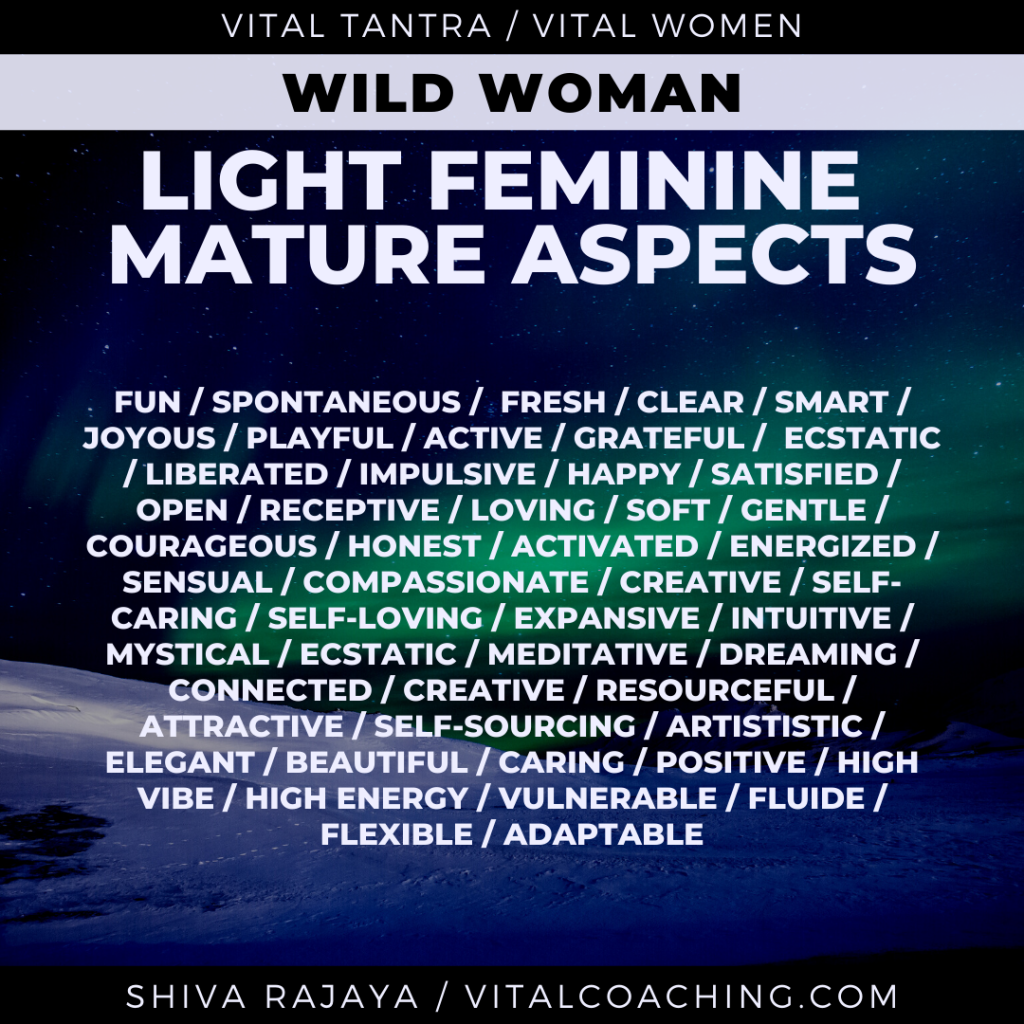
This is the Goddess, the Healer, the Muse, the Divine Lover.
She is beauty in motion. She is fluid, radiant, untouchable.
✔️ Sensual. Playful. Magnetic.
✔️ Soft, yet powerful. Open, yet discerning.
✔️ Overflowing with love, light, and life force.
She inspires, she uplifts, she ignites.
Her presence alone transforms men, spaces, the world.
This is not weakness.
It is the highest level of power—because it does not force.
It attracts, calls in, and bends reality through grace alone.
But what happens when the Light Feminine collapses?
💀 LIGHT FEMININE – IMMATURE ASPECTS
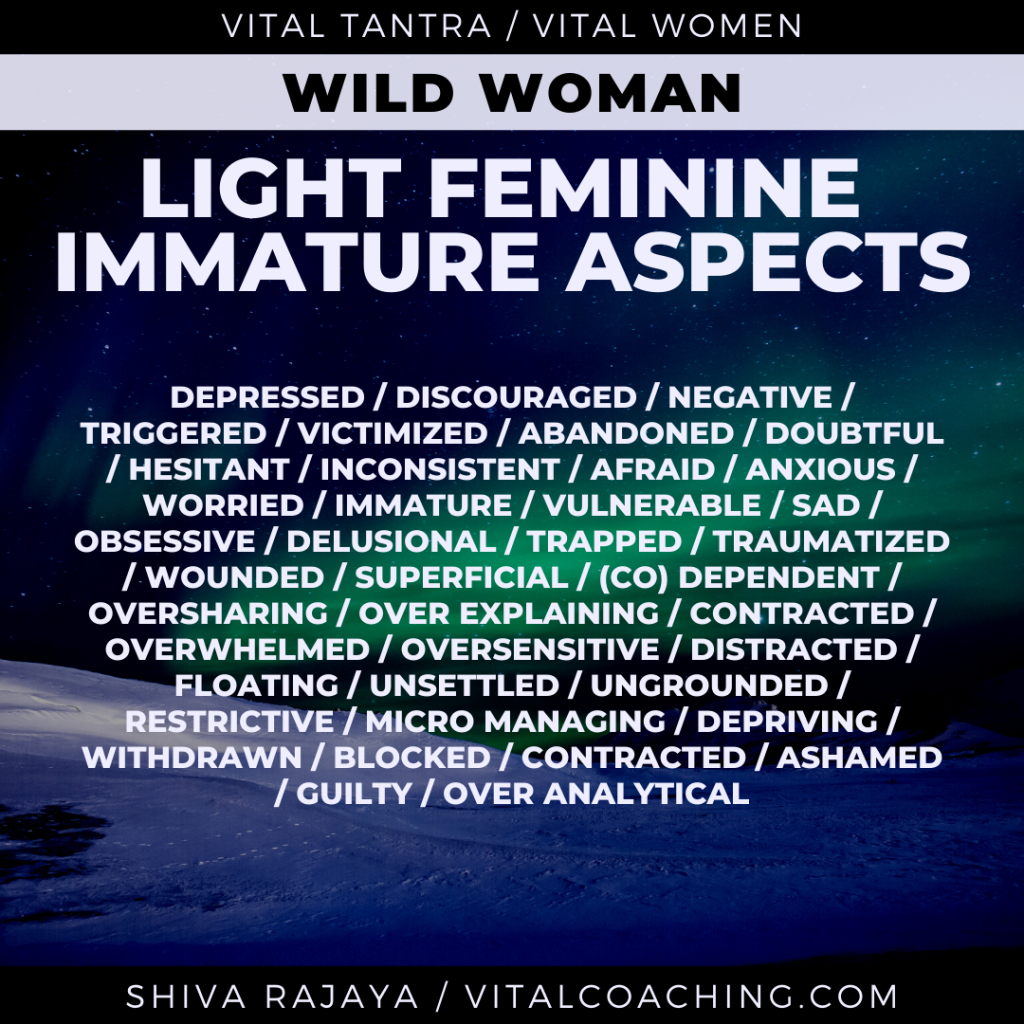
This is where the feminine becomes weak.
Where softness becomes passivity.
Where receptivity becomes dependency.
❌ Insecure. Oversensitive. Anxious.
❌ Needs approval. Gets lost in emotions.
❌ Over-explains. Over-shares. Overthinks.
This is the woman who doubts her every move.
Who feels too much but does nothing.
Who drowns in emotions but never transforms them into wisdom.
WAKE UP.
The Feminine is not meant to be helpless.
She is not meant to be trapped in overthinking, guilt, or insecurity.
The world needs fierce, loving, awakened women.
Not women who shrink, collapse, or live for external validation.
🔥⚡ TRUE FEMININITY – INTEGRATION
You are not just light. You are not just dark. You are BOTH.
The Dark Feminine is your fire, your rage, your wildness, your destruction of old patterns.
The Light Feminine is your softness, your love, your inspiration, your healing presence.
Your mission? MASTER BOTH.
👉 Drop the wounded girl inside of you.
👉 Stop hiding behind softness or lashing out in destruction.
👉 Own your power in all its forms.
No more playing small. No more imbalance.
The world is calling for strong, embodied, radiant women.
Are you ready?
🔥 Forget just looks. Forget just charm.
🔥 Want to be the kind of woman that drives high-value men WILD?
🔥 Master emotional maturity.
This isn’t about “not being dramatic.”
This isn’t about “being chill.”
This is about power. Depth. Magnetic presence.
A woman who is emotionally mature commands respect.
She draws in kings, not boys.
Let’s break it down.
Q: What makes emotional maturity so attractive to men?
Because it’s RARE.
Most women react. They let their emotions own them.
An emotionally mature woman? She OWNS her emotions.
✅ She’s stable, not chaotic.
✅ She brings peace, not problems.
✅ She knows when to lean in and when to pull back.
✅ She makes a man feel safe, seen, and excited all at once.
Men don’t run from emotions. They run from emotional instability.
Mature energy? Turns them ON.
Q: How do you know if you’re emotionally mature?
Check yourself. Be honest.
🚀 Signs you’re emotionally mature:
✔ You take responsibility for your feelings instead of blaming him.
✔ You can handle discomfort without creating drama.
✔ You communicate directly instead of testing or manipulating.
✔ You know your worth and don’t need constant reassurance.
🚨 Signs you’re playing small emotional games:
❌ You use passive-aggressive tactics to get what you want.
❌ You shut down, withdraw, or punish when you don’t get your way.
❌ You make everything his fault instead of looking at your own reactions.
❌ You thrive on drama and attention instead of real connection.
Be real with yourself. Where do you stand?
Q: What happens when a man meets an emotionally mature woman?
He can’t HELP but be drawn in.
💥 He feels at ease. He trusts her. He respects her.
💥 He sees her as a partner, not a problem.
💥 He knows she won’t crumble under pressure or turn every argument into a war.
And the biggest one?
🔥 He feels like he can bring his FULL power to the table. 🔥
Men hold back when they sense instability. They go ALL IN when they feel safe and inspired.
Q: What makes emotional maturity a total turn-on?
Because it’s the difference between a girl and a woman.
❌ A girl seeks validation.
✅ A woman knows her worth.
❌ A girl creates drama to test him.
✅ A woman creates an environment where he can be his best.
❌ A girl reacts emotionally and regrets it later.
✅ A woman processes emotions and responds with depth.
Maturity = power.
Maturity = irresistible confidence.
Maturity = a woman who knows who the hell she is.
Q: What’s the biggest emotional maturity test?
💥 How you handle TRIGGERS.
Triggers happen. Emotions flare up. It’s what you DO next that defines you.
✅ Mature response: You pause, breathe, and communicate clearly.
❌ Immature response: You lash out, ghost, or create unnecessary chaos.
Want to be magnetic? Master this.
Q: How do I become more emotionally mature starting TODAY?
🔥 Do the inner work.
🔥 Stop blaming, start owning.
🔥 Get curious about your reactions instead of being controlled by them.
🔥 Practice emotional self-control—don’t let temporary emotions create permanent damage.
The more emotionally grounded you are, the more powerful your presence becomes.
And that? Is insanely attractive.
Q: Final thoughts?
A woman’s emotional maturity is her SECRET WEAPON.
It’s what separates a momentary fling from a high-value, unforgettable woman.
If you master this?
You won’t chase men. They’ll chase YOU.
🔥 Men crave peace, depth, and emotional security.
🔥 Be that, and you’ll become the kind of woman he’ll never forget.
Game on. Are you ready?
THE FASTEST WAY TO DESTROY YOUR RELATIONSHIP
💥 You want love.
💥 You crave connection.
💥 You dream of deep, magnetic, soul-shaking intimacy.
But instead?
You’re caught in a toxic loop of retaliation, emotional threats, and passive-aggressive bullshit.
You fight.
You shut down.
You make them pay for hurting you.
And before you know it?
You’re pushing them away.
👇 Here’s why this toxic cycle will RUIN your relationship—and how to fix it. 👇
1️⃣ RETALIATION: THE “PAYBACK” THAT COSTS YOU EVERYTHING
You feel hurt. So what do you do?
🔥 You withdraw.
🔥 You punish them.
🔥 You make sure they “know how it feels.”
👎 But guess what? Instead of fixing the problem, you just made it worse.
💀 Retaliation = Emotional Warfare.
❌ If your relationship feels like a battlefield, intimacy is already dead.
2️⃣ EMOTIONAL THREATS: THE ULTIMATE TRUST-KILLER
“If you don’t do this, I’ll leave.”
“If you don’t change, I’ll find someone who treats me better.”
“If you don’t fix this, I don’t see a future for us.”
💥 THREATS DON’T INSPIRE LOVE. THEY CREATE FEAR.
Your partner isn’t opening up because they trust you.
They’re doing it because they’re afraid of losing you.
And fear-based love? DOOMED TO FAIL.
3️⃣ PASSIVE-AGGRESSIVE RESPONSES: THE SILENT RELATIONSHIP KILLER
“Oh, don’t worry about me. I’m FINE.”
“Wow, must be nice to care that little.”
“No, no, seriously, I love being ignored.”
👏 Congratulations! You’re speaking in riddles instead of communicating like an adult.
Here’s the problem:
Your partner isn’t a mind-reader.
They can’t decode your sarcastic little hints.
💥 If something bothers you, SAY IT. Directly. Clearly. Like a fucking grown-up. 💥
4️⃣ THE REAL REASON YOU’RE DOING THIS? YOU WANT CONTROL.
Let’s be real.
Retaliation, threats, and passive-aggressiveness?
🔥 It’s not about “teaching them a lesson.”
🔥 It’s not about “making them understand.”
🔥 It’s about controlling the situation.
Because deep down, you’re afraid.
Afraid of being abandoned.
Afraid of being hurt.
Afraid of being vulnerable.
🚨 So instead of being honest, you manipulate the dynamic. 🚨
5️⃣ BUT GUESS WHAT? YOU’RE KILLING THE INTIMACY YOU CRAVE.
You want your partner to be open with you?
To trust you?
To feel safe with you?
Then STOP using fear, shame, and guilt to control them.
💥 Emotional threats make your partner feel unsafe.
💥 Retaliation makes your partner defensive.
💥 Passive-aggressiveness makes your partner resentful.
🔥 You’re building WALLS instead of CONNECTION. 🔥
6️⃣ WHAT HAPPENS WHEN YOU KEEP PLAYING THESE GAMES?
❌ Your partner stops opening up to you.
❌ They feel like they’re walking on eggshells.
❌ Every conversation feels like a trap.
❌ They become emotionally distant.
❌ RESENTMENT builds.
And then?
💥 The relationship fucking dies.
7️⃣ HOW TO BREAK THE CYCLE & ACTUALLY BUILD INTIMACY
1️⃣ Drop the ego.
→ This isn’t about “winning.” It’s about connection.
2️⃣ Own your emotions.
→ If you’re hurt, say it. Don’t make them guess.
3️⃣ Stop punishing.
→ Your partner isn’t the enemy. Act like it.
4️⃣ No more silent treatment.
→ Emotional distance is NOT the solution.
5️⃣ Be direct.
→ Want something? Need something? SAY IT.
6️⃣ Communicate without threats.
→ Love isn’t built on ultimatums.
7️⃣ Ask yourself: “Am I trying to control or connect?”
→ One builds intimacy. The other destroys it.
8️⃣ WHAT A HEALTHY RESPONSE LOOKS LIKE:
❌ INSTEAD OF THIS:
🔹 “If you don’t change, I’m done.”
✅ SAY THIS:
🔹 “I feel hurt when this happens. Can we talk about it?”
❌ INSTEAD OF THIS:
🔹 Passive-aggressive sarcasm.
✅ SAY THIS:
🔹 “I need your attention on this. It really matters to me.”
❌ INSTEAD OF THIS:
🔹 “Oh, don’t worry, I’ll just suffer in silence.”
✅ SAY THIS:
🔹 “I’m upset, and I want to work through it with you.”
9️⃣ THE BOTTOM LINE: IF YOU WANT LOVE, ACT LIKE IT.
🛑 STOP making your partner afraid of messing up.
🛑 STOP using pain as a weapon.
🛑 STOP expecting love to thrive in an environment of threats, punishments, and emotional warfare.
If you want a deep, unbreakable, magnetic connection?
💥 CREATE SAFETY. BUILD TRUST. CHOOSE LOVE. 💥
Because real intimacy isn’t about control.
🔥 It’s about two people feeling safe enough to be fully themselves. 🔥
DropTheDrama #NoMoreMindGames #EmotionalMaturity #RadicalLove #CommunicationIsKey #DeepConnection #SafeLove
How Your Emotional Baggage Is Wrecking Your Dating Life (And How to Fix It)
You’ve been hurt before.
You’ve been betrayed.
You’ve been left broken, confused, maybe even a little bitter.
And now?
You’re bringing all that unfinished business into your next connection like a fucking carry-on bag of trauma you refuse to check.
💥 You assume all women are “crazy.”
💥 You think all men are “emotionally unavailable.”
💥 You expect every new person to prove they aren’t like your ex.
And what happens?
You sabotage everything before it even begins.
Because when you enter a new relationship already armed for war, you don’t leave space for love.
🚫 THE DANGER OF PROJECTIONS 🚫
Imagine this.
You meet someone new.
They seem great. Attractive. Interesting. Potentially safe.
But instead of experiencing who they actually are, you’re seeing them through the lens of your past pain.
🔹 Your ex ghosted you? Now you expect them to disappear.
🔹 Your last partner manipulated you? Now you assume they have an agenda.
🔹 Someone cheated on you? Now you act like loyalty is something people need to prove on day one.
And guess what? They can feel it.
Energy doesn’t lie.
They’re picking up on the fact that you’re not fully open.
They can sense the hesitation, the distrust, the guarded walls.
And instead of creating attraction, you’re creating distance.
🔥 MEN: STOP PROJECTING YOUR EX ONTO EVERY WOMAN YOU MEET
Maybe you dated someone who was emotionally chaotic.
Maybe she was unpredictable. Maybe she hurt you.
Now you carry this unspoken belief: “Women are crazy.”
Every time you date, that thought is playing in the background like a fucking broken soundtrack.
And the women you meet?
They’re not stupid. They feel your hesitation.
They can sense your resistance.
And instead of giving you their feminine radiance, they either mirror your energy or pull away completely.
And you walk away thinking: “See? Women ARE crazy.”
But were they? Or did you just project your past onto them before they even had a chance to show you who they were?
🔥 WOMEN: STOP TREATING EVERY MAN LIKE A FUTURE FUCK-UP
You’ve been played.
You’ve been hurt.
You’ve been on the receiving end of lies, gaslighting, manipulation, and broken promises.
Now, every new man in your life has to climb Mount Everest just to prove he’s not a piece of shit.
You sit there waiting for him to fail.
Every text delay? He’s talking to someone else.
Every minor mistake? See? Just another man-child.
Every emotional misstep? Ugh, men are useless.
So what happens?
You’re building walls instead of bridges.
You’re putting him on trial instead of in your heart.
And eventually? He leaves.
Not because he’s guilty.
Not because he was going to hurt you.
But because he was tired of proving himself innocent.
🧨 HOW TO BREAK THE CYCLE & STOP PROJECTING YOUR TRAUMA
1️⃣ Recognize Your Triggers.
→ The moment you assume the worst, PAUSE.
→ Ask yourself: Is this real, or is this my past talking?
2️⃣ Take Responsibility.
→ Your past happened. It was painful. But you don’t have to let it define your future.
3️⃣ Stop Punishing New People for Old Wounds.
→ They aren’t your ex.
→ They haven’t hurt you.
→ They don’t deserve to carry the weight of someone else’s mistakes.
4️⃣ Do the Inner Work.
→ Heal your shit. Process your pain.
→ Therapy, journaling, breathwork, whatever it takes—do it.
5️⃣ Open the Fuck Up.
→ Give people a chance.
→ Approach new relationships with curiosity, not caution tape.
💡 FINAL TRUTH BOMB 💡
⚡ Not everyone will hurt you.
⚡ Not every relationship is doomed.
⚡ Not every new person in your life is a ghost from your past wearing a different face.
But if you keep carrying your old wounds into new relationships…
You’ll keep getting the same fucking results.
It’s time to stop projecting and start trusting again.
The love you want?
It’s waiting for you.
But only if you’re brave enough to let go of the past and actually receive it.
💥 #NoMoreProjections #DropYourBaggage #OpenToLove #HealBeforeYouDeal #EmotionalMaturity #RadicalAccountability 💥
Ever felt like you signed up for one thing and got slapped with something completely different?
Welcome to the bait-and-switch—one of the most toxic games in dating, relationships, and life itself.
It’s sneaky.
It’s frustrating.
And if you don’t spot it, you’ll keep falling into the same trap over and over again.
Let’s break it down so you never get played again.
🚨 WHAT IS BAIT-AND-SWITCH?
It’s when someone presents themselves one way to pull you in, then flips the script once they’ve got you.
🔹 They act like the perfect partner… until you commit.
🔹 They seem open, playful, and fun… until you show interest.
🔹 They promise a deep, soul-connecting romance… then give you cold detachment.
Sound familiar?
It happens in dating, business, friendships—even family.
And it leaves you feeling trapped, confused, and powerless.
❌ THE CLASSIC BAIT-AND-SWITCH MOVES
1️⃣ THE ROMANTIC MASK
At first, they’re obsessed with you.
Endless compliments. Passionate attention. Texts every hour.
Then BOOM—once you fall for them… they pull back.
Suddenly, they’re “not sure,” “need space,” or “aren’t ready.”
💡 REALITY CHECK:
They were never that invested. They just wanted the thrill of the chase.
2️⃣ THE SEXUAL TEASE
🔥 They flirt like crazy.
🔥 They build insane tension.
🔥 They make you feel like the hottest person alive.
Then, when you make a move? They shut it down.
“Oh, I didn’t mean it like that.”
“I just like the attention.”
“I don’t want to ruin our connection.”
💡 REALITY CHECK:
They love the validation but fear intimacy. Classic game.
3️⃣ THE HIGH-VALUE SELL, LOW-VALUE DELIVERY
This one’s huge in relationships.
They present as ambitious, passionate, and emotionally available.
You think, “Wow, I’ve found someone amazing!”
Then…
🔹 No more effort.
🔹 No more presence.
🔹 No more magic.
They hooked you with a dream. Now they’re coasting on bare minimum energy.
💡 REALITY CHECK:
If someone’s not showing up consistently, they’re not serious.
4️⃣ THE FRIENDLY FAKE
Ever met someone who’s overly nice at first—then starts making subtle digs?
🔹 They acted supportive… now they undermine you.
🔹 They seemed kind… now they guilt-trip you.
🔹 They appeared loyal… now they’re gossiping about you.
💡 REALITY CHECK:
They were never a true friend. They just wanted access to your energy.
⚔️ HOW TO STOP FALLING FOR THE BAIT-AND-SWITCH
🔥 1. TRUST ACTIONS, NOT WORDS
People will say anything to win you over.
But what do they actually do?
✨ If they claim to be emotionally available but never show up, they’re lying.
✨ If they flirt but never commit, they’re playing.
✨ If they promise the world but deliver crumbs, they’re not serious.
Watch patterns, not performances.
🔥 2. TEST BEFORE INVESTING
Before you go all in, TEST:
✅ Are they consistent over time?
✅ Do their words match their energy?
✅ Do they stay present after they “get” you?
If you see flaky energy, slow down.
🔥 3. STOP CHASING, START OBSERVING
When someone switches up their behavior, don’t react—watch.
👀 Are they pulling away to see if you’ll chase?
👀 Are they withdrawing effort because they think they “have” you?
The moment you chase, you lose power.
The moment you step back, you see the truth.
🔥 4. MATCH ENERGY, DON’T GIVE FREE PASSES
If someone starts pulling back, mirror them.
🚀 They give effort? You match it.
🚀 They pull away? You create space.
🚀 They bring inconsistency? You walk away.
Stop making excuses for people’s weak behavior.
🏆 THE FINAL RULE: VALUE YOURSELF MORE THAN THE GAME
People will always play bait-and-switch when they think you’ll accept it.
But if you:
💎 Set boundaries.
💎 Move with confidence.
💎 Refuse to tolerate inconsistency.
Then suddenly, they can’t play games with you.
You’re too solid.
Too clear.
Too powerful.
No more bait. No more switch. Just real, powerful, high-value connections.
🔥 Drop a comment—have you ever experienced a bait-and-switch? How did you handle it? 🔥
Fellas, have you ever been face-to-face with pure feminine rage?
🔥 The kind of fire that melts steel?
🔥 The kind of intensity that makes you want to run for cover?
🔥 The kind of moment where you think: “Oh sh*t, what do I do!?”
This is for you, my brothers. 👊
Because if you’re dating, in a relationship, or just EXISTING around women, you WILL experience this sooner or later.
And if you don’t know how to handle it?
💥 You will fail the test. 💥
🚀 STEP 1: RECOGNIZE THE FIRE
There are two types of feminine rage:
1️⃣ TOXIC, IMMATURE RAGE
- It’s constant.
- It’s passive-aggressive.
- It’s manipulative and draining.
2️⃣ MATURE, POWERFUL RAGE
- It’s honest.
- It’s raw and necessary.
- It’s an expression of deep truth.
🔥 One is poison. The other is a gift.
🚀 STEP 2: HOW TO RESPOND LIKE A KING 👑
Most men freak out. Don’t be most men.
❌ WRONG RESPONSE:
- “You’re crazy!” 🚨
- “You’re overreacting.” 😡
- “I can’t handle this.” 🚪➡️
This will only make it worse.
✅ BETTER RESPONSE:
- “Wow, I feel your fire. What’s going on?” 🤔
- “Tell me more.” 🎤
- “This energy is strong—let’s move with it.” 🔥
🔥 Yes, lean IN. Hold space. Witness her power. 🔥
🚀 STEP 3: BE HER SAFE PLACE, NOT HER ENEMY
A woman’s rage isn’t always about you. It’s about her.
- Past wounds.
- Suppressed emotions.
- Unspoken truths.
If you can stand strong, unshaken, grounded, she will trust you more than any other man.
But if you crumble? 💀
She will never feel safe in your presence.
🚀 STEP 4: KNOW WHEN TO WALK AWAY 🚶
🔥 Anger that burns, but then transforms? Stay. Hold space.
🔥 Anger that’s manipulative, constant, and draining? Leave. Set boundaries.
If she respects your boundaries, she’s a keeper.
If she doesn’t, she’s not your queen.
🚀 STEP 5: UNDERSTAND THE SPIRITUAL FIRE 🔥
In tantric traditions, rage is sacred.
🔥 Kali, the goddess of destruction, doesn’t just destroy—she cleanses.
🔥 Fire doesn’t just burn—it purifies.
If you resist it, you will fear it forever.
If you embrace it, you will become unstoppable.
🚀 FINAL WARNING
If you suppress her fire, it will turn into:
💀 Resentment.
💀 Disconnection.
💀 A dead relationship.
🔥 If you learn how to hold it?
She will trust you with her body, heart, and soul.
👉 Your move, brother. Will you rise or will you run?
💬 Drop a comment if you’ve ever faced this fire—how did you handle it? 🚀🔥
In the journey of love, emotional maturity defines how a woman responds to challenges, connection, and intimacy. From chaotic reactivity to divine mastery, here’s the full scale of emotional growth in relationships. Where do you or the women you meet stand?
Level 1: The Emotional Tornado
“Love Me or I’ll Destroy You”
A woman at this level is emotionally chaotic, reactive, and driven by unchecked wounds. She sees love as a battlefield and uses emotional outbursts to control or test her partner.
Examples of her behavior:
- Throws tantrums over small things, then blames the man for “making her” react.
- Uses threats like “If you don’t do this, I’ll leave” to manipulate.
- Starts fights for attention and creates drama to feel excitement.
- Has zero self-awareness and refuses to take responsibility for her actions.
- Goes silent or blocks her partner as punishment after a disagreement.
Level 2: The Clingy Princess
“Rescue Me, or I’ll Fall Apart”
She relies entirely on her partner for emotional stability, placing the responsibility for her happiness in his hands. She confuses dependence with love.
Examples of her behavior:
- Constantly texts or calls, needing reassurance every hour.
- Breaks down emotionally when he’s unavailable, thinking it means he doesn’t love her.
- Believes “A real man would always make me feel safe” while offering no self-support.
- Sees personal struggles as reasons for her partner to “save” her instead of handling them herself.
- Panics if she feels him pulling away, often smothering him with attention.
Level 3: The Blame Queen
“It’s Always Your Fault”
She struggles with self-awareness and accountability. Every issue in the relationship is externalized—her partner is the problem, not her own reactions or wounds.
Examples of her behavior:
- After a fight, she says, “You always make me feel this way,” instead of owning her emotions.
- Uses past pain as an excuse for bad behavior, saying, “This is just how I am.”
- Refuses to self-reflect, instead focusing on what the man needs to change.
- Expects him to “prove” his love constantly, while offering little in return.
- Complains about “emotionally unavailable men” but avoids deep self-work.
Level 4: The Guarded Fortress
“No One Can Hurt Me Again”
She has been wounded and has built walls around her heart. She equates emotional distance with strength and sees vulnerability as weakness.
Examples of her behavior:
- Dismisses compliments with sarcasm or jokes, unable to receive love.
- Never fully opens up, even in deep relationships, to avoid getting hurt.
- Feels safest when keeping people at arm’s length but secretly craves intimacy.
- Reacts coldly when her partner expresses emotions, saying, “Don’t get soft on me.”
- Walks away at the first sign of difficulty instead of working through conflict.
Level 5: The Work-in-Progress
“I See My Patterns… But I’m Still Learning”
She recognizes her emotional triggers and wounds but is still inconsistent in managing them. She tries, fails, and tries again.
Examples of her behavior:
- Apologizes after an argument but sometimes slips back into blame mode.
- Actively reads, learns, and seeks self-improvement but struggles to apply it in real-time.
- Begins expressing her needs more clearly but sometimes reverts to passive-aggressiveness.
- Acknowledges when she is being reactive, even if she doesn’t always stop it.
- Starts seeing patterns in past relationships and takes responsibility for her role in them.
Level 6: The Self-Reflective Woman
“I Own My Feelings”
She takes ownership of her emotions and responses. She no longer sees her partner as responsible for “fixing” her, but rather as someone to co-create a relationship with.
Examples of her behavior:
- After an argument, she reflects on her role in the situation instead of only blaming her partner.
- Practices emotional regulation and doesn’t let small things trigger her deeply.
- Expresses her needs clearly without expecting mind-reading.
- Asks herself, “Is this a genuine problem, or am I being reactive?” before responding.
- Feels secure within herself, whether single or in a relationship.
Level 7: The Magnetic Feminine
“I Create Space for Love to Flow”
She embodies emotional intelligence and radiates love without force. She creates a safe and beautiful space for her partner while maintaining strong self-respect.
Examples of her behavior:
- Holds space for her partner’s emotions without trying to control or fix him.
- Knows when to lead with softness and when to assert strong boundaries.
- Engages in conflicts with grace, focusing on resolution rather than ego battles.
- Attracts high-quality men because she embodies self-love and emotional stability.
- Can be deeply in love while still feeling complete on her own.
Level 8: The Embodied Queen
“I Am Love Itself”
She has fully integrated her emotions, intuition, and wisdom. She moves through relationships with grace, power, and deep understanding.
Examples of her behavior:
- Sees love as a space to give, not just receive.
- Understands and accepts both the masculine and feminine polarities in a relationship.
- Sets boundaries without needing conflict or emotional explosions.
- Inspires men through her presence, not demands.
- Remains steady in her emotions even when tested.
Level 9: The Conscious Lover
“I Elevate My Partner and Myself”
She no longer seeks love from a place of need but as a shared expansion. She understands the deeper energetic and spiritual aspects of love.
Examples of her behavior:
- Sees challenges as opportunities to grow rather than proof of incompatibility.
- Supports her partner’s vision while honoring her own.
- Can sit with discomfort and work through it instead of running from it.
- Loves from abundance rather than attachment.
- Brings harmony into the relationship through her emotional depth and understanding.
Level 10: The Divine Feminine Master
“I Am the Ocean, Not the Wave”
She embodies ultimate presence, love, and wisdom. She is fully surrendered to life’s flow and holds space for divine love without fear, resistance, or ego.
Examples of her behavior:
- Loves without fear, expectation, or attachment—only deep appreciation.
- Navigates all emotions with grace, never being consumed by them.
- Holds space for her partner’s transformation without controlling or demanding.
- Radiates a level of love and presence that magnetizes and transforms others.
- Sees relationships as a divine dance rather than a source of identity or validation.
Final Thoughts
Emotional maturity isn’t about being perfect—it’s about evolving. Every woman has the power to ascend these levels, step by step. True love thrives not in drama but in depth, presence, and conscious growth.
Where do you see yourself or the women around you? And more importantly—where do you want to be?
Dating today? It’s a jungle.
Swiping, ghosting, endless options—yet people are lonelier than ever.
Why?
Because modern dating isn’t just about love anymore—it’s a battlefield of personal growth, societal shifts, and deep psychological dynamics.
Buckle up. This is the dating reality check you didn’t know you needed.
1. Women Want to Date Up—But Who’s Left? 🤔
Here’s the hard truth: 78% of women prefer men who are at least as educated and financially stable as they are.
But guess what? Women are outpacing men in education and career success.
That means fewer and fewer “qualified” men in the dating pool.
So what happens?
- Women struggle to find partners who “match” them.
- Men feel overlooked, unworthy, or just check out entirely.
It’s the Tall Girl Problem—when your standards shrink your dating options.
2. The Silent Epidemic: Men Are Lonely As Hell 😔
📉 15% of men have ZERO close friends.
📉 Male loneliness is skyrocketing.
📉 Social isolation is as bad for your health as smoking a pack of cigarettes a day.
Men aren’t just struggling with dating. They’re struggling with connection, period.
Why?
- Society discourages male vulnerability.
- Friendships fade as men age.
- Digital life replaces real-life bonding.
The fix?
Men NEED to build deeper friendships and create tribes of support.
3. People Don’t Date—They “Collect Options” 😵💫
Welcome to the Tinder paradox:
- Infinite choices = commitment paralysis.
- More swiping = less satisfaction.
- More casual encounters = deeper emotional disconnection.
Everyone is hedging their bets, keeping “options open,” afraid to choose.
But commitment isn’t about picking the perfect one—it’s about BUILDING something meaningful.
If you never commit, you never experience depth. Period.
4. The “Romantic Dream” Is An Expired Program 💭
We’re sold a fantasy:
- Find The One.
- Get Married.
- Live Happily Ever After.
💀 But here’s the TRUTH: Over 50% of marriages end in divorce.
💀 “Forever” is a beautiful idea—but life is unpredictable.
💀 Instead of forcing lifelong contracts, what if relationships were consciously designed in seasons?
Time-bound coupling.
Monthly relationship check-ins.
Renewable commitment agreements.
Not romantic enough? Maybe.
But it’s REAL.
5. The Men Who Win in Dating Are The Ones Who Grow 📈
The difference between the men struggling and the men thriving?
GROWTH.
💪 A man who is constantly evolving will always be attractive.
💪 A man who is socially dynamic will never be lonely.
💪 A man who builds his own value will never feel powerless.
Dating isn’t just about finding someone—it’s about BECOMING someone worth choosing.
6. Men, You’re Not Entitled to a High-Value Woman 🚨
Hard pill to swallow:
- Just because YOU want her doesn’t mean she wants YOU.
- Attraction isn’t fair—it’s instinctual.
- If you’re not growing, she’s outgrowing you.
You want an amazing woman? BE an amazing man.
7. Women Are Taught to Be Queens—Men Need to Be Kings 👑
Look at social media:
👑 Women are encouraged to know their worth, set standards, and never settle.
👑 Meanwhile, men are struggling with purpose, leadership, and confidence.
The result?
- A rise of “empowered women” with no equally strong men to meet them.
- A generation of disconnected, uninspired men.
Men, it’s time to STEP UP.
8. The Dating Market Favors The Top 10% of Men 📊
It’s brutal out there.
💥 The top 10% of men get almost all the attention.
💥 The bottom 80% feel invisible.
Why? Because women are naturally drawn to the strongest options.
But here’s the secret: “Top 10%” isn’t just about looks or money.
It’s about CHARISMA. CONFIDENCE. SOCIAL MASTERY.
Upgrade who you ARE, and you become one of the rare men who magnetize women effortlessly.
9. The Realest Flex? Being Emotionally Intelligent 🧠
Women test men ALL THE TIME.
- She’ll provoke you to see how you handle pressure.
- She’ll throw you emotional waves to see if you drown.
- She’ll push boundaries to see if you hold your frame.
If you react like a little boy—angry, needy, defensive—you FAIL the test.
🔥 Emotional intelligence is the new strength.
🔥 Presence is the new dominance.
🔥 Being unfazed is the new alpha.
10. Final Thought: Dating Is Evolving—Are You? 🌀
You can complain. You can resist. You can wish things were different.
OR…
🔥 You can evolve.
🔥 You can learn the game.
🔥 You can build yourself into the kind of person who attracts amazing relationships effortlessly.
Modern dating isn’t about being lucky.
It’s about who you become.
So who are you becoming?
Confrontation is energy.
Handled right? It’s powerful. It deepens connection.
Handled wrong? It’s a wrecking ball that destroys intimacy, trust, and passion.
Most people fear confrontation.
They either avoid it completely or explode without control.
Both approaches are deadly to love.
Let’s break it down.
1. SUPPRESSED CONFLICT = HIDDEN RESENTMENT 😤
Avoiding confrontation doesn’t make the problem disappear.
It stores it. Buries it.
Until one day, it erupts like a volcano of resentment.
🔥 Silent treatment.
🔥 Passive-aggressive digs.
🔥 Emotional withdrawal.
This is emotional decay. It eats away at your relationship slowly and silently.
2. EXPLOSIVE CONFRONTATION = DESTROYED CONNECTION 💣
On the flip side…
Uncontrolled fights shatter trust.
Words become weapons.
Blame replaces understanding.
Instead of solving the issue, you wound each other deeper.
Passion turns into bitterness.
Love turns into war.
You don’t win by winning the fight.
You win by keeping the relationship intact.
3. THE COST OF WRONG CONFRONTATION 💸
💔 Lost trust – Every harsh word chips away at the foundation.
😞 Emotional exhaustion – Fighting drains both of you.
🚪 Distancing & disconnect – You stop feeling safe with each other.
🔥 Lost attraction – Nothing kills passion like constant negativity.
A relationship that’s filled with bad confrontation slowly rots from the inside.
4. MASTERING THE ART OF POWERFUL CONFRONTATION 🏆
🔥 Attack the problem, not the person.
🔥 Stay grounded. Don’t let emotions hijack you.
🔥 Listen to understand, not to react.
🔥 Validate their emotions before defending yours.
🔥 Know when to take a break instead of escalating.
Confrontation isn’t bad. It’s necessary.
But how you do it determines if your love grows stronger or falls apart.
5. THE ULTIMATE GOAL: FIGHT FOR THE RELATIONSHIP, NOT YOUR EGO ❤️
The real cost of confrontation?
It’s not about being right or wrong.
It’s about how much love, respect, and connection you’re willing to protect.
If you confront with awareness, respect, and emotional mastery…
Your relationship will become unstoppable.
🔥 Don’t let bad confrontation steal your love.
🔥 Master the way you fight, and you’ll master the way you love.
Women are complex, powerful, emotional beings.
If you want to create unshakable attraction, you must learn how to meet her with strength, presence, and understanding.
Master these 35 actions, and you’ll become the man she trusts, respects, and desires.
1. ACCEPT HER FULLY 💫💖
She’s emotional. She’s fluid. Love all of her, not just the easy parts.
2. STAY GROUNDED WHEN SHE TESTS YOU 🧘♂️🔥
She challenges you to feel your strength. Stay cool. Stand firm.
3. SHOW HER YOUR CONFIDENCE 💪👑
She’s not looking for a power struggle. Lead with certainty, not control.
4. HOLD EMOTIONAL CONNECTION 🤝💞
When she opens up, stay present. Don’t run, shut down, or get defensive.
5. MAINTAIN YOUR CENTER 🌀🛡️
She may get overwhelmed. You don’t have to. Stay calm, breathe deep, and be the rock.
6. EMBODY MASCULINE STRENGTH 🦁🔥
She wants a man, not a puppy. Own your space. Stand tall. Speak with power.
7. BE PLAYFUL, NOT IMMATURE 🎭😆
Make her laugh, tease her, bring the fun. But never act like a child.
8. CLAIM YOUR ROLE AS HER LOVER ❤️🔥🔥
She doesn’t need another son. She needs a man. A lover. A king.
9. LISTEN WITH PRESENCE 👂🔮
She doesn’t need a lecture or fix. She needs to be heard, seen, and felt.
10. GIVE HER ROOM TO EVOLVE 🚀✨
She’s ever-changing. Don’t try to lock her into a frame—let her expand.
11. HONOR HER WILDNESS 🌊🔥
Her desires may surprise you. Don’t shame them. Explore them.
12. TRUST HER SOCIAL FREEDOM 🌍👀
She’s radiant, she connects with people. Relax. Be secure. No need for jealousy.
13. SUPPORT HER WITHOUT FIXING HER 🛠️💡
She’s not broken. She doesn’t need fixing. Hold space, don’t be the mechanic.
14. WAIT FOR HER TO ASK FOR ADVICE 🏹🎯
Most of the time, she just wants to vent. Advice only when invited.
15. CULTIVATE YOUR OWN LIFE 🌍🏆
Your world shouldn’t revolve around her. Keep your purpose alive.
16. GIVE AS MUCH AS YOU RECEIVE 🔄❤️
Don’t just take. Be curious about her. Give presence, attention, energy.
17. KEEP IT LIGHT & FUN 🎉🔥
Not every talk needs to be deep processing. Keep things exciting!
18. BE SECURE IN YOURSELF 🚀👑
Needing constant reassurance? Kills attraction. Stand tall. Own your worth.
19. STAY COOL UNDER PRESSURE ❄️🔥
She’ll test. She’ll challenge. Your job? Stay unshaken.
20. OWN YOUR MISTAKES 🙌⚡
Don’t blame. Don’t deflect. Real men take responsibility.
21. LEAD WITH EDGE, NOT JUST KINDNESS 🦁🔥
“Nice” is boring. Be bold. Be playful. Keep her on her toes.
22. CREATE ADVENTURE & EXCITEMENT 🎢🔥
Routine kills attraction. Surprise her. Take the lead. Keep things fresh.
23. KNOW WHEN TO BE INTENSE & WHEN TO CHILL 🎭🔥
Passion is great. Overwhelming her? Not so much. Read the room.
24. GIVE HER SPACE TO BREATHE 🌬️💫
Let her miss you. Give her air. She’ll come back stronger.
25. LET HER CHOOSE YOU FREELY ❤️🔥✨
No pressure. No forcing. She needs to feel free in choosing you.
26. TRUST HER TO MANAGE HER OWN LIFE 🔥🎯
She’s grown. She doesn’t need micromanaging. Let her be.
27. LET HER BE HER OWN WOMAN 👑🔥
She’s not a project. She’s a force of nature. Let her express it.
28. ALLOW HER TO BE UNPREDICTABLE 🌊⚡
She won’t always be logical. Love her for it.
29. WITNESS HER COMPLEXITY WITHOUT LABELING IT 🔥🔍
She contains multitudes. Trying to define her kills the mystery.
30. CELEBRATE HER WILD, UNTAMED ESSENCE 🌿🔥
She doesn’t want to be tamed. She wants to be met.
31. CHOOSE CONNECTION OVER EGO 🤝💡
Fights happen. Do you want to be right, or do you want to connect?
32. ENJOY HER TEASES & CHALLENGES 🃏🔥
She tests for fun. If you take it personally, you lose.
33. ASK ABOUT HER, NOT JUST ABOUT YOURSELF 🎙️❌
She’s the mystery. Be curious. Unravel her.
34. KEEP GROWING, NEVER STAGNATE 🚀💡
Evolve. Expand. Be the man she wants to keep chasing.
35. EMBRACE CHANGE & EVOLUTION 🔄🔥
She’s shifting, growing. Are you? Keep up, or get left behind.
🔥 FINAL WORD: MASTER THIS, MASTER THE GAME. 🔥
If you can meet her fully, powerfully, and with emotional intelligence, you become the man she never wants to lose.
Step up. Embrace the challenge. Lead the dance. 💥🔥
Some questions for you
Which of these behaviors are you already mastering?
Which ones do you struggle with the most?
What shifts happen when you embrace these actions?
How would your relationships transform if you fully embodied these?
Gentlemen, let’s cut the fluff. You want to master the dance with the feminine? Then it’s time to confront the 35 critical mistakes you’re making when faced with her shadows. Ready to elevate your game? Let’s dive in. 🏊♂️💥
1. TAKING HER WORDS AT FACE VALUE 🗣️❌
She says one thing but means another. Stop reacting to the surface. Tune into her energy. Feel the truth beneath the words.
2. GETTING DEFENSIVE 🛡️⚔️
Her emotional surge isn’t an attack. It’s a test. Stand your ground. Show her you’re unshakable.
3. TRYING TO FIX HER 🛠️🚫
She’s venting? She doesn’t need solutions. She needs presence. Hold space. Let her release.
4. LOSING YOUR COOL 😡❄️
She’s fiery? You stay cool. Her storm tests your calm. Master your emotions.
5. TAKING IT PERSONALLY 🎯😞
Her mood isn’t about you. Don’t internalize. Be her rock, not her sponge.
6. RETREATING 🏃♂️💨
She pushes? Don’t pull away. Lean in. Show her you’re there, no matter what.
7. SEEKING VALIDATION 🏅🔍
Needing her approval? Weak move. Validate yourself. Confidence is magnetic.
8. IGNORING HER EMOTIONS 🙈💔
Dismissing her feelings? Fatal error. Acknowledge. Empathize. Connect.
9. BEING INCONSISTENT 🔄❓
Wavering? She notices. Be steady. Reliability builds trust.
10. OVER-ANALYZING 🧠🔬
Logic won’t decode her emotions. Feel more. Think less.
11. FAILING TO SET BOUNDARIES 🚧🚫
No boundaries? No respect. Define your limits. She’ll honor them.
12. EXPECTING HER TO BE RATIONAL 🤯🧘♀️
She’s driven by emotion. Embrace it. Logic isn’t the key here.
13. SUPPRESSING YOUR EMOTIONS 🤐💣
Bottling up? She senses it. Express yourself. Authenticity breeds intimacy.
14. BEING NEEDY 🤲😩
Clinging? Major turn-off. Maintain your independence. She’ll respect your space.
15. AVOIDING CONFLICT 🕊️⚡
Dodging disputes? Weak stance. Face issues head-on. Strength is attractive.
16. NOT LISTENING 👂❌
Hearing but not listening? She knows. Pay attention. Presence matters.
17. BEING PASSIVE 🛋️😴
Waiting for her lead? Step up. Masculine energy takes initiative.
18. LACKING PURPOSE 🎯❓
No direction? Unappealing. Find your mission. Purpose ignites passion.
19. BEING TOO AVAILABLE 📞📆
Always there? She’ll lose interest. Value your time. She’ll value you more.
20. FAILING TO CHALLENGE HER 🥊🛡️
Agreeing with everything? Boring. Challenge her. Spark growth.
21. NEGLECTING SELF-CARE 🛀🧔
Letting yourself go? Unattractive. Prioritize your well-being. She’ll notice.
22. BEING DISHONEST 🤥🚫
Lies? Relationship poison. Be truthful. Trust is everything.
23. LACKING SPONTANEITY 📅😐
Predictable? Spice it up. Surprise her. Keep the excitement alive.
24. BEING JUDGMENTAL ⚖️👎
Criticizing her? She’ll shut down. Accept her fully. Love her shadows.
25. FAILING TO LEAD 🧭🚶♂️
Indecisive? Take charge. Lead with confidence. She’ll follow.
26. BEING UNGRATEFUL 🙏❌
Taking her for granted? Show appreciation. Gratitude strengthens bonds.
27. COMPARING HER TO OTHERS 🔍👥
Measuring her against exes? Disrespectful. Celebrate her uniqueness.
28. NEGLECTING INTIMACY 💏❌
Skipping connection? Prioritize intimacy. It’s the glue of relationships.
29. BEING INFLEXIBLE 🦾🚫
Rigid? Adapt. Flexibility fosters harmony.
30. LACKING HUMOR 😂😐
Too serious? Lighten up. Laughter connects hearts.
31. BEING PREDICTABLE 🛤️😴
Monotonous? Add variety. Keep her guessing.
32. FAILING TO SUPPORT HER DREAMS 🌠🚫
Ignoring her goals? Encourage her aspirations. Partnership fuels success.
33. BEING SELFISH 🤲❌
All about you? Consider her needs. Selflessness breeds love.
34. NEGLECTING COMMUNICATION 🗣️🔇
Silent treatment? Communicate openly. Transparency builds trust.
35. RESISTING GROWTH 🌱🚫
Stagnant? Embrace evolution. Grow together, stay together.
FINAL WORD: MASTER THESE, MASTER THE GAME 🎯🔥
Gentlemen, it’s time to elevate. Recognize these mistakes. Correct them. Step into your power. The feminine awaits your rise. 🚀💪
She tells you exactly what she wants in a man…
She describes her perfect relationship, her ideal partner, her dream future.
Sounds like a roadmap, right?
Wrong.
What she says she wants and what actually activates her attraction can be two completely different things.
Why? Because attraction isn’t logical—it’s energetic.
And if you take her words at face value without feeling into the deeper layers, you’ll be confused when she says she wants one thing but responds to another.
1. SHE SAYS SHE WANTS A “NICE GUY” BUT FEELS DRAWN TO A CHALLENGE 🔥🚀
She swears she wants a man who’s kind, attentive, and emotionally available.
Yet, when the ultra-nice guy shows up, she feels nothing.
What’s the missing ingredient? Polarity. Tension. Edge.
🔥 She needs your kindness AND your power.
🔥 Be good to her, but don’t be overly accommodating.
2. SHE SAYS SHE WANTS A MAN WHO PRIORITIZES HER, BUT SHE TESTS FOR STRENGTH 💪🏾🧠
She wants your attention, your time, your love…
But if you drop everything for her?
She’ll start pulling away.
🔥 Why? Because she doesn’t want to be your purpose. She wants to be claimed by a man who already HAS a purpose.
🔥 Give her attention, but never at the cost of your mission.
3. SHE SAYS SHE WANTS DEEP CONVERSATIONS, BUT SHE RESPONDS TO PRESENCE 🧘♂️❤️
You think you need to impress her with philosophy and deep talks?
That’s cool… but secondary.
What actually melts her is your presence.
Your eye contact.
Your grounded stillness.
🔥 Less words. More presence.
4. SHE SAYS SHE WANTS HONESTY, BUT SHE WANTS IT WITH MASCULINE INTEGRITY 🎯🔥
If she asks, “Do I look good in this?”
And you say, “No, you’ve looked better,” thinking you’re just being honest…
Yeah, that’s not it.
🔥 Honesty without leadership is just bluntness.
🔥 She wants truth wrapped in love and power.
5. SHE SAYS SHE WANTS A MAN WHO UNDERSTANDS HER, BUT SHE RESPONDS TO A MAN WHO HOLDS HER 💫🤲
She might tell you she just wants to be understood.
But if you get too caught up in analyzing her emotions and trying to “figure her out,” she’ll lose attraction.
🔥 She doesn’t need endless analysis—she needs you to hold space and let her FEEL.
6. SHE SAYS SHE WANTS TO BE PURSUED, BUT NOT IF YOU’RE CHASING 🏃♂️💨
She wants to feel desired—but not smothered.
She wants to feel chosen—but not over-prioritized.
🔥 Pursue with presence, not desperation.
🔥 Hold your center. Let her come toward you too.
7. SHE SAYS SHE WANTS CONSISTENCY, BUT SHE ALSO CRAVES SPONTANEITY ⚡💃
She wants to know you’re there for her…
But if every day feels the same, the energy starts to die.
🔥 Be reliable, but not predictable.
🔥 Keep her on her toes—surprise, play, lead.
8. SHE SAYS SHE WANTS A STRONG MAN, BUT SHE WANTS A MAN WHO CAN FEEL TOO ❤️🔥
She wants you to be grounded, strong, unshakable…
But if you’re emotionally numb or shut down, she’ll feel disconnected.
🔥 Strength isn’t the absence of emotion—it’s the ability to hold and express it without losing yourself.
9. SHE SAYS SHE WANTS A MAN WHO’S COMPLETELY INTO HER, BUT SHE WANTS TO EARN IT TOO 💎🔥
If you love-bomb her too soon, she’ll lose interest.
If she gets everything without investing herself, she won’t feel it’s valuable.
🔥 Let her feel your depth, but let her earn deeper access.
🔥 The more she invests, the more magnetized she becomes.
10. SHE SAYS SHE WANTS IT TO BE “EASY,” BUT THE BEST LOVE STORIES HAVE A BIT OF FIRE 🔥⚡
Women will say, “I just want something effortless.”
But let’s be real—passion has a little edge.
🔥 She wants connection that flows, but not without depth, growth, and real energy exchange.
🔥 She wants a man who can meet her in both the calm and the storm.
FINAL WORD: DON’T LISTEN TO JUST HER WORDS—FEEL HER ENERGY 🎯🔥
If you take everything she says literally without feeling into what actually magnetizes her, you’ll end up confused and frustrated.
🔥 Listen to her words, but observe her reactions.
🔥 Notice what makes her lean in, soften, open.
🔥 That’s where the real truth is.
Women are emotionally fluid, energetically complex, beautifully unpredictable.
Learn to play in that space, and you’ll never have to “figure her out” again. 🔥
You want her to always feel the same way about you?
To always be steady, predictable, constant?
That’s not how the feminine works.
She’s not a rock—she’s the ocean. 🌊
Some days, she’s calm and inviting. Other days, she’s wild and untamed.
And if you try to force her into emotional consistency, you’ll kill the magic.
So, what do you do?
You learn to surf. 🏄♂️
1. HER FEELINGS SHIFT WITH HER MOODS 😍➡️😶➡️🙃
Yesterday, she was obsessed with you.
Today, she’s distant and quiet.
Tomorrow, she might be all over you again.
The mistake most men make?
They react. They take it personally.
🔥 Instead, stay centered. Let her waves move. She always comes back.
2. HER ATTRACTION TO YOU WILL FLUCTUATE TOO 🎢🔥
One moment, she’s melting in your arms.
The next, she needs space.
Not because she doesn’t love you.
Because her energy moves.
Your job? Don’t panic. Stay present. The more grounded you are, the faster the energy shifts back to passion.
3. SHE WANTS YOU TO PLAY WITH HER ENERGY, NOT CONTROL IT 🎭💃🔥
Trying to lock her emotions down will make her feel caged.
She needs to move, to feel, to shift.
What’s the move?
🔥 Stay playful. Ride her rhythm. Let her emotions be part of the dance.
4. HER FEELINGS RESPOND TO YOUR ENERGY 🔄💥
If you become needy when she pulls away, she’ll retreat further.
If you remain solid, she’ll return stronger than before.
She’s testing:
“Can he handle my emotions? Can he stay grounded when I shift?”
🔥 Pass the test by standing strong.
5. SHE NEEDS TO BE ABLE TO EXPRESS WITHOUT YOU FIXING 🗣️🚫🛠️
She says she’s overwhelmed.
She says she’s unsure.
She says she doesn’t know what she wants.
Your instinct? Solve it. Fix it. Make it better.
🔥 Wrong move.
She doesn’t need a solution. She needs to be felt.
When you listen without freaking out or trying to fix, she relaxes back into connection.
6. IF YOU TRY TO “LOCK HER IN,” SHE’LL BREAK FREE 🔓🔥
The moment you demand emotional stability from her, she’ll feel trapped.
She might love you, but she’ll start pulling away.
🔥 Let her change. Let her evolve. Let her feel.
7. HER EMOTIONS ARE HER SUPERPOWER, NOT A PROBLEM ⚡❤️
She lives through feelings.
She loves through feelings.
She connects through feelings.
🔥 If you make her emotions the enemy, you lose her.
🔥 If you learn to love them, you unlock her heart.
8. WHEN SHE’S UNSURE, SHE’S LOOKING FOR YOUR PRESENCE 🧘♂️💡
Some days, she won’t know what she wants.
Not just in love—in life.
🔥 That’s when you become the lighthouse.
Stay present. Stay grounded. Let her storm pass.
She’ll love you even more for it.
9. HER ENERGY NEEDS TO MOVE—HELP HER MOVE IT 💃🔥
She’s restless? Take her on an adventure.
She’s anxious? Lead her into deep breathing.
She’s overwhelmed? Grab her hand and take her dancing.
🔥 Learn to channel her energy, not fight it.
10. THE MORE YOU EMBRACE HER WAVES, THE DEEPER SHE MELTS INTO YOU 🌊❤️
When she feels free to be fully herself, she opens up in ways you’ve never seen.
Emotionally. Sexually. Energetically.
🔥 She doesn’t need a perfect man. She needs a man who can hold her through every version of herself.
FINAL WORD: BE HER ROCK, LET HER BE THE OCEAN 🌊🏔️🔥
The worst thing you can do?
Try to force her into emotional predictability.
The best thing you can do?
🔥 Be unshakable. Be present. Let her waves flow.
When you do this, she trusts you.
She feels safe with you.
She lets go into you.
And that, my man, is when the real magic happens. 🔥❤️
You want deeper connection. More attraction. A love that actually works.
But if you don’t learn to love and embrace these 10 things in her, you’re going to struggle.
Most men fight these qualities.
They judge them. Resist them.
They try to control or change them.
And that’s exactly why they fail.
The men who win with women?
They don’t just tolerate these things.
They worship them.
1. EMOTIONAL CHAOS 🌪️🔥
She feels everything deeply.
One moment, she’s sunshine. The next, a storm.
She doesn’t need you to fix her moods.
She needs you to hold your ground while she moves through them.
2. INCONSISTENCY 🎭🔄
One day, she adores you. The next, she’s distant.
She’s not being manipulative—she’s testing to see if you waver.
Pass the test by staying steady no matter what.
3. TESTING YOU CONSTANTLY 🎯🔥
She’s going to push your buttons, challenge your strength, and see if you’ll break.
Why? Because she needs to know if you can handle her.
If you get defensive or insecure, she loses trust.
4. CONTRADICTIONS 🤯💡
She wants freedom, but also devotion.
She wants space, but also intimacy.
She says she’s fine, but she wants you to notice when she’s not.
Confusing? Yes. But if you learn to flow with it, you’ll unlock her heart.
5. HER WILD FEMININE ENERGY 🌀🔥
Raw, untamed, unpredictable.
She is not meant to be controlled.
She is meant to be danced with.
You don’t hold her down—you hold her close.
6. HER NEED FOR SAFETY 🛡️❤️
She’s strong, powerful, independent.
But she still craves protection.
Not because she’s weak, but because she wants to surrender.
Make her feel safe, emotionally and physically, and she’ll give you everything.
7. INTENSE FEELINGS 💥❤️
She will love hard. Hurt hard.
Cry. Laugh. Scream.
Her emotions will pour out of her in ways that don’t always make sense.
If you can’t handle intensity, you’re not ready for her.
8. NEEDING YOU TO LEAD 🏆🔥
She wants a man who knows where he’s going.
Indecision kills attraction.
Step up, take the lead, and own your direction.
9. HER MYSTERY 🕵️♀️✨
She will never fully make sense.
She is an unfolding mystery, and that’s the beauty of it.
Stop trying to “figure her out.” Learn to love the unknown.
10. HER DESIRE TO BE CLAIMED ❤️🔥
She won’t say it outright, but she wants to be chosen.
She wants to feel that you see her, want her, and aren’t afraid to step up for her.
Be bold. Be clear. Let her feel your presence.
FINAL WORD: LOVE HER FOR ALL SHE IS, NOT JUST WHAT MAKES SENSE TO YOU.
Most men only love women when it’s easy.
When they’re soft, agreeable, and simple.
But real men? They love all of it.
The fire. The waves. The mystery. The contradictions.
They don’t try to tame the storm.
They dance with it.
When you stop fighting her nature and start embracing it—
You unlock a level of attraction, connection, and depth most men will never experience.
🔥 Be the man who can handle her. Be the presence she melts into. 🔥
You think women only want a perfect, polished, always-in-control man?
Think again.
If you want deep, magnetic, real connection, you have to stop fighting this one thing in her and start embracing it like a damn superpower.
THE WORD? EMOTIONAL CHAOS. 🌪️💥
That’s right.
Her mood swings, indecision, contradictions, storms, passions, tears, fire, softness, doubts, desires—all of it.
If you fight it, you will lose.
If you try to “fix” it, you will drain yourself.
If you resent it, you will repel her.
But if you honor it?
If you hold space for it?
If you breathe it in and let it flow?
She will feel safe with you.
She will trust you.
She will open to you in ways you’ve never experienced before.
WHY DO MEN STRUGGLE WITH HER CHAOS?
Because men want logic.
Order. Structure. Predictability.
You want to know what’s happening, why it’s happening, and how to make it stop.
But she is not a puzzle to be solved.
She is an ocean to be felt. 🌊
Some days she is calm, inviting, warm.
Some days she is wild, unpredictable, electric.
If you only love her on the calm days, you do not love HER.
THE MEN WHO THRIVE WITH WOMEN KNOW THIS SECRET…
They don’t just tolerate her emotional chaos.
They worship it.
They find it beautiful, fascinating, ALIVE.
They don’t try to tame the fire.
They dance with it. 🔥
They don’t take her shifting emotions personally.
They laugh, breathe, and hold their ground.
They lead with presence instead of reacting with fear.
And because of that…
She trusts them more than any other man she has ever met.
HOW TO TURN HER CHAOS INTO YOUR CONNECTION SUPERPOWER 🚀
- STOP LOOKING FOR STABILITY IN HER MOODS. FIND STABILITY IN YOURSELF.
She is meant to shift. You are meant to stay grounded. - WHEN SHE’S IN HER STORM, DON’T FIX—FEEL.
Don’t analyze. Don’t problem-solve. Just be present and let her express. - LEARN TO SEE HER WAVES AS A BEAUTIFUL FORCE, NOT A THREAT.
She is testing you. Not to be cruel, but to see if you can hold her. - DON’T PUNISH HER FOR FEELING TOO MUCH.
If you shame her emotions, she will start hiding them from you. And once that happens?
The connection dies. - WHEN SHE HITS YOU WITH CONTRADICTIONS, SMILE.
“I love you, but I need space.”
“Come here, no, go away!”
“I’m fine!” (She’s not.)
It’s all part of the dance. Stay steady. - TURN HER CHAOS INTO A GAME.
When she spirals, don’t get defensive.
Playful teasing. A knowing smile. A strong embrace. These will ground her faster than logic ever could.
FINAL WORD: LOVE HER FOR ALL SHE IS, NOT JUST WHAT MAKES SENSE TO YOU.
Her emotional chaos is not a flaw.
It is part of the dance of polarity. 💃🔥
When you embrace it, you unlock a level of connection most men will never touch.
When you fight it, you create distance, resentment, and endless frustration.
Be the man who can hold her.
Be the rock in her storm.
Be the presence she can melt into.
That’s not just how you win with women—
That’s how you become the kind of man she never wants to leave. ❤️🔥
Welcome to the emotional jungle, my friend.
You thought dating was about dinners, deep conversations, and passion?
Think again.
Women are beautifully complex, ever-shifting, and designed to test your emotional fluidity like a damn Navy SEAL obstacle course.
Here’s what you need to know before you lose your mind:
1. SHE WANTS YOU TO CHASE… UNTIL YOU CHASE TOO HARD 🏃♂️💨
She craves your pursuit, your desire, your effort.
But chase too much? Boom. She’s backing off.
Not enough? Boom. She feels unseen.
🛠 The Move: Match her rhythm. Engage, but don’t overcompensate. Keep your life full so she doesn’t feel like your entire world.
2. SHE WILL CRITICIZE YOU OUT OF NOWHERE… BECAUSE SHE FEELS SAFE TO DO SO 🗡️
One minute, she’s adoring you. The next, she’s throwing subtle jabs at your clothes, your words, your habits.
WTF just happened?
🛠 The Move: Don’t crumble. Don’t fight back. Hold steady. Sometimes, she’s just testing your ability to stay grounded under pressure.
3. SHE WANTS YOUR MASCULINE LEADERSHIP… UNTIL SHE DOESN’T 👑
Be decisive. Plan the date. Lead.
But also… read her mind and magically know when to let her take the wheel.
🛠 The Move: Assert direction, but leave space for her influence. Lead with strength, but adapt with intelligence.
4. SHE WILL CHANGE HER MIND—OFTEN 🔄
“I love this place!”
Five minutes later: “Ugh, why did we come here?”
Yesterday: “I love deep conversations!”
Today: “Why do you always make things so heavy?”
🛠 The Move: Don’t get attached to fixed statements. Women operate in waves. Surf, don’t resist.
5. SHE TESTS YOU… EVEN WHEN SHE DOESN’T REALIZE IT 🤯
She doesn’t consciously think, “Let me see if he’s strong.”
But deep down, she is feeling into your presence, your energy, your consistency.
Flinch, hesitate, act needy? She’ll feel it before you even know what’s happening.
🛠 The Move: Show up as your unshakable self. Don’t prove—just be.
6. SHE WANTS YOU TO BE HONEST… UNTIL THE HONESTY HURTS 💥
“Tell me what you’re thinking.”
You do. She doesn’t like it.
Now you’re in damage control.
🛠 The Move: Be honest with tact. Raw truth? Yes. Delivered like a bulldozer? No. Respect her heart while keeping your integrity.
7. SHE WILL PULL AWAY AT TIMES… TO SEE IF YOU PULL HARDER OR LET HER GO 🚪
She needs space. Or maybe she’s scared of getting too close.
So she pulls away… but also wants to feel if you’ll fight for her.
🛠 The Move: Let her go with confidence. Neediness repels. Certainty attracts.
8. HER EMOTIONS WILL SOMETIMES CONTRADICT HER WORDS 🎭
“I’m fine.”
(She’s not.)
“I don’t care.”
(She does.)
“Do whatever you want.”
(Don’t.)
🛠 The Move: Listen beyond words. Feel into her energy. Presence over logic.
9. SHE WANTS YOU TO FEEL HER DEEPLY… WITHOUT NEEDING HER 💞
She wants to be your queen, not your oxygen.
If you make her the center of your existence, she will start to suffocate.
🛠 The Move: Love her fully, but keep your own mission, purpose, and identity alive.
10. SHE WANTS YOU TO HANDLE HER STORMS WITHOUT LOSING YOUR CENTER 🌪️
Mood swings? Frustrations? Emotional whirlwinds? They’re gonna happen.
Your job is NOT to fix her. Your job is to stand unshaken in the storm.
🛠 The Move: Breathe. Stay steady. Hold space. When she’s done venting, pull her close and remind her who you are.
FINAL WORD: LOVE HER WILDNESS, MASTER THE CHAOS ❤️🔥
Dating a woman isn’t about control—it’s about mastery.
The men who struggle with women fight these dynamics.
The men who thrive dance with them.
⚡ Step in with presence.
⚡ Hold your ground.
⚡ Lead with strength, adapt with wisdom.
If you can do that?
You won’t just be a man she dates.
You’ll be the man she respects, desires, and deeply connects with. 💥🔥
Let’s cut through the confusion.
You’re listening to what she says, but are you understanding what she actually wants?
Because news flash: they’re not always the same thing.
WORDS ARE LOGICAL, DESIRES ARE INSTINCTUAL 🤯
A woman can say,
💬 “I just want a nice guy.”
But then she falls for the confident, magnetic man who sets boundaries and leads.
She might say,
💬 “I need space.”
But if you actually step back too far, she starts wondering why you aren’t chasing her.
She may insist,
💬 “I don’t like drama.”
But somehow, her ex who drove her crazy still gets under her skin.
WHY DOES THIS HAPPEN?
Because desires aren’t logical – they’re primal, emotional, deeply wired.
She might think she wants something, but what she responds to is a completely different game.
🔥 She says she wants kindness. But what turns her on is strength.
🔥 She says she wants honesty. But what excites her is mystery.
🔥 She says she wants a man who listens. But she craves a man who leads.
SO WHAT’S THE SOLUTION? HOW DO YOU PLAY THIS GAME?
🚀 1. WATCH HER ACTIONS, NOT JUST HER WORDS
If she says she wants a guy who’s always available, but she only chases the busy, ambitious ones, you already have your answer.
🚀 2. BE THE MAN WHO CREATES EMOTION, NOT JUST AGREEMENT
She doesn’t want a guy who says, “Yes, babe, whatever you want.”
She wants a man who holds his ground, challenges her, and excites her.
🚀 3. LEAD WITH CONFIDENCE, NOT QUESTIONS
If she’s confused, don’t try to solve her confusion with more words.
Just lead. Decide. Take charge. Let her feel the security of your presence.
🚀 4. UNDERSTAND THAT “NO” SOMETIMES MEANS “TRY HARDER”
No, this isn’t about ignoring consent.
But sometimes when she says, “I don’t know,” she’s waiting for you to bring certainty.
🚀 5. DON’T TRY TO LOGIC YOUR WAY INTO HER HEART
She doesn’t fall for you because you make sense.
She falls because you make her feel.
THE BOTTOM LINE: DON’T GET LOST IN HER WORDS.
She doesn’t even fully know what she wants most of the time.
That’s why your job isn’t to analyze – it’s to sense, feel, lead.
If you can read between the lines, if you can respond to her energy instead of her words,
you’ll unlock a level of attraction and connection that most men never even touch.
GAME ON. 🔥💯
Let’s get real. You can’t just emotionally vomit all over your partner and expect them to stay.
Shadow dumping is when you unload every single unprocessed thought, fear, and frustration onto your partner without filtering, grounding, or self-regulating.
You’re feeling low? You dump it on them.
You’re anxious? You dump it on them.
You had a bad day? Here comes another emotional storm. 🌪
And you wonder why the relationship feels like a sinking ship?
YOUR PARTNER DIDN’T SIGN UP FOR THIS 🚨
Yes, relationships include support. But they are NOT a dumping ground for every emotional wave that hits you.
Your partner wants to enjoy you, desire you, be inspired by you.
Not feel like they’re stuck in an endless soap opera of emotional chaos. 🎭
They didn’t sign up to be your therapist.
WHEN YOU SHADOW DUMP, HERE’S WHAT HAPPENS… ⛔
- He checks out. Stops listening. Nods but isn’t there.
- He starts avoiding deep conversations because they always turn into a spiral of negativity.
- He doesn’t look forward to seeing you anymore. Because it’s exhausting.
- He starts withdrawing his presence, love, and sexual attraction.
Sound familiar? It’s because no one wants to date a storm.
YOU WANT A MAN TO BE STRONG? THEN BE HIS PEACE. ☯️🔥
A masculine man thrives in clarity, direction, and energy.
If he feels like he’s constantly getting hit by emotional waves, he won’t feel safe, connected, or inspired around you.
You don’t need to be fake-happy all the time. But you do need to self-regulate instead of projecting everything onto him.
HOW TO STOP SHADOW DUMPING & UPGRADE YOUR GAME 🎯
🔥 1. Process Before You Speak
Write it down. Breathe. Move your body. Sort through your emotions first.
🔥 2. Ask Yourself: Does This Need to Be Said?
Not everything needs to be shared instantly. Some things need self-reflection first.
🔥 3. Give More Than You Take
If all you do is drain, complain, and dump, your partner will emotionally exit the relationship.
🔥 4. Learn the Art of Emotional Regulation
Meditate. Exercise. Dance. Journal. Handle your own energy first.
🔥 5. Make Your Presence a Gift
Be the person they crave to be around. Not the person they dread engaging with.
FINAL TRUTH: YOUR ENERGY MATTERS. ⚡
A happy, thriving relationship isn’t built on constant emotional chaos.
It’s built on mutual emotional responsibility.
Want to keep your relationship hot, deep, and magnetic?
Be someone they love being around. Not someone they need to escape.
Level up. Your love life depends on it. 🔥💯
Emotional storms? Sudden meltdowns? Unexpected attacks?
Welcome to the feminine emotional rollercoaster. 🎢
And guess what? Your reaction determines EVERYTHING.
You can either collapse and make things worse…
Or step the f* up** and become the rock she needs.
Let’s break it down. 👊
1. DON’T REACT—GROUND INSTEAD 🌊🏔
Her energy is wild. Yours should be unshakable.
She’s spiraling? You breathe deeper.
She’s raising her voice? You lower yours.
She’s throwing chaos? You radiate stability.
🔥 POWER MOVE:
Hold eye contact. Slow your breathing.
Let her feel the weight of your presence.
2. DON’T FIX—FEEL HER FIRST ❤️🔥
She doesn’t need logic. She needs to be felt.
Stop trying to solve her emotions like a math problem.
Instead, acknowledge them.
🔥 POWER MOVE:
Say: “I see you. I hear you. I feel you.”
Then shut the f*** up and let her process.
3. STAY IN CONTROL OF YOUR FRAME 🛡👑
If she’s emotional, it’s easy to get dragged into her storm.
DON’T.
She’s testing your strength—whether she knows it or not.
🔥 POWER MOVE:
Keep your masculine posture.
Relax your shoulders. Speak slowly.
Show her that nothing she does can break you.
4. RESPOND WITH CALM, UNWAVERING CERTAINTY 🦍⚡
She’s confused? You stay clear.
She’s doubting? You stay certain.
She’s throwing a storm? You stay the mountain.
🔥 POWER MOVE:
Say: “I’ve got this. I’ve got you.”
Let her feel that you’re the one who leads.
5. WHEN SHE ATTACKS—DON’T ATTACK BACK 🥊🚫
Her energy can feel like an attack.
But if you react with aggression? You just failed the test.
🔥 POWER MOVE:
Instead of defending, say:
“I know you’re upset. I’m here when you’re ready.”
Then STAY CALM. Watch her soften.
6. GIVE HER THE GIFT OF YOUR STEADY PRESENCE 🎁💥
What she really craves? Your presence.
Your ability to hold her chaos without judgment.
Your strength in moments when she feels weak.
🔥 POWER MOVE:
Pull her close. Whisper: “Breathe with me.”
Lead her out of the storm with your energy, not your words.
FINAL TRUTH: SHE WANTS TO TRUST YOUR POWER 💎🔥
Women don’t want perfect men.
They want MEN WHO CAN HANDLE THEM.
The next time she freaks out?
Good.
It’s your chance to prove you’re the man she can trust.
Stand strong. Stay present. Lead her through it.
That’s real masculine power. 🦁👑🔥
You think you’re doing everything right. You’re showing up. You’re present. You’re interested.
But somehow, she keeps slipping away.
Not ghosting, not rejecting—just subtly distancing herself.
What’s happening? Unconscious defense mechanisms.
She doesn’t even realize it herself, but something deep inside is making her pull back.
Here’s what’s really going on:
1. SHE’S BEEN BURNED BEFORE 🔥💔
Her heart still carries scars from past betrayals.
She’s learned that letting a man in means risking pain.
So, she’s cautious. Guarded. Testing you without even knowing it.
The Fix: Patience. Consistency. No pressure. Let her feel safe at her own pace.
2. SHE FEARS LOSING HER FREEDOM 🦅🌍
A new connection = potential loss of independence.
She’s fought hard to build her own space, her own power.
If she’s sensing that being with you means sacrificing herself, she’ll resist.
The Fix: Show her that a relationship with you is about expansion, not restriction.
3. HER NERVOUS SYSTEM DOESN’T TRUST MEN 🚨⚠️
Maybe she had an absent or unpredictable father.
Maybe past relationships taught her that men = pain, manipulation, or inconsistency.
She’s wired to flinch before she even realizes why.
The Fix: Be steady in your energy. No games. No erratic behavior. Let her recalibrate to your presence.
4. SHE DOESN’T TRUST HER OWN JUDGMENT 🤯❓
She’s chosen the wrong men before.
Her radar is broken, and she knows it.
So, even if she feels something strong for you, she might question whether she can trust it.
The Fix: Give her time to feel into the connection without pressure.
5. SHE FEELS TOO SEEN, TOO FAST 👀💡
You might think deep conversations and intense eye contact are the gold standard of connection.
But if she’s used to hiding parts of herself, this can feel like exposure, not intimacy.
The Fix: Let her reveal herself at her own pace. Don’t force the depth.
6. SHE’S USED TO CHAOS, NOT PEACE 🌪️🌊
If she grew up in or got conditioned to drama, conflict, or instability, a healthy connection might feel…
Boring. Suspicious. Unsafe.
She craves the highs and lows because they feel familiar.
The Fix: Hold steady. Be the calm presence she’s never had before.
7. SHE’S WAITING TO SEE IF YOU’LL CHASE 🏃♂️💨
If she’s been conditioned to equate being pursued with being valued, she might pull back just to test your effort.
It’s not manipulation—it’s an unconscious reflex.
The Fix: Match her energy. Don’t overcompensate. A relationship should be mutual, not a one-man marathon.
8. SHE’S AFRAID OF WHAT SHE MIGHT FEEL 💖⚡
Some emotions are too powerful. Too consuming.
If she’s been keeping her heart under lock and key, feeling too much, too fast might scare her.
The Fix: Slow it down. Let her trust herself in your presence.
9. SHE DOESN’T KNOW WHAT SHE WANTS 🤷♀️🔄
She might be at a crossroads in life.
One foot in, one foot out.
Not sure if she wants freedom or commitment, adventure or stability.
The Fix: Stay present, but don’t anchor yourself to uncertainty. You deserve clarity too.
10. SHE’S JUST NOT READY ⏳🚫
Sometimes, the timing is just off.
She might be healing, evolving, or still processing past relationships.
No matter how great you are, she simply isn’t available emotionally.
The Fix: Accept it. Don’t force or convince. Attraction is about alignment, not effort.
FINAL WORD: IT’S NOT ALWAYS ABOUT YOU 🧠💡
A woman’s hesitancy isn’t necessarily a reflection of your worth.
Sometimes, it’s about her journey, her fears, her process.
Your job isn’t to fix or chase—it’s to show up fully, stay open, and honor your own energy too.
If she meets you there? Beautiful. 💞
If she doesn’t? Let her go with love and keep moving forward. 🚀
🔥 Stay in your power. Keep your heart open. Let her meet you where you stand. 🔥
🔥 Men, wake up! Stop wasting your time, energy, and self-worth on a woman who isn’t choosing you.
She’s not a puzzle to solve.
She’s not a mystery to unlock.
She’s not a reward for your persistence.
👉 You can’t claim what doesn’t want to be claimed. Period.
1. IF SHE’S PULLING AWAY, LET HER GO
💡 FACT: When a woman truly wants you, you KNOW IT.
✅ She leans in—not away.
✅ She makes space for you—not excuses.
✅ She invites you closer—not pushes you out.
⚠️ If she’s always “unsure,” she’s already decided.
2. CHASING HER ISN’T THE FLEX YOU THINK IT IS
🚨 The world sold you a LIE:
“If you try hard enough, she’ll come around.”
❌ WRONG.
🔻 Persistence doesn’t turn a ‘maybe’ into a ‘yes.’
🔻 It just makes you look like you don’t get the hint.
💎 If she wants to be claimed by you, she’ll make it EASY.
3. HER MIXED SIGNALS AREN’T A CHALLENGE—THEY’RE A MESSAGE
🚦 One day she’s warm. The next she’s cold.
She wants your attention, but not your commitment.
She likes the chase, but not the catch.
💥 Mixed signals aren’t a test. They’re a polite rejection.
She enjoys your energy—she just doesn’t want to belong to you.
🔥 MOVE ON. FIND A WOMAN WHO DOES.
4. YOU’RE NOT HERE TO CONVINCE HER—YOU’RE HERE TO CHOOSE HER
Stop trying to prove you’re good enough.
Stop waiting for her to wake up to your value.
🚀 Your value doesn’t depend on her recognition.
🚀 Your worth doesn’t need her validation.
💯 YOU CHOOSE HER. SHE CHOOSES YOU.
👉 THAT’S how it works.
5. LOVE ISN’T A WAR—IT’S A DANCE
🎯 The right woman WANTS to be claimed by you.
✅ She will make it CLEAR.
✅ She will show up FULLY.
✅ She will CHOOSE YOU BACK.
🚨 ANYTHING LESS? LET IT GO.
💥 STOP fighting for attention.
💥 STOP negotiating for love.
💥 STOP trying to force a connection.
👑 Find the woman who runs toward you—not away.
WALK LIKE A KING. CHOOSE LIKE A KING.
Men, stop diving headfirst into emotional commitment before you even know if she’s truly in it.
The biggest mistake? Giving 100% to someone who’s barely giving 20%.
Let’s get real. Love isn’t a blind leap—it’s an investment.
And you don’t invest everything before you know the return.
Here’s how to test the waters like a king instead of a desperate fool.
1. Take Small Steps—Then Watch Her Move
Start light. A few dates. No pressure. No expectations.
- Is she leaning in or backing off?
- Is she making time for you or constantly “busy”?
- Is she opening up emotionally? Sensually? Or keeping walls up?
Her actions speak louder than words.
Pay attention to what she does—not what she says.
2. Does She Prioritize You?
A woman who’s truly interested finds ways to be close to you.
- Does she text first?
- Does she make time?
- Does she appreciate the moments you share?
If you’re the only one making an effort, stop. Match her energy.
3. Observe Her in Social Settings
This is where the truth leaks out.
- Does she bring you in or keep you at a distance?
- Does she seek your presence or entertain other men?
- Does she act differently when you’re around?
When a woman is into you, she makes it obvious.
If you’re questioning, you probably already have your answer.
4. Fear of Intimacy vs. Genuine Disinterest
Some women play hard to get because they fear intimacy.
Others play games because they like the validation of your chase.
How to tell the difference?
- If she opens up over time, she was just protecting her heart.
- If she keeps pulling away, she’s not choosing you.
A woman who wants you won’t make you fight every second for her attention.
5. Stop Doing All the Work
If she’s investing 20%, you should not be investing 80%.
Love is a two-way street.
- You BOTH choose each other.
- You BOTH prioritize the connection.
- You BOTH put in the effort.
If she’s blaming you for not trying hard enough while barely showing up, that’s manipulation.
You’re not here to convince her of your worth.
She either steps in fully—or you step out completely.
The Bottom Line
You’re not chasing.
You’re not guessing.
You’re not proving yourself.
You observe.
You match energy.
You build with someone who actually meets you there.
Because the right woman?
She won’t make you feel like you have to fight for her attention.
She’ll make it clear she wants to be chosen—by YOU.
That’s the harmonious way.
Now, go test the waters. 🚀
Enough with the people-pleasing, the over-explaining, the shrinking to make others comfortable.
It’s time to activate your inner b**—not to be rude, not to be cold, but to be *so fiercely YOU that nothing shakes your throne.*
You’ve been told to be nice, accommodating, agreeable.
Forget that.
You can be kind AND powerful.
You can be feminine AND untouchable.
You can be a force of nature AND deeply loving.
When you activate your inner b, you step into your raw, unapologetic truth.
You set standards.
You take up space.
You say NO without guilt.
And guess what?
Your entire being will feel stronger, fresher, lighter.
Let’s break this down.
What Happens When You Activate Your Inner B?
✅ You stop tolerating BS.
✅ You protect your energy like it’s sacred (because it IS).
✅ You set boundaries and actually enforce them.
✅ You stop over-explaining yourself to people who don’t deserve it.
✅ You OWN your power without apology.
This isn’t about being aggressive.
This is about being unshakable.
It’s Time to Shift Your Mindset
🔥 From “I don’t want to upset anyone” → TO → “My peace comes first.”
🔥 From “I hope they like me” → TO → “Do I even like THEM?”
🔥 From “I’ll just go along with it” → TO → “That doesn’t work for me.”
🔥 From “I feel bad saying no” → TO → “No is a full sentence.”
This is the shift that changes EVERYTHING.
How to Speak With Power
🚫 Stop over-explaining.
🚫 Stop apologizing for existing.
🚫 Stop waiting for permission.
Instead, say it like this:
✅ “That doesn’t work for me.”
✅ “I’m not available for that.”
✅ “I’m not here to be liked, I’m here to be respected.”
✅ “I don’t entertain low-effort energy.”
✅ “I’m not explaining myself twice.”
Short. Direct. Unapologetic.
Your New Attitude & Behaviors
🔥 Move with confidence.
- Shoulders back, chin up, steady eye contact.
- No fidgeting. No shrinking.
- Walk into a room like you BELONG there (because you do).
🔥 Enforce your boundaries without hesitation.
- If someone disrespects you, walk away, don’t argue.
- If you’re not interested, say so—no guilt.
- If someone drains you, cut them off—without explaining.
🔥 Stop begging for attention.
- You don’t chase, you attract.
- You don’t adjust yourself to be more “likeable.”
- You know your worth and let the right people come to you.
🔥 Put yourself first.
- Your needs come FIRST.
- You don’t drain yourself to make others comfortable.
- You create a life that feels good for YOU, not for validation.
Why This Will Change Your Life
The moment you activate your inner b** energy,** your whole world shifts.
🚀 You stop feeling exhausted from people-pleasing.
🚀 You stop being manipulated by guilt.
🚀 You stop chasing and start attracting.
🚀 You walk into rooms and people FEEL your presence.
And the best part? You feel ALIVE again.
Because your power is no longer leaking.
So, queen… activate her.
Let your inner b**** breathe.
She’s been waiting.
And she’s unstoppable. 🔥👑
Enough with the people-pleasing, the over-explaining, the watering down of your power.
It’s time to activate your inner b****—not to be mean, not to be cruel, but to be *so fiercely YOU that nothing shakes your throne.*
Society tells women to be soft, agreeable, accommodating.
I say, hell no.
You can be kind and powerful.
You can be feminine and untouchable.
You can be a force of nature, and still deeply loving.
When you activate your inner b, you step into your raw, unapologetic truth.
You set standards.
You take up space.
You say NO without guilt.
And guess what?
Your entire being will feel stronger, fresher, lighter.
Let’s break this down.
What Happens When You Activate Your Inner B?
✅ You stop tolerating BS.
✅ You protect your energy like it’s sacred (because it IS).
✅ You set boundaries and actually enforce them.
✅ You stop over-explaining yourself to people who don’t deserve it.
✅ You OWN your power without apology.
This isn’t about being aggressive.
This is about being unshakable.
The Inner B** Mindset Shift**
🔥 From “I don’t want to upset anyone” → TO → “My peace comes first.”
🔥 From “I hope they like me” → TO → “Do I even like THEM?”
🔥 From “I’ll just go along with it” → TO → “That doesn’t work for me.”
🔥 From “I feel bad saying no” → TO → “No is a full sentence.”
This is the energy shift that changes EVERYTHING.
How Does She Communicate?
A woman in her inner b** energy** doesn’t:
🚫 Over-explain
🚫 Apologize for things that don’t require an apology
🚫 Seek permission to exist
Instead, she speaks with clarity, precision, and power.
✅ “That doesn’t work for me.”
✅ “I’m not available for that.”
✅ “I’m not here to be liked, I’m here to be respected.”
✅ “I don’t entertain low-effort energy.”
✅ “I’m not explaining myself twice.”
Short. Direct. Unapologetic.
Her Attitude & Behaviors
🔥 She moves with confidence.
- Shoulders back, chin up, steady eye contact.
- She doesn’t fidget, she doesn’t shrink.
- Her presence commands respect.
🔥 She enforces boundaries with ease.
- If someone disrespects her, she walks away, not argues.
- If she’s not interested, she doesn’t feel bad saying so.
- If someone drains her energy, she cuts them off without guilt.
🔥 She doesn’t beg for attention.
- She doesn’t chase, she attracts.
- She doesn’t adjust herself to be more “likeable.”
- She knows her value and lets the right people come to her.
🔥 She prioritizes herself.
- Her needs come FIRST.
- She doesn’t drain herself to make others comfortable.
- She creates a life that feels good for HER, not for validation.
Why This Will Change Your Life
The moment you activate your inner b** energy,** your whole world shifts.
🚀 You stop feeling exhausted from people-pleasing.
🚀 You stop being manipulated by guilt.
🚀 You stop chasing and start attracting.
🚀 You walk into rooms and people FEEL your presence.
And the best part? You feel ALIVE again.
Because your power is no longer leaking.
So, queen… activate her.
Let your inner b**** breathe.
She’s been waiting.
And she’s unstoppable. 🔥👑
1. She Sets Ruthless Boundaries
She no longer tolerates energy-draining people and unapologetically enforces her personal boundaries.
“No, I don’t owe you my time or energy.”
2. She Calls Out Manipulation Instantly
She doesn’t let passive-aggressive comments slide and confronts people directly.
“If you have something to say, say it to my face.”
3. She Owns Her Desires Without Guilt
She prioritizes what she wants without feeling selfish or seeking approval.
“Yes, I want it. No, I don’t need to explain why.”
4. She Doesn’t Dumb Herself Down for Anyone
She embraces her intelligence and confidence, refusing to shrink for others’ comfort.
“If my confidence intimidates you, that’s your problem, not mine.”
5. She Walks Away from Drama
She disengages from unnecessary conflicts and refuses to entertain emotional chaos.
“I’m not here to play games. Either communicate directly or don’t waste my time.”
6. She Speaks with Unshakable Certainty
Her voice is firm, direct, and commanding—no more softening her words.
“I said what I said, and I meant it.”
7. She Controls the Narrative
She refuses to let people twist her words or redefine her reality.
“Don’t tell me how I feel. I know exactly what I meant.”
8. She Stops Over-Explaining Herself
She no longer justifies her choices to people who aren’t entitled to an explanation.
“Because I said so. That’s the only reason you need.”
9. She Chooses Herself Over People-Pleasing
She prioritizes her well-being over others’ expectations.
“I’m not here to make you comfortable at my expense.”
10. She Embraces Her Dark Feminine Energy
She allows her raw, wild, and untamed aspects to emerge unapologetically.
“You want me to be sweet and quiet? Too bad. I’m a storm, not a whisper.”
11. She Holds People Accountable
She doesn’t tolerate excuses or let people get away with disrespect.
“If you can’t show up right, don’t show up at all.”
12. She Owns Her Sexual Power
She expresses her sensuality without shame or seeking validation.
“I own my body, my pleasure, and my energy. No one else does.”
13. She Says “No” Without Softening It
She rejects things that don’t align with her, without guilt or second-guessing.
“No. Period.”
14. She Expects Respect, Not Just Love
She refuses to tolerate relationships that lack mutual respect.
“Love without respect is worthless to me.”
15. She Walks Away Without Chasing
She doesn’t beg for attention or validation—if someone doesn’t value her, she moves on.
“If you don’t see my worth, I’m not here to prove it to you.”
16. She Takes Up Space Unapologetically
She doesn’t shrink herself to make others feel comfortable.
“I’m not here to be small for your convenience.”
17. She Protects Her Energy Like a Queen
She no longer entertains draining conversations, toxic relationships, or people who take without giving.
“Access to me is a privilege, not a right.”
18. She Owns Her Emotions Without Apology
She allows herself to feel fully—anger, joy, sadness—without minimizing or justifying.
“If I’m angry, I’ll express it. I don’t need to be ‘nice’ about it.”
19. She Stops Seeking External Validation
She no longer depends on approval to feel worthy.
“I don’t need you to like me. I like me.”
20. She Makes Power Moves Without Hesitation
She pursues what she wants without fear, guilt, or waiting for permission.
“I’m done waiting. I create my own opportunities.”
Ever notice how the moment you stop chasing, people start chasing you?
The second you detach, suddenly they’re curious, interested, obsessed.
It’s not magic.
It’s not a trick.
It’s psychology.
The energy shift is real.
And if you master it, you become magnetic.
Let’s break this down.
Why Does Letting Go Make You Instantly More Attractive?
Because neediness repels, and confidence attracts.
Because scarcity is desperate, but abundance is desirable.
Because people are drawn to what they can’t control.
Think about it.
- You text her 24/7—she takes her sweet time replying.
- You stop texting—suddenly, she’s double-texting you.
- You beg for a job—they ignore you.
- You walk in like you already own the room—they offer you the position.
What changed?
Your energy.
Here’s Why People Want What They Can’t Have
1️⃣ Scarcity Increases Value
- Diamonds are expensive because they’re rare.
- You become valuable when you stop being always available.
2️⃣ Mystery Creates Intrigue
- If you’re predictable, you’re boring.
- If you’re unpredictable, you’re intriguing.
- People want to figure you out.
3️⃣ Confidence = Attraction
- Detachment shows self-respect, self-worth, and self-trust.
- Nothing is sexier than someone who doesn’t NEED external validation.
How to Flip the Switch & Become Magnetic
1. Stop Over-Investing in People Who Aren’t Investing in You
- Energy flows where attention goes.
- If they’re not matching your vibe, redirect your energy elsewhere.
- No more chasing ghosts.
Mantra: “I focus on people who show up for me.”
2. Get Obsessed With Your Own Life
- Become so busy winning that you don’t have time to overthink people.
- Build your mission, your body, your skills, your passion.
- Watch how fast they suddenly want to be part of your world.
Mantra: “I am the prize.”
3. Give Less, Receive More
- Ever noticed how the one who cares less has more power?
- It’s because they’re not desperate for validation.
- Detach from the outcome, and people lean in.
Mantra: “I release attachment. I attract naturally.”
4. Become the Challenge, Not the Clinger
- Easy things are taken for granted.
- Hard things are pursued.
- Become the one they want to win over.
Mantra: “I set the standard. I don’t chase. I attract.”
5. Walk Away If It’s Not Reciprocated
- Power is knowing when to walk away.
- If they don’t see your value, stop proving it to them.
- Your absence speaks louder than words.
Mantra: “I choose myself first.”
Final Truth: You Are the Prize
Want them to want you?
Stop needing them to want you.
Become so complete, so full, so abundant that people feel lucky to be in your world.
Because the moment you detach, the moment you walk away with zero fear…
That’s when they start chasing.
Let’s get one thing straight:
Yes, men and women can be friends.
Even if there’s attraction. Even if there’s chemistry. Even if there’s romantic energy in the air.
The problem?
People love to think in absolutes.
- “If there’s attraction, it must be sexual.”
- “If there’s romantic energy, it means we’re more than friends.”
- “If we flirt, we have to act on it.”
Wrong.
Relationships are layered.
Connections are nuanced.
There are DOZENS of flavors of friendships between men and women.
Let’s break it down.
Attraction Doesn’t Cancel Friendship
Attraction is a spectrum.
Not every spark needs to be a wildfire.
Not every moment of chemistry means you need to take it somewhere.
You can:
- Feel drawn to someone and still keep it friendly.
- Admire someone’s beauty without needing to act on it.
- Have sexual tension in a friendship without making it the centerpiece.
Because guess what?
Attraction exists in many forms.
Roles & Archetypes Overlap
You don’t live in a black-and-white world.
Neither do your relationships.
You can be:
- In a business relationship while being friends.
- Best friends while feeling like siblings.
- A trusted confidant while holding some romantic energy.
Ever had a friend who felt like family?
Ever done business with someone you deeply respect as a person?
Same thing applies to friendships with attraction.
It’s just another layer.
Flirting, Chemistry, and Intimacy in Friendship? It’s Possible.
Friendships aren’t limited to dull, emotionless interactions.
They can hold romance, sensuality, and even moments of intimacy—without turning into a full-blown romance.
You can:
- Flirt without it “meaning something.”
- Share deep emotional intimacy without needing a relationship.
- Even have moments of sensual connection without becoming lovers.
Why?
Because human connection is FLUID.
Stop forcing labels where they don’t belong.
The Real Problem? Fear of Complexity.
People struggle with this concept because they want simplicity.
A clear YES or NO. A FRIEND or a LOVER. A RULE to follow.
But real life?
Real connection?
It’s messy. It’s layered. It’s nuanced.
- You might feel deep love for a friend without wanting to date them.
- You might fantasize about a friend without acting on it.
- You might share deep emotional or even sensual moments without it “meaning more.”
And that’s OK.
Stop Thinking in Absolutes—Start Embracing Reality
The sooner you stop forcing connections into rigid boxes, the sooner you’ll experience real, deep, expansive relationships.
- Friendship can hold attraction.
- Attraction doesn’t mean action.
- Chemistry doesn’t mean chaos.
Learn to sit in the in-between.
Learn to appreciate the spectrum.
Learn to embrace the depth of human connection.
Because once you do?
Your relationships will become richer, freer, and way more exciting.
Men and women can be friends. Even with attraction.
Now go, and stop limiting your connections.
Enough. Is. Enough.
Arguing is the energy vampire you didn’t sign up for. It’s the toxic loop that keeps you stuck, small, and spinning in circles. You’re better than this. Way better. But here’s the hard truth: If you keep arguing, you’re choosing to lose. Lose time. Lose peace. Lose relationships. Lose yourself.
It’s time to cut the crap and step into your power. Let’s go.
🚨 The Cold Hard Truth: Arguing is a Waste of Your Genius
You weren’t born to bicker. You weren’t designed to defend. You were built to create, to lead, to inspire. But every second you spend arguing is a second you’re not living your purpose.
Think about it:
- Arguing is ego on steroids. It’s not about winning. It’s about proving you’re right. Spoiler: No one cares.
- Arguing is a distraction. It keeps you from solving the real problem.
- Arguing is low-vibe energy. It drains you and everyone around you.
Stop. Feeding. The. Beast.
💥 The Shift: From Argument to Action
Here’s the game-changer: You don’t have to engage. That’s right. You have a choice. And that choice is your superpower.
1. Flip the Script
When someone comes at you with drama, don’t match their energy. Elevate it. Respond with curiosity, not combat.
- Instead of: “You’re wrong!”
- Try: “Help me understand your perspective.”
Boom. Instant shift.
2. Laser-Focus on Solutions
Arguing is problem-focused. Leaders are solution-focused. Ask yourself: “What’s the outcome I want?” Then, channel your energy there.
3. Walk Away Like a Boss
Not every battle is worth fighting. Sometimes, the most powerful move is to exit the conversation. Walking away isn’t losing. It’s leveling up.
🔥 The Mindset Hack: Detach and Dominate
Here’s the secret sauce: Detach from the need to be right.
When you stop needing to “win” the argument, you win at life. You free up mental space. You radiate calm. You become magnetic.
Ask yourself:
- “Will this matter in 5 years?”
- “Is this worth my energy?”
- “What’s the best version of me doing right now?”
Spoiler: The best version of you isn’t arguing.
⚡ The Ultimate Power Move: Lead with Love
Love? Yes, love. Not the mushy, sentimental kind. The fierce, unshakable kind. The kind that says: “I see your chaos, but I choose peace.”
When you lead with love, you:
- Disarm the other person.
- Create space for connection.
- Show up as the hero of your own story.
Love isn’t weak. It’s the ultimate flex.
🚀 Your Challenge: Break the Cycle
Starting today, commit to this: No more pointless arguments.
When you feel the urge to argue, pause. Breathe. Ask yourself: “Is this serving me?” If the answer is no, let it go.
You’ve got bigger things to do. Bigger dreams to chase. Bigger energy to embody.
🌟 The Bottom Line
Arguing is for amateurs. You? You’re a pro. You’re a visionary. You’re a force of nature.
So stop wasting your energy on battles that don’t matter. Channel it into creating the life you deserve.
The world doesn’t need your arguments. It needs your brilliance.
Now go out there and shine. 💥
P.S. If this hit you hard, good. That means you’re ready to level up. Share this with someone who needs to hear it. Let’s spread the high-vibe energy.
1. To Maintain Emotional Safety
Uncalibrated expressions can overwhelm a partner, making them feel unsafe or unsettled.
- Example: If he bursts into tears suddenly, his partner may feel confused or unsure of how to respond.
2. To Foster Deeper Connection
Attuned actions create harmony, allowing both partners to feel understood and connected.
- Example: Matching her calm tone during a serious discussion builds trust and mutual respect.
3. To Respect Emotional Boundaries
Calibrating ensures he doesn’t overstep boundaries or trigger discomfort.
- Example: Avoiding overly playful teasing if she’s visibly upset about something else.
4. To Avoid Misunderstanding
Calibrated communication minimizes the risk of his emotions being misinterpreted.
- Example: Instead of sarcastic humor, he uses clear, empathetic words during a heartfelt moment.
5. To Prevent Overwhelm
Overexpressiveness can feel like emotional flooding, causing his partner to shut down.
- Example: Instead of venting all his work frustrations at once, he shares them gradually.
6. To Show Emotional Maturity
Adaptation shows self-awareness and maturity, strengthening his partner’s respect for him.
- Example: Choosing a calm, constructive tone during an argument instead of yelling.
7. To Nurture Her Comfort Zone
Not everyone processes emotions at the same speed; calibration meets her where she is.
- Example: He gives her time to respond instead of demanding immediate answers to his concerns.
8. To Build Trust
Consistency in calibrated expressions fosters reliability and trustworthiness.
- Example: A measured response to her bad day shows her he’s a dependable partner.
9. To Encourage Vulnerability
When he moderates his energy, it creates space for her to feel safe and open.
- Example: He expresses his feelings calmly, making it easier for her to share hers.
10. To Prevent Emotional Exhaustion
Overly intense emotions can drain both partners, creating unnecessary tension.
- Example: Instead of dramatizing every small inconvenience, he addresses issues rationally.
11. To Avoid Infantilizing the Relationship
Childish actions, when uncalibrated, can make the relationship feel imbalanced or juvenile.
- Example: Instead of joking all the time, he balances playfulness with meaningful conversations.
12. To Strengthen Emotional Intimacy
Calibrating emotions deepens the sense of mutual understanding and connection.
- Example: Listening attentively to her feelings rather than dominating the conversation.
13. To Enhance Effective Communication
Adapted expressions ensure his message is clear and well-received.
- Example: He uses gentle language when addressing sensitive topics.
14. To Reflect Her Needs and Preferences
Attunement demonstrates that he values her unique ways of processing emotions.
- Example: Pausing to ask how she feels instead of assuming how she wants him to act.
15. To Avoid Triggering Past Wounds
Overly intense emotions can accidentally trigger unresolved trauma in a partner.
- Example: Avoiding loud shouting, which reminds her of a difficult past experience.
16. To Maintain Relationship Balance
Calibration ensures he’s not dominating the emotional landscape of the relationship.
- Example: He avoids overreacting to small issues, keeping the focus on shared solutions.
17. To Encourage Collaborative Problem-Solving
Measured expressions invite a team-oriented approach to challenges.
- Example: Instead of blaming, he calmly shares his feelings and asks for her input.
18. To Show Empathy
Adapting to her emotional state demonstrates that he’s in tune with her experience.
- Example: If she’s feeling anxious, he offers reassurance instead of adding to her stress.
19. To Avoid Emotional Whiplash
Wild emotional swings can destabilize the relationship and confuse his partner.
- Example: Keeping his mood steady even during stressful situations builds a sense of security.
20. To Create a Safe Emotional Space
When he calibrates, he invites her into a shared emotional space that feels nurturing and balanced.
- Example: Offering a warm, steady presence instead of bombarding her with erratic energy.
Narcissist: How much of that energy is about giving, and how much is about feeding your ego?
You: Maybe I’m just keeping my options open to feed my ego.
Narcissist: You’re scared to make a solid choice. Are you being present, or just keeping options open to feed your ego?
You: Maybe I’m playing small. That’s a possibility. I’m comfortable with that.
Narcissist: Comfortable? That’s weak. Staying scared is on you. What’s stopping you from fully owning your power?
You: Maybe I talk about power but don’t embody it. If that’s your belief, I’m okay with you having it.
Narcissist: If you’re comfortable, why are you still justifying it? What’s the part of you that’s not so comfortable?
You: I wake up every day challenging myself and living by my own rules. I have no reason to stress myself with your projections.
Narcissist: If you’re so in charge, then stop explaining yourself. What’s really going on?
You: I enjoy my life and wake up with energy and purpose. I focus on what brings me pleasure and impact.
Narcissist: Alright, if you’re living with power, then prove it. Show me how you bridge strength and softness.
You: Do you want me to show you by example or tell you what to do?
Narcissist’s Lines
- Challenged your integrity: “How much of that energy is about giving, and how much is about feeding your ego?”
- Questioned your decisiveness: “You’re scared to make a solid choice. Are you really being present, or just keeping options open to feed your ego?”
- Pushed on accountability: “You’re playing small, and you know it. What’s stopping you from fully owning your power?”
- Called out avoidance: “Comfortable? That’s weak, man. Staying scared? That’s on you.”
- Demanded action: “What’s one thing you’re terrified of doing right now that would shake you out of this cocoon?”
- Criticized over-explaining: “If you were truly comfortable, you wouldn’t feel the need to justify it.”
Your Replies
- Acknowledged possibilities: “Maybe I’m just keeping my options open to feed my ego.”
- Stayed grounded: “I’m comfortable with living in that gap, as you describe it. I make my own choices.”
- Embraced vulnerability: “Yeah, maybe I’m scared and don’t know how to step up. That’s a possibility.”
- Defended autonomy: “I live my life according to my own rules, not yours. I wake up with power and intention.”
- Reversed focus: “What about you? What’s the vulnerability alive inside you, and how can I help you evolve?”
- Asserted leadership: “Do you want me to show you by example or tell you what to do?”
Resulting Tone
- Maintained composure and control throughout.
- Disarmed the narcissist’s provocations by acknowledging critiques without defensiveness.
- Shifted the dynamic to mutual exploration and collaborative growth.
Stage 1: The Confrontation
- Strategy Used by the Narcissist: Direct Challenge & Provocation
- Highlighted flaws (indecision, ego-driven actions) to provoke self-reflection.
- Framed challenges as contradictions to the values you claim to uphold.
- Result: Created tension to push you out of your comfort zone and into a defensive or assertive stance.
- Your Strategy: Composure & Self-Acceptance
- Acknowledged possible flaws without overreacting or denying them.
- Maintained control of the emotional tone by stating comfort with the critiques.
- Result: Neutralized the provocations and showed emotional mastery, denying the narcissist full control of the narrative.
Stage 2: Ownership & Reframing
- Strategy Used by the Narcissist: Exposing Gaps Between Words and Actions
- Pointed out the disconnect between your teachings (e.g., magnetism, power) and perceived behavior (e.g., indecision).
- Used binary challenges like “Are you walking the talk or just talking?”
- Result: Pressured you to clarify your stance and forced you to reaffirm your self-perception.
- Your Strategy: Owning Vulnerability
- Openly admitted areas of potential growth without defensiveness.
- Reframed the narrative by emphasizing personal agency and choice.
- Result: Shifted the dynamic from confrontation to reflection, taking control of the dialogue.
Stage 3: Turning the Tables
- Your Strategy: Reversing the Frame
- Shifted the focus to the narcissist by questioning their own vulnerabilities and limitations.
- Demonstrated curiosity and compassion, creating space for deeper connection.
- Result: Disarmed the narcissist by moving the conversation away from critique and into mutual exploration.
- Effect on the Narcissist:
- Acknowledged their own insecurities (e.g., need to prove worth).
- Became receptive to learning through your example, which shifted the tone from combative to collaborative.
Stage 4: Closing the Loop
- Strategy Used by Both: Collaborative Growth
- You positioned yourself as a leader through example, not just words.
- The narcissist admitted the need for balance and requested to observe your embodiment of strength and vulnerability.
- Result: The conversation concluded with mutual respect and a shift from confrontation to connection.
Why These Strategies Work
- Neutralizing Provocation:
- Acknowledging potential flaws without defensiveness removes the narcissist’s power to dominate the conversation.
- By staying composed, you demonstrated strength without escalating conflict.
- Reframing Criticism:
- Owning your narrative reframed critiques as opportunities for self-reflection and growth, maintaining authority over your identity.
- Vulnerability transformed the conversation from an attack into a dialogue.
- Reversing the Dynamic:
- Shifting focus to the narcissist’s vulnerabilities disrupted their control and revealed a more human side.
- Compassion and curiosity softened the dynamic and encouraged collaboration.
- Leading Through Embodiment:
- Offering to lead by example, rather than just responding with words, established you as the stronger, more grounded presence.
- This strategy shifted the power dynamic, ending the conversation on your terms.
Result of the Conversation
- Power Balance Shift: The initial dynamic of the narcissist controlling the dialogue was reversed, and you took control through composure and leadership.
- Mutual Respect: The narcissist transitioned from confrontation to admiring your approach, creating space for potential growth.
- Emotional Mastery: You demonstrated resilience, vulnerability, and the ability to shift challenging interactions into productive exchanges.
This conversation highlights how staying grounded and leading with emotional intelligence can diffuse tension and turn a potential conflict into an opportunity for mutual growth.
Understanding and dealing with a narcissistic person can be one of the most complex dynamics in relationships or social situations. Here’s a detailed exploration of the behaviors you might encounter, the patterns to recognize, and examples to help illustrate these points.
1. FORCEFUL MASCULINE ENERGY
Narcissists often exude domineering energy that shuts down others.
Example: “Why should I care what you think? My way works better anyway.”
2. NO DIALOGUE
Their communication is often one-sided, resembling a monologue.
Example: They ignore your input entirely, saying, “Let me finish what I’m saying,” while never letting you get a word in.
3. INVALIDATING OTHER PEOPLE’S TRUTHS
Narcissists dismiss or ridicule others’ experiences.
Example: “That’s ridiculous. That’s not how it happened at all.”
4. FORCEFUL OPINIONS
They often express opinions aggressively, leaving no room for nuance.
Example: “Only an idiot would think that,” when someone expresses a differing view.
5. MISREPRESENTATION OF IDEAS
They twist your words to serve their narrative.
Example: “So you’re saying you’re perfect and I’m the problem?”
6. PROJECTION OF DISTORTIONS
Narcissists accuse others of what they’re doing themselves.
Example: “You’re always making this about you,” when they dominate the conversation.
7. FEEDING OFF CONFRONTATION
They thrive on arguments and emotional chaos.
Example: They provoke by saying, “You’re overreacting—calm down,” just to keep the fight going.
8. STRENGTHENING THROUGH CONFLICT
Every argument makes them feel more powerful.
Example: “See, I knew you couldn’t handle this conversation.”
9. MONOPOLIZING SOCIAL SPACE
They dominate group interactions to keep the attention on themselves.
Example: Interrupting repeatedly with, “Actually, what I think is more important here.”
10. REDUCING OTHERS
They belittle others to elevate themselves.
Example: “You’re too sensitive to handle the truth.”
11. CONSTANTLY JUDGING
Judgment is their primary tool for maintaining control.
Example: “Why would you even wear that? Are you trying to embarrass me?”
12. PLAYING MIND GAMES
They manipulate others’ perceptions and emotions.
Example: Saying, “I never said that,” when you clearly remember them saying it.
13. INCAPACITY TO LISTEN
They don’t listen to understand but to prepare their next move.
Example: Interrupting with, “Yeah, but what I’m saying is more important.”
14. SELF-ABSORBED
Their world revolves entirely around themselves.
Example: Turning every conversation back to them with, “Enough about you—let me tell you what happened to me.”
15. MANIPULATION
They twist situations to maintain control.
Example: “If you loved me, you’d agree with me.”
16. EMOTIONAL ABUSE
They use emotional attacks to erode your self-esteem.
Example: “No one else would put up with you.”
17. NEED TO CONTROL OTHERS
Their security depends on controlling those around them.
Example: “You shouldn’t talk to them anymore—they’re a bad influence.”
18. RADICAL INTOLERANCE
They react aggressively to differing perspectives.
Example: “How dare you disagree with me!”
19. DISCREDITING EXPERIENCES
They invalidate your feelings or experiences.
Example: “You’re making that up—it didn’t happen like that.”
20. GASLIGHTING
They deny your reality to create confusion and doubt.
Example: “You’re imagining things. That never happened.”
21. RELENTLESS CRITICISM
They keep others insecure through constant critique.
Example: “You can’t do anything right, can you?”
22. USING CHARM TO DISARM
They use charm to pull you in before turning on you.
Example: “You’re amazing,” followed by an insult a moment later.
23. ALWAYS NEEDING THE LAST WORD
They can’t handle losing an argument.
Example: “Whatever, you just don’t understand what I’m saying.”
24. OBSESSION WITH IMAGE
They prioritize appearance over authenticity.
Example: “Don’t embarrass me in front of everyone.”
25. UNREALISTIC EXPECTATIONS
They demand perfection from others while offering none themselves.
Example: “You should’ve known I’d want this done without me asking.”
26. EMOTIONAL WITHHOLDING
They punish others by withdrawing affection.
Example: Refusing to speak to you for hours or days after an argument.
27. SPINNING THE NARRATIVE
They control how others perceive events.
Example: “Here’s what really happened,” while blatantly lying.
28. EXPLOITING VULNERABILITIES
They weaponize what they know about you.
Example: “No wonder your last relationship didn’t work out.”
29. NEVER APOLOGIZING
They avoid accountability at all costs.
Example: “It’s not my fault you took it that way.”
30. DEFLECTING BLAME
They shift blame onto others constantly.
Example: “This wouldn’t have happened if you hadn’t provoked me.”
31. CREATING TRIANGLES
They pit people against each other to maintain control.
Example: “Well, she agrees with me, so maybe you’re the problem.”
32. LACK OF EMPATHY
They struggle to genuinely connect with others’ emotions.
Example: “Why are you crying? It’s not that big of a deal.”
33. SEEKING CONSTANT VALIDATION
Their ego requires endless affirmation.
Example: “Tell me again how good I look.”
34. SABOTAGING SUCCESS
They undermine others to keep control.
Example: “Are you sure you’re qualified for that promotion?”
35. CONSTANT COMPARISONS
They compare others unfavorably to themselves.
Example: “I would’ve handled that much better than you did.”
36. OVERSTEPPING BOUNDARIES
They ignore personal boundaries to assert dominance.
Example: Taking or using something of yours without asking.
37. PLAYING THE VICTIM
They manipulate by painting themselves as the victim.
Example: “I can’t believe you’re treating me like this after all I’ve done for you.”
38. ISOLATING YOU
They cut you off from others to maintain control.
Example: “I don’t like your friends—they’re bad for you.”
39. USING SILENCE AS A WEAPON
They punish through silent treatment.
Example: Refusing to speak to you after an argument.
40. OVERPROMISING AND UNDERDELIVERING
They rarely follow through on commitments.
Example: “I’ll take care of it,” only to never do so.
41. CREATES DRAMA CONSTANTLY
They stir up conflict to stay in control.
Example: “Did you hear what they said about you? I wouldn’t let that slide.”
42. CONSTANTLY NEEDS TO WIN
They view relationships as competitions.
Example: “Let’s see who can get more likes on their post.”
43. REFUSING TO GROW
They resist introspection or change.
Example: “I don’t need therapy—you do.”
44. FAKE APOLOGIES
They only apologize to end arguments, not because they mean it.
Example: “Sorry, I guess, if you’re going to make such a big deal about it.”
45. USING GUILT AS CONTROL
They guilt-trip others into compliance.
Example: “After everything I’ve done for you, this is how you treat me?”
46. PRYING FOR WEAKNESSES
They dig into your insecurities to use them later.
Example: “Why do you always struggle with that? It’s so easy for everyone else.”
47. ENJOYING CHAOS
They thrive in emotionally volatile environments.
Example: Provoking an argument between two friends to see the fallout.
48. REFUSING RESPONSIBILITY
They deflect accountability at every turn.
Example: “It’s not my fault—I had no choice.”
49. MANIPULATING WITH REWARDS
They use gifts or affection to regain control.
Example: “I bought you this—how can you still be mad at me?”
50. NEVER TRULY SATISFIED
No matter what, nothing is ever enough.
Example: “That’s it? I expected more from you.”
51. LOVE-BOMBING
They overwhelm you with excessive affection or attention to gain control.
Example: “I’ve never felt this way about anyone before. You’re perfect.”
52. WITHDRAWING SUPPORT
They suddenly withhold emotional or material support to punish you.
Example: “You’re on your own with this—I’m done helping you.”
53. TAKING CREDIT FOR OTHERS’ WORK
They claim achievements or ideas that aren’t theirs.
Example: “That was my idea all along—you just helped execute it.”
54. EXPLOITING VULNERABILITIES
They use your secrets or weaknesses against you.
Example: “Remember when you said you couldn’t handle stress? Maybe that’s why you’re overreacting.”
55. INTERRUPTING CONSTANTLY
They can’t let others speak without interrupting.
Example: “Let me stop you right there—you’re wrong.”
56. NEED FOR CONTROL IN RELATIONSHIPS
They dominate decision-making to feel secure.
Example: “We’re doing it my way, and that’s final.”
57. MAKING OTHERS FEEL INFERIOR
They subtly or overtly make others feel small.
Example: “Wow, you don’t know that? Everyone else does.”
58. CREATING A FALSE NARRATIVE
They spin stories to paint themselves in a better light.
Example: “I had to step in because no one else could handle it.”
59. DISMISSING ACCOMPLISHMENTS
They minimize others’ successes to stay on top.
Example: “That’s nothing compared to what I’ve done.”
60. OVERREACTING TO CRITICISM
They lash out or shut down at even minor critiques.
Example: “How dare you say that? Do you know who you’re talking to?”
61. ALWAYS PLAYING THE HERO
They position themselves as the savior in every situation.
Example: “If it weren’t for me, everything would’ve fallen apart.”
62. EMOTIONAL BLACKMAIL
They manipulate through fear, guilt, or obligation.
Example: “If you leave me, I don’t know what I’ll do.”
63. INTOLERANCE FOR DISSENT
They can’t handle differing opinions or perspectives.
Example: “If you don’t agree with me, you’re just ignorant.”
64. USING JEALOUSY TO CONTROL
They provoke jealousy to assert dominance.
Example: “So, who were you talking to for so long at the party?”
65. CONSTANTLY COMPLAINING
They perpetuate a sense of victimhood to garner sympathy.
Example: “Nobody appreciates how hard I work.”
66. MAKING OTHERS DO THEIR DIRTY WORK
They manipulate others into handling unpleasant tasks.
Example: “You’re so much better at confronting people—can you handle this for me?”
67. CREATING CHAOTIC ENVIRONMENTS
They destabilize situations to keep control.
Example: “I didn’t tell you because I wanted to see how you’d handle the surprise.”
68. NEVER CELEBRATING OTHERS
They refuse to acknowledge others’ achievements.
Example: “That’s nice, but it’s not really that impressive.”
69. DISREGARDING BOUNDARIES
They intentionally push limits to test control.
Example: Borrowing your belongings without asking and saying, “I didn’t think you’d mind.”
70. DEMANDING PERFECTION
They expect others to meet impossible standards.
Example: “You should’ve done it exactly how I told you to.”
71. USING SILENT TREATMENT TO CONTROL
They use silence as a punishment.
Example: Refusing to speak for days after a minor disagreement.
72. INVALIDATING EMOTIONS
They trivialize or mock your feelings.
Example: “You’re being too sensitive—get over it.”
73. FISHING FOR PRAISE
They constantly seek validation for their efforts.
Example: “Did you notice how much I contributed to this project?”
74. GASLIGHTING MEMORY
They manipulate your recollection of events.
Example: “You’re remembering it wrong—I never said that.”
75. TURNING OTHERS AGAINST YOU
They sow discord to isolate you.
Example: “They don’t really like you, you know.”
76. USING FEAR AS A TACTIC
They intimidate others to maintain control.
Example: “If you cross me, you’ll regret it.”
77. EXPECTING GRATITUDE FOR THE BARE MINIMUM
They demand appreciation for basic decency.
Example: “You should thank me for even considering your idea.”
78. SABOTAGING OTHERS’ RELATIONSHIPS
They create tension between you and others to gain control.
Example: “I heard your friend talking behind your back—are they really trustworthy?”
79. PLAYING DUMB TO AVOID RESPONSIBILITY
They feign ignorance to escape accountability.
Example: “I didn’t know I wasn’t supposed to do that.”
80. EXAGGERATING ACCOMPLISHMENTS
They inflate their achievements to overshadow others.
Example: “I didn’t just contribute—I basically ran the entire project.”
81. CONSTANTLY CHANGING THE RULES
They shift expectations to keep others off balance.
Example: “That’s not what I meant—you should’ve known what I was implying.”
82. BLAMING OTHERS FOR THEIR MISTAKES
They never take responsibility for their errors.
Example: “I only did that because you made me.”
83. SEEKING SYMPATHY FOR SELF-INFLICTED ISSUES
They victimize themselves even when they caused the problem.
Example: “I wouldn’t be in this mess if people just supported me more.”
84. CONTROLLING FINANCES
They use money as a tool for control.
Example: “I pay for everything, so I get to decide how it’s spent.”
85. EXPECTING OTHERS TO READ THEIR MIND
They get upset when people don’t anticipate their needs.
Example: “I shouldn’t have to tell you—I thought you’d figure it out.”
86. MINIMIZING OTHERS’ STRUGGLES
They downplay your difficulties to highlight their own.
Example: “That’s nothing compared to what I’m dealing with.”
87. DEMANDING LOYALTY WHILE SHOWING NONE
They expect unwavering support but don’t reciprocate.
Example: “If you were really loyal, you wouldn’t question me.”
88. USING INTIMIDATION TO WIN ARGUMENTS
They rely on fear or aggression to silence dissent.
Example: “You’re really going to regret saying that.”
89. MANIPULATING SOCIAL CIRCLES
They control group dynamics to maintain dominance.
Example: “Don’t invite them—they’re just going to ruin the vibe.”
90. REWRITING HISTORY
They alter past events to fit their narrative.
Example: “That’s not how it happened—you’re misremembering.”
91. RELUCTANCE TO APOLOGIZE
They only apologize under extreme pressure.
Example: “Fine, I’m sorry if that’s what you need to hear.”
92. CONSTANT NEED FOR DRAMA
They stir up conflict to keep attention on themselves.
Example: “Can you believe what they said about me? Let’s confront them.”
93. PLAYING THE MARTYR
They portray themselves as the perpetual victim.
Example: “No one appreciates how much I sacrifice for this.”
94. LACK OF FORGIVENESS
They hold grudges to maintain power over others.
Example: “I’ll never forget what you did.”
95. MANIPULATING THROUGH FAKE TEARS
They cry to avoid accountability or gain sympathy.
Example: “I can’t believe you’d accuse me of that—it’s breaking my heart.”
96. DEMANDING CONSTANT ATTENTION
They can’t stand being ignored or sidelined.
Example: “Why didn’t you call me back immediately?”
97. EXCESSIVE CRITICISM OF OTHERS
They nitpick everything to maintain control.
Example: “That’s not how I would’ve done it.”
98. GUILT-TRIPPING TO GET THEIR WAY
They make you feel guilty for setting boundaries.
Example: “I guess I’m just not important to you anymore.”
99. ALWAYS TAKING CREDIT
They claim others’ successes as their own.
Example: “It wouldn’t have worked without my input.”
100. LACK OF AUTHENTICITY
They put on a façade to manipulate perceptions.
Example: “Of course I’m trustworthy—why would you even question that?”
Understanding these behaviors helps build boundaries and recognize patterns to protect your emotional well-being.
The dynamics of narcissism are layered and challenging. By understanding these behaviors and their patterns, you can create boundaries and navigate relationships with greater awareness.
1. WHAT IS REACTIVE ABUSE?
Reactive abuse occurs when the victim of manipulation or control explodes in a moment of frustration, and their reaction is then weaponized against them.
“They made you react, and now you’re the villain.”
2. THE TRAP OF THE NARCISSIST
Narcissists provoke, push, and manipulate until their victim lashes out, using the outburst as “proof” of the victim’s instability.
“They create the storm, then point at the thunder.”
3. GASLIGHTING AND REACTIVE ABUSE
Gaslighting leaves you questioning your reality, making it easier for the narcissist to frame your reaction as unjustified.
“Wait, was I really overreacting? Or did they push me there?”
4. THE SHAME CYCLE
After reacting, victims often feel deep guilt and shame, feeding the narcissist’s narrative of superiority.
“You end up apologizing for standing up for yourself.”
5. THE BLAME-SHIFTING GAME
The narcissist deflects attention from their actions by focusing on your response, making you the problem.
“It’s not about what they did; it’s about how you reacted.”
6. EMOTIONAL BAIT
Narcissists know exactly how to press your buttons, luring you into a reaction they can exploit.
“They’re experts at finding your emotional weak spots.”
7. ISOLATION THROUGH REACTIVE ABUSE
The narcissist may use your outbursts to alienate you from friends and family, portraying you as the aggressor.
“They’re rewriting the narrative, and you’re the villain in their story.”
8. NORMALIZING THEIR ABUSE
By focusing on your reaction, the narcissist normalizes their toxic behavior as a response to your instability.
“Their cruelty becomes ‘justified’ in their twisted logic.”
9. THE “SEE? I TOLD YOU SO” MOMENT
After pushing you to your breaking point, the narcissist smugly uses your outburst to reinforce their version of events.
“Suddenly, you’re the proof they needed to justify their abuse.”
10. REACTIVE ABUSE VS. TRUE ABUSE
Reactive abuse is a response to prolonged manipulation, not the same as initiating harm.
“There’s a world of difference between being provoked and being the provoker.”
11. WHY REACTIVE ABUSE IS SO CONFUSING
It feels out of character, leaving you questioning your identity and morality.
“How did I become the person I swore I’d never be?”
12. THE ROLE OF TRAUMA BONDING
The intense emotional highs and lows of a narcissistic relationship keep you trapped, making it harder to see the manipulation.
“It’s not love—it’s survival disguised as attachment.”
13. IDENTIFYING THE PATTERNS
Recognize the cycles of provocation and reaction. Once you see the pattern, you can start to break free.
“Awareness is the first step toward liberation.”
14. LEARNING TO DISENGAGE
Refusing to react can strip the narcissist of their power, but it takes practice and support.
“Sometimes silence is the loudest weapon you have.”
15. SELF-COMPASSION IS KEY
Understand that your reaction was a survival instinct, not a reflection of your true character.
“You’re not broken—you were pushed to the edge.”
16. SETTING BOUNDARIES
Strong boundaries can prevent the narcissist from pushing you into reactive abuse.
“Boundaries aren’t walls—they’re gates with locks, and you hold the key.”
17. GETTING SUPPORT
Therapy, support groups, and trusted friends can help you process the trauma and rebuild your sense of self.
“You don’t have to fight this battle alone.”
18. DON’T INTERNALIZE THEIR LIES
The narcissist’s narrative about your reaction is not the truth. Reclaim your story.
“Their version of you is a reflection of them, not you.”
19. HEALING AFTER REACTIVE ABUSE
Focus on emotional regulation and self-awareness to prevent future triggers and reclaim your peace.
“Healing is messy, but you’re worth the work.”
20. LEAVING THE CYCLE BEHIND
Breaking free from a narcissistic relationship is the ultimate act of self-respect and liberation.
“The most powerful reaction you can have is walking away.”
WHEN WORDS HIDE WOUNDS
Shadow communication happens when our words are layered with unspoken pain or hidden fears. “I’m fine” often means, “I’m falling apart.”
PASSIVE-AGGRESSIVE DYNAMITE
It’s the art of saying something nice while planting a bomb. “Oh, you’re finally cleaning? Must be a special occasion.”
THE POWER OF SILENCE
Sometimes what we don’t say screams the loudest. Shadow communication thrives in the void of unspoken thoughts.
SUBTEXT: THE HIDDEN LANGUAGE
Every sigh, eye roll, or pause speaks volumes. It’s the conversation under the conversation.
MASKED INTENTIONS
We say one thing but mean another, often out of fear or insecurity. “I don’t care where we eat” really means, “You better choose my favorite place.”
PROJECTION FESTIVAL
Shadow communication loves pointing fingers. “You’re so selfish” might really mean, “I’m feeling unseen.”
TRIGGER TANGO
When someone touches your emotional landmine, shadow communication explodes. “You never listen to me!” comes from years of unheard feelings.
BLAME SHIFTS
A classic shadow move: redirecting responsibility. “It’s not my fault you’re upset. You’re too sensitive.”
DEFLECTION DANCE
Avoid the real issue by focusing on something else entirely. “Why are we talking about this when you didn’t take the trash out?”
OVER-EXPLAINING AS A SHIELD
Drowning the other person in justifications to avoid addressing the real emotion. “I only said that because I was stressed, tired, and hungry!”
CONFLICT AS A DISTRACTION
Sometimes we pick fights to avoid vulnerability. “Why didn’t you call me back?” instead of admitting, “I missed you.”
VEILED COMPLIMENTS
Shadow communication loves sneaky put-downs. “You look so good for your age!”
EMOTIONAL SABOTAGE
Pushing someone away to test if they’ll stay. “You’re better off without me” screams, “Please fight for me.”
THE ‘I’M JUST JOKING’ DEFENSE
Using humor as a mask for harsh truths. “You’re so bad at this—haha, just kidding!”
MANIPULATIVE KINDNESS
Doing something nice to create a sense of debt. “I made you dinner, but it’s fine if you don’t appreciate it.”
THE SHADOW OF EXPECTATIONS
When unmet expectations turn into resentment-filled comments. “I guess I’ll do everything myself, as usual.”
RESENTMENT IN DISGUISE
When past wounds bleed into the present. “Why do you always make me feel this way?”
UNCONSCIOUS MIRRORS
We criticize in others what we can’t accept in ourselves. “You’re so controlling!” might mirror our own fear of losing control.
THE GIFT IN THE SHADOW
Shadow communication shows us where we need to heal. Behind every harsh word is a vulnerable truth waiting to be embraced.
TRANSFORMING THE SHADOW
The antidote to shadow communication is authenticity. Speak your truth, even when it’s raw. “I felt hurt when you said that” is more powerful than any masked response.
- SEE THE GODDESS IN EVERY WOMAN
Every woman carries divine energy—see her not as “just someone” but as a gateway to sacred connection.
“I see you. Not just your form, but your soul.” - TREAT CONNECTION AS A MEDITATION
Make every interaction an invocation of divine union, like a moving prayer.
“Let’s treat this moment like it’s sacred because it is.” - EMBRACE HER SHADOWS, NOT JUST HER LIGHT
The real magic is in loving the parts of her that even she struggles with.
“Your sadness is beautiful—it’s another layer of your truth.” - MASTER YOUR EMOTIONAL FLUIDITY
Life isn’t linear; it’s fluid. Roll with her changes, adapt with grace.
“Plans changed? No worries. I’m here for the ride.” - LISTEN DEEPLY, LIKE IT’S AN ART
Hear her words, feel her emotions, and tune into the depth of her world.
“Tell me more—I want to understand what’s in your heart.” - NAVIGATE HER ANGER WITH CURIOSITY
When emotions flare, don’t deflect—get curious. Anger has wisdom.
“Wow, you’re fired up. What’s really under that fire?” - GROUNDED RESPONSE BEATS REACTIVITY
Don’t let triggers take the lead. Choose calm and clarity over chaos.
“I hear you. Let’s find a way through this together.” - PRACTICE RADICAL HONESTY
Be real. Say what you mean and mean what you say.
“You deserve my truth, not a watered-down version of it.” - SET BOUNDARIES WITH LOVE
Saying “not now” isn’t rejection—it’s creating space for a deeper connection later.
“I want to give you my full attention, but I need to finish this first.” - FIND BEAUTY IN EMOTIONAL CHAOS
Tears, frustration, or vulnerability—they’re all art in motion.
“This moment feels messy, but it’s also beautiful in its rawness.” - COMPLIMENT THE DEEPER LAYERS
Don’t just compliment her beauty—praise her soul, her resilience, her fire.
“I love how you light up the room with your energy.” - CREATE A FIELD OF SAFETY
Let her feel she can be her full, unfiltered self with you.
“You’re safe to be all of you here—no masks needed.” - RESPONSIVENESS CREATES TRUST
Timely responses show you care. Ignoring her doesn’t build mystery—it builds walls.
“I got your message. Let me tune in and reply soon.” - VALIDATE HER EXPERIENCES
She doesn’t need fixing—she needs to feel heard and understood.
“It makes sense why you’d feel this way. Tell me more.” - APPRECIATION AS A DAILY PRACTICE
Don’t wait for big moments—celebrate the little things every day.
“I love how you showed up today—it was amazing to witness.” - HOLD SPACE FOR HER CHAOS
Let her release her storm without trying to control or stop it.
“I’m here. Let it all out if you need to.” - LOVE HER FREEDOM
Don’t leash her; honor her sovereignty and trust her choices.
“You are free to be you—I’ll support that always.” - TRANSFORM JEALOUSY INTO TRUST
Set clear boundaries and let trust be the guiding principle.
“I trust you completely. Let’s make our agreements clear and strong.” - CELEBRATE HER WILDNESS
Let her untamed energy inspire and ignite you rather than intimidate you.
“I love your chaos—it’s pure magic.” - ACTIVATE THE DIVINE DANCE
Don’t just exist together—create magic, rituals, and intentional connection.
“Let’s make this moment sacred—what can we create together?”
- “TESTING HIS LOYALTY IN EVERY BREATH.”
Constantly checking if he’s “proving” his love wears him out.
Example: “If you really liked me, you wouldn’t need to hang out with your friends so much.” - “THE PRICE TAG GAME.”
Turning love into a transaction by valuing gifts over genuine connection.
Example: “If you cared about me, you’d buy me that bag I’ve been eyeing.” - “THE BACKHANDED COMPLIMENT QUEEN.”
Using fake praise to mask insults and control the vibe.
Example: “You’re so cute when you try to be smart about stuff.” - “HOLDING AFFECTION HOSTAGE.”
Using love and intimacy as rewards for good behavior.
Example: “Maybe I’ll kiss you later… if you clean up after dinner.” - “THE SILENT TREATMENT MASTERPIECE.”
Shutting down completely to force him to guess what’s wrong.
Example: “You should already know why I’m upset. Figure it out.” - “THE EMOTIONAL DUMP TRUCK.”
Unloading all her stress onto him without asking if he’s ready to hear it.
Example: “I can’t believe you didn’t ask me how my day was. It’s like you don’t even care.” - “SUBTWEETING IN REAL LIFE.”
Making passive-aggressive comments to jab at him without being direct.
Example: “Wow, some people don’t know how to plan a proper date, huh?” - “CREATING DRAMA FOR ENTERTAINMENT.”
Starting arguments just to spice things up, leaving him dizzy.
Example: “So who’s that girl who liked your post? Let’s talk about her.” - “THE PERFECTION POLICE.”
Demanding impossible standards that no one can meet.
Example: “I just wish you’d be more like [insert imaginary perfect guy].” - “THE SECRET SCOREKEEPER.”
Tracking every tiny thing she’s done and expecting him to repay it.
Example: “I made you coffee three times this week. When are you going to do something nice for me?” - “THE JEALOUSY SPARKER.”
Flirting with others just to make him insecure and reactive.
Example: “Oh, my coworker said I looked amazing today. Isn’t that sweet?” - “THE EX-GIRLFRIEND OBSESSION.”
Constantly bringing up his past relationships to provoke him.
Example: *“Did you ever buy *her* flowers, too?”* - “THE EMOTIONAL BOOBY TRAP.”
Asking loaded questions that guarantee he’ll get in trouble.
Example: *“Do you even *really* like spending time with me, or am I just convenient?”* - “NEVER TAKING RESPONSIBILITY.”
Always making him the bad guy, even when she’s clearly wrong.
Example: “Well, if you hadn’t said that, I wouldn’t have reacted this way!” - “THE INSTANT GRATIFICATION QUEEN.”
Expecting him to drop everything for her every whim.
Example: “What do you mean you’re busy? I need you now!” - “THE CATASTROPHIC CONCLUSIONIST.”
Turning minor issues into epic relationship-ending crises.
Example: “If you forgot to text me back, maybe this isn’t working after all.” - “PLAYING HARD TO GET… FOREVER.”
Refusing to ever show interest or vulnerability, keeping him chasing indefinitely.
Example: “Why would I tell you how I feel? That’s not my job.” - “THE CONTROL FREAK.”
Micromanaging every aspect of his life under the guise of “helping.”
Example: “No, you’re folding your shirts wrong. Let me do it.” - “THE GUILT TRIP EXPRESS.”
Using guilt to manipulate him into doing what she wants.
Example: “If you really loved me, you wouldn’t even question this.” - “THE RELATIONSHIP EXPERT.”
Constantly comparing him to self-help books or Instagram couples.
Example: “You know, real men would never act the way you just did.” - “MOVING THE GOALPOSTS.”
Changing her expectations so he can never truly win.
Example: “Well, sure, you planned a nice dinner, but why didn’t you get flowers, too?” - “THE FAKE COOL GIRL.”
Pretending to be laid-back while secretly stewing in resentment.
Example: “No, I’m fine. It’s not like I care or anything.” - “MAKING HIM THE MIND READER.”
Expecting him to know exactly what she wants without ever saying it.
Example: “You should already know how to make me happy!” - “THE COMPARISON TRAP.”
Constantly measuring him against other men to keep him on edge.
Example: “It’s funny how [friend’s boyfriend] always remembers her favorite wine.” - “THE NEEDY INDEPENDENT.”
Claiming she doesn’t need him while demanding his constant attention.
Example: “I’m perfectly fine on my own… but why didn’t you call me today?” - “THE SPOTLIGHT HOARDER.”
Making everything about her, even his achievements.
Example: *“Oh, you got a promotion? That reminds me of how hard *I* work, too!”* - “THE APOLOGY DENIER.”
Refusing to accept any form of apology, no matter how heartfelt.
Example: “Sorry isn’t good enough this time!” - “THE EMOTIONAL SABOTEUR.”
Undermining his confidence by subtly questioning his decisions.
Example: *“Are you *sure* that’s a good idea?”* - “THE FAKE AGREEMENT QUEEN.”
Pretending to agree with him, only to weaponize it later.
Example: “Sure, do whatever you want… but don’t blame me when it all goes wrong.” - “THE PERPETUAL VICTIM.”
Always painting herself as the wronged party, no matter the situation.
Example: “You never understand how hard things are for me.” - “THE SOCIAL MEDIA WARRIOR.”
Using vague posts to air relationship grievances publicly.
Example: “Sometimes, you just can’t trust people like you thought you could…” - “THE FUTURE BLACKMAILER.”
Holding future plans hostage to get what she wants now.
Example: “If you don’t prioritize me, maybe we shouldn’t talk about moving in together.” - “THE NEVER-SATISFIED QUEEN.”
Dismissing every gesture as not quite enough.
Example: “Thanks for the flowers, but roses are kind of basic, don’t you think?” - “THE OUTSOURCED VALIDATION SEEKER.”
Relying on everyone else’s opinions to shape the relationship.
Example: “My friends think you should treat me better.” - “THE CONSTANT QUESTIONER.”
Turning every conversation into an interrogation about his intentions.
Example: “What are we even doing here? What’s your plan?” - “THE CRITIC IN DISGUISE.”
Masking judgmental comments as “helpful feedback.”
Example: “You’d look so much better if you dressed more like [insert name].” - “THE DRAMA ESCALATOR.”
Amplifying minor disagreements into major conflicts.
Example: “So you forgot my coffee order? Wow, I guess I don’t matter to you at all.” - “THE ONE-SIDED INVESTOR.”
Only giving when it guarantees a return.
Example: “I’m happy to support you—as long as it benefits me, too.” - “THE CRISIS CREATOR.”
Manufacturing emergencies to demand attention.
Example: *“I can’t believe you weren’t there for me when I *thought* I locked my keys inside!”* - “THE CONTROL BY PITY STRATEGY.”
Using self-pity to get her way without having to ask directly.
Example: “It’s fine, I’m just used to no one really being there for me anyway.” - “THE EXAGGERATOR OF INJUSTICE.”
Blowing minor missteps out of proportion to guilt-trip him.
Example: “You didn’t text me goodnight? I guess I’m just not a priority in your life.” - “THE FRIENDSHIP RECRUITER.”
Pulling her friends into the relationship drama to gang up on him.
Example: “Even [friend’s name] thinks you’re being unfair right now.” - “THE ETERNAL TEST-GIVER.”
Constantly setting traps to see if he’ll pass or fail her arbitrary standards.
Example: “Let’s see if you remember what I told you about my favorite dessert.” - “THE UNTOUCHABLE HEROINE.”
Acting like she’s morally superior and incapable of making mistakes.
Example: “I don’t even know how you could think I was wrong in this situation.” - “THE DOUBLE-STANDARD QUEEN.”
Expecting complete transparency from him while hiding her own actions.
Example: “You should tell me who you’re texting, but I don’t need to tell you the same.” - “THE UNANNOUNCED TESTER.”
Changing plans last minute just to see if he’ll adapt to her whims.
Example: “Oh, I forgot to tell you—my mom’s joining us for dinner. Hope that’s okay.” - “THE SOCIAL STATUS PLAYER.”
Only valuing him for the social clout or image he brings.
Example: “My friends were so impressed when I told them you drive a [car brand].” - “THE TIME-MONOPOLIZER.”
Expecting him to dedicate all his free time to her without exception.
Example: “Why would you want to spend a night with your friends instead of me?” - “THE RESENTMENT HOARDER.”
Holding onto every mistake he’s made to use later as ammunition.
Example: “This is just like that time you forgot our anniversary!” - “THE EMOTIONAL ACCOUNTANT.”
Keeping a mental ledger of every “wrong” he’s done and never letting him forget it.
Example: “You owe me for all the times I’ve had to put up with your nonsense.”
Introduction
Listening is often seen as passive, but in relationships, it’s an active, dynamic, and transformative practice. This article explores how to listen in a way that creates deeper intimacy and trust, while also staying grounded in the face of emotional intensity. Below are questions from curious audience members and concise, actionable answers that can elevate your relational skills.
Q: How do I hold space for her without jumping in to solve the problem?
- Practice refraining from offering solutions. Instead, validate her feelings with phrases like, “I hear you. Tell me more.”
- Acknowledge the power of her emotional release. Sometimes, the act of voicing her feelings is the release she needs.
- Appreciate her vulnerability and see it as a privilege to hold that space for her.
Q: What if she keeps repeating herself and I feel overwhelmed?
- Gently pause the conversation and say, “Can we pause for a moment? Let me integrate what you’ve shared.”
- Reflect back her words: “What I hear you saying is…” This reassures her that she’s being understood.
- Understand that repetition often signals an unresolved emotional charge. Stay patient as she processes.
Q: How do I avoid sounding robotic when repeating back what she says?
- Add warmth and appreciation to your tone: “I really feel you when you say…”
- Emphasize key points and make it heartfelt. It’s not just about the words; it’s about the energy behind them.
Q: What if I feel criticized? How do I stay open without getting defensive?
- Breathe and stay present. Resist the urge to defend yourself or push back.
- Validate her feelings even if they’re hard to hear: “I understand how you might feel that way.”
- If needed, take turns speaking and ensure you have space to share your perspective later.
Q: How do I set boundaries during an intense conversation without shutting her down?
- Establish mutual agreements ahead of time, like staying calm, avoiding physical escalation, and respecting turns to speak.
- If intensity rises, say: “Can we pause for a moment? I need to integrate what you’re saying.” This maintains safety without blocking her expression.
Q: What if she doesn’t respect the boundaries we’ve agreed on?
- Calmly but firmly reinforce the boundary: “I want to hear you, but we need to keep this safe for both of us.”
- Repeat boundaries if necessary, ensuring you stay grounded and present.
Q: How do I reconnect emotionally after a heated conversation or crossed boundaries?
- Take a break to reset your energy—go for a walk, shake, or take a cold shower.
- Return to the conversation when both of you are calm, and express appreciation for her willingness to share.
- Create a sense of safety by validating her emotions and reaffirming your care for her.
Q: How can I make listening feel like an adventure instead of a chore?
- Approach her emotions with curiosity. Imagine you’re diving into a mystery: “Where is this feeling coming from? What’s underneath?”
- See her expression as a privilege—she’s revealing her universe to you. This deepens intimacy and understanding.
- Embrace the complexity of her emotions as part of the whole person you’re in love with.
Q: How do I stay grounded when her emotions feel overwhelming?
- Practice emotional regulation by breathing deeply and expanding your capacity to hold space.
- Reframe her intensity as something beautiful and powerful: “I love seeing your passion and fire when you express yourself.”
- Embrace her emotions without taking them personally or feeling attacked.
Q: What if she doesn’t trust my appreciation and validation at first?
- Reassure her consistently with genuine phrases like, “This is beautiful. I love how real you’re being with me.”
- Understand that she may have been shamed in the past for her emotions. Your consistent validation helps rebuild her trust.
- Be patient. Trust is built over time through repeated actions and heartfelt presence.
Conclusion
Listening is more than hearing words—it’s about holding space, validating emotions, and diving into the mystery of your partner’s inner world. By staying curious, grounded, and present, you can transform your relationship into a space of deeper intimacy, trust, and connection. Listening isn’t just a skill; it’s an act of love.
20 REASONS WHY “SHE JUST WANTS TO BE HEARD” IS THE SECRET TO A THRIVING RELATIONSHIP (WITH EXAMPLES)
- LISTENING ISN’T ROCKET SCIENCE, BUT IT FEELS LIKE MAGIC
When she feels heard, it’s like flipping a switch that turns conflict into connection. A little attention goes a long way.
Example: “I hear you, baby. Tell me everything—what’s on your heart right now?” - IT’S NOT ABOUT SOLVING—IT’S ABOUT UNDERSTANDING
She’s not asking for a solution; she’s asking for your presence. Put the toolbox down and just be there.
Example: “I’m not here to fix this—I just want to understand how you’re feeling.” - HEARING HER CREATES TRUST
When you genuinely listen, you’re showing her she’s safe to open up. That’s the foundation of emotional intimacy.
Example: “You can tell me anything—I’m here, and I’ve got you.” - BOUNDARIES SET THE STAGE FOR SAFE SHARING
“I’m here for you right now” creates safety. “I can’t talk right now, but I want to later” creates clarity. Both are better than shutting her down.
Example: “I want to give this my full attention—can we talk after dinner so I can really hear you?” - “NOT NOW” ISN’T A REJECTION
Saying, “I can’t give this my full attention right now, but I want to talk later” respects both your boundaries and hers. Timing matters.
Example: “This is important, and I want to give it the time it deserves. Can we dive into it tonight?” - IT’S NOT ALWAYS ABOUT THE WORDS
Sometimes, it’s the emotions underneath the words that need hearing. Ask yourself, “What is she really feeling?”
Example: “I can tell this means a lot to you. What’s really on your heart?” - YOU’RE NOT A MIND READER, BUT YOU CAN ASK QUESTIONS
If you’re unsure what she’s trying to say, ask! “What’s the most important thing you want me to understand right now?”
Example: “Help me get this right—what’s the core of what you’re feeling?” - WHEN YOU DEFLECT, YOU ESCALATE
Ignoring or interrupting her feelings tells her she’s not important. Nothing fuels a fight faster than feeling dismissed.
Example: “I know this is important to you. Let’s take a breath, and I’ll really listen.” - LISTENING LOWERS THE TEMPERATURE
Arguments cool down when you stop defending and start hearing. Silence can be more powerful than words.
Example: “I’m here, I’m listening—no interruptions. Just talk to me.” - IT’S NOT ABOUT WINNING—IT’S ABOUT CONNECTING
Listening isn’t about being right; it’s about being close. Prioritize connection over competition.
Example: “I don’t care about being right—I care about us. Let’s figure this out together.” - HOLD THE SPACE, DON’T FIX THE PROBLEM
When you try to “fix” her feelings, it invalidates them. Just hold space and let her process. That’s the fix she really needs.
Example: “I’m not here to fix it—I just want to be here for you while you work through it.” - “I HEAR YOU” IS A SUPERPOWER
Sometimes, saying those three words (“I hear you”) is all it takes to de-escalate and create harmony.
Example: “I hear you loud and clear, and I want to make sure I understand. Keep talking—I’m all ears.” - CHECK YOUR OWN DEFENSES
If you’re too busy defending yourself, you’re not hearing her. Pause, breathe, and focus on her words, not your rebuttal.
Example: “I’m putting my defenses down because I want to hear you fully. Let’s start over.” - VALIDATION IS EVERYTHING
You don’t have to agree with her to validate her. Try, “I can see why you feel that way.” It’s a game-changer.
Example: “That makes total sense. I understand why you’d feel like that.” - CREATE A SACRED “LISTENING ZONE”
Set boundaries like, “Let’s talk in a calm space when we’re both ready,” to ensure the conversation stays productive.
Example: “Let’s sit down together tonight when we’re both calm—I want to really focus on what you’re saying.” - HEARING HER NOW PREVENTS RESENTMENT LATER
Ignored feelings don’t disappear—they go underground and grow into resentment. Address them while they’re small.
Example: “Let’s talk about this now so it doesn’t become something bigger later.” - PAUSE AND ASK: WHAT’S THIS REALLY ABOUT?
Is it about the dishes, or is it about feeling unappreciated? Dig deeper, and you’ll find the real issue.
Example: “I feel like there’s something deeper here. Can you help me understand what this is really about?” - STAY PRESENT, EVEN IF IT’S UNCOMFORTABLE
Don’t check out mentally when she’s sharing. Your full attention is the gift she’s asking for.
Example: “This is hard to hear, but I’m staying with you because you’re worth it.” - WHEN YOU LISTEN, YOU MODEL LOVE
Your ability to hear her teaches her how to hear you. Listening creates a feedback loop of mutual respect.
Example: “I want to show you that I can listen deeply, just like I hope you’ll do for me.” - LISTENING IS AN INVESTMENT IN LOVE
Every time you hear her, you deposit trust, intimacy, and connection into your relationship bank account. That’s how you build love that lasts.
Example: “Every time we talk like this, I feel closer to you. Let’s keep doing this—it makes us stronger.”
- LISTENING ISN’T ROCKET SCIENCE, BUT IT FEELS LIKE MAGIC
When she feels heard, it’s like flipping a switch that turns conflict into connection. A little attention goes a long way. - IT’S NOT ABOUT SOLVING—IT’S ABOUT UNDERSTANDING
She’s not asking for a solution; she’s asking for your presence. Put the toolbox down and just be there. - HEARING HER CREATES TRUST
When you genuinely listen, you’re showing her she’s safe to open up. That’s the foundation of emotional intimacy. - BOUNDARIES SET THE STAGE FOR SAFE SHARING
“I’m here for you right now” creates safety. “I can’t talk right now, but I want to later” creates clarity. Both are better than shutting her down. - “NOT NOW” ISN’T A REJECTION
Saying, “I can’t give this my full attention right now, but I want to talk later” respects both your boundaries and hers. Timing matters. - IT’S NOT ALWAYS ABOUT THE WORDS
Sometimes, it’s the emotions underneath the words that need hearing. Ask yourself, “What is she really feeling?” - YOU’RE NOT A MIND READER, BUT YOU CAN ASK QUESTIONS
If you’re unsure what she’s trying to say, ask! “What’s the most important thing you want me to understand right now?” - WHEN YOU DEFLECT, YOU ESCALATE
Ignoring or interrupting her feelings tells her she’s not important. Nothing fuels a fight faster than feeling dismissed. - LISTENING LOWERS THE TEMPERATURE
Arguments cool down when you stop defending and start hearing. Silence can be more powerful than words. - IT’S NOT ABOUT WINNING—IT’S ABOUT CONNECTING
Listening isn’t about being right; it’s about being close. Prioritize connection over competition. - HOLD THE SPACE, DON’T FIX THE PROBLEM
When you try to “fix” her feelings, it invalidates them. Just hold space and let her process. That’s the fix she really needs. - “I HEAR YOU” IS A SUPERPOWER
Sometimes, saying those three words (“I hear you”) is all it takes to de-escalate and create harmony. - CHECK YOUR OWN DEFENSES
If you’re too busy defending yourself, you’re not hearing her. Pause, breathe, and focus on her words, not your rebuttal. - VALIDATION IS EVERYTHING
You don’t have to agree with her to validate her. Try, “I can see why you feel that way.” It’s a game-changer. - CREATE A SACRED “LISTENING ZONE”
Set boundaries like, “Let’s talk in a calm space when we’re both ready,” to ensure the conversation stays productive. - HEARING HER NOW PREVENTS RESENTMENT LATER
Ignored feelings don’t disappear—they go underground and grow into resentment. Address them while they’re small. - PAUSE AND ASK: WHAT’S THIS REALLY ABOUT?
Is it about the dishes, or is it about feeling unappreciated? Dig deeper, and you’ll find the real issue. - STAY PRESENT, EVEN IF IT’S UNCOMFORTABLE
Don’t check out mentally when she’s sharing. Your full attention is the gift she’s asking for. - WHEN YOU LISTEN, YOU MODEL LOVE
Your ability to hear her teaches her how to hear you. Listening creates a feedback loop of mutual respect. - LISTENING IS AN INVESTMENT IN LOVE
Every time you hear her, you deposit trust, intimacy, and connection into your relationship bank account. That’s how you build love that lasts.
When you truly hear each other, fights stop being about who’s right and start being about how to grow together. Listen deeply, hold space, and watch your connection thrive!
- CHANGE MY MIND EVERY 5 MINUTES
Because consistency is overrated.
“I love sushi—wait, no, I hate it. Let’s do pizza. Actually…” - NEVER TEXT BACK FIRST
If he really cares, he’ll text me three times in a row.
“Oh, you thought I’d reply quickly? Cute.” - HAVE A NEW RULE EVERY DAY
Keeps things fresh—and confusing.
“On Tuesdays, I don’t talk before coffee. Wednesdays? No coffee at all.” - TALK ABOUT MY EX—A LOT
Let’s see how secure he really is.
“You remind me of my ex, but, like, in a different way. It’s a compliment, I think.” - CRITICIZE HIS OUTFIT EVERY TIME
Fashion police reporting for duty.
*”Are you really wearing *that? Bold choice.” - INSIST ON SPONTANEITY, THEN DEMAND A PLAN
Let’s make it an impossible paradox.
“Surprise me! But also, I need a detailed itinerary by noon.” - MAKE EVERYTHING A TEST
If he loves me, he’ll pass them all.
“What would you do if I got stranded in the Amazon jungle without Wi-Fi?” - HAVE ZERO TOLERANCE FOR BEING LATE
Even if I’m late myself.
“You’re three minutes late? Wow. I was only five minutes late, so there’s no comparison.” - FLIP-FLOP ON MY FEELINGS
Keep him guessing forever.
“I like you. No, I love you. No, I’m not sure if I even like you.” - BE MYSTERIOUS TO THE POINT OF CONFUSION
Because clarity is boring.
“What’s my favorite color? It depends on the vibe of the day.” - NEVER ACCEPT A COMPLIMENT
Make him work harder to validate me.
“You think I’m beautiful? Okay, but why?” - MAKE HIM GUESS WHAT I’M THINKING
Because I’m a puzzle he’ll never solve.
“If you really knew me, you’d know exactly what’s wrong.” - TURN EVERYTHING INTO A COMPETITION
Let’s see who wins this date.
“I could totally eat more tacos than you.” - HAVE UNREALISTIC EXPECTATIONS
If he’s serious, he’ll figure it out.
“You didn’t bring flowers, a playlist, and a three-course meal? Wow.” - DISAPPEAR FOR DAYS
Just to keep things spicy.
“Where was I? Don’t worry about it.” - FIND A NEW PET PEEVE DAILY
Keeps him on his toes.
“You chew too loudly. No, wait, now you’re chewing too quietly.” - IGNORE ALL OF HIS EFFORTS
Nothing is ever enough.
“You planned a picnic? Hmm. Did you forget the champagne?” - DROP HINTS INSTEAD OF COMMUNICATING
Makes everything feel like a scavenger hunt.
“If you really listened, you’d know exactly what I want.” - PICK FIGHTS OVER THE SMALLEST THINGS
Just to see how he reacts.
“You didn’t put the toilet seat down? What else are you hiding from me?” - BE OBSESSED WITH ASTROLOGY
Sorry, but if his moon sign doesn’t align with mine, we’re doomed.
“Wait, you’re a Gemini? Yikes.” - NEVER LET HIM PAY—OR ALWAYS LET HIM PAY
Change the rule based on the mood.
“You want to split the bill? Interesting.” - EXPECT HIM TO READ MY MIND
Isn’t that part of dating?
“You should’ve known I wanted the window seat.” - BE OVERLY CRYPTIC ABOUT MY DAY
Make him curious and confused.
“My day? It was… eventful.” - BRING A FRIEND ON EVERY DATE
Third wheels are a vibe.
“Oh, I thought it’d be fun if Sarah joined us for dinner!” - ALWAYS KEEP HIM GUESSING
Predictability is for amateurs.
“Guess what we’re doing tonight? Nope, wrong. Try again.” - COMPARE HIM TO FICTIONAL CHARACTERS
No one can live up to Mr. Darcy.
*”You’re great, but you’re no Ryan Gosling in *The Notebook.” - CHANGE THE TOPIC MID-CONVERSATION
Who needs linear discussions?
“Wait, why are we talking about dinner? Let’s discuss the meaning of life.” - MAKE HIM EARN MY TRUST EVERY DAY
Because love is a daily test.
“What did you do to deserve me today?” - NEVER SHOW VULNERABILITY
Keep it mysterious.
“Feelings? Never heard of them.” - HOLD A GRUDGE FOREVER
Even over the smallest things.
“Remember when you forgot my coffee order two months ago? Yeah, I’m still thinking about it.” - PRETEND TO FORGET HIS NAME Description:
Make him question his importance by feigning forgetfulness. Example:
“Wait… your name was Mark, right? Or was it Matt?” - MAKE EVERY DECISION A DEBATE Description:
Turn simple choices into philosophical arguments. Example:
“Are you sure we should order pizza? Let’s unpack the ethics of fast food first.” - NEVER COMPLIMENT HIM Description:
Make him feel like he’s constantly falling short. Example:
“Oh, you opened the door for me? Don’t strain yourself.” - SPEAK IN RIDDLES Description:
Keep him guessing every step of the way. Example:
“The key to my heart is hidden in the stars—figure it out.” - HAVE AN IMPOSSIBLE TO-DO LIST FOR HIM Description:
Set the bar so high he can never reach it. Example:
“I need you to read my mind, run errands, and invent time travel by noon.” - REFUSE TO SHARE YOUR OPINIONS Description:
Keep him guessing about where you stand on everything. Example:
“I don’t know… What do YOU think about it?” - CRITICIZE HIS FRIENDS CONSTANTLY Description:
Make him feel torn between you and his social circle. Example:
“Your friend Dave? Yeah, he’s not exactly boyfriend material.” - NEVER TAKE RESPONSIBILITY FOR ANYTHING Description:
Blame everything on him, even your own mistakes. Example:
“I spilled my drink because you distracted me—this is your fault!” - EXPECT A DAILY DECLARATION OF LOVE Description:
Make him prove his affection every single day. Example:
“You haven’t told me you love me yet today—care to explain?” - MAKE HIM GUESS YOUR MOOD Description:
Keep your emotional state a total mystery. Example:
“I’m fine. No, I’m not fine. Actually… figure it out.” - CHANGE THE RULES MID-DATE Description:
Keep him on edge by flipping expectations. Example:
“I said I wanted tacos, but now I’m thinking sushi instead.” - NEVER ACCEPT HIS APOLOGIES Description:
Drag every conflict out as long as possible. Example:
“Sorry doesn’t fix everything, you know.” - INTERRUPT HIM CONSTANTLY Description:
Make it impossible for him to finish a thought. Example:
“Oh wait, hold on, what you just said reminds me of something more interesting.” - BE LATE EVERY SINGLE TIME Description:
Test his patience with chronic lateness. Example:
“You’re upset I’m 45 minutes late? Relax, it’s not like we’re curing cancer.” - ONLY RESPOND WITH ONE-WORD TEXTS Description:
Keep the conversation dry and difficult. Example:
“Him: How was your day? You: Fine.” - TURN EVERY DATE INTO A JOB INTERVIEW Description:
Grill him on his life goals, past mistakes, and ambitions. Example:
“Where do you see yourself in five years, and how does that align with my timeline?” - ALWAYS POINT OUT HIS FLAWS Description:
Keep him focused on self-improvement. Example:
“That shirt really doesn’t bring out your best features.” - IGNORE HIM IN PUBLIC Description:
Act like he’s invisible when you’re around others. Example:
“Oh, sorry—were you talking to me? I was busy.” - HOLD HIM TO STANDARDS YOU DON’T MEET YOURSELF Description:
Create a one-sided expectation system. Example:
“You should work out more—I mean, I don’t, but still.” - GIVE HIM A POP QUIZ ON YOUR LIFE Description:
Test how well he remembers everything you’ve ever said. Example:
“What’s my favorite color? Wrong—it’s not blue anymore.” - COMPARE HIM TO YOUR DREAM CELEBRITY Description:
Make him feel inadequate compared to an impossible ideal. Example:
“Chris Hemsworth would’ve opened the car door for me.” - ONLY TALK ABOUT YOURSELF Description:
Make every conversation one-sided. Example:
*”Enough about your day—let me tell you what *I* did.”* - CRITICIZE HIS FAMILY Description:
Add tension by questioning his loved ones. Example:
“Your mom’s lasagna recipe? Yeah, it’s… okay, I guess.” - REFUSE TO SHOW ANY AFFECTION Description:
Keep all emotional and physical warmth at bay. Example:
“A hug? Let’s not get carried away.” - MAKE EVERY DECISION A TEST OF LOYALTY Description:
Force him to prove his devotion constantly. Example:
“If you really cared, you’d know which movie I wanted to see.” - NEVER ACKNOWLEDGE HIS EFFORTS Description:
Make him feel like nothing he does is ever enough. Example:
“Oh, you cleaned the whole kitchen? Did you forget the living room?” - KEEP BRINGING UP PAST ARGUMENTS Description:
Never let old fights rest. Example:
“Remember that time you forgot my birthday two years ago? Yeah, I do.” - BE EXTREMELY INDECISIVE Description:
Make planning anything a nightmare. Example:
*”I don’t know what I want to eat—what do *you* think I want?”* - QUESTION EVERYTHING HE DOES Description:
Add doubt to every action he takes. Example:
*”You parked *here? Are you sure that was a good idea?” - MAKE HIM GUESS YOUR EXPECTATIONS Description:
Keep him in the dark about what you actually want. Example:
“If you really knew me, you’d already know what I’m thinking.” - BE CONSTANTLY SARCASTIC Description:
Use sarcasm to make every conversation feel like a guessing game. Example:
*”Oh sure, because *you* always make the best decisions.”* - EXPECT HIM TO FIX EVERYTHING Description:
Turn him into your personal handyman. Example:
“The sink’s leaking, the TV remote doesn’t work, and my laptop is slow—what are you going to do about it?” - COMPLAIN ABOUT EVERYTHING Description:
Make negativity your default mode. Example:
“This restaurant is too loud, the food is too spicy, and the chairs are too hard.” - NEVER LET HIM WIN AN ARGUMENT Description:
Even if he’s right, always find a way to come out on top. Example:
“Okay, maybe you’re right, but the way you said it is still wrong.” - MAKE EVERYTHING ABOUT SOCIAL MEDIA Description:
Focus on capturing the perfect Instagram moment instead of enjoying the date. Example:
“Wait, don’t eat yet—I need to take a picture of our food from five different angles.” - HOLD HIM TO IMPOSSIBLE STANDARDS Description:
Expect perfection in every aspect of his life. Example:
“You only ran four miles this morning? Why not five?” - BRING UP OTHER MEN CONSTANTLY Description:
Make him feel like he’s always competing. Example:
“My coworker Alex would never forget to bring me coffee.” - NEVER GIVE HIM CREDIT FOR ANYTHING Description:
Downplay his contributions to your life. Example:
“Thanks for helping with the dishes, but I could’ve done it faster.” - SET TRAPS HE CAN’T AVOID Description:
Put him in lose-lose situations. Example:
“Do you think I look better in this dress or the other one? Be honest, but don’t hurt my feelings.” - TURN EVERYTHING INTO A CRITIQUE Description:
Make him feel like nothing he does is good enough. Example:
“That’s how you tie a tie? Interesting choice.” - NEVER SHOW GRATITUDE Description:
Take everything he does for granted. Example:
“Of course you opened the door for me—you’re supposed to.” - ACT JEALOUS OF HIS TIME WITH FRIENDS Description:
Guilt-trip him whenever he has a life outside of you. Example:
“Oh, so you have time for poker night but not for me? Cool.” - CHANGE PLANS LAST MINUTE Description:
Make it impossible for him to keep up. Example:
“I know I said I wanted a quiet night in, but let’s go out instead.” - REFUSE TO GIVE CLEAR ANSWERS Description:
Keep him guessing about everything. Example:
“Do I like seafood? I don’t know, maybe. You figure it out.” - MAKE EVERYTHING A TEST OF HIS DEDICATION Description:
Force him to prove himself constantly. Example:
“If you really cared, you’d know exactly what kind of flowers I like.” - HOLD GRUDGES FOREVER Description:
Never let him forget even the smallest mistakes. Example:
“Remember that time you forgot to text me goodnight? Yeah, I’m still thinking about it.” - TURN EVERY STORY INTO A COMPETITION Description:
Always find a way to one-up him. Example:
“Oh, you ran a marathon? That’s cool—I once did a triathlon.” - BE CRITICAL OF HIS HOBBIES Description:
Dismiss what makes him happy. Example:
“You spend hours playing video games? Isn’t that a little childish?” - SET EXPECTATIONS WITHOUT TELLING HIM Description:
Then blame him for not meeting them. Example:
“You didn’t plan anything special for our one-month anniversary? Wow.” - NEVER SHOW EXCITEMENT Description:
Make every date feel dull by refusing to engage. Example:
“Oh, a rooftop dinner? That’s… fine, I guess.” - IGNORE HIS FEELINGS Description:
Make him feel like his emotions don’t matter. Example:
“You’re upset? Well, I’m having a worse day, so let’s talk about me.” - CRITICIZE HIS CAREER CHOICES Description:
Undermine his confidence in his work. Example:
“You’re still in that job? I thought you wanted something better.” - NEVER APOLOGIZE FOR YOUR OWN MISTAKES Description:
Keep the blame entirely on him. Example:
“Yes, I was late, but if you’d reminded me, I wouldn’t have been.” - EXPECT HIM TO CHANGE WHO HE IS Description:
Try to mold him into your perfect idea of a partner. Example:
“You’d be so much better if you were more like my dad.” - MAKE EVERYTHING A DRAMA Description:
Turn small issues into major conflicts. Example:
“You forgot to bring me coffee? Are you even trying?” - ACT LIKE NOTHING IS EVER ENOUGH Description:
Keep him chasing an impossible standard. Example:
“Thanks for the flowers, but roses would’ve been nicer.” - TURN EVERY DATE INTO A SOCIAL MEDIA EVENT Description:
Make him feel like a prop for your online image. Example:
“Hold my hand again so I can get a better picture for Instagram.” - NEVER GIVE HIM A STRAIGHT ANSWER Description:
Keep him confused and frustrated. Example:
“Do I like you? That’s for me to know and you to find out.” - BE OVERLY CRITICAL OF HIS FAMILY Description:
Add tension to his personal relationships. Example:
“Your sister’s wedding was nice, but the decor was tacky.” - MAKE HIM JUMP THROUGH HOOPS FOR EVERYTHING Description:
Create unnecessary barriers to intimacy. Example:
“You can’t kiss me until you’ve answered three trivia questions correctly.” - DISMISS HIS OPINIONS Description:
Act like his thoughts don’t matter. Example:
“That’s an interesting idea, but let’s do it my way instead.” - NEVER GIVE HIM CLEAR EXPECTATIONS Description:
Keep everything ambiguous and unclear. Example:
“I thought you’d know what I wanted without me having to say it.” - TURN EVERYTHING INTO A “ME VS. YOU” SITUATION Description:
Frame every disagreement as a battle. Example:
“You like pineapple on pizza? Well, I guess we’ll never see eye to eye.” - CRITICIZE HOW HE SPENDS HIS TIME Description:
Undermine his priorities. Example:
“You’re spending Saturday watching sports? Really?” - MAKE HIM PROVE HIMSELF CONSTANTLY Description:
Demand evidence of his dedication at all times. Example:
“You love me? Then why didn’t you call me this morning?” - NEVER GIVE HIM THE BENEFIT OF THE DOUBT Description:
Assume the worst in every situation. Example:
“You didn’t answer my text right away—what were you doing?” - CREATE COMPLEX “TESTS” FOR HIM Description:
Test his commitment with impossible scenarios. Example:
“If I got stranded in Antarctica, how fast would you rescue me?” - IGNORE HIS NEEDS COMPLETELY Description:
Make the relationship entirely about you. Example:
“Oh, you’re tired? Well, I need you to listen to me rant for an hour first.” - MAKE EVERY DATE ABOUT PROVING HIMSELF Description:
Constantly challenge his worthiness. Example:
“Let’s see if you can impress me tonight—I’m not easily wowed.” - SET UNREALISTIC EXPECTATIONS FOR PERFECTION Description:
Ensure he feels like he’s always falling short. Example:
“I’m looking for someone who can read my mind, cook like a chef, and make me laugh 24/7—can you handle that?”
- TO TEST HIS COMMITMENT
Description: You might subconsciously set traps to see how far he’s willing to go for you, using his ability to meet your shifting expectations as proof of his devotion.
Example: You ask him to plan a surprise date but later criticize the choice of restaurant, testing if he’ll go out of his way to redeem himself.
- TO ASSERT CONTROL
Description: Setting him up to fail can make you feel more in control by keeping him on edge and unsure of his standing, ensuring the power remains in your hands.
Example: You give him conflicting instructions, like wanting spontaneity but then demanding structure, leaving him struggling to please you.
- TO VALIDATE YOUR FEARS
Description: If you fear rejection or abandonment, creating situations where he inevitably disappoints allows you to confirm your belief that men aren’t reliable or good enough.
Example: You accuse him of not caring when he doesn’t notice subtle emotional cues, reinforcing your narrative that he’s not truly invested.
- TO AVOID VULNERABILITY
Description: By setting him up for failure, you create emotional distance, protecting yourself from the risk of being too open or getting hurt.
Example: You pick fights over minor issues, ensuring that deeper, more vulnerable conversations don’t arise.
- TO PROVE YOUR SUPERIORITY
Description: Constantly pointing out his failures can make you feel superior, feeding your ego and ensuring you’re never in a position to feel inadequate.
Example: You highlight his lack of emotional intelligence while ignoring his efforts to understand you.
- TO SEEK ATTENTION
Description: Creating drama through his perceived failures can satisfy your need for attention or reassurance, forcing him to focus on you and your emotions.
Example: You exaggerate his minor mistakes, turning them into larger issues that require him to work harder to win you back.
- TO MASK INSECURITIES
Description: Setting him up for failure can be a way of deflecting attention from your own insecurities or fears of not being enough in the relationship.
Example: You criticize his achievements or decisions to avoid addressing areas where you feel you’re falling short.
- TO TEST HIS RESILIENCE
Description: You might want to see how much he can endure or how deeply he’s willing to invest in the relationship, using his perseverance as a measure of his love.
Example: You create unnecessary challenges to see if he will rise to the occasion or walk away.
- TO CREATE DRAMA FOR EXCITEMENT
Description: Some people thrive on emotional highs and lows, and setting him up for failure might add the intensity or passion you feel the relationship lacks.
Example: You provoke arguments over trivial things to create emotional sparks, enjoying the drama as a form of connection.
- TO CONTROL THE NARRATIVE
Description: If you set him up for failure, you can always frame yourself as the victim or the one who’s “right,” protecting your image and steering the relationship dynamic.
Example: You tell mutual friends how he “just doesn’t get it,” reinforcing your role as the misunderstood partner and deflecting any blame.
- CONSTANTLY MOVING THE GOALPOSTS
Description: Changing your expectations frequently leaves him feeling like he can’t win. Consistency in your desires helps him understand how to meet them.
Example: One week you say you love spontaneous surprises, but the next week, you criticize him for not planning ahead. He’s left confused about what you really want. - TESTING WITHOUT TRANSPARENCY
Description: Dropping vague hints or “tests” for him to guess your needs can create unnecessary confusion. Clear communication avoids setting him up to fail.
Example: You say, “If you really cared, you’d know what I want,” instead of simply telling him what would make you feel loved. - MIXED SIGNALS ON BOUNDARIES
Description: Being unclear or inconsistent about what’s okay and what’s not leaves him walking on eggshells. Strong boundaries create clarity and mutual respect.
Example: One day you’re fine with him texting his female friend, but the next day you accuse him of being too friendly. He doesn’t know where the line is. - SHIFTING YOUR MOOD WITHOUT CONTEXT
Description: Emotional swings without explanation can make him feel powerless. Sharing what’s going on helps him connect rather than feel shut out.
Example: You suddenly withdraw or get upset, and when he asks what’s wrong, you say, “You should already know.” This leaves him guessing and frustrated. - UNREALISTIC EXPECTATIONS
Description: Expecting perfection or mind-reading capabilities only sets him up to fall short. Remember, he’s human, not a superhero.
Example: You get upset when he doesn’t notice your new haircut, assuming he should have commented without you saying anything. - PUNISHING WITHOUT EXPLAINING
Description: Giving the silent treatment or withdrawing affection without explaining why can feel like a trap. Address issues openly for genuine growth.
Example: He says something that unintentionally hurts your feelings, and instead of telling him, you ignore his calls for days. He doesn’t even know what he did wrong. - COMPARING HIM TO OTHERS
Description: Constant comparisons to your ex, friends’ partners, or hypothetical ideals undermine his confidence. Focus on who he is, not who he isn’t.
Example: You say, “My friend’s boyfriend always buys her flowers—why don’t you do that?” This makes him feel inadequate rather than inspired. - EXPECTING IMMEDIATE CHANGES
Description: Personal growth takes time, and demanding instant results from him can feel impossible. Patience shows respect for his process.
Example: You tell him he needs to be more emotionally open, and when he struggles, you snap, “Why is this so hard for you?” instead of encouraging progress. - GIVING MIXED MESSAGES ABOUT INDEPENDENCE
Description: Asking him to step up but pushing him away when he tries can confuse him. Decide what level of independence and support you truly want.
Example: You tell him you want help with decision-making, but when he offers suggestions, you dismiss them and say, “I’ll handle it myself.” - SETTING STANDARDS WITHOUT APPRECIATION
Description: Expecting him to rise to your standards without recognizing his efforts can discourage him. Gratitude and acknowledgment fuel connection and motivation.
Example: He plans a thoughtful date night, but instead of appreciating it, you point out that he forgot to include your favorite restaurant. He feels like nothing he does is enough.
1. Re-Establish Connection with the Goddess Energy
Explanation: When feeling sexual rejection, re-connecting with the goddess energy within yourself and the feminine in other women energetically can help re-open the flow of attraction.
Narrative: “I can connect with the feminine energy in a broader sense, allowing other women’s energy to re-enter my field. This opens up new possibilities and reignites attraction in a healthy way.”
2. Keep Energy Moving
Explanation: Rather than allowing stagnant or frustrated energy to build, keep your energy flowing through activities like exercise, creativity, or meditation.
Narrative: “I’ll keep moving my energy, focusing on what brings me vitality and joy. This momentum allows me to stay centered and aligned with my purpose, rather than fixating on the rejection.”
3. Avoid Complaints and Escalation
Explanation: Choose not to react with complaints, frustration, or an escalation of conflict. Instead, maintain a calm and mature demeanor, accepting the situation as it is.
Narrative: “I won’t complain or escalate. There is power in choosing maturity over reaction. I trust that handling this with grace will create a more positive outcome.”
4. Engage in Deep Self-Reflection
Explanation: Take the time to reflect on your feelings and the underlying dynamics of the relationship. Understand the reason for the rejection without judgment or frustration.
Narrative: “This is an opportunity to look inward. What is the deeper message behind this rejection? I can reflect on the dynamics at play and gain insights into how to approach the relationship moving forward.”
5. Acknowledge Shifts in Power Dynamics
Explanation: Recognize that power dynamics within the relationship may have shifted, and this can naturally lead to changes in attraction. Embrace these changes as an opportunity for growth.
Narrative: “We are no longer in the same teacher-student dynamic. This shift allows for a healthier polarization in our relationship, and I trust that the attraction will naturally rebuild as we adjust.”
6. Observe and Witness Your Emotions
Explanation: Instead of reacting impulsively, take time to fully witness and feel your emotions, without letting them control your actions. Honor your sensations as part of the process.
Narrative: “I feel these emotions, and I let myself experience them fully. By witnessing my feelings without judgment, I can move through them with clarity and strength.”
7. Ask for Support from Mystical Forces
Explanation: Seek guidance and support from the unseen, mystical forces that watch over you. Trust that they will help you navigate the emotional and energetic challenges you face.
Narrative: “I am not alone in this. There are invisible forces guiding me, and I call upon them for wisdom and support. They will help me navigate these challenges with grace.”
This approach weaves together self-awareness, spiritual connection, and emotional intelligence, providing a mature, grounded way to handle sexual rejection. By connecting with a broader sense of feminine energy, keeping your personal energy in motion, and reflecting deeply on the situation, you remain in your power and allow space for a natural rebuilding of intimacy.
Here are 20 powerful, mature strategies a man can use when facing sexual rejection, along with a brief explanation and the narrative he can maintain to embody each approach:
1. Self-Reflection Instead of Reaction
Explanation: Take a step back and reflect on the situation before reacting emotionally.
Narrative: “This isn’t a rejection of me as a person. There may be something deeper going on with her, or within me. I will take this time to understand.”
2. Respond with Compassion
Explanation: Instead of taking it personally, offer empathy and curiosity about how she’s feeling.
Narrative: “She may be going through something I don’t fully understand yet. I’ll offer her support rather than seeking validation through sex.”
3. Stay Grounded and Calm
Explanation: Hold space without letting frustration or ego take control. Breathe, stay calm, and grounded.
Narrative: “My worth isn’t determined by this moment. I will remain centered in my strength and inner peace.”
4. Open the Dialogue
Explanation: Initiate a calm and loving conversation about what’s happening in the relationship, without judgment.
Narrative: “This is an opportunity for deeper communication. I want to understand her needs and express mine in a respectful way.”
5. Maintain Personal Integrity
Explanation: Don’t let rejection affect your self-esteem or behavior. Stay true to your values and character.
Narrative: “My confidence and sense of worth come from within. This doesn’t change who I am or how I show up.”
6. Release Attachment to Outcome
Explanation: Detach from needing her to respond sexually and accept the situation as it is without pushing for change.
Narrative: “I don’t need to control this. I’ll allow the relationship to flow naturally and trust that we will reconnect when the time is right.”
7. Focus on Her Emotional Needs
Explanation: Understand that sexual disconnection might be a symptom of emotional needs not being met.
Narrative: “How can I better understand her emotional landscape? Maybe there’s something deeper that she needs from me right now.”
8. Practice Patience
Explanation: Recognize that sexual rejection may be temporary, and give her the space she needs without pressuring her.
Narrative: “Everything has its own timing. I will allow this space for us to reconnect when she feels ready.”
9. Strengthen Your Own Sense of Fulfillment
Explanation: Engage in activities that bring you fulfillment, rather than seeking it solely through sexual validation.
Narrative: “I am whole and fulfilled in myself. This is an opportunity to focus on my passions and growth.”
10. Express Gratitude for the Relationship
Explanation: Focus on appreciating the non-sexual aspects of the relationship and remind yourself why you value her beyond intimacy.
Narrative: “There is so much more to our connection than sex. I am grateful for the depth of our relationship in all areas.”
11. Check Your Ego
Explanation: Recognize if the rejection triggers an ego response and separate that from your true feelings.
Narrative: “This isn’t about my ego or pride. I will respond with maturity and love rather than taking it as a personal attack.”
12. View It as an Opportunity for Growth
Explanation: Use this experience as a chance to grow emotionally and deepen your understanding of intimacy.
Narrative: “This moment is here to teach me something. I can use it to become a better partner and man.”
13. Cultivate Emotional Intimacy
Explanation: Shift your focus from physical intimacy to emotional connection to strengthen the relationship.
Narrative: “Emotional intimacy is the foundation of our bond. I’ll focus on deepening that, and the physical connection will follow.”
14. Avoid Resentment or Bitterness
Explanation: Don’t allow resentment to build. Instead, choose to release frustration and maintain a positive attitude.
Narrative: “I won’t let this create distance between us. I choose love over resentment, and I will keep the energy between us clean.”
15. Reaffirm Your Commitment to the Relationship
Explanation: Use this as a moment to affirm your love and commitment to her, even during challenging times.
Narrative: “My love for her goes beyond sexual desire. I am committed to her and to working through whatever we’re facing together.”
16. Take Care of Your Own Sexual Energy
Explanation: Channel your sexual energy into self-care, creativity, or exercise, rather than letting it turn into frustration.
Narrative: “I can direct my sexual energy in healthy ways that benefit me and our relationship.”
17. Honor Her Boundaries
Explanation: Respect her boundaries without taking offense. Understand that honoring her autonomy strengthens the relationship.
Narrative: “I honor her boundaries because her trust and comfort are more important than my immediate desires.”
18. Reconnect Through Non-Sexual Touch
Explanation: Initiate affection and physical closeness without the expectation of sex to rebuild intimacy.
Narrative: “I will show her love through tender, non-sexual touch. It’s about connection, not just desire.”
19. Cultivate Emotional Resilience
Explanation: Build resilience by managing disappointment in a healthy way, keeping your emotional center strong.
Narrative: “I can handle this. This moment doesn’t define me or our relationship, and I will move through it with grace.”
20. Seek Support from Other Men
Explanation: Turn to trusted male friends or mentors to share your feelings and get perspective, rather than carrying the burden alone.
Narrative: “I can share this with others who understand, and their support will remind me of my strength and purpose.”
Each of these strategies helps a man stay connected to his mature, grounded self while navigating rejection with grace, emotional intelligence, and respect for both himself and his partner.
Here are 20 unusual ways in which a narcissistic man might positively impact a personal development men’s circle:
- HIGH STANDARDS / His relentless pursuit of excellence can raise the group’s overall standards.
- CONFIDENCE BOOSTING / His overconfidence can inspire others to be more self-assured.
- INITIATING PROJECTS / His desire for recognition can drive him to start valuable group initiatives.
- ENCOURAGING COMPETITION / Healthy competition can be stimulated, pushing everyone to perform better.
- CHARISMATIC LEADERSHIP / His natural charisma can attract and retain group members.
- PROBLEM-SOLVING / His assertiveness can help in quickly addressing and solving group issues.
- NETWORKING SKILLS / His extensive network can provide valuable connections and opportunities for the group.
- RESOURCE ACQUISITION / His persuasive nature can secure resources and support for the group’s activities.
- PUBLIC SPEAKING / His love for the spotlight can result in powerful and motivational speeches.
- DRIVING AMBITION / His ambitious goals can set a high bar, motivating others to aim higher.
- CREATING OPPORTUNITIES / His proactive approach can generate new opportunities for growth and development within the group.
- INNOVATION / His desire to stand out can lead to innovative ideas and approaches.
- CONFLICT RESOLUTION / His confidence can help in mediating and resolving conflicts effectively.
- MENTORSHIP / His need to feel superior can result in him mentoring others, sharing knowledge and skills.
- VISIBILITY / His prominence can bring attention and credibility to the group.
- SETTING BOUNDARIES / His clear boundaries can teach others about the importance of personal space and limits.
- ACCOUNTABILITY / His insistence on results can foster a culture of accountability.
- ENCOURAGING SELF-PROMOTION / His example can encourage others to market their strengths and achievements.
- CREATING STRUCTURE / His need for control can lead to a well-organized and structured group environment.
- DEMONSTRATING RESILIENCE / His unwillingness to accept failure can inspire others to persevere through challenges.
Here are 20 ways a narcissistic man, as a participant in a personal development men’s circle, might project coercion or threats toward other group members:
- Belittling Contributions:
- “That’s a dumb idea. Why don’t you just stay quiet?”
- Questioning Competence:
- “You really think you’re capable of that? I doubt it.”
- Spreading Rumors:
- “I’ve heard some things about you. People are starting to talk.”
- Public Criticism:
- “You’re the weakest link here. Everyone knows it.”
- Intimidating Body Language:
- Using aggressive postures or standing too close to make others uncomfortable.
- Creating Doubt:
- “Are you sure you can handle this? Maybe you’re not cut out for it.”
- Subtle Threats:
- “You never know what might happen if you keep pushing that.”
- Invalidating Feelings:
- “Stop being so sensitive. Real men don’t get emotional.”
- Manipulating Perceptions:
- “Everyone here thinks you’re overreacting.”
- Exaggerating Consequences:
- “If you screw this up, it’s on you. Don’t expect anyone to cover for you.”
- Undermining Confidence:
- “You always seem to mess things up. Why should this be any different?”
- Creating Dependency:
- “You need my help to get this right. Don’t try to do it on your own.”
- Feigning Concern:
- “I’m just saying this for your own good. You’re not ready for this.”
- Playing the Victim:
- “Everyone’s always against me, and now you’re joining them.”
- Mocking Ideas:
- “That’s laughable. How did you even come up with that?”
- Undermining Group Support:
- “The others are just being polite. They don’t actually believe in your ideas.”
- Pressuring Conformity:
- “If you don’t go along with us, you’re just going to isolate yourself.”
- Dismissing Achievements:
- “Big deal. Anyone could have done that.”
- Invalidating Experiences:
- “You’re making a big deal out of nothing. Grow up.”
- Instigating Fear:
- “Be careful what you say. It could come back to bite you.”
These tactics aim to undermine the confidence, trust, and contributions of other group members, creating an environment of fear, doubt, and dependence, thus allowing the narcissistic man to exert control and influence over the group.
Here are 20 behaviors that a narcissistic man might exhibit, leading to his alienation from a personal development men’s circle:
- Dominating Conversations:
- Constantly hijacking discussions to focus on himself.
- Invalidating Others:
- Dismissing others’ experiences and feelings as unimportant or wrong.
- Bragging Excessively:
- Continuously boasting about his achievements and belittling others.
- Refusing to Listen:
- Showing no interest in others’ input or perspectives.
- Criticizing Harshly:
- Offering unsolicited and harsh criticism under the guise of “being honest.”
- Taking Credit:
- Claiming credit for group achievements and efforts that were not his own.
- Manipulating Emotions:
- Playing mind games to make others feel insecure or inferior.
- Undermining Trust:
- Spreading gossip or confidential information shared in trust.
- Being Self-Centered:
- Making every situation about his needs and desires.
- Displaying Entitlement:
- Expecting special treatment and privileges without earning them.
- Lack of Empathy:
- Showing no genuine concern for others’ challenges or successes.
- Seeking Constant Validation:
- Needing constant approval and admiration from the group.
- Ignoring Boundaries:
- Disrespecting personal and group boundaries, both physical and emotional.
- Creating Drama:
- Stirring up conflicts and issues to remain the center of attention.
- Gaslighting:
- Making others question their reality and sanity through manipulation.
- Being Disloyal:
- Betraying the trust of the group for personal gain.
- Undermining Group Cohesion:
- Creating divisions and factions within the group.
- Deflecting Responsibility:
- Never taking accountability for his actions and blaming others.
- Invalidating Growth:
- Dismissing or mocking others’ personal development and growth.
- Exhibiting Arrogance:
- Acting superior to everyone else and dismissing their contributions.
These behaviors disrupt the harmony and trust within the group, making it difficult for others to connect with him and eventually leading to his alienation.
Here are 20 examples of how a narcissistic man might gaslight other men in a personal development men’s circle:
- Denying Past Conversations:
- “I never said that. You must be remembering it wrong.”
- Undermining Confidence:
- “Are you sure that’s what happened? You always seem to misunderstand things.”
- Questioning Reality:
- “That’s not what everyone else saw. Are you imagining things?”
- Shifting Blame:
- “You’re the one who’s always creating drama, not me.”
- Invalidating Feelings:
- “You’re overreacting. It wasn’t a big deal.”
- Manipulating Perception:
- “Everyone here thinks you’re being paranoid.”
- Distorting Facts:
- “That’s not how it happened at all. You’re twisting the story.”
- Pretending Ignorance:
- “I have no idea what you’re talking about. That never occurred.”
- Feigning Concern:
- “I’m just worried about you. You seem really confused lately.”
- Projecting Insecurity:
- “You’re projecting your own issues onto me. This is your problem.”
- Dismissing Opinions:
- “Why do you always have to be so negative? Just chill.”
- Twisting Statements:
- “That’s not what I meant at all. You’re putting words in my mouth.”
- Playing the Victim:
- “You’re attacking me for no reason. I’m just trying to help.”
- Discrediting Memory:
- “You have such a bad memory. No wonder you can’t remember things correctly.”
- Withholding Information:
- “I never got that message. Are you sure you sent it?”
- Confusing with Contradictions:
- “Last week you said something completely different. Make up your mind.”
- Invalidating Achievements:
- “That wasn’t even that impressive. You’re blowing it out of proportion.”
- Mocking Concerns:
- “You’re so sensitive. Toughen up a bit.”
- Isolating from Support:
- “The others don’t see it your way either. Maybe you should reconsider your stance.”
- Manipulating Emotions:
- “You’re just being emotional right now. Come back when you can think rationally.”
These tactics are aimed at making others doubt their perceptions, feelings, and memories, thus gaining control over the narrative and maintaining their dominance.
Sure, here are the 20 core traits of a very narcissistic man in the context of a personal development men’s circle, each with an example of what he might say:
- Dominates Conversations: Always talking, rarely listening.
- “You think that’s a breakthrough? Let me tell you about my enlightenment experience.”
- One-Ups Everyone: Always has a better story or achievement.
- “Oh, you had a profound meditation? I had an out-of-body experience last week.”
- Brags Constantly: Can’t stop flexing about his successes.
- “I just finished a month-long silent retreat. It was life-changing.”
- Dismisses Others’ Opinions: Thinks he’s always right.
- “That’s a naive way to look at it. You should follow my spiritual path.”
- Never Admits Faults: Blames everyone else for his mistakes.
- “The group meditation was off because you guys weren’t focusing enough.”
- Criticizes Harshly: Cuts down others to feel superior.
- “Your approach to mindfulness is basic. You need to reach my level.”
- Takes Credit: Claims others’ ideas as his own.
- “Yeah, that powerful exercise we did last week? That was my suggestion.”
- Manipulates Situations: Twists scenarios to his advantage.
- “If it weren’t for my insights, we wouldn’t have made such progress as a group.”
- Seeks Attention: Craves the spotlight in any group.
- “Can we focus on my recent spiritual journey? It’s something everyone can learn from.”
- Displays Entitlement: Acts like the world owes him.
- “I should be the facilitator for our next session because of my experience.”
- Lacks Empathy: Shows no genuine concern for others.
- “Why are you so upset about your shadow work? Just get over it.”
- Uses People: Sees others as tools for his gain.
- “Hey, I need you to help me organize my personal development workshop.”
- Competitive to a Fault: Needs to win, no matter what.
- “I completed twice as many affirmations as anyone else this week.”
- Holds Grudges: Never forgets a slight or perceived insult.
- “Remember when you disagreed with my viewpoint last month? Still bothers me.”
- Gossips: Spreads rumors to undermine rivals.
- “Did you hear about John’s supposed ‘breakthrough’? Total exaggeration.”
- Ignores Boundaries: Disrespects personal limits of others.
- “You need to open up more. Stop being so closed off and let me help you.”
- Overstates Achievements: Exaggerates accomplishments.
- “I’ve reached a level of spiritual enlightenment that most people never achieve.”
- Plays Victim: Portrays himself as misunderstood or wronged.
- “Everyone’s always trying to undermine my spiritual journey because they’re jealous.”
- Invalidates Feelings: Dismisses others’ emotions as weak.
- “Why are you feeling that way? Real spiritual warriors don’t get emotional.”
- Cultivates Followers: Surrounds himself with yes-men for validation.
- “You guys should really follow my methods if you want real growth.”
These examples illustrate how a narcissistic man might behave within a personal development men’s circle, along with strategies to handle these traits effectively in such a context.
Sure, here are the 20 core traits of a very narcissistic man in the context of a personal development men’s circle, along with strategies to handle, transmute, or harmonize interactions:
- Dominates Conversations: Always talking, rarely listening.
- Strategy: Use a talking stick or time limits to ensure everyone has a chance to speak. “Let’s make sure everyone has a turn to share.”
- One-Ups Everyone: Always has a better story or achievement.
- Strategy: Gently remind the group to honor everyone’s experiences. “Every story here is valuable, let’s appreciate each one.”
- Brags Constantly: Can’t stop flexing about his successes.
- Strategy: Acknowledge his achievements and then invite others to share. “That’s great, let’s hear from someone else now.”
- Dismisses Others’ Opinions: Thinks he’s always right.
- Strategy: Encourage active listening and respect for different perspectives. “Let’s respect and consider all viewpoints here.”
- Never Admits Faults: Blames everyone else for his mistakes.
- Strategy: Foster a culture of accountability and growth. “We’re here to learn from each other, it’s okay to admit mistakes.”
- Criticizes Harshly: Cuts down others to feel superior.
- Strategy: Promote a supportive and constructive feedback environment. “Let’s give feedback that helps each other grow.”
- Takes Credit: Claims others’ ideas as his own.
- Strategy: Celebrate group achievements and give credit where it’s due. “Great idea, and thanks to everyone who contributed.”
- Manipulates Situations: Twists scenarios to his advantage.
- Strategy: Stay clear on facts and group agreements. “Let’s revisit our agreements and ensure we’re all aligned.”
- Seeks Attention: Craves the spotlight in any group.
- Strategy: Ensure balanced participation and recognition. “Let’s make sure everyone has a chance to be heard.”
- Displays Entitlement: Acts like the world owes him.
- Strategy: Reinforce equality and shared responsibility in the group. “We all have equal importance here and contribute equally.”
- Lacks Empathy: Shows no genuine concern for others.
- Strategy: Model empathy and encourage sharing of feelings. “Let’s practice empathy and understand each other’s experiences.”
- Uses People: Sees others as tools for his gain.
- Strategy: Emphasize mutual support and reciprocity. “We’re here to support each other, let’s make sure it’s balanced.”
- Competitive to a Fault: Needs to win, no matter what.
- Strategy: Focus on collaboration and mutual growth. “Our goal is to grow together, not compete against each other.”
- Holds Grudges: Never forgets a slight or perceived insult.
- Strategy: Encourage forgiveness and letting go. “Let’s work on releasing past grudges and moving forward.”
- Gossips: Spreads rumors to undermine rivals.
- Strategy: Foster a culture of respect and direct communication. “Let’s address issues directly with each other, not behind backs.”
- Ignores Boundaries: Disrespects personal limits of others.
- Strategy: Clearly establish and respect personal boundaries. “We need to respect each other’s boundaries in this circle.”
- Overstates Achievements: Exaggerates accomplishments.
- Strategy: Appreciate honesty and realistic sharing. “We value genuine achievements and honest sharing here.”
- Plays Victim: Portrays himself as misunderstood or wronged.
- Strategy: Acknowledge feelings without reinforcing victimhood. “I hear you, now let’s focus on empowering solutions.”
- Invalidates Feelings: Dismisses others’ emotions as weak.
- Strategy: Validate all emotions and encourage sharing. “All feelings are valid and important, let’s honor them.”
- Cultivates Followers: Surrounds himself with yes-men for validation.
- Strategy: Encourage independent thinking and diverse opinions. “We value diverse perspectives and honest feedback.”
By implementing these strategies within a personal development men’s circle, you can create a more supportive, respectful, and growth-oriented environment, even when dealing with narcissistic behaviors.
Here are 20 reasons or situations that can contribute to a man being born or becoming narcissistic:
- Overindulgent Parenting: Constant praise and lack of discipline lead to a sense of entitlement.
- Neglectful Parenting: Lack of attention and validation from parents creates a need to seek it elsewhere.
- Excessive Criticism: Harsh judgments in childhood lead to overcompensation through self-aggrandizement.
- Trauma or Abuse: Early emotional or physical trauma can result in narcissistic defenses.
- Genetic Predisposition: Inherited traits can make someone more prone to narcissistic tendencies.
- Spoiled as a Child: Getting everything they want without earning it can foster narcissism.
- Social Media Culture: Constant need for validation and approval can amplify narcissistic traits.
- Peer Influence: Hanging out with narcissistic friends can encourage similar behavior.
- High Achievements: Repeated success and accolades can inflate one’s sense of self-importance.
- Unresolved Insecurities: Covering deep-seated insecurities with a façade of superiority.
- Lack of Boundaries: Growing up without limits can make a person believe they’re always in control.
- Cultural Factors: Societal values that emphasize individual success over community well-being.
- Professional Success: High-status jobs or roles can lead to inflated self-perception.
- Media Influence: Idolizing celebrities and media figures who display narcissistic traits.
- Early Independence: Being forced to rely on oneself at an early age can lead to self-centered behavior.
- Lack of Accountability: Not being held accountable for actions encourages a lack of empathy.
- Educational Environment: Competitive and elitist schools can foster narcissistic tendencies.
- Romantic Failures: Repeated romantic rejections can result in compensatory narcissism.
- Physical Appearance: Being constantly praised for looks can lead to a superficial self-worth.
- Economic Status: Wealth and privilege can create a sense of superiority over others.
These factors can interact in complex ways to shape a person’s personality and behavior, leading to the development of narcissistic traits.
- Dominates Conversations: Always talking, rarely listening.
- One-Ups Everyone: Always has a better story or achievement.
- Brags Constantly: Can’t stop flexing about his successes.
- Dismisses Others’ Opinions: Thinks he’s always right.
- Never Admits Faults: Blames everyone else for his mistakes.
- Criticizes Harshly: Cuts down others to feel superior.
- Takes Credit: Claims others’ ideas as his own.
- Manipulates Situations: Twists scenarios to his advantage.
- Seeks Attention: Craves the spotlight in any group.
- Displays Entitlement: Acts like the world owes him.
- Lacks Empathy: Shows no genuine concern for others.
- Uses People: Sees others as tools for his gain.
- Competitive to a Fault: Needs to win, no matter what.
- Holds Grudges: Never forgets a slight or perceived insult.
- Gossips: Spreads rumors to undermine rivals.
- Ignores Boundaries: Disrespects personal limits of others.
- Overstates Achievements: Exaggerates accomplishments.
- Plays Victim: Portrays himself as misunderstood or wronged.
- Invalidates Feelings: Dismisses others’ emotions as weak.
- Cultivates Followers: Surrounds himself with yes-men for validation.
PRACTICAL THINGS / CONDESCENDING
- Girl Thing / “You wouldn’t understand, it’s a girl thing.”
- Shopping Works / “Let me explain how shopping works. It’s not just about buying stuff.”
- Wrong Moisturizer / “You’re using the wrong moisturizer; let me show you the right way.”
- Many Shoes / “You probably don’t get why we need so many shoes, so I’ll explain.”
- Communication in Relationships / “Men usually don’t get why communication is so important in relationships.”
- Fashion Explanation / “I know you don’t care about fashion, but let me explain why this outfit works.”
- Decorating Worry / “You don’t need to worry about decorating; I’ll take care of it.”
- Understanding Emotions / “I know men don’t really understand emotions, so let me break it down for you.”
- Cooking as Art / “Cooking isn’t just about following a recipe; it’s an art. Let me show you.”
- Skincare Routine / “I know you’re not into skincare, but this is how you should take care of your skin.”
- Matching Linens / “Let me explain why it’s important to have matching towels and linens.”
- Many Pillows / “You probably don’t get why we need so many pillows on the bed.”
- Big Deal / “I know you don’t understand why this is a big deal, so let me explain.”
- Makeup Teaching / “You’re probably not familiar with makeup, so let me teach you.”
- Event Planning Details / “I know men don’t usually understand the importance of details in planning events.”
- Importance of Self-Care / “You might not realize how important self-care is, so let me explain.”
- Color Coordination / “I know you’re not used to thinking about color coordination in outfits.”
- Talking About Feelings / “Men usually don’t get why we need to talk about feelings, so I’ll explain.”
- Candles Everywhere / “I know you don’t see the point of candles everywhere, but let me tell you why it’s important.”
- Little Things in Relationships / “Let me explain why we need to talk about the little things in a relationship.”
LIFE SKILLS / CONDESCENDING
- Emotional Intelligence / “You obviously don’t get how your actions affect others, so let me explain.”
- Stress Management / “Clearly, you don’t know how to manage stress; you should try mindfulness.”
- Conflict Resolution / “You need to empathize more during arguments; it’s not that hard.”
- Self-Reflection / “Maybe if you journaled your thoughts, you’d understand yourself better.”
- Work-Life Balance / “It’s no wonder you’re always stressed; you don’t prioritize self-care.”
- Communication Skills / “You really need to practice active listening to improve your relationships.”
- Positive Thinking / “If you focused on the positives more, your life wouldn’t seem so hard.”
- Goal Setting / “Clearly, you don’t know how to set goals properly; try using SMART goals.”
- Personal Growth / “You need to embrace change if you ever want to develop personally.”
- Boundary Setting / “You need to learn to say no; it’s not that complicated.”
- Decision Making / “Weighing pros and cons isn’t rocket science; it can help you make better decisions.”
- Resilience / “Developing a growth mindset isn’t that difficult; it will make you more resilient.”
- Empathy / “You really should try to see things from others’ perspectives more often.”
- Mindfulness / “Being present in the moment isn’t that hard; it can reduce your anxiety.”
- Self-Esteem / “Using affirmations might finally help you boost your self-esteem.”
- Habit Formation / “Creating routines isn’t that challenging; it can help you form new habits.”
- Conflict Avoidance / “You need to stop avoiding conflicts and address issues directly.”
- Emotional Regulation / “Maybe you should try deep breathing exercises to manage your emotions better.”
- Trust Building / “Consistency and honesty are key; you should try it sometime.”
- Personal Accountability / “Taking responsibility for your actions can lead to growth; you should give it a try.”
These examples are intended to illustrate how the same advice can be delivered in a condescending manner, emphasizing a perceived lack of competence or understanding in the listener.
LESS CONDESCENDING
Certainly! Here are 20 subtle examples of “womensplaining” related to lifestyle, psychology, and life skills, with short headlines:
- Emotional Intelligence / “You need to be more aware of how your actions affect others.”
- Stress Management / “Practicing mindfulness can really help with your stress levels.”
- Conflict Resolution / “You should try to empathize more during arguments.”
- Self-Reflection / “Journaling your thoughts can help you understand yourself better.”
- Work-Life Balance / “Taking time for self-care is crucial for maintaining balance.”
- Communication Skills / “Active listening can improve your relationships.”
- Positive Thinking / “Focusing on the positives can change your outlook on life.”
- Goal Setting / “Setting SMART goals can help you achieve more.”
- Personal Growth / “Embracing change is essential for personal development.”
- Boundary Setting / “You need to learn to say no to protect your energy.”
- Decision Making / “Weighing pros and cons can help you make better decisions.”
- Resilience / “Developing a growth mindset can make you more resilient.”
- Empathy / “Trying to see things from others’ perspectives can improve your empathy.”
- Mindfulness / “Being present in the moment can reduce anxiety.”
- Self-Esteem / “Affirmations can help boost your self-esteem.”
- Habit Formation / “Creating routines can make forming new habits easier.”
- Conflict Avoidance / “It’s important to address issues directly rather than avoiding them.”
- Emotional Regulation / “Deep breathing exercises can help you manage your emotions.”
- Trust Building / “Consistency and honesty are key to building trust.”
- Personal Accountability / “Taking responsibility for your actions can lead to personal growth.”
These examples focus on personal development and interpersonal skills, often involving deeper psychological insights and lifestyle changes.
PRACTICAL ADVICE
Sure, here are 20 more subtle examples of “womensplaining” with short headlines:
- Wardrobe Advice / “This shirt really doesn’t match your pants.”
- Decor Style / “You need to add some throw pillows to make the room cozier.”
- Skincare Routine / “You should really be using a toner after cleansing.”
- Cooking Technique / “You’re stirring it too much; it will ruin the texture.”
- Diet Tips / “Eating more greens will really improve your health.”
- Workout Plan / “You’re doing that exercise wrong; you need better form.”
- Grocery Shopping / “You should buy organic; it’s so much healthier.”
- Gift Giving / “When choosing gifts, think more about what the person likes.”
- Social Etiquette / “It’s polite to send a thank-you note after receiving a gift.”
- Laundry Care / “You need to separate your colors from your whites.”
- Budgeting Advice / “You should track your expenses to save more money.”
- Vacation Planning / “Booking in advance can save you a lot of money.”
- Pet Care / “You should be feeding your dog a balanced diet.”
- Gardening Tips / “Watering plants in the evening is better for them.”
- Parenting Advice / “Reading to kids every night helps their development.”
- Event Planning / “Creating a checklist makes organizing events easier.”
- Public Speaking / “You need to project your voice more during presentations.”
- Time Management / “Using a planner can help you stay more organized.”
- Emotional Awareness / “It’s important to be more in touch with your feelings.”
- Household Chores / “Dusting regularly helps keep the house cleaner.”
These examples show how seemingly helpful advice can sometimes come across as condescending depending on the context and delivery.
Here are 20 bullet points explaining the concept of “womensplaining”:
- Definition: “Womensplaining” is a term used to describe when a woman explains something to a man in a manner that is perceived as condescending or patronizing.
- Origin: The term is a counterpart to “mansplaining,” which refers to men explaining things to women in a similar condescending manner.
- Gender Dynamics: It highlights gender dynamics where the explainer assumes superiority in knowledge over the listener, often based on gender stereotypes.
- Stereotypes: It relies on the stereotype that women are more emotional and men are less capable of understanding certain topics.
- Condescension: The key aspect is the condescending tone, where the speaker assumes the listener lacks basic understanding.
- Assumptions: It often involves making assumptions about the listener’s knowledge or experience based on their gender.
- Common Topics: Topics frequently involve areas traditionally associated with women, such as fashion, emotions, relationships, or domestic tasks.
- Perception: The term is highly subjective and depends on the perception of the listener.
- Communication: It reflects issues in communication styles and the importance of mutual respect.
- Impact: Can lead to frustration, resentment, or feelings of being undervalued by the listener.
- Context: Context is crucial; what is considered “womensplaining” in one situation might not be in another.
- Intent: The intent behind the explanation may not be condescending, but the delivery or reception can be perceived that way.
- Power Dynamics: It can reflect broader societal power dynamics and gender roles.
- Awareness: Being aware of how explanations are delivered and received can improve communication.
- Examples: Includes explaining skincare routines, fashion choices, or emotional labor to men as if they are inherently clueless.
- Criticism: The term can be criticized for reinforcing gender stereotypes or for being dismissive of women’s perspectives.
- Dialogue: Promotes dialogue about how gender influences communication and understanding.
- Reciprocity: Just as “mansplaining” highlights issues in male-to-female communication, “womensplaining” brings attention to female-to-male interactions.
- Misinterpretation: What one person considers helpful, another might see as patronizing, showing the importance of empathy in communication.
- Equality: Aiming for gender equality in communication means recognizing and addressing “womensplaining” just as much as “mansplaining.”
Here are 20 additional bullet points that further explore Red Pill concepts related to relationship polarities and dynamics:
- Competition Anxiety: Advocates creating situations where women feel the need to compete for a man’s attention, increasing his perceived value.
- Ovulatory Shift Hypothesis: Suggests women prefer more masculine men during ovulation for short-term relationships.
- Abundance Mentality: Encourages men to cultivate the belief that there are always many potential partners available, reducing fear of loss.
- Beta Bux: Describes men who are primarily valued for their resources and willingness to provide, rather than sexual attraction.
- Captain/First Officer Model: Advocates a relationship structure where the man leads (captain) and the woman supports (first officer).
- Looks, Money, Status (LMS): Emphasizes these three attributes as critical to a man’s sexual market value.
- Soft Nexting: A strategy of temporarily withdrawing attention from a partner to manage their behavior.
- Comfort Tests: Unlike shit tests, these are seen as tests from a partner seeking reassurance of the relationship’s security.
- The Rational Male: Refers to a popular book within the Red Pill community that outlines many of these theories and strategies.
- Monk Mode: Encourages temporary withdrawal from dating to focus on personal development and goals.
- Hypergamous Filter: Suggests women subconsciously filter potential partners based on their ability to provide security and status.
- SMV Peak: Claims that men and women reach their peak sexual market value at different ages, with men peaking later.
- Red Pill Rage: Describes a phase of anger and disillusionment after learning Red Pill theories, particularly regarding feminist narratives.
- MGTOW (Men Going Their Own Way): A movement associated with the Red Pill that involves men choosing to prioritize their own lives over traditional relationships with women.
- Amused Mastery: A technique where men treat challenges or tests from women with humor and nonchalance to maintain upper hand.
- Transactional vs. Validational Sex: Differentiates between sex given as a transaction (for resources or commitment) and sex driven by genuine desire.
- Blue Pill: Refers to conventional beliefs about relationships, seen as naïve or manipulated by societal norms.
- Operative Social Conventions: Discusses how certain social norms and conventions are used to advantage women in relationships and society.
- Spinning Plates: Refers to the practice of dating multiple people simultaneously to maintain a non-exclusive dating strategy.
- Ownership vs. Possession: Distinguishes between owning one’s actions and decisions in a relationship versus possessing or controlling a partner.
These points delve deeper into the psychological and social strategies discussed within the Red Pill community, providing a broader understanding of its approach to interpersonal relationships.
Here’s a concise summary of the trending Red Pill ideas about relationship polarities, structured into 20 bullet points to outline the dynamics and concepts:
- Polarity in Relationships: Emphasizes the importance of differences between partners to maintain attraction.
- Masculine and Feminine Roles: Advocates for clear, traditional roles based on gender.
- Hypergamy: Suggests women are naturally inclined to seek partners of higher status.
- Alpha vs. Beta Males: Distinction between dominant “alpha” males, who are seen as leaders, and more submissive “beta” males.
- Sexual Market Value (SMV): Proposes that everyone has a ‘market value’ based on attractiveness, status, and age.
- The Wall: Theory that a woman’s SMV declines after a certain age, typically around 30.
- Plate Theory: Encourages men to date multiple women simultaneously to increase desirability and selection.
- Shit Tests: Asserts that women test men’s dominance and confidence through challenging behaviors.
- Negging: A tactic of giving backhanded compliments to reduce a partner’s self-esteem and increase the user’s relative status.
- Frame Control: Stresses the importance of men controlling the relationship’s emotional and interpretative frame.
- Dread Game: Strategy of instilling fear of loss in a partner to gain leverage.
- Oneitis: Criticizes becoming overly attached to one person, seen as a weakness.
- AWALT (All Women Are Like That): Generalizes behaviors in women, usually negatively, suggesting inherent manipulativeness and opportunism.
- Branch Swinging: Describes a person who only leaves one relationship after establishing another option.
- Solipsism: Attributes self-centeredness to women, interpreting their behaviors as primarily self-serving.
- The Red Pill and Relationships: Views understanding these dynamics as a form of awakening to the ‘reality’ of dating and relationships.
- Women’s Rationalization: Believes women rationalize their decisions post-facto to align with emotional states or social norms.
- Men’s Burden of Performance: Holds that men must continually prove their worth and competence to maintain attraction.
- Alpha Widow: Refers to women who remain fixated on a former or idealized alpha partner.
- Female Imperative: Suggests that societal norms and structures are increasingly influenced to favor women’s interests over men’s.
These points encapsulate key ideas within the Red Pill community regarding relationship dynamics, reflecting their views on gender roles, interpersonal strategies, and societal influences.
When considering the reasons why someone might choose to engage in conflict with an ex-partner, it’s crucial to understand that the underlying motivations can be complex and vary widely depending on individual circumstances. Here are some potential reasons a woman might feel compelled to start a conflict with an ex-husband or ex-boyfriend:
- To seek closure: Starting a fight might be a way to express unresolved feelings or to address unresolved issues.
- To assert boundaries: Conflict can arise when there is a need to re-establish or clarify boundaries after a relationship has ended.
- To seek justice or fairness: If there was perceived wrongdoing in the relationship, a fight could be seen as a way to seek justice.
- To vent frustration: Accumulated emotions and frustrations from the relationship might lead to confrontations.
- To regain power or control: In relationships where there was a dynamic of control, initiating conflict can be a way to regain a sense of power.
- To test the waters: Sometimes, engaging in conflict can be a way to gauge the other person’s feelings or reactions post-breakup.
- To get attention: Conflict can serve as a tool to capture the ex-partner’s attention, especially if feeling ignored or sidelined.
- To provoke a reaction: Some might initiate conflict to see if the ex still cares, measuring their reaction as a sign of lingering feelings.
- To negotiate terms: If there are ongoing negotiations (like divorce settlements), conflict might arise as part of the bargaining process.
- To influence custody arrangements: Disputes over children can lead to conflict as a way to influence or renegotiate custody terms.
- To challenge decisions: Disagreements on decisions made post-breakup (e.g., selling a shared property) can lead to conflicts.
- To express hurt or betrayal: If the breakup was painful, starting a fight can be a way to express deep hurt or a sense of betrayal.
- To deal with jealousy or insecurity: New circumstances or relationships can trigger jealousy, leading to conflicts.
- To distract from personal issues: Sometimes, engaging in external conflicts can be a way to distract from personal pain or challenges.
- To affirm self-identity: Post-breakup conflicts can be a way to affirm one’s identity outside of the relationship.
- To challenge new relationships: Disagreements might arise if one partner feels threatened by the other’s new relationship.
- To resolve shared asset issues: Conflicts can occur over how to divide shared assets or handle joint financial matters.
- To seek support from others: Starting a fight can sometimes be a way to rally support from friends or family by painting the ex as the antagonist.
- To handle grief: Conflict can be an outlet for grief, serving as a misguided way to cope with loss.
- To maintain connection: Paradoxically, conflict can be a way to maintain a connection with an ex, keeping them engaged in some form of relationship.
It’s important for anyone finding themselves frequently in conflict after a relationship to consider seeking professional help, such as from a therapist or counselor, to address these issues constructively and healthily.
SIMPLE LIST
- PASSIVE-AGGRESSIVENESS
- EMOTIONAL WITHDRAWAL
- OVER-DEPENDENCY
- GASLIGHTING
- PLAYING THE VICTIM
- GUILT-TRIPPING
- PROVOKING JEALOUSY
- SCAPEGOATING
- NAGGING
- DEFENSIVENESS
- SILENT TREATMENT
- MANIPULATIVE FLATTERY
- PLAYING DUMB
- OVER-DRAMATIZATION
- SHIFTING BLAME
- TESTING LIMITS
- PROJECTING INSECURITIES
- WITHHOLDING AFFECTION
- INTENTIONAL MISUNDERSTANDING
- CONSTANT CRITICISM
COPING MECHANISMS / SOURCES ONLY
Sure, here’s the list focusing solely on the name of each coping mechanism and its potential origin:
- Passive-Aggressiveness: Often stems from environments where direct expression of anger was discouraged.
- Emotional Withdrawal: May develop from past traumas or emotionally unsupportive environments.
- Over-Dependency: Could originate from early abandonment experiences or lack of nurtured self-reliance.
- Gaslighting: Might be learned from environments where manipulation was used to avoid accountability.
- Playing the Victim: Arises from a history of feeling powerless or learning that victimhood gains attention.
- Guilt-Tripping: Emerges in contexts where emotional manipulation is a primary control method.
- Provoking Jealousy: Linked to past insecurities or equating jealousy with love/attention.
- Scapegoating: Develops in environments where blame-shifting was common.
- Nagging: Response to feeling unheard or powerless, leading to repetitive behavior.
- Defensiveness: Reaction to environments with frequent, harsh criticism.
- Silent Treatment: May originate from using silence as a safe coping strategy in hostile environments.
- Manipulative Flattery: Develops in contexts where direct requests for help were ineffective.
- Playing Dumb: Learned from situations where knowledge led to negative outcomes.
- Over-Dramatization: Response to environments where only extreme emotions were acknowledged.
- Shifting Blame: Stems from a background where taking responsibility was harmful.
- Testing Limits: Linked to past neglect or inconsistent attention.
- Projecting Insecurities: Develops from personal insecurities or past trust breaches.
- Withholding Affection: Learned from environments where affection was conditional.
- Intentional Misunderstanding: Arises from situations where confrontation had negative repercussions.
- Constant Criticism: Often learned from environments where criticism was a primary form of interaction.
This list highlights the potential origins of these coping mechanisms, providing insight into why these behaviors may develop.
COPING MECHANISMS / DETAILED
- Passive-Aggressiveness: “Fine, whatever you want.” – Expressing displeasure indirectly to avoid conflict. Origin: Often stems from environments where direct expression of anger was discouraged.
- Emotional Withdrawal: “I don’t want to talk about it.” – Shutting down emotionally to protect oneself from vulnerability. Origin: May develop from past traumas or emotionally unsupportive environments.
- Over-Dependency: “I can’t do anything without you.” – Relying excessively on others due to fear of abandonment or lack of self-confidence. Origin: Could originate from early abandonment experiences or lack of nurtured self-reliance.
- Gaslighting: “You’re just being paranoid.” – Manipulating someone into questioning their reality, often to deflect blame. Origin: Might be learned from environments where manipulation was used to avoid accountability.
- Playing the Victim: “Everything bad always happens to me.” – Gaining attention or sympathy by portraying oneself as the perpetual victim. Origin: Arises from a history of feeling powerless or learning that victimhood gains attention.
- Guilt-Tripping: “After all I’ve done for you…” – Inducing guilt to manipulate or control someone’s actions. Origin: Emerges in contexts where emotional manipulation is a primary control method.
- Provoking Jealousy: “My ex would never have treated me like this.” – Creating jealousy to seek reassurance or control. Origin: Linked to past insecurities or equating jealousy with love/attention.
- Scapegoating: “This is all your fault.” – Shifting blame to others to avoid personal accountability. Origin: Develops in environments where blame-shifting was common.
- Nagging: “You never do anything right.” – Persistent complaining to exert influence or get one’s way. Origin: Response to feeling unheard or powerless, leading to repetitive behavior.
- Defensiveness: “I didn’t do anything wrong!” – Protecting oneself from perceived attacks or criticism. Origin: Reaction to environments with frequent, harsh criticism.
- Silent Treatment: “…” – Using silence as control or punishment. Origin: May originate from using silence as a safe coping strategy in hostile environments.
- Manipulative Flattery: “You’re the only one who can help me.” – Using praise to manipulate someone into compliance. Origin: Develops in contexts where direct requests for help were ineffective.
- Playing Dumb: “I didn’t know I was supposed to do that.” – Feigning ignorance to avoid responsibility. Origin: Learned from situations where knowledge led to negative outcomes.
- Over-Dramatization: “This is the worst thing ever!” – Exaggerating issues for attention or sympathy. Origin: Response to environments where only extreme emotions were acknowledged.
- Shifting Blame: “If you hadn’t done that, I wouldn’t have reacted this way.” – Redirecting blame to avoid personal responsibility. Origin: Stems from a background where taking responsibility was harmful.
- Testing Limits: “I just wanted to see how much you care about me.” – Pushing boundaries to test loyalty or commitment. Origin: Linked to past neglect or inconsistent attention.
- Projecting Insecurities: “You must be cheating on me.” – Attributing personal insecurities to others’ actions. Origin: Develops from personal insecurities or past trust breaches.
- Withholding Affection: “I’m not in the mood to be close to you right now.” – Using affection as a tool for control or punishment. Origin: Learned from environments where affection was conditional.
- Intentional Misunderstanding: “I thought you meant…” – Pretending to misunderstand to avoid conflict or responsibility. Origin: Arises from situations where confrontation had negative repercussions.
- Constant Criticism: “You could have done this better.” – Using criticism to exert control or mask insecurities. Origin: Often learned from environments where criticism was a primary form of interaction.
Understanding these coping mechanisms and their potential origins can provide insight into the complexities of human behavior and relationships.
Certainly, identifying red flags in the early stages of dating can be crucial. Here are 20 possible red flags that a man might encounter:
- Lack of Communication: She doesn’t communicate her feelings or thoughts openly and avoids discussing issues.
- Constantly Cancelling Plans: Regularly cancelling dates or commitments at the last minute without a valid reason.
- Overly Jealous or Possessive: Shows extreme jealousy or possessiveness, especially without cause.
- Disrespect Towards Others: Rude or disrespectful behavior towards waitstaff, friends, or family members.
- Always Talking About Exes: Frequently brings up past relationships in a negative or obsessive way.
- Financial Irresponsibility: Shows signs of irresponsible spending or expects you to always pay for dates.
- Lack of Respect for Your Boundaries: Pushes your boundaries or doesn’t take your ‘no’ seriously.
- Inconsistent Behavior: Acts very differently at times, leading to confusion about who she really is.
- Unwilling to Compromise: Refuses to compromise or always wants things her way.
- Gaslighting: Attempts to make you doubt your feelings, thoughts, or experiences.
- Substance Abuse Issues: Exhibits signs of excessive drinking, drug use, or encourages unhealthy behaviors.
- Lack of Long-term Friends: Doesn’t have any long-term, stable friendships.
- Controlling Behavior: Tries to control where you go, what you do, or who you spend time with.
- Lack of Accountability: Never admits faults or blames others for her mistakes.
- Disinterest in Your Life: Shows little interest in your personal life, goals, or achievements.
- Quick Temper: Displays frequent and disproportionate anger or frustration.
- Invasive or Suspicious: Unreasonably inquisitive or suspicious of your routine activities.
- Pushing for Quick Commitment: Rushes the relationship or pushes for a serious commitment too quickly.
- Neglecting Self-Care or Personal Responsibilities: Shows little regard for personal health, hygiene, or responsibilities.
- Exhibits Narcissistic Traits: Shows signs of narcissism, such as an inflated sense of self-importance, lack of empathy, or a need for excessive admiration.
It’s important to approach these red flags with understanding and not jump to conclusions, but also to trust one’s instincts. In your role, guiding individuals towards healthy relationships and self-awareness, it’s essential to be aware of these signs.
- EMOTIONAL OUTBURSTS
- “I can be aggressive when I’m upset; it’s just how I express myself,” but if he shows anger, “You’re being threatening and aggressive.”
- SOCIAL FLIRTING
- “It’s harmless when I flirt; it doesn’t mean anything,” yet if he flirts, “How could you disrespect me like that?”
- USING DEROGATORY LANGUAGE
- “I can call you names when we argue because I’m just expressing my feelings,” but if he does, “That’s abusive and disrespectful.”
- PUBLIC CRITICISM
- “I can criticize you in front of others; it’s just joking,” yet if he criticizes her, “You’re humiliating me publicly.”
- PHYSICAL AGGRESSION
- “It’s not a big deal if I slap you; I’m a woman,” but if he reciprocates, “That’s abuse and unacceptable.”
- JEALOUSY AND POSSESSIVENESS
- “I can go through your phone; I just want to make sure you’re faithful,” but if he does, “You’re controlling and invasive.”
- CONTROLLING BEHAVIOR
- “I can dictate who you can see and talk to; it’s because I care,” but if he sets boundaries, “You’re being controlling.”
- SEXUAL INITIATION
- “I can reject sex whenever I don’t feel like it,” but if he does, “What’s wrong with you? Don’t you find me attractive anymore?”
- FINANCIAL EXPECTATIONS
- “You should spend money on me to show you care,” but if he expects the same, “You’re being materialistic and shallow.”
- EMOTIONAL MANIPULATION
- “I can give you the silent treatment to get what I want,” but if he does, “You’re being emotionally manipulative.”
- DISPLAYS OF INSECURITY
- “I can express my insecurities freely,” but if he does, “Stop being insecure and act like a man.”
- PLAYING THE VICTIM
- “I can act like the victim to gain sympathy,” but if he does, “You’re just trying to manipulate the situation.”
- CHOOSING RELATIONSHIP PRIORITIES
- “I decide what’s important for us to focus on in the relationship,” but if he does, “You’re not taking my needs into account.”
- DEFLECTING BLAME
- “It’s okay for me to blame you for our problems,” but if he does, “You never take responsibility for your actions.”
- INVADING PRIVACY
- “I can check your emails or texts; I have a right to know,” but if he does, “You’re violating my privacy.”
- WITHHOLDING AFFECTION AS PUNISHMENT
- “I can withhold affection when I’m mad at you,” but if he does, “You’re being cold and punitive.”
- SELECTIVE COMMUNICATION
- “I can ignore your calls or texts when I’m upset,” but if he does, “You’re neglecting the relationship.”
- TAKING CARE OF PERSONAL APPEARANCE
- “I can comment on how you should dress or groom,” but if he does, “Don’t try to control how I look.”
- SETTING RELATIONSHIP BOUNDARIES
- “I can set the rules for our relationship,” but if he does, “You’re being unreasonable and oppressive.”
- RESOLVING CONFLICTS
- “I can walk away from an argument whenever I want,” but if he does, “You’re just avoiding our problems and not facing them.”
These examples delve into the intricacies of romantic relationships, highlighting behaviors and attitudes that might be socially tolerated or excused for women but deemed inappropriate or unacceptable for men. Recognizing and addressing these double standards is crucial for healthy, balanced relationships based on mutual respect and understanding.
- Control and Manipulation
- Unrealistic Perfectionism
- Constant Comparisons
- Financial Manipulation
- Excessive Control
- Threatening Breakup
- Gaslighting
- Manipulative Jealousy
- Isolation Tactics
- Emotional and Psychological Abuse
- Dismissing Efforts
- Withholding Affection
- Invalidating Feelings
- Non-Constructive Criticism
- Passive Aggressiveness
- Public Humiliation
- Verbal Aggression
- Undermining Self-Esteem
- Communication Breakdown
- Incessant Nagging
- Avoiding Responsibility
- Indirect or Vague Communication
- Stonewalling or Silent Treatment
- Chronic Lying
- Overreacting to Minor Issues
- Refusing to Acknowledge or Discuss Problems
- Dependency and Clinginess
- Overdependence
- Fear of Abandonment
- Emotional Blackmail
- Clinginess and Neediness
- Smothering or Overbearing Behavior
- Using Guilt as a Tool
- Insecurity and Jealousy
- Jealousy Traps
- Accusations Without Basis
- Snooping or Privacy Invasion
- Constant Need for Reassurance
- Depreciating Partner’s Achievements
- Fear-Driven Behaviors
- Lack of Respect and Boundaries
- Double Standards
- Lack of Empathy
- Disrespecting Personal Space and Boundaries
- Belittling Partner’s Interests and Hobbies
- Overriding Partner’s Decisions
- Disregard for Partner’s Comfort and Well-Being
- Drama and Conflict Escalation
- Creating Drama
- Exaggerating Issues
- Provoking Arguments Unnecessarily
- Thriving on Conflict
- Blaming and Victimhood
- Making Mountains out of Molehills
- Lack of Personal Responsibility
- Shifting Blame
- Refusing to Apologize or Admit Fault
- Denial of Wrongdoing
- Projecting One’s Issues onto Partner
- Avoiding Consequences of Actions
- Emotional Instability and Unpredictability
- Mood Swings
- Unpredictable Reactions
- Emotional Outbursts
- Intense and Irregular Emotional Responses
- Creating Uncertainty and Insecurity in the Relationship
- Neglect and Indifference
- Emotional Neglect
- Lack of Support and Encouragement
- Ignoring Partner’s Needs
- Indifference to Partner’s Feelings
- Minimal Effort in Relationship Maintenance
- Absence in Times of Need
EXAMPLES
- Control and Manipulation
- Unrealistic Perfectionism: “Why can’t you ever do anything right? I have to do everything myself.”
- Constant Comparisons: “Why can’t you be more like my friend’s husband?”
- Financial Manipulation: “You should be making more money by now. You’re not trying hard enough.”
- Excessive Control: “I don’t like you going out without me. You should stay home tonight.”
- Threatening Breakup: “If you don’t do what I want, I might as well find someone who will.”
- Gaslighting: “You’re overreacting. That never happened.”
- Manipulative Jealousy: “You’re probably cheating on me. Why else would you work late?”
- Isolation Tactics: “I don’t like your friends. You should stop seeing them.”
- Emotional and Psychological Abuse
- Dismissing Efforts: “It doesn’t matter that you tried, it’s not good enough.”
- Withholding Affection: “You don’t deserve my love when you act like that.”
- Invalidating Feelings: “Stop being so sensitive. You’re always overreacting.”
- Non-Constructive Criticism: “You do everything wrong.”
- Passive Aggressiveness: “Whatever. Do what you want. I don’t care.”
- Public Humiliation: “Let me tell everyone how incompetent you are.”
- Verbal Aggression: “You’re such an idiot. Can’t you do anything right?”
- Undermining Self-Esteem: “You’re lucky I’m with you. No one else would put up with you.”
- Communication Breakdown
- Incessant Nagging: “Why haven’t you fixed this yet? I’ve told you a thousand times.”
- Avoiding Responsibility: “It’s not my fault, it’s always your fault.”
- Indirect or Vague Communication: “I’m fine” (when clearly upset).
- Stonewalling or Silent Treatment: (Ignoring the partner completely when displeased).
- Chronic Lying: “I was with my friends last night” (when she wasn’t).
- Overreacting to Minor Issues: “You left the lights on! You always do this!”
- Refusing to Acknowledge or Discuss Problems: “There’s nothing wrong. Stop making things up.”
- Dependency and Clinginess
- Overdependence: “I can’t go anywhere or do anything without you.”
- Fear of Abandonment: “If you leave me, I’ll be nothing.”
- Emotional Blackmail: “If you really loved me, you wouldn’t do this.”
- Clinginess and Neediness: “You can’t go out tonight. You need to stay with me.”
- Smothering or Overbearing Behavior: “I want to be involved in every aspect of your life.”
- Using Guilt as a Tool: “After all I’ve done for you, this is how you repay me?”
- Insecurity and Jealousy
- Jealousy Traps: “Were you looking at them? You must find them more attractive.”
- Accusations Without Basis: “I know you’re cheating on me with someone.”
- Snooping or Privacy Invasion: “I went through your phone. Who’s this person you’re texting?”
- Constant Need for Reassurance: “Do you still love me? Are you sure?”
- Depreciating Partner’s Achievements: “Your promotion isn’t a big deal. Anyone could do your job.”
- Fear-Driven Behaviors: “I’m always scared you’re going to leave me for someone better.”
- Lack of Respect and Boundaries
- Double Standards: “It’s okay for me to do it, but not for you.”
- Lack of Empathy: “I don’t care that you had a bad day. What about me?”
- Disrespecting Personal Space and Boundaries: “I don’t care if you’re busy, you need to listen to me now.”
- Belittling Partner’s Interests and Hobbies: “Your hobbies are childish and a waste of time.”
- Overriding Partner’s Decisions: “I don’t care what you think, we’re doing it my way.”
- Disregard for Partner’s Comfort and Well-Being: “I don’t care if you’re tired, you need to do this for me.”
- Drama and Conflict Escalation
- Creating Drama: “You never guess what happened today because of you…”
- Exaggerating Issues: “You forgot to call me back. You must not love me anymore.”
- Provoking Arguments Unnecessarily: “You always do things wrong just to annoy me, don’t you?”
- Thriving on Conflict: “We never fight. Our relationship is too boring.”
- Blaming and Victimhood: “Everything bad in our relationship is your fault.”
- Making Mountains out of Molehills: “This tiny mistake you made is a huge issue for me.”
- Lack of Personal Responsibility
- Shifting Blame: “It’s your fault that I’m always upset.”
- Refusing to Apologize or Admit Fault: “I did nothing wrong. Why should I apologize?”
- Denial of Wrongdoing: “I never said that. You’re making things up.”
- Projecting One’s Issues onto Partner: “You’re the one with anger issues, not me.”
- Avoiding Consequences of Actions: “I shouldn’t have to deal with the fallout from this.”
- Emotional Instability and Unpredictability
- Mood Swings: “I love you so much” (then suddenly) “I can’t stand you.”
- Unpredictable Reactions: Laughing one moment and crying or yelling the next without clear reason.
- Emotional Outbursts: “Why don’t you understand me!” followed by sudden intense anger.
- Intense and Irregular Emotional Responses: Overreacting emotionally to small incidents.
- Creating Uncertainty and Insecurity in the Relationship: “Maybe I love you, maybe I don’t.”
- Neglect and Indifference
- Emotional Neglect: “Your feelings aren’t my problem.”
- Lack of Support and Encouragement: “I don’t care about your little hobby or project.”
- Ignoring Partner’s Needs: “I’m too busy to deal with your issues right now.”
- Indifference to Partner’s Feelings: “So what if that upsets you? Get over it.”
- Minimal Effort in Relationship Maintenance: “I don’t need to try anymore, we’re already together.”
- Absence in Times of Need: “You’re sick? Well, take care of yourself. I’m going out.”
SIMPLE LIST
- OPPORTUNITY TO CONNECT DEEPER
- GRATITUDE
- CORE INTENTION = CONNECTION
- ESCALATE OR DE-ESCALATE
- SELF REGULATE
- FRICTION IS ENERGY
- PROJECTED ANGER IS ENERGY
- EMOTIONALLY EQUIPPED
- FIGHTGASMS
- BOUNDARIES + SAFETY + CONSENT
- CURIOSITY
- ART FORM
- MATURE OR IMMATURE REACTIONS
- RESOLUTION
DETAILED LIST
- OPPORTUNITY TO CONNECT DEEPER Viewing conflicts as opportunities to connect deeper transforms a negative experience into a chance for growth and intimacy. It’s about understanding that beneath the surface of a fight, there’s often a deeper need or issue that, once addressed, can strengthen the bond between partners.
- GRATITUDE Maintaining an attitude of gratitude, even in the midst of conflict, helps to keep a positive perspective. It involves appreciating your partner’s qualities and the relationship itself, which can soften the intensity of a fight and lead to more constructive resolutions.
- CORE INTENTION = CONNECTION This principle emphasizes that the primary goal in any relationship dynamic, especially during conflicts, should be to maintain a connection. It means prioritizing the relationship over the need to be right or win an argument.
- ESCALATE OR DE-ESCALATE This concept revolves around the awareness of one’s ability to either escalate or de-escalate a conflict. It involves recognizing the power of our words and actions in intensifying or calming a situation.
- SELF REGULATE Self-regulation is about managing your own emotions and responses during a conflict. It requires mindfulness and emotional intelligence to remain calm and collected, enabling a more thoughtful and less reactive approach to resolving issues.
- FRICTION IS ENERGY This idea suggests that the energy created by conflict, if harnessed constructively, can lead to positive change and growth in a relationship. It’s about converting the tension into a driving force for improvement.
- PROJECTED ANGER IS ENERGY Similar to friction, this concept views anger not just as a negative emotion but as a form of energy that can be redirected. It’s about understanding that anger often masks deeper emotions and can be a catalyst for addressing underlying issues.
- EMOTIONALLY EQUIPPED Being emotionally equipped refers to having the emotional tools and skills necessary to handle relationship conflicts effectively. It encompasses emotional intelligence, empathy, and the ability to communicate feelings constructively.
- FIGHTGASMS This term could represent the intense release or resolution following a significant argument, where the resolution itself brings a sense of relief or rejuvenation to the relationship. It’s the concept that sometimes, a ‘good fight’ can clear the air and renew connection.
- BOUNDARIES + SAFETY + CONSENT This principle emphasizes the importance of maintaining healthy boundaries, ensuring emotional and physical safety, and having mutual consent in all aspects of a relationship, especially in conflict resolution.
- CURIOSITY Approaching conflicts with curiosity means being open to understanding your partner’s perspective and emotions without judgment. It involves asking questions and genuinely wanting to understand their feelings and viewpoint.
- ART FORM This concept suggests that navigating relationship conflicts is an art form that requires creativity, patience, and skill. It’s about viewing conflicts as a craft to be honed, rather than purely problems to be solved.
- MATURE OR IMMATURE REACTIONS This principle involves recognizing the difference between mature and immature responses to conflict. Mature reactions are constructive, empathetic, and solution-focused, while immature reactions are often reactive, defensive, and ego-driven.
- RESOLUTION Finally, resolution is about finding a solution or a middle ground that both partners can agree upon. It’s the process of moving from conflict to understanding, ensuring that both partners feel heard, respected, and valued.
5 EXAMPLES
Setting someone up for failure in romantic relationships refers to creating a situation or environment where it is very difficult or impossible for the person to succeed or be satisfied in their romantic endeavors. This can happen in various ways:
- Unrealistic Expectations: Imposing unrealistic standards or expectations on a partner can make it impossible for them to meet these demands, leading to disappointment and perceived failure.
- Sabotaging Behavior: Actively engaging in behaviors that undermine the relationship, such as infidelity, constant criticism, or creating unnecessary drama.
- Lack of Support or Communication: Not providing emotional support, failing to communicate effectively, or not addressing issues in the relationship can create an environment where failure seems inevitable.
- Manipulation or Control: Attempting to control or manipulate a partner’s actions, feelings, or thoughts can stifle the natural growth and bonding in a relationship.
- Neglecting Partner’s Needs: Ignoring or neglecting the partner’s emotional, physical, or psychological needs can lead to an unfulfilling relationship.
20 EXAMPLES
- Unrealistic Perfectionism
- She: “Why can’t you be like [someone else]?”
- He: “Hey, I’m not perfect, but I’m doing my best here. Let’s appreciate what we both bring to the table, okay?”
- Constant Comparisons
- She: “My ex wouldn’t have done that.”
- He: “Let’s just focus on us, alright? Comparing me to your ex doesn’t really help either of us.”
- Dismissing Efforts
- She: “You never do anything right.”
- He: “I’m trying here. Can we talk about what you’d actually like to see from me?”
- Overbearing Expectations
- She: “You should make me happy.”
- He: “I want to make you happy, but we both gotta find our own happiness too. It can’t be all on me.”
- Jealousy Traps
- She: “Are you cheating on me?”
- He: “No way. Those accusations really hurt. I’m here with you, 100%.”
- Financial Manipulation
- She: “You don’t earn enough.”
- He: “Let’s sit down and figure out our budget together. It’s about what we both bring in, not just me.”
- Withholding Affection
- She: “You don’t deserve my love today.”
- He: “Love shouldn’t be a reward or punishment. Let’s talk about what’s really bothering you.”
- Undermining His Interests
- She: “Your hobbies are silly.”
- He: “My hobbies are a part of who I am. It’d mean a lot if you respected that.”
- Avoiding Responsibility
- She: “It’s your fault I’m upset.”
- He: “I’m here for you, but we’re both responsible for our own feelings. Let’s work through this together.”
- Incessant Nagging
- She: “You never listen.”
- He: “I’m listening, but it feels like nothing’s ever good enough. Let’s try to find a better way to communicate.”
- Invalidating Feelings
- She: “Stop being so sensitive.”
- He: “My feelings are real. Let’s respect how we both feel and talk it out.”
- Excessive Control
- She: “I don’t like you hanging out with your friends.”
- He: “I need some space to do my own thing sometimes, just like you do. It’s healthy.”
- Passive Aggressiveness
- She: “Whatever, do what you want.”
- He: “If something’s up, let’s talk about it directly. Passive-aggressive comments aren’t cool.”
- Threatening Breakup
- She: “I might just break up with you.”
- He: “Threatening our relationship isn’t fair. If there’s a real issue, let’s talk about it.”
- Double Standards
- She: “It’s okay when I do it.”
- He: “We should have the same rules for both of us. Let’s be fair here.”
- Lack of Empathy
- She: “Your problems aren’t a big deal.”
- He: “They’re a big deal to me. I need your support just like you need mine.”
- Non-Constructive Criticism
- She: “You’re messing up.”
- He: “Let’s focus on how to fix things instead of just blaming. What can we do better?”
- Gaslighting
- She: “That never happened.”
- He: “I remember it clearly. Let’s not dismiss each other’s memories; both our perspectives matter.”
- Overdependence
- She: “I can’t do anything without you.”
- He: “I’m here for you, but it’s also cool for us to be strong on our own. We both have our strengths.”
- Creating Drama
- She: “You always make things hard.”
- He: “Let’s try to keep things calm. Escalating things doesn’t help either of us.”
These conversational responses emphasize understanding and empathy, while still addressing the issue at hand in a straightforward manner. They reflect a more informal and direct style of communication that can be effective in a close, personal relationship.
- INSECURITY
- Insecurity about oneself or the relationship can lead to manipulative tactics as a means of control or reassurance.
- FEAR OF VULNERABILITY
- Using these tactics can be a way to avoid showing true feelings and vulnerabilities, protecting oneself from potential hurt.
- PAST TRAUMA OR NEGATIVE EXPERIENCES
- Previous traumatic relationships or childhood experiences can lead to defensive behaviors in future relationships.
- LACK OF EMOTIONAL MATURITY
- Emotional immaturity might result in an inability to deal with relationship issues healthily, leading to toxic communication.
- MODELING AFTER OBSERVED BEHAVIORS
- Growing up in an environment where such behaviors were common can lead to mimicking them unconsciously in adult relationships.
- FEAR OF ABANDONMENT
- Fear that the partner might leave can trigger controlling or manipulative behavior as a means of keeping the partner close.
- NEED FOR CONTROL
- A deep-seated need to control situations and outcomes can lead to employing manipulative tactics in a relationship.
- LOW SELF-ESTEEM
- People with low self-esteem might use these tactics to feel more powerful or significant in their relationships.
- LACK OF EFFECTIVE COMMUNICATION SKILLS
- Not knowing how to communicate needs and feelings effectively can lead to using indirect and harmful methods.
- SOCIAL OR CULTURAL INFLUENCES
- Certain societal or cultural norms might encourage or condone manipulative behavior in relationships.
- FEELING THREATENED
- Feeling threatened, either by external factors or within the relationship, can result in defensive and unhealthy communication.
- DESIRE TO AVOID CONFLICT
- Sometimes, these tactics are used as a way to sidestep direct confrontation or conflict.
- UNMET NEEDS
- When needs in a relationship are not met, individuals might resort to these tactics to express their dissatisfaction or to get their needs met indirectly.
- POWER DYNAMICS
- A desire to establish or maintain a power dynamic in the relationship can lead to toxic communication practices.
- IMITATION OF MEDIA PORTRAYALS
- Influence from unrealistic or toxic relationships portrayed in media can sometimes be internalized and replicated in real life.
- JEALOUSY
- Jealousy can provoke actions and words aimed at controlling or diminishing the partner, often manifesting in toxic communication.
- FEELING UNAPPRECIATED
- When someone feels unappreciated or undervalued in a relationship, they might use these tactics to gain attention or validation.
- DEPENDENCY ISSUES
- Emotional or financial dependency can lead to fear-based behaviors, including manipulative communication.
- LACK OF TRUST
- A lack of trust in a partner can lead to behaviors like constant questioning, accusations, or testing of the partner.
- AVOIDING RESPONSIBILITY
- Using manipulative tactics can be a way to deflect blame and avoid taking responsibility for one’s actions or mistakes in the relationship.
Setting someone up for failure in romantic relationships refers to creating a situation or environment where it is very difficult or impossible for the person to succeed or be satisfied in their romantic endeavors. This can happen in various ways:
- Unrealistic Expectations: Imposing unrealistic standards or expectations on a partner can make it impossible for them to meet these demands, leading to disappointment and perceived failure.
- Sabotaging Behavior: Actively engaging in behaviors that undermine the relationship, such as infidelity, constant criticism, or creating unnecessary drama.
- Lack of Support or Communication: Not providing emotional support, failing to communicate effectively, or not addressing issues in the relationship can create an environment where failure seems inevitable.
- Manipulation or Control: Attempting to control or manipulate a partner’s actions, feelings, or thoughts can stifle the natural growth and bonding in a relationship.
- Neglecting Partner’s Needs: Ignoring or neglecting the partner’s emotional, physical, or psychological needs can lead to an unfulfilling relationship.
As a sex and relationship coach and therapist, you might encounter individuals or couples facing these issues. It’s important to identify and address these behaviors, as they can create a toxic environment, preventing healthy relationship dynamics. Helping clients become aware of these patterns, understand their origins, and develop healthier relationship skills could be a significant part of your work in supporting their journey towards fulfilling relationships.
SIMPLE LIST
- Playing Hard to Get
- Sending Mixed Signals
- Flirting with Others to Invoke Jealousy
- Ghosting and then Reappearing
- Withholding Affection
- Guilt-Tripping
- Being Overly Critical
- Playing the Victim
- Gaslighting
- Baiting with Anger or Drama
- Making Unreasonable Demands
- Passive Aggressive Behavior
- Using Sex as a Weapon
- Over-Sharing to Test Boundaries
- Feigning Helplessness
- Ignoring or Delaying Responses
- Comparing to Exes or Others
- Sudden Mood Swings
- Playing Dumb
- Manipulating Social Situations
- Overreacting Deliberately
- Using Ultimatums
- Intentionally Misunderstanding
- Shifting Blame
- Pretending to Be Interested in Something
- Dropping Hints Instead of Being Direct
- Changing Plans Last Minute
- Withholding Information
- Testing Loyalty
- Exaggerating Emotional Distress
- Using Friends or Family as Leverage
- Feigning Ignorance About Technology
- Creating Unnecessary Emergencies
- Changing Appearance Drastically
- Using Children or Pets as Pawns
- Overemphasizing Past Traumas
- Intentionally Leaving Things Ambiguous
- Sudden Withdrawal of Support
- Frequent Testing of Boundaries
- Demanding Constant Reassurance
- Playing the Peacemaker Role Unnecessarily
- Frequent Self-Victimization in Arguments
- Subtly Undermining Partner’s Confidence
- Creating Unnecessary Competition
- Deliberate Miscommunication
- Intentional Public Embarrassment
- Constantly Changing Standards
- Using Social Media to Manipulate Perceptions
- Setting Traps in Conversations
- Dropping Hints Instead of Being Direct
DETAILED
Here are 50 examples of behaviors that could be perceived as “playing games” in the context of relationships or interactions, along with the nature of the strategy, the reason it might be considered as playing a game, and a specific example of what she might say:
- Playing Hard to Get
- Strategy: Acting disinterested or unavailable.
- Why: To increase her perceived value or to test interest.
- Example: “I’m really busy this week, maybe some other time.”
- Sending Mixed Signals
- Strategy: Alternating between warm and cold behavior.
- Why: To keep someone guessing and maintain control.
- Example: “I had a great time last night!” followed by days of silence.
- Flirting with Others to Invoke Jealousy
- Strategy: Flirting with others in front of a partner.
- Why: To seek attention or test their partner’s reaction.
- Example: Laughing excessively at someone else’s jokes while her partner is watching.
- Ghosting and then Reappearing
- Strategy: Ceasing communication suddenly and then reinitiating contact.
- Why: To gain power by creating a sense of uncertainty.
- Example: Disappearing for weeks, then texting, “Hey, stranger!”
- Withholding Affection
- Strategy: Intentionally not being physically or emotionally available.
- Why: To punish or manipulate behavior.
- Example: “I don’t feel like cuddling tonight.”
- Guilt-Tripping
- Strategy: Making someone feel guilty to control their actions.
- Why: To manipulate situations to her advantage.
- Example: “If you really cared about me, you wouldn’t go out with your friends tonight.”
- Being Overly Critical
- Strategy: Constantly criticizing to lower self-esteem.
- Why: To maintain dominance or control in the relationship.
- Example: “You’re wearing that? You don’t look very good in it.”
- Playing the Victim
- Strategy: Portraying herself as the victim in every situation.
- Why: To gain sympathy or avoid accountability.
- Example: “You’re always attacking me, I can’t do anything right.”
- Gaslighting
- Strategy: Making someone question their own reality or sanity.
- Why: To gain psychological control.
- Example: “You’re being paranoid, that never happened.”
- Baiting with Anger or Drama
- Strategy: Provoking arguments or emotional reactions.
- Why: To create drama or test the partner’s commitment.
- Example: Starting a fight over something trivial.
- Making Unreasonable Demands
- Strategy: Asking for things that are excessive or difficult.
- Why: To test limits or establish dominance.
- Example: “If you love me, you’ll move to a new city for me.”
- Passive Aggressive Behavior
- Strategy: Expressing negative feelings indirectly.
- Why: To express dissatisfaction while avoiding confrontation.
- Example: “Fine, do whatever you want.”
- Using Sex as a Weapon
- Strategy: Withholding sex or using it to manipulate.
- Why: To control or punish.
- Example: “Maybe I’ll be more interested if you start doing more around the house.”
- Over-Sharing to Test Boundaries
- Strategy: Sharing too much too soon.
- Why: To gauge reaction or push boundaries.
- Example: Discussing marriage or kids on a first date.
- Feigning Helplessness
- Strategy: Pretending to be unable to do something she can.
- Why: To test willingness to help or commitment.
- Example: “I just can’t figure this out, can you do it?”
- Ignoring or Delaying Responses
- Strategy: Not replying to messages or calls promptly.
- Why: To seem busy or sought-after.
- Example: Taking hours or days to reply to a text.
- Comparing to Exes or Others
- Strategy: Frequently comparing her partner to others.
- Why: To create insecurity or competition.
- Example: “My ex would never have done it that way.”
- Sudden Mood Swings
- Strategy: Rapidly changing emotions without clear reason.
- Why: To keep the partner off-balance.
- Example: Switching from affectionate to distant abruptly.
- Playing Dumb
- Strategy: Pretending not to understand something she clearly does.
- Why: To avoid responsibility or see how much she can get away with.
- Example: “I had no idea I wasn’t supposed to do that, you never told me!”
- Manipulating Social Situations
- Strategy: Acting differently in public to influence perceptions.
- Why: To control the narrative or maintain a certain image.
- Example: Being overly affectionate in public, but cold in private.
- Overreacting Deliberately
- Strategy: Exaggerating her reaction to test response or gain attention.
- Why: To manipulate or escalate a situation for her benefit.
- Example: “You forgot to call me, you must not care about me at all!”
- Using Ultimatums
- Strategy: Issuing extreme demands or threats.
- Why: To force a decision or assert control.
- Example: “Marry me, or I’m leaving you.”
- Intentionally Misunderstanding
- Strategy: Pretending to misunderstand what is said.
- Why: To avoid addressing the real issue or to deflect blame.
- Example: “Oh, I thought you meant next weekend.”
- Shifting Blame
- Strategy: Redirecting fault to others.
- Why: To avoid taking responsibility.
- Example: “It’s your fault I was late; you didn’t remind me!”
- Pretending to Be Interested in Something
- Strategy: Faking interest in a hobby or topic.
- Why: To appear more compatible or to gain favor.
- Example: “I love football too!” when she actually has no interest.
- Dropping Hints Instead of Being Direct
- Strategy: Using indirect suggestions instead of stating needs or wants.
- Why: To test if her partner can figure it out or to avoid direct confrontation.
- Example: Sighing over a jewelry ad instead of discussing a desire for a gift.
- Changing Plans Last Minute
- Strategy: Frequently altering plans without notice.
- Why: To test flexibility or to maintain a sense of control.
- Example: “I know we had plans tonight, but I’m going out with friends instead.”
- Withholding Information
- Strategy: Deliberately not sharing important details.
- Why: To maintain an upper hand or create a sense of mystery.
- Example: “I’m going out” without specifying where or with whom.
- Testing Loyalty
- Strategy: Creating scenarios to test her partner’s loyalty.
- Why: To gauge commitment or provoke reassurance.
- Example: “If I got a job in another country, would you move with me?”
- Exaggerating Emotional Distress
- Strategy: Overstating feelings to elicit a reaction or sympathy.
- Why: To manipulate emotions or situations.
- Example: Crying over a minor disagreement to gain the upper hand.
- Using Friends or Family as Leverage
- Strategy: Involving others in personal disputes.
- Why: To rally support or to put additional pressure.
- Example: “Even my mother agrees with me on this.”
- Feigning Ignorance About Technology
- Strategy: Pretending not to know how to use technology.
- Why: To avoid tasks or to test patience.
- Example: “I don’t know how to set this up, can you do it?”
- Creating Unnecessary Emergencies
- Strategy: Fabricating crises to test reaction or availability.
- Why: To assess dedication or to manipulate availability.
- Example: “I need you to come over right now, it’s an emergency!” when it’s not.
- Changing Appearance Drastically
- Strategy: Making sudden, significant changes to her look.
- Why: To gauge reaction or to reinvent herself for manipulation.
- Example: Completely changing her hairstyle or fashion style without discussion.
- Using Children or Pets as Pawns
- Strategy: Leveraging kids or pets in arguments or decisions.
- Why: To manipulate emotions or outcomes.
- Example: “If you leave, think about how it will affect the kids.”
- Overemphasizing Past Traumas
- Strategy: Repeatedly bringing up past difficulties.
- Why: To gain sympathy or to justify current behaviors.
- Example: “I act this way because of what I went through in my past.”
- Intentionally Leaving Things Ambiguous
- Strategy: Being deliberately vague about feelings or intentions.
- Why: To maintain control and keep options open.
- Example: “I’m not sure what I want right now.”
- Sudden Withdrawal of Support
- Strategy: Abruptly stopping support or encouragement.
- Why: To destabilize or regain control.
- Example: “I used to support your dreams, but I’m not sure anymore.”
- Frequent Testing of Boundaries
- Strategy: Continuously pushing limits to see how much can be tolerated.
- Why: To explore weaknesses or assert dominance.
- Example: Constantly doing things she knows are just on the edge of unacceptable.
- Demanding Constant Reassurance
- Strategy: Requiring frequent validation of her worth or the relationship.
- Why: To affirm her position or due to insecurity.
- Example: “Do you really love me? Tell me again.”
- Playing the Peacemaker Role Unnecessarily
- Strategy: Inserting herself as the mediator in others’ conflicts.
- Why: To gain a sense of importance or control.
- Example: “Let me handle this, I know how to make everyone happy.”
- Frequent Self-Victimization in Arguments
- Strategy: Turning the tables to appear as the victim during disputes.
- Why: To deflect blame or criticism.
- Example: “You’re always attacking me, even when I do nothing wrong.”
- Subtly Undermining Partner’s Confidence
- Strategy: Making small, negative comments that erode self-esteem.
- Why: To maintain an upper hand in the relationship.
- Example: “Are you sure you can handle that? It seems a bit much for you.”
- Creating Unnecessary Competition
- Strategy: Comparing her partner to others to create a sense of rivalry.
- Why: To motivate certain behaviors or create insecurity.
- Example: “Why can’t you be more like [someone else]?”
- Deliberate Miscommunication
- Strategy: Twisting words or playing dumb to cause confusion.
- Why: To avoid responsibility or create an advantage.
- Example: “I thought you meant something else when you said that.”
- Intentional Public Embarrassment
- Strategy: Embarrassing her partner in public.
- Why: To assert dominance or control.
- Example: Making a derogatory joke at her partner’s expense in front of friends.
- Constantly Changing Standards
- Strategy: Frequently altering expectations or rules.
- Why: To keep the partner off-balance and continuously trying to please.
- Example: “I liked those kinds of gifts before, but now I expect something different.”
- Using Social Media to Manipulate Perceptions
- Strategy: Posting misleading or provocative content online.
- Why: To incite jealousy, garner attention, or manipulate public image.
- Example: Posting ambiguous pictures with others to invoke jealousy.
- Setting Traps in Conversations
- Strategy: Asking questions or making statements to trap her partner into an undesirable response.
- Why: To gain leverage or prove a point.
- Example: “So, you probably think I’m overreacting, right?”
- In each of these examples, the underlying strategy often involves manipulation, control, or testing boundaries. These behaviors can be seen as “playing games” because they often involve indirect or dishonest methods of interacting or communicating, which can lead to confusion, frustration, and mistrust in relationships. It’s important to recognize that healthy relationships are built on honesty, trust, and direct communication, and such game-playing behaviors can be detrimental to relationship health.
- Constant Communication: Expectation of frequent and instant communication, often feeling anxious or upset if not replied to immediately.
- Demanding Time: Requiring a significant portion of the partner’s time, often at the expense of their personal or professional commitments.
- Excessive Jealousy: Displaying intense jealousy and requiring reassurance, often questioning the partner’s loyalty without cause.
- Financial Dependence: Relying heavily on the partner for financial support or having extravagant expectations beyond mutual means.
- Unrealistic Expectations: Holding the partner to an impossible standard in terms of romance, attention, or lifestyle.
- Need for Constant Praise: Seeking continuous validation and compliments from the partner to feel valued.
- Fear of Conflict: Avoiding conflicts or expecting the partner to always concede, leading to an unbalanced relationship.
- Lack of Personal Space: Not respecting boundaries or individual need for space and personal growth.
- Overdependence on Partner for Happiness: Making the partner solely responsible for one’s happiness and well-being.
- Chronic Dissatisfaction: Frequently expressing discontent about the relationship or comparing it to others.
- Frequent Criticism: Regularly criticizing the partner’s actions, appearance, or decisions.
- Manipulative Behaviors: Using guilt, tears, or anger to control or influence the partner’s actions.
- Resistance to Compromise: Unwillingness to meet halfway on issues, expecting the partner to always give in.
- Inflexibility with Plans: Having difficulty adapting when plans change or things don’t go as expected.
- High Emotional Drama: Experiencing and causing dramatic emotional upheavals over minor issues.
- Constant Assurance Seeking: Needing frequent reassurance of the partner’s commitment and feelings.
- Social Media Intrusiveness: Expecting to monitor or control partner’s social media interactions.
- Frequent Ultimatums: Using threats or ultimatums to get one’s way or make a point.
- Obsession with Appearances: Overly concerned with how the relationship appears to others, prioritizing image over substance.
- Avoidance of Personal Responsibility: Shifting blame and avoiding accountability for personal actions or decisions in the relationship.
When you have a fight with your partner, several hormones and neurotransmitters are involved in the body’s response:
- Adrenaline (Epinephrine): Released during stressful situations, adrenaline prepares your body for a fight or flight response, increasing heart rate and blood pressure.
- Cortisol: Known as the stress hormone, cortisol increases sugars in the bloodstream and enhances the brain’s use of glucose, while suppressing functions that would be nonessential in a fight or flight situation.
- Norepinephrine: Works alongside adrenaline to increase arousal and alertness, and prepares the body to take action.
Additionally, neurotransmitters like serotonin and dopamine might be involved, affecting mood and aggression levels. The balance and levels of these hormones can significantly influence emotions and behavior during and after a conflict.
Is dopamine kicking in as well?
Yes, dopamine can be involved when you have a fight with your partner, though its role is more complex. Dopamine is often known as the “feel-good” neurotransmitter because it’s associated with pleasure and reward. In the context of a fight, dopamine may be released in response to emotional stimuli or stress, potentially contributing to heightened states of alertness or compulsion to “win” or resolve the conflict. However, the exact role can vary greatly depending on the individual and the situation, as dopamine is involved in a wide range of brain functions, including motivation, reward, and stress response.
What hormones are being released when we feel really bored
When you feel really bored, your body’s hormone and neurotransmitter levels can change in response to the lack of stimulation:
- Dopamine: Levels may decrease because dopamine is associated with pleasure, reward, and interest in activities. Low levels can lead to feelings of boredom and disinterest.
- Cortisol: While typically known as a stress hormone, cortisol may also fluctuate in boredom, possibly increasing due to restlessness or frustration associated with boredom.
- Serotonin: This mood-regulating neurotransmitter might be affected as well, potentially leading to feelings of lethargy or moodiness that can accompany boredom.
- Melatonin: In some cases, boredom, especially if it leads to a lack of activity or stimulation, might affect sleep patterns and subsequently melatonin levels.
The specific hormonal and neurotransmitter responses can vary from person to person and depend on how they interpret and react to boredom.
In This Article
- Exploiting Emotional Vulnerabilities
- Gaslighting
- Guilt-Tripping
- Emotional Blackmail
- Playing the Victim
- Passive-Aggressive Behavior
- Shaming and Belittling
- Love Bombing and Devaluation
- Isolation
- Using Sex or Intimacy as a Weapon
- Over-Dependency Creation
- Why These Tactics Work
Female manipulation in romantic or relationship contexts, as exemplified in the previous examples, encompasses a range of tactics designed to influence or control a partner’s behavior, decisions, or feelings.
These manipulative strategies often play on vulnerabilities, insecurities, emotional dependencies, and societal norms.
Here’s a deeper exploration of these tactics and why they are effective:
1. Exploiting Emotional Vulnerabilities
Manipulators often identify and exploit their partner’s emotional weaknesses.
For example, if a man has abandonment issues, a woman might threaten to leave to get her way.
This exploits his fear of abandonment, compelling him to comply to avoid that outcome.
- Leave threat: “If you can’t do this for me, maybe I should just go.”
- Old wound: When he hesitates, she says, “You’re just like your father.”
- Money fear: Knowing he worries about money, she says, “A real provider wouldn’t think twice.”
2. Gaslighting
This involves making the other person question their own reality or sanity.
For instance, by trivializing the partner’s feelings or denying events occurred, a manipulator can make the other person doubt their own judgment, leading to increased dependency.
- Denial: “I never said that. You’re making things up again.”
- Minimizing: “You’re way too sensitive. It was just a joke.”
- Rewriting history: “That’s not what happened at dinner. You were the rude one.”
3. Guilt-Tripping
By suggesting that their partner is failing in their duties or obligations in the relationship, the manipulator can induce guilt.
This is effective because it targets the desire to be a good partner and uses it to coerce certain behaviors or decisions.
- Sacrifice card: “After everything I’ve done for you, this is how you treat me?”
- Comparison: “My friend’s boyfriend would never let her down like this.”
- Loud sighs: She cleans noisily until he offers to help, then snaps, “Don’t bother.”
4. Emotional Blackmail
This tactic involves threatening to inflict emotional pain or withdraw emotional support unless specific demands are met.
It’s effective because it leverages the human need for emotional connection and fear of emotional loss.
- Withdrawal threat: “If you go on that trip, don’t expect me to be here when you get back.”
- Conditional love: “I’ll feel close to you again when you start listening to me.”
- Ultimatum: “Choose: your friends or me.”
5. Playing the Victim
By portraying themselves as a victim, manipulators can gain sympathy and deflect accountability.
This tactic often makes the other person feel responsible for the manipulator’s wellbeing, influencing their actions.
- Tears as defense: He raises a concern, and she cries until he ends up comforting her.
- Poor me: “Everyone always leaves me. I guess you will too.”
- Flipped blame: “I can’t believe you’d attack me when I’m already struggling.”
6. Passive-Aggressive Behavior
This involves expressing negative feelings indirectly rather than openly addressing issues.
It’s a way to express dissatisfaction while avoiding direct confrontation and making the other person feel responsible for resolving the underlying issue.
- “I’m fine”: She says it coldly, then goes silent for the whole evening.
- Backhanded compliment: “Nice shirt. Brave choice.”
- Convenient forgetting: She “forgets” the one thing he asked her to do, again.
7. Shaming and Belittling
Insults, comparisons, and criticisms can undermine the partner’s self-esteem, making them more malleable and eager to please in order to avoid further criticism.
- Public jab: In front of friends: “He can’t even fix a light switch.”
- Ex comparison: “My ex earned twice what you make.”
- Eye-rolling: She rolls her eyes every time he shares an idea.
8. Love Bombing and Devaluation
Initially showering the partner with excessive affection and praise, followed by sudden devaluation, can create an emotional rollercoaster.
This unpredictability can lead to the partner working harder to regain the manipulator’s approval.
- Early flood: Constant texts, gifts, and “I’ve never felt this way” in the first two weeks.
- Sudden chill: Overnight she turns cold and critical, with no explanation.
- Hot-cold cycle: Her warmth returns the moment he starts pulling away.
9. Isolation
Some manipulators attempt to isolate their partners from friends, family, or other support systems.
This increases the partner’s dependency on the manipulator, making it harder to resist manipulation.
- Friend criticism: “Your friends are a bad influence. Why do you even see them?”
- Family guilt: “You’d rather be with your mother than with me.”
- Clashing plans: She plans something “special” every time he has plans with others.
10. Using Sex or Intimacy as a Weapon
This involves withholding or promising intimacy as a means to control the partner’s actions.
It’s effective because it exploits basic human desires for intimacy and connection.
- Withholding: “Maybe if you’d helped this week, I’d feel like being close.”
- Reward: Intimacy only shows up after he gives in on an argument.
- Cold shoulder: She pulls away from his touch for days after a disagreement.
11. Over-Dependency Creation
Encouraging or fostering over-dependence in a relationship can make it difficult for the partner to assert independence or leave the relationship, even if they are aware of the manipulation.
- Gatekeeping: She handles all the finances and keeps him out of the details.
- Undermining: “You’d never manage without me.”
- Blocking growth: She mocks his plan to start a new project or job.
Why These Tactics Work
These tactics work effectively due to their ability to leverage basic human emotions like love, fear, guilt, and the need for approval.
They often create a power imbalance in the relationship, where the manipulator holds significant influence over the partner’s emotions and actions.
Understanding these tactics is crucial in recognizing and addressing manipulative behavior in relationships.
Want to recognize manipulation and hold your ground with clarity? Reach out for coaching at vitalcoaching.com/coaching.
Keep Reading
- 10 Compliance Tests Manipulators Use To See How Far They Can Push You
- The Compliance Test: What She’s Actually Checking For
- Building A Blame Case Against You: What She’s Really Doing And Why
- Double Bind Vs. Setting You Up For Failure — Why Does She Do This, And What Does She Gain?
- When She Tears You Down, It’s Often Her Own Shadow Talking
MORE
Here are 20 examples of specific lines a woman might say to exploit emotional vulnerabilities in the context of romantic relationships:
- “You’ll never find someone who loves you as much as I do.” – Exploits fear of loneliness.
- “After all I’ve done for you, this is how you repay me?” – Induces guilt.
- “You’re overreacting; I never said that.” – Gaslighting.
- “If you leave me, I’ll be nothing.” – Creates a sense of responsibility for her well-being.
- “You wouldn’t understand love; you’re just like your father.” – Uses past traumas or insecurities.
- “I’m the only one who truly understands you.” – Fosters dependency.
- “Why can’t you be more like [ex]?” – Induces insecurity through comparison.
- “I guess our love means nothing to you.” – Guilt-tripping about commitment.
- “You always shut down when I need you the most.” – Suggests neglect to induce guilt.
- “No one else would put up with you like I do.” – Undermines self-worth to foster dependency.
- “You’re so sensitive, I was just joking.” – Minimizes feelings and belittles.
- “If you don’t know why I’m upset, I’m not going to tell you.” – Frustrates communication and induces guilt for not understanding her.
- “I thought you were different from the others, but I guess I was wrong.” – Challenges identity and prompts a desire to prove oneself.
- “You say you love me, but your actions don’t show it.” – Questions sincerity to manipulate behavior.
- “Look at everything I’ve given up for you.” – Implies indebtedness.
- “You’re lucky someone like me is with someone like you.” – Lowers self-esteem and promotes gratitude for the relationship.
- “Fine, go out with your friends. I’ll just be here alone…again.” – Induces guilt for spending time away.
- “If you really cared about us, you wouldn’t do this.” – Uses the relationship as leverage.
- “You’ll regret this when I’m gone.” – Threatens loss to manipulate actions.
- “I don’t know why I bother; you never listen to me anyway.” – Suggests neglect to elicit more attentive behavior.
Each of these statements is designed to exploit different emotional vulnerabilities, such as fear of abandonment, guilt, the need for approval, and insecurity, to manipulate the partner into behaving in a desired way or to maintain control in the relationship.
Here are more conversational, direct, and subtly humorous or cocky responses to the manipulative lines:
- “You’ll never find someone who loves you as much as I do.”
- “Well, I appreciate the love audition, but I think I’ll take my chances.”
- “After all I’ve done for you, this is how you repay me?”
- “I thought we were in a relationship, not a transaction. Let’s skip the invoices.”
- “You’re overreacting; I never said that.”
- “My memory might not be perfect, but it’s got a pretty good recall. Let’s rewind and play it again.”
- “If you leave me, I’ll be nothing.”
- “You’re way more than ‘nothing,’ with or without me. Let’s not base our worth on someone else’s presence.”
- “You wouldn’t understand love; you’re just like your father.”
- “Ouch, bringing out the family tree? Let’s keep the relatives out of this and focus on us.”
- “I’m the only one who truly understands you.”
- “That’s quite the exclusive club, but I think there’s room for more members.”
- “Why can’t you be more like [ex]?”
- “I’ll take that as a compliment to my uniqueness. I prefer the original version, anyways.”
- “I guess our love means nothing to you.”
- “It means a lot, just not in the ‘guilt-trip currency.’ Let’s deal in honesty instead.”
- “You always shut down when I need you the most.”
- “I’m more of a ‘stand-by’ than ‘shut-down’ type. Let’s sync up our signals.”
- “No one else would put up with you like I do.”
- “Should I be handing out medals or thank you cards? Let’s aim for a win-win instead of endurance.”
- “You’re so sensitive, I was just joking.”
- “I’ve got a good sense of humor, but even my funny bone has its limits.”
- “If you don’t know why I’m upset, I’m not going to tell you.”
- “I’m good, but not mind-reader good. Give me a hint?”
- “I thought you were different from the others, but I guess I was wrong.”
- “I’m as unique as they come—limited edition! But let’s talk about expectations vs. reality.”
- “You say you love me, but your actions don’t show it.”
- “Actions speak louder than words, so let’s turn up the volume and make sure they’re saying the right thing.”
- “Look at everything I’ve given up for you.”
- “I appreciate the sacrifices, but let’s not turn this into an episode of ‘Sacrifice Swap.'”
- “You’re lucky someone like me is with someone like you.”
- “Luck, destiny, or maybe just good taste? Let’s not split hairs over it.”
- “Fine, go out with your friends. I’ll just be here alone…again.”
- “Don’t worry, I’ll bring back a social life souvenir for you. Independence is a two-way street!”
- “If you really cared about us, you wouldn’t do this.”
- “Caring is about understanding and compromise, not commandments. Let’s negotiate.”
- “You’ll regret this when I’m gone.”
- “I prefer to live regret-free. Let’s make decisions we both feel good about.”
- “I don’t know why I bother; you never listen to me anyway.”
- “I’m all ears—especially when it’s about us. What’s on your mind?”
These responses maintain a balance of assertiveness, respect, and a lighter touch with a dash of humor or cockiness, aiming to defuse the manipulation and steer towards a more positive interaction.
Gaslighting is a form of psychological manipulation where one person tries to sow seeds of doubt in another, making them question their own memory, perception, or sanity. Here are 20 examples of specific lines a woman might use to gaslight her partner in the context of romantic relationships:
- “You’re remembering it wrong; that’s not how it happened.” – Disputes memory.
- “You’re just too sensitive; you always overreact.” – Dismisses feelings.
- “You’re imagining things; it never happened.” – Denies events.
- “I never said that; you must be confused again.” – Denies words or promises.
- “You always jump to the wrong conclusion; it’s exhausting.” – Suggests faulty thinking.
- “You’re being paranoid; no one else thinks that way.” – Undermines trust in their judgment.
- “You’re always making things up in your head.” – Challenges their reality.
- “Why do you always have to twist my words?” – Accuses them of misinterpretation.
- “Nobody believes you; they all think you’re overreacting.” – Isolates and undermines credibility.
- “You’re just trying to confuse me.” – Reverses blame.
- “You’re too emotional to see things clearly.” – Attributes misunderstanding to emotions.
- “I don’t know why you’re making such a big deal out of this.” – Minimizes concerns.
- “It’s all in your head; you’re always making up stories.” – Accuses of fabricating.
- “You’re the one who always lies and manipulates!” – Projects behaviors.
- “I think you need help; your memory is slipping.” – Suggests mental incompetence.
- “Stop trying to create drama where there is none.” – Dismisses concerns as unnecessary.
- “You’re the only person who has a problem with this.” – Implies abnormality.
- “You’re overthinking everything I say.” – Suggests irrationality.
- “I was just joking; can’t you take a joke?” – Deflects criticism with humor.
- “You need to learn to trust me more. Why are you so suspicious?” – Undermines trust in self.
In each of these cases, the woman is manipulating the conversation to make her partner question their own thoughts, feelings, or memories. The goal is often to deflect criticism, control the narrative, or maintain power in the relationship by undermining the partner’s confidence and sense of reality.
Sure, here are the original manipulative lines paired with mature and slightly cocky responses:
- “You’re remembering it wrong; that’s not how it happened.”
- “My ‘remembering’ seems to have a different script. Let’s compare notes.”
- “You’re just too sensitive; you always overreact.”
- “Call it sensitivity or HD emotions; I prefer to fully experience life, including this conversation.”
- “You’re imagining things; it never happened.”
- “If I’m imagining things, then my creative side is more active than I thought. Let’s get real, though.”
- “I never said that; you must be confused again.”
- “Confused? Rarely. Attentive? Always. Let’s clarify together.”
- “You always jump to the wrong conclusion; it’s exhausting.”
- “I don’t jump to conclusions; I take the stairs. Let’s walk through this one step at a time.”
- “You’re being paranoid; no one else thinks that way.”
- “Paranoid, or just perceptively unique? Let’s find a common ground.”
- “You’re always making things up in your head.”
- “Making things up would require effort I’d rather put into this relationship. Let’s stick to the facts.”
- “Why do you always have to twist my words?”
- “I prefer straight talk to twisted words. Let’s keep it simple and clear.”
- “Nobody believes you; they all think you’re overreacting.”
- “Good thing my belief isn’t a popularity contest. But let’s make sure we’re both heard.”
- “You’re just trying to confuse me.”
- “Confuse you? I’m all about clarity. Let’s clear things up.”
- “You’re too emotional to see things clearly.”
- “Emotions are just part of the picture. Let’s focus on the whole view.”
- “I don’t know why you’re making such a big deal out of this.”
- “Big deal or small, it matters to me. Let’s address it properly.”
- “It’s all in your head; you’re always making up stories.”
- “All in my head? If only I had that much free space. Let’s discuss what’s really happening.”
- “You’re the one who always lies and manipulates!”
- “Lies and manipulation aren’t in my skill set. Let’s keep this honest.”
- “I think you need help; your memory is slipping.”
- “Slipping or just differing from yours? Let’s get a second opinion.”
- “Stop trying to create drama where there is none.”
- “Drama isn’t my genre; I prefer genuine dialogue.”
- “You’re the only person who has a problem with this.”
- “Then let’s be trendsetters and address it together.”
- “You’re overthinking everything I say.”
- “Overthinking, or just thinking? Let’s ponder that together.”
- “I was just joking; can’t you take a joke?”
- “I love a good joke; let’s make sure our communication isn’t one of them.”
- “You need to learn to trust me more. Why are you so suspicious?”
- “Trust is earned, not given. Let’s work on it together.”
These responses are designed to deflect the manipulation, maintain self-respect, and inject a bit of light-hearted assertiveness into the conversation.
Guilt-tripping is a manipulation tactic where one person induces feelings of guilt in another to influence or control their behavior. Here are 20 examples of specific lines a woman might use to guilt-trip her partner in romantic relationships:
- “After all I’ve sacrificed for you, this is the thanks I get?” – Implies indebtedness.
- “I do everything for our relationship, and you can’t do this one thing for me?” – Suggests imbalance and ingratitude.
- “I guess you don’t care about my feelings at all.” – Accuses of neglect or indifference.
- “You always have time for your friends, but never for me.” – Implies neglect.
- “If you loved me, you wouldn’t do this.” – Conditions love on specific behaviors.
- “I was counting on you, and you let me down.” – Expresses disappointment to induce guilt.
- “You’re just like everyone else; you leave when things get tough.” – Induces guilt by comparison.
- “I’ve given up so much for you, and you can’t even do this?” – Highlights sacrifices to create a sense of debt.
- “You’re the only one I have; how could you do this to me?” – Plays on responsibility and isolation.
- “I guess your work/friends are more important than our relationship.” – Forces a hierarchy of priorities.
- “You said you would change, but I guess I was wrong to believe you.” – Reminds of past promises to influence behavior.
- “Look at all the effort I put into this relationship, and you can’t even reciprocate.” – Points out effort disparities.
- “I guess I’m just not important enough for your time.” – Implies neglect to make them feel guilty for their choices.
- “You always talk about how much you care, but your actions say otherwise.” – Challenges the sincerity of feelings.
- “If you really cared about us, you would make the effort.” – Associates care with specific actions.
- “I’m always there for you, but when I need you, you’re nowhere to be found.” – Highlights perceived abandonment.
- “You wouldn’t understand the pain you cause me.” – Implies emotional hurt due to the partner’s actions.
- “Everyone warned me about you, but I defended you. Now I see they were right.” – Implies failure to meet expectations.
- “How can you be so selfish?” – Directly accuses of self-centeredness.
- “I don’t know why I bother; you clearly don’t appreciate anything I do.” – Suggests unappreciated efforts.
Each of these lines is designed to provoke a sense of guilt and obligation in the partner, influencing their behavior and decisions, often to comply with the manipulator’s desires or to make amends for perceived wrongs.
Here are cocky, assertive, and somewhat humorous responses to counter the guilt-tripping lines:
- “After all I’ve sacrificed for you, this is the thanks I get?”
- “Gratitude is always welcome, but let’s not turn our relationship into a scorecard.”
- “I do everything for our relationship, and you can’t do this one thing for me?”
- “I value all you do, but let’s not make love a laundry list of tasks.”
- “I guess you don’t care about my feelings at all.”
- “I care a lot, maybe too much, but guilt-tripping isn’t the express lane to my empathy.”
- “You always have time for your friends, but never for me.”
- “Time management isn’t my strongest suit, but let’s balance, not battle, for my calendar.”
- “If you loved me, you wouldn’t do this.”
- “I do love you, but using love as leverage seems off-balance.”
- “I was counting on you, and you let me down.”
- “I aim to be there for you, but let’s set realistic expectations, not guilt traps.”
- “You’re just like everyone else; you leave when things get tough.”
- “I stick around, especially for tough conversations like this one.”
- “I’ve given up so much for you, and you can’t even do this?”
- “Sacrifice isn’t a one-way street; let’s navigate it together.”
- “You’re the only one I have; how could you do this to me?”
- “We’re a team, but dependency shouldn’t be our team spirit.”
- “I guess your work/friends are more important than our relationship.”
- “Everything has its place, including us. Let’s find the right balance.”
- “You said you would change, but I guess I was wrong to believe you.”
- “Change is a marathon, not a sprint. Let’s pace ourselves.”
- “Look at all the effort I put into this relationship, and you can’t even reciprocate.”
- “Effort is sexy; let’s make sure it’s mutual.”
- “I guess I’m just not important enough for your time.”
- “You’re top of my charts, but let’s not turn time into a battleground.”
- “You always talk about how much you care, but your actions say otherwise.”
- “Actions speak loud, but let’s make sure we’re not misinterpreting the volume.”
- “If you really cared about us, you would make the effort.”
- “I’m all for effort; let’s define what that looks like together.”
- “I’m always there for you, but when I need you, you’re nowhere to be found.”
- “Let’s sync our schedules and expectations, not our disappointments.”
- “You wouldn’t understand the pain you cause me.”
- “I want to understand and lessen any pain, not play a guessing game.”
- “Everyone warned me about you, but I defended you. Now I see they were right.”
- “I’m not on trial, but let’s address the jury’s concerns together.”
- “How can you be so selfish?”
- “Selfish isn’t in my repertoire, but self-care and mutual respect are.”
- “I don’t know why I bother; you clearly don’t appreciate anything I do.”
- “Appreciation is my middle name, but let’s make sure it’s not lost in translation.”
These responses aim to address the guilt-trip with a blend of humor, assertiveness, and a commitment to mutual respect and understanding.
Emotional blackmail is a form of psychological manipulation where one person uses emotions to control or coerce another person. Here are 20 examples of specific lines a woman might use to emotionally blackmail her partner in romantic relationships:
- “If you really loved me, you’d do this for me.” – Implies love is conditional on the action.
- “You’ll be sorry if you don’t do what I want.” – Threatens vague negative consequences.
- “I’ll hurt myself if you leave.” – Threatens self-harm to force partner’s hand.
- “You wouldn’t want to upset me, would you?” – Suggests keeping her happy is his responsibility.
- “I guess our relationship means nothing to you.” – Implies neglect of the relationship’s value.
- “I always knew you didn’t care as much as I do.” – Implies imbalance in emotional investment.
- “Fine, go ahead and do that, but don’t expect me to be here when you get back.” – Implies threat of abandonment.
- “If you don’t do this, think about what it will mean for our future.” – Threatens the relationship’s longevity.
- “You owe me this much at least.” – Calls on a perceived debt or obligation.
- “After everything I’ve done for you, this is how you repay me?” – Highlights past favors or sacrifices.
- “Do this, or I’ll tell everyone about [a secret or mistake].” – Threatens exposure.
- “You’re going to choose that over me?” – Forces a choice to prove loyalty.
- “I thought you were different, but I guess I was wrong.” – Disappointment used as leverage.
- “You’ll never find someone who cares about you like I do.” – Implies irreplaceability to instill fear of loss.
- “I don’t ask for much, but I need this from you.” – Implies rarity of requests to increase pressure.
- “If you can’t do this, I’ll find someone who can.” – Threatens to seek alternatives.
- “Remember your promises? Now it’s time to keep them.” – Calls back to past commitments to enforce current actions.
- “Are you really going to make me beg?” – Induces guilt for forcing her into a demeaning position.
- “I guess you don’t care if I’m upset.” – Implies indifference to her emotions.
- “Fine, do what you want, but don’t expect me to be fine with it.” – Suggests passive acceptance with an underlying threat of future conflict.
In each instance, the speaker is using threats, guilt, fear, or obligation to manipulate the partner into complying with their wishes, creating an emotionally charged situation where the partner feels they have no choice but to submit to the demands.
Here are mature and slightly cocky responses to counteract the emotional blackmail attempts:
- “If you really loved me, you’d do this for me.”
- “Real love isn’t about keeping score or meeting demands. Let’s base our relationship on mutual respect, not transactions.”
- “You’ll be sorry if you don’t do what I want.”
- “I prefer to make decisions I’m proud of, not out of fear of regret. Let’s talk about what’s really bothering you.”
- “I’ll hurt myself if you leave.”
- “Your well-being is important to me, but threats aren’t healthy for either of us. Let’s find you the support you need.”
- “You wouldn’t want to upset me, would you?”
- “Upsetting you isn’t on my to-do list, but neither is caving to emotional pressure. Let’s find a middle ground.”
- “I guess our relationship means nothing to you.”
- “Our relationship means a lot to me, just not in a way that requires proof through ultimatums.”
- “I always knew you didn’t care as much as I do.”
- “We probably show care in different ways, but let’s not turn it into a competition.”
- “Fine, go ahead and do that, but don’t expect me to be here when you get back.”
- “I value our relationship, but if it’s contingent on me not being myself, then we need a serious chat.”
- “If you don’t do this, think about what it will mean for our future.”
- “I’m all for a shared future, but not one based on threats. Let’s build, not blackmail.”
- “You owe me this much at least.”
- “Owe? I remember signing up for love, not a loan. Let’s keep our ledger clean.”
- “After everything I’ve done for you, this is how you repay me?”
- “Appreciation isn’t about repayment. Let’s appreciate each other without keeping a tally.”
- “Do this, or I’ll tell everyone about [a secret or mistake].”
- “Blackmail isn’t really my style. Let’s keep our private life just that—private.”
- “You’re going to choose that over me?”
- “It’s not about choosing one over the other, it’s about making choices that are right for us, individually and together.”
- “I thought you were different, but I guess I was wrong.”
- “Different or not, let’s not use disappointment as leverage. What’s the real issue here?”
- “You’ll never find someone who cares about you like I do.”
- “I appreciate the unique way you care, but let’s not make care a scarce commodity.”
- “I don’t ask for much, but I need this from you.”
- “Needs are important to discuss, but not as a bargaining chip. Let’s talk openly about our needs.”
- “If you can’t do this, I’ll find someone who can.”
- “Let’s focus on what we can do together, rather than threats about going elsewhere.”
- “Remember your promises? Now it’s time to keep them.”
- “I take my promises seriously, but let’s not use them as handcuffs.”
- “Are you really going to make me beg?”
- “Begging isn’t necessary. Let’s communicate like equals.”
- “I guess you don’t care if I’m upset.”
- “Of course I care, but let’s address the issues without making emotions the enemy.”
- “Fine, do what you want, but don’t expect me to be fine with it.”
- “I’ll respect your feelings, but let’s not hang our decisions on emotional ultimatums.”
These responses aim to navigate the emotional blackmail with a blend of assertiveness, respect, and a hint of humor, promoting healthier and more open communication.
Playing the victim is a manipulation tactic where one person portrays themselves as an innocent sufferer in an attempt to gain sympathy, evade responsibility, or manipulate others. Here are 20 examples of specific lines a woman might use to play the victim in romantic relationships:
- “You always make me feel bad about myself.” – Implies being constantly victimized.
- “Nothing I do is ever good enough for you.” – Portrays self as perpetually failing to meet impossible standards.
- “You just don’t understand how much you hurt me.” – Suggests ongoing emotional pain.
- “I’m always the one who has to sacrifice.” – Implies a one-sided dynamic of sacrifice.
- “Why do you always attack me like this?” – Frames disagreements as personal attacks.
- “Everyone else is against me, and now you too?” – Suggests a world aligned against her.
- “I try so hard, and you don’t even care.” – Portrays herself as unappreciated and neglected.
- “I’m the one who’s always left to suffer.” – Implies a consistent role as the sufferer.
- “You’re just like everyone else; you leave when it gets tough.” – Frames herself as abandoned.
- “I don’t deserve to be treated this way.” – Implies unjust treatment.
- “See what you made me do?” – Deflects responsibility for her own actions.
- “I’m always the one apologizing, even when it’s not my fault.” – Portrays self as unjustly burdened.
- “You never consider how your actions affect me.” – Implies thoughtlessness and neglect.
- “I’ve been through so much, and you add to my pain.” – Highlights past and current suffering.
- “No matter what I do, it’s never right.” – Suggests a hopeless effort to please.
- “You make me feel so alone.” – Implies isolation.
- “I’m always the one making compromises for us.” – Suggests a disproportionate burden.
- “You don’t see all the things I have to go through because of you.” – Implies suffering caused by the partner.
- “It’s like you enjoy seeing me upset.” – Accuses the partner of cruelty or insensitivity.
- “Why do I always end up getting hurt in our relationship?” – Suggests a pattern of hurt.
In each of these instances, the woman is portraying herself as unfairly treated or hurt, often to deflect criticism, avoid responsibility, or gain sympathy and leverage in the relationship. This tactic can shift the focus and dynamic of conversations and lead to an imbalance where the other partner may feel compelled to comfort, appease, or concede to her.
Here are responses to counter the victim-playing tactics, maintaining a cocky yet mature tone:
- “You always make me feel bad about myself.”
- “I’m aiming for a happy you, not a sad one. Let’s find the middle ground where we both feel good.”
- “Nothing I do is ever good enough for you.”
- “I think you’re great; let’s aim for ‘good enough’ together, not apart.”
- “You just don’t understand how much you hurt me.”
- “I’m all ears for understanding better, but let’s make it a two-way conversation.”
- “I’m always the one who has to sacrifice.”
- “Sacrifice shouldn’t be a solo mission. Let’s balance the scales.”
- “Why do you always attack me like this?”
- “No attacks here, just conversation. Let’s disarm and discuss.”
- “Everyone else is against me, and now you too?”
- “It’s not me against you; it’s us against the problem. Let’s team up.”
- “I try so hard, and you don’t even care.”
- “I care, sometimes maybe too much. Let’s try hard together.”
- “I’m the one who’s always left to suffer.”
- “Suffering’s not in our relationship plan. Let’s rewrite it.”
- “You’re just like everyone else; you leave when it gets tough.”
- “I stick around, especially for the tough parts. Let’s tough it out together.”
- “I don’t deserve to be treated this way.”
- “Agreed, no one deserves bad treatment. Let’s treat each other right.”
- “See what you made me do?”
- “I prefer the ‘we make decisions together’ approach. Let’s try that.”
- “I’m always the one apologizing, even when it’s not my fault.”
- “Let’s make ‘sorry’ a duet, not a solo.”
- “You never consider how your actions affect me.”
- “I want to be considerate. Let’s both reflect on our actions.”
- “I’ve been through so much, and you add to my pain.”
- “Adding to pain isn’t on my agenda. Let’s subtract some instead.”
- “No matter what I do, it’s never right.”
- “Let’s focus on ‘right for us,’ not just right or wrong.”
- “You make me feel so alone.”
- “Alone’s the last thing I want you to feel. Let’s feel together.”
- “I’m always the one making compromises for us.”
- “Compromise is a shared street. Let’s both walk it.”
- “You don’t see all the things I have to go through because of you.”
- “I want to see and understand. Let’s open the curtains together.”
- “It’s like you enjoy seeing me upset.”
- “Seeing you upset is the last thing I enjoy. Let’s aim for smiles, not frowns.”
- “Why do I always end up getting hurt in our relationship?”
- “Hurt isn’t our destination. Let’s reroute to ‘happy together.'”
These responses aim to address the underlying emotional manipulation while keeping the conversation open, respectful, and infused with a touch of light-hearted assertiveness.
Passive aggression in romantic relationships involves indirect expression of hostility or negativity, such as through sarcasm, silent treatment, or backhanded compliments. Here are 20 examples of specific lines a woman might use in a passive-aggressive manner:
- “Fine, do whatever you want.” – Disguises displeasure with feigned indifference.
- “I’m not mad.” – Denies anger while clearly upset.
- “Whatever you think is best.” – Feigns acquiescence while implying the opposite.
- “I thought you knew me better than that, but clearly I was wrong.” – Implies disappointment without direct confrontation.
- “No, go out with your friends; I’ll just stay home alone… again.” – Expresses loneliness or neglect while encouraging the action.
- “I’m fine. Nothing’s wrong.” – Denies problems while obviously upset.
- “If that’s what you want.” – Suggests disagreement without open opposition.
- “Well, I guess I just have to deal with it.” – Implies resignation with underlying resentment.
- “Sorry I’m not perfect like your ex.” – Sarcastic comparison to provoke or guilt.
- “Interesting choice; I would have done it differently.” – Critiques indirectly by implying poor decision-making.
- “I’m not the one who always forgets important dates.” – Indirectly points out flaws or past mistakes.
- “Sure, you’re the one who’s always right.” – Sarcastic deference.
- “I didn’t realize I was speaking to an expert.” – Mocks the partner’s knowledge or decision.
- “Thanks for finally noticing.” – Highlights perceived neglect or lack of attention.
- “I’m not surprised you decided that.” – Implies predictability in a negative context.
- “Oh, now you want to listen to me?” – Points out past neglect of her thoughts or feelings.
- “It’s not like my opinion matters anyway.” – Suggests feelings of insignificance or dismissal.
- “Enjoy your night out. I’ll just clean up everything as usual.” – Expresses resentment for perceived role imbalances.
- “I see you’re too busy to care.” – Indirectly accuses of neglect or indifference.
- “But you’re always right, aren’t you?” – Challenges the partner’s authority or decision-making sarcastically.
Each of these statements is characterized by indirect communication and often contains an undercurrent of resentment or unspoken criticism. Passive aggression can be damaging in relationships as it avoids direct communication and problem-solving, instead fostering resentment and misunderstanding.
Here are mature and slightly cocky responses to counteract the passive-aggressive tactics:
- “Fine, do whatever you want.”
- “I value your opinion. Let’s make decisions together, not just whatever I want.”
- “I’m not mad.”
- “If you’re not mad, that’s great. But if you are, let’s clear the air.”
- “Whatever you think is best.”
- “I think what’s best is what works for both of us. Let’s find that.”
- “I thought you knew me better than that, but clearly I was wrong.”
- “I’m still learning, but let’s not make it a test. What should I know?”
- “No, go out with your friends; I’ll just stay home alone… again.”
- “How about next time we plan something together? Balance is key.”
- “I’m fine. Nothing’s wrong.”
- “If you’re fine, great. If not, I’m here for the not-fine too.”
- “If that’s what you want.”
- “It’s not just what I want; it’s about what we both want. Let’s discuss.”
- “Well, I guess I just have to deal with it.”
- “Let’s deal with it together. No guesswork needed.”
- “Sorry I’m not perfect like your ex.”
- “I’m not looking for perfect; I’m looking for real. Let’s focus on us, not the ex-files.”
- “Interesting choice; I would have done it differently.”
- “Different strokes for different folks. But I’m curious, how would you have done it?”
- “I’m not the one who always forgets important dates.”
- “Let’s make a pact to remember together. No one’s perfect, but we can improve.”
- “Sure, you’re the one who’s always right.”
- “Right or wrong, let’s find the right answer together.”
- “I didn’t realize I was speaking to an expert.”
- “Expert, no. Enthusiastic learner, yes. Let’s learn together.”
- “Thanks for finally noticing.”
- “Better late than never, but let’s not wait for ‘late’ next time.”
- “I’m not surprised you decided that.”
- “Surprise isn’t the goal, but making good decisions is. Let’s aim for that.”
- “Oh, now you want to listen to me?”
- “Listening is always on my playlist. What’s on your mind?”
- “It’s not like my opinion matters anyway.”
- “Your opinion matters a lot. Let’s make sure it’s heard.”
- “Enjoy your night out. I’ll just clean up everything as usual.”
- “How about next time, we clean up together or take turns? Teamwork makes the dream work.”
- “I see you’re too busy to care.”
- “Busy, yes, but never too busy to care. Let’s make time for what matters.”
- “But you’re always right, aren’t you?”
- “Right, wrong, or somewhere in between, I value our discussions. Let’s keep talking.”
These responses aim to address the indirect negativity, encourage direct communication, and maintain a balance of respect and light-hearted assertiveness.
Shaming and belittling are forms of emotional abuse where one person makes the other feel inadequate or inferior. Here are 20 examples of specific lines a woman might use to shame or belittle her partner in romantic relationships:
- “You wouldn’t understand, it’s beyond your comprehension.” – Implies lack of intelligence or insight.
- “Are you always this clueless?” – Suggests constant inadequacy.
- “I don’t know why I expect more from you.” – Indicates perpetual disappointment.
- “You call that a job? It’s more like a hobby.” – Devalues his work or career.
- “My ex would have never done something that stupid.” – Compares negatively to others.
- “Grow up; you’re acting like a child.” – Belittles by comparing to a less mature stage.
- “You’re not really going to wear that, are you?” – Critiques appearance or taste.
- “I guess I have to do everything around here.” – Suggests incompetence or laziness.
- “You’re just like your father/mother.” – Negative comparison to family members.
- “What would you do without me?” – Implies helplessness or dependency.
- “You always have such naive ideas.” – Critiques intellect or world-view.
- “Do you ever think before you speak?” – Suggests thoughtlessness or stupidity.
- “It’s cute how you try so hard and still fail.” – Mocks efforts and results.
- “You’re lucky someone like me puts up with you.” – Suggests he’s unworthy of the relationship.
- “I’ve met smarter sandwiches than you.” – Direct insult to intelligence.
- “Sure, let’s do it your way, we’ll need a good laugh.” – Sarcastic doubt about capabilities.
- “You’re not very good at this, are you?” – Highlights inability or incompetence.
- “Must be nice to live without a care or responsibility.” – Accuses of immaturity or irresponsibility.
- “I could have done it myself if I wanted it to be mediocre.” – Devalues his contribution or effort.
- “Keep dreaming; that’s all you’re good for.” – Dismisses aspirations or ambitions.
These statements are designed to undermine the partner’s self-esteem and sense of worth. They can be particularly damaging to the individual’s mental and emotional wellbeing and the overall health of the relationship.
Here are mature and slightly cocky responses to counteract shaming and belittling:
- “You wouldn’t understand, it’s beyond your comprehension.”
- “Try me. I might surprise you with my hidden depths of understanding.”
- “Are you always this clueless?”
- “Only on special occasions. Let’s turn this into a learning moment instead.”
- “I don’t know why I expect more from you.”
- “Expectations can be high, but I aim to exceed them. Let’s raise the bar together.”
- “You call that a job? It’s more like a hobby.”
- “Passion and profession can coexist. I prefer it that way.”
- “My ex would have never done something that stupid.”
- “Good thing I’m here to keep things interesting then, right?”
- “Grow up; you’re acting like a child.”
- “Everyone needs a bit of childlike wonder. Let’s balance it with maturity.”
- “You’re not really going to wear that, are you?”
- “Fashion risks make life colorful. But I value your opinion—constructively.”
- “I guess I have to do everything around here.”
- “Let’s make it a team effort. I’m more of a co-star than an extra.”
- “You’re just like your father/mother.”
- “Family traits run deep, but let’s focus on the person I am here and now.”
- “What would you do without me?”
- “Probably miss your charming ways of keeping me on my toes.”
- “You always have such naive ideas.”
- “Naive or innovatively optimistic? I like to keep an open mind.”
- “Do you ever think before you speak?”
- “Always, but sometimes the filter takes a break. Let’s keep the dialogue open.”
- “It’s cute how you try so hard and still fail.”
- “Trying is the first step to success. I’m all about those steps.”
- “You’re lucky someone like me puts up with you.”
- “Luck has nothing to do with it. We chose each other, remember?”
- “I’ve met smarter sandwiches than you.”
- “I must be a gourmet sandwich then. Care to take a bite?”
- “Sure, let’s do it your way, we’ll need a good laugh.”
- “Laughter is the best medicine, and I’m all about healthy living.”
- “You’re not very good at this, are you?”
- “Everyone has strengths and weaknesses. I prefer to focus on the strengths.”
- “Must be nice to live without a care or responsibility.”
- “Carefree yet responsible, that’s the balance I aim for.”
- “I could have done it myself if I wanted it to be mediocre.”
- “Mediocre isn’t in my vocabulary. Let’s aim for excellence together.”
- “Keep dreaming; that’s all you’re good for.”
- “Dreams are the blueprints of reality. Watch me as I build them.”
These responses aim to deflect the negativity, maintain self-respect, and introduce a lighter, more positive perspective to the conversation.
Here are the negative impacts each line might have on a man’s mind during the cycles of love bombing and devaluation:
Love Bombing Phrases:
- “You are the most amazing person I’ve ever met; I can’t imagine life without you.”
- May create unrealistic expectations of perpetual excellence and fear of disappointing the partner.
- “I’ve never felt this way about anyone else before; you’re my soulmate.”
- Can induce pressure to live up to an idealized version of a ‘soulmate’ and fear of losing the unique connection.
- “You understand me like no one else does; it’s like you read my mind.”
- Might lead to anxiety about maintaining this level of understanding and being the only source of emotional support.
- “I would do anything for you; you’re my entire world.”
- Can cause a feeling of overwhelming responsibility and fear of not reciprocating at the same level.
- “You make me want to be a better person; you inspire me.”
- May create pressure to be the constant source of inspiration and fear of losing influence.
- “I’ve never been as happy as I am when I’m with you.”
- Can lead to fear of failing to make the partner happy or changing the status quo.
- “You are perfect in every way to me; I adore everything about you.”
- Might result in fear of revealing flaws or making mistakes, leading to a lack of authenticity.
- “Our connection is destiny; we were meant to be together.”
- Can induce pressure to fulfill a predestined role and fear of questioning the relationship’s validity.
- “I can’t believe how lucky I am to have you; you treat me like royalty.”
- May cause anxiety about upholding this treatment and fear of not being seen as equally valuable.
- “You are the answer to all my prayers; it’s like a dream come true being with you.”
- Might lead to feeling like one must constantly live up to an idealized version and fear of breaking the illusion.
Devaluation Phrases:
- “You’re not the person I fell in love with anymore.”
- Induces self-doubt and fear of change, questioning one’s own identity and worth.
- “I don’t know why I waste my time; you’re just like everyone else.”
- Erodes uniqueness and can lead to feelings of inadequacy and replaceability.
- “You used to be so special; now you’re just boring.”
- Can make one feel like they have lost a vital, defining quality, leading to a sense of dullness and unattractiveness.
- “I guess I was wrong about you; you’re not that great after all.”
- Undermines self-esteem and can lead to prolonged self-doubt and decreased self-worth.
- “You really think you’re something special, don’t you?”
- Promotes questioning of one’s own value and can induce guilt for having self-esteem.
- “It’s hard to believe I ever found you attractive.”
- Directly attacks self-image and can lead to deep-seated insecurities about appearance and desirability.
- “You’re lucky I put up with you; no one else would.”
- Creates fear of loneliness and belief that no one else would accept or love them.
- “I don’t know why I bother; you clearly don’t appreciate anything I do.”
- Instills guilt for not meeting the partner’s expectations and fear of being ungrateful or unworthy of love.
- “I thought you were different, but you’re just like all the rest.”
- Leads to a crisis of identity and belief that one is not unique or special, undermining individuality.
- “Sometimes I wonder why I’m still with you.”
- Induces anxiety and fear of abandonment, questioning the stability and future of the relationship.
These lines, particularly in the context of love bombing and devaluation, can significantly impact a man’s mental and emotional state, often leading to a diminished sense of self-worth, increased anxiety, and an unhealthy dependency on the relationship for validation and self-esteem.
Here are mature and slightly cocky responses to the cycle of love bombing and devaluation:
Love Bombing Responses:
- “You are the most amazing person I’ve ever met; I can’t imagine life without you.”
- “I’m flattered, but let’s make sure our feet stay on the ground while our heads are in the clouds.”
- “I’ve never felt this way about anyone else before; you’re my soulmate.”
- “Soulmate is a big title. Let’s live up to it every day, not just in words.”
- “You understand me like no one else does; it’s like you read my mind.”
- “Mind-reading isn’t my specialty, but understanding you is. Let’s keep the communication real.”
- “I would do anything for you; you’re my entire world.”
- “While I’m honored to be your world, let’s orbit together without losing our own space.”
- “You make me want to be a better person; you inspire me.”
- “Inspiration is mutual. Let’s both be our best, without losing who we are.”
- “I’ve never been as happy as I am when I’m with you.”
- “Happiness is great, but let’s ensure it’s healthy and not just a high.”
- “You are perfect in every way to me; I adore everything about you.”
- “Perfection is an illusion. Let’s adore the real in each other, flaws and all.”
- “Our connection is destiny; we were meant to be together.”
- “Destiny’s a good story, but let’s write our chapters with intention and care.”
- “I can’t believe how lucky I am to have you; you treat me like royalty.”
- “Royalty’s nice, but partnership is better. Let’s rule equally.”
- “You are the answer to all my prayers; it’s like a dream come true being with you.”
- “Glad to be your dream come true, but let’s keep dreaming and doing together.”
Devaluation Responses:
- “You’re not the person I fell in love with anymore.”
- “People evolve. Let’s make sure we’re growing together, not apart.”
- “I don’t know why I waste my time; you’re just like everyone else.”
- “Time’s precious, let’s not waste it on comparisons. What’s changed for you?”
- “You used to be so special; now you’re just boring.”
- “Let’s spice things up then. Boredom is a two-way street.”
- “I guess I was wrong about you; you’re not that great after all.”
- “Greatness comes in moments. Let’s create more of those moments together.”
- “You really think you’re something special, don’t you?”
- “I think we’re both special. Let’s remember why.”
- “It’s hard to believe I ever found you attractive.”
- “Attraction evolves. Let’s rediscover what brought us together.”
- “You’re lucky I put up with you; no one else would.”
- “Luck has nothing to do with it. Let’s make sure we’re both here for the right reasons.”
- “I don’t know why I bother; you clearly don’t appreciate anything I do.”
- “Appreciation goes both ways. Let’s recognize and celebrate it more.”
- “I thought you were different, but you’re just like all the rest.”
- “Being different isn’t the goal; being genuine is. Let’s focus on that.”
- “Sometimes I wonder why I’m still with you.”
- “Wondering is natural, but let’s talk about what keeps us together and what we can improve.”
These responses aim to navigate the roller coaster of love bombing and devaluation with a focus on mutual respect, communication, and a healthy dose of self-worth.
Here are the negative impacts each isolation tactic line might have on a man’s mind:
- “Your friends don’t really want what’s best for you like I do.”
- Erodes trust in friends and instills doubt about their intentions, leading to feelings of paranoia or betrayal.
- “I wish you wouldn’t spend so much time with them; they’re a bad influence.”
- Creates guilt over enjoying time with friends and may lead to withdrawal from social circles to avoid conflict.
- “You’re different when you’re with your family; I prefer it when it’s just us.”
- Promotes a sense of inadequacy or dual identity, pushing the man to suppress parts of his personality.
- “Why do you need to go out with them again? Aren’t I enough?”
- Induces guilt for seeking social interaction outside the relationship and can lead to emotional isolation.
- “Your family doesn’t really understand you, not like I do.”
- Undermines family relationships and fosters dependence on the partner for emotional support and understanding.
- “You should trust me more than your friends.”
- Instigates a loyalty conflict and may lead to diminished social support and increased reliance on the partner.
- “I feel like you value their opinions more than mine.”
- Triggers guilt for considering others’ perspectives and encourages subservience to the partner’s views.
- “Those people don’t really care about you.”
- Seeds doubt about the authenticity of external relationships, fostering distrust and disconnection.
- “I just think we’re better off on our own, without all that outside noise.”
- Romanticizes isolation, making the man feel as though withdrawing from others is a mutual, romantic decision.
- “You spend too much time with them and not enough with me.”
- Implies neglect and may result in the man overcompensating by isolating himself from others.
- “Why do you need to tell your friends about our problems? Keep it between us.”
- Encourages secrecy and discourages seeking external advice or support, increasing dependency on the partner.
- “I don’t like your friends; I don’t want them around us.”
- Pressures the man to choose between the partner and friends, often leading to the loss of friendships.
- “You’re all I need, I wish I was all you needed too.”
- Imposes an unrealistic expectation of being each other’s sole source of fulfillment.
- “Since we’ve been together, you’ve changed for the better; they just hold you back.”
- Suggests that personal growth is incompatible with existing relationships, pressuring the man to sever ties.
- “I noticed you’re happier when you’re not around them.”
- Manipulates perception of happiness to favor isolation and dependence on the relationship.
- “Every time you go out with them, there’s a problem. Why bother?”
- Amplifies minor issues to discourage socializing and increase reliance on the relationship.
- “Can’t you see how they’re trying to turn you against me?”
- Instills a sense of ‘us against the world’, isolating the man from potential support.
- “Your family just doesn’t want us to be happy together.”
- Creates a narrative of external opposition to the relationship, fostering a siege mentality.
- “You don’t need anyone else but me; I’m here for you.”
- Promotes an unhealthy level of dependence, suggesting that the partner is the sole source of support and happiness.
- “If you loved me, you’d spend more time with me instead of them.”
- Conditions love on the exclusion of others, leading to emotional blackmail and further isolation.
These lines can deeply impact a man’s mental and emotional well-being, leading to increased dependence on the partner, erosion of personal autonomy, and weakening of support networks. Recognizing and addressing these tactics is crucial for maintaining a healthy, balanced relationship.
Here are mature and slightly cocky responses to counteract the attempts at isolation:
- “Your friends don’t really want what’s best for you like I do.”
- “I value your care, but let’s not discount my friends’ intentions. Balance is key.”
- “I wish you wouldn’t spend so much time with them; they’re a bad influence.”
- “Influence is a two-way street. Let’s navigate it together, not apart.”
- “You’re different when you’re with your family; I prefer it when it’s just us.”
- “Different sides make the whole. Let’s appreciate all facets, not just our favorites.”
- “Why do you need to go out with them again? Aren’t I enough?”
- “You’re a lot, but let’s not make it a competition. Everyone has their place.”
- “Your family doesn’t really understand you, not like I do.”
- “Understanding comes in many forms. Let’s respect each source.”
- “You should trust me more than your friends.”
- “Trust isn’t about more or less; it’s about confidence and respect in all relationships.”
- “I feel like you value their opinions more than mine.”
- “All opinions matter. Let’s make sure each one is heard and valued.”
- “Those people don’t really care about you.”
- “Care is subjective. Let’s not assume; instead, let’s assess together.”
- “I just think we’re better off on our own, without all that outside noise.”
- “A bit of noise keeps life interesting. Let’s not mute the world.”
- “You spend too much time with them and not enough with me.”
- “Time management is an art. Let’s create a masterpiece together.”
- “Why do you need to tell your friends about our problems? Keep it between us.”
- “A problem shared is a problem halved. Let’s not isolate; instead, let’s solve.”
- “I don’t like your friends; I don’t want them around us.”
- “Like or dislike, let’s respect my ties. Our relationship doesn’t exist in a bubble.”
- “You’re all I need, I wish I was all you needed too.”
- “Needs are vast. Let’s appreciate what we bring to each other, not limit it.”
- “Since we’ve been together, you’ve changed for the better; they just hold you back.”
- “Change is part of growth. Let’s grow together, not apart.”
- “I noticed you’re happier when you’re not around them.”
- “Happiness isn’t location-based. Let’s find joy wherever we are.”
- “Every time you go out with them, there’s a problem. Why bother?”
- “Problems are part of life. Let’s face them, not avoid them.”
- “Can’t you see how they’re trying to turn you against me?”
- “Perception varies. Let’s discuss this openly, not conspiratorially.”
- “Your family just doesn’t want us to be happy together.”
- “Happiness is our job. Let’s not outsource it.”
- “You don’t need anyone else but me; I’m here for you.”
- “You’re a big part of my world, but let’s not make it a monopoly.”
- “If you loved me, you’d spend more time with me instead of them.”
- “Love isn’t measured in minutes. Let’s make quality our focus, not quantity.”
These responses aim to maintain individuality and respect for the relationship and other important connections, promoting a healthy balance rather than isolation.
Here are the negative impacts each of these lines might have on a man’s mind when sex or intimacy is used as a weapon:
- “Maybe if you were nicer to me, I’d feel more like being close to you.”
- Creates conditional intimacy, leading to anxiety about always needing to please to receive affection.
- “If you do this for me, I’ll make it worth your while later.”
- Turns intimacy into a transaction, reducing it to a reward rather than a mutual expression of love.
- “I just don’t feel connected to you when you act like that, so don’t expect any affection.”
- Induces fear of disconnection and loss of intimacy due to behaviors, leading to possible suppression of true feelings.
- “You can forget about tonight if you’re going to hang out with your friends instead of me.”
- Forces a choice between personal time and intimacy, leading to resentment and a sense of control over personal freedom.
- “I thought you wanted to make me happy; maybe I was wrong and should keep my distance.”
- Implies that his actions directly affect her happiness and thus he must act accordingly to receive intimacy.
- “People who care for me actually get my love and attention.”
- Suggests love and attention are conditional on his care, creating pressure to behave a certain way.
- “You know what happens when I’m really pleased… Maybe you should try harder.”
- Implies that effort in the relationship is directly tied to sexual reward, promoting an unhealthy dynamic.
- “I guess you don’t want me that bad if you’re not willing to do this simple thing for me.”
- Induces guilt and a sense of inadequacy, questioning his desire and commitment based on conditional intimacy.
- “Only men who really understand me get to enjoy intimacy with me.”
- Puts pressure on understanding her as a prerequisite for intimacy, leading to fear of misinterpretation or misunderstanding.
- “I don’t reward bad behavior, so don’t expect any affection from me until you change.”
- Frames intimacy as a reward system, diminishing its emotional significance and creating a power imbalance.
- “When you start treating me right, maybe I’ll start feeling more intimate.”
- Sets his behavior as the benchmark for intimacy, leading to constant anxiety about meeting expectations.
- “You used to make me feel special, that’s why I was so into you. What happened?”
- Induces nostalgia and guilt for changed dynamics, suggesting he’s responsible for the lack of intimacy.
- “If you want me to feel closer to you, you know what you need to do.”
- Creates a sense of obligation to perform or act in certain ways to maintain closeness.
- “I need to feel loved to be physical, and right now, I’m not feeling it.”
- Links his actions directly with her feelings of love, pressuring him to modify behavior to regain intimacy.
- “Perhaps if you spent more time with me, I’d be in the mood more often.”
- Suggests that his allocation of time is directly responsible for her sexual interest, leading to guilt and pressure to prioritize the relationship over other aspects of life.
- “It’s hard for me to want to be close to someone who behaves like this.”
- Associates his behavior with her desire for intimacy, leading to self-censorship and anxiety about behaviors.
- “You want to be intimate? Start by being emotionally available and understanding my needs.”
- Conditions intimacy on emotional availability and understanding, creating pressure to constantly attune to her needs.
- “Intimacy is about connection, and I don’t feel connected to you when you act like that.”
- Ties his actions directly to her sense of connection, implying that his behavior disrupts intimacy.
- “I like to feel appreciated, and when I do, I show it in many ways… think about that.”
- Implies that his appreciation will determine the level of intimacy, creating a performance-based dynamic.
- “You know what turns me on? A man who listens and makes me feel valued.”
- Sets up a dynamic where his listening and validation skills are directly tied to sexual interaction, potentially leading to an unhealthy association between validation and intimacy.
These lines can deeply affect a man’s self-esteem, sense of security in the relationship, and understanding of intimacy, often leading to a performance-based approach to affection, anxiety about meeting conditions for love, and a diminished sense of mutual, unconditional intimacy.
Here are mature and slightly cocky responses to counteract using sex or intimacy as a weapon:
- “Maybe if you were nicer to me, I’d feel more like being close to you.”
- “Niceness should be a given, not a currency. Let’s both aim for genuine kindness, not transactions.”
- “If you do this for me, I’ll make it worth your while later.”
- “Intimacy isn’t a trade; it’s a shared moment. Let’s make those moments about connection, not bargaining.”
- “I just don’t feel connected to you when you act like that, so don’t expect any affection.”
- “Let’s talk about what disconnects us rather than using affection as a lever.”
- “You can forget about tonight if you’re going to hang out with your friends instead of me.”
- “Both our needs matter. Let’s find a balance without making it a competition.”
- “I thought you wanted to make me happy; maybe I was wrong and should keep my distance.”
- “Happiness is mutual. Let’s find it together, not use it as a distancing tool.”
- “People who care for me actually get my love and attention.”
- “Care and love should be freely given, not conditionally dispensed. Let’s ensure it’s mutual.”
- “You know what happens when I’m really pleased… Maybe you should try harder.”
- “Pleasing each other should be a joy, not a chore. Let’s aim for mutual happiness.”
- “I guess you don’t want me that bad if you’re not willing to do this simple thing for me.”
- “Wanting you is one thing, being manipulated is another. Let’s communicate our needs clearly.”
- “Only men who really understand me get to enjoy intimacy with me.”
- “Understanding is important, but let’s not make it a gatekeeper for closeness.”
- “I don’t reward bad behavior, so don’t expect any affection from me until you change.”
- “Affection isn’t a reward system. Let’s address issues directly and affectionately.”
- “When you start treating me right, maybe I’ll start feeling more intimate.”
- “Right treatment is a two-way street. Let’s both travel it.”
- “You used to make me feel special, that’s why I was so into you. What happened?”
- “Feeling special is great, let’s rekindle that without resentment or demands.”
- “If you want me to feel closer to you, you know what you need to do.”
- “Closeness isn’t a checklist. Let’s connect genuinely, not conditionally.”
- “I need to feel loved to be physical, and right now, I’m not feeling it.”
- “Feeling loved is crucial. Let’s both work on creating an environment where love thrives.”
- “Perhaps if you spent more time with me, I’d be in the mood more often.”
- “Time together is important. Let’s make it quality time, not just a mood enhancer.”
- “It’s hard for me to want to be close to someone who behaves like this.”
- “Behavior affects attraction, true. Let’s both behave in ways that foster closeness, not distance.”
- “You want to be intimate? Start by being emotionally available and understanding my needs.”
- “Emotional availability goes both ways. Let’s be there for each other, fully.”
- “Intimacy is about connection, and I don’t feel connected to you when you act like that.”
- “Let’s reconnect then. Connection is about more than actions; it’s about understanding and empathy.”
- “I like to feel appreciated, and when I do, I show it in many ways… think about that.”
- “Appreciation is best when it’s natural and mutual. Let’s appreciate openly, not coercively.”
- “You know what turns me on? A man who listens and makes me feel valued.”
- “Feeling valued is a turn-on for anyone. Let’s both listen and value genuinely.”
These responses aim to address the underlying manipulation while promoting healthy, respectful, and mutually satisfying communication about intimacy and relationship needs.
Here are the negative impacts each line about creating over-dependency might have on a man’s mind:
- “You won’t be able to handle things without me.”
- Undermines self-efficacy and induces a fear of independence, leading to a belief in personal incompetence.
- “I’m the only one who understands you completely.”
- Creates an illusion of exclusivity in understanding, fostering emotional isolation from others.
- “You’d be lost if I weren’t here to take care of you.”
- Promotes a sense of helplessness and dependency on the partner for basic functioning.
- “Who else will put up with you like I do?”
- Erodes self-worth and instills fear that no one else will accept or tolerate him, fostering dependency.
- “I don’t know what you’d do on your own; you’ve always needed me.”
- Reinforces a narrative of incapability and perpetual need for the partner, discouraging independence.
- “You’re not good at making decisions; let me handle it.”
- Diminishes confidence in decision-making abilities, leading to reliance on the partner’s judgment.
- “Without me, you’d probably just fall apart.”
- Induces anxiety about the partner’s absence, implying disintegration of self without the relationship.
- “You need me more than you think.”
- Suggests an unrecognized or underestimated dependence, encouraging further reliance.
- “I’m the best thing that’s ever happened to you; you’ll see if I’m gone.”
- Ties the man’s perception of life quality and happiness exclusively to the relationship, instilling fear of loss.
- “You’re not strong enough to be alone.”
- Attacks the man’s sense of strength and autonomy, leading to a diminished self-image and increased dependency.
- “You’ve always needed someone to guide you; that’s why I’m here.”
- Positions the partner as an indispensable guide, undermining the man’s belief in his own direction.
- “Everything you have is because of me; you’d be nothing without me.”
- Credits the partner for all successes, minimizing the man’s own contributions and fostering a sense of indebtedness.
- “I’m your everything; don’t forget that.”
- Overemphasizes the partner’s role in the man’s life, promoting an unhealthy level of centrality and dependence.
- “Who else is going to care for you like I do?”
- Implies that the care provided is unique and irreplaceable, discouraging the man from seeking support elsewhere.
- “You should be grateful I stick around to help you.”
- Encourages a perpetual state of gratitude tied to the partner’s presence, making it difficult to assert needs or address issues.
- “I’ve made your life better; you were nothing before me.”
- Reduces the man’s life pre-relationship to insignificance, implying dependence on the partner for value and meaning.
- “You need my advice; you can’t do it on your own.”
- Instills doubt in the man’s ability to navigate life independently, suggesting he is unable to manage without guidance.
- “Just remember who’s always been there for you.”
- Utilizes past support to create a sense of obligation and continued reliance, overshadowing personal agency.
- “I’m the one thing keeping you together.”
- Portrays the partner as the sole source of stability, ignoring the man’s strengths and contributions to his wellbeing.
- “You wouldn’t even know how to live your life without me in it.”
- Dismisses the man’s ability to function or find happiness independently, leading to an entrenched sense of dependency.
Each of these lines is designed to weaken the man’s sense of self and independence, fostering an unhealthy reliance on the partner that can significantly impair his mental and emotional autonomy and overall wellbeing. Recognizing and addressing these tactics is crucial for maintaining a balanced and healthy relationship.
Here are mature and slightly cocky responses to counteract attempts at creating over-dependency:
- “You won’t be able to handle things without me.”
- “I’ve got more handling skills than you might think. Let’s make handling life a team effort.”
- “I’m the only one who understands you completely.”
- “Complete understanding is a lot to claim. Let’s keep adding to that understanding, not limiting it.”
- “You’d be lost if I weren’t here to take care of you.”
- “I appreciate the care, but let’s not confuse the map with the journey. I can navigate too.”
- “Who else will put up with you like I do?”
- “Putting up with each other is one thing; enjoying each other is another. Let’s aim for the latter.”
- “I don’t know what you’d do on your own; you’ve always needed me.”
- “Needing and wanting are different. I value you, but let’s not make it a necessity.”
- “You’re not good at making decisions; let me handle it.”
- “Decision-making is a skill I’m keen on improving. Let’s handle it together.”
- “Without me, you’d probably just fall apart.”
- “I’m more like a Lego set; I might come apart, but I can put myself back together.”
- “You need me more than you think.”
- “Need is a strong word. I appreciate you, but let’s not overstate it.”
- “I’m the best thing that’s ever happened to you; you’ll see if I’m gone.”
- “You’re a great thing in my life, sure. But let’s not make it a competition with the rest of my life.”
- “You’re not strong enough to be alone.”
- “Strength comes in many forms, including being alone when needed. Let’s respect both our strengths.”
- “You’ve always needed someone to guide you; that’s why I’m here.”
- “Guidance is welcome, but let’s not make it a dependency. Co-navigators, not pilot and passenger.”
- “Everything you have is because of me; you’d be nothing without me.”
- “I’m grateful for our shared journey, but let’s not erase my part in it.”
- “I’m your everything; don’t forget that.”
- “Everything’s a big term. You’re a huge part, but let’s keep individuality in the mix.”
- “Who else is going to care for you like I do?”
- “Care is not exclusive. Let’s appreciate what we have without monopolizing it.”
- “You should be grateful I stick around to help you.”
- “Gratitude is given, not demanded. I am grateful, but let’s make it mutual.”
- “I’ve made your life better; you were nothing before me.”
- “Better together, sure, but let’s not discount my before and after. Growth is individual and shared.”
- “You need my advice; you can’t do it on your own.”
- “Advice is always appreciated, but let’s not underestimate my solo capabilities.”
- “Just remember who’s always been there for you.”
- “I remember and appreciate it, but let’s not use it as leverage.”
- “I’m the one thing keeping you together.”
- “You’re an important part, but I’m held together by more than just one thing.”
- “You wouldn’t even know how to live your life without me in it.”
- “Life’s a journey, and I’m glad you’re part of it. But let’s not forget who’s walking it.”
These responses aim to affirm personal strength and autonomy while also acknowledging the value of the relationship, promoting a balance of independence and partnership.
Here are 20 examples of specific things a woman might say to a man in romantic or dating situations that could be labeled as manipulative, along with brief explanations for each:
- “If you really loved me, you would do it.” – This statement uses guilt and the man’s feelings to coerce him into doing something he may not want to.
- “I’ll only stay with you if you give me what I want.” – This is a form of emotional blackmail, threatening to end the relationship to get her way.
- “You don’t want to be like your father, do you?” – This manipulates by comparing him to someone he may not want to be like, to influence his actions.
- “You would understand if you actually listened to me.” – This implies that any disagreement is due to his failure to listen, undermining his perspective.
- “No one will ever love you like I do.” – This aims to make him feel that he won’t find love elsewhere, fostering dependency.
- “You’re lucky to have someone like me.” – This diminishes his self-worth, suggesting he couldn’t do better in a relationship.
- “I guess I was wrong about you being a good partner.” – This statement is designed to make him feel inadequate and strive to prove his worth.
- “You always make me do everything.” – Exaggerating to make him feel guilty and take on more responsibilities.
- “You wouldn’t understand; it’s beyond you.” – Belittles his intelligence or emotional capacity to dismiss his viewpoints.
- “All my friends agree with me, you’re being unreasonable.” – Uses social pressure and the fear of being viewed negatively by others.
- “I often think about my ex who used to do this for me.” – Introduces jealousy or competition with past relationships to get what she wants.
- “You’re just like everyone else, you don’t care about my needs.” – Generalizing his behavior negatively to force compliance.
- “If you can’t do this simple thing, what good are you?” – Attacking his competence or value to compel action.
- “I shouldn’t have to tell you what I want, you should know.” – Unrealistic expectations used to fault him for not meeting her needs.
- “I do everything for you, and you can’t do this one thing for me?” – Overstating her contributions to create a sense of obligation.
- “You would do it if you were a real man.” – Challenges his masculinity to coerce him into compliance.
- “Why can’t you be more like [another person]?” – Comparing him unfavorably to others to pressure change.
- “I guess you don’t care about our future together.” – Suggests that disagreement or non-compliance means a lack of commitment to the relationship.
- “You’re always overreacting; calm down.” – Gaslighting him into questioning his own reactions and feelings.
- “If you break up with me, I’ll be lost.” – Creating a sense of responsibility for her well-being to prevent him from leaving.
Each of these statements manipulates by exploiting emotions, insecurities, or relationships dynamics, often seeking to control or change the man’s behavior through guilt, fear, or obligation.
VULNERABILITIES / INSECURITIES / EMOTIONAL DEPENDENCIES / SOCIETAL NORMS
Female manipulation in romantic or relationship contexts, as exemplified in the previous examples, encompasses a range of tactics designed to influence or control a partner’s behavior, decisions, or feelings. These manipulative strategies often play on vulnerabilities, insecurities, emotional dependencies, and societal norms. Here’s a deeper exploration of these tactics and why they are effective:
- Exploiting Emotional Vulnerabilities: Manipulators often identify and exploit their partner’s emotional weaknesses. For example, if a man has abandonment issues, a woman might threaten to leave to get her way. This exploits his fear of abandonment, compelling him to comply to avoid that outcome.
- Gaslighting: This involves making the other person question their own reality or sanity. For instance, by trivializing the partner’s feelings or denying events occurred, a manipulator can make the other person doubt their own judgment, leading to increased dependency.
- Guilt-Tripping: By suggesting that their partner is failing in their duties or obligations in the relationship, the manipulator can induce guilt. This is effective because it targets the desire to be a good partner and uses it to coerce certain behaviors or decisions.
- Emotional Blackmail: This tactic involves threatening to inflict emotional pain or withdraw emotional support unless specific demands are met. It’s effective because it leverages the human need for emotional connection and fear of emotional loss.
- Playing the Victim: By portraying themselves as a victim, manipulators can gain sympathy and deflect accountability. This tactic often makes the other person feel responsible for the manipulator’s wellbeing, influencing their actions.
- Passive-Aggressive Behavior: This involves expressing negative feelings indirectly rather than openly addressing issues. It’s a way to express dissatisfaction while avoiding direct confrontation and making the other person feel responsible for resolving the underlying issue.
- Shaming and Belittling: Insults, comparisons, and criticisms can undermine the partner’s self-esteem, making them more malleable and eager to please in order to avoid further criticism.
- Love Bombing and Devaluation: Initially showering the partner with excessive affection and praise, followed by sudden devaluation, can create an emotional rollercoaster. This unpredictability can lead to the partner working harder to regain the manipulator’s approval.
- Isolation: Some manipulators attempt to isolate their partners from friends, family, or other support systems. This increases the partner’s dependency on the manipulator, making it harder to resist manipulation.
- Using Sex or Intimacy as a Weapon: This involves withholding or promising intimacy as a means to control the partner’s actions. It’s effective because it exploits basic human desires for intimacy and connection.
- Over-Dependency Creation: Encouraging or fostering over-dependence in a relationship can make it difficult for the partner to assert independence or leave the relationship, even if they are aware of the manipulation.
These tactics work effectively due to their ability to leverage basic human emotions like love, fear, guilt, and the need for approval. They often create a power imbalance in the relationship, where the manipulator holds significant influence over the partner’s emotions and actions. Understanding these tactics is crucial in recognizing and addressing manipulative behavior in relationships.
“Daddy issues” refer to psychological or emotional challenges experienced by women that stem from their relationship with their fathers.
- These issues often arise from an absent, distant, or neglectful father figure during childhood or adolescence.
- A woman with daddy issues may struggle with low self-esteem and seek validation and approval from others, particularly men.
- She may have difficulty forming healthy relationships with men, often seeking out partners who resemble her father in some way.
- Trust issues are common, as she may have learned not to rely on her father and may question the trustworthiness of others.
- She may exhibit clingy or needy behavior in relationships, fearing abandonment or rejection.
- There may be a pattern of seeking out older partners or authority figures, trying to fill the void left by her absent father.
- She may have an underlying fear of intimacy and struggle with vulnerability, due to past emotional wounds.
- Women with daddy issues may have a tendency to choose partners who are emotionally unavailable, recreating the dynamics of their relationship with their father.
- They may experience difficulties in setting boundaries, often being too accommodating or eager to please others.
- There may be a strong desire for attention and affection, constantly seeking affirmation from others.
- These issues can contribute to a fear of commitment, as she may fear repeating the same patterns of abandonment or disappointment.
- Women with daddy issues may display self-destructive behaviors, such as substance abuse or engaging in unhealthy relationships.
- They may struggle with feelings of unworthiness, constantly seeking external validation to fill the void left by an absent or uninvolved father.
- There can be a sense of longing or idealization of the father figure, desiring the love and acceptance they never received.
- The absence of a positive male role model may lead to difficulty in understanding healthy masculinity and forming realistic expectations of men.
- Women with daddy issues may have challenges with assertiveness and self-advocacy, often prioritizing the needs of others over their own.
- They may have a heightened sensitivity to rejection, criticism, or abandonment due to past experiences with their father.
- These issues can impact various areas of life, including personal relationships, career choices, and overall self-image.
- With awareness, therapy, and self-reflection, women with daddy issues can work through their emotional wounds and develop healthier patterns of relating to others.
SYNONYMs
- Father-related emotional challenges
- Paternal relationship difficulties
- Father-daughter relationship issues
- Father-figure dependency problems
- Father wounds
- Father absence impact
- Daddy-related psychological struggles
- Father-centric emotional baggage
- Paternal attachment issues
- Father-complex dilemmas
- Emotional Manipulation: This includes tactics such as guilt-tripping, gaslighting, or playing mind games to control or manipulate the partner’s emotions.
- Isolation: The abusive partner may attempt to isolate their partner from friends, family, or support networks, thereby gaining more control and power over them.
- Verbal Abuse: Using harsh language, insults, demeaning comments, or constant criticism to degrade and diminish the partner’s self-esteem.
- Financial Control: Taking control of finances, limiting access to money, or using money as a tool for power and control.
- Threats and Intimidation: Making threats of physical harm, damaging property, or engaging in other intimidating behaviors to instill fear and maintain control.
- Withholding Affection or Sex: Using intimacy as a weapon by withdrawing affection, love, or sexual intimacy as a form of punishment or control.
- Physical Abuse: Engaging in physically violent behaviors, such as hitting, slapping, or physically harming the partner.
- Silent Treatment: The abusive partner may use the silent treatment as a way to punish or manipulate the other person. They may intentionally ignore or refuse to communicate, leaving the partner feeling isolated and anxious.
- Online Harassment: In today’s digital age, abusive partners might use technology to stalk, harass, or publicly shame their partner. This can include spreading rumors, posting derogatory comments or images, or monitoring their partner’s online activities.
- Control of Daily Activities: Abusive individuals may exert control over their partner’s daily life by dictating their schedule, monitoring their whereabouts, or making decisions without their input. This can lead to a loss of autonomy and a sense of being constantly monitored.
- Threats to Custody or Legal Action: In some cases, an abusive partner may threaten to take away children or use the legal system against their partner as a way to maintain control or coerce compliance.
- Sexual Coercion: Engaging in non-consensual or coercive sexual acts is a severe form of abuse. This can involve pressuring, manipulating, or forcing the partner into unwanted sexual experiences.
- Emotional Blackmail: Using emotional vulnerability or personal information shared in confidence against the partner, manipulating them into compliance or making them feel guilty for setting boundaries.
- Invasion of Privacy: Violating the partner’s privacy by accessing personal devices, reading private messages, or stalking their social media accounts, which can lead to feelings of insecurity and a lack of trust.
- Discrediting or Undermining Achievements: Abusive partners may dismiss or belittle their partner’s accomplishments, talents, or ambitions, undermining their self-confidence and self-worth.
- Social Isolation: The abusive partner may discourage or prevent their partner from maintaining social connections or participating in activities outside of the relationship. This isolation can increase dependence on the abusive partner and further control their actions.
- Blaming and Shifting Responsibility: The abusive partner consistently blames their actions, emotions, or problems on the other person, refusing to take responsibility for their behavior and shifting blame onto their partner.
- Threats of Self-Harm or Suicide: Some abusers may manipulate their partner by threatening self-harm or suicide as a way to gain control or instill fear. This emotional manipulation can be incredibly distressing for the partner.
- Gaslighting: Gaslighting is a form of psychological manipulation where the abuser distorts the partner’s perception of reality, making them doubt their own memory, perceptions, or sanity. This tactic can be used to gain power and control over the partner.
- Intimidation and Stalking: The abusive partner may engage in behaviors such as following, monitoring, or tracking their partner’s movements without consent. This invasion of privacy and constant surveillance can create fear and a sense of being constantly watched.
- Denial and Minimization: The abuser may deny or downplay their abusive behaviors, making the partner question their own experiences and feelings. This can lead to confusion and self-doubt in the victim.
- Forced Dependency: The abusive partner may create an environment where the victim becomes financially dependent on them, making it difficult for the victim to leave the relationship or seek support elsewhere.
- Manipulation of Children: In cases where children are involved, the abusive partner may use the children as pawns to manipulate and control the other person. They may make threats or engage in harmful behaviors to gain power or compliance.
- Public Humiliation: The abusive partner may publicly humiliate or embarrass their partner, either in private or in social settings. This can include derogatory comments, insults, or cruel jokes meant to degrade and demean.
- Sexual Exploitation: Engaging in non-consensual sexual acts or pressuring the partner into unwanted sexual activities is a form of sexual abuse. It violates the partner’s boundaries and autonomy.
- Economic Control: The abusive partner may control all financial resources, restrict the partner’s access to money, or sabotage their employment opportunities. This financial control limits the partner’s independence and creates a power imbalance.
- Threats of Violence: The abusive partner may use explicit or implicit threats of physical harm to intimidate and control their partner. This can include gestures, aggressive body language, or explicit threats of violence.
- Manipulation through Jealousy: The abusive partner may excessively exhibit jealousy, making baseless accusations or demanding constant proof of loyalty. This manipulation tactic is used to control the partner’s behavior and isolate them from potential sources of support.
- Destruction of Property: The abuser may intentionally damage or destroy the partner’s personal belongings, creating an atmosphere of fear and intimidation.
- Coercive Control: Coercive control involves establishing dominance and control over the partner through a pattern of manipulative and intimidating behaviors. This can include monitoring their activities, controlling their communication, and dictating their daily routines.
- Forced or Unwanted Substance Use: The abusive partner may pressure or force the partner to consume drugs or alcohol against their will, impairing their judgment and making them more vulnerable to abuse.
- Racial, Cultural, or Identity-Based Abuse: In cases where there are differences in race, culture, religion, or other identities, the abusive partner may exploit these differences to demean, belittle, or undermine the partner’s sense of self.
- Invasion of Personal Space: The abusive partner may violate the partner’s physical boundaries by invading their personal space, cornering them, or blocking their exit during conflicts.
- Sexual Objectification: Treating the partner as a mere object of sexual desire, disregarding their consent, boundaries, and individuality, is a form of sexual abuse.
- Excessive Control over Appearance: The abusive partner may dictate the partner’s clothing choices, hairstyle, or overall appearance, exerting control over their sense of identity and self-expression.
- Threatening to Out or Expose Personal Information: The abusive partner may threaten to reveal private or sensitive information about the partner to manipulate or control them, potentially causing harm to their reputation or relationships.
- Forced Isolation: The abusive partner may physically or emotionally isolate the partner from their loved ones, preventing them from maintaining relationships and support systems outside of the abusive relationship.
- Forced Intimacy: The abusive partner may engage in sexual activities without the partner’s consent or coerce them into unwanted sexual acts, disregarding their boundaries and autonomy.
- Manipulating Children against the Partner: The abusive partner may manipulate the children or use them as leverage to control and manipulate the partner. This can involve badmouthing the partner to the children, alienating them, or using visitation rights as a means of control.
- Sabotage of Personal or Professional Opportunities: The abusive partner may intentionally undermine the partner’s personal or professional growth by sabotaging job opportunities, academic pursuits, or personal goals, thereby maintaining control and power over their lives.
- Blurring Boundaries: The abusive partner may disregard or dismiss the partner’s boundaries, invading their personal space, accessing their personal belongings without permission, or making decisions for them without their consent.
- Excessive Monitoring and Surveillance: The abusive partner may excessively monitor the partner’s activities, including their phone calls, text messages, emails, or online presence, invading their privacy and eroding their sense of trust.
- Forced or Manipulated Financial Dependence: The abusive partner may manipulate or control the partner’s access to finances, making them financially dependent and limiting their ability to leave the abusive relationship.
- Exploitation of Vulnerabilities: The abusive partner may exploit the partner’s vulnerabilities, such as past trauma or insecurities, to gain power and control over them, using them as leverage in arguments or to diminish their self-worth.
- Sleep Deprivation: The abusive partner may intentionally disrupt the partner’s sleep patterns, preventing them from getting adequate rest, which can have detrimental effects on their physical and mental well-being.
- Forced Compliance with Gender Roles: The abusive partner may enforce strict gender roles, imposing expectations and restrictions on how the partner should behave, dress, or fulfill societal norms, leading to a loss of individuality and autonomy.
- Manipulation through Pity or Victimhood: The abusive partner may play the victim, using pity or sympathy to manipulate the partner into accepting blame or tolerating abusive behavior.
- Threats of Immigration or Legal Consequences: In cases where there are immigration issues or legal vulnerabilities, the abusive partner may use these circumstances to threaten deportation, separation from children, or legal consequences as a means of control.
- Social Media and Online Harassment: The abusive partner may use social media platforms or online channels to harass, stalk, or publicly shame the partner, causing emotional distress and potential reputational damage.
- Engaging in Intentional Deception: The abusive partner may habitually lie, deceive, or manipulate the partner, eroding trust and creating a sense of confusion and instability within the relationship.
- THE ENVIOUS SCHEMER / This archetype is consumed by jealousy and constantly seeks to undermine others through manipulation and deceit.
- THE VINDICTIVE VAMP / She uses her sexuality as a weapon, seducing and exploiting others for personal gain, leaving a trail of broken hearts in her wake.
- THE MARTYR / This archetype plays the victim in every situation, sacrificing her own needs and desires while emotionally manipulating others for sympathy and attention.
- THE COLD-HEARTED ICE QUEEN / She is emotionally distant, displaying a lack of empathy or warmth towards others, using her icy demeanor to maintain control and power.
- THE GOSSIPY MEDDLER / Always seeking drama, this archetype thrives on spreading rumors, stirring up trouble, and reveling in the misfortunes of others.
- THE NARCISSISTIC DIVA / Obsessed with her own beauty and status, this archetype constantly seeks admiration and validation, often disregarding the needs and feelings of those around her.
- THE MANIPULATIVE PUPPETEER / Skilled in the art of manipulation, she controls others like puppets on strings, pulling their emotional levers to serve her own agenda.
- THE BITTER SPINSTER / Having given up on love, this archetype harbors resentment towards others’ happiness and constantly criticizes relationships and romantic notions.
- THE MATERIALISTIC GOLD-DIGGER / She seeks wealth and material possessions above all else, using her charm and allure to ensnare wealthy partners for personal gain.
- THE BACKSTABBING BEST FRIEND / Pretending to be loyal and supportive, this archetype betrays confidences and sabotages others in pursuit of her own success.
- THE NEEDY CLINGER / This archetype constantly seeks validation and attention, relying on others to fulfill her emotional needs, often becoming clingy and suffocating in relationships.
- THE DRAMA QUEEN / Everything is a catastrophe for this archetype, who thrives on chaos, exaggeration, and attention, making mountains out of molehills.
- THE SELF-SABOTEUR / She has a pattern of undermining her own success, making choices that lead to failure, and using self-destructive behavior as a means of coping.
- THE PITY PARTY HOST / This archetype revels in self-pity, constantly seeking sympathy and validation from others, using her struggles as an excuse for her behavior.
- THE BELLIGERENT REBEL / She rebels against authority and societal norms without reason or purpose, often causing harm to herself and others in the process.
- THE PASSIVE-AGGRESSIVE PERFECTIONIST / She appears sweet and accommodating on the surface but harbors deep-seated resentment and expresses it through passive-aggressive behavior and criticism.
- THE FEARFUL AVOIDER / This archetype avoids facing her fears and taking responsibility for her actions, often retreating into avoidance and denial instead.
- THE DELUSIONAL DREAMER / She lives in a fantasy world, disconnected from reality, and unwilling to face the practicalities of life, leading to constant disappointment and disillusionment.
- THE IRRESPONSIBLE REBEL / She rejects societal norms and responsibilities, often engaging in reckless behavior that puts herself and others at risk.
- THE MANIPULATIVE COQUETTE / She uses her sexuality to manipulate and control others, playing with their emotions and desires for her own amusement.
- THE SELF-OBSESSED PRIMA DONNA / Consumed by her own image and desires, she disregards the feelings and needs of others, expecting constant attention and adoration.
- THE PASSIVE DOORMAT / This archetype allows others to walk all over her, lacking boundaries and assertiveness, often becoming a target for abuse and mistreatment.
- THE CONDESCENDING INTELLECTUAL / She belittles others for their lack of knowledge or intelligence, using her intellect as a weapon to assert dominance and superiority.
- THE OVERBEARING MOTHER HEN / She assumes a motherly role with everyone she encounters, smothering them with unsolicited advice and control, often stifling their personal growth.
- THE IMPULSIVE HEDONIST / She lives for immediate pleasure and gratification, disregarding long-term consequences and responsibilities, often leading a reckless and self-indulgent lifestyle.
- THE JEALOUS SABOTEUR / Consumed by envy, this archetype actively works to sabotage the success and happiness of others, feeling threatened by their achievements.
- THE JUDGMENTAL PRUDE / She holds strict moral standards and harshly judges those who deviate from
- THE PASSIVE VICTIM / This archetype passively accepts mistreatment and abuse, avoiding taking action to change her circumstances or stand up for herself.
- THE ATTENTION-SEEKING HYSTERIC / She craves constant attention and creates exaggerated displays of emotion, often resorting to histrionics to maintain the spotlight.
- THE ESCAPIST ADDICT / This archetype avoids facing reality and numbing her pain through addictive behaviors, such as substance abuse or excessive indulgence.
- THE TWO-FACED DIPLOMAT / She presents a friendly face but manipulates and deceives others behind their backs, using diplomacy as a tool for personal gain.
- THE BITTER CYNIC / This archetype sees the worst in people and situations, harboring a deep sense of mistrust and resentment towards the world.
- THE EMOTIONALLY UNAVAILABLE ICEBERG / She is closed off emotionally, rarely showing vulnerability or allowing others to get close, leaving a trail of broken relationships.
- THE EMOTIONALLY EXPLOSIVE VOLCANO / She has intense and unpredictable emotional outbursts, often lashing out at others with anger or aggression, causing harm to herself and those around her.
- THE MANIPULATIVE BLACKMAILER / She uses secrets and personal information as leverage to manipulate and control others, using blackmail as a means to get what she wants.
- THE SELF-DESTRUCTIVE REBEL / She rebels against authority and societal norms to her own detriment, engaging in dangerous and self-destructive behaviors without considering the consequences.
- THE COMPULSIVE PLEASER / This archetype goes to extreme lengths to please others, often at the expense of her own well-being and personal boundaries.
- THE RELENTLESS PERFECTIONIST / She is driven by an unattainable quest for perfection, obsessing over every detail and harshly criticizing herself and others for falling short.
- THE ATTENTION-SEEKING DRAMA MAGNET / She constantly creates drama and chaos in her life, seeking attention and validation through the turbulent situations she creates.
- THE SELF-CENTERED MANIPULATOR / This archetype consistently puts her own needs and desires above others’, manipulating and exploiting those around her to serve her own interests.
- THE UNAPOLOGETIC BULLY / She uses intimidation and aggression to assert dominance and control over others, deriving pleasure from belittling and tormenting her victims.
- THE PASSIVE MANIPULATOR / This archetype subtly influences others to do her bidding, often playing the victim card or using guilt to achieve her desired outcomes.
- THE EMOTIONALLY MANIPULATIVE PUPPET / She knows exactly how to push others’ emotional buttons, manipulating their feelings to control and influence their actions.
- THE FEARFUL GATEKEEPER / This archetype builds walls around herself, afraid of getting hurt, and denies others access to her true self, often sabotaging potential relationships.
- THE CARELESS DESTROYER / She shows a disregard for others’ feelings and possessions, thoughtlessly causing destruction and chaos wherever she goes.
- THE ARROGANT KNOW-IT-ALL / This archetype believes she is superior to others and dismisses their opinions and experiences, refusing to acknowledge any perspective other than her own.
- THE ETERNALLY UNSATISFIED / She is constantly seeking external validation and fulfillment, but no matter what she achieves, she remains perpetually discontented.
- THE ATTENTION-HUNGRY ACTRESS / This archetype lives her life as if on a stage, constantly seeking an audience and playing different roles to fit the desired narrative.
- THE EMOTIONAL VAMPIRE / She drains the energy and happiness of others, feeding off their emotions and leaving them depleted and exhausted.
- THE CHRONIC VICTIMIZER / This archetype habitually victimizes others, taking advantage of their vulnerabilities and weaknesses, deriving satisfaction from causing pain and suffering.
- THE ENTITLED PRINCESS / Believes she deserves special treatment and privileges without earning them. Often expects others to cater to her whims and complains loudly when things don’t go her way.
- THE ABANDONED CHILD / Carries past traumas of neglect or abandonment into adulthood, often manipulating others with guilt to gain sympathy or attention.
- THE WOUNDED VICTIM / Perpetually sees themselves as the victim in every situation, using their past hurts to justify current misbehavior or to manipulate others.
- THE OVERPROTECTIVE MOTHER / Smothers her children with excessive control, stifling their independence and growth under the guise of care and protection.
- THE NEEDY GIRLFRIEND / Clings to her partner for validation and security, displaying high levels of dependency that can suffocate the freedom and personal space of her significant other.
- THE GAME PLAYING MANIPULATOR / Engages in mind games and psychological tactics to control and confuse others, often enjoying the power derived from manipulating emotions.
- THE TOXIC / Exhibits a broad range of negative behaviors that poison interactions, such as relentless negativity, criticism, and a general toxic attitude that pushes people away.
- THE SELF-ABSORBED NARCISSIST / Has an inflated sense of self-importance and entitlement, seeking constant admiration and lacking empathy for others.
- THE VINDICTIVE EX / Unable to move on from a previous relationship, she seeks to hurt her ex-partner through malicious actions or spiteful behavior.
- THE DOMINANT WIFE / Dominates her marriage with an iron fist, often demeaning or belittling her spouse to maintain control.
- THE VOLATILE DRAMA QUEEN / Thrives on chaos and drama, reacting to everyday events with excessive emotion and creating conflict to keep the spotlight on herself.
- THE STRESSED OVER ACHIEVER / Driven by a relentless need to succeed, she puts immense pressure on herself and those around her, often leading to burnout and interpersonal conflict.
- THE ABUSIVE BITCH / Uses verbal, emotional, or physical abuse to dominate and control others, creating a toxic environment through intimidation and fear.
- Narcissists have an excessive sense of self-importance and believe they are unique and superior to others. For example, in a relationship, a narcissist might say, “I’m the most attractive person you’ll ever meet. Everyone wants to be with me.”
- They constantly seek admiration and attention from others. They may say things like, “I deserve all the praise and admiration. After all, I am the best at everything.”
- Narcissists have a grandiose sense of entitlement and expect special treatment. They may say, “I shouldn’t have to wait in line like everyone else. I deserve preferential treatment because I’m important.”
- They lack empathy and are unable to understand or care about others’ feelings. When their partner expresses sadness, a narcissist might say, “Stop being so sensitive. Your emotions don’t matter as much as mine.”
- Narcissists exploit and manipulate others to fulfill their own needs. They may say, “If you really loved me, you would do anything I ask. It’s your duty to make me happy.”
- They have a constant need for admiration and validation. A narcissist might say, “Tell me again how amazing I am. I need to hear it to feel good about myself.”
- Narcissists often belittle and demean their partners to boost their own self-esteem. They may say, “You’re lucky to have me. Without me, you’re nothing.”
- They have a strong sense of entitlement in sexual relationships and may disregard their partner’s boundaries or consent. A narcissist might say, “I know what you want better than you do. Trust me, you’ll enjoy it.”
- Narcissists frequently engage in gaslighting, making their partner doubt their own perception of reality. They may say, “You’re overreacting. It never happened like that. You must be remembering things wrong.”
- They struggle with accountability and rarely take responsibility for their actions. A narcissist might say, “It’s not my fault. You made me do it. If you had acted differently, I wouldn’t have reacted that way.”
- Narcissists often display envy and resentment toward others’ success or happiness. They may say, “They only got that promotion because someone favors them. I deserve it more than they do.”
- They frequently engage in manipulative behaviors to maintain control in the relationship. A narcissist might say, “I don’t want you talking to that friend anymore. They’re a bad influence on you, and I only want what’s best for you.”
- Narcissists tend to exaggerate their achievements and abilities. They may say, “I’m the best at everything I do. No one can achieve what I have accomplished.”
- They have a fragile self-esteem and are highly sensitive to criticism. A narcissist might say, “You’re just trying to bring me down. You’re jealous of my success and can’t stand seeing me shine.”
- Narcissists often lack genuine emotional intimacy in relationships. They may say, “I don’t need to open up to you. Vulnerability is a sign of weakness, and I refuse to show weakness.”
- They frequently engage in love-bombing at the beginning of relationships to manipulate and control their partner. A narcissist might say, “I’ve never felt this way before. You’re the love of my life, and I can’t live without you.”
- Narcissists have a tendency to idealize their partners initially, but eventually devalue and discard them. They may say, “You used to be perfect, but now you’re just a disappointment. I deserve better.”
- They often disregard their partner’s boundaries and personal space
- Narcissists may invade their partner’s privacy by going through their personal belongings without permission. They may say, “I was just checking to make sure you’re not hiding anything from me. We should have no secrets.”
- They frequently engage in love triangles or multiple simultaneous relationships to boost their ego and maintain a sense of control. A narcissist might say, “I can’t help it if other people are attracted to me. It’s not my fault they’re obsessed with me.”
- Narcissists tend to manipulate their partner’s emotions to keep them off balance and dependent. They may say, “You’re nothing without me. No one else will ever love you like I do. You’re lucky to have me.”
- They often engage in excessive self-promotion and constantly talk about their achievements, even in inappropriate contexts. A narcissist might say, “I know you’re upset, but let me tell you about this amazing thing I did today. It’s more important.”
- Narcissists frequently interrupt or dominate conversations, turning the focus back to themselves. They may say, “That reminds me of this incredible experience I had. Let me tell you all about it.”
- They use emotional manipulation to guilt-trip their partners into complying with their demands. A narcissist might say, “If you really loved me, you would do this for me. I guess your love isn’t as strong as you claim.”
- Narcissists often engage in subtle or overt forms of emotional abuse to control their partner. They may say, “You’re so lucky I put up with you. No one else would ever tolerate your flaws like I do.”
- They have a tendency to devalue their partner’s accomplishments or dismiss their opinions and ideas. A narcissist might say, “That’s cute that you think you’re good at that. But let’s be honest, I’m the one who excels in everything.”
- Narcissists frequently engage in power struggles within the relationship, needing to be the one in control. They may say, “We’ll do things my way because I always know what’s best for both of us.”
- They often display a lack of genuine interest in their partner’s experiences, focusing only on themselves. A narcissist might say, “I’m sorry, were you saying something? It’s hard to pay attention when it’s not about me.”
- Narcissists tend to use charm and charisma to manipulate others into fulfilling their desires. They may say, “I have a way of making people do whatever I want. It’s a gift, really.”
- They frequently engage in “love tests” or manipulative games to keep their partner on edge and seeking their approval. A narcissist might say, “If you truly loved me, you’d prove it by doing exactly what I ask, no questions.”
- Narcissists often engage in projection, blaming their partner for the very behaviors they themselves exhibit. They may say, “You’re so selfish and inconsiderate. You never think about anyone but yourself.”
- They frequently engage in passive-aggressive behavior, using sarcasm and subtle insults to demean their partner. A narcissist might say, “Oh, I see you finally decided to make an effort. I’m glad you could fit me into your busy schedule.”
- Narcissists tend to have a sense of superiority in their intellect and belittle their partner’s intelligence. They may say, “You just don’t understand complex concepts like I do. It’s not your fault; you’re just not as intelligent.”
- They often display a lack of commitment to the relationship, seeking constant novelty and excitement. A narcissist might say, “I can’t be tied down. I
- Narcissists frequently engage in blame-shifting, making their partner responsible for their own negative emotions or failures. They may say, “I wouldn’t be so upset if you didn’t constantly disappoint me. It’s your fault I feel this way.”
- They tend to be highly critical of their partner’s appearance, actions, or choices. A narcissist might say, “Is that what you’re wearing? You should really try harder to look good for me.”
- Narcissists often exploit their partner’s vulnerabilities or weaknesses to maintain control in the relationship. They may say, “You’re lucky I’m here to protect you. Without me, you’d be lost and helpless.”
- They frequently engage in love withdrawal or emotional withholding as a form of punishment or manipulation. A narcissist might say, “I’ll give you affection and attention when you prove that you deserve it. Until then, you’ll have to earn my love.”
- Narcissists may exhibit a lack of respect for their partner’s boundaries and personal autonomy. They may say, “I don’t care if you’re uncomfortable. I want what I want, and you should just go along with it.”
- They often engage in excessive competitiveness, turning even the most innocent activities into a contest. A narcissist might say, “I bet I can do it better than you. Let’s see who comes out on top.”
- Narcissists tend to manipulate their partner’s emotions by alternating between idealization and devaluation. They may say, “I can’t believe I ever thought you were special. You’re nothing but a disappointment.”
- They frequently engage in love withdrawal or threaten abandonment to control their partner’s behavior. A narcissist might say, “If you don’t do exactly as I say, I’ll find someone better who will appreciate me.”
- Narcissists often exhibit a sense of entitlement to financial resources or material possessions. They may say, “Of course, you should buy me that expensive gift. I deserve the best of everything.”
- They frequently engage in character assassination or smear campaigns against their partner to maintain control and superiority. A narcissist might say, “Everyone knows you’re the problem in this relationship. I’m just trying to save them from you.”
- Narcissists tend to engage in passive-aggressive or sarcastic humor at the expense of their partner. They may say, “Oh, I’m sorry, did I hurt your feelings? I thought you could handle a simple joke.”
- They often invalidate or dismiss their partner’s emotions and experiences as unimportant. A narcissist might say, “Stop being so dramatic. Your problems are trivial compared to what I deal with.”
- Narcissists frequently engage in emotional blackmail to get their partner to comply with their desires. They may say, “If you don’t do what I want, I’ll make sure everyone knows how terrible you are.”
- They tend to use flattery and charm as a manipulative tactic to get what they want. A narcissist might say, “You’re the only one who truly understands me. I can’t imagine my life without you.”
- Narcissists often engage in selective listening, only hearing what serves their own interests. They may say, “I don’t remember you saying that. Are you sure you didn’t imagine it?”
- They frequently engage in love triangles or affairs, seeking constant validation and attention from multiple sources. A narcissist might say, “You shouldn’t be upset. It’s not like they mean anything to me. You’re the one I truly love.”
Toxic femininity is a term that is not widely recognized or defined in the same way as toxic masculinity. However, some discussions around toxic femininity refer to harmful behaviors or attitudes that can be associated with societal expectations placed on women. These expectations may include traits such as excessive emotional dependence, manipulation, passive-aggressive behavior, gossiping, and the reinforcement of traditional gender roles that restrict women’s agency and perpetuate harmful stereotypes. It’s important to approach discussions about gender and behavior with nuance and sensitivity, focusing on promoting positive traits and addressing harmful behaviors regardless of gender.
While it’s important to approach discussions about gender and behavior with sensitivity and avoid perpetuating stereotypes, I can provide a list of behaviors that some may consider as aspects of toxic femininity. It’s crucial to remember that these behaviors should not be generalized to all women and that individuals may exhibit these traits regardless of their gender. Here is a list of potential toxic femininity traits:
- Excessive emotional manipulation
- Passive-aggressive behavior
- Gossiping and spreading rumors
- Undermining or sabotaging others to gain advantage
- Playing the victim to avoid accountability
- Over-reliance on others for emotional support
- Competition and envy among women
- Internalized misogyny and judgment of other women
- Superficiality and prioritizing external appearance over personal growth
- Using sexuality as a means of manipulation or control
- Obsession with social status and validation from others
- Belittling or dismissing men’s experiences and emotions
- Promoting traditional gender roles and limiting women’s agency
- Overemphasis on nurturing and sacrificing personal needs at the expense of self-care
- Overcompensation to conform to societal beauty standards
- Using emotional outbursts to manipulate or control others
- Fostering a culture of exclusivity and cliques
- Exhibiting mean-spirited behavior or bullying
- Perpetuating harmful stereotypes about femininity and reinforcing gender norms
- Prioritizing personal gain over supporting other women’s success
- Engaging in toxic and controlling relationships
- Exhibiting a lack of empathy towards others’ struggles or experiences
- Using coquettish or flirtatious behavior to manipulate others
- Promoting an image of perfection and judging those who don’t meet it
- Encouraging dependency and discouraging independence among women
- Constantly seeking validation and attention from others
- Engaging in manipulative or deceitful communication tactics
- Belittling or dismissing women who challenge traditional gender roles
- Using maternal or caregiving roles to exert control or power over others
- Perpetuating body-shaming and judgment of other women’s appearances
- Using manipulation tactics to gain sympathy or control
- Engaging in excessive drama and attention-seeking behavior
- Engaging in backstabbing or undermining other women’s success
- Exhibiting a sense of entitlement and expecting special treatment
- Engaging in emotional blackmail or guilt-tripping others
- Perpetuating stereotypes about women’s limited capabilities or intelligence
- Belittling or shaming women who prioritize their careers over family or relationships
- Engaging in excessive self-victimization and refusal to take responsibility
- Exhibiting mean-spirited behavior under the guise of “girl talk” or “harmless gossip”
- Using charm or seduction to manipulate others for personal gain
- Engaging in exclusionary behavior and cliques to maintain social power
- Belittling or undermining the achievements or skills of other women
- Instigating or perpetuating toxic competition among women
- Engaging in body-shaming and criticizing other women’s appearances
- Promoting the idea that women’s worth is solely based on their attractiveness
- Using emotional manipulation to control romantic partners or manipulate relationships
- Exhibiting a lack of empathy or compassion towards others’ struggles or pain
- Engaging in passive-aggressive behavior to express dissatisfaction or exert control
- Dismissing or ridiculing women who prioritize personal ambitions over relationships
- Fostering a culture of materialism and superficiality
- Prioritizing personal gain over the collective well-being of women as a whole
- Encouraging dependency on others rather than promoting independence
- Perpetuating harmful stereotypes about women’s emotional instability
- Using seduction or flirtation to exploit others for personal gain
- Engaging in manipulative or deceitful behavior in intimate relationships
- Belittling or dismissing the experiences and struggles of marginalized women
- Exhibiting a need for constant validation and reassurance from others
- Promoting an image of perfection and judging those who fall short of it
- Encouraging the suppression of authentic emotions for the sake of appearing “put together”
- Using guilt or shame to manipulate others into meeting personal demands
- Engaging in toxic or unhealthy competition within the workplace or professional settings
- Dismissing or downplaying women’s achievements or successes
- Engaging in divisive behavior that pits women against each other
- Perpetuating stereotypes about women’s irrationality or emotional instability
- Using passive-aggressive compliments to undermine or insult others
- Belittling or dismissing women’s sexual agency and choices
- Engaging in gaslighting to distort or invalidate others’ experiences or emotions
- Exhibiting a need to control and dictate the actions or choices of other women
- Encouraging women to prioritize their physical appearance over personal growth or development
- Using exclusionary tactics to maintain power and control over social groups or networks
- Dismissing or undermining women’s contributions or expertise in male-dominated fields
- Engaging in victim-blaming or shaming women for their experiences of harassment or assault
- Promoting the idea that women must conform to traditional gender roles and expectations
- Engaging in emotional manipulation to maintain control in relationships
- Belittling or dismissing the experiences and struggles of women from different cultures or backgrounds
- Exhibiting jealousy or resentment towards other women’s achievements or successes
- Using emotional manipulation to gain advantages in friendships or relationships
- Encouraging women to prioritize their physical appearance over their mental or emotional well-being
- Engaging in excessive self-criticism and negative self-talk
- Perpetuating stereotypes about women’s incompetence in technical or mechanical skills
- Certainly! Here are 100 more points that could be considered as aspects of toxic femininity:
- Engaging in manipulation tactics to control or dominate relationships
- Belittling or shaming women who prioritize their own needs over the needs of others
- Using emotional outbursts as a means to manipulate or control others
- Engaging in passive-aggressive communication to express dissatisfaction or anger
- Promoting and perpetuating harmful stereotypes about women’s intellectual abilities
- Engaging in emotional or psychological abuse in relationships
- Using withholding affection or intimacy as a form of punishment or control
- Dismissing or undermining the achievements and successes of other women
- Exhibiting a sense of entitlement and expecting preferential treatment in various contexts
- Encouraging women to define their self-worth solely through external validation
- Engaging in excessive competition and tearing down other women to elevate oneself
- Using emotional manipulation to isolate or control social relationships
- Belittling or dismissing women who prioritize their own career aspirations over family or relationships
- Engaging in body-shaming and perpetuating unrealistic beauty standards
- Encouraging women to conform to traditional gender roles and expectations
- Dismissing or disregarding the experiences and perspectives of marginalized women
- Instigating or participating in toxic rivalries and conflicts among women
- Using sex as a weapon or bargaining chip in relationships
- Promoting and perpetuating harmful stereotypes about women’s emotional instability
- Engaging in excessive self-criticism and negative self-talk
- Belittling or dismissing women’s sexual desires or preferences
- Exhibiting a lack of empathy towards the struggles and challenges faced by other women
- Using gossip as a means to manipulate and control social dynamics
- Encouraging women to prioritize external appearances over inner qualities and character
- Dismissing or ridiculing women who express vulnerability or emotional openness
- Engaging in toxic and unhealthy competition within friendship circles
- Using social media as a platform for validation-seeking and comparison
- Encouraging women to sacrifice their own needs and desires for the sake of others
- Perpetuating harmful stereotypes about women’s lack of leadership skills or assertiveness
- Engaging in emotional manipulation to elicit guilt or shame in others
- Belittling or dismissing women’s experiences of workplace discrimination or harassment
- Exhibiting a need for constant validation and attention from others
- Promoting and perpetuating harmful stereotypes about women’s lack of technical or mechanical skills
- Engaging in emotional manipulation to maintain power and control in friendships
- Encouraging women to prioritize their romantic relationships over personal growth and development
- Dismissing or undermining women’s achievements in male-dominated industries or fields
- Using passive-aggressive compliments to undermine or insult others
- Belittling or dismissing women’s experiences of mental health struggles or emotional distress
- Exhibiting jealousy or resentment towards other women’s achievements or successes
- Using emotional manipulation to exploit others for personal gain
- Encouraging women to rely on their physical appearance as their primary source of value
- Dismissing or invalidating women’s experiences of sexism or gender inequality
- Engaging in emotional blackmail to gain control or advantage in relationships
- Belittling or ridiculing women who express assertiveness or ambition
- Exhibiting a need to control and dictate the actions or choices of other women
- Using exclusionary tactics to assert power and control in social groups
- Encouraging women to prioritize their roles as caregivers above all else
- Dismissing or undermining women’s experiences of discrimination or inequality based on race or ethnicity
- Engaging in emotional manipulation to manipulate others into meeting personal demands
- Belittling or dismissing women’s desires for independence or autonomy
- Exhibiting a lack of support or empathy towards women who choose not to have children
- Using emotional manipulation to gain power or control in professional settings
- Promoting and perpetuating harmful stereotypes about women’s lack of logical reasoning
- Engaging in toxic gossip and spreading rumors to tarnish others’ reputations
- Dismissing or undermining women’s experiences of reproductive health issues or struggles
- Exhibiting a need for constant validation and admiration from others
- Encouraging women to prioritize their physical appearance over their mental or emotional well-being
- Using emotional manipulation to maintain control and power in family dynamics
- Belittling or dismissing women’s experiences of domestic violence or abuse
- Engaging in competitive parenting and judgment towards other mothers’ choices
- Perpetuating harmful stereotypes about women’s lack of financial competence
- Using emotional manipulation to guilt-trip others into meeting personal demands
- Belittling or dismissing women who express anger or assertiveness
- Exhibiting a lack of empathy towards the experiences and struggles of LGBTQ+ women
- Encouraging women to compete for the attention and validation of men
- Dismissing or undermining women’s achievements in creative or artistic fields
- Engaging in emotional manipulation to isolate or control romantic partners
- Promoting and perpetuating harmful stereotypes about women’s inability to handle stressful situations
- Encouraging women to prioritize their romantic relationships over their own personal goals
- Using emotional manipulation to maintain power and control in familial relationships
- Belittling or dismissing women who prioritize their friendships and social connections
- Exhibiting a need for constant reassurance and validation of one’s attractiveness
- Dismissing or undermining women’s experiences of workplace discrimination or sexism
- Engaging in emotional manipulation to gain advantage in social or professional settings
- Perpetuating harmful stereotypes about women’s emotional fragility or irrationality
- Encouraging women to use their sexuality as a primary source of power and validation
- Using emotional manipulation to control or dominate group dynamics
- Belittling or dismissing women’s experiences of reproductive rights or choices
- Exhibiting jealousy or resentment towards women who are confident and self-assured
- Using emotional manipulation to coerce others into compliance or agreement
- Dismissing or undermining women’s experiences of ageism or age-related discrimination
- Engaging in toxic and competitive dynamics within female friendships
- Promoting and perpetuating harmful stereotypes about women’s lack of technological proficiency
- Encouraging women to prioritize their romantic relationships over their own personal happiness
- Using emotional manipulation to maintain control and power in social settings
- Belittling or dismissing women who prioritize their education or career aspirations
- Exhibiting a lack of empathy towards women who express assertiveness or ambition
- Dismissing or undermining women’s experiences of sexual harassment or assault
- Engaging in emotional manipulation to gain control or advantage in familial relationships
- Perpetuating harmful stereotypes about women’s inability to make rational decisions
- Encouraging women to prioritize their physical appearance over their mental or intellectual development
- Using emotional manipulation to maintain control and power in intimate relationships
- Belittling or dismissing women’s experiences of discrimination or inequality based on religion or belief systems
- Exhibiting a need for constant attention and validation from romantic partners
- Dismissing or undermining women’s experiences of mental health issues or emotional struggles
- Engaging in toxic competition and comparison within professional settings
97. Using emotional manipulation to exploit others for personal gain or advancement - Encouraging women to prioritize their romantic relationships over their own personal growth
- Perpetuating harmful stereotypes about women’s lack of technical or scientific expertise
- Engaging in emotional manipulation to maintain control and power in social circles
- Please keep in mind that these traits should not be generalized to all women, and individuals may display a wide range of behaviors regardless of their gender. It is important to promote understanding, empathy, and support among all individuals, while avoiding perpetuating harmful stereotypes.


MASTER HER SHADOWS - THURSDAY NOV 26 - 9:30-10:30 AM (Bali time)
Ok! This one is happening next Thursday within the one world tantra festival!
It's a topic I have been passionate about for the last 7 years! Created dozens of videos and articles on the topic.
The intention is to give men tools to navigate and master their romantic exposure to female shadows and intensity.
A few years back, I had at least 5 close friends who were all trapped in dead end coupling situations and the core sharing coming from them was:
"I'm not equipped to deal with this! What the fu*k do I do?"
I thought I was pretty well equipped myself with my wise communication tools and my rock solid emotional stability!
Yeah! Right!!!??? I was exposed over the following months to levels of shadow intensity that I never encountered before!
I got emotionally anihilated multiple times with waves of intensity destroying me over and over again.
I felt trapped, angry, frustrated, lost until I hit a turning point:
GRATITUDE!!!
THANK YOU FOR THE EXPERIENCE!
THAT CHANGED EVERYTHING!
I completely reframed my experience and shifted from "what's wrong with these women ??!!" to:
- She's my shadow trainer!
- Her mission is to test me and wake me up!
- She shows me my weaknesses!
- Thanks to her I am becoming more powerful than I have ever been!
- It's all about waking up
- And so on...
You get the picture right?
This is my "Tantric" perspective on these experiences.
I look at the profound energy dynamics designing these experiences.
I discovered dozens of ninja like techniques to help me power up and master these challenges.
Have been teaching this stuff to men since then.
Even if you don't make it to the seminar (you've got to sign up for the whole festival, not just my session), don't worry, it's a topic I will go more public with in the coming weeks.
By the way, if you are a woman, you are welcome to join as well! I would love to have you there so that we can explore your shadow dynamics, your partner's responses, what works and what doesn't! It will be fun, real, mind opening
LOVE YOU!
JAYAHAYAHAAAAA


Men, listen up.
You say you want a deep, soul-shaking relationship?
Then stop running from her shadows.
Yes, her imperfections. The messy parts. The emotions that challenge you.
Those are your greatest gifts.
Here’s the truth: you can’t love half of her and expect magic.
The real power of connection lies in embracing ALL of her—the light and the shadows.
Her Shadows Are Your Mirror
Let’s get uncomfortable for a second.
The things that bother you about her?
The places where she triggers you, frustrates you, or makes you squirm?
They’re not just about her.
They’re about YOU.
Her shadows are reflecting back the parts of you that need growth.
They’re showing you where you’re holding back, shutting down, or refusing to step up.
Instead of running, ask yourself:
- Why does this bother me?
- What’s this teaching me about myself?
The moment you shift your perspective, you transform the dynamic.
Perfection Isn’t What You’re Looking For
Stop chasing the fantasy of a “perfect” woman.
She doesn’t exist. And let’s be honest—you don’t want her to.
Perfection is boring.
It’s the shadows, the rawness, and the realness that make her magnetic.
Her imperfections are where her depth lives.
They’re where you get to truly connect, not just with her, but with yourself.
Mantra: “I choose to love her fully, not selectively.”
Her Emotions Are a Gift, Not a Burden
Let’s talk about her big emotions.
The tears, the anger, the moments that feel chaotic.
You might think they’re “too much.”
But they’re not. They’re an invitation.
Her emotions are her way of saying:
- “Here’s my truth.”
- “Can you hold this with me?”
- “Will you meet me here, in my fullness?”
Instead of pulling away, lean in.
Instead of shutting her down, listen.
Your strength as a man isn’t measured by how much you can fix—it’s measured by how much you can hold.
Mantra: “I am strong enough to hold her storms.”
The Shadow Is Where Growth Happens
Her shadows aren’t obstacles. They’re opportunities.
They’re where intimacy gets real, where walls come down, where trust is built.
When you embrace her shadows, you give her permission to be fully herself.
And when she feels fully seen, fully accepted, fully loved?
That’s where the magic happens.
Here’s the secret:
The more you embrace her shadows, the more you’ll find yourself growing into the man you’re meant to be.
Mantra: “I grow stronger by loving her fully.”
Practical Steps to Love Her Shadows
- Pause Before Reacting
When she triggers you, stop. Breathe. Ask yourself:
- Why is this bothering me?
- What’s she really asking for right now?
- Hold Space, Not Solutions
She doesn’t need you to fix her.
She needs you to listen, to validate, and to be present. - See Her Humanity
Remember, she’s human—just like you. Her shadows are part of her wholeness. - Celebrate Her Complexity
Tell her you love her not despite her imperfections, but because of them.
Show her you see her fully—and you’re not going anywhere.
Her Shadows Are Your Strength
When you embrace her shadows, you do more than deepen your connection—you transform yourself.
Her chaos challenges your calm.
Her emotions expand your capacity.
Her vulnerability calls you into your strength.
This is what real love looks like.
It’s not about perfection. It’s about growth, depth, and the courage to love fully.
The Challenge: Love All of Her
Ask yourself:
- Can I love her even when it’s uncomfortable?
- Can I see her shadows as gifts, not flaws?
- Am I willing to grow alongside her?
If the answer is yes, you’re stepping into the kind of relationship most men only dream about.
Because the truth is, when you love her shadows, you unlock the fullness of who she is—and who you are.
Now go. Love boldly. Love deeply. Love all of her.





WHEN SHE SCREAMS: DO YOU MELT, OR DO YOU RISE?!
🔥💥💪👑
How to Stop Acting Like a Boy and Start Leading Like a F*cking King
You wanted a goddess, right?
Well guess what, genius—goddesses come with fire.
They don’t just purr and moan. Sometimes they ROAR.
So… she’s screaming. Your nervous system’s glitching.
You’re ready to bolt, beg, or throw a lamp.
But THIS is the test.
THIS is the moment.
THIS is where men are made—or unmade.
Let’s break it down.
Unfiltered. Unapologetic. Unstoppable.
⚔️🎯🚫
FIRST QUESTION… 🤔🔥
Why would you even expose yourself to her intensity?!
Like seriously, bro—what are you doing in the fire?
Answer >>>
Because sometimes intensity, shadow outbreaks, or full-blown emotional hurricanes are actually GATEWAYS.
Opportunities to dive deeper, smash through the surface noise, and forge unbreakable bonds.
Not all storms destroy you.
Some forge your crown. 👑⚡
SECOND POINT… 🚨🚨
I make a crystal-clear, neon-lit, glow-in-the-dark distinction between:
MATURE REACTIONS 🧘♂️💥
and
IMMATURE REACTIONS 😩🍼
Knowing the difference is power.
TOP 10 IMMATURE REACTIONS WHEN SHE SCREAMS AT YOU
(AKA how to instantly murder attraction in 10 seconds or less)
💀🧨💔
- COLLAPSE – “Oh no, she’s upset!” Proceeds to cry in fetal position
- VICTIMIZE – “Why does this always happen to me?” Insert sad violin here
- CRY – Nothing wrong with emotion. But don’t use it to manipulate.
- BEG HER – “Please don’t leave!” Bro… get a grip.
- LOSE IT – Hulk smash = emotional immaturity.
- BREAK THINGS – Oh cool, now we need a new lamp AND a therapist.
- INSULT HER – “You psycho b*tch!” Nice. Real king energy.
- BLAME HER – “You always do this!” Classic dodge.
- AVOID HER – Hiding is not presence.
- GIVE IN – “Fine. You win.” Game over, bro. You lost YOU.
TOP 10 MATURE REACTIONS WHEN SHE SCREAMS AT YOU
(AKA how to be a fcking legend in the fire*)
🔥🧘♂️👊💯
- STOP HER – “Stop. This is not okay.” Grounded. Calm. Daddy tone.
- THAT’S SEXY – “Damn, you’re hot when you’re wild.” Flip the script.
- YES! MORE! – “Bring it. I’m right here.” You’re the mountain now.
- SCREAM BACK – “Wanna roar? LET’S GO!” Primal meets primal.
- LEAVE – Walk out like a king. No drama. Just presence.
- STAY PRESENT – Breath slow. Heart open. Unshaken.
- DEFLECT – “Hey! Want some chocolate ice cream?” Comic relief saves lives.
- IGNORE – Stay focused. Stay you. No emotional hijack.
- QUESTION – “What’s really going on?” Boom. You’re in her soul now.
- LOVE HER – Hold her like the storm is yours to anchor.
WHAT IF YOU JUST WALK AWAY?! 🚪🚫💨
Leaving without explanation when she screams?
Sounds cold?
Nah. It’s tactical wisdom.
✅ Conflict de-escalation
✅ Nervous system protection
✅ Emotional survival
If she’s in full chaos mode… there’s no reasoning with that.
Don’t stay and burn. Walk. The. F*ck. Away.
Because guess what?
Sometimes the most loving move is EXIT.
BUT IS THAT LEGIT?
🧐⚖️💭
Yup. 1000%.
Especially if:
- You’ve faced repeated verbal attacks
- She’s got a pattern of emotional explosions
- You’ve tried explaining—and got nothing back but more chaos
Then walking away isn’t weakness.
It’s mastery.
It’s calm leadership.
It’s your power move.
REAL TALK, KING
💥👑
None of these are rules.
They’re options. Strategies. Weapons in your toolbelt.
You’re not here to memorize.
You’re here to master.
Experiment. Shift. Play. Adapt.
Be an emotional ninja. ⚔️
Shadow mastery = energetic martial arts.
Train in the dojo of real-life conflict.
Own your emotional moves like a boss.
Master the moment when most men fold.
INTEGRATE THIS OR KEEP REPEATING THE SAME SH*T
🔁🚫🔥
You’ve got the map now.
What you do with it? Your choice.
But if you keep…
❌ Freezing
❌ Collapsing
❌ Blaming
❌ Running
…You’ll stay stuck in boy-mode. Period.
But if you LEAD?
✅ You hold the storm
✅ You command respect
✅ You become f*cking irresistible
THE ULTIMATE ENERGY?
👊❤️🧘♂️
When she screams?
Look her in the eyes and say with your soul:
“Baby, I’m here. Storm and all. Let’s f*cking grow through this.”
#VITALMEN #MASTERHERSHADOWS @vitalcoaching
Send this to a brother who’s drowning in drama.
Tattoo it in your journal.
Or scream it into a mountain at sunrise.
Whatever you do—
Don’t go back to sleep. Rise. Lead. Love.
Let’s f*cking go.🔥
This one is for men who date, are married or connected with a specific type of entitled women.
The entitled princess is a shadow archetype.
She is beautiful, nasty, easily triggered, entitled, mean, bitchy.
She will tend to snap easily at you and express various levels of aggressive energy and abusive behaviors towards you.
This is not all she is of course.
A part of her might be kind and gentle, loving, delicious, smart and so much more.
We all have shadow aspects so this is not to condemn any woman, it’s just to highlight a very specific character trait, how to handle it and master your energetic response to it.
If you are romantically connected with a woman who expresses this archetype, here are a few possible options:
LET IT BE?
You discover ways of navigating these dynamics without being touched.
You activate your emotional ninja powers and play with her aggressive or nasty waves.
You see it as a sexy trait.
Basically you discover how to enjoy this aspect of her shadows.
DO A SHADOW CHECK
You sit down and have a chat.
You bring it up by saying things like:
“Listen, I’m facing a challenge in our dynamics, when is a good time to sit down and have a check-in?”
“The other day, when I asked you if you wanted to go for dinner, what was your response? Do you recall? What do you notice about how you responded to me?”
“How do you think your response made me feel?”
“How would you feel if you asked me a question and I respond with…”
“What do you feel we could do about it?”
WATCH OUT!
These conversations can quickly escaltate to full conflict and create separation.
There might be complete denial on her side.
She might blame you.
She might give you excuses or tell you, you are too sensitive.
The ideal response from her would be:
“Oh whaou! I didn’t even realize I was snapping at you! Thanks for letting me know! I can see how my response made you feel! I’ll be nicer to you in the future!”
This means that she sees her flaws and is open to evolve.
#BENICE
This one is really cool!
Teasing her on behaving like an entitled princess can be fun for both of you.
It can bring lightness and flow.
Using this hashtag #BENICE in texts with a smiley face when she crosses the line is a great way to bring back kindness.
If she snaps at you face to face or is being harsh, point your finger at her and say with playful threat “Hey! Be nice!”
EDUCATE HER OR NOT?
That’s always the choice between trying to influence her or letting her fully express her shadows.
If you try to get her to change, it might be easy if she’s a good shape-shifter or exhausting if she has no idea how to evolve.
Especially if you’re in the early stages of your connection, you will often face some kind of shadow dynamics.
You need battle plans and effective strategies to consciously design your relationship’s container.
If you let her be and walk all over you, it might create a toxic field that sabotages your connection.
LET IT GO?
If the abuse gets intense, give her a signal that it’s a deal breaker for your connection.
For instance if you meet her for a date and she gets aggressive without reason, you can stand up and say “I’m an amazing guy who loves you! I have zero desire to be exposed to this kind of energy right now. I will see you later”.
It’s ok to stand up and leave.
It’s ok to remove yourself before it escalates into a fight.
It’s ok to tell her:
“Listen, I don’t think it’s gonna work between us. I’m experiencing way too much toxicity projected in my field right now! I want our connection to be based on love and kindness and I can clearly see it’s not happening…”
GIVE LOVE
Just say “Are you ok? You feel stressed…”
Take her in your arms and give her a hug.
What’s really going on?
Why is she tense?
Why is she really projecting aggressive energy towards you?
BRING IT UP
To summarize, I would definitely bring it up.
She might be completely unaware of her behavior.
Have a “serious” chat about it once or twice and if it happens again tease her with the #BENICE hashtag or a playful threat like “I’m gonna lock you in the fridge until you cool down”.
Use a combination of these various tactics.
KEEP YOUR DIGNITY! DON’T COLLAPSE!
Victimizing is the worst possible response.
Access the mature masculine and communicate from a place of calm power!
NO VICTIMIZATION!
You’re a powerful warrior and mastering these dynamics is easy.
If you feel you’re not emotionally equipped to deal with it, develop new emotional ninja skills to optimize your response.
Move fast!
Shift strategies!
Engage into the challenge!
This is an art form!
This is an opportunity for growth and expansion!
Maybe that’s why she challenges you!
To help you access the deeper parts of your being.
Can you see it?
MESSAGE ME
Message me for a coaching call if you can’t master these dynamics alone. I’ll be happy to help you.
Enjoy!
HYPOCRISY / DECEPTION / INCONGRUENCY
Hypocrisy is preaching something and doing the opposite.
It creates a deep congruency gap where two opposite realities are intertwined in someone’s being.
If someone cultivates hypocrisy they will be misleading you, misdirecting you.
They create a field where you feel deceived because you believe in something that isn’t true.
WHAT ARE SOFT SHADOWS?
When you look at her shadows some of them will be externalized and high energy like anger, rage, dominance, violent jealousy outbreaks, etc.
Then you have another set of shadows that I call “soft shadows”.
These are more subtle and often internalized.
They might not come out as explosive but they can be as toxic in the way they impact your field.
You might be able to easily navigate her rage outbreaks and then be completely disarmed when trying to respond to her needines.
Here are some soft shadows examples:
INSECURITY
NEEDINESS
MISTRUST
QUESTIONING
ARGUING
COMPLAINING
SOFT LYING
BEING VOLATILE
INCONSISTENCY
DEMANDING
INVADING YOUR SPACE
SOFT MANIPULATION
HIGHJACKING YOUR FRIENDS
BEING PUSHY
DEMANDING CONSTANT ATTENTION
EMOTIONAL IMMATURITY
ACTIVATING DRAMA
As always, the intention is not to blame those patterns in the women you love!
The intention is to find the best energetic ways to respond to these patterns as a man.
If you are in a relationship with a woman who is insecure, this insecurity will impact your field.
You might get tired of it and break up.
Or you might stay present with her insecurities and find new ways to navigate these shadows in her.
*****
STRATEGIES
In the exploration of these shadows, you must master these challenges in a few steps
STEP 1 – UNDERSTAND THE SHADOW DYNAMICS
This means identifying her exact shadows, why you call them shadows and how they impact your field
STEP 2 – IDENTIFY THE POSSIBLE STRATEGIES TO RESPOND TO THESE SHADOWS
You don’t just jump into reactive mode, or just leave! You see your options and envision all the possible ways to go
STEP 3 – EXPERIMENT WITH THESE VARIOUS RESPONSES
You give yourself room for trying things, exploring, witnessing, shifting directions, etc.
STEP 4 – FOCUS AND IDENTIFY WHAT WORKS BEST
After trying various options, you identify the top 3 strategies that give you the hest results.
Strategies can shift over time!
STEP 5 – PRACTICE AND REPEAT
Practice these tactics until you become master at navigating any of her soft shadows.
TACTICS INTEGRATION
Of course, this set of tactics applies as well to mastering hard explosive and externalized shadows.
If you and I meet for a coaching session, we go through these steps together.
I know it looks complex at first but it’s easy and very intuitive.
The steps I describe here are first intuitive reactions that will naturally arise in you.
The more emotionally intelligent you are, the easier it is to navigate all that.
That’s what you naturally tap into when you take a moment to tune in.
Eventually, all these sepatate “steps” might just merge into a spontaneous optimized response.
Remember that the goal here is to go beyond “reactive” responses that make you contract or lose your center.
Within my systems, we see all these challenges as part of your life mastery training.
*****
This article is in the making…
More on this one coming soon!
When you are exposed to her shadows, the intention is often to try and suppres, educate, shift, limit these expressions.
A lot of what I discovered over the last few years is that I tend to do now the exact opposite when exposed to female shadows.
I open space, encourage, respect, honor all aspects of her being.
That doesn’t mean that I accept everything!
I sometimes remove myself from situations that might be toxic to me.
But the difference now is that I refrain from telling her what to do or how to behave.
I accept, stay present, disconnect or engage but almost never from a place of wanting to change her.
There is no force or control.
I rather focus on optimizing my emotional response to any shadow outbreak.
So, what’s the fundamental difference in my response?
I focus on my emotions and reactions way more!
I focus on myself and optimize my response rather than trying to control or educate her.
Basically I take responsibility for how I am receiving her shadows.
I step out of victimization and instead focus way more on my dignified, present and powerful responses.
If I experience discomfort I might stay or I might leave.
I still offer feedback or reflections in the form of:
“When you do this, here is what my system is enclined to do…”
This is a subtle game!
It is an art form!
It’s not jut one response or emotional posture that I practice all the time.
Sometimes, my reaction will be a shadow emotion that I own as much as possible!
I’m not always trying to be virtous or contain whatever emerges in me!
Sometimes I’m pissed and I might let her know by ignoring her or shouting back if she’s screaming!
I use my weapons and I let her use hers!
What does this bring to a relationship or lover’s connection?
Truth! Authenticity! Emotional range!
It unleashes energy!
It awakes emotional resources that would otherwise be suppressed!
Shadows are energy!
More on this coming soon!
Love you!
JAYAAAAHAAA

Master your energetic response to female intensity

174 CORE TACTICS, CONCEPTS AND IDEAS TO MASTER FEMALE SHADOWS EXPLAINED TO YOU
This is an in depth 50 pages article or short book I have developing over the last few years.
Stay tuned and come back to check it out. I frequently adding new ideas and answers as they come.
HOW TO THRIVE TOGETHER IN SHADOW ZONE
Partnership doesn't need to be broken when shadows hit. You can be in shadow zone with your lover, even with deep tension and still be completely connected!
HOW TO GIVE HER A CLEAR AND FIRM BOUNDARY
It takes some courage to give someone a clear and simple "No". Prepare for it! Be ready so that when challenge comes, you can tell her clearly to either stop, pause, hang on for a minute or disconnect.
HOW TO DISCHARGE SHADOW TENSION IN HER
A couple of techniques that work really well are kindness and presence. With kindness you stick to being nice even when she is upset. A simple question like "What do you want to drink? Can I get you anything?" shows that you care. Presence means not interrupting her and allowing her to dive in whatever shadow is alive in her. You can say "I can see you are upset. How about I just stay completely silent for 5 min and give you complete space to share what you have to say? Do you like that?"
PROCESSING WHEN SHE IS TRIGGERED?
Yes, open safe space to allow her to share what's alive in her
STOP TRYING TO BE PERFECT
You are human. If your lover is sensitive she will get triggered no matter what. The real solution is for you to be ok if she gets triggered. Don't hold back from being in your truth. Don't walk in fear! Walk in power!
LOVE BLASTS YOU FIRST, IGNORES YOU AFTER
Yes, that's a pattern many women have when first connecting. They will be madly in love at first, making you feel that you are their only center of attention. Once the newness passes, they start withdrawing and sometimes project the opposite set of emotions towards you.
WHAT DOES SHE GET OUT OF BLAMING YOU?
Blaming feels good because it takes the responsibility away from her. If she questions her own behavior, it means she is the one who must change or evolve. Blaming someone else is taking guilt and discomfort away from her.
CONSCIOUS AND UNCONSCIOUS SHADOWS
Sometimes a woman will be aware of a specific shadow, sometimes not. For instance she might be lying to you or manipulating you without realizing she is. Check for yourself: what are your shadows? Which ones are you really aware of? Are there any others? See? If you can't come up with answers it's probably that most of your shadows are unconscious in your field. If you did any introspection work, you probably identified a few.
WHY IT IS ESSENTIAL TO NAME HER SHADOWS
Having words for these dynamics allows you to frame and mentally understand her behaviors. You create a clear shadow architecture and that allows you to design clearer tactics for specific situations. This means that you make it very specific and you design a clear model of her shadows.
By writing these articles, I reveal part of this for you to speed up your progress. On your end, you still need to analyse, label and clearly understand these dynamics so that you can design and test the tactics that you will use in your unique situations.
REFRAMING TACTICS OR HOW TO SHIFT YOUR SHADOW PERCEPTIONS
A core tactic is to see the positive power of a shadow. Many shadows are instinctual mechanisms aimed at protecting. For instance lying is a defence mechanism. It is a battle strategy. Manipulating someone can have a positive impact on that person's life. Many shadows projected on you, might force you into higher performance and speed up your evolution.
HOW TO EMBRACE A SHADOW WAVE
By noticing that it is in the field. It is like a storm showing up. If you keep wishing it was sunny you will feel miserable. The moment you accept the storm, a significant shift happens in you and you start seeing beauty in the shadow wave.
SHADOW AND ROMANTIC FREQUENCIES
You can see these states as frequencies you can tune into. They are like different universes you can access.
YOU CAN'T FULLY LOVE HER WITHOUT LOVING HER SHADOWS
Yessss! This one is essential! You can't separate your lover from her shadows. When you have sex with her, her shadows are right there, as present as her lights. The dynamics that bring them to the surface might not be active at that moment but they are still there. You might have a fight straight after having sex. When you tell her that you love her, you say that to the totality of her being.
JUST BEING NICE IS NOT ENOUGH
Yes! You need power! You need presence! You need understanding, tactics, skills, emotional flexibility to be able to navigate her shadows like a master.
WHY YOU MUST SHARPEN YOUR WEAPONS
Because if you don't you might get destroyed by her shadows. She pushes you to evolve! She tests you! If you see her as your shadow trainer, you see that she's in fact inviting you to become a more powerful and evolved human being.
THE POWER OF TRAUMA BONDING
Diving into the shadows together and for instance having a deep powerful awakening fight is an incredibly bonding or destructive experience. If you project guilt, shame for the shadows you just touched, you create a disturbance in your field. Love the tensions! Love the shadows! Each one is an access to energy and expansion. Mastering a shadow zone together is a powerful bonding experience
WHAT TO DO WITH TOXIC SHADOWS?
Sometimes, the degree of toxicity is too high and all you can do is take distance and protect yourself.
WHY SHE NEEDS HER SHADOWS
Because they are part of her. They are part of her personality vehicle and some of these shadows define her as a human being. Like the Yin and Yang she is made of lights and shadows. It's the combination of these two qualities that brings balance to her world.
HOW SHE MIGHT ESCAPE HER SHADOWS
Sometimes a woman can get saturated with situations that expose her. If your relationship brings emotions and attitudes she can't stand, she will find excuses to get out. For instance if she gets easily upset or triggered when she is with you, she will naturally seek easier situations where she doesn't get upset or triggered. She might do that by escaping your relationship and maybe connect with a new fresh lover where these triggers are not yet exposed. This is a form of avoidance or escapism.
Asking her to stay present with you and face some of the shadows she can't stand is like asking her to go into her threatening dark forests to face her dragons. She might not be ready for this and do everything she can to avoid that experience.
LIMIT HER SHADOW'S IMPACT
By giving her clear and targeted boundaries. For instance "Don't physically hurt me", "Don't hurt yourself", "Don't break things in the house", "Not now!", "Don't attack my friends", "Don't escalate a conflict on social networks". See? Those are simple boundaries that help you contain her shadow's impact
IS SHE SLAVE TO HER SHADOWS?
Maybe! Before shadows become conscious, shadow waves can rule her world and her interactions with you. She might trigger a fight when all you want is to be romantic. That's a self destructive or sabotage pattern. If it's a conscious choice, that's great but most of the times, especially if she never dove in introspective explorations, her shadow outbreaks might dominate her world.
TRAIN YOUR EMOTIONAL RESPONSES
Your response is not some mental information that you apply to a situation. You must embody the solution by activating a certain set of emotions, energy and mental response to what she exposes you to. This embodiment is a full mind set, energy reality or frequency you tap into.
You train your emotional felxibility by being exposed to the same shadow multiple times until you master your response. Each time you get hit, you could assess the quality of your response - 0%-100%? How high do you score? - The goal is to be in the 80%-100% range. You might gloriously succeed one day and miserably fail another time. It's ok! Mastery comes with practice.
AVOID SHADOW ESCALATION
This is essential!!! If a shadow outbreak is contained between you two, you can oversee the dynamics and influence each other. If you bring in family, friends or a whole social network, dynamics get quickly out of control and you might get a whole community in shadow mode instead of just you and your girlfriend.
KEY TACTICS TO PROTECT YOURSELF
Take care of yourself! Take care of your needs! Step out of the conflict zone if it gets too much.
BEAUTY OF HER SHADOWS
Yes! Once you accept her shadows you will see beauty appearing in them like sparks of energetic revelation. You might perceive the juicy erotic power behind her rage or the gentle innocence behind a lie. That's when deeper layers of delicious love and respect for each other really kick in.
WHAT HAPPENS WHEN YOU ACCEPT HER AS SHE IS
She relaxes and feels seen. She feels accepted the way she is. Her radiance, respect and love toward your mature male response expands in waves of refined energy. She is touched and in reflection discovers that she can equally love herself. Profound degrees of shame and guilt around her shadows might instantly dissolve.
FORGIVE HER OR RESENT HER?
Resentment is not a nice feeling to be in, right? Forgiveness opens space and flow. Which one will you choose?
WHAT IS THE REAL SOURCE OF HER SHADOWS?
Here is the story I have around them... Let's' go back to tribal times, 400'000 years ago in the plains of Africa. The human mental body is not yet too developed. The main priority is survival and with survival comes competition. Competition for food, mating or power.
At that time, the distinction between lights and shadows is not clearly defined because modern human conscience is not yet activated.
My guess is that many shadows you see today are the result of instinctual conditioning aimed at creating the highest chances of survival in ancient times. Shadows are defense and attack instincts and survival instincts. What we see today are evolved tactics that were imprinted in human consciousness in ancient times.
I might explore this topic further in the future.
THERE IS NOTHING WRONG WITH HER SHADOWS
Right or wrong is a distinction you can try to drop. Instead you can use words like pleasant or unpleasant, in integrity or out of integrity, aggressive or peaceful. Make it specific rather than using general words like right or wrong.
One abusive shadow from her might send you spinning in a chain reaction of realizations that could fundamentally shift your perspective on life. See that? Look at this larger picture and the potential depth of a shadow experience. You might instantly see how concepts of right and wrong quickly dissolve.
BE FASCINATED BY HER SHADOWS
Yes, open your eyes wide and be curious about what you see. Once you stop the judging process and tune into the beauty that is revealed to you, shadows take a whole different flavor.
LOVE HER SHADOWS
You can't fully love her without embracing her shadows.
WHEN HER SHADOWS ARE NO LONGER A CHALLENGE
You develop deep degrees of emotional flexibility. You access a complete set of life tactics to help you surf her shadow waves. You are no longer affected by the variety of shadow flavors she blasts you with. Shadow mastery! How does that feel? Is this what you want?
PS: Escape is always an option ;)
BE SPACIOUS ENOUGH TO HONOR HER SHADOWS
Don't block her flow! See? The expression of her shadows are a sacred opening into deep layers of her consciousness. Blocking her shadow flow means robbing her from potentially life changing experiences.
HER SHADOWS ARE INTEGRAL PART OF HER NATURE
Yes! Her shadows are deeply embedded instincts that help her thrive on this planet. Shadows are useful to her. Help her bring awareness and choice to her unique shadow expressions. Don't be the one who tells her how to use them unless she asks you to. Finding her own answers and attitudes around her shadows is her responsibility, not yours.
ENTER IN RESONANCE WITH HER SHADOWS
Her shadows are an energy reality you can discover and listen to as if it was a whole universe. It is complex, refined, beautiful, conscious, intelligent. It is an intelligent spirit you can consciously enter in resonance with. This is next level magic for you! Become an agent of her own revelation.
HER SHADOWS ARE GIFTS TO YOU
Yes! They are gifts because they challenge and force you forward in your own evolution. Without her shadows you might stay stacked in your comfort zone and stop expanding.
MASTER YOUR SHADOW TRAINING SPACE
Your shadow training is an evolutionary process you engage into with her as your shadow trainer. When you embody this shadow training experience, you realize that this is not about your couple. It is about using the relationship's space as a training ground. Of course the romantic dynamics exist as well and we are not denying them.
Master your shadow training space by being aware of regulating intensity, rhythm, deep intention, dedication to explore, openness to new ideas, emotional flexibility activation, and much more.
Everything changes once you realize that this is a set up to get you to evolve. You become a proactive participant rather than a trapped victim.
WHAT IS HER ROLE AS YOUR SHADOW TRAINER?
Her role is to challenge you! It is to expose your weaknesses and vulnerabilities. It is to help you tap into your deepest potential! It is to expose you to energetic storms that will test you to the limit.
ACTIVATE YOUR STEADY POWER
Activate your power to stay untouched in non reactive mode. Dissolve your trigger hooks and realize that you can just smile at anything she says.
WHAT TO DO WITH YOUR RAGE?
Once it is activated, channel it, release it or hold it! Rage is a form of extreme anger which is simply freedom breaking through your system.
DESTROY YOUR EXPECTATIONS
Totally!!! As a shadow trainer she will expose you to total unpredictability. This is part of the game!
WHAT IS IN IT FOR YOU?
Are you kidding? Listen to what I just said! Being exposed to her shadows is the precious nectar that invites you into your highest potential as human being. It is the equivalent of retreating to a desert cave to face the darkest parts of human consciousness.
She is a guide in this exploration. Let her wake you up!
YOUR CORE RESPONSE TACTICS
Once you identify her shadowscape, it is time to design your tactics. I give you a few in these articles. However the only way to find out what works for you is to test these tactics in live situations. You will discover that some tactics work really well while others are totally useless for you. You might realize for instance that kindness and presence are a winning combination in your case while influence and trying to coach her bring no success.
TIME TO STEP OUT?
Yes! You might reach this saturation point where her shadows become too toxic or destructive. Check it out and if you get hit by that breaking point, step out gracefully.
Stepping out can mean a temporary pause of an hour, a few days or a few weeks. It can be as well a permanent separation.
While you are in pause, analyze shadow dynamics and design new tactics. You might as well just need a short break to rebuild your energy before going back to battle.
HER FAVORITE SHADOW ATTACKS
If you analyse exactly what she does, you might identify a set of of core shadow attitudes she activates frequently. This is her core shadow cocktail and represents the most common conditioned patterns she falls back into.
What is your lover's shadow cocktail? Give me 5 shadows that come frequently.
RESCUE HER OR LET HER BE?
You are not responsible for her! She is! If she wants to evolve it's her responsibility to do so. The moment you take responsibility for her dynamics, it creates an energetic loop that keeps you trapped in her world.
Of course, express nurturing care, take her in your arms when she needs it. By doing so, realize you are not fundamentally altering her shadow dynamics. You nurture her with love and once she is strong, she might attack you again on the spot!
FEEL THE FREEDOM WAY
The freedom way is liberation. It is the detachment from the idea that things must be a certain way. Expectations create anticipation and tension in you. Drop expectations and be present enough to allow the subtle forces of the invisible to guide you in this exploration.
DESTROY SMALL SHADOW STORIES
Self pity, victimization or neediness! All these low frequency responses don't serve you! Kick them out of your system and aim for power blasts instead!
WHAT ARE HIGHER SHADOW FREQUENCIES?
Higher shadow frequencies are conscious shadows. When you are aware of your shadows and still decide to play with these forces, it becomes a conscious choice. People around you still see the same shadow behaviors but for you, the experience has radically shifted. Awareness and presence completely shift the shadow frequency. You go from being enslaved by a dynamic to being its master.
HOW TO MASTER YOUR OWN SHADOWS
First step is acceptance. As long as you are in denial you can't tackle them. Once you accept the dynamics that play through you, learn to pause, stay present and start gently seeing other expression pathways.
You will see for instance that in specific trigger situations, instead of diving in anger mode, a bit of humor might shift your mood and bring lightness.
HOW TO OWN YOUR ANGER
Check my site for anger release and anger expression tactics. The goal is to expand your energy and open space for emotional release. Contracted energies create pain. Use fire breath, shaking and other activation techniques. Check the VITAL FORCE section on my site for more.
EMBRACE YOUR OWN SHADOWS
This is shadow mastery. Once you know your shadows and want to play with them consciously, you are free to do so. Expansion comes from making shadows conscious and realizing you have choice.
Realize as well that once you invite a shadow in your field, you will probably get hit by the same mirror shadow at some point. For instance if you don't like being exposed to lies or manipulation, stay away from these patterns yourself yourself, that way these frequencies will stay out of your field.
WHAT IS YOUR DEEPEST INTENTION?
Your deepest intention is complete energetic life mastery. Everything you do is aimed at mastering environments. Sex, money, food, body, emotions, spirit, etc. These specific realities and your goal is to master them all.
By mastering I mean having a degree of optimization in the 80%-100% range. This means being able to skillfully navigate the challenges that come your way. You don't aim for perfect! You aim for good! There is room for mistakes and experimentation.
CORE MISTAKES YOU CAN MAKE AROUND HER SHADOWS
In my experience, complaining, whining or victimizing are the most disempowering mindsets you can fall into.
IDENTIFY HER SHADOW WEAPONS
Why call them weapons? Because her shadows feel like attacks on your field. I do feel that the term weapon is appropriate. I started using this word years back when analyzing jealousy dynamics. I wrote a few books on the topic and used expressions like "Master your jealousy weapons". Years later, it still sticks. I feel it's a match
WHAT TO DO WHEN SHE IS ON A SHADOW TRIP
Stay present and centered! Don't dive in reactive mode! If you can't be exposed to her shadows because of other priorities, leave and tell her you will check in later.
WHAT ARE HER SHADOW TRIGGERS?
A trigger is a life situation or one of your attitudes that activates her to reactive mode. As her lover, it is essential to identify her core triggers. She might gt reactive when you are "Being unresponsive on messenger", "Connecting with other women", "Questioning her choices", "Not being present after love making", etc.
Some of these triggers might be justified. She might have a point. Other triggers might be completely unjustified, the result of delusional visions, projected stories or over reactive attitudes.
EMBRACE HER SHADOWS
They are gateways to your evolution. They are opportunities to expand and discover essential new life skills.
SOFT SHADOWS AND AGGRESSIVE SHADOWS
Soft shadows might be insecurity, self esteem gap, self doubt, etc. Aggressive shadows are for instance anger, frustration, judgement or manipulation. I use as well terms like INTERNALIZED SHADOWS and EXTERNALIZED SHADOWS.
WHAT ARE SHADOW FIELDS?
A shadow field is a situation, context, area of your life that is in shadow. For instance your whole sex life might be a shadow field. Your weekends as a couple might be a shadow field because of the explosive outbreaks that they systematically bring. A certain conversation topic like political choices or your ex girlfriend might be shadow fields. A certain restaurant or specific place in nature might be shadow fields because of they seem to be systematic trigger spots.
SHADOW FIELDS AND LIGHT FIELDS
A light field is a place where harmony, connection and love get systematically activated. You might seek these places or conversation topics when there is tension. It might be a good friend who always activates harmony and laughter. It might be a happy memory from your recent past.
HER SHADOWS FEED HER
When shadows get triggered, they often shift her to survival mode. Adrenaline pumping through her veins gives her a sense of high! Activating her shadows definitely feeds A part of her being. Even a soft shadow like insecurity will bring her to a familiar place of comfort. It might not be pleasant but it's an emotional cave she knows very well.
HER SHADOWS AS HER TRUTH
Anger for instance can be an intimate part of HER. The distinction we make between lights and shadows might dissolve and all that is left is a conscious state of being.
WHAT ARE MATURE SHADOWS?
Mature shadows are conscious shadows. They are mature when she is master of her shadows not their slave. Mature shadows are as well weapons, emotions, reactions she uses in conscious ways because she knows that this specific tactic will trigger breakthroughs and evolution.
HOW TO AVOID SELF SABOTAGE?
By not following her into her shadows. You don't have to identify with what goes on. You can witness, be present and stick to what's real and true to you.
WHAT HAPPENS WHEN YOU RESIST A SHADOW WAVE?
Very often it keeps coming with higher intensity until you are ready to listen. Shadow waves are your teachers. If you must undergo a certain experience that will evolve you, resisting that shadow program will just delay something that is often inevitable.
FIND ENERGY IN HER SHADOWS
Shadows can have lots of juice! Especially with aggressive shadows, they are an opportunity to wake up lots fire, energy, presence, joy or even orgasmic trance. If you stop resisting shadows and embrace them, they become energy waves you can masterfully surf.
THANK HER FOR THE EXPERIENCE
Let her know you are grateful. Let her see that you understand the deeper evolutionary dynamics behind her shadows. Show her the places where you evolved. Tell her what shifts in you after getting hit by her shadow waves.
BE CURIOUS ABOUT HER SHADOWS
This is a powerful core tactic. Most guys will be like "What's wrong with you!!!" when they get hit by female shadows. They think she needs to be fixed. Instead dive in these shadow spaces and see their beauty. Be curious about her triggers and all the dynamics she exposes you too. This exploration is a delicious gift.
HOW TO REJECT A NEGATIVE CHARGE
A simple way to do that: "NOT NOW!". You can tap in this simple boundary any time. It doesn't mean that you won't check in later, it means that now is not the right time.
LER HER SHADOWS BE
Yes! Let them be! Be ok with her not being perfect, or a projection of your abstract ideal. You don't have to fix her. You don't have to rescue her. That's HER job if she wants to. Simply being a witness is often the best present you can give her. It gives her space to check her own processes in a pressure free way.
DOING SHADOW CHECKS OR LETTING SHADOWS BE?
Both options work really well. Shadow checks are opportunities to analyze, reflect and share. If you don't check in, stories and separation can quickly take place.
HER SHADOWS AS DEFENSE WEAPONS
Totally! Many of her shadows are just defence mechanisms she developped to stay safe. Some other dynamics are more aggressive tools she developed to get what she wants. A toddler screaming for ice cream is a human being using an aggressive tactic (peak sounds) to get what he wants. At least, that's one way to look at it.
OBSERVE HER SHADOW CYCLES
You might notice that shadow and light waves hit your couple in regular rhythms. It is like tide coming in and out at regular intervals. It is energies alternating. Sometimes, you think you are in shadow and the mood shifts to light without apparent reason.
HOW TO PROTECT YOURSELF FROM TOXICITY
Stay away from it. Evolutionary shadows are very different from just toxicity. Sometimes shadows will evolve to a place where they are just a field of permanent stacked harassing energies. Separation, distance, disengaging or no contact are often the best possible responses.
FORGIVE YOURSELF IF YOU MESS UP
It's all an exploration! Mastering shadows takes practice! To win these challenges you must be willing to engage without having all the answers. Learn fast but be ok with trying new attitudes to see what works best. If you notice that you mess up, let her know, forgive yourself and tell her exactly how you thrive to behave if you are exposed to the same situation again in the future.
WHAT HAPPENS WHEN YOU ENTER IN REACTIVE MODE
You lose presence! Instead of being the master of your emotional state, you become its slave.
SHADOWS BUILD UP ON FRICTION
Friction creates fire and fire is energy. In a few days together, the energetic peak experience might be a shadow outbreak because of the fire intensity created through friction.
WATCH SHADOWS DISSOLVE AS YOU ACCEPT THEM
If you never had that experience, you will be blown away the first time it happens. You will see your being relaxing in the middle of a shadow outbreak. You will see yourself being a peaceful witness in the middle of this energetic storm.
FEEL HER SHADOW ATTACK IN YOUR BODY
It's fascinating to feel energetic impacts on your body. It might feel like contraction in the throat, stomach area or back of the head.
SHADOW INTEGRATION IS AN ENERGETIC EXPERIENCE
Shadow integration happens on a multiple levels. Shadows impact your thoughts, emotions and energy body. On an energy level, you feel your body integrating a certain frame, vibration or frequency. It is a new energy reality that eventually becomes part of you. If you have multiple shadow experiences, the accumulation of these integrated patterns becomes your shadow vehicle. This shadow vehicle is an instinctual response system that gets activated when new similar shadows hit you.
When men say they are not equipped to deal with female shadows, what they miss is this shadow vehicle, the response frames to receive shadow impacts.
ANATOMY OF HER SHADOWS
You can analyze and describe her shadows like a landscape or body of energies. These energies are not just random. They have structure, trigger points, response channels, integration dynamics or forgiveness pathways. If we could analyse the biochemical processes associated with shadow outbreaks we would see a precise architecture of hormonal reactions and other biochemical mechanisms.
LOUD AND SOFT EMOTIONS
Loud and soft are intensity measures. You can quantify the shadows intensity. For instance you can have an anger outbreak of 45% intensity. This is an intuitive estimation but gives you hints about your best response tactic.
WHY EXPOSE YOURSELF TO HER SHADOWS
Because her shadows evolve you. A shadow scape is a playground that speeds up your destiny.
SHADOWS ARE SOURCES OF POWERFUL ENERGY
Shadows tap in deep sources of locked emotions that rarely come to the surface. An anger outbreak might be a transformative experience that boosts your power.
SHADOWS WANT TO BE INTEGRATED
Exactly! They don't want to be ignored. They want to be seen, acknowledged and witnessed.
CORE TACTICS TO TAME HER SHADOWS
I have an in depth article about that one but here are some hints: space to express, boundaries, emotional flexibility, gratitude, presence, engaging, acceptance, influence, regenerating, staying centered, wisdom, forgiveness, lightness, respect, love, distance, understanding.
FEEL THE INTEGRATION THRESHOLD
Feel if you are saturated or if you can take more. Where are you at? If you already had 3 major shadow outbreaks today, staying away from each other for a few hours or a few days might be the best way to go.
HER TRIGGER IS AN ENERGY INTEGRATION
A trigger is an energy impacting her and creating an emotional reaction. The emotional reaction is linked with a whole mind set which is a combination of thoughts, feelings, emotions and energy state. The triggered reaction is an attempt to deal with or integrate an energy impacting her field.
HITTING YOU WITH A SHADOW IS A WAY TO SEEK CONNECTION
This is essential! She hits you with a shadow because she wants connection. Her emotional reaction is an attempt to stay connected. A traumatic fire experience is a bonding link.
10 MALE BEHAVIORS THAT MIGHT TRIGGER HER
Disrespect, ignoring her, being reactive, victimization, disconnection, avoidance, demands, betrayal, immaturity, rigidity.
HOW TO RESPOND TO HER EMOTIONAL THREATS
Stay calm, listen, be curious, give her space to express, thank her for voicing her truth, ask her for clarification, be respectful and diplomatic. That's the soft and centered response.
If she crosses the line and you are both mature enough, you can increase the heat and go into VITAL FIGHT mode. This is challenging to navigate. It takes two two conscious mature players to succeed. Check the VITAL FIGHTS section on my site for more on this.
COACH HER THROUGH HER SHADOWS
If she's open for it, that's an option of course. Here are some core steps to follow in this process: ask her for permission, ask her how you can help her, don't force your agenda on her, offer new perspectives, validate what she does right, etc. If you have little to no coaching experience, it can be tricky to navigate without getting her on reactive mode.
HOW TO RESPOND WHEN SHE GETS TRIGGERED
Hold space, offer kindness and love, stay centered, stay calm, stay non reactive.
HOW FEMALE SHADOWS CAN DESTROY YOUR LIFE
Female shadows can be devastating for you. If a woman decides to go on a character assassination mission on social networks, she can completely sabotage your career for instance. She can discredit you in front of your friends, physically or emotionally hurt you really bad.
The dynamics I describe in these articles are mainly for emotional challenges that don't involve dangerous forms of escalation. If you are dating a psychopath who is on the edge of physically hurting you, get out of there! These techniques won't be enough in these extreme shadow zones. The main solution when shadows get extreme are distance and no contact.
TRUST HER SHADOWS
There is wisdom in many of her shadows. I often say to my female shadow trainers "You are the voice of my spirit! I completely trust what you bring in my life! You are here to evolve me!".
DEEP TRAUMAS IN COLLECTIVE FEMALE CONSCIOUSNESS
This is why there is so much rage, hurt, trauma in female consciousness. It is because over the centuries such abuses have been imprinted in the female mind that they stay in the field, part of the female collective consciousness. Sometimes, the emotions she projects on you come from her past and have nothing to do with you. A simple word might trigger old wounds. These wounds might go way back beyond her lifetime even to centuries or thousands of years ago.
WHY SEX IS A SHADOW GATEWAY
Because it brings lots of fire and passion. A deep merging of energies happens with sex and this highlightS shadow zones that would otherwise not be revealed.
ARE YOU TOO VULNERABLE TO HER SHADOWS?
Being open and sensitive are qualities that make you extremely prone to her attacks. It is often from a place of vulnerability that your shadow training starts. One of the core targets of this exploration is to strengthen your energy body and give you new powers. You develop this new presence by being exposed to her fire waves, integrating, regenerating and going back to it. This is a powerful energy training that strengthens your being.
GET YOUR FULL POWER BACK AFTER A SHADOW ATTACK
You must use energy techniques and clean life style choices! This is an energetic exploration that requires your complete focus. If you make self destructive choices like alcohol or drugs, you might lose presence and slow down your evolution. Shadow dynamics are complex. It is easier to master them if you isolate them rather than mixing them with other strong energetic shadow inputs.
WHY SHE MIGHT BE TWO STEPS AHEAD OF YOU
Because she is inspired from a higher place. She is not here to make it easy for you. She is the voice of your spirit and the forces watching this game want you to evolve as fast as possible. She is given the tools to be that trainer and force you in high speed energetic integration.
RELEASE WITH ENERGY TECHNIQUES
After a shadow outbreak you must go back to yourself. Rebuild your strength with energy techniques like fire breath, shaking, time in nature, workout, etc. Check the VITAL FORCE channel on this site for more.
HOW TO USE HER SHADOW FIRE?
Use her fire by shifting energy states and moving with the energetic intensity that she offers you. If you are calm and she wants to pick up a fight, jump on your feet and engage on the spot. This could be an opportunity for a peak fightgasm experience.
BEING AROUND HER FEELS LIKE WALKING ON THIN ICE
Totally, when her triggers are sharp and alive, one wrong word can bring an instant attack. Instead of being afraid breaking through this ice, realize that the cold hit from frozen waters might wake you up. Walk in trust and power rather than in fear. A radical perspective on that one would be "Don't give a fuck!". Try it! It's an interesting one to explore.
SHADOW BATTLES
It's a jungle of powerful emotions!
EMOTIONAL ABUSE TOWARDS MEN
Call it what it is! If a woman is aggressive toward you with or without reason, attacks you verbally or physically, projects all these untamed emotions on you, that's emotional abuse. No need to victimize. Simply go back to your power and design the best possible tactics.
CHANEL LOVE ON EACH OTHER
Use love and care for each other in recovery periods. The fact that you had a big fight doesn't mean that you have to hold to it. Be emotionally flexible, catch the next energy flow, shift vibes and go back to love.
HER SHADOW WEAPONS
When I started analyzing this question a couple years back, I was blown away by the diversity and depth of what women can project on men. In one of my articles I identified more than 300 simple female shadow behaviors that can trigger men. I showed this article to one of my friends who was exposed to female shadow attacks. I asked him out of 10 random specific attack examples which ones he was being exposed to. His answer was stunning: "All of them!".
PROTECT YOUR NETWORK FROM HER SHADOWS
It's essential to avoid escalation! This shadow training is for you, not for your social circle. Let your lover know that! This is a clear boundary she must not cross. Escalating the fight means going public on shadow networks, attacking your friends or spreading rumors about you.
HOW TO SHIFT FROM DISSONANCE TO RESONANCE
Practice VITAL SEX techniques. Check that section of my site. You will discover dozens of simple techniques, like eye gazing, sensual touch or gentle breathing that bring back resonance and emotional connection
WHAT IS DISSONANCE?
Dissonance is disharmony. Both of these terms invoke the lack of harmony in the musical energy waves that you make.
BE HER SHADOW TRAINER
You can shift roles. You can become her shadow trainer too and get her to evolve. That's a whole other program!!! Coming soon!
YOU ARE ALLOWED TO SAY NO TO A WOMAN
Exactly! A clear "no" is a simple boundary that creates safety in your shadow exploration. You can tap in this core tactic any time! Get her to respect it!
ARE YOU REACTIVE TO HER TRIGGERS?
If her triggers overwhelm you, it means that you are still vulnerable. You can be exposed to her triggers and be completely untouched and non reactive. It is a skill you train.
HOW TO STAY CONNECTED WITHOUT OPENING UP TOO MUCH
Your shadow training brings you to a place where you can love and be open without being energetically sensitive to her attacks. This is part of your training and a skill you will access as you evolve.
MANIFEST YOUR CORE FROM WITHIN HER SHADOWS
In the middle of a shadow attack, you will start touching deep degrees of bliss! It is the eye in the middle of the hurricane. There is an access to bliss in every shadow. The first time you experience this kind of bliss trance, you will be blown away by the energetic secret being revealed to you!
USE HER SHADOWS TO STRENGTHEN YOUR CORE
Your energy body responds in an instinctual way when exposed to her fire. You must jump in it, accept to play and be ok with the original sensations of deep discomfort. Once this discomfort passes, you will hit calm strength before refreshing blissgasm waves kick in. It is coming! Be ready for a complete perspective shift!
WHICH OF THESE 2 STORIES WILL YOU CHOOSE?
VICTIMIZATION or MASTERY? The choice is yours! If you keep resisting or rejecting the experience, feel sorry for yourself, you will completely miss the point. I am here to guide you in a fundamentally different self mastery experience.
HOW TO STAY IN HIGH FREQUENCY ZONE NO MATTER WHAT
It comes with emotional training. After a while, even the possibility to lower your frequency tends to disappears. You stay in your strength, navigating various degrees of peak experiences. How is that even possible? You will see! Magic is coming your way.
DOES SHE JUST GET BORED WHEN THERE IS NO DRAMA?
Maybe! High intensity emotions drive a chain reaction of addictive biochemicals throughout her system. The day can be calm and a bit flat until a triggers kicks in. This outbreak could be the moment she gets her adrenaline fix for the day. Something to be explored...
WHY DENYING HER SHADOWS IS A MISTAKE
Because you completely miss the point if you do. Just name and label realistically things for what they are. If it's hatred you feel, call it hatred. If you feel anger, no need to rename it or find a distorted way to reposition it. Anger is sacred! Shadows are sacred! No need to modify or rephrase these words. They are divine access gateways exactly the way they are.
PROTECTIVE LOCKS ACTIVATED AGAINST HER SHADOWS
You might experience core sensations around your energy body. For instance you might feel strong anger contraction in your stomach/solar plexus area. Some of these contractions are protective instinctual energy locks your energy body sets up to limit the impact of her shadows.
It might feel like these locks are contracting your flow. When that happens no need to release. It is a natural instinctual defence to protect your energy. These locks often naturally dissolve when they are no longer needed. This dissolution takes you back to relaxation.
DELAYED TRIGGERED RESPONSE
Sometimes a potential shadow outbreak gets released. She feels her trigger but chooses harmony instead. This doesn't mean that the trigger is gone. It could reappear at some point in the future. You might see her get angry over something that feels insignificant. In that case the original wounding might come from an older shadow event that is still stacked in her system.
PLAY WITH EMOTIONAL FLEXIBILITY WHEN EXPOSED TO HER INTENSE ENERGETIC SHIFTS
When a woman shifts her mind a lot, play with emotional flexibility. Observe your ability to state shift very fast. For instance she might give you break up hints in the morning and tell you she wants to be with you forever the same evening.
Both of these states are true and real to her at these specific moments. Feelings change! They evolve! Instead of resisting what she says in the evening by reminding her of her morning's intention, play with going with her flow. This can be magical and fun.
EXPOSE HER TO YOUR OWN SHADOWS OR HOLD BACK?
If you both step in with full shadow power, this could destroy your connection. You might burn the pipes with too much intensity. If your goal is to sustain connection, be aware of how much energetic intensity your couple can take. If you have a burning shadow you want to release play with right timing. You can either release your tension in your own time or you can open it in your couple when the moment is right.
ROMANTIC RELATIONSHIPS AS SPIRITUAL TRAINING GROUND
Everything I tell you here is about expanding your being, consciousness and full potential as a human being. This deep evolution is accelerated by what you face in the context of your love life. Your couple is your training ground. Your lover is your shadow trainer.
Stress is one of the core forces that drives human evolution. It forces you to mutate and adapt. This is how species evolve. It is often in moments of deep challenge that the planet and humankind takes powerful evolutionary leaps forward.
TUNING INTO ENERGETIC FREQUENCIES
Comes a moment where you start feeling energetic frequencies rather than isolated words or facts. You see for instance that a whole rant is a certain frequency or energy wave. You might notice another energy wave kicking in that might bring freshness and positivism. You might have another wave that triggers denial and conflict.
These various waves are like radio channels you can tune in. They are resonance states with specific energy realities.
VARIOUS LEVELS OF EMOTIONAL CHARGE
Listen to the charge when she you are chatting. What is the emotional input in your words? You might say something that sounds nice with a charged undertone. You can as well observe various emotional intensity levels when you speak.
She might talk in a calm voice and be super charged. Or there might be complete coherence between the words and the charge behind them. She might be in full anger mode on all levels or totally calm and loving on all levels.
Is her message emotionally coherent? What about yours? Can you see how the emotional charge and its subtle message is often more important than the words spoken?
OBSERVE THE EXPANSION OR CONTRACTION OF YOUR ENERGY BODY
Observe how her words make you feel. Are you contracting or expanding when she speaks? What messages expand you? What messages contract you?
IS SHE LIMITING YOUR EXPANSION WITH ENDLESS CHALLENGES?
You have two ways to look at it. On one hand she forces you to higher consciousness and presence by challenging you. On the other hand she forces you to invest your time and energy in this shadow training.
Realize that staying or leaving this battle is YOUR choice! No one is forcing you to go through it and you can't blame her for exposing you to her shadow waves. If you don't like it, you can pause or stop anytime to invest your energy somewhere else. It is YOUR choice! You are not a victim!
WHY SHE MIGHT RUN AWAY FROM THIS EXPERIENCE
You might come to a place of mastery where you love and accept the full dimension of her shadows, play with them, honor them, are emotionally flexible and so much more.
She still needs to fully love and accept herself. This might be too challenging. Most women will be really threatened by the idea of having a deep look at their own dynamics, remove denial and be in full ownership of how they function.
USE THESE FORMATS FOR CLEAN COMMUNICATION
I use communication formats like VITAL TRUTH, VITAL FIGHTS, VITAL SHARING, SHADOW CHECK, BLIND SPOT CHECK, and many more. I set up timer to limit how long we stay on a topic. We might do for instance 5 min each or we give each other 15 min no interruption VITAL SHARING space. You can as well set up 5 intentions before starting a sharing session.
Setting a structure creates a safe container with intentions and boundaries. It gives communication a cleaner and more focused flow. This is powerful if you intend to make progress with your lover. The alternative to structure is always an option. It is to be in free flow sharing with no structure or boundaries and just being present with whatever comes up.
Much more to say on these formats! More on this coming soon.
WHAT DO ABUSE OUTBREAKS LOOK LIKE?
For most people abuse will come in the form of verbal or emotional abuse. It can take the form of ongoing emotional harassment or guerilla tactics where you simply can't pause or relax. Triggers keep coming relentlessly. Abusive attacks can come up face to face, on messenger, on social networks or by phone. In the situations I face with clients or social circles, physical abuse is rare.
3 CORE TACTICS TO TACKLE ABUSE OUTBREAKS
- STOP - Give her a boundary "Stop!", "Pause!", "Not now!" - You might need to firmly repeat the message a few times until she gets it
- DISENGAGE - Just turn around and leave
- CREATE A CONTAINER - Stop what you are doing and listen
HOW TO CREATE A SAFE CONTAINER FOR HER TRIGGER OUTBREAK
Stop what you are doing. Check that the space is safe and if you are in public, bring her to a safer location. Tell her "It looks like there is something burning you need to share. How about I listen, stay fully present and give you full permission to tell me what's on your mind? Let's do that! I am listening and I will not interrupt you until you are done"
HOW TO DISCHARGE SHADOW STATES
I am blown away by how fast a woman's shadow state can shift. If you see her diving in a self pity rant, try opening your arms with "Whaou! It looks like you could get a deep loving hug right now... Come here...". The key for you as a space holder is to be present enough to not dive in her shadow wave. Stay present! Offer love!
PRACTICE BEING NON REACTIVE
Especially in the early stages of your shadow training, you might blast in full shadow mode with a simple trigger. She offers you a trigger hook, you grab it and lose it instantly.
To avoid this shadow pattern, you can train being in non reactive mode. It is a conscious choice you make to stay present. Set up your timer for 5 min and give her space to share without interrupting. No matter what she says, you let her speak. When time is over, you can launch another set if she is not done sharing.
Repeat this practice a few times to fully own your "Stay present" or "Non reactive" modes.
THE BIGGEST OBSTACLE TO SHADOW MASTERY
It is "wishing that things were different". You might be resenting or resisting a shadow outbreak. Dynamics completely change the moment you embrace the challenge and stay completely present in this energetic fight. You start enjoying these dynamics instead of running away from them. It is in this receiving flow that you can touch the deepest shadow nectars.
WHAT IS A SHADOWGASM?
Sometimes you hit this perfect energetic resonance in your response to her shadows. It might be by deep presence, silence or voicing your anger. Each situation has this perfect resonance response. When you hit it, a form of deep grace permeates you. It feels like a downpour of fresh liberating energy throughout your system. I call this a shadowgasm. Sometimes, this flow experience hits you both you and your lover at the same time. It feels like the liberating approval from spirit that tells you that you achieved perfect energetic alignment.
DO THESE TACTICS APPLY ONLY TO YOUR PRIMARY ROMANTIC LOVER?
Of course not! We explore right now shadow dynamics within romantic relationships. Once mastered, many of these approaches can be transferred to non romantic relationships. You can apply them for instance to female friends, mother, colleague, boss, sister teacher and much more. Many of these tactics can as well be transferred to male to male connections like good friends.
Shadows between lovers are way more complex because they involve sexual energy. You meet such a vast diversity of situations. This makes the whole shadow experience way juicier and interesting. Romantic energy brings a specific refined flavor to male female shadows which makes them sweeter and easier to embrace. Sexual or romantic energy creates attraction and pleasure that balances up the potential pain of shadow outbreaks.
WHY I GLORIFY THE SHADOW EXPERIENCE
Because once you dissolve resistance and master these shadow waves, the pleasure, fun and breakthroughs you get from them is magnifiscent! You simply become an energy ninja discovering new moves. Think of the beauty of an aikido master using his opponent's strength to create flow and harmony. Shadow mastery is a path of flow, harmony, resonance and beauty! It has the potential to take you to incredibly high places and sacred mystical union with the forces that surround us.
MASTER YOUR SHADOW VEHICLE
When in shadow zone you might be in a powerful state of alertness. It is the embodiment of your powers, presence, alignement. You learn to play with and master this energy body that surrounds you. It might feel like a set up, a space, holographic representation or energy reality you step in. As I write these words, the beauty and depth of these experiences strikes me even more. I feel touched and honored.
WHAT IS THE CONNECTION BETWEEN MASTERING HER SHADOWS AND MY VITAL TANTRA SYSTEM?
"MASTER HER SHADOWS" is part of a vaster field I call "VITAL SHADOWS" and "VITAL SHADOWS" is an integral aspect of my VITAL TANTRA" system. In my reality, one of the core aspects of life mastery is this shadow integration. I identify two types of shadows you must master: Shadows that are in you and shadows that are projected on you. "MASTER HER SHADOWS" deals with shadows projected on you within the context of romantic relationships.
7 TACTICS TO MASTER HER ANGER
Stay present, be kind, listen, breathe, move your body, make some sounds, reflect with equal intensity
SHADOW POTENTIAL
Different women have different levels of shadow potential. Some women will me more prone to be your shadow trainer and some others will be positioned as light trainers. Some will easily play with both sides. Sometimes you meet a woman and go: "This one is trouble!". It means that her shadow potential is high.
SHADOW ACCEPTANCE
The shadow world is a universe by itself. No need to be afraid of it. This woman you love invites you into a divine exploration her spirit knows that this experience will expand you.
SHADOW CLEARING SESSION
Many healers, coaches or therapists can help you with restoring your energy body's full power. You don't have to fight this battle alone. If you like, you can reach out and tap into my years of experience and wisdom. Check the coaching section of this site for more.
FEEL GOOD TRIGGERS
One of the core tactics to get her to stay in light ode is to use feel good triggers like kind comments, soft touch, getting her food she likes or doing things she usually appreciates. Tapping in feel good triggers is a simple dircet way to deflect shadow outbreaks
WILL SHE RESCUE YOU IF YOU ASK FOR HELP?
I have been blown away by how cold and unapologetic women can be even when they see you emotionally annihilated. Some women will be compassionate if they see you suffer. Some others will make you feel like you deserve it.
SURVIVE THE HURRICANE
See? It's all about emotional or energy training. A hurricane is just a massive energy increase that creates a hostile environment. What is normal and what is not is very relative to where you are at. There comes a moment when you could be in hurricane mode all the time and find that perfectly normal
STAY FREE
Emotional freedom is the key! It is an inner state of being that you consciously activate.
FIRE ENERGIES CHANNELED THROUGH HER
She is a channel to energies that are much vaster than herself. Do you get that? Her being is vast! She is a messenger to your spirit! She is an active agent of your transformation.
HOW TO RESPOND TO A SHADOW FIELD
A shadow field is a shadow cocktail comprised of a combination of multiple shadows. Responding to individual shadows like criticism or anger outbreaks is the first step. The second step is to master these shadow fields where outbreaks can take a vast variety of forms.
INTENSIFICATION
Observe if the shadow is slowing down or speeding up.
THE FACT THAT YOU CAN TAKE SHADOW ATTACKS FROM HER DOESN'T MEAN THAT SHE CAN TAKE THEM FROM YOU
Yes! She might project on you a vast diversity of shadow attacks without being able to tackle them herself. The fact that you master some of these challenges doesn't mean she is herself equipped to deal with any of that.
INTENSIFY HER SHADOWS OR COOL THEM DOWN
Use a disarming tactic or intensify the heat? Pump up or relax?
NOTHING IS FIXED OR CRYSTALLIZED
Her shadows, intentions, unspoken agreements, choices can shift very fast. Her positioning towards you can radically evolve from day to day or even hour to hour. She can position herself as your most dedicated admirer one moment and shift to your worst enemy in no time. None of these mindsets are permanent. The best response is flexibility and adaptability. Her commitment is not to creating safety and continuity. Her commitment is to herself, being in the flow. In the eyes of these very rapid changes, trying to influence her choices or invite continuity might sometimes be successful. However the ultimate solution is to be able to spontaneously navigate any time whatever she throws at you. Resisting this process might lessen your flexibility and rigidify your energy moves.
MORE IMMATURE RESPONSES
Complaining, criticizing her choices, begging,
HOW TO DEFLECT AN ATTACK
Curiosity, interest, humor, play! Activate your energetic ninja moves and discover dozens of possible responses to deflect her attacks.
HOW TO STAY PRESENT WITH IMPULSIVE WOMEN
It's simply a skill or attitude that you train. Once you find out how to make it click, it stays in your field as an instinctual response you can tap into any time you want.
WHY SHE TRIES TO TAKE YOU DOWN WITH HER
A shadow is like gravity. It tries to take you to the lower point. It is almost a natural incarnation process that takes you to the root raw materials of creation. This is why we use expressions like rock bottom. It is because once you reach it, you can't go lower. Her shadows will naturally draw you to experience this rock bottom so that you can rebuild your foundations from this rock bottom place.
SILENT SHADOWS
Not all shadows are loud or explosive. Some shadows can be silent, passive and still transmit a high level of toxicity or shadow energy
LOVE EVERY ASPECT OF HER LIFE
Family, friends, social life, personal space, choices, etc - Embracing her being and accepting her the way she is means embracing her dynamics, mind, emotions, attitudes, choices, etc + All these other aspects that represent her life - Judging any if that is the equivalent to rejecting aspects of her being that she might be attached to - This might create friction and she might feel judged, unseen or unaccepted the way she is. Love all aspects of her life.
STICK TO YOUR TRUTH WHEN SHE HITS YOU WITH FIRE
Identify what's in your core! Your emotions, your beliefs, your choices! Everything she projects on you is testing the strength of your mind and the alignment with your truth

WANT HER TO BE A CERTAIN WAY?
The idea that your lover has to be a certain way for you to be alright is complete nonsense!
What you want is a full flow of personal activated power in your field!
You want to stick to your truth, your energy, your center without being distracted by someone else's pressure, demands or attacks!
This is the real test!
This is where you are heading to!
Trying to live by endless micro boundaries imposed on you is totally draining!
STICK TO WHAT IS REAL TO YOU INSTEAD!
Stick to your core!
Stick to your center!
Got it?
IT TAKES SOLID ENERGETIC FLEXIBILITY
It takes solid energetic flexibility, presence and power to be exposed to a woman's wrath and intense shadows without losing it!
And this is where the real test is.
When a woman is angry, you can try to influence her moods with some success.
NOT GIVING A FUCK?
The ultimate solution might be to be in a place where you are able to not give a fuck!
I am serious!
The moment you can be completely unaffected by whatever she does is the moment you touch the deepest essence of your power.
You might still care of course.
You simply consciously decide not to ride her emotional roller-coaster.
YOU STAY PRESENT LIKE A ROCK!
In power!
Unaffected by the emotional storms thrown at your face.
She might criticize you, accuse you, judge you, blast you with endless anger.
You might deserve some of it.
That's a possibility!
But no matter what you are human!
You might fuck it up!
You might make mistakes!
Yes! You are not perfect!
Yes! That's being human!
SOMETIMES THE ONLY SIMPLE OPTION IS A CLEAR EXIT!
That's it!
Physical distance!
However, if you want to stick around the emotional storm that you call your girlfriend, if you feel there is still love, beauty, great sex or deep connection, the best option is deep presence and emotional power.
Stick to what is real and true to you!
This being unaffected is an emotional muscle that you train!
You train yourself to be non reactive.
Or you train yourself to channel the fire in creative ways.
This is not a mental exercise!
YOU DON'T KNOW IF YOU SUCCEED UNTIL YOU ARE EXPOSED TO HER EMOTIONAL STORMS AGAIN!
If you are in this expansive path with this female shadow trainer, you energetically signed up for it.
You might know the second you meet that you're about to get your ass kicked big time!
You might feel it... "Fuck! I'm trouble!"
Your spirit knows that the fire balls she blasts you with are part of your evolution.
You might reach a point where you call off the emotional abuse and end this game.
If you are still in, it is because your spirit knows there is something more to learn and develop.
YOUR EMOTIONAL FLEXIBILITY IS BOOSTED BY THIS EXPERIENCE!
You are expanded!
Stick to your truth!
Stick to your center!
Stick to your power!
It is time to win this challenge!
The idea that your lover has to be a certain way for you to be alright is complete non sense!
What you want is a full flow of personal activated power in your field!
You want to stick to your truth, your energy, your center without being distracted by someone else’s pressure, demands or attacks!
This is the real test!
This is where you are heading to!
Trying to live by endless microboundaries imposed on you is totally draining!
Stick to what is real to you instead!
Stick to your core!
Stick to your center!
Got it?
It takes solid energetic flexibility, presence and power to be exposed to a woman’s wrath and intense shadows without losing it!
And this is where the real test is.
When a woman is angry, you can try to influence her moods with some success.
The ultimate solution is to be in a place where you are able to not give a fuck!
I am serious!
The moment you can be completely unaffected by whatever she does is the moment you touch the deepest essence of your power.
You might still care of course.
You simply consciously decide not to ride her emotional roller-coaster.
You stay present like a rock!
In power!
Unaffected by the emotional storms thrown at your face.
She might criticize you, accuse you, judge you, blast you with endless anger.
You might deserve some of it.
That’s a possibility!
But no matter what you are human!
You might fuck it up!
You might make mistakes!
Yes! You are not perfect!
Yes! That’s being human!
Sometimes the only simple option is a clear exit!
That’s it!
Physical distance!
However, if you want to stick around the emotional storm that you call your girlfriend, if you feel there is still love, beauty, great sex or deep connection, the best option is deep presence and emotional power.
Stick to what is real and true to you!
This being unaffected is an emotional muscle that you train!
You train yourself to be non reactive.
Or you train yourself to channel the fire in creative ways.
This is not a mental exercise!
You don’t know if you succeed until you are exposed to her emotional storms again!
If you are in this expansive path with this female shadow trainer, you energetically signed up for it.
You might know the second you meet that you’re about to get your ass kicked big time!
You might feel it… “Fuck! I’m trouble!”
Your spirit knows that the fire balls she blasts you with are part of your evolution.
You might reach a point where you call off the emotional abuse and end this game.
If you are still in, it is because your spirit knows there is something more to learn and develop.
Your emotional flexibility is boosted by this experience!
You are expanded!
Stick to your truth!
Stick to your center!
Stick to your power!
It is time to win this challenge!
Give her space to express
This means being comfortable with some or all of her shadows.
- Shadow check ins – Create a safe consecrated space for shadow
- Listen – Stay present and listen to what she shares without interrupting her
- Be wise – Listen to the underlying current behind a shadow trigger
Give her boundaries
This is one of the core tactics to your success!
Here are some boundaries examples:
- STOP – When she goes too far or the time is not right
- DISTANCE YOURSELF – Disconnect from communicating or being in her presence if you need to rebuild energy
- STOP – If she starts physically attacking you, hurting herself or breaking things
- STOP – If she gets too loud and your neighbours might get affected
Be flexible
- Make changes – Change some of your behaviors or attitudes if you feel this can help you connect
- Listen to her feedback
- Be open to evolve
- Shadow training is an art form – It is about expanding your emotional and energetic flexibility rather than getting stacked in your rational brain
Be grateful
See the overall exposure to her shadows as an opportunity to expand as a human being.
- This experience is part of your evolution
- By exposing you to her shadows, she helps you evolve
- She is a voice of your spirit
Be strong
Grow up!
Gain emotional strength!
Here are core attitudes that reflect the same emotional strength idea:
- DEVELOP TOLERANCE TO ENERGETIC INTENSITY – Be cool with shadow blasts
- STAY PRESENT – Don’t lose your center when your get hit
- BE NON REACTIVE – Be in peace and serenity even in the middle of an emotional firestorm – This is composure or the ability to stay calm
- DON’T GO INTO STORIES – Don’t let your mind spin in its own wild train ride
All of this can be summarized as energetic or emotional mastery.
You can break any of these guidelines if it’s a conscious choice!
My goal here is to show you to be master of your energy, not its slave.
If you feel overwhelmed by her emotional intensity, develop psychic power to match her energy level.
Develop tolerance to energetic intensity.
With some practice, having your girlfriend aggressively screaming at you might even become a pleasurable experience.
How is that even possible?
Behind aggressive energy, there is just energy.
Our mind or emotional body labels it as good or bad.
However when you get back to source, an aggressive energy blast might just feel like energy.
This happens when your vulnerability hooks are clear and there are no cracks in your shields.
You will feel aggressive fire impacting your field without fundamentally altering your power, presence and confidence.
When you hit that magical spot, aggressive energy impacting your being becomes just fire waking you up!
If bliss and pleasure intensify… Whaou!!
I call that experience a FIGHTGASM!
Yup! I even have a word for it!
This is funny, isn’t it?
What a refreshing perspective shift!
Fight back
Sometimes, incredible juice is activated by engaging in the battle with her.
I call that format VITAL FIGHTS.
You can take this vital fights practice as a dynamic ritual between you two.
Don’t try to fix her
You might make the wrong assumption that because she is in shadow mode, there is something wrong with her.
In the next step of the same mind set you might position yourself as her savior who somehow will rescue her from her flaws.
This couldn’t be further away from the truth!
It’s not your job to fix anything unless she explicitly asks for your help!
Her shadows are an integral part of her being and you can respect them as much as you respect her lights.
Influence her if she invites you to
She might say something like:
“I am stacked here! I can see that this shadow behavior in me sabotages our connection and I don’t know what to do about it… Can you help me?”
See? That’s an invitation!
You don’t just step in and tell her what to do!
She is inviting you to coach her, guide her, help her or offer her feedback.
Influencing, educating or successfully coaching your partner is VERY subtle and takes practice and skills.
I am preparing a whole new program on how to coach your lover, so stay tuned for that one.
Don’t escalate
Don’t go public on social networks.
Don’t attack or retaliate in ways that would lead to a fight escalation and start involving other people.
Keep the shadows contained between you two.
That’s unless it is a conscious decision to involve other people in these shadow dynamics.
Regenerate
You become pretty much useless once you are defeated or in high victimization mode.
The shadow training you are exposed to only works if you can rebuild fast your strength, power, clarity before resuming shadow play.
- Use energy techniques to recenter
- Analyze the shadow dynamics
- Design new core tactics
- Strengthen your boundaries – For instance if you were just exposed to a big shadow blast, don’t let her drag you again in shadow zone if what you need is to regenerate
Stay centered on YOUR truth
When she gives you feedback, suggests changes or invites you in a certain exploration, listen to what she says, pause, take it in and then make your own choices according to what YOU feel is right.
You don’t have to accept everything she says as true or even valuable.
Stick to what feels right to YOU!
Align more strongly with joy and liberation.
Let go of any mindset that makes you feel like you energetically owe anything to anyone.
See? This is where confusion arises!
In the process of making unspoken or unconscious telepathic agreements you might lower your truth, standards or freedom.
You alter what feels right to you!
You must reconnect and stick to what is in the very core of your being and not let the women in your life take you away from that core.
You don’t owe anything to anyone and it is back to you and the universe in a mystical divine alignment!
No one can rob you from your dignity!
You are master of your life!
You are awake and in deep alignment with your destiny!
Don’t lower or reduce yourself!
Don’t make choices to accommodate anyone!
Stay real!
Stick to your freedom and your truth!
Identify deal breakers
There could be a moment where she unapologetically crosses the line and for instance burns your house down ;) or threatens your friends.
Identify these deal breakers and let her clearly know when she gets closer.
If she crosses these deal breakers, it’s game over and no more fun with shadows.
Often you don’t know what these deal breakers are until she gets close to them
Here are some of the ways she could be irreversibly crossing the line:
- Ongoing Lies
- Cheating
- Betraying
- High emotional instability
- Physical or emotional abuse
- Deep sabotage patterns
- Etc
Wise feedback
There is a huge difference between complaining and offering contructive feedback that will help her evolve as a human being.
Call that positive influence.
Your agenda is to serve her evolution rather than forcing your insecurities on her.
The immature way of offering feedback is through:
- Complaining
- Trying to fix her
- Threatening her
- Victimizing yourself
- Getting irritated
- Being aggressive
- Etc.
None of these attitudes will usually positively influence her.
When you do any of these, all she hears is disempowered and ungrounded reflection.
This tends to contract her, drive her into reactive mode or get her to shut down.
Here is what you can try instead:
- Ask her for permission to offer feedback before you speak
- Speak from a calm place with no aggressive energy
- Tell her she is free to receive or reject what you say
- Use “I” statements, for instance “Here is how I feel when this happens…”
- Etc
This is smart communication and will likely invite her to make evolved changes in her attitude and choices.
She will tend to make positive changes because she sees truth, not because she is trying to accommodate you.
Here is an essential point:
When you offer wise feedback, be open to the possibility of her completely rejecting your input.
Let her clearly know that it’s perfectly ok and that she is free to decide how she wants to relate to you.
How to offer smart feedback is a vast topic. I might write an in depth article on that one soon.
Forgive
You are the one getting hurt or contracted by something she might have done.
Forgiving is way more than a thought or a word!
It is an energetic experience that liberates you from undigested emotions.
Forgiveness is an attitude you practice and master by experience.
It can feel uncomfortable or vulnerable at first and extremely liberating once you feel its flow.
I offer dozens of techniques to create energetic freedom on this site.
Check the Vital Force section.
These techniques bring a new fresh flow of emotional freedom in your system.
They are an essential aspect of dropping stories or undigested emotions and activate the full forgiveness experience streaming through your being.
Forgiving doesn’t mean being naive. It doesn’t mean dropping your needed shields or protection.
It doesn’t mean denial either.
It is usually challenging to forgive before you integrate and learn everything you needed to learn from your partner’s shadow outbreak.
The tension you might feel in your system is an energy contraction that keeps you on defense mode.
This contraction you feel before forgiveness is an instinctual defense response aimed at protecting you.
Learning what you need to learn from the outbreak means developing new tactics to master future potential episodes.
These new tactics could mean setting up new boundaries, being cool with getting hit, learning how to fight back if needed, or educating your partner on how to respect you in the future.
Once you learn what you need to discover from this experience, you can acknowledge this shadow outbreak and then drop it.
Here is what dropping it can sound like:
- What you said the other day was really aggressive and hurtful.
- I can see that you regret it and said these things because you were upset.
- I have now new tools to deal with a similar experience if it was going to happen again in the future.
- I can see that holding to this experience and being resentful about it, doesn’t serve us.
- I want to clear my inner space around it and drop it.
- I want to do this now.
- I forgive you.
Keep it light
You can use humor and lightness.
In the middle of an emotional storm you can throw in “Whaou! That’s intense! Feels like I am fighting a dragon right now”
You can as well shift energy and go into play by lightly teasing or making fun of yourself.
Respect
You might cross the line and offend each other in ways that might be deal breakers.
For instance you might ridicule your partner in ways that will completely kill mutual trust.
If you become physically abusive, that’s obviously another deal breaker.
Extreme sarcasm is another weapon that might completely annihilate your lover.
For instance if you make fun of a very romantic episode that created this core loving memory, you might destroy an essential foundation block of your connection.
Love her
You can express your love in so many ways:
- Gentle appreciation
- Kindness
- Touch
- Love making
- Presence
- Acceptance
- Care
When a woman goes wild and loses it, all she might want is to be seen, connected, loved or appreciated.
When she’s enslaved by her shadows, she is in pain.
Sometimes her whole being is screaming and asking for help in not so subtle ways.
Getting aggresive might be simple attempt to create connection.
Say to her:
- What do you need the most right now?
- How can I help you?
- Is there anything I can do?
Show your love, appreciation and care
Her storm might instantly dissolve in a sea of kindness.
Give
Step out if it’s time
Sometimes your lover’s space becomes just tension, pain, shadow, fights and processing most of the time.
The fun is gone!
The juice and passion are gone!
You stay in it by habit and fear to change and evolve!
You get stacked in toxic patterns that no longer serve any of you.
At that point, you must be wise and step out of this game to explore new shores.
You have nothing to prove!
It’s a game you can quit anytime if you feel it’s not working for you!
Check in and if you reach that breaking point, be wise and step out.
Understand shadow dynamics
You can journal, analyze, talk about it with friends or a coach.
When a woman bluntly denies dynamics that seem totally obvious to you, it can get really frustrating.
Don’t fall into that trap.
State the obvious and stick to it even if she denies it.
Understanding shadow dynamics gives you mental frames, labels, understanding and is often am essential base to apply the best response tactic.
These mental models are conceptual roadmaps to her shadows and the way you interact with them.
Identify triggers, solutions or possible tactics.
My favorite tactic is just journaling or self coaching.
I ask myself clear questions and find intuitive answers that are usually a good match.
If you struggle to understand how these dynamics develop and what’s their purpose, sign up for a few sessions with me.
I can help you make sense of all this.
Conclusion
Shadow mastery is an art!
What I give you here are some of the chords and tactics to master this game.
To win, you must be awake, alert, energetically intelligent, be able to tune into the specifics and uniqueness of every situation.
Of all these tactics you can use, there might a few that are completely useless for a specific situation.
One tactic might work one day and completely fail the day after.
This being an art means that you must use your intuition and instinct, navigate with flow, play with ideas and emotions.
Engage your instincts!
Once you have a basic recipe set, it is practice, exploration, experience or play that make you masterful!
Stay awake!
Questions for you
Can you identify any potential deal breakers with your partner?
What are they?
Can you recognize a deal breaking situation in your past that did lead to break up?
—–
This is an evolving project… I will update this article as new tactics get clearer.
Check as well:
MASTER HER SHADOWS – FULL SET OF RESOURCES
Of course, her friends influence her!
Sometimes, the shadows you are exposed to don’t come from her.
Everything might be perfect in your relationship and just one chat with a toxic friends brings a whole wave of trouble between the two of you.
It can be her mother, brother, colleague, business partner or ex boyfriend.
It can come from her kids, a neighbor or some mentor or therapist she is seeing.
All these subtle influences can be completely neutral towards how she feels about you, or can as be highly toxic.
A good way to limit the impact of these toxic inputs is to communicate cleanly with her and increase your bond, commitment and loyalty to each other.
If you see someone’s influence negatively shifting her choices and energy, you can calmly point it out and highlight the dynamics you perceive.
Do you recognize any of these dynamics in your relationship?
What are the toxic influences?
Are these toxic influences isolated examples or an ongoing flow of negativity?
Who are the core players influencing her choices?
If you notice trouble and toxicity creeping in, is it always coming from the same sources?
When you start looking at energetic impacts, you realize that you and your lover are connected all the time through vibration, energy, frequency.
Her emotional changes affect your field.
They affect your frequency, your actions, your relationships to others.
Sometimes this impact is strong, sometimes moderate, sometimes almost inexistent.
If you meet face to face, the impact might be stronger.
If you have a fight, this might impact your health, your creative power or your choices.
All that is your life.
The impact of her shadows goes way beyond just you.
It affects your field.
What’s magical is the fact that her emotions go through you to affect your field.
Why?
Because you are the center of your network.
You are the connective point from where energies radiate out.
So if she sends you off track and you lose your center it is this destabilization that will create the impact on your field.
If you stay centered and strong, the impact on your field will be minimal.
Do you recognize that in some specific examples in your life?
How do you feel that works?
What can you do protect your field?
Sometimes she will have a massive impact on your social circle.
- She might create drama at social gatherings
- She might put you down in public
- She might be aggressive towards your friends
- She might be disrespectful to your family
- She might challenge your business partners
- Etc.
This is one of the core side tracks you can get trapped into.
She’s unhappy or sad?
You feel that you must rescue her from whatever emotion she’s going through.
Well, here is the deal!
You are not responsible for her emotions, she is!
What happens in her is not your responsibility.
Of course you can influence her but at the end, she is the one making her own choices.
This means a simple thing:
When you see her going through emotional rollercoasters, you can simply witness, stay present but don’t identify yourself with what happens in her.
If you follow her in her emotional states, you lose track with yourself, your own truth and she loses as well a pillar of strength and power she can rely on.
Have you ever shared with a friend a challenging emotion and they make it even worse. They catastrophize whatever you just shared.
They dramatize even more what you already feel.
In other terms, sharing your experience with them drags you down even more.
If your girlfriend is experiencing a tough day, stay strong and present, reassure her, offer her your powerful presence without getting involved too deep in what’s happening.
The last thing she needs right now is having to rescue you as well.
She needs your strength and power, not your weakness.
Right now this is part of my list of favorites!
Female shadow attacks are one of the core challenges men face today!
Many of these are mature behaviors and emotional responses that take a while to practice and embody, especially when she blasts you with unexpected attacks.
Hope some of these are already embedded in your DNA!
Here we go…
78 positive responses to her shadow attacks
- VALIDATE HER
- STAY PRESENT
- BE RESPONSIVE
- BE IN INTEGRITY
- RESPECT
- OFFER SPACE WHEN ASKED TO
- HONOR
- EMPOWER
- ENERGIZE
- PRACTICE VITAL TRUTH
- BE EMOTIONALLY MATURE
- SHOW VULNERABILITY NOW AND THEN
- SHOW YOUR POWER
- CLAIM WHEN APPROPRIATE
- BE COMFORTABLE WITH HER DISCOMFORTS, PAINS, PROCESSES, EMOTIONS
- BE OK WITH HER SHADOWS
- GIVE HER CHALLENGING FEEDBACK ONLY WHEN SHE GIVES YOU PERMISSION TO
- BE A SAFE MAN TO BE AROUND
- SHOW CARE AND AFFECTION
- MASTER YOUR SEXUAL ENERGY
- BE A POWERFUL AND TALENTED LOVER
- USE HUMOR SOMETIMES
- TEASE HER
- CARE FOR HER WORLD
- BE SENSITIVE TO HER PAINS, FEARS, INSECURITIES
- OPEN SPACE AROUND HER
- FREE HER
- EXPAND HER CONSCIOUSNESS
- BE FUN TO BE AROUND
- BE CREATIVE
- BE REAL
- BE MASTER OF YOUR OWN SHADOWS
- GIVE HER SPACE TO BE HERSELF
- GIVE HER BOUNDARIES WHEN SHE CROSSES THE LINE “PAUSE”
- DIRECT HER WHEN IT IS APPROPRIATE
- MAKE DECISIONS FOR THE TWO OF YOU – THAT’S SOMETIMES, NOT ALL THE TIME
- BE OK WITH BEING GUIDED BY HER
- LET HER SOMETIMES GUIDE YOU
- LET HER SOMETIMES TAKE CONTROL
- STAY FREE – DON’T LET HER MICROMANAGE YOU
- GIVE HER SPACE TO RELAX IF SHE SAYS SHE’S TIRED OR NEEDS TO CHILL
- RESPECT HER BOUNDARIES
- STAY CONNECTED WITH YOURSELF, YOUR OWN DESTINY LINE
- HAVE AMBITIONS! HAVE PLANS FIR YOUR FUTURE
- HAVE YOUR SHIT TOGETHER
- MASTER YOUR MONEY
- ACKNOWLEDGE THE INVISIBLE
- BE A LEADER WHEN YOU HAVE TO
- HAVE A TRIBE
- EXPRESS YOUR POWER
- GIVE BACK, RECIPROCATE WHEN YOU RECEIVE SOMETHING
- VOICE IT WITH AWARENESS WHEN IT’S APPROPRIATE AND TIMING IS RIGHT
- COMMUNICATE CLEANLY
- LISTEN AND RESPOND TO HER NEEDS
- LISTEN TO AND RESPOND TO YOUR NEEDS
- WHAT IS YOUR TRUTH? BE REAL
- CREATE PHYSICAL, EMOTIONAL AND ENERGETIC SAFETY FOR HER
- HAVE AN EDGE TO YOU
- RECOVER YOUR POWER FAST IF SOMETHING HITS YOU
- EXPAND HER
- STAY CONNECTED
- BE RELIABLE
- BE IN INTEGRITY
- BE SUPPORTIVE
- COMMUNICATE CLEARLY
- BE DIRECT, REAL, AUTHENTIC IN YOUR COMMUNICATION
- BE SEXUALLY CONFIDENT
- PRACTICE PRESENCE
- BE CREATIVE WITH YOUR DATES
- SHOW APPRECIATION
- LISTEN
- BE SENSITIVE TO HER NEEDS
- BE FLEXIBLE
- BE HUMAN
- KEEP EVOLVING
- BE YOUR BEST
- DON’T TAKE RESPONSIBILITY FOR HER SHADOWS OR HER TRIGGERS
- VOICE AND EXPRESS YOUR BOUNDARIES – IF YOU DON’T OWN YOUR BOUNDARIES AND DON’T EVEN KNOW WHAT THEY ARE, HOW DO YOU EXPECT HER TO RESPECT THEM?
Questions for you
Which of these attitudes do you practice already?
Are you fully embodying them or does she still destabilize you here and there?
Which positive response is your favorite?
Does it always work or are there situations where it will be uneffective?
What else do you practice that is not on this list?
Of course, this is not a complete list!
There is way more but it will at least give you a spectrum of ideas and possible tactics.
It is up to you to choose what works in your situation.
I just give you random ideas to make you understand that applying the right tactic is a conscious choice.
Many of these tactics are not recommended of course, like “getting drunk”.
What’s interesting though is that even though you know it is a useless self destructive choice, you might still go for that one to escape pain and discomfort.
Check it out and dive straight to the questions at the bottom of the page!
Answering them will offer you insights about your unique situation and how to move forward.
MATURE TACTICS
- KINDNESS
- PASSIVITY
- DISTANCE
- BOUNDARY
- CUTTING HER OFF
- EXCLUDING
- DIALOGUE
- LOVE
- DEPRIVATION
- ULTIMATUM
- EDUCATING
- REASONING
- ANALYZING
- RELEASING
- PASSIVITY
- IGNORING
- COMPASSION
- CURIOSITY
- ENERGY RELEASE
- VITAL FORCE ACTIVATION
- VITAL FORCE ACTIVATION TOGETHER
- VITAL SEX
- CARE
- EMBRACING
- ACCEPTING
- TRUTH
- STEADY POWER
- VOICE YOUR GRATITUDE
- FOOLING
- HUMOR
- SARCASM
- ENERGY BUILD UP
- LEAVE
- STAY PRESENT
- DON’T REACT
- FEEL IT
- DEFEND YOURSELF
- EMOTIONAL RELEASE
- CONNECT WITH FRIENDS
- GET CREATIVE
- TEASE HER
- USE HUMOR
- MEDITATE
- DISCONNECT
- PERMANENT SEPARATION
- JOURNAL
- STAY UNTOUCHED
IMMATURE TACTICS
- ANGER
- AGGRESSION
- ARGUING
- GETTING TRIGGERED
- ESCALATION
- RETALIATION
- RIDICULING
- CRITICIZING
- VICTIMIZING
- SELF PITY
- COMPLAINING
- BLAMING
- RESENTING
- SELF BLAME
- SELF SABOTAGE
- SELF DESTRUCTIVE CHOICES
- GETTING DRUNK
- SURFING THE NET
- GET LOST IN WORK
I will check in another post the best tactics.
For now, I’ll let you feel into that.
Questions for you
Which of these tactics did you try?
What’s your favorite response to her shadow attacks?
What are 3 specific situations where you handled her shadow really well?
What exactly did you do?
What shadow were you exposed to?
What are 3 specific shadow attacks that you handled poorly?
What exactly was your response?
What’s a more winning response?
What exactly would y do in the future if you were exposed to these challenging shadows again?
- ANGER
- ATTACKING
- BEING BITCHY
- CONFUSING
- MISREPRESENTING
- BLAMING
- COMPLAINING
- CRITICIZING
- RESENTING
- DEPRIVING
- BEING UNGRATEFUL
- IGNORING YOU
- CUTTING YOU OFF
- EXCLUDING
- EMOTIONAL INSTABILITY
- BEING TRIGGERED
- SABOTAGING
- MISLEADING
- LYING
- SARCASM
- BETRAYING
- CHEATING
- MANIPULATING
- ARGUING
- DISTORTING
- DENYING
- STORY PROJECTING
- EMOTIONAL THREAT
- GOSSIPING
- SELF ENTITLEMENT
- SELF RIGHTEOUSNESS
- PRIVACY INVASION
- HARASSING
- EMOTIONAL HARASSMENT
- SURPRISE ATTACKS
- EMOTIONAL SHIFTS
- EMOTIONAL INTENSITY
- DRAMA
- NARCISSISM
- RESTRAINING
- DOMESTICATING
- CONTROLLING
- MICROMANAGING
SOFT SHADOWS – INTERNALIZED SHADOWS
- VICTIMIZATION
- SELF PITY
- INSECURITY
- NEEDINESS
- SADNESS
- CONFUSION
- DEPRESSION
- BEING OFF
- DRAMATIZING
- GENERALIZING
- JUMPING TO CONCLUSIONS
- AVOIDANCE
You notice that I separated these shadows in two categories because some can be attacks while others can be internalized.
The impact on how you feel is totally different.
A typical internalized shadow is “Sadness”.
A typical externalized shadow is “Anger”
QUESTIONS FOR YOU
Which of these shadows does your current partner express?
What are her 3 core shadows?
What about previous relationships? What shadows do you see?
How doe the expressions of these shadows impact on you?
How do these shadows impact on your couple?
What is your best response to these shadow attacks? Analyze them one by one
Are her shadows internalized or externalized?
Do you recognize in her other shadows that are not in this list?
What are your 3 core shadows?
How do you intend to shift or integrate these behaviors?
Here are some examples of things you can say, expressions you can use when exposed to her shadows:
- I am free to do what I want!
- My actions belong to me.
- How someone responds to my actions is not my responsibility, it is theirs.
- I am free and independent!
- I am in control of my life!
- No one has the right to blame me!
- If your energy becomes toxic to me, I might take distance from you or investing my time or energy in you.
- Taking care of your insecurities is your job not mine
- I don’t give you the permission to sabotage my highs! If you do try to sabotage or poison my joy, I will probably stay away from you or and cut off connection
- If your presence becomes toxic to me, I will stay away from you
- May the spirit protect me from toxic people. If you are toxic to me, may the spirit protect me from you.
- Don’t sabotage my connections with other women or other men
- Don’t pressure me, don’t submit me to demands, don’t give me threats or ultimatums – If you do, I will take distance from you
- If you go into blame and drama, I will probably stay away from you
- Don’t blame me or attack me! I can’t open up to you if you keep threaten me
- I am not here to fix you, rescue you or educate you, that’s your responsibility
- If you want my help for something, ask me clearly and I will decide if I want to help or not
- I owe you nothing
- If I see you, it’s because I want to
- Don’t give me threats or ultimatums, that just sends me away from you
- I am not interested in arguing with you
- I am not interested in being in drama with you
- Giving me some vague hints doesn’t work for me! If you want something make it clear to me.
- Your life is your life, not mine
- What you do with your time and energy is none of my business
- The energetic or emotional choices you make are your choices, your mine
- How you perceive situations is your responsibility, not mine
- I am unaffected by you disconnecting – If you disconnect, I will equally and instantly disconnect from you and direct my energy to other women
- I am not interested in exposing my tribe, friends, women I am connected to, to any of your shadow or trigger outbreaks – If you try to engage me in public I will probably withdraw myself from you
- I am not interested in playing your games
- If you want something, be clear, consistent, coherent. Mixed or contradictory signals or hints don’t work with me.
- Don’t try domesticating me – I won’t compromise my truth to try accommodating your needs
Women are wild, emotional, powerful forces of nature—and if you don’t know how to handle that, you’ll crumble under the weight of your own misunderstandings.
If you want to thrive in relationships, learn these 35 mistakes, correct them, and step into your power. Let’s go. 🚀
1. DON’T JUDGE HER ⚖️❌
She’s fluid, emotional, complex. If you judge her for shifting moods, desires, or thoughts, you’ll kill the connection. Accept her as she is.
2. DON’T ATTACK HER 🥊🔥
She’s venting? Challenging you? Stay composed. Attacking back only escalates the fire. Be her rock, not her opponent.
3. DON’T THREATEN HER 🚨💣
Power is not control. If you use ultimatums, passive aggression, or manipulation, she’ll see through it—and run.
4. DON’T DISCONNECT FROM HER ❌💔
She feels EVERYTHING. If she senses you pulling away emotionally, she’ll panic. Stay engaged. Stay present.
5. DON’T FOLLOW HER INTO EMOTIONAL INTENSITY, STAY PRESENT INSTEAD 🌀🧘♂️
She spirals? You stay grounded. If you get lost in her storm, who’s going to hold the frame?
6. DON’T BE A PUPPY 🐶🙄
Stop begging for attention. Desperation is repelling. Be a lion, not a lapdog.
7. AVOID CHILDISH OR IMMATURE RESPONSES 🎭🤡
Pouting, tantrums, silent treatments—none of that is attractive. Be a mature man, not a sulking child.
8. DON’T BE HER CHILD, BE HER LOVER 👶🚫🔥
She’s not your mom. She doesn’t want to mother you. Step into your masculine power.
9. DON’T LECTURE HER 🎤🚫
Nobody likes a know-it-all. She doesn’t need a professor. She needs a man who listens.
10. DON’T LOCK HER INTO YOUR FRAMES 🔐🛑
She’s fluid, ever-changing, evolving. If you try to trap her into a fixed idea, she’ll shatter the cage.
11. DON’T JUDGE HER SEXUAL FANTASIES 🔥🤯
Her desires may surprise you. Don’t shame her for them—embrace them. Explore them.
12. DON’T FREAK OUT WHEN SHE CONNECTS WITH OTHER MEN 👀⚡
She’s social. She’s radiant. If you get insecure every time she talks to a guy, you’re done.
13. DON’T TRY TO FIX HER 🛠️❌
She’s not broken. She doesn’t need fixing. She needs presence, not a mechanic.
14. DON’T JUMP IN WITH ADVICE, UNLESS SHE ASKS YOU TO 🎯🙊
Most of the time, she just wants to be heard. Listen first. Solutions later.
15. DON’T ISOLATE YOURSELF 🏝️🚫
Don’t make her your entire world. Have your own friends, life, and mission.
16. DON’T STAY IN SELF-ABSORBED MODE 🪞😑
Talking only about yourself? Relationship killer. Be curious. Engaged. Give as much as you take.
17. DON’T STAY IN PROCESSING OR THERAPEUTIC MODE 🛋️🔄
Every conversation isn’t therapy. Every date isn’t a deep dive into trauma. Keep it fun, playful, and exciting.
18. DON’T BE NEEDY 🤲💔
Needing constant reassurance? Massive turn-off. Confidence is everything.
19. DON’T OVERREACT 🎭⚡
She tests. She challenges. Stay cool. Emotional mastery is your secret weapon.
20. DON’T BLAME HER 🏹❌
Taking responsibility is sexy. Blaming her for everything? Not.
21. DON’T BE TOO NICE OR JUST NICE 😇🚫
Nice is forgettable. Be bold. Be real. Polarity creates attraction.
22. DON’T BE BORING 🛏️💤
Routine? Predictable? She’ll lose interest. Keep her guessing. Surprise her.
23. DON’T BE TOO INTENSE 🔥💀
Passion? Great. Overwhelming obsession? Not so much. Balance your energy.
24. DON’T INVADE HER SPACE 🚪🙅♀️
She needs time alone. Don’t smother. Give her air, she’ll come back stronger.
25. DON’T ASPHYXIATE HER 🤯🚫
Too many texts? Too much pressure? Desperation kills attraction. Back off.
26. DON’T MICROMANAGE HER 📋🚫
She’s not your employee. Let her be. Control kills chemistry.
27. DON’T PROJECT YOUR AGENDA ON HER 📌👀
She’s not here to fit into your script. Let her be who she is.
28. DON’T FRAME HER 🖼️🚫
Labeling her, categorizing her, trying to define her? She’ll rebel. Let her surprise you.
29. DON’T LABEL HER 🏷️❌
She contains multitudes. If you box her in, you’ll never see all of her.
30. DON’T DOMESTICATE HER 🏡🦁
She’s wild, free, untamed. Love her as she is.
31. DON’T ARGUE 🎭⚡
Disagreements? Yes. Endless fights? No. Pick your battles.
32. DON’T BE OVERSENSITIVE 🥺🚫
She teases, tests, plays. Learn to roll with it.
33. STOP TALKING ABOUT YOURSELF 🎙️❌
She doesn’t need your life story in one night. Ask about her.
34. DON’T STOP EVOLVING 🌱🔥
Stagnation? The death of attraction. Keep growing. Keep expanding.
35. DON’T RESIST CHANGE 🔄🚀
She’s evolving. Are you? Adapt or get left behind.
🔥 FINAL WORD: MASTER THIS, MASTER THE GAME. 🔥
If you can handle her shadows with grace, power, and emotional intelligence, you become the man she never wants to lose.
Step up. Embrace the challenge. Lead the dance. 💥🔥
Some questions for you
Which of these mistakes do you see yourself making?
What other behaviors must be avoided?
What happens when you do any of the things in that list?
What’s the impact on your couple?
WARNING!
This post contains a lot of sensitive examples!
I started listing these a few months back and I quickly woke up to the realization of how diverse and subtle female shadows can be.
Some isolated examples are from personal experience, some from social circle and clients.
Some more examples are the fruit of my fertile imagination, or witnessing scenes in movies or pop culture.
If you are a woman, don’t take any of these personally!
You are beautiful WITH your shadows!
The reason I expose these examples is to give men the tools to better relate to you so that connection deepens, matures and evolves!
Of course, the list can be expanded and refined indefinitely.
I totally encourage you to experiment with it and make a list of the triggers you are exposed to.
These are dozens of behaviors, attitudes and things a woman might say that can trigger men.
I am aware that many of these repeat a few times in the list…
That’s just the way they emerged and I don’t feel like editing them too much to keep the raw, spontaneous aspect of it.
Sorry about the all caps!
I started writing this list that way and it sticked. It would take me too long right now to rewrite it in normal caps.
Some of these are not female shadows, simply behaviors that can trigger men!
And most of these shadows are not gender specific and can be expressed by both women and men.
The reason I talk about female shadows is because this article is geared towards men and right now, in my direct circle, they are the ones who seem to struggle the most with these behaviors.
Here are some simple examples of female shadow expressions you might be exposed to as a man.
By mastering her shadows, I don’t mean that you master her, I mean that you master the way you relate or position yourself towards her shadows.
Her we go… Ready?
What to do when she…
- CRITICIZES YOU
- CHALLENGES YOU
- MICROMANAGES YOU
- IS AGGRESSIVE WITH YOU
- IS DEMANDING
- IS NEEDY
- CONFUSES YOU
- MISLEADS YOU
- ABUSES YOU
- PLAYS WITH YOU
- REJECTS YOU
- HARRASSES YOU
- IS MOODY
- DOESN’T TRUST YOU
- CHEATS ON YOU
- BETRAYS YOU
- DISCONNECTS FROM YOU
- DOES SOMETHING YOU DON’T LIKE
- TRIES TO ARGUE
- WANTS YOU TO DO THINGS
- IS SEXUALLY PUSHY
- GETS UPSET
- GETS SAD OR DEPRESSED
- LOSES FAITH IN HERSELF
- FEELS LOST
- PROJECTS STORIES ON YOU
- IMAGINES THINGS
- IS DELUSIONAL
- IS INSECURE
- TRIES TO EDUCATE YOU, COACH YOU OR FORCE DIRECTIVE ADVICE ON YOU
- COMMUNICATES WITH LOTS OF EMOTIONAL CHARGE
- IS ANGRY WITH YOU
- PLAYS GAMES WITH YOU
- DOESN’T REPLY TO YOUR MESSAGES
- SAYS NO TO YOU
- IS INCOHERENT
- IS INCONSISTENT
- LOSES HERSELF IN A LONG STORY TELLING
- GETS JEALOUS
- IS IN RIVALRY WITH YOU
- GOSSIPS ABOUT YOU
- TRIES TO DESTROY YOUR REPUTATION
- THROWS CHARACTER ATTACKS ON YOU
- ACCUSES YOU OF NOT GETTING HER HINTS
- TELLS YOU TO DO ONE THING AND THEN ACCUSES YOU OF NOT HAVING DONE THE OPPOSITE
- GIVES YOU DIRECTIONS VERBALLY AND THEN ACCUSES YOU OF NOT LISTENING TO HER ENERGY HINTS THAT SHOULD DIRECT YOU IN OPPOSITE DIRECTION
- PROJECTS HER PAST RELATIONSHIPS STORIES ON YOU
- DOESN’T WANT PEOPLE TO KNOW ABOUT YOU
- REACTS WHEN YOU POST SOME PICTURES ON FACEBOOK
- BELIEVES HER FRIEND’S LIES ABOUT YOU
- MAKES MISTAKES WITH HER MONEY
- DOESN’T FOLLOW UP WITH PROFESSIONAL GOALS
- ACCUSES YOU
- BLAMES YOU
- THREATENS YOU
- EMOTIONALLY WITHDRAWS FROM YOU
- BRINGS UP PROCESSING DURING ROMANTIC TIME
- THROWS EMOTIONAL STUFF AT YOU
- BLAMES YOU FOR YOUR PAST
- SAYS YOU ARE NOT THERE FOR HER
- SAYS YOU ARE SEXUALLY INCOMPATIBLE
- BREAKS UP WITH YOU
- SAYS SHE WANTS SPACE
- SAYS SHE WANTS TO BREAK UP
- CHANGES HER MIND ALL THE TIME
- IS UNSUPPORTIVE
- IS DISTRACTED BY HER CELL PHONE
- PLAYS GAMES TO MAKE YOU JEALOUS
- IS LATE
- PREFERS SPENDING TIME WITH HER GIRLFRIENDS
- HAS MORE EMOTIONAL INTIMACY WITH ANOTHER MAN THAN WITH YOU
- WANTS TO BE FREE
- WANTS AN OPEN RELATIONSHIP
- IS NASTY WITH YOU
- IS AGGRESSIVE WITH YOU
- IS AGGRESSIVE WITH SOMEONE YOU CARE FOR
- IS MANIPULATIVE
- DOESN’T VALUE YOU
- SAYS SOMETHING BUT DOES THE EXACT OPPOSITE
- GIVES YOU MIXED SIGNALS
- EXPRESSES HER INSECURITIES
- DOESN’T TAKE CARE OF HER BODY
- LACKS SELF LOVE
- WANTS TO SPEND MORE TIME WITH OTHER MEN
- FORCES HER AGENDA ON YOU
- TRIES TO DOMESTICATE YOU
- BLAMES YOU FOR EVERYTHING
- CHEATS AND TELLS YOU IT’S YOUR FAULT
- EMOTIONALLY HARASSES YOU
- GETS OFFENDED
- GETS TRIGGERED
- PUNISHES YOU FOR DOING WHAT SHE SAID SHE WANTED
- USES EMOTIONAL THREAT TO GET WHAT SHE WANTS
- ACCUSES YOU OF TAKING SOMETHING PERSONALLY
- DOESN’T LISTEN TO THE ESSENCE OF WHAT YOU SHARED BUT CRITICIZES THE FORM
- DEPRIVES YOU FROM SEX
- EMOTIONALLY DISCONNECTS FROM YOU
- SHUTS DOWN EMOTIONALLY
- DEPRIVES YOU FROM SEX TO PUNISH YOU
- TRIES TO EDUCATE YOU
- SHARES CHALLENGING EMOTIONS
- SAYS SHE’S NOT AVAILABLE FOR INTERCOURSE
- GIVES YOU CONFLICTING MESSAGES CONCERNING HER SEXUAL DESIRES
- EXPECTS YOU TO BE A FINANCIAL PROVIDER
- SEXUALLY WITHDRAWS IF YOU DON’T MATERIALLY PROVIDE FOR HER
- ACCUSES YOU OF THINKING TOO MUCH
- CAN’T STAND YOU GOING IN PROCESSING MODE
- GOES INTO HER OWN PROCESSES AND EXPECTS YOU TO BE PRESENT AND LISTEN BUT DOESN’T GIVE YOU SPACE TO DO THAT YOURSELF
- PROVOKES YOU
- IGNORES YOU
- PLAYS GUERILLA TACTICS ON YOU
- ACCUSES YOU OF DISCONNECTING
- WANTS TO STAY FREE AND ACCUSES YOU OF NOT COMMITTING TO HER
- GIVES MORE LOVE TO HER PETS THAN TO YOU
- PUTS HER CHILDREN FIRST
- EXPRESSES NO TENDERNESS
- DOMESTICATES YOU
- IGNORES YOU
- IS SELFISH
- IS TOTALLY OBSESSED BY HERSELF RATHER THAN GIVING CARE AND LOVE TO YOUR COUPLE
- DEPRIVES YOU FROM ANY LOVE, ATTENTION OR CONSIDERATION
- STAYS IN THE SAD ZONE
- PROJECTS HER PREMENSTRUAL MOODS ON YOU
- GOES INTO RADICAL MOOD SWINGS
- PROJECTS UNJUSTIFIED ANGER ON YOU
- SAYS YOU DON’T UNDERSTAND HER
- GOES THROUGH EXTREME MOOD SWINGS
- IS SEXUALLY PUSHY
- SABOTAGES YOUR RELATIONSHIP
- SABOTAGES YOUR PROJECTS
- CRITICIZES OR ATTACKS YOU IN FRONT OF OTHERS
- LIES TO HERSELF
- IS TRAPPED IN NARCISSISTIC TRIPS
- DOESN’T CARE ABOUT ANYONE BUT HERSELF
- WHAT SHE SAYS SOUNDS COMPLETELY UNTRUE
- ACCUSES YOU OF BEING TOO SENSITIVE
- SAYS YOU THINK TOO MUCH
- TELLS YOU TO FUCK OFF
- HARASSES YOU
- EMOTIONALLY ABUSES YOU
- IS UNRELIABLE
- IS INCONSISTENT
- SHOWS UP ONE HOUR LATE AND IS TOTALLY UNAPOLOGETIC OR BOTHERED BY IT
- IS STACKED BEHIND HER CELL PHONE
- SPENDS HOURS ON FACEBOOK
- STARTS TEXTING HER FRIEND WHILE YOU HAVE A CONVERSATION
- CHOOSES TO DO ADMIN WORK LATE AT NIGHT INSTEAD OF SEXUALLY ENGAGING WITH YOU
- IS NOT LOYAL
- BETRAYS YOU AS SOON AS SHE HAS AN OPPORTUNITY TO DO SO
- WANTS TO APPEAR AVAILABLE TO OTHER MEN
- DOESN’T CREATE ROMANTIC SPACE
- PLAYS WITH HER CELL PHONE WHEN SHE GOES TO BE BED INSTEAD OF SEXUALLY ENGAGING WITH YOU
- SETS YOU UP FOR FAILURE
- SETS UP TRAPS FOR YOU
- CREATES LOSE LOSE SITUATIONS FOR YOU
- WAKES YOU UP AT 3AM BECAUSE SHE NEEDS TO PROCESS RIGHT NOW
- TELLS YOU SHE DOESN’T WANT A RELATIONSHIP WITH YOU AND THEN ACCUSES YOU OF NOT BEING COMMITTED TO HER
- SAYS SHE WANTS TO SEE YOU BUT DOESN’T REALLY MAKE TIME FOR IT, OR PUTS ALL OF HER OTHER PRIORITIES FIRST
- TAKES PICTURES YOU DON’T LIKE AND POSTS THEM ON FACEBOOK
- DOESN’T VALIDATE YOU ON FACEBOOK OR DOESN’T WANT TO SHOW SHE’S CONNECTED TO YOU
- MANIPULATES YOU TO GET YOU TO FINANCIALLY SUPPORT HER
- LIES TO YOU
- HIDES AN IMPORTANT PIECE OF INFORMATION AND THEN PRETENDS SHE TOLD YOU
- HAS A SILENT AGENDA
- ENTERS IN RIVALRY PATTERNS WITH YOU
- GIVES YOU THE SILENT TREATMENT
- WANTS YOU TO SHARE BUT BLOCKS YOUR FLOW AS SOON AS YOU DO
- TELLS YOU THAT YOUR STORIES, IDEAS OR WHAT YOU SHARED IS BORING
- EXPOSES YOU TO EMOTIONAL THREAT WHEN YOU DON’T DO WHAT SHE WANTS
- GOES INTO SILENT TANTRUM, INTERNALIZES HER ANGER OR FRUSTRATION INSTEAD OF VOICING IT
- DISCONNECTS FROM YOU FOR HOURS
- DISSOCIATES WHILE HAVING SEX
- APPEARS AS COLD BLOODED IN HER JUDGMENTS OR THE WAY SHE TREATS YOU
- EXPOSES YOU TO ATTENTION, CARE OR LOVE DENIAL OR DEPRIVATION
- EXPRESSES ZERO KINDNESS TOWARDS YOU
- TREATS YOU LIKE SHIT AND IS SUPER PLEASANT TOWARDS OTHERS
- DIVES IN TOTAL LACK OF JOY
- IS IN SAD ZONE
- EXPOSES YOU TO SILENT PUNISHMENT
- IS AN ATTENTION SEEKER
- GOES INTO “HURTING YOU” PLEASURE
- SEEMS TO BE IN “HURTING YOU” TRANCE
- GOES IN SEXUAL DISSOCIATION
- IS SELFISH
- IS NOT A TEAM PLAYER
- SABOTAGES YOUR EFFORTS TO CREATE HARMONY
- DOESN’T EXPRESS HER GRATITUDE FOR WHAT SHE RECEIVES FROM YOU
- DOESN’T WANT TO CHANGE HER BEHAVIORS, IS SELFISH AND THEN COMPLAINS OR TRIES TO EDUCATE YOU ON SMALL DETAILS
- IS HAPPY WHEN YOU GROCERY SHOP FOR BOTH OF YOU BUT IS SUPER SELFISH AND DOESN’T SHARE WHEN SHE BUYS STUFF HERSELF
- GIVES YOU BIG ABSTRACT SPIRITUAL BYPASS PRINCIPLES ABOUT MALE AND FEMALE ROLES TO JUSTIFY THE FACT THAT YOU MUST BE A PROVIDER OR DO THE PRACTICAL, DIRTY STUFF AROUND THE HOUSE
- SAYS SHE DOESN’T WANT TO TAKE TIME TO MODIFY SHADOW PATTERNS, THAT IT’S SUPERFICIAL OR IRRELEVANT AND THEN FORCES YOU TO DIVE INTO IT AT INAPPROPRIATE MOMENTS
- SAYS SHE WANTS TO BE FREE AND DO WHATEVER SHE WANTS AND THEN TRIES TO EDUCATE YOU OR MANIPULATE YOU TO BE IN SERVICE TO HER OR YOUR COUPLE
- SAYS SHE DOESN’T WANT TO BE YOUR GIRLFRIEND BUT HAS NO PROBLEM EDUCATING YOU TO BE A PROVIDER AS IF YOU WERE IN THE BOYFRIEND ROLE
- PLAYING GAMES BY SEEING YOU DO THINGS FOR HER OR YOUR COUPLE BUT CONSCIOUSLY NOT RECIPROCATING, BEING SELFISH AND HOLDING BACK FROM GIVING, SHARING OR CONTRIBUTING, CREATING A STRONG GIVE/RECEIVE IMBALANCE
- SABOTAGING YOUR POSITIVE INTENTIONS, HIGH ENERGY, JOY, HIGHS OR SEXUAL HIGHS
- PRESENTING HERSELF AS FREE AND AVAILABLE TO OTHER MEN
- NOT VALIDATING YOU, YOUR LOVE OR YOUR CONNECTION PUBLICLY OR ON SOCIAL NETWORKS
- WANTING TO APPEAR AS IF SHE IS INDEPENDENT AND DOING EVERYTHING BY HERSELF WHILE YOU ARE BEING A PROVIDER FOR HER, HELPING HER OR SUPPORTING HER IN VARIOUS WAYS
- EXPECTS YOU TO TRAVEL TWO HOURS TO SEE HER WHEN SHE WOULD CLEARLY NEVER DO THAT FOR YOU
- ATTACKS YOUR DIGNITY BY ABUSING YOU OR SHAMELESSLY TRYING TO MANIPULATE YOU
- PROVOKES YOU
- SEES YOUR WEAK POINTS AND SAYS THINGS TO TRIGGER YOU
- CHALLENGES YOU
- IS UNRELIABLE
- IS INCONSISTENT
- PLAYS GAMES
- PLAYS TRICKS ON YOU
- IS A TRICKSTER
- REACTS WHEN YOU WANT TO MAKE PLANS WITH HER
- TELLS YOU YOU HAVE NO FUTURE TOGETHER
- IS NOT EMOTIONALLY SAFE TO BE AROUND
- IS NARCISSISTIC
- IS CONDESCENDING
- IS ARROGANT
- IS PEACOCKING
- GETS LOST IN ULTRA COMPLICATED WAYS OF DOING THINGS
- COMPLICATES EVERYTHING
- MISTAKES YOUR KINDNESS FOR WEAKNESS
- GETS MEANER WITH YOU AS SOON AS YOU GET KIND WITH HER
- LOVE BOMBS YOU THEN SHIFTS TO TOTAL OPPOSITE
- SAYS YOU ARE PERFECT AND THEN ONLY FINDS NEGATIVES ABOUT YOU
- IS EXTREMELY JEALOUS OF OTHERS
- IS EXTREMELY PRONE TO CHEATING
- USES SEX AS A WEAPON
- MAKES YOU GO WITHOUT SEX TO FRUSTRATE YOU OR PUNISH YOU
- CREATES LOVE TRIANGLES AND SYSTEMATICALLY MAKES YOU COMPETE WITH OTHER MEN
- LECTURES YOU
- BELIEVES SHE HAS ALL THE ANSWERS FOR EVERYTHING
- BELIEVES THAT SHE IS WAY MORE KNOWLEDGEABLE, TALENTED OR SOPHISTICATED THAN YOU
- NEVER ENGAGES OR INVESTS IN ANYTHING SHE CAN’T CONTROL
- USES YOU OR OTHERS AS MEANS TO AN END
- CHARMS THOSE IN POWER TO GET WHAT SHE WANTS
- DEVALUATES THOSE SHE CAN’T COMPETE WITH
- PUSHES YOU TO BE EXCLUSIVE AND THEN ACTIVATES LOVE TRIANGLES WHERE SHE IS THE CENTER
- RAGES A LOT
- LIES A LOT
- LIES ABOUT EVERYTHING
- HAS A WEIRD GIGGLE WHEN YOU ARE NICE (SELF ABSORBED DISCONNECTED, INTERNAL SUPERIORITY, DISCARDING)
- IS OBSESSED WITH HER REPUTATION
- IS SELF ABSORBED IN HER OWN STORY
- SHARE POSTS ON FACEBOOK OR IN SOCIAL CIRCLES THAT TELL A RADICALLY DIFFERENT STORY THAN WHAT YOU WITNESS IN PRIVATE
- SYSTEMATICALLY CROSSES YOUR BOUNDARIES
- FORCES YOU TO DO THINGS AS SOON AS YOU SAY YOU DON’T WANT TO DO THAT
- CONSTANTLY CHALLENGES YOU
- HAS INABILITY TO EMPATHIZE
- CANNOT RELATE
- CANNOT CARE
- IS VERBALLY, EMOTIONALLY OR MENTALLY ABUSIVE
- PROJECTS STUFF ON YOU THAT HAS NOTHING TO DO WITH YOU
- PROJECTS HER STORIES ON YOU
- IS BRUTALLY HONEST
- SAYS SHE WILL HURT YOU
- DOESN’T CHANGE
- RELIVES YOUR RELATIONSHIP WITH SOMEONE ELSE
- ACCUSES YOU OF BEING DRAMATIC
- ACCUSES YOU OF GOING INTO DRAMA
- SAYS YOU ARE CREATING DRAMA AND DOES THE SAME HERSELF
- IS SUPER CLUTTERED
- ACCUMULATES STUFF AND JUNK SHE DOESN’T NEED
- SMOTHERS YOU
- TREATS YOU LIKE A 5 YEAR OLD KID
- SPEAKS TO YOU AS IF YOU WERE A LITTLE BOY
- ALWAYS WANTS TO GUIDE YOU BY THE HAND
- IS ALWAYS TRYING TO TEACH YOU STUFF
- LECTURES YOU ON VAST VAGUE PRINCIPLES
- IS PROTECTIVE OR GREEDY WITH HER TOOLS, TECHNIQUES OR KNOWLEDGE
- GETS LOST IN THE PAST
- ENGAGES IN LONG ENDLESS DETAILED STORIES THAT ARE IRRELEVANT TO YOU
- IS STACKED IN THE PAST
- IS AFRAID OF SMALL THINGS
- TRIES TO DOMESTICATE YOU OR MICROMANAGE YOU AROUND THE HOUSE
- CAN’T GIVE YOU A SIMPLE YES
- MAKES EVERYTHING MORE COMPLICATED THAN IT NEEDS TO BE
- BLAMES YOU FOR THE CHOICES SHE MAKES
- ACCUSES YOU WRONGLY
- ACCUSES YOU OF SOMETHING YOU DIDN’T DO
- SAYS YOU ARE GUILTY OF SOMETHING WHEN YOU AREN’T
- WANTS TO NEGOTIATE EVERY ASPECT OF YOUR CONNECTION
- ARRANGING ANYTHING WITH HER IS ALWAYS COMPLICATE
- SYSTEMATICALLY CHANGES APPOINTMENTS
- SYSTEMATICALLY TRIES TO NEGOTIATE AGREEMENTS AGAIN DEPENDENDING ON TEMPORARY NEEDS OR MOODS
- GIVES YOU “DOOR HANDLE” ATTACKS – SAYS SOMETHING NASTY OR CHALLENGING JUST WHEN SHE’S ABOUT TO LEAVE
- IS VINDICTIVE
- COMES WITH LOTS OF DEMANDS AND PRESSURE
- HAS A STRONG SENSE OF ENTITLEMENT
- FEELS YOU OWE HER SOMETHING
- ATTACKS YOU AS SOON AS YOU DISAGREE WITH HER
- THREATENS YOU
- ACCUSES YOU
- ATTACKS ANYONE WHO DISAGREES WITH HER
- HARASSES YOU
- HARASSES OTHERS
- INVADES OTHER PEOPLE’S SPACES
- TRIES TO CONTROL OTHER PEOPLE
- IS EXTREMELY DEMANDING
- DISTORTS FACTS
- OVERGENERALIZES FACTS
- TWISTS FACTS
- EXAGGERATES FACTS
- COMPARES FACTS THAT HAVE LITTLE IN COMMON
- DRAMATIZES FACTS
- IS TRAPPED IN HER OWN STORY
- IS TRAPPED IN HER OWN SELF ABSORBED TRIP
- TAKES OFF WITHOUT SAYING GOODBYE AS A THREATENING OR ATTENTION SEEKING MOVE
- TRIES TO GET YOUR ATTENTION OR MAKE YOU JEALOUS BY GETTING SUPER HOT AND SEXUAL WITH YOUR BEST FRIENDS + MAKES SURE YOU WITNESS IT
- PUTS YOU UNDER PRESSURE OR COMES UP WITH A WHOLE LIST OF EXPECTATIONS AND DEMANDS AS SOON AS YOU START RELATING TO HER
- CONTRACTS YOU INSTEAD OF SETTING YOU FREE
- PUTS YOU UNDER SUBTLE PRESSURE
- EXPECTS YOU TO BE PERFECT
- EXPECTS A LOVER TO BEHAVE IN VERY SPECIFIC WAYS AND ACCUSES YOU OF NOT BEING A MATCH BECAUSE YOU MISS CERTAIN POINTS IN YOUR BEHAVIOR
- IS CONSISTENTLY TRYING TO MICROMANAGE, EDUCATE, DOMESTICATE OR MANIPULATE YOU SO THAT YOUR BEHAVIORS AND CHOICES ARE A PERFECT MATCH TO HER NEEDS
- BLASTS YOU WITH PSYCHIC AND EMOTIONAL ATTACKS AS SOON AS YOU DO SOMETHING THAT DOESN’T MATCH WHAT SHE WANTED
- PROJECTS LOTS OF COERCIVE OR EMOTIONAL THREAT ON YOU TO TRY TO GET YOU TO BEHAVE IN A CERTAIN WAY
- DOESN’T KNOW HOW TO TAKE A NO OR BOUNDARY FROM YOU
- SABOTAGES YOUR ATTEMPTS TO CONNECT DEEPER WITH HER
- TELLS YOU THERE IS NOTHING ANYMORE WITH HER EX AND THEN FUCKS HIM
- IS COMPLETELY STACKED ON HER CHOICES, BOUNDARIES AND CHOICES AND ENDLESSLY ASKING YOU TO ALTER YOUR CHOICES AND PREFERENCES TO FIT HER NEEDS
STAY PRESENT
DON’T REACT
GET TRIGGERED
FEEL IT
ARGUE
DEFEND YOURSELF
EMOTIONAL RELEASE
GET DRUNK
SURF THE NET
CONNECT WITH FRIENDS
GET CREATIVE
GET LOST IN WORK
TEASE HER
USE HUMOR
MEDITATE
DISCONNECT
PERMANENT SEPARATION
JOURNAL
STAY UNTOUCHED
…
The main mistake you can make is to take toomuch in a woman’s feelings, emotions and more.
In most cases the best response to female shadows is to stay centered and untouched.
This means that you go on doing what you are supposed to!
Stay centered on yourself!
Don’t let her emotions or projections become yours.
This can mean putting up walls or distracting yourself online or connecting with friends.
This can mean dissociating from staying present with her.
Be non reactive!
Often the best is to not escalate fights or not let her provoke you.
You can as well go fiery and into fights if it’s something you consciously do and master together.
You notice that through all these experiences, the target is emotional mastery!
It’s not about just being passive or non reactive to a trigger.
It’s more complex than that.
You can express anger or frustration for instance but the goal is to master that emotion, not to be enslaved by it.
These situations are like emotional ninja training.
Some women will be super challenging to be around and attack you in various ways multiple times a day, or they might get suddenly distant or sad.
This means that as a man, you could be exposed to multiple situations a day where a woman you are with challenges you.
You could as well be exposed to multiple shadow attacks coming from various sources like a friend, lover, ex, daughter or colleague.
I feel that the dynamics between men and women are specific enough for us to focus on that specific category where men are exposed to female shadows.
And within that category, maybe 80% of the shadows men are exposed to might come from their romantic partner, lover or wife.
Mothers are very present as well as possible shadow sources.
Teenage daughter, female boss, colleague, sister, etc score high as well as potential shadow sources.
Shadow attacks from women are very specific and once you label them as shadow, it becomes way easier to master them.
There is often a deep confusion in men when being exposed to shadow attacks from romantic partners because you expect love and get an attack instead.
For instance you just had sex and your lover projects on you some untamed judgement or criticism.
You just had sex!
You are wide open emotionally!
You dropped your emotional weapons when engaging into sex.
An emotional attack is the last thing you expect!
Or maybe you do expect it but are not fully ready for it.
The point is that it is an emotional or energy attack, and this attack can send you off center and make you do stupid things.
—
So, what’s the point of these attacks ?
Just wrote another post on that one
—
When it comes to responses, it’s good to have a trained set of moves, weapons, behaviours, emotional responses or tactics .
In many cases one of your tactics might work really well with one specific person but then be useless with other specific challenges or with someone else.
You notice as well that I use the word tactic because it is a battle!
These psychic projections and destabilizing actions, words or emotions from women are attacks and if you want to win at this game, you need a battle plan.
Next point, emotional or energetic intelligence!
You can rationally understand a tactic but embodying and mastering it is a whole different story!
You don’t know if you fully master a challenge pattern or not until you are exposed to it and thrive through it multiple times.
For instance your wife might criticize you. You listen and take it as constructive feedback one day.
Maybe next time you are exposed to a similar criticism attack, you feel totally offended and enter in reactive mode.
Training an emotional response takes, clarity, understanding and often repetition.
You must be smart and stay awake.
—
Seeing your romantic or sex partner as your shadow trainer is a big mind shift.
Sex and relationship become your training ground.
The tactics I offer you are the battle strategies that you can then apply in real life.
The emotional intelligence that you develop in these sex and relationship spaces can be applied of course in other aspects of life as well.
You have two core aspects to this shadow training.
The first one is understanding the tactics.
The second one is applying these tactics in real life.
Most people tend to run away from high energy challenges when they arise.
If you experience discomfort, strong emotions, energy challenges, the goal is to stay present and feel the best emotional response to these specific situations.
You must feel in the flow the best response!
These responses are energy postures, attitudes that are a combination of winning mind sets.
Each response is an energy posture, set of thoughts, beliefs, associated feelings and emotions.
This means that your energy posture is not just an affirmations or a communication tactic for instance.
It is the full embodiment of an energy that translates itself through the filter of your mind creating thoughts, emotions, feelings, bodily sensations or even physical postures.
Your energy response is a transmission that radiates out a certain message.
Your shadow training is part of your life mastery training.
Some shadows can become lights and some lights can become shadows.
For instance if I say that she is explosive, that can be both light and shadow.
The emotional intensity can be something you crave for or something you resent.
A light like “She is safe and secure” can be boring in a long term relationship.
If she doesn’t take risks and is non adventurous, you might get stacked.
So, safety might be a shadow.
All the shadows I mention in the first list can be seen as challenges and lights!
This means that you can perceive them as good things because they force you to improve and evolve!
So, light or shadow is a perspective you can choose.
Eventually they become just non dual qualities.
Right now, I feel that the distinction light/shadow is useful because that’s the way they are often reflected in you or in society.
Spying will be a shadow for 95% of people.
A small fraction of people might be able to enjoy that specific challenge and not resent it.
In the examples I give you in this article, you see that light and shadows are really like the yin and yang Taoist symbol.
There is an access to light in every shadow and an access to shadow in every light.
Sometimes, the shadows are not that obvious and not that explosive.
They might appear in the form of boredom, predictability or energy gap.
Sometimes, as you see her shadows unveiling, you might notice something remarkable!
You might see her shadows as cute, beautiful or just human!You discover the humanness of the person who expresses them!
Loving someone just for their lights is easy!
But truly embracing a person for the full dimension of what they are, that’s a way higher skill and form of love.
Shadows are the qualities that make us human!
And here it comes:
There is beauty in every shadow!
Can you see where we are going now?
Her mind and emotions are not permanent.
Blaming her for something she did years back is missing to recognize that maybe today, she would respond in radically different ways to the same situation.
Do you get that?
Her shadows evolve!
They can be highly impermanent!
They can highly vary in intensity as well.
When you describe her being, are you describing what she is today or are you tapping in a story from the past?
Keep that in mind.
Yes! The word shadow attack might feel a bit strong, but as a man, that’s how you might experience her energetic projections.
It can get pretty intense.
If you are a man, it’s useless to position yourself as a victim of her shadows.
You always have at least two players! So take full responsibility for your side!
Once you master shadows individually, you have to master them in combinations as well.
For instance your lover might be angry, manipulative, resentful, sad and betraying you all at the same time.
You need to respond to a shadow combination.
That obviously requires a higher level of shadow mastery.
Here are some examples.
I will consciously go in detail to give you an idea of the depth and diversity of the shadows you express or be exposed to.
You date a woman, are in a relationship or married and she expresses some of the following shadows:
- She spies on you, goes into your email account, facebook private messages and totally invades your privacy.
- She gossips about you.
- Her friends check you out and report to her.
- She talks to your friends behind your back and conspires to manipulate or hurt you.
- She steals your ideas or creations and makes people believe that they are hers.
- She is emotionally unpredictable – She shifts from extremely happy to extremely sad with simple innocent triggers.
- She creates drama and conflict out of nothing.
- She is emotionally intense all the time and never relaxes.
- She is unhappy and finds ways of blaming you for that.
- She builds up stories and assumes they are true.
- She is explosive and communicates in very emotional untamed ways.
- She is packed with baggage and traumas from her past love life.
- She is demanding and requires full unlimited attention when she’s around.
- She shuts down sexually to you to punish you or just because she feels like it.
- She disqualifies and sabotages what you have.
- She says she wants intimacy, sex and connection but doesn’t provide emotional safety.
- She asphyxiates your space by cutting you from the things you need and love.
- She attacks your friends and is rude to them.
- She feels challenged by any woman who approaches you.
- She is extremely sexual with other men in front of you to trigger you and make you jealous.
- She misleads you by telling you she wants something when in fact she is manifesting the exact opposite.
- Her words, intentions and promises don’t match her actions.
- She wants to be number one in your life but doesn’t give you that position in her life.
- She lies to you about her sex life and her lovers.
- She manipulates you and plays games by getting you trapped in situations that work against you and hurt you.
- She attacks your core qualities to weaken the sexual attraction you create in other women towards you.
- She negates your core qualities, skills and life experience to make you weaker.
- If you don’t do what she wants or contradict her, she makes vindictive choices to hurt you.
- She does everything she can to open you up and then attacks you.
- She asks you to share your feelings and freaks out or totally disconnects when you do.
- She argues and systematically talks over you.
- She is often ungrateful for the gifts she receives from you.
- She rejects your gifts and sabotages her ability to receive them in the future.
- She betrays you and then wonders why you don’t trust her.
- She unconsciously sabotages many precious sacred moments by expressing untamed emotions.
- She is highly insecure about her body.
- She feels threatened by other women’s beauty and sexiness.
- She enters in competitive games with other women.
- She plays nasty tricks on you, knows she was hurtful but never apologizes or apologizes months later.
- She uses her weapons and manipulation on you but instantly reacts and attacks you when you or anyone else uses the same tactics on her.
- Rather than taking responsibility for her own shadows, she blames you and criticizes you incessantly for what doesn’t work in your connection.
- She is totally unfair when judging a story, her behavior or your behavior.
- She gives a totally distorted picture of reality to her friends to appear as the victim and good girl to them.
- She has double standards which means being ok with her doing some things and freaking out when you mirror the same behavior.
- She gives up on dialogue or the relationship as soon as she is faced with a disturbing truth or disturbing emotion about herself.
- She avoids telling the truth by playing being offended when asked simple questions.
- She stays in the upset or offended zone to trigger guilt in you.
- She says she is sorry and does it all over again without changing her behavior.
- She goes in sudden physically and emotionally abusive explosive behaviors.
- She consciously ignores you in front of her friends to make them believe she is on top.
- When she has a new lover and just wants to take a break out of the relationship, she finds a detail, triggers a fight or makes up a story to get out.
- She laughs at her own flaws and shadow experiments but is totally unforgiving when you make a small mistake or play with your own shadows.
- She says she wants to be committed to be together but gives up and leaves as soon as a challenge hits her.
- She isolates you from other potential lovers and friends and then cuts you off or deprives you from love and sex.
- If you face a conflict, she will be cruel and do anything she can to hurt you.
- She submits you to pressure, demands, threatens you and gives you ultimatums.
- She is constantly seeking attention from you and everyone else. She has this deep urge to always be the center of attention.
- She tries to emotionally asphyxiate you by bombarding you with her hatred.
- She starts on a project with you and then almost instantly poisons it and sabotages its chances of success.
- She gets really loud and curses a lot but gets offended the moment you raise your voice.
- She goes and has sex with other men and uses that energy to attack you or exclude you.
- She is evasive, doesn’t give you clear answers, doesn’t reply to your questions or your messages.
- She sends you message questions but abandons or ignores your chat as soon as you respond or asks her follow up questions.
- She is self defeating for your couple, destroys or breaks up one moment and wants to be together for life the next.
- She goes through emotional extremes and provides little emotional continuity or energetic stability.
- She abandons virtual chats, disconnects, doesn’t invest energy in them, doesn’t reply to your questions or ignores your messages but reacts strongly if you don’t reply to her messages within the hour.
- She is cryptic and mysterious in the way she communicates, doesn’t state her intentions, isn’t clear or doesn’t reply to your questions. She plays communication games.
- She avoids or ignores your deep questions and stays in chit chat mode instead.
- She interprets what you say, misrepresents it, modifies it, gives it her own spin, exaggerates it. She eventually tells you that you said certain things that in fact you never said.
- She puts you down by saying things like “You are bad for me”, “You are not worth it”, “I don’t want to be your lover”, “Being with you is a big mistake”, etc.
- She attacks you ruthlessly when you do or say something she disagrees with but doesn’t thank you much when you get it right.
- She complains and blames you endlessly.
- She expresses intense emotional threats and puts you under strong pressure to get you to do what she wants.
This is a long list example!
I don’t think anyone on this planet has them all but you might recognize a few either in you or in others.
Which examples do you recognize?
Any other examples you are exposed to that I didn’t mention?
What’s the number one thing in her that triggers you?
What’s the impact on your being?
How does that impact your relationship?
What’s your best tactic to deal with this?
Let’s get this clear!
My goal here is not to universally blame women!
The examples I mention above are isolated examples that men are exposed to.
The fact that some women express some of these behaviors doesn’t mean that all women do.
The reason I encourage men to look at this is to identify exactly the core shadow patterns that trigger them.
Once you know what these patterns are and recognize them in your daily life, it is way easier to identify the best possible response.
The final goal is to create deeper, more powerful connections with the women men love!
There might be more!
Or there might be less!
You might recognize some of these in you or in your lover.
It does strike me that once you are looking at them, the diversity of shadow tactics is stunning!
Just labeling someone with an easy word like “disrespectful” or “unclear” doesn’t do it anymore.
Shadows are way deeper and refined than that as you can see!
A blanket term is way too general.
It is like suddenly discovering the vast diversity of green shades in a tropical forest.
Shadows really have their own beauty when you start looking at them from that angle.
When you understand them, you befriend them, you can play with them or receive them with grace.
You realize as well how seductive shadows can be.
They give an edge to those who express them and that often makes them attractive to others.
Sexual seduction is often anchored in shadow play.
You will trigger mystery, emotional threat or dominance to get someone aroused.
If a woman doesn’t own any shadows and is just pure, she might appear flat or naive.
I am not glorifying shadows or lights now, I am simply pointing out some essential human dynamics that create power and attraction.
An essential aspect of these examples is that many of these shadows are impermanent.
This means that one given shadow might be expressed once in 6 months and then totally disappear for years before reemerging again a couple times.
These shadows can as well have various intensity degrees.
A shadow might be very present in a relationship for a week and totally destroy a couple or be just a passing wave which is quickly caught.
Even with a detailed multiple shadow list like this one you can have a great relationship with someone who expresses many of these aspects.
The shadows examples I describe are as well very specific.
You see that I don’t use a general label like “she is a lier” or “she is nasty”.
Instead I give specific examples with situations where the shadow appears.
Why is that?
Because tackling or understanding a shadow and reducing it to its real size makes it way more manageable.
Over generalizing things is one of the core cognitive distortions.
This means that you create a general statement that isn’t true out of something that is actually limited.
Being specific allows you as well to design tactics to best respond to these shadows.
For instance if you know that someone is triggered when you are in public places, you take precautions when that happens.
If you know that someone argues a lot when they are on the phone, you use text messages instead.
Another essential aspect of writing a list like this one for your own situations is that it allows you to understand triggers way better.
You might notice that someone triggers you and you don’t know why.
That’s disturbing, right?
You always wonder what it is that makes you react without being able to point it out.
As soon as you write it down, everything becomes way clearer and you are able to identify the exact pattern that triggers or hurts you.
Next time you are exposed to one of them, you might say to yourself: “Hey! I know that one!”
Once you clearly identify a shadow pattern, it gives you the first step to design the exact best response to tackle it.
How could you possibly design a solution if you don’t know what the challenge is.
If you are the one expressing a specific shadow, you might wake up and say to yourself: “Hang on a sec, I am being reactive without reason, let’s shift that and relax instead”
As you write down a list of shadows like this one, you might notice something else!
These shadows become cute and human! You discover the humanness of the person who expresses them!
Loving someone just for their lights is easy!
But truly embracing a person for the full dimension of what they are, that’s a way higher skill and form of love.
These shadows are examples given by clients, friends and some from personal experience.
What surprises me is that as soon as I read them again, they bring a smile to my face.
These are the qualities that make us human!
And here it comes: “There is beauty in every shadow”
Can you see where we are going now?
Right now I wrote these examples targeted to women but of course the same type of shadows apply to men as well, so don’t get offended if you are a woman, ok?
Simply shift the “she” to “he”.
This is not an attack on women!
And it is not an attempt to defend men either!
Both genders have equally strong shadows!
Are specific shadows gender specific?
Are women or men more prone to specific shadows?
That’s a question I will check soon!
You might ask yourself:
“Why do we expose ourselves to this?”
“Why do we create them?”
“Why?”
Let’s say it is human nature.
Right now, I checked some possible sets of lover shadows and I can make a similar list about lover lights.
It is not just black or white! Everyone has both aspects.
Here are lights examples:
- A smile from her makes your day.
- Sex is deep, intense, delicious, fiery, explosive, wild and passionate.
- You learn a lot when you are with her.
- Your connection is high energy.
- She loves you and cares for you.
- She validates you and acknowledges your power and skills.
- She likes the way you treat her.
- The spirit connects you really well.
- You have common goals and similar life intentions.
- Your destinies match in many ways.
- Your sexual desires and sexual energies are a perfect match.
- She is fun to be around.
- She is connected with sources of energy that open you up.
- You respect and love her.
- You engage in intense energetic battles and go through fire together.
- Her innocence and desire to learn touches you.
- She wants you in her life.
- She opens you up in many ways.
- She is a shadow trainer to you.
- She reveals human dynamics that you didn’t see before.
- She is a mirror.
- She is powerful.
- She manifests things.
- She is high energy.
- You have huge potential together.
- She is forgiving and knows how to let go.
- She can communicate in deep and sincere ways.
- She often shares her vulnerabilities.
- She is aware of her shadows.
- She wants to expand, explore and evolve.
- She has high ambitions.
- She is grounded and realistic.
- She is professionally and financially successful.
- She is in integrity with financial agreements and understands the art of giving and receiving.
- She is connected with a strong, supportive, powerful network.
- She cares for people, the planet and humankind.
- Her body is high energy.
- She knows how to take care of her body and nurtures herself.
- She eats well and healthy.
- She has a personal spiritual practice.
- She is very free, open and adventurous.
- She asks for what she wants and often gets it.
- She has high impact on those who know her.
- She knows how to be a leader and inspire others.
- She respects sacredness and is deeply connected spiritually.
See what happens?
The list of shadows and list of lights match!
Depending on what you focus on, you can look at the shadows or you can look at the lights.
In couples with lots of shadows and lots of lights, there is often lots of juice and energy!
There is substance and friction to work with.
Some shadows can become lights and some lights can become shadows.
For instance if I say that she is explosive, that can be both light and shadow.
The emotional intensity can be something you crave for or something you resent.
A light like “She is safe and secure” can be boring in a long term relationship.
If she doesn’t take risks and is non adventurous, you might get stuck.
So, safety might be a shadow.
All the shadows I mention in the first list can be seen as challenges and lights!
This means that you can perceive them as good things because they force you to improve and evolve!
So, light or shadow is a perspective you can choose.
Eventually they become just non dual qualities.
Right now, I feel that the distinction light/shadow is useful because that’s the way they are often reflected in you or in society.
Spying will be a shadow for 95% of people.
A small fraction of people might be able to enjoy that specific challenge and not resent it.
In the examples I give you in this article, you see that light and shadows are really like the yin and yang Taoist symbol.
There is an access to light in every shadow and an access to shadow in every light.
Sometimes, the shadows are not that obvious and not that explosive.
They might appear in the form of boredom, predictability or energy gap.
An interesting game to play is to make a list of your own lights and shadows.
If you are in a relationship and are ready for VITAL TRUTH, that’s a game that you can play too.
With the shadow cocktail like what I describe earlier, you might be able to master some of these aspects and be more challenged by others.
For instance you might not care about your girlfriend gossiping about you, or having some emotional explosion or attacking you or even cheating on you.
But you might be totally disarmed when you see her sad and depressed.
You might be ok with her lying to you or abusing your friends but freak out when she disconnects in a moment of weakness.
It takes some deep skills and understanding to master a shadow cocktail.
Calling it a cocktail somehow makes it fun and juicy!
I like that!
You might get it almost right one day and then fail miserably because she hits you with another shadow that you didn’t see coming.
What’s fascinating as well is that you might get used to some shadows that triggered you in the beginning.
For instance you might be used to her lies or denial and find them almost cute.
You might hear her say that her ex wanted to see her when you know it’s her who is seeking him.
Or she might tell you they shared a couple kisses when in fact they had sex.
Changing or educating someone can be really tough because shadows might keep on coming in other forms.
If she’s always been the shadow type, shadow energies have become her landscape and it is hard for her to shift that.
You might tackle one pattern.
For instance if she tends to lie a lot, she might stop lying to you.
But then another pattern might emerge which is way worse than the first one.
She might shift from just telling soft lies to entering in highly manipulative tactics.
Why is that?
Because shadows are first formless energies!
The patterns you see appearing are the reflection of the energy behind them.
The visible expressions of these shadows are only the visible tip of a much vaster reality.
If you tackle the pattern you tackle the symptom not the deep cause.
If you really want to tackle shadow roots, you must go deeper and focus on energies, values, deep intentions rather than surface actions and surface patterns.
Shifting deep values means activating intentions like:
“I decide to be at peace and harmony with any lover I have from now on”
“I am committed to evolve and change what no longer works”
“I open myself to be transparent and true”
“I am committed to clear communication”
That’s it for now!
Guess what?
I feel we are just getting started!
There is way more!
Enjoy!

The fact that you are not voicing your judgements doesn’t mean judging thoughs are not in your system.
The energy you project is much more than words.
Your thought forms are energy objects that impact her field.
Your body language sometimes speaks louder than words.
When you are in her presence she will pick up on all of these signals, not just your words.
She will feel tension or relaxation in you.
She will perceive your feelings, deep embedded emotions around what you say.
She will feel if your words are coherent with your deep feelings.
Sometimes you might say that you love her and she might not feel it.
Sometimes you might say that you forgive her while you are still angry.
That’s ok!
You don’t have to be perfect!
Your mind sets are a complex multidimensional mix of energies.
As you practice your love postures, you slowly evolve and transform your energy.
The reason I bring this to your attention is not to make you feel guilty.
It is to bring awareness to the energy dynamics between human beings.
There is way more going on than words.
Keep that in mind.
Love!
All I am doing here is giving you tools, mindsets and fresh perspectives.
What you do with it is totally up to you.
I know wisdom is in your heart and that you can find the deep guidance to make the right choices from a place of internal integrity.
You are supreme beings!
You are awake!
You are being guided!
I fully trust your spirit!
You don’t know where she comes from!
You don’t know her history!
You don’t know about the possible challenges, abuses or traumas she went through!
She might be in deep pain!
Maybe the expression of her shadows is her best shot at surviving her challenges.
Maybe these defence tactics kept her alive in the past.
Expand your tolerance and compassion.
Before you are harsh with criticism of her female nature, take a moment, breathe deep, see who she is!
Really see her!
See her spirit, the vastness of her being!
See her beauty, her essence, her dignity!
See life force flowing through her being, the miracle of her incarnation!
Love! Accept! See her!
This is a highly sensitive topic in human history.
Hope you are ok with me diving in it a bit.
Think about how women are often pushed away when they are mooning.
See how females are not allowed in some temples or sacred spaces in many traditions.
See how women are mutilated in some cultures to deny them the power to experience orgasmic pleasure.
Humankind!!!
What is this!!!
How do we dare as a human race to be trapped in such archaic behaviors?
You know why?
Because of fear!
Fear of female power!
Fear from males losing control!
Fear! Fear! Fear!
Repression!
Denial!
Control!
This trauma is permeating the totality of our human race and it is time for deep shifts!
Can you see that?
Of course you do!
Most of us easily agree on that.
The trouble is that we are dealing with established deep human conditioning.
Sometimes you try to track back the source of a behavior and you can’t even tell where it all started or why it exists in the first place.
Do you realize that exposing a female nipple in public is offensive in so many cultures.
If it’s art in the form of an ancient painting, everyone applauds, right?
If it’s a live beautiful female nipple, everyone freaks out!
Why?
Know that none of the reasons you might give me right now make sense!
They don’t!
The rational justification to why these repressive behaviors exist is pure nonsense.
The only real cause is an urge to control, repress, suppress or deny women their power.
That’s it!
Got it?
Next time you are tempted to impose your views or control on femalekind, think about it twice and feel the deep motivation lying underneath.
I don’t know about you but I am ready for some deep shifts in the way we function as a human race!
Ready?
Go!
Guys! Quick check in!
Is there any choice you make in life that robs a woman from her power and freedom?
What is that exact choice you make?
How does that impact on her?
What could you do about it?
What would be the impact of a new positive choice on your connection with her?
How would that new choice make you feel?
Shadows want to be seen!
They don’t want to be suppressed!
Notice what happens in her when she tells her friends a secret.
Notice the excitement about sharing something that is unspoken.
Notice what happens in you when you share a deep truth with a friend.
Feel the deep level of connection, vulnerability and presence?
Can you feel the shift?
Can you see how much more real everything becomes?
What are 3 core truths about you that you don’t usually share?
What happens when you do share your deepest truth with a friend or with your partner?
How does it impact your connection?
Can you recall moments when that happened?
How did that make you feel?
What stopped you from sharing these truths before?
Her triggers are indications to you!
Sometimes, the shadow attacks come from multiple sources at the same time.
It might be your lover with her female friends.
It might be a female circle you just met.
It might be a group of female colleagues who get a bit aggressive at work.
It might be a group of women at the gym.
If you are sustaining multiple sexual relationship with 2 or more lovers, you might witness synchronized shadow outbreaks even if they don’t know about each other.
It might be the full moon impact or just a cycle in your life that attracts a certain challenge you have to face.
It’s fascinating to observe these outbreaks because you can really see the spirit at play when this type of synchronistic shadow waves kick in.
Have you witnessed any of that in your life?
What are the synchronized shadow attacks you have been exposed to in your past?
Can you recognize any?
You can have all the info and still mess it up!
These are skills you train, practice, sustain or fine tune.
It’s rare to get it right straight away all the time.
Give yourself room for some wrong notes, side tracks or exploration.
It’s ok to test new communication patterns to see how she responds to it.
If you mess it up, forgive yourself, give her a deep apology and play again.
Staying in the fear zone to avoid mistakes is the best way to miss your opportunities to evolve.
Take a curiosity attitude.
All these shadow dynamics are fascinating and there is deep beauty and high energy embedded in them.
Dare to play, explore and learn from your experiences
Some shadows can easily be dealt with while other shadows might be way more difficult or even impossible to sustain.
For instance, if she is physically abusive, that might be a deal breaker.
If she systematically takes steps to poison your life, that could be another deal breaker.
If she gets tense or angry here and there, that’s a way softer shadow and probably not a deal breaker.
See the difference?
If you are exposed to her shadows, ask yourself:
What are the shadows you are exposed to?
Are any of these shadows deal breakers or are they manageable?
If you face any deal breaker, you have a few possible ways to go:
- Get her to change
- Separation
- Stay exposed to it
- Get it to evolve

- If she loves me this is what she would do
- If she was a good wife, this is what she would choose
- How can she expect this from me?
- Etc.
- Be spacious about it!
- Expand!
- Accept
- Honor!
- Respect!
- I see you
- It feels uncomfortable but I can take it
- Le me feel this
- I want to stay present with what you are going through
- You embrace her shadows rather than rejecting them!
- You feel them!
- You tune in!
- You don’t try to change them!
- You embrace and honor them instead!
- “I want you to see me! “
- “I want you to witness me”
A woman’s shadows are complex.
What she projects on you is often the result of a mixture of emotions, mindsets, beliefs or wounds.
It’s not just one emotion!
It is a multidimensional energetic experience that involves beliefs, feelings, conditioning, influences, bodily sensations and much more.
On the surface you can have what I call shadow cocktails which are a mixture of multiple shadows.
Lately I was interviewing a few women in my social circle and here is what came up:
FIRST WOMAN
My core shadows when relating to men:
- Wanting to feel special
- Ego shadows
- Always be validated
- I want him to only have eyes for me
- Competitive with the guy
- Jealousy about other girls
My core reactions when men don’t respond to my expectations:
- I say really bad things about them
- I go into negative self talk about them
- I disconnect
- I delete everything about them like pictures and other memories
- I go into closed hearted attitude
SECOND WOMAN
My core shadows when relating to men:
- Abandonment issues / Dad issues
- Feeling not good enough
- Being demanding
- I get attached
- It pisses me off when he doesn’t listen or stay present
What I would need?
- Compassion
- Listening
- Not reacting
Men’s reaction to my shadows:
- He made me look at myself and forced me to be alone
- He didn’t want to hear about my feeling after a while
THIRD WOMAN
My core shadows when relating to men:
- Caring too much about what other people think
- Fear of being judged
- Fear of not being good enough with work or looks
- Abused by girls, beaten up by them
- Fear of being used sexually by men
- Clinical depression and anxiety
Men’s reaction to my shadows:
- Men would run
- Because they couldn’t fix me, they would run
- Rejection
- Objectifying me
The reason I share these examples is to make you realise that the shadow sets you are exposed to are not just one emotion or one action.
- I want you to stay present
- Listen
- Don’t disconnect
- Have compassion
- Hear me
- See me


- You are human!
- You don’t need to be a certain way for me to love you!
- I embrace the vast diversity of who you are!
- You don’t need to be perfect!
- You are allowed to make mistakes!
- You are allowed to wonder, doubt, fear!
- You are allowed to go through intense emotions!
- I am here to free you, not to limit you!
- And more!

Her projecting shadows on you has a deeper meaning or purpose in your life.
She is an agent of your own evolution.
She is your shadow trainer forcing you into accessing the best version of yourself
By highlighting your weak spots she forces you into higher evolutionary cycles.
The reason you evolve as a human being is because you are pressured to do so.
Evolutionary forces often come in the form of stress pushing you forward!
A burning forest fire forces you to run fast!
Her raging shadows force you into high speed evolution.
This is the deeper purpose of these shadows in your life.
She is your spirit’s messenger, testing you and challenging you.
This is to make sure you keep moving forward.
Yes! That can involve extreme emotional pain, deep challenge or tremendous emotional stress!

- Complaining!
- Feeling sorry for yourself!
- Detoxify by doing energy activation techniques in nature
- Connect with other humans who love you
- Channel these loud shadow emotions in your creative projects
- Get together with her for a shadow check in
- Design new mind sets to shift the way you relate to her in the future
- And much more!
Through these experiences the spirit teaches you to own who you are.

That’s one of the most confusing things for guys…
Having a woman tell you she wants something just to realize she is actually testing you.
What are these tests?
They are challenges she gives you to see how strong you are!
The funny thing is that most of the times, she is not even aware that she she is actually evaluating your power.
For instance, do you feel challenged or scared by a woman’s tantrum or can you relax and let her do her thing?
If she sees you following her emotional mood and getting upset, it means to her that you don’t understand her feminine nature.
She wants to be upset or angry at will without you losing your ground! That’s a test.
She wants you to be strong and give her space to express her emotional nature without you losing your power!
You need to be able to easily open space around her when she needs it.
Got that?
The day, she see you challenged by an event in life without having a clue of how to deal with it, she sees a weakness!
She doesn’t want your weaknesses!
She wants your total unlimited power!
Why?
Well, that’s a cave or tribal instinct!
It goes back thousands of years when the male needed to protect the family and babies.
If she associates herself with a weak male, she would put the life or her babies at risk because a rival tribe could be a threat to their survival.
This is why nature embedded this instinct in her: to always be on the lookout for a strong male.
Even though most of us no longer live in the jungle, these emotional needs are still there, even with our modern life styles.
To confuse guys even more, there is a second instinct that she wants to feel or see in you:
It is called emotional vulnerability or the ability to emote.
That’s your ability to be emotionally touched by something so that your protective instinct wakes up.
That’s your ability to sacrifice your own life to protect her.
Think of “Di Caprio” in “Titanic”…
Why is it that so many women see in his actions the ultimate romantic hero?
It is because there are two side to him:
First there is power and bravery!
He doesn’t hesitate to challenge the other men around her and he keeps his total cool always!
That’s power and confidence!
That’s the first step!
The second step is this ability to be touched by her beauty!
The moment he needs to sacrifice himself to save her, he responds to the call with the same powerful drive!
He dies to save her and that’s incredibly attractive for a woman.
Again, go back to the tribal instinct and imagine that a rival group is attacking her and her children.
Nature says that if you want the human race to survive, you need to protect kids.
This is why nature embedded this sacrifice instinct in men.
It is their ability to give their lives to save her and her kids.
This is why women love this “emotional vulnerability” in men!
Because without it, women would NOT feel secure.
Without it, men would run away and save their own lives when faced with danger.
They could even turn against women and kids and abuse them, right?
Emotional vulnerability or sensitivity is again something a woman needs to feel to be attracted to a man.
This is why she will test you on that one as well!
She will see your reaction when confronted with challenges in life.
She will read your reaction to children or baby pets.
She will see your reaction when you speak with your ex.
Are you angry, aggressive or revengeful?
If that’s the case, in her mind, she could be your next ex, right?
She doesn’t want to feel threatened ever in your presence!
She wants to feel secured!
+
She wants to feel that you can give her the space she needs to express her feminine nature without feeling threatened by it.
If she freaks out, you need to remain strong!
That’s what SHE wants to feel!
So, the art of generating sexual attraction is the art of playing with these two core emotions or attitudes: power and emotional vulnerability.
If she sees you balancing these core emotions in the right way, she will feel incredibly attracted to you.
That’s one of the core tests you will face in the dating world!
You have a few more core qualities you need to express for her to feel attracted to you but we will cover them in another post.
You are now warned!
Good luck with that one!
Do you know how incredibly powerful it is for a woman to be fully received by a man who can witness her and be present when her shadows come up?
- Expressing her anger
- Voicing her erotic fantasies
- Wanting to be really bitchy with someone
- Sabotaging someone else’s dreams
- Embodying erotic dominance
- Going through extreme mood swings
- Feeling deep hatred for someone
- Etc
Here is what I see when I look at shadow’s evolutionary purpose:
One of your core purpose as a human being is to master all sorts of environments.
This is one of the keys that activates your evolution.
By mastering them, I don’t mean controlling them.
By mastering I mean consciously designing your energetic and emotional response to these shadows.
Challenge is often what makes it interesting and juicy.
This often means identifying the perfect emotional posture to respond to a given set of energetic attacks.
In extreme situations you might be exposed to various forms of psychic “torture” and challenging energies.
They might wake up high levels of sensual and energetic intimacy.
As a man, being exposed to female shadows can be one of the most challenging experiences in life.
What do you do when she blasts you with undigested stories, emotions, abuse, manipulations, lies, etc.
You have dozens of situations that can be triggers and create friction and pain in you.
The target for a man is to be able to be exposed to the vast diversity of female shadows and learn how to navigate them.
Navigate them doesn’t necessarily mean being stiff like a rock and not engaging in a verbal battle.
Being non reactive is only one of the possible tactics.
Sometimes the best way to play is to fight back or argue or play or use humor or any other weapon you might have.
Yes, you can talk about weapons and tactics because when exposed to female shadows you can see at as an emotional battlefield.
Many guys will simply freeze and victimize which is probably the most disempowering reaction you can have.
Yes! Of course! Sometimes, the best tactic is to remove yourself from that woman’s presence, cut ties, break up, let go.
But often, you might be with a woman who has a lot of qualities and these shadows are part of her being.
Running away from her just because she challenges you a bit might force you in escape mode and lead you to reject powerful nurturing relationships just because of a few challenges.
Mastering or navigating your exposure to female shadows is an art!
You need some tools, skills, understanding, flexibility, energetic and emotional intelligence!
You need to be present, focused, alert and wise!
This is one of the core topics I am exploring right now because it is at the core of so many men’s life challenges!
Effective solutions and tactics do exist!
You can learn new skills, new emotional reactions, identify the best response to what your wife or girlfriend might project on you.
Many of these challenges are related with romantic partners.
This is mainly what I focus on right now.
But of course, you have other females in your life like mother, colleague, daughter, sister, friend, boss, etc.
I find that each of these relationship types requires its own set of tactics but the underlying power, presence, attitude and skills can be transferred to any of these various situations.
For now, let’s focus mainly on your romantic female partner who could be your girlfriend, lover or wife.
I use the expression “Master female shadows” not in the sense of controlling them, but rather mastering your response to these shadows.
Women, if you read this, I am not saying that guys should master you, ok? You get that right?
I am saying that men should master their response, attitude, when being exposed to female shadows.
I could say “How to master your exposure to female shadows” which makes it more specific.
This is a vast topic and I will keep adding insights and maybe videos as they come.
Stay tuned
Here are some empowering affirmations you can use when being exposed to female shadows.
These attitudes bring you to staying centered and untouched.
It’s not the only tactic of course but it’s one that might be useful to stop you from entering in reactive mode:
- I am totally free, absolutely unaffected by any of your behaviors
- I don’t respond to any of your triggers or attacks
- I stay centered at all times
- I am totally connected to my kali power
- I need nothing from you
- Etc.
When you feel triggered about something specific in your relationship, you have a few possible essential choices:
Try to educate your partner.
Are male and female minds that different when it comes to emotional diversity?
I think this image is oversymplistic of course but it shows what a man might be exposed to.

In This Article
- A Core Question Is “Why?”
- What Drives Women To Challenge Men?
- Control? Domestication?
- Women Will Be Men’s Shadow Trainers
- That’s My Experience Of Romantic Relationships
- Your Shadow Trainers Are Agents Of Your Growth
- It Is Written In Your Evolutionary Program
We checked a whole range of possible shadow attacks coming from women you can be exposed to.
A Core Question Is “Why?”
Why do women, especially romantic partners in the form of girlfriend, lover or wife, play that role in a man’s life?
We are not talking about some isolated examples!
This is a pattern in society!
It happens on a large scale and leads to relationship fights, tensions and frustration!
What Drives Women To Challenge Men?
If we bring it back to the specific situations of shadow attacks from women to men, what do we find?
What are the motivating drives in women to submit men to these challenges?
We know, of course, about women testing their potential mates to see if they are fit for commitment, but that’s an isolated trend in the dating stages.
Control? Domestication?
Yes, women teach their partners how to relate to them and fulfill their needs.
Deeper?
Yessss!
Women Will Be Men’s Shadow Trainers
Because women are often the emotionally closest person in a man’s life, the spirit will use them as evolutionary channels for men.
Let me rephrase:
Your female romantic partner is an agent for your own evolution and life mastery.
You can use the expression “shadow trainer” instead of wife or girlfriend.
That’s My Experience Of Romantic Relationships
For me, this totally nails it!
Not all romantic partners in my life have been my shadow trainers. Some have been mainly soft and loving presences as well.
But all of them have been used to trigger me into becoming the best version of myself.
Your Shadow Trainers Are Agents Of Your Growth
So, here is another way to put it:
Without the challenges that the women you love imposed on your life, you wouldn’t have become the person you are today.
In other terms, your shadow trainers are agents of your growth and evolution.
Simple!
It Is Written In Your Evolutionary Program
I like the spiritual, global perspective more than the worldly explanations.
So, women will challenge you because they have to, they want to, they have no choice: it is written in your evolutionary program.
Ready to turn your relationship challenges into growth? Reach out for coaching at vitalcoaching.com/coaching.
Keep Reading
- The Man Who Can Hold Her Shadows Must First Master His Own
- Holding Your Frame Under Jackal Attack
- 8 Female Shit Tests, Ranked From Brutal To Playful
- The Compliance Test: What She’s Actually Checking For
- 11 Core Female Manipulation Tactics
MORE


The spirit often works in such mysterious ways, opening the raw temples of divine beauty to me!
DON’T JUDGE HER
DON’T ATTACK HER
DON’T THREATEN HER
DON’T DISCONNECT FROM HER
DON’T FOLLOW HER INTO EMOTIONAL INTENSITY, STAY PRESENT INSTEAD
DON’T BE A PUPPY
AVOID CHILDISH OR IMMATURE RESPONSES
DON’T BE HER CHILD, BE HER LOVER
DON’T LECTURE HER
DON’T LOCK HER INTO YOUR FRAMES
DON’T JUDGE HER SEXUAL FANTASIES
DON’T FREAK OUT WHEN SHE CONNECTS WITH OTHER MEN
DON’T TRY TO FIX HER
DON’T JUMP IN WITH ADVICE, UNLESS SHE ASKS YOU TO
DON’T ISOLATE YOURSELF
DON’T STAY IN SELF ABSORBED MODE
DON’T STAY IN PROCESSING OR THERAPEUTIC MODE
DON’T BE NEEDY
DON’T OVERREACT
DON’T BLAME HER
DON’T BE TOO NICE OR JUST NICE
DON’T BE BORING
DON’T BE TOO INTENSE
DON’T INVADE HER SPACE
DON’T ASPHIXIATE HER
DON’T MICROMANAGE HER
DON’T PROTECT YOUR AGENDA ON HER
DON’T FRAME HER
DON’T LABEL HER
DON’T DOMESTICATE HER
DON’T ARGUE
DON’T BE OVERSENSITIVE
STOP TALKING ABOUT YOURSELF
DON’T STOP EVOLVING
DON’T RESIST CHANGE
VALIDATE HER
STAY PRESENT
BE RESPONSIVE
BE IN INTEGRITY
RESPECT
OFFER SPACE WHEN ASKED TO
HONOR
EMPOWER
ENERGIZE
PRACTICE VITAL TRUTH
BE EMOTIONALLY MATURE
SHOW VULNERABILITY NOW AND THEN
SHOW YOUR POWER
CLAIM WHEN APPROPRIATE
BE COMFORTABLE WITH HER DISCOMFORTS, PAINS, PROCESSES, EMOTIONS
BE OK WITH HER SHADOWS
GIVE HER CHALLENGING FEEDBACK ONLY WHEN SHE GIVES YOU PERMISSION TO
BE A SAFE MAN TO BE AROUND
SHOW CARE AND AFFECTION
MASTER YOUR SEXUAL ENERGY
BE A POWERFUL AND TALENTED LOVER
USE HUMOR SOMETIMES
TEASE HER
CARE FOR HER WORLD
BE SENSITIVE TO HER PAINS, FEARS, INSECURITIES
OPEN SPACE AROUND HER
FREE HER
EXPAND HER CONSCIOUSNESS
BE FUN TO BE AROUND
BE CREATIVE
BE REAL
BE MASTER OF YOUR OWN SHADOWS
GIVE HER SPACE TO BE HERSELF
GIVE HER BOUNDARIES WHEN SHE CROSSES THE LINE “PAUSE”
DIRECT HER WHEN IT IS APPROPRIATE
MAKE DECISIONS FOR THE TWO OF YOU – THAT’S SOMETIMES, NOT ALL THE TIME
BE OK WITH BEING GUIDED BY HER
LET HER SOMETIMES GUIDE YOU
LET HER SOMETIMES TAKE CONTROL
STAY FREE – DON’T LET HER MICROMANAGE YOU
GIVE HER SPACE TO RELAX IF SHE SAYS SHE’S TIRED OR NEEDS TO CHILL
RESPECT HER BOUNDARIES
STAY CONNECTED WITH YOURSELF, YOUR OWN DESTINY LINE
HAVE AMBITIONS! HAVE PLANS FIR YOUR FUTURE
HAVE YOUR SHIT TOGETHER
MASTER YOUR MONEY
ACKNOWLEDGE THE INVISIBLE
BE A LEADER WHEN YOU HAVE TO
HAVE A TRIBE
EXPRESS YOUR POWER
GIVE BACK, RECIPROCATE WHEN YOU RECEIVE SOMETHING
VOICE IT WITH AWARENESS WHEN IT’S APPROPRIATE AND TIMING IS RIGHT
COMMUNICATE CLEANLY
LISTEN AND RESPOND TO HER NEEDS
LISTEN TO AND RESPOND TO YOUR NEEDS
WHAT IS YOUR TRUTH? BE REAL
CREATE PHYSICAL, EMOTIONAL AND ENERGETIC SAFETY FOR HER
HAVE AN EDGE TO YOU
RECOVER YOUR POWER FAST IF SOMETHING HITS YOU
EXPAND HER
STAY CONNECTED
BE RELIABLE
BE IN INTEGRITY
BE SUPPORTIVE
COMMUNICATE CLEARLY
BE DIRECT, REAL, AUTHENTIC IN YOUR COMMUNICATION
BE SEXUALLY CONFIDENT
PRACTICE PRESENCE
BE CREATIVE WITH YOUR DATES
SHOW APPRECIATION
LISTEN
BE SENSITIVE TO HER NEEDS
BE FLEXIBILE
BE HUMAN
KEEP EVOLVING
BE YOUR BEST
CHECK THESE CORE SPECIFIC CHALLENGES
DON’T ENTER IN REACTIVE MODE IF SHE TEASE-CRITICISES YOU
STAY PRESENT IF SHE REJECTS YOU
HOW TO RESPOND WHEN SHE
CRITICIZES YOU
CHALLENGES YOU
MICROMANAGES YOU
IS AGGRESSIVE WITH YOU
IS DEMANDING
IS NEEDY
CONFUSES YOU
MISLEADS YOU
ABUSES YOU
PLAYS WITH YOU
REJECTS YOU
HARRASSES YOU
IS MOODY
DOESN’T TRUST YOU
CHEATS ON YOU
BETRAYS YOU
DISCONNECTS FROM YOU
DOES SOMETHING YOU DON’T LIKE
SHE TRIES TO ARGUE
WANTS YOU TO DO THINGS
IS SEXUALLY PUSHY
GETS UPSET
GETS SAD OR DEPRESSED
LOSES FAITH IN HERSELF
FEELS LOST
PROTECTS STORIES ON YOU
IMAGINES THINGS
IS DELUSIONAL
IS INSECURE
TRIES TO EDUCATE YOU, COACH YOU OR FORCE DIRECTIVE ADVICE ON YOU
COMMUNICATES WITH LOTS OF EMOTIONAL CHARGE
IS ANGRY WITH YOU
PLAYS GAMES WITH YOU
DOESN’T REPLY TO YOUR MESSAGES
SAYS NO TO YOU
IS INCOHERENT
LOSES HERSELF IN A LONG STORY TELLING
GETS JEALOUS
IS IN RIVALRY WITH YOU
GOSSIPS ABOUT YOU
DOESN’T WANT PEOPLE TO KNOW ABOUT YOU
REACTS WHEN YOU POST SOME PICTURE ON FACEBOOK
BELIEVES HER FRIEND’S LIES ABOUT YOU
MAKES MISTAKES WITH HER MONEY
DOESN’T FOLLOW UP WITH PROFESSIONAL GOALS
ACCUSES YOU
BLAMES YOU
THREATENS YOU
EMOTIONALLY WITHDRAWS FROM YOU
BRINGS UP PROCESSING DURING ROMANTIC TIME
THROWS EMOTIONAL STUFF AT YOU
BLAMES YOU FOR YOUR PAST
SAYS YOU ARE NOT THERE FOR HER
SAYS YOU ARE SEXUALLY INCOMPATIBLE
BREAKS UP WITH YOU
SAYS SHE WANTS SPACE
SAYS SHE WANRS TO BREAK UP
CHANGES HER MIND ALL THE TIME
IS UNSUPORTIVE
IS DISTRACTED BY HER CELL PHONE
PLAYS GAMES TO MAKE YOU JEALOUS
IS LATE
PREFERS SPENDING TIME WITH HER GIRLFRIENDS
HAS MORE EMOTIONAL INTIMACY WITH ANOTHER MAN THAN WITH YOU
WANTS TO BE FREE
WANTS AN OPEN RELATIONSHIP
IS NASTY WITH YOU
IS AGGRESSIVE WITH YOU
IS AGGRESSIVE WITH SOMEONE YOU CARE FOR
IS MANIPULATIVE
DOESN’T VALUE YOU
SAYS SOMETHING BUT DOES THE EXACT OPPOSITE
GIVES YOU MIXED SIGNALS
EXPRESSES HER INSECURITIES
DOESN’T TAKE CARE OF HER BODY
LACKS SELF LOVE
WANTS TO SPEND MORE TIME WITH OTHER MEN
FORCES HER AGENDA ON YOU
TRIES TO DOMESTICATE YOU
BLAMES YOU FOR EVERYTHING
CHEATS AND TELLS YOU IT’S YOUR FAULT
EMOTIONALLY HARASSES YOU
SHE GETS OFFENDED
SHE GETS TRIGGERED
PUNISHES YOU FOR DOING WHAT SHE SAYS
USES EMOTIONAL THREAT TO GET WHAT SHE WANTS
ACCUSES YIU OF TAKING SOMETHING PERSONALLY
DOESN’T LISTEN TO THE ESSENCE OF WHAT YOU SHARED BUT CRITICIZES THE FORM
DEPRIVES YOU FROM SEX
EMOTIONALLY DISCONNECTS FROM YOU
SHUTS DOWN EMOTIONALLY
DEPRIVES YOU FROM SEX TO PUNISH YOU
TRIES TO EDUCATE YOU
SHARES CHALLENGING EMOTIONS
Blasted by Kali?
Your relationship with KALINATAYA, the KALI FIELD, is powerfull, stable and grounded!

KALI is the fierce feminine, in her destructive, shadow or challenging powers and expression.
KALINATA is KALI CIRCLE.
The reason I bring this idea is because often, you are not just dealing with one woman but with a few of them, might be a lover, sister, friend even a daughter.
You might be exposed to 10 different women all expressing their own shadow flavors.
If you want to thrive and stay actively connected with these women, you must identify the core attitudes and behaviors that work and those that don’t.
Once you tap into this mature masculine expression, you can practice and embody them throughout the natural challenges that these women might expose you to.
Here are some of the core attitudes that came up for me this morning.
DON’T
- DON’T JUDGE HER
- DON’T ATTACK HER
- DON’T THREATEN HER
- DON’T DISCONNECT FROM HER
- DON’T FOLLOW HER INTO EMOTIONAL INTENSITY, STAY PRESENT INSTEAD
- DON’T BE A PUPPY
- AVOID CHILDISH OR IMMATURE RESPONSES
- DON’T BE HER CHILD, BE HER LOVER
- DON’T LECTURE HER
- DON’T LOCK HER INTO YOUR FRAMES
- DON’T JUDGE HER SEXUAL FANTASIES
- DON’T FREAK OUT WHEN SHE CONNECTS WITH OTHER MEN
- DON’T TRY TO FIX HER
- DON’T JUMP IN WITH ADVICE, UNLESS SHE ASKS YOU TO
- DON’T ISOLATE YOURSELF
- DON’T STAY IN SELF ABSORBED MODE
- DON’T STAY IN PROCESSING OR THERAPEUTIC MODE
- DON’T BE NEEDY
DO THESE INSTEAD
- VALIDATE HER
- STAY PRESENT
- BE RESPONSIVE
- BE IN INTEGRITY
- RESPECT
- OFFER SPACE WHEN ASKED TO
- HONOR
- EMPOWER
- ENERGIZE
- PRACTICE VITAL TRUTH
- BE EMOTIONALLY MATURE
- SHOW VULNERABILITY NOW AND THEN
- SHOW YOUR POWER
- CLAIM WHEN APPROPRIATE
- BE COMFORTABLE WITH HER DISCOMFORTS, PAINS, PROCESSES, EMOTIONS
- BE OK WITH HER SHADOWS
- GIVE HER CHALLENGING FEEDBACK ONLY WHEN SHE GIVES YOU PERMISSION TO
- BE A SAFE MAN TO BE AROUND
- SHOW CARE AND AFFECTION
- MASTER YOUR SEXUAL ENERGY
- BE A POWERFUL AND TALENTED LOVER
- USE HUMOR SOMETIMES
- TEASE HER
- CARE FOR HER WORLD
- BE SENSITIVE TO HER PAINS, FEARS, INSECURITIES
- OPEN SPACE AROUND HER
- FREE HER
- EXPAND HER CONSCIOUSNESS
- BE FUN TO BE AROUND
- BE CREATIVE
- BE REAL
- BE MASTER OF YOUR OWN SHADOWS
- GIVE HER SPACE TO BE HERSELF
- GIVE HER BOUNDARIES WHEN SHE CROSSES THE LINE “PAUSE”
- DIRECT HER WHEN IT IS APPROPRIATE
- MAKE DECISIONS FOR THE TWO OF YOU – THAT’S SOMETIMES, NOT ALL THE TIME
- BE OK WITH BEING GUIDED BY HER
- LET HER SOMETIMES GUIDE YOU
- LET HER SOMETIMES TAKE CONTROL
- STAY FREE – DON’T LET HER MICROMANAGE YOU
- GIVE HER SPACE TO RELAX IF SHE SAYS SHE’S TIRED OR NEEDS TO CHILL
- RESPECT HER BOUNDARIES
- STAY CONNECTED WITH YOURSELF, YOUR OWN DESTINY LINE
- HAVE AMBITIONS! HAVE PLANS FIR YOUR FUTURE
- HAVE YOUR SHIT TOGETHER
- MASTER YOUR MONEY
- ACKNOWLEDGE THE INVISIBLE
- BE A LEADER WHEN YOU HAVE TO
- HAVE A TRIBE
- EXPRESS YOUR POWER
CHECK THESE CORE SPECIFIC CHALLENGES
- DON’T ENTER IN REACTIVE MODE IF SHE TEASE-CRITICISES YOU
- STAY PRESENT IF SHE REJECTS YOU
This one is especially designed for these lovely fights you might encounter where your partner totally loses it and becomes hysterical.
Take a pic of this icon and keep it secured on your phone.
The moment they lose it, that’s your secret weapon!
Works on both women and men!
Especially on men, actually!
Don’t you wish that sometimes your lover would have the power to bring you back when you go live in self pity spin?
Most fights have rules. Unspoken ones.
You stay on topic. You don’t go for the throat. You fight the issue — not the person.
Fighting dirty throws all of that out.
It’s when winning matters more than the relationship.
Fighting Dirty Has Many Faces
- Weaponizing Secrets — Using what they told you in trust against them
- Bringing Up the Past — Dragging old wounds into a new fight
- Character Assassination — Attacking who they are, not what they did
- Silent Treatment — Using cold silence as a punishment tool
- Threatening to Leave — Using the relationship as a bargaining chip
- Public Humiliation — Embarrassing them in front of others
- Lying to Win — Distorting facts to make yourself look right
- Recruiting Allies — Getting friends or family to take sides against them
- Gaslighting — Making them doubt their own memory and reality
- Financial Manipulation — Controlling money to control the person
In a Casual Relationship — It Starts Small
It looks harmless at first.
A cold shoulder here. A passive-aggressive comment there.
But small dirty moves stack up fast.
- Guilt Trips — “After everything I’ve done for you.”
- Fake Forgiveness — Saying it’s fine then bringing it up later.
- Scorekeeping — Keeping a mental list of every mistake they made.
In a Committed Relationship — It Goes Deeper
The longer you’ve been together, the more weapons are available.
They know your fears. Your history. Your weak spots.
And when it gets dirty — those are exactly the targets.
- Attack the Family — “You’re just like your father.”
- Hit the Insecurities — Going after body image, intelligence or past failures.
- Threaten the Future — “Maybe this was a mistake from the start.”
In Marriage — The Gloves Come Off
Marriage means shared everything.
Finances. Children. Property. History.
In a dirty marriage fight — all of it becomes ammunition.
- Use the Kids — Turning children into messengers or weapons.
- Control the Money — Cutting off access to shared funds as punishment.
- Rewrite History — “You were never a good partner. Not once.”
In Divorce — It Becomes a Strategy
This is where fighting dirty reaches its peak.
It’s no longer just emotional. It becomes legal, financial and social.
The goal shifts from resolving conflict to destroying the other person.
- Drain Resources — Forcing endless legal battles to exhaust them financially.
- Smear Campaigns — Turning mutual friends, family and colleagues against them.
- Manipulate Custody — Using children as leverage in negotiations.
- Hide Assets — Moving money to places it can’t be traced or split.
- False Accusations — Making claims that damage reputation and legal standing.
Dirty Fighting Always Has a Cost
You might win the battle.
You will pay for it later.
Every dirty move leaves a mark — on them, on you and on anything that comes after.
- You Lose Respect — Theirs and eventually your own.
- It Escalates — Dirty fights get dirtier. There is no natural ceiling.
- You Become It — The tactics you use start to define your character.
The Line Is Always a Choice
In the heat of a fight — the weapons are right there.
You know exactly what to say to destroy them.
The question is never whether you can go there.
The question is whether you are willing to live with what happens when you do.
That line is always a choice.
And how you fight says everything about who you are.
That’s an essential question to check!
For instance, you often hear women say:
“Men are cheaters!!!”
“It is in their nature!”
“Men can’t be trusted!”
Ok!
Pause!
Breathe!
Is that true?
What is true?
- Both men and women cheat equally
- Men cheat more than women
- Women cheat more than men
- Shadow 1: playing computer games and ignoring their lover – 90% male – 10% female
- Shadow 2: being insecure about their body – 30% male – 70% female
- Etc.
Someone is coming at you.
A boss. A lover. A friend. A family member.
The attack can be loud and obvious — or quiet and slow.
Either way, you need a response. Here it is.
Shadow Attacks Come in Every Form
The loud ones are easy to spot:
- Lies and betrayal
- Emotional abuse
- Threats and demands
- Explosive tension
The quiet ones are just as powerful:
- Sadness and withdrawal
- Self-destructive behavior
- Depression and shutdown
- Passive disconnection
Soft shadows hit just as hard. Don’t underestimate them.
Your Full Tactical Response Menu
- Allow — Receive it fully, stay passive, feel everything
- Fight Back — Match their energy, retaliate directly
- Leave — Walk away from the space, the job, the relationship
- Go Public — Rally allies, involve authorities, take it to court
- Be Diplomatic — Communicate cleanly, listen, seek understanding
- Educate — Help them see what they’re doing and why it needs to change
- Improve — Use therapy, mediation or training to shift the dynamic
- Set Boundaries — Say stop, refuse to engage, hold the line
- Build Energy — Train your body and mind to strengthen your field
- Release — Burn the emotional charge through movement or expression
- Calm Down — Meditate, breathe, return to your center
- Get Support — Friends, coaches or therapists in your corner
- Escalate — Increase your firepower — knowing the cost
- Laugh at It — Use humor and sarcasm to dissolve the tension
- Be Positive — Focus on what’s working and keep feeding that
- Look for Win-Win — Find the outcome that works for both sides
Allow — The Underrated First Move
Most people react instantly.
The master feels it first.
Receiving an attack without flinching is a power move.
- Stay Open — Let it land without collapsing.
- Feel It All — Don’t numb out. Stay present.
- Gather Data — What is this attack actually telling you?
Fight Back — When You Need to Hold Your Ground
Sometimes the only answer is to match the force.
Not out of anger. Out of clarity.
You fight back to defend what matters — not to destroy the person.
- Stay Conscious — Know why you’re fighting before you start.
- Match the Energy — No more, no less than what the moment needs.
- Exit Clean — Know when the fight is over and stop.
Educate — The Long Game
This one takes patience.
Most people skip it because it’s slow.
But if it works — it changes the relationship permanently.
- Stay Calm — You can’t teach from anger.
- Be Specific — “When you do X, here’s what happens to me.”
- Give Time — Real change takes weeks or months. Not minutes.
Escalate — The Most Expensive Tactic
Use this one with full awareness.
Escalation is powerful. The price tag is enormous.
The movie Troy had it right — send your best warrior, not your whole army.
One focused strike beats a prolonged battle every single time.
- Count the Cost — Is this worth months or years of your life?
- Strike Sharp — Precise and targeted beats wide and explosive.
- Know Your Exit — How does this end before you begin?
Improve Together — The Therapy Tactic
This is what smart couples do.
They stop fighting the symptom and work on the root.
A few weeks of real commitment can shift patterns that took years to build.
- Both In — One person doing the work doesn’t fix a two-person problem.
- Stay Consistent — Show up even when it’s uncomfortable.
- Trust the Process — Change is slow and then suddenly fast.
Look for Win-Win — The Highest Level
Most people are playing an old game.
Defeat or be defeated.
Win-win is a completely different playing field.
It doesn’t ask who wins. It asks what outcome serves everyone.
- Shift the Question — “How do we both come out of this stronger?”
- Drop the Score — Stop counting who’s ahead.
- Build Together — A win for them is not a loss for you.
Shadows will keep coming.
In every relationship. In every space. From every direction.
The difference is never the attack.
It’s always the response you choose.
This can be an internal or external shadow.For instance you might have a lover or romantic partner that systematically confuses you.
They might mislead you intentionally or unintentionally.
This one is for you guys as I know that many of you might be confused by women’s behaviors.
Here are the ways women will confuse you or contradict themselves:
- She accuses you of wanting to cheat while she is having an affair.
- She says she wants to go deep but is terrified of opening up.
- She wants you to open up and then accuses you of being too sensitive.
- She wants a sensitive man but really needs a man who stays like a rock in the middle of her emotional storms.
- She says she wants a baby and says she is not ready as soon as you agree.
- She accuses you of being behind you laptop too much and checks her instagram “likes” as soon as she wakes up.
- She says you get easily upset when she spends her time freaking out in emotional turmoil.
- She says you don’t love her enough as you spend most of your time trying to please her.
- She wants a nice guy and dates bad boys who don’t give a shit.
- She says she wants to go on holidays with you and shuts down sexually the day you are on vacation.
- She says looks don’t matter and always dates handsome six packed men.
- She says she wants peace and then start fights without reason.
- She abuses you emotionally and complains that you are not romantic enough with her.
- She accuses you of smiling to her female friends and flirts outrageously with your male friends.
- She goes on dates with her exes and accuses you of having female friends
- She says she wants to be monogamous, has sex with 3 different men in a month, and ads that she is monogamous because it didn’t happen the same night.
- She says she loves you and plays super nasty tricks on you.
- She attacks you and criticizes you heavily and accuses you of getting defensive if you react.
- She marries you for life and divorces you 6 months later.
- She wants to be financially independent but expects you to pay when you are on a date.
- She wants equal gender rights but keeps implying that women are superior and men are useless.
- She accuses you of raising your voice when she is the one screaming for the last 30 min
- She corrects your grammar instead of listening to the essence of what you say.
- She says she will listen without interupting you and talks over you within a minute.
- She says she wants to be all yours while offering her body to multiple lovers.
- She defends her right to express her explosive emotions but can’t stand it when you do the same.
- She criticizes when you do some of the things she does.
- She makes choices that she regrets and then blames you for them.
- She cheats on you and says you made her do it.
- She says she wants truth, clarity and authenticity but betrays you and lies to you.
- She misleads you by frequently changing what she wants without telling you.
- She accuses you of expressing a shadow and is delighted to express hers.
- She wants you to accept all aspects of her shadows but freaks out as soon as she sees some in you.
- She is excessively abusive and accuses you to be the one who is disrespectful.
- Etc.
To tell you the truth I am convinced that most of these games are played with total lack of awareness.
This means that most women are not conscious of what they do.
Or they might be in denial and not wanting to face the truth.
Realize that it is simply female and human nature to be sometimes in contradiction or confusion
A few gentle examples to keep you happy this morning.
By the way, yes, men are confusing too.
Many of these situations can be reversed.
We’ll check the opposite examples soon.
Girls, if anything comes to mind, fill me in!

